Tag: Afghanistan

  • Afghan asylum seekers overtake Syrians on Arctic route to Europe

    OSLO (TIP): Afghans have overtaken Syrians as the biggest group of asylum seekers crossing Norway’s remote Arctic frontier from Russia, even though many risk being sent back to Kabul, Norway’s top immigration official said on Nov 5.

    Many other European nations have also seen a surge in arrivals from Afghanistan, adding to Europe’s biggest migrant crisis since World War Two. On Tuesday, Austria’s cabinet proposed a tough new bill to deter Afghans.

    “It worries us that there are so many from Afghanistan … They should think twice,” Frode Forfang, head of the Norwegian Directorate of Immigration, told reporters.

    “In the summer it was primarily Syrians seeking asylum in the north, with about three quarters of all those crossing the border. Now 60 percent of the daily arrivals are from Afghanistan,” he said.

    Forfang said many Afghans wrongly believed they could automatically get work or study permits.

    He said many risked being flown back to Kabul, a city Norway considers relatively safe even though much of Afghanistan remains chronically unstable amid continued fighting between the Western-backed government and Taliban militants.

    A record 196 asylum seekers, from all nations, crossed the Arctic border from Russia on Monday after a steady rise during the year, said Forfang. In 2014, only about 10 asylum seekers in the whole year crossed the remote border post.

    Bicycles

    Some Syrians fleeing civil war fly to the Russian Arctic port of Murmansk via Moscow and then take taxis to the border. They often buy bicycles for the final stretch because Russian law bars travel on foot in the region and Norway fines people driving migrants to the frontier under laws barring human trafficking.

    Forfang said Afghans had started to take the same route, also using bicycles to cross the border. Some of them seem to be residents of Russia or have visas, he said, adding that it was unclear exactly where the majority of them had come from.

    Norway, one of the world’s richest countries, is a member of Europe’s passport-free ‘Schengen zone’, even though it is not part of the European Union.

    Oslo is considering using boats to help house migrants in the sparsely populated north, according to Norway’s deputy justice minister Joeran Kallmyr of the Progress Party, a junior partner in government and the least welcoming to migrants.

    “There are not enough houses. It is winter up there now, but on the boats they will get shelter in a warm and safe place, but not much more than that,” he told Reuters.

    Temperatures in the border area were around freezing on Nov 5.

    So far this year almost 22,000 people have sought asylum at all of Norway’s frontiers, including 7,858 from Syria and 4,079 from Afghanistan. The total could reach 30,000 or even 40,000 by the end of the year, Forfang said.

  • Four Sikhs sworn in as cabinet ministers in Canada

    Four Sikhs sworn in as cabinet ministers in Canada

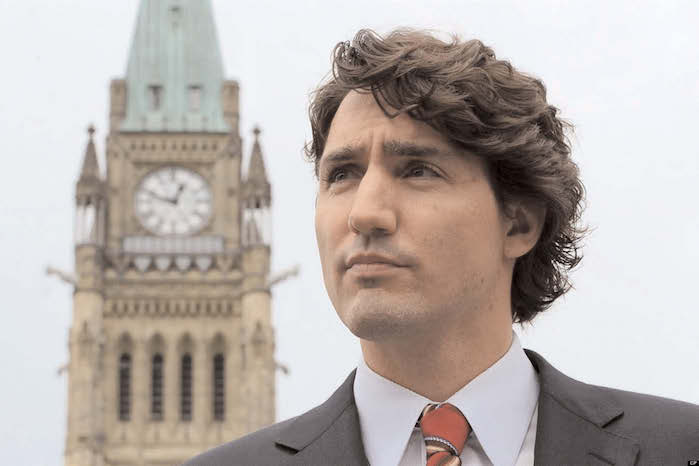
    OTTAWA Nov 4: The Punjabi community in Canada made history when two turbaned Sikhs, among four Indo-Canadians, were sworn in as cabinet ministers, as 42-year-old Justin Trudeau took oath as the country’s 23rd prime minister at a grand public ceremony here.

    The World Sikh Organization (WSO) in a statement said: “Today was a historic day for Canada.  Prime Minister Trudeau’s cabinet for the first time includes an equal number of men and women, and is the most diverse and inclusive group in recent history.”

    “The appointment of ministers Judy-Wilson Raybould and Hunter Tootoo has sent a strong message that this government is serious about ensuring that cabinet reflects the strengths, talents, and diversity of Canadians,” said Dr. Amritpal Singh Shergill, WSO President.

    The ministers:

    * Navdeep Bains: Minister of Innovation, Science and Economic Development.

    * Harjit Sajjan: Minister of Defence.

    * Amarjeet Sohi: Minister of Infrastructure and Communities.

    * Bardish Chagger: Minister of Small Business and Tourism.

    NAVDEEP Singh Bains, Minister of Innovation, Science and Economic Development and MP for Mississauga-Malton (Ontario), played a key role in Trudeau’s leadership bid in 2013.

    He was a distinguished visiting professor at Ryerson University’s Ted Rogers School of Management and holds an MBA with a specialization in finance. As a Certified Management Accountant, he has worked several years in accounting and financial analysis for the Ford Motor Company of Canada.

    HARJIT Singh Sajjan, Minister of Defence and MP for Vancouver South, is a retired Lieutenant-Colonel in the Canadian Armed Forces and a combat veteran. He was deployed to Bosnia-Herzegovina and served three separate deployments to Kandahar, Afghanistan. Sajjan has received numerous recognitions for his service, including the Meritorious Service Medal for reducing the Taliban’s influence in Kandahar Province. He is also a recipient of the Order of Military Merit, one of the military’s highest recognitions. Sajjan also served as an Aide-de-Camp to the Lieutenant Governor of British Columbia.

    Sajjan was a police officer with the Vancouver Police Department for 11 years. He completed his last assignment as a Detective-Constable with the Gang Crime Unit specializing in organized crime. He proudly tackled gang violence and drug crimes in Vancouver. Sajjan is also a human security specialist, and has lectured to a wide audience in both Canada and the United States.

    AMARJEET Sohi, Minister of Infrastructure and Communities and MP for Edmonton Mill Woods in Alberta, was elected three times as an Edmonton City Councillor.

    Dedicated to improving Edmonton’s infrastructure and livability, Sohi represented the city on the Canadian Urban Transit Association, and has been a strong advocate for light rail transit. Sohi also advocated municipal interests to other levels of government through his delegation to the Alberta Urban Municipalities Association. He has been a prominent leader on municipal and provincial issues, volunteering with Public Interest Alberta, the Centre for International Alternatives, and the Canadian Labour Congress.

    BARDISH Chagger, Minister of Small Business and Tourism and MP for Waterloo (Ontario), is a natural leader and organizer and is devoted to inclusion and community building. From assisting with recreational sports for kids to volunteering with seniors, Chagger is committed to strengthening the bonds of the Waterloo community.

    In her role with the Kitchener-Waterloo Multicultural Centre, Chagger has worked to foster diversity within the community providing opportunities for social and economic engagement. As the former executive assistant to former Member of Parliament Andrew Telegdi, Chagger has a deep understanding of the issues that are important to residents of Waterloo, including manufacturing, technology and innovation.
    Justin Trudeau, the 42-year-old son of charismatic former prime minister Pierre Trudeau who is credited with opening Canada to new immigrants in the 1970s, led the Liberal Party to win 184 seats in the 338-member House of Commons.

    Trudeau is the second youngest prime minister of Canada.

  • Drone strike at Pakistan-Afghan border kills three

    Drone strike at Pakistan-Afghan border kills three

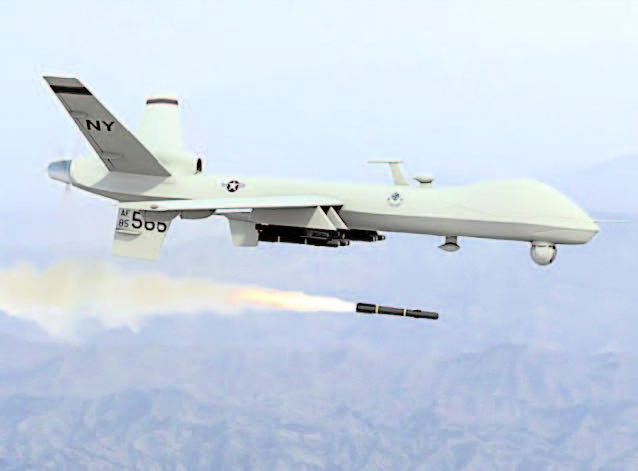
    ISLAMABAD/KABUL (TIP): At least three suspected rebels, belonging to the self-styled Islamic State militant group, were killed on Oct 29 in a US drone strike in Nangarhar province of Afghanistan, near Pakistan’s Khyber agency.

    Security sources said the drone targeted a militant compound in the Nazyan district, killing three suspected militants and injuring five others, Dawn reported.

    In a similar airstrike in the same area on October 23, at least 16 suspected militants belonging to IS were reported killed.

  • US fighter jets track drifting military blimp

    MUNCY, PENNSYLVANIA (TIP): An unmanned Army surveillance blimp broke loose from its mooring in Maryland and floated over Pennsylvania for hours on Oct 28 with two fighter jets on its tail, triggering blackouts across the countryside as it dragged its tether across power lines.

    The bulbous, 240-foot helium-filled blimp eventually came down in at least two pieces near Muncy, a small town about 80 miles north of Harrisburg, as people gawked in wonder and disbelief at the big, white, slow-moving craft. No injuries were reported.

    Fitted with sensitive defense technology, the radar-equipped blimp escaped from the military’s Aberdeen Proving Ground around 12:20 p.m. and drifted northward, climbing to about 16,000 feet, authorities said. It covered approximately 150 miles over about 3½ hours. As it floated away, aviation officials feared it would endanger air traffic, and two F-16s were scrambled from a National Guard base in New Jersey to track it. But there was never any intention of shooting it down, said Navy Capt. Scott Miller, a spokesman for the nation’s air defense command.

    The blimp — which cannot be steered remotely — eventually deflated and settled back to Earth on its own, according to Miller. He said there was an auto-deflate device aboard, but it was not deliberately activated, and it is unclear why the craft went limp.

    He said it was also unknown how the blimp broke loose, and an investigation was under way. Residents watched it float silently over the sparsely populated area, its dangling tether taking out power lines.

    Tiffany Slusser Hartkorn saw it fly over her neighborhood on the outskirts of Bloomsburg around 2:15 p.m. and soon disappear from sight.

    “I honestly was worried that there were people in it that would be injured. A neighbor down the road is thinking it knocked down a tree branch and power pole by his house that could’ve potentially destroyed his house,” Hartkorn said.

    Wendy Schafer’s first thought upon seeing the blimp near her job at a spa and salon in Bloomsburg was that a nearby school was conducting an experiment.

    “I had no idea what it was. We lost power at work, so I looked outside and saw the blimp,” Schafer said. “My first thought was Vo-Tech was doing something at the school until my friends tagged on Facebook about the blimp. It was crazy.”

    About 27,000 customers in two counties were left without power, according to electric utility PPL, and Bloomsburg University canceled classes because of the outage. Electricity was restored to most people within a few hours.

    The craft even knocked out power to the State Police barracks at Bloomsburg before settling in a wooded hollow, where it was swiftly cordoned off while military personnel began arriving to retrieve it, State Police Capt. David Young said. He said trees will probably have to be cut down to get it out.

    Miller, the spokesman for the North American Aerospace Defense Command, said the tail portion broke off and hit the ground about a quarter-mile from the main section. The craft is known as a Joint Land Attack Cruise Missile Defense Elevated Netted Sensor System, or JLENS, and can be used to detect hostile missiles and aircraft. Such blimps have been used extensively in the Iraq and Afghanistan wars to provide radar surveillance around US bases and other sensitive sites.

    (Source : AP)

  • Afghanistan Pakistan Earthquake – US, Iran & India offer assistance

    Afghanistan Pakistan Earthquake – US, Iran & India offer assistance

    A powerful earthquake of 7.5 magnitude centred in Afghanistan, has killed nearly 300 people, including 12 Afghan schoolgirls who were crushed in a stampede as they tried to flee their collapsing school.

    Afghani and Pakistani officials said 237 of those deaths occurred in Pakistan, while 74 have been confirmed dead in Afghanistan. The temblor was centered deep beneath the Hindu Kush mountains in a sparsely populated region of northeastern Afghanistan that borders Pakistan, Tajikistan and China.

    Tremors from the quake were also felt in northern India and Tajikistan.

    The earthquake was centred in the mountainous Hindu Kush region, 76km (45 miles) south of Faizabad, the US Geological Survey reported.

    The death toll is set to rise as the most severely affected areas are very remote and communications have been cut off.

    Thousands spent the night outdoors in near-freezing temperatures reluctant to go back inside for fear of aftershocks, Pakistani media reported on early on Tuesday.

    “Rescue work is ongoing, and tents, blankets and sleeping mats are being provided,” Latif ur Rehman, a Pakistani disaster management official, told Reuters from the northwestern city of Peshawar.

    The total death toll stood at 375 with at least 260 people killed in Pakistan and at least 115 more in Afghanistan, according to official reports from the two countries. More than 2,000 people have been injured.

    Nawaz Sharif, the prime minister of Pakistan, cut short his visit to the United Kingdom to fly home to deal with the emergency.

    The United States offered emergency shelters and relief supply kits stored in warehouses throughout Afghanistan that could be used. White House spokesman Josh Earnest said the U.S. government has been in touch with officials in Afghanistan and Pakistan and is ready to provide any additional support.

    Indian Prime Minister Narendra Modi tweeted, “Heard about strong earthquake in Afghanistan-Pakistan region whose tremors have been felt in parts of India. I pray for everyone’s safety,” and also, “I have asked for an urgent assessment and we stand ready for assistance where required, including Afghanistan & Pakistan.”

    Pakistan has said it will not issue any appeals to the international community for help as the country has the required resources to carry out the rescue and relief work. “We will try our best to deal with this disaster using our own resources,” Nawaz Sharif said.

  • Afghanistan Pakistan earthquake – Death Toll over 300

    Afghanistan Pakistan earthquake – Death Toll over 300

    A powerful earthquake of 7.5 magnitude centred in Afghanistan, has killed nearly 300 people, including 12 Afghan schoolgirls who were crushed in a stampede as they tried to flee their collapsing school.

    Afghani and Pakistani officials said 237 of those deaths occurred in Pakistan, while 74 have been confirmed dead in Afghanistan. The temblor was centered deep beneath the Hindu Kush mountains in a sparsely populated region of northeastern Afghanistan that borders Pakistan, Tajikistan and China.

    Tremors from the quake were also felt in northern India and Tajikistan.

    The earthquake was centred in the mountainous Hindu Kush region, 76km (45 miles) south of Faizabad, the US Geological Survey reported.

    The death toll is set to rise as the most severely affected areas are very remote and communications have been cut off.

    In Pakistan, the Swat Valley and areas around the Dir, Malakand and Shangla towns in the mountains of Khyber Pakhtunkhwa province were also hard-hit in the quake. The Pakistani town closest to the epicenter is Chitral while on the Afghan side it is the Jurm district of Badakhshan.

    Pakistan’s Prime Minister Nawaz Sharif on Tuesday visited the earthquake-hit town of Shangla in the northwestern Khyber Pakhtunkhwa province, where at least 49 people were killed and 80 were injured in the earthquake. Also Tuesday, Sharif attended a briefing in Islamabad about the damages caused by the quake.

    According to a statement, Sharif praised the country’s rescue efforts and insisted that Pakistan was “capable enough to rescue and rehabilitate those affected by the earthquake” and that every effort would be made to help those stricken. He said his government would soon announce a relief package to compensate those affected by the quake.

  • Indian American Marine Killed in Jet Crash in UK

    Indian American Marine Killed in Jet Crash in UK

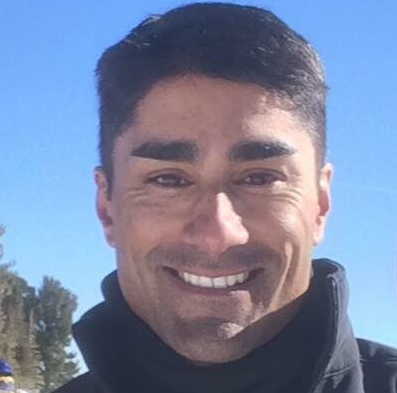
    LONDON:  An Indian-American marine has been killed after a single-seat aircraft he was flying crashed shortly after take-off near a US airfield in England.

    The crash occurred on Wednesday when San Diego-based Major Taj Sareen was piloting his F/A-18C Hornet to Miramar Marine Corps Air Station in the US after a six-month deployment in the Middle East, the San Diego Union-Tribune reported. This was Sareen’s third deployment. But whenever he was away, he’d speak with his family every day.

    “The aircraft went down near the Lakenheath Royal Air Force base,” the 3rd Marine Aircraft Wing was quoted as saying by the daily.

    The aviation wing is headquartered at Miramar. The Hornet crashed shortly after take-off, descending into farmland about six miles northwest of Lakenheath in the Cambridgeshire county of eastern England, it said.

    Major Sareen was the only casualty, British officials said.

    They also said he was ejected from the jet, although Marine officials have not verified that detail.

    Other personnel from the “Red Devils” Marine Fighter Attack Squadron 232 have returned to Miramar this week, concluding their deployment in the Central Command area of military operations, the report said.

    Major Sareen had deployed to Afghanistan in 2010 as part of Operation Enduring Freedom and was an instructor with Marine Fighter Attack Training Squadron (VMFAT) 101.

    He was a native of Hillsborough. He was commissioned in the Corps in 2005. He graduated from the University of San Francisco in 2004.

    U.S. Marine Maj. Taj Sareen’s family in Hillsborough is heartbroken. They discussed his final, heroic moments and the decision Taj made that may have saved many other lives. His parents and sister want people to know what kind of man Sareen was. They told ABC7 News about the last conversation they had with him that they will never forget. “I’ll see you in two days dad,” K.B. Sareen said. Those last words echo in a home Sareen was about to come back to.

    The Marine fighter pilot was in one of six jets coming back to the states from the Persian Gulf when it crashed in England. He ejected, but did not survive.

    Initial reports say one of his final moves was to avoid crashing into homes on the way down. “That’s the kind of person he was,” K.B. said.

    A GoFundMe account has been set up. Click here if you would like to make a donation.

  • Pakistan PM fails to win US support against India

    Pakistan PM fails to win US support against India

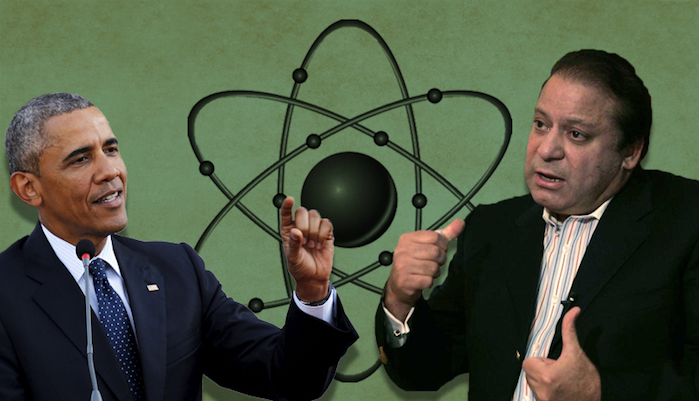
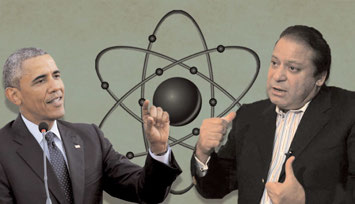
    WASHINGTON (TIP): Pakistan Prime Minister must be a disappointed man. His bilateral with US President Barack Obama is being viewed as a diplomatic failure. India has watched the Sharif-Obama summit in Washington keenly, and while it is clear that Prime Minister Nawaz Sharif returns to Islamabad without any big announcement to show for the bilateral, and no progress on US-Pakistan civil nuclear negotiations, there are many parts to the 2015 joint statement issued by the two that could  be worrisome for India.

    Here are the key statements in the US-Pakistan joint statement which may cause concern to India.

    1.  Hydroelectric projects in PoK/Gilgit-Baltistan 

    President Obama expressed support for Pakistan’s efforts to secure funding for the Diamer Bhasha and Dasu dams to help meet Pakistan’s energy and water needs.

    India has opposed the construction of hydro-electric projects in the disputed region of Kashmir that includes PoK and Gilgit-Baltistan. Most recently, External Affairs Minister Sushma Swaraj had called the China-Pakistan Economic Corridor (CPEC) unacceptable because it includes these projects, while India had told the UNGA that “India’s reservations about the proposed China-Pakistan Economic Corridor stem from the fact that it passes through Indian territory illegally occupied by Pakistan for many years.”

    In recent years, the 4,500 m W Diamer Bhasha dam (DBD) project, that the Pakistan government says will halve its electricity shortfall when constructed, had come to a standstill over funding. In 2013, prospective investors – the ADB, China and Russia – had asked Pakistan to obtain an NOC (No objection certificate) from India before they could proceed on loans. Even after the announcement of the China-Pakistan Economic Corridor by President Xi Jinping for projects including dams in PoK in April 2015, China has shown a preference for the $1.6 billion Karot project, rather than DBD, which would now cost an estimated $14 billion. It is significant that the US wants to play ‘White Knight’ on these two dams, and for India, the construction of major projects like these endorsed by the US would be a blow to its claim on PoK. Earlier this month, reports suggested India had protested over a USAID event aimed raising funding for DBD, where US firm Mott McDonald has been contracted to perform a technical engineering review.

    2.  Talks with the Taliban
    President Obama commended Pakistan for hosting and facilitating the first public talks between the Afghan government and the Taliban in July 2015 and highlighted the opportunity presented by Pakistan’s willingness to facilitate a reconciliation process that would help end insurgent violence in Afghanistan.

    India has felt cut out of the Taliban peace process, and relations with President Ghani’s government underwent a strain when New Delhi learned that Pakistan would be allowed to host the talks in Murree. “This is an open acknowledgement that Pakistan controls the Taliban,” a senior official had told The Hindu at the time, “And rather than castigate Pakistan for not curbing the Taliban’s violence, these talks will legitimize its actions.”

    When the talks collapsed over the announcement of Mullah Omar’s death, it was felt Pakistan’s claim of being a ‘peacemaker’ rather than a sponsor of Taliban-terror would end. However, despite a surge in violence by the Taliban, including the brutal siege of Kunduz that was overthrown by Afghan and US special forces last month, the Joint statement seems to indicate the US is prepared to let Pakistan host the talks again.

    3.  Resume India-Pakistan talks
    President Obama and Prime Minister Sharif stressed that improvement in Pakistan-India bilateral relations would greatly enhance prospects for lasting peace, stability, and prosperity in the region. The two leaders expressed concern over violence along the Line of Control, and noted their support for confidence-building measures and effective mechanisms that are acceptable to both parties. The leaders emphasized the importance of a sustained and resilient dialogue process between the two neighbors aimed at resolving all outstanding territorial and other disputes, including Kashmir, through peaceful means and working together to address mutual concerns of India and Pakistan regarding terrorism.

    For over a decade, the US has stayed away from openly pushing India towards talks with Pakistan. In the period between 2003-2008, this was because India and Pakistan were engaging each other, and both the composite dialogue and back-channel diplomacy yielded many important confidence building measures between them. After the Mumbai 26/11 attacks, the US recognized India’s legitimate anger over the attacks being planned and funded in Pakistan, and abstained from making any comments on the resumption of India-Pakistan dialogue, restricting itself only to “welcoming” talks between their leaders in Thimphu, Delhi, New York and Ufa. The US-Pakistan joint statement doesn’t just put the importance of “sustained and resilient dialogue process” (codeword for comprehensive dialogue) back in focus, it makes a new mention of “violence along the LoC” which India squarely blames Pakistan for initiating. India believes ceasefire violations are aimed at “infiltrating terrorists”, a charge the government repeated when the NSA talks were cancelled. Of particular worry for India will be the US-Pakistan joint statement’s reference to “mutual concerns of terrorism”, as it comes in the wake of Pakistan’s latest claims of Indian support to terrorism inside Pakistan. Pakistan NSA Sartaj Aziz had told the press that Indian agency “involvement” in Balochistan and FATA would be taken up during the summit.

    4.  Action on LeT?
    In this context, the Prime Minister apprised the President about Pakistan’s resolve to take effective action against United Nations-designated terrorist individuals and entities, including Lashkar-e-Tayyiba and its affiliates, as per its international commitments and obligations under UN Security Council resolutions and the Financial Action Task Force.

    Action against the LeT has been India’s most sustained demand from Pakistan, especially after the 26/11 attacks, when the LeT’s top leadership was charged with planning and executing the carnage in Mumbai. Yet years later, chief Hafiz Saeed is free, LeT operations chief Zaki Ur Rahman Lakhvi is out on bail, and there seems little evidence that Pakistani forces have conducted any sort of crackdown on the Lashkar e Toiba, especially when compared to action against other groups after the Peshawar school attack of December 2014. While the US-Pakistan joint statement doesn’t note President Obama’s acceptance of Pakistan’s claims of keeping its “international commitments and obligations”, it is significant that the US has not raised the obvious violation of the UNSC and FATF requirements earlier this year during the bail process of Lakhvi. Despite Indian representations to the US and UN, there has been little pressure on Pakistan how Lakhvi raised the funds when according to the UNSC 1267 Committee rules, a designated terrorist cannot be allowed recourse to finances.

    5.  Nuclear talks
    The leaders noted Pakistan’s efforts to improve its strategic trade controls and enhance its engagement with multilateral export control regimes. Recognizing the importance of bilateral engagement in the Security, Strategic Stability and Non-Proliferation Working Group, the two leaders noted that both sides will continue to stay engaged to further build on the ongoing discussions in the working group.

    Both, the US and Pakistan, have denied a report in the Washington Post that they had planned what it called a “diplomatic blockbuster”: negotiations over a civil nuclear deal on the lines the US and India signed in 2005. Pakistan’s foreign secretary reacted to the report with a detailed account of Pakistan’s “low-yield tactical nuclear weapons” aimed at India, to calm fears in Pakistan that the government was giving up its weapons program. Even so the details in the Post have left lingering doubts over what the US intends, including pushing for a possible NSG waiver for Pakistan in exchange for limiting Pakistan’s missile capability. The report goaded the MEA into counseling the US on taking a closer look at Pakistan’s past on supplying nuclear weapons to North Korea and Iran, “Whosoever is examining that particular dossier should be well aware of Pakistan’s track record in proliferation. And when India got this particular deal, it was on the basis of our own impeccable non-proliferation track record,” the MEA spokesperson said on October 9, given that India will watch this space closely, particularly the phrase on “engagement with multilateral export regimes” mentioned in the US-Pakistan joint statement.

  • 15 militants, six security personnel killed in Afghanistan

    15 militants, six security personnel killed in Afghanistan

    KABUL: At least 15 Taliban militants and six security force members were killed in clashes as the Taliban seized a district in Afghanistan’s province of Herat, the authorities said on October 22.

    Afghan troops were meanwhile battling the Taliban in three districts in the southern Helmand province, on the other side of the country. A total of six army personnel were also killed in the 24-hour period, the statement said.

    The Taliban militant group has yet to make comments. Hundreds of Taliban fighters attacked Ghoryan district and took control of the bazaar and government offices following heavy clashes in the province which has Herat city as its capital, 640 kms west of Kabul, Xinhua news agency reported. “A total of 15 Taliban terrorists were killed during the police operations,” Sediq Sediqqi, Afghan interior ministry spokesman, said in a tweet.

    Six security personnel were also killed in the fighting, according to district officials. The Taliban has intensified attacks in Afghanistan over the past couple of months as the security forces assumed full responsibility from NATO-led troops since January 1.

  • 5 turbaned Sikhs among 19 Indo-Canadians elected to Canadian Parliament

    5 turbaned Sikhs among 19 Indo-Canadians elected to Canadian Parliament

    TORONTO (TIP): The 1.25 million-strong Indo-Canadian community had much to cheer about on Tuesday, October 20, as it doubled its representation in the new Parliament with the election of a record number of 19 MPs.

    Though comprising only about 3% of the population of Canada, the community outperformed those numbers. The new number of Indo-Canadian lawmakers far outstripped the previous high of nine.

    In 2011, almost all the Indo-Canadians MPs were Conservatives, with no Liberals elected, reflecting the overall mandate. The triumph of Justin Trudeau catapulted at least 15 Indo-Canadian Liberals to the Parliament in Ottawa.

    Two Turbaned Sikh MPs Lt Col Harjit Singh Sajjan (left) and Randeep Singh Sarai
    Two Turbaned Sikh MPs Lt Col Harjit Singh Sajjan (left) and Randeep Singh Sarai

    There will also be an overhaul in the ranks of the community’s MPs, with only a couple of sitting members re-elected. Indo-Canadians won seats in four provinces – Ontario, Quebec, British Columbia and Alberta.

    Canadians voted out the Conservative Party by handing a landslide to the Liberal Party on Monday, October19.

    Winners Ruby Sahota
    Ruby Sahota

    If there were significant victors among these candidates, the biggest loser was minister of state for sports Bal Gosal, who lost by about 6,000 votes to Liberal Party candidate Ramesh Sangha in Brampton Centre constituency of Ontario, once held by Liberal Gurbax Singh Malhi.

    Among the prominent winners was Harjit Sajjan of the Liberal Party, a Canadian Armed Forces veteran who served three operational deployments in Afghanistan.

    The longest-serving Indo-Canadian MP, Deepak Obhrai, won for the seventh time from Calgary Forest Lawn, while four-time MP Nina Grewal lost the elections.

    Winners Deepak Obhrai
    Winners Deepak Obhrai

    Also a winner was Sukh Dhaliwal, another Liberal, who as an MP in 2010 had moved a resolution in the Canadian Parliament to have the 1984 riots in India declared a “genocide”. Dhaliwal lost in 2011 but he turned the tables on his opponent, sitting MP Jinny Sims of the New Democratic Party, this time.

    Some candidates emerged victorious in ridings (as constituencies are called in Canada) where the Indo-Canadian vote wasn’t a major factor. Among them was Liberal candidate Chandra Arya, a former executive and chair of the Indo-Canada Ottawa Business Chamber, who won from Nepean that falls within the boundary of Ottawa, Canada’s capital.

    His party colleague, Anju Dhillon, won from Dorval-Lachine-LaSalle, a constituency on Montreal island, becoming the first Indo-Canadian to win a seat in the French-speaking province of Quebec.

    Most Indo-Canadian victories came in Canada’s biggest province of Ontario as many seats in Brampton and Mississauga cities went to candidates from the community.

    Some Indo-Canadian MPs

    • Anju Dhillon: Liberal, won the Quebec constituency of Dorval-Lachine-LaSalle
    • Chandra Arya: Liberal, won from Nepean in Ontario
    • Ramesh Sangha: Liberal, won from Brampton Centre in Ontario, defeating minister of state Bal Gosal
    • Gagan Sikand: Liberal, won from Missauga-Streetsville in Ontario
    • Deepak Obhrai: Conservative, won from Calgary Forest Lawn in Alberta
    • Harjit Sajjan: Liberal, won from Vancouver South in British Columbia
    • Sukh Dhaliwal: Liberal, won from Surrey Newton in British Columbia
    • Raj Saini: Liberal, won from Kitchener Centre in Ontario
    • Bardish Chagger: Liberal, won from Waterloo in Ontario
    • Bob Saroya: Conservative, won from Markham-Unionville in Ontario
  • A US-Pak nuclear deal would be a threat to India’s security

    A US-Pak nuclear deal would be a threat to India’s security

    If a report in a US newspaper is to be believed, a US-Pakistan nuclear deal might be on the cards. The report says that such a deal is being considered around Prime Minister Nawaz Sharif’s visit to Washington this month.

    The report would not have appeared credible but for the evasive comment of the State Department on the subject and the official reaction of the spokesperson of our Ministry of External Affairs cautioning the US authorities against any such decision.

    Ever since the India-US nuclear deal was signed, the Pakistanis, obsessed with the idea of parity with India, have been seeking a similar deal.

    Besides calling the India-US nuclear deal discriminatory, Pakistan has condemned it as threat to its security and warned that it would take all necessary steps to safeguard its interests. Pakistan’s Foreign Affairs Adviser Sartaj Aziz aggressively reiterated this on the occasion of President Barack Obama’s visit to India in January this year.

    By remaining silent, the US has only encouraged this absurd posturing by Pakistan.

    US soft on Pakistan

    Some western nonproliferation specialists have been advocating for some time a nuclear deal with Pakistan in order to remove its sense of grievance. They feel it would give Pakistan an incentive to limit the expansion of its nuclear arsenal and stabilize the nuclear situation in the sub-continent.

    Such advocacy is largely prompted by negative attitudes towards India which, with its historical opposition to the NPT, is seen as the one responsible for nuclearizing South Asia. In their eyes, this is one way of denying India any one-sided advantage in nuclear status.

    Until now, the US Administration has been differentiating India’s case from that of Pakistan and disclaiming any move to offer the latter a similar deal, thought the tenor of its statements has not been sufficiently convincing.

    In fact, both the US and China, to different degrees, have aided Pakistan in achieving its nuclear and missile ambitions.

    A US-Pak nuclear deal will erode the strategic importance of the Indo-US nuclear deal

    In the past, knowing the China-Pakistan nuclear and missile nexus, the US has waived the application of its laws for larger geopolitical reasons linked to the combat against the Soviets in Afghanistan. The Afghanistan factor has, unfortunately, continued to condition US thinking on Pakistan’s nuclear and other errant behavior.

    The US was remarkably soft with Pakistan on the AQ Khan case. It has tolerated Pakistan’s tactics to obstruct discussions on the FMCT at Geneva at a time when fissile material control was still on the US agenda.

    It has overlooked supplies of additional Chinese nuclear reactors to Pakistan in violation of China’s NSG commitments.

    One could speculate that having settled the nuclear question with India, this was one way for the US to allow Pakistan to be a beneficiary of external cooperation in its nuclear sector, as part of the traditional policy of “hyphenation”.

    US agencies and think tanks have been propagating information about the frenetic pace at which Pakistan has been expanding its nuclear arsenal, without any visible reaction from the US government.

    At one time, worried about the rise of radicalism in the country, the US was expressing concern about the security of Pakistan’s nuclear arsenal. But such fears are no longer being expressed.

    US conduct over the years suggests that it has favored the idea of a Pakistani nuclear capability to balance India’s. Remarkably, its complaisance towards the Pakistani nuclear program has continued long after the end of the Cold War.

    Adding to all this, US treatment of Iran’s nuclear ambitions contrasts strikingly with its handling of Pakistan’s nuclear transgressions. While draconian sanctions have been applied on Iran, in Pakistan’s case the US has argued that sanctions might hasten its slide towards failure as a state and increase the risk of its nuclear assets falling into the hands of religious extremists.

    This is specious logic as the US has not taken any precautionary step to curb the development of Pakistan’s nuclear assets, including its decision to introduce tactical nuclear weapons in the subcontinent. An expanded Pakistani nuclear arsenal is even more likely to fall into the wrong hands.

    US reaction to Pakistan’s loose talk about using nuclear weapons against India has been, moreover, notably mild. It could and should have been much stronger.

    The hesitation to impose sanctions on Pakistan contrasts also with the willingness to impose sanctions even on a powerful country like Russia, including its most senior leaders and functionaries.

    What inhibits the US to strong arm Pakistan despite its provocations remains unclear.

    The argument that for dealing with the situation in Afghanistan the US needs Pakistan’s assistance is not convincing. The US needs Russia even more for dealing with yet more complex and fraught problems as Iran and West Asia in general, including the rise of the Islamic State, not to mention the fall-out of mounting tensions in Russia-West relations.

    China-Pakistan axis

    It is mystifying why the US should want to politically legitimize Pakistan’s nuclear conduct through an India-like nuclear deal.

    In India’s case, the US wanted to make a geopolitical shift with the rise of China in mind. It saw India as a counterweight to China in Asia, but for this the nonproliferation issue which inhibited India’s international role had to be resolved.

    Pakistan is in fact China’s closest ally. The geopolitical purpose of a nuclear deal with Pakistan will only legitimize the China-Pakistan nuclear and security relationships and undermine India’s strategic interests vis-a-vis both these adversaries.

    The US has wanted to build a strategic relationship with India largely around shared interests in the Indian Ocean and Asia-Pacific regions in view of mounting signs of Chinese political and military assertiveness and its ambitious naval expansion program.

    Through the China-Pakistan Economic Corridor and the development of Gwadar, Pakistan is facilitating an increased Chinese strategic presence in the Indian Ocean, which contradicts this US strategy.

    Shocking rationale

    According to reports, the underlying reasoning offered by the US, if correctly reported, is almost shocking. In return for an NSG waiver, Pakistan will be asked to restrict its nuclear program to weapons and delivery systems that are appropriate to its actual defense needs against India’s nuclear threat, and not to deploy missiles beyond a certain range.

    This implies that the US accepts that India’s nuclear program is Pakistan-centric and that it poses a threat to Pakistan.

    The Chinese threat to India is being overlooked and the fact that India faces a double Pakistan-China nuclear threat – in view of the close nuclear collaboration between the two countries- is being ignored.

    The US, it appears, would be comfortable if only India would be exposed to the Pakistani nuclear threat, not others.

    US has been consistently soft on Pakistan’s errant behavior in matters like nuclear weapons

    But then, Pakistan’s nuclear arsenal, according to its own leaders, is India-centric. Pakistan is not threatening China, Iran or Saudi Arabia with its nuclear weapons. Which are the countries that the US wants to protect against the use of nuclear weapons by Pakistan?

    Pakistan is developing delivery systems to reach any point in India. The US would apparently be comfortable with that, but not if it developed missiles of longer range. But whose security is US worried about if Pakistan did that? US itself, Japan, Australia, Singapore, China, Iran, Saudi Arabia, Israel?

    China, we know, opposes India’s NSG entry without Pakistan. It would seem the US would be willing to accommodate both China and Pakistan if the latter limited its nuclear threat to India.

    By implication then, the US has no stakes in India’s security from an unstable and adventurous Pakistan, despite our so-called strategic partnership.

    A reward for Pakistan’s military

    The timing of a nuclear deal would be odd too. It is now universally recognized that it is General Raheel Sharif and not Nawaz Sharif who really hold the reins of power in the country. A nuclear deal will be a reward for the Pakistan military and not the civilian power, as Pakistan’s nuclear program is under military control.

    Does the US want to reward the Pakistan military for its operations in North Waziristan against the Pakistani Taliban and is this considered meritorious contribution to the fight against Al Qaeda and terrorism?

    One would have thought far more important for the US and the West is the rise of the Islamic State and its ideology. Compared to which North Waziristan is a side-show. In any case, the Pakistani military is not fighting the Haqqani group.

    Worse, while Pakistani is being accepted as an honest mediator in the Afghan reconciliation process, the Taliban showed its mounting force by occupying Kunduz.

    One hopes that the US report does not accurately reflect President Obama’s thinking.

    If it does, it will show how hollow is the strategic relationship between India and the US, and why it would not be wise to trust the US.

    The India-US nuclear deal will be eroded of much of its strategic importance bilaterally, as result. The US would have, in addition, administered a big political blow to Prime Minister Narendra Modi who has gone out of his way to improve strategic understanding with the US.

    But then, news reports are news reports, and they could merely be political kite-flying. In which case, the India-US relationship will not receive a big jolt for all the reasons mentioned in this article.

    (The author is a former foreign secretary of India. He has also served as India’s ambassador to Turkey, Egypt, France and Russia. He can be reached at sibalk@gmail.com)

  • Does India’s nuclear doctrine need a revision?

    Does India’s nuclear doctrine need a revision?

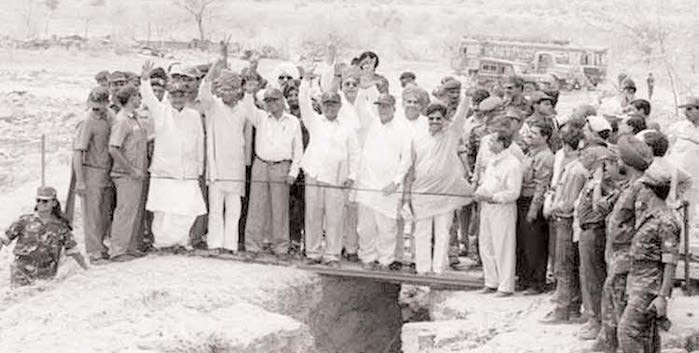
    India’s first nuclear test in 1974 called smiling Buddha in Pokhran desert was, for tactical reasons, characterized as “Peaceful Nuclear Explosion”. The second series of five nuclear tests in 1998 (Pokhran II) was again accompanied by a statement from the then PM Vajpayee attesting to lack of aggressive intent. The 2003 Indian nuclear doctrine went a step forward and made a written unilateral concession about India’s adherence to “No First Use” Doctrine. Since then a lot of debate has gone into the rationale, the need and the necessity for India to revise her Nuclear Doctrine and posture. Some foreign policy mandarins have tried to argue that India does not need to make any changes in the 2003 version of the doctrine. Though the election manifesto of the BJP prior to May 2014 Lok Sabha election noted the need to take a relook at India’s nuclear doctrine, subsequent statements by the PM nipped it in the bud.

    Site of India's first nuclear test in 1974 called smiling Buddha in Pokhran desert
    Site of India’s first nuclear test in 1974 called smiling Buddha in Pokhran desert

    While looking at the nuclear scenario, India has to take the contemporary threat perception and other geo-political factors into account while revising her strategic nuclear policy. It will be a good idea for India to periodically revise her nuclear doctrine every 10-15 years based on the geo-political situation. A lot has already changed since 2003. There is nothing sacrosanct about revising a document that was essentially tactical in nature. Newer nuclear threats have emerged from both the nuclear neighbors, China and Pakistan that mandate that India revise her nuclear doctrine and posture in order to avoid future nuclear blackmail.

    China has significantly diluted its “No first use” nuclear doctrine over the years. China has no intention of exercising restraint in the growth of its nuclear weapons program till the other two nuclear weapons superpowers (US and Russia) have brought down their number of nuclear weapons to China’s level. China has started deploying its nuclear powered submarines in the Indian Ocean region.

    Pakistani Nuclear program was initiated in 1970s by ZA Bhutto after Pakistan’s defeat in Bangladesh war of independence in 1971. His famous statement in 1965 in UNSC was about waging a thousand years war against India. Later on he talked about eating grass and obtaining Nuclear weapons. Pakistan’s nuclear weapons program has been, is and will remain an India-centric nuclear toy in the hands of ISI/GHQ/Pakistani military as the civilians do not control the program. From the beginning Pakistani nuclear program has had Chinese footprints all over.

    While Pakistan’s economy goes south, it remains a rentier state having extorted $31 billion from the US since 9/11. Pakistan keeps on getting tranches of money from the Kingdom of Saudi Arabia under an all-weather Sunni Alliance. Pakistan and ZA Bhutto had proudly proclaimed Pakistan’s nuclear weapons as “Islamic bomb” having been financed by Islamic money from KSA. Last year, Pakistani PM was able to obtain $ one billion from Saudi Arabia at a time when Pakistan’s economy took a hit. Money will never be a problem for Pakistani nuclear establishment as it grows at a disproportionate rate.

    Pakistani ballistic missile program has also heavily borrowed from China and North Korea since the 1990s. Hate IX (Vengeance-IV) Nasr was purpose built to carry tactical nuclear weapons (sub kiloton yield) over short range of 60-90 kilometers. On March 9 2015, Pakistan successfully tested the Shaheen-III surface-to-surface ballistic missile, capable of carrying nuclear warheads to a range of 2,750 km. Shaheen III nuclear capable missiles increase the range of Pakistani nuclear missiles to include the entire Indian land mass and the Indian Eastern naval command based in Andaman & Nicobar Islands. Pakistani has recently become the beneficiary of Chinese nuclear powered submarines that definitely pose a threat to India for her second strike capabilities.

    General Khalid Kidwai who was the director of Pakistani Army’s Strategic Planning Division (SPD) for a period of 15 years, in an open meeting in March 2015 at the Carnegie Endowment for International Peace, in Washington DC aggressively articulated Pakistan’s new offensive nuclear doctrine and posture. He brazenly threatened India with the first use nuclear attack threats painting a new picture. From the initial posture of credible minimum deterrence, Pakistan has moved to the concept of “Full Spectrum Deterrence” which envisages aggressive and offensive use of nuclear weapons by Pakistan against India in a number of scenarios. Not only Pakistan has linked its full spectrum nuclear deterrence doctrine with resolution of J&K dispute in its favor, Pakistan has threatened to use nuclear weapons against India if its tentacles in Afghanistan are cut off. Extra-territorial linkage with loss of its assets in Afghanistan widens the role for nuclear weapons under the new Pakistani doctrine.

    Pakistan has already developed tactical nuclear weapons to be used in the war theater on the mechanized divisions of Indian armed forces. Ostensibly, Pakistan has justified use of tactical nuclear weapons as a policy against Indian Army’s imaginary “Cold start doctrine” which was never officially promulgated.

    Pakistan is the only country that has single-handedly blocked an international agreement on FMCT while feverishly increasing its fissile material production. While traditionally cited figure is Pakistan has 90-110 nuclear weapons, reality has changed during last few years. The Pakistani nuclear armada is the fasted growing in the entire world with production of 10-20 new nuclear weapons every year.

    Pakistani state has brazenly and repeatedly indulged in nuclear blackmail and rent collection over the last several decades. This Pakistani behavior will NOT change only the sponsors and the rent-payers will change over time.

    There is NO reason for India to remain complacent while the nuclear threat perception changes. The PM will do a yeoman’s service to long-term strategic security of Indian nation if he revisits the Indian nuclear doctrine and allows it to grow some teeth. A number of remedial steps can be taken including discarding the meaningless no-first use doctrine to safe-guard nation’s security. Victors always write the history and India has lost repeatedly in history making.

  • Pakistan rejects accusations of involvement in Kunduz attack

    Pakistan rejects accusations of involvement in Kunduz attack

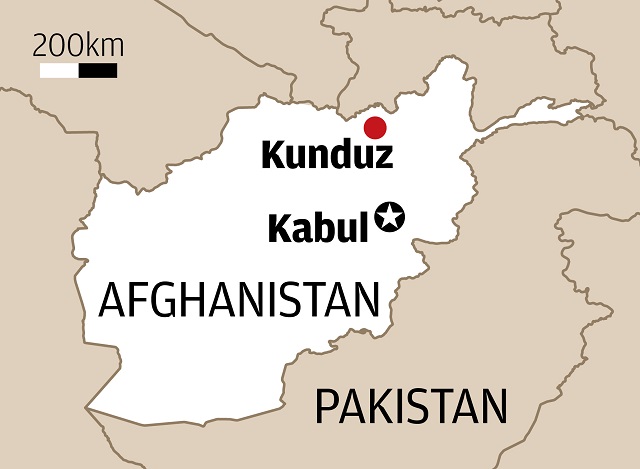
    ISLAMABAD (TIP): Pakistan’s military has rejected allegations by Afghanistan’s deputy army chief that Pakistani generals were involved in the Taliban’s brief capture of Kunduz and had escaped the city wearing burqas.

    Taliban fighters seized control of the northern Afghan provincial capital for three days last week, their most spectacular victory since being toppled from power by a US-led coalition in 2001.

    General Murad Ali Murad, Afghanistan’s deputy army chief, told Afghan media Monday that Pakistan’s military had helped lead the attack.

    “We will identify and detain these Pakistani generals who are hiding now and escaped wearing women’s burqas,” he said, according to Tolo News.

    Pakistan was the Taliban’s main ally during their 1996 – 2001 rule and is frequently accused by Afghanistan of supporting the present insurgency.

    A Pakistani military spokesman said in a statement late Tuesday the allegations of Pakistani involvement in the Kunduz attack were “mischievous”.

    “The allegations levelled by an Afghan official are totally unfounded, baseless, uncalled for and mischievous,” he said.

    “Such allegations are not even comprehensible.”

    Pakistan for its part has been demanding Afghanistan hand over hardline cleric Maulana Fazlullah, head of the Pakistani Taliban, who is believed to be hiding in eastern Afghanistan.

    Islamabad organised the first set of direct peace talks between the Taliban and the Afghan government in July. But another round scheduled for later that month was cancelled following the announcement of the death of Taliban founder Mullah Omar.

    Hopes for better ties between the neighbours were high following the election of Afghan President Ashraf Ghani last year, who said he wanted a rapprochement similar to France and Germany after World War II.

    But they have plummeted since then, with Kabul blaming Islamabad for a surge in Taliban violence this year, as Ghani accused Pakistan of sending “messages of war”.

  • India’s Economy Impacted by Terror Attacks: Moody’s

    India’s Economy Impacted by Terror Attacks: Moody’s

    In a report dated 6 October 2015 Moody’s says “more than 60% of all (terrorist) incidents in 2013 were concentrated in just four countries. Iraq (24% of terrorist incidents, Pakistan 19%, Afghanistan 12% and India 5.8%.” With India facing fourth largest number of terror attacks across the world in 2013, such incidents have a significant and long-lasting negative impact on the economy, according to Moody’s Investors Service.

    India has been mentioned with terrorist havens like Pakistan, Afghanistan and Iraq; However, unlike these three nations, India does not harbor and nurture terrorists. By Moody’s algorithm, every developed country would be termed as a terror state whereas the truth is they are victims, actual or potential, of terrorist attacks.

    India in 2013 faced 690 terror attacks. Topping the list was Iraq with 2,852 incidents, followed by Pakistan (2,212 attacks) and Afghanistan (1,443 incidents). In 20 years (from 1994 to 2013), India faced 6,024 attacks, a little less than tenth of 68,962 incidents worldwide.

    “Even normalised by the size of the country, Iraq and Afghanistan are at the top of the list with 82 and 47 incidents per million people, respectively, in 2013. This compares with a global average of 2.4 incidents per million people in 2013,” it said. Terrorist attacks, it said, are diverse in terms of the personal and property damage inflicted. Moody’s said its study shows that terrorist attacks significantly weaken economic activity, with long-lasting effects on the economy.

    The study measures the impact of terrorism on a country’s economic growth, investment growth, government expenditure and government cost of borrowing. “For example, in 2013 the 10 countries most affected by terrorism took an immediate and significant hit to growth, dampening GDP between 0.5 and 0.8 percentage points,” says Moody’s Merxe Tudela.

    “Even worse is that the negative impact continues for years after the attack, taking up to five years for the effects to peter out.” Investment growth takes an even greater immediate hit, with Moody’s estimating for the same episodes that investment growth declines between 1.3 and 2.1 percentage points.

    “Terrorist events of the type and frequency seen in the top ten most terrorism-inflicted countries just in 2013 immediately weaken GDP growth between 0.51 percentage points (pps) and 0.80 pps; they further deteriorate growth between 0.37 pps and 0.59 pps after one year, and by 0.05 pps and 0.07 pps after three years,” it said. Terrorist attacks reduce investment growth (and hence impair potential growth) on the year of the terrorism event, by between 1.31 pps and 2.07 pps, for the top ten most affected countries.

    Terrorist events lift the government cost of borrowing. In the most terrorist-inflicted countries, the cost of borrowing jumps between 41 and 65 basis points within one year and by 51-81 bps after one year of the event.

  • 11 killed in US C-130 plane crash in Afghanistan

    11 killed in US C-130 plane crash in Afghanistan

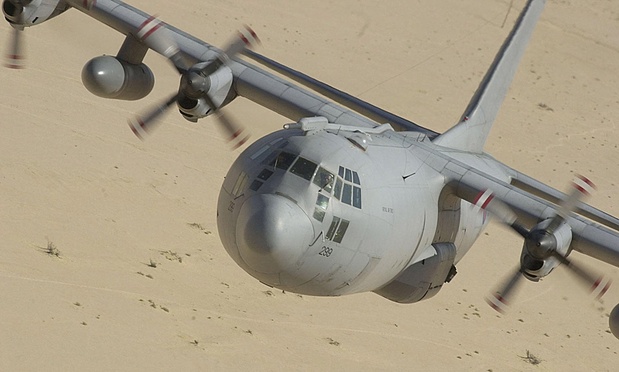
    WASHINGTON (TIP): An American C-130J military transport plane crashed at the Jalalabad airport in Afghanistan early Oct 2, killing all on board, including six US service members and five civilian passengers, the Pentagon said.

    An Air Force C-130J assigned to the 774th Expeditionary Airlift Squadron, part of the 455th Air Expeditionary Wing, crashed at approximately 12:19 am at Jalalabad Airfield, a Pentagon statement said.

    The crew of six US service members and five civilian passengers died in the crash, it said.

    There was no immediate indication why the plane might have crashed. “The cause of the accident is currently under investigation. More information will be released as it is gathered,” the Pentagon said.

    Jalalabad, in eastern Afghanistan near the border with Pakistan, is home to several military operations. The Jalalabad airfield is adjacent to the civilian airport.

    The C-130 Hercules is a cargo plane built by Lockheed Martin. It is powered by four turboprop engines and is used extensively by the military to ship troops and heavy gear.

  • India, US and a New moment

    India, US and a New moment

    Prime Minister Narendra Modi’s visit to the United States has taken place at a moment of significant opportunity for India. The Chinese economy, which had seemed invincible, has faltered and is facing deep structural problems. India is poised to become the world’s best performing economy, though there are still signs of sluggishness and it is imperative that both domestic and foreign investment be accelerated for its full potential to be reached. Against this backdrop, Modi’s program, replete with high-profile meetings with CEOs of US financial, media and technology companies and a well-attended public function with the Indian community, addressed the business and diaspora constituencies that have been central to the prime minister’s foreign outreach since he assumed office.

    American technology companies see India as the next big growth opportunity, given the difficulties in operating in China and the fast growth of the smartphone market and e-commerce in India.

    This was evident from the enthusiasm with which Modi was received in Silicon Valley by the chief executives of America’s best known technology companies, several of whom, like Satya Nadella and Sundar Pichai, hail from India. India’s goal to harness the digital revolution to skill its people, improve infrastructure and delivery of goods and services opens up exciting possibilities. For India, the challenge is to leverage these opportunities to create employment for the millions who enter the job market each year, and develop domestic technical and manufacturing capabilities.

    In the last years of the previous government, American investors had become wary of doing business in India on account of slow decision-making and the unpredictability of the regulatory environment. But the high expectations that the new government, with a solid majority in the Lok Sabha, would be able to smoothen out these tangles quickly and expedite reform have been moderated as several key initiatives like the land amendments and GST have been abandoned or failed to make progress. The unpredictability of the tax regime has been a major concern of foreign investors and this is still a work in progress. India needs to step up its game to create a conducive business environment. Equally, high US visa fees for Indian software engineers deployed there for short periods, numerical quotas and the absence of a tantalization agreement constrain the business of Indian IT companies in America. These issues need to be addressed if businesses are to build on their synergies.

    The three million-strong Indian American community has come of age and is a vital bridge connecting the people of the two countries. Modi has paid special attention to the overseas Indian community as an asset for India’s development and a force-multiplier in India’s diplomacy. This was again visible at the public function in San Francisco with the Indian American community.

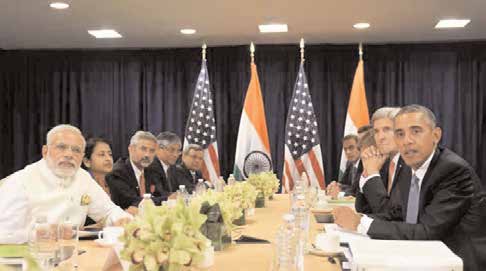
    This was not a bilateral visit, though Modi and President Barack Obama did meet – for the fifth time – on the sidelines of the UN. Climate change was uppermost on Obama’s agenda in the run-up to the Paris conference. With China having announced its intention to cap its emissions in 2030, there is pressure on India to announce its emission-reduction goals. Modi underlined that India will be a constructive player in Paris while keeping open avenues for meeting its developmental needs. In setting our national goals, Delhi needs to ensure that it does not disproportionately add to the costs of doing business in India. Affordable clean and renewable energy and energy efficiency hold the key to a less carbon-intensive future for India and it is here that an India-US partnership can bring real value to the table.

    Afghanistan faces an uncertain future post the withdrawal of US combat forces. The US, along with China, co-chaired a meeting on Afghanistan to which India was not invited. The US and Chinese efforts to stabilize Afghanistan with Pakistan’s cooperation should not lead to a situation that exacerbates terrorism challenges for India and the region. Continued support for strengthening the capacities of the Afghan government, particularly the army and the police, would be critical. There is need for candid discussions on Afghanistan between India and the US, and they have agreed to strengthen their consultations.

    Modi and Obama welcomed the progress made in giving shape to the joint strategic vision on the Asia Pacific and Indian Ocean regions and the joint engagement with regional powers like Japan. The upgraded trilateral ministerial consultations between India, the US and Japan were initiated on the sidelines of the UN. Japan is expected to participate in the Malabar naval exercise. Modi sought US support for India’s membership of the Asia-Pacific Economic Cooperation. Both India and the US have convergent interests in shaping an Asian balance grounded in international norms and conducive to peace and prosperity.

    The PM participated in the important UN Summit that adopted the Sustainable Development Goals. These set out an ambitious new agenda to end poverty by 2030 and promote shared economic prosperity, social development and environmental protection. India’s record on the Millennium Development Goals has been mixed, with considerable success in poverty reduction but more work to be done in health and education. The 17 new goals are in line with India’s national agenda for development, but achieving these would require renewed and sustained efforts by the government, civil society and the private sector over the next 15 years.

    The meeting of G-4 leaders shone a spotlight on UN Security Council reform, which has been languishing despite the growing recognition that the council, as it exists today, reflects the world as it emerged after World War II and needs to change to represent current realities and better fulfill its objectives. Four of the five permanent members of the Security Council, including the US, have expressed support for India’s candidature for permanent membership, while China has been ambivalent. Reform is likely to be a difficult process. The P-5 have been resisting change. A bottom-up approach -garnering support from members of the General Assembly combined with pressure from outside – would be required to generate momentum for Security Council reform.

  • Refugees face new diversion as Hungary prepares to seal Croatia border

    Refugees face new diversion as Hungary prepares to seal Croatia border

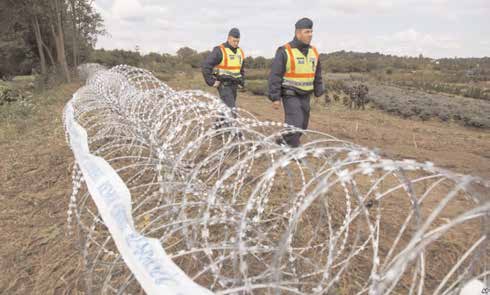
    ZAKANY, HUNGARY (TIP): A small gap in coils of newly laid razor wire is all that remains of the Zakany-Botovo border crossing between Hungary and fellow European Union member Croatia, as Budapest prepares to close off another route for refugees flocking to Europe.

    Heavy machinery is clearing trees and a 3-metre-high fence is taking shape along the line of the razor wire.

    The border, still traversed by thousands of refugees daily en route to Austria and Germany, could be sealed in a matter of minutes, potentially diverting the refugees into tiny Slovenia or stranding them in Croatia, where authorities are struggling with the scale of the influx.

    Prime Minister Viktor Orban, who has already thrown up a fence to shut down the refugee route over Hungary’s southern border with Serbia, said last week the closure was imminent, and speculation is rife that it might follow his return from the United Nations General Assembly in New York on Thursday.

    Border crossings have been fitted with gates of steel and concrete.

    At the Zakany train station, military armored personnel carriers guard a train car, one side of which has been covered in razor wire in what appears to be a replica of the wagon used to close the main refugee route from Serbia.

    The closure of that stretch of Hungary’s border saw violent clashes between police firing tear gas and water cannon and young, male refugees lobbing stones and smashed concrete.

    The European Union is moving ahead with a plan, opposed by Hungary and several other eastern, ex-Communist members of the bloc, to distribute 120,000 refugees, many of them Syrians, between its members.

    But that is just a portion of this year’s influx of refugees, which the U.N. refugee agency said on Thursday may reach 700,000 and possibly more in 2016, in the greatest movement of people in Europe since World War Two.

    Orban, one of Europe’s most vociferous opponents of immigration, says he need not wait for the fence to be completed before he orders the crossings closed. Razor wire would suffice.

    Fast-flowing river

    “We need not wait for the completion of the second layer to order the closure of the green border,” he told a news conference last week.

    “We cannot wait for an as-yet-unborn common European policy. Once everyone understands what the Hungarian intention is and they can prepare that the Serbian-Hungarian border status quo will extend to the Croatian-Hungarian border, we will put those rules in effect to enforce EU laws on border crossing.”

    The razor wire runs the length of Hungary’s border with Croatia, including along sections that follow the Drava river, a fast-flowing artery that some refugees may be tempted to swim.

    Unlike Hungary, Croatia is not a member of Europe’s Schengen zone of passport-free travel.

    Relations between the two countries have soured considerably since the refugees began flowing into Croatia after Hungary shut down their route from Serbia, reflecting the discord and recrimination running through the European Union.

    Closing the Croatia-Hungary border crossings may force Croatia to transport more refugees into Slovenia, a former Yugoslav republic of 2 million people that says it can manage an influx of 10,000 per day.

    It will likely lead to a backlog at Croatia’s eastern frontier with Serbia, crossed by thousands every day in sometimes chaotic and desperate scenes. Croatian officials have declined to comment on what might happen if or when Hungary seals the border.

    For now, the flow from Croatia into Hungary and on to Austria is unbroken, efficient even.

    Police, ambulance crews and aid workers await trainloads of refugees on the Croatian side, handing them bread, water, canned fish and an apple each before they stride across the bridge over the Drava. Lines of refugees snake through riverside shrubs to a gap in the razor wire, where Hungarian police officers and a waiting train greet them.

    Anil Safia, an 18-year-old boxer from Afghanistan, devoured the bread and fish.

    “I’m sorry I have to eat while I talk,” he told a reporter, “but I have not had anything for a day and I need to maintain my weight, you know.”

  • AT 110, ‘OLDEST’ REFUGEE REACHES GERMANY FROM AFGHANISTAN

    A man who claims to be 110 years old has applied for asylum in Germany after spending eight months travelling 3,000 miles from Afghanistan. Abdul Qadir Azizi, arrived in Germany with his 60-yearold daughter and eight other family members, who had to carry him for much of the journey.

    Aziz’s family, when asked by German officials, said he was born on January 1, 1905.He is believed to be the oldest refugee to arrive in Germany.

  • India, Iran and Afghanistan come together for international transit corridor

    MUMBAI (TIP): India is looking to step up the pedal over its ambitious Chabahar port project in Iran by signing an international transit corridor agreement with Iran and Afghanistan.

    One of the reasons why the port project is important for India as it will facilitate access to Afghanistan, bypassing Pakistan. Over the past 2 days, officials from the 3 countries have met to finalize agreement for a Chabahar transit corridor. “We are looking at a trilateral transit corridor MoU,” India’s ambassador to Afghanistan Amar Sinha said.

    While India and Iran are developing the Chabahar port jointly, Sinha said, Afghan businesses are investing in the attached free trade zone where Iran has allotted land for Afghan investors. For India, Chabahar port is an important initiative involving three partners, and is a critical alternate trade route for Afghanistan. What came as a shot in the arm for India was that the port was welcomed by all regional partners of Afghanistan at the VI RECCA (Regional Economic Cooperation Conference on Afghanistan) conference held in Kabul on September 4.

    The transit corridor will be significant for Afghanistan too with President Ashraf Ghani declaring that his country wants to revitalize the Silk Road and act as a regional hub for connecting South Asia with Central Asia.

    Indian officials said though that the primary motivation for the port and transit corridor was not bypassing Pakistan. We are actually hoping that Pakistan too at some stage will join all trade and transit agreements being negotiated under Saarc by all other member nations?,” said an Indian official.

  • Taliban storm Afghanistan jail, free 350 inmates

    GHAZNI (TIP): Taliban insurgents stormed a prison in Afghanistan’s Ghazni on September 12 , killing police and releasing more than 350 inmates, including nearly 150 deemed a threat to national security , and then at tacked troops rushing to help officials said.

    The latest Taliban prison raid, on the outskirts of the central city of Ghazni, comes after setbacks for the government in different parts of the country and deadly attacks in Kabul which have dashed hopes for peace talks. A journalist outside the mud fort prison in Ghazni, 120 km southwest o Kabul, saw the bodies of two men who appeared to be suicide bombers and a blown-up car that had apparently been used to destroy the main entrance Clusters of bullet casings were scattered across the road.

    The interior ministry said that 355 of the 436 prisoners had escaped. Of those who got away , 148 were a “threat to national security and 207 were criminals,” the ministry said, adding that four Taliban and four members of the security forces were killed.

    Mohammed Ali Ahmadi, deputy city governor, said the prison’s security was well below recommended standards as it was so close to Ghazni -only seven km from the city centre -and it was believed that reinforcements would get there quickly in the event of trouble. On Sunday , officials concerned about a breakout had transferred 18
    “dangerous” Taliban to a jail operated by the Afghan intelligence agency, Ahmadi said. Seventeen were left behind.

  • Europe’s Refugee Crisis

    Europe’s Refugee Crisis

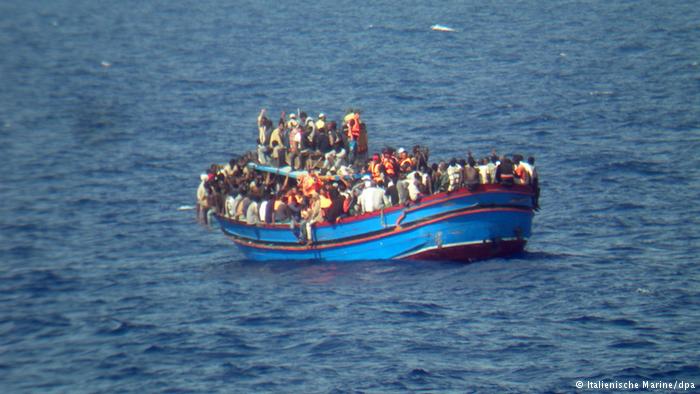
    Another major crisis is unfolding in Europe. Still struggling to find solutions for the Eurozone and Ukrainian crises, The European elite was hardly prepared to face a serious refugee and migration challenge. The problem has already been unfolding for some time. This year alone, more than 300,000 people have risked their lives to cross the Mediterranean Sea (including 200,000 to Greece). Over 2,600 did not survive this dangerous journey. More than 70 people were found dead in an abandoned truck in Austria. Even last year about 3500 people were reported dead or missing in the Mediterranean Sea. For years, these people were seen by many Europeans merely as economic migrants. The images of Syrian toddler Aylan Kurdi whose body was found on Turkish shores after a failed attempt to reach Greece finally shocked the Europeans and the world. Further, chaotic scenes in Budapest, where the Hungarian government tried to stop Syrian refugees’ journey towards Germany, forced the European media and its institutions to change the narrative. The UNHCR has clearly declared now that “this is a primarily refugee crisis, not only a migration phenomenon”.

    The way different EU governments have responded to the present crisis has again exposed structural flaws of common EU policies. The Dublin procedure established that the first EU country where a migrant or refugees enters, is responsible for processing his or her asylum claim. This obviously put tremendous pressure on countries like Greece and Italy where most asylum seekers arrived first. In recent months, Hungary has also joined frontline status as refugees are entering its territory from neigbouring Serbia. As most asylum seekers want to go to Germany, Sweden, France or Italy, questions are raised as to why register and house them in a country where they do not want to stay any way.

    To alleviate the problem, the EU proposed a quota system to distribute migrants among different nations. All 28 EU member states were required to accept asylum seekers in proportion to the size of their economy, unemployment rate and population. Although the plan was initially backed by Germany, France and Italy, they have now suggested many corrections. The UK was already out of the system. Many East Europeans say it will not work as most asylum seekers want to settle in West Europe. Spain has also rejected the plan. Some have objected to the principle itself. The Hungarian Prime Minister Victor Orban asserted that “the idea that somebody allows some refugees in their own country and then distributes them to other member states is mad and unfair”. Later he even added that “the problem is not European, it’s German. Nobody would like to stay in Hungary, neither Slovakia, Poland or Estonia”. The smaller nations in former Eastern bloc feel that policies are being imposed on them by bigger members.

    The number of asylum seekers in the EU has increased significantly in the last few years. Eurostat data shows that about 625,000 claimed asylum in the EU in 2014. The numbers were high but perhaps not as alarming as presented in European media. Europe has seen high numbers even before, particularly during the Yugoslav crisis. In 1992 alone, there were close to 700,000 applications. In the first half of 2015, close to 434,000 people have filed applications for asylum in Europe. Last year, the largest number of asylum seekers came from Syria (20%), followed by Afghanistan (7%), Kosovo (6%), Eritrea (5%), Serbia (3.5%) and Pakistan (3%). In fact, more people from Pakistan applied for asylum than from Iraq. About one third people applied for asylum in Germany only. One in four asylum seekers was a minor.

    As per the UNHCR, over 4 million Syrians are now refugees. It is not that all Syrians are moving towards Europe. About 1.9 million have taken refuge in Turkey. Similarly, about 1.1 million and 630,000 have found shelter in Lebanon and Jordon respectively. Only about 350,000 Syrians have applied for asylum in Europe.
    Europeans know that they cannot run away from their responsibility as many of these people have become refugees due to European involvement in shaping conflict outcomes in Syria, Iraq, Afghanistan, Libya and Kosovo. Both Russian and Turkish presidents have blamed the western world for their policies on this crisis.

    To tackle the crisis, the EU has urged member states to work out a common strategy based on responsibility and trust. So instead of accusing each other, can Europe’s nations agree on some joint action? Many new plans including EU-wide border protection force, destruction of smuggler ships, reallocation plan for already entered refugees, list of safe countries of origin (Balkan states, Bangladesh, Pakistan, Senegal etc) and reception centres closer to conflict areas will be discussed in the coming weeks. European Commission president Jean-Claude Juncker is soon going to outline his plans to relocate 160,000 asylum seekers across Europe over the next two years.

    In the meanwhile, Hungary is building 175 km fence on its border with Serbia. Germany has suspended Dublin rules for Syrian refugees. The Visegrad group (Hungary, Poland, Czech Republic and Slovakia) has declared that any proposal to introduce quota system is unacceptable to them.

    As political and military solutions to the conflicts in Syria and Afghanistan are nowhere in sight, the refugee crisis in Europe is not going to disappear in a hurry. UN High Commissioner for Refugees, Antonio Guterres has urged Europe to “reaffirm the values upon which it was built”. Many West European countries led by Germany have shown courage to accept large numbers of refugees this year. Still the message from the Hungarian prime minister to Syrian refugees was entirely different – “please don’t come. Why you have to go from Turkey to Europe? Turkey is a safe country. Stay there, it’s risky to come. We can’t guarantee that you will be accepted here”.

    (Gulshan Sachdeva is Chairperson, Centre for European Studies, School of International Studies, JNU)

    Views expressed are of the author and do not necessarily reflect the views of the IDSA or of the Government of India

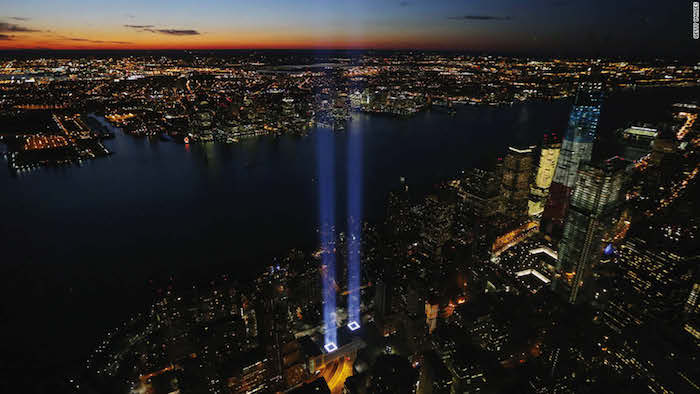
  • 14 YEARS LATER, US REMEMBERS THE TRAGIC EVENTS OF 9/11 ATTACKS

    14 YEARS LATER, US REMEMBERS THE TRAGIC EVENTS OF 9/11 ATTACKS

    The September 11 attacks (also referred to as 9/11) were a series of four coordinated terrorist attacks by the Islamic terrorist group al-Qaeda on the United States on the morning of Tuesday, September 11, 2001. The attacks consisted of suicide attacks used to target symbolic U.S. landmarks.

    Four passenger airliners—which all departed from airports on the U.S. East Coast bound for California—were hijacked by 19 al-Qaeda terrorists to be flown into buildings. Two of the planes, American Airlines Flight 11 and United Airlines Flight 175, were crashed into the North and South towers, respectively, of the World Trade Center complex in New York City. Within an hour and 42 minutes, both 110-story towers collapsed with debris and the resulting fires causing partial or complete collapse of all other buildings in the World Trade Center complex, including the 47-story 7 World Trade Center tower, as well as significant damage to ten other large surrounding structures. A third plane, American Airlines Flight 77, was crashed into the Pentagon (the headquarters of the United States Department of Defense) in Arlington County, Virginia, leading to a partial collapse in the Pentagon’s western side. The fourth plane, United Airlines Flight 93, initially was steered toward Washington, D.C., but crashed into a field near Shanksville, Pennsylvania, after its passengers tried to overcome the hijackers. In total, the attacks claimed the lives of 2,996 people (including the 19 hijackers) and caused at least $10 billion in property and infrastructure damage. It was the deadliest incident for firefighters and law enforcement officers[4] in the history of the United States, with 343 and 72 killed respectively.

    TRAGIC EVENTS OF 9:11 ATTACKSSuspicion for the attack quickly fell on al-Qaeda. The United States responded to the attacks by launching the War on Terror and invading Afghanistan to depose the Taliban, which had harbored al-Qaeda. Many countries strengthened their anti-terrorism legislation and expanded the powers of law enforcement and intelligence agencies to prevent terrorist attacks. Although al-Qaeda’s leader, Osama bin Laden, initially denied any involvement, in 2004, he claimed responsibility for the attacks. Al-Qaeda and bin Laden cited U.S. support of Israel, the presence of U.S. troops in Saudi Arabia, and sanctions against Iraq as motives. Having evaded capture for almost a decade, bin Laden was located and killed by members of the U.S. military in May 2011.

    The destruction of the World Trade Center and nearby infrastructure caused serious damage to the economy of Lower Manhattan and had a significant effect on global markets, closing Wall Street until September 17 and the civilian airspace in the U.S. and Canada until September 13. Many closings, evacuations, and cancellations followed, out of respect or fear of further attacks. Cleanup of the World Trade Center site was completed in May 2002, and the Pentagon was repaired within a year. On November 18, 2006, construction of One World Trade Center began at the World Trade Center site. The building was officially opened on November 3, 2014. Numerous memorials have been constructed, including the National September 11 Memorial & Museum in New York City, the Pentagon Memorial in Arlington County, and the Flight 93 National Memorial in a field near Shanksville.

    Casualties

    The attacks resulted in the deaths of 2,996 people, including the 19 hijackers. The 2,977 victims included 246 on the four planes (from which there were no survivors), 2,606 in the World Trade Center and in the surrounding area, and 125 at the Pentagon. Nearly all of those who perished were civilians with the exceptions of 72 law enforcement officers, 343 firefighters, and 55 military personnel who died in the attacks. After New York, New Jersey lost the most state citizens, with the city of Hoboken having the most citizens that died in the attacks. More than 90 countries lost citizens in the September 11 attacks. The attacks of September 11, 2001, marked it the worst terrorist attack in world history and the deadliest foreign act of destruction to life and property on American soil since the Japanese surprise attack on Pearl Harbor on December 7, 1941.

    In Arlington County, 125 Pentagon workers lost their lives when Flight 77 crashed into the western side of the building. Of these, 70 were civilians and 55 were military personnel, many of them who worked for the United States Army or the United States Navy. The Army lost 47 civilian employees, six civilian contractors, and 22 soldiers, while the Navy lost six civilian employees, three civilian contractors, and 33 sailors. Seven Defense Intelligence Agency (DIA) civilian employees were also among the dead in the attack, as well as an Office of the Secretary of Defense (OSD) contractor Lieutenant General Timothy Maude, an Army Deputy Chief of Staff, was the highest-ranking military official killed at the Pentagon.

    In New York City, more than 90% of the workers and visitors who died in the towers had been at or above the points of impact. In the North Tower, 1,355 people at or above the point of impact were trapped and died of smoke inhalation, fell or jumped from the tower to escape the smoke and flames, or were killed in the building’s eventual collapse. The destruction of all three staircases in the tower when Flight 11 hit made it impossible for anyone above the impact zone to escape. 107 people below the point of impact died as well.

    In the South Tower, one stairwell, Stairwell A, was left intact after Flight 175 hit, allowing 14 people located on the floors of impact (including one man who saw the plane coming at him) and four more from the floors above to escape. 911 operators who received calls from individuals inside the tower were not well informed of the situation as it rapidly unfolded and as a result, told callers not to descend the tower on their own. 630 people died in that tower, fewer than half the number killed in the North Tower.

    Casualties in the South Tower were significantly reduced by some occupants deciding to start evacuating as soon as the North Tower was struck.

    At least 200 people fell or jumped to their deaths from the burning towers (as exemplified in the photograph The Falling Man), landing on the streets and rooftops of adjacent buildings hundreds of feet below.[119] Some occupants of each tower above the point of impact made their way toward the roof in hope of helicopter rescue, but the roof access doors were locked. No plan existed for helicopter rescues, and the combination of roof equipment and thick smoke and intense heat prevented helicopters from approaching. A total of 411 emergency workers died as they tried to rescue people and fight fires. The New York City Fire Department (FDNY) lost 343 firefighters, including a chaplain, two paramedics, and a fire marshal. The New York City Police Department (NYPD) lost 23 officers. The Port Authority Police Department (PAPD) lost 37 officers. Eight emergency medical technicians (EMTs) and paramedics from private emergency medical services units were killed.

    Cantor Fitzgerald L.P., an investment bank on the 101st–105th floors of the North Tower, lost 658 employees, considerably more than any other employer. Marsh Inc., locatedimmediately below Cantor Fitzgerald on floors 93–100, lost 358 employees, and 175 employees of Aon Corporation were also killed. The National Institute of Standards and Technology (NIST) estimated that about 17,400 civilians were in the World Trade Center complex at the time of the attacks. Turnstile counts from the Port Authority suggest 14,154 people were typically in the Twin Towers by 8:45 a.m. The vast majority of people below the impact zone safely evacuated the buildings.

    Weeks after the attack, the death toll was estimated to be over 6,000, more than twice the number of deaths eventually confirmed.[138] The city was only able to identify remains for about 1,600 of the World Trade Center victims. The medical examiner’s office collected “about 10,000 unidentified bone and tissue fragments that cannot be matched to the list of the dead”. Bone fragments were still being found in 2006 by workers who were preparing to demolish the damaged Deutsche Bank Building. In 2010, a team of anthropologists and archaeologists searched for human remains and personal items at the Fresh Kills Landfill, where seventy-two more human remains were recovered, bringing the total found to 1,845. DNA profiling continues in an attempt to identify additional victims. The remains are being held in storage in Memorial Park, outside the New York City Medical Examiner’s facilities. It was expected that the remains would be moved in 2013 to a repository behind a wall at the 9/11 museum. In July 2011, a team of scientists at the Office of Chief Medical Examiner was still trying to identify remains, in the hope that improved technology will allow them to identify other victims. On March 20, 2015, the 1,640th victim was identified.

    There are still 1,113 victims who have not been identified.

    Damage

    Along with the 110-floor Twin Towers, numerous other buildings at the World Trade Center site were destroyed or badly damaged, including WTC buildings 3 through 7 and St. Nicholas Greek Orthodox Church. The North Tower, South Tower, the Marriott Hotel (3 WTC), and 7 WTC were completely destroyed. The U.S. Customs House (6 World Trade Center), 4 World Trade Center, 5 World Trade Center, and both pedestrian bridges connecting buildings were severely damaged. The Deutsche Bank Building on 130 Liberty Street was partially damaged and demolished some years later, starting in 2007. The two buildings of the World Financial Center also suffered damage.

    The Deutsche Bank Building across Liberty Street from the World Trade Center complex was later condemned as uninhabitable because of toxic conditions inside the office tower, and was deconstructed.The Borough of Manhattan Community College’s Fiterman Hall at 30 West Broadway was condemned due to extensive damage in the attacks, and is being rebuilt. Other neighboring buildings (including 90 West Street and the Verizon Building) suffered major damage but have been restored. World Financial Center buildings, One Liberty Plaza, the Millenium Hilton, and 90 Church Street had moderate damage and have since been restored. Communications equipment on top of the North Tower was also destroyed, but media stations were quickly able to reroute the signals and resume their broadcasts.

    The Pentagon was severely damaged by the impact of American Airlines Flight 77 and ensuing fires, causing one section of the building to collapse. As the airplane approached the Pentagon, its wings knocked down light poles and its right engine hit a power generator before crashing into the western side of the building. The plane hit the Pentagon at the first-floor level. The front part of the fuselage disintegrated on impact, while the mid and tail sections kept moving for another fraction of a second. Debris from the tail section penetrated furthest into the building, breaking through 310 feet (94 m) of the three outermost of the building’s five rings.

    TRAGIC EVENTS OF 9:11 ATTACKS Memorial 1

    National September 11 Memorial & Museum

    The National September 11 Memorial & Museum (known separately as the 9/11 Memorial and 9/11 Memorial Museum) is the principal memorial and museum, respectively, commemorating the September 11 attacks of 2001 and the World Trade Center bombing.

    The Tribute in Light is an art installation of 88 searchlights placed next to the site of the World Trade Center to create two vertical columns of light in remembrance of the September 11 attacks. It is produced annually by the Municipal Art Society of New York.
    The Tribute in Light is an art installation of 88 searchlights placed next to the site of the World Trade Center to create two vertical columns of light in remembrance of the September 11 attacks. It is produced annually by the Municipal Art Society of New York.

    The memorial is located at the World Trade Center site, the former location of the Twin Towers (which were destroyed during the September 11 attacks). It is operated by a non-profit corporation, headed by Joe Daniels, whose mission is to raise funds for, program, own and operate the memorial and museum at the World Trade Center site.

    TRAGIC EVENTS OF 9:11 ATTACKS MemorialA memorial was planned in the immediate aftermath of the attacks and destruction of the World Trade Center for the victims including those involved in rescue operations.The winner of the World Trade Center Site Memorial Competition was Israeli architect Michael Arad of Handel Architects, a New York- and San Francisco-based firm. Arad worked with landscape-architecture firm Peter Walker and Partners on the design, a forest of trees with two square pools in the center where the Twin Towers stood. In August 2006, the World Trade Center Memorial Foundation and the Port Authority of New York and New Jersey began heavy construction on the memorial and museum. The design is consistent with the original Daniel Libeskind master plan, which called for the memorial to be 30 feet (9.1 m) below street level—originally 70 feet (21 m)—in a plaza, and was the only finalist to disregard Libeskind’s requirement that the buildings overhang the footprints. The World Trade Center Memorial Foundation was renamed the National September 11 Memorial & Museum in 2007.

    On September 11, 2011, a dedication ceremony commemorating the tenth anniversary of the attacks was held at the memorial. It opened to the public the following day; the museum was dedicated on May 15, 2014 and opened on May 21. Three months after its opening, the memorial had been visited by over a million people.

    In 2012 Tuesday’s Children, a non-profit family-service organization dedicated to individuals directly impacted by 9/11 and those who have lost loved ones to terrorism worldwide, joined with the 9/11 Memorial to offer private tours to family members of
    9/11 victims and first responders.

  • Pakistan to push for resumption of Afghan-Taliban talks

    Pakistan to push for resumption of Afghan-Taliban talks

    Islamabad: Pakistan is likely to persuade Afghanistan to resume talks with the Taliban after their parleys were snapped due to power struggle within the militant group following the death of its chief Mullah Omar.

    Pakistan Prime Minister’s Adviser on National Security and Foreign Affairs Sartaj Aziz plans to visit Afghanistan tomorrow to attend the two-day Regional Economic Cooperation Conference on Afghanistan (RECCA). Diplomatic sources said that he is expected to meet Afghan officials including Foreign Minister Salahuddin Rabbani on the sidelines of the conference. “We believe that dialogue is the only way forward and Afghanistan should resume the talks with Taliban instead of indulging in blame-game,” the sources said. Pakistan has said that it supports an “Afghan-owned and Afghan-led peace process” and offered its help in this regard. The peace talks were launched in July when the first round between the two parties was held in Murree near Islamabad but before the scheduled second round on July 31, Afghan official broke the news of Omar’s death.

    Taliban this week accepted that their leader died more than two years ago but they wanted to keep the news under the wraps until the drawdown of Western troops. Afghan-Pakistan ties improved after President Ashraf Ghani took over last year but the recent bombings did a lot of damage to the confidence building as Ghani blamed Islamabad for militancy in his country, a charge denied by Pakistan. Pakistan is believed to have links with Afghan Taliban who fled to lawless tribal region of the country after the downfall of their regime in 2001. Analysts believe that new Taliban chief Mullah Akhtar Mansoor is now in full control of the group after some power struggle within the militant group.

  • Zee TV Canada now available on Jadoo TV

    Zee TV Canada now available on Jadoo TV

    August 28, 2015 New York: Zee TV, the No.1 South Asian Network will now be available on Jadoo TV in Canada. The company has reached a subscriber licensing agreement for its flagship networks Zee TV Canada, Zee Punjabi and Zee Cinema with Jadoo TV. Beginning September 1st 2015, the three Zee networks will be available to all Jadoo TV subscribers in Canada. Zee TV Canada is currently available on all satellite, cable, telco and IPTV platforms and, is one of the fastest growing international channels in Canada. Zee TV Canada will be available in High Definition to all Jadoo TV subscribers.

    “Canada is one of the fastest growing markets for us. Our business has more than tripled in last 2 years. This move helps us to further consolidate our position in the market. Jadoo TV has been one of the pioneers in over the top play, which has been the fastest growing category of access”, added Sameer Targe, General Manager, Asia TV USA Ltd.

    We’re excited about bringing Zee TV channels to the largest South Asian viewership base in Canada on JadooTV. Zee TV is not only popular amongst the Indian diaspora in Canada, but also has great appeal amongst the greater South Asian community. The addition of Zee TV, Zee Cinema, and Zee Punjabi will enhance our entertainment offering, making JadooTV the best value for end users. With this agreement, Jadoo TV has further cemented its position as market leader in the OTT space for South Asian diaspora worldwide” said Sajid Sohail, Founder & CEO of JadooTV, Inc.

    jadooAbout JadooTV, Inc.

    JadooTV is a consumer technology and content services company based in Silicon Valley committed to delivering Live and On-Demand content to viewers via its proprietary Internet based set-top box (STB). JadooTV is the leading distributor of Internet based South Asian television content, bringing Television, Movies, and Music to South Asian diaspora from India, Pakistan, Bangladesh, Afghanistan, Nepal, and Middle East. JadooTV is privately held and backed by Intel Capital. For further information please visit: www.jadootv.com

  • Pakistan probes ‘$100 ID cards for militants’ scam

    KARACHI (TIP): Pakistani authorities are investigating officials at the national identity database for allegedly issuing ID cards to militants, including some linked to al-Qaida, in return for bribes as small as $100.

    The country’s main spy service, the Inter-Services Intelligence agency (ISI) uncovered the alleged corrupt practices at the National Database and Registration Authority (NADRA) during ongoing anti-terrorism operations, according to official documents.

    “It has been found that many NADRA officials are involved in facilitating miscreants and terrorists in obtaining fake identity,” said ISI correspondence seen by AFP.

    Adnan El Shukrijumah, a senior al-Qaida leader wanted by the US over a 2009 plot to attack the New York subway system, was among those who obtained a Pakistani ID card by bribing officials, the documents said.

    Shukrijumah, who was born in Saudi Arabia and spent some years in the United States, was killed in December 2014 during a Pakistan army operation in South Waziristan tribal area close to Afghanistan.

    He was described by the FBI as “one of the leaders of al-Qaida’s external operations program” and had a $5 million bounty for information leading to his arrest.

    ‘50,000 fake ID cards’ 

    The ISI investigation also found that three Uzbek nationals who were arrested in Qatar for robbing a bank also carried Pakistani identity papers.

    Several dozen Chinese nationals and Maldivians were also issued Pakistani ID cards, with NADRA officials taking bribes of 10,000 to 20,000 rupees ($100-200) in return.

    The intelligence probe has named about 40 NADRA officials involved in issuing the fake paperwork in Karachi, including a retired army brigadier and a retired colonel.

    Sources said that NADRA offices in other cities had also issued ID cards corruptly, including Lahore, in the east, and Dera Ismail Khan, which is close to the tribal areas on the Afghan border and has long had a reputation as a staging post for militants.

    Foreign militants flocked to Pakistan’s lawless tribal areas in the wake of the 2001 US-led invasion of Afghanistan to take part in the “jihad” against American forces across the border. Corruption is rampant in Pakistan, with backhanders regularly paid to officials of all ranks to grease the wheels of bureaucracy. But the computerised ID system introduced several years ago was supposed to be a key plank in the fight against terrorism and make it easier to catch foreign fighters, so the cards for cash scam represents a major security breach.