
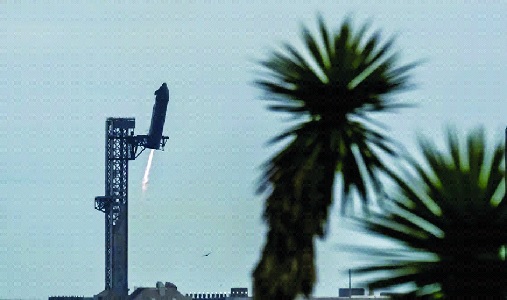

On a cloudy Saturday (Nov 14) afternoon in the southern US state of Texas, a pair of large metallic arms stretched out and caught a giant in midair as it descended from the sky.
At 124 metres (407ft) tall, SpaceX’s Starship is the world’s largest and most powerful rocket, intended for travel to the Moon and Mars. Yet 22 hours after its latest blast off into space, it made history on Earth while returning, as it slipped smoothly between mechanical “chopstick arms” above Launch Pad 2 at Starbase city in Texas.
Aerospace engineers across the globe have lauded the first-ever capture of the upper stage of a spaceship and welcomed the achievement, which signals that mega rockets could soon be fully reusable.
How did it work?
After orbiting Earth 14 times for 22.5 hours, SpaceX’s Starship emerged from thick clouds over its Starbase launch site, flipped itself to a vertical position and slowly descended into the arms on the ‘Mechazilla’ launch tower. Like massive tweezers, the arms caught the upper stage of the spacecraft in midair, while its engines were still roaring. The spacecraft then hooked onto the tower’s mechanical arms and shut off its engines. The roaring sound was instantly replaced by loud cheers from watchers nearby – they had just seen for the first time in history the capture of a mega rocket. “That was the missing link, the holy grail of spaceflight,” said SpaceX mission commentator Dan Huot. “We caught a Starship and now everything changes.”
Why was the capture tricky?
Spacecraft returning to Earth battle gravity and a range of atmospheric factors that are nearly impossible to perfectly predict or game. Sputnik 1, the first-ever artificial satellite sent into space, burned up while returning to Earth. Several manned spacecraft have been destroyed while re-entering the atmosphere, killing the astronauts on board. In April 1967, the Soviet Union’s Soyuz 1 spacecraft re-entered the atmosphere successfully, but its parachutes failed to deploy properly. Cosmonaut Vladimir Komarov died in the crash-landing near the Ural mountains. Decades later, NASA’s space shuttle Columbia disintegrated during re-entry from orbit, killing all seven astronauts on board.
In recent decades, space agencies and private firms have made major advances in safety. But many spacecraft are impossible to reuse after splashing down in the sea or on land.
Why does it matter for space technology advances?
SpaceX has become dominant in the aerospace industry primarily because the company has been trying to slash the cost of space travel by launching reusable rocket technology and rapid, repeat engineering.
So far, its Falcon 9 rocket has launched 700 times since 2010, with its first stage being reusable and its second stage discarded into the sea.
With Starship, Musk has said he wants to create fully reusable flights that can also transport humans into space with minimum refurbishment.
“SpaceX has already significantly reduced the cost of getting to orbit through Falcon 9’s reusability. It’s super cheap and convenient to send satellites to low Earth orbit. Starship takes this a step further by being a much bigger craft and aiming for full reusability of both the booster and the upper stage,” Patel said.



Be the first to comment