Tag: America Politics

  • By taking the U.S. House of Representatives, Democrats can try to frame national agenda

    By taking the U.S. House of Representatives, Democrats can try to frame national agenda

    The Democratic Party made a comeback in Tuesday’s midterm elections after spending two years in the political darkness, when it seized control of the House of Representatives. Yet, predictions of a “blue wave”, as a backlash to the racially charged, polarizing campaign led by President Donald Trump, failed to materialize. The Democrats secured control of the 435-member lower chamber of Congress, flipping at least 26 seats from their Republican incumbents. This outcome, which will likely give the Trump administration pause for thought on the policy agenda for the remainder of its tenure, ends one-party rule in Washington. Yet, Mr. Trump hailed the results as a “tremendous success”, alluding to the fact that Republicans gained at least two seats in the Senate, giving them a clear majority in the 100-seat upper chamber. Results among the 36 gubernatorial races favored Democrats: although Mr. Trump’s support paid off in some swing States crucial to his 2020 re-election campaign, including Florida, Iowa and Ohio, his party failed to hold on to power in Wisconsin and Michigan. Democrats flipped seven States out of Republican control. While the 2018 midterm election results tracked the typical historical pattern of the party controlling the White House facing setbacks on Capitol Hill, the voter split appeared to reflect the legacy of Mr. Trump’s 2016 campaign. Republicans polled well in small towns and rural areas, while Democrats fared well in urban and suburban districts across the country. The Grand Old Party scored well in Senate races in Texas, Indiana, North Dakota and Missouri.

    Does this mean that the bitter polarization, racial hatred and culture wars that buoyed Mr. Trump’s prospects in 2016 have become entrenched in American society? Perhaps, but what the Democratic sweep of the House implies is that the constitutionally mandated system of checks and balances will be actively in force from January 2019. This could come in the form of House subpoenas to the White House, impediments to the progress of the additional tax cut proposals of the White House, or even putting the brakes on hardline stances impacting trade policies. Democrats under the likely leadership of Representative Nancy Pelosi may be tempted to lead the charge on inquiries into some of the Trump Organization’s murkier business dealings, or the Robert Mueller-led investigation into Russian interference in the 2016 election. But for now the Democrats are unlikely to go as far as attempting to impeach Mr. Trump. And rightly so, for a sober assessment of the midterm election mandate would focus on jobs, healthcare, and immigration, issues that matter most to the common American. If bipartisanship, and not belligerence, emerges between the two sides, that might then afford some space to discuss concerns about the functioning of the U.S. democratic machine, including campaign finance laws, redistricting and voter suppression.

    (The Hindu)

  • Trump sacks AG, ‘takes over’ Russia meddling probe

    Trump sacks AG, ‘takes over’ Russia meddling probe

    WASHINGTON(TIP): President Donald Trump on Wednesday, November 7,  sacked US Attorney General Jeff Sessions, virtually taking operational control of a sensitive probe into foreign interference in the 2016 election and the possibility of collusion between the Trump campaign and Russia.

    For months, Trump publicly attacked Sessions for recusing himself from overseeing the probe in 2017 and blamed his decision for allowing Deputy Attorney General Rod Rosenstein to appoint a special counsel.

    Trump said Sessions will be temporarily replaced by his chief of staff, Matthew Whitaker, who is a Republican loyalist. Now, with Whitaker at the helm, Trump has someone leading the Justice Department who has already suggested that Mueller’s probe should be reined in.

    CBS News reported that Deputy Attorney General Rosenstein is no longer leading the Mueller inquiry, and that Whitaker will now assume control.

    In a tweet on Wednesday Trump said: “We are pleased to announce that Matthew G Whitaker, Chief of Staff to Attorney General Jeff Sessions at the Department of Justice, will become our new Acting Attorney General of the US. He will serve our country well (sic).”

    “We thank Attorney General Jeff Sessions for his service and wish him well! A permanent replacement will be nominated at a later date,” he tweeted.

    Observers opine that Trump’s move will have potential implication on Special Counsel Robert Mueller’s probe as Whitaker has been overtly critical of the Mueller’s team to investigate beyond allegations Trump’s campaign colluded with Russia in 2016 and other ties between the President, his family and aides, and Kremlin.

    Questions are also being raised about the validity of appointment of Whitaker as Acting Attorney General.

    Meanwhile, thousands, on November 8, took to streets asking Whitaker to recuse himself from Mueller investigation.

    The coming days are likely to witness an interesting tug of war between Republicans and Democrats on the issue of Mueller Investigation.

    New York Attorney Ravi Batra described Jeff Sessions as a man of honor.

    “Attorney General Jeff Sessions is a man of honor – he honored his oath to the Constitution, and then he honored the president of the United States in faithfully discharging the laws of the United States. The uncomfortable tension between the attorney general and the president speaks to American exceptionalism. Indeed, it is dissent itself that serves to ‘check and balance’, so that we may form a more perfect nation.”


  • Democrats capture House, Republicans retain  Senate

    Democrats capture House, Republicans retain Senate

    Record number of women win; Four Indian Americans re-elected to House

    WASHINGTON(TIP): US President Donald Trump has described the midterm election results as a “tremendous success” even as opposition Democrats wrested the House of Representatives from the ruling Republican party, which managed to retain its majority in the Senate in the highly polarized polls.

    Trump, who campaigned aggressively in the last several weeks, Wednesday, November 7, offered an olive branch to Democrats, saying he wanted to work together with the Democratic leadership to continue delivering for the American people, including on economic growth, infrastructure, trade, lowering the cost of prescription drugs.

    “Last night the Republican Party defied history to expand our Senate majority while significantly beating expectations in the House for the midterm year,” Trump told reporters, hours after the Republicans lost control of the House for the first time in eight years.

    “These are some of the things that the Democrats do want to work on, and I really believe we’ll be able to do that. I think we’re going to have a lot of reason to do it,” he said as he termed the midterm poll results as a “tremendous success”.

    The Democrats now have majority in the 435-member House, while Trump’s party has retained majority in the 100-member Senate.

    At the time of going to press, late November 8 night, Democrats had won 229 House seats with Republicans getting 199, while 11 were still undecided.

    Democrats polled 52% of votes  in an election which has sent 99 women to the House, surpassing the previous record of  84 women elected to the House.

    In the Senate, Democrats won 46 seats, a  loss of 2 seats while Republicans won 51, a gain of 2 seats. 3 remain to be decided

    The statements from the Democratic party leaders after the results indicated it would make it tough for President Trump, who wants major legislative changes on some of his signature issues including immigration, tax and healthcare reforms.

    By capturing the House of Representatives, the Democrats may exert a major institutional check on Trump and break the Republican monopoly in Washington.

    In the House of Representatives, the Democrats seized at least 30 seats from Republican hands, enough for the majority in the 435-membered chamber. In the outgoing House, the Republicans had 235 seats while the Democrats 193.

    House Democratic leader Nancy Pelosi hopes to return as Speaker when the new Democratic majority takes over in January. After House win, the top Democrat in the US House of Representatives pledged a new era of congressional scrutiny over President Donald Trump, shrugging off White House threats of political warfare if Democrats launch investigations into his affairs.

    Emboldened Democrats want healthcare protected and Trump impeached.

    Democrats have a clear message for party leaders who will take control of the US House of Representatives next year, according to a Reuters/Ipsos national opinion poll: Protect their healthcare and impeach President Donald Trump.

    The poll released on Thursday, November 8,  found that 43 per cent of people who identified as Democrats want impeachment to be a top priority for Congress. That goal was second in priority only to healthcare

    Party leaders on Wednesday, November 7,  vowed to use their majority to impose a new level of scrutiny on the Trump White House, but said impeachment would require evidence of action to subvert the Constitution.

    A divided country has much to worry in the coming months, even as the Republicans and Democrats head for a collision course.

  • President Trump’s continuing gift to the world – from Nikki Haley to maybe Heather Nauert

    President Trump’s continuing gift to the world – from Nikki Haley to maybe Heather Nauert

    By Ravi Batra

    America has enjoyed unprecedented success in reforming the United Nations thanks to President Trump. First, he selected Nikki Haley – a distinguished conservative governor who is a proud daughter of Indian-American Sikh parents. Nikki went on to be an exceptionally effective team player with Secretary Rex Tillerson and now Secretary Mike Pompeo and NSA Ambassador. John Bolton. She has served America and President Trump without confusion, and enhanced America’s respect globally worthy of being the preeminent super power that we are and the security-umbrella  we provide nation-States.

    Nikki’s resignation, while a clear loss, was a difficult opportunity for President Trump to continue America’s necessary leadership in the geopolitical world that exists in the UN buildings in Manhattan. Just as the US Dollar is a reserve currency, the UN being in America adds American gravitas to geopolitics as humanity seeks to survive regional wars & destruction without end, while Mother Nature puts us all on notice of weaponized weather that knows no border, sovereignty or race.

    Well, seems the world may get a second gift from President Trump by his appointment of the next US Ambassador to the UN: the nuance-rich Heather Nauert who has Olympic-level ability to safely dance in the minefield of geopolitics, more dangerous than land mines. The grand stilettos of Nikki Haley will be both honored and wore well if indeed Heather Nauert – already a trusted team player – becomes the latest protector of vital American interests, while spreading freedom and human rights to every dark corner of our globe. God bless Nikki, and Heather for agreeing to follow a giant – including, the United States continuing to support, by co-sponsorship at the UN, Diwali Foundation USA’s Power of One Awards celebrating victory of “Good over Evil” by now-former exceptional diplomats. Ranju Batra, chair of Diwali Foundation, joins me in celebrating President Trump’s wisdom in his appointments.”

    (Ravi Batra is a New York based attorney)

  • Democrats most likely to wrest  the House while Republicans retain the Senate

    Democrats most likely to wrest the House while Republicans retain the Senate

    By Ven Parmeswaran

    4 days before the midterms, the veteran of US politics hazards  a guess about the  Nov 6 elections. Keenly aware of the “anything can happen” syndrome , he makes a prediction, albeit hesitatingly, that Democrats are likely to wrest the House while Republicans may continue to have a superiority in the Senate. Well, we will know the outcome in the next 4 days.- EDITOR  

    It has been customary for the opponent of President’s party to win in the midterm elections.  As of today, almost all polls are predicting that the Democrats are favored to take back the House from the Republicans.   It must be pointed out that nobody predicted in 2016 that the most popular candidate, Hillary Clinton would be defeated by a newcomer Donald Trump. All predictions by all pollsters, pundits and the mass media were 100% wrong.  Therefore, it is safe to conclude that it is impossible to predict President Trump, who is the leader of the Republican Party.   He is one of the most important factors for the midterm election.  What he says and does have an impact, good or bad.

    Usually the polls keep on tightening as the voting day approaches.  It happens fast and more within a week before the election.  In 2016, the polls were tightening and changing every day in favor of Trump in the battleground states of PA, WI, OH, MI, MN, IW.  The media refused to take this into  account and publicize.  If the media is not honest, people suffer.  There is a  reason why President Trump calls  it ‘fake media’.

    IMMIGRATION was an important factor for the 2016 Presidential election.  President Trump capitalized on this issue.  Because of his aggressive stand against illegal immigration and measures he is recommending to stop illegal immigration, polls show that more Independents and some Democrats are supporting President Trump.

    President Trump’s decision to use military to defend the open border is gaining support of the voters.

    ECONOMY:  We had 4.2% GDP growth in the 2ndquarter and 3.5% in the third quarter.  We are enjoying the lowest unemployment of 3.7%.  Unemployment amongst all the minorities, especially the Blacks is the lowest historically speaking.  The wages and profits have been gaining.   America first policy seems to be benefiting the USA in trade, jobs, manufacturing and even in foreign policy.  President Trump’s economy has 70% approval.

    PRESIDENTIAL APPROVAL:  President Trump’s approval is much higher than when he got elected.  Now he has 47% approval, much higher than that of Obama or Bush during the same time of their presidencies.  This should reflect on the polls.  90% of the Republicans support Trump now.  This is also much higher than the figure in 2016.  The Republicans, some Democrats, and many Independents have also been positively impacted by Trump’s appointment of two Supreme Court Judges.

    The Whites are still the majority.  Majority of the Whites support the GOP.  Majority of women support the Republicans. Majority of college educated women support the Democrats.  But there are more non-college educated voters than the college educated.

    The new voters under 20 are likely to vote for the Democrats.  Majority of the minority voters will be voting for the Democrats.

    HEALTHCARE: The Democrats have made this an issue and it is helping them in the polls.

    It is difficult to predict what happens between now and November 6.  The dynamics of news cycles, President Trump’s rallies, last minute surprises (domestic and international) all could contribute to tightening the polls till the last minute.    If the turn out is larger than normal for midterm elections, it should help the Democrats to  easily gain 23 seats in the Congress and take back the House from the Republicans.   The GOP is more likely to retain its majority in the U.S. Senate and may even add a seat or two.

    (The author is Chairman, Asian American Republican Committee (founded 1988) is from Scarsdale, N.Y.)


  • Heather Nauert is Trump’s top choice to succeed Nikki Haley as  UN ambassador

    Heather Nauert is Trump’s top choice to succeed Nikki Haley as UN ambassador

    WASHINGTON(TIP): President Donald Trump has told advisers that Heather Nauert, the State Department spokeswoman, is his leading choice to become US ambassador to the United Nations and he could offer the post as soon as this week, according to a CNN report

    If named Nauert, who met with Trump Monday, October 29,  would leave her role at the State Department to take over from Nikki Haley, who surprised White House officials last month when she announced her decision to step down at the end of the year.

    People close to the President cautioned that his pick is not final until it is formally announced. The White House declined to comment on the matter. Nauert has been keeping a low profile this week after meeting with Trump on Monday. Two of her daily briefings have been conducted by her deputy.

    Speaking at the White House on Thursday, November 1, Trump confirmed that Nauert is “under very serious consideration” to become the next US ambassador to the UN.

    “She’s excellent. She’s been with us a long time. She’s been a supporter for a long time. And she’s really excellent,” Trump said.

    “We’ll probably make a decision next week,” Trump said in his remarks. “We have a lot of people that want the job and they’re a lot of really great people.”

    Trump has eyed several people to replace Haley, including Ric Grennell, the US ambassador to Germany; Jamie McCourt, the US envoy in Paris; and Kelly Craft, the ambassador in Canada. One person initially considered a leading contender, former deputy national security adviser Dina Powell, withdrew from consideration early in the process. Trump has repeatedly told aides he wanted a woman to fill the role.

    Nauert, who came to government from Fox News, served as State Department spokesman for both Rex Tillerson and Mike Pompeo but has enjoyed a closer relationship with Trump’s second secretary of state than she did Tillerson, who was privately skeptical of her close ties with the West Wing.

    Her elevation to a top diplomatic role underscores the importance Trump has placed on having his top aides also serve as television surrogates. Nauert has briefed regularly from the State Department podium and had a long career in television news before that.

    Still, as a diplomat she lacks experience. Previous holders of the UN ambassador position — including current national security adviser John Bolton — came to the role with years of foreign policy experience. Nauert served briefly as Undersecretary for Public Diplomacy from March until October.

    Nauert would face what could be a contentious confirmation hearing, with Democrats quizzing her on her qualifications for the post.

    Instead, Nauert comes with something perhaps more valuable in the Trump administration: loyalty and a willingness to defend the President. That loyalty has at moments caused friction at the State Department. As Tillerson’s relationship with Trump began to deteriorate in his final months, he privately told allies he thought she was more loyal to the West Wing than the State Department. Chief of staff John Kelly informed Tillerson his time in the top diplomatic post was expected to end while on a multi-country sweep through Africa. Trump later announced his firing on Twitter.

    The UN ambassador role is viewed by some as a launching point for higher-profile positions. Both Bolton and Susan Rice, who served in the post under President Barack Obama, eventually became White House national security advisers.

    The position is based in New York, so is also viewed as having less direct oversight than a high-level post in Washington.

    Nauert’s move to the United Nations would take her out of the running for other roles in the West Wing, which has struggled at times to fill key positions and went without a communications director for months. Nauert was widely seen as the front-runner to replace Sarah Sanders as White House press secretary when she leaves which she is expected to do in the coming months after more than a year in the role, according to multiple officials.

  • Bombs reach top U.S. porches: Trump calls for more civility in politics

    Bombs reach top U.S. porches: Trump calls for more civility in politics

    WASHINGTON(TIP): US President Donald Trump has called on people to be more civil in politics, after a series of suspected explosives were sent to high-profile U.S. figures just days ahead of the mid-term polls.

    None of the packages exploded. The Federal Bureau of Investigation has launched a hunt for their sender, the BBC reported.

    Mr. Trump was speaking after parcels were sent to top Democrats, including former President Barack Obama and Hillary Clinton, besides New York Governor Andrew Cuomo, and media offices of CNN and the San Diego Union — Tribune, who are all prominent targets of right-wing criticism.

    “Those engaged in political arena must stop treating political opponents as being morally defective,” he said. “No one should carelessly compare political opponents to historic villains, which is done often,” he added.

    Speaking at a Wednesday night rally in Wisconsin, Mr. Trump vowed to catch the perpetrator and called on the media to “stop endless hostility”. Critics called his latest remarks hypocritical, as he often uses vicious language against his opponents and the press.

    However, he made no specific reference to the intended recipients of the packages, the BBC reported

    Earlier CNN worldwide President Jeff Zucker criticized Mr. Trump and the White House Press Secretary Sarah Sanders for not understanding that “words matter”. “There is a total and complete lack of understanding at the White House about the seriousness of their continued attacks on the media,” Mr. Zucker said.

    Suspected bombs were sent to locations in New York, the Washington DC area and Florida, authorities said on Wednesday. All the apparent targets were regularly criticized by conservatives —— especially by President Trump.

    U.S. authorities are investigating this as a connected series, officials said.

    Sources told CNN that a suspicious package intended for California Democratic Maxine Waters was intercepted at a congressional mail screening facility in Maryland; New York Governor Mr. Andrew Cuomo received what he said was a device at his Manhattan office; and the San Diego Union—Tribune evacuated its building after “suspicious looking packages” were spotted outside.

    CNN’s New York bureau in the Time Warner Center was evacuated after a package containing a bomb, addressed to former CIA Director John Brennan, was discovered, city and local law enforcement officials said.

    Later Wednesday night, two law enforcement sources told CNN that law enforcement officials were trying to track down a package addressed to former Vice President Joe Biden considered suspicious because of similarities to other packages.

    The package was misaddressed and returned to sender.

    The developments, which unfolded rapidly and continued steadily into the afternoon, touched off fear and confusion and immediately invited questions about the motives of those responsible.

    Some Democrats have accused the president of inciting violence with his past rhetoric, while some of his supporters have said they believe the packages are part of a Democratic plot to win votes in the mid-term elections.

    There is no evidence for this and the police have not released any information about any suspects. The attempted attacks come just under two weeks before the mid—terms, with U.S. politics highly polarized.

    (Source: IANS)

  • Indian American US Congress Candidates Raise $26 Million for Midterm Polls

    Indian American US Congress Candidates Raise $26 Million for Midterm Polls

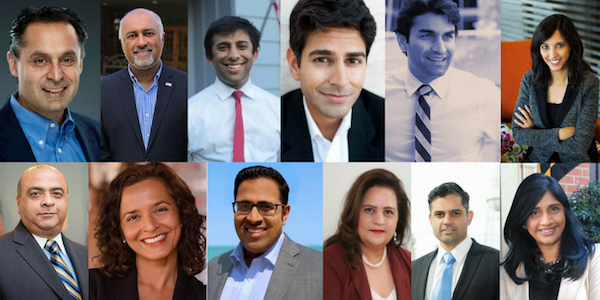
    WASHINGTON(TIP): More than 12 Indian Americans running for the US Congress have collectively raised over $26 million for their election campaign with six of them outraising their opponents, according to the latest official figures.

    Raja Krishnamoorthi, Ro Khanna, Pramila Jayapal, Ami Bera, Hiral Tipirneni, and Aftab Pureval have outraised their opponents in their respective seats for the US House of Representatives.

    For political pundits, funds raised by a candidate is considered the barometer of their popularity and one who raises more than his/her opponent is normally considered to win.

    Most of the fund-raising figures released by the Federal Election Commission (FEC) are till September 30 and the final number before the November 6 polls is likely to jump further.

    If they win the number of Indian Americans in the US House of Representatives could jump from the current four to six, with two of them being woman and one being of Tibetan origin.

    Raja Krishnamoorthi from the eighth Congressional District of Illinois till September 30, as per FEC figures, has raised more than $5 million, topping the list.

    His opponent, Jitender Diganvker also an Indian American has raised a paltry $35,817, which is also the lowest fund-raising figure among the dozen Indian Americans in the race for the Congress this time.

    Shiv Ayyadurai who is running for a Senate seat in Massachusetts against the powerful Democratic Senator Elizabeth Warren, has surprised many by raising $5 million. But political pundits give him very little chance against the Warren, who has raised $20 million so far.

    Indian American physician Hiral Tipirneni has raised over $3.76 million. Tipirneni lost to incumbent Debbie Lesko during the special elections early this year.

    The momentum looks like is with the Indian American woman in this eighth Congressional District of Arizona as her opponent so far has raised $1.8 million.

    And so has Aftab Pureval, who is seeking to enter the US House of Representatives from the first Congressional District of Ohio.

    The only Indian American to be endorsed by former US President Barack Obama, Pureval has raised $3.1 million, as against his Republican opponent and incumbent Steve Chabot of about  $1 million. Chabot’s latest figures with FEC are only till June 30.

    Three-time Congressman from seventh Congressional District of California Dr Ami Bera has raised $2.69 million as against  $373,000 by his Republican opponent Andrew Grant.

    All the previous three elections bids for him had been tough and all the three times he was declared elected only after recounting of votes.

    Representing Silicon Valley, Ro Khanna from the 17th Congressional District of California is pretty close with $2.62 million. He virtually has no contest at all.

    Pramila Jayapal, the first Indian American woman to be elected to the US House of Representatives has raised $1.66 million, according to the FEC figures till July 18. Her opponent Craig Keller has raised about $3,000 till the same period.


  • Ambassador Nikki Haley Capitalizes on her Resignation and Builds Political Capital

    Ambassador Nikki Haley Capitalizes on her Resignation and Builds Political Capital

    By Ven Parameswaran

    Kathleen Parker, a columnist for The Washington Post wrote: “In decades of writing about politics, I have run across few with Haley’s innate talents.  She is a natural with people, whether crouching with children on the ground in Africa—reminiscent of Princess Diana on similar travels—speaking to leaders in the tense theater of the United Nations.

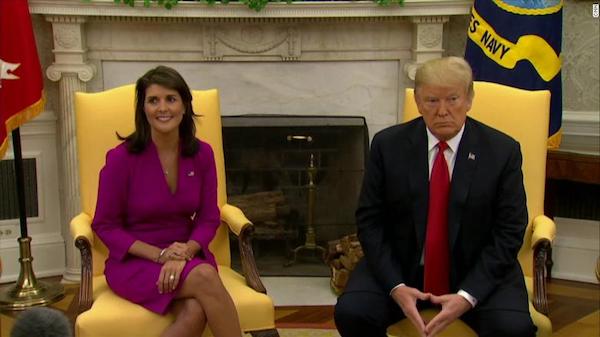
    Ambassador Nikki Haley sitting by President Trump in the White House oval office announced her resignation.   The event was followed by a press conference.  The story was a stunt and received the widest media coverage for a couple of days.  First, I must congratulate Nikki Haley for her modus operandi and political skills in getting President Trump and the public to listen to her story from the oval office.  Never before, a resignation of a cabinet official has received such importance.   The exchange Nikki Haley had with Trump proved that they have the best rapport and cordial and professional relationship.  Perhaps, having refined her diplomatic skills at the United Nations, she emulated them at the White House.

    Nikki Haley, 46 started her political career 14 years ago as State Senator in South Carolina.  At the end of her third term, Nikki Haley ran as a Primary candidate for the Governor of South Carolina.  This was a tough fight and she won.  She won the Governor’s race with a wide margin.  Her performance as Governor enabled her to win her second term in 2014.   President Trump appointed her as Ambassador to the U.N. in 2017.   Thus, Nikki Haley became a durable political timber and unchallenged national leader.

    PERFORMANCE AT THE U.N.

    P stands for Performance and R stands for Reporting in Public Relations. Nikki Haley’s performance as Ambassador was extraordinary and outstanding.  When she took up the job, everyone underestimated her and she prove them wrong.  Nikki Haley developed the  best diplomatic relations with China and Russia.  This helped her to get their consent when the U.S. imposed severe sanctions against these countries and also Iran and North Korea.  She represented the USA and President Trump admirably and commanded the highest respect at the United Nations.

    She came to the UN post without previous foreign policy experience.  The position often thrust her into the spotlight and enabled her to win favor among conservatives for her staunch defense of Israel and sharp criticism of Iran and Russia.

    For a time at the UN, diplomats saw her as the face of U.S. foreign policy, noting differences between Trump and then Secretary of State Rex Tillerson. She made a point at the UN to project the impression that she was close to Trump and that she “had his ears,” one diplomat said.

    WHY DID NIKKI HALEY RESIGN?  IS SHE SHOOTING FOR THE PRESIDENCY AFTER TRUMP?

    In 14 years, Nikki Haley has accumulated substantial political experience by representing South Carolina as a State Senator and Governor, and as Ambassador to the U.N.  She has proven legislative and executive  experience.  Everyone is speculating about her future potential, that is unlimited.  Nikki Haley is very popular.  Quinnipiac Poll gave her 75% approval rating by Republicans and 55% by Democrats.  President Trump sent her to Sudan and other African countries and India.  Ambassador Haley was well respected and received by one and all.  When Secretary of State Rex Tillerson’s resignation was imminent there was speculation that Trump was considering her for the Secretary of State.    When the reporters asked Haley whether she would be running for President in 2020, she said she would not be running but would be supporting Trump.    As a conservative Republican woman with seasoned experience one can say she has the necessary credentials to run for President in 2024.   There is speculation that Trump may fire Attorney General Sessions after the Mid Term elections and was considering Senator Graham of S.C. If so, there is a possibility that Nikki Haley could be tapped to finish the term of Senator Graham till 2020, and get reelected.  Senator Graham may also be interested in the U.N. Ambassador’s job.  There is also speculation that Trump may want a woman as his running mate in 2020 and could offer the V.P. slot to Nikki Haley.

    There is also a report that Nikki Haley may be interested in private industry.  Her personal finances are not that strong and she could very well serve as C E O of a Fortune 500 corporation.  Such an assignment could give her multimillion dollar salary.    Thus, she is in demand.

    Kathleen Parker, a columnist for The Washington Post wrote: “In decades of writing about politics, I have run across few with Haley’s innate talents.  She is a natural with people, whether crouching with children on the ground in Africa—reminiscent of Princess Diana on similar travels—speaking to leaders in the tense theater of the United Nations.  As Governor, she led the legislature to remove the Confederate battle flag from the statehouse grounds, while also guiding South Carolina through the shock and grief of the 2015 church massacre in Charleston.    It won’t  serve her presidential aspirations well to stay out of politics for long, as Haley surely knows.  Thus, the burning question—what is next?—has only one certain answer:  WHATEVER SHE WANTS?”

    The New York Times editorial wrote: “Ms. Haley, who is expected to pursue the presidency one day, may eventually find herself having to defend facilitating some of President Trump’s worst policies and instincts.  But she will also be able to point to more constructive roles she played. Indeed a replacement in her mold may be the best to hope for from Mr.Trump.”

    (The author based in Scarsdale, N.Y is Chairman, Asian American Republican Committee (founded in 1988). He can be reached at  vpwaren@gmail.com)


  • Is Democracy dying?

    Is Democracy dying?

    By David Frum

    America’s Slide Toward Autocracy

    Democracy has taken a beating under President Trump. Will the midterms make a difference?

    Restoring democracy will require more from each of us than the casting of a single election ballot. It will demand a sustained commitment to renew American institutions, reinvigorate common citizenship, and expand national prosperity. The road to autocracy is long—which means that we still have time to halt and turn back. It also means that the longer we wait, the farther we must travel to return home.

    Twenty-one months into the Trump presidency, how far has the country rolled down the road to autocracy? It’s been such a distracting drive—so many crazy moments! —who can keep an eye on the odometer?

    Yet measuring the distance traveled is vital. As Abraham Lincoln superbly said in his “house divided” speech: “If we could first know where we are, and whither we are tending, we could then better judge what to do, and how to do it.”

    Let’s start with the good news: Against the Trump presidency, federal law enforcement has held firm. As of this writing, Special Counsel Robert Mueller’s inquiry is proceeding despite the president’s fulminations. The Department of Justice is ignoring the president’s Twitter demands to prosecute his opponents. As far as we know, the IRS and other federal agencies are not harassing Trump critics. In July, a police department in Ohio retaliated against a Trump adversary, the porn actress known as Stormy Daniels, by arresting her on now-dismissed charges that she touched undercover officers while performing at a strip club. But evidence indicates that this was entirely a local initiative.

    Trump sometimes wins in court, as he did on his Muslim ban. He loses more often, as he did on separating immigrant children from their parents at the southern border. Politically charged cases are advancing through the legal system in traditionally recognizable ways.

    More generally, Trump has been noticeably constrained by his unpopularity. He inherited a strong and growing economy. Casualties from America’s military actions have remained low. A more normal president, facing the same facts, might expect approval ratings like those of Bill Clinton during his second term: mid-50s or higher. Instead, Trump scrapes by in the low 40s.

    In June, Gallup asked Americans to assess 13 aspects of Trump’s personality. Only 43 percent of respondents thought he cared about people like them. Only 37 percent found him honest and trustworthy. Only 35 percent said they admired him. Clearly, his erratic and offensive behavior, his overt racial hostility, and his maltreatment of women have taken a toll.

    The bulk of this magazine issue is given over to questions about liberal democracy’s long-term viability. Around the world, democracy looks more fragile than it has since the Cold War. But if it survives for now in America, future historians may well conclude that it was saved by the president’s Twitter compulsion. Had he preserved a dignified silence for a few consecutive months, he might have bled less support and inflicted more damage on U.S. institutions. Then again, a Donald Trump with impulse control would not be Donald Trump.

    Trump has built the worst-functioning White House in living memory, and its self-inflicted errors have slowed him down almost as much as his personality has. He traveled to Saudi Arabia, but never visited forward-deployed U.S. troops in the region. Potentially positive moments, like North Korea’s release of three detainees on May 10, 2018, are regularly squashed by stupidities, like the leak that day of a White House aide’s denigration of John McCain (“It doesn’t matter; he’s dying anyway”).

    Yet even as Trump ties his own shoelaces together and lurches nose-first into the Rose Garden dirt, he has scored a dismaying sequence of successes in his war on U.S. institutions. In this, Trump is not acting alone. He is enabled by his party in Congress and its many supporters throughout the country. Republican leaders and donors have built a coping mechanism for the age of Trump, a mantra: “Ignore the weird stuff, focus on the policy.” But the policy is increasingly driven by the weird stuff: tariffs, trade wars, quarrels with allies, suspicions of secret deals with the Russians. The weird stuff is the policy—and it is transforming the president’s party in ways not easily or soon corrected. Maybe you don’t care about the president’s party. You should, because a liberal democracy cannot endure if only one of its two major parties remains committed to democratic values.

    Here are the three areas of most imminent concern:

     ETHICS

    President Trump continues to defy long-standing ethical expectations of the American president. He has never released his tax returns, and he no longer even bothers to offer specious reasons, like a supposed audit. His aides shrug off the matter as something decided back in 2016.

    Meanwhile, the president continues to collect payments from people with a vested interest in decisions made by his administration, from foreign governments looking to influence U.S. policy, and even from his own party. Those who seek the president’s attention know to patronize his hotels and golf courses. Authoritarian China has fast-tracked trademark protections for his family’s businesses. Trump’s disdain for ethical niceties has infected his Cabinet and his senior staff. It’s no longer much of a story when his commerce secretary is revealed to have filed false financial disclosures or when his top communications aide turns out to have worked to intimidate alleged sexual-harassment victims at Fox News. Or when his son-in-law is shown to have sought financing for business ventures from investors in Qatar and the United Arab Emirates at the same time that he was participating in the administration’s discussion about which of those countries to back in a military confrontation. If one gauge of authoritarianism is the merger of state power with familial economic interests, the needle is approaching the red zone.

    SUBORDINATION OF STATE TO LEADER

    At a July 20, 2018, ceremony, CEOs gathered in the White House to offer personal job-creation pledges to the president. Watch the video if you have not already; the scene recalls a rajah accepting accolades from his submissive feudatories.

    Perhaps the most defining characteristic of modern autocrats such as Recep Tayyip Erdoğan, Viktor Orbán, and Vladimir Putin is the way they seek to subsume the normal operations of government into their cult of personality. In a democracy, the chief executive is understood to be a public employee. In an autocracy, he presents himself as a public benefactor, even as he uses public power for personal ends.

    Apparently to punish the Washington Post owner and Amazon CEO Jeff Bezos for his paper’s reporting, Trump has pressed the Postal Service to raise Amazon’s rates—thus warning other business leaders to be careful what they say. He has conscripted NFL team owners into his war against black football players who kneel during the national anthem to protest racism and police brutality.

    Trump’s tariffs personalize power too. They enable him to privilege some industries and hurt others. Some losers—farmers, say—may be compensated; others, such as aerospace manufacturers, will be disregarded. All economic sectors must absorb the new truth that executive action can send their profits soaring (in July, not long after Trump imposed new tariffs on steel and aluminum, America’s largest steelmaker reported its highest second-quarter profits ever) or tumbling (shares of Molson Coors, which relies on cheap aluminum to make its beer cans, dropped 14 percent this spring after Trump’s tariffs were announced).

    When Trump refers to “my” generals or “my” intelligence agencies, he is teaching his supporters to rethink how the presidency should function. We are a long way from Ronald Reagan’s remark that he and his wife were but “the latest tenants in the People’s House.”

    ALTERNATIVE FACTS

    Trump is hardly the first president to lie, even about grave matters. Yet none of his predecessors did anything quite like what he did in July: Travel to a U.S. Steel facility and brag that, thanks to his leadership, the company would open seven wholly new facilities. In reality, the company was reopening two blast furnaces at a single facility. You’d think his audience would know better, but the assembled employees cheered anyway.

    Trump may not be much of a manager or developer, but he is a great storyteller. He has substantially shaped his supporters’ worldview, while successfully isolating them from damaging news. The share of Republicans with a positive opinion of the FBI tumbled from 65 percent in early 2017 to 49 percent this past July. In the past three years, Vladimir Putin’s approval rating among Republicans has almost tripled, to 32 percent.

    To protect the president—and themselves—from the truth about Russia’s intervention in his election, Republican members of the House Intelligence Committee have concocted (and the conservative media have disseminated) an elaborate fantasy about an FBI plot against Trump. The party’s senior leaders know that the fantasy is untrue. That’s why they squelch attempts to act on the fantasy by opening a special-counsel investigation into the bureau. But they cheerfully allow their supporters to believe the fantasy—or to believe it just enough, anyway, to get revved up for the midterm elections.

    Many Americans want to believe that Democratic victories in November will reverse the country’s course. They should be wary of investing too much hope in that prospect. Should Democrats recover some measure of power in Congress, their gains could perversely accelerate current trends. As Republicans lose power in Washington, Trump will gain power within his party.

    Today, Republicans queasy about Trump can look to House Speaker Paul Ryan or Senate Majority Leader Mitch McConnell as alternative sources of power or patronage in Washington. But if the party loses hold of Congress, congressional Republicans’ clout will dwindle. Power will be divided in Washington between Trump and the Democrats. If legislative success becomes a vanishing possibility, the White House may begin testing the limits of its authority more aggressively.

    Trump will face more hearings, more investigations, and generally more trouble than he faces today. Partisan loyalties will be engaged as Republicans rally around their embattled leader. The conservative pundit M. Stanton Evans quipped, “I didn’t like Nixon until Watergate.” A joke then describes reality today. Among Trump supporters, “No collusion!” has already evolved into “Collusion is not a crime,” with “Collusion is patriotic” perhaps soon to follow. Trump supporters have no exit ramp. Party affiliation has hardened since the 1970s into a central aspect—in many ways the central aspect—of personal identity. If Trump is exposed and repudiated, his supporters will be discredited alongside him. If he is to survive, they must protect him.

    In an ultra polarized post-November environment, the Republican Party may radicalize further as it shrivels, ceasing to compete for votes and looking to survive instead by further changing the voting system. Donald Trump is president for many reasons, but one is the astonishing drop in African American voter participation from 2012 to 2016. It’s not surprising that Hillary Clinton inspired lower black voter turnout than Barack Obama did in 2012. It is surprising that she inspired lower black turnout than John Kerry did in 2004. But in the intervening years, the rules were changed in ways that made voting much harder for non-Republican constituencies, particularly black people—and the rules continue to be changed in that direction.

    You may know the story of American democracy as a series of suffrage extensions, culminating in the reforms of the 1960s and ’70s. But voting rights have just as often been rolled back at the state and local levels—the literacy tests and poll taxes of the Jim Crow South are the best-known examples. Since 2010, that history of state-pioneered ballot restrictions has repeated itself, and if Republican power holders feel themselves especially beset after 2018, the rollbacks may continue.

    We cannot blame democracy’s troubles in the United States or overseas on any one charismatic demagogue. Many of today’s authoritarians are notably uncharismatic. They flourish because they command political or ethnic blocs that, more and more, prevail only as pluralities, not majorities. So it is with Trump.

    Free societies depend on a broad agreement to respect the rules of the game. If a decisive minority rejects those rules, then that country is headed toward a convulsion. In 2016, Trump supporters openly brandished firearms near polling places. Since then, they’ve learned to rationalize clandestine election assistance from a hostile foreign government. The president pardoned former Sheriff Joe Arpaio, convicted of contempt of court for violating civil rights in Maricopa County, Arizona, and Dinesh D’Souza, convicted of violating election-finance laws—sending an unmistakable message of support for attacks on the legal order. Where President Trump has led, millions of people who regard themselves as loyal Americans, believers in the Constitution, have ominously followed.

    Once violated, democratic norms are not easy to restore, as Rachel Kleinfeld of the Carnegie Endowment for International Peace has observed. In the wake of Silvio Berlusconi’s corrupt tenure as prime minister, Italy is now governed by a strange coalition of extremist parties. Nominally of the right and the left, they share a dislike of the European Union, affinity for Putin’s Russia, and distrust of vaccines. Fate struck down the demagogic Louisiana governor Huey Long, but his family bestrode the state’s politics for decades after his death. Argentina, emerging from neo-Peronism, has stumbled on its way back to legality.

    Weakened institutions will be challenged from multiple directions: We are already hearing liberals speculating about 1930s-style court packing as a response to Trump’s cramming of the judiciary. The distrust of free speech on campus is being carried by recent graduates into their jobs and communities. We see in other countries, especially the United Kingdom, the rise of an activist left nearly as paranoid and anti-Semitic, as disdainful of liberal freedoms and democratic institutions, as the so-called alt-right in the U.S.

    It could happen here. Restoring democracy will require more from each of us than the casting of a single election ballot. It will demand a sustained commitment to renew American institutions, reinvigorate common citizenship, and expand national prosperity. The road to autocracy is long—which means that we still have time to halt and turn back. It also means that the longer we wait, the farther we must travel to return home.

    (The author is a staff writer at The Atlantic and the author of Trumpocracy: The Corruption of the American Republic. In 2001 and 2002, he was a speechwriter for President George W. Bush)

    (Source: The Atlantic)

  • She said, He Said at Senate Judiciary Committee Hearing of the Accuser and the Accused

    She said, He Said at Senate Judiciary Committee Hearing of the Accuser and the Accused

    Feared being raped, killed’, says the accuser Dr. Ford. The accused SC Nominee Kavanaugh proclaims innocence, terms it a smear campaign against him

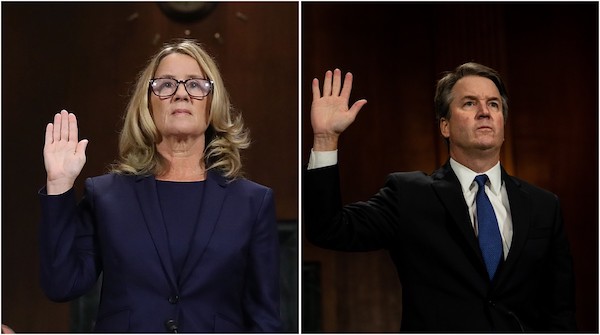
    WASHINGTON(TIP): Dr. Christine Blasey Ford, a university professor on Thursday, September 27, detailed her allegations that Brett Kavanaugh, President Donald Trump’s Supreme Court nominee, sexually assaulted her 36 years ago, saying she thought he was going to rape and perhaps accidentally kill her, during a dramatic US Senate Judiciary Committee hearing.

    Christine Blasey Ford, whose voice sometimes cracked with emotion, testified to the Senate Judiciary Committee during a hearing that could determine whether Kavanaugh will be confirmed to the lifetime job after a pitched political battle between Trump’s fellow Republicans and Democrats who oppose the nominee.

    “With what degree of certainty do you believe Brett Kavanaugh assaulted you?” Democratic Senator Richard Durbin asked Ford. “One hundred per cent,” she replied, remaining firm and unruffled through hours of questioning.

    Ford said “absolutely not” when Democratic Senator Dianne Feinstein asked her if it could be a case of mistaken identity.  The hearing, which has riveted Americans and intensified the political polarization in the United States, occurred against the backdrop of the #MeToo movement against sexual harassment and assault. Kavanaugh has been accused of sexual misconduct by two other women as well. He has denied all the allegations.

    While some Republicans and Trump have called the allegations by Ford and two other women against Kavanaugh part of a smear campaign, Ford told the committee, “I am an independent person and I am no pawn.”

    Democratic senators, who praised the credibility of her testimony and called her brave for coming forward, sought to score political points during their five minutes apiece of questioning Ford. The panel’s Republican senators, all men, did not question her, assigning that task to Rachel Mitchell, a sex crimes prosecutor.

    While Mitchell sought to probe Ford’s account including any gaps in her story, her questioning seemed disjointed because she took turns with the Democratic senators to ask questions in five-minute segments, disrupting her flow.

    “The first thing that struck me from your statement this morning was that you are terrified. And I just wanted to let you know, I’m very sorry. That’s not right,” Mitchell said.

    Ford, a psychology professor at Palo Alto University in California, said a drunken Kavanaugh attacked her and tried to remove her clothing at a gathering of teenagers in Maryland when he was 17 years old and she was 15.

    Brett groped me and tried to take off my clothes… he was very inebriated. I believed he was going to rape me. I tried to yell for help. Brett put his hand over my mouth. — Christine Blasey Ford

    Under questioning from Feinstein, Ford said she has suffered from claustrophobia and anxiety, adding her strongest memory of the incident was the “uproarious laughter between the two (Kavanaugh and Judge) and their having fun at my expense.”

    Judge Brett Kavanaugh, in his testimony before the Senate Judiciary Committee, proclaimed his innocence.

    In a passionate defense, the 53-year-old conservative judge insisted before the Senate Judiciary Committee that it never happened, accused Democrats of destroying his reputation and condemned his confirmation battle as a “national disgrace” and a “circus.”

    “Judge Kavanaugh showed America exactly why I nominated him,” the President tweeted just minutes after the close of the hearing.

    “His testimony was powerful, honest and riveting,” Mr. Trump said. “Democrats’ search and destroy strategy is disgraceful and this process has been a total sham and effort to delay, obstruct and resist. The Senate must vote!”

    Senate Majority Leader Mitch McConnell said Mr. Trump would get his wish, with the Judiciary Committee — which has 11 Republicans and 10 Democrats — set to vote on its recommendation Friday before the nomination goes to the full Senate, where Republicans hold a slim 51-49 edge.

    “We’re going to vote in the morning and we’re going to move forward,” Mr. McConnell told journalists.


  • Indian American Tech Executive Anita Malik wins Arizona 6th district Democratic congressional primary 

    Indian American Tech Executive Anita Malik wins Arizona 6th district Democratic congressional primary 

    ARIZONA(TIP): Indian American Anita Malik has won the Democratic party primary in Arizona’s 6th congressional district. She is the 11th Indian American to win the nomination of one of the two major parties in the midterm elections.

    Malik will face GOP Rep. David Schweikert, who won the Republican primary unopposed, on November 6.

    The primary in Arizona was held on August 28, but the 6th district race was too close to call on the election night, with Malik leading her nearest rival Heather Ross by a narrow margin of 383 votes.

    But, as the absentee ballots were counted and certified, the Indian American’s lead grew to 2,402, according to the official results posted on the Maricopa County Recorder website.

    Malik, who quit her job as the chief operating officer of the tech startup ClearVoice to run for Congress, was declared the winner.

    According to the official tally, Malik received 22,522 (42.04 percent) votes, while Ross received 20,120 (37.55 percent) votes.

    “I am proud that my campaign reflected a broad, grassroots coalition of Arizonans who came together to support our vision of creating jobs and ensuring the ability of families to work, live, and thrive in the 6th congressional district,” Malik said in a statement posted on her Twitter account on August 31st.

    “Arizonans deserve someone who will work hard to represent them and build a stronger future for our community, our state and our country,” she added. “As the daughter of immigrants — people who believed in the promise of American — I want to help everyone have that opportunity to build a better life for themselves and their families.”

    As soon as her victory was announced, Malik quickly went on the general election campaign mode. Focusing on corruption, which is likely to be a major midterm issues, she tweeted: “Indictments, corruption, and ethical violations are the norm in today’s Congress. I’ll fight to root out corruption and enact higher ethical standards, starting with our own district.”

    On Labor Day, she tweeted in support of workers: “Today we honor those who have built this country. It’s a strong reminder of the course correction the country needs to bring our voices back to the table. The future of work is already here, it’s time to move boldly and swiftly to protect and support American workers.”

    Born in Kansas City, Missouri, Malik’s family moved to Arizona when she was 7. She graduated summa cum laude with degrees in computer information systems and finance from Arizona State University.

    She also has a master’s degree in journalism from the University of Southern California.

  • Indian American Democrats win congressional primaries unopposed

    Indian American Democrats win congressional primaries unopposed

    NEW YORK(TIP): Indian Americans appear to be doing well in politics. In the latest political bouts, Hiral Tipirneni and Sanjay Patel ran and won unopposed on August 28 Democratic primaries in Arizona and Florida.

    On Tuesday , another Indian American Democrat, tech executive Anita Malik, is leading by 383 votes against her nearest rival in Arizona’s 6th congressional district. Malik’s race is too close to call.

    Tipirneni, who lost a close special election to Rep. Debbie Lesko in April, will now face the same rival in the midterm elections on November 6 in Arizona’s 8thcongressional district.

    In the highly competitive special election, which was warranted because the incumbent GOP Rep. Trent Franks resigned last December after he was embroiled in a sexual misconduct scandal, Tipirneni received more than 82,300 votes (47.4 percent), roughly 9,000 fewer than Lesko.

    However, despite the competitive nature of their last race, Cook Political Report rates the district as a solidly Republican seat in November.

    Patel will run against face incumbent Bill Posey, who similarly ran unopposed in the Republican primary in Florida’s 8th congressional district.

    Patel, a first-generation immigrant and small business owner, also starts as an underdog. Cook Political report rates the district as a solidly Republicanseat, with GOP having a 11-percentage point advantage. Sabato’s Crystal Ball also rates the district as a “safe” Republican seat.

    Patel is also behind in the money race, having raised only $231,000, less than half of the nearly $600,000 collected by Posey, according to the Center for Responsive Politics.

    The Indian American is running on a number of issues such as healthcare, economy and jobs, environment and education.

    On healthcare, he has vowed to work “to make healthcare a right for every American by supporting Medicare for All.”

    With the primary victories of Patel and Tipirneni, the number of Indian Americans on the midterm congressional ballots has reached double digits.

  • Indian American members of Congress running for re-election

    Indian American members of Congress running for re-election

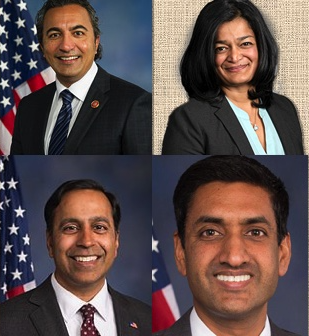
    WASHINGTON(TIP): Never before has there been such a crop of Indian Americans in politics in the US. The Indian American community has come of age in respect of their involvement in politics. Four Indian American members of Congress — Reps Ami Bera, D-CA; Ro Khanna, D-CA; Pramila Jayapal, D-WA; and Raja Krishnamoorthi, D-IL — are running for re-election.

    Additionally, the following Indian Americans will be on ballot in November:

    Aftab Pureval, Ohio’s 1st congressional district: Pureval, son of an Indian father and a Tibetan mother, is one of the rising stars in Ohio’s Democratic party. He won the May primary unopposed and is running against Republican Rep. Steve Chabot.

    Sri Preston Kulkarni, Texas’ 22nd congressional district:

    A former diplomat, Kulkarni won a contested primary to earn the right to face Republican Pete Olson in the Houston area district.

    Chintan Desai, Arkansas’ first district: Desai, a teacher, won the Democratic primary in June and will take on three-term incumbent Republican Rick Crawford in November.

    Jitendra ‘J.D.’ Diganvker, Illinois’ 6th congressional district: Diganvker, who immigrated to the United States in 1995, is the only Indian American Republican congressional candidate who will be on the ballot in November. He will face the incumbent Indian American Rep. Krishnamoorthi.

  • Trump Lawyers Submit a Counteroffer to Mueller’s Terms for Interview with the President

    Trump Lawyers Submit a Counteroffer to Mueller’s Terms for Interview with the President

    WASHINGTON(TIP): President Trump’s lawyers on Wednesday, August 8, submitted a counteroffer to Special Counsel Robert Mueller’s proposal for the terms of a possible interview with the president, the latest turn in the protracted negotiations over a sit-down stretching back to January, according to a report published in Wall Street Journal.

    The counteroffer largely sticks to the terms the president’s legal team outlined last month, a person familiar with the matter said: The president’s lawyers would be open to questions about collusion with Russia but wished to limit inquires related to obstruction of justice.

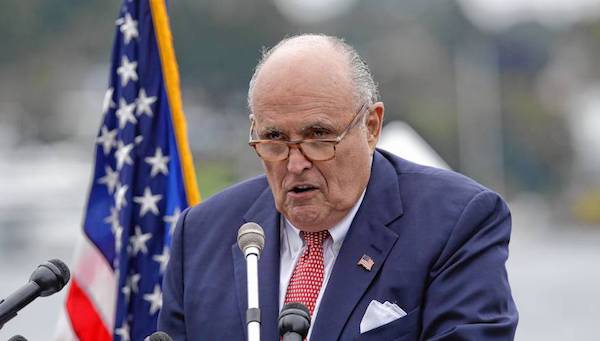
    Rudy Giuliani, one of the president’s lawyers, said in an interview that the team’s proposal was “a little bit different than what we recommended before, but not terribly.”

    He said the legal team had “left open” the possibility to investigators that the president would answer a question on obstruction of justice “if they can show us an obstruction question that they need an answer to, where they haven’t gotten an answer.”

    Mr. Giuliani said that in the special counsel’s last offer, Mr. Mueller agreed to decrease the number of questions posed to the president but hasn’t agreed to the Trump team’s request to curb obstruction of justice inquiries.

    A spokesman for Mr. Mueller, who has not publicly commented on the negotiations, didn’t immediately respond to a request for comment.

    Mr. Mueller is investigating whether Trump associates colluded with Russia’s efforts to interfere in the 2016 U.S. election, and whether Mr. Trump sought to obstruct justice by firing Federal Bureau of Investigation Director James Comey in May 2017, while the FBI’s Russia probe was under way. Mr. Trump has repeatedly denied collusion and obstruction, and Moscow has denied election interference.

    The special counsel’s team of investigators and prosecutors has netted guilty pleas from several Trump campaign associates and indictments of a dozen Russian intelligence officials on hacking charges, among other prosecutions. Mr. Trump’s one-time campaign chairman Paul Manafort is currently being tried in Virginia on bank and tax fraud charges.

    The special counsel this year outlined for the president’s legal team more than 40 questions he planned to ask in a possible interview with Mr. Trump. The questions focused largely on the president’s decision to fire Mr. Comey and his public criticisms of Attorney General Jeff Sessions and other top law-enforcement officials.

    Mr. Giuliani has said the reasons Mr. Trump has given in public for firing the former FBI director are “more than sufficient” and that as president, he had the power to fire any member of his administration.

    The president’s legal team has been negotiating the terms of a possible interview with Mr. Mueller for more than eight months. Mr. Trump has said he is eager to sit down with Mr. Mueller. It is unclear how long the two sides will allow the negotiations to continue.

    Mr. Giuliani said Wednesday that the legal team wants to see the Mueller investigation “over with” by Sept. 1, ahead of the November midterm elections. He said Mr. Trump’s lawyers would make a final decision in the coming weeks whether or not the president would sit for an interview. The president’s lawyers have previously offered timelines in which they would decide on an interview, only to see those end dates pass by.

    “It really depends on how badly they want it,” Mr. Giuliani said of an interview. “This is about the last couple of days that you can really putz around.”

  • Indian American Sri Preston Kulkarni Quit Job Over Trump’s Policies

    Indian American Sri Preston Kulkarni Quit Job Over Trump’s Policies

    WASHINGTON(TIP): Indian American Sri Preston Kulkarni decided to quit his dream job at the US State Department last December to run for Congress. Preston found it difficult to defend the Trump administration’s policies as a diplomat especially over race and immigration.

     Mr Kulkarni, whose family traces its roots to Maharashtra and Karnataka, says on his website that he spent his career trying to reduce conflict in other countries…”but right now hostility and conflict are being inflamed in our own country through the politics of anger and demagoguery”.

    “I have worked under Democratic and Republican administrations before, but the current situation is different and should concern all Americans of conscience,” he said on his website.

    After quitting his job, Mr Kulkarni announced that he will run for the 22nd Congressional District of Texas, to be part of the policy making, and not implementing them.

    Six months later, he won the Democratic primary and is pitching for a tough battle against five-term Republican incumbent Pete Olson.

    “There is a little bit of nervousness on the other side about (my) campaign,” Mr Kulkarni told the media.

    Mr Kulkarni’s family immigrated to the US in 1969 to Louisiana, where he was born in 1978. Soon thereafter they moved to Houston, where Mr Kulkarni grew up.

    After completing his college, he joined the US foreign service in 2003 and worked in various capacities in both inside the US and overseas. This summer he was posted as spokesperson of the US Embassy in New Delhi.

    Being an Indian American, representing the US was very important, he said.

    “But I think the 2016 election for me actually drove home as some of these issues are still unresolved for America,” he said.

    “During that election, there was so much anti-immigrant sentiment being spread that it was a real blow to me personally. When I came back to the State Department, I said (to myself) ‘I’m just going to continue to be a professional and I’m going to do this job’,” he said.

    But, there were two incidents that changed his mind and made him feel that he couldn’t continue in the State Department.

    “One was the Charlottesville rally one year ago where we had Nazis in the street screaming about white supremacy and my government could not make a clear distinction. That’s absolutely morally unequivocally awful. I was asked to explain this when I was overseas. Why is it that they’re very fine people who were Nazis and why is it that both sides are the same? I couldn’t do that,” Mr Kulkarni said.

    At the rally last summer, white supremacists and counter-protesters clashed in the streets before a car plowed into a crowd, killing 32-year-old counter-protester.

    The second was the Roy Moore campaign, Mr Kulkarni recollected.

    “He was molesting 14-year-old girls and he said that our families are stronger when we had slavery and that Muslims shouldn’t be able to hold a public office in the United States. To me that’s just beyond what’s acceptable in the kind of democracy and the kind of society that I believe in,” he said.

    Roy Moore was the Republican nominee in the 2017 US Senate special election in Alabama to fill the seat vacated by Jeff Sessions. Moore, who had faced multiple allegations of sexual assault during his campaign, was backed by President Donald Trump. Later he lost to Democratic candidate Doug Jones.

    At the time of these incidents, Mr Kulkarni was in Jamaica on a temporary assignment. His next posting was at the US Embassy in New Delhi as its spokesperson.

    “I decided that I was going to resign to come back home and run for office. Because I think we need to stand up against this idea that we should be divided up by, by race, by ethnicity, and that some people are less American than other people. That’s when I started the campaign,” Mr Kulkarni said.

    Mr Kulkarni resigned from the foreign service in December.

    He says that it is not about just one person, Trump as an individual.

    “It is more about these ideas that we should be divided against each other, Muslim versus Hindu or Muslim or Christian or Hindu versus Christian or black versus white or Asian versus white. That ideas are the more dangerous thing than a person,” he said.

    He said the social fabric of America was being torn apart and Americans were blaming immigrants for everything.

    “If the fight is against illegal immigrants, then why H-1B program is being threatened. Why are we trying to reduce legal immigration and family reunification?” he asked.

    “It doesn’t have to do with illegal immigration. That has to do with anti-immigrant sentiment. The anti-immigrant sentiment is something that should worry all of us because we are an immigrant country and honestly, without immigrants, most of our fortune 500 companies wouldn’t be here,” Mr Kulkarni said.

    “But whenever any group is discriminated against, it’s a threat to all minority groups. If a Muslim is being discriminated against, it still affects me as a Hindu,” Mr Kulkarni said.

    Now running an effective campaign, Mr Kulkarni, pollsters say has considerably reduced the poll numbers against his rival Olson, who is considered to be a friend of India in the US Congress.

    Mr Kulkarni, who is a cousin of BJP Member of Parliament Poonam Mahajan, hopes that the entire community would come out to vote in November.

  • Indian American Democrats lose in Michigan primaries

    Indian American Democrats lose in Michigan primaries

    MICHIGAN(TIP): Indian American Democrats Shri Thanedar and Suneel Gupta lose in Michigan primaries on August 7. Entrepreneur and scientist Shri Thanedar finished third for Michigan governor, which was won by former legislative leader Gretchen Whitmer.

    Thanedar, from Ann Harbor, polled 199,574 votes, while Whitmer received 586,074 votes.

    Abdul El-Sayed, who was endorsed by former presidential candidate Bernie Sanders, was second with 340,560 votes.

    Suneel Gupta, brother of physician and television personality Sanjay Gupta fell short by more than 5,000 votes in Michigan’s 11th congressional district. Gupta received 19,149 votes. The eventual nominee Haley Stevens received 24,232 votes.

    Thanedar, who grew up in Belgaum, in the south Indian state of Karnataka, self-financed his campaign to the tune of $11 million.

    His website says Thanedar purchased or sold eight different businesses—many of them chemical testing analytics firms.

    The controversial businessman had toyed with the idea of running in the Republican primary before filing papers to run as a Democrat, according to reports. Ultimately, he ran as a progressive.

    Gupta, whose mom was the first female engineer hired by Ford half a century ago, ran on a progressive platform, including education, environment, healthcare and jobs creation.

    “Taking this country back from Donald Trump—that’s job one,” Gupta, who holds a law degree from Northwestern Law School and an MBA from the Kellogg School of Management, said in one of his campaign ads.

    He founded Rise, a healthcare technology company he set up, with the help of his brother Sanjay Gupta.


  • Indian American Democrat Candidate Aftab Puravel receives Obama endorsement

    Indian American Democrat Candidate Aftab Puravel receives Obama endorsement

    OHIO(TIP): Indian American Democrat candidate Aftab Puravel from Ohio’s first congressional district received former President Barack Obama’s endorsement on August 2.

    The Hamilton County Courts clerk is one of the dozens of Democrats the former president — who’s considered the de facto leader of the party — endorsed via twitter in what’s billed as the “first wave of mid-term endorsements.”

    Last week, political analyst Larry Sabato’s “Crystal Ball” moved the district to the “Toss up” column, indicating that it will be one of the dozens of districts that will decide which party will control Congress after November. Previously, Sabato had deemed Ohio-1 as “Likely Republican.”

    Pureval is the only Indian American endorsed by Obama on Wednesday. In all, the previous occupant of the White House endorsed more than 80 Democrats who are running for various state and federal offices that include governor, lieutenant governor, US Senate and US House of Representatives.

    Pureval, who won the Democratic primary unopposed, has so far outraised Chabot by more than 2 to 1 margin, campaign finance data by the Center for Responsive Politics shows. Through June 30, he raised more than $1.5 million, compared to $950,000 raised by the congressman.

    Pureval, 35, is the son of an Indian father and Tibetan mom. He is a former Special Assistant US Attorney for the Department of Justice and the first Democrat to get elected as the Hamilton County Courts clerk in a hundred years.


  • Russia faces US sanctions over poisoning of Skripal in UK

    Russia faces US sanctions over poisoning of Skripal in UK

    WASHINGTON(TIP): The US has said it will impose fresh sanctions on Russia after determining it used nerve agent against a former Russian double agent living in the UK.

    Sergei Skripal and his daughter Yulia were left seriously ill after being poisoned with Novichok in Salisbury in March, though they have now recovered.

    A UK investigation blamed Russia for the attack, but the Kremlin has strongly denied any involvement.

    Russia has criticized the new sanctions as “draconian”.

    In a statement released on Wednesday, August 8, the US State Department confirmed it was implementing measures against Russia over the incident.

    Spokeswoman Heather Nauert said it had been determined that the country “has used chemical or biological weapons in violation of international law or has used lethal chemical or biological weapons against its own nationals”.

    “The strong international response to the use of a chemical weapon on the streets of Salisbury sends an unequivocal message to Russia that its provocative, reckless behavior will not go unchallenged,” a UK Foreign Office statement said.

    The Russian embassy in the US hit back on Thursday morning, criticizing what it called “far-fetched accusations” from the US that Russia was behind the attack.

    Russia had become “accustomed to not hearing any facts or evidence”, it said, adding: “We continue to strongly stand for an open and transparent investigation of the crime committed in Salisbury.”

    The new sanctions will take effect on or around 22 August and relate to the exports of sensitive electronic components and other technologies.

    The State Department said “more draconian” sanctions will follow within 90 days if Russia fails to give reliable assurances it will no longer use chemical weapons and allow on-site inspections by the United Nations.

    An official said it was only the third time that the US had determined a country had used chemical or biological weapons against its own nationals.

    Previous occasions were against Syria and against North Korea for the assassination of Kim Jong-nam, the half-brother of leader Kim Jong-un, who died when highly toxic VX nerve agent was rubbed on his face at Kuala Lumpur airport.

    Are these the only US sanctions against Russia?

    No. In June the US imposed sanctions on five Russian companies and three Russian individuals in response to alleged Russian cyber-attacks on the US.

    All are prohibited from any transactions involving the US financial system.

    Treasury Secretary Steven Mnuchin said the measures were to counter “malicious actors” working to “increase Russia’s offensive cyber-capabilities”.

    After pressure from Republican members of Congress, the State Department has determined Moscow broke international law by using a military grade chemical weapon on the Skripals.

    While the US expelled some five dozen diplomats shortly after the poisoning, the administration stopped short of making a formal determination that Russia had broken international law.

    But Congress has been pushing for such a decision and now the state department has confirmed Russia’s actions contravened 1991 US legislation on the use of chemical weapons. That breach automatically triggers the imposition of sanctions and places requirements on Russia to avert further restrictions in three months’ time.

    Those requirements could include opening up sites in Russia for inspection – a move Moscow would probably resist.

    So far President Donald Trump has been silent on this latest move – which could well derail his attempts to develop a new, warmer relationship with Vladimir Putin.

    Following the incident, the British government said the military-grade nerve agent Novichok, of a type developed by Russia, had been used in the attack.

    Relations between Russia and the West hit a new low. More than 20 countries expelled Russian envoys in solidarity with the UK, including the US. Washington ordered 60 diplomats to leave and closed the Russian consulate general in Seattle.

    Three months after the Salisbury attack, two other people fell ill at a house in Amesbury, about eight miles from the city. Dawn Sturgess later died while her partner, Charlie Rowley, spent three weeks recovering in hospital.

    After tests, scientists at the UK’s military research lab, Porton Down, found the couple had also been exposed to Novichok.

    Mr Rowley told ITV News he had earlier found a sealed bottle of perfume and given it to Ms Sturgess, who sprayed the substance on her wrists.

  • NY Congressman Collins Arrested, Charged with Insider Trading

    NY Congressman Collins Arrested, Charged with Insider Trading

    NEW YORK(TIP): The FBI has arrested New York Rep. Chris Collins on securities fraud-related charges, law enforcement officials said.

    Collins, a Republican who hails from western New York, his son and his son’s future father-in-law have all been charged with insider trading, U.S. Attorney Geoffrey Berman said.

    The congressman surrendered to the FBI at 26 Federal Plaza Wednesday, August 8 morning, officials said.

    Collins pleaded not guilty at an appearance in Manhattan federal court Wednesday afternoon.

    Hours after he was released on bail, Collins spoke to reporters in Buffalo, professing his innocence and saying he would remain on the ballot for re-election this fall.

    Collins was one of the first members of Congress to endorse President Donald Trump during his presidential campaign.

    Last fall, the Office of Congressional Ethics released a report that said the congressman may have violated House rules when he bought discounted stock that wasn’t available to the public and was offered to him based on his status as a politician.

    The report also found that Collins, a board member of Australia-based Innate Immunotherapeutics, may have shared nonpublic information about the company, another possible violation.

    Innate had been in the process of developing a drug to treat multiple sclerosis in 2017, according to the indictment. When the product failed drug trials in June 2017, however, the public results sent Innate stock prices plummeting by 92 percent.

    Collins — one of Innate’s largest stockholders — had access to information about the company and its research that wasn’t available to the public, the indictment alleges.

    When Collins found out about the trial results, he allegedly told his son Cameron Collins, also an Innate stockholder, who told his then-girlfriend’s father Stephen Zarsky, as well as several other stockholders.

    Cameron Collins, Zarsky, and the stockholders Collins told subsequently sold their Innate stock before prices plunged, narrowly avoiding hundreds of thousands of dollars in losses, the indictment says.

    The congressman, his son and Zarsky have all been charged with conspiracy, securities fraud, wire fraud and making false statements to the FBI, the Manhattan U.S. Attorney’s office said. The Securities and Exchange Commission has filed its own civil action against the three men.

    “Representative Collins, who, by virtue of his office, helps write the laws of this country, acted as if the law did not apply to him,” Berman said. “These charges are a reminder that this is a nation of laws, and everyone stands equal before the bar of justice.”

    “I believe I acted properly and within the law at all times,” he said. “I will mount a vigorous defense in court to clear my name. I look forward to being fully vindicated and exonerated.”

    The congressman’s attorneys Jonathan Barr and Jonathan New, of BakerHostetler, also said Wednesday they would “answer the charges filed against [Collins] in court and… mount a vigorous defense to clear his good name.”

    “It is notable that even the government does not allege that Congressman Collins traded a single share of Innate Therapeutics stock,” they said in a statement. “We are confident he will be completely vindicated and exonerated.”

    House Speaker Paul Ryan said in a statement the congressman would no longer serve on the House Energy and Commerce Committee, pending the ultimate outcome of the indictment.

    “While his guilt or innocence is a question for the courts to settle, the allegations against Rep. Collins demand a prompt and thorough investigation by the House Ethics Committee,” he said. “Insider trading is a clear violation of the public trust.”

    House Democratic leader Nancy Pelosi, meanwhile, said Americans “deserve better than the GOP’s corruption, cronyism and incompetence.”

    “The charges against Congressman Collins show the rampant culture of corruption and self-enrichment among Republicans in Washington today,” she said. “The Ethics Committee must accelerate its own investigation into Congressman Collins’ illegal abuse of the public trust.”

    The congressman is expected to appear in court again on Oct. 11.

  • Pence details plan for creation of Space Force

    Pence details plan for creation of Space Force

    ‘We must have American dominance in space”- Pence

    WASHINGTON(TIP): ‘We must have American dominance in space”, said Vice President Pence, outlining an ambitious plan on Thursday, August 9 that would begin creating a military command – “Space Force” as the sixth branch of the U.S. military as early as 2020.

    Pence warned of the advancements that potential adversaries were making and issued what amounted to a call to arms to preserve the military’s dominance in space.

    “Just as we’ve done in ages past, the United States will meet the emerging threats on this new battlefield,” he said in a speech at the Pentagon. “The time has come to establish the United States Space Force.”

    But the monumental task of standing up a new military department, which would require approval by a Congress that shelved the idea last year, may require significant new spending and a reorganization of the largest bureaucracy in the world. And the idea has already run into fierce opposition inside and out of the Pentagon, particularly from the Air Force, which could lose some of its responsibilities.

    Defense Secretary Jim Mattis last year said he opposed a new department of the military “at a time when we are focused on reducing overhead and integrating joint warfighting functions.”

    This week, Mattis said the Pentagon and White House “are in complete alignment” on the need to view space as a warfighting domain. But he stopped short of endorsing a full-fledged Space Force. In a briefing with reporters after Pence’s speech, Deputy Defense Secretary Patrick Shanahan suggested that Mattis’s comments opposing the Space Force were made at a different time, before the Pentagon received a bolstered budget.

    White House officials have been working with national security leaders to aggressively move ahead without Congress. The first step is creating a new U.S. Space Command by the end of the year, which would be led by a four-star general, the way the Pentagon’s Indo-Pacific Command oversees those regions.

    The new command would pull space experts from across the armed services, and there would be a separate acquisitions office, dedicated to buying satellites and developing new technology to help the military win wars in space.

    After the announcement Thursday, President Trump tweeted, “Space Force all the way!”

    For months, Trump has been calling for a Space Force, a new, free-standing military department, with its own chain of command and uniforms.

    The White House intends to work with lawmakers in submitting legislation by early next year, a senior administration official said, with the hopes of standing up the first new military department since the Air Force in 1947.

    Some members of Congress and military leaders have been warning space is no longer a peaceful sanctuary, but a domain of conflict that needs more attention and resources. Space is vital to the way the United States wages war; The Pentagon’s satellites are used for missile-defense warnings, guiding precision munitions and providing communications and reconnaissance.

    Russia and China have made significant advancements, challenging the United States’ assets in space.

    After Pence’s speech, Reps. Mike Rogers (R-Ala.) and Jim Cooper (D-Tenn.), members of the House Armed Services Committee, praised the move, saying a Space Force “will result in a safer, stronger America.”

    “We have been warning for years of the need to protect our space assets and to develop more capable space systems,” they said in a joint statement.

    In his speech, Pence urged the audience to support the administration’s effort to create the new department.

    Speaking to a room made up mostly of U.S. troops in uniform, Pence said their “Commander-in-Chief is going to continue to work tirelessly toward this goal, and we expect you all to do the same.”

    “The only thing we can’t afford is inaction,” he said.


  • Indian American Woman becomes the first ever CEO of Democratic National Committee

    Indian American Woman becomes the first ever CEO of Democratic National Committee

    WASHINGTON(TIP): Indian American Seema Nanda has been announced as the CEO of the opposition Democratic National Committee. She vows to fight for the “soul of the country” and ensure the victory of Democrats in every corner of the US in the crucial upcoming mid-term elections.

    “We are fighting now for the soul of our country, for our democracy and for opportunity,” Ms Nanda, the first Indian- American ever to be the Chief Executive Officer of either the Democratic National Committee or the Republican National Committee took over reigns of the main opposition party on July 23.

    In this capacity, she is responsible for the day-to-day operations of the powerful Democratic National Committee (DNC).

    She would play a key role in party’s winning strategy in the mid-term November elections, for which the DNC has set a target of winning back the House of Representatives from the Republicans.

    “Democrats are offering the positive solutions so desperately needed right now, solutions forged by the strength of our diversity, the rigor of our ideas, and the decency of our values,” she said.

    “Since (President Donald) Trump took office, it’s been clear that the number one best way for us to set our country back on track is to elect Democrats in every corner of our country. That’s why I took this job,” Ms Nanda said in her first message to Democratic supporters.

    Ms Nanda said supporting the Democratic party is synonymous with building a future for the children that they can be proud of.

    “My promise to my two teenage boys is to do all I can to create an America that is bright, fair, and that works for everyone, where opportunity for all means something,” she said.

    “Our party is strong because it’s built on forging positive solutions that include everyone. I’m proud to be the first Asian-American in recent memory to lead the DNC. Democrats are leading with our values and empowering people from diverse backgrounds to speak up and make our voices heard,” Nanda said.

    The fight to take back the country for working families is one that all must fight together, she said, adding “At the DNC, we have committed to helping Democrats win back seats at all levels of government, because we need Democrats from the school board to the Senate to take back our country”.

    Noting that everything is at stake with this year’s midterm elections in November, Nanda said Democrats are investing in state parties, putting organizers on the ground in all 50 states, and mobilizing 50 million voters by November through their nationwide ‘I Will Vote’ campaign.

    “We’re setting our sights and our goals higher than ever before in order to help Democratic leaders fight and win all across our country,” Nanda said.

    “As we head toward a crucial election, I’m one hundred percent certain that Seema’s leadership will help the DNC capitalize on the unprecedented grassroots energy and enthusiasm surging throughout the country,” DNC Chairman Tom Perez had said on her appointment last month.

    Ms Nanda’s appointment is seen as another sign of the political emergence of Indian-American in particular women in the country’s political arena.

    Nanda, whose parents are dentists, grew up in Connecticut. She went to the Brown University and Boston College Law School.

    She also has a background in labor and employment law and has worked in the Civil Rights Division of the Department of Justice.


  • Indian American Raj Shukla announces his candidacy for Madison, Wisconsin Mayor

    Indian American Raj Shukla announces his candidacy for Madison, Wisconsin Mayor

    MADISON, WI(TIP): Indian American Raj Shukla has announced that he will run for the Madison, Wisconsin, mayor. “I am running for mayor to lead Madison to become all we know it can be,” he said on his website announcing the candidacy. “I’ve helped businesses, nonprofits and governments move forward and live up to their ideals. I will do same for the people of Madison, WI.”

    The University of Wisconsin-Madison grad is currently the executive director of River Alliance of Wisconsin, a coalition of individuals, businesses and watershed groups that works toward protecting and restoring the state’s waters. Shukla also heads the Sustainable Madison Committee — an advisory panel appointed by the mayor that is tasked with ensuring that Madison is safe, clean and healthy. He once worked for former Vice President Al Gore’s Climate Reality Project.

    According to the Political Action Committee Indian American Impact Fund, if elected, Shukla would become the first Indian American mayor of one of the 100 largest cities in the United States.

    The primary will be held on February 19, 2019, and the general mayoral election is scheduled for April 2, 2019.

    Madison is an overwhelmingly progressive and Democratic city. The last time a Republican won a mayoral election in the city was in 1969.

    Shukla is the fourth Democrat to enter the race.

    The current Mayor Paul Soglin, who is running for Wisconsin governor, announced on July 17 that he will not seek re-election.

    Shukla and his wife, Tora Frank, have been residents of Madison since 2006. They have three daughters.

  • Trump should be Impeached. Are there Republicans with spine who will do it? ​

    Trump should be Impeached. Are there Republicans with spine who will do it? ​

    By M.P. Prabhakaran

    Will some Republicans in Congress prove that they have spine by coming forward to initiate the process of impeachment of Trump? Any effort on the part of Democrats will get nowhere, because they are in a minority in both the House of Representatives and the Senate. The initiative should come from Republicans. They owe it to their country to act before it is too late. And they owe it to the Constitution which they are sworn to “support and defend … against all enemies, foreign and domestic.

    President Donald Trump has already committed crimes that are impeachable under the U.S. Constitution. Apolitical Americans are demanding that he be impeached right away. Are there Republicans with spine in U.S. Congress who will initiate the process of impeachment without wasting any more time? They don’t have to wait until special counsel Robert S. Mueller III completes his investigation into Russia’s meddling in the 2016 presidential election and into the alleged collusion between the Trump campaign and Russia during that election.

    The demand for Trump’s impeachment became louder in the wake of his disgraceful performance at the joint press conference with Russian President Vladimir V. Putin, in Helsinki, Finland, on July 16, 2018. Most Americans were appalled to see the president of their country fawning before the Russian dictator, who is also a murderous thug. They bowed their heads in shame when they heard the president challenge the findings of the intelligence community of his own country, in the presence of the man who has been implicated in those findings. Nothing comparable to that has ever happened in the history of their country, they all say.

    The press conference followed a secret one-on-one meeting of the two leaders, with only two translators present. Except for some stooges of Trump, all Americans had expected him to cancel the hastily arranged meeting, because, only a week earlier, the Mueller investigation referred to above had taken a critical turn: It had indicted 12 officers of the GRU, Russia’s military intelligence service, for their role in their country’s attack on America’s electoral system. The 29-page indictment detailed how these officers, at the behest of their president, hacked into the computers of over 300 people working for Democratic Party candidate Hillary Clinton and of the Democratic Party itself; stole thousands of emails and other documents; and used them to prepare anti-Clinton propaganda material. They opened fake social-media accounts to release the material to the public. (At this writing, Facebook, the social-media site that has the widest reach in the U.S., has announced the closing of 32 fake accounts and their respective web pages, on suspicion of being linked to Russians. The fake accounts were opened to disrupt the mid-term election that will take place in three months.) President Trump, who has been ridiculing the Mueller investigation as a “witch hunt” and the allegations of Russian interference in the 2016 election as a “hoax,” paid no heed to the indictment and went ahead with the planned summit with his favorite Russian dictator.

    Putin could not have asked for a better warm-up to the summit than the Twitter message Trump issued on the morning of the summit. In that message, he blamed the years of tension with Russia on the “foolishness and stupidity” of his own country, as well as the “Rigged Witch Hunt,” meaning the Mueller investigation. Americans are anxious to know what the two leaders discussed at their one-on-one secret meeting. What little they know so far came to them in dribs and drabs from the government-controlled Russian press, not from the free press of their own country. The free press of America, which is the envy of the rest of the world, is being attacked by Trump day in and day out. It puts out only “fake news,” he keeps saying, to the delight of Putin and his ilk. Does Mr. Trump know that an attack on the free press is an attack on the First Amendment rights enshrined in the Constitution, which he has sworn to “preserve, protect and defend.” The time will come when he will be made to pay a heavy price for this deplorable behavior. But the words he uttered at the press conference that followed the Helsinki meet and the way he conducted himself in the presence of the man, who ordered the attack on the democratic foundation of his own country, annexed Crimea, is supporting rebels in Ukraine and defending the murderous Assad regime in Syria, and has poisoned his opponents both at home and abroad, call for action right now.

    Standing next to that man, Trump challenged the conclusion of the Justice Department, the intelligence community and both houses of the legislature of his own country. Their conclusion was that Russia had attacked the United States during the 2016 presidential election. The attack, which took the form of hacking into the digital devices used in the election, was called cyberattack. It was an attack on the very democratic foundation on which the country is built. As such, it was an attack on the country itself. Despite the irrefutable evidence of the attack contained in the indictment, Trump repeated his ridicule that the Mueller investigation was a “witch hunt,” this time in the presence of the man who necessitated it.

    Putin, as was expected, denied that his country had anything to do with the hacking. But he did admit, in his answer to a reporter’s question, that he wanted Trump, and not his Democratic opponent Hillary Clinton, to win the election. The reason for his preference, he added, was that Trump had “talked about bringing the U.S.-Russia relationship back to normal.” To a follow-up question, put to Trump, as to whom he trusted more, Putin or his own intelligence community, Trump gave this reply: “I have confidence in both parties. I have great confidence in my intelligence people, but I will tell you that President Putin was extremely strong and powerful in his denial today.”

    That response, and his responses to many other questions, drew strong protests not only from Democrats, but from some Republicans as well. Some even characterized some of his words “treasonous” and called for his impeachment. Let’s examine whether those words rise to the level of treason.

    “Treason” Under the U.S. Constitution

    Under the U.S. Constitution, “Treason against the United States shall consist only in levying War against them, or in adhering to their Enemies, giving them Aid or Comfort.”

    Russia is the enemy and it has been waging war against the U.S. for some time now. As stated above, it is a new kind of war, something unheard of at the time the U.S. Constitution was written. The term used to refer to it is “cyberwar.” If it can be established that cyberwar falls within the purview of war as defined in the Constitution, President Trump’s performance in Helsinki was treasonous, and the demand for his impeachment is justified. He called Putin’s denial of the cyberwar “powerful;” praised him as a “good competitor,” hastening to add that “the word competitor is a compliment;” and denigrated his own country as “foolish” for allowing its relationship with Russia to deteriorate.

    There was also a moment when he uttered something which even his lackeys back home found loathsome. He did it when Putin offered, while responding to a reporter’s question, to allow the Mueller team to interview the 12 Russians indicted by the special counsel, in exchange for allowing Russian investigators to interview Bill Browder and those close to him. Mr. Browder, a billionaire, born in the U.S. but now a British citizen (which fact Putin didn’t seem to know), has been at the top of the list of Putin’s foreign enemies for 10 years. Trump welcomed what Putin said as “an incredible offer.” If words like these don’t give comfort to an enemy, what will? The charge of treason leveled against Trump is a valid one.

    How did Bill Browder make the list of Putin’s enemies? Browder himself has answered the question in an article, titled “Viewpoint: The View from the Top of Putin’s Enemies List,” published in the July 30, 2018, issue of TIME magazine: “Putin almost never utters the names of his enemies – except for mine, which lately seems to be very much on his mind. Why? Because I am the person responsible for lobbying the Obama Administration to pass the Magnitsky Act in 2012. The law allows the U.S. to freeze the assets and withhold the visas of people who are violating human rights in Russia. The act was named for my lawyer Sergei Magnitsky, who was murdered in a Moscow jail in 2009 after uncovering a massive $230 million Russian government corruption scheme – one we have since traced to Putin’s cronies.”

    Since the passage of the Magnitsky Act, Russia has been reeling from the punishing sanctions imposed on it by the Obama administration, and re-imposed by the Trump administration after a great deal of arm-twisting by both Democrats and Republicans. Several European allies of the U.S. have expressed solidarity with it by passing their own versions of the Magnitsky Act and imposing sanctions on Russia. Many other countries around the world are also in the process of taking similar steps. No wonder Putin detests Bill Browder. Browder’s TIMES article also gives a clue to why Trump did not have a word of a word of criticism for Putin and was obsequious toward him throughout the news conference.

    Trump’s Links to Russian Oligarchs

    Rumors have been rife that Donald Trump’s business activities in Russia were bankrolled by Russian oligarchs. Some of them could as well be “Putin’s cronies” that Browder referred to in his article. The fear of his questionable dealings with those cronies being exposed may be the reason behind Trump’s persistent refusal to release his tax returns. The same fear may be what stands in the way of his confronting Putin for the election meddling. That also explains his tirade against the Mueller investigation which, among other things, has been looking into Trump’s business activities in Russia.

    We will know more about those activities and about Trump’s links to Russian oligarchs as the trial of his former campaign chairman, Paul Manafort, progresses. The trial, in a federal court in Alexandria, Virginia, has entered its second day as I write this. This is the first trial stemming from Mueller’s Russia probe, though the crimes Manafort is charged with have nothing to do with the Russian meddling in the U.S. election. He is charged with tax evasion and bank fraud. The 32 charges he is facing arose largely from his work as a political consultant in Ukraine.

    The star prosecution witness in the case is Rick Gates, Manafort’s longtime partner in the political consultancy work, who had also worked as number two person in Trump’s presidential campaign, when Manafort was its chairman. He stayed on with the campaign even after Manafort was removed from it over his work in Ukraine. While Manafort decided to fight the charges against him, Gates pleaded guilty and offered to cooperate with the investigation. He is now one of the 35 prosecution witnesses.

    Manafort’s main client in Ukraine was Viktor F. Yanukovych, the pro-Russian politician whom he helped to become president of Ukraine in 2010. Since his removal from power in February 2014, Yanukovych has been living in exile in Russia. Manafort also worked for some pro-Russian, pro-Yanukovych Ukrainian oligarchs. Payments for his work came through bank accounts in Cypress. Manafort’s defense team says that they were opened by the Ukrainian oligarchs who were his clients. Ukrainian oligarchs’ links to Russian oligarchs are well-documented. The possibility of some of them being linked to Donald Trump cannot be ruled out. Since the Manafort trial began, Trump has been going berserk. He and his attorney, Rudolph Giuliani, have intensified their tirade against the Mueller investigation. Trump has even asked attorney general Jeff Sessions to call off the investigation.

    Russia’s Offer of “Dirt” on Hillary Clinton

    The media was abuzz throughout last with a new revelation on the controversial meeting Donald Trump Jr. had with a Russian lawyer, at Trump Tower, New York, in June 2016. The lawyer, Natalia Veselnitskaya, reportedly has strong ties to the Kremlin. The meeting was held in pursuance of an email Trump Jr. received from Veselnitskaya, offering some “dirt” on Hillary Clinton. The dirt was supposedly gathered by Russian intelligence. The meeting was attended by high-ranking officials of the Trump campaign, including chairman Manafort.

    Donald Trump had said all along that he knew nothing about the meeting, held at his own New York residence, which was also his campaign headquarters at the time. Michael Cohen, his longtime personal lawyer, confidant and fixer, who fell out with him recently, threw a bombshell last week, saying that Trump was lying. He had prior knowledge of the meeting, Cohen said. If Cohen has concrete evidence to prove it, the Mueller investigation will be a step closer to proving that the Trump campaign did collude with Russia.

    Among the numerous documents confiscated during the FBI raid, in April, on Cohen’s apartment in Manhattan were dozens of tapes containing recorded conversations between him and Trump. It was through the airing of one such tape that another lie of Trump’s got exposed. It pertained to his affair with Karen McDougal, a former Playboy model, and payment to her of $150,000 as hush money to buy her silence about the affair. Until the tape, containing Trump’s conversation with his then-attorney Cohen about how to pay the money, was aired, Trump had kept denying that he had any affair with Ms. McDougal.

    The McDougal story broke out in the wake of the controversy stirred by another Trump lie about his affair with another woman. The woman involved in this was is a pornographic film actress known as Stormy Daniels. The hush money paid to her was $130,000. Here again, the middleman was Michael Cohen. How Cohen raised the money to pay the porn star and what made her break the silence about the affair and expose another Trumpian lie were juicy topics of gossip in the media as well as in political circles. Though the controversy did not derail Trump’s presidential campaign and, later, his presidency, he is not out of the woods yet. Stormy Daniels has taken the matter to court. Michael Avenatti, the attorney who represents her, also represents three other women who claim to have had affairs with Trump. All three, Avenatti said, were paid “hush money” before the 2016 election. We will hear more juicy stories when those cases go on trial.

    Trump was shocked that that his own personal attorney had been secretly taping his conversations with him. He is also afraid that having been a longtime associate, Cohen may spill the beans on many more of his personal, business and political activities during his testimony in the case that will soon come up in the federal court in New York. Investigators are examining Cohen’s role in the payment of hush money to women during the 2016 campaign and whether campaign finance laws were violated. More than anyone else, Cohen knows that he could be implicated in many questionable activities Trump was involved in as a real estate tycoon. So, his offer to cooperate with the investigators is understandable.

    A panic-stricken Trump has launched a Twitter tirade against the Mueller investigation. He is very much aware of the disastrous consequences of what Cohen may reveal to the authorities. His tirade against the investigation has now taken the form of a character assassination campaign against special counsel Mueller himself. His personal attorney now is Rudolf Giuliani, a former New York mayor and himself a federal prosecutor once. Giuliani has been making himself a laughingstock by saying stupid and contradictory things in defense of his client. The latest stupid thing he said is that even if there was collusion between the Trump campaign and Russia, collusion is not a crime. I leave it to legal experts to tutor him on that. What he and his client don’t seem to realize is that their attacks on the special counsel could be construed as obstruction of justice.

    Conclusion

    I can go and on to stress the point that the demand for impeachment of President Trump is a well-founded one. Apart from treason, which we discussed above, “bribery and other high crimes and misdemeanors” are also grounds for impeachment under the Constitution. We already discussed some of the activities and utterances of Trump that fit one or more of those categories. By the time the Muller team completes its work, we will surely learn of many more of the Trumpian activities and utterances that reach the level of impeachability. Remember, we are talking about a man who, according to The Washington Post, utters 6.5 lies a day, on average. He doesn’t know when he lies that some of them could be perjurious, which is another ground for impeachment.

    If the Congress is serious about impeaching Trump, it doesn’t have to wait until the Russia probe is completed. It already has ample bases to initiate the process. Alas, it won’t happen as long as the composition of the Congress is what it is. It is Republican-controlled, and most Republicans are too timid to stand up to Trump. His modus operandi is such that even a mafia don could learn a lesson or two from him. He has been running the country as if it were part of his sprawling business empire.

    Will some Republicans in Congress prove that they have spine by coming forward to initiate the process of impeachment of Trump? Any effort on the part of Democrats will get nowhere, because they are in a minority in both the House of Representatives and the Senate. The initiative should come from Republicans. They owe it to their country to act before it is too late. And they owe it to the Constitution which they are sworn to “support and defend … against all enemies, foreign and domestic.”

    (The author is editor and publisher of The East-West Inquirer. He can be reached at prabha@eastwestinquirer.com)


  • Intelligence heads warn of foreign interference in US elections

    Intelligence heads warn of foreign interference in US elections

    “We know that, through decades, Russia had tried to use its propaganda and methods to sew discord in America. However, they stepped up their game big time in 2016.”-  Director of National Intelligence Dan Coats.

    WASHINGTON(TIP): A number of top intelligence community officials gathered, August 2, at White House briefing to discuss U.S. efforts going forward to combat election interference attempts. White House press secretary Sarah Huckabee Sanders was joined by FBI Director Christopher Wray, Director of Homeland Security Kirstjen Nielsen, Director of National Intelligence Dan Coats, National Security Advisor John Bolton, and National Security Agency Director Gen. Paul Nakasone.

    The briefing came after a Senate intelligence hearing Tuesday, July 31 in which key officials criticized the Trump administration for not taking foreign election threats more seriously.

    Each intelligence official opened with a statement on what their agency is doing ahead of the 2018 midterm elections while also cautioning that election meddling efforts are real and pervasive.

    Nielsen said that “our democracy is in the crosshairs.”

    Ahead of the briefing on Thursday, Bolton also sent a letter to Democrat Senators outlining how the Trump Administration is taking action to ensure election integrity.

    “I think the president has made it abundantly clear to everybody who has responsibility in this area that he cares deeply about it and that he expects them to do their jobs to their fullest ability, and that he supports them fully,” Bolton said in the briefing.

    Coats, who fielded most of the reporter questions following each official’s opening statement, said that while the U.S. is just “one keyboard click away” from encountering a previously unidentified means of Russian meddling, there appears to be a lesser effort ahead of the 2018 midterm elections than there was in 2016.

    “Relative to what we have seen for the midterm elections, it is not the kind of robust campaign that we assessed in the 2016 election,” Coats said. “We know that, through decades, Russia had tried to use its propaganda and methods to sew discord in America. However, they stepped up their game big time in 2016. We have not seen that kind of robust effort from them so far.”

    Coats said the current efforts do not appear to target one specific party but mentioned that the U.S. is aware of actors other than Russia with meddling capabilities and who considered attacking.

    “The Russians are looking for every opportunity regardless of party, regardless of whether or not it applies to the election, to continue their pervasive efforts to undermine our fundamental values,” he said.

    Wray said the FBI has not yet seen foreign attempts at interfering with election infrastructure for the midterms, but that divisive information is being spread from overseas.