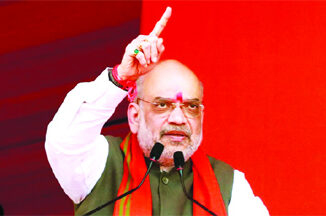
Dhemaji (TIP-Cl aiming that the demography of Assam changed during Congress rule, Union Home Minister Amit Shah on Friday said the BJP-led government under Prime Minister Narendra Modi is working to reverse the trend.
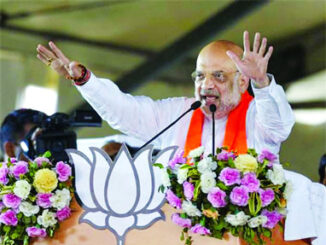
Addressing the closing ceremony of the 10th Mising Youth Festival organised by Takam Mising Porin Kebang (All Mising Students’ Union) at Kareng Chapori here as the chief guest, Shah appealed to people to vote for the BJP in the upcoming Assembly elections to free the state from infiltration.
“Assam’s demography totally changed during the Congress rule. The population of infiltrators rose to 64 lakh from nil, and infiltrators became a majority in seven districts,” he alleged.
Shah asserted that the Modi government was working through various means to reverse the demographic trend in the state.
“If you want to stop infiltration in Assam, then elect the BJP government for a third term and strengthen the hands of Chief Minister Himanta Biswa Sarma in the fight against illegal immigrants. Two BJP state governments in Assam have freed 1.26 lakh acres of land from encroachment by infiltrators,” he added.
The Union home minister also stressed the role played by the Mising community in stopping infiltrators from settling in Upper Assam through their lifestyle of hard work.
“It’s the responsibility of the Mising community to stop infiltration. You do not need to take up guns. Through your culture of hard work, infiltrators have not been able to come to this side,” he said.
Talking about the Bogibeel bridge over Brahmaputra river connecting Dibrugarh and Dhemaji, Shah said it stands as a symbol of India’s progress before the entire world.
“However, very few people in India know that the Bogibeel Bridge was built through the hard work and sweat of my brothers and sisters from the Mising community. Today, this bridge has become a powerful representation of the vision of a New India, both across the nation and globally,” he added.
The Union home minister further said that Rajya Sabha MP from Assam, Manmohan Singh had served as Prime Minister for 10 years but this bridge remained incomplete.
“The people of Assam placed their trust in Modi Ji, and it was under his leadership that this bridge was completed in just four years,” he added.
Shah also alleged that several tribal communities struggled to protect their identity during the Congress regime, while asserting that the BJP was committed to addressing the issues of the Mising society through an interlocutor appointed by the Centre. He lauded the unique ‘chang ghar’ or stilt house of the community, saying its architectural design in a way gives way to river during the flood, thereby silently fighting the global warming.
The Union home minister announced that a special requirement drive will be conducted for Mising youths for the central paramilitary forces.
“If I had not attended the Mising Youth Festival, my life would have felt incomplete without witnessing this truly magnificent spectacle. Today, I bow with deep respect to the sacred ‘Donyi-Polo’ tradition, which embodies nature worship and the faith of our Mising community,” he added.
Tag: Amit Shah
-

64 lakh infiltrators entered Assam in Congress rule: Amit Shah
-
BSF allowing infiltration to destabilize Bengal: Mamata
Firing a salvo at Union Home Minister Amit Shah, West Bengal Chief Minister Mamata Banerjee on Thursday, January 2, accused the BSF of allowing infiltration from Bangladesh to destabilise the state, calling it the Centre’s “nefarious blueprint”.
The CM said during an administrative meeting that the Border Security Force (BSF), which guards West Bengal’s border with Bangladesh, was allowing infiltration into the state. Banerjee’s remarks follow Union Home Minister Amit Shah’s charge made earlier saying “infiltration from Bangladesh” was disrupting peace in Bengal.
Mamata Banerjee said, “The BSF is allowing infiltration from different areas into Bengal. The TMC is not guarding the borders. The border is not in our hands, so if someone accuses the TMC of permitting infiltration, it must be pointed out that it was the BSF’s responsibility”.
Banerjee said she would write a strong letter to the Centre regarding the BSF allowing infiltration from Bangladesh. Stating that it is important to maintain peace in West Bengal and also have good relations with Bangladesh, Mamata Banerjee said, “We have no enmity, but goons are being allowed here. They commit crimes and return across the border. BSF is enabling this, and the Centre has a role in it.”
Slamming Banerjee for the remarks, BJP leader Sukanta Majumdar said she “has reached the ultimate level of delusion”. The Union Minister and BJP West Bengal chief said in a post on X (formerly Twitter), “Despite not providing land to set up outposts for border surveillance, she used to blame the Border Security Force for illegal infiltration. But now, crossing all limits of accusations, she has started blaming her own administration’s officials! According to her, the incompetent DMs and SPs under her administration are allowing foreign criminals to infiltrate the border to murder the elected representatives of her party.”
Arvind Kejriwal also questioned the BJP on the issue. Kejriwal asked, “Is the Centre deliberately allowing infiltration from the Bangladesh border or is the BJP government failing to protect the border?” -

Modi returns, Rahul finds foothold: Revisiting the grand political tamasha India witnessed this year
The year 2024 was significant for Indian politics as the Election Commission carried out the world’s largest electoral exercise with 642 million people voting to decide who would rule the nation for the next five years.
The elections were carried out in seven phases between April and June with thousands of government functionaries — who were manned by an even greater number of security forces — managing a whopping 10.5 lakh polling booths across the country.
The year also witnessed several states electing their new governments, with all but two retaining those in power. The opposition also got a new lease of life this year despite being on the losing side in the general elections.
Congress leader Rahul Gandhi became the Leader of Opposition in Lok Sabha as his party won 99 seats, nearly double the number it had scrambled to in 2019. The grand old party celebrated the performance like a win against the larger-than-life figure of Narendra Modi, who became the Prime Minister for the third consecutive time, though with figures far below the BJP’s expectations.
In the national capital, the tug of war between the Centre and the elected Aam Aadmi Party government witnessed strong pulls and drags this year. The tension peaked when AAP chief Arvind Kejriwal was jailed in March for his alleged role in the Excise Policy Scam. He functioned as Delhi Chief Minister behind bars for the next seven months until the Supreme Court granted him bail with conditions, following which he quit, paving the way for his party leader Atishi to take over as Delhi CM.
The resignation, arrest, and return of Hemant Soren in Jharkhand, the fall of the Biju Janata Dal government in Odisha after 24 years, the return of Chandrababu Naidu as Andhra Pradesh Chief Minister, the maiden Assembly Elections in the Union Territory of Jammu and Kashmir, and the NDA’s landslide victory in Maharashtra Elections were some of the other major political developments the country witnessed in 2024.
Here is a sneak peek into these and other landmark events in Indian politics this year.
Hemant Soren’s Fall And Rise
Four-time Jharkhand Chief Minister, Hemant Soren dogged it out against the central government in the very first month of 2024 but managed to retain power amid a high-decibel political drama at the fag end of the year.
The gripping political potboiler saw Soren quitting as chief minister hours before he was arrested by the Enforcement Directorate in a land scam case on January 31. Ahead of his arrest, the agency could not confirm his whereabouts for around 24 hours before he showed up in Ranchi. Soren claimed the charges against him were nothing but a vindictive action on the part of the BJP-led central government.
His chosen replacement Champai Soren functioned as Jharkhand CM for barely five months till Hemant was released on bail on June 28. Less than a week later, Champai Soren resigned as CM, making way for Hemant who took oath as CM on July 4. The move did not go down well with Champai Soren who quit JMM and joined the BJP on August 30.
In the November Assembly Elections, Hemant Soren signed off the year with flying colours as the JMM-led alliance won 56 seats, the party’s best performance since inception. Soren was unanimously elected as leader of the legislature party and again took oath as Chief Minister on 28 November.
Delhi CM Arvind Kejriwal Is Jailed
Embroiled in controversies that saw him running the Delhi government from behind bars for several months, Aam Aadmi Party National Convener Arvind Kejriwal was on a political roller-coaster in 2024.
With several of his key party members and ministers in the Delhi government already arrested in the alleged excise policy scam, Kejriwal also was on the Enforcement Directorate’s radar.
He managed to dodge multiple summons by the central agency before he was arrested on March 21 after the Delhi High Court rejected his plea for anticipatory bail. Kejriwal knew his arrest was around the corner and had time and again mentioned it in his prior public speeches.
The BJP were all but sure of him resigning from his post but Kejriwal stayed put and ran the Delhi government from jail for several months. He attempted to get bail from the Delhi High Court however the same was rejected multiple times.
During his jail time, Kejriwal’s legal battles took several twists and turns. He was granted interim bail by the Supreme Court from May 10 to June 1, 2024, to allow him to campaign for the Lok Sabha elections. After his interim bail expired, Kejriwal surrendered at Tihar Jail on June 2.
Delhi Rouse Avenue Court granted him bail on June 20. However, the Enforcement Directorate challenged the trial court order before the Delhi High Court which stayed the bail order on June 21. Five days later, the CBI arrested Kejriwal in a different case linked to the alleged excise policy scam.
The Supreme Court granted Kejriwal interim bail on July 12, but he remained in jail due to the CBI arrest. He was finally granted bail by the Supreme Court on September 13, 2024, after spending over five months in prison.
The bail, however, came with certain conditions including prohibiting him from making public statements about his arrest by the CBI. He was also ordered not to enter the office of the Delhi Chief Minister and sign any official files in his capacity as the Chief Minister.
Just four days later, on September 17, Kejriwal resigned as the Chief Minister of Delhi. He made it clear that he would only consider taking up the role again if he received a public mandate. On September 21, Atishi, the Delhi education minister till then, replaced Kejriwal as the youngest woman CM of Delhi.
2024 General Elections:
A Mammoth Exercise
India witnessed its 18th general elections this year as the entire country voted to choose the next central government. Of the 96.8 crore (968 million) people who were eligible to vote, 64.2 crore exercised the right including 312 million women, the highest-ever participation by female voters.
The 44-day electoral exercise was the second longest in country after the first parliamentary elections of 1951-52, which lasted for more than four months. The polls were conducted in seven phases beginning April 19 and ending June 1. The results were declared on June 4.
The BJP-led NDA alliance won the elections with Narendra Modi returning as Prime Minister for the third consecutive time. The BJP’s performance, however, was below expectations and it had to heavily rely on two main allies—the Telugu Desam Party of Andhra Pradesh and Janata Dal (United) of Bihar—to form a coalition government.
Eyeing 400 of the 543-seat Lok Sabha, BJP managed to win only 240 while its main partners TDP and JD(U) won 16 and 12 seats respectively. Overall, the NDA won 293 seats.
In 2019, the BJP won 303 seats with the NDA’s final tally at 353. In contrast, Congress recorded a turnaround winning 99 seats, nearly double its 2019 tally of 52, thereby coming back as a potent opposition.
Narendra Modi Takes Oath As PM For Third Consecutive Time
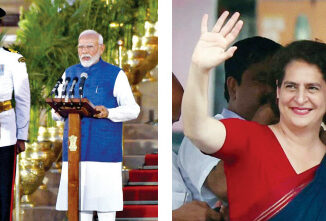
On June 9, Narendra Modi took oath as the Prime Minister of India for the third consecutive time after his BJP-led NDA alliance registered a victory in the 2024 Lok Sabha elections.
The ruling party’s rallies ahead of the elections were powered by the ‘Modi ki Guarantee’ campaign, which managed to help it win 240 seats, a lacklustre performance but strong enough to form a coalition government with the BJP as its most powerful constituent.
Three days after the results were declared on June 4, Modi confirmed the support of 293 MPs to President Droupadi Murmu after which he was sworn-in as the Prime Minister for the third time on June 9.
As for his individual performance from the Varanasi Lok Sabha seat, PM Modi had a shocking start on the result day as Congress’ Ajay Rai was seen leading in the first hour of vote counting.
PM Modi raced past in the second half defeating Rai by a margin of 1,52,513 votes. It was the second-lowest-ever victory margin (in percentage points) for a sitting prime minister and a steep fall for Modi compared to his 2019 margin of 4.5 lakh votes.
In his victory speech, Prime Minister Modi pledged to work with all states, regardless of the party in power, to build a developed India. He also laid out his vision for the third term saying it would be a tenure of big decisions and a key emphasis would be on uprooting corruption. He thanked TDP supremo Chandrababu Naidu and Bihar Chief Minister Nitish Kumar, his NDA allies for the electoral successes in Andhra Pradesh and Bihar.
Rahul Gandhi’s Resurgence As LoP, Priyanka’s Debut in Parliament
Ridiculed as ‘Shehzada’ and dismissed as ‘Pappu’, Congress leader Rahul Gandhi had the last laugh in the 2024 Lok Sabha election as he managed to gain big even though his party lost the elections.
Gandhi contested from Kerala’s Wayanad and Uttar Pradesh’s Rae Bareli, winning the southern seat by 3.64 lakh votes against his nearest rival Annie Raja of CPI and the northern one by 3.9 lakh votes against BJP’s Dinesh Pratap Singh. Rahul retained Rae Bareli and his sister Priyanka fought and won from Wayanad by an even greater margin in the by-elections later in the year, making her Parliament debut as she took oath as Lok Sabha MP on November 28.
Congress credited its spirited performance in the general elections to Rahul Gandhi for a campaign that focussed on people’s issues and welfare measures. The party lauded Gandhi for creating a new narrative through his Bharat Jodo Yatras, the on-foot marches he undertook from one end of the nation to another during which he was seen meeting people on the ground and getting to know about the real issues facing mainland India.
Even the harshest of his critics would concede that Gandhi’s 2024 campaign was by far his best one as he focussed on bread-and-butter issues and the party’s welfare guarantees which struck a chord with a section of the voters.
With Congress winning 99 seats in the elections (more than the requisite 55 or 10 per cent of the 543 seats), it meant that for the first time since 2014, it had the opportunity to pick a Leader of Opposition (LoP) in Lok Sabha. As an obvious choice, the party nominated Gandhi who was appointed the LoP on June 24, his maiden constitutional position since his entry into politics in 2004.
As LoP Gandhi was accorded a Cabinet Minister’s rank, enhancing his position in the protocol list. The work of the Leader of the Opposition in the Lok Sabha is opposite to that of the Leader of the House.
TDP Wins Andhra Elections,
Naidu Returns As CM
Andhra Pradesh saw a power transfer in 2024 as the ruling YSR Congress party lost the Assembly Elections to Telugu Desam party-led NDA. The elections were held in a single phase on May 13 with counting of votes on June 4. The polls were held simultaneously with the Lok Sabha elections.
The incumbent Jagan Mohan Reddy’s YSRCP faced a crushing defeat as it won just 11 seats against 151 in 2019. In contrast, the TDP won 135 seats in the 2024 elections against just 23 in 2019.
TDP Chief N Chandrababu Naidu returned as Chief Minister, taking oath on June 12. His last term as CM was from 2014 to 2019. Before the state bifurcation, he served as the CM of United Andhra Pradesh twice – 1995-99 and 1999-2004.
The other highlights of the 2024 Andhra Elections were Naidu’s son Nara Lokesh and Janasena leader Pawan Kalyan entering the Assembly for the first time. The BJP got a much-needed boost with the NDA alliance winning 21 out of the total 25 Lok Sabha seats in the state. YSRCP got just four MP seats.
Analysts said strong anti-incumbency coupled with a united fight by the opposition parties routed the ruling YSRCP. Though the Reddy-led government shelled out Rs 2.60 lakh crore towards doles over the last five years, there was no perceivable development in the state.
BJP Wins Odisha, Naveen
Patnaik’s 24-Year Rule Ends
Odisha crossed a political milestone in the 2024 Assembly Elections as the electors voted for the BJP, ending the 24-year Biju Janata Rule (BJD) rule. Naveen Patnaik’s party could manage only 54 seats in the elections, a huge dip from 113 in the previous elections.
BJP, on the other hand, secured a simple majority, winning 78 seats in the 147-seat Legislative Assembly. Held simultaneously with Lok Sabha elections, the elections were carried out in four phases with the first on May 13 and the last on June 1. The BJP also made significant gains, winning 20 out of 21 Lok Sabha seats in Odisha marking one of the strongest wins for the saffron party in the general elections.
As for Naveen Patnaik, the BJD leader contested from two seats – Hinjili and Kantabanji. He won from Hinjili with 66,459 votes, defeating BJP candidate Sisir Kumar Mishra by a narrow margin of 4,636 votes.
The election campaign by the BJP was intense, with Prime Minister Narendra Modi addressing several rallies and holding two road shows in Bhubaneswar and Puri. The BJP’s high-profile electioneering seemed to overshadow the BJD’s campaign, which was largely led by Patnaik and his aide VK Pandian.
2024 Tripura Peace Accord
On September 4, India’s northeast region witnessed a historic moment when the 35-year-long insurgency in Tripura came to an end following the signing of an agreement between the Centre, the Tripura government and two insurgent outfits of the state–the National Liberation Front of Tripura (NLFT) and All Tripura Tiger Force (ATTF).
The agreement was signed at North Block in the presence of Union Home Minister Amit Shah, Tripura Chief Minister Dr Manik Saha, and top leaders of both NLFT and ATTF. As per the agreement, the Centre sanctioned a special economic development package amounting to Rs 250 crore for a period of four years to be implemented by the state government for the overall development of tribals of Tripura.
“The Government of India and the Government of Tripura have been making concerted efforts to engage the tribal armed groups of Tripura in order to bring peace and harmony in the state, and rehabilitate the cadres so as to enable them to lead a normal life in the society,” the agreement stated.
The agreement stated that NLFT and ATTF would not extend any support to any other militant or armed groups by way of training, supply of arms, providing protection or in other manner.
Jammu And Kashmir UT Gets Maiden Elected Government
The Union Territory of Jammu and Kashmir flipped a page in its political history in 2024 as it witnessed its first assembly elections after the abrogation of Article 370 and downgrading of the state into two federally controlled territories in 2019.
The long-pending elections were finally carried out in three phases from September 18 to October 1 with counting of votes on October 8. They were held in the backdrop of the Supreme Court direction in December 2023 in which it had asked the Election Commission to “restore the democratic process” in the union territory by September 2024.
The opposition bloc led by the National Conference in the Union Territory won the elections bagging 49 of the 90 Assembly seats. NC emerged as the single largest party winning 41 seats followed by BJP (29) and Congress (6). Mehbooba Mufti-led PDP was able to win only three seats, the worst performance by the party since it was founded by Late Mufti Sayeed 25 years ago.
Former CM and National Conference leader Omar Abdullah was sworn in as the first Chief Minister of the J&K UT on October 16. Interestingly, a few months before the election dates were announced, the Ministry of Home Affairs increased the powers of the L-G Manoj Sinha-led administration by amending the Jammu and Kashmir Reorganisation Act, 2019.
The amendment entrusted more powers to the L-G for making decisions on police, all-India services officers and appointment of advocates and other law officers. He was also given powers for sanctioning prosecution in certain cases and taking decisions on anti-corruption bureau-related matters.
BJP’s Hat-Trick In Haryana
Buoyed by its success in Odisha, BJP recorded a hat-trick win in Haryana leaving the opposition stunned while managing to overcome anti-incumbency with ease.
The single-phase elections were held on October 5 and the votes were counted on October 8. The victory in Haryana was a significant milestone for the BJP as, despite predictions of a Congress-led alliance win, the saffron secured a majority with 48 seats in the 90-member Assembly, marking its third consecutive win in the state.
The election saw a high voter turnout of 67.90 per cent, with the BJP winning 39.94 per cent of the popular vote. The Congress, led by Bhupinder Singh Hooda, won 37 seats with 39.09 per cent of the popular vote.
Nayab Singh Saini, the 54-year-old OBC leader who was made CM in March to replace Manohar Lal Khattar in an unexpected appointment, took oath as the new Haryana Chief Minister for the second term on October 17.
The BJP’s victory was attributed to its strong campaign and the popularity of its leaders. The party’s decision to contest the election without a chief ministerial face also seemed to have worked in its favour.
The Congress, on the other hand, faced internal conflicts and was unable to capitalize on the anti-incumbency factor. The party’s alliance with the Communist Party of India (Marxist) also failed to yield the desired results.
The Jannayak Janta Party (JJP), which had allied with the BJP in the previous election, contested the election alone but failed to win any seats. The Indian National Lok Dal (INLD) also failed to make a significant impact, winning only two seats.
Mahayuti’s Landslide Victory In Maharashtra, Fadnavis Returns As CM
The BJP-led Mahayuti alliance registered a landslide victory in Maharashtra as the key western state went to polls on November 20. In the 288-seat Legislative Assembly, the BJP won 132 and its allies Shiv Sena and NCP bagged 57 and 41 seats respectively. The opposition Maha Vikas Aghadi (MVA) was handed one of the worst defeats in recent history as the three main constituents of the alliance could manage wins in just 50 seats–Congress 16, Shiv Sena (UBT) 20, and NCP (SP) 10.
The BJP was at the forefront of this spectacular performance, comprehensively managing to buck the anti-incumbency and emerge as the largest party in the state pocketing 132 of the 149 seats it contested in the politically significant western state. BJP’s success was led by its senior leader and state deputy CM Devendra Fadnavis, who eventually became the Chief Minister for the third time after some hiatus on the part of the Eknath Shinde-led Shiv Sena.
Fadnavis’ name was finalised for the Maharashtra Chief Minister post at a key meeting on December 4. A day later, he took an oath as the Chief Minister for the third time. The swearing-in ceremony was attended by Prime Minister Narendra Modi and other top political figures of the country. The results came as a fillip for the BJP after the unprecedented hat-trick in Haryana and helped the party overcome some of its setbacks in the general elections where it bagged just 240 seats.
Voters in the politically significant western state of Maharashtra, which sends 48 MPs to the Lok Sabha and gave the MVA a decisive 30 seats, clearly decided to go against the trend of that parliamentary victory just five months ago. -

Amid din, Lok Sabha sends ‘one nation, one election’ Bills to joint committee of Houses
New Delhi (TIP)- Amid uproar over Home Minister Amit Shah’s remarks related to B R Ambedkar, the Lok Sabha on Friday, December 20, referred the two bills on simultaneous polls to a joint committee of Parliament.
Opposition members were raising slogan haling Ambedkar and slamming Shah when the House met for the day.
Instead of taking up the Question Hour, Speaker Om Birla asked Law Minister Arjun Ram Meghwal to move the resolution to refer the Constitution (129th Amendment) Bill, 2024 and the Union Territories Laws (Amendment) Bill, 2024 referred to Joint Committee of Parliament comprising 27 members from the Lok Sabha and 12 from the Rajya Sabha. The resolution was adopted by a voice vote amid noisy scenes. The Lok Sabha was then adjourned sine die (indefinitely), bringing to an end the Winter session which began on November 25.
The two ‘one nation, one election’ (ONOE) bills, including one requiring an amendment in the Constitution, lay down the mechanism to hold simultaneous elections and were introduced in the Lok Sabha on Tuesday after a fiery debate.
BJP MP Bhartruhari Mahtab is being considered to head the joint committee of Parliament that will scrutinise the two bills proposing simultaneous elections, sources said.
With the BJP set to get the position of the chair for the crucial panel, official sources said Mahtab’s parliamentary experience may weigh in his favour. The strength of the committee was increased from 31 MPs to 39, giving representation to more parties. While the panel already includes BJP’s P P Chaudhury and Anurag Thakur, Priyanka Gandhi Vadra of the Congress is another prominent member on the committee. Among the Lok Sabha members, 17 are from the BJP-led National Democratic Alliance, including 12 from the BJP.
Lok Sabha adjourns sine die amid protest by Congress
The Lok Sabha was adjourned sine die on Friday, December 20, after four weeks of high drama and protests, which crippled the Parliament.
As soon as the Lok Sabha convened for the day, the Speaker called Law Minister Arjun Ram Meghwal to present a resolution for setting up a joint committee of Parliament to examine the bills related to ‘one nation, one election’. Slogans of ‘Jai Bhim’ reverberated in the House as the Speaker read out directions barring demonstrations and protests at the gates of Parliament.
As the protests continued, the Speaker adjourned the House sine die.
Even before the House proceedings began, Congress members started raising slogans “Jai Bheem, Jai Jai Bheem”.
Amid the slogans by the opposition, Prime Minister Narendra Modi entered the Lok Sabha chamber.
The Winter Session saw a standoff between the Congress and BJP with charges of ‘attempt to murder’ against the Opposition and they demand resignation of the Home Minister over remark on BR Ambedkar.
The Opposition MPs staged a protest at Vijay Chowk here on Friday again demanding Home Minister Amit Shah’s apology and resignation for allegedly “insulting” BR Ambedkar.
They also carried out a protest march from Vijay Chowk to Parliament. Congress general secretary Priyanka Gandhi Vadra also slammed the BJP over the FIR filed against the Leader of Opposition in the Lok Sabha Rahul Gandhi, saying it “shows their desperation level”. -
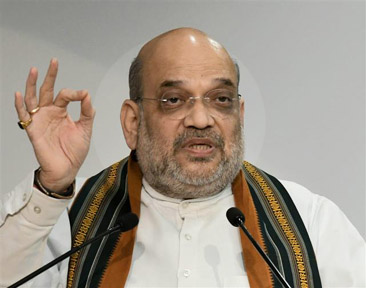
Counter-terrorism policy on cards: Amit Shah
Home Minister Amit Shah on Thursday, Nov 7, said the Centre will soon bring a National Counter Terrorism Policy and Strategy to combat the terror-related ecosystem across the country.
Addressing the inaugural session of the two-day anti-terror conference organised by the NIA, Shah said, “The terrorist attacks and their conspiracy are against us in a borderless and invisible manner. If we have to deal with it accurately, then our young officers will have to be equipped with the highest technology. We are taking the next step in the proactive approach that the Home Ministry has made to fight terrorism, terrorists and the terrorism ecosystem. We will come up with a National Counter Terrorism Policy and Strategy.”
In a significant observation, Shah told investigative agencies fighting against terrorism, to apply the UAPA without hesitation wherever needed and seek assistance from the NIA for investigations.
“The NIA has filed 632 cases, out of which in 498 cases, chargesheet has been filed. It has 95 per cent conviction rate. If the NIA can do this then why can’t state police do it? Wherever the UAPA is needed, it should be applied and wherever it is applied, the NIA as supervisory authority should ensure that it also provides assistance in such cases,” Shah said.
He further pointed out that though law and order is a State subject, terrorism doesn’t know any territorial limits. “When the RDX is recovered, it finds only two column space, but when bombs made of the same RDX explode, there is widespread media coverage,” the Home Minister said. -

In big blow to Naxals, 31shot dead in Chhattisgarh encounter
Dantewada (TIP)- The bodies of three more Naxalites were recovered on Saturday, October 5, morning in Chhattisgarh’s Bastar region, where a fierce encounter with security personnel took place a day ago, police said. With this, the number of Naxalites killed in the gun battle with the security personnel on Friday has risen to 31, they said, adding that a search operation is still under way in the area. “Bodies of three more Naxalites were recovered this morning from the dense forest where the encounter took place on Friday,” Inspector General of Police (Bastar range) Sundarraj P told PTI.
“With this, the toll of Naxalites in the encounter rose to 31. The identity of the Naxalites is yet to be ascertained, but prima facie it appears that they belonged to PLGA (People’s Liberation Guerilla Army) company No. 6, Platoon 16 of Maoists and east Bastar division of Maoists,” he said.
On Friday, the gunfight broke out between security forces and Naxalites around 1 am in a forest between Nendur and Thulthuli villages on Dantewada and Narayanpur inter-district border, where a joint team of District Reserve Guard (DRG) and Special Task Force (STF) was out on an anti-Naxal operation.
The intermittent firing lasted for a long time and the security forces continued search operations in the area.
This is the highest number of fatalities suffered by Maoists in a single operation since the creation of the state 24 years ago and the offensive comes more than five months after 29 Naxalites, including higher-ranking cadres, were gunned down in an encounter with security personnel in Kanker district.
A jawan of the state police’s DRG sustained injuries in a blast in a shell of Under Barrel Grenade Launcher (BGL) fired by Maoists during the gunfight, the official said.
Along with the bodies, a cache of weapons, including an AK-47 rifle, one SLR (self-loading rifle), one INSAS rifle, one LMG rifle and one .303 rifle were also recovered from the encounter spot, the IGP said.
With this, as many as 185 Maoists have been killed in 93 separate major encounters in Bastar in 2024 so far. While 663 Naxals were arrested, 656 ultras have surrendered in Bastar so far. The slain Maoists included three senior Naxal leaders, Jaganna, Rupesh and Jagdish, who were members of Dandakaranya Special Zonal Committee (DKSZC), the most powerful wing of Maoists. Security forces have intensified counterinsurgency operations in Bastar in the wake of Union home minister Amit Shah setting March, 2025 the deadline to end Naxalism in Chhattisgarh. Chhattisgarh chief minister Vishnu Deo Sai has hailed the security forces for executing the biggest ever counterinsurgency operation in Bastar in the state in which 28 Maoists were killed in Abujhmad on Friday. He said that Naxalism is going to end in Bastar soon and peace will return. Mr Sai recalled the deadline set by Union home minister Amit Shah to root out Leftwing extremism in the country by March 2026 and expressed confidence that it would be met. Sai convened a meeting of senior police officers here on Friday night to review the security situation in Bastar in the wake of the Abujhmad encounter. -

India government plans talks with warring Kuki, Meitei community leaders in Manipur
NEW DELHI (TIP): The Centre is likely to hold talks with Kuki and Meitei communities as a step to resolve the 16-month ethnic strife in Manipur, a TNS report says. This comes amid the now unsubstantiated claims by the Manipur Government that 900 Kuki militants may launch an attack in the state on September 28.
Highly placed sources informed The Tribune that the Centre may soon initiate talks with both communities as part of its initiative to restore peace in the troubled state.
Another source closely connected with developments in Manipur also indicated that the stage is being set by the Centre as well as the state government to reach out to both communities.
This source said although the situation is relatively peaceful as no violent incident has been reported in the last fortnight, the security forces are on high alert with 80 odd companies of both the BSF and the CRPF on vigil to counter any spike in violence.
A senior security official told the Tribune correspondent that the security personnel were prepared to combat any kind of situation, though any decision would be taken only after consultations with the state government.
Last week, the security adviser to the Manipur Government and head of the unified command, Kuldeep Singh, had claimed that 900 highly trained Kuki militants had entered the state through Myanmar and were planning attacks on Meiteis on September 28. The Kuki groups had consequently given a call for a complete shutdown in areas under their domination on that day.
On September 25, the Manipur Government retracted its claim, saying reports about Kuki militants’ infiltration through Myanmar could not be substantiated. This too led to Kuki groups lambasting the government. Kuki groups went on to say that the call given for total shutdown on September 28 would remain, adding that if there was any bloodshed, then the state government would be responsible for the same.
While sources indicated that the state government climbed down from its earlier claim about infiltration by Kuki militants to prevent a flashpoint between the two communities, as several Meitei groups had also threatened to launch counter-attacks on Kukis, the situation, they added, continues to remain on a boil.
Meanwhile, there are indications that the Centre was likely to initiate talks with both groups as part of its peace initiative in a state, which has seen killing of more than 200 persons and displacement of 50,000 ever since the ethnic strife began there on May 3.
Earlier this month, Home Minister Amit Shah had said that the Centre was hopeful of controlling the situation in strife-torn Manipur, as talks were going on with both Meiteis and Kukis to find a solution to the ongoing ethnic violence.
He had further junked talks about Manipur Chief Minister N Biren Singh’s resignation or replacement. “Of late, there have been sporadic cases of violence, but Manipur has been relatively calm over the last three months. There has been no incident of violence in the last three days. We are sure of regaining control and restoring peace,” Shah had said on September 17. He further said that it was an ethnic issue that could not be resolved unless both ethnicities engage in talks. “We are talking to both Kuki and Meiteis communities, Shah said, adding that Biren Singh won’t be replaced as Chief Minister.
-

Punishment given for crimes against women should be publicized, says PM Modi in his address to the Nation on 78th Independence Day
Thanks world leaders for greetings
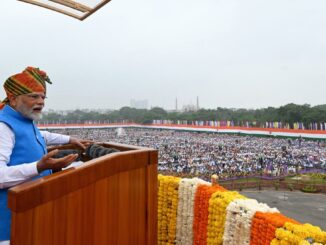
NEW DELHI (TIP): Prime Minister Narendra Modi in his 11th address to the nation from the Red Fort, highlighted the achievements and plans to lay down the roadmap for a ‘Viksit Bharat’ by the year 2047.
PM Modi gave a renewed push to the BJP’s ideological aim of a Uniform Civil Code, reframing the idea as a “secular civil code” enshrined in the Constitution and a way of ensuring equality before the law for all.
PM Modi also thanked several world leaders including French President Emmanuel Macron, and Italian Prime Minister Giorgia Meloni.
Prime Minister Narendra Modi unfurled the national flag for the 11th time in a row at the Red Fort. Security was tightened across India with over 10,000 cops, facial recognition cameras and snipers deployed in Delhi and security camps set up in 13 villages in Chhattisgarh’s Maoist-hit Bastar region where the Tricolor will be hoisted for the first time to celebrate Independence Day.
Snipers, elite SWAT commandos, kite catchers and sharpshooters were positioned at strategic locations for the security of the Prime Minister and other VVIP guests at Red Fort in New Delhi. Additionally, 700 AI-based facial recognition CCTV cameras have been installed in central and New Delhi. These cameras have high-resolution pan-tilt-zoom features, allowing identification of a person from a distance, the officials said.
Meanwhile, Mr. Modi recalled the sufferings of people impacted by India’s partition and reiterated the commitment to always protecting the bonds of unity and brotherhood in the nation on August 14. Union Home Minister Amit Shah also paid tributes to all those who suffered during India’s partition in 1947, saying a nation that remembers its history can build its future and emerge as a powerful country. President Droupadi Murmu addressed the nation on the eve of Independence Day on August 14 and emphasized the need to strengthen affirmative action as a tool for inclusion while urging the rejection of divisive tendencies rooted in perceived social hierarchies. She also said that India’s successful conduct of elections strengthens democratic forces around the world.
The Indian contingent from the Paris Olympics, student beneficiaries from the Atal Innovation Mission, workers of the Border Roads Organisation and sarpanches were among the 6,000 special guests who attended the 78th Independence Day celebrations in New Delhi on August 15.
(With inputs from The Hindu) -

Homage paid to victims of partition on “Partition Horrors Remembrance Day”
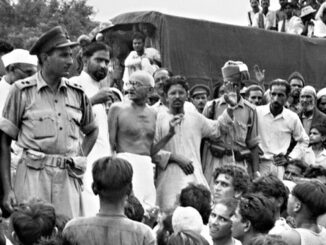
NEW DELHI (TIP): Prime Minister Narendra Modi on Wednesday, August 14, 2024) recalled the sufferings of people impacted by India’s partition and reiterated the commitment to always protecting the bonds of unity and brotherhood in the nation.
On the Partition Horrors Remembrance Day, he said, “We recall the countless people who were impacted and greatly suffered due to the horrors of Partition. It is also a day to pay tributes to their courage, which illustrates the power of human resilience. A lot of those impacted by Partition went on to rebuild their lives and attain immense success.” He added, “Today, we also reiterate our commitment to always protect the bonds of unity and brotherhood in our nation.”
Union Home Minister Amit Shah also paid tributes to all those who suffered during India’s partition in 1947, saying a nation that remembers its history can build its future and emerge as a powerful country. “On Partition Horrors Remembrance Day my homage to the millions who suffered inhumane pains, lost lives, turned homeless during this most hideous episode of our history,” Mr. Shah wrote on ‘X’.
He said observing this day is a foundational exercise in the process of nation-building under the leadership of Prime Minister Narendra Modi.
The Modi government has been observing August 14 as the ‘Partition Horrors Remembrance Day’ since 2021 in remembrance of those who lost their lives during the country’s partition.
While making the announcement about the ‘Partition Horrors Remembrance Day’ in 2021, PM Modi had said the day would be observed in the memory of the struggles and sacrifices of people as the pain of partition can never be forgotten.
Mr. Modi had also noted that millions of people were displaced and many lost their lives due to mindless hate and violence caused by the partition.
(Source: TIP) -

Kargil Victory Day : PM Modi pays homage to Kargil war martyrs in Drass
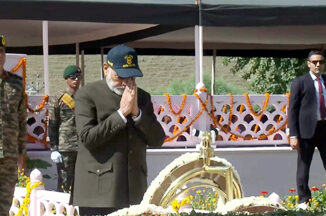
LADAKH (TIP): Prime Minister Narendra Modi, Indian Army Chief General Upendra Dwivedi, Chief of Air Staff Air Chief Marshal V.R. Chaudhari and Navy Chief Admiral Dinesh K. Tripathi paid tributes to soldiers at the Kargil War Memorial in Drass on the occasion of the 25th anniversary of the Kargil Vijay Diwas.
Mr. Modi said that Pakistan has not learnt any lessons from history and has faced defeat whenever it carried out any misadventure. He noted that Pakistan was trying to remain relevant through terror and proxy war, but it has faced defeat whenever it has carried out any misadventure. “Today, I am speaking from a place where masters of terror can hear my voice directly. I want to tell patrons of terrorism that their nefarious designs will never succeed,” he said.
“Our Bravehearts will crush terrorism and enemy will be given a befitting response,” he asserted. The prime minister’s remarks come in the backdrop of a surge in terror incidents in Jammu. Mr. Modi said, “In Kargil, we not only won the war, we gave a wonderful example of truth, restraint and strength”.
President Droupadi Murmu hailed the “courage and extraordinary valor” of the armed forces and urged all the countrymen to “draw inspiration from the sacrifice and valor” of the soldiers.
In a post on X, she said, “Kargil Vijay Diwas is an occasion for a grateful nation to pay tribute to the indomitable courage and extraordinary valor of our armed forces. I pay tribute to each soldier who made the supreme sacrifice while protecting Mother India on the peaks of Kargil in the year 1999 and bow in reverence to their sacred memory.”
“I am confident that all countrymen will draw inspiration from their sacrifice and valor. Jai Hind! Jai Bharat!,” she added. Defense Minister Rajnath Singh also offered tribute to the soldiers to commemorate the occasion. In a post on X, he heaped praise on the “unwavering commitment, valor and patriotism” of the soldiers ensuring the safety and security of the country.
“Today, on the 25th anniversary of Kargil Vijay Diwas, we remember the indomitable spirit and courage of the brave soldiers who fought valiantly in the 1999 war. Their unwavering commitment, valor and patriotism ensured that our country remained safe and secure. Their service and sacrifice will continue to inspire every Indian and our coming generations,” Mr. Singh mentioned in the post.
Union Home Minister Amit Shah said that Kargil Vijay Diwas is a symbol of the unwavering resolve and valor of the brave soldiers of the army. “Kargil Vijay Diwas is a symbol of the unwavering resolve of the valor of the brave soldiers of the army. In the Kargil war, the brave soldiers displayed the ultimate valor in the inaccessible hills of the Himalayas and forced the enemy army to kneel down, and made the country proud by hoisting the tricolor again in Kargil,” he said in a post on X. “Today on ‘Kargil Vijay Diwas’ I salute the brave soldiers who protected the motherland with their courage in this war. The nation will never forget your sacrifice, dedication and sacrifice,” he added. Minister of External Affairs (EAM) S. Jaishankar also took the opportunity to “salute the valor and dedication of soldiers” on the occasion. “On Kargil Vijay Diwas, salute the valor and dedication of our brave soldiers. The legacy of their courage and patriotism acts as a guiding light for all Indians,” he said in a post on X.
In a post in Hindi on X, the Congress said, “’Kargil Vijay Diwas’ is a symbol of the indomitable courage and determination of the country’s heroes. On this day, the brave sons of Mother India, on the strength of their amazing valor, drove away the enemy from Kargil and hoisted the tricolor flag.” “We are proud of the heroes dedicated to protecting the nation. We salute them,” the party said.
Congress president Mallikarjun Kharge, in a post on X, said, “Congratulations to our brave soldiers, their families and all Indians on the occasion of 25th ‘Kargil Vijay Diwas’. We bow our heads in tribute to the martyrdom of our heroes who made the supreme sacrifice while protecting our motherland in the Kargil War.” “We are proud of their indomitable courage and valor,” he said.
“On Kargil Vijay Diwas, my salutations to the immortal martyrs who sacrificed themselves to protect India. The country will always be indebted to them for their supreme sacrifice,” Rahul Gandhi said in a post in Hindi on X. Congress general secretary Priyanka Gandhi Vadra said Kargil Vijay Diwas is that golden page of Indian military history which reminds us of the valor and sacrifice of our brave soldiers. “In the Kargil War, the brave soldiers of our army, while facing difficult conditions, put their lives at stake and drove away the enemy and made the country proud by hoisting the tricolor on the high peaks of the Himalayas,” she said. “Salute to all the brave soldiers who made the supreme sacrifice to protect the country! The country will always remain indebted to our brave martyrs,” she added.
As the country celebrates the 25th anniversary of the Kargil Vijay Diwas today, the families of the soldiers remember the bravery and dedication of their loved ones who laid their lives during the war between India and Pakistan at icy heights in 1999.
Madhubala, widow of Kargil hero Vinod Kumar, said, “On May 18, 1997, we got married and on June 14, 1999, he lost his life. I feel very good to be here and feel proud. Rajender Kumar, the elder brother of Kargil hero, soldier Bejender Kumar, said that he feels proud that his brother died for the country. “I feel so proud; he died for the country. We remember him every day,” he said.
Prashanti, wife of Kargil hero, Group Captain K. Nachiketa Rao, said that, like all the other countrymen, she used to pray for his repatriation from Pakistan everyday. Group Captain Rao was a fighter pilot in the Indian Air Force who was captured by Pakistani forces before he was handed over to the Indian authorities. “I feel very proud. The bravery and courage he had shown. We were not married at the time of the war. We married after two years of it. Like all the other countrymen, we used to pray every day for his repatriation (from Pakistan). We feel proud as there are very few people who get such a chance to show such bravery and then get to comeback and live to tell those tales,” she said.
Kargil Vijay Diwas, observed annually on July 26, commemorates the success of Operation Vijay in 1999. During this conflict, Indian forces successfully reclaimed strategic positions in the Kargil sector of Jammu and Kashmir that had been infiltrated by Pakistani soldiers and terrorists.
(Agencies) -

Home minister Amit Shah reviews security in J&K after terror attacks
New Delhi (TIP)- Union home minister Amit Shah on Friday, June 14, reviewed the security in Jammu and Kashmir with the senior officers of his ministry and Intelligence Bureau (IB) in the wake of four terror attacks in the Jammu region since Sunday, in which 10 people, including nine civilians and a Central Reserve Police Force (CRPF) jawan, were killed.
People familiar with the development said Shah was apprised of the current deployment scenario in the Jammu region, at the Line of Control (LOC) and international border, the status of combing operations by the security forces to locate the terrorists and steps being taken to identify their local supporters.
The home minister has directed that he will chair a detailed meeting on June 16 in North Block, which will be attended by Lt Governor Manoj Sinha, National Security Adviser (NSA) Ajit Doval, Union home secretary Ajay Kumar Bhalla, senior officers from the army, J&K police, central paramilitary forces and local administration, to discuss further steps to be taken to ensure foolproof security and preparations for Amarnath Yatra.
“Specific instructions on how to deal with the situation are expected from the home minister on Sunday, particularly after Prime Minister Narendra Modi has already given clear directions to deploy the full spectrum of counterterror capabilities to deal with the spate of attacks,” said an officer, who did not want to be named.
A decision on whether to send additional companies of paramilitary forces to the affected districts of Rajouri, Kathua, Samba, Jammu and Poonch will also be taken in the June 16 review meeting, said this officer.
Currently, there are 70 battalions (about 70,000) of central paramilitary forces deployed in Jammu and Kashmir to deal with insurgency and law and order issues. Besides, the Border Security Force (BSF) and army are responsible for maintaining vigil at the border.
At the entire 3,323-km-long land border with Pakistan, there are currently 675 border outposts (BOPs), while work on 31 more BOPs is expected to be completed by June 2025 and alternative sites are being explored for 30 more such posts. Overall, the forces will have 736 BOPs at the western border. The government has also sanctioned a 2097.646 km fence, out of which 2064.666 km has been completed and the work at the remaining 32.98 km is in progress.
The intelligence agencies are learnt to have conveyed to the ground forces that infiltration attempts from the LoC and the international border have increased in the past few weeks, with Pakistan trying to foment trouble in the region with the help of proxy outfits of Lashkar-e-Taiba (LeT) and Jaish-e-Mohammad (JeM) among others. Data suggests that overall infiltration has significantly dropped in J&K since 2017, from 419 attempts (136 net infiltrations) to 53 attempts (14 net infiltrations) in 2022 and almost negligible last year. Till June 2023, there were zero infiltration incidents reported in the entire region.
To contain cross-border infiltration, said a second counter-terrorism official, “we are strengthening border infrastructure, there is multi-tiered deployment along the International Border and LOC, and near the ever-changing infiltration routes”.
“There is also round-the-clock surveillance and patrolling on the border and establishment of observation posts, increase in number of BSF personnel in sensitive areas, construction of border fencing and floodlighting, and use of advance technological equipment like handheld thermal imager (HHTI), night vision device (NVD), twin telescope, unmanned aerial vehicles (UAV). Subsequently, intelligence setup is regularly upgraded,” the second officer added.
In four back-to-back terror attacks in Reasi, Kathua and Doda districts since Sunday, highly trained foreign terrorists from Pakistan have targeted civilians and security forces.
In one attack, a group of three to four militants opened fire on a joint check post of the 4 Rashtriya Rifles and the Jammu & Kashmir Police in Doda’s Chattargala area on the Bhaderwah-Pathankot road at 1.45am on Wednesday. The ensuing gunbattle lasted several hours, leaving five army personnel and a special police officer injured.
On June 12, evening, officers said the second attack was on in the Kota Top area, 150 km away from Chhattargala, when a second group of terrorists attacked a police team and injured head constable Fareed Ahmed.
In Kathua another gunbattle began late on Tuesday night and continued into June 12 morning, leaving one CRPF jawan dead, six security personnel and one civilian injured, and two terrorists neutralised.
The three gunfights came on the heels of an attack on a bus carrying pilgrims in Reasi on June 9 when armed terrorists opened fire on the vehicle, causing it to lose control and plunge into a gorge, with nine people dead and 42 others injured.
Source: HT -

This is Rahul Gandhi vs Modi election, says Amit Shah
Hyderabad (TIP)- Union Home Minister Amit Shah on Thursday, May 9, said the 2024 election is Rahul Gandhi vs Narendra Modi and that it is a contest between vote for development and “vote for jihad”.
Addressing an election rally in Bhongir Lok Sabha constituency of Telangana, he said the election is between Prime Minister Narendra Modi’s “Bharatiya guarantee” against Congress leader Rahul Gandhi’s “Chinese guarantee”.
Describing the Congress, BRS and AIMIM as a triangle of appeasement, he said the parties don’t let Ram Navami procession to take place and that they also oppose CAA.
“These people don’t allow the celebration of ‘Hyderabad Liberation Day’ (September 17). These people oppose CAA. These people want to run Telangana on the basis of Sharia and Quran,” he said.
BJP would secure nearly 200 seats in the three phases of Lok Sabha elections held so far and Telangana needs to vote to help the party cross the target of 400 seats, Shah said. Observing that BJP had won four of the 17 Lok Sabha seats in Telangana in 2019, he asked Chief Minister A Revanth Reddy to realise that BJP would win more than 10 seats in the present elections.
The double digit score in Telangana would make PM Modi cross 400 seats, he predicted. Referring to Congress’ allegation that BJP would change the Constitution and abolish reservations, he said Congress wants to fight elections by telling lies.
Congress says Modi would scrap quotas but he has not done so despite being in power for the last 10 years with full majority, he said.
But, Congress in Telangana robbed the reservations of SC, ST and OBCs by providing four percent reservation to Muslims, he alleged.
Shah said BJP would end Muslim reservation and increase SC, ST and OBC quotas, if they came to power.
“Modi ji does what he says. The guarantees of Rahul baba (Gandhi) don’t last even till sunset,” he said.
At the time of Telangana assembly polls, Rahul Gandhi had promised Rs two lakh farm loan waiver, Rs 15,000 every year for farmers, Rs 12,000 annually for agriculture workers, Rs 500 bonus on MSP for paddy farmers, Rs five lakh loan to students without guarantee, ‘scooty’ to college going girls and international schools in every tehsil, but they have not been implemented, Shah said.
Congress withheld the construction of Ram temple for 70 years, but Modi, in just five years, won the case, performed ‘bhumi puja’ and later participated in the consecration, he said.
AICC president Mallikarjun Kharge said that though people from Rajasthan and Telangana don’t have anything to do with Kashmir, the people of Bhongir would be ready to sacrifice their life for the sake of Kashmir, he said.
Highlighting the abolition of Article 370, Shah also said Modi has ended terrorism, Naxalism and made the country secure.
He alleged that AIMIM president Asaduddin Owaisi, BRS and Congress are “ABC of appeasement”.
Modi removed triple talaq, but Congress, BRS and AIMIM want to bring it back, he said, adding that the parties also boycotted the consecration of the Ram temple.
He also alleged that Revanth Reddy made Telangana the “ATM” of Congress.
Shah highlighted the various development works undertaken by the Modi government in the Bhongir LS constituency, including establishment of AIIMS. Source: PTI -

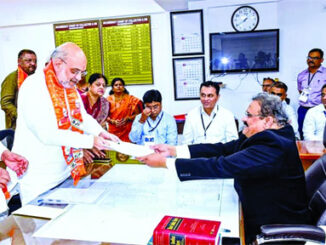
Amit Shah files nomination from Gandhinagar
Union Home Minister Amit Shah on Friday, April 19, filed his nomination for the Gandhinagar Lok Sabha seat and said the General Election was all about giving a third term to Prime Minister Narendra Modi. Shah was accompanied by Gujarat Chief Minister Bhupendra Patel when he submitted his nomination to the Gandhinagar Collector and District Election Officer MK Dave in the state capital at 12.39 pm, considered as “Vijay Muhurat”.
Talking to reporters, Shah said this General Election was all about giving a third term to PM Modi so that he could make India a developed nation by 2047.
He said Modi’s third term would be crucial because his first two terms went into correcting the mistakes made by the previous Congress-led UPA government. “This election is all about making Narendra Modi our PM for the third time. Modiji has resolved to turn India into a developed country by 2047 and number one in all sectors. The next five years are crucial if we want to achieve that because the last 10 years went into filling pits (gadde) created by the previous UPA government,” Shah said. The next five years would be used to create a strong foundation for “Viksit Bharat”, he said.
The opposition Congress has fielded party secretary Sonal Patel from Gandhinagar. Voting for all 26 Lok Sabha seats in Gujarat will be held in the third phase on May 7. -
Repealing sedition law: Move welcome, but substitute shouldn’t be draconian
Often misused against activists and journalists, the archaic sedition law is all set to become history. Union Home Minister Amit Shah — who introduced three Bills in the Lok Sabha on Friday to replace the Indian Penal Code (IPC), the Criminal Procedure Code and the Indian Evidence Act — announced that the sedition law had been proposed to be removed. The decision comes as a pleasant surprise as barely two months ago, the
Law Commission had recommended retention of Section 124A (sedition) of the IPC and enhancement of punishment for the offence. Citing its misuse and the resultant ‘chilling effect’, the Supreme Court had in May last year put the sedition law on hold, pending a review. Absent from the original IPC, which was drafted by Lord Macaulay and came into force in 1862, the sedition law was added in 1870. It was widely used to suppress the freedom struggle after its ambit was expanded in 1898. The Punjab High Court had in Tara Singh Gopi Chand vs The State (1951) declared Section 124A IPC unconstitutional, but the Supreme Court upheld its validity in Kedarnath Singh (1962), while restricting its scope.
However, the Bharatiya Nyaya Sanhita, 2023 — which will replace the IPC — proposes to have a provision that punishes ‘acts endangering sovereignty, unity and integrity of India’ with life imprisonment or imprisonment up to seven years and a fine. One hopes it’s not the sedition law by another name. Doing away with this law is not a standalone measure. It’s part of an overhaul of the criminal justice system undertaken by the government, two decades after Justice VS Malimath Committee on Reforms of Criminal Justice System submitted its report to the Home Ministry. There is a lot that can be changed in procedural laws. But the government should tread cautiously while redrafting the substantive criminal law.
(Tribune, India)
-

Some global forces use tech for social harm: Amit Shah at G20
Gurugram (TIP)- Union home minister Amit Shah said on Thursday, July 13, pushed for “uniformity” in global laws and a “united front” to deal with cyber threats, adding that some antisocial elements and global forces are using technology to cause economic and social harm to citizens and governments.
The home minister underlined threats emanating from cyber criminals using the darknet, metaverse, deepfakes, ransomware and toolkit-based misinformation campaigns, and who target critical information and financial systems. He asked members of the G20 to have a “dedicated common channel” to prevent financial irregularities through the use of digital currencies.
“Our vision for the internet should neither compromise the security of the nation by allowing excessive freedom nor should it adopt an isolationist structure like digital firewalls,” he said, explaining the need for a balanced vision for the internet.
“Today, we live in a big global digital village. Although technology is a positive development in bringing human beings, communities, and countries closer, there are also some antisocial elements and global forces that are using technology to cause economic and social harm to citizens and governments,” Shah said while inaugurating the two-day “G20 Conference on Crime and Security in the Age of NFTs, Artificial Intelligence and Metaverse“ in Gurugram.
Over 900 participants from G20 countries, nine special invitee countries, international bodies such as Interpol, and technology leaders and domain experts from India and across the world are attending the conference.
While the home minister did not name any country, there have been instances of cyberattacks by China-backed hackers on India’s key establishments in the recent past, including the hacking of All India Institute of Medical Sciences servers last year. Asserting that the metaverse may create new opportunities for terrorist organisations, primarily for propaganda, recruitment, and training, Shah said, “This will make it easier for terrorist organisations to select and target vulnerable people and prepare material according to their vulnerabilities.”
“Cybercriminals are perpetrating incidents ranging from ransomware attacks, sale of critical personal data, online harassment, and child abuse to fake news and misinformation campaigns with ‘toolkits’. At the same time, there is also a growing tendency to strategically target critical information and financial systems. Such activities are a matter of national concern, as their activities have a direct impact on national security, law and order, and the economy. If such crimes and criminals have to be stopped, then we have to think and also act by rising above the conventional geographic boundaries,” Shah said.
The home minister noted that terrorists are leveraging technology, which is becoming a challenge for law enforcement agencies. “The transformation of our security challenges from ‘dynamite to metaverse’ and ‘hawala to crypto currency’ is a matter of concern for countries across the world. Terrorists are finding new ways to perpetrate violence, radicalise youth and raise financial resources. New methods in the form of virtual assets are being used by terrorists for financial transactions”.
Cryptocurrencies are not recognised as payment instruments in India and the government is yet to take a call on whether to restrict the conversion of rupees to any of the cryptocurrencies — which effectively amounts to a complete ban. It does, however, apply a 30% tax on inward conversions, and has urged at international forum a concerted decision on how these currencies can be used.
“And all of us, together, have to devise a common strategy against it,” Shah added.
Emphasizing that no single country or organisation can combat cyber threats alone, Shah said that “it requires a united front”.
“We aim to create a ‘cyber success world’ and not a ‘cyber failure world’. Together, we can harness the potential of these technologies while ensuring a ‘secure and prosperous digital future for all. Let us seize this opportunity to collaborate, share our ideas and forge international partnerships,” he said.
Commenting on the rise in cybercrime involving digital currency, Shah said the nature of the cyber threat landscape has spread across national boundaries, necessitating cooperation and sharing of information by nations, organizations and stakeholders to effectively combat cybercrimes. Source: HT -

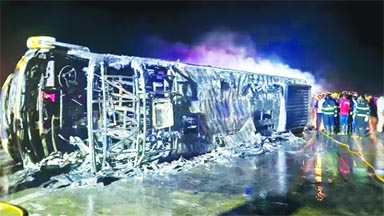
25 bus passengers charred to death as vehicle catches fire on expressway in Maharashtra
Mumbai (TIP)- At least 25 people died after a bus carrying 33 passengers burst into flames on the Samruddhi Mahamarg expressway in Maharashtra’s Buldhana, police said. Deputy SP Baburao Mahamuni said that the injured were to Buldhana Civil Hospital, reported ANI. The incident happened around 2 am on Saturday, July 1, when a private travels bus was on its way from Nagpur to Pune and rammed into a divider near Sindkhedraja in Buldhana district, police said.
Buldhana SP Sunil Kadasne told PTI that as per preliminary information, a bus tyre burst and the vehicle hit a pole, collided with a divider and caught fire. Of the 33 passengers in the bus, 25 were charred to death.
The driver of the bus, who survived the incident, said that the bus overturned after a tyre burst leading to flames in the bus, according to Kadasane.
Maharashtra chief minister Eknath Shinde has announced an ex-gratia of Rs 5 lakh for the next of kin of the deceased in the bus accident, according to his office.
Calling the incident ‘very shocking and heart-wrenching’, Maharashtra deputy CM Devendra Fadnavis said his government is in touch with the district as well as the police administration and all kinds of help are being provided immediately.
“The state government will bear the cost of treatment of the injured,” he said.
Union home minister Amit Shah expressed grief over the incident and said that treatment is being provided to the injured by the administration.
“The road accident in Maharashtra’s Buldhana district is heartbreaking. In this hour of grief, my thoughts are with the families of those who lost their lives in this horrific accident. Quick treatment is being provided to the injured by the administration. I pray to God for his speedy recovery,” Shah said in a tweet in Hindi.
Uttar Pradesh chief minister Yogi Adityanath tweeted, “The loss of lives in the unfortunate incident of fire in a bus on the Mumbai-Nagpur Expressway is extremely sad and heart-wrenching. My condolences are with the bereaved families.”
“I pray to God that the departed souls get a place in his holy feet and the injured get speedy recovery.” -

After fresh Manipur violence, Amit Shah to visit state, hold talks with stakeholders
Guwahati (TIP)- Union home minister Amit Shah on Thursday, May 25, called for peace in violence-torn Manipur and said he will visit the northeastern state next week to hold talks with all stakeholders — the first major public intervention by the Centre since ethnic clashes broke out three weeks ago, killing 74 people and displacing another 30,000. Speaking at an event in neighbouring Assam, Shah said only talks between various groups can bring calm. His comments came a day after fresh bouts of violence roiled a district in Manipur that had previously been relatively unscathed by the clashes that convulsed the state from May 3. “I will go to Manipur soon and stay there for three days but before that, both groups should remove mistrust and suspicion among themselves and ensure that peace is restored in the state,” he said.
Union minister of state (home) Nityanand Rai, who arrived in Imphal on Thursday, told reporters that Shah will reach Manipur on May 29 to take stock of the situation and stay till June 1.
“The Centre will ensure that justice is delivered to all those who suffered in the clashes in the state, but people must hold dialogue to ensure peace….in the last six years, prior to the recent clashes, there was no blockade or bandhs in Manipur and people must ensure the return of such a situation again,” Shah said.
“Charcha ke saath hi shanti ho sakti hain (Peace can only be restored through dialogue),” he added.
This is the first announcement of a high-level intervention by the Centre in Manipur since May 3, when clashes broke out in Churachandpur town after tribal Kuki groups called for protests against a proposed tweak to the state’s reservation matrix, granting scheduled tribe (ST) status to the majority Meitei community. Violence quickly engulfed the state, displacing tens of thousands of people who fled burning homes and neighbourhoods into jungles, often across state borders. To be sure, the Indian Army has been deployed in the region since May 4. Source: HT -

Supreme Court disapproves of Amit Shah’s statement on scrapping of 4pc Muslim quota in Karnataka
NEW DELHI (TIP): The Supreme Court on Tuesday disapproved of senior BJP leader and Union Home Minister Amit Shah’s statement on scrapping the four per cent quota for Muslims in government jobs and educational institutions in poll-bound Karnataka, saying a sub-judice issue should not be politicized.
A Bench of Justice KM Joseph, Justice BV Nagarathna and Justice A Amanullah said public functionaries should exercise caution in their statements about issues pending before courts.
“When the matter is pending before the court and there is a court order on Karnataka Muslim quota, then there should not be any political statements on the issue. It’s not appropriate. Some sanctity needs to be maintained,” it noted. The top court was hearing petitions challenging the Karnataka government’s decision to scrap four per cent reservation for Muslims under OBC category in government jobs and educational institutions and distribute it equally to Vokkaligas and Lingayats in the state.
The comments from the Bench came after senior counsel Dushyant Dave, representing the petitioners, raised the issue and said every day the Union Home Minister was making statements on the issue which amounted to contempt of court. “They (BJP leaders) are proudly saying they have withdrawn (quota for Muslims),” Dave told the Bench. “If what you are saying is true, then we wonder why when the matter is sub-judice before the Supreme Court, there should be statements made by anybody as such?” Justice Nagarathna commented.
Solicitor General Tushar Mehta, representing the Karnataka Government, objected to Dave’s submission, saying the Bench had not been told about the “content and context” of Shah’s statement.
“I don’t wish to do politics here. He (Dave) may move an application. We don’t know what statement is being attributed to (Shah),” Mehta said, asserting any religion-based reservation was unconstitutional even as he maintained “We understand and respect the sentiment of the court.”
“Solicitor General making a statement in the court is not a problem but someone saying anything on a sub-judice matter outside the court is not appropriate…In 1971, the West Bengal CM was held for contempt for holding a press conference defending a rationing order that was the subject matter of a challenge before the court…”We may have reservations about reservations but we can’t let it be politicized in this manner…,” said Justice Joseph.
“I can’t respond to political [allegations] … I can’t shout like my learned friend (Dave)…,” Mehta said, adding the matter was being politicized before the court.
As Dave interjected to say, “This was not religion based,” Mehta said, “Lordships will have to control (Dave). Can’t let this become a fish market… So far no judge has controlled him…That’s the problem…Some judge will have to.
“Some sanity must prevail… There is no such statement (by Shah) to my knowledge. But in the (election) manifesto one is entitled… Even I can’t be instructed as to how to argue in a vitiated atmosphere,” Mehta went on.
At one point, Justice Joseph asked Dave not to shout and make political statements in the court.
The Bench deferred the hearing to July 25 after the Solicitor General said he was busy with the Constitution Bench hearing on the same sex marriage issue. However, he assured the top court that the earlier reservation regime would continue till the next date of hearing. Dave said he will file an application and bring it on record the statements being made on the matter. As Central Muslim Association’s counsel wanted the top court to restrain the press from publishing such speeches, Mehta asserted that media can’t be censored like this. After the Karnataka Government’s March 27 decision – that came weeks before the May 10 assembly elections, Muslims will be eligible to vie for 10 per cent reservation under the Economically Weaker Sections (EWS) category while the four per cent quota enjoyed by them for three decades stood distributed equally between Veerashaiva-Lingayats and Vokkaligas – considered to be numerically dominant and politically influential communities in the state. The Supreme Court had on April 13 questioned the Karnataka government’s decision to scrap the four per cent reservation for Muslims under OBC category in government jobs and educational institutions, saying prima facie it appeared to be based on “fallacious assumptions”.
-

BJP and allies retain power in Tripura, Nagaland; hung verdict in Meghalaya
New Delhi (TIP)- The Bharatiya Janata Party (BJP) and its allies retained power in Tripura and Nagaland, while in Meghalaya, the National People’s Party (NPP) emerged as the single largest party. The results show that voters in these northeastern States largely rejected calls for a change. The polls in each of the three States were seen as a litmus test for the BJP with the 2024 Lok Sabha election just a year away.
The BJP and its regional ally, the Indigenous People’s Front of Tripura, won 33 seats — 11 fewer than in 2018 but two more than the majority mark. The TIPRA Motha, which banked primarily on the ‘Tiprasa’ (tribal) people who dominate 20 of the 60 Assembly seats, lived up to the expectations by winning 13 of the 42 seats it contested.
The outcome was a setback for the Left Front, which saw its seat count dip to 11 from 16 five years ago. But the Congress gained from a seat-sharing agreement with the Left Front, winning three of the 13 seats it contested. The grand old party drew a blank in 2018. Tripura Chief Minister Manik Saha attributed the party’s victory to Prime Minister Narendra Modi, Home Minister Amit Shah and BJP national president J.P. Nadda’s leadership besides the legwork of its grassroots workers.
“We shall continue with the good work initiated in 2018 and take Tripura forward,” he said.
State BJP leaders said the victory underlined Mr. Saha’s role as the saviour of the party’s image after his predecessor Biplab Kumar Deb, who often courted controversies. Mr. Saha, a soft-spoken dental surgeon, replaced Mr. Deb as the Chief Minister nine months ahead of the elections.
Pradyot Bikram Manikya Debbarma, the chairman of Tipra Motha, said his party did well to emerge as the second largest within two years of its birth. “One has to acknowledge the discontent among the tribal people in Tripura,” he said. One of the factors that helped the BJP win is believed to be the consolidation of the non-tribal voters wary of the Greater Tipraland demand of the Tipra Motha. Non-tribals dominate 40 seats in the State.
The BJP and its dominant regional ally, the Nationalist Democratic Progressive Party (NDPP), had it fairly easy in Nagaland, a State virtually without any Opposition for a long time.
While the BJP maintained its 2018 seat count with 12 seats in the 60-member Assembly, the NDPP increased its tally to 25 from 17 in five years. Six other parties and Independents bagged the remaining 23 seats.
The other parties include the Republican Party of India (Athawale) and the Lok Janshakti Party (Ram Vilas), which won two seats each. These parties are associated with the BJP at the national level.
The Congress, once a formidable force, failed to open its account for the second successive time, while the Naga People’s Front managed only two seats, 24 fewer than in 2018.
Mandate 2023 in Nagaland proved to be historic with two women — NDPP’s Hekani Jakhalu and Salhoutuonuo Kruse — becoming the first to be elected to the State Assembly.
“The people have reposed their faith in us once again. Our responsibility to address some key issues has increased,” Nagaland Chief Minister Neiphiu Rio.
Source: The Hindu
-
Countering narco terror
- State-of-the-art anti-drone technology is a must
Reiterating the Centre’s zero-tolerance policy on the drug menace, Home Minister Amit Shah has announced that big criminals involved in narcotic trafficking would be put behind bars in the next two years. He has admitted that profits from the drug trade are being used to finance terrorism, while expressing concern that the ‘dirty money’ thus generated is hurting the country’s economy. According to the minister, the mapping of drug routes has been done in 472 districts, even as narcotic contraband is entering the country from across the border through drones, tunnels, ports and airports. Shah’s statement in the Lok Sabha came hours after the Border Security Force (BSF) recovered around 26-kg heroin from a field in Fazilka, a border district of Punjab. Suspected Pakistani smugglers had abandoned the drug packets and escaped after the troops opened fire. On the intervening night of December 20-21, the BSF had shot down a drone near Amritsar and seized over 4 kg of narcotics.
Attempts by smugglers to push narcotics and weapons into India through drones and other means have increased during the ongoing winter season, when dense fog envelopes the region. The BSF says it has stepped up vigil near the India-Pakistan border in Punjab, but the frequent seizures don’t seem to be deterring drug traffickers. Most of the drugs smuggled into India originate from the ‘Golden Crescent’ (comprising Afghanistan and parts of Pakistan) and the ‘Golden Triangle’ (including areas of Myanmar, Laos, Vietnam and Thailand). There are reports that the illicit drug trade continues to flourish in Afghanistan under the Taliban regime, which had promised a crackdown on narcotics after it grabbed power in August last year. India has proactively used multilateral platforms this year to push for a joint fight against terror funding.
There is a need to up the ante and call out nations aiding or abetting narco terror. On the ground, the security forces should be equipped with state-of-the-art counter-drone technology to block the aerial route of drug supply. Synergy among agencies and governments holds the key to breaking the back of drug cartels.
(Tribune, India)
-

The bewildering inner dynamics of Congress
There are signs, however faint, that the popularity of PM Modi is fraying at the edges and people are not too happy with the govt indulging in political games, even as they are feeling the pinch in terms of inflation and lack of jobs. And this is the time for Opposition parties, especially the Congress, to get a foot in the door. Bharat Jodo Yatra is expected to be the grand strategy to achieve a breakthrough. Time will tell whether the march has been worthwhile.

By Parsa Venkateshwar Rao Jr Two major things are happening simultaneously in the Congress at a time when its friends and critics gave it up as being irredeemable. First, party’s former president Rahul Gandhi, who refused to take over as the chief despite the cringing pleas made by sycophants, has set out on a marathon padayatra based on the theme of ‘Bharat Jodo’ (unite India). Optimists believe that this move would revive the party, and party insiders and those who support the Nehru-Gandhi family believe that this would also show the challengers and the sceptics in the party as to who commands popular support in the country.
In many ways, the party’s presidential election has been almost reduced to a sideshow. The contest for the party’s top post is between seasoned Mallikarjun Kharge, who is seen as the Sonia-Rahul candidate — though ‘strenuous’ efforts were made to show that the family had not endorsed his name — and the party MP from Thiruvananthapuram, Shashi Tharoor.
This was preceded by the tragicomedy of Rajasthan Chief Minister Ashok Gehlot leading a last-minute protest rally by the party’s MLAs in Jaipur, which showed the chinks in the Nehru-Gandhi armor and forced the family to adopt a tough stance towards the family loyalist. The attempt of former Madhya Pradesh Chief Minister and Rajya Sabha member Digvijaya Singh to enter the fray failed once Kharge entered the fray. It is quite clear that the contest between Kharge and Tharoor, interestingly both from south India — one from Kerala and the other from Karnataka — is no epic battle like the one between Subhas Chandra Bose and Mahatma Gandhi’s nominee Pattabhi Sitaramayya in 1938. This year’s Congress presidential contest is not even like the one that took place in 1996 between Sitaram Kesri, Sharad Pawar and Rajesh Pilot because at that time Sonia Gandhi had not entered politics. Jitendra Prasada challenging Sonia in the 2000 party presidential election was indeed a non-event. The contest between Kharge and Tharoor is not evenly balanced. Kharge, apart from the ‘tacit’ support from the Nehru-Gandhi family, is considered by many Congress people as one of them because he has been in the party for decades now. Tharoor, despite being a three-time MP, is viewed as an unreliable newcomer, if not a total outsider. The former international civil servant, with all his proven savvy, has no advantages with the Congress and its convoluted factionalism.
The fact that the Congress needs new ideas and a revamp is not a priority for the Rahul and Sonia camps; it is necessary to recognize that there are two camps, and the Congress deadlock since 2019 has been due to the tussle between the two groups. Tharoor does not belong to either of them. And it appears that the Rahul camp may tolerate Kharge better than they would Tharoor. The Nehru-Gandhi family should have favored Tharoor, but they are not sure of his loyalty quotient. Or, Sonia should have asked Sachin Pilot, the Gehlot rival in Rajasthan, to contest the presidential election. But it seems that they do not like the ‘ambitious’ Pilot, and his failed attempt to bring down the Gehlot government and his flirtation with the BJP have alienated him from the family. The palace intrigues of the Congress are indeed endless and they are not relevant when the question arises as to whether the Congress can revive itself sufficiently under Rahul to put up a credible fight against the Narendra Modi-Amit Shah BJP in the 2024 Lok Sabha elections. There are signs, however faint, that the popularity of Prime Minister Modi is fraying at the edges, and people are not too happy with the government indulging in political games, even as the people are feeling the pinch in terms of inflation and lack of jobs. And this is the time, indeed, for the Opposition parties, especially the Congress, to get a foot in the door. The Bharat Jodo Yatra is expected to be the grand strategy to achieve the breakthrough. Time will tell whether it has been worthwhile.
A member of G-23, the dissident faction inside the Congress, has remarked that the Bharat Jodo Yatra will help rebrand Rahul; and strengthening of the Congress is incidental. But many would say that if Rahul is successful in rebranding his image, it would amount to rebranding the Congress.
But Congress members of all camps should pay heed to what Union Home Minister Amit Shah told BJP members over a month ago; he advised the Union Cabinet Ministers to give time to the party work and party members. He said PM Modi was indeed popular across the country, but Modi would not be able to win the election if the party organization was not strong. It is a lovely commentary on the ruthlessly realistic approach of the BJP towards Modi and to elections in general.
It seems that the strategy of the Nehru-Gandhi family as well as other leaders in the party camp is to strengthen the brand image of Rahul and of the family, so that it helps the party. But Rahul seems to be working on a Mahatma Gandhi-like mass contact program. It is an idealistic plank that will work on the realistic plane of day-to-day politics as well, but the party has to close its ranks and present a united front.
Rahul is apparently focusing on making the Congress the lone alternative to the BJP because he seems to realize that Opposition unity is just a chimera. But he cannot ignore the imperative of making the party strong and broaden the base of inner-party consultation. A G-23 member’s complaint is that before 2019, Rahul did not like to have anything to do with the people above the age of 50, and now he has conceded to talk to people between the age group of 50 and 60. So, 80-year-old Kharge and 66-year-old Tharoor do not fall in this category.
(The author is a Senior Journalist)
-
Govt working on national database on terrorism: Amit Shah
New Delhi (TIP)-The Centre is working on creating a national database on bomb blasts, terror funding, fake currency, narcotics, hawala transactions, arms smuggling and terrorism, Union home minister Amit Shah said on Thursday, April 21. The database is being formulated by the National Investigation Agency (NIA) in coordination with the National Intelligence Grid (NATGRID) and Intelligence Bureau, he added.
“Any data, if used in silos, is of no use but if it is shared with each other and analysed properly, it will be very helpful,” the Union minister said while addressing the 13th foundation day of NIA here.
There should be a radical change in the method of investigation, Shah said. “Investigation should no longer depend on third-degree methods but on data, information and technology,” he added. The minister also said that “it has been the endeavor of the government to coordinate sharing of all terrorism-related information with police and agencies of all states, strengthen the anti-terrorism laws, hence empower the anti-terror institutions”.
“The Unlawful Activities (Prevention) Act was amended in that direction only. Now, NIA can even declare individuals as terrorists and probe cases in foreign jurisdictions,” Shah said. The home minister also lauded the NIA for its investigation and conviction rate in terror-related cases in the last 13 years.
“In such a short span (13 years), the NIA has set ‘gold standards’ of conviction in terror cases and has played a major role in achieving Prime Minister Narendra Modi’s vision of a terror-free India,” Shah said. The central agency has established itself as an international agency and has worked hard to probe cases related to terrorism, terror funding and Maoists in just over a decade, he added. Source: HT
-

Yogi Adityanath takes oath as Uttar Pradesh CM; 52 ministers also sworn in
LUCKNOW (TIP): Yogi Adityanath on Friday took oath as Uttar Pradesh Chief Minister for the second term at a mega ceremony attended by Prime Minister Narendra Modi and top BJP leaders, including Amit Shah, Rajnath Singh and JP Nadda. Chief Ministers of party ruled states and Bihar CM Nitish Kumar were also present on the occasion.
Yogi was sworn in along with 52 ministers, including Keshav Prasad Maurya and Brijesh Pathak as Deputy CMs, all hand-picked by Modi and Shah keeping in mind regional and caste equations and giving representation to all sections.
The Yogi 2.0 council has 16 Cabinet ministers, 14 ministers of state with independent charge and 20 ministers of state. There are 31 new faces in the government. Twenty-four ministers from the first term have been dropped.
While the party has retained top OBC leader Keshav Prasad Maurya despite him losing his seat, several big names, including Deputy CM Dinesh Sharma and cabinet ministers Shrikant Sharma and Sidharth Nath Singh, were dropped.
Shrikant Sharma’s name is, however, doing the rounds for the post of UP state president. The buzz is that after party president JP Nadda completes his term, some names from UP may figure in the organization headed by the new chief.
PM’s close confidante and former bureaucrat AK Sharma has also made it as the UP Cabinet. The inclusion of AK Sharma, an MLC, is an acknowledgement of his handling of the second wave of Covid-19 in Varanasi/Purvanchal region. Among the new ministers are former Uttarakhand Governor Baby Rani Maurya and Jitin Prasad, Brahmin leader who quit the Congress last year. Former police officer Aseem Arun and Kalyan Singh’s grandson Sandeep Singh have been included as ministers of state (independent charge).
-

BJP retains power in 4 States; AAP Tsunami decimates stalwarts in Punjab
Uttarakhand votes for BJP, but CM Dhami loses; BJP to form govt in Goa with Independents, MGP; Adityanath back with higher vote share but fewer seats; AAP wins 92 of 117 seats in Punjab, In Manipur, BJP wins 32 seats in 60-member House
NEW DELHI / NEW YORK (TIP): The BJP retained power in all the four States that it was governing while the Congress lost Punjab to the Aam Aadmi Party (AAP). The AAP said it has emerged as the “natural, national” alternative to the BJP, even as the Congress declined to a new low of just 18 seats in Punjab, 2 in UP, 18 in Uttarakhand, 12 in Goa , and 5 in Manipur.
The BJP held on to power in Uttar Pradesh, where it won two-thirds of the seats (274), compared to three-fourths in 2017. The Samajwadi Party succeeded in improving upon its 2017 performance by bagging 124 seats. The BJP’s vote share though increased in U.P., Goa and Manipur. The party conclusively won Uttarakhand, and won enough seats to retain power in Manipur and Goa — three States where its main rival was the Congress. “This is a seal of approval by the people for the BJP’s pro-poor, proactive governance,” Prime Minister Narendra Modi said at the party headquarters on Thursday, March 10 evening. “We will learn from this,” Congress leader Rahul Gandhi posted on Twitter. In U.P., the Samajwadi Party doubled its 2017 tally but fell far short of a majority, in the second consecutive Assembly election defeat under the leadership of Akhilesh Yadav, who did not comment on the results. His call for a coalition of Ambedkarites and Samajwadis — a euphemism for Dalits and Other Backward Classes — had takers as the increase in SP’s vote share shows, but nowhere enough to dislodge the BJP. Bolstered by Hindutva, welfarism, and expansive accommodation of OBCs and Dalits, the BJP stayed ahead of the SP across all regions of the State.
Swami Prasad Maurya, an OBC leader who switched from the BJP to the SP on the eve of the elections lost his own seat; in west U.P., the SP’s alliance with the Rashtriya Lok Dal dented the BJP but only marginally. “This is a victory of nationalism and good governance,” Chief Minister Yogi Adityanath told an ecstatic crowd at the party office in Lucknow, concluding his speech with calls of “Jai Shriram”.
In Punjab, the AAP harnessed the resentment against the Congress and the Akali Dal that have been alternating in power, to build a decisive momentum that won it 92 of the 117 seats in the State. The Congress won 18 and the BJP two, which is as many as what the Congress won in U.P.
AAP with 92 seats has created history as never before has a single party in Punjab won as many seats. The highest number of 93 seats was once won by the coalition of SAD and BJP.
“This is a revolution,” AAP founder and Delhi Chief Minister Arvind Kejriwal said. “First this revolution happened in Delhi, then in Punjab and it will now happen all over country,” he said.
Party leader Raghav Chadha said Mr. Kejriwal would become the Prime Minister of the country one day. The AAP will have two Chief Ministers now- one in Delhi and another in Punjab which is as many as what the Congress has.
The Congress’s last minute efforts to rescue its fortunes in Punjab, which elected one-fifths of its Lok Sabha members, through a leadershipchange that brought Charanjit Singh Channi at the helm did not bear fruit. The party’s halfhearted attempt to profit from his Dalit identity appears to have alienated dominant social groups such as Jatt Sikhs. Mr. Channi lost both seats that he contested.
The father-son duo that helms the SAD — Sukhbir Singh Badal and Prakash Singh Badal — both former CMs, lost their seats, even as the party finished with just four seats in its second consecutive rout. Mr. Modi said the voters have punished dynastic parties, referring to the setbacks to the SP, RLD, SAD and the Congress, all controlled by particular families for generations.
(With inputs from agencies)