Tag: Amit Shah

  • VK Singh sparks row with ‘dog’ remark on Dalit deaths, apologizes

    VK Singh sparks row with ‘dog’ remark on Dalit deaths, apologizes

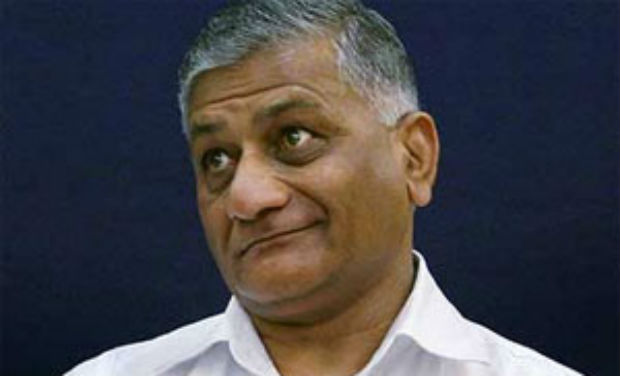
    NEW DELHI (TIP): BJP’s run of controversial statements continues with minister of state V K Singh’s ill-phrased comment that the government cannot be held responsible if a stone is thrown at a dog – in the context of the murder of two dalit children in Faridabad – inviting a storm of criticism from opposition parties. Though Singh tried to initially defend his remarks, by late evening he apologized for them. Sources said his fuller apology came after BJP chief Amit Shah spoke to him.

    “I will be very clear on this that in case, because of this mixing up of two things, which someone else has done, if somebody’s feelings have been hurt, I am apologizing for it. Because some people have created a totally different picture altogether, which was never there. I had no intention of hurting anybody. Because of this imaginative linking of somebody if somebody’s feelings have been hurt, I apologize whole-heartedly,” Singh told ANI before flying to Thailand on a ministerial assignment.

    The opposition pounced on Singh’s comments and demanding he be sacked. The issue resonated in Bihar as well where RJD chief Lalu Prasad came down heavily on the minister and BJP at a time when the NDA feels a significant section of dalits are finally moving towards it. Singh’s made the controversial remarks when he was in Ghaziabad, the constituency he represents in the Lok Sabha.

  • RSS Chief plays down communal attacks

    RSS Chief plays down communal attacks

    Since Prime Minister Modi and his ministerial colleagues have chosen to report to the RSS and invite its inputs on policy issues, it is important to take note of RSS chief Mohan Bhagwat’s annual Vijayadashmi address, delivered at Nagpur on Thursday and telecast live by Doordarshan despite Opposition protests last year. While his emphasis on “unity in diversity” is welcome, Mohan Bhagwat has, without naming any of the recent incidents – killings of writers and rationalists, beef and ink attacks and the Dadri lynching – said that “small incidents” were being “blown up”.

    He chose to give an indirect message to hardliners in the Sangh Parivar and other outfits by saying that his organization believed in “cooperation and coordination” and “such small incidents do not affect Indian and Hindu culture.” While Mohan Bhagwat talks of inclusivity being “the core of our culture”, the Union Culture Minister is known to violate the basic values of Indian culture very time he opens his mouth. Prime Minister Modi, BJP chief Amit Shah and Finance Minister Jaitley too have reacted to these incidents but none has given the recalcitrant ministers, MPs and MLAs a message strong enough to silence them and others. The latest to display characteristic insensitivity is Union minister VK Singh, who, reacting to the burning to death of two Dalit children in Haryana, said: “If someone throws stones at a dog, the government is not responsible”. For the benefit of the BJP in Bihar, Bhagwat did not say anything damaging. He did not touch on the reservation issue. But there seems no one to control the likes of Gen VK Singh and Kiren Rijiju, who too has been encouraged to make irresponsible comments about north Indians.

    If so many loose cannons have sprung up creating social tension, it is because there is no fear of the law or disciplinary action. If Bhagwat considers the recent incidents, which have forced writers to return their awards, as “small”, then he is not expected to contain the elements threatening India’s culture of tolerance and liberalism. His silence on the Shiv Sena, which has launched a hate campaign against anything and anyone Pakistani, is understandable, but not desirable.

  • BJP urges EC to withdraw FIR against Amit Shah

    BJP urges EC to withdraw FIR against Amit Shah

    NEW DELHI (TIP): BJP on Oct 8 approached the Election Commission seeking immediate withdrawal of an FIR against party chief Amit Shah for his “Chara chor” (fodder thief) remark against RJD chief Lalu Prasad and demanded action against officials working “under pressure” of the state government. A delegation of party leaders, led by Union minister M Venkaiah Naidu, drew EC’s attention to the alleged hate speeches of Prasad and AIMIM chief Asaduddin Owaisi and sought strong action against them for their remarks.

    “In Bihar, an unnecessary FIR has been registered against BJP President Amit Shah. We feel it is done under pressure from the local government.

    “An FIR has been registered against the president of a national party. It is very objectionable. We have brought it to the notice of EC and put forth the facts and requested EC that they should hold an immediate inquiry and this FIR should be withdrawn,” Naidu told reporters.

  • BJP BLEEDS: Lalitgate and now Advani Emergency Remark

    BJP BLEEDS: Lalitgate and now Advani Emergency Remark

    NEW DELHI  (TIP): As if the pain of Lalitgate involving Sushma Swaraj and Vasundhara Raje Scindia was not enough , Advani chose to inject a little more of it with his emergency remarks.

    Already in the line of opposition’s fire over the Lalit Modi issue, the ruling BJP on Thursday, June 18, was further driven to a corner over remarks of party senior L.K. Advani that he did not rule out another Emergency-like situation in the country.

    As the Congress continued its attacks on the Bharatiya Janata Party over the help provided to “fugitive” former IPL commissioner Lalit Modi by External Affairs Minister Sushma Swaraj and also allegedly Rajasthan Chief Minister Vasundara Raje, other opposition parties like AAP, the JD-U, the RJD and the CPI-M also attacked the party on Advani’s remarks, terming them a veiled swipe at Prime Minister Narendra Modi. The BJP however denied it.

    In an interview to the Indian Express ahead of the 40th anniversary of the Emergency, during which he had been jailed, Advani had said that “forces that can crush democracy” (in the country) were stronger and that there were “not enough safeguards in India in 2015” to prevent an Emergency-like situation.

    “Advani ji is correct in saying that Emergency can’t be ruled out. Is Delhi their first experiment,” Delhi Chief Minister Arvind Kejriwal tweeted. Besides Kejriwal, Advani found another supporter in Bihar Chief Minister Nitish Kumar of the Janata Dal-United, who told media persons in Patna, that the BJP veteran was “right to a large extent”. Rashtriya Janata Dal chief Lalu Prasad tweeted: “Already there is undeclared emergency as authoritarian & Hitlerian tendencies prevailing in country since May14.” “Advani Ji proved that our concerns regarding anti-democratic elements & activities being sponsored & promoted by union government are correct.”


    Congress spokesperson Tom Vadakkan said it is not only his party which is questioning the government “but even senior BJP leadership is raising questions on the efficacy of the government”, while his colleague Sanjay Jha, tweeted: “A totalitarian system is gradually overwhelming India; Advani Ji’s warnings confirm our worst apprehensions.”

    Aam Aadmi Party leader Ashutosh also tweeted that Advani’s interview is first
    “indictment of Modi’s politics” and that Advani indicated “democracy is not safe, emergency is not far, under Modi’s leadership”.”

    Slamming the NDA government at the centre over a host of issues, veteran Communist Party of India-Marxist leader Biman Bose too expressed apprehension that an emergency may be proclaimed to stifle democracy as Modi’s “aachhe din (good days)” promise had fallen flat. “So, unable to solve all these problems, there may come a situation, when to stifle democracy, these people may resort to emergency,” he told media persons in Kolkata. BJP spokesperson M.J. Akbar said that Advani may have been referring to institutions rather than individuals. Internal emergency was imposed on the country by then Prime Minister Indira Gandhi on June 25-26, 1975 and lasted 19 months.

    The Congress on Thursday also demanded a “decisive” reply from Prime Minister Modi on the Lalit Modi controversy while clarifying that it was not mulling any legal recourse against the government as of now. “The silence of the prime minister is deafening. He must tell the people of India about his views,” Congress leader C.P. Joshi told the media, also asking him to clarify whether Sushma Swaraj decided to give the go-ahead for travel documents for Lalit Modi as an individual minister or on behalf of the entire government. “He (the prime minister) should give a quick reply. He should put forward his views in a decisive manner,” he said. The former union minister from Rajasthan also sought the resignation of Vasundhara Raje and asked the RSS to clarify its stand on her, noting it had spoken for Sushma Swaraj but was silent on the state chief minister. “We request BJP president Amit Shah to sack her immediately,” he added.

    The external affairs minister as well as the Rajasthan chief minister are facing flak for their association with former IPL chief Lalit Modi, who is wanted by the Enforcement Directorate for alleged financial impropriety in the money-spinning IPL, and currently living in London. In Hyderabad, Minister of State for External Affairs V.K. Singh defended his senior cabinet colleague saying that matters were being blown out of proportion. “What is happening is, many things are being blown out of proportion. Lot of noise is being made. For example, it was said that because Sushma-ji’s daughter is Lalit Modi’s lawyer, so something is fishy…. Chidambaram’s wife is a lawyer in Sardha scam. Should he come under scanner for that? I leave this question to you,” he told reporters.

  • AMID LALITGATE ROW, RAJE CANCELS ANANDPUR SAHIB AVOIDS MEETING AMIT SHAH

    AMID LALITGATE ROW, RAJE CANCELS ANANDPUR SAHIB AVOIDS MEETING AMIT SHAH

    JAIPUR (TIP): Amid raging Lalitgate row, Rajasthan chief minister Vasundhara Raje on June 19 cancelled her visit to Punjab where she would have come face-to-face with BJP president Amit Shah for the first time since the damaging revelations.

    “Due to back pain, the chief minister’s doctor has advised her to take rest so she has cancelled her visit to Punjab today,” Raje’s press advisor said.

    Raje, who is embroiled in a controversy over allegedly favouring tainted IPL chief Lalit Modi’s immigration plea in London, was scheduled to share the dais with BJP chief Amit Shah and Union home minister Rajnath Singh at the function in Anandpur Sahib celebrating 350 years of the key Sikh shrine. Significance was being attached to the meeting as none of the BJP central leaders or the government have come to her defence since the issue came out in public.

    Raje had spoken to Shah over phone on Wednesday to explain her position.

    Congress has been demanding her immediate resignation along with that of external affairs minister Sushma Swaraj, saying they have no right to continue in office after helping the former IPL chairman who is facing money laundering and other charges.

    However, Rajasthan health minister Rajendra Rathore rejected demands for Raje’s resignation, saying the entire national BJP and party MLAs were with her.

    “The entire BJP be it at the Centre or the state are with her. She has been leading us and will continue to do so. The entire legislature party is standing strongly with her. Our leadership is standing by her. The question of her resignation does not arise,” he had said.

  • Man responsible for Vajpayee govt’s fall set to join BJP

    NEW DELHI (TIP): Former Odisha CM Giridhar Gamang, whose controversial vote during the 1999 no-confidence motion had contributed to the fall of Atal Bihari Vajpayee-led NDA government after thirteen months in office, on June 12 decided to join BJP.

    In fact, both BJP and Gamang put the past behind and embraced each other as the former Congress leader met BJP chief Amit Shah at the party headquarters. Gamang said he likes BJP’s “political strategy”. He had quit Congress on May 30.

    Gamang was caught up in a controversy in Parliament on April 17, 1999, when the 13-month Vajpayee government fell as he voted despite having become the chief minister of Odisha by then. Since Gamang, who was then MP from Koraput, had not resigned from Lok Sabha even two months after becoming CM, it was left to his conscience to decide whether to vote. He voted, much against protests from BJP MPs.

    However BJP tried to bury the issue saying Gamang voted against the BJP-led NDA government and then he was part of Congress. On his part, Gamang had argued that it was National Conference’s Saifuddin Soz whose cross-voting led to the NDA’s defeat on the floor of the House. He also recalled that Mayawati’s BSP, which had five members in Lok Sabha, made a last minute change in stand and instead of abstaining, voted against the government. The BJP leadership is to formally welcome the 72-year-old tribal leader in Bhubaneshwar. The party hopes Gamang’s entry will strengthen its base in Odisha.

    “I have decided to join the BJP, but I will join formally soon. It will be decided by the state unit soon. I had met the Amit Shah today and made my plea which has been accepted by the party leadership,” Gamang said.

  • Govt tries to avoid ‘core’ BJP issues

    NEW DELHI (TIP): The BJP-led NDA government at the Centre is attempting to play down contentious issues like Ram Mandir and beef ban while projecting development as its priority.

    At a press conference on May 29 to talk about Modi government’s one year in office, Union Home Minister Rajnath Singh too chose to avoid controversial topics. He described himself as “swayamsevak” of the RSS but did not give a direct reply on whether the Sangh fountainhead was interfering in governance.

    The controversial “ghar wapsi” programme, campaign on love jihad and communal remarks by Union ministers and BJP MPs had put the government on the back foot in the recent past.

    Singh was cautious on BJP’s eyebrow raising issues. “All issues are important. We have to decide on our priorities. Now, development is the priority. The Ram Mandir issue is subjudice. No talks as of now. If a solution comes, there will be nothing better. Otherwise, people of the two communities should can sit together and discuss,” he said.

    He was responding to a question on whether the BJP has put Ram Mandir and revocation of Article 370 that gives special status to Jammu and Kashmir on the back burner. BJP president Amit Shah had said that the party-led government could not decide on contentious matters like Ayodhya or Article 370 as it does not have the numbers.

    A question on beef ban was also posed to him against the backdrop of controversial comment by Union Minister Mukthar Abbas Naqvi that beef-eaters should go to Pakistan. Singh’s junior minister Kiren Rijiju, who was also present at the conference, had also objected to Naqvi’s comments.

    “Those who belong to India will stay in India only,” Singh rebuffed Naqvi.

    Singh’s statement also echoed Union Finance Minister Arun Jaitley’s disapproval of Naqvi’s comments and Shah ruling out a countrywide ban on beef while leaving it to states to decide.

    He also sought to downplay the Sangh affiliates’ joining a strike on September 2 called by opposition trade unions, saying these are autonomous outfits and it was not proper to link them to the party.

  • Land Bill: BJP panel too favours 80% consent clause

    Land Bill: BJP panel too favours 80% consent clause

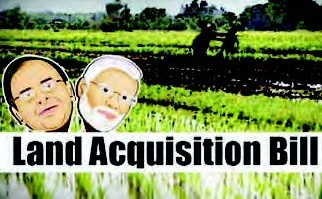
    NEW DELHI (TIP): Even as the NDA govern ment seems to be determined to pass the Right to Fair Compensation & Transparency in Land Acquisition, Rehabilitation & Resettlement Bill, 2015, an internal committee of BJP has found some sticking points on the consent clause even among farmer groups sympathetic to the party.

    According to top sources in BJP, the eight-member committee headed by party vice-president Satya Pal Malik has submitted its feedback to party chief Amit Shah. Though at least six out of the nine amendments made to the bill in the Lok Sabha were as a result of this committee’s feed back, one important sticking point has remained unresolved.

    “Most of the representations made by farmers groups and activists to the committee wanted restitution of the clause which stipulated that 80% of land owners should give consent for acquisition before the state can step in and acquire the remaining bit for any private project,” Malik said. “We haven’t submitted any written report; just given a feedback and written ideas suggested by stakeholders whom we spoke to for over 10 days,” he added.

    “I feel there is more propaganda around it than what is actually there. It is a fair bill, but like the rumour of grease ridden cartridges which had set off the revolt of 1857, rumours are strengthening the opposition to the bill,” he added.

    For example, he added, the acquisition of land one km deep from proposed industrial corridors was being touted as a grave rip off.”Yet, provision for acquisition of land 500 metres on either side of the corridor is there in the old UPA bill too,” Satya Pal Malik added.

  • AMIT SHAH REVAMPS BJP NATIONAL EXECUTIVE

    AMIT SHAH REVAMPS BJP NATIONAL EXECUTIVE

    NEW DELHI (TIP): The first meeting of BJP’s new national executive finalised on March 12 by party president Amit Shah is expected in the first week of April in Bangalore.

    Shah finalised the party’s 111-member national executive, which includes top party leaders including Prime Minister Narendra Modi and former prime minister AB Vajpayee besides a host of top party leaders.

    All the eight chief ministers of BJP-ruled states and two deputy chief ministers, including that in Jammu and Kashmir where the party shares power with PDP, besides 24 former chief ministers and three former deputy chief ministers are permanent invitees to the national executive.

    The BJP chief has also made 40 senior leaders from across the country special invitees to the national executive.

    The new list comes ahead of the party’s national executive meeting and party’s restructuring by Shah.

    Among those who are part of the new national body include party veterans LK Advani and Murli Manohar Joshi, besides Union ministers Rajnath Singh, Sushma Swaraj, Arun Jaitley, M Venkaiah Naidu, Nitin Gadkari, Ananth Kumar, Thawarchand Gehlot, Jagat Prakash Nadda, Ravi Shankar Prasad, Kalraj Mishra, Narendra Singh Tomar, Harsh Vardhan, Bandaru Dattatreya and Radha Mohan Singh. However, HRD minister Smriti Irani and minority affairs minister Najma Heptulla are among the prominent faces who have been dropped from party’s national executive . Even Mathura MP Hema Malini and BJP’s Mumbai spokesperson Shaina NC did not find mention in the list.

    Others include Yashwant Sinha, Vinay Katiyar, CP Thakur, Jual Oram, SS Ahluwalia, Vijay K Malhotra, besides Hukumdev Narayan Singh, L Ganeshan, Lalji Tandon, O Rajgopal, Tathagat Roy, Gulab Chand Katariya and Subramanyam Swami.

    Ministers Mukhtar Abbas Naqvi, Dharmendra Pradhan, Rajeev Pratap Rudy, Prakash Javadekar, (Gen) VK Singh, Suresh Prabhu, Birendra Singh, Piyush Goyal and Nirmala Sitharaman are also part of the new executive.

    Other leaders like Varun Gandhi, Tapir Gaon, Vijay Goyal Satpal Maharaj, Vishnubhushan Harichandan, Vijay Mahapatra and PK Krishna Das, V Shanmughanathan, are also its members.

    Party’s firebrand leaders like Yogi Adityanath and Navjot Singh Sidhu are part of the executive, while another such leader Sadhvi Niranjan Jyoti is a special invitee.

    All the BJP chief ministers Shivraj Singh Chauhan, Raman Singh, Vasundhra Raje Scindia, Anandiben Patel, Raghuvar Das, Devendra Gandadharrao Fadnavis, Manohar Lal Khattar and Laxmikant Parsekar, besides deputy Chief Ministers Fracesco De D’souza and Nirmal Singh are also invitees. Besides, all Legislative Assembly and Legislative Council party leaders, state presidents of all states, all General Secretaries (Organisation) will be special invitees in National Executive.

  • DELHI ELECTIONS – AAP TROUNCES BJP IN DELHI

    DELHI ELECTIONS – AAP TROUNCES BJP IN DELHI

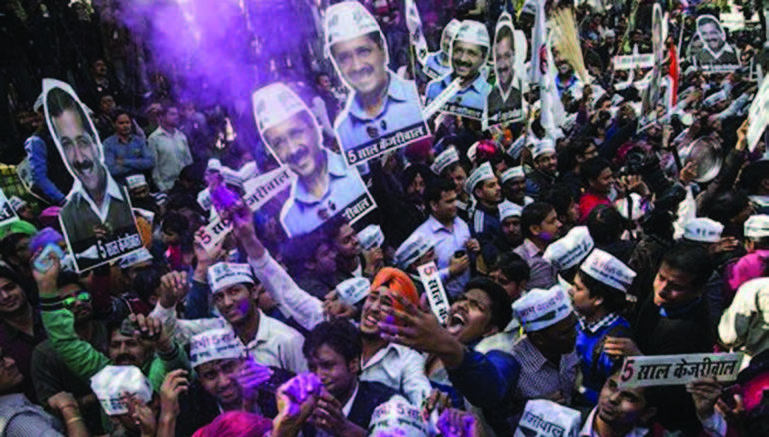
    NEW DELHI (TIP): Arvind Kejriwal’s Aam Aadmi Party surged to a landslide win in Delhi that surpassed the wildest of expectations and left a routed Bharatiya Janata Party licking its wounds in the city-state from which it rules the country.

    Kejriwal, a former tax official who turned social activist and founded AAP just over two years ago, will become chief minister for the second time on February 14, the first anniversary of his controversial resignation after just 49 days in the job.

    AAP won a record 67 seats out of 70, far higher that even the most generous exit poll, and a full 39 seats more than it won as a fledgling unit in 2013. The BJP-led alliance, which ran a disjointed campaign marked by internal dissent, saw its share vapourise to just 3 seats, down 29.

    AAP TROUNCES BJP1

    “The people of Delhi want an honest government, the people want to get rid of hollow speeches or statements like women should give birth to four children or ghar wapsi. Instead they want a government that has an action plan for Delhi,” said AAP leader Manish Sisodia as party workers celebrated wildly.

    Kejriwal thanked the city for the unprecedented win, but termed the mandate “very scary” and asked party leaders not to be arrogant. Prime Minister Narendra Modi, who had participated in a bitter election campaign against AAP, tweeted that he had congratulated Kejriwal and assured him of “complete support in the development of Delhi”.

    AAP rode to the second-biggest election victory in India’s history on promises of cheaper electricity and water and probity in government. The party also has a strident position against Delhi’s famed culture of privilege; in its last stint, one of its more popular moves was the outlawing of red beacons on official cars.

    Its culture of handouts runs counter to the ruling principles of the BJP at the Centre, which espouses a market-friendly approach and wants to cut subsidies. Stock markets, which had fallen sharply on Monday after investors took fright from the exit polls, rebounded as people chose to look ahead to this month’s union Budget.

    For the BJP, this was its first significant defeat after sweeping last year’s general election. Though statistically tiny in the overall scheme of things, the capital is home to India’s two biggest national parties and many of its top politicians, giving it a disproportionately high profile.

    The saffron party was quick to distance the result from the performance of the Narendra Modi government at the Centre. It is also expected to try and ringfence blame around its chief ministerial candidate Kiran Bedi, a high profile former cop parachuted into the role by party president and ace strategist Amit Shah, for whom the result is a rare embarrassment.

    “It’s not a referendum on the BJP government. It will be a collective responsibility of the party…and winning will just be the first step for AAP. They had made many promises. AAP kaam karke dikhaye ab (AAP, now show us what you can do),” said BJP leader Shazia Ilmi. Senior leaders stayed away from the party’s Pandit Pant Marg office after seeing the initial trends.

    Kejriwal swept to an easy win in the New Delhi constituency, while Bedi and Ajay Maken, the Congress’ chief ministerial hopeful, bit the dust in seats thought to be relatively secure for their respective parties. Congress, which ruled the state for 15 years ending 2013, scored an embarrassing duck, and its offices wore a deserted look.

    Bedi stayed true to her reputation for gaffes, telling a news conference that she hadn’t lost the elections because she had given her best. “As far as the party is concerned, it is for them to introspect on the reasons for the loss,” she added.

    Kejriwal’s first essay as chief minister, with Congress support, was marked by chaos and a vigilante approach by some of his ministers. The CM himself famously went on a dharna against the police near Rail Bhavan that briefly threatened to disrupt the Republic Day parade. He flamed out in 49 days, a resignation he later conceded was a mistake.

  • Sonia seeks four weeks to respond to CIC notice

    Sonia seeks four weeks to respond to CIC notice

    NEW DELHI (TIP): Congress president Sonia Gandhi has sought four weeks time to respond to a notice of the Central Information Commission seeking an explanation on why her party had not complied with the commission’s June 2013 verdict bringing political parties under the Right to Information Act.

    Citing Delhi elections, Sonia said despite best efforts, she could not prepare the reply to the complaint within the timeframe.

    In her submission filed through her lawyer, Sonia said she was in the process of seeking legal advice and preparing appropriate response to be filed before the commission which is expected to be ready within four weeks. “The request for extension of time has been necessitated by reasons beyond the respondent’s control. The application is made bona fide and in the interest of justice,” Sonia’s lawyer said in the submission.

    The CIC had issued notice to Sonia asking her to explain why her party had not complied with the directives of a panel about responding to RTI queries and not replying to an RTI plea filed last year.

    Similar notices were issued by the CIC in separate cases to BJP as well but its chief Amit Shah has not responded till now.

    A full bench of CIC had declared that Congress and five other national parties –BJP, CPI, CPM, NCP and BSP — were public authorities under the RTI Act, but none of the parties had set up any mechanism to respond to such queries nor altered the law nor challenged the order in any high court.

    Activist R K Jain had filed the RTI application with Congress last February but with there being no response to it, he later made a complaint to the CIC.

    Alleging “non-action” on his complaint, Jain approached the Delhi High Court seeking directions for the CIC to take action on his plea. The high court gave six months to the commission to take action on Jain’s complaint.

    In a separate case filed by activist Subhash Agrawal, notices were sent to Shah and the chiefs of the other four political parties.

    Refusal to provide information or not furnishing complete information is deemed an offence under the RTI Act, which prescribes a penalty of Rs 250 per day on the public information officer of the public authority from the date the information became due to the day that it was finally made available.

  • CAMPAIGNING ENDS: ROADSHOWS, RALLIES MARK THE DAY AS CAPITAL BATTLE GOES DOWN TO THE WIRE

    CAMPAIGNING ENDS: ROADSHOWS, RALLIES MARK THE DAY AS CAPITAL BATTLE GOES DOWN TO THE WIRE

    NEW DELHI (TIP): The high-octane campaign for the Delhi Assembly came to a close on February 5, 48 hours ahead of the February 7 polls in which the BJP is seeking to gain majority in the face of strong challenge from the Aam Aadmi Party (AAP).


    February 5 saw some heavy duty and intense campaign by the principal contenders and the Congress, which still hopes to be up and counted having been rejected by the voters of Delhi towards the end of 2013.


    BJP president Amit Shah and its chief ministerial candidate Kiran Bedi held roadshows to demonstrate the strength of the party. The strength of its cadres was no less than the large number of supporters AAP who joined a similar roadshow by Arvind Kejriwal in his Gole Market constituency.


    Although the focus was not so much on the Congress, the party vice president Rahul Gandhi stepped out in Sultanpur Majra for a roadshow which seems to be the more preferred way of reaching out to the people in an informal way.


    The BJP asked its battery of leaders to spread out in each of the 70 constituencies while its RSS
    ‘karyakartas’ began reaching out door-to-door. Stepping up the attack on AAP, BJP chief charged that the AAP received donations in black cautioning that the party “goes back on what it promises”. Speaking in Hindi he said Kejriwal’s challenge to arrest him was made knowing that no probe was possible during elections.


    The BJP chief harped on development and welfare schemes of the Modi government as also rise in the prestige of the country since the BJP government came to power. AAP chief Arvind Kejriwal attacked the BJP saying it’s their ‘religion’ to attack others and like Duryodhana of Mahabharat the entire administrative apparatus was with it, while the nascent AAP had God on its side.


    Kejriwal started his campaign from Mandir Marg in New Delhi constituency today and said he was getting amazing response. “Just amazing response. Unbelievable. Kuch adbhut hi ho raha hai. Its all divine,” Kejriwal said in a tweet.


    The AAP chief exuded confidence, saying the party was “following the path of truth”.


    Adding strength to the support base, the Trinamool Congress and the Janata Dal (United) too endorsed AAP in the battle for the ballot in Delhi. BJP leaders Shah and Union Minister M Venkaiah Naidu have already said that the Delhi election was not a referendum on the Modi government’s performance.


    The Congress, which had been in the saddle for 15 years till December, 2013, has been lagging way behind AAP and BJP in pre-poll surveys.

  • Kiran Bedi joins BJP with Chief Ministerial  ambition

    Kiran Bedi joins BJP with Chief Ministerial ambition

    BJP chief Amit Shah presents a bouquet to Kiran Bedi to welcome her into the party during a press conference in New Delhi.

    NEW DELHI (TIP): Not unexpectedly, former Team Anna member Kiran Bedi on Thursday, January 15, joined the Bharatiya Janata Party (BJP), and laid bare her chief ministerial aspirations before party president Amit Shah as she marked her “40 years of experience in administration” and ability to “extract work” from people.

    Apart from Bedi, other well known women leaders, too, may join the BJP. Former Samajwadi Party MP and actor Jaya Prada and former Aam Aadmi Party leader Shazia Ilmi are in talks to join the BJP.

    Bedi was the first woman IPS officer. She joined the service in 1972. She made a high-profile entry into the BJP in the presence of Shah and Finance Minister Arun Jaitley during a press conference at the party’s Ashok Road headquarters.

    While the BJP was reluctant to disclose the seat identified for launching Bedi in the polls, the social activist used her introductory statement to pitch herself as an experienced administrator.

    “I have 40 years of administrative experience, now I am here to present my experience to Delhi,” she told the gathering.

    “I can work and know how to get work done from others. Together we will work and extract work from others as well.”

    The former top cop had met Prime Minister Narendra?Modi along with Shah before becoming a BJP member.

    She said she was inspired by Modi’s leadership qualities which prompted her to take a plunge into politics.

    The anti-corruption crusader stressed she was on a “mission mode” and would work towards a steady, stable and corruption-free government.

    Shah praised Bedi, saying that she would strengthen the BJP’s Delhi unit and offer “constructive contribution” in elections and government formation.

  • Excesses of Hindutva hotheads

    Excesses of Hindutva hotheads

    There is urgent need to restrain those making provocative and poisonous statements, says the author.

    All through his campaign that brought him spectacular victory in the parliamentary poll, Prime Minister Narendra Modi had concentrated on only “development” and “good governance” and avoided any item on the Hindutva agenda that could have upset the pluralist Indian society. Unfortunately, however, even then he did absolutely nothing to silence or even restrain those of his irresponsible supporters belonging to the Sangh parivar who made provocative, polarizing and even poisonous statements.

    For instance, at an early stage, Giriraj Singh, a Bhumihar leader of Bihar, declared that all those who opposed Mr. Modi in any way would have “no place in India” and must therefore “go to Pakistan”. Mr. Modi said not a word about this preposterous pronouncement. All that Rajnath Singh, then the BJP president and now Union Home Minister, did was to “disassociate his party” with Mr. Giriraj Singh’s statement. No wonder there followed a spate of equally absurd and dangerously divisive observations.


    49


    The head of the BJP unit in Uttar Pradesh, Laxmikant Bajpai, and the five-time MP, Yogi Adityanath, discovered that the Muslims were engaged in “love jihad” – a campaign to lure Hindu women into marriage or romance and then “forcibly” convert them to Islam. Mr. Bajpai stated that of the rapes taking place “99 per cent were committed by Muslims”. As for Amit Shah, Mr. Modi closest confidant and soon to be the party president, the Election Commission was constrained to deny him permission to hold public rallies.

    This ban was withdrawn only after Mr. Shah had apologized to the Commission and assured it that he would say anything that was “unacceptable”. On none of these disconcerting episodes Mr. Modi said a word during his powerful oration on all other subjects under the sun. Sadly, most people’s hope that what had been permitted during the election would be quietly disallowed after the BJP-led government had settled down has turned into a dupe. The bitter stand-off between the ruling party, on the one hand, and nine Opposition parties, including the Congress, that have a clear majority in the Rajya Sabha, on the other, that led to the disruption of the Upper House for several days could be the foreshadow of the shape of things to come.

    The sequence of events was distressingly sordid. A 47-year-old, firsttime BJP MP, Sadhvi Niranjan Jyoti – who was recently made a Minister of State, together with Mr. Giriraj Singh – had delivered an election speech in a Delhi suburb as the national capital is due to have assembly elections. Pontifically she told her audience that the choice before them was clear: They could elect a government of “Ramzadas” (children of Lord Ram) or that of “Haramzadas” which really means “b******s” but the BJP propagandists translated it as “illegitimate” to dilute the vulgarity. Inevitably there was a wave of outrage.

    When the matter exploded in Parliament, as it was bound to, the Prime Minister chose to stay away. Some senior cabinet ministers told the House that at a party meeting Mr. Modi had “strongly disapproved of the language used” whereupon the sadhvi offered an apology of sorts. This, declared the BJP leaders magisterially, was the “end of the matter”. The Opposition in both Houses, but particularly that in the Rajya Sabha where the saffron party is in a minority, demanded that Mr. Modi should come to the House to explain his position. He took three days to do so and declared that discussion was all over.

    An easily avoidable disruption of the Rajya Sabha followed. For, the determined Opposition gave up its initial demand for the sadhvi’s resignation or dismissal and asked for only a resolution to denounce the use of foul language by everybody in politics. The government contemptuously rejected this. In the end a “consensus statement,” appealing to all MPs “to maintain civility at all costs in public discourse” settled the bitter dispute.

    The crowning irony is that just when Vice-President Hamid Ansari, who is also the Chairman of the Rajya Sabha, was reading out the consensus document, a former BJP minister, Swami Chinmayanand was publically using the H-word in relation to, of all people, Imam Bukhari of Jama Masjid for advertising his association with a foreign place, Bukhara. Far more shocking was what so senior and experienced a leader as Foreign Minister Sushma Swaraj, who was earlier leader of the Opposition in the Lok Sabha, did only a few hours earlier. She strongly advocated that the Gita should be declared the “National Scripture” of India.

    Remarkably, even before anyone from religions other than Hinduism could speak, vigorous opposition to Swaraj’s demand came from Tamil Nadu, ironically from the BJP’s allies. One of them, MDMK leader Vaiko, simultaneously announced that he was ending the alliance. He accused the Centre of working against Tamil Nadu and suggested that the Dravidian forces should unite to fight the “Sanskritisation” of cultural and social spheres. He added that “Hindutva will not be allowed to gain a foothold in Tamil Nadu”. PMK’s founder S. Ramadoss, who is still an ally of the BJP, also came out against Swaraj’s idea and stated that “apart from “cultural imposition” the Modi government had “hardly come out with any constructive programs in the last six months”. The BJP would be making a grave mistake if it underestimates the Tamil sentiment. Those who did so in 1965 over the official language issue paid a very heavy price.

    At that time even Prime Minister Shastri did not dare to go to the trouble-spot. Only Indira Gandhi had the necessary courage. Finally, it cannot be overlooked that while Mr. Modi has full control on his government he is either unwilling or unable or both to discipline the wrongdoers among other members of the Sangh parivar who seem determined to build up a Hindu rashtra by hook or by crook. They enjoy the protection of the Rashtriya Swyamsevak Sangh (RSS) of which the BJP is only the political face.

    (The author is a Delhi-based political commentator.)

  • RSS man Manohar Lal Khattar is Haryana’s new chief minister

    RSS man Manohar Lal Khattar is Haryana’s new chief minister

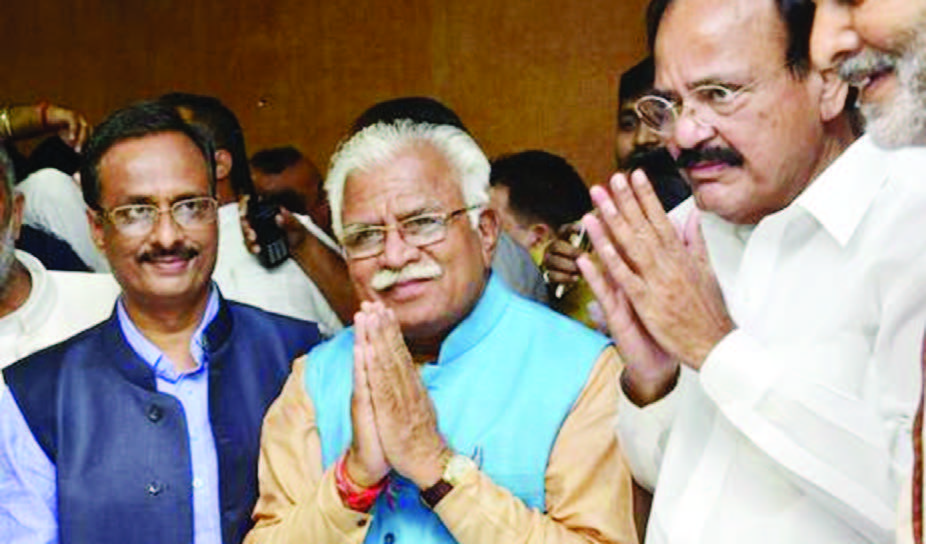
    CHANDIGARH (TIP): The Bharatiya Janata Party (BJP) has named Manohar Lal Khattar as chief minister of Haryana after it secured a majority in the Assembly elections for the first time in the state. Khattar, a Punjabi, had worked as a Rashtriya Swayamsevak Sangh (RSS) pracharak (a full-time RSS worker) for 40 years.

    The decision was taken in a meeting of elected MLAs, attended by Parliamentary Affairs Minister M Venkaiah Naidu and BJP vice president Dinesh Sharma, who were appointed as observers by the BJP’s Parliamentary Board to decide on who would become Haryana’s new chief minister. Born in Rohtak district, Khattar had contested the Assembly elections from Karnal. He won the Karnal seat with a margin of 63,736 votes. He is stated to be close to the Prime MinisterNarendra Modi and BJP chief Amit Shah Manohar Lal Khattar said, “MLAs have elected me as the leader of BJP Legislature Party.

    It was a unanimous decision. We are going to the Governor and will put forth our claim to form the Government. “The BJP has got a clear majority in the 90- member Assembly for the first time,” Khattar said as he entered the guest house with his supporters who shouted slogans in his favour. Prem Lata, first-time MLA from Uchana Kalan and wife of Birendra Singh, who joined the BJP recently, told reporters that her husband was the most experienced politician to run the state. The saffron party won 47 seats while the Indian National Lok Dal (INLD) won 19, the Congress 15, HJC-BL two, BSP and SAD bagged one seat each while Independents got five.

  • BJP TO ROLL OUT BIG GUNS FOR ASSEMBLY POLLS

    BJP TO ROLL OUT BIG GUNS FOR ASSEMBLY POLLS

    NEW DELHI (TIP): With Dussehra over, BJP will get into campaign mode for the Haryana and Maharashtra assembly polls on a war footing.

    Prime Minister Narendra Modi and his senior ministers will have little time for anything else, criss-crossing the two states over the next two weeks, addressing rallies. BJP plans to hold at least four big rallies a day in each state till campaign ends for the October 15 polls.

    Modi will begin his charge on Saturday morning from Karnal in Haryana and move to Maharashtra to address three rallies in Beed, Aurangabad and Mahalakshmi (Mumbai). The PM will address 8-10 rallies in Haryana and around 22 in Maharashtra.

    Two senior ministers — home minister Rajnath Singh and external affairs minister Sushma Swaraj — will be all over Haryana on Saturday, holding four rallies each in the state. Singh will be at Radaur, Kalayat, Julana and Jakholi Rai while Swaraj will address rallies in Kalka, Thanachhapar, Shahbad and Gohana. Singh will address about 15 rallies in each state.

    The party has decided to have Swaraj, who belongs to Haryana, focus on the state where BJP is contesting on its own and is aiming to replace the Congress government. Similarly, road transport minister Nitin Gadkari has been asked to concentrate on Maharashtra, his home state, where BJP is contesting without its 25-year-old partner Shiv Sena this time.

    Swaraj is scheduled to address about 22 rallies in Haryana and will be in Maharashtra only for a day on October 6, attending three rallies. She will take a break from campaigning as she is travelling abroad between October 8 and 10. Gadkari is expected to address about 36 rallies in Maharashtra.

    Party veteran L K Advani will address six rallies in Maharashtra and two in Haryana, while Murli Manohar Joshi will address two rallies in Maharashtra and one in Haryana.

    Urban development minister M Venkaiah Naidu is slated to spend four days in Maharashtra and two in Haryana. Other ministers who will address a few rallies in both states are chemical and fertilizer minister Ananth Kumar, HRD minister Smriti Irani and social justice minister Thawar Chand Gehlot. Party chief Amit Shah will address about 15 rallies in each state.

    The party has roped in all its chief ministers to ensure its good governance campaign is showcased. Goa CM Manohar Parikkar will focus on Maharashtra while Madhya Pradesh CM Shivraj Singh Chouhan will spare three days for Maharashtra and one for Haryana. Rajasthan CM Vasundhara Raje has three days in Maharashtra and two days in Haryana, Chhattisgarh CM Raman Singh and Gujarat CM Anandiben Patel will each spend two days in Maharashtra. On an average, the chief ministers will address three rallies a day, party vice-president M A Naqvi said.

    Not to forget its star power, BJP has roped in actor-turned-MPs Hema Malini, Vinod Khanna and Shatrughan Sinha to campaign in both states.

  • BJP GIVES ULTIMATUM TO SHIV SENA OVER SEAT-SHARING

    BJP GIVES ULTIMATUM TO SHIV SENA OVER SEAT-SHARING

    NEW DELHI (TIP): Setting itself on a confrontation path with its oldest ally, BJP on September 18 gave Shiv Sena an ultimatum to agree on a seat-sharing formula for the coming assembly elections or face a break-up of the alliance. Having jacked up its demand for contesting 135 of the 288 seats, which has been rejected by Shiv Sena, senior BJP leaders have communicated to Sena chief Uddhav Thackeray to decide by this evening whether his party was willing to conform to a “mutual and respectable” seat-sharing formula.

    The BJP’s ultimatum comes against the backdrop of party president Amit Shah’s tough talk this morning in Kolhapur in Maharashtra that there will be no compromise at the cost of selfrespect. Top BJP sources said that the party was upset that Shiv Sena, an ally of 25 years, has not given any response to the proposal sent by it on the higher number of seats it wanted to contest in the coming elections. In the 2009 elections, the BJP had contested 119 and the Sena 169 seats. However, this time the alliance “Mahayuti” has been broad based with the inclusion of four more parties –RPI (Athawle), Rashtriya Samaj Paksha, Swabhimani Shetkari Paksha and Loksangram.

    The BJP sources said the party was awaiting a reply from Uddhav Thackeray and decided to make clear its position because time was running out.The party was particularly peeved that Thackeray has not responded to or was not in communication with the BJP leadership ever since the demand for 135 seats was put forth to him. In fact, without responding to BJP’s demand directly, he went public earlier this week on rejecting it. They also said that they were keen on an alliance but the party cannot wait endlessly. A decision has to be taken as a strategy has to be worked out on the basis of the seat sharing formula of the alliance, they said.

  • By-poll results shock BJP

    By-poll results shock BJP

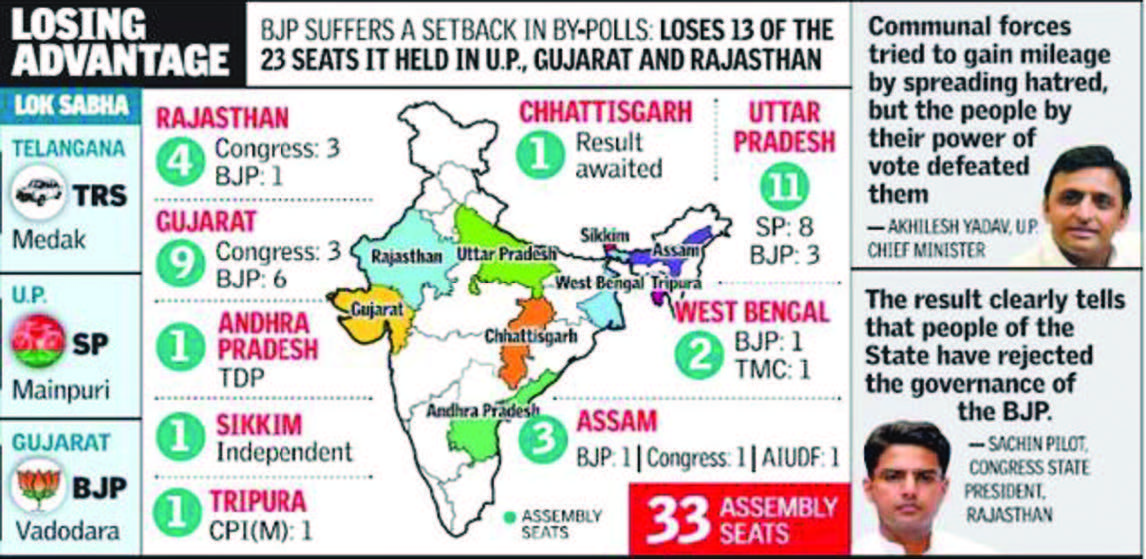
    New Delhi (TIP): The results of the Assembly byelections have come as a blow for the BJP in Uttar Pradesh, Rajasthan and Gujarat — the states it had swept in the Lok Sabha polls four months ago — losing 13 of the 24 seats held by it. Of the 32 Assembly seats across nine states for which counting of votes was held today, the BJP won 12, Congress seven and Samajwadi Party eight while TDP (Andhra), Trinamool Congress (West Bengal), AIUDF (Assam) and CPM bagged one each. One seat in Sikkim was won by an Independent.


    This is the third consecutive setback for the saffron party after its disappointing performance in Assembly byelections in Bihar, Uttarakhand, Karnataka and Madhya Pradesh in the past two months. All 11 seats in Uttar Pradesh, Gujarat (9) and Rajasthan (4) were held by the BJP and the bypolls were necessitated after the sitting MLAs were elected to the Lok Sabha. It was Uttar Pradesh — the party’s recently acquired stronghold where the BJP managed a near-total sweep in the LS elections — that delivered a humiliating blow to the saffron party as it lost seven of the 11 seats held by it, including the one held by its ally, the Apna Dal.


    The BSP’s absence in the byelections had made it a virtual straight fight between the SP and the BJP in the politically crucial state. BJP strongman Amit Shah was credited with crafting the spectacular win for his party in UP in the Lok Sabha polls. The party lost six out of 13 seats in Rajasthan and Gujarat, where it’s in power. Lost for words, BJP leaders could not even blame rival parties for playing foul in the elections. Senior BJP leader Rajiv Pratap Rudy said the results “deserve a small introspection”. “This is not a national mandate. It is a localised issue.


    Surely, it is a wake-up call for better planning in the upcoming Haryana and Maharashtra Assembly elections,” he said. Senior leader Uma Bharti dismissed questions about efficacy of the “Modi wave” saying “state leaders and workers need to introspect.” It was a significant comeback by the SP, which won eight out of 11 seats in Uttar Pradesh —and the Congress, which trounced BJP on three out of four seats in Rajasthan. “The people of the state have given a befitting reply to the communal forces and clearly expressed their desire for harmony and brotherhood,” said a beaming UP CM Akhilesh Yadav.


    Among BJP’s big losses is the Rohaniya seat, which falls within Modi’s parliamentary constituency Varanasi. The saffron party just about managed to hold to its own in Modi’s home state Gujarat, winning six out of nine seats. Rajasthan Chief Minister Vasundhara Raje was left re-faced as the Congress won three out of four seats. One of the seats — Surajgarh—was being contested by her close aide Digambar Singh who lost to Shravan Kumar of the Congress by 3270 votes.


    The BJP had swept the Lok Sabha and Assembly elections in the desert state earlier this year. High on the win, Rajasthan Congress chief Sachin Pilot advised the “BJP to take a lesson from these elections and introspect” The BJP retained Kota South, losing Surajgarh, Weir and Nasirabad to the Congress. The only silver lining for the BJP was the inroads into WB where it has won Basirhat Dakshin (South) seat.

  • AFTER BY-POLL SETBACK, BJP BLINKS ON SEAT-SHARING WITH SHIV SENA

    AFTER BY-POLL SETBACK, BJP BLINKS ON SEAT-SHARING WITH SHIV SENA

    Mumbai (TIP): Late on September 17 night, the BJP drew up a list of 119 seats that the party would like to contest in next month’s state elections in Maharashtra. It is seen as a climb down from the 135 it was insisting on a few days ago. Since then, however, it has suffered reverses in by-elections giving ally Shiv Sena an advantage in tough negotiations over seat-sharing.


    After a meeting at Union Minister Nitin Gadkari’s Mumbai residence on Wednesday night, attended by senior Maharashtra unit leaders, the BJP said it wanted its 25-year alliance with the Sena to continue. “We have sent a list of 119 seats to central leadership… 135 seats was just an estimate. We have communicated this to the Sena. Discussions will go on as far as distribution of seats is concerned,” BJP leader Sudhir Mungantiwar said. Earlier in the evening, sources said, BJP president Amit Shah had met central party leaders OP Mathur and Rajiv Pratap Rudy after the Sena, emboldened by the BJP’s losses in Tuesday’s by-elections, blandly stated that it will contest more seats than the BJP.


    Sena MP Sanjay Raut said his party wanted the alliance to continue, but on its terms. “In Maharashtra, the chief minister will be from the Shiv Sena and we will contest more seats. There will be no change in that,” he said. The BJP earlier argued that its superior performance in the national elections four months ago has earned it the right to an equal number of seats to contest. It had suggested a formula that the two partners contest 135 seats each in the 288-member state Assembly and leave 18 for their smaller allies.


    The Sena insisted that it must continue to be the senior partner in the state and contest more seats, at least 155. It said the by-election results vindicate its stand that the general elections will have no bearing on state elections. The stakes are high as the party with the most legislators will have the bigger claim to the Chief Minister’s post if the alliance wins.


    DON’T LET SUCCESS GO TO YOUR HEAD: SENA TAUNTS BJP


    The BJP’s losses in by-elections has further emboldened its partner in Maharashtra, the Shiv Sena, to blandly state that it will contest more seats than the BJP in next month’s state elections. Sena MP Sanjay Raut today said his party wants the 25-year alliance to continue, but on its terms. “In Maharashtra, the chief minister will be from the Shiv Sena and we will contest more seats. There will be no change in that,” he said. This morning’s issue of the Sena magazine “Saamna” cautioned the BJP against taking “voters for granted.”


    It praised Prime Minister Narendra Modi, saying he should not be blamed for the by-election setback. But it also said, “The by-election results are a lesson for the Maharashtra elections,” adding, “Each election comes with its tides and tides change after every election. Vidhan Sabha elections cannot be fought on the basis of the Lok Sabha wave.” The sub-text was that the BJP cannot count on the “Modi wave” to win the Maharashtra elections. Shiv Sainiks across the state have backed their chief Udhav Thackeray in his tussle with the BJP over seat sharing and say they are gearing up to win 150 of the 288 assembly seats. “There is only one wave in Maharashtra, the Shiv Sena wave,” said Sanjay Raut.

  • BJP GETS THE JOLT IT DESERVED

    BJP GETS THE JOLT IT DESERVED

    The folly of polarization boomerangs

    Normally no great importance is attached to by-elections in this country which should explain why no Prime Minister has ever canvassed during them. Interestingly, Congress president Sonia Gandhi and her son and party vice-president Rahul Gandhi have stuck to this routine even after losing power. During the most recent by-elections to 33 assembly and three parliamentary seats, the Congress’ First Family chose to be abroad.


    38


    It must have regretted this because it lost the opportunity to celebrate the jolt the Bharatiya Janata Party has suffered exactly four months after its spectacular success in the parliamentary poll under Narendra Modi’s leadership. Particularly prominent is the saffron party’s overwhelming defeat in the politically key state of Uttar Pradesh where it had won 71 of the 80 Lok Sabha seats on May 16. This time around it has surrendered eight of 11 assembly seats to the Samajwadi Party that rules the state even though the latter’s own record is conspicuously poor.

    Even more hurtful to the BJP is that the Congress that was virtually wiped out in the Lok Sabha elections has wrested from it three assembly seats each in the BJP’s bastions, Rajasthan and Mr.Modi’s Gujarat. In UP, however, the Congress has drawn a complete blank. Having slid in nine of the 10 states where by-elections were held, the BJP has a cause for comfort only in West Bengal, where it has wrested a seat from Chief Minister Mamata Banerjee’s Trinamool Congress. From the day the Modi government came to power, there have been 50 by-elections across the country.


    39


    Of these the BJP and its allies have won only 18 and lost all others. The reason for this serious setback is crystal clear and it is writ large on the political landscape.Mr. Modi may have spoken about development and good governance in the past. Those in charge of the by-elections or chief campaigners in the by-elections never used these expressions. Arrogantly confident of coming to power in this most populous state in 1917, the BJP adopted the wrong, disruptive and dangerous strategy of polarization along religious lines. “Love jihad” was one of its favorite slogans.

    As time passed, the tone of the BJP’s UP leaders – such as the president of the party’s state unit, Lakshamikant Bajpai, and the saffron-clad Yogi Adityanath, a five-time MP and the principal campaigner in the state – became more provocative and indeed poisonous. It is noteworthy that neither Prime Minister Modi, nor party president Amit Shah, nor any other senior leader did anything to restrain the Hindutva hotheads. On the contrary, their silence greatly encouraged those spewing venom.

    The situation is not without irony. At a time when Bajpai and Yogi Adityanath were shouting hoarse about “love jihad”, an oxymoron that is supposed to mean that Muslims were busy luring Hindu women to marry them and then convert to Islam, the country’s Home Minister and a former president of the BJP, Rajnath Singh, told a press conference that he didn’t know what “love jihad” was. Exactly at that time, Sakshi Maharaj, another saffron-wearing BJP leader in UP, harangued his audience and the media not only about “love jihad” but also about “education in terrorism”.

    He thundered that madrasas were teaching “terrorism” to their pupils and “motivating” youth to lure women of other religions with “offers of cash awards – Rs 11 lakh for an affair with a Sikh girl, Rs 10 lakh with a Hindu girl and Rs 7 lakh for a Jain girl”. Not to be left behind, Usha Thakur, a BJP MLA in Madhya Pradesh who is also the vice-president of the party unit in the state, made another startling disclosure: At the prolonged Hindu festival of Garba, according to her, Muslims joined in large numbers. Consequently at the end of this festival every year, four and a half lakh Hindu women were converted to Islam.

    Yogi Adityanath reaffirmed that wherever in India the proportion of Muslims in the population was 35 per cent or more “non- Muslims could not be safe”. At this stage no less a person than Union Cabinet minister Maneka Gandhi intervened to declare that “profits made from the trade in slaughtered animals was financing terrorism” and to demand that the slaughter of all animals should be “banned completely”. If this strange and highly controversial statement went relatively unnoticed the reason is that by-election results had started coming and it was immediately obvious that the electorate in UP had rejected with contempt the BJP’s strategy to polarize and divide the country along religious lines.

    An accompanying development of significance is that the Election Commission took note of some of Yogi Adityanath’s “hate speeches” and “use of religion for electoral purposes”. He has been asked to explain why requisite action should not be taken against him. An earlier FIR against the BJP’s national president Amit Shah, issued by the UP police, was set aside by a district judge. The critically important need now is for the BJP to abandon its dangerously disastrous electoral strategy of polarization that has already boomeranged.

    So Mr. Modi must give priority to this for two reasons, and make up his mind on the subject because he alone can take crucial decisions. The first reason is that assembly elections are due in Maharashtra and Haryana very soon, and the saffron party would be courting huge trouble if it repeats in these two states what it did in UP. It should fully exploit the heavy anti-incumbency the Congress has piled up against itself in both these states. The second reason is that in view of the worsening of the overall situation, our duty is to promote communal harmony, not communal hatred.

    (The author is a senior journalist and editor.)

  • Advani, M M Joshi axed from BJP parliamentary board

    Advani, M M Joshi axed from BJP parliamentary board

    NEW DELHI (TIP): The generational shift in BJP was complete on August 26 with its founders Atal Bihari Vajpayee, L K Advani and Murli Manohar Joshi being dropped from the BJP parliamentary board, the highest decision-making body headed by BJP president Amit Shah, which has the stamp of Prime Minister Narendra Modi all over now.

    In a token gesture, ailing Vajpayee along with Advani and Joshi, for long the BJP’s ‘Trimurti’, now figure in the new five-member ‘margdarshak mandal’ (guiding group) after being associated with the party for nearly four decades. Three-time Madhya Pradesh chief minister Shivraj Singh Chouhan and party general secretary J P Nadda are the new entrants to the BJP parliamentary board which was reconstituted by newly-appointed chief Amit Shah. The two have also been included in BJP’s central election committee, which decides on the party candidates to be fielded in elections.


    42
    MM Joshi


    The 12-member parliamentary board chaired by Shah now has Modi, Rajnath Singh, Arun Jaitley, Sushma Swaraj, Venkaiah Naidu, Nitin Gadkari, Ananth Kumar, Thawarchand Gehlot, Shivraj Singh Chouhan, Jagat Prakash Nadda and Ramlal as its members. New BJP president Amit Shah initiated the changes after consultations with top BJP leaders and Prime Minister Narendra Modi. For the two veterans, who were not considered for positions of power in the new saffron regime because they were over 75 years, this will be a far more significant blow.

    For Advani, the exclusion from the board is part of a procession of setbacks that the veteran has suffered since he was overruled on whether Narendra Modi should be projected as the party’s PM candidate. The leadership had also shrugged aside the argument of Advani’s loyalists that he should be sponsored for the post of Lok Sabha Speaker. “When a generational shift has taken place and when need for accommodating fresh energy and ideas has finally been recognized, we need to make room for others who are more in tune with the requirements of the changed times,” a senior party leader said.

  • Vijay Jolly calls on US Congressmen & Chairman Foreign Affairs Committee Mr. Edward R. Royce

    Vijay Jolly calls on US Congressmen & Chairman Foreign Affairs Committee Mr. Edward R. Royce

    LOS ANGELES (TIP):
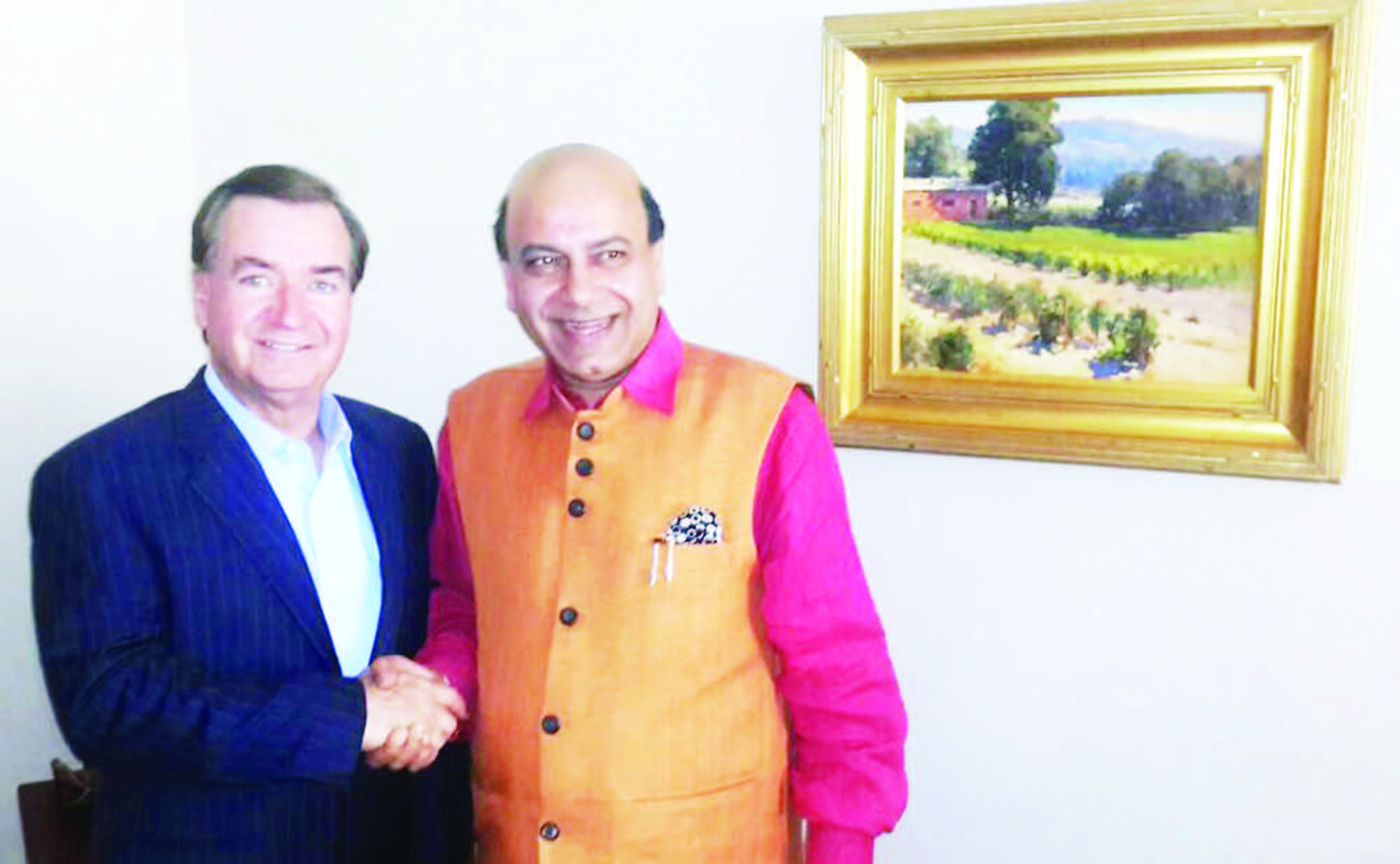
    OFBJP Global Convenor Vijay Jolly arrived here August 20th, from Vancouver to a rousing welcome at LA Int’l Airport. OFBJP US President Chandra Kant Patel, LA Convenor P. K. Nayak along with a large contingent of BJP supporters received OFBJP leader Jolly with bouquets. Vijay Jolly drove to the residence of US Congressmen & Chairman Foreign Affairs Committee Edward R. Royce here. Both leaders had a 45 minutes long meeting on Indo-US relations.

    They also discussed the forthcoming US visit by Indian Prime Minister Narendra Modi latter in the month of Sep 2014. Edward Royce is also the Chairman of India Caucus in US. Congressman expressed a keen desire to meet & welcome PM Modi along with Foreign Affairs Committee members in Washington D.C. Jolly promised to convey this to the Indian officials arranging the PM’s US visit. Jolly also extended an invitation to the Congressman to attend the Sunday 28th September public program organized by Indian American Community Foundation for NAMO Swagatam at Madison Square Garden, New York. He accepted the invite with a smile & warm handshake.

    Vijay Jolly also visited the LA Chino Hills located BAPS Swami Narayan Temple and offered floral greetings on behalf of BJP President Amit Shah. Swami Sarv Darshan, head of the BAPS temple blessed the OFBJP leader and his mission in US. Latter in the evening a grand public program organized in support of NAMO’s September visit was addressed by Jolly in downtown Los Angles. Jolly attended a successful OFBJP Vancouver, Canada program celebrating 68th India Independence Day at Surrey in British Columbia .

    The Indian Consul General Ravi S. Aisola attended the program. A book in Punjabi language on PM Modi was released by Jolly at a crowded public program. A large contingent of Indians led by Aditya Tawatia, OFBJP President Vancouver and owner of Radio India Maninder Gill pledged to participate in the NAMO program in US on 28th September, 2014 in New York.

  • India must never be a ‘Hindu Pakistan’

    India must never be a ‘Hindu Pakistan’

    By Inder Malhotra

    Modi should restrain Bhagwat & others

    Mr. Bhagwat at first propounded the strange theory that since every citizen of America is called American and that of Germany is known as German, every citizen of Hindustan “must be called a Hindu”. Someone should explain to this learned gentleman that by his own logic citizens of Hindustan should be known as Hindustanis, not Hindus”, says the author

    When Narendra Modi was swept to power spectacularly just over three months ago high hopes of an early improvement in both development and governance were accompanied by some fears that Hindutva hotheads and other extremists in the Sangh Parivar might try to queer the pitch by promoting the cult of “Hindu Rashtra”. Sadly, this seems to be coming to pass, not by the efforts of only foot soldiers and fringe elements.

    The minister of state in the Prime Minister’s Office (PMO) was the first to talk of repealing Article 370 of the Constitution that gives the state of Jammu and Kashmir a special status. This produced a reaction in the sensitive state so vehement that the state’s Chief Minister, Omar Abdullah, and his father and then Union Cabinet minister Farooq Abdullah, even threatened secession.

    This did not deter another minister to propose that it was time to have a uniform civil code, inviting another furore. Then something startling happened, of all places, in Goa. A BJP leader there announced that Mr. Modi would make India a “Hindu State” before the end of his first term. He was upstaged by the state’s Deputy Chief Minister, who blandly stated that this was already the case. Obviously, no one took him seriously because the international president of the Vishwa Hindu Parishad, Ashok Singhal, mounted the rostrum to declare that the Muslims had citizenship rights in this “Hindu” country, but they also had the duty to accept Hindutva’s doctrines and demands.

    One specific demand he made was that, the Babri Masjid at Ayodhya out of the way, “the Muslim community should willingly give up two other mosques in the holy cities of Varanasi and Mathura”. In Parliament and elsewhere Opposition members and people continued to ask Prime Minister Modi to say something about these “objectionable and divisive” declarations but he continued to maintain his eloquent silence.

    A few of those who claimed to know him pointed out that to remain silent was both his strategy and style. This reading seemed to be correct. For Parliament’s first session ended on a very sharp note just before Independence Day. The Congress and other Opposition parties condemned his government for having encouraged both polarisation and increasing communal violence since its very formation. His ministers retorted that the greatest communalist in the country was the Congress. But while speaking from the ramparts of the Red Fort, the Prime Minister dealt with the burning issue very briefly.

    He appealed to everyone to embark on a ten-year moratorium on all violence whether the “poison” be casteism, communalism, regionalism or discrimination of any kind because all these “are obstructions in our way forward”. This attracted no criticism although some did ask: “Why should there be a moratorium for a limited number of years? Why not get rid of all these evils permanently”? Ironically, it was at this precise moment that the leadership of the campaign to Hinduise the Indian state – that under the Constitution has to be secular – was taken over by the chief of the Rashtriya Swayamsevak Sangh (RSS), Mohan Bhagwat.

    He is the head of the entire Sangh Parivar of which the Bharatiya Janata Party is but one member. Nor has it gone unnoticed that the new BJP president, Amit Shah, who is also the right-hand man of Mr. Modi, has given the RSS representation in his team that is greater than ever before. Mr. Bhagwat at first propounded the strange theory that since every citizen of America is called American and that of Germany is known as German, every citizen of Hindustan “must be called a Hindu”.

    Someone should explain to this learned gentleman that by his own logic citizens of Hindustan should be known as Hindustanis, not Hindus. No America would call himself/herself as an “Am” or the German as “Ger”. If every Indian is called a Hindustani there would be no problem. Followers of the Hindu religion in this country are a huge majority of over 80 per cent. But the rest are Muslims, Christians, Sikhs, Jews, Parsis and so on. To call them Hindus would be an invitation not to a disaster but to a catastrophe.

    Probably for this reason the RSS chief changed his tune. “Hindustan (he has stopped using the names India or Bharat)”, he proclaimed, “is a Hindu state and Hidutva is the identity of our nation … and it (Hinduism) can incorporate in itself other religions”. No fewer than seven political parties, including the Congress, the Samajwadi Party and the CPM, have lambasted Mr. Bhagwat for planning to “impose Hindu majoritarianism” on the country. Several Opposition leaders have called him “Hitler” and a radical Sikh organisation, Dal Khalsa, has declared that it would not allow the RSS to “foist its fascist agenda on Punjab”.

    This said, one must add that communalism of every religious community is equally dangerous and deplorable. The entire Kashmiri Pandit minority was hounded out of the Kashmir valley two decades ago. The Pandits have become refugees in their own country, and their return to their homes remains problematic. Some Sikhs in Punjab have made a film glorifying the assassins of Indira Gandhi that cannot but cause trouble.

    In all fairness, it must also be recognised that the Congress that ruled the country for the last 10 years must accept its share of responsibility for encouraging the votaries of Hindutva. It always declared that its fight against the BJP was a contest between secularism and communalism. But, as former Defence Minister A. K. Antony, who investigated the causes of the Congress party’s electoral debacle has admitted, the Congress’ practice of secularism was more rhetorical than real.

    The country perceived it as the “appeasement of Muslim minority”. Whatever might have happened in the past, the two sides must learn a lesson from what the Pakistani Taliban have done to that Islamic country in the name of Islam. India doesn’t deserve that.

  • RSS Influence over the BJP

    RSS Influence over the BJP

    Despite the nominal distance it maintains from the organisations of the Sangh Parivar, the RSS ensures that its writ runs where it matters: in the BJP governments at the Centre and in the States. The influence of the Rashtriya Swayamsevak Sangh on the Bharatiya Janata Party is always greater during periods when the party is in power. While the Sangh is sometimes ready to appear twice removed from the government, it is keen to exercise control over the party’s organisational affairs.

    Little surprise then, the newly elected president of the BJP, Amit Shah, chose to pack the top rung of the party with those from the Sangh. Former RSS spokesman Ram Madhav is now general secretary and ideologue Vinay Sahasrabuddhe is vice-president; four of the joint secretaries (organisation) are RSS members without much of a background of work in the party. Despite the nominal distance it maintains from the organisations of the Sangh Parivar, the RSS ensures that its writ runs where it matters: in the BJP, and in the BJP governments at the Centre and in the States.

    With its organisational strength, and the large number of committed cadre, the RSS is the backbone of the BJP, and not just an ideological mentor. In the 2014 general election, workers of the RSS and its affiliates threw their weight behind the BJP and contributed in no small measure to the party’s revival in States such as Uttar Pradesh and Bihar.

    It was only natural for the BJP, especially Mr. Shah who was in charge of the party’s electoral management in Uttar Pradesh, to recognise this fact and accommodate RSS leaders in the decision-making structure of the party. What is problematic, however, is how the RSS will wield its influence in the BJP to remote-control the government. Mr. Shah enjoys a close rapport with Prime Minister Narendra Modi and it is feared he might indeed function as an extra-constitutional authority. Now, with the BJP being led by RSS hands, the party’s influence on the government can only get bigger.

    Decision-making may not be confined to the Cabinet or legislative bodies, but may extend to party forums and Sangh meetings. Going by the statement of RSS sarsanghchalak Mohan Bhagwat that Hindutva is India’s identity, the RSS’s relations with the BJP and, by extension, with the government, could raise serious concerns in the public mind, and particularly among minorities. Prime Minister Modi spoke of ruling by consensus and not by the party’s majority in the Lok Sabha, but statements such as those made by Mr. Bhagwat seeking to equate Hindutva with Indianness and Hindustanis (Indians) with Hindus can only create doubts whether the BJP intends to return to a divisive majoritarian agenda.

    Mr. Modi and the BJP need to distance themselves from such statements if these are not to be taken as reflective of the thinking of the ruling establishment. Otherwise, the Sangh, the BJP and the government would be widely seen as just different forms of the same entity.

  • No room for complacency in state polls, Amit Shah tells BJP MPs

    No room for complacency in state polls, Amit Shah tells BJP MPs

    NEW DELHI (TIP):
    On the back of BJP’s stupendous victory in the Lok Sabha polls, party chief Amit Shah has asked ministers and MPs to put their best foot forward to maintain the winning streak in the assembly polls slated in four states later this year. Addressing party MPs on July 31, for the first time since he took charge, Shah made it clear that there is no room for complacency and that the immediate focus of the party is to win the state polls in Maharashtra, Jammu and Kashmir, Jharkhand and Haryana.

    Speaking at the parliamentary party meeting at the Central Hall, Shah, whose UP strategy changed BJP’s electoral fortunes, asked the MPs to adhere to “Sampark, Samvaad and Samanvay” (communication, dialogue and coordination) with the voters, so that they do not turn away from the party at the state level. He asked the MPs to utilize their MPLADS funds judiciously in consultation with local leaders to avoid any disconnect between the party and MPs. As a step in this direction, he said, each one of them should set up offices as well as coordination committees in their respective constituencies for effective utilisation of MPLADS funds.

    Shah cautioned them against disconnect with voters and take the upcoming assembly elections and bypolls seriously. Prime Minister Narendra Modi, who chaired the BJP parliamentary party meeting, earlier introduced Shah to the party MPs. “The new BJP chief stressed on having coordination between the party MPs and the public and asked all party members to work at the booth-level,” said BJP vice president Mukhtar Abbas Naqvi after the meeting.

    Shah told the MPs that this was the first time in independent India’s history that a non-Congress government got absolute majority and it will be the duty of MPs to ensure party’s victory in their respective states. MPs from those states which are not poll-bound will also be deployed for party work in the pollbound states.