Tag: Apple News

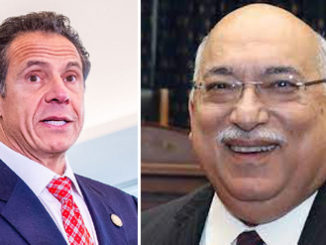
  • Ravi Batra’s advice to Gov Andrew Cuomo to “heal, enjoy fatherhood fully, and find himself, outside of politics, as a Sphinx of a man.”

    Ravi Batra’s advice to Gov Andrew Cuomo to “heal, enjoy fatherhood fully, and find himself, outside of politics, as a Sphinx of a man.”

    I.S. Saluja

    NEW YORK (TIP): Attorney Ravi Batra the other day sent a note to The Indian Panorama which clearly carried a friend’s concern for another in the wake of the latter’s tragic fall from grace in the wake of allegations of sexual misconduct.

    Cuomo probably did not realize when the allegations flew into his face that he was no Donald Trump. At the same time, he also found, ironically, unlike Donald Trump, his conscience pricking him and finally compelling him to step down.

    Cuomo could have saved himself from the disgrace he encountered by stepping down the moment the smoke rose, but he allowed the smoke to choke him.

    Ravi Batra who is a friend to Cuomo decided to give him an open friendly advice.

    “Ranju& I know Andrew Cuomo as a dear friend when he was New York State Attorney General and supported him fully. I saw in him qualities of a President Teddy Roosevelt – and said so – to reporter Liz Benjamin. He is “blue-blood” to power, which to paraphrase Mark Twain in “The Prince and the Pauper,” Andrew is a Prince who would never use the great seal of New York “to crack walnuts.” But, unfortunately, that which made him American royalty or political aristocracy, was also his Achilles’ heel: as in a nation of laws, under-pinned by our exceptional “separation of powers” regime, no one can control government. Andrew amazingly did.

    Indeed, to avoid going to war with my friend, I quit the powerful New York State Joint Commission on Public Ethics (JCOPE) in September 2012, even as I was one of its founding commissioners warmly supported by my dear friend, the late great District Attorney Robert M. Morgenthau Jr. I even sent him a letter, as both he and I are “blue-blooded” sons of great fathers. But he was surrounded by a tight circle of “yes” men and women, benefitting and roasting warmly in his power.

    His accumulation of extra-constitutional control permitted him to act – in public policy or private conduct – as if he was above the law. And just like a car without “brakes “and only an “accelerator,” a crash is inevitable as it is unavoidable. Andrew’s crash has been happening over 10 years, like a fine Opera taking time to build to a crescendo: a tragic end of Andrew the Great.

    I knew his Dad, Hon. Mario Cuomo, albeit, not as well as Andrew. Still, he was the happy personification of the American Dream, and an orator Mark Anthony would applaud. There is no joy in seeing my old friend Andrew self-destruct like Lazarus flying too close to the sun. In time, his private conduct will have met a full measure of justice, but history will always weep for what he would and could have wrought, as a sensible centrist Democrat worthy of being president of the United States and keeping us all safe from enemies foreign and domestic. I wish Andrew to heal, enjoy fatherhood fully, and find himself, outside of politics, as a Sphinx of a man.”

  • India Day Parade draws Crowds despite of Inclement Weather

    India Day Parade draws Crowds despite of Inclement Weather

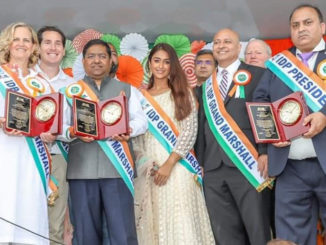
    Braving the weather, dignitaries ride a float. Seen, among others, Guest of honor Dr. D. Nori (extreme left), Indu Jaiswal (3rd from left), Guest of Honor Ranju Batra, Grans Marshall Consul General of India, Randhir Jaiswal, Nassau County Executive Laura Curran (extreme right)
    A group of protesters demanding justice for agitating farmers in India
    A Salute to Indian soldiers.
    Organizers and volunteers celebrate.

    Pro-farmers protesters demonstrate and disrupt the entertainment program

    I.S. Saluja

    HICKSVILLE,NY (TIP): India Day Parade (IDP) USA drew crowds despite of inclement weather on Sunday, August 8. It was the 7th parade in 10 years of the existence of IDP USA. Last year, because of Covid conditions, the organizers took out a car rally. Earlier, the parade was not taken out for 3 years on account of internal strife among the founders / organizers.

    Starting from Patel Brothers Plazaon South Broadway, the parade made it to the entertainment stage at the parking lot near Asa Mai Hindu temple, off North Broadway.

    Because of intermittent rain, not many people thronged the sides of the 2-mile route.

    On the way, pro-farmers protesters at some places gathered and shouted slogans in favor of protesting farmers in India. They also carried placards saying,“No Farmers, No Food.”

    At the entertainment venue, a larger group of pro-farmers protesters carrying placards, shouted anti-India government and anti-Modi slogans, and demanded that the government talk to protesting farmers to resolve their issues. Some of the representatives who addressed the gathering from the stage said they were protesting peacefully in favor of the farmers who have been protesting for over a year now. They held the Modi government responsible for the loss of life of more than   400 farmers during their agitation, Terming the Modi government’s attitude as callous, they demanded that the government talk with them and resolve the issues. They said that Indians abroad fully supported the protesting farmers and would continue to give them all support until the anti-farmers laws are annulled.

    Indian Overseas Congress group which was to march in the parade took a decision not to join the parade in view of the avowed support of their Party in India. Mr. Mohinder Singh Gilzian, IOC USA president said that their support for farmers will continue until justice is done to them. He called upon Modi government to take a step forward and meet with the protesting farmers and resolve the issue in the interest of the Indian nation. “There can be no better occasion than the Independence Day of India to take a bold initiative,” he said.

    Consul General of IndiaRandhir Jaiswal, Bollywood star Ileana D’Cruz, and Dr Jay Sarkar, philanthropist, entrepreneur, and life consultant were the Grand Marshalls

    An exultant IDP USA President Deepak Bansal, said a record number of dignitaries participated which included elected officials, lawmakers, and community leaders. New York State Comptroller Thoams DiNapoli, Nassau County Executive Laura Curran, State Senator Kevin Thomas, Supervisor of Town of Oyster Bay Joseph Saladino, Town of Hempstead Clerk Kate Murray, New York State Senator Todd Kaminsky, and County legislator Rose Walker graced the occasion with their presence.

    The Guests of Honor included internationally renowned oncologist Padma Shri Dr Dattatreyudu Nori, Diwali Foundation USA Chair Ranju Batra, Navika Group CEO/President Naveen Shah and young guru and motivational speaker Ishan Shivanand. Other notable guests included Farah Mozawalla, director of minority affairs of Nassau County and Ragini Srivastava, an upcoming politician.

    The comely Ileana D’Cruz, wearing a floor length crème colored dress, was quite a sport, posing with fans. She is an Indian-born Portuguese actress who predominantly appears in Telugu and Hindi language films.

    The entertainment stage saw a few scintillating song and dance numbers and 37 performances by kids, and the program finished around dusk. Facing the stage were 45 stalls selling ethnic clothes and jewelry and food of course. For kids there were free rides and free popcorn.  Most stalls did not have customers and folded up because of inclement weather.

    A Nissan car sponsored by DP Singh of Meetu Magic was the first prize of the raffle. He was there to take out the draw and the lucky winner turned out to be Suhag Mehta, impresario, and part of the founding team of IDP. Other raffle prizes included an Apple watch, a 50-inch TV set, and 2 air tickets courtesy CheapOair.

    President Bansal said the parade represents our motherland and people who come out to support make India proud. He thanked the IDP USA office bearers and committee chairs for working tirelessly over 3 months to prepare for the massive parade.

    According to the press release sent to The Indian Panorama, the parade was supported by top brands including Phalguni-Chintu Patel, Navika Group, The South Asian Times, CheapOair, , Patel Brothers, Vass Pipe, The Portables Choice Corp, PICC, Flushing Bank, STI Consultants, Maharaja, Badshah, Property Professionals, Commercial Capital Funding Group, Elevator the movie, Indian Visa Center, BCB Bank, Omni Mortgage, HAB Bank, No Limit Auto Body and Shiv Yog. Several media organizations also supported the parade by promoting it.

    IDP plans to celebrate the success of the 2021 Parade at a Gala at Antun’s by Minar on Thursday, August 19, 2021.  A souvenir will be released at the gala, the press release said.

    (With inputs from IDP USA press release)

  • US warns 9/11 anniversary could inspire extremist attacks

    US warns 9/11 anniversary could inspire extremist attacks

    WASHINGTON (TIP): The upcoming 20th anniversary of the September 11 attacks as well as approaching religious holidays could inspire extremist attacks, the Department of Homeland Security said in a terrorism alert issued Friday, August 13.

    DHS did not cite any specific threats in the National Terrorism Advisory System Bulletin. But it noted that the US is in a “heightened threat environment,” fueled by factors that include violent extremists motivated by racial and ethnic hatred and resentment of restrictions imposed during the pandemic.

    DHS issues the warnings to alert the public as well as state and local authorities. They reflect intelligence gathered from other law enforcement agencies. The bulletin is an extension of a similar one issued in May that expired on the day the new one was issued. DHS says domestic extremists remain a national threat priority for US law enforcement and will for at least the remainder of the year. The agency noted that al-Qaida in the Arabian Peninsula recently released the first English-language edition of its Inspire magazine in four years, apparently to mark the upcoming anniversary of the September 11, 2001, terrorist attacks. The anniversary and the approaching holidays “could serve as a catalyst for acts of targeted violence,” it said. DHS also noted that domestic extremists motivated by religious and ethnic hatred have in the past attacked houses of worships and other gatherings, but it said there aren’t any “credible or imminent threats identified to these locations.”

    As in previous bulletins, DHS expressed concern about both domestic extremists, motivated by “personal grievances and extremist ideological beliefs,” and foreign influences.

    The agency said Russian, Chinese and Iranian government-linked media outlets have helped spread conspiracy theories about the origins of Covid-19 and the effectiveness of vaccines and have in some cases amplified calls for violence against people of Asian descent.

    (Agencies)

  • A Gold Medal for India at the Tokyo Olympics at last

    A Gold Medal for India at the Tokyo Olympics at last

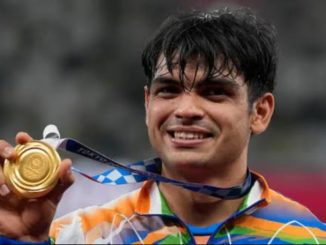
    Neeraj Chopra wins historic Olympic gold in athletics

    India’s total medal tally-7 (1 gold, 2 silver, 4 bronze)

    TOKYO /NEW YORK (TIP): “It feels unbelievable,” said Chopra. “It’s a proud moment for me and my country.” Neeraj Chopra is only the second Indian to win an individual gold after Abhinav Bindra in the 10m air rifle event at Beijing 2008. Prime Minister Narendra Modi congratulated Chopra on Twitter, saying that history had been created. Chopra’s gold was India’s seventh medal – one gold, two silver and four bronze – in Tokyo, their best ever Olympic haul having passed the six they won at London 2012.

  • “No Safe Harbor for Hate in Nassau County”

    DEAR EDITOR,

    On Sunday, July 25, I had the distinct honor and privilege to celebrate the opening of the beautiful Gurudwara Shaheedan of Hicksville and rejoice in the spirit of peace, love and light embraced by our brothers and sisters of the Sikh community.

    Last week, we learned that a gurdwara under construction in New Hyde Park was the target of disgusting, racist vandalism. Worse yet, as reported by the Washington Post, the Sikh Coalition noted the vandalism occurred days before the ninth anniversary of the Oak Creek gurdwara mass shooting in Wisconsin, when on Aug. 5, 2012, a gunman with links to neo-Nazi groups killed six worshipers.

    This most recent incident is sadly emblematic of the targeted hatred that so many in the Asian American Pacific Islander (AAPI) community have endured throughout the COVID-19 pandemic. That is why I filed legislation this spring to update County law to specifically outlaw discrimination based on an actual or perceived relationship to the pandemic and empower victims of discrimination to sue for compensatory and punitive damages and other relief deemed appropriate by the court.

    Unfortunately, since that time, the measure has languished without a public hearing. I once again urge my colleagues in the Majority to bring this measure to the floor of the Legislature so that it can be debated, approved, and sent to the County Executive’s desk.

    Hate has no place in Nassau County, and I proudly stand with the Sikh community today and always. Police are asking anyone with information about the New Hyde Park incident to call Nassau County Crime Stoppers at 1-800-244-TIPS. All callers will remain anonymous.

    ARNOLD W. DRUCKER

    Nassau County Legislator (LD 16)

    Plainview, NY


  • 75 years of Indian cinema post-Independence: The past, present and a sneak peek into future

    By Murtaza Ali Khan

    Post-Independence, Indian cinema started evolving at a breakneck pace.  While the film industry did suffer huge losses in terms of actors, writers, and technicians who decided to move to Pakistan, the industry greatly gained from the nation building campaigns helmed by Jawaharlal Nehru. For, many of these campaigns revolved around film stars whose mass appeal was leveraged upon by Nehru to give impetus to what came to be known as the Nehruvian idea of India.  There is no denying that we have come a long way as a nation over the last 75 years: from bullock carts to jeeps to airplanes to space to the internet. As far as cinematic storytelling is concerned, OTT is the new buzz word, even as the jury is still out on whether cinema the way we know it would survive or not. So, let’s take a look at the journey of cinema since independence. But, before we start discussing the journey of Indian cinema after independence, it is important to retrace our rich roots of storytelling.

    There is no denying that storytelling is one of the most powerful tools known to mankind. It also happens to be one of the oldest art forms. Storytelling is not merely a means of indulgence but also a great source of learning. Since time immemorial, storytellers have spun yarns with the hope of delighting mankind. Be it the Illiad and the Odyssey of Homer, the Jataka tales, the Mahabharata of Vyasa, the One Thousand and One Nights, or the plays of Shakespeare, each of these sprawling sagas, above all, has proven to be a consummate manifestation of the human expression. Storytelling shares an intimate relationship with performing arts. As far as India is concerned, the history of performing arts can be traced back to Bharatmuni’s Natya Shastra, which describes art as the search for truth. Human life too is a pursuit for truth and happiness. It is this connection that makes life and art inseparable. While discussing art in the context of the 20th and the 21st centuries, it is essential that we expatiate upon the notion of cinema as a mass medium of storytelling that’s often looked upon as the definitive art form that seamlessly combines elements of storytelling, performing arts, and science.

    The origins of the cinematic medium

    At the turn of the 19th century, cinema became a phenomenon across Europe thanks to the exploits of the Lumière brothers who conducted private screenings of projected motion pictures in the world’s major cities such as Paris, London, New York, Montreal, and Buenos Aires. It was in July 1896 that the Lumière films finally got screened in Bombay (now Mumbai). A couple of years later, an Indian photographer named Hiralal Sen made India’s first short film, A Dancing Scene, from the scenes of a stage show, The Flower of Persia. It was followed up by H S Bhatavdekar’s The Wrestlers (1899) – a recording of a wrestling match at the Hanging Gardens in Mumbai – which was also India’s first documentary film. In 1912, Dadasaheb Torne made a silent film titled Shree Pundalik – a photographic recording of a popular Marathi play.

    A year later in 1913, Dadasaheb Phalke made India’s first feature-length motion picture – a silent film in Marathi titled Raja Harishchandra. Phalke, who is often referred to as the Father of Indian Cinema, had mastered the art of integrating centuries old narrative techniques, borrowed from the indigenous epics, with the emerging technique of making motion pictures. In 1916, R Nataraja Mudaliar made Keechaka Vadham, the first silent film in Tamil. Bangla motion pictures soon followed. The year 1931 proved to be a landmark for Indian cinema as it marked the end of the silent era with Ardeshir Irani making India’s first sound film Alam Ara, made in Hindi/Urdu. The early commercial success of Phalke’s films not only paved the way for more such motion pictures but also set the ball rolling for cinema as a commercial art form. In the years to come, cinema in India evolved further as a potent art form capable of mirroring socio-political and economic issues plaguing India with films like Achhut Kanya (1936) and Sujata (1959). Hindi cinema gained international visibility with Chetan Anand’s Neecha Nagar (1946) and Bimal Roy’s Do Bigha Zamin (1953), which won the Grand Prix and Prix International awards at the Cannes Film Festival in 1946 and 1954, respectively.

    Nehruvian socialism and post-independence Hindi cinema

    National Award-winning film critic, M K Raghavendra, highlights in his book, The Politics of Hindi Cinema in the New Millennium: Bollywood and the Anglophone Indian Nation, how Hindi cinema, post-independence, played a big part in helping Indians imagine themselves as an entity binding them together – the Indian nation. Evidently, the first couple of decades after independence saw the influence of Nehruvian socialism on Hindi cinema. It is sometimes argued that popular films of the 1950s failed to capture the prevalent reality of the times owing to the filmmakers’ compulsion to fortify the nationalistic myths created by the newly appointed Jawaharlal Nehru government. However, if one tries to closely examine some of the most important films made during this period such as Raj Kapoor’s Awaara (1951), Bimal Roy’s Do Bigha Zamin (1953), Mehboob Khan’s Mother India (1957), and Guru Dutt’s Pyaasa (1957), it becomes evident that the Hindi films of this period were not always in harmony with Nehru’s vision of India. But, it is also true that other important films from this era like Andaz (1949), Naya Daur (1957), and Howrah Bridge (1958) did succeed in depicting the dichotomy associated with Nehru’s ideals of modern India – the good side of modernity shown through the doctors, engineers, etc. and the bad side through the caricatures of the gamblers, cabaret dancers, etc.

    While these trends continued, Hindi cinema never eschewed from capturing the nerve of the important historical events in post-colonial India such as highlighting the gloomy reality of the Sino-Indian war, the euphoria associated with green revolution of the mid-1960s, Indira Gandhi’s meteoric rise in the late 1960s, her growing populism in the 1970s and her crushing defeat in the 1977 general elections following the 21 dark months of Emergency, emergence of regional conflicts during the 1980s like the Khalistan movement, and the economic liberalization during the early 1990s under the prime ministership of P V Narasimha Rao, ushering in a new era of globalization.

    Amitabh Bachchan and the Rise of the Angry Young Man

    While during the late ’60s and early ’70s Hindi cinema witnessed the dominance of romantic movies with actors like Rajesh Khanna, Shashi Kapoor, Dharmendra and actresses like Sharmila Tagore and Asha Parekh becoming household names, by the mid-1970s a new kind of hero emerged who was not identified by his chocolate boy image but by his rugged machismo. Popularly described as the ‘Angry Young Man’, this new protagonist actually represented the anger and frustration of an entire generation exploited by those in power. For, this was a period of political, social, and economic upheaval in India with the issues of poverty, unemployment, and political violence plaguing the common man more than ever. While Amitabh Bachchan made this character his own (with the grand success of films like Zanjeer, Deewaar, and Sholay) through the ’70s and the ’80s, actors like Anil Kapoor and Sunny Deol carried the mantle forward into the ’90s. The ’70s and ’80s also marked the advent of the Indian New Wave or Parallel Cinema with films like Ankur (1973), Nishant (1975), Manthan (1976), and Saaransh (1984). Mrinal Sen’s Bhuvan Shome (1969) is widely considered as the starting point of this movement. Shyam Benegal, Mani Kaul, Ketan Mehta, and Govind Nihalani are some of the prominent names of the Indian New Wave.

    The ’90s and the Khan Trio

    The late ’80s and the ’90s witnessed commercial Hindi cinema go from strength to strength with blockbusters like Mr. India (1987), Tezaab (1988), Qayamat Se Qayamat Tak (1988), Maine Pyar Kiya (1989), Khiladi (1992), Darr (1993), Mohra (1994), Hum Aapke Hain Koun..! (1994), Karan Arjun (1995), Dilwale Dulhaniya Le Jayenge (1995), Raja Hindustani (1996), Dil To Pagal Hai (1997), Kuch Kuch Hota Hai (1998), Pyaar To Hona Hi Tha (1998), and Mann (1999) setting new box office records. Many of these films starred Anil Kapoor, Shah Rukh Khan, Salman Khan, Akshay Kumar, Aamir Khan, Ajay Devgan, Madhuri Dixit, Karisma Kapoor, and Kajol. At the turn of the 21st century, parallel cinema underwent a revival of sorts with the arrival of filmmakers like Ram Gopal Varma, Madhur Bhandarkar, and Anurag Kashyap, whose cinema mainly dealt with depiction of organized crime. The success of Satya (1998), Chandni Bar (2001), Company (2002), Black Friday (2004), and Sarkar (2005) proves beyond doubt the changing tastes of the Hindi film audiences during this phase.

    The growing influence of the Indian Diaspora on Bollywood filmmakers

    If we study Hindi cinema closely, we observe that the 1990s proved to be the tipping point with Nehruvian socialism making way for economic liberalization in India. As the Indian economy gradually opened up to the world, the Hindi cinema underwent an Anglicization of sorts owing to the growing influence of the Indian Diaspora – a trend that is best demonstrated by films like Dilwale Dulhania Le Jayenge (1995), Pardes (1997), Kabhi Khushi Kabhie Gham (2001), and Namastey London (2007). During this period, Bollywood started catering more and more to the English-speaking Indians rather than the whole of India as used to be the norm earlier. In other words, the poor were no longer the subjects of Hindi movies. The trend perpetuated with the continuous expansion of the urban middle class under the Anglophonic cultural influence as well as the multiplex boom.

    Subsequently, filmmakers like Vishal Bhardwaj, Anurag Kashyap, and Tigmanshu Dhulia made efforts to bring about a change to this trend by making films such as Matru Ki Bijlee Ka Mandola (2013), Gangs of Wasseypur (2012), Paan Singh Tomar (2012), etc. even as many major production houses remained quite content in sticking to the safe formula of making films that cater to the Anglophonic tastes of the diaspora as well as the urban middle class, as evident from films like Jab Tak Hai Jaan (2013) and Dil Dhadakne Do (2015).

    Bollywood and the 100 Crore Club

    During this phase, Hindi cinema continued to take new leaps in terms of revenue generation but there appeared to be a stagnation of sorts in terms of creative thinking. The success of a Hindi film started depending on whether it entered the ‘100 Crore Club’ or not. Even the most successful films would run only for a few weeks as opposed to the ‘Jubilee Era’, when success was measured in terms of the number of weeks a movie ran in the theatres: 25 weeks (Silver Jubilee), 50 weeks (Golden Jubilee), or 75 weeks (Platinum Jubilee).

    Hindi cinema and the Hindi heartland

    Building on the trend that was started by the likes of Anurag Kashyap, Tigmanshu Dhulia, Vishal Bhardwaj, and Aanand L. Rai, Hindi films subsequently started focusing consciously on stories based in the Hindi heartland. The diaspora no longer remained the primary target of Hindi filmmakers and as a result as the industry witnessed a surge in the number of films that are set in north-central India which enjoys a Hindi-speaking majority. But, a lot of the mainstream Hindi films since Lagaan (2001) seemed to lack the impetus needed to march in the global arena. It is true that there have been Hindi films like Miss Lovely (2012), Titli (2014), and Masaan (2015) which have made it to the Un Certain Regard Section at Cannes. But, our films have consistently found it hard to make it to the competition grade at the world’s premier film festivals such as Cannes, Berlin, and Venice? And no film since Lagaan has got nominated for the Oscars. Where is Hindi cinema’s answer to the Terrence Malicks, the Nuri Bilge Ceylans, the Christopher Nolans, and the Paolo Sorrentinos of the world? Let’s not forget that there was a time when stalwarts like Chetan Anand and Bimal Roy competed head and shoulders with some of the world’s best filmmakers at the leading cinematic forums across the globe. What Hindi cinema needs today are brave filmmakers with novel and ingenious ideas. Perhaps, Hindi cinema can take the lead from Marathi cinema, which has really come of age during the last few years. Along with the upcoming crop of filmmakers, the onus also lies with the young Hindi film audiences to grow choosier and become more demanding of the filmmakers. As the French  author Andre  Malraux said: “Great  films  will  be  made  when  we  become  a  great  audience.”

    The rise of web and the OTT platforms

    Speaking of the audiences, the rise of various OTT platforms has had a dramatic impact on nature of content produced.  Today, we have audiences with such diverse tastes that content creators are forced to create content targeted at different segments of audiences. The COVID-19 pandemic has further given a fillip to OTT platforms. With cinemas indefinitely shut down more and more viewers are forced to shift to one or more of these platforms for their daily dose of entertainment. This has also given rise to what is described as binge-watching. But before we try and examine this in detail, it is first important to decipher the nuances of binge-watching. For the uninitiated, binge-watching is a way of consuming content all in one go as opposed to consuming it in serialized weekly installments. It’s an effective way to watch plot-heavy shows. Now that we have a basic understanding of this novelty we will try and analyze its various aspects. For years cinema has been enjoying an undisputed status over its poor cousin television. While one agrees with the classification of cinema and television as two different mediums it cannot be denied that with the advent of new age content the line between the two is fast fading. In fact, today we can easily look at the majority of binge-worthy international television / web series as 8 or 10 hour films and that’s primarily because of the topnotch production values and the cinematic grammar associated with them.

    The advent of streaming services like Netflix and Amazon Prime has given rise to Indian original shows like The Family Man, Special Ops, Sacred Games, Breathe: Into the Shadows, Inside Edge, and, most recently, Ray. The greatest marker of these shows is the cinematic quality associated with them. Not to mention that these shows mostly star A-list actors in the major roles. Clearly, this rapid emergence of binge-worthy content is proving to be a real game changer for the Indian entertainment industry at large. This is in stark contrast to some of the daily soaps we have grown accustomed to watching on Indian television over the years. But there is interesting flip side to this trend. Often the viewer is in such a hurry to finish off a season that he / she often ends up overlooking some important details. Perhaps, this is a price that most viewers are willing to pay.

    The emergence of binge culture is not just impacting the end consumers it is also pushing the artists to expand their horizons. The rise of binge culture poses a big challenge for the artists to make themselves platform agnostic. Putting together an 8 to 10 hours of quality content for every season requires a different level of creative commitment. However, at the same time, it provides them with a wonderful opportunity to reinvent themselves as per the changing needs of time. Now, India’s entertainment industry has a great scope for embracing new trends, the rise of binge culture is bound to have a strong impact on cinema viewing in the longer run once normalcy returns post-pandemic. While the opinions surrounding binge culture may widely vary, even the staunchest critics wouldn’t deny that the rise of new platforms like Netflix has led to greater accessibility, reach, and creative freedom.

    The contribution of NRI filmmakers to Indian cinema

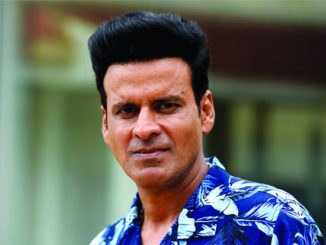
    While discussing Indian cinema post-independence one would be remiss to overlook the contributions of NRI filmmakers whose multifaceted work offers a unique blend of cinema that binds the Indian Diaspora with the general populace. Emmy-nominated Indian-American filmmaker, Ayurveda restaurateur, and Happy Life Yoga speaker Tirlok Malik is best known for making films about Indian immigrants in the US. Malik’s filmmaking journey started with his pioneering work Lonely in America (1990) which he wrote and produced while also acting in it. The film was shown in over 70 countries and screened at several leading festivals all across the globe. Since then he has made several other films about issues pertaining to the Indian diaspora such as Love Lust and Marriage, On Golden Years, and Khushiyaan which he shot in India with an ensemble cast that featured the likes of Jasbir Jassi, Tisca Chopra, Kulbhushan Kharbanda, and Rama Vij. Malik’s new short film project titled To New India with Love is set to release on the nritvfilmclub YouTube channel on the occasion of India’s 75th Independence Day. The film is being presented by Padma Shri Dr. Sudhir Parikh, chairman of Parikh Worldwide Media. It explores the subject of youth aspirations through the story of a young college student who asks a visiting NRI professor to help him go to America. Many internationally acclaimed filmmakers have also contributed wholeheartedly to the growth and development of Indian cinema in the global arena-most notably Mira Nair (Salaam Bombay!, Kama Sutra: A Tale of Love, Monsoon Wedding, The Namesake, The Reluctant Fundamentalist, A Suitable Boy), Deepa Mehta (Fire, Earth, Midnight’s Children, Leila), and Gurinder Chadha (Bend it Like Beckham, Bride and Prejudice, Viceroy’s House, Beecham House). Also, filmmakers Raj & DK deserve a special mention here as they too started their filmmaking journey outside India with their 2003 film Flavors about Indian immigrants living in America. In the recent years, Raj & DK have emerged as two of the most sought after filmmakers in India. Their Amazon Prime Video web show The Family Man starring Manoj Bajpayee in the role of an Indian intelligence officer named Srikant Tiwari has emerged one of the most popular shows in the Indian web space.

    Some reflections on the 75 year journey since independence and the way forward

    The journey of Indian cinema since 1947 has had its share of ebbs and flows and the path forward is laden with difficulties and challenges. While there are opportunities galore, there are also many obstacles. Amit Khanna, the writer, director, and producer who has been an integral part of the Hindi film industry for the last five decades, recollects how he convinced his filmmaker friends to join him for a meeting he had set up with Federation of Indian Chambers of Commerce & Industry (FICCI) during the early ’90s which proved to be instrumental in helping Bollywood get an industry status. “After our studio system got dismantled around WWII, it took us almost five decades to once again get a little organized and corporatize things. I remember when I took my close friends such as Yash Chopra, Manmohan Shetty, Ramesh Sippy and others to a meeting with FICCI they all questioned the rationale behind it. Then over time the people realized the importance of the corporate connect. Back then I was the lone voice pushing for institutional financing and recognition as an industry. Through repeated representations with the government and relentless efforts we finally succeeded in securing the industry status that paved the way for the entry of the larger corporate players while some of the smaller ones also started getting institutionalized as funding became a lot more transparent,” explains Khanna who began his career as an executive producer with actor-producer Dev Anand’s Navketan Films in 1971. “In the ’70s the video came in and kind of disturbed the equilibrium. There was a lot of resistance from producers and distributors against video. Also, there was a video piracy which continued well into the ’80s. From a peak cinema screen count of 13,000 the number went down drastically by the ’90s to less than 9,000. It was only towards the end of the 90s with the multiplex boom that things changed,” recollects Khanna who is chuffed to see the improving standards of professionalism in the industry in the recent decades.

    Noted author Nandita Puri, the chairperson of the Om Puri Foundation and wife of the late actor Om Puri, feels that Indian cinema has come a long way since independence. “The cinema in India since 1947 has undergone a massive change, both technically and content wise. We have sailed from the black and white era gracefully into the color and now the special effects scenario has captured the medium. Also from mythological stories (that’s how India got the tag of a country of maharaja and snake charmers and elephants) to the middle of the line cinema of Bimal Roy and Raj Kapoor to the realism of Satyajit Ray (who got us noticed in the West) to the blockbusters of Desai & Co (inane but entertaining) to the parallel cinema of the 1980s and to finally the multiplex filmmakers (sensible, realistic entertainment i.e. infotainment)… we have indeed traversed a long way,” explains Puri.

    German-born Indian actress Suzanne Bernert is fascinated by the vastness and scope that Indian cinema offers. “Indian Cinema is a giant… and at the same time intricate and detailed… how is that possible? If you see the vastness of India and look at how many regions exist you might get an idea how many ‘cinemas’ exist. In comparison, Germany has just one language and one audience. My own journey into regional Indian cinema is unlike anything I experienced before. You travel in India to a different state and you enter a new World. It’s distinctively Indian and at the same time you encounter a new treasure trove of language, culture and the art of shooting a movie. An experience I love and can highly recommend. Watch a regional movie and enter a new corner of India,” explains Bernert.   Award-winning filmmaker, international entrepreneur, motivational speaker and author Dr. Bhuvan Lall feels that the rich diversity that the Indian cinema continues to enjoy is seen nowhere else in the world. “A healthy cinema culture with regional flavors can only exist in a democratic setup where the artists are free to speak. India is a striking example of the largest producer of content on earth today. There is no denying that despite all the problems that we face as a country, our film industry is totally secular, totally based on Indian ethos, and capable of producing a vast array of content ranging from realism to fantasy. Here people love to say what they want to say. In any other country this is not possible as the population size doesn’t allow it. At the end of the day, you need to have a market for such diverse content and most countries in the world don’t enjoy the same luxury,” explains Lall who feels that the superstardom that the Indian actors enjoy is seen nowhere else in the world. “The star system that Indian cinema has created really has no equal. Our superstars such as Rajinikanth, Amitabh Bachchan, Shah Rukh Khan, Aamir Khan, Salman Khan, and Hrithik Roshan, among others stand head and shoulders above the leading names in Hollywood in terms of fandom and craze,” opines Lall who is Executive Chairman of Lall Brothers Media and Entertainment which provides strategic advice to the top influencers in Hollywood and Global M&E companies.  Actor-Author Vivaan Shah is fascinated by the richness of Indian cinema, “In the 75 years since Independence, the Indian cinema has had a fascinating trajectory. It has grown from a form of expressionistic extravagance to documenting the sober realities of our society, from the baroque to the naturalistic, from the geographic to the philosophical, and from the real to the surreal. Ours is a cinema of pageantry, a carnival of colours and sensation, and a document of truth and cold hard experience,” explains Shah.

    Noted Indian critic Ajit Rai throws caution to the wind by reminding that unlike films from Hollywood, the Indian films have very limited global influence outside the Indian Diaspora. “Unfortunately, we haven’t been able to establish the film industry in India like the way we have in the US and Europe. For the longest time the bulk of the films made in India have been modeled on the kind of cinema produced in the West and there are very few exceptions. In fact, if you talk to any European you will come to know that they don’t know much about Indian cinema beyond the works of Satyajit Ray. In the past, most of our commercial films to have tasted global success outside of the Indian Diaspora actually had a strong melodramatic appeal which greatly worked to their advantage,” opines Rai who is currently working on a book on the Hinduja Family and the Indian Cinema. “One of the key advantages of American cinema is that it has continued to enjoy a healthy base of non-American audiences worldwide. That’s why their business model is truly global. On the other hand, Indian cinema doesn’t have the same luxury. Most of the global business that our films do can be attributed to the diaspora. What we are dearly missing is a healthy budget for good scripting on our films. Our makers are happy to spend millions to shoot a song in exotic locations in the West but when it comes to scripting they are not very keen to spend wholeheartedly. Also, there is a great dearth of good film institutions in the country of almost 140 crore population,” sums up Rai.

    (Murtaza Ali Khan is an Indian Film & TV Critic / Journalist who has been covering the world of entertainment for over 10 years. He tweets at @MurtazaCritic and can be mailed at: murtaza@apotpourriofvestiges.com. His video essays / commentaries can be watched on his YouTube Channel at: https://www.youtube.com/c/murtaza19alikhan).

  • COVID-19 crisis and its impact on India

    COVID-19 crisis and its impact on India

    Children orphaned by COVID

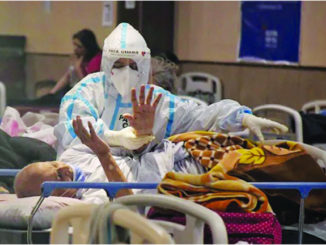
    The second wave of COVID-19 brought with it unimaginable grief, agony, and frustration. India saw a sharp increase in the number of deaths, especially among younger people, which meant that many children lost one or both parents. Reports of people seeking help for orphaned children as well as requests to ‘adopt’ these children emerged on social media. Data collected and presented by the National Commission for Protection of Child Rights in the Supreme Court as of June 8th, 2021 revealed that COVID-19 left 3,621 children orphaned. Additionally, more than 26,000 children lost one of their parents and 274 children were abandoned. These numbers, which are likely to be higher, indicate grave protection-related issues for children.

    To address this emerging child rights issue, the central government and various state governments announced social protection packages for children orphaned due to COVID-19. These packages mainly include cash transfers (different governments have designed various modalities) and concessions with a preference for the education of children who have been orphaned. Some packages also include health insurance and employment assurance upon completion of education. Though timely, there is a conscious need to design, allocate, and implement these schemes using a child-sensitive lens that responds to gender and age-appropriate needs.

    Securing rights for domestic workers

    The global COVID-19 pandemic has brought many lives to a standstill. In addition to grave health repercussions, it has resulted in a deluge of socio-economic and humanitarian suffering due to lockdowns and restrictions aimed at curbing transmission. As policymakers grapple with these conflicting pressures, millions of informal workers—domestic workers included—have faced tremendous uncertainty with regard to their work and income. Despite an easing of lockdown restrictions across India after the first wave, 45 percent of domestic workers faced some form of job loss. From those who managed to keep their jobs, many had to accept lower wages and faced working conditions fraught with health and safety risks.

    By definition, informal workers are susceptible to exploitation due to the absence of work security and social security. However, within this subset, domestic workers fare far worse than their counterparts in construction work and street vending who benefit from protective legislation. Consequently, street vendors and construction workers significantly out-earn domestic workers in both rural and urban contexts.

    In fact, domestic workers were revealed to be the lowest paid amongst all the informal trades studied by WIEGO. This is despite the immense scale of the domestic work sector. Official estimates suggest that there are 4.75 million domestic workers in India; but this is likely to be a gross under-estimation and the real number is actually closer to 50 million. Moreover, domestic work is a trade dominated by vulnerable individuals such as women—who constitute 80 percent of domestic workers globally—and also includes minors.

    Gender inequities prevail in  vaccination drive

    Just over 20 percent of India’s adult population has received their first COVID-19 vaccine dose. During the rollout, clear gender disparities have emerged, and these are of concern for the coming months. In a recent map released by Ashoka University, only around 86 women are receiving vaccine doses for every 100 men. According to data from the government’s CoWIN dashboard, in only three states—Chhattisgarh, Himachal Pradesh, and Kerala—are women currently receiving an equal or higher number of vaccine shots compared to men. Union territories including Dadra and Nagar Haveli, Daman and Diu, Jammu and Kashmir, and Chandigarh are the worst-performing regions on vaccine gender parity. As the vaccination programme begins in rural areas, addressing this gender gap early is a priority.

    In the initial days of the vaccine rollout, women made up the majority of vaccine recipients given that many frontline jobs are performed by women. In March 2021, when vaccines became available to those over 45 years of age, and then in May 2021 to those between ages 18 to 44 years, the numbers began reversing, with more men being vaccinated than women. In April alone, 2.4 million fewer women than men received a vaccination.

    India’s COVID-19 response limited by strong urban and tech bias

    Economist Jayati Ghosh analyses how the response strategy during the first wave of the COVID-19 crisis utterly neglected the plight of people from marginalised sections of society. She underlines that the policy actions—ranging from the lockdowns to the economic relief packages—were devised with a parochial view, relying on limited sources of information. Reference points for policymaking were starkly ignorant of ground realities. As a result, these measures disproportionately affected women, people belonging to the working class, and marginalised caste communities. Also, the economic relief packages during these distressing times increased the liquidity in the markets instead of improving the buying capacity of the poor. As a result, the low-income groups and labour-intensive sectors of the economy couldn’t be rescued from the crisis.

    Steps such as nationwide lockdowns were made with an assumption that all families across the country live in nicely-built houses and maintain enough savings to survive for days even in the absence of livelihood opportunities. Or, that homes are ‘safe’ for all people, ignoring ground realities about homes as sites of violence, especially for women and queer people. No wonder then that such measures led to widespread exclusions and added to the innumerable agonies among the weaker sections of society.

    Relief measures and cash transfers, according to Gram Vaani’s research, were designed to rule out ‘inclusion errors’ rather than to prevent vulnerable people from falling through the cracks. This has led to significant exclusion. Other measures, such as ramming through the new labour and farm laws, were designed to benefit corporates, the formal economy, and the upper section of the society.

    Indian achievements that helped push technological boundaries the world over

    Thanks to the talent and infrastructure in our country, today, India is among the topmost countries in the world in the field of scientific research.

    There are so many technological achievements that every Indian should feel proud about.

    1. Development of an atomic clock has made ISRO one of the few space organisations in the world to have gained this sophisticated technology.

    ISRO has developed an atomic clock that will be used in navigation satellites to measure precise location data. The space agency currently imports atomic clocks from European aerospace manufacturer Astrium.

    1. A team of Indian astronomers has discovered an extremely large supercluster of galaxies.

    This is one of the largest known structures in the neighbourhood of the universe – as big as 20 million billion suns. It is a path-breaking discovery and the cluster has been named ‘Saraswati’.

    1. ISRO demonstrated its capability of handling complex missions by successfully launching a record 104 satellites on a single rocket.

    This is the highest number of satellites ever launched in a single mission by any other country in the world.

    1. ISRO launched the country’s heaviest rocket GSLV-Mk III whose cryogenic engine was developed indigenously.

    The rocket is described as a “game-changer” in the first of its kind space mission and is yet another major step towards being self reliant in the country’s space programme.

    1. Rifath Sharook, an 18-year-old from Karur in Tamil Nadu, scripted history by designing the world’s smallest satellite.

    The tiny 3D-printed satellite is called Kalamsat, after former President Abdul Kalam, and was flown by NASA into space in one of its missions.

    1. PARAM – India’s first ever indigenous supercomputer was a major milestone in modern India’s technological journey.

    India faced a technology-denial regime in the 80s. It was then that the Centre for Development of Advanced Computing (C-DAC) was set up with the clear mandate to develop an indigenous supercomputer to meet high-speed computational needs.

    1. Aryabhatta – the first unmanned satellite built by India was a breakthrough achievement in India’s space programme.

    Aryabhata was built by the Indian Space Research Organization to conduct experiments in X-ray astronomy, aeronomics, and solar physics and opened new possibilities for ISRO.

    1. India developed an indigenous seeker for Brahmos for the first time.

    Brahmos is the world’s fastest and most formidable anti-ship cruise missile. This marks a big achievement and breakthrough for the supersonic missile as this is the first time the country has developed a seeker for a missile of this calibre and class.

    1. The Mars Orbiter Mission made India the only nation in the world to reach Mars in its first attempt.

    Mangalyaan-1, the indigenously built space probe marked India’s first venture into the interplanetary space. It also made India first in Asia, and fourth in the world to reach the surface of Mars.

    1. Chandrayaan-1, India’s first lunar exploration mission, made it possible for ISRO to go beyond the Geostationary Orbit.

    With this mission, India emerged as the fourth country in the world to hoist its flag on a lunar surface. It also provided the needed thrust to basic science and engineering research in the country.

    1. ISRO successfully test-fired its Scramjet Rocket Engine, a breakthrough technology in air-breathing propulsion.

    Air-breathing rocket systems use atmospheric oxygen from their surroundings, burn it with the stored fuel to produce a forward thrust in contrast to the conventional chemical rocket systems which carry both the oxygen and the fuel. The development of this high-technology system will go a big way in meeting India’s futuristic space transportation needs.

    1. Space Capsule Recovery Experiment Mission established India’s technological capability to recover an orbiting satellite.

    It was a remarkable achievement and the technology will now be used to develop recovery technologies for future human and robotic missions.

    1. The successful demonstration of the use of cryogenic engine technology put India among a league of only five other such nations.

    With the successful launch of GSLV-D5, India has gained the capability to launch heavy satellites without foreign assistance. It will also pave way for sizeable savings for the country’s future launch costs.

    1. India’s INSAT system is one of the largest domestic communication satellite systems owned by any country in the Asia-Pacific region.

    It initiated a major revolution in India’s communications sector. At present, it is serving several crucial sectors of our economy, including telecommunication, education, and meteorology.

    1. Indian Regional Navigation Satellite System (IRNSS) helped India realize its dream of having an independent satellite navigation capability.

    It has freed India from its dependence on navigation satellite systems operated by other countries. By all means, a home grown GPS system like IRNSS could serve as a strategic asset of tremendous significance for the military too.

  • Exports, FDI, startups fire on all cylinders to get Indian economy back on track

    Exports, FDI, startups fire on all cylinders to get Indian economy back on track

    • Independence day special

    Until February 2021, India had only ever had five months where goods exports had surpassed $30 billion. These five months were spread over the preceding decade. Since March 2021, India has had five straight months where goods exports have exceeded $30 billion every month. In fact, July 2021 was the first month ever that India crossed $35 billion in goods exports.

    While the goods exports have topped $130 billion in the first four months of this financial year, services exports have gone past $55 billion in the first quarter as reported by the Reserve Bank of India. For the first time ever, India may hit $600 billion in cumulative exports this financial year.

    What is noteworthy is that these stupendous increases have in the middle of the COVID-19 pandemic. Global trade has been impacted directly by the pandemic, as well as due to derivative issues like delays and capacity constraints in the shipping industry. And yet, the Indian exports have not just turned a corner, but have shown remarkable strength in a host of sectors. Agriculture, engineering goods, gems and jewelry, petroleum products and textiles – the numbers have been strong in each of these areas this financial year.

    It is not just export bounce-back and upward trajectory. It is also the year for India’s promising technology sector to shine. The first half of this year has seen fresh investments of $11 billion in Indian start-ups. Twenty unicorns – firms with a valuation of more than $1 billion – have flown in the Indian entrepreneurship skies already this year. And these encouraging numbers have come in at a time when the all-pervasive Chinese capital took a break from the Indian markets after investment restrictions were imposed after the Galwan Valley incident in the summer of 2020.

    The Indian start-up ecosystem is now the third-largest in the world. The number of start-ups recognised by the Department of Promotion of Industry and Internal Trade has crossed 50,000 and is spread across 623 districts in India. Nearly 1.8 lakh formal jobs have been created by 16,000 start-ups which were recognised in the last financial year. Several times more indirect jobs get created with a formalisation of jobs being created as well as aggregated by the start-up ecosystem.

    Once these startups achieve scale, they will be the fuel to power India’s growth trajectory. They are the lynchpins of tomorrow’s business ecosystem. That several of them have started to consider listing in India is an additional positive. Many of these listed start-ups will eventually create wealth for not just their founders but for their employees and retail investors alike.

    Indian start-ups have indeed become a magnet for global investors. But more broadly, the Foreign Direct Investment (FDI) has also been buoyant. FDI is critical for business growth as well as for achieving export competitiveness. By liberalizing the FDI policy in several sectors and improving ease of doing business, India has been able to garner historic Inflows.

    The highest ever FDI inflow of $82 billion was clocked in the last financial year. This was 10 percent more than the 2019-20 figure. The positive momentum on FDI has also continued this financial year. The month of May saw $10.5 billion coming in. Again, these figures become doubly critical in the context of the pandemic-led disruptions.

    With India focusing on the Production Linked Incentives (PLI) programme for 13 key sectors for five years, this trifecta of forces – Indian entrepreneurship, risk capital and potential for rapid market expansion can further come together in the time to come. The government has made an outlay of Rs 1.97 lakh crore for the PLI program to enhance cost-competitiveness, quality, efficiency and technological maturity of Indian manufacturing and for creating and nurturing global champions.

    Prime Minister Narendra Modi had announced the Aatmanirbhar Bharat ambition in the middle of last year as India sought to rebuild the economy after the first wave of the pandemic. The program, expected to reinvigorate the country, after a once in a century crisis with no playbook to tackle, has started in the right earnest. After a series of discussions with the industry captains on Aatmanirbhar Bharat last year, Modi spoke to Indian missions, which can play a pivotal role in attracting capital and projects for India.

    Trade and Industry have the power to write the growth story of a nation. As the world learns to live with the virus, India has a key role to play in the global order as a reliable and trusted partner. The Tridevs of the economy – exports, FDI and start-ups – have sent a resounding signal of India’s potential and promise to the world.

    Road ahead

    As indicated by provisional estimates released by the National Statistical Office (NSO), India posted a V-shaped recovery in the second half of FY21. As per these estimates, India registered an increase of 1.1% in the second half of FY21; this was driven by the gradual and phased unlocking of industrial activities, increased investments and growth in government expenditure.

    As per the Reserve Bank of India’s (RBI) estimates, India’s real GDP growth is projected at 9.5% in FY22; this includes 18.5% increase in the first quarter of FY22; 7.9% growth in the second quarter of FY22; 7.2% rise in the third quarter of FY22 and 6.6% growth in the fourth quarter of FY22.

    India is focusing on renewable sources to generate energy. It is planning to achieve 40% of its energy from non-fossil sources by 2030, which is currently 30% and have plans to increase its renewable energy capacity from to 175 gigawatt (GW) by 2022. In line with this, in May 2021, India, along with the UK, jointly launched a ‘Roadmap 2030’ to collaborate and combat climate change by 2030.

    India is expected to be the third largest consumer economy as its consumption may triple to US$ 4 trillion by 2025, owing to shift in consumer behaviour and expenditure pattern, according to a Boston Consulting Group (BCG) report. It is estimated to surpass USA to become the second largest economy in terms of purchasing power parity (PPP) by 2040 as per a report by PricewaterhouseCoopers.

  • 75 years on, women’s fight for freedom, against injustice continues

    75 years on, women’s fight for freedom, against injustice continues

    • Independence day special

    As we celebrate  75th Independence Day, let us not forget that somewhere in interior India, women are still fighting for their freedom, liberty, and justice. That they are fighting for not just themselves but also their family and society is what makes them special. And this is why we must pay respect to the unconditional contribution women have made, from raising children to maintaining households; from working in the day to looking after their family in the evening.

    Looking at various indicators that define women, such as economic and political empowerment, justice, safety, health and dignity, India has made a leap forward from where it began in 1947. In the last 70 years of Indian history, we have seen a degree of social progress across multiple issues that concern women in India. Indicators such as education, crime, gender equality and women empowerment, have witnessed a marked improvement.

    Today, we have more girls enrolled in schools than what it was 75 years ago. As per Unified-District Information System For Education (UDISE), the Gross Enrolment Ratio (GER) of girls at the secondary level is 80.97% and at Senior Secondary level is 56.41% respectively. Health wise, the mortality rate has come down. The gender gap has narrowed and women are beginning to play leadership roles in politics and corporate sector.

    In spite of the social progress made by women, however, challenges exist. Female labour force participation rate declined from 42.5% in 1987-1988 to 18% in 2011-2012 for rural women and from 25.4% in 1987-88 to 13.4% in 2011-2012 for urban women. At the same time, official data does not reflect the amount of work that women actually do to enable their families to survive, collecting fuel, fodder or water, keeping poultry, working as unpaid labor on family farms.

    As our society confronts these challenges towards the greater emancipation of women in India, we list out five key schemes delivered by the government that is playing or have played an important role in delivering empowerment and socio-economic progress for women in India.

    National Policy of Women

    The policy unveiled by the Government last year will help towards the creation of a society with women working as equal partners in all spheres of life. It envisages developing a framework to ensure equal rights and opportunities for women.

    Formation of Central and State Commission for Women

    A key statutory and regulatory development, the formation of National Commission for Women and subsequently state commission from 1992 onwards has played a pivotal role to address women’s right issues in the highest Government capacity. Formed under the 1990 National Commission for Women’s Act, the Commission has represented the rights of women in India and to provide a voice for their issues and concerns. The subjects of their campaigns have included issues that concern the lives of women in India such as dowry, politics, religion, equal representation for women in jobs, and the exploitation of women for labor.

    Sarva Shiksha Abhiyan

    The Sarva Shikha Abhiyan, India’s first ever nation-wide program for Universal Elementary Education has gone a long way to deliver education for girls in India. The program, pioneered by former Prime Minister Atal Bihari Vajpayee, has helped educate millions of children across the country and helped raise literacy levels among women in India.

    Direct Benefit Transfer

    In India, subsidies are paid to rural households to help them access basic utilities. Leakages and delays, however, are a common phenomenon attached with subsidy transfer that leads to situations where the beneficiaries suffer without access to subsidies. To address this challenge, the Government launched the Direct Benefit Scheme that has now been championed by the present Government as a mechanism to address leakages and prevent delays by directly transferring the money into the account of beneficiaries. Women have benefited the most as they are the ones responsible for maintaining the household activities, and with the advent of this scheme, have been able to access funds and subsequently manage their expenses.

    Beti Bachao Beti Padhao

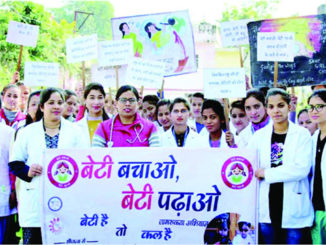
    The trend of declining sex ratio from 945 in 1991 to 918 in 2011 has been a major cause of concern. To address this challenge and to enhance girl child literacy, Prime Minister Modi launched the Beti Bachao Beti Padhao in 2015. Notwithstanding the challenges towards its implementation and delivery, the program has helped increase access to education as a means to empower the girl child.

    75 years of Socio-Political Progress

    75 years since independence, the Indian woman has surged ahead with great leaps and bounds. Today we have higher levels of consciousness about the plight of women in our country where women have suffered a lot of exploitation and discrimination.

    The discourse on women empowerment and gender equality has gone beyond the chores of households into the political arena of policies and development. Violence is spoken about but also women have broken their silence against the crimes. The present generations of men are also more sensitive than their previous generations and this is a welcome trend towards enhancing gender sensitivity in the country.

    The realization that women should be treated equally in our society has made considerable progress in light of the social and political challenges that confronted us at the time of independence. We have witnessed a sense of movement that is driving social progress and recognizing the role of women in politics, labor force etc. Over the years, we have seen suffering for women at every level at a workplace.

    However, we believe that positive times are here to come and stay to eliminate the suffering of women and enhance their equality in the society. We feel a sense of satisfaction having been able to help women from getting laws amended to raising social issues in public, helping women access to justice and joining forces with institutions to drive women empowerment.

    The next 75 years

    For the coming 75 years, there is a  sense of optimism. Although there is no short cut to embrace equality and gender justice, there is no alternative either. In the future we will have more women in policy making and in Parliament. It is believed that women will play a critical role towards delivering peace and harmony in the world, and through that, We see much more economic justice and equality. We believe this because women care, nurture and rear and they feel pain greater than men.

    This is why, we also believe that global women leadership can bring an end to conflicts and war. As women are more sensitive to crisis and wars, We are  hopeful that in the coming years, women leadership can deliver tranquility and help humanity evolve from the dark times of conflicts that have engulfed our societies from time to time.

  • 75 years on: Is India’s youth skilled enough?

    75 years on: Is India’s youth skilled enough?

    • Independence day special

    Jawaharlal Nehru in his speech Tryst with Destiny said “The achievement we celebrate today is but a step, an opening of opportunity, to the greater triumphs and achievements that await us. Are we brave enough and wise enough to grasp this opportunity and accept the challenge of the future? Today, when we are at the helm of 75 years of Independence, it seems the right time to evaluate and measure the growth and re-imagine where we need to be and what is the path that can take us there.

    India is one of the youngest nations in the world with 62% of the Population in the working age group and about 54% of the population below 25 years of age. With millions of youth joining the labour workforce year on year, and industry is looking for a productive and skilled workforce.

    Unemployability is a bigger problem than unemployment; 90% of what we learn at our academic institutes is knowledge, whereas 90% of what employers ask for is skills. 58% of India’s youth suffer from some skill deprivation and the ones that get employed don’t get the right wage. Traditionally, our Education system has been the ones offering degrees and thereby a promise of decent wage employment, however as industries evolved their requirement for a skilled workforce started increasing. A parallel skills development ecosystem was created where students would go to college to get a degree and parallely to skilling institutes to learn skills and make them employable.

    The employment landscape has been rapidly changing, Industry 4.0 is redefining the workforce landscape of India and demanding newer skills. Many jobs give importance to cognitive skills and system skills over other abilities. However, upskilling and reskilling of their workforce had not been an important area of focus for employers, thus leaving the skill development and funding for skilling to the employees themselves. The biggest question that we continuously ask ourselves is who pays for the learning? Job seekers are willing to pay for jobs but not learning, employers are willing to pay for skilled workforce but not for skilling them and the Government has been the one who has been focussing on funding for skilling programs. We had over 19 ministries with skills budgets, however not all was spent on upskilling & reskilling our workforce, NSDC (National Skills Development Corporation) was incorporated in 2008 and an independent Ministry of Skills & Entrepreneurship by the government with an aim to bring adequate focus on Skills Development .

    One of the biggest steps towards the direction of developing a highly skilled and productive workforce is the announcement of the New Education Policy (NEP), which aims to universalize education. Obviously we need to think about bringing the implementation cycle from the proposed 15 years to 5 years. There are many ways that can be done to improve the skills of our youth and few of them are:

    –     Upward mobility and Degree Connectivity: Offering degree connectivity to students having 10+2 from any higher secondary board of education as well as to candidates having 10+2 year ITI in relevant trade. Students should have the option to enrol for regular University programmes, Work Based Learning (hybrid) programmes or Part Time programmes (for working professionals).

    The four qualification corridors can be Certificate, Diploma, Advanced Diploma and Degree in one or more vocational skills educational space. Keeping the learner at the centre of our Education System, a degree should be earned anywhere and anytime. Building in flexibility with the Education System to recognise work based learning, OnJobTraining, Online learning along with OnCampus and OnSite learning, provide credits leading to degrees on vocational skilling to multiple forms of learning and have skilled and knowledgeable workforce join the labour market.

    –    Integrated Apprenticeship Program: Apprentices, while learning on the job, should also be provided OnSite / OnLine learning leading them towards credits and certifications. Work Based Learning will create a higher productive workforce, thereby reducing the attrition and cost of hiring for employers. An Apprentice scheme will serve the purpose of both the Government, by providing sustainable jobs and the industry, by providing skilled and productive workforce.

    –       Continuous Learning for Working Professionals: In order to ensure continuous learning, Education institutes should assess learner performance continuously over the duration of each semester. The examination system should be designed to assess the learner’s progress systematically across all the classrooms. Both the Industry and Government should focus on upskilling existing skill sets and reskilling for newer job roles. The industry should identify the upskilling / reskilling needs, provide the necessary resources and the Government should either subsidize or reimburse some form of learning and certification. By creating a productive workforce, it will improve the overall health of the industry, sector and their economy.

    –       Digital Infrastructure: The Covid pandemic advanced technology adoption by at least 2 decades in India, however many students do not have access to internet connectivity, laptops / phones and thereby have lost on learning over the last year. The Government has to make investments in setting a digital infrastructure and help learners get access to remote learning and upskilling to ensure there is limited or no delay in learning and making our youth employable.

    With its young population, India can and should become the skill capital of the world, however we will need to shift gears and focus on preparing and repairing skills of our youth and making them productive and employable.

    Source: Financial Express (The author, Neeti Sharma, is Co-Founder and President, TeamLease EdTech. Views expressed are personal)

  • India after Independence

    India after Independence

    • Independence day special

    When India became independent in August 1947, it faced a series of very great challenges. As a result of Partition, 8 million refugees had come into the country from what was now Pakistan. These people had to be found homes and jobs. Then there was the problem of the princely states, almost 500 of them, each ruled by a maharaja or a nawab, each of whom had to be persuaded to join the new nation.

    The problems of the refugees and of the princely states had to be addressed immediately. In the longer term, the new nation had to adopt a political system that would best serve the hopes and expectations of its population.

    India’s population in 1947 was large, almost 345 million. It was also divided. There were divisions between high castes and low castes, between the majority Hindu community and Indians who practiced other faiths. The citizens of this vast land spoke many different languages, wore many different kinds of dress, ate different kinds of food and practiced different professions. How could they be made to live together in one nation-state? To the problem of unity was added the problem of development. At Independence, the vast majority of Indians lived in the villages. Farmers and peasants depended on the monsoon for their survival. So did the non-farm sector of the rural economy, for if the crops failed, barbers, carpenters, weavers and other service groups would not get paid for their services either. In the cities, factory workers lived in crowded slums with little access to education or health care. Clearly, the new nation had to lift its masses out of poverty by increasing the productivity of agriculture and by promoting new, job-creating industries. Unity and development had to go hand in hand. If the divisions between different sections of India were not healed, they could result in violent and costly conflicts – high castes fighting with low castes, Hindus with Muslims and so on. At the same time, if the fruits of economic development did not reach the broad masses of the population, it could create fresh divisions – for example, between the rich and the poor, between cities and the countryside, between regions of India that were prosperous and regions that lagged behind.

    A Constitution is written

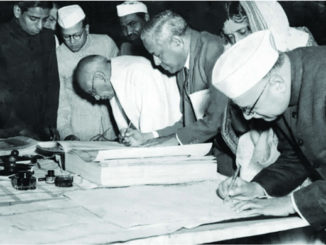
    Between December 1946 and November 1949, some three hundred Indians had a series of meetings on the country’s political future. The meetings of this “Constituent Assembly” were held in New Delhi, but the participants came from all over India, and from different political parties.

    These discussions resulted in the framing of the Indian Constitution, which came into effect on 26 January 1950. One feature of the Constitution was its adoption of universal adult franchise. All Indians above the age of 21 would be allowed to vote in state and national elections. This was a revolutionary step – for never before had Indians been allowed to choose their own leaders. In other countries, such as the United Kingdom and the United States, this right had been granted in stages. First only men of property had the vote. Then men who were educated were also added on. Working-class men got the vote only after a long struggle. Finally, after a bitter struggle of their own, American and British women were granted the vote. On the other hand, soon after Independence, India chose to grant this right to all its citizens regardless of gender, class or education.

    A second feature of the Constitution was that it guaranteed equality before the law to all citizens, regardless of their caste or religious affiliation. There were some Indians who wished that the political system of the new nation be based on Hindu ideals, and that India itself be run as a Hindu state. They pointed to the example of Pakistan, a country created explicitly to protect and further the interests of a particular religious community – the Muslims. However, the Indian Prime Minister, Jawaharlal Nehru, was of the opinion that India could not and must not become a “Hindu Pakistan”. Besides Muslims, India also had large populations of Sikhs and Christians, as well as many Parsis and Jains. Under the new Constitution, they would have the same rights as Hindus – the same opportunities when it came to seeking jobs in government or the private sector, the same rights before the law.

    A third feature of the Constitution was that it offered special privileges for the poorest and most disadvantaged Indians. The practice of untouchability, described as a “slur and a blot” on the “fair name of India”, was abolished. Hindu temples, previously open to only the higher castes, were thrown open to all, including the former untouchables. After a long debate, the Constituent Assembly also recommended that a certain percentage of seats in legislatures as well as jobs in government be reserved for members of the lowest castes. It had been argued by some that Untouchable or as they were now known, Harijan, candidates did not have good enough grades to get into the prestigious Indian Administrative Service. But, as one member of the Constituent Assembly, H.J. Khandekar, argued, it was the upper castes who were responsible for the Harijans “being unfit today”.

    Addressing his more privileged colleagues, Khandekar said: We were suppressed for thousands of years. You engaged us in your service to serve your own ends and suppressed us to such an extent that neither our minds nor our bodies and nor even our hearts work, nor are we able to march forward. Along with the former Untouchables, the adivasis or Scheduled Tribes were also granted reservation in seats and jobs. Like the Scheduled Castes, these Indians too had been deprived and discriminated against. The tribals had been deprived of modern health care and education, while their lands and forests had been taken away by more powerful outsiders.

    The new privileges granted them by the Constitution were meant to make amends for this. The Constituent Assembly spent many days discussing the powers of the central government versus those of the state governments. Some members thought that the Centre’s interests should be foremost. Only a strong Centre, it was argued, “would be in a position to think and plan for the well-being of the country as a whole”. Other members felt that the provinces should have greater autonomy and freedom.

     A member from Mysore feared that under the present system “democracy is centred in Delhi and it is not allowed to work in the same sense and spirit in the rest of the country”. A member from Madras insisted that “the initial responsibility for the well-being of the people of the provinces should rest with the Provincial Governments”. The Constitution sought to balance these competing claims by providing three lists of subjects: a Union List, with subjects such as taxes, defence and foreign affairs, which would be the exclusive responsibility of the Centre; a State List of subjects, such as education and health, which would be taken care of principally by the states; a Concurrent List, under which would come subjects such as forests and agriculture, in which the Centre and the states would have joint responsibility. Another major debate in the Constituent Assembly concerned language. Many members believed that the English language should leave India with the British rulers. Its place, they argued, should be taken by Hindi. However, those who did not speak Hindi were of a different opinion. Speaking in the Assembly, T.T. Krishnamachari conveyed “a warning on behalf of people of the South”, some of whom threatened to separate from India if Hindi was imposed on them.

     A compromise was finally arrived at: namely, that while Hindi would be the “official language” of India, English would be used in the courts, the services, and communications between one state and another. Many Indians contributed to the framing of the Constitution. But perhaps the most important role was played by Dr B.R. Ambedkar, who was Chairman of the Drafting Committee, and under whose supervision the document was finalised. In his final speech to the Constituent Assembly, Dr Ambedkar pointed out that political democracy had to be accompanied by economic and social democracy. Giving the right to vote would not automatically lead to the removal of other inequalities such as between rich and poor, or between upper and lower castes. With the new Constitution, he said, India was going to enter into a life of contradictions. In politics we will have equality and in social and economic life we will have inequality. In politicswe will be recognising the principle of one man one vote and one value. In our social and economic life, we shall, by reason of our social and economic structure, continue to deny the principle of one man one value.

    How were states to be formed?

    Back in the 1920s, the Indian National Congress – the main party of the freedom struggle – had promised that once the country won independence, each major linguistic group would have its own province. However, after independence the Congress did not take any steps to honour this promise. For India had been divided on the basis of religion: despite the wishes and efforts of Mahatma Gandhi, freedom had come not to one nation but to two. As a result of the partition of India, more than a million people had been killed in riots between Hindus and Muslims. Could the country afford further divisions on the basis of language? Both Prime Minister Nehru and Deputy Prime Minister Vallabhbhai Patel were against the creation of linguistic states. After the Partition, Nehru said, “disruptionist tendencies had come to the fore”; to check them, the nation had to be strong and united. Or, as Patel put it: … the first and last need of India at the present moment is that it should be made a nation … Everything which helps the growth of nationalism has to go forward and everything which throws obstacles in its way has to be rejected … We have applied this test to linguistic provinces also, and by this test, in our opinion [they] cannot be supported. That the Congress leaders would now go back on their promise created great disappointment. The Kannada speakers, Malayalam speakers, the Marathi speakers, had all looked forward to having their own state. The strongest protests, however, came from the Telugu-speaking districts of what was the Madras Presidency. When Nehru went to campaign there during the general elections of 1952, he was met with black flags and slogans demanding “We want Andhra”. In October of that year, a veteran Gandhian named Potti Sriramulu went on a hunger strike demanding the formation of Andhra state to protect the interests of Telugu speakers. As the fast went on, it attracted much support. Hartals and bandhs were observed in many towns.

    On 15 December 1952, fifty-eight days into his fast, Potti Sriramulu died. As a newspaper put it, “the news of the passing away of Sriramulu engulfed entire Andhra in chaos”. The protests were so widespread and intense that the central government was forced to give in to the demand. Thus, on 1 October 1953, the new state of Andhra came into being, which subsequently became Andhra Pradesh.

    After the creation of Andhra, other linguistic communities also demanded their own separate states. A States Reorganisation Commission was set up, which submitted its report in 1956, recommending the redrawing of district and provincial boundaries to form compact provinces of Assamese, Bengali, Oriya, Tamil, Malayalam, Kannada and Telugu speakers respectively. The large Hindi-speaking region of north India was also to be broken up into several states. A little later, in 1960, the bilingual state of Bombay was divided into separate states for Marathi and Gujarati speakers. In 1966, the state of Punjab was also divided into Punjab and Haryana, the former for the Punjabi speakers (who were also mostly Sikhs), the latter for the rest (who spoke not Punjabi but versions of Haryanvi or Hindi).

    Planning for development

    Lifting India and Indians out of poverty, and building a modern technical and industrial base were among the major objectives of the new nation. In 1950, the government set up a Planning Commission to help design and execute suitable policies for economic development. There was a broad agreement on what was called a “mixed economy” model. Here, both the State and the private sector would play important and complementary roles in increasing production and generating jobs. What, specifically, these roles were to be – which industries should be initiated by the state and which by the market, how to achieve a balance between the different regions and states – was to be defined by the Planning Commission.

    In 1956, the Second Five Year Plan was formulated. This focused strongly on the development of heavy industries such as steel, and on the building of large dams. These sectors would be under the control of the State. This focus on heavy industry, and the effort at state regulation of the economy was to guide economic policy for the next few decades. This approach had many strong supporters, but also some vocal critics.

    Some felt that it had put inadequate emphasis on agriculture. Others argued that it had neglected primary education. Still others believed that it had not taken account of the environmental implications of economic policies. As Mahatma Gandhi’s follower Mira Behn wrote in 1949, by “science and machinery he [mankind] may get huge returns for a time, but ultimately will come desolation. We have got to study Nature’s balance, and develop our lives within her laws, if we are to survive as a physically healthy and morally decent species.”

    The Nation, 75 years on

    On 15 August 2021, India celebrates 75 years of its existence as a free nation. How well has the country done in this time? And to what extent has it fulfilled the ideals set out in its Constitution? That India is still united, and that it is still democratic, are achievements that we might justly be proud of. Many foreign observers had felt that India could not survive as a single country, that it would break up into many parts, with each region or linguistic group seeking to form a nation of its own. Others believed that it would come under military rule. However, as many as thirteen general elections have been held since Independence, as well as hundreds of state and local elections. There is a free press, as well as an independent judiciary. Finally, the fact that people speak different languages or practise different faiths has not come in the way of national unity.

    On the other hand, deep divisions persist. Despite constitutional guarantees, the Untouchables or, as they are now referred to, the Dalits, face violence and discrimination. In many parts of rural India they are not allowed access to water sources, temples, parks and other public places. And despite the secular ideals enshrined in the Constitution, there have been clashes between different religious groups in many states. Above all, as many observers have noted, the gulf between the rich and the poor has grown over the years. Some parts of India and some groups of Indians have benefited a great deal from economic development. They live in large houses and dine in expensive restaurants, send their children to expensive private schools and take expensive foreign holidays. At the same time many others continue to live below the poverty line. Housed in urban slums, or living in remote villages on lands that yield little, they cannot afford to send their children to school. The Constitution recognises equality before the law, but in real life some Indians are more equal than others. Judged by the standards it set itself at Independence, the Republic of India has not been a great success. But it has not been a failure either.

  • Hindu Mahasabha, RSS stayed away from freedom struggle: Historians

    Hindu Mahasabha, RSS stayed away from freedom struggle: Historians

    Independence day special

    While the entire nation was fighting for a free India, there were some individuals and organizations, especially the Hindu Mahasabha and the RSS, that stayed away from the Independence struggle.

    The idea of nationalism in India, as in all third-world countries, is essentially rooted in ‘anti-imperialism and anti-colonialism’, historian Mridula Mukherjee said, asserting that proponents of Hindutva had nothing to do with it.

    “It is ironical that the proponents of Hindutva brand of nationalism, who are presently trying to appropriate the mantle of Indian nationalism had nothing whatsoever to do with the ideas of anti-colonialism and anti-imperialism. The other three essential elements of any sort of nationalism — equity, civil liberties and democracy — also have no space whatsoever in the Hindutva brand nationalism,” Mukherjee, a former director of Nehru Memorial Museum and Library, had said during a  lecture at the Aligarh Muslim University on ‘India and the road to nationalism and freedom’.

    This uncritical acceptance of the label of “nationalist” – which the Sangh parivar has conveniently ascribed to themselves – reflects a poor knowledge of history among many senior journalists. This is being used as an asset by the Hindutva coalition in their attempts to shrug off the burden of historical shame they ought to bear for having betrayed the national struggle for independence. This acceptance of their self-proclamation is being used by the Rashtriya Swayamsevak Sangh (RSS) to reinvent themselves, falsely, as hyper-patriots who have put the interests of the nation before all other concerns.

    The link between nationalism and the struggle for national liberation is inextricable in India. Recounting the role played by the RSS when India was struggling to break free from colonialism can test the credentials of the self-appointed nationalists.

    RSS in the Dandi March

    On March 18, 1999, the then prime minister, Atal Bihari Vajpayee, issued a postage stamp commemorating K.B. Hedgewar, the founder of the RSS, as a great freedom fighter before an audience that consisted mostly of Sangh cadres. This move, Shamsul Islam wrote, was an attempt “to pass off a pre-independence political trend represented by the RSS as a legacy of the anti-colonial struggle whereas in reality the RSS was never part of the anti-imperialist struggle. On the contrary, since its inception in 1925, the RSS only tried to disrupt the great anti-imperialist struggle of the Indian people against the British colonial rulers.”

    According to an article by Pavan Kulkarni,  a freelance journalist, published in The Wire, Hedgewar, the freedom fighter, was a pre-RSS Congressman, arrested and sentenced for a year’s imprisonment for his role in the Khilafat movement (1919-1924) – and that was his last participation in the freedom struggle. Soon after his release, Hedgewar, inspired by Savarkar’s idea of Hindutva, founded the RSS in September 1925. And this organisation, throughout the rest of its life under the British Raj, remained subservient to the colonising power and opposed the mass movements for India’s freedom in every phase of the struggle.

    According to Hedgewar’s biography published by the RSS, when Gandhi launched the Salt Satyagraha in 1930, he “sent information everywhere that the Sangh will not participate in the Satyagraha. However those wishing to participate individually in it were not prohibited. This meant that any responsible worker of the Sangh could not participate in the Satyagraha”.

    There was, however, no lack of enthusiasm among the cadres to participate in these momentous events. However this enthusiasm was actively discouraged by Hedgewar. M.S. Golwalkar, who succeeded Hedgewar, documented an incident which is insightful about the role of RSS leadership : “..there was the movement in 1930-31. At that time many other people had gone to Doctorji (Hedgewar). This delegation requested Doctorji that this movement will give independence and Sangh should not lag behind. At that time, when a gentleman told Doctorji that he was ready to go to jail, Doctorji said: ‘Definitely go. But who will take care of your family then?’

    That gentleman replied: ‘I have sufficiently arranged resources not only to run the family expenses for two years but also to pay fines according to the requirements’.

    Then Doctorji told him: ‘If you have fully arranged for the resources then come out to work for the Sangh for two years’. After returning home that gentleman neither went to jail nor came out to work for the Sangh.”

    However, Hedgewar himself participated in an individual capacity and went to prison. Although, this time, not with the motives of a freedom fighter. He went to prison, according to his RSS-published biography, with “the confidence that with a freedom-loving, self-sacrificing and reputed group of people inside with him there, he would discuss the Sangh with them and win them over for its work”.

    Alarmed by the motivation of both Hindu and Muslim sectarian groups to use Congress cadres for their own disruptive purposes, the All India Congress Committee passed a resolution in 1934 which prohibited members of the Congress party from becoming members of the RSS, the Hindu Mahasabha and the Muslim league.

    By the end of the decade in December 1940, when Gandhi had launched the satyagraha for Quit India, a note from the home department of the colonial government reveals that RSS leaders met the secretary of the home department and “promised the secretary to encourage members of the Sangh to join the civic guards in greater numbers,”. The civic guards was set up by the imperial government as one of the “special measures for internal security.”

    RSS and its opposition to

    Quit India movement

    A year-and-a-half after the Quit India movement was launched, the Bombay government of the British Raj noted in a memo, with considerable satisfaction, that “the Sangh has scrupulously kept itself within the law, and in particular, has refrained from taking part in the disturbances that broke out in August 1942.”

    However, as in the previous case of the Dandi March, the cadres of the RSS were frustrated by their leaders who were holding them back from participating in the movement. “In 1942 also”, Golwalkar himself pointed out, “there was a strong sentiment in the hearts of many…. Sangh is an organisation of inactive persons, their talks are useless, not only outsiders but also many of our volunteers did talk like this. They were greatly disgusted too.”

    But the RSS leadership had a curious reason for not participating in the struggle for independence. In a speech given on June 1942 – months before an unnecessary, British-made famine was to kill at least three million Indians in Bengal – Golwalkar said that the “Sangh does not want to blame anybody else for the present degraded state of the society. When the people start blaming others, then there is basically weakness in them. It is futile to blame the strong for the injustice done to the weak…Sangh does not want to waste its invaluable time in abusing or criticising others. If we know that large fish eat the smaller ones, it is outright madness to blame the big fish. Law of nature whether good or bad is true all the time. This rule does not change by terming it unjust.”

    Even in March 1947, when the decision was already made by the British to finally quit India following the naval mutiny of the previous year, Golwalkar persisted in his criticism of those RSS cadres who wanted to participate in India’s struggle for independence.

    Post-independence

    ‘anti-nationalism’

    In an editorial published in the RSS mouthpiece, the Organiser, on the eve of India’s independence, the Sangh opposed the tricolour flag, declaring that “it never be respected and owned by the Hindus”. “The word three”, the editorial went on explain, “is in itself an evil, and a flag having three colours will certainly produce a very bad psychological effect and is injurious to a country.”

    A few months after independence, Nathuram Godse – who was a member of both the Hindu Mahasabha and the RSS – shot Gandhi three times at point-blank range on January 30, 1948. Historian A.G Noorani, quoting from the records of Pyarelal Nayyar, personal secretary to Gandhi at the time, wrote: “Members of the RSS at some places had been instructed beforehand to tune in to their radio sets on the fateful Friday for the ‘good news’.

    “After the news, sweets were distributed in RSS circles at several places”, according to a letter received by Sardar Patel from a young man, “who according to his own statement was gulled into joining the RSS… but was later disillusioned”

    A few days later, the RSS leaders were arrested and the organisation was banned.

    Sardar Vallabhbai Patel, whom the RSS claim as their own today, wrote to Golwalkar in September that year, explaining his reasons for banning the RSS. Speeches of the RSS, he said, “were full communal poison.. As a final result of the poison, the country had to suffer the sacrifice of the valuable life of Gandhiji. Even an iota of sympathy of the government or of the people no more remained for the RSS. In fact the opposition grew. Opposition turned more severe, when the RSS men expressed joy and distributed sweets after Gandhiji’s death. Under these conditions it became inevitable for the government to take action against the RSS.”

    In another letter dated July 18, 1948, Patel said to Hindu Mahasabha leader, Shyama Prasad Mukherjee,“..our reports do confirm that, as a result of the activities of these two bodies (RSS and the Hindu Mahasabha), particularly the former (the RSS), an atmosphere was created in the country in which such a ghastly tragedy became possible.”

    However, Godse claimed in the court that he had quit the RSS before assassinating Gandhi, and so did the RSS. This claim, however, could not be verified because “no records of the proceedings.. no membership registers are maintained” by the RSS, as pointed out by Rajendra Prasad in a letter to Patel. Under the circumstances, no evidence could be found to prove that Godse was a continuing member of the RSS.

    Nonetheless, Gopal Godse, brother of Nathuram who was also arrested as a co-conspirator and sentenced to imprisonment, said in an interview with Frontline magazine, 30 years after his release from prison, that Nathuram had never quit the RSS and had lied in the courts. “All the brothers”, he said, “were in the RSS. Nathuram, Dattatreya, myself and Govind. You can say we grew up in the RSS rather than in our home. It was like a family to us. Nathuram has said in his statement that he left the RSS. He said it because Golwalkar and the RSS were in a lot of trouble after the murder of Gandhi. But he did not leave the RSS.”  This claim is also corroborated by another member of Godse’s family in a recent interview with the Economic Times.

    In the same interview with Frontline, Gopal Godse went on to accuse L.K. Advani of “cowardice” for disowning Nathuram. “You can say that RSS did not pass a resolution, saying, ‘go and assassinate Gandhi’. But you do not disown him.” he complained.

    But long before Gopal Godse chose to testify that Nathuram had remained a member of RSS at the time of Gandhi’s murder, the government, unable to provide any evidence, lifted the ban on the organisation in July 1949, after the RSS, arm-twisted by Sardar Patel, wrote for itself a constitution in which it was made clear that the RSS will be “wedded to purely cultural work” and will have no politics of their own.

    Four months later, after the drafting committee had completed the process of drafting the constitution, the RSS raised an objection in an article in the Organiser, published on November 30, 1949: “But in our constitution, there is no mention of that unique constitutional development in ancient Bharat… To this day his laws as enunciated in the Manusmriti excite the admiration of the world and elicit spontaneous obedience and conformity. But to our constitutional pundits that means nothing.”

    Here perhaps the RSS was offering an insight into its – or at least that of its leaders’ – reactionary mindset by regarding as superior to our constitution the Manusmriti – a legal code according to which, “[t]he service of Brahmanas alone is declared an excellent occupation for a Shudra; for whatever else besides this he may perform will bear him no fruit”; an oppressive regime which prohibited a Sudra from earning wealth “even though he be able; for a Sudra who has acquired wealth, gives pain to Brahmanas”.

    The campaign of the RSS to implement the Manusmriti instead of the constitution continued well into the following year, even after the the constitution was officially adopted by the country. In an editorial titled ‘Manu Rules Our Hearts‘, the RSS asserted in a tone of defiance:  “Even though Dr Ambedkar is reported to have recently stated in Bombay that the days of Manu have ended it is nevertheless a fact that the daily lives of Hindus are even at present day affected by the principles and injunctions contained in the Manusmriti and other Smritis. Even an unorthodox Hindu feels himself bound at least in some matters by the rules contained in the Smritis and he feels powerless to give up altogether his adherence to them.”

    But now they are patriots

    So in conclusion, I ask, what would be a reasonable word to describe a cult which went down on its knees before the colonial government and opposed the mass struggle to create an independent nation; a cult which opposed the national flag and the country’s constitution, and whose “men expressed joy and distributed sweets after” the assassination of a person regarded by the masses as the father of our nation? Are they to be branded as traitors? No. In our times when history is becoming increasingly irrelevant for political discourse, they are the “Nationalists”. And everyone else is anti-national.

              Source: The wire and HT

  • Mahabalipuram

    Mahabalipuram

    Famous for its intricately carved temples and rock-cut caves, Mamallapuram or Mahabalipuram as it is famously known, is a historically important and well-loved tourist location situated on the Coromandel Coast along the Bay of Bengal, in the state of Tamil Nadu. Once the abode of the famous demon king Mahabali, Mahabalipuram was later renamed Mamallapuram.

    The serenity, the alluring atmosphere and the impressive setting with many beautiful white sandy beaches dotted with casuarina trees are all reasons as to why one would want to visit this wonderful town. Some famous tourist spots include the UNESCO world heritage site Group of Monuments like the Shore Temple and the Five Rathas, the Crocodile Bank which is home to some exquisite species of crocodiles and alligators, and the beach resorts in Kovalam and Sadras.

    Places To Visit Shore Temple

    Built during the 7th century, Shore Temple is one of the oldest South Indian temples constructed in the Dravidian style and depicts the royal taste of the Pallava dynasty. The work of the temple has been listed amongst the World Heritage Sites by UNESCO. It is located in Mahabalipuram and is one of the most photographed monuments in India situated on the shores of Bay of Bengal.

    Mahabalipuram Beach

    Also known as Mamallapuram by locals, the Mahabalipuram Beach is situated at a distance of 58 km from the Chennai city in Tamil Nadu. The beach lies on the shore of Bay of Bengal and comprises of some rock-cut sculptures which are pleasing to the eyes. It is also famous for caves, massive rathas, chariots and temples which offer a great spot for holiday. The Mahabalipuram beach is a perfect place to relax and give yourself a break from the deadlines and work pressure on a daily basis. People from near and far flock to the beach especially to enjoy the natural sunbathing offered by the beach. The windsurfers and swimming lovers are bound to have an amazing time at the beach for they are seen doing just that on the shores of the beach.

    So as to attract tourists, the beach also has interesting places to offer including a crocodile bank with about 5000 crocodiles belonging to 6 different species, a school of art & sculpture and a snake venom extracting centre. There are also numerous resorts along the beach offering delicious food joints to fill the empty bellies of visitors. The scintillating beach has golden sand all along the stretch surrounded by rising hills and the sparkling sea.

    Five Rathas

    The Five Rathas, also known as Panch Rathas, is a exemplary set of rock temples. They are excellent examples of the evolution of Dravidian style architecture.

    These temples are built in the same shape as pagodas, and greatly resemble Buddhist shrines and monasteries. The rathas are associated with the great epic Mahabharata. The first ratha that is located right by the entrance gate is Draupadi’s Ratha. It is shaped like a hut and is dedicated to the goddess Durga. Next comes Arjuna’s Rath. This one has a small portico and carved pillar stones and is dedicated to Lord Shiva. There are no carvings inside this temple, but many are on the outside. Directly in front of Arjuna’s Rath is the Nakula Sahadev Rath. This ratha has some huge elephant sculptures included that are a huge draw for the Five Rathas. It is dedicated to the God of Rain, Lord Indra. The Bhima Rath is huge. It measures 42 ft in length, 24ft in width, and 25ft in height. The pillars there do contain lion carvings even though the ratha as a whole is incomplete. The largest of the Five Rathas is the Dharamraja Yudhistar’s Rath.

    Arjuna’s Penance

    The Arjuna’s Penance is an enormous rock-cut relief, one of the largest in the whole world, situated in Mahabalipuram of Kanchipuram district, Tamil Nadu. It is also known by the name ‘Descent of the Ganges’ because the structure depicts either or both of these two significant and symbolic events of Hindu mythology; thus making this attraction spot a favourite among historians, scholars, academics as well as tourists who are enthusiastic about the cultural past of India.

    Alamparai Fort

    Many do not know the significance of the captivating fort as this long forgotten trading post is spoken about quite infrequently. In fact, the fort was listed in the International Tourism Fair in Berlin as one of the twenty lesser known tourist attractions in Tamil Nadu by The Tamil Nadu Tourism Development Corporation (TTDC). No matter what the present condition of the Alamparai fort is, the view is sure to take your breath away. As you walk across the enthralling fort, you’ll find surprising traces of life in the form of shrubs, creepers, bushes and trees even on the walls. It almost looks like they are supporting those parts of the structure and help them stand strong even today.

  • How AI can help choose your next career and stay ahead of automation

    How AI can help choose your next career and stay ahead of automation

    Sydney (TIP): The typical Australian will change careers five to seven times during their professional lifetime, by some estimates. And this is likely to increase as new technologies automate labour, production is moved abroad, and economic crises unfold.

    Jobs disappearing is not a new phenomenon – have you seen an elevator operator recently? – but the pace of change is picking up, threatening to leave large numbers of workers unemployed and unemployable.

    New technologies also create new jobs, but the skills they require do not always match the old jobs. Successfully moving between jobs requires making the most of your current skills and acquiring new ones, but these transitions can falter if the gap between old and new skills is too large.

    We have built a system to recommend career transitions, using machine learning to analyse more than 8 million online job ads to see what moves are likely to be successful. The details are published in PLOS ONE.

    Our system starts by measuring similarities between the skills required by each occupation. For example, an accountant could become a financial analyst because the required skills are similar, but a speech therapist might find it harder to become a financial analyst as the skill sets are quite different.

  • Google unveils new next-gen Nest cameras, doorbell

    Google unveils new next-gen Nest cameras, doorbell

    San Francisco (TIP): With an aim to offer more security and privacy to its users, Google on Thursday unveiled a new line of home security cameras and a doorbell under its Nest brand. The new Google Nest Cam, a battery-powered camera, is priced at $179.99, and Google Nest Doorbell (battery) is priced at $179.99.

    There’s Google Nest Cam with a floodlight priced at $279.99 and the second-generation Google Nest Cam (wired) at $99.99.

    “Google Nest’s mission is to create a home that takes care of the people inside it and the world around it… All of this starts with helping you understand what’s happening within the walls of your home and outside of it,” the company said in a blogpost.

    “Because we’re all overloaded with notifications every day, our next-generation cameras and doorbell are made to send you the most helpful alerts,” it added.

    With the new Nest Cams and a display, users can keep an eye on the backyard from their kitchen and get alerts when the doorbell rings.

    They can detect important events that happen in and around the home, including alerts for people, animals and vehicles—and in Nest Doorbell’s case, also packages.

  • Nasa scientists spot unusual set of rings around black hole with companion star

    Nasa scientists spot unusual set of rings around black hole with companion star

    Astronomers have spotted a spectacular set of rings around a black hole in an image captured using Nasa’s Chandra X-ray Observatory and Neil Gehrels Swift Observatory. Nasa said that the X-ray images of the giant ring reveal information about the black hole, its companion star, and the intervening dust clouds.

    “The black hole is part of a binary system called V404 Cygni, located about 7,800 light-years away from Earth. The black hole is actively pulling material away from a companion star — with about half the mass of the Sun — into a disk around the invisible object. This material glows in X-rays, so astronomers refer to these systems as “X-ray binaries,” the US space agency said.

    In 2015, Neil Gehrels Swift Observatory discovered a burst of X-rays from V404 Cygni creating high energy rings. These rings were generated when a burst of X-rays from the black hole system bounced off of dust clouds between V404 Cygni and Earth, a phenomenon called light echoes. Cosmic dust consists of tiny, solid particles.

    The rings tell astronomers about the landscape between V404 Cygni and Earth. According to Nasa, the diameter of the rings reveals the distances to the intervening dust clouds the light ricocheted off. When the cloud is closer to Earth, the high energy ring appears larger and vice versa.

    “The light echoes appear as narrow rings rather than wide rings or haloes because the X-ray burst lasted only a relatively short period of time,” said Nasa.

    NASA Mars rover fails to collect rock in search of alien life

    NASA’s Perseverance drilled into the surface of Mars but failed in its initial attempt to collect rock samples that would be picked up by future missions for analysis by scientists on Earth.

    The US space agency published images Friday of a small mound with a hole in its center next to the rover — the first ever dug into the Red Planet by a robot.

    But data sent to Earth by the rover after its first attempt to collect a sample and seal it in a tube indicated no rock had been gathered.

    “While this is not the ‘hole-in-one’ we hoped for, there is always risk with breaking new ground,” said Thomas Zurbuchen, associate administrator for NASA’s science mission directorate, in a statement.

    “I’m confident we have the right team working this, and we will persevere toward a solution to ensure future success.”

    The drill hole is the first step of a sampling process that is expected to take about 11 days, with the aim of looking for signs of ancient microbial life that may have been preserved in ancient lakebed deposits.

    Scientists also hope to better understand Martian geology.

    The mission took off from Florida a little over a year ago and Perseverance, which is the size of a large family car, landed on February 18 in the Jezero Crater.

    Scientists believe the crater contained a deep lake 3.5 billion years ago, where the conditions may have been able to support extraterrestrial life.

    NASA plans a mission to bring around 30 samples back to Earth in the 2030s, to be analyzed by instruments that are much more sophisticated than those that can be brought to Mars at present

  • Twitter Spaces adds co-hosts feature to help moderate, manage rooms

    Micro-blogging site Twitter has announced that it is now rolling out a new update to Spaces to allow hosts to designate up to two co-hosts for its social audio rooms.

    The new update will make it easier for hosts of the audio space to help manage and moderate conversations.

    Once invited, co-hosts have almost all the same moderation and managing privileges as the main host, they can speak, invite other members of the room to speak, pin tweets, boot people from the room and more, reports The Verge.

    There are a few limitations, though as only the main host can invite or remove other users as co-hosts — one co-host can’t invite a second one, for example.

    Co-hosts also can’t end the room; only the original host can.

    The co-host feature also expands the number of participants that can talk at once in a Space, the report said.

    Now you can have one host, two co-hosts and ten speakers all active in a room at once, up from the previous ten-speaker limit, it added.

    The new addition has started rolling out now and should be a useful part in helping hosts keep spaces under control, especially for larger conversations.

    A recent report said that Twitter users will now be able to compose a new tweet directly from the Space, which will link to the audio chat and any accompanying hashtags.

  • Halle Berry continues shooting for ‘Bruised’ despite two broken ribs

    Halle Berry continues shooting for ‘Bruised’ despite two broken ribs

    Hollywood star Halle Berry cracked two of her ribs on the first day of filming her new movie “Bruised” but that did not stop her from shooting, says her stunt coordinator.

    Berry will be seen playing a disgraced MMA fighter in her upcoming directorial. The story revolves around her return to fighting to redeem herself after the son she gave up as an infant re-enters her life unexpectedly, reports aceshowbiz.com.

    The role required lots of physical work for Halle Berry and on the very first day of shooting, she ended up with two broken ribs. The actress did not let her injury pause the production and insisted on continuing with the shoot.

    “(It was) kind of a crazy injury,” stunt coordinator Eric Brown told Entertainment Weekly.

    The stunt coordinator added: “But that was just her intensity… Halle’s a special case. I’ve worked with tons of actors, and almost none of them have that kind of work ethic.”

    This is not the first time Halle Berry has broken her ribs. She also suffered a rib injury while shooting for “John Wick: Chapter 3 – Parabellum”.

    Her experience after that was what encouraged her to keep going with the shoot of “Bruised”.

    “I told the director about it (then), they told the insurance,” Berry recalled of her “John Wick” accident.

    She added: “We had to shut down for months and it was a big ordeal. On this (Bruised), because it was an independent movie, we didn’t have a big budget. The director in me said, ‘I didn’t come this far and work this hard to go home.”

  • Kesar Peda

    Kesar Peda

    Ingredients

    –        500g Soft white milk fudge (khoya)

    –        300gms sugar powdered

    –        ½tsp cardamom powder

    –        1tsp cardamom seeds semi crushed

    –        1tbsp slivered or crushed pistachios

    –        A few strands of saffron

    –        1tbsp warm milk

    –        2 drops saffron color (optional)

    Recipe Method

    –        Soak the saffron in warm milk.

    –        Crumble the milk fudge. If very hard, grate the fudge.

    –        Add powdered sugar and mix well.

    –        Put mixture in a large heavy or nonstick pan. Heat on medium high for few minutes. Reduce the flame and cook till soft and gooey.

    –        Make sure to stir continuously, while on heat. When mixture is thick and gooey, add cardamom and saffron. Add the color if desired.

    –        Mix well, and take off fire. Allow to cool, gently turning occasionally.

    –        Use cookie molds, or shape pedas with palms into patty rounds. Mix pistachios and cardamom seeds and press a bit on top of each.

    –        If using molds, first sprinkle some at bottom. Take some mixture and press into mold. When set well, invert and carefully, unmold.

  • Tandav controversy didn’t delay The Family Man 2: Manoj Bajpayee

    Tandav controversy didn’t delay The Family Man 2: Manoj Bajpayee

    Manoj Bajpayee believes it is a great time to be in the content space. The pandemic has changed the way India consumes its entertainment, putting story in the spotlight and making writers and directors with vision its new kings. The 53-year-old actor, who has become a darling of the audience on the OTT space, spoke about the churning in the entertainment space at an online Adda hosted by the Indian Express on Thursday. He was in conversation with Anant Goenka, Executive Director, The Indian Express Group, and film critic Shubhra Gupta.

    Manoj spoke how the era of superstars may be over as OTT levels the playing field. He called the streaming a far more democratic medium where talent is thriving. “The system that is based on Friday releases has lost out. You see their desperation and anxiety but they are also trying to tweak themselves to be a part of this new situation.”

    Calling the big actors, the “real kings of box office”, Bajpayee added, “For us, it was always this situation. We were doing everything so that we can be part of such films. But they were the real kings of box office. They will take time to come to terms to this situation and start re-inventing themselves. I see that effort happening from that side also,” he added.

    However, given the dynamics of Bollywood, Manoj said he saw nothing wrong with stars taking a large chunk of the film’s profit. “If you ask me were stars right in taking 50-60 percent of profit share, I would say yes, because that is how producers and directors were casting. They were not taking Manoj Bajpayee randomly and making him a star. They were going to the stars who can give them numbers at the box office. And those films were star-centric, created around those stars to make profit. So if the main guy is taking that much of profit, I don’t see anything wrong there because it’s all a commercial preposition. We aren’t talking about cinema here,” Bajpayee opined.           Source: The Indian Express

  • Courteney Cox drives around tourists on Warner Bros’ set during her free time from shoot

    Courteney Cox knows how to utilize her time while on set. A lot of people don’t know that making a film or a series takes a lot of blood, sweat and tears. There can be issues regarding the shooting, the set, lighting, makeup, hair, script and so on. There is a lot of time to kill too when in-between shots changes because the actors have to wait for hours before they can get back to work.

    The Friends actor has been in the business for long enough to find clever ways to avoid sitting around, and it sounds nothing but fun to us!

    While on the Warner Bros. set for filming the new show ‘Shining Vale’, Courteney Cox posted a video on Instagram. In the video, she tells her fans, “Here I am on the backlot of Warner Bros. filming my show, Shining Vale. There’s definitely a lot of time in between setups, but I don’t get bored. Nope, I see opportunity all around.”

    After that, Courteney Cox started to show off her industriousness, filling her time with several activities, including driving around the tourists enjoying the Warner Bros. studio tour in Burbank, California.

  • Disney cuts ties with Scarlett Johansson, to not go ahead with any project?

    Disney cuts ties with Scarlett Johansson, to not go ahead with any project?

    Scarlett Johansson and Disney are at loggerheads, and the legal battle between them is still trending and making news. While there are a lot of speculations in the air about the future of the two together, many new continue to surface. The latest has to do with the question that will Scarlett ever again reprise Black Widow for the Marvel Cinematic Universe. Well, it seems dark. If you are unaware, Scarlett Johansson sued Disney recently. She accused the studio of breaching her contract in which they promised her an exclusive theatrical release of the Black Widow standalone flick. The studio released the movie simultaneously on their streaming platform Disney Plus. Johansson claimed to has incurred losses in huge numbers. Now if the latest dash of grapevine is to go by, the studio has now made a firm decision to not ever partner with Scarlett, who has been their Natasha Romanoff.

    Scarlett Johansson entered the Marvel Cinematic Universe in 2008 as Natasha Romanoff in Iron Man 2. Over the decade, she appeared in multiple projects and won hearts only for the fans to keep asking for a standalone flick. After a massive demand, the actor finally got Black Widow but only to start a war between the studio and Johansson.

    Now as per We Got This Covered, Disney has now decided to not ever work again with Scarlett Johansson. The studio who have strongly dissed the lawsuit twice calling it ‘meritless’ and ‘PR Stunt’. They now plan to completely cut ties with their Black Widow and halt everything that they were planning to do with her. This also means that they won’t be going ahead with Tower Of Terror, which started the actor in the lead role.

  • Christina Applegate suffers from multiple sclerosis

    Christina Applegate suffers from multiple sclerosis

    Emmy award-winning actor Christina Applegate has shared that she has multiple sclerosis and revealed that it has been a “strange journey”. Applegate announced it in a post on Twitter, reports variety.com.

    “Hi friends. A few months ago I was diagnosed with MS. It’s been a strange journey. But I have been so supported by people that I know who also have this condition. It’s been a tough road. But as we all know, the road keeps going. Unless some a****** blocks it,” the Christina Applegate actor wrote.

    The “Dead to Me” actor added: “As one of my friends that has MS said aWe wake up and take the indicated action.’ And that’s what I do. So now I ask for privacy. As I go through this thing. Thank you XO.”

    Applegate won a Primetime Emmy for an outstanding guest appearance in a comedy series for “Friends” in 2003. She was nominated in the same category for the same show in 2004.

  • Modi expected to address annual UNGA session in person on Sept 25

    Modi expected to address annual UNGA session in person on Sept 25

    Prime Minister Narendra Modi is expected to address the annual high-level UN General Assembly session in person on September 25, according to a provisional list of speakers released by the UN.

    The list and schedule are subject to changes and the presence of world leaders in the United Nations headquarters here for the high-level annual session will significantly depend on the global Covid situation, particularly as the highly transmissible Delta variant rages in the US as well as across other UN member nations.

    According to the first provisional list of speakers for the General Debate at the 76th session of the UN General Assembly, Modi is scheduled to speak at the high-level session on the morning of September 25, the first leader listed for the day.

    In 2019, Modi travelled to New York for the high-level UN General Assembly session.

    Last year, world leaders, including Modi, submitted pre-recorded video statements for the United Nations General Assembly session in September, as heads of state and government could not physically attend the annual gathering due to the coronavirus pandemic.

    It was the first time in the UN’s 75-year history that the high-level session had gone virtual. This year too, the option has been kept open for the world leaders to send in pre-recorded statements since the pandemic continues to rage across several nations around the world.

    The General Debate begins on September 21 and US President Joe Biden is scheduled to address the session in person, his first address to the world organisation as the American leader.

    Japanese Prime Minister Yoshihide Suga and Australian leader Scott Morrison are also listed to address the General Debate in person on September 24.

    With leaders of Australia, India, Japan and the United States expected to attend the General Assembly session in person, it is highly likely that the Quad Leaders’ Summit could take place in September around the UNGA.

    The US, India, Australia and Japan had in 2017 given shape to the long-pending proposal of setting up the “Quad” or the Quadrilateral coalition to counter China’s aggressive actions in the Indo-Pacific region.

  • Mixing shots a bad idea; India may not meet Dec 31 target: SII founder

    Mixing shots a bad idea; India may not meet Dec 31 target: SII founder

    Pune (TIP) : The Serum Institute of India is unlikely to be able to secure a licence for its version of the highly efficacious coronavirus vaccine developed by US-based company Novavax, the Pune-based vaccine maker’s chairman said on Friday, when he also urged caution on mixing of doses, said booster shots may be needed for those vaccinated over six months ago, and that the expectation that all Indians will be vaccinated by the end of 2021 was unlikely to be achieved.

    Cyrus Poonawalla, 80, who founded SII – now the world’s largest vaccine maker by volume – was speaking at an event in Pune, where he credited the Centre for easing regulatory processes for vaccine makers at a difficult time. He, however, stressed that the ideal gap between two doses of Covishield, which his company makes, was two months, and criticised the government for banning the export of doses.

    On the vaccination target to reach all Indians by 2021, Poonawalla said: “We are yet to increase our production to 10 crore (100 million) vaccines. No single company in the world can produce 10 crore vaccines in a month. We have promised about 110-120 crore doses annually because we invested in it prior. So you can do the math now. If other manufacturers produce 1-2 crores every month then the production would increase accordingly.”

    The SII founder also said it was a “bad move by the government” to embargo exports of vaccines. “My son (SII CEO Adar Poonawalla) asked me not to open my mouth. But it is my view that exports ought to be opened,” Poonawalla said, citing SII’s supply commitments.

    Over 150 countries are dependent on SII for vaccines and are blaming the company for stopping the supply during a crucial period, he said, before adding that these countries have paid “crores” in advances. The Bill and Melinda Gates Foundation and World Health Organisation (WHO) have given it ?5,000 crore which, Poonawalla said, he offered to return. He hinted that they declined his offer in the hope that the Indian government will lift the ban soon.

    India banned vaccine exports in April when the second wave of the pandemic began to peak and the need to vaccinate people in the country at a greater pace was felt acutely.

    Poonawalla, however, credited the Centre for easing regulatory processes. “I must stress that my difficulties are much reduced under the Modi government. Definitely, I am not the one to give lip sympathy to government ministers but certainly, one of the major reasons why we could launch our Covid vaccine so quickly was because of the forthcoming grant of permissions, encouragement to industries and reduction of ‘Licencing Raj’. We have now got a drug controller who responds in the evening hours,” Poonawalla said.

    SII-manufactured Covishield accounts for close to 90% of all coronavirus vaccine doses administered in India. In mid-July, the Union government announced that it had placed orders for 375 million doses of Covishield at a rate of ?205 per dose. These doses will be supplied between August and December. The Union government recently told Parliament that the company will produce 150 million doses a month beginning next month.

              Source: HT