Tag: Australia

  • US missions in Asia used for spying?

    US missions in Asia used for spying?

    SYDNEY (TIP): China and Southeast Asian governments demanded an explanation from the US and its allies on October 31 following media reports that American and Australian embassies in the region were being used as hubs for Washington’s secret electronic data collection programme.

    The reports come amid an international outcry over allegations that the US has spied on the telephone communications of as many as 35 foreign leaders. A document from NSA leaker Edward Snowden, published this week by German magazine Der Spiegel, describes a signals intelligence programme called “Stateroom” in which US , British, Australian and Canadian embassies secretly house surveillance equipment to collect communications.

    Those countries, along with New Zealand, have an intelligence-sharing agreement known as “Five Eyes.” “China is severely concerned about the reports, and demands a clarification and explanation,” Chinese foreign ministry spokeswoman Hua Chunying said. Australia’s Fairfax media reported on Thursday that the Australian embassies involved are in Jakarta, Bangkok, Hanoi, Beijing and Dili in East Timor; and High Commissions in Kuala Lumpur and Port Moresby, Papua New Guinea.

    The Fairfax report, based on the Der Spiegel document and an interview with an anonymous former intelligence officer, said those embassies are being used to intercept phone calls and internet data across Asia. Indonesia’s foreign minister Marty Natalegawa said his government “cannot accept and strongly protests the news of the existence of wiretapping facilities at the US embassy in Jakarta.

    It should be emphasized that if this is confirmed, such action is not only a breach of security, but also a serious breach of diplomatic norms and ethics, and certainly not in tune with the spirit of friendly relations between nations,” he said. The Snowden document said the surveillance equipment is concealed, including antennas that are “sometimes hidden in false architectural features or roof maintenance sheds.

    Des Ball, a top Australian intelligence expert, said he had personally seen covert antennas in five of the embassies named in the Fairfax report. He declined to go into further detail or specify which embassies those were. But Ball said what Der Spiegel has revealed is hardly surprising or uncommon.

  • Australian PM Tony Abbott makes surprise visit to Afghanistan

    Australian PM Tony Abbott makes surprise visit to Afghanistan

    CANBERRA (TIP): Australian Prime Minister Tony Abbott made a surprise visit to Afghanistan on October 28 to mark the impending end of Australia’s military involvement in the conflict, his office said. Abbott arrived at the Australian headquarters at Tarin Kowt under tight security for a ceremony to mark the end of Australia’s involvement in the war that has cost the lives of 40 Australian soldiers over more than a decade, the Prime Minister’s office said in a statement. The headquarters will be given to the Afghan army and most of Australia’s 1,500 troops will be withdrawn by Christmas. “Australia’s longest war is ending not with victory, not with defeat, but with, we hope, an Afghanistan that is better for our presence here,” Abbott told a large crowd of Australian and international soldiers. Abbott said it the withdrawal was a “bitter-sweet” occasion, and that “Afghanistan remains a dangerous place despite all that has been done.” Australia is the largest provider of troops to the Afghanistan war outside NATO.

  • WE COULD HAVE CHASED DOWN 296, SAYS SKIPPER MS DHONI

    WE COULD HAVE CHASED DOWN 296, SAYS SKIPPER MS DHONI

    RANCHI (TIP): Anything close to 300-run mark is always tough to chase down but India captain Mahendra Singh Dhoni backed his batsmen to overhaul the 296-run target set by Australia in the fourth ODI which was called off due to rain on October 23. Dhoni said all that his side would have needed was a good start to chase down the target after Australia made 295 for eight after being asked to bat at the JSCA Stadium. “It depended on the first 15 overs, on the start we get. If we didn’t lose too many wickets the pitch would have become better to bat on,” he said after the match was washed out. India were 27 for no loss in 4.1 overs when heavens opened up for the second time during the match. The match was stopped at 6.18 pm because of light drizzle which later intensified, making the ground unplayable. The match was called off after the umpires found out that the ground was too water logged to continue the proceedings. “The weather is not in our control. To some extent you are a bit disappointed, but whatever result it was we have to accept it. We wouldn’t have minded a 20 over game with the start we had,” Dhoni said. The Indian skipper was full of praise for fast bowler Mohammed Shami (3/42) who impressed with his deceptive bowling. “He (Shami) is deceptive. He bowls quicker than you think. What was important was he bowled full and the wickets he got, he was hitting the bails,” Dhoni said.

    “In the death he was getting the yorkers in pretty consistently. I know they will come back strong.” India’s fielding was not up to the mark today as they dropped as many as six catches, but Dhoni backed his butterfingered fielders to come back strongly in the next match. “At times it happens, some of the stadiums it is difficult to sight the ball,” he said. Australian captain George Bailey, who top-scored for his team with a 94-ball 98, also expressed disappointment with the wash out. “It could have been a reasonably good game of cricket. We snuck away with the bat, thanks to Glenn Maxwell’s innings. There was a little bit of swing and seam and he assessed the conditions well, especially considering he had to bat longer than he is normally used to,” he said. With a lively pitch on offer, Bailey said he backed his side to win the match. “We fancied our chances, with the pitch providing a bit of seam and pace and Mitch ( Mitchell Johnson) was getting it to go,” he said. “But it’s obviously important to be in the lead in any series and hopefully we’ll get to Cuttack and get a good game in and get a win.”

    Watch out for Shami:

    Bailey Rattled by Mohammed Shami’s threewicket burst with the new ball in the abandoned fourth ODI, Australian skipper George Bailey has instructed his batsmen to watch out for the rookie Indian pacer in the remaining games of the ongoing sevenmatch series. Taken aback by Shami’s pace and swing, Bailey said: “Obviously Shami bowled very well. He’s someone we haven’t seen in the series and he was a little bit quicker than what we expected. He certainly got movement off the seam,” Bailey told reporters after the fourth one-dayer at the JSCA Stadium on Wednesday. “That’s something to be pretty aware of for the rest of the series. That’s obviously what’s going to be coming at us,” he said. Shami rocked the Australian top-order but half-centuries from Bailey (98) and Glenn Maxwell (92) in a record 153-run fifth wicket stand enabled them to post a challenging 295/8. However, rain played spoilsport when India were 27 for no loss after 4.1 overs and the match was abandoned with Australia continuing to lead the series 2-1. Amassing 318 runs, Bailey on October 23 became the first Australia skipper to go past 300 in any bilateral ODI series. Yet a modest Bailey said it was ridiculous for him to think of making to the Ashes squad in the Australian summer. “I think there’s probably eight guys who have got a chance of playing in that Ashes team. It’s so far away. It’s just ridiculous to look at it,” Bailey said. “There are guys who will be at home playing Shield cricket, we’ve got Australia A games when we get back. It’s a completely different format. I don’t think there’s anyone out playing in these games thinking about that series.” Asked whether he had any special preparation for the series in India, Bailey said: “I didn’t do anything different. I think coming over here you focus a little bit more on how you’re going to play spin, because India have good spinners. “It’s important to be at the top of your game there. I’d done a lot of that leading into England as well, so that wasn’t too much different.”

    The lower-order added just 57 runs in the last 10 overs as Australia posted a less than 300-plus total for the first time in the series but Bailey begged to differ in his assessment. “I actually thought we played really really smartly in the last 10 overs. We were two or three wickets further down than we wanted to be. So it was really important that James (Faulkner) and Mitch ( Mitchell Johnson) actually got us into the latter part of that innings. “If we’d lost one of them there then 295 would’ve been 250 or 260. It was really important that they actually took some time out of the game and continued to score. I thought they played it better than I expected.” Standing in as skipper in the absence of an injured Michael Clarke, Bailey has impressed one and all with his smart captaincy and he attributed this to his Tasmanian skipper Dan Marsh. “I learnt a lot from him. He’s now the Tasmanian coach. Both temperament, the way he communicated, his knowledge of the game, I don’t think I’ll ever have that but I certainly learnt a lot and continue to learn a lot off him,” Bailey said. The 31-year-old also said he had learnt a lot from Ricky Ponting and Clarke. “I think you take little bits from absolutely everyone you play. Playing a year with Ricky last year was fantastic, just to see how he was around the group and how hard he trained, how he communicated with guys and how much he backed his own team was great. “And I’ve loved playing under Pup too. From everyone you play under and everyone you play with, you learn so much. There’s so much to learn if you’re willing,” he signed off.

    Rains travel with teams
    Even as India and Australia teams arrived in Bhubaneswar on October 24 afternoon amid cheers of cricket enthusiasts and were given a warm welcome, rain continued to play havoc at the Barabati stadium in Cuttack for the fifth day on the trot. The teams are scheduled to play the fifth ODI of the 7-match series in Cuttack on October 26. While curator Pankaj Patnaik and his 50 odd staff members were elated to see clear skies in the morning and were working on war footing to get the outfield in order at the Barabati Stadium, after 9.30 am it started pouring again which continued till late afternoon, much to the frustration of the groundstaff. Quizzed about the ground conditions, Patnaik said, “We are helpless if rain does not stop. The continuous rain for last 4-5 days has even raised water level of the drain outside the stadium. So even if we pump out water from the ground, where does it go?” Asked if it would be possible to have nets at the venue on Friday, the curator said, “It would not be possible on the outfield. But we have five pitches at the centre and we can devote two of those for practice if there is no rain from Friday.” He informed that the pitch and the area within the 30-yard circle has been covered. If there is hot sun on Friday and no rain there would be no problem in having a full match.

  • VIRAT KOHLI & ROHIT SHARMA STAR IN INDIA’S RECORD-BREAKING ODI WIN

    VIRAT KOHLI & ROHIT SHARMA STAR IN INDIA’S RECORD-BREAKING ODI WIN

    JAIPUR (TIP): An inspired India pulled off an incredible nine-wicket victory over Australia in the second cricket onedayer on Wednesday, achieving the second highest ever run chase in ODI history. Chasing an mammoth victory target of 360 on a belter of a track at the Sawai Man Singh Stadium, India crossed the line with 40 balls to spare as records tumbled like nine pins. This is also India’s highest ever successful run chase as the hosts restored parity 1-1 in the seven-match series. Rohit Sharma (141 not out), Virat Kohli (100 not out) and Shikhar Dhawan (95) were the main contributors for India. This is his 16th ODI century in 115 matches. His innings had eight fours and seven sixes. Rohit Sharma (141 not out from 123 balls) got a well-deserved third ODI century while Shikhar Dhawan (95) again showed love for anything Australian but was unlucky to miss out on a ton. It was a match where the Australians created a world record with their five top batsmen scoring half-centuries but the Indian batsmen proved they were better on the night.


    img45

    The Australians now have the ignominy of ending second best in two highest run-chases having faced similar fate against Herschelle Gibbs’ South Africa seven years back, when they failed to defend a mammoth score of 434. Indian batting’s ‘Gen-Next’ troika showed why they are not afraid of any target and reasserted India’s supremacy in the 50-over format. While bowling continues to be a worrying factor for skipper Mahendra Singh Dhoni, he should at least feel happy that Kohli along with Rohit and Shikhar are ready to take the legacy of Indian batting forward in the next decade. The victory was built on two partnerships. An opening stand of 174 between Dhawan and Rohit followed by another 186 runs scored in only 17.2 overs between Rohit and Kohli. The duo put on 100 runs in only 62 balls. The chase practically started in the ninth over when Dhawan, in his bid to break the shackles, hit Shane Watson for three successive boundaries. In the next over from Clint McKay, Rohit got a couple of boundaries more as 26 runs came off these two overs. While Dhawan repeatedly charged out to the pacers piercing the off-side cordon, Rohit used field restrictions to good effect by lofting the deliveries over in-field.

    Rohit hit Glenn Maxwell for a six over deep mid-wicket to bring up the team’s 100 and then got his half century with a tickle down leg-side off Xavier Doherty. If Dhawan muscled the deliveries, Rohit found a way to caress them to the boundary. However, after reaching his 50, Dhawan upped the ante with some sizzling strokeplay before James Faulkner got him to edge one trying to hit one shot too many. His 86-ball stay had 14 sweetly timed boundaries as he missed out on what would have been a well-deserved hundred. Kohli did not take time to settle down as he raced to a half-century in only 27 balls with four huge sixes. Whether hitting Faulkner over long-off or smashing Watson over deep mid-wicket, each shot came out of the top drawer as India steadily inched towards victory with minimum fuss. Earlier, Australian batsmen yet again took the Indian bowling attack to the cleaners as they scored a massive 359 for five, equaling their highest ever total against India. Led from the front by their skipper George Bailey (92 not out), the Australian batsmen made merry of a listless Indian attack on a good track. This incidentally is Australia’s highest total on Indian soil surpassing their previous best of 350 for four in Hyderabad in 2009. This total also equalled their highest ever total of 359 for two against India made during 2003 World Cup final in South Africa as well as 359 for four in a VB Series match in Sydney back in 2004.

    Phil Hughes (83), Aaron Finch (50), Shane Watson (59) set up the platform for skipper Bailey and Glenn Maxwell (53) to finish the innings with a flourish. Indian bowlers conceded 122 runs in the last 10 overs of the innings as Bailey and Maxwell sent the Indian attack on a leather-hunt putting on a staggering 96 runs in only 8.3 overs for the fourth wicket. Bailey bludgeoned the Indian bowling as he faced only 50 balls in his unbeaten innings, hitting eight fours and five sixes. Both Ishant Sharma (0/70 in 9 overs) and Bhuvneshwar Kumar (0/54 in 10 overs) lacked penetration as both Finch and Hughes negotiated the duo with ease. The third seamer R Vinay Kumar was guilty of bowling either too short or only slower deliveries and it only added to skipper Mahendra Singh Dhoni’s woes. Vinay (2/73 in 9 overs) had the worst figures among the pacers. The worst among the Indian bowlers was though left-arm spinners Ravindra Jadeja (0/72 from 10 overs) and Yuvraj Singh (0/35 from four overs) and the duo gave away 107 runs in 11 overs between them. Ravichandran Ashwin (1/50 from eight overs) fared marginally better. While Finch, as usual, was at his attacking best, Hughes complemented him by playing the second fiddle to perfection. Any width outside the off-stump was dealt with severity by Finch, who also pulled a slow bouncer from Vinay Kumar for a six to complete his second successive halfcentury of the series.

  • RAGING AUSTRALIAN WILDFIRES DESTROY HOMES, KILL 1

    RAGING AUSTRALIAN WILDFIRES DESTROY HOMES, KILL 1

    SYDNEY (TIP): Nearly 100 wildfires raged across Australia’s most populous state on Friday, killing one person, destroying dozens of houses and forcing hundreds of evacuations as the nation’s annual fire season got off to an unusually early start. Milder conditions were helping firefighters after Thursday’s unseasonably hot temperatures and strong winds fanned flames across the parched landscape and threatened towns surrounding Sydney. Rural Fire Service spokeswoman Natalie Sanders said the number of fires in New South Wales state had dropped from more than 100 overnight to 94, burning across 86,000 hectares (330 square miles). But 28 continued to burn out of control, she said. Roads and schools in the worsthit areas were closed and fire assessment teams and police were moving into the destruction zones in search of survivors and victims. Officials were trying to determine how many homes were destroyed; Prime Minister Tony Abbott said it could be hundreds, but the exact number was not known. “I know some information that’s been passed to me that just in one street, there were 40 homes lost,” Rural Fire Service Deputy Commissioner Rob Rogers told Nine Network television.

    Rogers said interstate firefighters were on their way to help fight the blazes, including one burning near the town of Lithgow, west of the Blue Mountains, across a front 25 kilometers (16 miles) wide. Blue Mountains Mayor Mark Greenhill visited the devastated village of Winmalee, on Sydney’s western fringe, where some streets were almost entirely razed. “It’s been an awful 24 hours for the Blue Mountains” region, Greenhill told Nine. “We’ve lost possibly scores of homes – I can’t put the number closer than that.” The Fire Service said a 63-yearold man had a fatal heart attack while he was fighting a fire at his home at Lake Munmorah, north of Sydney, late Thursday. Two people suffering from smoke inhalation, including a 68-year-old man from Winmalee, were in intensive care at Sydney’s Concord Hospital on Friday, hospital spokeswoman Kate Benson said. She had no details on the second victim. Two injured firefighters were treated and released from a hospital, and another firefighter remained hospitalized Friday after undergoing surgery, Fire Service spokesman Matt Sun said. He had no information on the nature of their injuries. Wildfires are common in Australia, though they don’t tend to pop up in large numbers until the summer, which begins in December.

    This year’s unusually dry winter and hotter than average spring have led to perfect fire conditions. “We’re not called the land of droughts and flooding rains – the sunburnt country – for nothing,” the prime minister told reporters in Winmalee. In February 2009, wildfires killed 173 people and destroyed more than 2,000 homes in Victoria state. A plane carrying infrared imaging equipment flew over the fires Thursday night and recorded heat spots where maps showed homes were located, emergency services minister Mike Gallacher said. The red and orange spots indicated the homes were burning. “Sadly, where most of these little red dots were, that’s where yesterday morning there used to be houses,” Gallacher told Nine. The fire front was still visible from Winmalee on Friday, but had moved toward the neighboring village of Springwood where homes were evacuated. Hundreds of residents spent Thursday night in dozens of evacuation centers in the Blue Mountains and elsewhere in New South Wales. Most were unaware of the fate of their houses. Temperatures west of Sydney were expected to reach around 23 degrees Celsius (73 degrees Fahrenheit) on Friday – around 10 degrees Celsius (18 degrees Fahrenheit) cooler than on Thursday. Gentle breezes had replaced strong winds. “It’s calmed down a lot since yesterday, but make no mistake: We’ve got thousands of kilometers of fire front that we are faced with trying to deal with,” said Rogers, of the fire service. “This is absolutely far from being over,” he added.

  • THE LEGEND:SACHIN TENDULKAR

    THE LEGEND:SACHIN TENDULKAR

    I LOOK FORWARD TO PLAYING MY 200TH TEST MATCH ON HOME SOIL, AS I CALL IT A DAY -Sachin Tendulkar

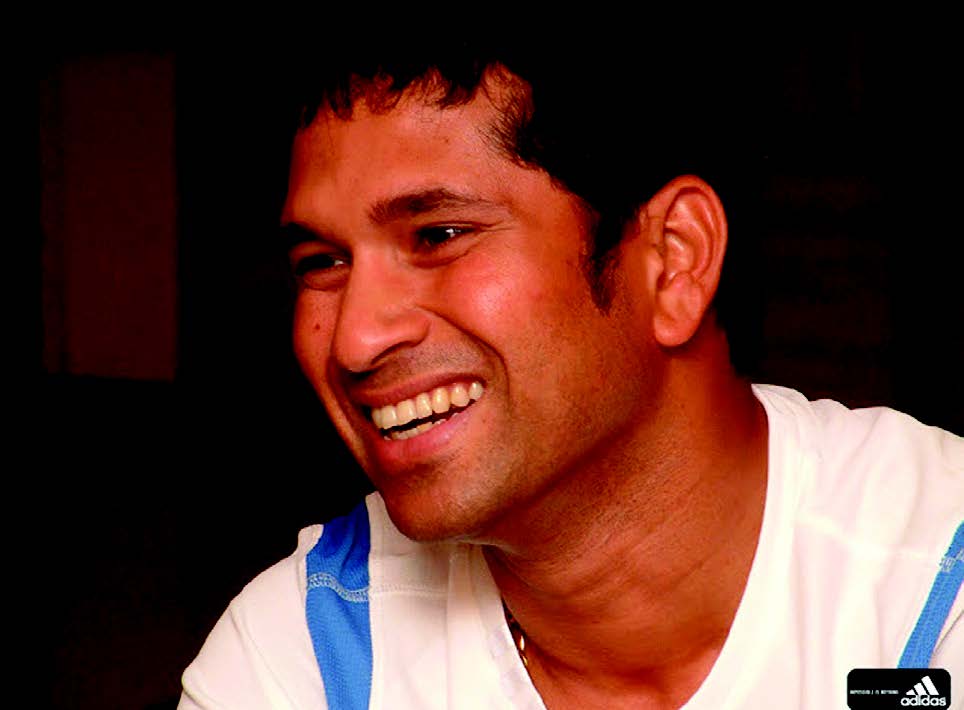
    Sachin Ramesh Tendulkar famously known as Little Master or Master Blaster is one of the greatest cricketer to have ever played the game. He is the leading run scorer and century maker in both formats of the game. Tendulkar is the only player to be in top 10 ICC Batsmen ranking for 10 years in Tests and in 2002, Wisden ranked Sachin as second greatest Test batsman of all time next only to legendary Sir Donald Bradman and the second greatest ODI batsman behind West Indies great Sir Vivian Richards. A normal person can be a specialist in one thing he does the best but Sachin is one man in this world who defies these laws and is a specialist in everything he does. Whether it is batting, bowling or fielding, this man will give everything to help India win. Sachin Tendulkar is one person capable of bringing his country to a standstill. Whenever Sachin strides into the middle, the crowd goes berserk, TRP ratings and TV volume go through the roof, tension levels hit all time high and expectations increase to unprecedented levels. From a child to an 80-year-old man, all have their sights set on Sachin.

    If one has to describe Sachin Tendulkar as a player, he would soon run out of adjectives; words like awesome, brilliant, magnificent are certain to cross your mind, though. He is a genius, with God given talent no doubt. He stands at the crease, with such wonderful balance and poise and at the same time intimidating the bowlers. His footwork is near perfect and he is the nearest thing to Bradman there’s ever been. At 5’5, Tendulkar was not the most colossal player to stride on to the field but he bows out as a giant, who ruled cricket for 24 years and gave his legion of fans mesmerizing and emotionally overwhelming memories. With a mountain of runs, Tendulkar’s retirement creates a void so big that one can safely say cricket would never be the same again. His journey started way back in 1989 at the tender age of 16. A disarming smile, curly locks, resolute eyes and abundant talent, this was Sachin who first stepped on to Test cricket against a fiery Pakistani bowling attack boasting of that deadly combination of Imran Khan, Wasim Akram and Waqar Younis. Tendulkar has niched out a career out of innovation and adaptability. No bowler has single handedly dominated the master. In his glorified two decade journey, Sachin has won almost every award associated with cricket. He also owns the highest number of Man-of-the-Match (62) and Man-of-the-Series awards (26) along with 50,000 in every format of the game.

    Sachin got the better of every bowling attack. With wickets falling around, he always decided to take the fight to the opposition and single handedly won India several matches. Sachin has been a part six World Cups, a record jointly held by Pakistan’s Javed Miandad. He has scored more than 2000 runs in the competition which is the highest by any batsman. The talent and genius of Sachin was best summed up by Bradman when he said Tendulkar’s batting reminded him of his own. Tendulkar was the first cricketer to have scored a double century in ODI cricket, the feet he reached at Gwalior on February 25th 2010 against South Africa, at 37 years of age. During the later half of the ’90s, Tendulkar dominated both ODI and Test cricket at will producing memorable innings all across the globe, including the famous ‘Desert Storm’ against Australia which are arguably two of the best ODI knocks ever played. Sachin’s tremendous performances soon elevated him to the most challenging task of captaining the Indian side. But sadly, the pressure of Captaincy took it’s toll on Sachin as his batting form dipped and many criticized Sachin for not leading from the front. Much has been said about the characteristics of a great batsman by many pundits over the year. But when Tendulkar produced what many believe “the most awe-inspiring innings” at Sydney in January 2004 against the might Aussies, he redifined greatness.

    After being repeatedly dismissed playing shots on the off-side, Tendulkar did not attempt even a single off-side stroke until he was a good 150 not out and went to score 241 in that innings. More recently, he was woefully out of form during India’s Test and ODI whitewash at the hands of England last year and carried the weight of expectations to what turned out to be a horror tour of Australia. But eventually, the best batsman of the modern era dug in deep and ensured that he went out on his own terms. His impact resonated much beyond the cricket field as he accomplished a rare feat by becoming a Rajya Sabha member last year. “Beneath the helmet, under that unruly curly hair, inside the cranium, there is something we don’t know, something beyond scientific measure. Something that allows him to soar, to roam a territory of sport that, forget us, even those who are gifted enough to play alongside him cannot even fathom. When he goes out to bat, people switch on their television sets and switch off their lives- BBC Sports, on Sachin Tendulkar.”

    Achievements
    1994: Sandeepreddy Award Recipient for achievements in cricket 1997: Tendulkar was one of the five cricketers selected as Wisden Cricketer of the Year 1997/98: India’s highest sporting honour – Rajiv Gandhi Khel Ratna 1999: Padma Shri – India’s fourth highest civilian award 2008: Padma Vibhushan – India’s second highest civilian award 2010: ICC Cricketer of the year – Highest award in the ICC listings 2010: LG People’s Choice Award ICC World Test XI: 2009, 2010, 2011 ICC World ODI XI: 2004, 2007, 2010 Wisden Leading Cricketer in the World 1997, 2010, 2012.

  • YUVRAJ BLINDER OVERCOMES CHASE OF 202

    YUVRAJ BLINDER OVERCOMES CHASE OF 202

    RAJKOT (TIP): In his second comeback after recovering from cancer, a leaner and fitter Yuvraj Singh was called upon to do a job he has done numerous times for India in ODIs – revive a floundering chase, with MS Dhoni for company, and only the lower order to follow. Only, this was a T20 and Yuvraj did not have the luxury of building his innings before accelerating. He duly cut out the building part, and unleashed trademark pick-up sixes and lofted drives to haul in the target of 202 with two deliveries remaining. India were facing an asking-rate of nearly 12 at 100 for 4 in the 12th over, but Yuvraj’s response was so forceful, that all Dhoni needed to do was give him the strike. By the end, the partnership was 102 at exactly two runs a ball, Yuvraj’s 77 off 35 showing his dominance. Shikhar Dhawan, Suresh Raina and Virat Kohli had all failed to kick on from starts and India’s innings was in danger of going Australia’s way, who had lost too many wickets in maintaining a frenetic pace of scoring, and had run out of steam at the death.

    Aaron Finch seemed set to carry Australia way over 200 but his exit in the 17th over for 89 off 52 helped India keep the visitors to 201, as only 29 came off the final four. India themselves needed 49 off the final four, but Yuvraj was in such flow that the big shot was always at hand. Yuvraj first took 18 off Clint McKay in the 14th over, and then, when the pressure escalated again, carted James Faulkner for successive sixes in the 17th. The timing on the boundaries was vintage Yuvraj, as was the effortlessness and grace. George Bailey’s preferred field of three men in the ring around point worked to Yuvraj’s advantage, as did the fact that Australia bowled too full to him. Dhoni did his bit, constantly scampering twos and ones as he does in ODI chases, and coming up with the crucial boundary, a typical stretch-and-club to cover, when it came down to six needed off four. Yuvraj’s cool assault meant Finch’s innings, and Australia’s electric start, were in vain. After being put in, Finch and debutant Nic Maddinson had kickstarted the innings with a 56-run partnership inside five overs. It was the manner in which the openers attacked the offspin of R Ashwin that stood out.

    The highly-rated Maddinson, 21, calmly stepped out to Ashwin’s first delivery and lofted it cleanly over extra cover for four. Finch set about cutting and lofting with intent, and Ashwin’s first over cost India 17. Maddinson made 34 before missing a slog to be bowled. Vinay Kumar got both Shane Watson and George Bailey in the eighth over. Finch, meanwhile, kept battering boundaries, generating immense power and finding gaps consistently. He was swift and brutal on the cut, played the lofted drive repeatedly and when he went to cow corner, it was more timing and placement than slogging. Glenn Maxwell showed Australia were in no mood to relent even momentarily, swinging Ashwin for three sixes in the tenth over as the score zoomed to 114 for 3 at the halfway stage of the innings. Ashwin’s figures read 2-0-41-0, and Dhoni was forced to turn to Virat Kohli’s mediums for a couple of costly overs. Australia stalled after Finch clubbed a high full toss straight to Vinay. The blow split the webbing on the bowler’s left hand, but did not deter him from sending down a couple of tight overs. A last-ball six from Faulkner took the score past 200, but Yuvraj hunted it down with the calm of old.

  • Tendulkar to retire after 200th test match

    Tendulkar to retire after 200th test match

    NEW DELHI (TIP): Sachin Tendulkar on October 10 announced his decision to retire from Test cricket after playing his landmark 200th match against the West Indies next month, bringing an end to the intense speculation about his future. The 40-year-old Tendulkar, who has not been in the best of form in recent times, has informed the BCCI about his decision to quit Test cricket after a glorious career spanning 24 years. “All my life, I have had a dream of playing cricket for India. I have been living this dream every day for the last 24 years. It’s hard for me to imagine a life without playing cricket because it’s all I have ever done since I was 11 years old. “It’s been a huge honour to have represented my country and played all over the world. I look forward to playing my 200th Test Matchon home soil, as I call it a day,” Tendulkar, who has already retired from the ODIs, said in the released issued by BCCI Secretary Sanjay Patel.

    Tendulkar thanked the BCCI for its support throughout his career and also for allowing to walk into Test sunset at a time of his choosing. “I thank the BCCI for everything over the years and for permitting me to move on when my heart feels it’s time! I thank my family for their patience and understanding. Most of all, I thank my fans and well-wishers who through their prayers and wishes have given me the strength to go out and perform at my best,” he said. Reacting to the news of his retirement, BCCI President N Srinivasan said that he is one of the greatest admirers of Sachin Tendulkar. “We respect Sachin’s decision to retire but many of us can’t imagine an Indian team without him,” he said. “Sachin has been an inspiration for generations of sportsmen and not just for cricketers,” he added. There was intense pressure on Tendulkar to bid adieu to Test cricket after a prolonged form slump and particularly with the advent of a number of young players. Tendulkar’s 200th Test match is most likely to be held at his home ground in Mumbai from November 14. The Eden Gardens in Kolkata is also a contender for hosting that historic match. The BCCI has not yet announced the venues for the two Tests against the West Indies.

    The fact that the BCCI squeezed in a home series against the West Indies had raised speculation that it was done to give Tendulkar the opportunity to retire in front of his home fans. Although Tendulkar had always maintained that he would continue playing cricket as long as he enjoys playing the game, the pressure of playing at the international level has gradually taking a toll on his ageing body. He recently retired from the IPL and the Champions League T20 event after his franchise Mumbai Indians won both the titles this year. Although the decision to retire was in the offing for some time, the BCCI release did create a flutter, prompting many former Test crickets to pay glorious tributes to the champion batsman who virtually held every batting record. Tendulkar has been the most complete batsman of his time and the most prolific runmaker of all time. His 198 Test appearances yielded 15,837 runs at an average of 53.86. From his 463 ODI matches, he had, under his belt, a whopping 18,426 at an average of 44.83. He is the only batsman to score 100 international centuries — 51 in Tests and 49 in ODIs.

    Much before his debut on November 15, 1989 against Pakistan, Tendulkar’s precocious talent was there to be seen when he shared an unbeaten 664-run stand with buddy Vinod Kambli in the Lord Harris Shield Inter-School Game in 1988. His first Test century came in England in 1990 at Old Trafford and the Mumbaikar rose in stature after the 1991-92 tour of Australia, hitting sublime hundreds on a Sydney turner and a Perth minefield. Tendulkar was also the first batsman in the world to score a double ton in ODIs, a feat he achieved in Gwalior against South Africa in February 2010. This was included in Times magazine’s top 10 sports moments of the year. A perfect team-man, Tendulkar limited his Twenty20 ambition to the Indian Premier League, ruling himself out of national reckoning lest it upsets the existing equilibrium of the side. The biggest compliment to his batting came from Bradman himself in 1999 when he said that Tendulkar’s style of playing resembled his style. His 154 scalps in ODIs underline the fact that Tendulkar could have also staked claim to be that elusive all-rounder that India has been desperately looking for since the legendary Kapil Dev. In the field, he is among the safest pair of hands in the slip and his flat throw releasing strong arm saw him manning the deep with equal aplomb. He has taken 114 catches in Test cricket and 140 in the ODIs.

  • ROYALS’ IMPECCABLE RECORD, SUPER KINGS’ CAUSE FOR CONCERN

    ROYALS’ IMPECCABLE RECORD, SUPER KINGS’ CAUSE FOR CONCERN

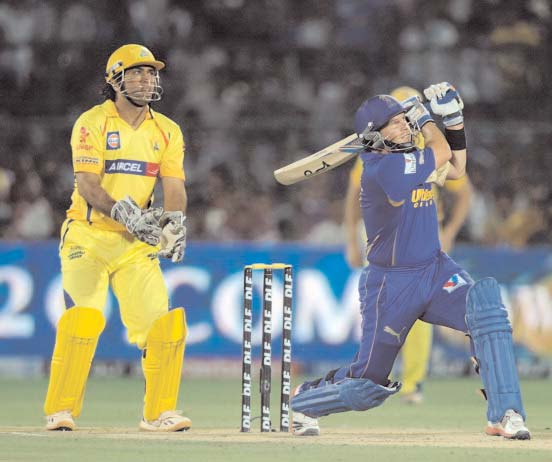
    JAIPUR (TIP): What started as a former captain’s demand is now a habit for the Rajasthan Royals. Shane Warne, who led the Royals to the inaugural Indian Premier League (IPL) crown in 2008, insisted that his troops turn the Sawai Mansingh Stadium into a fortress. It has been two years since the Australia spin wizard bid the IPL and Royals adieu, but breaching the Jaipur stadium is still a Herculean task for the opposition.

    Invincible run
    Now under the leadership of Rahul Dravid, the Royals are in the middle of an invincible run. Prior to the four victories in the ongoing Champions League T20, the side registered eight consecutive wins in the IPL. The only team in the CLT20 to have played all their games at home this year, Rajasthan refused to let the opportunity slip. Besides the Highveld Lions and Perth Scorchers, they have scalped two other major outfits. By brushing aside the defending IPL champions, Mumbai Indians, with relative ease and snapping the 15- match winning-streak of the Otago Volts, the Royals have exemplified the notion of home advantage in sport. What the winning run also meant was that the Royals earned the right to play their semifinal at home. Apart from the overwhelming crowd support, it is the familiarity that breeds success. At the nets on Thursday, the players chatted with the net bowlers and groundsmen. It was as if all the parties were aware of the team’s recipe for success.

    Opposition worried
    In fact, the 12-game unbeaten run at home will worry the opposition, and Chennai Super Kings coach, Stephen Fleming, did sound concerned. “We would have loved to play the Mumbai Indians in the semifinals. But you cannot pick and choose and we are now heading to Rajasthan,” he said, before adding, “There is no illusion as we know their record at home. We all know how tough it would be for us.” Fleming ‘s side was caught unawares with the Trinidad and Tobago spinners making them struggle. To add to their discomfort, Royals’ Ashok Meneria said, “I think it could be a headache for Chennai to play us in Jaipur, where we have not lost the last 12 games, which is a big deal.”

  • CLARKE A DOUBT FOR ASHES OPENER

    CLARKE A DOUBT FOR ASHES OPENER

    SYDNEY (TIP): Australian captain Michael Clarke admitted he may not be fit for the first Ashes Test against England next month, with his long-standing back problem needing extended treatment and rest. Clarke was ruled out of Australia’s one-day tour of India in October and while desperate to be ready for the first Ashes Test in Brisbane on November 21, the star batsman is pragmatic. “Where I sit right now is I don’t know when I’ll be back playing cricket,” he said. “We have no idea how long it’s going to take. “There’s certainly no guarantee (for the first Test) at this stage. It’s hard for me to say that because I’m trying my best not to look at it like that. “I’m always positive and if they ask me, I’ll say I’ll be fit in a week’s time. But you ask Alex (Kountouris, team physio) who knows me very well, and he’d say there’d be doubt I won’t be right.” Clarke has been plagued by back problems for years and they flared up again before Australia’s final ODI in Southampton last month at the end of a gruelling five-Test Ashes tour to England, which Australia lost 3-0. He played in that game, but selectors were reluctant to take any more risks with him given the big home summer coming up, and ruled him out of the India tour. Coach Darren Lehmann said all he could do was hope Clarke would be fit to face arch-rivals England. “I hope he improves his back pretty quickly,” Lehmann said. “(The Ashes) is a long way off so hopefully with all the medicos behind him getting it right he should be right. “But only time will tell. I can’t worry about that. What I can worry about is making sure all the other players are ready to go as well… getting the right side for the first Test match.” Australia are due to play five Tests against England, starting in Brisbane

  • VIRENDER SEHWAG SHOWS INTENT IN MIDDLE ORDER

    VIRENDER SEHWAG SHOWS INTENT IN MIDDLE ORDER

    INDORE (TIP): Virender Sehwag’s decision to bat down the order for Delhi in the Challenger Trophy match against India Blue may have come as a surprise to his fans. But it wasn’t really unexpected as there has been speculation that he was contemplating such a move to give his flagging career a second wind. Many experts believe it is not a bad idea for the attacking batsman to give up the opener’s slot as age has slowed him down. His eyesight too isn’t the same. Ironically, as Delhi lost two quick wickets, Sehwag was at the crease in the third over itself and must have felt like he was still an opener. He impressed during his half-century stint, even showing glimpses of his old self.

    At the same venue where he made a record-breaking 219 against the West Indies in Dec 2011, Sehwag seemed way on his way to a breezy century till he threw it away. It is difficult to say whether, with one flourishing innings, he has been able to convince the national selectors, led by Sandeep Patil, about his utility in Team India, be it as an opener or a middle-order batsman. Sehwag, who is 25 days away from his 35th birthday, had begun his career as a middle-order batsman and scored his first Test century batting at No. 6. But he gave opening a shot as Team India had a start-studded middle order.

    With his belligerent strokeplay, he changed the entire concept of batting in Test matches. He has been among the most successful openers for India, with two triple hundreds and a couple of double centuries in Test cricket, besides a record breaking 219 in ODIs. Yet, Sehwag has always maintained that he was keen to go back to the middle order, where he doesn’t always have to negotiate the new ball. On the 2011 tour of Australia, when Sehwag was captaining the side at Adelaide, he had given the first indication of moving down the order. He had then said; “No, not immediately as we have a very good middle order. When they retire, I’ll think about it. It depends on the combination, and who’s the captain, and who’s going to retire.”

  • TENDULKAR TO QUIT AFTER PLAYING 200TH TEST AT HOME AGAINST WEST INDIES

    TENDULKAR TO QUIT AFTER PLAYING 200TH TEST AT HOME AGAINST WEST INDIES

    KOLKATA (TIP): Sachin Tendulkar will play his 200th Test match at home against the West Indies later this year. BCCI interim secretary Sanjay Patel confirmed on Sunday that the West Indies Cricket Board (WICB) has agreed to tour India in November during which they are likely to play at least two Tests and five ODIs. The itinerary for the tour will be drawn up in consultation with the WICB, but in all likelihood the second Test will be played at the Wankhede Stadium. Assuming he figures in both Tests, Sachin would not only become the first player in cricket’s history to play 200 Tests, he would also get to achieve the landmark in Mumbai, his own backyard.

    It could also be his farewell series as indications are that the Little Master is likely to announce his retirement from all forms of the game at the end of that series. BCCI’s tour and fixtures committee, which will meet shortly to finalise the dates and venues, is also likely to award the first Test to Kolkata. The proposed tour by the West Indies was sprung on the Working Committee members by BCCI’s president-inexile N Srinivasan and was passed unanimously, ostensibly to appease host broadcasters and sponsors. Under the Future Tours Programme (FTP), India are scheduled to host only a seven-match ODI series against Australia in October. Sachin, who recently started practising after undergoing surgery on his left palm, has confirmed his availability for the Champions League T20 where he will turn out for the Mumbai Indians. The peerless batsman has so far played 198 Tests, scoring 15,837 runs at an average of 53.86. He is also the only batsman in the world to log 100 centuries in international cricket, 51 of them coming in the longest (five-day) format. He had announced his retirement from ODIs late last year after having played 463 games in the course of his 24-year long career, amassing a record 18,426 runs, including 49 centuries at an average of 44.83.

  • India pays homage to those killed in the 9/11 terrorist attack

    India pays homage to those killed in the 9/11 terrorist attack

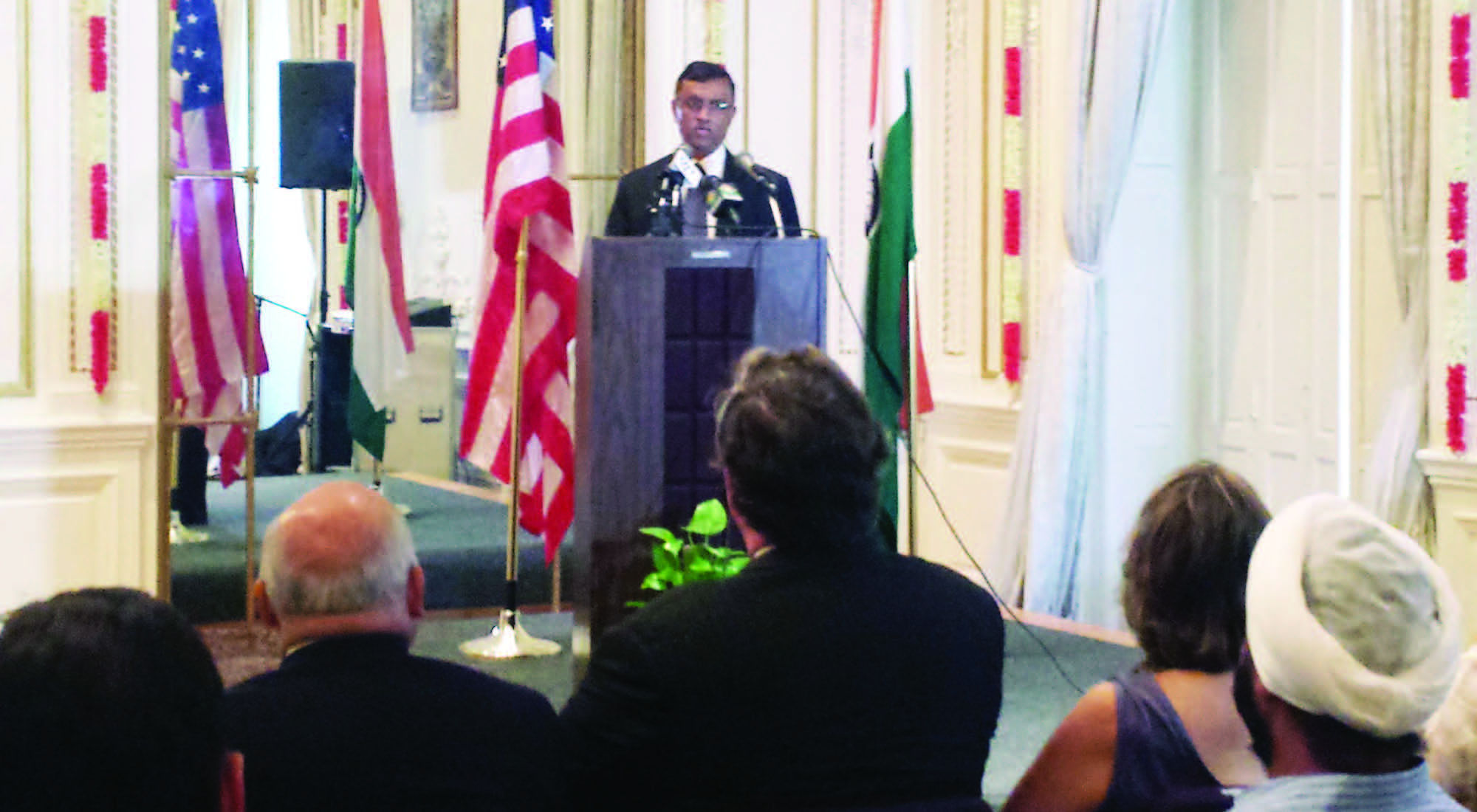
    NEW YORK, NY (TIP): On the 12th anniversary of the September 11 terror attacks that killed nearly 3,000 people India announced its participation in the Queen Elizabeth II September 11 Garden as one of the commonwealth nations. The announcement was made by Consul General of India in New York, Ambassador Dnyaneshwar Mulay, at a prayer meeting organized for those who lost their lives in the deadly attack. The British Garden at Hanover Square- a triangular slip of greenery at Pearl and Hanover streets- was commissioned by the British Memorial Garden Trust and given to the city in memory of British citizens who lost their lives during the attacks of September 11 2001 and in the ensuing wars.


    img26
    A view of the gathering

    However in August of 2011, the purpose of the garden was expanded to honor victims from the Commonwealth nations. “We are deeply honored and touched that India has chosen to join us at the Queen Elizabeth II Garden September 11. When we started in 2002 we wanted something to honor back then the British society. However, over the years it became clear that our mission was much wider than just British nationals and changed it to much wider Commonwealth nations,” said British Memorial Garden Trust Chairman, Victor Stewart. He added, “We believe that it is very important that Commonwealth nationals in this international city have a common place that they can go to and reflect upon our common heritage.” “So far Commonwealth nations who have participated include Australia, Canada, New Zealand, Jamaica and now, it is India.We would like all Commonwealth nations especially those affected by 9/11 to participate,” said Vice Chairman, British Memorial Garden Trust, Rodney Johnson.

    Condemning the terrorist attacks, Ambassador Mulay stated, “The Queen Elizabeth II September 11 garden is built in the memory of those who sacrificed their lives in the 9/11 terrorist attacks. India lost about 47 people and this number does not include people who died outside the building or people who are not accounted for and so we thought it is a good gesture to participate and pay homage to people who died.We had a request from the chairman of the garden and we readily agreed.” At the event, Ambassador Mulay recited a Sanskrit prayer to pay homage to those who died in the terrorist attack. Approximately 2996 people were reported dead in the multiple attacks. “We are gathered here to essentially pray for those who sacrificed their lives irrespective of their nationalities or religion and also take this opportunity to condemn all form of terrorism,” said Ambassador Mulay. Those who spoke on the occasion, besides Ambassador Mulay, included Attorney Ravi Batra, George Abraham, and Jagdish Sewhany.

  • Diwali, “the Timeless Festival of Lights” comes to Times Square

    Diwali, “the Timeless Festival of Lights” comes to Times Square

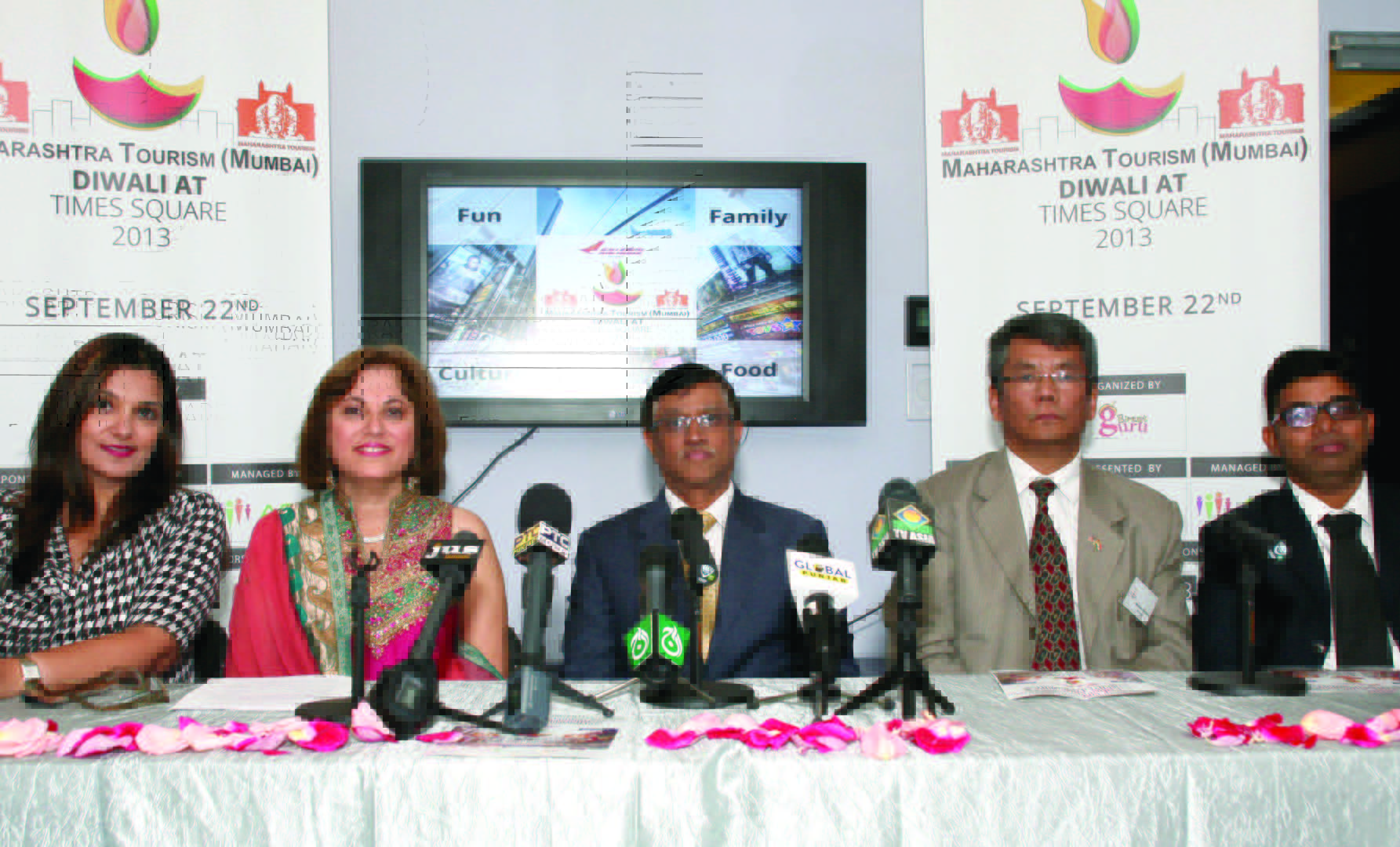
    NEW YORK, NY: Come September 22nd and “Celebrity appearances, musical performances, Asian Indian Cuisine, ethnic Indian dances, fashion show and a “Light Up Times Square” concert will be the highlights of the first ever Diwali at Times Square, New York”, said Ms Neeta Bhasin, President of ASB Communications who have conceptualized and are managing the mega event. She was speaking at a press conference organized by Event Guru and ASB Communications at the up end The Atelier- Sky Lounge August 29th.

    The Consul General of India in New York, Ambassador Dnyaneshwar Mulay and the principal sponsors of the Times Square Diwali, Air India Regional Manager for Americas, Mr. Riwo Norbhu, MoneyGram Senior Marketing Manager Ms Zainab Ali, and Mr. Dinesh Kamble, Senior Manager at Maharashtra Tourism joined Neeta Bhasin at the press conference which was attended by a large number of media persons from both the print and electronic media, and a select gathering of the Indian American community’s best faces. Welcoming them all and introducing the sponsors, Neeta said that she was greatly impressed by the Maharashtra Tourism department which took just seven days to agree to become the title partners.We have, therefore, christened the Times Square Diwali as “Maharashtra Tourism (Mumbai) Diwali at Times Square”. “Air India”, she said, “are our valuable presenting partners”.

    She introduced Zainab Ali of MoneyGram as “our constant partners in all ventures” and thanked all sponsors present and those who were not around, including Bank of Baroda, Wells Fargo and “many others”. The CE of Bank of Baroda, Mr. Dhimant P. Trivedi could not make it to the press conference but was mentioned by Neeta as one who has always been supportive of every community event. Speaking on why she chose to have Diwali at the Times Square, Neeta said that she was keen to showcase India’s rich heritage and culture to the mainstream in America. “And what other place better that the Center of the World-the Times Square!” she said. Times Square, she said, attracts on an average 350,000 pedestrians each day. Neeta said she felt the need and urge to organize an event that would make the mainstream take notice of the Indian American community which has given to America the second largest group of professionals. “Unfortunately, despite our strengths and contribution, we, the Indian Americans, have not received the kind of recognition from the mainstream as Indians in U.K. or Australia.

    Diwali at Times Square is an attempt at the legitimate recognition of the Indian American community.” Outlining details of the Diwali celebrations on September 22nd when “every Indian American will own Times Square for the day”, Neeta said the event will take place from 11 A.M. to 6 P.M., followed by the “Light Up Times Square” Concert which will showcase live performances from some of the biggest names in Bollywood. “The concert will also feature a breath-taking laser light show”, she disclosed. Inviting the Indian Americans to the history-making event, being the first ever Diwali at the Times Square, Neeta exhorted them to “come in traditional outfit and be the proud owners of Times Square for the day.” A message from Maharashtra Minister for Tourism, Mr. Bhujbal was screened at the press conference. The Minister welcomed all and said, “I thank everyone for being present here for the curtain raiser of Maharashtra Tourism (Mumbai) Diwali at Times Square.” He found many similarities between New York and Mumbai. He said if New York was America’s financial capital, Mumbai was India’s financial capital. Both cities are cradles of diverse cultures, he said. Speaking about the state of Maharashtra, Mr.

    Bhujbal described it as a large state with varied topography and enormous scenic beauty. He added that the state was rich in heritage and was a repository of age old culture. In fact, there were four world heritage sites in Maharashtra that included Ajanta, Ellora and Elephanta. One of the most favored tourist destinations, the state, he said is “one of the most developed states of India”. He extended invitation to the gathering to come and holiday in Maharashtra. He said he was happy to have a global platform in the shape of Times Square in New York to showcase the state of Maharashtra, its variety and richness of heritage and culture. Ambassador Mulay, a scholar, writer and poet, besides being an ace career diplomat, spoke of the 5000 years old civilization of India and how over the centuries India absorbed different cultures and grew richer and more diverse. He also spoke of the geographical diversity of India; The Himalayas in the North, the plains, and the seas to the East, the West and the South. Speaking about Diwali, Mr. Mulay said, “Diwali is the king of all festivals. Despite religious connotations, Diwali is a secular festival, the most representative festival of India”. He gave a great description of the event when he said it would be appropriate to say “the Timeless festival comes to Times Square”. Mr. Mulay had a word of appreciation, bordering admiration, for America and New York. ” The beauty of the US is that it is always able to institutionalize.

    New York is a place of meeting, meeting and greeting- a rendezvous. Diwali, too, is a festival of meeting and greeting”, Mr. Mulay said. Appreciating the organizers’ vision, Mr. Mulay said, “It is not only a good idea but a great idea” and added that the event will be “a great celebration of growth of India and growth of Indian American diaspora”. “1.2 billion hearts will throb to see Diwali being celebrated at the Times Square”, he said and called upon all Indian Americans to “participate in full vigor”. On the occasion, he also recalled how Ranju Batra, who was also present, has been making strenuous and constant effort to have a Diwali commemorative stamp issued by the US Postal department and hoped “we will see the Diwali stamp this Diwali”. Air India Regional Manager for Americas Mr. Riwo Norbhu who seemed to believe in the dictum “Brevity is the soul of wit” said, “At Air India we all are very proud to celebrate Diwali at Times Square”. MoneyGram Senior Marketing Manager Zainab Ali who was in a hurry to catch a flight to LA, made a brief remark. She said, “MoneyGram has been part of many community celebrations.When my friend Neeta broached the subject I felt it was a great idea. I have never seen a person who worked as hard as Neeta to see that the idea takes a shape. Her effort will see 1.2 billion Indians in India celebrating Diwali at Times Square. MoneyGram will be happy to support her now and always”. All eyes are now turned to September 22nd.

  • Indians Across World Celebrate Independence Day With Gusto

    Indians Across World Celebrate Independence Day With Gusto

    BEIJING/MELBOURNE (TIP): Indians across the globe on August 15 donned patriotic colours as they celebrated the country’s 67th Independence Day, unfurling the national flag and organising cultural events to mark the occasion. India’s ambassador to China S Jaishankar hoisted the tri-colour at the embassy premises in Beijing to celebrate the Independence Day.

    A large gathering of Indian expatriates working in Beijing attended the ceremony. Jaishankar read out President Pranab Mukharjee’s national address and later hosted a reception on the occasion. The national tricolour also fluttered proudly across southeast Asia, as Indians and friends of India thronged to witness the unfurling of the flag by Indian envoys in the region to mark India’s 67th Independence Day. In Bangkok, India’s ambassador to Thailand Anil Wadhwa unfurled the flag and read out the President’s speech.

    School children sang patriotic songs while 14 dancers from Arunachal Pradesh’s Tawang district performed the Snow Lion dance much to the delight of hundreds of Indians present at the Embassy. The tricolour was also unfurled by Indian envoys in neighbouring Myanmar, Singapore, Laos, Indonesia, Malaysia, the Philippines, Cambodia and Vietnam. In Tokyo, India’s ambassador to Japan Deepa Wadhwa unfurled the national flag. About 300 Indians and friends of India attended the function. Patriotic songs were sung by school children from two Indian schools in Tokyo.

    In Singapore, India’s high commissioner Vijay Thakur Singh led more than 500-strong Indian community in celebrating the Independence Day. Singh read out the President’s message which was followed by three hours of cultural performances and singing of patriotic songs. Students from Indian schools in Singapore also performed during the cultural events. Singh hosted a morning reception for the Indian community and businessmen in Singapore.

    In Australia, Indian diaspora celebrated the 67th Independence Day by organising flag hoisting ceremonies across the country followed by gala dinners and events. Speaking on the occasion, India’s high commissioner to Australia Biren Nanda extended greetings to Indian nationals and persons of Indian origin in the country. He said India’s relations with Australia have grown from strength to strength since the establishment of a strategic partnership between the two countries in 2009. “Our bilateral trade has reached $20 billion. There has been a very significant growth in two-way investment.

    Indian companies have invested significantly in the resources sector and have propelled our economic relationship to the strategic level,” he said. Nanda further took note of Indian companies which have established joint ventures in Australia in the manufacturing sector in areas like auto components, aircraft manufacture, the manufacture of tractors and refining of vegetable oils. “The Free Trade Agreement that we are now negotiating will diversify and deepen our economic engagement,” Nanda said.

    Indian government is organising Regional Pravasi Diwas this year in Sydney which is expected to be attended by over 1000 participants across the region. In the southern Chinese city of Guangzhou, consul general K Nagaraj Naidu hoisted the tricolour and read the President’s address to the nation at the Indian Consulate.

  • INDIA’S HIGHS AND THE LOWS

    INDIA’S HIGHS AND THE LOWS

    The transition of India from a British colony to a sovereign, secular, and democratic nation was indeed historical. It was a long journey of around two decades that started with the conceptualisation of the dream in 1930 to its actual realization in 1950. A look into the journey that led to the birth of Indian Republic will make our celebrations more meaningful.

    Lahore Session of the Indian National Congress The seeds of a republican nation were sowed at the Lahore session of the Indian National Congress at the midnight of 31st December 1929. The session was held under the presidency of Pt. Jawarhar Lal Nehru. Those present in the meeting took a pledge to mark January 26 as “Independence Day” in order to march towards realizing the dream of complete independence from the British. The Lahore Session paved way to the Civil Disobedience movement.

    It was decided that January 26, 1930 would be observed as the Purna Swaraj (complete Independence) Day. Many Indian political parties and Indian revolutionaries from all over the country united to observe the day with honour and pride.

    Indian Constituent Assembly Meetings
    The Indian Constituent Assembly, which was constituted as a result of the negotiations between the Indian leaders and members of the British Cabinet Mission, had its first meeting on December 9, 1946.The Objective of the Assembly was to give India a constitution, which would serve a lasting purpose and hence appointed a number of committees to thoroughly research the various aspects of the proposed constitution. The recommendations were discussed, debated and revised many times before the Indian Constitution was finalized and officially adopted three years later on November 26, 1949.

    Constitution came into force
    Though India became a free nation on August 15, 1947, it enjoyed the true spirit of Independence on January 26, 1950 when the Constitution of India finally came into force. The Constitution gave the citizens of India the power to govern themselves by choosing their own government. Dr. Rajendra Prasad, took oath as the first President of India at the Durbar Hall in the Government House and this was followed by the Presidential drive along a five-mile route to the Irwin Stadium, where he unfurled the National Flag.

    Ever since the historic day, January 26 is celebrated with festivities and patriotic fervor all around the country. The day owes its importance to the constitution of India that was adopted on this day. On this Republic Day, read what the great Constitution of India, that propounds liberal democracy, has in its store. Let’s also feel proud in pronouncing what the Preamble to our Constitution (External website that opens in a new window) says.

    1971 Indo Pak War As in the 1965 Indo-Pak War, the main battles in 1971 between armoured formations was relegated to Chamb and Shakargarh sectors – located in the Western Theatre. Sporadic tank battles took place in the East Theatre, but these were one-sided battles weighed heavily in India’s favour. No action had taken place in the Punjab sector, but the South-Western sector in Rajasthan did see much activity. An offensive by the Pakistanis was blunted here solely on the use of air power.

    The Indian Army had two armoured regiments and three independent armoured squadrons supporting Lieutenant General Jagjit Singh Aurora’s Eastern Command’s thrust into East Pakistan. India had one T-55 tank regiment in the northern sector supporting the XXXIII Corps’ offensive in the Hilli-Bogra area, with one PT-76 regiment in the western area supporting the II Corps’ thrust.

    Finally three independent armoured squadrons (one PT-76, one AMX- 13 and one Ferret armoured car) were supporting the IV Corps’ offensive from the east. Opposing them were a Pakistani armoured force of a regiment of M-24 Chafees in the Bogra area, countering India’s T-55 regiment and two squadrons of Chafeee tanks supporting the west and Dacca sectors.

    When full scale hostilities began, half the tanks were either knocked out or captured by the time the Indian troops were on the outskirts of Dacca. After which the rest of the tanks were finally accounted for, as part of the surrender deal. In it’s offensive, Indian losses were heavy. At least thirty PT-76 tanks were destroyed or damaged, another four T-55s had their tracks blown up over mines.

    The high loss rate among the PT-76 tanks was due to the fact that this type of tank had very thin armour plating to help assist its amphibious capabilities and was an easy target for mines. However all, but eleven, of the PT-76s were repaired after the war. The AMX-13s did not see much action and the Ferrets had no battle casualties. One very interesting situation, had the tank squadron of the 7th Light Cavalry recovering one of their own tanks lost to the Pakistan Army during the 1965 War, which was displayed at the East Bengal Regimental Center as a war trophy.

    The tank was then handed to the Army Ordnance Corps, which in turn handed it back to the East Bengal Regimental Center! The Battle of Basantar took place during the 1 Corps’ offensive in the Shakargarh Sector. India employed two armoured brigades to support its offensive by three infantry divisions and the Pakistani reaction was swift. On December 16th and 17th, when Indian infantry captured certain villages at the River Basantar, Pakistan sent in an armoured brigade.

    The 17 Poona Horse equipped with the Centurion tank, blunted the Pakistani armoured offensive. One particular action at Barapind saw one lone tank troop (three tanks) of the 17 Poona Horse – Indian Army take on an entire squadron of Pattons of the 13th Cavalry – Pakistan Army. When one of the tanks was hit & disabled and another tank’s gun was jammed, the troop commander, Captain V Malhotra gave the order for the last remaining tank to withdraw.

    But this tank led by Second Lieutenant Arun Khetarpal, stuck to its position and kept firing at the Pattons till the last moment when Second Lieutenant Khetarpal was hit and killed. These three tanks accounted for more than the ten tanks out of the squadron. So impressed were the Pakistanis with this action, that the Squadron Commander of Pakistan’s 13 Cavalry – Major Nissar came over to the Indian lines after the ceasefire to talk to the tank commanders who had blunted his offensive.

    At the end of which, 66 Pakistani tanks were claimed as destroyed. Indian casualties were about 23 tanks, however the efforts of the EME (Electrical & Mechanical Engineers) saw to that all, but 10 of the tanks, were back on the road again.

    Period of Liberalization
    The arrival of the East India Company in India caused a huge strain to the Indian economy and there was a twoway depletion of resources.The British would buy raw materials from India at cheaper rates and the finished goods were sold at higher than normal price in Indian markets. During this phase India’s share of world income declined from 22.3% in 1700 AD to 3.8% in 1952. Post Colonial Indian Economy: After India got independence from colonial rule in 1947, the process of rebuilding the economy started. For this various policies and schemes were formulated. First five year plan for the development of Indian economy came into implementation in 1952.

    These Five Year Plans, started by Indian government, focused on the needs of the Indian economy. If on one hand agriculture received the immediate attention on the other hand the industrial sector was developed at a fast pace to provide employment opportunities to the growing population and to keep pace with the developments in the world. Since then the Indian economy has come a long way.

    The Gross Domestic Product (GDP) at factor cost, which was 2.3 % in 1951-52 reached 6.5 in the financial year 2011-2012 Trade liberalization, financial liberalization, tax reforms and opening up to foreign investments were some of the important steps, which helped Indian economy to gain momentum. The Economic Liberalization introduced by Man Mohan Singh in 1991, then Finance Minister in the government of P V Narsimha Rao, proved to be the stepping-stone for Indian economic reform movements.

    To maintain its current status and to achieve the target GDP of 10% for financial year 2006-07, the Indian economy has to overcome many challenges. Challenges before Indian economy: Population explosion:The rising population is eating into the success of India. According to 2011 census of India, the population of India has crossed one billion and isgrowing at a rate of 2.11% approx. Such a vast population puts lots of stress on economic infrastructure of the nation.

    Thus India has to control its burgeoning population. Poverty:As per records of National Planning Commission, 36 crore people are living below the poverty line in India in 2012. Unemployment:The increasing population is pressing hard on economic resources as well as job opportunities. Indian government has started various schemes such as Jawahar Rozgar Yojna, and Self Employment Scheme for Educated Unemployed Youth (SEEUY). But these are proving to be a drop in an ocean. Rural Urban Divide:It is said that India lies in villages, even today when there is lots of talk going about migration to cities, 70% of the Indian population still lives in villages.

    There is a very stark difference in pace of rural and urban growth. Unless there isn’t a balanced development Indian economy cannot grow. These challenges can be overcome by the sustained and planned economic reforms. These include: Maintaining fiscal discipline Orientation of public expenditure towards sectors in which India is faring badly such as health and education. Introduction of reforms in labour laws to generate more employment opportunities for the growing population of India. Reorganization of agricultural sector, introduction of new technology, reducing agriculture’s dependence on monsoon by developing means of irrigation. Introduction of financial reforms including privatization of some public sector banks.

    Scams That Rocked India
    Ever since India has achieved her freedom, she has also been known as a corrupted land. The extend of corruption has increased to such an extend that, any person joining political parties does have an intention of making easy and fast money within the shortest period of time. If all the amounts that have been disclosed, for every scam till date is pooled up, I guess , India is most richest country and the power and strength She holds could not be compared with any other.

    However, since people are getting more and more selforiented, when it comes to progress and wiping away poverty, nobody is least bothered. A few of the top scams that have taken place since the year 1947 is discussed here, just to bring to the notice of the public where we stand and how things are working. Let us get from the latest to the oldest.
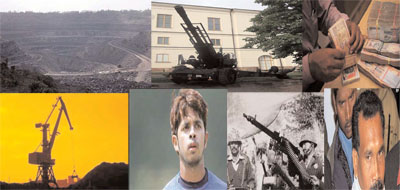
    1. The Indian Coal Allocation Scam: This is one among the latest scams that has occurred concerning the Indian government’s allocation of the nation’s coal deposits to public sector entries and private companies. According to the CAG (Comptroller and Auditor General of India), the Indian Government was accused of allocating coal blocks, in an in-efficient manner during the period 2004-2009.

    The reason for this allegation was because, the Government had the authority to check on the allocation of coal blocks by a process of competitive bidding, but they failed to do so, resulting in lower payment by the public sector enterprises and the private firms. According to the CAG report, an amount of near to Rs. 185,591 crore (USD $ 35.08 billion) was lost to the government because of this improper screening in procedures, which might have happened due to bribery is what studies says. Whatever it may be, loosing such a huge amount by the Government is a fall from the Governments side.
    2. The 2G Spectrum Scam: This scam was one which involved the politicians and government officials equally. The scam involved in issuing frequency allocation licenses by the telephone companies in re-creating 2G subscriptions for cell phones. When valued by the Comptroller and Auditor General ( CAG ) of India about the money composed from the 2G licenses , the defeat for the exchequer was Rs. 176,369 crore ( USD $ 39.16 billion ). The issuing of licenses began in 2008; however it came to public attention when the Indian Income tax Department conducted an investigation on the political campaigner Niira Radia.

    The Supreme Court on February 2012 declared cancellation of all licenses issued in 2008 during the tenure of A. Raja, who was the minister of telecom then. There were about 122 licenses that were cancelled. The actual plan for awarding the licenses was on a first come first served policy. However, A. Raja manipulated the rules and instead pf the first who applied for the licenses, it was first who tipped Raja got the license. 3.

    Commonwealth Games Scam:
    This was a scam that was harshly criticized by several well-known social activists and politicians as billions of dollars were being spent on sporting event, although the fact that we have the leading concentration of poor people. Some of the other major problems that was being highlighted was grave corruption by the games organizing committee, delay in the erection of the main Games venues, and infrastructural compromise. Indian businessman Azim Premji called the Commonwealth games a “drain on the public funds” and also said that hosting such an expensive game event was not the priority for India, and India had other priorities to look into like education, public health and infrastructure.

    4. Satyam Scam:
    In the history of the corporate, Satyam Computer Services Scandal is biggest ever and the chairman, Ramalinga Raju confessed that the company’s accounts were falsified. For near to a decade, Raju kept the accounts details in the dark by pumping up revenues and earning up figures of Satyam. He confessed that , as per the balance sheet of 30th September 2008, the company had exaggerated figures for cash and bank balances of Rs. 5040 crore ( USD $ 1.12 billion ) as next to Rs. 5361 Crore ( USD $ 1.19 billion ) in the book thus acquiring an interest of Rs. 376 Crore , which was not existing.This scam was in tune of near to Rs. 14000 Crore.

    5. Bofors Scam:
    This scandal is also known as the hallmark of Indian Corruption. This was a most important corruption during the 1980`s where the then Prime Minister Rajiv Gandhi and quite a few others which also includes a powerful NRI family named the Hindujas were accused of receiving bribe from Bofors AB for engaging a proposal to supply India’s 155 mm field howitzer. The scale of the corruption was so worse that it led to the crush of Gandhi’s ruling in the Indian national Congress party.

    It was hypnotized that the level of the scandal was tuned to be about Rs. 400 million. The middle man who was associated with this scandal was an Italian businessman named Ottavio Quattrocchi and who also represented the petrochemicals firm, Snamprogetti. Quattrocchi was very intimate to the family and emerged as a influential broker in the 1980`s between big business and the Government of India. Despite the controversy, the Bofor gun was used extensively during the Kargil War with Pakistan and gave India ‘an edge’ over Pakistan according to battlefield comrades.

    6. The Fodder Scam:
    This scam involved the misappropriation of about Rs. 950 crore (USD $ 179.55 million) from the government treasury, of Bihar. The scheme involved the manufacture of ‘vast herds of invented stock’ for which food, medicines and animal husbandry equipment was apparently acquired. In this scam even the Chief Minister of Bihar, Laloo Prasad Yadav was included then which finally led to his resignation. The scam had its origins in small scale by some government employees by submitting false expense reports, which grew in magnitude and drew additional elements over a period of time which ultimately led to the forming of a mafia. This scam still continues to be exposed by the media due to the widespread links between tenured bureaucrats, elected politicians and businesspeople involved.

    7. The Hawala Scandal:
    This was an Indian political scandal, which involved payments allegedly acknowledged by politicians through four hawala brokers, mostly the Jain brothers. It was about $ 18 million bribery humiliation. In an arrest linked to the militants in Kashmir is what gave way to the raid of the hawala brokers and the scandal through them, which revealed large scale payments to national politicians.

    8. The IPL Scam:
    Cricket is a game where lot of commotions occur and there hare many hurdles to cross over and the IPL (Indian Premier League) is no better at it. The BCCI (Board of Control for Crocket in India) has found itself in the middle of many conflicts with the coming of IPL. The IPL had set forth many terms at many occasions, which were not accepted and had to be terminated. There were conflicts with the Cricket Club of India, with the England and Wales Cricket board, with Cricket Australia and many more. The IPL chairman Lalit Modi was suspended in 2010 for alleged act of individual transgression by the BCCI. There was also spot fixing among the players during the IPL in 2012.

    9. Harshad Mehta Scam:
    Mehta was a famous stockbroker of his time. He was well known for his high record breaking profits from the stock market and trading and later was involved in the scandal worth Rs. 5000 crore ( USD $ 945 million) in Bombay Stock Exchange. He had a great way in convincing the public that through the banking system he could finance his buying. Two small and little known banks helped him in this and he made a great fraudulent price hikes in the stock markets. By the time the scandal came to limelight, many banks were left blank and in fact Managers from two reputed banks committed suicide.

    10. Kinetic Finance Limited Scam:
    In this scam, various banks lost about Rs. 200 crore (USD $ 37.8 million). The promoters of kinetic finance limited borrowed about Rs. 145 crore from an association of banks led by SBI, and Bank of Baroda. After borrowing the money, they used it for other purposes of the Kinetic group and eventually the promoters resigned and the firm was renamed in another name. A special Investigation Audit was conducted and based on the report it was found that about five banks filed criminal cases against the promoters.

    11. Adarsh Housing Scam
    In this scam, land was allotted to the war widows of Kargil war and also for the retired personal of The continued on page 48 Defense Services. Over a period of 10 years, the top politicians and bureaucrats bend several rules and commit various acts of commission and omission to have the building in order and finally they got themselves allotted with flats at the premium locality at a much cheaper cost. This scam is noticeable as it took keen planning and almost 10 years to execute this kind of brutality to the poor and left alone in the defense.

    12. Citibank Fraud:
    This was a fraudulent done by the bank employee by promoting false promises to the customers. Shivraj Puri, the Relationship manager of Gurgaon branch had convinced his customers to invest in a fake scheme that gave high interests. He made forged circulars from SEBI. He opened joint accounts in several names and made customers deposit into those accounts and he invested in places of his interests. This was bought to lime light when customers started complaining about being asked to invest in a scheme that was not available to the bank.

    13. Madhu Koda Scandal:
    Madhu Koda is the ex-chief Minister of Jharkhad. He was bought to limelight by the IT department by charging for laundering money for about Rs. 4000 crore and other disproportionate income. Almost five currency counting machines were seized from his residence. The amount was used to purchase hotels, mines, and companies, in foreign countries like Thailand, Liberia, Dubai and many other places. With this kind of laundering and investments, he builds an empire, but bigger to the most successful businessmen within a short period of time.

    14. Barak Missile Scandal:
    This is a case of alleged defense corruption which was related to the purchase of Barak 1 Missile Systems by India from Israel. The contracts have been signed by the Indian government to procure seven Barak systems at a total cost of Rs. 199.50 million. This was done despite objections raised by several groups, including members of the team that had actually visited Israel to observe the performance of the missile.

    15. Kargil Coffin Scam:
    This is one of a kind of scam, where even the coffins for the soldiers who died in the Indo-Pak war, were bought for low quality and at higher price. The government had paid about $2500 per coffin, which was earlier purchased for $172 per coffin. And moreover the quality was very poor. This led to range among the public and led to the resignation of the defense minister.

    16. Mining Scam in India:
    This scam is related to the ore-rich states of India and has generated controversies in India which spans encroachment of forest areas, underpayment of government royalties, and conflict with tribal regarding land-rights.

    17. Sukh Ram Telecom Scam:
    Sukh Ram is a former union communication minister in Indian National Congress Government. He was the telecom Minister during the P.V. Narasimha Rao`s cabinet. He was caught with allegations regarding irregularities in awarding a telecom contract. The CBI seized around Rs. 3.6 crores from his residence. He has been imprisoned for the fraud that he has done.

    18. SNC Lavalian Scam:
    This is a financial scam related to the government with a Canadian company. A loss of about Rs. 374.50 crores, for the renovation and modernization of the hydroelectric power stations at Pallivasal, Sengulam, and Panniar (The PSP Project as it is called) at the Idduki district in Kerala.

    19. Belekeri Port Scam:
    This scam relates to about 3.5 million of sequester iron ore that was exported illegally from Belekeri Port in Karnataka. This scam is said to be worth about Rs. 60,000 crore (USD $ 12 billion). The iron ore was illegally mined after giving a minimal pay to the government.

    20. Telgi Scandal: The Telgi scandal is after the great Abdul Karim Telgi who issued counterfeit stamp papers. Had appointed about 300 people as agents to sell these counterfeit stamp papers to bulk purchasers like banks, insurance companies, and share broking firms. The size of the scam is about 20,000 crores (USD $3.78 billion). In this scam, many high ranked governmental officials were also recorded.

  • Bresnan Out For Season With Back Injury

    Bresnan Out For Season With Back Injury

    LONDON (TIP): Tim Bresnan has been ruled out of the remainder of the international season with a stress fracture in his lower back. His absence creates a space in England’s bowling attack for the fifth Investec Ashes Test, which begins on August 21. Bresnan was preferred to Steven Finn for the second Test at Lord’s and has performed well in the series with 10 wickets and two crucial contributions in the closelyfought fourth Test at Chester-le- Street.

    Bresnan made 45 in England’s second-innings to boost his side’s lead before making a breakthrough with the wicket of David Warner when Australia were on course to chase 299 for victory. England went on to win comfortably and clinch the series. But now Bresnan will be unable to help England attempt to win their fourth Test of the series at The Oval. Bresnan will begin a recovery and rehabilitation programme and a date for his return to cricket will be determined in due course.

    The injury is the latest setback for Bresnan who needed elbow surgery for the second time in February which ruled him out of England’s tour of New Zealand. His absence is a blow to England’s one-day plans. He has been a feature in limited-overs cricket and helped England reach the final of the Champions Trophy in June. England take on Australia in two T20s on August 29 and 31 before a five-match ODI series starting on September 6.

    Before then, England will need to draft another bowler into their attack for The Oval Test match. Finn was selected for the first Test at Trent Bridge but, having been left out for the Lord’s Test, has not featured in England’s squad for the third or fourth Tests. Chris Tremlett was included in the 13 for Old Trafford and Durham without being included in the XI but could get an opportunity on his home ground.

  • Egypt Violence: World Leaders Concerned;UN Urges ‘Restraint’

    Egypt Violence: World Leaders Concerned;UN Urges ‘Restraint’

    NEW YORK (TIP): The ever increasing violence in Egypt which has claimed hundreds of lives and is threatening a bloody civil war in the country has shaken world leaders and the United Nations. The Argentine president of the United Nations Security Council urged all parties in the crisis in Egypt to exercise “maximum restraint” on Thursday, following an emergency meeting in New York.

    Argentine Ambassador Maria Cristina Perceval said that the Council’s 15 member states had regretted the loss of life in Cairo, called for an end to the violence and spoke of the need to advance “national reconciliation”. The meeting was requested by France, Britain and Australia a day after nearly 600 people were killed when security forces moved to clear camps of supporters of ousted Islamist president Mohamed Morsi.

    France and Britain are permanent members of the Security Council and Australia is one of the 15 countries currently represented. Argentina currently presides over the Council. Perceval said its members shared “a common desire” to stop the unrest. U.N. Secretary-General Ban Ki-moon condemned the violence and urged calm and restraint on both sides.

    He made no direct criticism of the military leadership or the protesters who had refused to disperse on their own but said he was “well aware that the vast majority of the Egyptian people, weary of disruptions to normal life caused by demonstrations and counterdemonstrations, want their country to go forward peacefully in an Egyptian-led process towards prosperity and democracy.” UN rights chief Navi Pillay has urged a wide-ranging probe.

    A disturbed President Obama announced that the United States had canceled longstanding joint military exercises with the Egyptian Army set for next month, using one of his few obvious forms of leverage to rebuke Egypt’s military-backed government for its brutal crackdown on supporters of the ousted president, Mohamed Morsi. Earlier, U.S. Secretary of State John Kerry termed Egypt violence as “deplorable”.

    “The United States strongly condemns the use of violence against protesters in Egypt,” White House spokesman Josh Earnest said in a statement. “We have repeatedly called on the Egyptian military and security forces to show restraint and for the government to respect the universal rights of its citizens, just as we have urged protesters to demonstrate peacefully.”

    The U.S. opposed the one-month state of emergency imposed by the Egyptian government, he added. Britain, Germany, France and Italy also criticized the use of force and called on both sides to stand down from their dangerous face-off and return to meaningful dialogue to defuse Egypt’s political stand-off.

  • CLARKE SAYS ‘MOMENTUM’ WITH..

    CLARKE SAYS ‘MOMENTUM’ WITH..

    JOHANNESBURG (TIP): Australian captain Michael Clarke has claimed that his side has the momentum before the fourth Ashes Test starts at Chester-le-Street after the England side was stung by accusations of cheating and embarrassed by the off-field antics of a squad member.

    According to Sport24, the tourists are 2-0 down with two matches remaining and have to wait until the return series in Australia at the end of the year for a chance to reclaim the urn but such was their dominance of the drawn third Test at Old Trafford that squaring the series is a realistic target for Michael Clarke’s side Clarke said that England would be taking the positive that they are 2-0 up in the series and can not lose the Ashes but the way Australia had played in Manchester, it had built some momentum for them. Meanwhile, England captain Alastair Cook also said that the series was still very much alive, the report said.

  • Bat Used By Donald Bradman Up For Auction

    Bat Used By Donald Bradman Up For Auction

    SYDNEY (TIP): A cricket bat used by Australian great Donald Bradman and signed by his 1948 ‘Invincible’ team is expected to fetch up to Aus$20,000 ($17,900) at auction this month, an auctioneer said. Charles Leski, whose company is selling the item, said Bradman used the Sykes bat to score 115 in his final first-class innings at home before the team travelled to England in 1948. The Invincibles went on to become – and remain – the only Australian side to go through an entire Ashes tour unbeaten.

    The item, which spent 20 years on display at the Western Australian Cricket Association (WACA) from 1984, will be auctioned on August 15 in Melbourne. “Few items of cricketing memorabilia overshadow those belonging to Sir Donald Bradman,” Leski said. “Of these, his bats are among the most prized possessions because they were his ultimate stock in trade.” “Together with his baggy green caps, they represent his unique talent that has yet to be matched.”

    The legendary Australia batsman, who died aged 92 in 2001, played his last match in England in 1948 and retired with a yetto- be-topped Test batting average of 99.94 despite scoring a duck in his final innings.

  • INDIA CLOSE TO LOSING $1 TRILLION MARK-CAP TAG

    INDIA CLOSE TO LOSING $1 TRILLION MARK-CAP TAG

    MUMBAI (TIP): Thanks to the weakness of the rupee and the slide in the stock market for six consecutive sessions, India is on the brink of losing the elite tag of a trillion-dollar stock market. As the Indian rupee traded near its all-time low of 61.20 and the sensex was down over 150 points, BSE’s market capitalization was almost close to breaking below the $1-trillion mark.

    At close, however, as the rupee recovered sharply and the sensex too rebounded from its intra-day low to close at 19,346, down just 3 points, the country’s market value ended the session at $1.03 trillion — just managing to keep its membership of the trillion-dollar market cap club intact. One of the main reasons for this slide is the sharp depreciation of the rupee in recent months. From about 54.5 to a dollar at the start of the year, the Indian currency has depreciated about 12.7% to its current level.

    And since the stock market has remained almost stagnant during this period, India’s market value in dollar terms has eroded substantially, market analysts said. Led by a $20-trillion plus market value, US leads the pack of 11 countries which are currently in this elite group, Bloomberg data showed. Along with the US, Japan and UK complete the top three slots. The table, however, considers Hong Kong ($3.2 trillion) and China ($3 trillion) as separate markets. In case the two are combined, they would replace Japan from its second slot with a combined market value of $6.2 trillion.

    At number 11, India is behind Australia, which has a market cap of $1.3 trillion. From the BRICS bloc, only China and India are the two countries present in this 11-nation league. The last time India’s marketcap was below the 12-figure mark was exactly four years ago, in mid-July of 2009. Since then, although the rupee has depreciated, a steady gain in the stock market ensured that India remained in the elite group.

  • MOVIE REVIEW – Ramaiya Vastavaiya

    MOVIE REVIEW – Ramaiya Vastavaiya

    Cast: Girish Kumar, Shruti Haasan, Sonu Sood,
    Randhir Kapoor, Vinod Khanna, Poonam Dhillon
    Direction: Prabhudheva
    Genre: Romance
    Duration: 2 hours 28 minutes

    Story: A NRI boy falls in love with gaon-ki-girl, their families oppose, but he labours to win them over. Movie Review: Welcome to Animal Farm. With ample chicks, hens, horns; many ‘murgas’, mulgis, mummyjis and baaratis. Add to this rustic beauty some colours of harvest, village belles, jadoo ki jhappi (read: item number by Jacqueline Fernandez) and of course, amidst it all – blooming romance in fields of gold.

    In pure Prabhudheva style – with spoonfuls of desi ghee! Ram (Girish), billionaire baap (Randhir) ka beta from Australia, lands in India for a wedding, where he’s stunned to see lovely ladies bedecked in salwar-kamzeez and sarees (Whaaat? Kis khet ki mooli hai yeh?!). He falls in love with the bride’s best friend, the simple gaonki- chori, Sona (Shruti). She’s forced to leave him, but Ram follows her to the village and swears to win over her bhaiya, the proud kisaan, Raghuvir (Sonu).

    The billion-dollar-baby turns desi-cool – He ploughs, milks the cows (even puts them on a diet), and does a ‘shitload’ of work (with gobar, ghaas, et al). The film (remake of Prabhudheva’s debut directorial Telugu film) isn’t ripe with any newness – in story or direction. In fact, it discernibly replants stories from the 80’s-90’s era (remember: ‘Maine Pyar Kiya’, ‘Pyar Kiya Toh Darna Kya’), with cliches, a banal plot, an field-full of supporting cast (of which Kapoor and Khanna are underused but good) and a budding lead pair.

    Debutant Girish makes a splash of an entry (surfing in blue seas, ‘Bond’ babes take a bow), and dances with flair. His overly exuberant performance seems flaky in the first half. Later, when he turns from a cool to kisaan, he breaks loose and performs a tad better. Shruti looks the desi beauty; her performance is not striking, yet likeable. Sonu is the best of the ‘crop’, his years of labour as an actor shows.

    There are few good laughs, doses of sweetness and fresh melodies (Sachin-Jigar), but sadly even that is mowed down by heightened histrionics, routine dialogues and a trite tale. This one’s like a pretty field decked up in celebration, but with no real harvest to show.

  • Royal Baby Boy Born In London

    Royal Baby Boy Born In London

    Royal Baby Boy Born In London
    LONDON (AP) — It’s a boy! Prince William’s wife, Kate, has given birth to a boy, a child now third in line to the British throne. The child was born on July 22, after many Britons woke up to the news that Kate had gone into labor with the couple’s first child. The birth announcement, via a press release from Kensington Palace, said the boy was born at 4:24 p.m. weighing 8 pounds 6 ounces.

    The new royal baby was named George Alexander Louis. Kensington Palace revealed on July 25 that the third-in-line to the throne will be known as His Royal Highness Prince George of Cambridge. The last British royal named George was the child’s great-great-grandfather King George VI, who was Queen Elizabeth’s father. The royal birth recalled that of the baby’s father, William, in 1982, at the same central London hospital. Many remember the moment when he was carried out in his mother Princess Diana’s arms with proud father Prince Charles at their side.

    William and Kate’s son is expected to follow Charles and William to the throne. No one can tell what political and personal changes the intervening years will bring, but the baby can be expected to become the head of state of 16 countries, including Britain, Australia and Canada, and possibly the head of the Commonwealth, which covers 54 nations.

    The child will also eventually become Supreme Governor of the Church of England. The baby represents a living link to Britain’s imperial history — the infant is the great-great-great-great-great-grandchild of Queen Victoria, who ruled at the peak of British power. Many Britons had hoped that William and Kate would start a family shortly after their gala 2011 wedding, which drew a global television audience in the hundreds of millions.

    The couple waited, however, until William was nearly finished with his military work as a search and rescue helicopter pilot based at an air base in a remote island off the coast of Wales. That allowed Kate to ease into royal life, and to become more comfortable in the spotlight, before becoming a parent. It also allowed her to play a supporting role during Queen Elizabeth II’s Diamond Jubilee celebrations last summer.

    The first months of her pregnancy were not easy, and she was hospitalized in early December with acute morning sickness that left her weak and dehydrated. She seemed to recover her stamina fairly quickly and made a series of public appearances until the final weeks before giving birth, drawing praise for her poise and good cheer.

    The royal couple and their newborn are expected to spend much of their time in the coming years in renovated quarters at Kensington Palace, where William and Harry also spent much of their childhood. Royal officials say Kate and William will try to give their child as normal an upbringing as possible — which may be challenging in an age when the British royals are treated as major world celebrities.

  • NASA to support ISRO in India’s Mars mission

    NASA to support ISRO in India’s Mars mission

    MUMBAI (TIP): The US would support India in its much-awaited Rs 450-crore Mars Orbiter Mission (MOM) slated for lift off from Sriharikota in October-November 2013. “Nasa is providing the deep space navigation and tracking support to this mission during the non-visible period of the Indian Deep Space Network,” said a US state department announcement.

    The decision to cooperate was taken at the fourth meeting of the US-India joint working group on civil space cooperation held in Washington on March 21. But the details of the meeting were made public on Monday through the US-India joint fact sheet. Its release coincided with the Indo-US Strategic dialogue, and the talks between Isro chairman K Radhakrishnan and Nasa administrator Charles Bolden in New Delhi.

    Nasa will provide support from its facilities at Goldstone in the US, Madrid in Spain and Canberra in Australia. The teaming up for the Mars mission assumes significance in the context of Bolden calling for strengthened co-operation in this programme, when he addressed Isro staffers nationwide from the Ahmedabad-based Space Applications Centre.

    The American state department document also stated that both countries have “agreed to cooperate in potential future missions to the moon and Mars”. Isro officials have not ruled out a second mission to Mars, which they said will have more scientific content. It is learnt that Nasa was keen on participating with Isro in the analysis of data from the Methane Sensor For Mars, which is one of the five instruments on board the present Indian Mars orbiter. But Isro has not given any firm response so far.

  • Social Media And Our Responsibility: Individual And Collective

    Social Media And Our Responsibility: Individual And Collective

    While the Social media has undoubtedly revolutionized our communication and brought the world together, there are also multiple fallouts.
    Social media, especially the Facebook, Twitter and their multiple avatars, undoubtedly is a great revolution today. Perhaps, one of the greatest that humankind has witnessed. While we are yet to comprehend the impact of this media, the strides it has taken so far have been enormous – both on positive and negative aspects.

    Social media is not like any other media – print and electronic. It is unique and has revolutionized the interpersonal relationship and communication. Cutting across all boundaries – natural and manmade, the Social media today is in a different league, not affected by any of the limitations of print and electronic media. In fact, the evolution of technology in the recent decades, and the easy use of it by everyone is absolutely mind boggling.

    Consider the last three decades – perhaps from the early 1990s till this day. The introduction of mobile phones in the early 1990s and its subsequent wide use reduced the gap between us. Gone are those days when we patiently waited in STD/ISD shops, or the Post Office to make a phone call and speak to the other – either officially or personally. The growth of mobile phone and its reach is so much, that the telegrams today have become totally irrelevant and outdated.

    After being in use since the 1850s, the BSNL in India has officially decided to close down its telegram operations; those who would like to get nostalgic about sending and receiving telegrams, please try one last telegram before 14 July. Remember those days – sending telegrams on the arrival of new ones in our families, or the departure of older ones; marriage wishes; a happy note getting new job or promotion; intimation to our bosses of late returning to the work from our native village after being on leave and related multiple stories? Of course, we can’t blame the BSNL for closing it down.

    According to an estimate, today there are only 5000 telegrams sent all over the country every day, when compared to six million in 1985! Obviously, we have other means to reach out – to convey our personal and professional messages. From birth to death, from “I love you” to “Sorry, this will not work”, from “punctured tire; will be coming late to office,” to “seriously unwell. Give me leave”, the SMS has transformed our communication – both personal and official.

    Next came the internet, again in the 1990s, yet another communication revolution. It has thoroughly broken all the barriers of communication. Do we remember reading a newspaper from neighboring country or the region, on real time before the 1990s? Remember our personal letters and official communication before the 1990s? Remember our first leave letter, or the love letter? Remember our inland letter or the postcard to our father, asking for five hundred or thousand rupees extra for the month? Remember the long letters from our grandparents? Remember waiting for the postman? Today, the keyboards have taken over our handwriting skills; and never worry about your vocabulary or spelling; all you have to do is a right click! Today, we do not even have to remember our residential address. Emails and SMS will do the necessary communication.

    It has drastically revolutionized the way we communicate – in real time. A daughter can Skype (communicate on Skype) from any part of the world to her parents, with less or no cost. And parents witness the marriage of their children in Canada or Australia online! Then came the Social media during the last decade. Unlike the print media or the electronic media, where there is a gap between the speaker and the audience – physical and emotional, the social media puts the two directly in touch, that too in real time.We don’t have to wait to write to newspapers to get our response published; we send our responses immediately.

    All we need is a computer or a lap top, connected with the internet. However, the biggest revolution of the above three – is the complete merger of them, in terms one using the other. The mobile phones are connected to the internet; today we are talking about the super speed 3G connections and the use of Facebook and Twitter on our mobile. What this means is, we don’t have to wait to reach our computer or laptop, and ensure there is internet and electricity, before starting communication.

    If the internet has made us to access the rest of the world, the Facebook and Twitter are getting the world into our mobile network.We don’t have to read the newspapers in print, or even access their websites; they are delivered to us. Social media, does one thing even better; it enable us directly to contact someone who is sitting in a remote corner in Africa or Antarctica! All you need to do is to send a friend request. The Social media has completely broken any barrier that man has taken since the Treaty of Westphalia to distance each other.We can sit in the washrooms and keep communicating to our beloved ones.

    We can sit in front our parents in the dining table or in a classroom in front our teacher, yet messaging to our friends without anyone noticing. (And, where do children learn to message, keeping the phone below the table, but looking at you?). While the Social media has undoubtedly revolutionized our communication and brought the world together, there are also multiple fallouts. One great problem is the parenting; the children are hooked onto the Social media. In fact, this should be considered as one of the greatest dope that man has ever invented.

    We are addicted to the Social media; if anyone has a doubt, please notice, what the rest of us are doing while you travel next time in a public transport – either in train or bus. Second, there is a greater tendency to trivialize ourselves today. More than the event or experience, we would like to get that feeling across into our Facebook or Twitter. This has become common today: Oh, I should change my profile picture with this; wow, this picture will get more likes on my Facebook; I should have this in my twitter… It appears, instead of the Social media helping us to reach out to the other, is dangerously taking us in a path of reorienting our self.

    From “having a haircut” to “overcooked my chicken”, we seem to be in the path of becoming narcissistic, with ease and élan. Third and the most important aspect is the mayhem that it could create in distancing the people. As we could see in some of the recent conflict situations in Myanmar and Northeast, the Social media wreaked havoc in venting our anger and offending the other. Since Social media gives us the luxury to remain anonymous, and post any kind of messages, without realizing the impact. What is its greatest strength – the real time connectivity and mobility, is also the greatest liability in spreading hatred and venom.

    I can sit calmly in my washroom, yet create mayhem thousand miles away, without revealing my identity. I can tweet a harsh note, tweak a picture and pass it as real, and yet remain anonymous. Undoubtedly, Social media is a great revolution today; it has bulldozed all barriers between us in terms of distance and time. However, we also have a responsibility, to ensure that this revolution brings us closer, than divide us.

    The State cannot and should not attempt to regulate this; it should be left to our individual and collective conscience.We have a huge responsibility.