Tag: Ban Ki-moon

  • Diwali “Power of One” Awards to be presented on December 6th at United Nations HQ

    • I. S. Saluja
      November 29, 2024

    NEW YORK (TIP): Diwali “Power of One” Award , established by Diwali Foundation, USA, Inc. chaired by Ranju Batra, in 2017 is to celebrate and highlight the vital and important work done across the world in a peaceful manner, especially at the United Nations.

    To be eligible for the Award, , one has to be a former Permanent Representative or former high-level member of UN Secretariat, or soon to be former, who has toiled selflessly to “help form a more perfect, peaceful and secure world for all”.

    The 2024 Diwali Power of One Award will be presented to F.M. Juan Ramon de la Fuente (Mexico); Amb. Ferit Hoxha (Albania); Amb. Tarek Ladeb (Tunisia); and Amb. Olof Skoog (Sweden & EU).

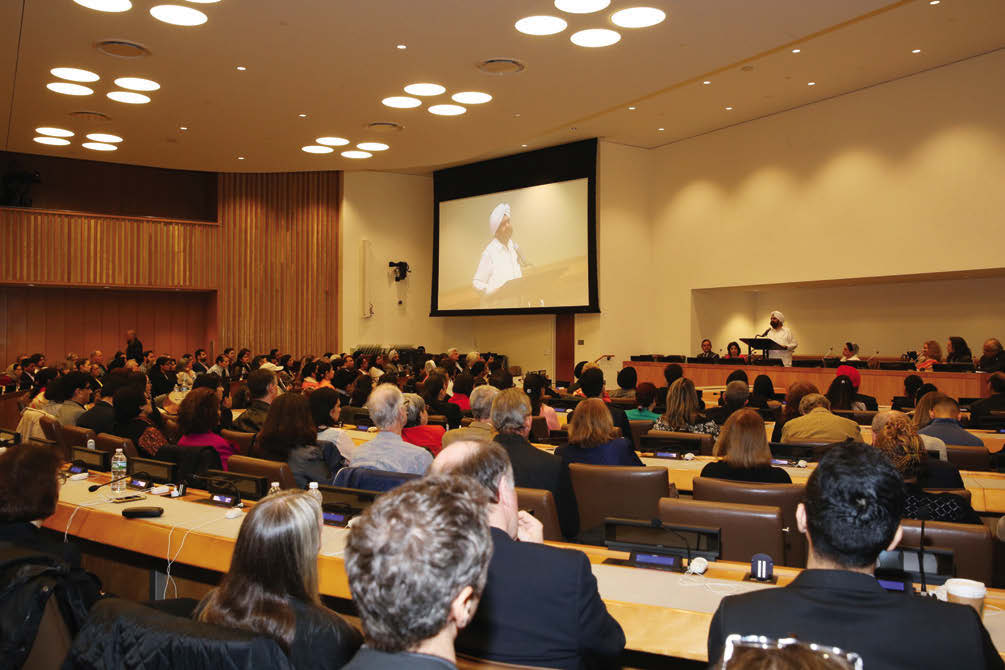
    The Annual Event of presentation of Power of One Award- also known as Oscar of Diplomacy – on 6 December, 2024 at Delegates Dining Room, United Nations HQ from 3 PM to 6 PM, is hosted by Permanent Mission of Georgia.

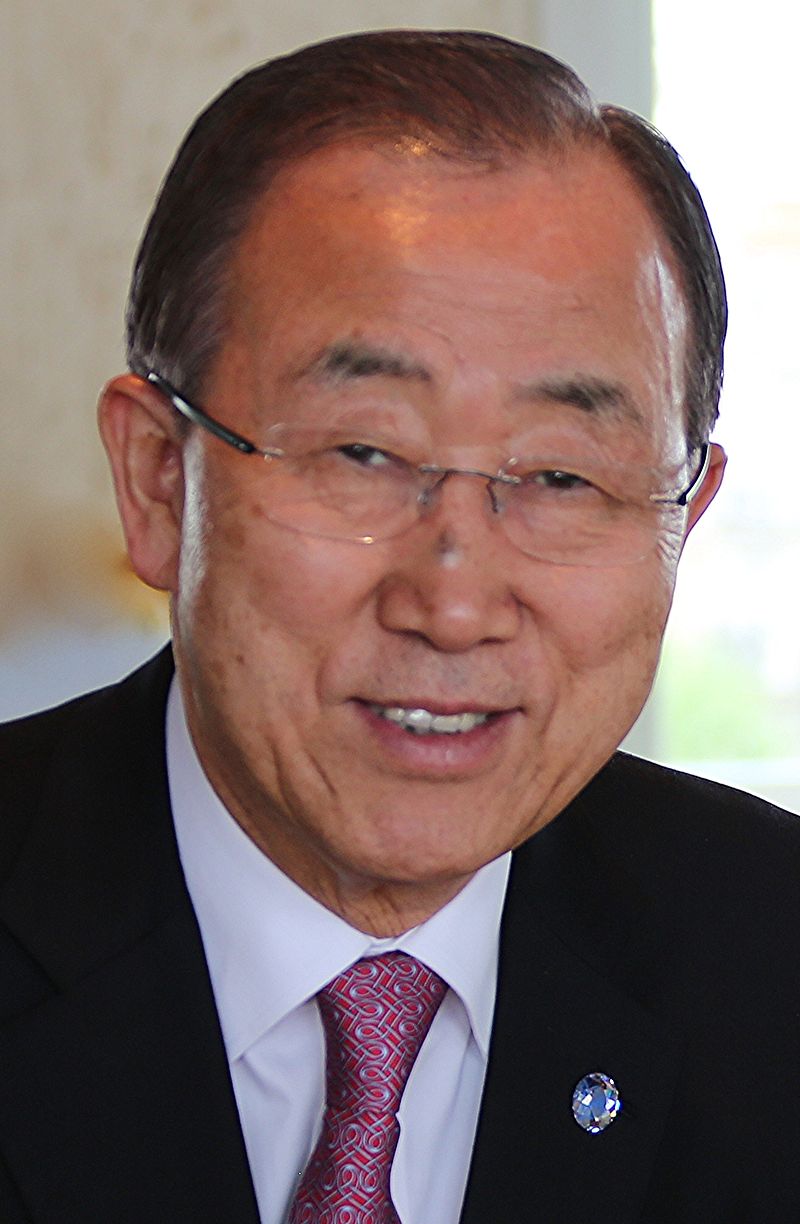
    Diplomats and Diwali Foundation Chairperson Ranju Batra and Ravi Batra at the lighting ceremony of Diwali 2023 Power of One Award presentation. On extreme left is Ban Ki-moon, who served as the Secretary General of the United Nations from 2007 to 2016. (Photo : Jaffer-SnapsIndia)
  • Role of Diplomacy in International Affairs: From General Douglas MacArthur to Qin Gang

    Role of Diplomacy in International Affairs: From General Douglas MacArthur to Qin Gang

    • Diplomacy is the “lines of communications” that sovereign nations use to engage in sovereign intercourse – across a wide array of menu items that arise – be it during peace or war.

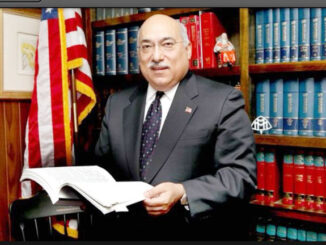
    by Ravi Batra, Esq.
    Chair, National Advisory Council South Asian Affairs

    From time immemorial, Emperors and Kings have engaged in the comity of nations through their ambassadors passing official messages, and responses, back and forth. That practice has continued, even after 1776 and the birth of the great American Experiment.
    Sovereign nations can either trade with each other, or wage war upon the other. Diplomacy, then, is a core governmental function that is necessary to assist in enhancing bilateral trade or to secure additional rights in lieu of war being engaged in futuro. Diplomacy is the “lines of communications” that sovereign nations use to engage in sovereign intercourse – across a wide array of menu items that arise – be it during peace or war.
    Indeed, diplomats are issued special passports by their sending-nation state, and credentials for the welcoming-nation state. Every nation state welcoming an ambassador accepts the credentials of such ambassador, and by so doing, the two-way official lines of communication are set.
    Recently, Qin Gang, the father of “Wolf Warrior” diplomacy was dishonorably retired – as he should have been – by President Xi Jinping, as he structurally violated the basic tenet of diplomacy: to make love or war, with equal sobriety, and passion for accurate reporting bilaterally. Indeed, while our President nominates ambassadors to 193 nations around the world, it is our Senate Foreign Relations Committee that holds hearings, and if approved, the Senate confirms with its “advise and consent” power. Only after that, does our Secretary of State, much like a corporate secretary, issue credentials to the confirmed-ambassador, which will then be presented to the Head of State or Government of the receiving nation-state.

    While anyone can be diplomatic, only persons representing their nation – be it a democracy, theocracy, autocracy or monarchy – is a diplomat, officially engaging in diplomacy. It is true that private persons – such as Bill Richardson, former U.S. Permanent Representative to the UN and governor of New Mexico – can engage in “fringe diplomatic” efforts that, hopefully, assist in resolving a thorny issue between two or more nation-states. For example, Bill Richardson helped to secure the freedom of hostages from Iran, Libya, Myanmar and inter alia Russia. The list included basketball player Brittney Griner, journalist Danny Fenster, U.S. Marine veteran Trevor Reed, and inter alia Osman Khan. Khan was freed with the help of the State Department and the Richardson Center in October 2022 along with six others in exchange for two relatives of Venezuelan President Nicolas Maduro jailed in the United States.
    The Osman Khan episode is an example of hybrid­ diplomacy, but the most famous example is in the movie – Bridge of Spies – wherein Tom Hanks portrays a private lawyer, James Donovan, who secured the release of hostages from then-East Germany, and years later, President John F. Kennedy, after the Bay of Pigs, again looked to James Donovan to seek the release of a few American hostages, and Donovan, well in excess of his mandate, secured the release of all Americans held by Cuba, then within USSR’s core sphere of influence. A nation so close to Miami that we ought to create a process to resolve all issues, including: property claims, and the so-called “Havana Syndrome.” Then, and only then, will the Monroe Doctrine be properly effectuated.

    Diplomats are granted inviolability in the nation they are credentialed to, but are not above the rule of law in the nation they are sent by. That means no law enforcement can arrest them or stop them for any reason, and they have full “freedom of movement” in the nation they are accredited to.
    In the tragic times of pre-World War II period of appeasement, which was driven by the strategic failure of the Great Powers to unite, Neville Chamberlain, then Prime Minister of the great British Empire, made a Peace Deal on behalf of Europe with Hitler’s Third Reich – the First Reich being the medieval Holy Roman Empire, which lasted until 1806; and the Second Reich included the German Empire from 1871-1918 – by gifting Czechoslovakia to Hitler, without any right or any consent of said nation to be so subjugated! This was followed up by USSR’s Stalin’s Foreign Minister Vyacheslav Molotov negotiating into the wee hours of August 23, 1939 with Hitler’s Foreign Minister Joachim von Ribbentrop to create the Molotov-Ribbentrop Pact, with secret protocols that became public during the Nuremberg Trials, to ensure peace between Hitler and Stalin, with each of them agreeing to fight and create agreed-to future-spheres of influence. On September 1, 1939, a week later, Hitler attacked western Poland, on September 17th Stalin invaded eastern Poland, and on September 22nd the Soviet and Nazi militaries held a joint military parade in Brest-Litovsk. The USSR-Nazi joint-war effort was short-lived, and Stalin’s USSR fought Nazi Germany and suffered the largest number of casualties at over 26 million dead to defeat fascist Nazis.

    Diwali Stamp – Power of One Awards, called the Oscars of Diplomacy, were instituted by Ranju Batra in 2017 to honor diplomats who uphold the spirit of Diwali. At the last awards event at the UN in December 2023, former UN Secretary General Ban Ki-moon was one of the honorees.

    It was Winston Churchill’s “we will never surrender,” and our Franklin D. Roosevelt, after Pearl Harbor, that the West, as we know it, was formed and was “united,” still, sadly, a term of art. Later, in early and cold February 1945, FDR, Churchill and Joseph Stalin met for over a week – the Yalta Conference – in a resort in Crimea, and negotiated the shape of the postwar world. This, too is diplomacy, albeit, by and between the principals themselves guided by their “fears” and “wants.”
    So long as deception exist in human conduct – aka “fraud” in civil context – to aid and abet the vices that can reside in many an ambitious human heart which the great General Sun Tzu and Nico Machiavelli are masters of explaining, let alone Mark Twain’s hilarious rendition in his “Prince and the Pauper,” where walnuts are cracked with the Great Seal of England.
    Diplomacy, then, is a vehicle that can enhance peace, start a war, or end it on terms negotiated poorly – as after World War II – that led to the Weimar Republic’s hyperinflation and Hitler’s rise to power – or well, as our General Douglas MacArthur, Supreme Commander of the Allied Forces, on September 2, 1945 did in accepting the Instrument of Surrender from Japan on the teak deck of the USS Missouri, with full honors and respect so as to help create a new prosperous and democratic Japan and everyday Japanese wishing to be a forever-American Ally.
    Those who enjoy “insult” – as in the Alaska Summit at Anchorage on March 18, 2022 – will forever be mired in conflict, and even in a war that was avoidable. And those who harness the power of “respect,” especially for an adversary, as General MacArthur proved, will find a durable peace and friendship. Until then the United Nations Charter is our best hope for a more perfect world, and why the UN is the Vatican of Hope, and the Permanent Representatives Arch-Angels.

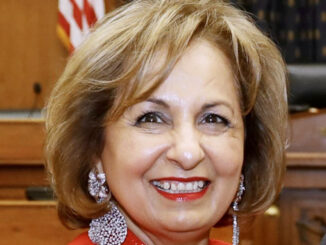
  • Ranju Batra: Securing Diwali Stamp and launching Oscars of Diplomacy

    Ranju Batra: Securing Diwali Stamp and launching Oscars of Diplomacy

    The ideals of Diwali are the ideals of the UN Charter. The Power of One awards, Ranju says, honor diplomats whose work away from the public eye can make a difference between war and peace.

    A historic number of 24 nations, led by Belarus and India as co-organizers, and United States Postal Service, came together in December 2016 at the United Nations to celebrate “Small Stamp for a Big Festival” and to honor Mrs. Ranju Batra for spearheading the seven-year-long campaign to secure the release of the Diwali Forever stamp by USPS.

    Ranju Batra addressing Diwali Stamp – Power of One Awards ceremony 2022

    Ranju felt the honor was for her journey for the Diwali Stamp seen as a metaphor for peace and harnessing its power to promote excellence in diplomacy. In fact, the ideals of Diwali are the ideals of UN Charter. Speaking to The Indian Panorama, she recalled that one diplomat dubbed her singular achievement the ‘power of one’. That inspired her to launch the ‘Diwali Stamp – Power of One’ awards to honor exceptional diplomats.
    Under the aegis of the Diwali Foundation USA that she chairs, these awards are presented every year since 2017 (barring the Covid years) to exceptional world class diplomats at the UN.
    Says Ranju about honoring diplomats, “They work hard every day away from the public eye but the public needs to know that what they do is important as that could be the difference between war and peace.”
    The ‘Diwali Stamp – Power of One’ awards are supported multilaterally. For example, in 2023 the awards were co-organized and co-sponsored by over 70 member states and the European Union. The Permanent Mission of India at the UN has, of course, supports the ceremony every year.

    Ranju Batra with the honorees and others at the Diwali Stamp – Power of One Awards ceremony 2022.

    Since 2017, 25 awards have been given to esteemed ambassadors. The honorees have included Lakshmi Puri, former Executive Director of the UN Women, former UK Ambassador to the UN Matthew Rycroft, former Permanent Representative of Georgia to the UN Kaha Imnadze, and former Permanent Representative of Grenada to the UN Keisha McGuire.
    The most high-profile diplomat to be honored to date has been the UN Secretary-General (2007-2016) Ban Ki-moon. He was honored last December along with former Permanent Representative of Bosnia and Herzegovina to the UN Amb. Mirsada Colakovic, former Permanent Representative of South Korea to the UN Amb. Kim Sook and 72nd UN General Assembly President and EU Special Representative for the Belgrade-Pristina Dialogue Miroslav Lajcak.
    In his acceptance speech at the event attended by UN diplomats, envoys, civil society members and policy experts, Ban commended the work and “forward-thinking vision” of the Diwali Foundation USA “for advancing vital light in a world of increasing darkness”. He said the world today “seems fractured like never before” as he cited the COVID-19 pandemic, climate crisis and regional crisis seen in the Middle East and Ukraine.
    India’s Ambassador to the UN Ruchira Kamboj said that Diwali is a celebration that holds a special place in the hearts of over a billion Indians across the globe. Diwali “is more than just a festival. It is a sentiment that embodies the triumph of light over darkness, knowledge over ignorance and hope over despair”, she said.
    Sri Lanka’s Ambassador to the UN Mohan Pieris said “Deepavali has become truly a secular festival in the world, since its message is not exclusively restricted to any religious creed.”
    Ravi Batra, the eminent Indian-American attorney, and Chair of National Advisory Council South Asian Affairs, and moderator of the award ceremony, said the UN transcends borders and boundaries.
    The Power of One award is given to a former permanent representative or former high-level member of UN secretariat or member state, or soon-to-be former, who has worked selflessly to help form a more perfect, peaceful, and secure world for all. Assuming eminence, these awards have come to be called the ‘Oscars of Diplomacy’.
    The Diwali Foundation, USA’s mission is to support the UN Charter of multilateralism and enhance peace and security around the world by promoting excellence in diplomacy.
    The Diwali Stamp triumph
    Ranju’s campaign for the Diwali Stamp was fervently followed and supported by Indians in America. It was backed by many Congress members and Indian diplomats in the US. She took it up as President of the Association of Indians in America (AIA)-New York during its Silver Anniversary year, 2011-12. The entire Indian community celebrated with her when on October 5, 2016, USPS officially dedicated the stamp at the Indian Consulate in New York. Ranju’s personal sale of over 170,000 stamps for First Day made the “Diwali Stamp” the best seller in USPS’ over 200 years history.
    Looking back, Ranju says, “The Diwali stamp issued by the USPS is equivalent to the US government issuing a passport to Diwali itself and supporting light over darkness, knowledge over ignorance.” Diwali is now part of Americana. Since the Diwali stamp was issued as a Forever stamp, USPS is required to issue it annually.
    Since September 2021, Ranju is an Advisor for Legal and Humanitarian Affairs to the Permanent Mission of Georgia to the UN, having previously served as an Advisor to the Permanent Mission of Ukraine from 2015.
    Since 1990, she has been the Administrator of The Law Firm of Ravi Batra, founded by her husband.

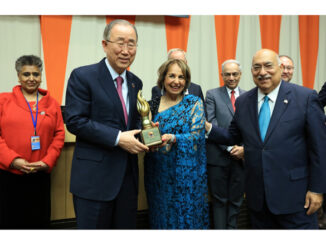
    Former UN Secretary General Ban Ki-moon was presented the Power of One Award in 2023 by Ranju Batra, accompanied by Ravi Batra.
  • Former Secretary General Ban Ki-moon, three veteran diplomats honored with 2023 Diwali ‘Power of One’ Awards at UN

    Former Secretary General Ban Ki-moon, three veteran diplomats honored with 2023 Diwali ‘Power of One’ Awards at UN

    “The ideals of Diwali are the ideals of UN Charter” : Chair of Diwali Foundation USA Ranju Batra

    UNITED NATIONS (TIP): Former UN Secretary General Ban Ki-moon and three veteran diplomats were honored with the annual ‘Diwali Power of One Awards’, hailed as the ‘Oscars of diplomacy’, for their selfless efforts to “help form a more perfect, peaceful, and secure world for all”. The former UN chief was honored with the Lifetime Achievement Award at the 2023 Diwali Stamp — The Power of One Award ceremony organized by the Diwali Foundation USA. The other awardees for the year 2023 are former permanent representative of Bosnia and Herzegovina to the UN Ambassador Mirsada Colakovic, former permanent representative of South Korea to the UN Ambassador Kim Sook and 72nd UN General Assembly president and EU Special Representative for the Belgrade-Pristina Dialogue Miroslav Lajcak. They were honored at a special ceremony held in the UN Headquarters on Monday, December 11.

    Former Secretary General Ban Ki-moon addressing the gathering after receiving the award. Seen, among others, are India’s Permanent Representative to the United Nations, Ambassador Ruchira Kamboj ( extreme left) , Ranju Batra (4th from left), and Ravi Batra (behind Mr. Ban Ki-moon) (Photo : Mohammed Jaffer / SnapsIndia)

    Ban commended the work and “forward-thinking vision” of the Diwali Foundation USA “for advancing vital light in a world of increasing darkness”.

    Ban said the world of today “seems fractured like never before” as he cited the COVID-19 pandemic, climate crisis and regional conflicts, particularly “regional crisis as we see today in the Middle East and Ukraine”.

    “But it is exactly at times such as these that the work of the United Nations is indispensable. The United Nations and its pursuit of peace, human rights and sustainable development exemplifies the values and principles that we should all espouse to replicate,” he said. Ban was the eighth Secretary-General of the United Nations, serving two terms as the world’s top diplomat from January 2007 to December 2016.

    He said that as the world moves into 2024 and beyond, “we share a common destiny illuminated by peace, sustainability and prosperity. Let us work together and expand our unified efforts to realize this shared destiny for all. This is your political responsibility and for me, my moral responsibility as a former Secretary General” and as an awardee of the Power of One honor.

    India’s Permanent Representative to the UN Ambassador Ruchira Kamboj, in her address to the event attended by UN diplomats, envoys, civil society members and policy experts, said that Diwali is a celebration that holds a very special place in the hearts of over a billion Indians across the globe.

    Diwali “is more than just a festival. It is a sentiment that embodies the triumph of light over darkness, knowledge over ignorance and hope over despair”, she said.

    Kamboj said, “as we light the lamps of Diwali, let us remember that every small light, no matter how small, can make a significant difference in dispelling the shadows”.

    Sri Lanka’s Permanent Representative to the UN Ambassador Mohan Pieris said “Deepawali has become truly a secular festival in the world, since its message is not exclusively restricted to any religious creed.

    “This festival has united the global community with the central message that we need more than ever the humanistic ideals to engage the inglorious wars, which are bleeding the innocence of humanity,” he said.

    Pieris underscored that for the world to have peace, it is important that the whole world must be united to save the higher ideals of humanity, which have evolved since the millennium in various religious traditions.

    Chair of Diwali Foundation USA Ranju Batra, who had spearheaded efforts for over seven years to get a commemorative ‘Forever Diwali’ stamp issued by the US Postal Service in 2016, said: “Diwali is a message of peace.” She said her journey for the Diwali stamp is seen as a “metaphor of peace and harnessing its power to promote excellence in diplomacy. The ideals of Diwali are the ideals of UN Charter”.

    She noted that the 2023 Power of One awardees have clearly demonstrated that “one person can make a difference”. The Diwali stamp celebration is not of a religion or nation but of the spirit of harmonious inclusiveness and cross-cultural understanding that all religions deserve, she said.

    Eminent Indian-American attorney and Chair of National Advisory Council South Asian Affairs and moderator of the award ceremony Ravi Batra said the UN transcends borders and boundaries.

    “The need to acknowledge excellence is critical, generally, but in diplomacy, which is on life support in today’s world, it is essential and that’s how these awards are – the Power of One,” he said, adding that they honor “world class diplomats who have changed the world by what they did”.

    Awardees and organizers of Power of One Awards (Photo : Mohammed Jaffer / SnapsIndia)

    Hailed as the ‘Oscars of Diplomacy’, the awards are presented to former Permanent Representatives or former high-level members of the UN Secretariat or member state, or soon to be “former”, who have “toiled selflessly to help form a more perfect, peaceful and secure world for all”.

    The 2023 Award ceremony was co-organized by the Diwali Foundation USA and Delegation of the European Union to the United Nations, and the Permanent Missions of Chile, Eritrea, Georgia, India, Kazakhstan, Kiribati, Morocco, Oman and Sri Lanka to the United Nations. The co-sponsors included the Permanent Mission to the United Nations of Albania, Armenia, Austria, Azerbaijan, Belarus, Bhutan, Cyprus, France, Germany, Ghana, Hungary, Iraq, Israel, Kuwait, Kyrgyzstan, Malaysia, Mexico, Nepal, Philippines, South Korea, South Africa, Spain, Tajikistan, Thailand, Turkiye, Turkmenistan, Ukraine, United Kingdom, United States, Uzbekistan, Vietnam and Palestine, and International Atomic Energy Agency (IAEA-NY) among others.

    Diwali Foundation USA was established in 2017 to promote a peaceful and consensus-based process to achieve societal “good, as befits the high hopes and ideals of humanity enshrined in the United Nations Charter”.

    The Foundation established ‘The Power of One’ awards to celebrate and highlight the important work done in a peaceful manner, especially at the United Nations.

    Previous honorees include former UN assistant secretary general and deputy executive director of UN Women, Lakshmi Puri, former UK Ambassador to the UN, Matthew Rycroft, former permanent representative of Georgia to the UN, Kaha Imnadze, and former permanent representative of Grenada to the UN Keisha McGuire.
    (Source: PTI)

    The traditional lamp lighting . Mr. & Mrs. Ban Ki-moon with organizers of Power of One Award lighted the lamp. (Photo : Mohammed Jaffer / SnapsIndia)
  • Hollande awards France’s Legion of Honour to UN’s Ban Ki-moon

    Hollande awards France’s Legion of Honour to UN’s Ban Ki-moon

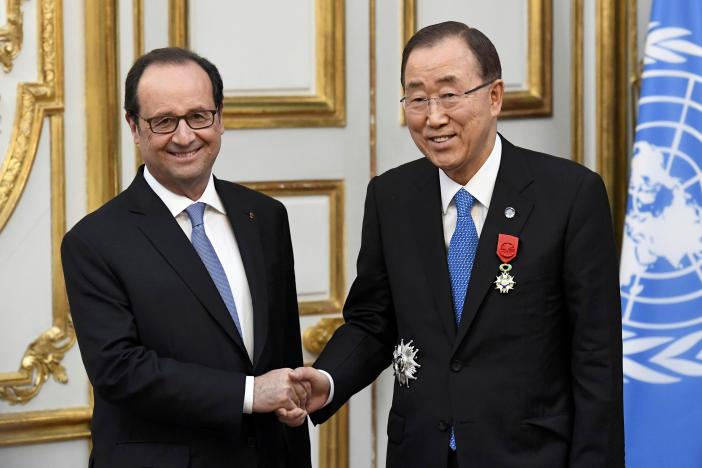
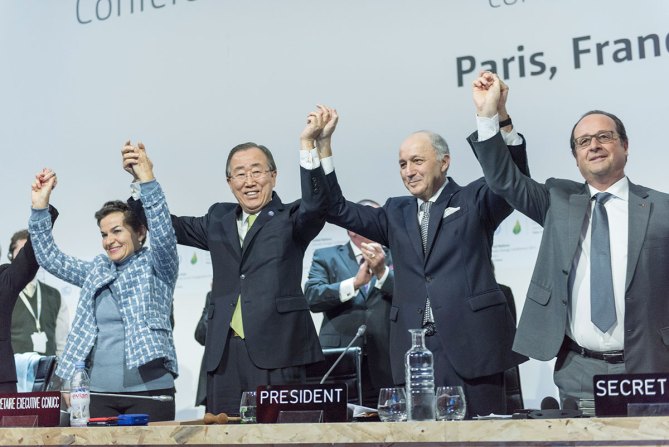
    PARIS (TIP): United Nations Secretary General Ban Ki-moon received the Legion of Honour from French President Francois Hollande on Nov 17 for his contributions to tackling climate change.

    The South Korean diplomat helped push through the 2015 Paris Agreement, a deal aimed at moving away from fossil fuels to cleaner energies that was signed by almost 200 countries after nearly two decades of negotiations.

    “It was largely because of your contribution, because many years ago you started putting this topic on all the agendas,” Hollande said at the ceremony of Ban’s efforts.

    The Legion of Honour was established in 1802 by Napoleon Bonaparte and is considered to be one of France’s highest civilian awards.

    “By doing this you are rewarding our honourable organisation and I feel deeply honoured and proud,” said Ban, who will step down as head of the 193-member world organisation after 10 years on January 1. He will be replaced by Antonio Guterres of Portugal. (Reuters)

  • A PIROUETTE ON PAKISTAN

    A PIROUETTE ON PAKISTAN

    In February this year, shortly after the attack in Pampore, Jammu and Kashmir, a diplomat belonging to a ‘friendly’ country delicately asked an unusual question. His Foreign Ministry headquarters were asking if they should send a message condemning the terrorist attack in which three Army men, two Central Reserve Police Force personnel and a civilian had been killed in a siege which bore resemblance to the Pathankot attack a month before. The problem, he explained, was that the Indian government itself was making no statements on the incident, and he wasn’t sure if statements of support were welcome or not. A few days after the Pampore incident on February 20, the Ministry of External Affairs had sought to play it down, saying only that the matter was “still being investigated”. Eventually, the Pampore incident, despite the obvious strains of evidence linking it to Pakistan-based groups that officials on the ground pointed to, was buried. At the time, the Indian and Pakistani National Security Advisers (NSAs) were still talking to each other “regularly”, said the government, and a Pakistani investigation team was coming to Pathankot airbase to survey evidence.

    It is only now, after the Uri tragedy of September 18, that India has brought up the number of attacks and attempted infiltrations across the Line of Control (LoC) this year. “Seventeen such attempts have been interdicted at or around the LoC, resulting in the elimination of 31 terrorists and preventing their intended acts of terrorism,” Foreign Secretary S. Jaishankar told Pakistan High Commissioner Abdul Basit when he summoned him on Wednesday. In fact, there have also been more than 20 attacks on security force installations in Jammu and Kashmir in the past two years, including the Pampore attack; another 15 were foiled.

    The incident with the diplomat only serves as a small indicator of how confusing the government’s moves on Pakistan have been, even to close watchers and friendly governments. In fact, India’s moves on Pakistan in the past few years have been a series of such missteps, misperceptions and a complete misunderstanding of the Pakistani responses to them.

    Missing the signs

    To begin with, the on-again, off-again dialogue process that began with Prime Minister Narendra Modi’s grand gesture of inviting his Pakistani counterpart Nawaz Sharif to his swearing-in ceremony is perplexing. When the government called off talks between the Foreign Secretaries over the Pakistan High Commissioner’s talks a few months later with the Hurriyat leadership, it played the move as the drawing of a “redline”. But in a turnaround in March this year, that redline was erased, and the government posed no objection to the High Commissioner meeting the Hurriyat a few days before the Foreign Secretary-level talks in Delhi. What the government failed to notice between those two dates in 2014 and 2016 was a hardening of the Pakistani military’s position on the India policy. Another missed sign was the clear targeting of NSA Ajit Doval, India’s main interlocutor with Pakistan, by the military establishment’s propaganda wing, as the mastermind of terror attacks in Pakistan.

    As a result, when Mr. Modi met Mr. Sharif in Paris and suggested restarting talks beginning with NSA Doval and the newly appointed Pakistani NSA Gen. Nasser Khan Janjua, it was far from a match made in heaven. For his part, Mr. Doval was viewed with deep suspicion by Pakistan. Indian government officials drew false comfort as they viewed Gen. Janjua as a “military man” with the ear of Pakistan Army Chief Gen. Raheel Sharif. But they should have asked more closely about Gen. Janjua’s nebulous role in the Pakistani power structure, as he seemed to only be deputed for relations with India: when Prime Minister Sharif went to Saudi Arabia, Gen. Sharif to Afghanistan, and Foreign Affairs Adviser Sartaj Aziz to the U.S., Gen. Janjua was nowhere in the picture.

    Neither war-war nor jaw-jaw

    Yet the government pressed on with the initiative with Pakistan, and both External Affairs Minister Sushma Swaraj and Mr. Modi have paid visits to Pakistan. They both gave the same message: this time they would not allow terrorism to derail talks between the two countries. “We want to ensure we are not provoked by saboteurs who want to stop the dialogue process,” Ms. Swaraj told Parliament about the government’s new plans with Pakistan. Yet provoked they were, and the government took another turn, calling off the Foreign Secretary-level dialogue process shortly after the Pathankot attack in January. NSA talks, however, persisted and led to the curious precedent that saw Pakistani intelligence operatives get access to look at the very base India accused their groups of attacking. Through every attack from Pakistan, the government has flipped and flopped, explaining itself unconvincingly to even its well-wishers.

    There is enough evidence to show that Ms. Swaraj’s instincts were correct. Nothing upsets the elements of the Pakistani establishment that carry out terror attacks against India more than a consistent dialogue process, and in the past too, it is when India and Pakistan have come closest to a breakthrough that their attack is the hardest. The last few years, however, have seen neither what Winston Churchill famously called jaw-jaw (talks), nor has there been an outright war-war, and it’s that situation of disorder that empowers those destructive elements the most.

    Not setting the agenda

    Equally confusing are the steps the government has taken on the international stage. At the G20, ASEAN and East Asian summits, and every possible international forum, Prime Minister Modi has made statements about Pakistan’s link to the violence in Kashmir. Yet the government rejoiced this week when UN Secretary General Ban Ki-moon omitted any references to Kashmir, saying this reaffirms India’s traditional position that it is a bilateral, not international, issue. The damage is twofold: not only does this allow Pakistan to set the agenda for India at international fora as Mr. Sharif’s speech calling Kashmir an “intifada” did, it also gives rise to ambiguities on the status of Kashmir that other countries draw upon.

    Meeting Mr. Sharif this week, U.S. Secretary of State John Kerry, for example, expressed “strong concern with recent violence in Kashmir – particularly the Army base attack”, and then added the “need for all sides to reduce tensions”, as if there was some equivalent responsibility for both India and Pakistan. Similarly, France issued a statement condemning the Uri attack, but also called for a resolution of the Kashmir dispute, drawing a link between the two that India would like to avoid.

    Finally, there is an inconsistency between the government’s rhetoric and the actions it is prepared to take in the wake of an attack. Initial indications after the Uri attack suggest the government and the armed forces are not in favor of a “knee-jerk” air strike or cross-border raids at this point. It is counterproductive to issue statements on “befitting punishment” to Pakistan or exchanging a tooth for a full set of dentures if the plan is to exhaust diplomatic options first.

    The truth is, the world understands India is the victim, and Pakistan the perpetrator of terror. While the government keeps producing evidence of each attack it traces to the Jaish-e-Mohammed and the Lashkar-e-Taiba, as it has done post-Uri as well, the obvious evidence should be the original case against them: that JeM leader Masood Azhar was exchanged for hostages during the IC-814 hijack in 1999, and Hafiz Saeed has been identified by at least three people involved in the 26/11 Mumbai attacks of 2008 as its mastermind, and is wanted not just by India but the UN as well. If that’s not enough for Pakistan, nothing will ever be, and the fact that both terrorists roam freely and run flourishing empires within the country should be enough to show Pakistan’s complicity. But until India builds a coherence in its own strategy, and unity in focus and purpose, it will continue to face such challenges from across the border, as well as comforting but empty words of solidarity from the rest of the world.


    (The author is a columnist and can be reached at suhasini.h@thehindu.co.in)

  • 2 Indians, 1 Indian-American Among 17 UN Young Leaders

    2 Indians, 1 Indian-American Among 17 UN Young Leaders

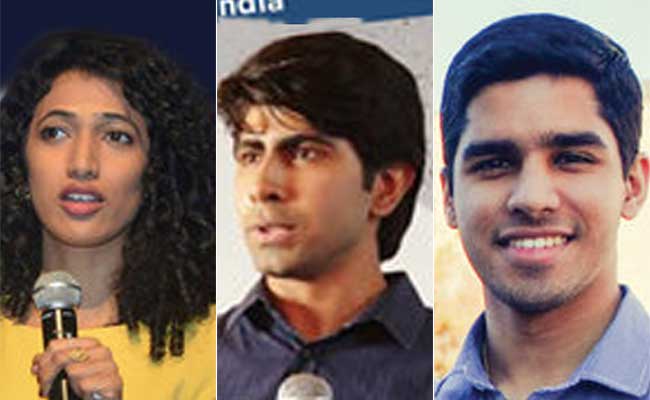
    Two Indians and an Indian American are among 17 people selected for the inaugural class of UN Young Leaders for Sustainable Development Goals for their leadership and contribution to end poverty, fight inequality and injustice, and tackle climate change by 2030.

    Trisha Shetty, 25, is the founder and CEO of ‘SheSays’, a platform she launched last year to educate, rehabilitate and empower women to take direct action against sexual assault in India.

    Ankit Kawatra, 24 founded ‘Feeding India’ in 2014 to address the issues of hunger and food waste, particularly by distributing excess food from weddings and parties to the needy.

    Indian-American Karan Jerath, 19, invented a ground- breaking, sub-sea wellhead capping device that contains oil spills at the source as a solution in the aftermath of the BP deepwater horizon oil spill – the largest marine oilspill in US history, near his home in Texas.

    UN Secretary-General Ban Ki-moon said the 17 young change-makers are a “testament to the ingenuity of youth and I congratulate them for their exceptional leadership and demonstrated commitment to the Sustainable Development Goals”. ‘SheSays’ uniquely provides tools and resources for women, including access to legal, medical and psychological support.

    “I decided to do something when I realised that I could go online to find information about restaurants, but for victims of sexual abuse, there was nothing,” Ms Shetty said.

    Ms Shetty and her team work with established institutions across the education, entertainment and healthcare sectors to build a network of support that recognises all levels of sexual abuse and provides the necessary means to fight it, according to a statement on the young leaders by the office of the UN Secretary-General’s envoy on Youth.

    So far, the organisation has successfully engaged more than 60,000 young people through educational workshops and Ms Shetty is now focussed on achieving the Sustainable Development Goal (SDG) of gender equality.

    Ms Kawatra’s organisation has a network of over 2,000 volunteers in 28 cities in India for rescuing and redistributing excess food to help feed people in need. The organisation has served over one million meals to date and aims to reach 100 million by 2020.

    Mr Kawatra, who quit his corporate job at 22, said he decided to focus on tackling food waste and hunger in India when at an Indian wedding he was “appalled” by the amount of food going waste in a country where 194 million are undernourished.

    The idea behind his organisation was to collect excess food from parties, events and weddings and re-distribute to people in need and it is now eyeing reaching zero hunger.

    Speaking at a UN event, Mr Kawatra said he was “honoured” to be selected as a UN Young Leader, a role which will give “me an opportunity to further advocate global development goals that need to be achieved for a better planet and also raise India’s concerns and social challenges all over the world”.

    Mr Jerath, a scientist and innovator, was born in India, raised in Malaysia and moved to the US at the age of 13. When the BP oil spill happened 30 minutes away from his home in Texas, Mr Jerath says he was determined to take action. “I realized that much smaller spills are happening on a daily basis and negatively affecting our oceans and environment. I had to find a solution,” he said.

    While still in high school, he invented a device that contains oil spills at the source. The patent-pending device can collect oil, gas and water gushing from a broken well on the seafloor, providing an effective, temporary solution in the case of an unforeseen subsea oil spill.

    For his invention, Mr Jerath won the ‘Young Scientist Award’ at the Intel International Science and Engineering Fair’s 2015 competition, and was selected as the youngest honoree on this year’s Forbes 30 Under 30 Energy list.

    Other leaders are Anthony Ford-Shubrook from the UK, a lifelong advocate for disability rights and access, Kenya’s Rita Kimani, co-founder of a social enterprise that connects unbanked and underserved smallholder farmers to credit, women’s rights activist Safaath Ahmed Zahir from Maldives.

    Shougat Nazbin Khan from Bangladesh who established a digital school for children from underprivileged communities in Bangladesh and Tunisian-Iraqi writer Samar Samir Mezghanni who has written over 100 short stories for children and published 14 books.

    The inaugural class, selected from over 18,000 nominations from 186 different countries, will support efforts to engage young people in the realisation of the SDGs and will have opportunities to engage in UN and partner-led projects.

    The initiative will also contribute to a brain trust of young leaders supporting initiatives related to the SDGs.

    The young leaders have been recognised for their leadership and contribution to the achievement of the 2030 Agenda for Sustainable Development, which includes a set of 17 Goals to end poverty, fight inequality and injustice, and tackle climate change by 2030.

    UN Secretary-General’s Envoy on Youth Ahmad Alhendawi unveiled the inaugural class of UN Young Leaders for the SDGs at the Social Good Summit in New York yesterday. The flagship initiative of the Office of the Secretary-General’s Envoy on Youth comes against a backdrop of increasing efforts by the UN to engage young people in its efforts to achieve the SDGs.

    “We are proud to announce this group of young global citizens who are already transforming their communities. At the same time, the selection process was an important reminder of the great potential and talent of so many young people around the world, who are making immense contributions to peace, development and the achievement of the Sustainable Development Goals,” Mr Alhendawi said.

    The Young Leaders Initiative is powered by the Office of the UN Secretary-General’s Envoy on Youth and is part of the Global Youth Partnership for Sustainable Development Goals, launched in 2015 and housed in the Envoy’s Office.

    From food to fashion to micro-finance, the UN Young Leaders for the SDGs, aged 19-30 years old, come from many different backgrounds, represent every region in the world and inspire all of us to achieve the goals.

  • UN holds first-ever summit on refugees and migrants

    UN holds first-ever summit on refugees and migrants

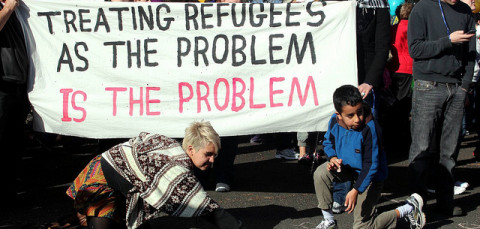
    UNITED NATIONS: The issue of what to do about the world’s 65.3 million displaced people takes center stage at the United Nations General Assembly when leaders from around the globe converge on New York for the first-ever summit on Addressing Large Movements of Refugees and Migrants.

    With more people forced to flee their homes than at any time since World War II, leaders and diplomats are expected to approve a document aimed at unifying the UN’s 193 member states behind a more coordinated approach that protects the human rights of refugees and migrants.

    “It’s very interesting because if we are able to translate that paper into a response in which many actors are going to participate, we will solve a lot of problems in emergency responses and in long-term refugee situations like the Syrian situation,” Fillipo Grandi, the UN’s High Commissioner for Refugees told reporters.

    That may prove an uphill struggle, however, as the document is not legally binding and comes at a time that refugees and migrants have become a divisive issue in Europe and the United States.

    A number of countries rejected an earlier draft of the agreement that called on nations to resettle 10 percent of the refugee population each year, something that has led a number of human rights groups to criticize the document as a missed opportunity.

    The US and a number of other countries also objected to language in the original draft that said children should never be detained, so the agreement now says children should seldom, if ever, be detained.

    Secretary-General Ban Ki-moon, whose report on refugees and migrants laid the basis for the summit document, said he was aware of the criticism from non-governmental groups.

    “While we all wish it could be a stronger outcome document … all 193 member states had to agree on their commitment. As you will see, my report was a strong one,” Ban said. “I hope that, as the two compacts are adopted over the coming year and a half, some stronger language and commitment and elements from the report will reappear in the course of this negotiation,”.

    First-ever summit on refugees and migrants: Facts

    When and where? The Summit is an all day event on Monday 19 September 2016 at the UNHQ in New York.

    Who is organizing? The High Level summit is being organized by the President of the General Assembly on behalf of Member States.

    In January 2016, the Secretary-General appointed a Special Adviser, Karen AbuZayd, to work with United Nations entities and undertake consultations with Member States and other relevant stakeholders in the lead up to the Summit.

    Participation The Summit will be attended by heads of state and government, Ministers, and leaders from the UN System, civil society, private sector, international organizations, academia, and beyond in alignment with the General Assembly resolution establishing the summit’s modalities.

    Background The UN General Assembly decided to convene a high-level plenary meeting on addressing large movements of refugees and migrants on the 19 September 2016 and requesting UN Secretary-General Ban Ki-moon to prepare a report with recommendations on the issue.

    – With inputs from www.refugeesmigrants.un.org

  • UN Secy Gen Ban Ki-moon condemns Uri attack

    UN Secy Gen Ban Ki-moon condemns Uri attack

    United Nations Secretary General Ban Ki-moon has condemned the terrorist attack on Uri in Jammu & Kashmir.

    The response comes in the middle of the 71st United Nations General Assembly (UNGA) at the UN headquarters in New York.

    A statement issued by the United Nations stated, “The Secretary-General condemns today’s militant attack in Uri, Jammu and Kashmir. He expresses his deepest sympathy and condolences to the families of the soldiers who lost their lives and to the Government of India. He wishes a speedy recovery to those injured. The Secretary-General hopes that the perpetrators of this crime will be identified and brought to justice.”

    smoke-rises-from-the-uri-brigade-camp-during-the-september-18-2016-terror-attackuri-attack-uri-terror-attack-uri-jawans-killed-uri-jawans-uri-jawansThe attack has claimed the lives of 18 soldiers and injured 19 others.

    The attack stared at 4:30 am September 18.


  • High time to make #UNSC more Democratic & Representative: UN chief Ban Ki-moon

    High time to make #UNSC more Democratic & Representative: UN chief Ban Ki-moon

    UN chief Ban Ki-moon has said it is “high time” for the reform of Security Council for making it more “democratic and representative” as he appealed the member states to pay heed to the rapidly changing and “deteriorating” security challenges in the world.

    “When it comes to reform of the United Nations, particularly Security Council reform, I have been stating many times ? I dont know how many times, repeatedly ? that it is high time that the Security Council must be reformed and changed in a more democratic and representative way,” Ban told reporters here yesterday at a press conference ahead of the high-level General Assembly session that starts next week.

    “They have been meeting to negotiate this reform process for longer than two decades. Many proposals have been proposed, and they have been reviewed and discussed. Unfortunately, not a single issue has been able to see any convergence of opinions among the Member States,” he said.

    The UN Secretary General noted that each country and group brings their own proposals which have not been able to get the support from others.

    “So its important that the member states should look at this issue ? after a two-decades long consultation and negotiation process, its high time to discuss this matter,” Ban said.

    “As Im just about to leave my position, Im urging that they should reflect the voices and aspirations of the Member States and the rapidly changing, deteriorating security challenges of the international community really make it imperative that the Security Council should be changed,” he said.

    Ban said that the global challenges pertaining to refugees and migrants, climate change, and the war in Syria will be the major topics that will likely figure prominently in this years high-level week at the UN.

    “This years high-level week at the United Nations comes at a critical time,” Ban said, previewing activities that will take place at the annual session, when international attention is focused on the work underway at UN.

    World leaders are scheduled to address next weeks general debate and other events that will take place during the high-level segment of the General Assemblys 71st session.

    With the Secretary-Generals second five-year term expiring on December 31, this will be Bans last high-level week as the UN chief.

    Ban said he is pushing for the entry into force of the Paris Agreement on climate change before the end of this year.

    The worlds two largest emitters, China and the US, recently joined the accord.

    “Now we need just 28 more countries, representing 16 per cent of global emissions, to cross the necessary threshold,” he said, drawing attention to the September 21 special event at which countries can deposit their ratification instruments with the Secretary-General.

  • Taking the Paris process forward

    Taking the Paris process forward

    The ratification of the Paris Agreement on climate change by the United States and China, which together account for 38 per cent of global greenhouse

    gas emissions, provides much-needed momentum for the global compact to be in force beyond 2020. As UN Secretary-General Ban Ki-moon has emphasized, 26 countries have already acceded to the accord; to reach the target of 55 per cent emissions, 29 more must come on board.

    For the U.S., this is a landmark departure from its long-held position of not accepting a binding treaty like the Kyoto Protocol, where emerging economies heavily reliant on fossil fuels have no firm commitments.

    The Paris Agreement addressed this issue by stipulating voluntary but verifiable emissions reduction goals for all parties, within the principle of common but differentiated responsibilities that underpin the UN Framework Convention on Climate Change. Contrary to the belief that a requirement to cut GHGs will make economies less competitive, a major section of global industry and business has reaffirmed the potential for trillions of dollars in green investments flowing from the ratification of the Paris Agreement by the U.S. and China. This is a clear pointer for India, which is estimated to have the third highest individual country emissions as of 2014.

    There are distinct low-carbon pathways that India has outlined in its national plan submitted to the UNFCCC. Among these, the scaling up of renewable energy and non-fossil fuel sources to 40 per cent of installed power production capacity by 2030 is predicated on technology transfer and the availability of Green Climate Fund resources. Not much progress has been made in this area, and Minister of State for Environment Anil Madhav Dave confirmed recently that no contribution had been received from the Fund. Helping India lock in the right technologies in its growth trajectory is important for a global reduction in greenhouse gases. It is important for the U.S. to help accelerate this process in the area of power generation, following up on the assurances given by Secretary of State John Kerry during his recent visit on clean energy finance, technology, solar catalytic funding and help for power grid upgradation. New Delhi can, in parallel, do much more on domestic policy to achieve green and low energy intensive growth – such as taxing fossil fuels, managing emissions from waste better and making low-carbon buildings mandatory. India joined other G20 countries at Hangzhou to commit itself to addressing climate change through domestic policy measures. For that to happen, the Centre must initiate a serious discussion with the States on the national imperatives.

    (The Hindu)

  • Setting out for New Friends

    Setting out for New Friends

    A Modi doctrine on Pakistan is now visible after two years of Pakistan policy vacillations. It basically has old elements which are newly interpreted.

    First is ‘zero tolerance to terror’, which even the Vajpayee government espoused. The Congress in opposition ridiculed it, arguing that a dialogue with Pakistan could not be made so contingent as that would give terrorists veto on the normalization process.

    In power, the Congress discovered that dialogue and terror could indeed not subsist if the attack caused widespread loss. Neither of the two governments, however, could devise a counter-strategy to deter future attacks. This was because military options ran into the nuclear conundrum i.e. retaliation could lead to nuclear holocaust. The Vajpayee government retaliated when Parliament was attacked in December 2001 by mass troop mobilization. The Manmohan Singh regime cancelled parleys after coordinated train bombings in Mumbai, a copy of similar strikes in London and Madrid, caused massive carnage. Dialogue was resumed only when a new counter-terrorism mechanism was established.

    The Modi government is trying to break out of this catch-22 situation by lowering the threshold of terror tolerance. The Pathankot attack did not cause significant loss of life or assets. But because the planning and abetting was traced to Pakistan, the arrest and prosecution of perpetrators was made an additional precondition to dialogue.
    Second, is the new approach to the Hurriyat. It is to have no role in India-Pakistan parleys. Again, past Indian governments have scowled at Pakistan using the Hurriyat as a co-interlocutor. Now, any blatant contact with the Hurriyat during India-Pakistan parleys would be a deal breaker.

    India reasons that Pakistan cannot determine the representatives of J&K people when they have elected the government of the state.

    Why should not India have the serving Chief Minister in attendance when talking to Pakistan instead of, or in addition to, the Hurriyat?

    Third, is the Modi government’s alacrity in bringing on record, what was whispered in the past, regarding Sino-Pak activities in Gilgit-Baltistan. This would now be on the agenda of talks with both countries, particularly when China itself has conceded in the past in Article 6 of the 1963 Sino-Pakistan border agreement that all understandings were subject to settlement of the Kashmir issue between India and Pakistan.

    The doctrine got the Prime Minister’s imprimatur in his Red Fort Independence Day speech. It played well domestically, with social media in a tizzy over the new assertiveness. But there are international ramifications for which the government is calibrating its diplomacy. Besides UN Secretary General Ban Ki-moon, who has to issue homilies on peace and security, even the US is beginning to lean on India. The Organization of Islamic Conference (OIC) is getting proactive and Pakistan is unleashing a major diplomatic offensive by dispatching two dozen envoys to plead its case over Kashmir. Pakistan senses an opportunity with the widespread protests in the Valley and the approaching session of the UN General Assembly in September.

    But both nations have domestic imperatives too. In Pakistan, despite the chief of army staff, Gen Raheel Sharif, announcing retirement when his three-year term ends in November, speculation is rife about an extension. PM Nawaz Sharif would prefer a new appointee as the incumbent has developed an overpowering persona. A strong pitch on Kashmir helps Sharif regain legitimacy that his long medical absence and lackluster performance has dented. The Obama administration may favor a transition too, as the US appears tired of the Pakistan army’s role in Afghanistan. Newly anointed Taliban leader Mullah Mansour’s killing by a US drone and the US urging India to give military assistance to Afghanistan convey a policy shift, transitory though it may be.

    The Modi government likewise faces crucial elections in Punjab, with extreme anti-incumbency and UP, where the BJP must score to justify having won there a quarter of its total seats in Parliament. Then, come the elections in Gujarat, which paved Modi’s path to Delhi. What if the Patel agitation, Dalit ire and ineffective successors to Modi cost BJP its ‘model’ state? It is thus not the polls in magazines today, but in states tomorrow that will determine his political standing. Some well-heeled ambassadors in town are quizzing Indian analysts if fueling tension with Pakistan is not a precursor to actual hostilities.

    The Modi government’s twin strategy thus is to woo select Muslim nations to counter Pakistani offensive as well as to bolster Muslim votes in UP. Newly drafted Minister of State MJ Akbar spent a week in Lebanon, Syria and Iraq, including a pilgrimage to the shrine of Hussain at Karbala. Besides the outreach to the Shia crescent that Iran dominates, the BJP eyes the Shia vote in UP, realizing that Sunnis will largely vote to defeat them. But the UN Security Council has begun examining the use of chemical weapons by the Assad regime in Syria. Akbar may have bitten more than India can diplomatically chew.

    Punjab was also covered when Akbar sought help to locate three dozen-odd, mostly Punjabi/Sikh, workers from around Mosul. Minister Sushma Swaraj has been for two years assuring their families that they were alive when the disarray of the IS and military pressure on them makes it highly unlikely that those non-Sunni stragglers can be alive among them. However, in Punjab, it covers the Akali/BJP flanks. Akbar also elicited support from Syria on India’s Kashmir position. ‘Secular’ Muslim nations are a rarity in today’s world.

    President Abdel Fattah el-Sisi of Egypt is another leader holding out against the Muslim Brotherhood and radical Islam. He began his India visit on August 31. For decades, President Hosni Mubarak was unable to visit and receive an honor conferred by India. But Egypt, the heart and mind of the Arab world, is today worth cultivating again. Many nations stand ready to reconfigure around the idea of religious tolerance and cohabitation, much as once the non-aligned movement cohered around the belief in strategic independence and post-colonial South-South inter-dependence.

    But the new outreach to ‘secular’ Muslim nations can only work if Modi aligns his domestic politics with his foreign policy. Merely milking the latter for domestic electoral reasons would be short-sighted and alienate both new and old friends.

    (The author, KC Singh, is a former Secretary, Ministry of External Affairs)

  • UN to investigate peacekeepers’ response to South Sudan hotel attack

    UN to investigate peacekeepers’ response to South Sudan hotel attack

    UNITED NATIONS (TIP): United Nations Secretary-General Ban Ki-moon launched an investigation on August 16 into accusations peacekeepers in South Sudan failed to respond properly to an attack on a Juba hotel by uniformed men who killed a journalist and raped several civilians.

    Ban was “alarmed” by the initial findings of a UN fact-finding mission into the attack on the Hotel Terrain on July 11 during an outbreak of fighting between troops loyal to President Salva Kiir and those backing former Vice President Riek Machar. The secretary-general was “concerned about allegations that UNMISS (the UN peacekeeping mission in South Sudan) did not respond appropriately to prevent this and other grave cases of sexual violence committed in Juba,” Ban’s spokesperson said.

    Ban has launched an independent special investigation to determine the circumstances surrounding the incidents and evaluate the overall response by the UN peacekeeping mission, the spokesperson said in a statement. US Ambassador to the United Nations, Samantha Power, said on Monday, “We are deeply concerned that United Nations peacekeepers were apparently either incapable of or unwilling to respond to calls for help.” (Reuters)

  • UN chief says he’d like a woman to be next secretary-general

    UN chief says he’d like a woman to be next secretary-general

    UNITED NATIONS (TIP): Secretary-General Ban Ki-moon says he would personally like to see a woman lead the United Nations for the first time since it was established more than 70 years ago.

    As he nears the end of his second five-year term on Dec. 31, Ban said that “it’s high time now” for a female secretary-general after eight men at the helm of the world organization.

    There are currently 11 candidates vying to succeed Ban, six men and five women.

    But he stressed that the decision isn’t up to him, it’s up to the 15-member Security Council which must recommend a candidate to the 193-member General Assembly for its approval.

    Sitting onstage in Los Angeles last Wednesday with US Rep. Ed Royce, a California Republican who chairs the House Foreign Affairs Committee, Ban stressed that women comprise half the world’s population and should be empowered and “given equal opportunities.”

    “We have many distinguished and eminent women leaders in national governments or other organizations or even business communities, political communities, and cultural and every aspect of our life,” he said a day later in an Associated Press interview. “There’s no reason why not in the United Nations.”

    “So that’s my humble suggestion, but that’s up to member states,” Ban said in the AP interview last Thursday during a visit to the home of 99-year-old Libba Patterson in Novato where he spent his first days in the United States as an 18-year-old student from South Korea.

    The Security Council has held two informal polls in which 12 candidates participated, and in each the highest-ranked woman was in third place, a disappointment to many. Former Portuguese Prime Minister Antonio Guterres, a former UN refugee chief, topped both polls.

    In the first “straw” poll Irina Bokova of Bulgaria, who heads the UN Educational, Scientific and Cultural Organization, came in third but in the second she dropped to fifth. In the second poll Argentina’s Foreign Minister Susana Malcorra, who was Ban’s former chief of staff, moved up to third. Former Croatian Foreign Minister Vesna Pusic, who placed last in the first poll, dropped out of the race.

    The three other women candidates are New Zealand’s former prime minister Helen Clark, Christiana Figueres of Costa Rica, and former Moldovan Foreign Minister Natalia Gherman,

    The Security Council has scheduled another “straw” poll on Aug 29 and at least one, and possibly two, are expected to be held in September.

    Ban spoke of the qualities he thinks are important for “any secretary-general, he or she.”

    The prospective secretary-general should have “a clear vision for the world of the future” and “strong integrity and commitment” to make progress toward peace and promote development and human rights, he said.

    His successor should also have “strong compassionate and visionary leadership” and be able to articulate the importance of human dignity for vulnerable groups including women and girls, the disabled and “people in homosexual orientations and minority groups,” Ban said. “If not the United Nations, who will take care of those people?,” he asked. (AP)

  • A.R. Rahman enthrals audience, honoring M.S. Subbulakshmi at 70th Independence Day celebrations at UN

    A.R. Rahman enthrals audience, honoring M.S. Subbulakshmi at 70th Independence Day celebrations at UN

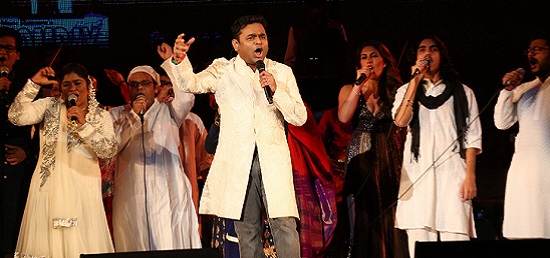
    United Nations — August 15, 2016: A.R. Rahman enthralled a packed audience at the iconic United Nations General Assembly Hall with his renditions of Indian Carnatic legend M. S. Subbulakshmi’s music, Sufi songs and the foot-tapping ‘Jai Ho’ at a concert to celebrate India’s 70th Independence Day on August 15th, 2016.

    The musical concert, organized by India’s Permanent Mission to the UN with the support of Sankara Nethralaya, an India-based not-for-profit organization, on India’s 70th Independence Day, was a tribute by Rahman to Subbulakshmi on the occasion of her birth centenary. Through the nearly three-hour long concert, Rahman and his troupe performed Subbulakshmi’s music and compositions.

    Oscar-winning composer Rahman (49), made history by becoming the only second Indian artist after Subbulakshmi, who had performed at the United Nations 50 years ago. The audience of ambassadors, diplomats and Indian-Americans welcomed Rahman with a thunderous applause and loud cheers as he stepped on stage, dressed in traditional Indian attire.

    The world body’s iconic General Assembly hall, from where world leaders address the globe, reverberated with Rahman’s enchanting music. Through his performance, Rahman paid homage to Subbulakshmi, the first musician ever to be awarded India’s highest civilian honor Bharat Ratna. The concert coincides with the completion of 50 years of Subbulakshmi’s performance in the UN General Assembly hall with the support of Chennai-based Sankara Nethralaya, a not-for-profit eye institution.

    The concert honoring Subbulakshmi at the UN aims to “perpetuate the memory of not only one of the greatest musicians India had ever produced but that of a greatest soul who lived a life of philanthropy and goodwill for all humanity”, Sankara Nethralaya’s Chairman Emeritus S S Badrinath said.

    Rahman, known to be a man of few words, said in the beginning of the concert that he had a long speech prepared but decided against delivering it, letting his music do the talking for him. In his homage to Subbulakshmi, Rahman said she had performed at the UN a year before he was born. “For us, she is a case study” of how a person with humble beginnings can conquer and rise above the caste and class system and become an “ultimate icon” for every aspiring singer.


    Her life was the inspiration behind Rahman’s Sunshine Orchestra, which was started about a few years ago and teaches eastern and western classical music to underprivileged children, he said. “Today these children have pushed their boundaries and are almost ready for the world,” he said. “It is one of my duties to come here and celebrate her,” he said, adding that he considers the music legend “God of my culture”.

    The concert was a way of celebrating M S Subbulakshmi’s performance at the UN General Assembly hall on 23 October 1966. The first ever musician to be awarded India’s highest civilian honor the Bharat Ratna, Subbulakshmi was invited by the then UN Secretary General late U Thant to perform at the General Assembly, becoming the first Indian to perform there. “It feels really, really good. I think 1966 was just one year before I was born. It’s been 50 years. So, (it was) coming back in a special way to celebrate one of my city’s icons, one of India’s icons- MS Subbulakshmiji,” Rahman was quoted to have said.

    A highlight of the concert was performances by students of Sunshine Orchestra, an initiative by the A.R. Rahman Foundation, that teaches music to underprivileged youngsters. “From today, you are privileged, you are not underprivileged anymore,” Rahman said as a word of encouragement to the students as they geared to perform on the UN stage.

    Rahman’s two sisters also performed on stage along with noted singers Javed Ali and renowned percussionist Sivamani. Rahman, sitting amid his musical instruments on one side of the UN stage, rendered one soulful number after another as his troupe gave mesmerising performances of Subbulakshmi’s Carnatic music. “Music has given me everything, this is a small thing in return,” Rahman said about the special backup.

    To loud cheers and applause, Rahman also performed some of his most popular songs including from movies such as ’Dil Se’ and ‘Bombay’ as well as a rendition of ‘Vande Mataram’ Towards the end of the concert, Rahman and his group performed Sufi songs, including ‘Khwaja Mere Khwaja’, ‘Kun Faya Kun’ and ‘Maula, Maula.’

    The grand finale was the foot-tapping song ‘Jai Ho’ from the movie Slumdog Millionaire, for which Rahman had won Oscars and several prestigious global awards. As Rahman and his troupe began the song, several people in the audience broke into a dance.

    A Photo Exhibition about M S Subbulakshmi’s life and times is also being held from August 15-19, 2016 at the United Nations. It depicts various facets and moment’s and provides a rare insight to the music legend’s achievements. United Nations Postal Administration issued a stamp to mark the birth centenary of Dr. M.S. Subbulakshmi.

    India’s Minister of State for External Affairs M J Akbar addressed the audience, and said, “Music is at the soul of the nation, that is India.” Akbar lauded the significance of music in India’s freedom struggle as well as its role as a unifying power. “Our journey towards freedom is represented by two songs — ‘Vande Mataram and Jann Gann Mann’,” Akbar said. He said that while other countries first formed a nation and then created an anthem, India “created anthems first and then formed a nation”. “Music is the most powerful expression of the soul of India because it inspires that spark of divinity that lives in every human soul,” he said, describing musicians as “ambassadors of God. Every morning in India begins with music. Every morning in every corner in India begins with the music of the Azaan, followed by the music of the Hanuman temple, followed by the music of the Gurudwara and then by the music of Church bells,” he said amid a huge round of applause, adding that one should “thank destiny for making us Indians”.

    India’s Permanent Representative to the UN Ambassador Syed Akbaruddin noted that the UN is observing its 70th anniversary as India’s celebrates its 70th independence day.

    “We hope this event will reinforce the belief that diverse cultural traditions reflecting each others values remain relevant to global thinking and the UN,” he said. Subbulakshmi is among the best musicians India has given to the world, Akbaruddin said.  “Remembering a legend. Photo exhibition @UN in memory of MS Subbulakshmi August 15-19,” he said in a tweet.

    The UN takes inspiration from various contributions made by India to the world, including the legacy of Mahatma Gandhi’s non-violent teachings and the harmony of Yoga, the world body’s Secretary-General Ban Ki-moon said. The video message was played during the concert at the UN on Monday.

    In his message to India on its 70th Independence Day, Ban said the occasion also celebrates India’s partnership with the UN. India is a founding member of the UN, Ban said and expressed his gratitude to the country for its significant contributions to the world body’s peacekeeping operations. “We are also celebrating India’s strong partnership with the UN,” he said in his message, which he began with a ‘Namaste’.

    Closing the concert, Rahman made an appeal for peace saying killing one another will not solve the world’s problems. “…We still kill each other. In my lifetime I want to see a world where people do not fight and kill each other but find better methods to solving conflicts. Let us hope in our lifetime we see this change.”

  • In a never-before sharp rebuttal at UN, India says Pakistan “extols virtues of terrorists”

    In a never-before sharp rebuttal at UN, India says Pakistan “extols virtues of terrorists”

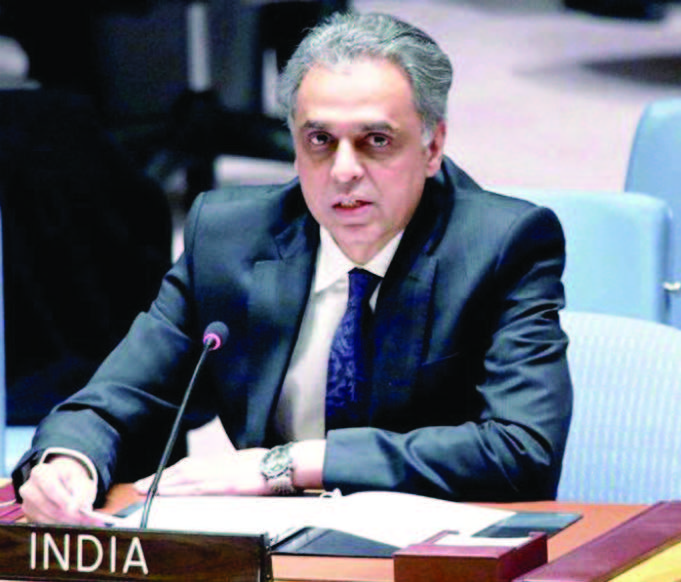
    UNITED NATIONS (TIP): India’s Ambassador to the UN Syed Akbaruddin responded sharply to the remarks made by Pakistan’s envoy Maleeha Lodhi on Kashmir and Wani’s killing during a debate on human rights in the 193-member UN General Assembly here on Wednesday, July 13.

    Strongly hitting back at Pakistan for raising in the United Nations the issue Indian Ambassador has said Pakistan “extols” the “virtues” of terrorists and uses terrorism as a state policy towards the “misguided end” of coveting the territory of others.

    Earlier, in her statement, Pakistan’s envoy Ms. Lodhi, besides raising the Kashmir issue, also mentioned the “extra-judicial” killing of Wani, whom she described as a “Kashmiri leader”, by Indian forces.

    Ms. Lodhi, who has regularly raised the issue of Kashmir at various U.N. fora, termed Wani’s killing as the “most chilling recent example” of “human rights violations” by Indian forces in Kashmir.

    Alleging that the denial of self-determination to Kashmiri people had led to arbitrary detentions, summary executions and other “atrocious” violations, she said, “Its most chilling recent example is the extra-judicial killing last week of a Kashmiri leader, Burhan Wani, shot to death by Indian forces along with dozens of other innocent Kashmiris.”

    In his statement, which sources here termed as perhaps the hardest-hitting against Pakistan in recent times, Mr. Akbaruddin said it is regrettable that Pakistan attempted to “misuse” the U.N. platform.

    “Regrettably, earlier today we have seen an attempt at misuse of this U.N. platform. The attempt came from Pakistan; a country that covets the territory of others; a country that uses terrorism as state policy towards that misguided end; a country that extols the virtues of terrorists and that provides sanctuary to U.N.-designated terrorists; and a country that masquerades its efforts as support for human rights and self-determination,” he said.

    “The international community has long seen through such designs. Cynical attempts, like the one this morning therefore, find no resonance in this forum or elsewhere in the United Nations,” he noted.

    Ambassador Akbaruddin asserted that Pakistan’s “track record” failed to convince the international community that it should gain membership of the Human Rights Council in this very session of the UNGA.

    “We remain strongly committed to the promotion and protection of all human rights for all through pursuit of dialogue and cooperation,” he added.

    Over 30 people have been killed and more than 250 injured in clashes between protesters and security personnel after Wani’s killing last week.

    The U.N. has expressed concern over the tensed situation in Kashmir, with U.N. Secretary General Ban Ki-moon calling on all parties to exercise “maximum restraint to avoid further violence and hopes that all concerns would be addressed through peaceful means.”

  • Indian Gets UN Honour For Corporate Sustainability Initiative

    Indian Gets UN Honour For Corporate Sustainability Initiative

    UNITED NATIONS:  An Indian social entrepreneur has been named among 10 “champions and pioneers” by UN Chief Ban Ki-moon under the world’s largest corporate sustainability initiative that calls on companies to align with universal principles of human rights, environment and anti-corruption.

    Zubaida Bai, the founder of ‘ayzh’, a for-profit social venture providing health and livelihood solutions to impoverished women worldwide, was named among the 10 ‘2016 Global Compact SDG Pioneers’, an initiative launched by UN to search for “entrepreneurs” who can play a pivotal role.

    The UN Global Compact, the world’s largest corporate sustainability initiative, supports companies to do business responsibly by aligning their strategies and operations with ten principles of human rights, labour, environment and anti-corruption; and to take strategic actions to advance broader societal goals, such as the UN Sustainable Development Goals (SDGs), with an emphasis on collaboration and innovation.

    Mr Ban announced the 10 pioneers at the Global Compact Leaders Summit in the city this week.

    Congratulating the honorees, Mr Ban said that he counts on their “strong commitment and engagement” to help businesses seize the opportunities of the SDG era.

    “All of you are leaders in the campaign for a world without poverty, a thriving planet, a vibrant and inclusive global economy and a life of dignity for all.”

    “This is the vision of the Sustainable Development Goals, agreed upon by the Member States of the UN in September last year,” he said at the summit.

    The Leaders Summit aims to jump-start business action everywhere on the SDGs.

    To that end, the Global Compact unveiled a multi-year strategy to drive business awareness and activity that supports the achievement of the goals by 2030.

    Noting that trillions of dollars will be invested in infrastructure in the coming years, he said that the Paris Agreement and the SDGs give the private sector an unprecedented opportunity to create clean-energy, climate- resilient, sustainable economies.

    “We are at a decisive moment in the shift to sustainable and inclusive markets,” continued the Secretary-General, noting that the first step in this regard would be to mobilise the global business community as never before.

    “All businesses, everywhere, can and should play a role in improving our world. That starts with integrity – doing business right,” he said.

  • COLOMBIA, FARC REBELS SIGN HISTORIC CEASEFIRE

    COLOMBIA, FARC REBELS SIGN HISTORIC CEASEFIRE

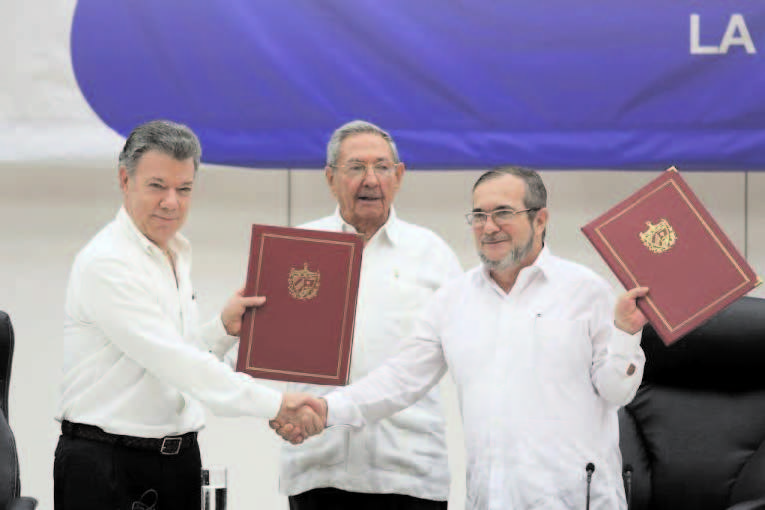
    HAVANA/BOGOTO (TIP):The Colombian government and FARC rebels signed a ceasefire and disarmament agreement on June 23, one of the last steps toward ending a half-century conflict that has killed hundreds of thousands of people.

    The deal puts a definitive end to fighting in Latin America’s longest civil war, which has torn the country apart with shootings and bombardments in its coca-rich jungles and hills.

    President Juan Manuel Santos and FARC leader Timoleon Jimenez shook hands and smiled after negotiators signed the deal at a ceremony in Cuba.

    The deal establishes “a bilateral ceasefire and end to hostilities and the definitive laying down of arms,” according to the text.

    “This is a historic day for our country,” Santos said in a speech to assembled leaders including UN Secretary General Ban Ki-moon.

    “After more than 50 years of confrontations, deaths, attacks and pain, we have put a final end to the armed conflict with the FARC.”

    Disarmament will begin after the signing of a full final peace agreement, expected within weeks.

    “Let this be the last day of the war,” Jimenez said.Thursday’s agreements “leave us on the verge of completing a final accord relatively soon,” he added.

    The final deal “will allow us to return at last to legal political activity through peaceful and democratic means.”

    In the Colombian capital of Bogota, crowds gathered to watch the announcement on a big screen.

    One man, Camilo Gonzalez, was moved to tears.

    “It has been a tragic journey. Millions of victims, people displaced, fighting, broken dreams,” he said.

    “But I think now we have reached a moment of hope.”

    Under the agreement, the Revolutionary Armed Forces of Colombia (FARC) must hand over its weapons to United Nations monitors within six months.

    The FARC’s members — an estimated 7,000 or so — will gather in “normalization zones” for a demobilization process.The sides also agreed to government action against “criminal organizations” blamed for fueling the conflict.

    The United States congratulated Colombia. “We will stand ready to help the Colombian people as they work toward a just and lasting peace,” said US National Security Advisor Susan Rice.

    The European Union’s foreign representative Federica Mogherini in a statement called it a “a turning point in the Colombian peace process.”

    “Now all efforts must be devoted to reaching a final comprehensive agreement that will pave the way to durable peace in the country” and justice for victims, she said.

    The Colombian conflict started in the 1960s as a rural uprising for land rights that spawned the communist FARC.

    The conflict has drawn in various leftist rebel groups, right-wing paramilitaries and drug gangs over the decades.

    It has left 260,000 people dead, 45,000 missing and nearly seven million displaced, according to official figures.

    Human rights groups say atrocities have been committed on all sides. Many families are still searching for missing loved ones.

    Thursday’s deal resolves one of the final points in peace talks between the government and the FARC, the country’s largest rebel group.

    However, the means of implementing the final peace deal remain to be settled after three-and-a-half years of negotiations.The two sides said they would wait for the courts to rule on whether a referendum can be held to endorse the accord, and would accept the court’s decision.

    Although peace with the FARC would virtually end the conflict, other armed groups are still operating in Colombia.

    A bid to hold peace talks between the government and the second-biggest rebel group, the leftist National Liberation Army (ELN), has stumbled because of its alleged kidnappings.

    “The activity of the ELN above all and the criminal gangs means that we cannot yet talk of a complete end to the armed conflict,” said Kyle Johnson, Colombia analyst for the International Crisis Group.

    (AFP)

  • International Day of Yoga celebrated at the UN

    International Day of Yoga celebrated at the UN

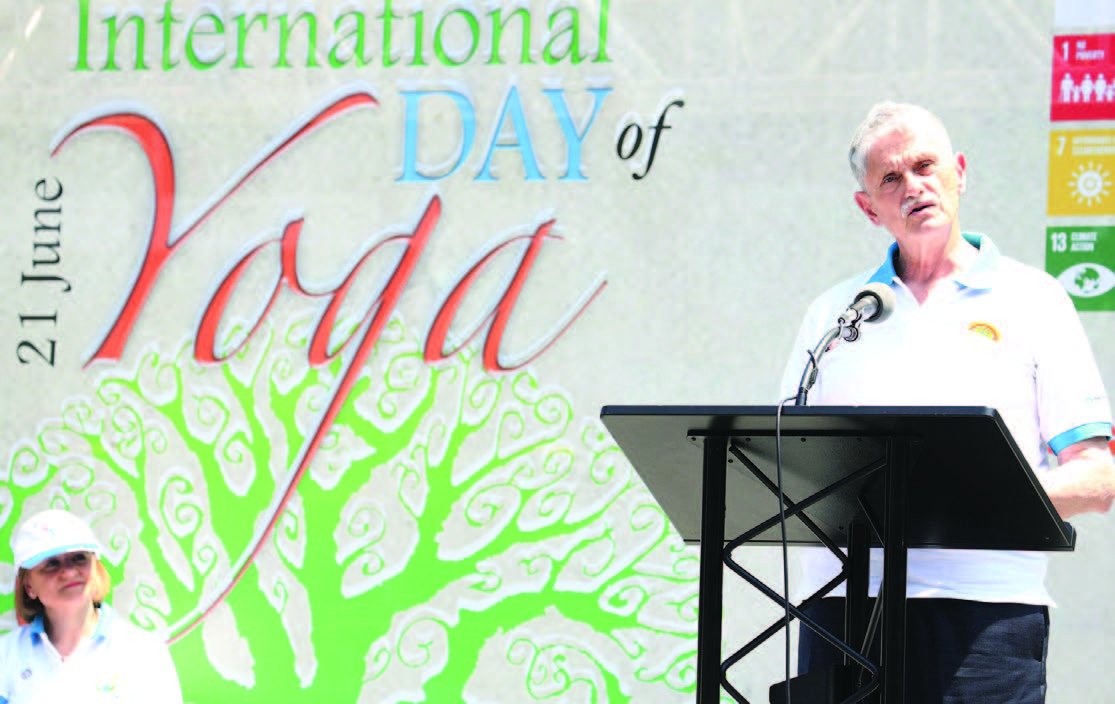
    UNITED NATIONS (TIP): The Second International Day of Yoga was celebrated at the United Nations June 21, 2016. Speaking on the occasion, India’s Permanent Representative to the United Nations, Ambassador Syed Akbaruddin said the celebration of IDY at the UN “has a special resonance” since it was here that the summer solstice was chosen for the IDY. He felt pleased to state that a record number of nationalities-135- were represented at the Yoga Day celebrations. He extended a hearty welcome to all.

    United Nations Secretary General Ban ki-Moon in his message said, “This year’s observance of the International Day of Yoga highlights the important role healthy living plays in the realization of the Sustainable Development Goals, adopted last year by all 193 United Nations Member States.”

    Sadhguru teaching Yoga at the International Yoga Day celebrated on 21st June 2016 | Photos / Mohammed Jaffer-SnapsIndia
    Sadhguru teaching Yoga at the International Yoga Day celebrated on 21st June 2016 | Photos / Mohammed Jaffer-SnapsIndia

    In his Video message PM Narendra Modi described Yoga as “invaluable gift of ancient India”.

    The External Affairs Minister Sushma Swaraj said, “We all are participants in this great celebration of health and spirituality”.

    Mogens Lykketoft, President of the 70th session of the United Nations General Assembly described Yoga as a union of mental, physical and spiritual faculties.

    Ms. Cristina Gallach, UN Under-Secretary-General for Communications and Public Information and the Yoga Guru Sadhguru also spoke on the occasion. Sadhguru gave lessons in Yoga.

    A large number of diplomats participated. India's PR to the UN, Ambassador Syed Akbaruddin is seen here doing Yoga with fellow diplomats
    A large number of diplomats participated. India’s PR to the UN, Ambassador Syed Akbaruddin is seen here doing Yoga with fellow diplomats
  • Feminine Divinity, Symbolism of Shakti and Women’s Empowerment in Contemporary India

    Feminine Divinity, Symbolism of Shakti and Women’s Empowerment in Contemporary India

    Since 1947, India has been somewhat isolated globally because it stands alone and is not part of any of the usual groups or clubs. India is not a white or western country, it is not an Islamic country, it is not an Arabic country, it is not a communist country and it is certainly not a military dictatorship. It was part of non-aligned movement which did not have any natural commonality in its members. India still remains isolated because it stands alone on many international fora owing to India’s unique ancient history. India was described as a “functioning anarchy” by a former US ambassador to India John Kenneth Galbraith. Break-up or disintegration of India has been ritually predicted and invoked by so many western analysts and thinkers. Numerous international conspiracies have been hatched since 1947 to materialize support for further partition of India. Some have even refused to accept the nation-hood or statehood of India in a geo-political sense. Others have erroneously credited the British colonial empire for bestowing the sense of nationhood on India as a unique colonial contribution.

    As India changes its direction and gathers some self-confidence, there has been resurgence of talk in the mainstream media and academia for the last two years about the threats facing the so-called “Idea of India”. The terms like “Idea of India” and “Intolerance” have been utilized as code-words or proxy to pillory Hindu traditions and Indian Renaissance. There seems to be an obvious nexus between Indian mainstream media and the western mainstream media in an exercise in bashing India, Indian tradition and Indian growth trajectory. Isolated incidents have been magnified. Indeed, the naysayers and the “Nattering Nabobs of Negativism” have predicted impending doom for India. Heinous crimes against women, though very unfortunate, have been given so much prominence in the media as if they were normative occurrence in India without taking into consideration the positive aspects of Indian society and Indian traditions. The movie “India’s Daughter” by Leslee Udwin was a prime example of this India bashing exercise. The western protagonists and their Indian acolytes, owing to an inherent Hindu-phobic and anti-India bias, have failed to take into consideration the frequency of such crimes in US or UK or elsewhere in the world presenting a very sensational and distorted picture of India. Powerful international and local forces are at work to portray our Hindu tradition as sexist, anti-women, misogynist and anti-feminist. India’s leftists, liberals, card-carrying communists, caste-ists, Islamists and feminists have built up a de facto “alliance of convenience” and a political “coalition of the willing” in conjunction with the western NGOs that funnel monies to these local groups. There is a method to this madness. Alliance of Indian feminists, nay, Femi-nazis with their western sponsors poses a real national security threat to the fabric of the Indian nation. Women are the real fabric of the nation. A nation can be defeated only if its women are subjugated by fraud, deception or brute force. While pillorying Indian (read Hindu) society as patriarchal, misogynist and anti-women, these groups fail to appreciate the plurality and the extreme diversity of Indian traditions with still prevalent matriarchal subcultures in the contemporary Indian society, e.g.; the Nairs in Kerala, some sections in Kinnaur, Himachal Pradesh and the Khasis in Meghalaya. People in Kinnaur, HP follow a matriarchal system; they also practice polyandry following the historical example of the Pandavas from Mahabharata times.

    Ancient India and Concept of Devi, the Divine Femininity:

    In this article we will recapitulate the venerable place, honor and respect given to women in the ancient Hindu tradition. We will also review the historical vicissitudes of the status of women in ancient, medieval, colonial eras and in modern India. We also delineate and emphasize those foreign factors that adversely influenced the status of women in the Indian society and subjugated them in the colonial era that lasted approximately one thousand years. We also discuss the very uniquely Hindu concepts of Devi (female divinity), Shakti and the veneration of Shakti as the ultimate mother and its symbolic use in women’s empowerment in the contemporary Indian society. Female divinity is unique to Hinduism. The word Devi in Sanskrit means the illuminated or the illustrious one. Like the holy trinity of Brahma, Vishnu and Mahesh or Shiva, there is divine female trinity of Saraswati, Lakshmi and Uma, all three equally holy, divine and worthy of worship in their own right. Woman always comes first in various Hindu traditions, be they Vaishnava, Shaiva, Tantra, Vama-marga, Vedanta etc. That is why we have expressions like Sita-Ram, Radhey-Shyam and Gauri-Shankar. It is never Ram-Sita, Shyam-Radha, Narayan-Laxami or Shankar-Gauri. Shakti comes first, and Shiva comes afterwards. Hindu Males always follow, venerate and vow to protect the females, as the divine mother who gives birth, as loving daughter to be given away as kanyadanam during marriage (the ultimate danam a Hindu male can do for the perpetuation of human race), as sister to be protected or as wives to be cherished as ardhangini. The concept of mother-goddess is so deeply enshrined in Hinduism that per Bhagwat Purana there are seven mothers: the one who gives birth (biological mother), wife of your teacher (gurupatni), wife of priest (brahmani), queen (rajpatni), cow (dhenu or gaumata), one who raises you (foster-mother or dhatri) and earth (Prithavi). There is a saying: mata prithavi, putroham prithivyam!

    All Hindu rituals are conducted primarily by women, men have to sit quietly and follow the women. Woman is the leader; man is the follower and the participant. A Hindu man is incomplete without his wife during religious rituals and yajanas just as even Rama was incomplete without Sita during the ashwamedha yajana!  He had to have a statue of Sita sit by his left side while performing the yajana. During the festival of Navaratras, the Devi, the feminine divinity, the Goddess is worshipped in her nine different forms! These nine different forms are Durga, the invincible mother, Bhadrakali, the mother of fortune and wealth, Amba, the universal mother, Annapoorna that feeds the world by providing Anna, Sarvamangala that brings peace and joy to the world, Bhairavi, the divine mother that brings good to good people & evil to bad people, Chandika, the fierce one, Saraswati, the goddess of learning & beauty, Bhavani, the Goddess of mercy, and Mookambika, the Goddess of Shiva and Shakti. The symbolism that woman comes first and the man just follows her becomes apparent when one watches the contemporary Hindi TV serials be it Kum Kum Bhagya, Pavitra Rishta, Suhasini or Woh Rahane Waali Mahlon ki! The female lead character always epitomizes the Hindu woman as Shakti, as a warrior princess or Durga who fights for her rights, defeats the evil and always protects the good but in that arduous, long-drawn journey, she also sacrifices her personal needs while nurturing others in her family!

    Let us make no mistake. There are enormous cross-cultural differences in the gender roles and gender behaviors in Indian society versus western societies. However, in Hindu context the women have traditionally exercised tremendous political power through their fertility, i.e. progeny unlike the West where women exercise their power and autonomy using their sexuality and art of seduction. Indian society has historically emphasized dignity and honor of women instead of a pseudo-equality and gender role substitutability. The concept of the divine mother as the originator of the srishti is so unique to Hinduism only. Invoking divine qualities in the mother Goddess gives a unique and special status to Hindu women who have attained motherhood and in no way diminishes them for exercising their fertility unlike so in Western societies. In fact, the suffix or the title Sreemati in Sanskrit literally means the lady who possesses wealth and prosperity!

    A famous quote from Manu Smriti, that has been demonized by the leftist cabal as anti-women, states:

    यत्र नार्यस्तु पूज्यन्ते रमन्ते तत्र देवता: ।

    यत्रैतास्तु न पूज्यन्ते सर्वास्तत्राफला: क्रिया: ।।

    Yatra Naryastu Pujyante Ramante Tatra Devata


    Yatraitaastu Na Pujyante Sarvaastatrafalaah Kriyaah

    Meaning: “Where Women Are Honored, Divinity Blossoms There; And Where They Are Dishonored, All Action Remains Unfruitful.”

    That is the essence of and epitome of the exalted status given to women in ancient Indian culture and Hindu tradition.

    Concept of Shakti in Hindu Tradition:

    Shaktism is the worship of the Supreme being as the Divine mother in the form of Shakti or Devi. Etymologically, the word Shakti in Sanskrit is derived from the “shak” dhatu or root which literally means “CAN DO”! Shakti literally means one who “CAN DO”! Shakti is the eternal supreme power. Shaktiman is the one who has Shakti, who is endowed with Shakti, i.e. energy! Shakti is the one who can accomplish victory over evil by the virtue of her creative energy force. In Hindu traditions, woman is the vessel of Shakti. The identification with Shakti stipulates woman as a fountainhead of both creative and destructive power. Each Hindu God has his Shakti, Brahma has Saraswati, Vishnu has Lakshmi and Shiva has Gauri or Parvati. Each is incomplete without his Shakti. Unlike Hinduism, in Christianity the myth has been created that Jesus was celibate and his historically acknowledged wife Mary Magdalene was a fallen woman. A prostitute who had merely become his disciple! In Islam, the woman has just one-fourth the value of a man in testamentary capacity! Shakti, the supreme energy force, is the personification of God in all the Indic traditions including Hinduism, Sikhism, Jainism and Buddhism. The Tibetan New Year Losar is essentially a celebration of Shakti. Even the 10th Sikh Guru, Govind Singh worshipped goddess Durga and named his fighting sword Chandi as a symbolism of Shakti.

    There are four Adi Shaktipeethas in Shakti tradition. Fifty-one Shaktipeethas are located all over the entire Indian subcontinent. In ancient Indian history and literature (carried through oral traditions), there are honorable mentions of women as Shakti, a divine feminine energy force or Urja. Examples are Mahishasur Mardini or Kali, Chandi, Durga a warrior goddess. There are other examples of women warriors in ancient Indian history. Kekayi, the youngest wife of King Dashratha obtained those infamous three boons from him by saving his life in the battlefield. Naturally, the question arises as to what Kekayi was doing in the battlefield except for combat!

    In tantric tradition, the woman is considered of higher status than the man. Tantra stipulates that mortal women are “life-itself” and Goddess-like because they embody the principle of Shakti. The institution of Bhairavi in Tantra and Vamamarga tradition does not suggest exploitation or anti-women attitude of Indian society. Bhairavi in Tantra tradition epitomizes the powerful feminine achievement by embarking a journey of supreme spirituality, sublime sensuality and symbiotic sexuality with her Bhairava who just follows her and is by her side, every step of the way, in her raising the kundalini energy! And yes, Bhairavi is not ashamed of her symbiotic sexuality because it is the ultimate life-force and she is the protagonist, she is the leader (and not the cheer-leader), she is initiator! Bhairavi, in that particular tradition, is neither repressed nor oppressed nor exploited!

  • Humanicy in collaboration with United Nations Organizes a Charity Football Match

    Humanicy in collaboration with United Nations Organizes a Charity Football Match

    NEW YORK (TIP): “Humanicy”, with United Nations in association with All Stars FootballClub (ASFC) team, Skill India and Sports Authority of India are initiating a Football match between “MEMBERS OF PARLIAMENT vs ALL STARS FOOTBALL CLUB” on Saturday, 11th June, 2016 at Jawaharlal Nehru Stadium, New Delhi. The 50% of the proceeds received from sale of Tickets would be donated to “Skill India” and or “Swatchh Bharat Abhiyan” and promoting Football in India.

    Shri Rajiv Pratap Rudy, Minister of State- Skill Development & Entrepreneurship (Independent Charge) & Parliamentary Affairs and Secretary (Administration) -Constitution Club of India and Shri Prasoon Banerjee, MP- Howrah, Arjun Awardee – Football have endorsed this programme have decided to Mentor this Football Match. Humanicy is also inviting Prime Minister Shri Narendra Modi and Mr Ban Ki-Moon, Secretary-General of the United Nations to attend and grace this occasion.

    Speaking to Journalists, Producer and DirectorBunty Walia, the Team’s Chief Co-ordinator stated that “Abhishek Bacchan, Ranbeer Kapoor and various Film Stars of ASFC team are participating in this event. Supporting a good cause has always been the main motto of ASFC”.

    Dr Raj Bhayani, CMD of Pranira International Private Limited and Shri Bhasker Prakash, Managing Director of Adhunik Art Gallery Private Limited who are members of Managing Committee for supporting PM’s various Abhiyans emphasized that, “It’s a non-political programme where Members of Parliament from all parties are participating and all are eager to work for Prime Minister’s various initiatives on Swatch Bharat and Skill India Abhiyans”. Dr Raj Bhayani and Shri Bhasker Prakash have been instrumental in bringing everyone together to implement the plan.

    Adv Arvind Rajpoot, this Events chief co-ordinator between all MP’s and Film Stars stated that “it was a humungous task to co-ordinate between film stars and MP’s. But finally we made it. We are also trying to rope in Sachin Tendulkar in his role as an MP to match Filmstars”. HUMANICY Trustee, Mr Suneet Singh, is co-ordinating between Government and UN Humanicy confirmed that “Danial Craig’ is coming to see this match”.

    The MP’s side team are also equally loaded with Stars. Actor MP Manoj Tiwari has confirmed to play from MP’s side and so has MP Babul Supriyo. The match will be a star-studded and politician studded night which shall be followed by Gala Dinner of all Who’s Who on 11th June, 2016 at a leading 5 star hotel.

    A formal press conference shall be held soon towards last week of May, 2016 and Ticket bookings shall start on 1st June, 2016

  • Indian Spiritual Master Sant Rajinder Singh says at the UN: “Meditation is Medication for the Soul”

    Indian Spiritual Master Sant Rajinder Singh says at the UN: “Meditation is Medication for the Soul”

    NEW YORK(TIP): Renowned spiritual Master Sant Rajinder Singh Ji Maharaj, head of Science of Spirituality,is no stranger to the United Nations. He was a featured speaker at the Millennium World Summit in 2000, when he delivered his message of inner and outer peace through spirituality to an international audience of religious and spiritual leaders. On Monday, May 2, he gave his second address at the widely respected institution, sponsored by theUNSRC SaluS Well Being Network Club in collaboration with Science of Spirituality. Appropriate to the occasion, his topic was, “Meditation as Medication for the Soul,” based on his book by the same name.

    The Reverend Susana Bastarrica, president, UNSRC SaluS Well Being Network, and Mr. Vijay Nambiar, Special Advisor on Myanmar to Secretary-General Ban Ki-moon introduced the spiritual Master.

    For the next hour, the spiritual Master spoke to an attentive audience about the benefits of meditation, emphasizing that relaxation, stress relief, better concentration, and improved relationships are byproducts of meditation, not its sole purpose. The prime purpose of stilling the body and stilling the mind in meditation is to experience God within ourselves.

    He also said that in meeting with world leaders, he found they are seeking peaceful solutions to conflict.They are realizing that becoming more peaceful themselves through an interest in meditation, they are able to make better judgements in challenging situations.

    Sant Rajinder Singh Ji Maharaj’s life and work can be summed up as a continuous journey of love and service. His peace paradigm, transforming lives through meditation, is an achievable construct that will heal the world one soul at a time. As head of Science of Spirituality, he is internationally recognized for his work toward promoting human unity. Among his many awards and tributes are five honorary doctorates for his tireless efforts in this field. His is a message of hope and promise, a light dispelling darkness in troubled times.

    Renee Mehrra, Chief Administrative Officer for Science of Spirituality, NGO with ECOSOC, United Nations made the concluding remarks and reinforced Sant Rajinder Singhji’s profound, simple yet timeless message of inner peace, human unity at the level of the soul and compassion for all beings in the age of conflict and negativity.

    For more information about Sant Rajinder Singh Ji Maharaj and his schedule please visit www.sos.org.

  • UN Chief Ban Ki-Moon offers his ‘good offices’ to resolve India-Pakistan Issues

    UN Chief Ban Ki-Moon offers his ‘good offices’ to resolve India-Pakistan Issues

    UNITED NATIONS (TIP): With Pakistan announcing that the bilateral peace process with India has been “suspended”, UN Secretary General Ban Ki-moon has said that the offer of his “good offices” to help resolve the conflict stands but it is up to both nations to seek it.

    “Whenever there is a conflict, an issue, between Member States, the Secretary-General’s offer for good offices stands as a matter of principle. But, that has to be agreed on and asked for by both parties,” Ban’s spokesman Stephane Dujarric told reporters here.

    Dujarric was responding to a question at his daily briefing yesterday about whether the Secretary-General would like to offer his good offices given that the peace talks between India and Pakistan were “interrupted” again.

    Introducing a fresh chill in Indo-Pak ties, Pakistan High Commissioner to India, Abdul Basit on April 7 said the bilateral peace process stands “suspended”.

    He also poured cold water on India’s expectations that a team of NIA investigators would be allowed to visit Pakistan in connection with the Pathankot terror strike probe on the basis of reciprocity, a Pakistani Joint Investigation Team (JIT) having just concluded a visit to India.

    India, however, countered the Pakistan High Commissioner’s assertion that the visit by Pakistani JIT was not on reciprocity and said that before the team’s visit, both sides had agreed that it would be on the basis of reciprocity.

  • Seven dead in south Sudan UN base attack: Ban

    Seven dead in south Sudan UN base attack: Ban

    UNITED STATES (TIP): An outbreak of fighting at a UN peacekeeping base sheltering civilians in South Sudan has killed at least seven people and injured 40, UN Secretary-General Ban Ki-moon said on Thursday.

    The seven displaced persons were living in the base in the northeast town of Malakal where violence between the ethnic Dinka and Shilluk communities broke out overnight and continued into the day, he said.

    Ban condemned the fighting and expressed concerns about the rise of ethnic violence in the more than two-year conflict. He warned “all parties against stoking ethnic disputes and calls on them to refrain from any actions or statements that could further escalate the situation,” according to a statement from his spokesman.

    The UN chief reminded all sides that attacks on UN peacekeeping bases can constitute a war crime and urged them to implement a peace deal signed in August

    Fighting has continued in South Sudan despite the peace accord. Thousands have died and more than 2.3 million have been driven from their homes.

    Nearly 200,000 civilians have sought shelter in the UN mission’s eight compounds in South Sudan since the conflict began.

  • India’s All-Female Peacekeeping Unit, a Inspiration For All | Ban Ki-Moon

    India’s All-Female Peacekeeping Unit, a Inspiration For All | Ban Ki-Moon

    UNITED NATIONS:  Hailing India’s women peacekeeping unit in Liberia as an inspiration for all, UN chief Ban Ki-moon said that their conduct has served as an example of how women can help the world body in its efforts to combat sexual exploitation and abuse.

    “Through their unwavering performance, professionalism and discipline, including during the Ebola epidemic, these brave women gained the respect of both the Government and the Liberian people,” the Secretary General’s spokesman said in a statement yesterday as the first-ever all-female police unit ended its operations after nine years.

    The 125 women and supporting personnel will return to India this weekend.

    According to the statement, Ban commended the Formed Police Unit (FPU) for their contributions in creating an environment for Liberia to assume fully its security responsibilities by June 30, 2016, as mandated by the Security Council.

    Through their work, they managed criminality, deterred sexual and gender-based violence and helped rebuild safety and confidence among the population, Ban said.

    Ban underscored that the conduct of the FPU served as an example of how the deployment of more female uniformed personnel can help the United Nations in its efforts to combat sexual exploitation and abuse.

    The Secretary-General thanked all the women who served in the FPU for inspiring all Liberians, as well as current and future generations of female police officers, and becoming role models for gender equality.

    He also payed tribute to the outstanding contribution of the Indian government in support of the United Nations peace operations.