Tag: BJP

  • GST matters but so does fiscal federalism

    GST matters but so does fiscal federalism

    As expected, the latest Goods and Services Tax (GST) Council meet, headed by the Union Finance Minister Arun Jaitley and with state finance ministers as members, could not arrive at any policy decision as far as the dual control of assessees is concerned. Consequently, the switchover to a single GST, subsuming almost all other commodity taxes will miss the stipulated date of its implementation, April 1, 2017.

    The Union Finance Minister has now set September 16 as the new deadline. For the first time, a tax would be placed in the Concurrent list, which our Constitution makers meticulously avoided so as to ensure smooth Centre-state financial relations. One should go slow in view of the turmoil created by the demonetization drive. Jaitley’s contention that GST must be implemented before September 16 is not convincing. With the consent of states, the implementation could be postponed. The adoption of VAT took nearly 30 years, though it did not have any implications for our federal set-up. It simply replaced state sales tax by state VAT and central excise duty by Cenvat.

    The chaos created by the demonetization drive has shaken the confidence of some states. After GST, they consider it the second blow to states’ autonomy, even though demonetization and the GST regime are aimed at ensuring transparent transactions. GST will neutralize the ill-effects of demonetization   like fall in demand, market shrinkage and unemployment by extending market frontiers.

    As GST ensures that tax credit is given to producers/ sellers for the taxes already paid, specialization and efficiency in production will be promoted. Producers and traders will get tax credit even on inter- state movement of goods and services. India will emerge as one common national market, with a seamless flow of goods and services across the country. There will be no tax on tax, so production and distribution of goods would become less costly, thereby boosting consumption and investment. Producers will be induced to invest in logistics and building warehouses and inventories, giving a fillip to ease of doing business. Implementing GST should not be viewed as a matter of prestige by the states or the Centre and both should adopt a pragmatic approach.

    The most significant impact of GST will be on extending the volume of trade. A National Council of Applied Economic Research (NCAER) study has evaluated the possible impact of GST on India’s international trade. It has been observed that, “The differential multiple tax regimes across sectors of production are leading to distortions in the allocation of resources as well as production inefficiencies. Complete offsets of taxes are not being provided to exports, thus affecting their competitiveness”. The study has estimated that “implementation of a comprehensive GST across goods and services will enhance the nation’s Gross Domestic Product (GDP) by between 0.9 and 1.7 per cent”. Boosting trade, both internal and external, with forward and backward linkages may lift the GDP by 1-2 per cent. Of course, the organized sector may gain at the cost of the unorganized sector, yet the conversion of the informal sector into the formal is the prerequisite for reducing poverty and inequalities. Demonetization too has induced the informal sector to convert into the formal sector.

  • Another session lost: A timely rebuke from a marg darshak

    Another session lost: A timely rebuke from a marg darshak

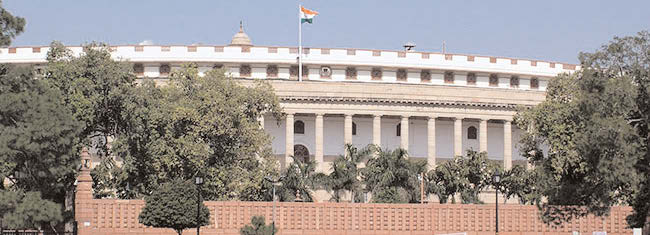
    The continued disruptions of the Lok Sabha provoked a strong reaction from a sidelined BJP veteran, LK Advani.

    The latter has blamed both Speaker Sumitra Mahajan and his one-time protégé, Parliamentary Affairs Minister Ananth Kumar, for the logjam. The superannuated leader, who gave voice to public disgust at the systemic paralysis, found an opportunity to get even with the BJP leadership which thought it had justifiably consigned him to political oblivion. The Advani rap has re-emphasized the established democratic norm that it is the ruling party’s responsibility to smoothly run Parliament. Prime Minister Modi’s call to the party MPs to “expose” the Opposition got lost in the political excitement that Advani’s sudden outburst generated.

    Opposition parties, too, need to have second thoughts if they think they are entitled to public gratitude for repeatedly highlighting hardships over demonetization. Noise is not a substitute for debate. Nor is disruption appreciated by the people who pay for it. Getting the day’s allowances without work should weigh on their conscience. It needs a level-headed legislator to articulate what agitates him. Who benefits from thoughtless sloganeering and kicking up of ruckus? A divided Opposition has weakened its case. AAP and TMC insist on a repeal of the demonetization notification. Most parties support the move against black money but agitate over its flawed implementation without offering alternatives or ways to plug loopholes. There was a lot opposition parties could do to pin down the government but by running away from debate they have perhaps ended up playing to the government-scripted tune.

    With just three effective sittings left for the winter session the government has got away lightly. A Bill to tax black or undeclared money was cleared by voice vote within minutes of being taken up as a money Bill in the Lok Sabha without a discussion. If GST is delayed, the blame would be passed on to the recalcitrant Opposition. Both sides have managed to skip a debate or action on the related issue of political funding. Chief Election Commissioner Nasim Zaidi has demanded that bribing voters and paid news should be made cognizable offences. For the Opposition and the government these do not seem to be priority issues.


  • Misery in rural India: The government should listen to its own bureaucrats

    Misery in rural India: The government should listen to its own bureaucrats

    If the government thought media was exaggerating the prevailing “cash chaos” and focusing excessively on urban India, its own officers’ report has confirmed that the situation is far worse in rural India. A team of 81 Central bureaucrats sent on November 18 to assess the ground-level impact of demonetization in rural India has pointed to a loss of jobs in farms and factories. Among those badly hit are tiny, small and medium enterprises where cash payments used to be the norm. Handlooms have suffered as cloth sales have declined. In the absence of currency notes of smaller denominations farm produce prices have dipped. The non-operation of cooperative banks has added to farmers’ worries during Rabi sowing.

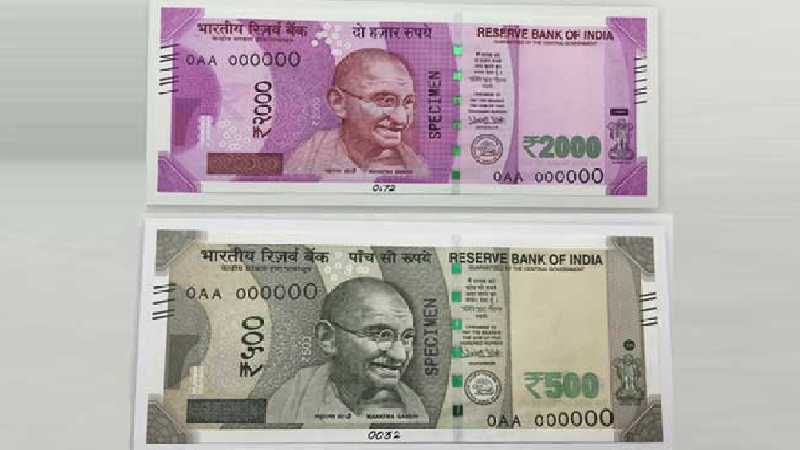
    The uneven spread of bank branches and ATMs has deprived villagers and daily wagers of whatever limited currency relief that has been rushed to tide over the situation. It is a known fact that rural and semi-urban bank branches cater to more customers than the urban branches do. A geographically large state like Rajasthan has fewer bank branches than Delhi. Given the limited reach of banking, much of rural India relies on cash deals. Media reports say actual or rumors of scarcity have led to the hoarding of 100-rupee note, while the inadequate availability of the new 500-note has also contributed to financial dislocation. Even where the 2000-note is available, it is of limited use since the lower denomination currency needed for change is unavailable.

    The net effect is hiring has slowed and reports of retrenchment stand confirmed. Though people in rural India often show greater patience in moments of crisis, their capacity to bear pain is lower than those in urban India. For them it is not just inconvenience, it is a loss of livelihood. Maybe the government should put the national rural job guarantee scheme to greater use, particularly in areas where survival is already at the marginal level. This is callousness foretold. A regime that prides itself on knowing the country and its needs better has been found wanting. Its incompetence and arrogance are spelling misery in rural India.


  • The implications of demonetization and Trump’s win will be far-reaching

    The implications of demonetization and Trump’s win will be far-reaching

    President-Elect Donald Trump met with the New York Times staff at the newspaper's office to make up with the premier newspaper of the US
    President-Elect Donald Trump met with the New York Times staff at the newspaper’s office to make up with the premier newspaper of the US

    Trump’s election as US President and demonetization in India arrived like conjoined twins on November 9. Joseph Schumpeter’s phrase “creative destruction”, used in 1942 to characterize industrial evolution, is the hopeful outcome. Experts are divided as neither falls into a neat historical precedent.

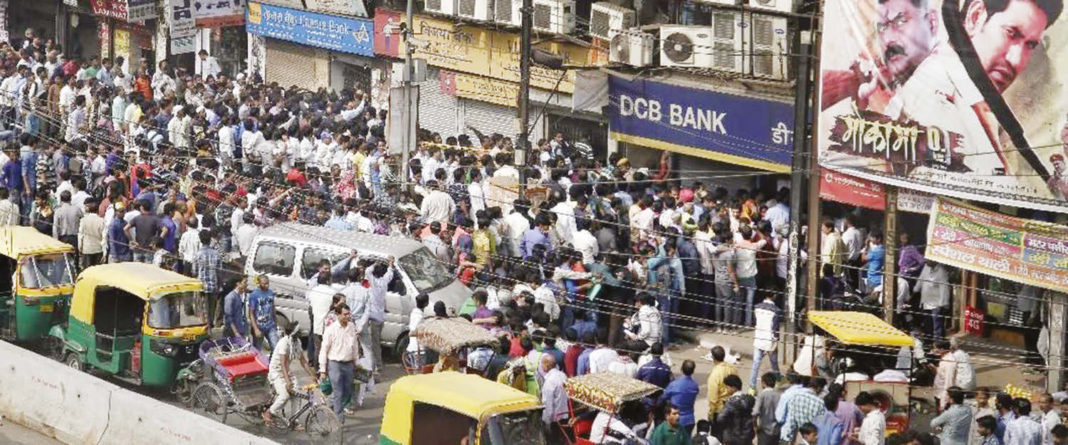
    Since PM Narendra Modi’s midnight announcement, queues of people wishing to withdraw money for weddings, agricultural inputs, studies, medical treatment or simply to meet daily expenditure continue to mull outside most banks. This has been particularly so in the Capital, where Parliament’s winter session gave the Opposition a ready stage for protests. The delivery of additional smaller and new higher denomination notes, printing of which lags demand, has been dismal in the hinterland. The crisis in rural areas has been compounded after cooperative banks were barred from the exercise, apparently due to their links to politicians in many states.

    Thus, while controlling black money has universal support, the poor implementation is souring public opinion. A number of conclusions can be reached. One, daily tweaking of levels, pretexts and manner of withdrawal confirms lack of planning. Two, making the Rs 2,000 note smaller and thus unusable in existing ATMs without recalibration defies common sense. The disruption of supply chains, private transportation and rural credit when the rabi season sowing was underway needs explaining. Finally, eliminating middle denomination notes – Rs 500 – made the Rs 2,000 note unusable as no one had change at retail level. The government should have had enough new notes when rendering 86 per cent of the currency invalid overnight.

    Experts on emerging markets are left incredulous. Ruchir Sharma of Morgan Stanley warned that populism “cannot paper over economic chaos”. India, he argues, is cash dependent, but its figure of 12 per cent of GDP compares with US’ 8 per cent and China’s 10 per cent. Tax collection is 16 per cent of GDP, “slightly higher than the norm for India’s peers”. Unlike India’s amnesty scheme that preceded demonetization, Indonesia’s keeping tax low at 4 per cent drew out $300 billion of hidden wealth. Sharma concludes that “revenge is not a development strategy”.

    Jean Druze likened the government’s move to shooting at the tires of a racing car. Respectable Larry H Summers expressed doubts about achieving stated objectives, pointing out the moral hazard of inconveniencing the majority honest people to bag a few crooks.

    After incremental bad news that cash shortage could only be ameliorated in some months, not weeks or even days as Modi hinted initially, the government resorted to jingoism. Indian people were participating in a public ritual or mahayagya of self-cleansing for larger national good and better future. Thus, its counter-terrorism role to choke funding by counterfeit currency was emphasized.

    India’s high risk and immediately disruptive policy has been unleashed when externally the world faces what The Economist calls “The New Nationalism”. Modi is in their “League of Nationalists” which includes China’s Xi Jinping; Turkey’s Recip Erdogan, Russia’s Vladimir Putin, and of course Donald Trump. Waiting in the wings are rising nationalists on the left and the right in Europe, particularly Marine Le Pen in France who if elected can spell the end of the EU. Thus, the timing for Indian financial experimentation is inappropriate as trade partnerships and alliances are tested globally.

    US leadership becomes critical at this juncture as since World War II it has underpinned the defense and propagation of a liberal and open international order, albeit for its own dominance. The economic power shift to Asia with the rise of China and now India and the concomitant de-industrialization in the US and economic distress in Europe, combined with the threat of Islamic terrorism, have created conditions for the rise of the new nationalism. The EU was an experiment in post-nationalism where nation states incrementally surrendered sovereignty to a supra-national entity. The process faces reversal.

    Trump is the wild card in this new game. In a New York Times interview on November 22, having kissed and made up, he moderated electoral rhetoric on some issues like prosecuting Hillary Clinton and climate change. But his core beliefs remain intact like lowering taxes, renewing US infrastructure or re-examining trade deals. He announced US withdrawal from a putative Trans-Pacific Partnership (TPP) that underpins US “pivot” to Asia and China containment strategy. Will China read it as US retreat or peace offering remains undetermined. The TPP, constituting two-fifth of the world’s economy, was to rewrite not just tariff and trade rules but harmonies standards on intellectual property, environment and labor rights. China will try filling the gap by either advancing a “Free Trade Area of the Asia-Pacific” tying 21 countries or pushing the Regional Comprehensive Economic Partnership (RCEP), which will, besides 10 ASEAN members, have India, Australia, New Zealand as well as China, ROK and Japan. This is the Chinese riposte to a US-centered intrusion into Asia. India needs to move cautiously as the cracks widen or heal.

    Meanwhile Pakistan, on the eve of army chief Gen Raheel Sharif’s retirement on November 29, has provoked India by repeat beheadings of Indian soldiers. India can either react clandestinely locally, which is unusable domestically by the BJP for jingoism or overtly, which should stall Gen Sharif’s retirement. Iran, too, is on tenterhooks with radical elements salivating at the nuclear deal falling through if Trump reimposes sanctions, which would be resisted by its European allies and Russia. On Syria, Trump, in the same interview, indicated urgency for a solution. Is he realizing that US retreat, as happened after World War I, would merely buy time till the US has to intervene under worse conditions?

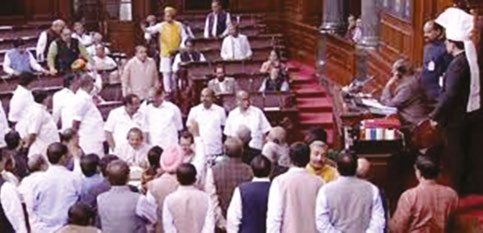
    Opposition members in the Rajya Sabha demand that the Prime Minister make a statement on demonetization in the House, during the winter session of Parliament in New Delhi. Photo courtesy of PTI
    Opposition members in the Rajya Sabha demand that the Prime Minister make a statement on demonetization in the House, during the winter session of Parliament in New Delhi.
    Photo courtesy of PTI

    With the Opposition unity enhanced, Parliament stymied and the Modi government’s ability to restore currency-in-hand normalcy in question, will Modi – like Trump – tamper the government’s brash approach to tackling black money, terror funding and counterfeit currency? With free fire across the LoC, the deterrence value of “surgical strike I” is questionable. “Surgical strike II” on black money has disabled a growing economy and launched a Mao-like, hopefully not fatal, “great leap forward”. History teaches us that for civilizational behemoths like India and China, only little leaps work. For global hegemons like the US leap-backs are equally fatal.

    (The author is a former Secretary, Ministry of External Affairs, India)

  • Monetary Stalinism: Perils of tinkering with jameen, jorru and jeb

    Monetary Stalinism: Perils of tinkering with jameen, jorru and jeb

    We do not want another ‘god’ as the political leader of our country…We must not only not have any more gods…we must also ‘devalue‘ the exaggerated importance that we have given to the office of Prime Minister.”

    The author of this wisdom lies gravely unwell in a nursing home in New Delhi. Much before old age and its attendant infirmities took their toll, this man used to articulate – on behalf of the BJP – wise propositions of good governance and democratic accountability. His name is Jaswant Singh, the most suave, educated and responsible minister in the Vajpayee era.

    Jaswant Singh had made this formulation in 1987. That was the age when the Prime Minister had more than four hundred seats in the Lok Sabha; he also had a majority in the Rajya Sabha. He had a shouting brigade who would keep the presiding officers in check; he had an officer in the PMO who would publicly deride Opposition leaders as “cretins”. That was the age of prime ministerial supremacy and it produced many unmitigated national disasters.

    Let us dig a little deeper in history. The year is 1971. The legend has it that the legendary soldier, Sam Manekshaw, told off an impatient Prime Minister Indira Gandhi that he would not be prepared for “action” in East Pakistan till he was satisfied that adequate preparations had been made and logistical wrinkles sorted out. The Prime Minister had the good sense to heed the sound advice of a sound officer, and lived thereafter to see the Indian armed forces settle Pakistan’s hash.

    These glimpses from the past are being recalled to reiterate the lessons the recent history has taught us. And, the unambiguous lesson, from 1975-77 onward, has been a cultivated distrust in the idea of an omnipotent Prime Minister and his overweening ambition. Beware of a too powerful Prime Minister. India is too vast a country to be at the mercy of a Prime Minister and his wisdom.

    The demonetization mess painfully brings home the correctness of Jaswant Singh’s caution against elevating a leader as “god” who must be rendered unambiguous obedience and obeisance. The utter incompetence in implementing the “demonetization” drive merely underlines the total abdication by the Reserve Bank of India of its institutional autonomy and voice. The RBI Governor was duty-bound to tell the Prime Minister to slow down, just as General Sam Manekshaw once told another Prime Minister. The country is a daily witness how the Finance Ministry officials are encroaching upon the RBI’s institutional space and making a mess of it.

    This is incongruent. Here is a regime -whose senior-most impresarios take considerable pride in micro-management and have built up a formidable reputation in Gujarat as control freaks – which was so callously inattentive to the post-demonetization dislocations. The very arbitrariness and the resulting chaos are being sought to be palmed off as “worth the pain” because Prime Minister Modi “means well”.

    No one is sure to what extent the Finance Minister, leave alone the rest of the Cabinet members, were privy to this so-called “surgical strike” on black money. The country remains in the dark as to whose counsel the Prime Minister sought while firmaning this most drastic and draconian change in currency notes. Not since Morarji Desai’s gold control (in the wake of the Chinese aggression) order has any other single governmental initiative touched the lives of so many Indians. Yet the collective thinking and collective decision-making appear to have been done away with.

    This unhealthy concentration of power and authority in one man can only be a recipe for unhappy consequences. Already the blue-book of personality cult is operational. Ideological, political and moral approval is sought for the Prime Minister and his “bold” move. Anyone disagreeing with the Leader is being called a habitual dissenter, a fake secularist, and a potential “deshdrohi”. Anyone dissenting is dismissed and ridiculed as an accomplice of the corrupt and the terrorist. The officials down the line have interpreted this kingly intolerance as a simple license to shut people up. For example, in Indore, the local officials have outlawed any criticism on the social media of the demonetization decision because they think “internet social media wars” could disrupt social peace. The Leader can disrupt the daily lives of the millions and millions of citizens but no citizen can have a right to share his/her plight or vent anger about being denied one’s own money. On the other hand, the Prime Minister’s Office uses the very social media to conduct an “opinion poll” of its own and claims wide public approval for the demonetization move.

    Why was one individual – however popular, wise, and honest – allowed to undertake this experiment in monetary Stalinism? Collectivist impulses of the State have been let loose. Millions and millions of households have been forced to surrender their meagre savings to the banks. The mopped-up savings will now be available to the Omnipotent Sarkar, to be dispersed as per the preference of the ruling clique. If Stalin could force the Soviet citizens to donate their labor for industrialization and for the glory of “motherland,” we can also force our people to cough up their hard-earned savings to fight off the evil Pakistan. The minatory penetration of a Leviathan State is complete and total even in the remotest part of the land; each day the State issues firmans on how much and how a citizen can use his own money. All because the Leader wanted to be “bold” and to “transform” India, like no other Indian leader had done these last 70 years.

    In the best of the Stalinist traditions the (virtual) mobs are being encouraged to denounce anyone who dare question the ruling regime’s preferences and priorities. We are manufacturing new orthodoxies: any governmental initiative-good, bad or malevolent – will not be questioned if it is declared to be in aid of fighting “corruption, black money, terrorism and counterfeiting of currency.” It is demanded of the citizens that they put up with the “inconvenience” in “our fight” against these presumed objectives. As in Comrade Stalin’s days, endorsements for the regime are expected. Expectedly, the venerable Ratan Tata has led the chorus of approval. Just stand up and applaud.

    A wise king was always advised to leave his subject unmolested of his two possessions – jameen (land) and jorru (womenfolk). Rulers, democratic or authoritarian, have faced most primeval resistance whenever they have sought to take liberties with their citizens’ land or women. Now, we have witnessed a new experiment with a democratically elected king putting his hand in the subject’s jeb (pocket).

    Consequences will be there.


    (The author is the chief editor of the Tribune group of publications)

  • New scheme may impose 50% tax on unaccounted money

    New scheme may impose 50% tax on unaccounted money

    NEW DELHI (TIP): The  government is likely to introduce a disclosure scheme under which anyone with unaccounted income can come clean by paying 50% tax before December 30.

    A fourth of the amount remaining after taxation will be locked in for four years, top officials told DH on Friday.

    They said the government was bringing in an amendment to the Income Tax Act in the current session of Parliament.

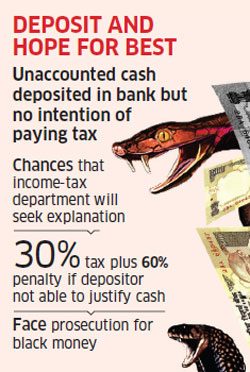
    The move is intended to ensure black money does not come back into circulation after tax is paid on it. Only 25% of the total disclosed amount will be available for use. Those with unaccounted-for cash who disregard this option will face a stiffer penalty if caught subsequently. They will have to pay 90% of the income, 30% being tax and 60% penalty.

    The amendments, cleared by the Cabinet, have been sent to the President for his assent and are likely to be introduced in Parliament next week, the sources said.

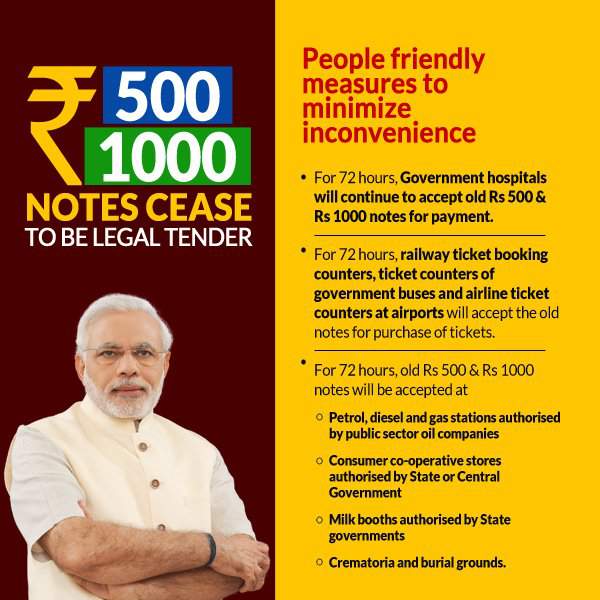
    On November 9, the government had said it would treat cash deposits exceeding Rs 10 lakh, and not matching declared income, as income on which tax had been evaded.

    It said such an amount would attract as penalty 200% of the tax payable.

    However, the proposal was criticised on the grounds that such steep penalties could not be imposed on individuals without an amendment to the tax laws.

    The government is also planning to include a clause in the IT Act to provide a permanent window to tax undisclosed income at a rate higher than that imposed under the Income Disclosure Scheme, which ended on September 30.

  • Modi’s black-money jibe at Opposition roils Parliament

    Modi’s black-money jibe at Opposition roils Parliament

    NEW DELHI (TIP): The political thrust and parry over the demonetization of high-value currency notes intensified on November 25 with Prime Minister Narendra Modi using the Constitution Day event to take on the Opposition for criticising the implementation of the plan.

    “Some people are saying the government did not make ample preparation. I think the pain of such people is that the government did not give them a chance to make any preparation,” Modi said. “If these people had been given 72 hours to make their preparation, they would have lavished praise that there is no one like Modi,” he added.

    His predecessor, Manmohan Singh, had said on November 24 that the implementation of the demonetization plan was marked by “monumental mismanagement”.

    Modi said that in the country’s battle against corruption and black money, the ordinary citizen is the “foot soldier”.

    “I received details about municipal corporations in some cities,” Modi added. “Earlier, they used to get Rs 3,000-3,500 crore as tax; but after November 8, they have collected Rs 13,000 crore as tax! This money will be used for development, like construction of roads and electricity supply,” he noted.

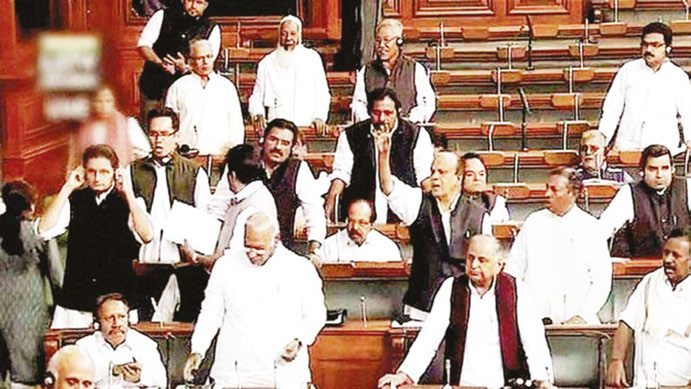
    Modi’s remarks stirred up the Opposition yet again. Members of almost all the Opposition parties trooped to the well of the Rajya Sabha demanding an apology from him.

    Leader of the Opposition Ghulam Nabi Azad said that although the Opposition had made it abundantly clear that it was not against the objectives of the scheme, Modi continues to make allegations to avoid a parliamentary debate on the issue.

    “How can the Prime Minister level such an allegation? We are against black money. The Prime Minister must apologize,” Azad said.

    For the seventh day of the Winter Session, the Lok Sabha was in turmoil, with the Opposition parties demanding the Prime Minister’s presence in the House for a debate on demonetisation and an apology from him for his jibe at them.

    Opposition members raised slogans asking Modi to make his statements inside the House.

    As the House met, Congress leader Mallikarjun Kharge said: “The issue now is not our demand for an adjournment motion, but the remarks of the Prime Minister… He said the Opposition supports black money.”

  • Dalit to be deputy CM if AAP wins Punjab: Kejriwal at manifesto release

    Dalit to be deputy CM if AAP wins Punjab: Kejriwal at manifesto release

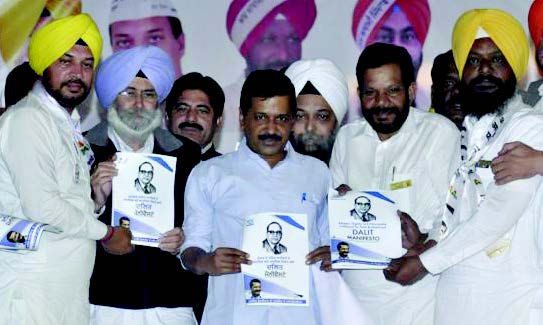
    JALANDHAR (TIP): With an eye on nearly 32% Dalit voters in Punjab, Aam Aadmi Party (AAP) convener Arvind Kejriwal on Friday playing the masterstroke by declaring that if his party formed the government in Punjab, the post of deputy CM will go to a Dalit. The announcement was made at a rally here during which he also unveiled the party’s 19-point manifesto meant exclusively for the Dalits.

    Kejriwal said it was a historic announcement by a political party wherein Dalits have been promised a high place in the corridors of power.

    “Saari partiyan kehti hain hum Daliton ko ye denge, wo denge…lekin koyi kursi nahin deta. They only give you choice for MLAs, that too because of the reservation. But AAP is not here to exploit you for votes. We will share the power with you . Bhim Rao Ambedkar and Kanshi Ram had stated that Dalits can only be brought in the mainstream if power is shared with them,” said Kejriwal, addressing a gathering in Dalit-dominated Doaba region.

    Even as the gathering was less in comparison to other AAP rallies, Kejriwal managed to steal the show with his announcement. AAP’s all Dalit candidates from across the state were present on the stage. He said it will be difficult for the traditional parties

    (Akali Dal and Congress)?to match what AAP has announced for the Dalits.

    The Delhi CM also said that even seven decades after the Independence, the Dalits are deprived off their rights. “Look at the plight of Dalits in Punjab. A journalist just told me that 18 lakh students study in government primary schools in Punjab, of which 14 lakh belong to Dalit families,” said Kejriwal. He said AAP enjoyed full confidence of Dalits in Delhi where it won all the 12 reserved seats. “In Delhi, we delivered what we promised for the Dalits. We have started regularising all safai sewaks,” he said, adding Dalits are being given free education and health care facilities in the national capital.

    Dalit manifesto: Old wine in new bottle?

    Except for promising deptuy chief minister’s post to a Dalit, the Aam Aadmi Party manifesto lacks innovation. Most promises in the document are more or less the same as those of rival parties.

    Concept of ‘mohalla clinic’ in Delhi has a mention in the document under the ‘Modern Pind Sehat Clinic’,, besides ?5 lakh health insurance. The promise to provide free gas connection, along with burner and stove, to all Dalit families is already being implemented in Punjab under the Pardhan Mantri Ujjwala Yojna. The party also announced free education for Dalit girls up to Class 12.

    Why Dalit vote counts

    • ? 32% of Punjab’s population is Dalit – the highest in the country.
    • ? 33 of 117 seats in the state assembly are reserved.
    • ? With 23 seats, the Dalit-dominated Doaba is a decisive factor in power sweepstakes. Source: HT
  • Cashless is painful: Address the panic in the street

    Cashless is painful: Address the panic in the street

    Post-demonetization, the country is in a state of economic convulsion.

    To keep it from turning into a social seizure, the government has appealed to patriotic fervor, raising every notion from the soldier’s suffering to the promise of a clean and bright financial future for the country. The poor are celebrating and the rich are losing sleep, the Prime Minister has formulated. The reality is that after a few days of initial excitement, the consequential enormity of the decision to demonetize is beginning to set in, both within the government and the masses, the poor included.

    There are many who support the decision in principle but say the implementation should have been better planned. That is perhaps an unreal expectation, given the very nature of the operation. The requirement of surprise necessitated that implementation-level government hands could not be involved. A lot of the planning is thus happening in real time, as the scheme moves along. Therefore, the government is constantly finessing the cash withdrawal, which only adds to the confusion and panic. Small trade has dropped drastically, daily-wage earners in the unorganized sector are missing out on employment, vegetables are rotting, farm cooperatives have been rendered inoperative for the time being, and the huge majority that was yet to enter the banking system is at its wit’s end on how to exchange their old currency.

    Social media, often taken as a barometer of national sentiment, has largely given a thumbs-up to the scheme. But this could be misleading, because the middle and lower middle classes that inhabit this space have alternative means of survival. The rich, who run the economy, and the rural poor are only yet forming their opinion based on their felt experience, which may not be very pleasant. The government will do well to pay heed to every section. The woeful lack of currency and means of its distribution have betrayed a lack of planning. Given the official haphazardness, who can feel assured that the implications for the long term -projected to be positive – have been calculated accurately? Tomorrow will be understood only when the dawn comes.

  • Government Limits Notes Exchange to Rs. 2,000, Starting November 18

    Government Limits Notes Exchange to Rs. 2,000, Starting November 18

    NEW DELHI (TIP): India government announced, November 17, new measures to help farmers and families planning weddings withdraw more money from banks amid a massive cash crunch after the sudden ban on high value currency last week. Prime Minister Narendra Modi has reviewed cash availability and the steps taken to ease hardship in a meeting with Finance Minister Arun Jaitley and the officials.

    The limit for swapping notes at banks has been reduced from Rs. 4,500 to Rs. 2,000 for each person from Friday. Economic Affairs Secretary Shaktikanta Das said this would give more people a chance to exchange banned Rs. 500 and Rs. 1,000 notes. The withdrawal limit was raised from Rs. 4,000 just four days ago, a measure that was welcomed by many as it would mean less trips to the bank.

    Finance Minister Arun Jaitley said, November 17, 22,500 ATMs would be recalibrated today, allowing them to dispense new notes. There are around 2 lakh ATMs across the country.

    Families can withdraw Rs. 2.5 lakh in one go for weddings but only from one account, based on self-declaration. In the wedding season, the notes ban has led to a severe crisis for families who had withdrawn cash in bulk just before the demonetization.

    Farmers can withdraw up to Rs. 25,000 a week against loans sanctioned to them to buy seeds and fertilizers and credited to their accounts. Rs. 25,000 a week can be drawn from payment that farmers receive for agricultural produce in form of checks. The time limit for the payment of insurance premium on crop loan has been extended by 15 days.

    Traders in vegetable wholesale markets can withdraw Rs. 50,000 a week to pay for expenses like wages.

    The Reserve Bank has reiterated that there is sufficient supply of notes “consequent upon increased production which started nearly two months ago”. It asked the people not to panic or hoard currency notes.

    Government employees will have the option to draw salary advance in cash.

    National Highways will not collect toll tax till November 24 midnight.

    The government’s sudden decision to pull out the high value currency notes from circulation to check black or untaxed money has driven people to wait for hours at banks and ATMs for cash.

    Since November 8, the government has announced more measures to reduce the pressure on people, amid opposition allegations that it was a poorly planned move.

  • Demonetization – How People are reacting on Social Media

    Demonetization – How People are reacting on Social Media

    Prime Minister Narendra Modi’s sudden decision to ban Rs1,000 and Rs500 notes in an attempt to crack down on black money has created a storm in India and abroad. While many including celebrities hailed this move as a surgical strike on black money, politicians and common man expressed their fury for the trouble they faced as they had to stand in long lines for hours and/or returned empty-handed from banks in search of new notes to replace their banned currency. They took social media to speak up their mind.

    Most Bollywood celebs welcomed the move.

    amitabh-bachchanAMITABH BACHCHAN “T2435 – the new 2000 rs note is PINK in color … the PINK effect ..!!”

    RISHI KAPOOR “PM Modi ji. Ball out of the stadium. Wohaaaaaa!!!! De monetisation is the right answer. Congratulations!”

    SUNIEL SHETTY “9/11 jab bhi aata hai hila dalta hai bhai…this 9/11 some will lose…many shall win! A powerful & brave decision indeed #RIP #BlackMoney”

    a-n-u-s-h-k-a-sharmaANUSHKA SHARMA “A welcome bold & courageous step by PM Modiji towards nation building. Each 1of us shld cooperate in d larger interest of d nation #BlackMoney.”

    sonali-bendreSONALI BENDRE “Couldn’t agree more!!! Historical move @narendramodi @PMOIndia it’s a beginning of new India…Jai Hind”

    RITEISH DESHMUKH “Bold move by PM @narendramodi ji as the #1000rs #500rs notes become invalid/redundant. #NewIndia”

    Among the politicians, West Bengal Chief Minister MAMATA BANERJEE was the first one who criticized Modi for not thinking about the sufferings of poor section and ordinary people who have no criminal intent. “Withdraw This Draconian Decision”, she tweeted hours after the banning on November 7.

    After leading a 1-kilometre march from Parliament House to the Rashtrapati Bhawan on November 16, she gave ‘ATM’ a whole new full form.

    “Initially ATM meant “All time Money” now it is “Aayega tab milega” she said. Situation got worse in last ten days and people started reacting angrily on social media.

    RAHUL BHATIA – Such a weird week. It feels like one of those stories my parents told me about life in the 70s.

    NITIN PAUL – Business is depressed, but people hopeful that this is a temporary blip. Varying levels of endurance and workarounds 2/n

    SASIKUMAR GANESHAN -Mom just called. She is unable to use cashless apps. No local language support. @India_Stack? I wish we can promote more local language.

    ANUJ SINGHAL – Finmin sources: limit of exchange from 4000 to 2000 is to discourage people from standing in queue for petty commission

    GANESH RENGASWAMY – For my friends who know India, this is what #demonetisation? has led to.

    Unprecedented! It seems if the situation does not improve, the social media will be flooded with such comments in coming days.

  • Modi May Need Six More Months to Replace India’s Junk Bills: Economist Saumitra Chaudhuri

    Modi May Need Six More Months to Replace India’s Junk Bills: Economist Saumitra Chaudhuri

    One estimate pegs May 2017 as date when bills will be replaced; Deutsche Bank says crunch to cut 50bps from Oct-Dec GDP growth

    NEW YORK (TIP): For Indians expecting respite from the government’s clampdown on cash, here’s a reality check: it probably won’t come soon, says a Bloomberg report published November 17.

    Bloomberg report quoted Saumitra Chaudhuri, an economist who advised Modi’s predecessor who said, “Prime Minister Narendra Modi’s administration may need until May 2017 to replenish the stock of now worthless bills”, The government on Nov. 8 banned 500 ($7.5) and 1,000 rupee notes in a surprise move against graft and tax evasion.

    Delays in replacing the currency risk prolonging the pain in the $2 trillion economy, where about 98 percent of consumer payments are made in cash. Deutsche Bank AG predicts the crunch could easily shave off a half-point from India’s growth in October-December, which could imperil its position as the world’s fastest-growing major market.

    This is how Chaudhuri reached his conclusion, which he published in a blog post on the Economic Times’ website: Extrapolating from central bank data, he estimates that Modi’s move sucked out about 16.6 billion notes of the 500-denomination, and 6.7 billion 1,000-rupee bills. That means more than 23 billion notes totaling 15 trillion rupees.Modi intends to replace these with new 2,000-rupee and 500-rupee bills. However, Bharatiya Reserve Bank Note Mudran Pvt., which prints the higher denomination currency, has a stated capacity of just 1.3 billion notes a month. That’s with working double shifts. Raise this to triple shifts and it becomes 2 billion bills, which means it will need until the end of 2016 to replenish in value the 1,000-rupee notes. Security Printing & Minting Corporation of India Ltd., whose capacity Chaudhuri estimates at 1 billion pieces a month, will need several more months to meet the 500-rupee target, even if it joins forces with BRBNM, he said. “Ergo, currency shortages will remain with us for many months and economic contraction will rule this period,” he wrote. “At the end of the period, confidence will be at new lows and recovery will take time.”

    In what could make matters worse, the presses — busy with the new bills — have almost completely stopped printing 100-rupee notes, Bloomberg Quint reported Wednesday citing central bank sources it didn’t name. These bills are the bread-and-butter of India’s $780 billion informal economy, which employs more than 90 percent of the workforce.

  • The War over Demonetization

    The War over Demonetization

    Government unfazed by combined opposition attack; fight will continue, says opposition Meanwhile, the common people undergo terrible suffering

    The war over demonetization between the government and opposition is getting fiercer as the latter vows to continue the fight while the Modi government makes it clear that they will stick to the decision.

    On November 17, West Bengal Chief minister Mamata Banerjee and Delhi Chief minister Arvind Kejriwal  sharply criticized Modi while addressing a rally in New Delhi. Kejriwal alleged that demonetization was the “biggest scam” in Independent India’s history and asked the government to roll back it in three days.

    Mamata Banerjee and Arvind Kejriwal led march to the Rashtrapati Bhavan to protest demonetization
    Mamata Banerjee and Arvind Kejriwal led march to the Rashtrapati Bhavan to protest demonetization

    Saying that such a crisis was not seen even during Emergency, Banerjee warned Modi that he should not run the country through “dictatorship” and the ‘protest is a fight to save the country.’

    Rejecting opposition party’s demand of withdrawing decision on banning 1,000 and 500 currency notes, Finance Minister Arun Jaitley ruled out roll back of demonetization saying that the government will stick to it.

    “Whatever AAP and Trinamool Congress said about the roll back, there is no question of that. It is a clear decision of the Prime Minister and government to cleanse politics and economy of the country. We will stick to it”, said Jaitley.

    On November 16, in a surprise move, National Democratic Alliance (NDA) ally Shiv Sena decided to participate in a protest march to the Rashtrapati Bhavan led by Mamata Banerjee along with National Conference and AAP leaders. Shiv Sena supremo Uddhav Thackeray had earlier said in a press conference “Modi did a surgical strike along the LoC and deserved praise. However, his demonetization decision could bounce back on him.”

    Surprisingly, Nitish Kumar, Chief Minister of Bihar and strong critic of Modi, expressed his “total support” for the ban, according to a report by NDTV. He said that like other opposition parties, he is concerned by the plight of millions of people left without any cash, but believes the PM’s reform will be effective and that Mr. Modi must next tackle benami or proxy-owned property, used often to park black cash.

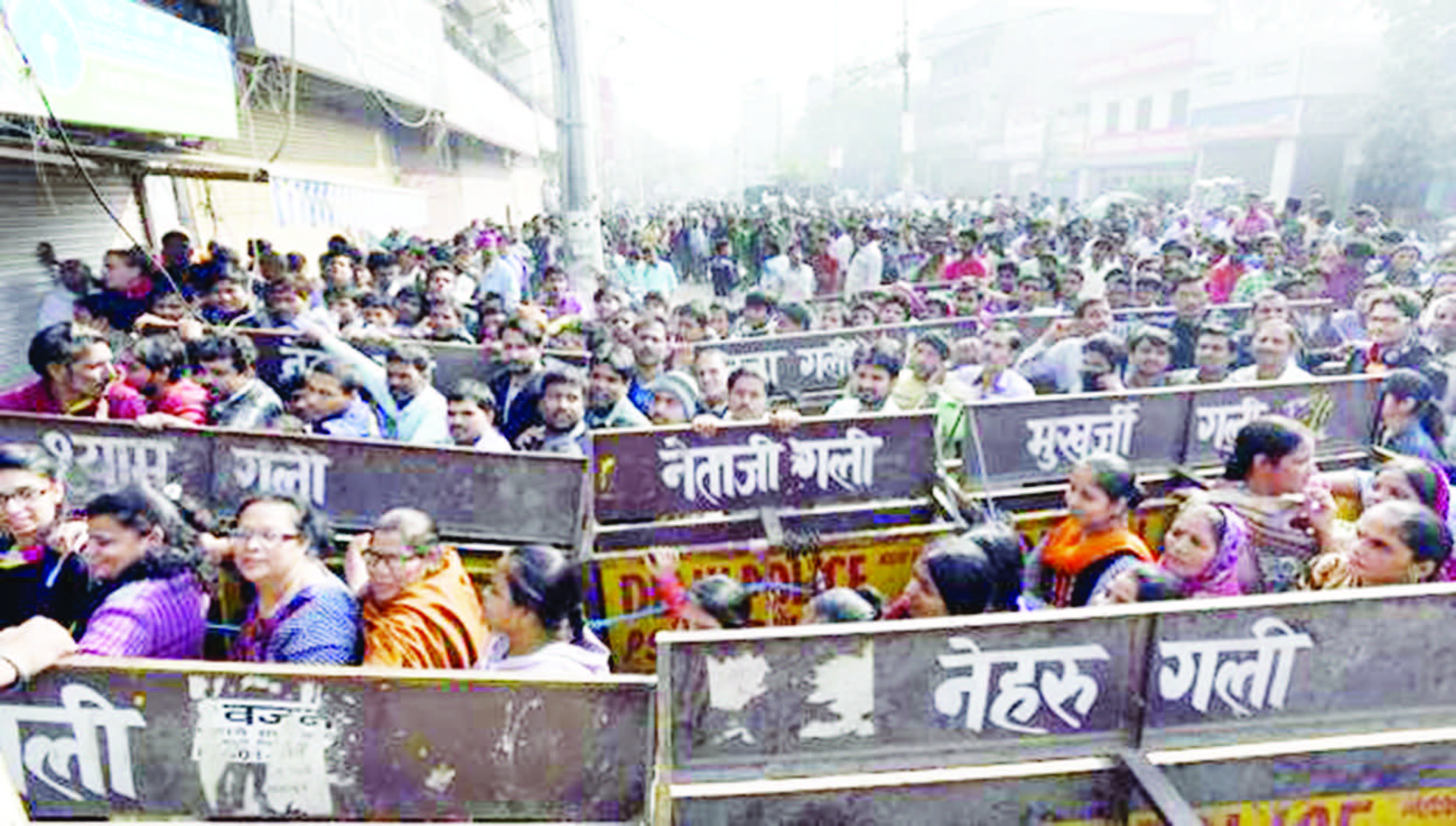
    Common people in long lines in front of a bank in Hyderabad to exchange the demonetized bills of Rs.1000.00 and Rs.500.00
    Common people in long lines in front of a bank in Hyderabad to exchange the demonetized bills of Rs.1000.00 and Rs.500.00

    Congress Vice President Rahul Gandhi alleged that 15 to 20 Industrialists who were close to Modi were running the country and the demonetization exercise was simply an exercise to ‘take from the poor to give to these rich industrialists.’

    “Mark my words, while all you poor people are standing in line to deposit your notes, the Modi government would soon use this cash to forego the debts of these 15 to 20 industrialists. In the last one year debts of these industrialists worth Rs 1.10 Lakh crore has been written off by the Modi government.” said Rahul Gandhi.

    CPI (M) General SecretarySitaram Yechury took a dig at Modi by comparing him to French Queen Marie Antoinette. “It reminds me of Marie Antoinette who during the French Revolution said if they (people) don’t find bread, why don’t they eat cakes. Now, we have Modi Antoinette who says: ‘If you don’t have paper, use plastic’.”

    But Modi strongly defended his currency move claiming that demonetization had equalized the rich and the poor. He asserted that his decision to scrap notes of high denomination was taken in the “interest and happiness of the poor,” the good of the country and the farmer.

  • Modi Carpet Bombs 80% Indians to Recover 3-5% Black Money

    Modi Carpet Bombs 80% Indians to Recover 3-5% Black Money

    It is very surprising why Team Modi ignored the very basic fact that the 1% of richest Indians own 53% of country’s wealth. Further the 5% of richest own 68.6% of country’s wealth, while the top 10% have 76.3%. On the other hand, 53.7 percent of the population(or 650 million)poor own princely 4.1% of the nation’s wealth.

    I wish Modi should have done a “Surgical Strike” to recover black money by raiding all the business premises and residences all over India of the 5,275 “willful defaulters” – together, they owe India’s banks INR 56,521 Crore. And all big business houses like Ambani, Adani, Tata, Birla, Sun Pharma, Jindal etc. etc. should have also been raided by the enforcement directorate. To be politically incorrect, Modi should have raided every political party’s premises and every politician’s homes, businesses, offices and vacation homes. It is an open secret that 67% of income of the 6 National Parties comes from unknown sources as well as from foreign lobbyists.

    India’s corporate houses owe the PSU Banks Rs 5 Lakh crore out of this about Rs 1.4 Lakh crore are owed by just 5 companies only. Gautam Adani, the mentor or big supporter of Modi, his group alone owes Rs 72,000.00 crore. In last 2-3 years Adani Group’s net worth has gone up by a whopping 85%! Incidentally the entire crop loan of all the farmers of India is also Rs 72,000 crore. All these corporate houses are cooking books and people who are controlling them are living a very lavish life that includes most expansive real estates, private islands, big fat weddings, Jets, luxury yachts and big fleets of luxury cars besides tons of gold and diamond jewelry as well as single dress/sari costing Rs. 2-3 crores. The investigators could have found numerous “Shell Companies” stashed with black money in India & abroad; used for bribing politicians, bureaucrats, judges, and law enforcement officials and for their personal luxuries.

    Cyrus Mistry, the ousted Chairman of Tata Sons, is already spilling beans how Ratan Tata along with Niira Radia, the famous lobbyist, was using corporate jets for their personal work, how Ratan Tata increased the cost of PR for the company from Rs40crore to Rs 60 crore by hiring Arun Nanda’s Redefussion. Mistry has also accused Ratan Tata of making questionable investment decisions in favor of his friends’ companies to cause massive losses to Tata sons.

    This figure was about Rs 30 crore in 2015. Mistry also accused Ratan Tata for allowing directors to draw additional parallel commission from group companies.

    Modi will not do a “Surgical Strike on Black Money” involving the premier corporate houses and the willful defaulters because these people spent Rs 32,000.00 crore on Modi’s campaign for 2 years to install him as Prime Minister of India in 2014.

    This is very disturbing how could the Team Modi ignore some of the other very important facts before embarking on “Carpet Bombing” as the Supreme Court of India has said about the so called “Surgical Strike on Black Money”.

    Out of the total cash in circulation, 86% are in large denomination like Rs 500 &Rs 1000 bills because with Rs 100 bill practically you cannot buy anything in India. Some economists have questioned the decision of introduction of Rs 2,000 bill. They say, if the policy is aimed to force people into the banking system, why the government issued a higher denomination bill -presumably an even more convenient vehicle for black money transactions? May be Team Modi wanted to make life easier for their campaign donors by introducing the higher denomination bills. The weight of Rs 1 crore in Rs 1000 notes is 12 Kg and for Rs 2000 notes it will be 6 Kg only, causing no inconvenience for an adult to carry even hiding in his body!

    Less than 35% people have access to banks and post offices in India. If one takes into account the Income Tax raids data for last 2 years, the cash component is only 6%including Jewelry. That black money is mainly invested in real estate, benami bank accounts, gold, silver and diamond. Those who are well educated and at the upper end of the wealth spectrum, have invested their black money to buy most expensive furniture, fine arts, paintings, rare scotch whiskey and wines also.

    The informal sector in India accounts for about 45 per cent of the GDP and employs nearly 80 percent of the population. About 80 percent of the people in the country have already been deprived of their livelihoods for more than a week and there are no signs that the normalcy can return even in next 2-3 weeks.

    Practically entire rural economy is in bad shape especially commodity business of production and distribution for variety of reasons including lack of education, lack of faith in banking and very limited access to banking. After Team Modi failed to push their Land Acquisition Act for the benefit of Indian and foreign corporate houses, they allowed FDI in food distribution in 2016 budget to pave the way for the big corporations to control Food Production and Supply Business.

    First, allowing FDI in food business was an assault on the rural economy and sovereignty of India. India has already given up the control on communication to foreigners and with FDI in food distribution it will put the entire nation at the mercy of foreign companies. Team Modi’s land acquisition act to control the rural economy has failed and this latest “Carpet Bombing in the name of Black Money” will paralyze the rural economy and pave the way for FDI/Foreign corporations to control the rural economy and food distribution of India.

    Already Modi has made a special place for himself in India’s history as he will be known as the first Prime Minister who put his hands in people’s mouth to take out the food they were eating and took away their profession of skinning dead animals. His anti-poor acts in the name of Cow and Hinduism was an assault on the poor of India that includes more Hindusthan other minorities.

    Team Modi has failed miserably in last 2 years on their promises of free speech, jobs, equal rights, education for all, universal healthcare, infrastructure and freedom to practice religion of one’s choice. By demonetizing Rs 500 and Rs 1000 notes aka doing “Carpet Bombing in the name of recovering Black Money” on the 80% of the population, Team Modi is depriving them of their livelihood. This is violation of Article 21 that guarantees Fundamental Right, “Right to life and personal liberty”. Even the SC, in its landmark judgement in 1985 in Olga Tellis and others Vs the Mumbai Municipal Corporation case said: “No person can live without the means of living, that is the means of livelihood. If, the right to livelihood is not treated as a part of constitutional right to life, the easiest way of depriving a person of his right to life would be to deprive him of his means of his livelihood to the point of abrogation.”

    Lastly, Team Modi completely forgot about the NRIs who supported them big time during 2014 elections and for bringing hired crowd for Modi’s rallies in New York, London, Sydney and other foreign cities. There is no provision for them to go to a PSU Bank’s foreign branch to convert old currency notes into new. Especially the NRIs who do not travel much to India and got Indian currency after paying in with their hard earned foreign currency, have no recourse to get back their money. May be these NRIs can use the old currency notes to make garlands for the central ministers and PM Modi’s future visits to their countries.

    (The author is a social activist and a regular contributor to the columns of The Indian Panorama. He can be reached at davemakkar@yahoo.com)

  • DEMONETIZATION STALLS Parliament

    DEMONETIZATION STALLS Parliament

    Chaotic scenes witnessed in both Houses of Parliament over scrapping of Rs1,000 and Rs 500 notes

    NEW DELHI (TIP): Both Houses of parliament were adjourned on Thursday, November 17, as opposition lawmakers continued their attack on the government over the impact of its ban on 500 and 1000 rupee notes. Today was the second day of the winter session. Union finance minister Arun Jaitley later rejected all demands of the opposition.

    In the Rajya Sabha or Upper House, where a debate on demonetization has been on since Wednesday, the opposition shouted slogans demanding that Prime Minister Narendra Modi come to the house, listen to debate and respond to their questions. It’s a stalemate, with the government refusing to give in to that demand. Finance Minister Arun Jaitley will reply to the debate, in which a united opposition has attacked the government over what they call “economic anarchy”.

    In the Lok Sabha, which did not function yesterday after obituaries, opposition parties have moved 21 adjournment motions, which seek to put aside regular work to debate and vote on the notes ban. Speaker Sumitra Mahajan said she would allow the debate but not until lawmakers stopped shouting. When that did happen, she adjourned the Lower House for the day. “We are ready to discuss any issue, there is nothing to hide. We want the Congress to clarify, are they with the government decision or not? You’ve got every right to make demands, and the government will reply to it all,” said senior union minister Venkaiah Naidu this morning.

    ‘There is no question of a rollback of the government’s cash clean-up move,’ Finance Minister Arun Jaitley said, rejecting the Opposition’s demand of a probe by a Joint Parliamentary Committee into the alleged leak of information to BJP units and “friends of BJP” on notes ban. Regarding the opposition’s other demand, that the Prime Minister respond to the debate, Mr. Jaitley said it was the prerogative of the party and government to decide who would reply. Opposition parties, except for the Trinamool Congress, have not demanded that the government withdraw the notes ban, but have criticized the manner in which it was implemented causing hardship to common people who have had to queue up for hours at banks amid a cash crunch. Ministers speaking in the debate said the radical step was taken in national interest to end corruption and black money. No honest taxpayer would lose a single rupee, while those with unaccounted wealth would suffer, as would terror organizations that had been choked by the currency ban, they said.

    Before the winter session began PM Modi had said he was counting on “good debates” on key issues and hopes the opposition will cooperate to support key legislation like taking the next steps to introduce the national Goods and Services Tax or GST, the biggest tax reform in decades.


  • NO MANDATORY ENGLISH? GOVT ‘NOTES’ RSS AFFILIATE’S PROPOSALS FOR EDU POLICY

    NO MANDATORY ENGLISH? GOVT ‘NOTES’ RSS AFFILIATE’S PROPOSALS FOR EDU POLICY

    NEW DELHI (TIP): The government has assured a Rashtriya Swayamsevak Sangh affiliate that a raft of suggested changes– including scrapping English as a mandatory language and banning references that insult India or eminent personalities – will be considered when the new education policy is formed.

    A report in the Indian Express on Friday said the RSS-affiliated Shiksha Sanskriti Utthan Nyas (SSUN) has written to the government with proposals for the new policy that is to be announced soon.

    The suggestions include making the medium of instruction in schools the respective mother tongues, doing away with foreign language as an alternative to Indian languages and junking English as a mandatory subject.

    The group also wants all government-funded research to be linked to “national requirements” and banning any textbook references that “insult Indian culture, tradition, sects, thoughts, eminent personalities and offer wrong explanations”, the Indian Express reported.

    The SSUN is also pushing for Indian language teaching in IIT, IIM and NITs.

    The founder of the organization, Atul Kothari, told the newspaper that human resource development minister Prakash Javadekar appreciated some of the suggestions and promised that the Centre would consider them.

    An October 14 email by an HRD official said “suggestions given by you have been noted down. They will be discussed during the formation of the new education policy”, the Indian Express said.

    The incident is likely to bolster charges that the BJP-led government is trying to influence the education policy to push its agenda. Source: HT


    Source: PTI

  • BJP wins over old Congress hand Rita Bahuguna in UP

    BJP wins over old Congress hand Rita Bahuguna in UP

    NEW DELHI (TIP): Senior Congress member from UP Rita Bahuguna Joshi joined BJP on Oct 20 (Thursday) and attacked Rahul Gandhi’s style of functioning and his “khoon ki dalali” comment with regard to Prime Minister Narendra Modi.

    Joshi joins her brother former Uttarakhand CM Vijay Bahuguna who had switched sides several months ago and led a revolt against CM Harish Rawat, almost toppling the government. Her move had been anticipated over the past few days.

    She is the first Congress leader of note from UP to join BJP after the saffron party was successful in poaching influential BSP leaders like Swami Prasad Maurya.

    Joshi said that the nation is not willing to accept Rahul’s leadership and that several senior Congress leaders are upset with him. While Congress chief Sonia Gandhi understands leadership and interacts with different people, Rahul Gandhi is not taken seriously, she said.

    For BJP, Joshi’s crossing over is a boost as it is expected to reinforce the impression that it is the preferred choice among upper castes and is seen to be in contention to assume office in next year’s assembly election.

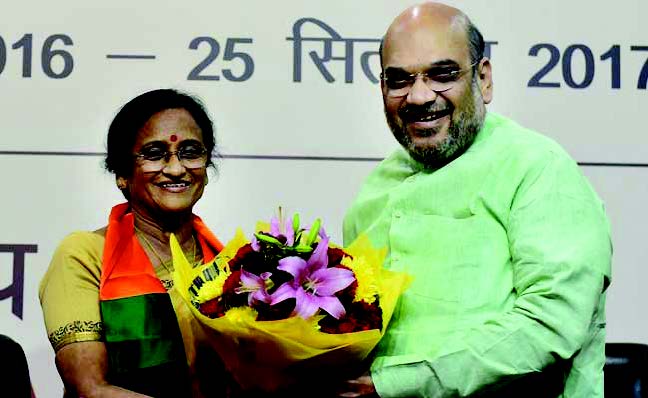
    Joshi, 67, daughter of late Congress leader Hemvati Nandan Bahuguna, joined BJP in the presence of party chief Amit Shah at the party headquarters here. Joshi, who also gave up her membership of the UP assembly, said there is no alternative to PM Narendra Modi and BJP. Her unhappiness with the Congress leadership is understood to have deepened following the projection of veteran leader Sheila Dikshit as the CM nominee in UP. She said Congress is in such bad shape that it has outsourced its functioning to poll strategist Prashant Kishor. Slamming Rahul Gandhi for his `dalali’ barb, Joshi said, “India is fighting terrorism and the Modi government has given the Army a free hand. Besides valour of the Army, the government’s strong leadership was also behind the surgical strikes.

    Noting that she had spent 24 years out of 27 years of her political career in Congress she said, “The decision to quit Congress was not easy . However, I took it in the interest of the nation and the state (UP).”

  • Punjab sends proposal to Centre for setting up STF to keep vigil on borders

    Punjab sends proposal to Centre for setting up STF to keep vigil on borders

    LUDHIANA (TIP): Punjab’s Deputy chief minister Sukhbir Singh Badal on Thursday said that a proposal has been sent to Centre for setting up a Special Task Force for keeping vigil on the borders to stop inflow of the drugs.

    “We have sent the proposal to the Centre,” Badal said while speaking on the sidelines of a function here.

    Notably, opposition Congress and AAP have made drug menace an issue in Punjab ahead of the assembly polls in the State, which are due early next year.

    Meanwhile, Sukhbir Singh Badal on Thursday set the tone for the celebrations of the 50th anniversary of the ‘Punjabi Suba’. A book titled ‘Dhart Punjab’ was also released which chronicles the cultural, economic and social traditions and environment of Punjab.

    Sukhbir Badal also eulogised the role played by Punjabis in the country’s freedom struggle.

    He said that Punjabi Suba was formed after enormous struggles and sacrifices but even at that time the state was discriminated against allegedly by then Congress government at the Centre.

    He further said that despite this, Punjab marched ahead on the road to prosperity especially under the SAD-BJP government. Lashing out at Punjab Congress President Captain Amarinder Singh, the Deputy chief minister said that the opposition leader was misleading people by making “false promises” of waiving off debt of the farmers. He also said that Captain Amarinder should give an affidavit in the court that he would sell his whole property including palace in Patiala if he fails to waive off the debt in case his party comes to power. Source: PTI

  • After the surgery:  BJP’s chest-thumping comes at a cost

    After the surgery: BJP’s chest-thumping comes at a cost

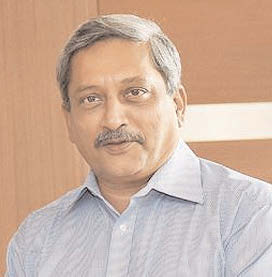
    Defense Minister Manohar Parrikar is not someone who holds himself back for long. His remarks in Mumbai on the Indian army’s post-Uri surgical strikes yielded several indicators. The government will milk the successful, nil-casualty army operation for all it is worth. After the statutory homage to the armed forces, the Defense Minister indicated why an operation like this must have been in the works. Three attacks had dented the Prime Minister’s strong man image and the constituency that vociferously backs him was thirsting for the kind of revenge promised in the run-up to the parliamentary elections. “The major share for the credit goes to the Prime Minister for decision-making and planning,” Parrikar had observed.

    Parrikar made the statutory denial about reaping political mileage. But the surgical raids have come as oxygen for the government. This was clear from Parrikar’s hagiographic positioning of Modi in the entire episode, the BJP’s massive hoardings thanking Modi for the strikes and the Prime Minister himself promising that this Ussher was a “very special occasion for the country”. In the by-now familiar good cop-bad cop routine, Modi refrained from commenting on the strikes during his Ussher address in Lucknow. He instead opted for coded references, symbols of political Hindutva and battle cries of communal mobilization. This left the audience in no doubt about the identity of the targeted “other” in the elections to the UP assembly.

    However, the army action may not have a long political shelf life. In Punjab, the BJP-Akali Dal faces 10 years of anti-incumbency. The fiasco of evacuating all border villages may have neutralized the advantage of the surgical strikes. Kashmir, the cause of the trouble since Burhan Wani was shot dead, does not buy into this discourse at all. A different narrative is required to put an end to three months of curfew, encounters and mass vandalism. There is little doubt that adroit packaging has helped New Delhi shore up its core constituency. But it cannot continue to trivialize the pain and aspirations of the people of Kashmir. This chest-thumping will affect efforts to turn around the situation in the Valley.

  • Saffron leaders push for Ram Mandir before UP polls

    Saffron leaders push for Ram Mandir before UP polls

    MUMBAI/NEW DELHI (TIP): The Shiv Sena asked the Narendra Modi government on Oct 13 to start constructing the Ram Temple at the disputed site in Ayodhya, joining other pro-Hindut va leaders in ra king up the contentious issue ahead of assembly polls in Uttar Pradesh.

    An editorial in the Shiv Sena mouthpiece Saamana said the BJP was well placed to settle the issue. “If the temple cannot be built today, it will never be built,” the Sena said.

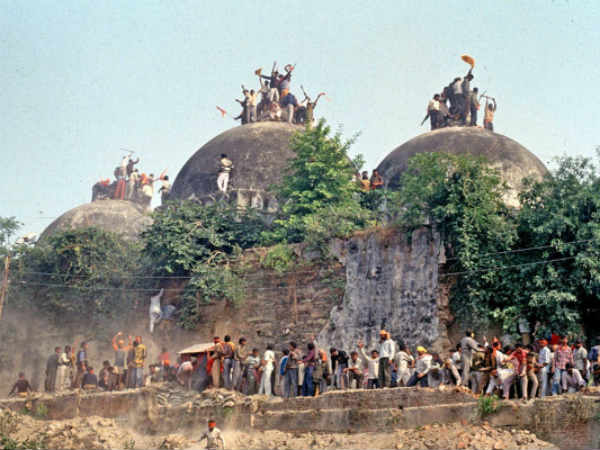
    The Sena comments followed B JP parliamentarian Sub ram an ian Swamy and firebrand Vishwa Hindu Parishad leader Praveen Toga di a prod ding the government on temple construction at the site where the historic Babri mosque was demolished by a Hindu mob on December 6, 1992.

    The Sena’s stand on the temple is seen as an attempt to woo hardline Hindu voters in the state where it plans to expand its presence by fielding candidates in 200 constituencies despite failing to win a single seat in 2012.

    The BJP is attempting to capture power in UP where it has been out of power for 14 years.

    However, the party has so far taken a neutral stand apparently in a bid to not antagonise the sizeable Muslim voters.

    “There has been plenty of politics over the Ram mandir issue. Now, decide once and for how long you want to go on politicising it… Don’t just raise slogans, start picking up bricks,” the Sena mouthpiece said, taunting Modi by pointing out that his own constituency was in the state.

    In an interview to a TV channel on Wednesday, Swamy said Ram mandir will be a crucial issue in the UP elections.

    “If we don’t raise it in UP, then where will we raise it? It is on our manifesto and will definitely be our main focus,” Swamy was quoted as saying.

    After Modi chanted ‘Jai Shree Ram’ in Lucknow’ on Tuesday, To g adia asked the Prime Minister to build the temple.

    BJP leaders, however, remained non-committal.

    “We appreciate the emotions and faith in Ram mandir and even (the) BJP manifesto is a reflection of that faith and emotion. However, being a responsible government, we have to follow the Constitution, which says either though discussion or court,” BJP secretary Sidharth Nath Singh said.

  • PM Modi profiteering from blood spilt by soldiers, says Rahul

    PM Modi profiteering from blood spilt by soldiers, says Rahul

    NEW DELHI (TIP): Congress vice-president Rahul Gandhi on Oct 6 unleashed a blistering attack on Prime Minister Narendra Modi, accusing him of “profiteering” from the soldiers who have given their blood for the nation.

    “Aap kar kya rahe ho jo hamare jawan hain, jinhone khoon diya hai, jinhone Jammu and Kashmir mei apna khoon diya hai, jinhone Hindustan ke liye surgical strike kiya hai, unke khoon ke peeche aap chhupe huye ho. (What are you (PM) doing? Our soldiers have given their blood in Jammu and Kashmir, carried out surgical strikes for India, you (PM) are hiding behind their blood),” he said.

    “Aap unki dalali kar rahe ho. Ye galat hai (PM is profiteering from the soldiers. This is wrong.),” Gandhi said, winding up his 26-day Kisan Yatra across poll-bound Uttar Pradesh in Delhi.

    Gandhi’s remarks came six days after he had praised the PM over the surgical strikes on terror launch pads across the Line of Control (LoC).

    “I want to thank him (PM) because for the first time in two-and-a-half years he has taken an action that is of the stature of PM,” he had said while addressing a public meeting at Bulandshahr in Uttar Pradesh.

    This was a rare occasion when Gandhi publicly praised Modi. But on Thursday evening, Gandhi was in an attacking mode.

    “The Indian army has done its job for the country, you do yours now. Increase their (soldiers) pay in the 7th pay commission,” he told the PM.

    Reacting shar ply to the Congress leader’s comment, BJP secretary Sidharth Nath Singh said, “Rahul Gandhi’s statement is a new low in Indian politics. It is not only condemnable but highly irresponsible coming from a vice-president of the Congress party which fought for Independence. It also proves that what Sanjay Nirupam had said two days back had Rahul Gandhi’s backing and, therefore, no action has been taken against him. Congress and other political parties may be nervous because of courage and will power shown by Modi government in backing armed forces’ decision to go for surgical strikes across LoC… Rahul Gandhi has done surgical strike on his party.”

    The much-publicised Indian army operation across the LoC is turning into a political slugfest, with the opposition asking the Modi government to furnish evidence to call “Pakistan’s bluff ”. Upcoming elections in five states, including Uttar Pradesh, Uttarakhand and Punjab, are widely believed to be the reason why the opposition parties are asking for proof but couching it as a must to quash Pakistan’s propaganda.

  • HOME MINISTRY ASKS OFFICERS TO RETURN CARS, GUARDS WITHIN A MONTH OF RETIREMENT

    HOME MINISTRY ASKS OFFICERS TO RETURN CARS, GUARDS WITHIN A MONTH OF RETIREMENT

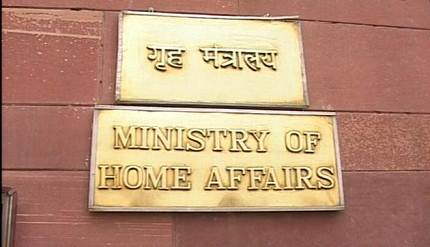
    NEW DELHI (TIP): The Union home ministry has said it will take action against police officers who retain personnel at their residences, including guards, and do not return their official vehicles months after their retirement.

    “…Various privileges such as personnel at residences, vehicles, personal security etc should be withdrawn within a period of one month after the retirement of any police official,” the ministry said in a letter to the chief secretaries of all states and heads of central police organisations.

    According to the ministry, such incidents create a wrong impression in the public mind and are also against the basic decorum and discipline of government service. It said if any retired police officer is to be provided security, it should be on the basis of a specific threat assessment.

    “In case, a retired officer fails to follow the instructions, he should be made to pay for various privileges. Similarly, action should be taken against serving officials who do not take timely action to withdraw various privileges mentioned above, from retired officials,” it said.

    The ministry has sought a compliance report in this regard by October 31.


  • First strategic PSU sale in 12 years okayed

    First strategic PSU sale in 12 years okayed

    NEW DELHI (TIP): The Centre has approved a strategic sale in loss-making Bharat Pumps and Compressors Limited. It comes 12 years after a state-run company — Jessop & Company —was last sold through this route.

    The cabinet committee on economic affairs approved “in principle” the strategic sale in the Allahabad-based public sector enterprise, which was set up in 1970.

    Strategic sale refers to transfer of management control and ownership. The Cabinet also approved the closure of Kolkata-based Hindustan Cables Ltd, where pro tan Cables Ltd, where production activity stopped in January 2003. The government will pay voluntary separation package to the employees. Cash infusion for the closure of the company is estimated at Rs. 1,310 crore, according to a government statement. So far, the government has cleared the closure of around half-a-dozen sick PSUs while several more are on the list of companies identified for shutting down as they are difficult to revive.

    Along with this, the government has also revived the process of strategic sale with the last one being undertaken by the Atal Bihari Vajpayee government in 2003-04 when 72% equity in Jessop & Company was sold to Indo-Wagon Engineering for Rs 18.2 crore.

    Since then successive governments have steered clear from strategic sales for fear of triggering controversy over valuation and political and trade union opposition to such sales.

    The Narendra Modi government has vowed to push through strategic sales and expects to raise Rs 20,500 crore from this route in the current financial. The overall target from disinvestment is estimated at Rs 56,500 crore which is lower than the previous year’s target of Rs 69,500 crore.

    The government had entrusted the Niti Aayog to suggest a roadmap for strategic sale in loss making and other state-run firms. The agency has submitted two reports to the government on the issue. The government is also pursuing strategic sales in some state-run hotels as well. It has decided to shut down 15 loss-making public sector units, of which at least six have now been cleared by the cabinet.

  • Pakistan Must Stop Dreaming About Kashmir, Says Sushma Swaraj At UNGA

    Pakistan Must Stop Dreaming About Kashmir, Says Sushma Swaraj At UNGA

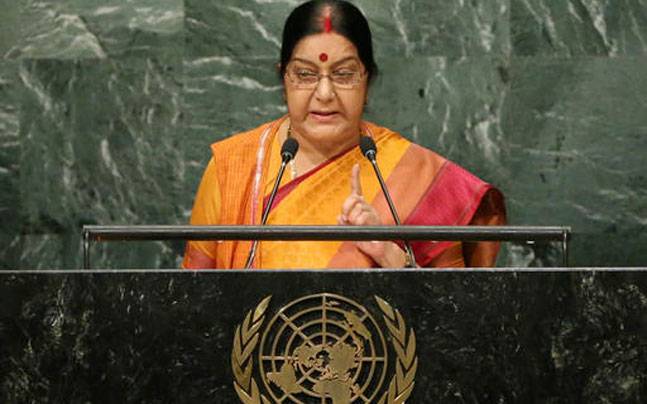
    External Affairs Minister Sushma Swaraj on Monday demanded isolation for the supporters of terrorism.

    While addressing the 71st session of UN General Assembly In New York, Swaraj Said ” We all have to come together to fight the scourge of terrorism, if some country is not willing then it must be isolated”

    ” We need to identify who gives shelter to the terrorists? How are they able to carry out such activities?. We need to uproot terrorism,”she added.

    Here is what all she said at the session:

    We should adopt Comprehensive Convention on International Terrorism to develop norms to prosecute terrorists: EAM Swaraj at UNGA

    Those who seed extr’t ideologies, reap a bitter harvest. This germ of evil has grown into a hydra-headed monster: EAM Sushma Swaraj

    Kashmir is an integral part of India, and will be always. Aap (Pak)sapna dekhna chor dijiye: EAM Sushma Swaraj to Pakistan

    Kashmir is an integral part of India and will remain an integral part of India: EAM Sushma Swaraj

    Humne sharton ke hisaab pe nahi, mitrta ka haath badhaya. Par hume kya mila? Pathankot? Uri? Bahadur Ali?: EAM Swaraj

    Bahadur Ali is a living example of Pakistan’s cross border terrorism: EAM Sushma Swaraj

    Jinke apne ghar sheeshe ke hon unko doosre pe patthar nahi phenkna chahiye, kya ho raha hai Balochistan mein?: EAM Swaraj

    Aatankwaadiyon ko paalna kuch deshon ka shaunk ban gaya hai: EAM Sushma Swaraj in New York

    I am very thankful to the UN for its tremendous support for International Yoga day: EAM Sushma Swaraj

    Sanitation is also a big issue, and we have started ‘Swacch Bharat Abhiyan’ under which 4 lakh toilets are built in 2 lakh schools: EAM

    A year has passed since I stood at this hallowed podium to address members of the international community,so much has changed since then:EAM

    Today the biggest challenge all of us face is the poverty prevalent in all corners of the world: EAM Sushma Swaraj

  • Shoe hurled at Rahul Gandhi

    Shoe hurled at Rahul Gandhi

    Congress Vice President Rahul Gandhi on Monday blamed BJP-RSS after a local hurled shoe at him during a road show.

    Rahul said “BJP, RSS throw as many shoes you want on me, I don’t fear you…I am unaffected by it”

    A shoe was thrown at Congress Vice President Rahul Gandhi during his ongoing ‘Kisan Yatra’ in Sitapur of Uttar Pradesh, police said.

    A youth has been arrested in this connection and taken to the Kotwali police station for interrogation.

    The shoe missed the Gandhi scion by a whisker and he looked back at the shoe as it zipped past him.

    The assailant has been identified as Hari Om Mishra, resident of Hargaon, a police official told IANS.

    Congress leader Jitin Prasada was with Gandhi at the time of the attack.

    Special Protection Group (SPG) men swung into action and surrounded the Congress leader after the shoe attack.

    Mishra told policemen that he was angry at the promises being made by Rahul Gandhi during his road shows as he believed the Congress was behind the problems faced by farmers. Gandhi started his ‘Kisan Yatra’ on Monday after a two-day break.