Tag: BJP

  • FOREIGN RELATIONS OF INDIA

    FOREIGN RELATIONS OF INDIA

    India has formal diplomatic relations with most nations; it is the world’s second most populous country, the world’s mostpopulous democracy and one of the fastest growing major economies. With the world’s seventh largest military expenditure, ninth largest economy by nominal rates and third largest by purchasing power parity, India is a regional power, a nascent great power and a potential superpower.

    India’s growing international influence gives it a prominent voice in global affairs. The Economist magazine argues, however, that underinvestment in diplomacy and a lack of strategic vision have minimised India’s influence in the world. India is a newly industrialised country, it has a long history of collaboration with several countries and is considered one of the leaders of the developing world along with China, Brazil, Russia and South Africa (the BRICS countries). India was one of the founding members of several international organisations, most notably the United Nations, the Asian Development Bank, G20 industrial nations and the founder of the Non-aligned movement.


    32
    India has often represented the interests of developing countries at various international platforms. Shown here is Prime Minister Manmohan Singh with Dmitry Medvedev, Hu Jintao and Luiz Inácio Lula da Silva during BRIC summit

    India has also played an important and influential role in other international organisations like East Asia Summit, World Trade Organisation, International Monetary Fund (IMF), G8+5 and IBSA Dialogue Forum. Regionally, India is a part of SAARC and BIMSTEC. India has taken part in several UN peacekeeping missions and in 2007, it was the secondlargest troop contributor to the United Nations.[12] India is currently seeking a permanent seat in the UN Security Council, along with the G4 nations. India’s relations with the world have evolved since the British Raj (1857–1947), when the British Empire monopolised external and defence relations. When India gained independence in 1947, few Indians had experience in making or conducting foreign policy. However, the country’s oldest political party, the Indian National Congress, had established a small foreign department in 1925 to make overseas contacts and to publicise its freedom struggle.

    From the late 1920s on, Jawaharlal Nehru, who had a longstanding interest in world affairs among independence leaders, formulated the Congress stance on international issues. As a member of the interim government in 1946, Nehru articulated India’s approach to the world. India’s international influence varied over the years after independence. Indian prestige and moral authority were high in the 1950s and facilitated the acquisition of developmental assistance from both East and West. Although the prestige stemmed from India’s nonaligned stance, the nation was unable to prevent Cold War politics from becoming intertwined with interstate relations in South Asia.


    33

    In the 1960s and 1970s India’s international position among developed and developing countries faded in the course of wars with China and Pakistan, disputes with other countries in South Asia, and India’s attempt to balance Pakistan’s support from the United States and China by signing the Indo- Soviet Treaty of Friendship and Cooperation in August 1971. Although India obtained substantial Soviet military and economic aid, which helped to strengthen the nation, India’s influence was undercut regionally and internationally by the perception that its friendship with the Soviet Union prevented a more forthright condemnation of the Soviet presence in Afghanistan. In the late 1980s, India improved relations with the United States, other developed countries, and China while continuing close ties with the Soviet Union. Relations with its South Asian neighbours, especially Pakistan, Sri Lanka, and Nepal, occupied much of the energies of the Ministry of External Affairs.

    In the 1990s, India’s economic problems and the demise of the bipolar world political system forced India to reassess its foreign policy and adjust its foreign relations. Previous policies proved inadequate to cope with the serious domestic and international problems facing India. The end of the Cold War gutted the core meaning of nonalignment and left Indian foreign policy without significant direction. The hard, pragmatic considerations of the early 1990s were still viewed within the nonaligned framework of the past, but the disintegration of the Soviet Union removed much of India’s international leverage, for which relations with Russia and the other post-Soviet states could not compensate. After the dissolution of the Soviet Union, India improved its relations with the United States, Canada, France, Japan and Germany. In 1992, India established formal diplomatic relations with Israel and this relationship grew during the tenures of the Bharatiya Janata Party (BJP) government and the subsequent UPA (United Progressive Alliance) governments.

    In the mid-1990s, India attracted the world attention towards the Pakistan-backed terrorism in Kashmir. The Kargil War resulted in a major diplomatic victory for India. The United States and European Union recognised the fact that Pakistani military had illegally infiltrated into Indian territory and pressured Pakistan to withdraw from Kargil. Several anti-India militant groups based in Pakistan were labeled as terrorist groups by the United States and European Union. India has often represented the interests of developing countries at various international platforms. Shown here are Prime Minister Manmohan Singh with Dmitry Medvedev, Hu Jintao and Luiz Inácio Lula da Silva during BRIC summit in June, 2009. In 1998, India tested nuclear weapons for the second time which resulted in several US, Japanese and European sanctions on India.

    India’s then-defence minister, George Fernandes, said that India’s nuclear programme was necessary as it provided a deterrence to potential Chinese nuclear threat. Most of the sanctions imposed on India were removed by 2001. After the 11 September attacks in 2001, Indian intelligence agencies provided the U.S. with significant information on Al-Qaeda and related groups’ activities in Pakistan and Afghanistan. India’s extensive contribution to the War on Terror, coupled with a surge in its economy, has helped India’s diplomatic relations with several countries. Over the past three years, India has held numerous joint military exercises with U.S. and European nations that have resulted in a strengthened U.S.-India and E.U.-India bilateral relationship. India’s bilateral trade with Europe and United States has more than doubled in the last five years.

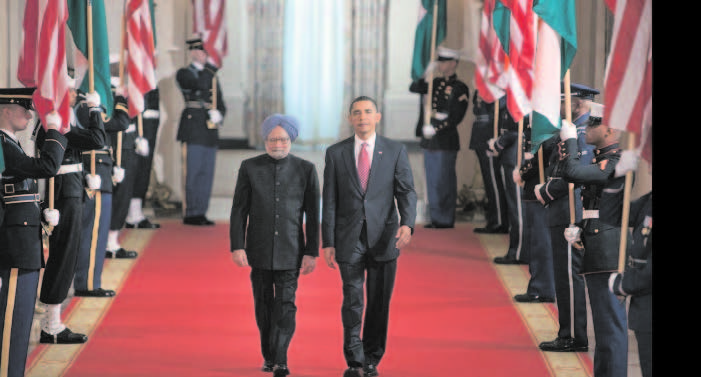
    India has been pushing for reforms in the UN and WTO with mixed results. India’s candidature for a permanent seat at the UN Security Council is currently backed by several countries including France, Russia,[50] the United Germany, Japan, Brazil, Australia and UAE. In 2004, the United States signed a nuclear co-operation agreement with India even though the latter is not a part of the Nuclear Non- Proliferation Treaty. The US argued that India’s strong nuclear non-proliferation record made it an exception, however this has not persuaded other Nuclear Suppliers Group members to sign similar deals with India. During a state visit to India in November 2010, US president Barack Obama announced US support for India’s bid for permanent membership to UN Security Council as well as India’s entry to Nuclear Suppliers Group, Wassenaar Arrangement, Australia Group and Missile Technology Control Regime.

  • CREED GUIDING MATURE REPUBLIC

    CREED GUIDING MATURE REPUBLIC

    Modern societies emerge out of their primitive forms. As India enters its 65th year as a republic, it is not what it used to be for the past several centuries: ruled by kings and nawabs, brutalised by Hindu orthodoxies of caste and sati, or dependent on agriculture.

    “India has changed more in last six decades than in six previous centuries,” said president Pranab Mukherjee on the eve of the Republic Day last year, adding: “It will change more in the next ten years than in the previous sixty.” The motor of change is democracy, or the republic’s politics reaffirmed every five years through the conscious act of voting.

    Democracy refers to demokratia—a political system that began in 5th to 4th centuries BC when the people (demos) of Athens revolted against the dynasties of tyrants and established their own kratos (rule). Over past decades, democracy in India has emerged as a revolt against caste and other social inequalities, empowering millions of dalits, minorities and women.


    19

    India still subjugates its women, but it will change as more than a million women, elected to political nurseries of panchayati raj, are about to alter the balance of gender relations. The Indian republic is a Greek city state in microcosm, whose citizens interact with philosophical concepts every day, acquiring new understandings of liberty and rationality. As it matures, it inculcates egalitarian ideals in its citizens who in turn guard demokratia, the republic’s dharma, or creed. The egalitarian Indian defends the order, defeating Indira Gandhi after the Emergency when democracy appeared to be failing, or producing an Aam Aadmi Party when corruption of an industrial scale emerged.

    The republic is nurtured from below. It just gave Kashmiri secessionists a recurring opportunity to prove their worth through the ballot option of NOTA, none of the above. In primitive societies, consensus emanated from similarities of beliefs and identities; in modern India consensus is derived from differences and moderated by media, political parties, voters, and the judiciary. The voter is the sane oracle, inaugurating an era of coalition politics in 1989 and shifting the polity towards federalism, in tune with the diversity of India. From the post-Emergency rise of anti-Congress parties to the AAP, the republic births new parties. It secures the confidence of minorities.

    According to a BJP research, India has seen the emergence of “smaller Muslim parties” that are determining outcomes in states from Assam to Kerala. Indian polity is ripe where any new party could transform into a countrywide behemoth by practising simple politics: electing leaders through organisational polls. There is space for all, as no party has got 50 per cent votes. In some way, parties are dying, or being obscured, eclipsed and forgotten. The Congress is forgotten in UP, Bihar, West Bengal, Delhi and many states; the BJP was reduced to irrelevance as a national opposition until Narendra Modi rose from below; the Rashtriya Janata Dal was dumped; and demokratia caught up with communists in West Bengal in 2011. It happens due to parties’ failure to abide by the republic’s dharma: more politics, more democracy. Politics has its own independent dignity.

    More parties could thrive if their funds were audited and if they held polls to elect party leaders or used secret ballot to elect chief ministers or Prime Minister. If the Congress practised politics, US-style primaries to elect party leaders could herald a revolution. Among democracies, some are religious states such as Britain whose societies are overwhelmingly secular; some are secular states like the US and India whose societies are predominantly religious. Religious neutrality, established first by Akbar, characterises the Indian state. The founders—Gandhi, Nehru and Ambedkar— wrote an array of liberties into the Constitution: equality of rights, multi-party elections, free press, individual freedoms, rule of law, independent judiciary, etcetera. Speaking at Oxford in 2005, Prime Minister Manmohan Singh noted that the founders were “greatly influenced by the ideas associated with the age of Enlightenment in Europe.”

    The political and religious freedoms Indians enjoy would not be possible if the British hadn’t arrived in India. Democracy is defined as the majority rule, but the majority is of the people, not of communities. For those who feed pessimism among minorities, the day is not far when India will see a Muslim prime minister, as religion will become irrelevant. For now, a Muslim politician is yet to be born who could read the republic’s political mind, the way Barack Obama read the American mind. There are reasons: Muslims must shed the fear of the BJP; the politics of secularism and reservation must be defeated by effective policing and through job creation by people. Primitive societies were dependent on agriculture.

    In a modern nation, while the agricultural output grows, its share in the gross domestic product must decline, accompanied by growth in knowledge sectors like biotechnology and financial services. Once seen by the West as the land of snake charmers, India is transformed into an information technology destination today. However, it is an inward-looking mystical civilisation, failing to grasp notions of power. India contemplated sending troops to Iraq in 2003, but succumbed to a perennial weakness to comprehend its place in the international state system. There were military roles in Bangladesh, Sri Lanka and Maldives that indicate India could exercise hard power abroad. Amid problems, the republic is maturing, aided by the Supreme Court which forced candidates to declare assets and criminal antecedents, disqualified elected representatives upon conviction in criminal cases, and enshrined negative voting through NOTA.

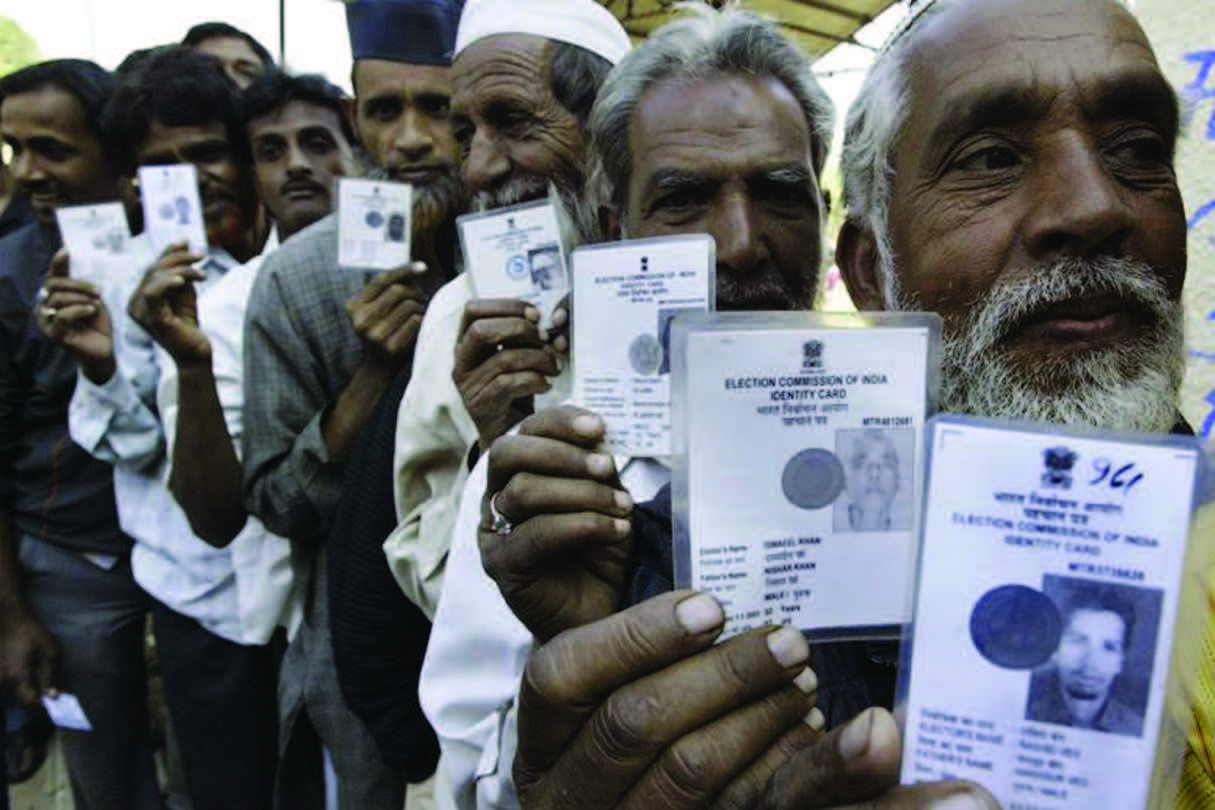
    If T N Seshan alone could retrieve autonomy of the election commission, it appears the Central Bureau of Investigation and other government institutions could cease being the ruling party’s mistress. At the heart of the country’s politics is the sane oracle, the voter: the elderly who walk to polling booths, tribesmen who defy Naxalites to vote, women who stand with men, youth who secure their aspirations in ballots. Of 790 million voters, 120 million are 18-23-yearolds, the first-time voters who must establish a relationship with people, not leaders, to secure the republic for their next generations. (The writer, Tufail Ahmad, is director of South Asia Studies Project at the Middle East Media Research Institute, Washington DC.)

  • Winds of Change

    Winds of Change

    November, 2013 gave a clear idea of which way the political wind in India was blowing. The rout of Congress in Delhi and Rajasthan; and its rejection by the electorate in Madhya Pradesh and Chhattisgarh indicated the loss of popularity of the party.

    Without going in to details of causes for the decline in popularity of a party that had managed to rule the center for almost 10 years at a stretch, it can now be said that the grand old party is tottering. The latest India Today Group’s Mood of the Nation opinion poll indicates huge losses for the Congress led UPA.

    The BJP led National Democratic Alliance (NDA) has been found to make significant gains. The projections are it could win 200-odd seats if the general elections were held in January 2014, the findings of the poll say. The opinion poll gives the Congress-led United Progressive Alliance (UPA) only around 100 seats, down by over 150 seats in the current Lok Sabha.

    It also underlines the significance of a possible Third Front in the forthcoming Lok Sabha election as the non-UPA, non- NDA parties and Independents are expected to win 220- odd seats. The NDA thus crosses the 200-mark for the first time since 2010. Both, the NDA and the likely Third Front, gain substantially in numbers and vote share at the cost of the Congress led UPA. The opinion poll suggests that the NDA’s vote share of 34 per cent will be significantly more than the UPA’s 23.

    However, the others will have the maximum vote share of 43 per cent. The scenario is frightening. The BJP emerges as the single largest party and yet it will not be able to form a government on its own. With its alliance partners, Shiv Sena, SAD and a few others, too, that form NDA, a government led by BJP does not appear in sight. The “others” are disparate groups. They cannot be expected to cobble together a government even though they will together be the largest group, according to the results of the poll. What happens then? Horse trading and unholy alliances will prevail. What happens then? Another round of misrule. Another five years of suffering for the common man. The writing is on the wall.

  • Congress poll strategy: Rahul eyes ‘sandwiched class’

    Congress poll strategy: Rahul eyes ‘sandwiched class’

    NEW DELHI (TIP): Not rich, notmiddle class, not BPL, is quite a mouthful. But shrunk to NRMB, the acronym stands for 70 crore Indians tagged by Rahul Gandhi as a vibrant vote bank sandwiched between poverty and middle class status.

    Congress is busy devising poll hooks for this section that party strategists feel can be welded into a powerful support base that aspires to be middle class but is acutely vulnerable to economic and political shocks. Speaking at the Congress plenary last week, Rahul Gandhi pledged concrete measures for “daily wagers, painters, builders, carpenters, farm labour and street vendors”, a section above the poverty line but often only just.

    The number crunching leading to the 70 crore estimate rests on assuming Rs 1000 per person per month as the threshold for poverty, in line with the official poverty line – currently under review —at Rs 960 a month. Having coined the acronym NRMB, the Congress backroom calculates those earning between Rs 1000 to Rs 15,000 fit the bill for Rahul’s definition of incomes susceptible to even minor flux like illness of an earning member or economic change.

    Based on these benchmarks, the BPL population is pegged at 36 crore and the middle class, assuming Rs 1 lakh per person a month as a cut off, is around 16 crore. Of these, the rich, largely immune to inflation, are seen to number 50 lakh. Congress’s manifesto, currently in the works, is expected to flesh out Rahul’s lengthy reference to NRMBs, an acronym that has gained salience in the party back room.

    Congress sources argue that it is the in-between NRMBs who need most attention as the BPL have schemes like rural employment guarantee and food security while the middle class benefit most directly from liberalization. Rahul’s target is to mobilize the support of a section that the party sees as a vote that could be lured by BJP leader Narendra Modi’s promise of a “better tomorrow” comprising higher incomes, more jobs and housing. Interestingly, Modi has also spoken of a “neo middle class”, with stakes in the growth opportunities unleashed by liberalisation and pointedly thanked this section of voters after winning the 2012 Gujarat election.

    A 2012 paper by the center for global development looked at the National Council of Applied Economic Research definition of middle class as two subgroups : “seekers” with annual household income between Rs. 200,000 and Rs. 500,000, and “strivers” with incomes between Rs. 500,000 and Rs. 1 lakh. “Assuming an average household size of 5 people and converting into constant 2005 purchasing power parity (PPP) dollar, these numbers would be about $8 to $20 per capita per day for seekers, and $20 to $ 40 per capita per day for strivers,” the paper says.

    Congress strategists have accepted this premise in the context of the household survey conducted in 2004/2005 that concludes that India’s “middle class” doubled over the last decade, growing from 5.7% of all Indian households in 2001/02 to 12.8%. This corresponds to about 28.4 million households or 153 million people. The large slice of the population below this middle class and above BPL could be a deciding factor in the 2014 election, Congress feels. A conclusion that BJP might reach as well.

  • Akkineni Nageswara Rao is dead: Condolences pour in from across the world

    Akkineni Nageswara Rao is dead: Condolences pour in from across the world

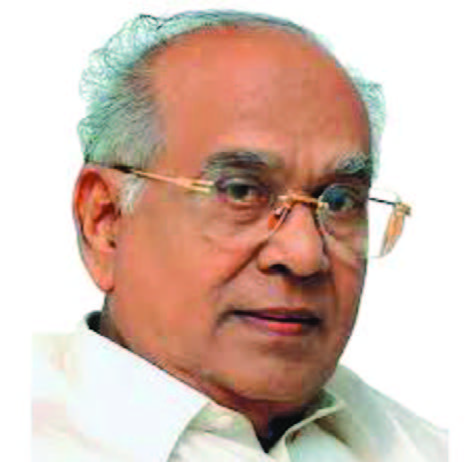
    HYDERABAD (TIP): Legendary Telugu actor and film producer Akkineni Nageswara Rao, also known as ANR, died January 22 in Hyderabad at the age of 90. Dada Saheb Phalke Award winner ANR, who is the father of famous Telugu actor Nagarjuna, had been battling cancer for several months.

    He had in October last year told media that he was diagnosed with cancer and that he would fight it till the end. Nageswara Rao, who recently underwent a surgery for intestinal cancer, is survived by three daughters and two sons. His funeral on January 23 was attended by thousands of grieving admirers.

    The Telugu film industry wants a monument to be constructed for Akkineni Nageswara Rao on the premises of Annapurna Studios which he founded. Paying respect to ANR, Movie Artistes Association (MAA) president M Murali Mohan said it would be appropriate to have a monument near ANR’s museum where his awards are located. “We have made a suggestion to the family about it,” he said. Meanwhile, as a mark of respect, the film industry cancelled all shootings for two days.


    6
    Thousands of grieving admirers of Akkineni Nageswara Rao joined the funeral procession on January 23, 2014

    Mohan said an appeal has also been made to theatre owners to stop screenings and cancel shows on Thursday, January 23. Throughout the day, condolences and praises flooded in for the late actor from his Tollywood and Bollywood colleagues and politicians. Dadasaheb Phalke award winner D Rama Naidu said ANR had always adopted a discipline towards his work and life. “It used to be a pleasure working with him,” he said.

    Union minister for tourism Chiranjeevi said he had met ANR only a couple of weeks ago and spent nearly an hour with him. “I want to hit a century with the best wishes of the people,” ANR reportedly told him. “It is sad that he is no more,” Chiranjeevi said. He also recalled how his mother was a big fan of ANR and how when she was pregnant she wanted to watch a film. “My father was concerned. However, she did go to watch the movie in which ANR had acted,” he said, adding that his mother gave birth to a boy a few days later. “That boy was me,” he reminisced.

    Filmmaker S S Rajamouli said he was “saddened by the news of the legendary Nageswararao garu.” “He stood as a towering father figure for the Telugu film industry. Irreparable loss,” he said. Tributes also poured in from other parts of the country. Veteran actor Amitabh Bachchan tweeted: “Another great iconic legend of cinema passes away this morning: Nageshwar Rao, of Telugu cinema, a most affable considerate human!” Actor Anupam Kher described ANR as “an actor, a gentleman and a cinematic phenomenon”. “Have learnt a lot from him,” he . “He was not just a great artist but a wonderful human being.

    I had the opportunity to meet him four years ago… I had received an award from him. May god bless his soul and I pray for his family,” 84-year-old singer Lata Mangeshkar tweeted. Several political leaders also joined in paying tributes. Gujarat chief minister Narendra Modi described ANR as “one of Indian cinema’s stalwarts who will be remembered for his rich contribution. Saddened by his demise. RIP.” Union minister of state for information and broadcasting Manish Tewari recalled that he had met Nageshwar Rao in Hyderabad last January, describing it as an “inspirational experience”.

    BJP leader Rajnath Singh said Nageshwar Rao’s contribution to Indian cinema would always be cherished. TDP president N Chandrababu Naidu also said he was grieved beyond words at the demise of ‘legend’ ANR. “An era comes to an end. Great actor & a great human being,” he said on a social networking site. Naidu also visited Annapurna Studios to pay tributes to actor. In New York, Rao Anumolu, President, CEO & Founder at ASR International Corporation, a close friend of late ANR, said he was deeply saddened to hear of ANR’s death and that whereas in his death, Telugus had lost a great actor and a fine human being, for him it was the loss of a close friend and end of an era.

  • Opinion poll predicts gains for BJP, losses for UPA

    Opinion poll predicts gains for BJP, losses for UPA

    NEW DELHI (TIP): Despite an apparent wave of Arvind Kejriwal-led Aam Aadmi Party (AAP) till recently, the National Democratic Alliance (NDA) would have won 200- odd seats if the general elections were held in January 2014, the findings of the latest India Today Group’s Mood of the Nation opinion poll suggest.

    The opinion poll gives the Congress-led United Progressive Alliance (UPA) only around 100 seats, down by over 150 seats in the current Lok Sabha. It also underlines the significance of a possible Third Front in the forthcoming Lok Sabha election as the non- UPA, non-NDA parties and Independents are expected to win 220-odd seats.

    The NDA thus crosses the 200-mark for the first time since 2010. Both, the NDA and the likely Third Front, gains substantially in numbers and vote share. The opinion poll suggests that the NDA’s vote share of 34 per cent will be significantly more than the UPA’s 23. However, the others will have the maximum vote share of 43 per cent. Under the leadership of Narendra Modi as its prime ministerial candidate, the Bharatiya Janata Party (BJP) looks all set to become the single largest party as it is also likely to emerge the biggest gainer in the Lok Sabha polls.

    Its 2009 tally of 116 is expected to rise to 188 in 2014, an increase of more than 60 per cent. Congress, under the leadership of its vice-president Rahul Gandhi, might win just 91 seats, as compared to its current tally of 206, a drop of about 55 per cent. The Congress ploy of propping AAP to counter Modi at the national level seems to have a limited impact, as Kejriwal’s gains are restricted to areas around Delhi and a few metro cities only.

    Modi consolidates his position
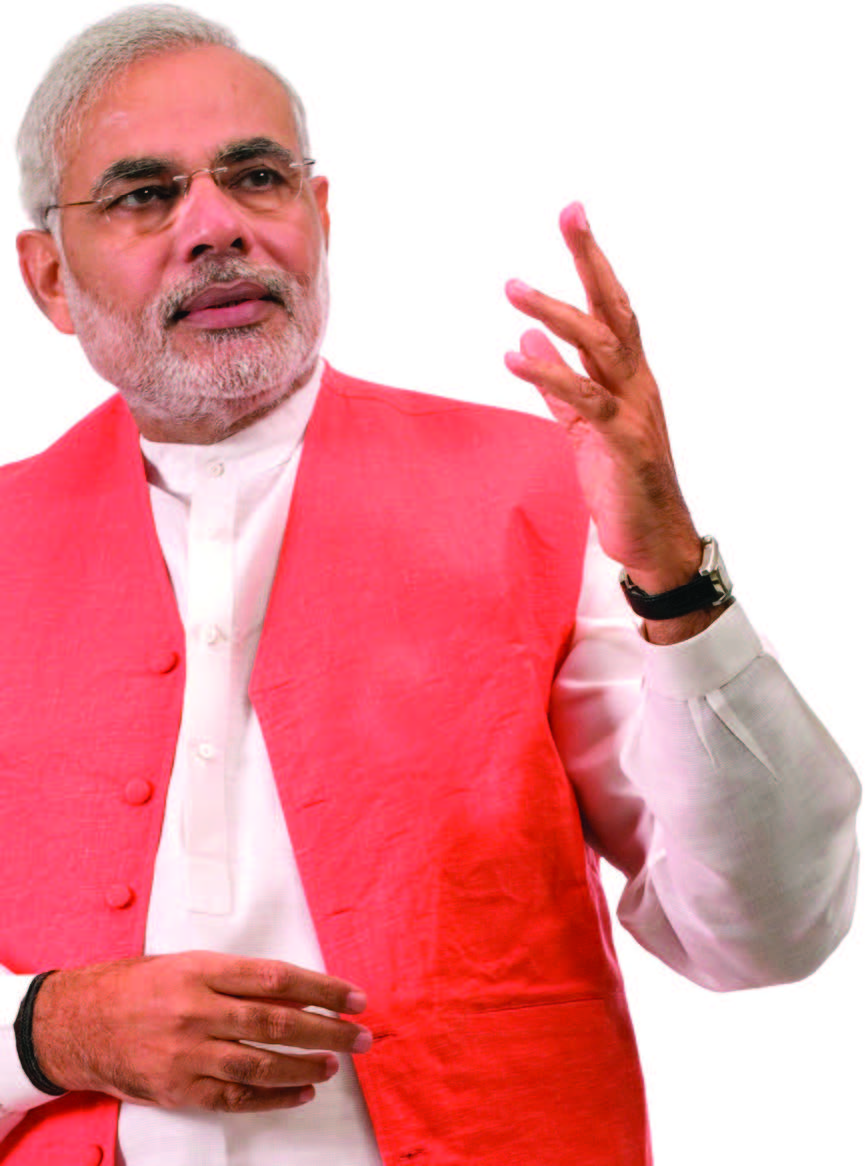
    Modi, who emerged as the strongest leader within his party after the BJP’s hat-trick in Gujarat in December 2012, cemented his position further through strong campaigning across the country. As the party’s lead campaigner in the recently held assembly elections in Madhya Pradesh, Chhattisgarh, Rajasthan and Delhi he consolidated his position further. In the latest India Today Mood of the Nation opinion poll, as many as 47 per cent people voted him as the best prime ministerial candidate against his previous best of 42 per cent polled in August 2013.

    The Gandhi scion was way behind Modi with just 15 per cent votes, followed by Kejriwal with 9 per cent votes and 6 per cent votes each to Prime Minister Manmohan Singh and Congress president Sonia Gandhi. During these five months Modi was also able to improve his image from being a communal leader to being pro-development. To a question “what does Modi represent”, the option “communalism” saw a drop of 11 per cent from 18 per cent in August 2013, while “economic development” increased by 6 per cent to 30 per cent. The number of people thinking Modi should apologize for the 2002 Gujarat riots also fell drastically during this period to 39 per cent from the previous figure of 51 per cent.

    Modi as a role model
    The Gujarat chief minister emerged as a role model for the highest 17 per cent respondents, a gain of as much percentage as nobody earlier saw him as one among the overall personalities of India. Modi was followed by Kejriwal with 14 per cent votes, up from 2 per cent. Bollywood superstar Salman Khan too saw a big jump in his popularity as 10 per cent people saw him as a role model, up from the previous 1 per cent, followed by legendary singer Lata Mangeshkar’s 9 per cent against 2 per cent in the earlier opinion poll.Veteran anti-corruption activist Anna Hazare’s position as a role model remained unchanged with 7 per cent votes.

  • No PM Candidate: Rahul to lead Election Campaign

    No PM Candidate: Rahul to lead Election Campaign

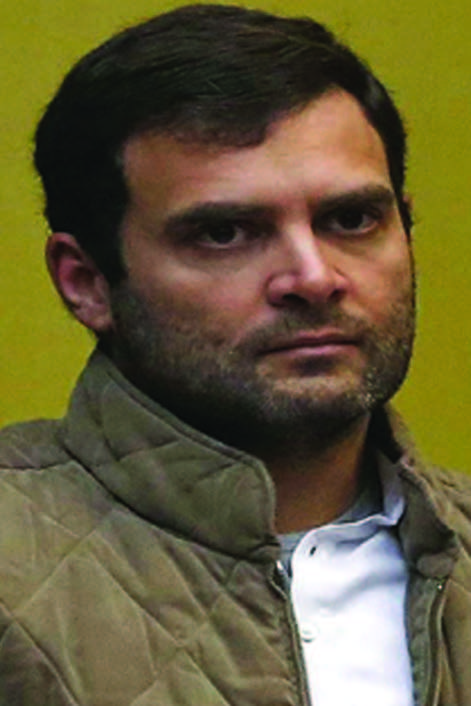
    NEW DELHI (TIP): Despite a majority of leaders at the Congress Working Committee meet pushing for Rahul Gandhi to be made the party’s prime ministerial candidate, the party demurred from the decision and instead decided to appoint him the poll campaign chief. “We had one major resolution that has to be passed tomorrow and all the issues in it were discusses…The Congress President and Vice President placed their views on the resolution,” Congress spokesperson Janardan Dwivedi told reporters, refusing to disclose all its contents.

    “Many of the members in the CWC wanted that he (Rahul) should be made the Prime ministerial candidate but after some debate Congress president Sonia Gandhi intervened,” he said. “She said that there was no such tradition in the Congress. If someone declares their PM candidate it doesn’t mean that we have to do the same,” Dwivedi said. He said that Sonia had endorsed making Rahul Gandhi the head of the party’s campaign in the upcoming elections. “The resolution in today’s meeting says: ‘This meeting of the AICC declares that the campaign of the elections will be headed by Rahul Gandhi’,” he said. Rahul Gandhi said that he would do everything to strengthen the party and that he would do anything that the party sought of him, Dwivedi said.

    “Rahulji said the decision on other matters will be taken at the appropriate time,” he said. Sources said that Rahul had himself said that he didn’t want to be the party’s prime ministerial candidate and was backed by the top brass of the party on his decision, including by Sonia Gandhi. The Congress leader is to be appointed the party’s poll committee chief at the AICC meet tomorrow, thus making him the face of the party’s campaign, but not pitting him in a direct race against the BJP’s Narendra Modi. In a recent interview, Rahul had said that he was willing to accept any responsibility for the party which had been interpreted by some as saying he was set to be the party’s prime ministerial candidate.

  • No PM Candidate: Rahul to lead Election Campaign

    No PM Candidate: Rahul to lead Election Campaign

    NEW DELHI (TIP): Despite a majority of leaders at the Congress Working Committee meet pushing for Rahul Gandhi to be made the party’s prime ministerial candidate, the party demurred from the decision and instead decided to appoint him the poll campaign chief. “We had one major resolution that has to be passed tomorrow and all the issues in it were discusses…The Congress President and Vice President placed their views on the resolution,” Congress spokesperson Janardan Dwivedi told reporters, refusing to disclose all its contents. “Many of the members in the CWC wanted that he (Rahul) should be made the Prime ministerial candidate but after some debate Congress president Sonia Gandhi intervened,” he said.

    “She said that there was no such tradition in the Congress. If someone declares their PM candidate it doesn’t mean that we have to do the same,” Dwivedi said. He said that Sonia had endorsed making Rahul Gandhi the head of the party’s campaign in the upcoming elections. “The resolution in today’s meeting says: ‘This meeting of the AICC declares that the campaign of the elections will be headed by Rahul Gandhi’,” he said. Rahul Gandhi said that he would do everything to strengthen the party and that he would do anything that the party sought of him, Dwivedi said. “Rahulji said the decision on other matters will be taken at the appropriate time,” he said.

    Sources said that Rahul had himself said that he didn’t want to be the party’s prime ministerial candidate and was backed by the top brass of the party on his decision, including by Sonia Gandhi. The Congress leader is to be appointed the party’s poll committee chief at the AICC meet tomorrow, thus making him the face of the party’s campaign, but not pitting him in a direct race against the BJP’s Narendra Modi. In a recent interview, Rahul had said that he was willing to accept any responsibility for the party which had been interpreted by some as saying he was set to be the party’s prime ministerial candidate.

  • RAMDEV TWEAKS TAX PROPOSAL, SUGGESTS AMNESTY

    RAMDEV TWEAKS TAX PROPOSAL, SUGGESTS AMNESTY

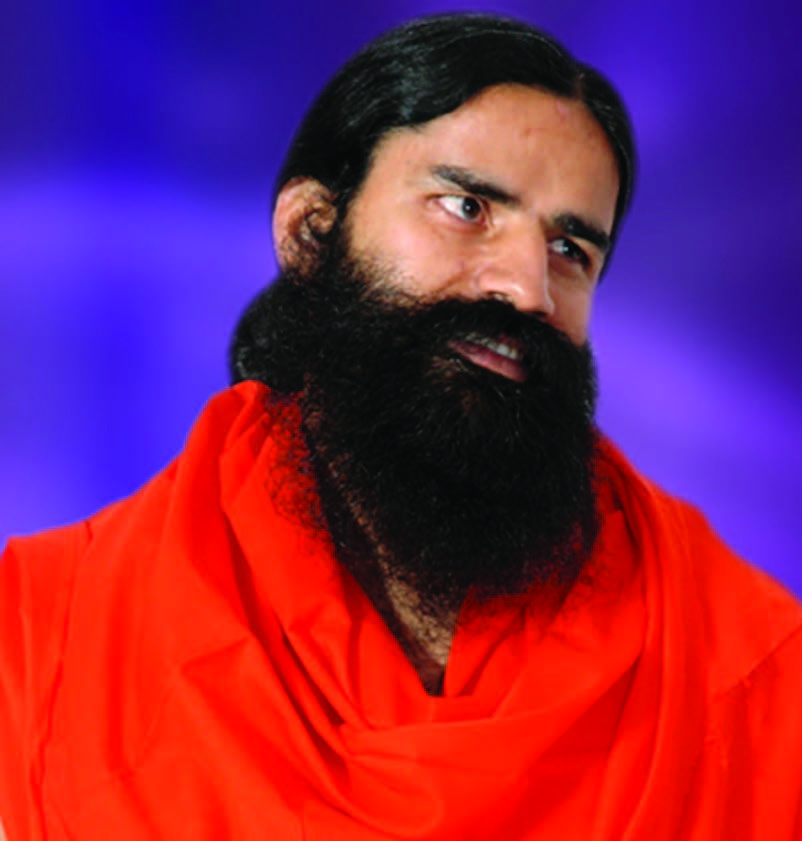
    NEW DELHI (TIP): With mounting criticism over the proposal to introduce a tax on bank deposits and abolish all other levies, yoga guru Baba Ramdev, who is one of the key proponents of the new regime, on Thursday tweaked the plan and suggested separate slabs for salaried as well as industries, while suggesting a tax amnesty scheme as a pre-cursor. Suggesting that the reform proposal will take a year, “provided there is political will”, Ramdev said that in the first phase the government will need to develop banking infrastructure, do away with currency notes of Rs 500 and Rs 1000 and also introduce a tax amnesty scheme, something that the Supreme Court has frowned upon.

    Although he recognized that getting states on board may be a tough task, he suggested that states and the Centre should get 40% each of the mop up, while local bodies will have a share of 18-19% and the rest will go to banks that collect the tax. Ramdev said that his proposal is different from the one being pushed by ArthaKranti, a Pune-based think tank, which has suggested a 2% levy. “You need slabs for it to be successful and equitable. The tax rate can be 0.1 or 0.2% to 30%, with a higher levy on alcohol and tobacco and an exemption for farmers and labourers,” he said in a bid to deal with criticism from BJP leaders like Arun Jaitley. Some BJP leaders had initially backed the proposal to move to a new tax regime, but have now backed out saying that the proposal is flawed.

  • UK GOVT ORDERS PROBE INTO ‘BRITISH HAND’ IN OPERATION BLUE STAR

    UK GOVT ORDERS PROBE INTO ‘BRITISH HAND’ IN OPERATION BLUE STAR

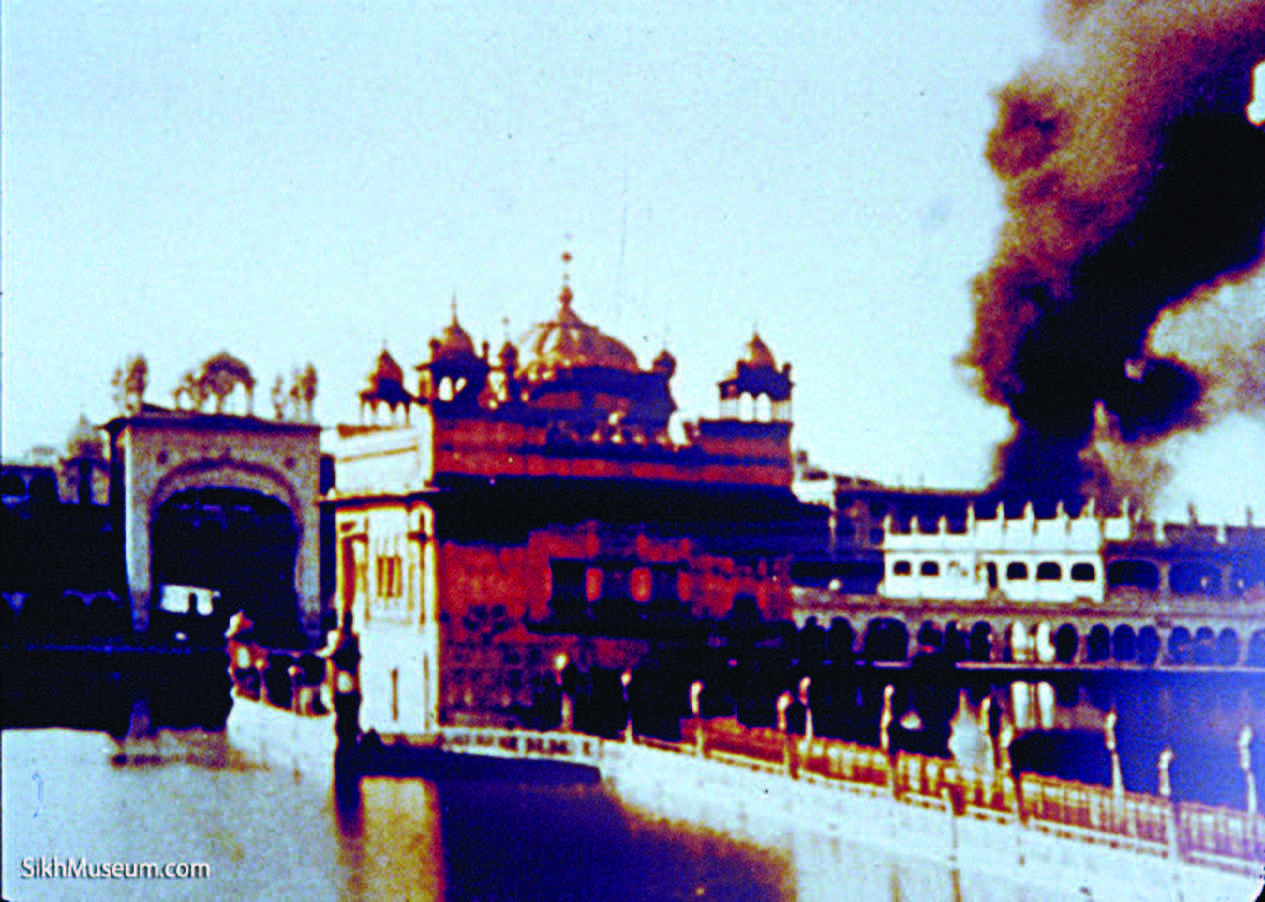
    NEW DELHI (TIP): Three decades after the Army stormed the Golden Temple, freshly declassified British documents show that the UK gave military advice to India on retaking the temporal seat of Sikhs, kicking off political storms in both London and New Delhi. The British government has ordered an inquiry into the revelations and the BJP has demanded an explanation. Intelligence officials involved in operations against Sikh extremists in Punjab during the period and military commanders who led Operation Blue Star have denied using any British plan. They said as far as they were concerned, the entire operation was planned and executed by the Indian Army. Lt Gen K S Brar, who headed the 1984 military operation, said he was not aware of any such British involvement. “As far as I am concerned, Operation Blue Star was planned and executed by Indian Army commanders.

    There was no involvement of anyone from the British government,” he told a TV channel. The bloody and heavily criticized operation led to the assassination of then PM Indira Gandhi in October 1984, which was followed by anti- Sikh riots that saw hundreds being butchered. The revelation is contained in a series of letters declassified recently by the National Archives of UK after the 30-year secrecy rule. In an official communication dated February 23, 1984 titled ‘Sikh Community’, an official with the foreign secretary told the private secretary to the home secretary that “the foreign secretary wishes him to be made aware of some background which could increase the possibility of repercussions among the Sikh communities in this country”. “The Indian authorities recently sought British advice over a plan to remove Sikh extremists from the Golden Temple in Amritsar.

    The foreign secretary decided to respond favourably to the Indian request and, with the prime minister’s agreement, a SAD (probably misspelling SAS) officer has visited India and drawn up a plan which has been approved by Mrs Gandhi. The foreign secretary believes that the Indian government may put the plan into operation shortly,” the letter said. The letter went on to say that the visit of the British special forces officer from SAS was kept a secret in both London and New Delhi. It also expressed apprehension that if the British advice were to emerge in public, it could increase tension in the Indian community in Britain. However, there is no evidence in any of the communication if the British plan was finally used for the June 1984 operation.

    In London, the UK government said it will investigate its involvement. “These events led to a tragic loss of life and we understand the very legitimate concerns that these papers will raise. The prime minister has asked the cabinet secretary to look into this case urgently and establish the facts,” a UK government spokesperson said in a statement. Labour lawmaker Tom Watson said the documents suggest that “Margaret Thatcher made a decision in secret without telling the British parliament to provide military planning support to the government of India in the buildup to the raid on the Golden Temple”.

    ‘Thatcher backed Indira after Operation Bluestar’
    Former Prime Minister Margaret Thatcher fully supported Indira Gandhi’s efforts to apply the ‘healing touch’ in the aftermath of Operation Bluestar in 1984 and assured her of steps to deal with pro-Khalistan elements operating in Britain at the time. Gandhi wrote to Thatcher on 9 and 14 June 1984 (Operation Bluestar ended on 10 June). The letters were about Sri Lanka and developments in trouble-torn Punjab. Her 14 June letter to Thatcher was specifically about Punjab.

    In her reply, Thatcher wrote on 30 June 1984: “These have been anxious weeks for you, involving difficult decisions. I have followed closely your efforts to restore calm there, and I very much hope that the ‘healing touch’ for which you have called will open the way to a peaceful and prosperous future for that troubled region”. Thatcher’s reply sent by telegram to New Delhi is among several documents de-classified and released by National Archives here.

    They include controversial documents of February 1984 that suggest that India sought, and Thatcher agreed to provide, advice from Britain’s special forces to flush out Sikh militants from the Golden Temple. Thatcher’s 30 June letter to Gandhi reflects the close relationship between the two leaders. Gandhi had raised concerns in her letter about pro-Khalistan elements operating from Britain and the effect of their activities on the tense situation in India.

  • Vasundhara Raje’s austerity measures to give competition to AAP govt

    Vasundhara Raje’s austerity measures to give competition to AAP govt

    JAIPUR (TIP): Delhi’s Aam Aadmi Party government’s roadside public hearings, austerity drive and brushing aside VIP culture has some serious competition coming from neighbouring Rajasthan’s Vasundhara Raje government. After deciding to cut down her security detail by half, not moving to the designated chief minister’s house and stopping at traffic lights, Vasundhara Raje now wants ministers and officials to go down the same route. District collectors, SPs and ministers have been directed accordingly at the Collectors and SP’s conference in Jaipur.

    State Health Minister Rajendra Singh Rathore said, “Definitely these are the times of the ‘aam aadmi’ and he has contributed in a big way in getting the Rajasthan government such a huge majority which is why its an ‘aam aadmi’ government.” The officials have been asked not to use police escort, not to keep a second official car, not to use the services of office staff, cooks etc at their homes and stay away from hosting meals at five star hotels at government expense. Most importantly miniaters are asked to listen to the ‘aam aadmi’ and redress their issues on priority.

    Not just officials but two Cabinet ministers have been directed to hold public hearing at the BJP office on a daily basis. Even though the BJP government is working on the lines of AAP, they have dismissed the charge that its working under AAP’s pressure. State Food and Civil Supplies Minister Hem Singh Bhadana, who took oath two weeks before AAP government, said, “AAP is following us and its not the other way round.” The AAP factor’s effect in the Vasundhara government’s governance is only obvious in the run up to the Lok Sabha polls but the aam aadmi is asking is if this is just a seasonal symbolism or is the government genuinely looking to cleanse the system.

  • TERRORISTS STRIKE AGAIN

    TERRORISTS STRIKE AGAIN

    On October 27, a series of bomb blasts rocked Patna at a massive election rally for BJP’s prime ministerial candidate Narendra Modi at Gandhi Maidan. Of the estimated 3,00,000 present at the “Hunkar” rally, six people were killed and many were injured. Investigations point to the role of the Indian Mujahideen. Earlier on July 7, a series of ten bombs exploded in and around the Mahabodhi Temple complex, a UNESCO World Heritage Site in Bodh Gaya.

  • THE INDIA STORY

    THE INDIA STORY

    Eye-watering onion prices set inflation rate soaring; the rupee also slid to new low before stabilizing. Reversing its bad run, the sensex at the end of the year surged to new highs buoyed by the BJP’s performance in recent state polls. Meanwhile, the appointment of Raghuram Rajan as RBI governor led to high expectations; he, however, has warned he does not have a magic wand to curb inflationary pressure. stabilize the rupee and at the same time spark a revival in economic growth.

  • Cultural Organizations or Trojan Horses?

    Cultural Organizations or Trojan Horses?

    The author finds fault with cultural organizations who dabble in politics. In fact, US administration will do well to screen these organizations who, if allowed to have their own way, may pose a threat to security of the US nation. A thorough overhaul of the mechanism for formation and functioning of these organizations is the need of the hour.

    In ordinary times, a U.S. House resolution ( 417) that calls for ‘reaffirming the need to protect the rights and freedom of the religious minorities while praising India’s rich religious diversity and commitment to tolerance and equality’, may not have ruffled any feathers let alone garnered some media attention. However, in a surprising twist, emotions were flying high over the move by the US lawmakers with some of the national and local Indian organizations that are quite active on the Capitol Hill in lobbying for various causes back in India.

    In particular, the Hindu American Foundation (HAF) and the Indian American Muslim Council (IAMC) are at loggerheads over this resolution that may not bode well for the larger interest of India. There is a potential that the ongoing fight might imperil India’s image as well as damage national interests among the US legislators at the Capitol. We have heard of charges and counter-charges by both sides and it is time to examine not only the veracity of these charges but also the propriety of actions undertaken by some of these organizations ‘on behalf of the community’ and ‘for the sake of India’. The recent incident involves a Modi supporter and Chicago-based entrepreneur Shalabh “Shalli’ Kumar who tried to hijack a carefully planned event by the Republican Party to woo Indian Americans to GOP.

    Once the story broke, many organizations and individuals like Mr. Juned Qazi, the Executive Committee member and the President of the Madhya Pradesh Chapter of Indian National Overseas Congress (I) USA wrote to the Republican lawmakers stating that the Republican Party was going against its own fundamental principles and traditions of tolerance and dignity by hosting and promoting such an event. The leaders of the GOP woke up and learned of the nefarious design by Mr. Kumar under the aegis of the National Indian American Public Policy Institute, to promote Narendra Modi and his candidacy for Prime Minister of India in the upcoming election. Mr. Kumar has committed the egregious error – and is probably in violation of the US ethics rules that prohibit the use of the Congressional seal, stationary and indicia – used the House seal and circulated a flyer that indicated Modi would address the meeting via video link. This action orchestrated by Mr. Kumar probably in collusion with other Modi supporters brought shame and disrepute to our community.

    A simplistic view might be that this is an isolated incident. However, if one examines the growth of the Indian Organizations and their activities under cover, a much clearer picture would seem to emerge. NIAPPI is not the first nonprofit organization that engaged in this sort of activity. Many of these organizations are founded to promote cultural or religious activities. To an average Indian American, these are noble objectives and for which they would volunteer their time, efforts and resources to promote the heritage and culture of India in a faraway land. It appears to be rewarding especially when these efforts are directed to educate the younger generations of age-old traditions and customs, and build bridges between the two countries and two cultures. However, some of these organizations seem to be operating under dubious objectives. The US India Political Action Committee (USINPAC), an organization that is dedicated to lobby Congress to promote India’s interest in the US has generally done a credible job promoting US-India relations.

    Their recent intervention on behalf of BJP and Narendra Modi exposes their narrow hidden agenda. A newly issued statement says ‘USINPAC has successfully led a grassroots lobbying efforts in Washington DC to stop the above Resolution from going to the House Floor for a vote. ‘ From now until the National elections in India anticipated in mid.2014, USINPAC will spare no effort in making sure the U.S. Congress does not intentionally or unintentionally influence the outcome of India’s upcoming elections. India is a sovereign nation and its citizens have a right to choose their leaders’ a recent press release stated. Yes, it appears that USINPAC would like to see the election impacted only one way: to assure a Modi victory! Sadly, the organization that is supposed to stand up for the common values and principles both the nations cherish, has decided to throw in their lot with a leader of a party that is no longer welcome in the U.S.

    That also explains the deafening silence on their part when minorities in India fall victims to human rights violations in places like Gujarat. Hindu American Foundation (HAF), is an organization that is said to promote and protect the Hindu philosophy and way of life in U.S. However, lately it has become the lightening rod for the ‘ Hindutva’ agenda. They professes to be ardent supporters of the separation of church and state in US often aligning them with ACLU to fight any Christian symbolism and yet supportive of a supremacist agenda of Rashtriya Swayamsevak Sangh (RSS) that has pushed the Narendra Modi candidacy for the Prime Minister in the upcoming election in India. Dr. Raja Swamy, a spokesperson for the ‘Coalition Against Genocide’ recently commented, “American audiences need to know that HAF and its ilk are rooted in supremacist and majoritarian ideologies. They pay lip service to caste oppression issues and pluralism but have a monoculture and elitist view of the Indian society. They want pluralism and minority rights for themselves here in the US but want minorities, Dalits and women to be second class citizens in India”.

    They ought to examine whether they truly share the same values both these countries are founded upon, freedom, liberty and justice for all. Federation of Indian Associations (FIA), the umbrella organization for various cultural and regional outfits in NY Tristate area was established in 1970’s to bring the community together. Their flagship event is the India Day Parade in New York every August to coincide with India’s Independence Day. If one carefully analyzes these events, the guest lists often include some of those vehemently anti- Congress leaders from India who would participate in the Parade and then go on to do negative propaganda on the UPA Government led by the Congress Party. This year, one of the invitees made the rounds openly promoting Bharatiya Janata Party (BJP). In a nutshell, some of these organizations are carrying on with a stealth agenda to promote the BJP and advance the cause of Narendra Modi. This overt political activity by cultural organizations might be in direct violation of the by-laws or the approved Constitutions and some of them may even be putting their hard-earned tax-exempt status at risk .

    Another disturbing aspect in the Asian Indian public arena is the notion that like some other communities, we could maneuver through the political process using money power to achieve any narrow political objectives from some of the largely unsuspecting and often naïve political leaders in this country. Shalli Kumar’s action is a prime example of such behavior. Two top members of a US Congress constituted commission on religious freedom have recently expressed sadness over nomination of Gujarat Chief Minister Narendra Modi as BJP prime ministerial candidate, terming him as the ‘poster boy’ of India’s failure to punish the violent. “It was another son of Gujarat, Mahatma Gandhi, who once offered a broad, tolerant vision for the country and its multireligious society” wrote Katrina Lantos Swett and Mary Ann Glendon in an Op-ed to CNN. It is a known fact the Gujarat’s High Court rapped Modi for inaction and ordered compensation for religious structures that suffered damage. In 2005, the U.S. State Department agreed with United States Commission for International Religious Freedom (USCIRF) and others and revoked Modi’s visa. It is time to ask a pertinent, albeit rhetorical question to many of these organizations that are acting as Trojan Horses on behalf of Modi: would these USbased organizations support for example, a Chris Christie Candidacy for Presidency if he is to show the same ‘inaction’, as Modi did in 2002 for not protecting the lives and properties of all Indians alike who live in New Jersey?

  • BJP WINNER, CONG ZERO, AAP HERO

    BJP WINNER, CONG ZERO, AAP HERO

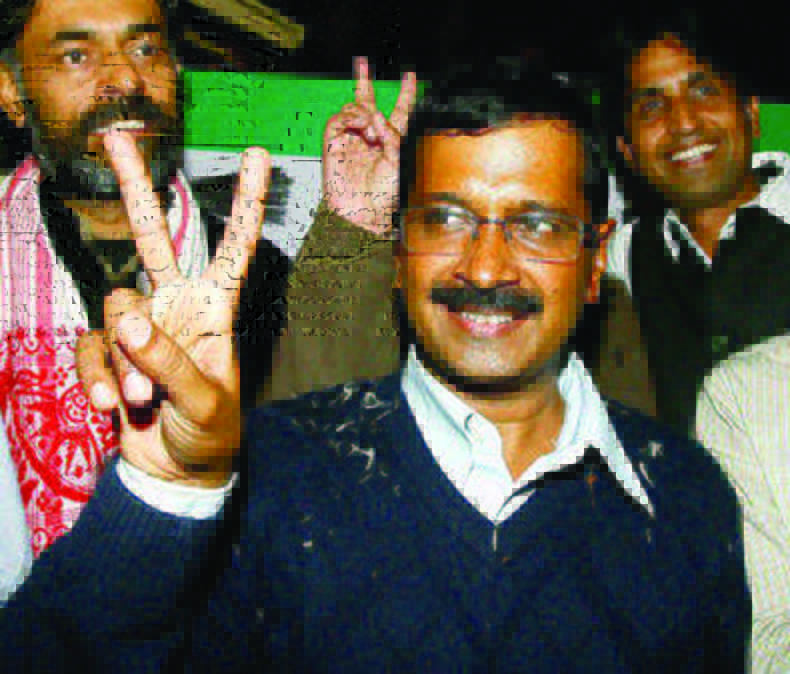
    Congress party’s 0-4 mauling and BJP’s triumph in Madhya Pradesh, Rajasthan and Chhattisgarh in what was billed as the “semifinal” for the 2014 elections was the big headline, but the central takeaway was Aam Aadmi Party’s stunning debut in Delhi, prising open space in national politics for an outsider.

  • BJP-JD(U) SPLIT AFTER 17 YEARS

    BJP-JD(U) SPLIT AFTER 17 YEARS

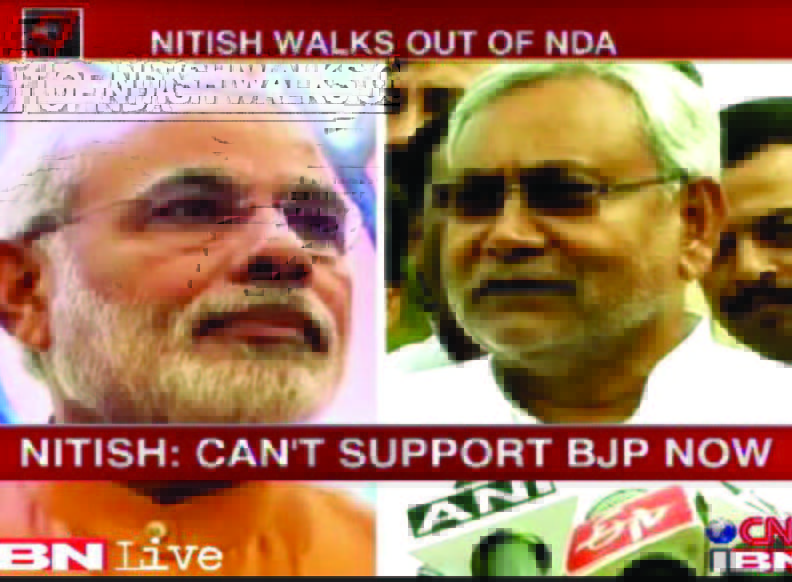
    In June, the JD(U) formally broke its 17-year-old ties with the BJP in Bihar and walked out of the NDA. Reacting to JD(U)’s decision, the BJP said there would be no compromise on decision to elevate Narendra Modi as its prime ministerial candidate, trashing allegations that Modi was an autocratic and divisive leader. It also question Nitish’s growing proximity to the Congress.

  • 34 children died in Muzaffarnagar riot camps, says Panel

    34 children died in Muzaffarnagar riot camps, says Panel

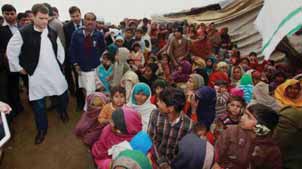
    LUCKNOW (TIP): Contradicting Mulayam Singh Yadav’s claim, a high-level official panel has said a total of 4,783 “displaced” people were still living in relief camps for riot-hit victims in Muzaffarnagar, where at least 34 children below 12 years lodged there had also died. After Rahul Gandhi’s sudden visit to the relief camps, Yadav, the chief of ruling Samajwadi Party, stoked a controversy on Monday claiming there are no riot victims at all in the camps and that people staying there are conspirators from the Congress and the BJP.

    According to the report of the panel submitted to the Uttar Pradesh government, 4,783 people are still living in five camps, including the one in Loi (Muzaffarnagar) and Madarsa Taimul Shah, Malakpur, Barnavi and Edgah (all in Shamli). To a question on whether there are any “conspirators” in the camps, Principal Secretary (Home) A K Gupta told reporters that the committee has said that “only displaced people are living in the camps”. “Most of the children who lost their lives are the ones who had been taken outside the camps for treatment by their parents or were referred to government hospitals for treatment,” Gupta said amid allegations that children in relief camps who died perished due to cold wave.

    The report quoted by Gupta said the deaths of the 34 children occurred between September 7 and December 20. “The cause of the death of all these children is different with about four dying because of pneumonia while some others died because of dysentery and one due to premature birth,” Gupta said. On the conclusion of the report, Gupta said that it has been recommended that the quality and facilities in the camps should be improved, and steps should be taken for early return of the people living in the camps to their homes. He said that all the children had got medical attention and “it cannot be termed as medical negligence or incapability of the doctors”.

    The panel headed by Commissioner Meerut had District Magistrates of Muzaffarnagar, Shamli and Chief Medical officers (CMOs) of these districts as members. It was constituted by the UP government to go into the factual details of the deaths of children as reported in the media. Union Minister Beni Prasad Verma, meanwhile, demanded an “apology” from Yadav over his remarks that those living in relief camps are conspirators.

  • UPA OKAYS PROBE INTO GUJARAT SNOOP CASE

    UPA OKAYS PROBE INTO GUJARAT SNOOP CASE

    The woman was tailed as she visited shopping malls, ice-cream parlours, hospitals and airports, according to the websites’ expose

    NEW DELHI (TIP): Spelling trouble for BJP’s prime ministerial candidate Narendra Modi, the Centre today has ordered the setting up of an inquiry commission to probe into the alleged snooping of a young woman by the Gujarat police, at the behest of then state home minister Amit Shah. The decision was taken according to Section 3 of Commissions of Inquiry Act which enables the government the government to set up such a commission. The committee will be headed by a retired judge and the probe will be completed in three months. The Gujarat government had earlier already ordered a probe into the case. BJP spokesperson Nirmala Sitharaman said: “Congress is trying to hit at the principal opposition party’s prime ministerial candidate.

    It is a clear case of political vindictiveness coming into play.” Flaying the Centre’s decision, senior BJP leader Arun Jaitley tweeted: ‘Cabinet decision to appoint a Commission to probe alleged snooping is violative of the Federal structure.’ He also said that the decision will be challenged in court. Jaitley said: “The Central Government has announced the setting up a Commission of Inquiry to probe the allegations of alleged snooping by the Gujarat Government. This action is politically motivated. The Congress Party has not learnt from the drubbing it got in the elections recently. It has continued with its strategy of fighting Narender Modi not politically but through investigative agencies and now through a Commission of Inquiry.” Two investigative websites – Cobrapost and Gulail – said earlier this month that they had access to 267 audio recordings that had been handed over to the Central Bureau of Investigation.

    They said the recordings contain telephone conversations from 2009 in which Modi’s former junior home minister Amit Shah orders a police officer to track the woman. In the phone recordings, the person alleged to be home minister Shah asks the surveillance to be carried out for his “saheb” – the respectful Hindi word for boss – when giving orders to police officer G L Singhal, who secretly recorded the conversations. Modi is not named. The woman was tailed as she visited shopping malls, ice-cream parlours, hospitals and airports, according to the websites’ expose. It was unclear why the woman was being followed. A letter by the woman’s father last week denied that there had been any unwanted surveillance. The father stated that he had asked Modi to keep a watch on his daughter for her safety. The BJP has dismissed the charges as part of “dirty tricks” in the lead-up to the elections.

  • Judges’ appointment panel gets Constitutional status

    Judges’ appointment panel gets Constitutional status

    NEW DELHI (TIP): Amid demands by jurists and the Opposition led by the BJP, the government today gave a go-ahead to grant constitutional status to a proposed commission for appointment and transfer of judges to the higher judiciary. The clearance, which would ensure that its composition is not altered through an ordinary legislation, came at the meeting of the Union Cabinet chaired by Prime Minister Manmohan Singh here. Among other decisions, the Cabinet Committee on Economic Affairs also gave its clearance to the guidelines for financial assistance to the sugar industry for payment of cane price arrears.

    According to the proposal, while new Article 124-A of the Constitution will define the composition of Judicial Appointments Commission (JAC), Article 124-B will define its functions. The JAC Bill defines the establishment of the proposed body to recommend appointment and transfer of judges of the Supreme Court and high courts. At present, the composition of the proposed panel is defined in the JAC Bill, 2013, which was introduced with a separate constitutional amendment Bill in the Rajya Sabha during the monsoon session. There were demands that the composition and functions of the proposed Commission should be mentioned in the Constitution as a safeguard against future changes.

    A Parliamentary standing committee that examined the JAC Bill, 2013, had also made a similar recommendation. While the constitutional amendment Bill — an enabling Bill — was passed by the Upper House, the main bill — the JAC Bill, 2013 — was referred to the standing committee. The Cabinet also approved the proposal to provide interest subvention for financial assistance to the sugar industry for effecting cane price payments as per guidelines of the “Scheme for Extending Financial Assistance to Sugar Undertakings, 2013”. The scheme’s expenditure would be met by the Sugar Development Fund (SDF).

    Under the proposal, the central government will provide an interest subvention up to 12 per cent, at a simple rate of interest, for the additional working capital loans to the sugar undertakings, equivalent to last three sugar seasons excise duty, cess and surcharge on sugar, according to an official statement released after the Cabinet meeting here. “The sugar undertakings with loans classified as Non-Performing Assets (NPA) by the banks will also be eligible for loans, provided the state governments concerned guarantee their new loans,” the statement said. The interest subvention or subsidy would be for total loan duration of five years, including two-year moratorium period. “No interest subvention to be provided for the period of default in the principal repayments,” the statement added.

  • AFTER BJP SAYS ‘NO’, LT. GOVERNOR INVITES AAP

    AFTER BJP SAYS ‘NO’, LT. GOVERNOR INVITES AAP

    NEW DELHI (TIP):
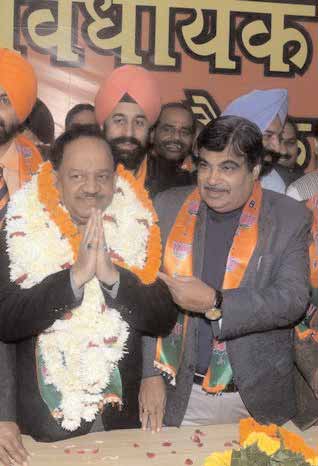
    The Bharatiya Janata Party onDecember 12 declined to form a government in Delhi, citing “lack of a clear mandate”. It would sit in the opposition keeping in view the party’s “high moral traditions”. After a 45-minute meeting with Lieutenant Governor Najeeb Jung, BJP leader Harsh Vardhan told reporters: “Since we do not have a clear mandate, we are not in a position to form the government.” Jung had invited the BJP, which emerged as the single largest party in this month’s Assembly elections, to discuss government formation.

    “We conveyed to him that we do not have enough seats, and in view of the lack of a clear mandate the party would like to sit in opposition,” said Dr. Vardhan. He gave it in writing to Mr. Jung. After the BJP declined, Mr. Jung invited Aam Aadmi Party convener Arvind Kejriwal to meet him on Saturday for discussions. The BJP, along with its ally the Shiromani Akali Dal which has one seat, has 32 MLAs in the 70-member Assembly.

    The AAP is the second largest party with 28 seats, followed by the Congress with eight seats. Dr. Vardhan said that if any other party was interested in forming a government it was welcome to do so. But his party cannot be held responsible for the consequences of the fractured mandate that could push the capital into fresh elections.

  • Lokpal missing from agenda, Anna criticizes Centre

    Lokpal missing from agenda, Anna criticizes Centre

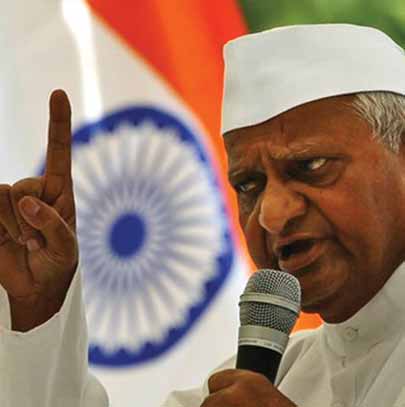
    PUNE (TIP): Social crusader Anna Hazare, who is on an indefinite fast at Ralegan Siddhi, has criticized the Union government for abdicating its responsibility towards the Jan Lokpal bill. He said the bill has not been included in the agenda of the winter session raising doubts about the government’s intention. In a letter written to V Narayanasamy, minister of state in the Prime Minister’s Office, on Thursday, Hazare said when he checked two days prior to the start of the winter session of Parliament, the lokpal bill was not on the agenda. “If it is not on the agenda, how will the government table the bill and discuss it? It is quite clear that the government is cheating me and the people of this country,” he said in the letter.

    Reminding the Congress that it had lost elections in four states recently, Hazare said: “If the Jan Lokpal bill is not passed during the winter session, the people of this country will teach the government and the ruling party a lesson in the forthcoming Lok Sabha elections too,” he said. Hazare said government representatives had told the media on Wednesday that the bill will be passed during this session, yet it has not been included in the agenda. He reiterated that he will not end his fast till the bill is passed. Meanwhile, in another letter sent to BJP leader Arun Jaitley, Hazare said he suspected the party’s intentions as it has failed to put pressure on the Union government to table the bill in the Rajya Sabha. “Your party has taken an aggressive stance regarding many issues both inside and outside the house. But I find that the party has been silent on the issue of Lokpal bill,” he said in the letter. Jaitley had written to Hazare on December 10 stating that his party was committed to passing the bill.

  • Delhi election 2013: What happens if no party has majority?

    Delhi election 2013: What happens if no party has majority?

    NEW DELHI (TIP): Most exit polls are predicting a hung assembly in Delhi. So, what happens next? If the predictions prove to be true, there are two possible scenarios. First, the single largest party, which is expected to be BJP, may form a coalition government with the support of other parties. If that fails to materialize, Delhi may come under President’s Rule, in which case it will have to vote in fresh elections within six months from December 17, the last day of the current assembly’s tenure.

    Once the figures of the hung assembly are officially declared, Lt Governor Najeeb Jung will have to invite the leader of BJP, if it turns out to be the single largest party, to explore the possibility of forming a government. This will be in keeping with the Indian precedent of the single largest party being given the first chance and also the British convention of inviting the Opposition party when the ruling party has lost majority in the election. Going by the precedent set by President Narayanan in the 1990s, Jung can ask Harsh Vardhan if, despite falling short of the half-way mark, he is “willing and able” to form a stable government.

    Given that all three major parties – Congress, BJP and AAP – have declared that they would not enter into any post-poll alliances, the chances of President’s Rule seem higher, especially if the largest party is way short of the majority mark. Since President’s Rule cannot last beyond six months, the fresh election to the Delhi assembly may well be held along with the Lok Sabha election in the summer of 2014. As per rule 5 of the Government of National Capital Territory of Delhi Act, 1991, the legislative assembly, unless sooner dissolved, shall continue for five years from the date of appointment for its first meeting and no longer, and the expiration of the said period of five years shall operate as dissolution of the Assembly.

    In the current scenario, the assembly was appointed on December 18 in 2008 and hence a new assembly must be constituted by that date of this year. As the result comes out on December 8, the political parties will have to come to a consensus in the next eight days. On failing to do so, President’s Rule will come into effect from the day the assembly stands dissolved (December 18). However, till December 17 the existing government can continue as “caretaker government”. Under President’s Rule in Delhi, the Lieutenant Governor becomes full-fledged executive head of the government and has the power to appoint a group of advisors who act as ‘council of ministers.’

    Even when the Assembly is in suspended animation, it will still be open to political parties to forge a coalition with a majority support in the House. Experts look at the scenarios as an ‘unfortunate’ one for the city as it hurts the functioning of the government in a significant way. “The functioning of Delhi government has already suffered in last few months as most of its staff was put on election duty. In case we have re-polling, it would mean another few months of minimal work in the government,” said Shakti Sinha, former finance and powers secretary of Delhi government.

    Delhi’s former chief secretary Rakesh Mehta sees it as a period that won’t see any crucial decision being taken, slowing the pace of the government significantly. “A hung assembly does not mean ‘no’ government — the constitution provides for a remedy in that case. However, absence of a formal government can slow down functioning of the departments.

    A government is needed for taking drastic and complex decisions that are crucial for the city,” Mehta added. Experts, however, also feel a huge voter-turn out usually suggests a decisive and clear mandate. “If people have come out in such large numbers to vote they must have given a clear mandate,” a senior bureaucrat added.

  • Criminality in the Indian Political System

    Criminality in the Indian Political System

    In their own long-term interest, all political parties must jointly agree to stop sponsoring criminal candidates, says the author.

    Criminality in politics, or more pointedly, criminals sitting in our Parliament and legislatures, is an issue that has for long been debated in many forums and has also been at the forefront of reform proposals sent by the Election Commission of India (ECI) to the government. With elections to five States under way, and the 16th General Election due to be completed before May 31, 2014, India is now gripped by that special fever that besets us every five years.

    Unexpectedly, part of the backdrop already stands influenced by a few recent decisions of the Supreme Court. The Supreme Court has importantly passed three orders that relate directly to the conduct of elections. The first relates to the distribution of “freebies”, wherein the ECI has been asked to frame guidelines in consultation with political parties. The second is directing the installation of the None-of-The-Above (NOTA) button in the Electronic Voting Machines, which has already been implemented in the current round of Assembly elections.

    The third is the court’s order of July 10, 2013 in the Lily Thomas vs Union of India matter, wherein the Supreme Court has declared unconstitutional Section 8 (4) of the Representation of the People Act, 1951. The importance of this order cannot be overemphasized. The position that prevailed before this order was enacted was that all convicted MPs and MLAs enjoyed a threemonth period in which to appeal against their conviction, and during this period they crucially retained their memberships in Parliament or legislatures respectively. What has changed is that while they still have the right to appeal, now they immediately cease to be members the House.

    While previously they were able to file appeals within the stipulated three months without giving up their membership, they managed, in effect, to remain MPs or MLAs often for long years after their terms had expired. Not only have these orders already impacted the elections under way but they will continue to have a profound impact on cleansing our political system. The Lily Thomas matter was applied by the court prospectively and not retrospectively. The court would have had many reasons not to apply its order retrospectively, not the least of which is that it would possibly have thrown our current polity into disarray.

    Be that as it may, in the present and future, every parliamentarian or legislator who stands convicted for an offence that leads to a sentence of imprisonment for two years and more, will also be debarred from contesting an election for six years after his or her prison term ends. Moreover and equally importantly, there are offences which are already on the statute book and where conviction (even without sentence of imprisonment) leads to disqualification.

    These include conviction for rape, for promoting enmity and hatred between and among different classes or groups, conviction relating to bribery, and conviction under the Prevention of Corruption Act, the Foreign Exchange Regulation Act (FERA) and The Prevention of Terrorism Act, 2002 (POTA). Once again, since the grace period for remaining an MP or MLA has ended, this in effect means that the six year axe of debarment comes immediately into operation in these categories of cases as well.

    Criminals among MPs, MLAs
    Close on the heels of this order, the nation witnessed the jailing of Lalu Prasad, the president of a once nationally recognized political party, the RJD, as well as Rasheed Masood, a former Minister and sitting MP of the Rajya Sabha. While both stand debarred from contesting elections for six years after their jail terms are completed, in effect such a long banishment might well put an end to their political careers. For, as is well known, politics abhors a vacuum.

    The abhorrence of criminality in politics is a common thread running through practically every student audience I have addressed across India in the last seven years. They are well aware of the figures compiled by non-governmental organizations such as NEW and ADR from the affidavits submitted to the ECI by contestants. Two vital orders of the Supreme Court in 2002 and 2003 made it compulsory for all candidates to file information regarding any and all criminal cases pending against them, as well as figures of the combined wealth or assets of the candidates and their spouses, and indeed their educational qualifications.

    With this information, the court hoped that voters could make informed choices about whom to vote for or not. Most of my student audiences knew the statistics; that in the present Parliament as many as 30 per cent of sitting Lok Sabha MPs and 31 per cent of Rajya Sabha MPs have criminal cases pending against them, that the Bihar Assembly (2010) has a high of 58 per cent criminals among its MLAs, while the Uttar Pradesh Assembly (2012) has 41 per cent. The Congress has 21 per cent declared criminals; the Bharatiya Janata Party has 31 per cent. At the other extreme, the Jharkhand Mukti Morcha has 82 per cent criminals among its MPs and MLAs.

    Is it any surprise then that student audiences inevitably ask what is the point of clean election processes if the end result is to elect tainted men and women? When the government decided to rush headlong into enacting an Ordinance to counter the July 10, 2013 Order of the Supreme Court, this resulted in a surge of public sentiment bordering on revulsion, against what would arguably have been a very regressive step in the development of our democratic institutions. The dramatic demise of the proposed Ordinance ironically became a critically important milestone in the strengthening of our democratic edifice, which I think many of us realize is still a work in progress.

    Three issues

    In the rash of commentaries that followed the Supreme Court Order of July 10, followed in turn by the legislative proposals sought to be placed before the winter session of Parliament and finally by the Ordinance that the Cabinet cleared, I would like to comment on three issues. First, it is no secret that many politicians have their own criminal elements to protect and whom they need to use in elections to round up voters.

    They spend clandestinely and sometimes devise mafia-like strategies to reinforce the “winnability” concept that has now come to be the “mantra” which has displaced any truly democratic relationship between candidates and the public whom they seek to represent. Hence the political establishment quickly closed ranks in favor of the Ordinance. The second issue to my mind was whether the President (who called in senior Ministers for consultation to raise questions and seek clarifications), would have signed this Ordinance, or whether he would have just let it asphyxiate itself.

    The third issue is that it took Rahul Gandhi to speak out and publicly criticize the Ordinance. In the aftermath of his intervention, the cacophony of opinions on our news channels reached a crescendo. One of the few voices that I managed to hear over the din of panelists and anchors, was that of The Hindu’s N. Ram, who cut aside all rhetoric on the non-use of parliamentary language by saying, “Rahul Gandhi singlehandedly killed the wretched Ordinance. Instead of acknowledging that, do we need to make a fuss about the words he used?” For what we must also recognize is that if this Ordinance had been passed, it would have officially endorsed that criminality in parliamentary ranks was perfectly acceptable.

    It would also have rendered our elected representatives even more distant from our people. Not only that, it would almost certainly have put the Executive and the Supreme Court on a collision course, leading to unnecessarily troubled relations between vital institutions. We have only to look in our own neighborhood to understand how such conflicts have in varying measure stunted the growth of democratic structures. I read in the press with increasing disappointment that many political leaders and parties including the Congress and the BJP have since given the ticket in these elections to either criminals or to their family members as proxies.

    This, sadly, concedes the “winnability” factor over “clean” politics. Surely the time is finally here for all political parties to jointly agree to step away from sponsoring criminal candidates. It would be in their long-term interest to do so, because now some ground realities have changed, for upon conviction such candidates would have to resign anyway and make way for by-elections. In the short-term, they may win an election, but in the longer term they will, once again, strike a blow to the development of a healthy, wholesome and robust democracy that our freedom fighters fought for, and our constitutional framers had envisaged.

  • Govern, or get out

    Govern, or get out

    The recent elections to assemblies in Chhatisgarh, Madhya Pradesh, Rajasthan and Delhi have a clear message for political parties. Govern or get out. The Exit Polls have indicated loss of power for the Congress Party in Delhi and Rajasthan While some may say the Congress has done badly in Delhi and Rajasthan because incumbency factor worked against it. One may as well ask, then how is that the same factor did not work against the BJP in Chhatisgarh and Madhya Pradesh? One can understand that during the last many months, rather, the last two years, the Congress Party was being attacked from all sides for its various omissions and commissions, which has done much harm to its image.

    The popular movement for Jan Lokpal led by Anna Hazare has certainly done a great damage to the Congress party. Baba Ramdev’s crusade against the Congress Party has been quite pronounced and has certainly ranged people against that party. More than the attacks of political parties on the Congress Party and its government it was the voice of social protest from Hazare, Ramdev and some others that created amongst the people’ mind a disillusionment with the Congress Party. And to top it all was the enormity of the scandals that the Congress government got enmeshed in.

    Its ministers were found to be involved neck deep in corruption. The pile grew bigger and the stone round the government and party’s neck heavier. The fall was imminent. The rout of the Congress party appeared imminent to any watcher of politics in India. One is surprised that the Congress party did not either realize it was going to be doomed or it accepted resignedly the fait accompli. But all is not lost. There is ample time between now and the 2014 General elections during which period the Congress party can do introspection and devise strategy to beat its adversaries at the polls.

    They have issues that their opponents have themselves thrown up during election campaign. The most important is the rising prices. I recall the BJP lost power once because it could not control the rising prices of onions. The Congress lost in Delhi, at least, for a similar reason. Of course, there were many other reasons, too which included power shortage and corruption. However, it will be unwise to write off the Congress as a spent political force. It has the strength but it needs a vision.

  • Exit Polls Indicate BJP Juggernaut & Congress Rout

    Exit Polls Indicate BJP Juggernaut & Congress Rout

    NEW DELHI (TIP): The Congress faces a blank-out in four states that have polled in assembly elections in November-December, while the BJP will certainly win in Madhya Pradesh and Rajasthan, is likely to retain Chhattisgarh and may just grab power in Delhi as well, according to exit polls and postpoll surveys released on December 4. If these polls prove to be accurate, it is very bad news for the Congress which faces a national election five months down the road. Equally, it is a bumper booster shot in the BJP’s arm and its prime ministerial candidate Narendra Modi.

    While Mizoram has also had assembly elections, no exit polls were available for the state and its outcome, in any case, can have little effect on the 2014 elections. While there were only minor differences among the different polls on Rajasthan, MP and Chhattisgarh, the estimates for Delhi varied widely, with two of the four polls predicting a hung assembly, but two others giving the BJP a clear though slim majority.

    One poll even suggested that debutant Aam Aadmi Party would emerge as the single largest party in the new assembly. On Delhi — the election that will be most closely watched as a pointer to the national mood — an ORG survey for Headlines Today suggested the BJP would win 41 seats, giving it a clear majority in the 70-member assembly. It said the Congress would win 20 seats, and AAP just six. The ABP News-AC Nielsen also predicted a BJP win with 37 seats, but predicted that the Congress with 16 and AAP with 15 would finish neck-and-neck.

    The C-Voter poll put the BJP tantalisingly short of a majority with 31 seats, the Congress and 20, AAP at 15 and others with four seats, which could end in a hung house. Today’s Chanakya had a radically different prediction, with AAP projected to win 31 seats, BJP 29 and Congress a mere 10. Obviously, the significant performance of newcomer AAP was seriously testing the science of psephology. The other relatively close contest appears to be in Chhattisgarh.

    Here, ORG and Today’s Chanakya gave BJP a clear majority, C-Voter predicted it would fall just short and the CNN-IBN-CSDS poll gave a range for the party of 45-55 seats in the 90-member house, which means it may or may not have a majority. What they all agreed on was that the Congress would not win, its tally ranging from a minimum of 32 to a maximum of 41 across the four polls. On Madhya Pradesh, there is unanimity that Shivraj Singh Chouhan will win a third term in style. The range of predicted tallies for the BJP in the 230-member is from a minimum of 128 in the C-Voter poll to a maximum of 161 in the poll done by Today’s Chanakya.

    The Congress tally in the state, if the polls are right, could be anywhere between 62 and 92. Rajasthan too is projected to deliver a landslide verdict in favour of the BJP, with its tally projected at 110-147 seats in the 200-member assembly across four different surveys and the Congress predicted to win at best 62 seats and at worst 39.