Tag: BJP

  • RAJYA SABHA PASSES BILL TO APPOINT JUDGES UNDER NEW SYSTEM

    RAJYA SABHA PASSES BILL TO APPOINT JUDGES UNDER NEW SYSTEM

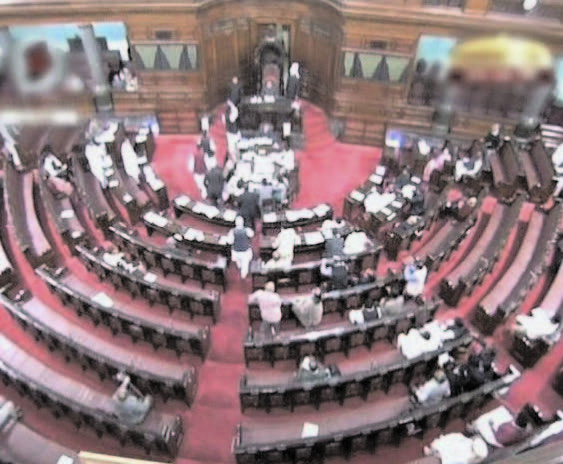
    NEW DELHI: Government and opposition in Rajya Sabha on September 5 presented a joint front in cornering judiciary on all fronts – ranging from corruption, favouritism and nepotism to compromises due to lust of post-retirement jobs\benefits – while discussing a bill which seeks to scrap the collegium system of appointing judges. The bill, giving executive a crucial role in judges’ appointment, was, however, finally passed without BJP members’ presence as they walked out protesting the government’s refusal to send the proposed legislation to a parliamentary standing committee for wider consultations. As the Upper House took up the bill to amend the Constitution to set up a Judicial Appointments Commission (JAC) replacing the collegium system, law minister Kapil Sibal, leader of opposition Arun Jaitley and several other members were of the view that the present system of appointing judges to Supreme Court and high courts lacked transparency and accountability.

    BJP members said though their party was fully in support of the bill, it wanted a wider consultations before passing of the bill. Jaitley said, “We don’t like the present system. So, we are agreed to change it. We are making a monumental change. Monumental changes are never brought with a knee-jerk reaction”. The bill, which was passed without BJP members participating in voting, seeks to set up a JAC to recommend appointment and transfer of Supreme Court and high court judges. It states that the JAC will make the participants in the selection accountable and introduce “transparency” in the selection process. With the creation of the proposed body, the executive seeks to have a say in appointment of members to the higher judiciary. The bill seeks to set up a panel headed by the Chief Justice of India (CJI) to appoint and transfer senior judges. The other members of the proposed commission would be two senior-most judges of the Supreme Court, the law minister, two eminent persons as members and secretary (justice) in the law ministry as Convener.

    Moving the bill, Sibal earlier said the Supreme Court in 1993 had sought to change the procedure of appointment of judges in higher judiciary by bringing in a collegium system. The judiciary has taken over executive power by rewriting Article 124 (of the Constitution). That balance must be restored. Executive must have a say in appointment.” Sibal said, “It has disturbed the delicate balance of separation of powers. There is very clear division of powers among the executive, legislature and judiciary in our Constitution. Judiciary cannot take over the function of the executive”. Sibal also chose the occasion to flag his concerns over “nepotism” in the judiciary. “We are really worried over the manner in which relatives of judges are practising in high courts. It is very disturbing. It is a matter of sadness that somebody’s maternal uncle, uncle and others practice in court. How long this nepotism will continue,” he asked. Jaitley echoed Sibal’s views as he pressed for reestablishment of the “separation of powers”. He said when other establishments of the democracy do not infringe upon functioning of the judiciary, then why would it ask the government to do this or do that and direct even on the economic policy of the government. “Courts cannot review a policy and say that my policy is better that your policy.

    It cannot say how to be tough on the Naxalites,” he said. Citing the ban on iron ore exports, Jaitley sought to link judicial orders partially to the present state of Current Account Deficit and depreciation of rupee as a result of that. Attacking judiciary, he said no government, irrespective of its complexions, has ever said that since court has three crore cases pending, somebody else would do it for courts. Stating that the present system of appointing judges lacks transparency, Jaitley said the three-member collegium often left out the best of the lot for a promotion and go ahead with their choices. “A collegium is as good as the members of the collegium,” he said as he observed, “Judges appoint themselves and judges are accountable to judges.” Stating that in the existing collegium mechanism the members of the panel of judges go by their own preferences, he said when the collegium meets for appointment of judges, they “have to accommodate the preferences of each other, and those who don’t come in their list of preferences lose out”. Jaitley also spoke against the trend of higher judiciary members seeking post-retirement jobs.

    He said, “I think this whole temptation of continuing to occupy a Lutyens Bungalow (government accommodation in heart of the Capital) is a very serious temptation….The desire of a postretirement job influences pre-retirement judgments. It is a threat to the independence of the judiciary. Once it influences pre-retirement judgments, it adversely impacts the functioning of our jud iciary itself”. The leader of opposition proposed that a judicial commission should not only have powers for appointment of judges but also ensure their accountability. He said in cases of judicial misconduct, falling short of acts that call for impeachment, the judges were accountable only to judges and “this needs to be changed”. Sibal, while moving the bill, said the proposal to set up JAC was also the part of BJP’s national agenda of governance in 1998. “I compliment the leader of opposition who then as the minister introduced the bill to set up the Judicial Commission in 2003.

    All we have done is that we have increased the number of eminent members from one to two who will be appointed in the National Judicial Commission which will appoint the Judges. We are grateful to the leader of opposition that we are only adopting what he had suggested,” he said. Sibal said the Law Commission had said in 2008 that the Supreme Court interpretation of Article 124 (2) is contrary to the letter and spirit of the very article. He recalled that Justice M N Venkatachaliah and Justice J S Verma, who had favoured the collegium system, had later said they regretted their decision and that the system was not working. The minister also recalled that as a counsel, he had in past supported the idea of the judiciary appointing judges. “I also regret…Wise men are always proved right. When we were young, we wanted to change the system and sorry we disregarded your wisdom,” Sibal said as nominated member and former Attorney General of India K Parasaran reminded him that Sibal was opposed to any outside role in judicial appointments. “I am not saying that you should go back to 1993.

    There should be a judicial commission so that a collaborative exercise is there for their appointments. We do not want to impose our decisions in judicial appointments. “That is why we have made provisions for inclusion of two eminent persons in the judicial commission whose names will be decided by the Prime Minister, leader of opposition in the Lok Sabha and Chief Justice of India

  • Uproar in parliament over Chinese incursion reports

    Uproar in parliament over Chinese incursion reports

    NEW DELHI (TIP): Both houses of parliament on September 5 saw noisy protests by members demanding a statement from Defence Minister A.K. Antony over media reports claiming that Chinese troops have intruded into Indian territory. As soon as the Lok Sabha met at 11 a.m., Bharatiya Janata Party (BJP) and Samajwadi Party (SP) members raised the issue, saying Indian territory has been occupied by China. The protesting members did not relent even after repeated requests by the chair to allow scheduled business to commence and consequently the house was adjourned briefly. After the house reconvened, BJP leader Yashwant Sinha said he had raised the matter Thursday but the government had yet not responded. SP chief Mulayam Singh Yadav attacked the government and said it has failed to take any action to prevent Chinese troops from entering Indian territory.

    “If the government can’t protect our interest, they have no right to stay in power,” said Yadav. Parliamentary Affairs Minister Kamal Nath responded: “It is no doubt a serious matter … neither the government is weak nor useless. The government has nothing to hide on the issue.” He said the defence minister will make a statement in the Lok Sabha at 1 p.m.and Rajya Sabha at 3 p.m. According to media reports, an official National Security Advisory Board (NSAB) probe report submitted to the Prime Minister’s Office had said that Indian troops are not being allowed to patrol the Line of Actual Control (LAC). The committee in its report allegedly concluded that 640 sq km of Indian territory has been occupied by China. However, NSAB had denied media reports. In Rajya Sabha, BJP leader M. Venkaiah Naidu called it a serious matter and insisted that the defence minister must respond

  • Political conspiracy to defame me: Asaram Bapu

    Political conspiracy to defame me: Asaram Bapu

    BHOPAL (TIP): Spiritual guru Asaram Bapu on August said the sexual assault charge against him was politically motivated. “I am not against any political party but people are telling me that ‘madam’ and her son are behind the conspiracy,” said Asaram Bapu, referring to Congress president Sonia Gandhi and her son Rahul Gandhi, the party vice president. “I am not personally blaming anyone. I am telling you what I have heard because you (media) have been compelling me to speak on the issue,” he added. Some Bharatiya Janata Party leaders, including Uma Bharti, have come out in support of the seer, alleging that he was being targeted for his anti-Congress views. Asked whether he was being supported by the BJP, the seer snapped at the media persons. “No party is defending me. This is wrong. You are trying to harass me,” said a livid Asaram Bapu. A 16-year-old girl had last week alleged that Asaram Bapu had raped her during one of her stays at the seer’s ashram. A case has been filed by Rajasthan Police and Asaram Bapu has been served summons to present himself Aug 30. However, citing prior engagements, Asaram Bapu has sought more time to appear before police.

  • Karnataka LS bypolls: Congress wins both seats

    Karnataka LS bypolls: Congress wins both seats

    BANGALORE (TIP): Karnataka chief minister Siddaramaiah won the acid test in the Lok Sabha bypolls with both Congress candidates winning Bangalore Rural and Mandya seats by a huge margin in these constituencies, which were the JD(S) fiefdom. The results declared on Aug 24 are a huge boost to the four-month old Congress party in Karnataka as they have the set the trend for the Lok Sabha elections eight months from now. Both the seats were won by political greenhorns, who have made their electoral debut with a leap to the parliament. Kannada actor Ramya won from Mandya and senior Congress MLA DK Shiva Kumar’s brother DK Suresh Kumar from Bangalore Rural. Both the seats were held by the JD(S) with Bangalore Rural won by former CM H D Kumaraswamy in 2009.

    The bypolls were held following the resignation of Kumaraswamy and JD(S) N Cheluvaraswamy from Mandya after they got elected to the legislative assembly in May. Ramya defeated JD(S) CS Puttaraju by a margin of 47,000 plus votes and Suresh Kumar trounced Kumaraswamy’s wife Anitha by over a lakh votes. The bypolls were crucial to both the Congress and JD(S). For the first time all opposition parties giving a go-by to their ideologies came together to put up a common candidate against the Congress in both constituencies. But the results revealed that voters have once again punished the JD(S) for teaming up with the BJP. The earlier instance was the 2008 assembly polls. The results are a big blow to the Deve Gowda family, more so to senior Gowda, who at the age of 81 years, pounded the streets of Bangalore Rural and Mandya seeking votes for his daughter-in-law and shedding tears at public meetings.

    Anitha, who has been a reluctant candidate to politics, had still not come out of her defeat from Channaptna assembly polls in May, when she was fielded in this bypoll. The 30-year-old actor Ramya, who was a last minute surprise candidate, in a way brought the feuding Congress leaders in Mandya to unite at least for the bypoll. Former CM S M Krishna and actor, housing minister MH Ambareesh, who don’t see eye to eye campaigned for Ramya, of course without sharing a common platform. Getting Ramya elected had become vital for the Mandya Congress unit, if it had to stake claim in appointments of chairpersons to the boards and corporations to be made shortly.

  • ADVANI Wants India To Unlock Unlimited Potential

    ADVANI Wants India To Unlock Unlimited Potential

    NEW DELHI (TIP): On a day when Gujarat chief minister Narendra Modi took on Prime Minister Manmohan Singh in his Independence Day speech, senior BJP leader L K Advani struck an optimistic note, saying “India has unlimited potential for the future”. In his address after hoisting the national flag at his residence, Advani said, “This past decade, which, as the prime minister said today, will get over in 2014.

    He has enumerated the achievements and the shortcomings of this decade. We should now be concerned about making the decade starting from 2014 an unprecedented one in India’s history. We should give it the best performance we can.” Striking a positive note, the BJP veteran said no one should be critical of each other on this occasion, rather each one should try to put in their best to ensure that India’s potential to shine in the 21st century is exploited.

    Since Advani was speaking moments after Modi’s speech in Gujarat, there was speculation that he was being critical of the Gujarat CM. However, the BJP veteran is learnt to have been unaware of the contents of Modi’s speech. Since the function at Advani’s residence was soon after the Red Fort event, which he attended, he was not aware of what Modi had said about the PM in his speech, it is learnt.

    Talking about a book on black money, which he is currently reading, Advani said, “The theme of the book is that though capitalism is good, if ethics and morality are set aside and people indulge in corruption, then it gives capitalism a bad name.” Leader of opposition in Lok Sabha Sushma Swaraj took a dig at the PM for not mentioning the name of his immediate predecessor and BJP veteran Atal Bihari Vajpayee while lauding the work of earlier prime ministers.

    “Dr Manmohan Singh referred to four prime ministers who contributed to the making of India — all from the Congress party. He forgot even Lal Bahadur Shastri there. The contribution of Morarji Desai and Atal Bihari Vajpayee has been no less. This partisan approach does not go with the solemnity of this great occasion,” Swaraj said on Twitter.

    Later, BJP described the PM’s speech as “lacklustre and an outright disappointment” but hoped that the coming year — in which general elections are due — will usher in a new decade of growth. Party general secretary Rajiv Pratap Rudy described the PM’s speech as “an outright disappointment”. “The country had large expectations from the prime minister on his parting Independence Day speech which was full of hollow claims.

    Country would have the PM to express his stand on issues of national security, especially in the backdrop of Pakistan attacking Indian soldiers and China intruding into Indian territory,” Rudy said. BJP president Rajnath Singh said if voted to power his party will tackle internal and external security challenges facing the country. He described the recent communal violence in Kishtwar as a “challenge to democracy”.

  • A PICTORIAL HISTORY OF INDEPENDENT INDIA

    A PICTORIAL HISTORY OF INDEPENDENT INDIA

    A chronology of key events
    India has been home to several ancient civilisations and empires, some dating back to more than 2,000 BC. Culture and religions have flourished over the millennia, and foreign influence has ebbed and flowed. 1947 – End of British rule and partition of sub-continent into mainly Hindu India and Muslim-majority state of Pakistan.

    1947-48 – Hundreds of thousands die in widespread communal bloodshed after partition.
    1948 – Mahatma Gandhi assassinated by Hindu extremist.
    1948 – War with Pakistan over disputed territory of Kashmir.
    1951-52 – Congress Party wins first general elections under leadership of Jawaharlal Nehru. Regional tensions 1962 – India loses brief border war with China.
    1964 – Death of Prime Minister Jawaharlal Nehru.
    1965 – Second war with Pakistan over Kashmir.
    1966 – Nehru’s daughter Indira Gandhi becomes prime minister.
    1971 – Third war with Pakistan over creation of Bangladesh, formerly East Pakistan.
    1971 – Twenty-year treaty of friendship signed with Soviet Union.
    1974 – India explodes first nuclear device in underground test. Democratic strains
    1975 – Indira Gandhi declares state of emergency after being found guilty of electoral malpractice.
    1975-1977 – Nearly 1,000 political opponents imprisoned and programme of compulsory birth control introduced. 1977 – Indira Gandhi’s Congress Party loses general elections. 1980 – Indira Gandhi returns to power heading Congress party splinter group, Congress (Indira).
    1984 – Troops storm Golden Temple – Sikhs’ most holy shrine – to flush out Sikh militants pressing for self-rule.
    1984 – Indira Gandhi assassinated by Sikh bodyguards, following which her son, Rajiv, takes over.
    1984 December – Gas leak at Union Carbide pesticides plant in Bhopal. Thousands are killed immediately, many more subsequently die or are left disabled.
    1987 – India deploys troops for peacekeeping operation in Sri Lanka’s ethnic conflict.
    1989 – Falling public support leads to Congress defeat in general election.
    1990 – Indian troops withdrawn from Sri Lanka.
    1990 – Muslim separatist groups begin campaign of violence in Kashmir.
    1991 – Rajiv Gandhi assassinated by suicide bomber sympathetic to Sri Lanka’s Tamil Tigers.
    1991 – Economic reform programme begun by Prime Minister PV Narasimha Rao.
    1992 – Hindu extremists demolish mosque in Ayodhya, triggering widespread Hindu-Muslim violence. BJP to the fore
    1996 – Congress suffers worst ever electoral defeat as Hindu nationalist BJP emerges as largest single party. 1998 – BJP forms coalition government under Prime Minister Atal Behari Vajpayee.
    1998 – India carries out nuclear tests, leading to widespread international condemnation.
    1999 February – Vajpayee makes historic bus trip to Pakistan to meet Premier Nawaz Sharif and to sign bilateral Lahore peace declaration.
    1999 May – Tension in Kashmir leads to brief war with Pakistan-backed forces in the icy heights around Kargil in Indian-held Kashmir.
    1999 October – Cyclone devastates eastern state of Orissa, leaving at least 10,000 dead.
    2000 May – India marks the birth of its billionth citizen.
    2000 – US President Bill Clinton makes a groundbreaking visit to improve ties.
    2001 January – Massive earthquakes hit the western state of Gujarat, leaving at least 30,000 dead. 2001 April – 16 Indian and three Bangladeshi soldiers are killed in border clashes. A high-powered rocket is launched, propelling India into the club of countries able to fire big satellites deep into space.
    2001 July – Vajpayee meets Pakistani President Pervez Musharraf in the first summit between the two neighbours in more than two years. It ends without a breakthrough because of differences over Kashmir.

    2001 September – US lifts sanctions which it imposed against India and Pakistan after they staged nuclear tests in 1998. The move is seen as a reward for their support for the US-led anti-terror campaign. Kashmir tensions rise
    2001 October – India fires on Pakistani military posts in 1984 – Indira Gandhi assassinated by Sikh bodyguards, following which her son, Rajiv, takes over.

    1984 December – Gas leak at Union Carbide pesticides plant in Bhopal. Thousands are killed immediately, many more subsequently die or are left disabled.
    1987 – India deploys troops for peacekeeping operation in Sri Lanka’s ethnic conflict.
    1989 – Falling public support leads to Congress defeat in general election.
    1990 – Indian troops withdrawn from Sri Lanka.
    1990 – Muslim separatist groups begin campaign of violence in Kashmir.
    1991 – Rajiv Gandhi assassinated by suicide bomber sympathetic to Sri Lanka’s Tamil Tigers.
    1991 – Economic reform programme begun by Prime Minister PV Narasimha Rao.
    1992 – Hindu extremists demolish mosque in Ayodhya, triggering widespread Hindu- Muslim violence. BJP to the fore
    1996 – Congress suffers worst ever electoral defeat as Hindu nationalist BJP emerges as largest single party. 1998 – BJP forms coalition government under Prime Minister Atal Behari Vajpayee.
    1998 – India carries out nuclear tests, leading to widespread international condemnation. 1999 February –

    Vajpayee makes historic bus trip to Pakistan to meet Premier Nawaz Sharif and to sign bilateral Lahore peace declaration.
    1999 May – Tension in Kashmir leads to brief war with Pakistan-backed forces in the icy heights around Kargil in Indian-held Kashmir.
    1999 October – Cyclone devastates eastern state of Orissa, leaving at least 10,000 dead. 2000 May – India marks the birth of its billionth citizen.
    2000 – US President Bill Clinton makes a groundbreaking visit to improve ties. 2001 January – Massive earthquakes hit the western state of Gujarat, leaving at least 30,000 dead.
    2001 April – 16 Indian and three Bangladeshi soldiers are killed in border clashes. A high-powered rocket is launched, propelling India into the club of countries able to fire big satellites deep into space.
    2001 July – Vajpayee meets Pakistani President Pervez Musharraf in the first summit between the two neighbours in more than two years. It ends without a breakthrough because of differences over Kashmir.
    2001 September – US lifts sanctions which it imposed against India and Pakistan after they staged nuclear tests in 1998. The move is seen as a reward for their support for the US-led anti-terror campaign.

    Kashmir tensions rise
    2001 October – India fires on Pakistani military posts in the heaviest firing along the dividing line of control in Kashmir for almost a year.
    2001 December – Suicide squad attacks parliament in New Delhi, killing several police. The five gunmen die in the assault.
    2001 December – India imposes sanctions against Pakistan, to force it to take action against two Kashmir militant groups blamed for the suicide attack on parliament. Pakistan retaliates with similar sanctions, and bans the groups in January.
    2001 December – India, Pakistan mass troops on common border amid mounting fears of a looming war.
    2002 January – India successfully test-fires a nuclear-capable ballistic missile – the Agni – off its eastern coast.
    2002 February – Inter-religious bloodshed breaks out after 59 Hindu pilgrims returning from Ayodhya are killed in a train fire in Godhra, Gujarat. More than 1,000 people, mainly Muslims, die in subsequent violence. Police and officials blamed the fire on a Muslim mob, but a 2005 government investigation said it was an accident. In 2012 a court convicts 32 people over the Naroda Patiya riots in Ahmedabad. 2002 May – Pakistan test-fires three medium-range surface-to-surface Ghauri missiles, which are capable of carrying nuclear warheads.War of words between Indian and Pakistani leaders intensifies. Actual war seems imminent.

    2002 June – UK, US urge their citizens to leave India and Pakistan, while maintaining diplomatic offensive to avert war.
    2002 July – Retired scientist and architect of India’s missile programme APJ Abdul Kalam is elected president.
    2003 August – At least 50 people are killed in two simultaneous bomb blasts in Bombay. Kashmir ceasefire 2003 November – India matches Pakistan’s declaration of a Kashmir ceasefire. 2003 December – India, Pakistan agree to resume direct air links and to allow overflights.
    2004 January – Groundbreaking meeting held between government and moderate Kashmir separatists.
    2004 May – Surprise victory for Congress Party in general elections. Manmohan Singh is sworn in as prime minister.
    2004 September – India, along with Brazil, Germany and Japan, launches an application for a permanent seat on the UN Security Council.

    2005 7 April – Bus services, the first in 60 years, operate between Srinagar in Indianadministered Kashmir and Muzaffarabad in Pakistani-administered Kashmir.
    2006 February – India’s largest-ever rural jobs scheme is launched, aimed at lifting around 60 million families out of poverty. Nuclear deal 2006 March – US and India sign a nuclear agreement during a visit by US President George W Bush.

    The US gives India access to civilian nuclear technology while India agrees to greater scrutiny for its nuclear programme.
    2006 November – Hu Jintao makes the first visit to India by a Chinese president in a decade.
    2006 December – US President George W Bush approves a controversial law allowing India to buy US nuclear reactors and fuel for the first time in 30 years.
    2007 March – Maoist rebels in Chhattisgarh state kill more than 50 policemen in a dawn attack.
    2007 April – India’s first commercial space rocket is launched, carrying an Italian satellite.
    2007 May – At least nine people are killed in a bomb explosion at the main mosque in Hyderabad. Several others are killed in subsequent rioting.
    2007 May – Government announces its strongest economic growth figures for 20 years – 9.4% in the year to March. First woman president 2007 July – Pratibha Patil becomes first woman to be elected president of India. 2008 July – Congress-led coalition survives vote of confidence brought after left-wing parties withdraw their support over controversial nuclear cooperation deal with US. After the vote, several left-wing and regional parties form new alliance to oppose government, saying it has been tainted by corruption. India successfully launches its first mission to the moon, the unmanned lunar probe Chandrayaan-1. Mumbai attacks

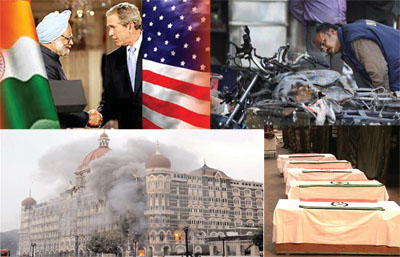
    2008 November – Nearly 200 people are killed and hundreds injured in a series of coordinated attacks by gunmen on the main tourist and business area of India’s financial capital Mumbai. India blames militants from Pakistan for the attacks and demands that Islamabad act against those responsible.
    2009 May – Resounding general election victory gives governing Congress-led alliance of PM Manmohan Singh an enhanced position in parliament, only 11 seats short of an absolute majority.
    2009 December – The government says it will allow a new state, Telangana, to be carved out of part of the southern state of Andhra Pradesh. Violent protests for and against break out.
    2010 May – The solve surviving gunman of the 2008 Mumbai attacks, Ajmal Amir Qasab, is convicted of murder, waging war on India and possessing explosives. 2010 June – A court in Bhopal sentences eight Indians to two years each in jail for “death by negligence” over the 1984 Union Carbide gas plant leak. Thousands died in this, the world’s worst industrial accident.
    Ayodha ruling 2010 September – Allahabad High Court rules that disputed holy site of Ayodhya should be divided between Hindus and Muslims; the destruction of a mosque on the site by Hindu extremists in 1992 led to rioting in which about 2,000 people died.
    2011 March – Results of 2011 census put India’s population at 1.21bn, an increase of 181 million over ten years.
    2011 August – Prominent social activist Anna Hazare stages 12-day hunger strike in Delhi in protest at state corruption.
    2011 November – Fourteen people including a government minister go on trial in one of India’s biggest ever corruption scandals – a telecoms deal alleged to have involved the selling of mobile phone licenses at knock-down prices in exchange for bribes.
    2012 May – Manmohan Singh pays first official visit to Burma by an Indian prime minister since 1987. He signs agreements aimed at providing border area development and an Indian credit line. 2012 June – Police in Delhi arrest a key figure allegedly involved in planning the 2008 Mumbai attacks. They say Abu Hamza, also known as Syed Zabiuddin, was the “handler” of the 10 gunmen. 2012 July – Pranab Mukherjee from the ruling Congress party is elected as president, comfortably beating his rival P.A. Sangma.

    2012 August – Court convicts 32 people over the 2002 religious riots in Gujarat and acquits 29 others. Among those convicted in the Naroda Patiya killings in Ahmedabad are former state minister Maya Kodnani and Babu Bajrangi, a former leader of the militant Hindu group Bajrang Dal.

    2012 December – The rape and murder of a young woman in Delhi triggers nationwide protests and a debate about sexual violence.
    2013 February – Two explosions in crowded Dilsukhnagar area of central Hyderabad kill 16 people. Police suspect the Indian Mujahideen Islamist armed group.
    2013 March – Five policemen are killed in a militant assault in Indian-administered Kashmir – the first major attack in the region in three years
    2013 August – In a deadly instance of firing on Indian Army troops on the Line of Control from Pakistan-occupied Kashmir, five Indian soldiers died in Poonch sector in Jammu and Kashmir.

  • 15-YEAR-OLD GIRL SET ON FIRE BY STALKER DIES, ODISHA FUMES

    15-YEAR-OLD GIRL SET ON FIRE BY STALKER DIES, ODISHA FUMES

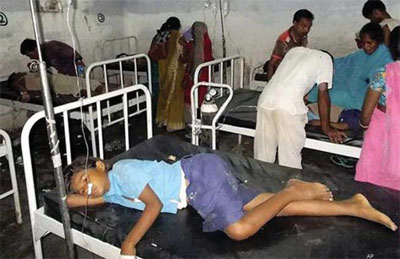
    BHUBANESWAR (TIP): A 15-year-old girl, who was set on fire by two youths 12 days ago in a village in Odisha, succumbed to her injuries on Aug 8 night after a failed attempt to shift her to a New Delhi hospital.

    A team of doctors from SCB Medical College and Hospital in Cuttack, where she was being treated since July 29, accompanied the girl to catch flight to New Delhi from Bhubaneswar airport at 9 pm to take her to the national capital’s Safdarjung Hospital. However, they could not board the plane at the last moment and were forced to take her to the nearest Capital Hospital in Bhubaneswar from the airport as her condition deteriorated. The doctors declared her dead at 11.45 pm but refrained from making any comments.

    The news of her death triggered protests from a crowd that had gathered at the hospital. People held demonstrations in front of the houses of chief minister Naveen Patnaik and health minister Damodar Rout. As the news spread, hundreds of activists of the opposition Congress and Bharatiya Janata Party (BJP) staged separate demonstrations across the city. While some protestors ransacked the hospital and broke furniture, a mob damaged three ambulances and torched two buses and a truck. However, no one was injured. The protestors also attempted to barge into the residences of Chief Minister Naveen Patnaik and Health Minister Damodar Rout but were chased away by the police.

    Patnaik on Aug 9 condoled the death of the girl and announced an ex-gratia of Rs. 10 lakh to her family. He also directed the police to take stern action against those responsible for her death. On July 28, two youth had set the victim afire after pouring kerosene on her in a village in Kendrapada district, about 150 km east of Bhubaneswar. She was admitted in a local hospital with 70 per cent burn injuries and later shifted to the SCB Medical College and Hospital. n Aug 7 doctors moved her from the burn ward to intensive care unit after her condition deteriorated.

    But when there was no sign of improvement, the authorities had decided to shift her to Safdarjung Hospital. The police, who have arrested both the youth, said the main accused Pradip Das wanted to marry the victim’s elder sister. But when the family married her off elsewhere, he stalked the victim for some time before setting her on fire to take revenge.

  • INDIA ON HOLD

    INDIA ON HOLD

    Keep economy above politics
    Prime Minister Manmohan Singh has emphasized the need for a political consensus on reforms. “Reforms”, he says, “don’t happen just because there is a professional consensus. They happen when the political leadership of the time decides to back these initiatives”. Finance Minister P. Chidambaram too had earlier felt the need for “political space” to implement the reforms.

    If the economy has faltered and growth has plunged in the past two years despite a team of competent economists being at the helm, political opposition to reforms is partly to blame. The UPA itself is divided on what needs to be done. Its concerns for electoral politics prevail over measures needed to put the economy back on track. During much of the UPA’s second term, there was a policy paralysis. Things started moving when Chidambaram took charge a year ago. The Prime Minister talked of “unleashing animal spirits” in the economy.

    Though foreign investors’ fears about sudden tax changes were allayed, high inflation did not let the RBI bring down interest rates. As the US economic recovery picked up momentum, the Federal Reserve talked of withdrawing the stimulus, which drove foreign capital from the emerging markets back to the US. As a result, the rupee and other currencies depreciated. The trend has not reversed despite some RBI and government initiatives.

    When things go wrong, politicians normally should think of the larger national interest and sink their differences to work out an economic rescue plan. Instead, they play the blame game, stall Parliament, delay crucial legislation and reforms like the goods and services tax (GST). The Congress and the BJP have almost similar economic policies. Yet petty politics divides them even as the growth rate plunges, jobs shrink and the plight of the poor worsens.

    The Amartya Sen- Jagdish Bhagwati debate has thrown up a wider consensus among experts: focus first on growth, then on distribution. This means cut down food and fuel subsidies, and other freebies, bring down interest rates, clear projects, lift the ban on mining and settle land disputes.Will the mainstream political class rise to the occasion?

  • What Will BJP Do To Jumpstart The Stalled Indian Economy If It Is Elected To Power

    What Will BJP Do To Jumpstart The Stalled Indian Economy If It Is Elected To Power

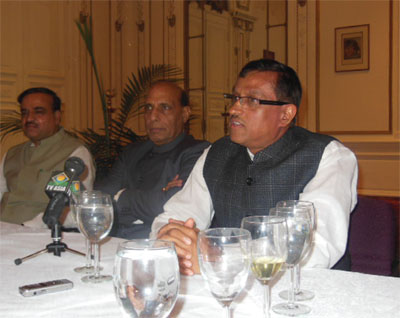
    Bharatiya Janata Party (BJP) President Rajnath Singh, National General Secretary, Anant Kumar and National Spokesperson, Dr. Sudhanshu Trivedi addressed India-America Chamber of Commerce in an in-depth analysis of “What will BJP do to Jumpstart the Stalled Indian Economy if it is Elected to Power” at a reception hosted by India-America Chamber of Commerce on July 25.

  • Cabinet nod to protect parties from RTI Act

    Cabinet nod to protect parties from RTI Act

    NEW DELHI (TIP): Ignoring concerns raised by civil rights activists the Union Cabinet on August 1 gave its nod for amending the Right to Information (RTI) Act to exclude political parties from its purview. The bill will be placed before the monsoon session starting August 5.

    The amendments have been necessitated by a Central Information Commission (CIC) order on June 3 that ruled that 6 national parties— Congress, BJP, BSP, CPI, CPM and NCP—were public authorities on the grounds that they were substantially funded by the government. The CIC also directed the parties to appoint public information officers by July 15, an order that was ignored by all 6. The cabinet gave its nod to amend the RTI Act to keep political parties out of the ambit of transparency law.

    The department of personnel and training (DoPT), which acts as nodal department for the implementation of the RTI Act, in consultation with law ministry moved the proposal to amend the RTI Act. The government seeks to change the definition of public authorities mentioned under Section 2 of the RTI Act to keep all political parties out of the jurisdiction of RTI, the sources said. Government sources said that there was unanimous support from all political parties on the issue.

    The CIC order argued that political parties received income tax exemptions and doles from government including land, electoral rolls and airtime on public broadcaster at nominal rates on the grounds that they were doing social service. The CIC order said that since the parties’ professed to be working for the public, they should be open to scrutiny from the public on the finances and decisions. Political parties across the board have opposed the order. They have argued that political parties are a voluntary association of people and in fact a very small part of their funds come from the government.

    The parties also said that they were under scrutiny of the Election Commission and the Income Tax authorities. Both parties and candidates are expected to furnish their sources offunding and details of assets owned to both authorities. Prominent activists including Aruna Roy, Shailesh Gandhi, Jayati Ghosh, Kamini Jaiswal,Nandita Das, Prashant Bhushan and Soli Sorabjee have written to the PM. Petitions have also been sent to parliamentarians to oppose the act which is unlikely since the bill has near unanimous political support.

  • BJP Wave In MP, Party On A Comeback In Rajasthan, UP

    BJP Wave In MP, Party On A Comeback In Rajasthan, UP

    NEW DELHI (TIP): The northern states of Rajasthan, Madhya Pradesh and Uttar Pradesh present a very contrasting picture when it comes to the political battle.While Rajasthan and Madhya Pradesh are basically a twohorse race with the Congress and the Bharatiya Janata Party (BJP) being the rivals, in Uttar Pradesh, which sends the largest number of MPs to the Lok Sabha, it is a four-cornered fight in most of the seats.

    According to the CSDSCNN- IBN Election Tracker survey, the BJP has a lot to cheer as the party is expected to give a tough fight to the Congress in Rajasthan to consolidate its position in Madhya Pradesh. Whereas in Uttar Pradesh, the party is on a comeback trail and is likely to bag the largest number of seats. The Congress, inspite of being in power in Rajasthan, is expected to do badly while in Madhya Pradesh it is being swept away by the BJP tide.

    Uttar Pradesh presents a very interesting picture with the two regional forces – the Samajwadi Party (SP) and the Bahujan Samaj Party (BSP) – not on a strong wicket with the Congress most likely ending fourth as the survey reveals that the grand old party of India is unable to repeat its good show of 2009 elections. The BJP has been on resurgences in all the three states and a good show by the party is likely to propel it closure to power at the Centre after the 2014 Lok Sabha elections.

  • BJP Cautions US Against Peace Talks With Taliban

    BJP Cautions US Against Peace Talks With Taliban

    WASHINGTON (TIP): The BJP has cautioned the US against any peace talks with the Taliban arguing that the terrorist outfit is unlikely to change its behavior and reconciliation effort would be a futile exercise.

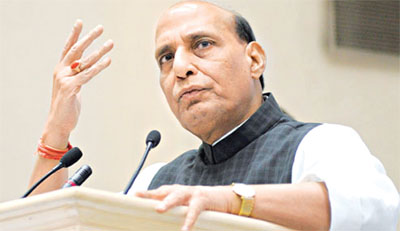
    “The eagerness to engage with elements that want to return Afghanistan to the status of ‘Islamic Emirates’ in the hope that they would deliver, and in the process humiliating and weakening the democratic leadership, doesn’t behove well for the region,” BJP President Rajnath Singh said here, July 23.

  • OFBJP Organizes Public Reception For BJP President Rajnath Singh

    OFBJP Organizes Public Reception For BJP President Rajnath Singh

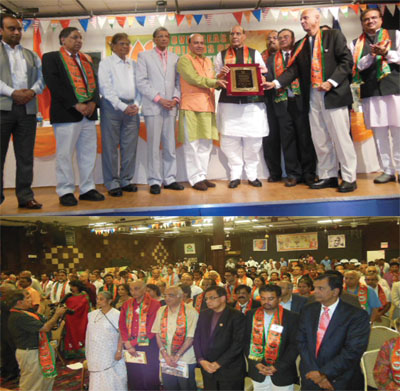
    EDISON, NJ (TIP): Indian American community of tri-state area (New Jersey, New York, and Connecticut) gave a rousing welcome to Rajnath Singh, President of Bharatiya Janata Party (BJP) and his BJP delegation Ananth Kumar, General Secretary; Sudhanshu Trivedi, National Spokesperson; and Vijay Jolly, Convener of Overseas Affairs and Overseas Friends of BJP (OFBJP) in TV Asia Studio Auditorium at Edison, NJ on Sunday July 21, 2013. The program was organized by OFBJP-USA as part of its community global outreach program.

    The program was broadcasted live on TV Asia across US reaching out to 1.5 million viewers. The program was also relayed live in India, Canada, UK, Europe and Middle East thru various channels. Addressing the jam-packed auditorium, Rajnath Singh said that he was elated by the warm welcome that had been accorded to him by the Indian Americans here in US. He said that trust and credibility have become a big problem in India and BJP is the only option. No party in India has grown bigger than Congress except the BJP.

    BJP is the only party that has not suffered a vertical split. Communists have lost relevance and Congress has no policy on any of the issues nor has any ideology. Since its inception in 1951 as Bharatiya Jan Sangh and later on as BJP, the party has been pursuing a policy of Nation first. He continued that Atal Behari Vajpayee led a 24 party coalition for 6 years and the NDA rule was far better than 55 years of Congress rule in every aspect.

    Corruption, Inflation and price rise are the signature of congress rule whereas NDA government controlled the inflation and price rise in spite of the prevailing severe drought and economic sanctions imposed by the entire West after Pokhran nuclear tests. NDA inherited a GDP growth of 4.8% and 10% inflation whereas BJP handed UPA a GDP of 8.4% and inflation 3.5% in 2004. Amidst applause from the audience he said that Pokhran test was a big step wherein the BJP led govt made India a nuclear power even though we knew economic sanctions were staring at us.

    Countries that are much smaller have become developed countries but India is still a backward country and not sure why 55 years of Congress rule did not change much. Congress has to answer as to how much time they need to make India better, to remove poverty. BJP invited FDI in telecom sector but encouraged Indian investors whereas Congress has opened up the telecom sector 100%, increased in the LIC sector from 26% to 49%. Foreign investors have pulled out $7.5 billion from India and no one is ready to invest.

    Even after 60 years of Independence we still have 67% of people who don’t get food and we need a food security bill. We need leaders with firm conviction and leaders with vision and when we come in power we will make India a super economic power in 10-15 years. National Highway development has seen tremendous growth during NDA rule. 50% of the highways that were built during 1980-2012 happened during 6 years of NDA rule and the other 50% were built during 26 years of non-BJP rule.

    Gujarat development has become a role model across the world. Madhya Pradesh agricultural growth (19%) is the highest in the world and very soon will be providing 24hrs of power supply. Chhattisgarh PDS system serves 90% of the population without any corruption and is a model for other states to emulate. Goa is the only state in India where Petrol is cheaper than Diesel. India has a GDP growth of 4.8% whereas BJP ruled states have 10% GDP growth. UPA government has no plan to tackle Naxalism or terrorism.

    Appeasement has become the state policy whereas BJP never links terrorism to any religion, caste or region. After Mumbai terror attack, Prime Minister made a statement that he will not talk to Pakistan until it gives an assurance that they will control terror activities and not support any groups that work against India but changed all that in a matter of few months. Our foreign policy is at its worst with no friendly neighbors around us. During NDA rule we maintained good relations with Russia and development excellent relations with US.

    We made US our strategic partner. He appealed to the US govt to lift the ban on visa to Narendra Modi, he said on one side US agencies rate Gujarat as the best state and Modiji as an excellent administrator and on the other hand they deny visa to him. It will be better if US takes a decision soon as they will be forced to take a decision anyway later. When BJP comes to power we will make India a power of Rishi and Krishi (knowledge and Prosperity), he said. Indian culture influenced the world for thousands of years.

    We never planned to dominate the world and even Swami Vivekananda came to Chicago on his own and had great influence on the world by his teachings. Citing the example of Newsweek columnist Lisa Miller who stated that by imbibing Yoga, Pranayam, Ayurveda and Organic farming people in the West are becoming Hindus whereas it is a crime in India if you say you are a Hindu.Talking on the recent controversy related to Narendra Modi statement that he is a Hindu and Nationalist, media created and pseudo secularists made a big fuss.

    Professing your Hindu culture became a communal word in India. He said that as per the Supreme Court, Hindutva is a way of a life. Hindutva teaches love not only for human beings but even for animals, plants, rivers, mountains etc. It is Hindutva that teaches us to serve milk to a snake and take care of animals like ants and birds. He called on the Indian American Community to support BJP to build a strong India.

    Shri Rajnath Singh was accorded standing ovation. Shri Rajnath Singh was honored by the OFBJP executive committee with a plaque for his contributions to the party and the country. Earlier, Ram Rakshpal Sood (Sr.Advisor, OFBJP) acting as the Emcee welcomed the audience, chief guests and the sponsors of the event. After the traditional lamp lighting ceremony amidst the chanting of Vedic mantras by Pandit Pravin Shastri and Chandrakant Trivedi and blowing of conch shell by Pravin Shashtri. Mrs. Vidya Labroo led the rendition of Vandemataram.

    Jayesh Patel (President, OFBJP) welcomed the distinguished guests and said that entire India is chanting Narendra Modi (NaMo) mantra and expressed hope that BJP will be able to get majority on its own merit in the next election. Ram Kamath (General Secretary, OFBJP) introduced Dr. Mahesh Mehta, National Coordinator of OFBJP-USA. Speaking on the occasion, Dr. Mehta said that mission 2014 is about transforming India into a global leader and Global Indians should contribute to be the part of this great movement that will eventually contribute to the development of India.

    Dr. Adapa Prasad (Immediate Past President) introduced Vijay Jolly, Convener of BJP Overseas Affairs and OFBJP, as a dynamic leader and former MLA who took on Delhi Chief Minister during the last election.

    In his electrifying speech, Vijay Jolly urged the audience to applaud for Rajnath Singh for honoring the feelings of the people by making NaMo as the chairman of the campaign committee. Stressing the fact the OFBJP is on a mission to develop leaders by inducting youth into the organization to dethrone the corrupt Congress regime in India. Stating that NRI’s have always made India proud, he said that OFBJP has setup its chapters in UK, Norway, Nepal, Kenya and other countries to work for the welfare of Indian diaspora.

    He got the past Presidents of OFBJP-USA honored by Rajnath Singh Introducing SudhanshuTrivedi, BJP National Spokesperson, Dr. Dinesh Agrawal (Former- President, OFBJP) said that as the national spokesperson, he is very active effective on TV channels spreading the message and its ideology of BJP. SudhanshuTrivedi reminded that July 21st the day of the program is a historical day when US astronauts landed on the moon. Edison town, the venue of the program, is also a historical town, named after the inventor of light bulb.

    Hence, he said that word Bharat stands for light and inspires us to take India to the pinnacle of glory. Stating that BJP is all set to form the next government is not based on hope but on facts. He concluded reciting a poem by A.B. Vajpayee. R.P. Singh (Org. Secretary, OFBJP) introduced Ananth Kumar, BJP general Secretary. Amidst thunderous applaud from the audience, Shri Ananth Kumar introduced himself as the Hanuman of South as Kishkinda, the birth place of Lord Hanuman is in Karnataka whereas Rajnath Singh is from U.P, the land of Ram. For Ram’s team to win we need Hanuman and he is there to lend services for the party and the country.

    India, he said is going through turbulent times and like A.B. Vajpayee model, we have Gujarat model of development under NaMo leadership and we will soon have NaMo model of governance. He said that BJP is already in battle mode, under NaMo and Rajnath Singh’s leadership we are all set to take on the corrupt congress government. Once in power, BJP will make India a global player not only in spirituality but in culture, strategic matters and will be a decisive player in the world. He urged the NRI’s to connect with their districts back home and work for BJP’s victory in 2014.

    Chandrakanth Patel introduced Rajnath Singh as a man of impeccable image in spite of being in political life for 40+ years. Born in a farmer’s family in Varanasi, he rose to be the president of BJYM. He was part of the J.P movement and became the Agricultural minister in A.B. Vajpayee’s government. He was the President of BJP between 2007-2009 and again became the President in January, 2013.

    Currently, he is a Member of Parliament from Ghaziabad, U.P. Earlier, the President of TV Asia and a well known community leader, Shri H.R.Shah addressed the gathering and said that TV Asia always supported India causes and he has been an admirer of Mahatma Gnadhi and Sardar Patel. He said he felt close to BJP principles and supported BJP. He wished that Narendra Modi would be elected as the Prime Minister. Krishna Reddy (Treasurer, OFBJP) presented the vote of Thanks.

  • Not In The Race For Prime Minister : RAJNATH SINGH

    Not In The Race For Prime Minister : RAJNATH SINGH

    NEW YORK (TIP): The Bharatiya Janata Party President Rajnath Singh on Saturday, July 20, categorically denied that he is in the race for Prime Minister of India if BJP returns to power at the Center. “I am more interested in getting the BJP back into power in Center and packing off the corruption-ridden bad governance of the Congress in my tenure as President of the party,” he said addressing a news conference of Indian-American media at Hotel Waldorf Astoria in Manhattan.

    On the question of party president not being projected as Prime Ministerial candidate in the Lok Sabha elections, he said it is not necessary that the two positions be placed in the hands of one person. “It’s not necessary that party president should also be a crowd puller and a prime ministerial candidate. I have an assignment to do for my party. I have a job to deliver – that is victory of the party in the 2014 elections.”

    “Seven months before the elections, I have nominated Gujarat Chief Minister Narendra Modi as chairman of the party campaign committee. What is unusual in that? We have nominated Modi like other parties do and why read between lines. I have named him as campaign head in view of his image, popularity and commitment to the party,” he said. He said Modi is certainly the most popular and the tallest leader of India.

    He is a crowd puller not only in Gujarat but also in Tamil Nadu, Andhra Pradesh, Uttar Pradesh and Bihar – from North to South, East to West. He is one single leader with a national appeal. His popularity will help the party in the elections. On the issue of visa rejection issue of Narendra Modi, he said he would take up the issue with the US lawmakers in Washington.

    “I will appeal to the US government to clear the US visa to the Gujarat Chief Minister.” People of India have now realized that BJP is the only solution after comparing the performance-oriented BJP led NDA Government and corruption-ridden inefficient Congress UPA dispensation, he said. The performances of several BJP-ruled states like Gujarat, Madhya Pradesh, Chhattisgarh are there for the people to see and if these states can provide 24 hour power supply, clean and efficient government, fillip to industries compared to poor performance of many Congressruled State governments what would people prefer? People have made up their mind, he said.

    Detailing steps taken by the BJP to face the national elections in 2014, he said the party had brought changes in organizational level by forming polling booth committees in every booth. “We have formed a committee consisting of 10 to 15 party men at grassroots level to strengthen the organization at village level,” he said Congress ruled for 10 long years at national level and what are their achievements other than wholesale corruption and compromise in national and international security, he asked.

    Indian voters are now realized that when the Center can’t guarantee growth rate of five percent or less, the growth rate in Gujarat, Madhya Pradesh and Chhattisgarh are approximately 10 percent. No one can fool Indian voters any more, he said. On the recent debacle of the party in Karnataka and setbacks in other states, the BJP President said assembly elections and municipal elections are different from parliament elections where people vote for a stable government.

    Voters are intelligent enough to compare the two governments and Congress will be out of power soon. They have ruled for 10 long years and now its time to give them rest, he said “We are confident that the failure of the Congress government will help BJP return to power in the center. Any political party that aspires to come to power should give good governance and satisfy the needs of the people.

    If they fail in this front, they will be out of power.” There is wholesale failure on economic front, compromise on internal and external security and diplomatic fronts as well. People are demanding a change very badly. If people want any change, the only choice is BJP who can provide an alternative to this government, he said. On allies deserting the party, he said BJP will try to get a clear majority in Lok Sabha polls but at the same time will not forget its allies – old and new.

    “Despite a clear majority in sight, we want our allies to participate in the government at the center. Now we have Shiv Sena and Shiromani Akali Dal and may get some nearer to the elections. There is also a possibility of post poll alliance with like minded parties if there is a need,” he said. In the coming Lok Sabha elections, Congress will be routed in Andhra Pradesh due to its ambiguity on Telengana issue.

    The BJP is the only national party that favors separate Telengana and it was passed as a resolution in our national executive committee meeting, he said. There is no ambiguity in the BJP unlike the Congress camp in the matter and BJP is in favor of Telengana. But it’s not in favor of bifurcation of UP and other states as Telengana issue is a totally different one. On the question of poll promises, he said BJP would rather go in for developmental debate than Ram Janma Bhoomi issue. “Ram temple was not a major poll issue anytime.

    It was at best a national issue but not an election issue,” he added. BJP government will consider instituting an inquiry commission to go into the corruption and scandals of the Congress government and will provide transparent and honest government with people’s interest as uppermost, he said. Ananth Kumar, party general secretary and chairman of Parliamentary Foreign Affairs Committee who is accompanying Rajnath Singh on the US tour, said the four member BJP delegation will meet members of the US Senate and House Representatives from both sides of the aisle – Democratic Party and the Republicans especially members of the Congressional Caucus of Indians and Indian Americans at the Capitol Hill.

    Ananth Kumar said Rajnath’s visit to the US is a two track outreach program – to outreach the Indian Diaspora to assess the mood of three million Indian-Americans across the nation who occupy important and powerful positions besides being opinion makers; and to meet with India Caucus Congressmen to impress on them that a change is sweeping in India on the heels of Lok Sabha elections.

    The other two members of the delegation are Dr. Sudhanshu Trivedi, party spokesman and advisor to the BJP President and Vijay Jolly, BJP national convener for Overseas Affairs and a former Delhi MLA. Jolly said the visit was to re-connect the Party President with the Indian-American Diaspora that plays a leading role in fostering friendship between the two countries. “We want to work closely with Non Resident Indians.” BJP – both as a government and party – will work with mainstream American and Indian-American business community on economic and investment matters.

    clearly is of the view that India and the US have a close correlation in internal and external security and they are strategic partners being natural allies, he said. Jolly said the Overseas Friends of BJP in the US has over 7000 members across the US and project a positive image of the party among Indian-Americans and policy makers. The Foreign Affairs Committee of the party will address the concerns of Indian Diaspora and include in them in the BJP parivar by assigning a major role in the ensuing elections.

    Rajnath Singh said it was NDA government under Vajpayee that gave voting rights to Non-Resident Indians and introduced Overseas Citizens Card (OCI) and Persons of Indian Origin (PIO) card. It was under Vajpayee’s leadership that the first Pravasi Bharatiya Divas was held in 2003 in New Delhi to bring all the Non- Resident and Diaspora Indians to work for the welfare of India. “All these were made possible due to the visionary leadership of Vajpayee and only the BJP has done a lot for NRIs and PIOs.”

    On the spate of killing of Hindu and BJP leaders in Tamil Nadu, he said he would appeal to Tamil Nadu Chief Minister to give protection to party leaders. “I appeal to Jayalalithaa to help stop the killing of Hindu and BJP leaders in Tamil Nadu. We will try to build pressure on state government so that it takes it seriously to put an end to such killings.”

  • India’s Economic Growth: Once a Shining Economy, India is in Danger of Running out of Gas

    India’s Economic Growth: Once a Shining Economy, India is in Danger of Running out of Gas

    “India Shining” has been the unofficial slogan for India since the turn of the 21st century. India averaged 8% annual GDP growth in the three years before the recent global financial crisis. Armed with population strength of more than a billion people, India is now the 11th largest economy in the world. According to data, from India’s Planning Commission, rapid economic growth has contributed to a decline in the poverty rate with 37.2% in 2005 to 29.8% in 2010, a drop of 40 million people in the absolute number of the country’s poor.

    Per capita income doubled during those five years. Internationally, India has also become an important actor. Forming the ‘I’ in the BRICS group of nations, India plays a very important role in the leadership of the emerging markets and developing nations. India boasts a culture of entrepreneurship and innovation, pioneering the global IT services industry, and has a global Diaspora that are leaders in various fields.

    On paper, India’s potential is immense, with approximately 500 million people between the ages of 18-25; its best years seem to be ahead. Polls have revealed that the Indian youth and business people are bullishly confident of a bright future in India. This potential is reason why India is tipped to become the largest economy by 2050. However, potential does not always translate to growth, and India has been learning this the hard way.

    An economy that once was shining is now rapidly losing that shine. India is at a serious risk of plunging itself into a crisis, one that might soon be too large to be defeated by policy.

    The Twist
    1991 is often used as the central year for economists and other experts when discussing the Indian economic growth story.In June 1991, then finance minister Manmohan Singh, passed widespread reforms that liberalized and opened India’s economy to the world. However, 1991 is also the year the last time India has passed economic reforms of such significance. Over the past 12 months, the optimistic mood within India’s economy has taken a sharp dip. GDP growth slowed to 6.3% in 2011-12; the worst it has been in 9 years, and the first quarter of 2012 India grew a measly 5.3%, according to some estimates.

    While a slowdown in GDP growth has been relatively recent, India has been battling with a rising inflation for the past two years, which included food inflation at between 15-25%. The Rupee has been in a sharp decline, decreasing by 25% in value of the past six months to become one of the worst performing currencies in the international market.

    Although a weakening external demand, due to the Eurozone crises and U.S. economic slowdown has contributed to the slowdown, India’s economy is very much based on internal demand, which has slowed recently partly because of private consumption dropping from 5.5% in 2011/12 from 8.1% the previous year. India’s economy is showing signs of overheating with a growing demand and inability to match it with supply.

    Leading domestic business people have exerted frustration at the economic situation. Since business confidence is at a low, the IMF, OECD and financial rating agency S&P are all issuing warnings to the Indian government. They all unanimously call for….

    Reform, Reform, Reform
    In its current form, the Indian economy is like a car sputtering forward and now slowly running out of fuel. India is in desperate need of reform of its tax laws. For over two years it has delayed passing laws on the goods & services tax which will allow the central government to regulate taxing on services and certain goods, rather than the current system of state regulations. In the current system, it is extremely difficult for business to run operations across the 28 state lines. Foreign investors have raised concerns on two Indian provisions seeking to tax indirect investments and combat tax evasion.

    The first gives India power to retroactively tax the indirect transfer of assets. The second targets tax evaders via the General Anti-Avoidance Rule (GAAR), putting the responsibility on investors registered in countries with special tax exemptions with India to prove they do not intend to explicitly avoid tax. Investors are fretting and such policies are threatening to drive away private investment rather than encourage it.

    Major hedge funds such as Macquarie’s Asia hedge fund which manages over $50 billion in emerging markets, have begun pulling out. A situation unthinkable a couple of years ago, India is feeling significant strains on its fiscal budget. When India was growing at 8% a few years ago, no one questioned the government’s spending. The Indian government spent freely on a variety of populist subsidies programs, racking up a fiscal deficit that it allowed itself due to GDP growth. India considered this deficit sustainable.

    The deficit currently stands close to 7% and the government must reign in on its spending, and it must discontinue these subsidies programs and allocate money to other sectors. For over a year, the central government has attempted but failed to institute such reforms.

    Bottlenecks
    India is in urgent need of reform on Foreign Direct investment (FDI) rules, particularly in its retail sector. Outdated technology, and lack of organization and inefficiency, has seen the Indian retail industry slowly and steadily pull down India’s economy. The Indian retail industry’s has an annual revenue of $500 billion as of 2011 and employs the second-most number of people after agriculture, a sector that is intrinsically linked to the retail sector. Yet, the Indian retail industry is also one of the most unorganized sectors in the country. 90% of the retail industry is controlled by smallscale, family-run operations with big chains making up just 10% of the market.

    Thus far, Indian suppliers have not been able to deliver to the consumer. Indian Commerce Minister Anand Sharma asserted that 30% of agricultural produce does not reach the market, and of the remaining 70%, more than 50% is lost due to poor transportation and storage technology. This is a gross waste in any country; especially in a developing country where there are still hundreds of millions bellow the poverty line.

    This lack of organization has led to much inefficiency, which is the root of many of India’s problems, especially inflation. Over the past two years, basic foods have been suffering an inflation of 15-20% and they have been directly linked to the inefficient supply chain. Increasing the cap on FDI in the retail sector will allow foreign firms to enter the country and make major investments that will significantly modernize the sector and will set the country on a path towards further modernization, and help it to increase consumer spending and address the food inflation.

    When the shoe doesn’t fit anymore
    India’s biggest challenge is its infrastructure deficit. If you have traveled to India, you have experienced tremendous traffic on poor roads burdened with bottle necks. India’s infrastructure deficit problem is nothing new, and the government has been trying to catch up for years. However, India’s economy has grown to a size that e will make it very difficult for both new businesses to enter the market and existing business to expand.

    According to the consulting firm Mckinsey, India is suffering a shortfall of $190 billion in the infrastructure sector and is in urgent need of capital. India’s roads are often unsuitable for large vehicles and they even literally form blockades for progress. The railways and roads dominate the country’s transport landscape.Within these two modes, 2% of road length carries 40 percent of all road traffic of the country, and one-sixth of the rail network.

    With the fragmented character of the industry, road transport services in India are generally poor and logistics costs high. Clocking the world’s lowest average speeds, trucks in India are used for 60,000-100,000 km annually – less than a quarter of the average in developed countries. A quick comparison with an immediate neighbor to the northeast gives you an idea. The time to travel by rail or road between India’s political capital New Delhi and Financial hub Mumbai is over 12 hours to cover 1180 km.

    In China, between Beijing and Shanghai, a train covers the 1071 km in approximately 5 hours. India needs to boost growth in this sector, and fast. Indian Urban Development Minister Kamal Nath stated, “With growth preceding infrastructure, we are not building for the future, but for the past.” There is a sense of saturation within the economy that is proving to be a damper for business. The government has steadily increased spending, but some wounds are self-inflicted.

    Private business have been desperately calling for reform in land acquisition, and in its current state, the lack of reform means companies are facing problems making large capital investment.Without such reform or encouragement for further private investment through allowing foreign funds and mutual insurance funds, India will continue to be building for the past. The root of India’s economic woes, in all the areas mentioned above, all find themselves leading to one common problem: The central government.India is in a crisis of politics and the center of the Indian government is stuck in a paralysis.

    In Office But not in Power
    India’s center of governance lies in the parliament in the capital city of New Delhi. However, power seems to lie everywhere, but in the center. The way India’s parliamentary system works is the ruling party holds together a coalition of smaller parties who come together to form a majority in the parliament. The current ruling coalition since 2009, called the UPA, is weak and fragmented, while the incumbent Prime Minister has shown himself to be to inept.

    The parliament has no significant majority and the center is loosing power to regional parties who consistently threaten to pull support from the coalition over major reform issues, forcing the leadership to back down. The opposition party, BJP, has shown itself more committed and content to reveal the weaknesses of the congress than to work towards a solution.

    The word ‘political paralysis’ has now become synonymous when discussing the Indian economy. Bills on subsidy reduction, tax reform, land acquisition reform, and FDI reform all exist, but a divided parliament is unable to pass such bills, and continues to be laborious and indecisive. The government has attempted to answer the calls for an end to the fiscally straining fuel and fertilizer subsidies that totally amount to 2.5% of GDP. However, these subsidies are extremely popular measures and the government has consistently faced opposition from regional parties.

    During the last 12 months, each time the central government has attempted to repeal the subsidies, regional parties carried out “All-India Bandhs,” enforcing the closure of all business for a day, using force if necessary. Acts such as this have only crippled the country further, diminishing the central government’s power and preventing reform. However, perhaps the biggest symbol of the political paralysis has been the attempt to raise the cap for FDI in the retail industry.

    In December 2011, PM Manmohan Singh announced that he was set to approve the bill on raising the cap from 21% to 49% FDI in domestic retail. There was a sense of relief for this would have a revolutionary impact on the retail industry. However, relief was short lived as Mamata Banerjee, Chief Minister of West Bengal, and an important UPA ally, threatened to pull support if this bill was passed, forcing the PM to once again pull back. There is a popular saying in India that all “economic growth in the country has been in spite the government, rather than because of the government,” and this tells a tale of frustration among Indian and foreign business people.

    Corruption has “paralyzed the government,” reckons the chief executive of one of India’s most prestigious firms. Further asserting, “We know what the problems are and we have done nothing … somebody’s neck has got to be on the line,” says the leader of a bank. What Indians always knew, is now beginning to reveal itself internationally. Business confidence in India is taking a big hit. Bureaucracy and red tape continue to scare foreign investors away.

    For example, regulatory and other obstacles recently delayed a proposed $12 billion steel investment deal from Korean company POSCO, who joined the list of other countries who have faced similar restrictions. Standard & Poor recently announced, in a special report, that India is in serious risk of being downgraded from its current BBB+ to BBB-. This downgrade is mainly connected to India’s slowing economic growth and weakening fiscal profile. S&P cited poor governance and political paralysis as the key root to India’s economic woes.

    What lies ahead?
    The most encouraging sign, although equally frustrating, is that the answers lie in its own hands. Reform bills, if passed, will take effect in a very short time, speeding business up while also inspiring confidence, which will encourage investors currently too afraid or unable to open their check book to begin investing again. The government recently announced the controversial bill on retroactive bill will be changed, which is a boost for foreign investors and is also a sign that the government is still capable of making decisions.

    Although still affected by the European debt crises and the global slowdown, India is still not as dependent on the international economy and is mostly inward looking. The service sector is continuing to grow and perform well. India’s monetary policy has proved extremely resilient, and helped carry India through from the financial crises until now. Masking inaction under conservatism or simply suffering from a gridlocked parliament will not help India’s cause.When times are tough a country needs its leaders to stand up and be counted.

    The unfortunate truth is PM Singh is not capable or powerless to do so, as he answers to Congress head Sonia Gandhi, and holds no true power base of his own. The last two years have seen a diffusion of power from the center to regional parties and this is alarming for the country. Regional parties are playing to popular vote policies, with short term rather than long term in interest.

    The situation is not as bad as it was in 1991, but it seems like it would take a crises of that magnitude to bring about the change. So far, high economic growth has legitimized the UPA’s inaction; however, that growth is no more. Ultimately, India is a democracy, and the government is responsible to the people. If reform does not come, the “Indian shining” story will be no more.

  • BJP President Criticized For Violating The Spirit Of India’s Constitution

    BJP President Criticized For Violating The Spirit Of India’s Constitution

    NEW YORK (TIP): Juned Qazi, president of Madhya Pradesh unit of Indian National Overseas Congress (I), who is vigorously campaigning for a Congress (I) ticket from Aligarh Lok Sabha constituency, strongly criticized Rajnath Singh, BJP president, for violating the secular spirit of India’s constitution in speeches made in New Jersey, USA, July 21.

    Qazi, who recently returned from a whirlwind BHARAT NIRMAN SANDESH tour of Aligarh, UP, criticized Singh for advocating ‘Hindu nationalism and Hindutva’ as a political strategy at a public reception hosted by ‘Overseas Friends of BJP’ in Edison, NJ on July 21, 2013. In a strongly worded press release Qazi pointed out that people of India can’t allow religion-based politics any more.

    “Such politics clearly violates the fundamental values of our nation upon which our constitution is based”, he said. “India is a secular country which clearly states the establishment of a secular, socialist and democratic nation”, Qazi said. “With its religion based politics, BJP is tempering with the secular nature of our constitution.” Qazi said that India is fortunate to have a very progressive and modern constitution, which is capable of taking the nation to new heights in 21st century.

    “We are a nation of young people who have no interest in promoting the bogey of religion for serving the political needs of outdated politicians. India’s constitution was created under the leadership of visionaries such as Dr. Baba Saheb Ambedkar who wanted to build India as a strong nation based secular and democratic values”, he pointed out. “BJP is a narrow-minded party whose leaders foolishly mislead the people of India by dragging religion in politics”, Qazi commented adding that BJP president Rajnath Singh spoke in USA as if he was speaking to people ignorant of outside world.

    BJP president Rajnath Singh urges Overseas friends of BJP to lobby US lawmakers and US Department of State to issue a US visa to tainted BJP leader Narendra Modi. Mr. Juned Qazi would like to ask the BJP president, why it is that BJP is unable to come to terms with the fact that Narendra Modi is in-fact responsible for the heinous systematic massacre(s) in Gujarat. With technical legal maneuvers, political arm twisting, witness/evidence tampering the BJP ruling apparatus was able to temporarily fool the Indian judiciary and procured a clean chit for the tainted leader.

    Why is it that the state department revoked Mr. Modi’s tourist/business visa and refused to let Modi into the United states on a diplomatic visa? As clearly cited in the official state department communiqué and various un-biased reports published by human rights groups, Modi and his government were directly responsible for systematic violation of human rights in the state of Gujarat.

  • Consul General Hosts BJP President And His Entourage

    Consul General Hosts BJP President And His Entourage

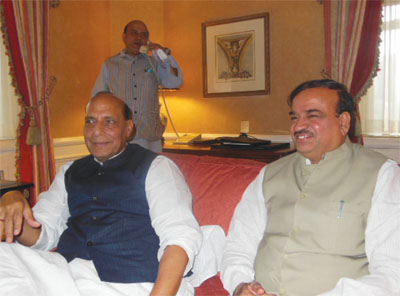
    Consul General Dnyaneshwar M. Mulay held, July 20, a dinner reception for the visiting BJP President Rajnath Singh and his entourage that included Ananth Kumar, BJP general Secretary, Vijay Jolly, Convener of BJP Overseas Affairs and OFBJP and SudhanshuTrivedi, BJP National Spokesperson.

    Mr. Mulay welcomed them as also the 20 or so guests invited to the reception dinner. Mr. Rajnath Singh spoke briefly on the state of Indian economy and stated that purpose of his visit was to meet Indian Americans and US lawmakers, policymakers and businessmen.

  • BJP Has Sound Plans To Jumpstart The Stalled Indian Economy- Rajnath Singh

    BJP Has Sound Plans To Jumpstart The Stalled Indian Economy- Rajnath Singh

    NEW YORK, NY (TIP): “The BJP-led NDA government created 67 million jobs in less than five years whereas the Congress led UPA created less than 2.7 million jobs between 2004 and 2009. These figures are from the data collected by the federal government controlled agencies and not a figment of imagination”, Rajnath Singh said.

    He was speaking on what BJP will do to jumpstart the stalled Indian economy at a function organized by India-America Chamber of Commerce, July 25. Rajnath Singh who was in Washington for three days said he had discussions with the Congressmen and administration officials on the issue of difficulties faced by candidates in H1B and L1 visa to work legally in the US. The GDP cost burden will go up by 0.3 to 0.4 percent due to increase in fees.

    “We had lodged our protest against the comprehensive immigration reforms bill and they had raised the issue of patents and compulsory drug license issues. There was only one case under these CDL whereas Indonesia had six cases and Canada four cases,” he added. The US would do well to share its latest technology on green energy with nations such as India so that it can benefit the humanity. Once these inventions are ashared, they would help us more in a very rapid manner, he said.

    The BJP government will strengthen the village economy as over 70 percent of the people live in rural areas. We will do our best to stop urbanization and create more jobs in the rural areas as was done in the previous NDA government under the PURA scheme. More than 55 percent of the jobs for youth are in rural areas and there is a need to strengthen this sector. Turning to climate change, the BJP leader said while US that has been preaching, has a carbon emission rate of 20 ton per capita per annum, India has only 1.5 per ton per capita per annum.

    The global average is only 4.5 ton per capita per annum. You now decide who is on the right side and who is not. Addressing the members of the India- America Chamber of Commerce in Manhattan, he said India is now facing a serious financial crisis of grave magnitude despite the fact that no one in the global economy can ignore India. The economy of India is not something that makes us feel comfortable or feel proud of.

    But India was regarded as third largest economy of the world, he said. When the NDA government led by Atal Behari Vajpayee stepped down in 2004, the fiscal deficit was 2.5 percent and current account deficit was surplus. The revenue deficit was less than one percent. The economy witnessed a boom period during 1999 to 2004 when the country was ruled by the NDA and the slide started in 2004. “The boom that we created lasted till 2008 and then we are now witnessing is one of the worse economic downturns,” Singh said.

    “When I mentioned to the Speaker of the House yesterday at Washington that we had a surplus current account when we left power, he was surprised. There was a revenue deficit that went up from 4.5 percent to 6 percent in 2008. The current account of deficit shot to 6 percent. We passed the fiscal responsibility bill in the parliament and hence were able to bring some fiscal discipline.

    Inflation is now hovering around 7.7 percent,” he said. The rupee value has depreciated drastically to the US dollar from Rs 37 a dollar in 2008 to Rs 60 in 2013 almost doubling in five years. We thought this would be offset by increase in exports and that also did not happen; it went up by just one percent. It’s very unfortunate that savings that have been the biggest strength of India as it provided capital is now falling at a very rapid rate.

    The small businesses tend to grow with the increase in savings and in the absence they take a major hit. Savings drop and growth rates drop and what else to drop. The success of Indian story is over. The success story of India is waiting for the BJP to return to power. The UPA has ruined the economic structure of the country. How will the BJP restore investors’ confidence and fix the broken economy once it comes to power? We will do what we did from 1999 to 2004 and we had a unique development model which is not only a model for India to feel proud of but came as a surprise to the world.

    When we handed over the reins of the government to the Congress-led UPA, India’s growth rate was 8 to 9 percent and rate of inflation was around three percent. More than 50 percent of the highways were built during the Vajpayee government and the present Congress dispensation had admitted this in the court. Where had all the developments gone now? The BJP created a success story only to be mauled by the Congress, he added.

    We have proved in the BJP-ruled states how we prioritize economic reforms and Gujarat is a shining example of India. The whole world is now talking about Gujarat and foreign governments are keen to study the success story. Take the case of Madhya Pradesh that was considered a sick state with no economic development before the BJP Government took over. Agricultural growth rate has gone up to 19.1 percent in the state as against 4 percent of the federal government.

    Madhya Pradesh has replaced as country’s largest supplier of food grains to the central pool. In Chhattisgarh, more than 90 percent of the population is covered under the Public Distribution System and people enjoy social security compared to mass suicide by farmers in the Congress-ruled states. Goa is the only state in India where petrol is cheaper than diesel similar to what we see in the US.

    Do we have to prove anything more to assure the people that our first priority will be to fix the problems and take India on a different plane?, he asked. The average GDP of BJP-ruled governments is about 10 percent whereas the nation is only experiencing a growth rate of less than five percent. There are only two models – BJP model for growth and Congress model for destruction, he added. Earlier, Rajiv Khanna, President, India-America Chamber of Commerce welcomed Rajnath Singh and introduced the subject of talk.

    He pointed out that Indian economy has been weakening and this had caused considerable doubts in the minds of investors and wanted Singh to speak on how his party, if it came to power would jumpstart the stalled Indian economy. The talk by Rajnath Singh was followed by an interesting Q & AA session. Singh candidly answered the few questions put to him.

  • Bihar Government Cries Conspiracy, Says Mid-Day Meal Was Poisoned

    Bihar Government Cries Conspiracy, Says Mid-Day Meal Was Poisoned

    PATNA (TIP): Under attack from the opposition over the death of 27 school children after consumption of midday meal at Saran, the Bihar government said it suspected a conspiracy behind the tragedy. “The deaths were not due to food poisoning but it’s a clear case of mixing poison in food,” state Education Minister P K Shahi told reporters here. He said doctors attending the students at Chhapra sadar hospital have reported that the children had died due to the presence of poisonous organic phosphorous in the food.

    “From where did this organic phosphorous come in the food given to students as part of the mid-day meal scheme?” Shahi asked and told the police to investigate the matter. The minister hinted at the involvement of opposition RJD in the tragedy though he did not make any direct reference. “Arjun Rai, the husband of the school headmistress, had supplied the food material for the midday meal.

    He is an active member of a party and cousin of local leader Dhruv Rai of Mashrakh, who is close to a prominent leader of a party (RJD),” he said. Rai, Shahi said, owns the grocery shop from where the materials were taken by the school headmistress Meena Devi for the midday meal scheme. Besides, the headmistress was posted at the school under pressure “from a particular party”. Block education officer Pramod Kumar, who is under suspension now, had appointed her as headmistress incharge of the school.

    The minister said, “Some people seem to be in a hurry to capture power anyhow and in persuading this ambition they are indulging in inhuman acts like the present tragedy.” The couple is absconding and an FIR has been lodged in Mashrakh police station against Meena Devi. Shahi said a student had told the media that the headmistress had forced them to finish the meal when they expressed reluctance to eat it because of its pungent taste.

    Besides, a cook had said she had complained to the headmistress about the oil given to her for cooking the meal but she told her it was fresh and asked her to use it. The minister said the government has ordered suspension of the headmistress and the block development officer has been asked to initiate the process but it is taking time as the BDO is engaged in law and order duty in view of the Saran bandh called separately by opposition RJD, BJP and LJP to protest the incident.

    Shahi, who had rushed to Chhapra yesterday on the instruction of Chief Minister Nitish Kumar, said the response time taken by the government to provide succour to the victims was quick. Refuting lacunae in implementation of the central government’s mid-day meal scheme, Shahi said the ruling JD(U) has always been concerned about improving the quality of food under the programme, implemented in 73,000 schools across the state.

  • Erosion Of Public Faith

    Erosion Of Public Faith

    “It is a sad commentary on politicians”. The nation’s problem is how to reignite the spirit of confidence and idealism. Alas, no political party, even in the states, comes up to that standard. Whether the next election throws up such people is in the realm of conjecture. Persons like me are still optimistic that India would return to the path of values which it took after winning Independence”, says the author.
    In the penultimate year of nearly onedecade rule by Prime Minister Manmohan Singh’s government, I find the biggest casualty is the people’s confidence in political parties, particularly the ruling Congress. In fact, the public is so exasperated that it has come to believe that dishonesty and politics are synonymous and those who have come to politics have done so only to make money.

    I was aghast to find that many wellplaced people have not contributed to the Prime Minister’s Relief Fund because they suspect that the money given for the Uttarakhand victims would be used by the Congress in elections. I can understand the argument that the assistance is mismanaged, but the suspicion about the PM’s Fund should awaken the rulers to the extent that the people have lost faith in them.

    The scandals like the 2G Spectrum regarding the mobiles and the allotment of coal blocks to unknown persons have, no doubt, damaged the credibility of the Congress. But the inference that those in positions, to whichever party they belong, are all corrupt is a sad commentary on politicians. Consequently, there is a question mark against any report or probe conducted by the government. Even a judicial verdict is taken with a pinch of salt.

    The fault is not that of the people, but the manner in which the affairs have been conducted since the seventies. Very little has been done to restore confidence. In fact, official machinery is in disarray. Take the case of Ishrat Jahan encounter. The Home Ministry at the Centre and the state government had taken the stand that Ishrat, along with her three accomplices, were terrorists who were killed in an encounter with the police suspecting them to have a plan to assassinate Gujarat Chief Minister Narendra Modi.

    The Central Bureau of Investigation (CBI) said that it was a coldblooded murder. The agency found no evidence to involve Pakistan and Lashkar-e-Toiba which the Intelligence Bureau (IB) had done. Who does the public believe? Both the CBI and the IB are parts of the same government. The public is further confused because the CBI has alleged that Ishrat and her accomplices were picked up from different places and shot dead.

    The weapons they had on them were allegedly planted by the police and none of these had been used for days. Assume that Ishrat and the others were terrorists. Does the police force have the right to kill them without proving in a law court that they were terrorists? If this rule is to apply, the killers of Mrs. Indira Gandhi and Rajiv Gandhi should have been shot dead in encounters instead of proceedings even in the Supreme Court.

    We should not have spent crores of rupees on the trial of Mohammad Kasab, who was hanged, and done away with him for the attacks on Mumbai. The food security law which will subsidies food for 65 per cent of the population is a prey to suspicion. The government is to be blamed for introducing the measure through an ordinance when the Parliament session was only three weeks away (It has now been postponed to August after the ordinance).

    Most political parties are in favor of the food Bill but want a legitimate discussion in Parliament before it is enacted. The Congress prefers the route of ordinance on the plea that political parties, particularly the BJP, have not allowed Parliament to function. This is true. But the ordinance too has to be passed by Parliament. For that a consensus would be required. Why couldn’t the government bring about it before the ordinance? There is something in the allegation that the Congress eyes are fixed on the parliamentary elections which are due in May 2014.

    It is possible that the polls may take place in November or December. Such are the suspicions which have nullified the food security ordinance which would enable roughly 850 million people of limited means to buy rice at Rs. 3, wheat at Rs. 2 and bajra for Rs 1a kg. The case of the CBI’s autonomy is yet another example worth dwelling on. People have no faith in the supervision by the three retired High Court judges. The suspicion is that the government would appoint pliable judges. Since the CBI will be under the government, any measure it takes fails to evoke faith.

    The other main political party, the BJP, is suspect because it is selling the Modi thesis of Hindutva. The latest is the building of the Ram temple at the site where the Babri Masjid stood before its demolition. The party should realize that the religious card cannot be played again and again. The demand for a temple and a uniform civil code is supposed to be part of development, a camouflage for Hindutva.

    The party is as much engaged in power politics as the Congress is. That the leftist parties have social justice and federalism on their agenda is to the liking of a preponderant majority. To their admiration, a convention of the leftist parties in Delhi last week reiterated the two points. Indeed, the Manmohan Singh government has made the rich richer and has made a mockery of political autonomy.

    Yet the CPI (M) was found wanting during its rule of 15 years in West Bengal. The Sachar Committee has said that the Muslim community in the state was the most backward in education (only 2.7 per cent). The CPI supported the authoritarian rule of Indira Gandhi during the Emergency. The Janata Dal (United) evokes hope to be a third alternative because its chief, Sharad Yadav, has said that his party will fight totalitarianism of communists and communalism of the BJP.

    Bihar Chief Minister Nitish Kumar has shown in his rule that a government can rise above gimmicks. Rightly Nitish Kumar has asked for the National Investigation Agency to probe the Bodh Gaya bomb blasts. The nation’s problem is how to reignite the spirit of confidence and idealism. Alas, no political party, even in the states, comes up to that standard.

    Whether the next election throws up such people is in the realm of conjecture. Persons like me are still optimistic that India would return to the path of values which it took after winning Independence.

  • Allahabad High Court Says No To Caste-Based Rallies In UP

    Allahabad High Court Says No To Caste-Based Rallies In UP

    LUCKNOW (TIP): Throwing a spanner in the works of Uttar Pradesh’s caste-dominated politics, the Lucknow Bench of the Allahabad High Court on July 10 stayed rallies based on caste in the state with immediate effect. The Division Bench comprising Justices Uma Nath Singh and Mahendra Dayal has also issued notices to the Central and state governments, Election Commission as well as the four major political parties – the BJP, Congress, Bahujan Samaj Party and Samajwadi Party. They have been asked to present their point of view.

    The next hearing is scheduled for July 25. The order comes a day after the Supreme Court cut to size the political elite in the nation by giving a judgment that stated that an elected representative would stand disqualified as soon as he was convicted even by a trial court for any offence which prescribes punishment for two or more years.

    Today’s order came in response to a public interest litigation (PIL) filed by Lucknow-based lawyer Motilal Yadav challenging caste-based rallies. In his petition, Yadav had demanded a ban on such rallies arguing that those were against the spirit of the Constitution which clearly states that all caste and communities were equal before the law and upheld that there would be no discrimination based on caste or religious lines.

    Such rallies were dangerous to the social fabric of the country as these created enmity between castes and promoted assertion of caste-based identities, pleaded Yadav. He had made the Central and state governments as well as the ECI, Congress, BJP, SP and BSP as respondents in the PIL. Additional Advocate General Bulbul Godiyal had appeared on behalf of the state government. The PIL was filed in the high court a day after BSP national president Mayawati addressed the 34th and last Brahmin Mahasammelan in Lucknow on July 7.

    These mahasammelans were meant to mobilise Brahmins in the state in the run-up to the 2014 Lok Sabha poll. While SP president Mulayam Singh Yadav welcomed today’s order, his party had also organised a similar Brahmin meeting at the SP office on April 26 where sops for Brahmins was announced, including the declaration of Parshuram Jayanti as a gazetted holiday. The Election Commission has already banned such caste and community based rallies and events during the election process.

  • Minister For Special Panel On Terror Cases Against Muslims

    Minister For Special Panel On Terror Cases Against Muslims

    NEW DELHI (TIP): Union minority affairs minister Rahman Khan wants the government to form an allpowerful taskforce to monitor and review terror cases against Muslims, arguing that it is needed to ensure justice for “innocent Muslim youth” languishing in jails after being framed in terror cases. Khan cited the example of the UK which, he said, has formed a task force under Prime Minister David Cameron to ensure there are no excesses in the crackdown on terror.

    “It should be the highest body with powers to review terror cases,” he told TOI, adding it would monitor the progress of cases to sift genuine ones from the trumped up cases. “I am finalizing the proposal and will soon write to the PM and Congress president Sonia Gandhi,” Khan said. Flagging the urgent need for supervision, Khan said many Muslim youth were languishing in jails for extended periods without chargesheets.

    “The existence of the panel will deter police from indiscriminate arrests in terror cases while ensuring that those arrested do get justice,” he said. The minister’s push for the allpowerful panel comes in the backdrop of increasing evidence that Muslim youngsters have generally been at the receiving end of police crackdown. The failure of the cops to nail several terror cases and prolonged incarceration of the accused have led to charges of religious persecution.

    Khan’s suggestion — he is in the process of finalizing the details — could lead to a push for the PM to head the panel so that the oversight mechanism gets the required political heft. However, it would test Congress’s appetite for bold moves in the run-up to the 2014 campaign, given that BJP will seize upon it to accuse UPA of being “soft on terror” and minority “appeasement”.

    Khan said his proposal emanated from complaints his ministry had been received from organizations and parents of terror detainees on a regular basis. “On a visit to London, I raised terror attacks with the UK minister for communities. He explained to me about a task force formed under the PM that comprises various ministers. It is a sort of cabinet subcommittee to review terror cases,” he said. Khan said it was high time the Centre take a close look at terror cases.

    “If people are acquitted after prolonged detention, where do they go for justice? Especially, if they are not compensated? The long years in jail disrupt lives of detainees,” he said. The issue of terror detainees, also raised in UPA coordination committee, has been mired in Centre’s lack of jurisdiction on states.

  • Jet-Etihad deal comes under scanner

    Jet-Etihad deal comes under scanner

    NEW DELHI (TIP): Alleging that the Jet- Etihad deal was being rushed through and the government agencies were not allowed to examine it in all its ramifications, the main opposition Bharatiya Janata Party (BJP) on July 3 asked the Congress party-led United Progressive Alliance (UPA) government to order a Central Bureau of India (CBI) inquiry monitored by the Supreme Court to trace the manner in which the deal was carried out.

    The BJP has said that the deal was mired in all kinds of controversies as it was carried out in a “half-cooked” and “objectionable” manner and was “predicated” on the increase in number of seats to be made available. “This deal smacks of a scam. It is already stinking. There should be an inquiry into who is responsible. The manner in which the deal was concluded two days after the bilateral agreement with the UAE was signed and assigning them 37,000 additional seats clearly indicates that these two private parties — Jet Airways and Etihad — were fully aware of what the government was going to do,” BJP leader Yashwant Sinha said here in Delhi. “As a matter of fact, given the kind of agreement which they have concluded, in which there will be members on the board much in excess of what 24 per cent entitles them to, is raising all kinds of concerns. The government should order a CBI inquiry monitored by the Supreme Court to probe the manner in which this deal has been done,” Sinha added. Objections to the deal were first raised by a Parliamentary Standing Committee headed by Communist Party of India (Marxist) leader Sitaram Yechury, followed up by senior Members of Parliament Jaswant Singh and Dinesh Trivedi, and Janata Party chairman Subramanian Swamy.

    The Parliamentarians have alleged that with the deal, Abu Dhabi will get thousands of new passengers on its routes to Europe, Africa and West Asia at the cost of Indian airports. Additionally, Prabodh Panda of the Communist Party of India (CPI) and BJP leader Nishikant Dubey have written to the Central Vigilance Commission, demanding to investigate the deal. “The deal has been struck just to benefit private players, which will hamper the interest of Air India. This has been done in violation of all norms and deliberately done to cause losses to the state-owned carrier.We have asked for a vigilance probe into the matter. Also profitable routes have been given away to private players at low rates. Delhi airport, which is attempting to emerge as an international hub, would also suffer at the cost of Abu Dhabi,” Panda said here.

    Both the bilateral agreement and the airline deal were announced on April 24 this year. Since then, the deal has run into trouble.With each passing day, the matter is getting complicated as more and more Indian political leaders are clamouring for a review of the deal. Last month, the Foreign Investment Promotion Board (FIPB) had deferred a decision on clearing the Rs20.58 billion deal. According to industry experts, the deal is all set for a delay, probably much longer than expected by the two airlines. Sources have revealed that the Prime Minister’s Office (PMO) does not want to be dragged into another 2G-like controversy, more so since the number of bilateral weekly seats between Abu Dhabi and Delhi were dramatically increased from 13,330 to 36,370 just before the deal.

  • Munde’s Rs.8-crore poll expenses claim could land him in trouble with EC

    Munde’s Rs.8-crore poll expenses claim could land him in trouble with EC

    Mumbai (TIP):L The Election Commission is likely to seek an explanation from senior BJP leader Gopinath Munde sooner than later over is reported claim that he had spent Rs.8 crore as poll expenses during the 2009 general elections as against the official sanctioned limit of Rs.25 lakh.

    According to a report in the New Indian Express, the Election Commission will in all likelihood question Munde on the issue, especially after he claimed that he had only Rs.6.22 crore in assets.

    The paper quotes RTI activist Anil Galgali, as saying that Munde has lied about the money he spent in the elections and also about his total assets. Maharashtra Home Minister R R Patil has asked the EC to take cognizance to the claims made by Munde.

  • 500 Relief Trucks Await Admn Nod

    500 Relief Trucks Await Admn Nod

    DEHRADUN (TIP): At least 500 trucks carrying ration and foodrelated material meant for distribution among survivors in catastrophe-hit Rudraprayag, Chamoli, Uttarkashi and Pithoragarh districts are lying parked for the last four days in Rishikesh, Dehradun, Haridwar and Haldwani. The trouble is the administration is not clearing their onward journey for want clearances. Of these, 96 ration-loaded trucks were sent by senior Congress leaders on behalf of Congress chief Sonia Gandhi and its vice-president Rahul Gandhi.

    These have been lying on both sides of the 230km Haridwar- Gangotri bypass obstructing traffic – all because the administration’s failure to ensure its distribution among survivors far-flung places. A senior Congress leader in Dehradun said these ration trucks were stuck because the administration has refused to accept the supplies for want of storage space. “Unless the administration allows these trucks to move, these will remain jammed and perishables items would rot,” said an official.

    Dehradun additional district magistrate Harak Singh Rawat said as the government does not have any place to store the heavy quantity of ration, the question of issuing permits to the truck owners to proceed further does not arise. Members of different social and political organisations, including state BJP chief Tirath Singh, have accused Congress leaders of unnecessarily wasting food supplies like grains, biscuits, drinking water, and oil for the sake of scoring brownie points from floods victims.

    Singh said Congress workers are not at all inclined to trek for miles to distribute food items to victims. State Congress chief Yashpal Arya said the government will issue permit to stranded truck owners to proceed further soon so as to distribute ration and food material among victims in affected areas. However, Garhwal commissioner Suvardhan said as the government already has more than enough stock of ration for distribution among those in need, the stranded trucks will have to wait for a two more days.

    “We will definite issue permits to their owners to move further so that material is distributed among people who are genuinely affected,” said Suvardhan. All this while people in remote areas await precious supplies that could save lives.