Tag: Buddhism

  • Only Dalai Lama can decide his successor, says India

    Only Dalai Lama can decide his successor, says India

    New Delhi (TIP)- In a terse message to China, India asserted on Thursday, July 3,  that the right to pick the 14th Dalai Lama’s successor rests with the incumbent and the institution, a day after Beijing said that his reincarnation must have its approval.

    India added that Union ministers Kiren Rijiju (BJP) and Rajiv Ranjan Singh (JDU), Arunachal Pradesh chief minister Pema Khandu and Sikkim CM Prem Singh Tamang will attend the Dalai Lama’s 90th birthday celebrations in Dharamshala on July 6.

    On Thursday, Rijiju said that the institution of the Dalai Lama is the most important and defining institution for Tibetans not just in Tibet but across the world. “And all those who follow the Dalai Lama feel that the Incarnation is to be decided by the established convention and as per the wish of the Dalai Lama himself… Nobody else has the right to decide it except him and the conventions in place,” Rijiju said. The minister said the Indian government’s decision to depute two senior ministers to attend the celebrations is not a political issue.

    India has for long stated that the process of naming the successor is a long standing tradition that the Dalai Lama undertakes and no third party has a role to play here.

    The Dalai Lama said on Wednesday that the 600-year-old institution of spiritual head of Tibetan Buddhists will continue after his death and a trust created by him will be the sole authority to recognise his reincarnation, effectively shutting out any role for China in choosing his successor.

    Speculation has swirled about the future of the institution since the Nobel laureate head of Tibetan Buddhism said in 2011 that he would decide on his 90th birthday – which falls on July 6 this year – whether the position should continue. His Wednesday announcement, which clarifies matters, came at a Tibetan religious conference in McLeodganj, near Dharamshala, that is part of a week of celebrations to mark his birthday.

    Hours later, an irate Beijing, which describes the Dalai Lama as a “separatist”, countered that the spiritual leader’s reincarnation “must be approved by the central (Chinese) government”.

    Chinese foreign ministry spokeswoman Mao Ning told a regular news briefing, “The reincarnation of the Dalai Lama, the Panchen Lama and other great Buddhist figures must be chosen by drawing lots from a golden urn, and approved by the central government.”

    “The Chinese government implements a policy of freedom of religious belief, but there are regulations on religious affairs and methods for managing the reincarnation of Tibetan living Buddhas,” she added.           Source: HT

  • Odisha: A journey through history, culture, tradition and architecture

    Odisha: A journey through history, culture, tradition and architecture

    Odisha’s history, culture, tradition, and architecture are intertwined in a rich tapestry that reflects its ancient glory and resilience. From the grandeur of the Kalinga Empire to the magnificence of the Jagannath Temple and the artistic finesse of Odissi dance, the state stands as a testament to India’s diverse heritage. Odisha’s political history, marked by conquests, colonial rule, and modern progress, adds depth to its narrative. As a land of spirituality, art, and history, Odisha continues to inspire and captivate people from all over the world, earning its rightful place as the cultural soul of India.

    Odisha, located on the eastern coast of India, is a land of timeless heritage, magnificent architecture, rich cultural traditions, and a fascinating political history. Known as the “soul of India,” Odisha has been a cradle of civilization, art, and spirituality. With its ancient temples, vibrant festivals, and storied past, the state beckons travelers, historians, and cultural enthusiasts alike. This article explores Odisha’s glorious history, cultural riches, architectural marvels, and political evolution over the centuries.
    Ancient History of Odisha
    Early Human Settlements
    The history of Odisha dates back to prehistoric times, with evidence of human settlements as early as the Stone Age. Excavations at sites like Kuliana and Mayurbhanj indicate that the region was inhabited by early human societies practicing rudimentary agriculture and crafting tools.
    Kalinga: The Ancient Name of Odisha
    In ancient history, Odisha was known as Kalinga. It gained prominence as a powerful kingdom that played a significant role in Indian politics, trade, and culture.
    The Kalinga region stretched across modern Odisha and parts of Andhra Pradesh. The first recorded mention of Kalinga appears in Mahabharata and Jain texts.
    The Kalinga War (261 BCE)
    One of the most defining moments in Odisha’s history was the Kalinga War fought between the Mauryan emperor Ashoka and the Kalinga kingdom in 261 BCE. The war was brutal, with massive casualties. However, its aftermath marked a turning point in Indian history. The devastation of the war led Ashoka to embrace Buddhism, promoting peace, compassion, and non-violence. The war’s significance is captured in Ashoka’s inscriptions at Dhauli and Jaugada.
    Maritime Trade and Cultural Exchange
    During ancient times, Odisha’s coastline facilitated extensive maritime trade with Southeast Asian countries like Java, Sumatra, Bali, and Sri Lanka. Traders and sailors from Kalinga established cultural and commercial ties, leading to the spread of Indian art, architecture, and religion, especially Buddhism and Hinduism.
    Rich Cultural Heritage
    Odisha’s culture is a harmonious blend of tradition, spirituality, art, and festivals, which have been preserved for thousands of years.
    Performing Arts
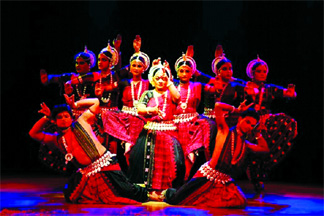
    Odissi Dance
    Odisha is the birthplace of Odissi, one of the eight classical dance forms of India. With its roots in ancient temple rituals, Odissi is characterized by graceful movements, expressive gestures, and intricate footwork. Dancers use mudras (hand gestures) to convey stories from Hindu mythology.
    Folk Dances
    Odisha boasts a variety of folk dances like Chhau, Sambalpuri, and Ghumura, each reflecting local traditions and cultural vibrancy. The Chhau dance, particularly from Mayurbhanj, combines martial arts and folk elements.
    Music
    Odisha has a rich musical tradition rooted in Odissi Sangeet, which is a form of classical music. The music, often accompanied by instruments like the veena, mardala, and bansuri, complements Odissi dance performances and devotional songs.
    Festivals
    Odisha’s festivals are colorful and deeply rooted in spirituality:
    Rath Yatra
    The annual chariot festival at the Jagannath Temple in Puri is one of the largest religious gatherings in the world.
    Durga Puja
    Celebrated with grandeur across the state, Durga Puja marks the victory of good over evil.
    Bali Yatra
    This festival commemorates Odisha’s ancient maritime connections and is celebrated on the banks of the Mahanadi River.
    Makar Sankranti and Nuakhai
    These harvest festivals celebrate agrarian traditions and community bonding.
    Handicrafts and Textiles
    Odisha’s artisans are renowned for their craftsmanship:
    Pattachitra
    Traditional scroll paintings depicting mythological themes and intricate designs.
    Applique Work
    Pipili appliqué craft, often seen during temple festivals, involves colorful fabric cutouts stitched onto cloth.
    Ikat Weaving
    Odisha’s handwoven Ikat sarees from Sambalpur and Sonepur are globally acclaimed.
    Stone Carving
    The art of stone carving, seen in Odisha’s temples, continues to thrive.
    Architectural Marvels
    Odisha is home to some of India’s most impressive architectural treasures. The state’s architecture reflects its religious and cultural history, particularly influenced by Hindu, Jain, and Buddhist traditions.
    Temples of Odisha
    The temples of Odisha are a testament to the state’s rich architectural heritage. Built primarily during the Kalinga period, these temples follow the Kalinga style of architecture, characterized by curvilinear spires, intricate carvings, and spacious courtyards.
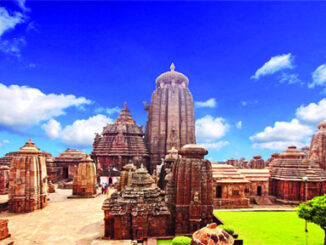
    Lingaraj Temple (Bhubaneswar)
    Built in the 11th century, this temple is dedicated to Lord Shiva and represents the zenith of Kalinga architecture. The sanctum, tower, and carvings display exceptional craftsmanship.
    Jagannath Temple (Puri)
    One of the Char Dhams of Hindu pilgrimage, the Jagannath Temple is dedicated to Lord Jagannath (a form of Vishnu). Its massive structure and annual Rath Yatra attract millions of devotees.
    Konark Sun Temple
    A UNESCO World Heritage Site, the Konark Sun Temple is shaped like a colossal chariot with intricately carved stone wheels, pillars, and sculptures. Built in the 13th century by King Narasimhadeva I, it remains a masterpiece of Kalinga architecture.
    Mukteshwar Temple
    Known as the “Gem of Odisha Architecture,” this 10th-century temple is renowned for its exquisite carvings and arched gateway.
    Buddhist Monasteries and Stupas
    Odisha has a rich Buddhist heritage reflected in its ancient stupas and monasteries:
    Ratnagiri, Udayagiri, and Lalitgiri
    Known as the Diamond Triangle of Odisha, these sites contain remains of stupas, monasteries, and sculptures from the Buddhist era (7th-12th centuries CE).
    Dhauli
    The site where Ashoka embraced Buddhism after the Kalinga War, Dhauli houses the Shanti Stupa (Peace Pagoda).
    Forts and Palaces
    Barabati Fort
    Located in Cuttack, this 14th-century fort was a prominent military stronghold during the medieval period.
    Chilika Lake and Kalijai Temple
    Though not an architectural site, the Kalijai Temple on Chilika Lake is a significant cultural landmark.
    Political History of Odisha
    Odisha’s political history is marked by the rise and fall of powerful dynasties, colonial domination, and post-independence development.
    Ancient Dynasties
    Mauryas and Ashoka
    The Mauryan conquest of Kalinga marked a significant chapter in Odisha’s history.
    Mahameghavahana Dynasty
    Under King Kharavela (1st century BCE), Odisha witnessed a resurgence of Jainism and territorial expansion. Kharavela’s Hathigumpha inscription at Udayagiri provides insights into his reign.
    Medieval Period
    Somavamshi Dynasty
    Between the 9th and 12th centuries, the Somavamshis established their rule in Odisha, contributing to temple construction.
    Ganga Dynasty
    The Ganga rulers, particularly King Anantavarman Chodaganga Deva, ushered in a golden era of Odisha’s art and architecture. The Jagannath Temple was built during this period.
    Eastern Ganga Dynasty
    The Ganga rulers continued their legacy, with the construction of the Konark Sun Temple marking the pinnacle of their achievements.
    Surya Vamsi Gajapati Dynasty
    In the 15th century, the Gajapati kings ruled Odisha with great prowess, expanding their influence to neighboring regions.
    Colonial Rule
    In the 16th century, Odisha came under Mughal rule and later the Marathas in the 18th century. In 1803, the British East India Company annexed Odisha, marking the beginning of colonial exploitation. The region became part of the Bengal Presidency until it gained separate identity as Odisha Province in 1936.
    Modern Odisha
    Post-independence, Odisha became a state of the Indian Union on April 1, 1936, celebrated as Utkal Divas. Since then, Odisha has made significant strides in socio-economic development while preserving its cultural heritage.
    BJP term in Odisha
    The Bharatiya Janata Party (BJP) assumed power in Odisha on June 12, 2024, marking a significant shift after five consecutive terms under the Biju Janata Dal (BJD).
    Since 1946, Odisha has had 14 chief ministers. Serving from 2000 till 2024, Naveen Patnaik of the Biju Janata Dal was the longest-serving chief minister in Odisha’s history. The current Chief Minister of Odisha since 12 June 2024 is Mohan Charan Majhi of the Bharatiya Janata Party.
    In collaboration with the state government, the 18th Pravasi Bharatiya Divas (PBD) Convention is scheduled to take place in Bhubaneswar from January 8 to 10, 2025. Prime Minister Narendra Modi is set to inaugurate the event, which will focus on the theme “Diaspora’s contribution to a Viksit Bharat.” The convention aims to engage the Indian diaspora in India’s development journey.
    The BJP government in Odisha has been proactive in implementing policies to enhance the state’s growth trajectory. Prime Minister Modi has acknowledged these efforts, emphasizing the government’s commitment to development.
    Additionally, the new administration has initiated investigations into alleged corruption during the previous BJD regime. Chief Minister Mohan Charan Majhi has pledged to probe all corruption cases from the BJD’s tenure, aiming to ensure transparency and accountability in governance.
    The BJP’s rise to power in Odisha signifies a transformative period, with the government focusing on development, anti-corruption measures, and strengthening ties with the Indian diaspora through events like the upcoming PBD Convention.

  • Bhubaneswar: The Temple City and venue of 18th Pravasi Bharatiya Divas

    Bhubaneswar: The Temple City and venue of 18th Pravasi Bharatiya Divas

    Bhubaneswar, famously known as the Temple City of India, is a harmonious blend of ancient heritage and modern urbanization. Located in Odisha, Bhubaneswar’s unique identity stems from its status as a repository of Indian temple architecture, cultural traditions, and its rapid transformation into a smart city. As the chosen venue for the 18th Pravasi Bharatiya Divas (PBD) in January 2025, the city will once again be in the global spotlight, showcasing its historical, cultural, and economic vibrancy.This article explores Bhubaneswar’s rich legacy, its evolution into a modern city, and its significance as the host of the Pravasi Bharatiya Divas, a global event that celebrates the Indian diaspora’s contributions.
    The Temple City’s Heritage
    Bhubaneswar derives its name from “Tribhubaneswar,” meaning “Lord of the Three Worlds,” referring to Lord Shiva. The city is home to over 700 temples, many of which date back to the 7th and 13th centuries, exemplifying the Kalinga architectural style.Lingaraj Temple: A masterpiece of Kalinga architecture, the Lingaraj Temple is dedicated to Lord Shiva and is a prominent pilgrimage site.
    The city’s temples are not just religious centers but also repositories of art, culture, and history. They attract historians, architects, and tourists from across the globe.
    Cultural Significance
    Bhubaneswar is more than just its temples. It is a cultural hub where traditional art forms like Odissi dance, Pattachitra painting, and stone carving thrive. The city also serves as a gateway to Odisha’s vibrant festivals such as Rath Yatra, Durga Puja, and Ekamra Utsav, which celebrate the region’s spiritual and artistic traditions.

    Bhubaneswar: The Cultural and Architectural Marvel of India
    Bhubaneswar, the capital city of Odisha, is a treasure trove of culture, architecture, and heritage. Known as the “City of Temples,” it boasts a history that spans over 3,000 years. From its ancient temples to modern urban planning, Bhubaneswar is a city that seamlessly blends its glorious past with a progressive present.
    Historical Significance of Bhubaneswar
    Bhubaneswar derives its name from the Sanskrit words “Bhubaneswar”, meaning “Lord of the Universe.” It is believed to have been the seat of the powerful Kalinga kingdom, which played a crucial role in shaping the history of ancient India.
    The city’s historical roots can be traced to the 2nd century BCE, as evidenced by the archaeological remains at Sisupalgarh, one of the oldest known fortified urban centers in India.The turning point in Bhubaneswar’s history was the Kalinga War (261 BCE), fought near the city’s vicinity. This transformative event led to Emperor Ashoka’s conversion to Buddhism and the spread of Buddhist teachings across Asia.
    Bhubaneswar’s historical narrative is deeply intertwined with Hinduism, Buddhism, and Jainism, making it a confluence of diverse religious traditions.
    Cultural Vibrance
    Bhubaneswar is not just a city but a living museum of Odisha’s vibrant culture. The city is renowned for its festivals, dance forms, music, and crafts, which reflect the ethos and spirit of Odisha.FestivalsThe festivals of Bhubaneswar are a testament to its cultural richness.
    The city comes alive during Rath Yatra, a grand chariot festival dedicated to Lord Jagannath. Though the primary celebrations occur in Puri, Bhubaneswar’s temples also partake in the festivities. Durga Puja, Makar Sankranti, and Diwali are celebrated with great enthusiasm, showcasing the city’s communal harmony.The Ekamra Utsav, a cultural festival named after Bhubaneswar’s ancient name, Ekamra Kshetra, highlights the city’s artistic heritage. It features traditional music, dance performances, and exhibitions of local crafts, drawing visitors from across the globe.
    Dance and Music
    Odissi, one of India’s classical dance forms, originated in Odisha and finds its soul in Bhubaneswar. The city is home to iconic institutions like the Odissi Research Centre, where the dance form is preserved and propagated. The fluid movements, intricate gestures, and emotive expressions of Odissi are a visual delight, embodying the spiritual essence of the city.
    Music in Bhubaneswar ranges from classical Odissi music to contemporary forms. The city’s musicians have preserved traditional instruments like the mardala and the gini, which add a unique rhythm to its musical heritage.
    Handicrafts and Textiles
    Bhubaneswar is a hub for Odisha’s famous handicrafts and textiles. The city markets, such as Ekamra Haat, showcase exquisite handwoven Sambalpuri sarees, Pipli appliqué work, and silver filigree jewelry. The intricate patterns and vibrant colors reflect the artisans’ skill and creativity, keeping traditional crafts alive in the modern era.
    Architectural Marvels
    Bhubaneswar is often referred to as a “living museum of architectural excellence.” The city’s temples, built over centuries, are exemplary of the Kalinga architectural style, characterized by ornate carvings, towering spires, and intricate sculptures.
    The Temples of Bhubaneswar
    Lingaraj Temple
    The crown jewel of Bhubaneswar’s temple architecture, the Lingaraj Temple is dedicated to Lord Shiva. Built in the 11th century, it is a masterpiece of Kalinga architecture, with a towering 180-foot spire and exquisite carvings. The temple complex also houses smaller shrines, each narrating a story of devotion and craftsmanship.
    Mukteshwar Temple
    Known as the “Gem of Odisha,” the Mukteshwar Temple is a 10th-century marvel. Its intricately carved torana (arched gateway) and latticed windows are among the finest examples of temple art in India. The temple’s sculptures depict scenes from the Panchatantra, showcasing the interplay of religion and folklore.
    Rajarani Temple
    Unlike most temples in Bhubaneswar, the Rajarani Temple is not dedicated to any deity. Its name is derived from the red and yellow sandstone used in its construction. The temple is adorned with elaborate carvings of celestial nymphs, dancers, and musicians, reflecting the artistry of the bygone era.
    Ananta Vasudeva Temple
    Dedicated to Lord Krishna, this temple stands out for its Vaishnavite influence in a city predominantly associated with Shaivism. The temple’s sculptures and carvings depict scenes from the Mahabharata and the Bhagavata Purana.
    Parasurameswara Temple
    One of the oldest temples in Bhubaneswar, it dates back to the 7th century. The temple’s intricate carvings and compact structure mark the early stages of Kalinga architecture.
    Jain and Buddhist Heritage
    Bhubaneswar’s architectural heritage is not limited to Hindu temples. The city and its surroundings are home to significant Jain and Buddhist sites.
    Khandagiri and Udayagiri Caves
    These twin hills house ancient Jain rock-cut caves, dating back to the 2nd century BCE. The caves, such as the Hathigumpha and Rani Gumpha, are adorned with inscriptions and carvings that narrate tales of royal patronage and asceticism.
    Dhauli Shanti Stupa
    Located a short drive from Bhubaneswar, the Dhauli hill is believed to be the site of the Kalinga War. The Shanti Stupa (Peace Pagoda), built by the Japanese Buddhist community, stands as a symbol of peace and Ashoka’s conversion to Buddhism.
    Ratnagiri, Lalitgiri, and Udayagiri
    These Buddhist sites, collectively known as the Diamond Triangle, are located near Bhubaneswar. They feature ancient stupas, monasteries, and sculptures, offering a glimpse into Odisha’s Buddhist past.
    Heritage Conservation
    Efforts to preserve Bhubaneswar’s heritage have gained momentum in recent years. The Ekamra Kshetra Heritage Project aims to restore and rejuvenate the old city area, showcasing its historical and cultural landmarks. Initiatives like guided heritage walks and digital documentation of monuments are helping to connect the younger generation with the city’s legacy.
    Modern Bhubaneswar A Smart City
    While steeped in history, Bhubaneswar is also a city of the future. Recognized as one of India’s first Smart Cities, it has embraced technology and sustainable urban development. The city’s well-planned infrastructure, green spaces, and efficient public transport make it a model for urban living.The Info Valley IT Park and Start-Up Odisha Initiative have positioned Bhubaneswar as an emerging hub for technology and innovation. Its educational institutions, such as the Indian Institute of Technology (IIT) Bhubaneswar and KIIT University, attract students from across the country, fostering a dynamic academic environment.
    Culinary Delights
    No exploration of Bhubaneswar is complete without savoring its delectable cuisine. The city’s food culture is a reflection of its rich heritage and diversity.Pakhala Bhata: A staple dish of fermented rice served with fried fish, vegetables, and curd, pakhala is a must-try.
    Chhena Poda
    Known as Odisha’s cheesecake, this dessert made of caramelized cheese is a local favorite.Dalma: A wholesome dish made of lentils and vegetables, seasoned with aromatic spices.
    Street Food
    From dahi vada-aloo dum to ghugni chaat, the city’s street food scene is vibrant and flavorful.Bhubaneswar’s Role in TourismBhubaneswar serves as the gateway to Odisha’s rich cultural and natural attractions. The city’s proximity to Puri (home to the Jagannath Temple and beaches) and Konark (famous for the Sun Temple) makes it a crucial stop on the Golden Triangle of Odisha tourism. The Chilika Lake, Asia’s largest brackish water lagoon, and the Similipal National Park are other nearby attractions that draw nature enthusiasts.
    Bhubaneswar is a city where the ancient and the modern coexist harmoniously. Its rich culture, stunning architecture, and historical significance make it a living testament to India’s diverse heritage. As it strides into the future as a Smart City, Bhubaneswar continues to honor its past, offering visitors an unforgettable journey through time. Whether you are a history buff, a culture enthusiast, or a seeker of spiritual solace, Bhubaneswar promises an experience like no other.

  • US Congress recognizes two Indian spiritual leaders for their contributions towards global peace

    US Congress recognizes two Indian spiritual leaders for their contributions towards global peace

    WASHINGTON, D.C. (TIP): The US Congress has recognized two Indian spiritual leaders, Sri Sri Ravi Shankar and Acharya Lokesh Muni, for their efforts towards global peace and harmony.

    “With his message of peace and commitment to education and humanitarianism, Gurudev has lived a life dedicated to the betterment of others,” Indian American Congressman Raja Krishnamoorthi said in his remarks in the House of Representatives. Describing Ravi Shankar as a global humanitarian and spiritual leader, Krishnamoorthi said for over 40 years, he has helped guide individuals in Illinois and throughout the world in their search for inner peace with his programs rooted in meditation and yoga.

    “Through his charity work and educational efforts, Gurudev has spread his belief that if individuals find inner peace, it can lead to real-world reductions in violence and conflict,” Krishnamoorthi said. He also recognized Acharya Muni for his lifetime dedication to promoting peace, religious tolerance, and universal values.

    “At a young age, Acharya Dr. Lokesh Muni Ji committed himself to the study and teaching of Jainism, Buddhism, and Vedic philosophy,” he said. “Acharya Dr. Lokesh Muni Ji has dedicated himself to the promotion of peace and tolerance among different faith groups,” he said. He has helped defuse communal violence on multiple occasions and recently opened the World Peace Center in Gurugram, India, Krishnamoorthi said.

    “With the support of Ahimsa Vishwa Bharti, Acharya Dr. Lokesh Muni Ji leads interfaith dialogues with the goal of finding common ground among the participants. Acharya Dr. Lokesh Muni Ji’s work has positively impacted individuals throughout the world,” he said.
    (Source: PTI)

  • IUDF opposes dividing the Indian American community by Hindutva groups

    NEW YORK (TIP): The Indo-US Democracy Foundation (IUDF), a newly formed think tank, deplores the attack on elected representatives in the U.S. by a cadre of people belonging to the Hindutva group, who support ideologies opposed by America.

     They are virtually threatening U.S. Representatives like Ro Khanna (California) and Pramila Jayapal (Washington) for not towing their line of Hindutva politics, which want to reshape India as a Theocracy or Hindu Rashtra. They even threatened Rep. Tom Suozzi of New York, a good friend of the Indian community, for demanding the restoration of democracy in Kashmir.

    The Hindutva forces in the U.S. follow the ideology of RSS, a militant organization in India, who want to make India a Hindu Rashtra and keep the Muslims, Christians, Sikhs, Dalits, and others as second class citizens, denying them equality in their ancestral land. It is not acceptable. It is un-American to profess such a fascist ideology in this land of the free.

     Rep. Khanna’s grandfather was a freedom fighter for India’s independence struggle and suffered greatly in jail for many years. Rep. Khanna rightly says that his grandfather fought for all Indians, and he cannot support divisive ideologies now. Rep.  Jayapal, too, demanded democratic rights for Kashmiris, who are citizens of India.

     The Hindutva forces in the U.S. may have money, power, and numbers; however, they forget that they have reached this level of success because of the democratic, secular, and tolerant fabric of this great country. While they enjoy the freedom and great opportunities in this nation, they are working hard on the sideline to deny these same rights and liberties to minorities and lower castes in India.

    These wolves in many garbs are busy trying to influence policies in Washington, often masquerading as champions for the Indian community in America.  Moreover, many Asian Indians in this country remained quiet for too long, under the false impression that India needed lobbying by these Hindutva groups for a better bilateral relationship. However, upon careful examination, these folks are exposed as more militant and strident in their voices than their so-called mentors in India, which is sad. It appears that they have brought their whole baggage of racism and bigotry to these shores and are working hard to convert others into the same.  In internet forums and discussion groups, they attack and denigrate anyone who is opposed to their ideology, often calling them traitors. Traitors to whom? These people seem to forget that their behavior is inconsistent with the values and traditions of this great country and is un-American.

     It is quite astonishing that some of these folks who are highly educated and better positioned in the social strata, denigrate Christianity and attack Islam in heinous terms. To intimidate others, they often use the legal system and also threaten actions from the Government of India, such as visa denial or cancellation of OCI Card.

    The Indian Diaspora is diverse and comprises many religions, regions, and languages. According to a Pew Research poll, 50% of the Indian Diaspora consists of Non-Hindus. And the majority of the Hindus in this country may also want to live in peace with one another. However, it is unfortunate that a small band of radical Hindutva supporters in this country is in the process of ruining the peace and harmony for everyone else.

    Here is a quote from the editorial of the Indian Panorama newspaper that captured the essence of the sentiment of the majority of the Indians who live here: “There is no harm in exercising one’s democratic rights in a democratic country. For long, Khalistanis have been demanding a Khalistan in India. It does not make a difference that there are people here who want a Hindu Rashtra. If the Khalistanis demanding Khalistan are anti-India and enemies of the nation, the same yardstick could be applied to those demanding a Hindu Rashtra. What is the difference? The demands of both the Khalistanis and the Hindutva supporters are divisive and against the interests of India and its 1.3 billion people.

     It is unfortunate that Indians who now are citizens of America should attempt to create hatred among people of Indian origin and divide them here in the U.S., where hundreds of ethnicities have learned to live in brotherhood and peace. Aren’t they committing a crime against America and American people? Nobody should be allowed to take advantage of the freedoms offered by the greatest nation on the earth. Nobody should be allowed to practice any form of terrorism in the greatest democracy in the world, which prides itself on the values of freedom and fraternity. President Trump, who has been bold enough to deal with the terrorism of all shades, should find a way to lock up people of foreign origin who promote hatred and create divisions and are a threat to the American National Security.

     Nobody should be allowed to take advantage of the freedoms offered by the greatest nation on the earth. Nobody should be allowed to practice any form of terrorism in the greatest democracy in the world, which prides itself on the values of freedom and fraternity. President Trump, who has been bold enough to deal with the terrorism of all shades, should find a way to lock up people of foreign origin who promote hatred and create divisions and are a threat to the American National Security.”

    Ref: https://www.theindianpanorama.news/other-stories/from-defending-a-diplomats-statement-to-advocating-hindutva-and-demanding-a-hindu-rashtra/

    https://indicanews.com/2019/09/07/ro-khannas-statement-against-hindutva-riles-bjp-supporters-but-is-hailed-by-others/


  • Shen Yun: The Stunning Theatrical Extravaganza

    Shen Yun: The Stunning Theatrical Extravaganza

    By Mabel Pais

    NEW YORK CITY (TIP): Preity Uupula, a former Miss India International, said of Shen Yun, “The energy was very powerful in the room. (For) some of the pieces, I just closed my eyes and I felt like it was a meditation. It’s very healing actually.”

    Like India, China can be proud of 5000 years of an ancient, rich civilization and culture. Having some of its roots in the ancient Indian spiritual path of Buddhism, Shen Yun, based in New York, has a mission to revive 5000 years of divinely inspired culture.

    The last performances of this breathtaking theatrical amazement, for the season, were held at NJPAC (the New Jersey Performing Arts Center, NJ) from May 3-7. For 5,000 years, divine culture flourished in the land of China.

    Shen Yun Performing Arts, Manchurian Elegance
    Shen Yun Performing Arts, Sleeves of Grace
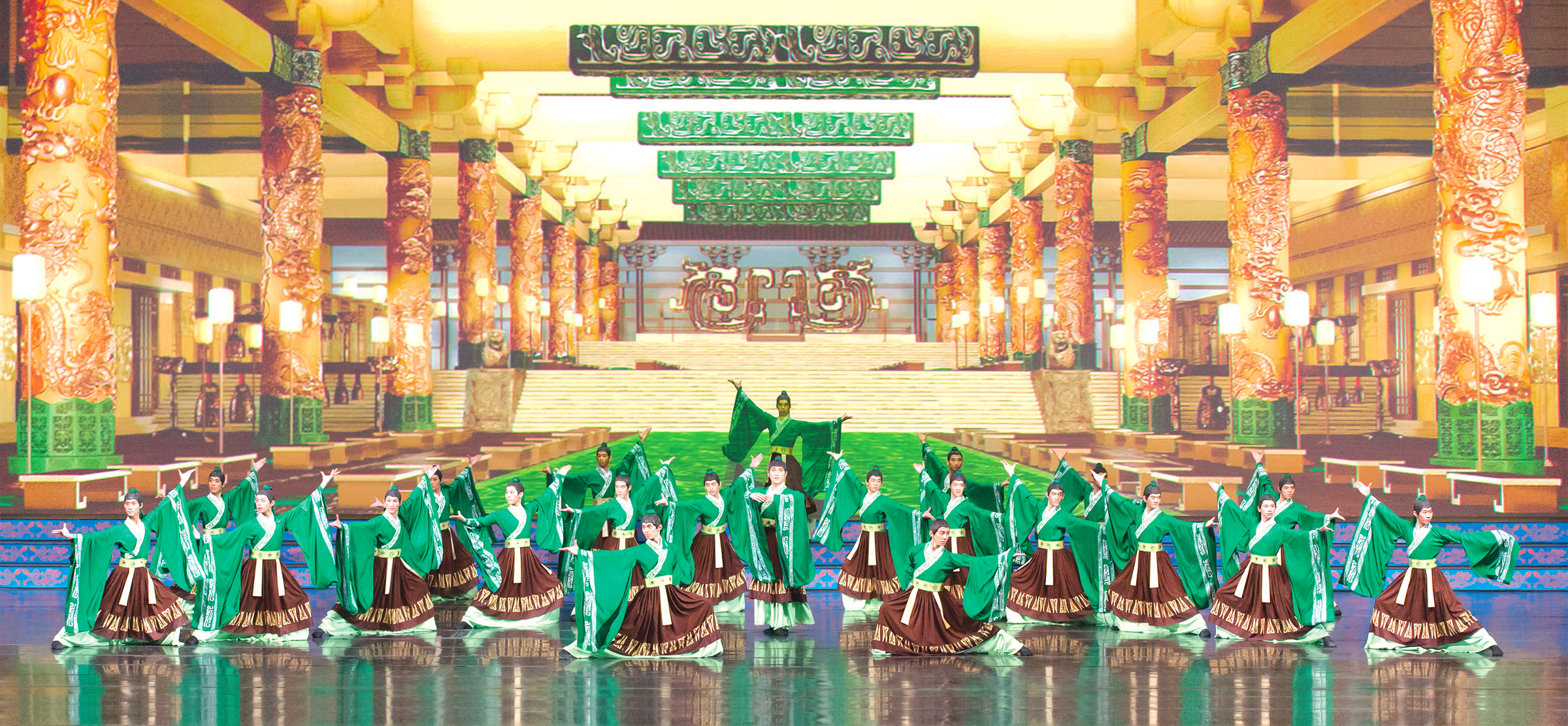
    Shen Yun Performing Arts, Han Imperial Air

    Humanity’s treasure was nearly lost, but through breathtaking music and dance, Shen Yun is bringing back this glorious culture. Shen Yun means, “The beauty of heavenly beings dancing.”

    Falun Dafa, also known as Falun Gong, is a practice that combines teachings for self improvement and meditation exercises. The teachings are centered on three main principles-truth, compassion, and tolerance.

    Shen Yun’s artists practice Falun Dafa, and it is a source of inspiration for their performances. However, over the last 60 years of Communist rule, the regime has treated Chinese values – centered on the idea of harmony between heaven and earth – as a threat to its existence and banned traditional beliefs and practices.

    Through the universal language of music and dance, Shen Yun weaves a wondrous tapestry of heavenly realms, ancient legends, and modern heroic tales, taking you on a journey through 5,000 years of Chinese culture. Its stunning beauty and tremendous energy leave audiences uplifted and inspired.

    A Shen Yun performance features the world’s foremost classically trained dancers, a unique orchestra blending East and West, and dazzling animated backdrops-together creating one spectacular performance. The Shen Yun Symphony Orchestra blends the singular beauty of Chinese melodies with the precision and power of the Western orchestra.

    “Amazing! The artists perform as if they are fluid bodies with no bones. Gravity does not apply to them. They leap and fly in the air while they perform their numbers…..” quipped Pattie King, audience member at NJPAC.

    “Mesmerizing! Reclaiming the divinely inspired cultural heritage of China,” remarked Donna Karan, creator of DKNY.

    “I was mesmerized and astonished within the first few minutes…..Shen Yun music proves that not every message needs to be delivered via language or written words…..” Rojin Rahmani, musician.

    Shen Yun Performing Arts is the world’s premier classical Chinese Dance and Music company. In 2006, a group of leading classical internationally award winning Chinese artists came together in New York with one wish: to revive the 5000-year-lost world of traditional Chinese culture and share it with the world. Through breath taking music and dance, Shen Yun is bringing back this glorious culture.

    Each season, the company produces an all new show and tours with it around the globe, performing at the world’s top venues – Lincoln Center in New York, The New Jersey Performing Arts Center, New Jersey, Kennedy Center in Washington, the London Coliseum.

    Since ancient times, Chinese culture has been heralded as a gift from the divine; and part of that divine gift was a supreme art form that has endured to this day: Classical Chinese Dance. “It (Classical Chinese Dance) has a history of several thousand years in both folk and imperial settings. It served as entertainment for large gatherings and celebrations”, says Ms. H. Sue Guo, Principal, The Fei Tian Academy of the Arts College, New York, the college that trains the performers of Shen Yun. Branches of the college exist in California and Taiwan.

    Within China’s grand civilization of 5000 years, many traditions are linked together: martial arts, Chinese opera, folk dance and acrobatics. They all have something in common. Chinese dance has 3 main components: technical skill, form and a special feature called yun or physical bearing. Chinese dance’s technical skills include a whole series of challenging leaps, jumps, flips and many difficult tumbling techniques.

    In eastern philosophy, there is a saying “beauty and roundness,” explains choreographer, principal dancer and associate company manager Yungchia Chen. “The path of the movement needs to be circular, rounded and full. It’s different from ballet which focuses on straight lines.”

    What takes classical Chinese dance to another level is yun or physical bearing that is a certain sensibility when Chinese people perform classical Chinese dance. “It’s an artistic feeling that rises from the culture” demonstrates dance teacher Gu Yun. When the dancer moves there is an internal energy connected to the breath. The breath meets the body. The breath is crucial.

    Over the centuries, the technical skills, form and bearing all come together to make classical Chinese dance one of the richest, most expressive and most demanding art forms in the world.

    The training process for each dancer is extremely arduous. Daily training lasts for 7- 8 hours. It takes 6 years schooling just to be good enough to go on stage. After 10 years training in college is completed.

    Every year, Shen Yun creates a whole new production with original dances, costumes and music. By adding the distinctive melodies of ancient Chinese instruments, over Western orchestration, Shen Yun brings together two of the greatest classical musical traditions the world has ever known.

    Johnny Stuart, music director, calls the music “just phenomenal, mind blowing!” Music conductor Leon Natker says that “putting together classical Chinese instruments and classical western instruments is a way towards the future for me as a musician.” Jing Xian, a composer of the performance, says, “Both these (Chinese and western) musical systems are excellent. But it’s just like cooking. You might have great ingredients but if we don’t understand the characteristics of the ingredients, and to stir fry random things together, it simply won’t taste good.”

    Shen Yun music displays China’s traditional melodies. Just like dance, music can also present different times, places, characters and moods. China has 5 millennia worth of culture: from the melodic styles of over 50 ethnic groups to grand imperial court music and lavish folk tunes. This heritage is an endless source of inspiration.

    “What we are taking on is a responsibility we simply cannot shirk. There are times when I really feel it’s our life’s mission. It may take many life times to complete.” “I have dedicated my entire life to the arts. Yet it was only after I reached my 70s that I found that this is where it has the greatest meaning,” says Ms. H. Sue Guo, Principal, The Fei Tian Academy of the Arts College, New York.

    (Mabel Pais is a freelance writer. She writes on theater, health and wellness, social issues and spirituality)


  • PM Modi in Lanka to re-emphasise traditional Buddhist connect

    PM Modi in Lanka to re-emphasise traditional Buddhist connect

    PM Modi in Lanka to re-emphasise traditional Buddhist connect

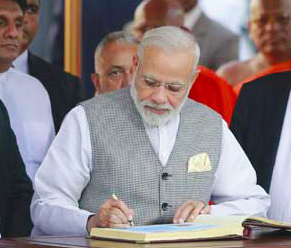
    NEW DELHI/COLOMBO (TIP):Prime Minister Narendra Modi arrived in Colombo on May 11 on a two-day visit which is mainly aimed at reinforcing the traditional connect between India and Sri Lanka at a time when China is seeking to make inroads in the island nation.

    Modi, on his second visit to Sri Lanka in two years, is here primarily to participate on Friday in the International Vesak Day celebrations, the biggest festival of Buddhists.

    He will inaugurate a hospital built with India’s assistance of Rs 150 crore. He will also address the Indian-origin Tamils against the backdrop of India’s insistence that Sri Lanka should undertake devolution of power to the ethnic community as part of the reconciliation process.

    Sri Lankan Prime Minister Ranil Wickremesinghe and several senior ministers, including foreign minister Mangala Samaraweera, were at the Colombo International Airport to receive the Indian Prime Minister.

    “As Sri Lanka proudly celebrates #InternationalVesakDay, I warmly welcome Indian Premier @narendramodi who will grace the occasion,” tweeted President Maithripala Srisena.

    Modi was accorded a guard of honour by the Sri Lankan Air Force at the airport. The visit and the agenda is mainly to re-emphasise the traditional connect between India and Sri Lanka, particularly in the context of Buddhism, which is a shared heritage.

    This assumes significance since China is aggressively trying to make inroads in Sri Lanka.

  • Tibetan lama gives up monkhood to marry childhood friend

    Tibetan lama gives up monkhood to marry childhood friend

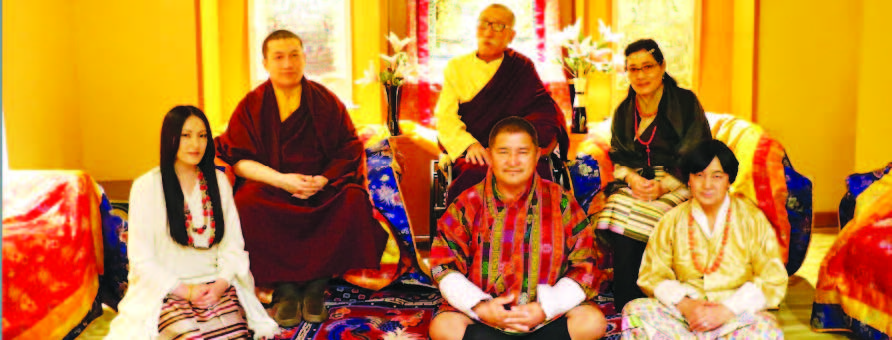
    NEW DELHI (TIP): A senior Tibetan lama based in India, who is one of the claimants to the title of Karmapa Lama, has married a childhood friend and abandoned monkhood, his office announced on Marck 30, Thursday.

    Thaye Dorje, 33, married Rinchen Yangzom, 36, in a private ceremony attended by close family members in New Delhi on March 25. His office described the couple as “close childhood friends” who have known each other for more than 19 years.

    “I have a strong feeling, deep within my heart, that my decision to marry will have a positive impact not only for me, but also for the lineage,” Thaye Dorje was quoted as saying in a statement posted on his website.

    “Something beautiful, something beneficial will emerge, for all of us.”

    Rinchen Yangzom, whose Tibetan name means “precious prosperity gathered”, was born in Thimphu and was educated in India and Europe. Thaye Dorje proposed to her according to Tibetan traditions on January 19. A spokesman for Thaye Dorje said that he will no longer be a monk but will continue “as the lineage lama and as the Karmapa, including by offering teachings and blessings to students around the world”.

    The statement said Thaye Dorje “appreciates that the news of his marriage will come as a surprise to many, and has faith that his students will understand his wish to have kept private this personal element of his very public life”. He and his wife will make their first public appearance together in Bodhgaya in December this year.

    Thaye Dorje has claimed since childhood to be the reincarnation of the Karmapa Lama, the 12th century leader of one of the four major schools of Tibetan Buddhism.

    Ogyen Trinley Dorje, another monk who fled from Tibet to India in 1999, is recognised by many followers of the Karma Kagyu school as the Karmapa Lama. He is also recognised by the Dalai Lama.

    The spokesman said Thaye Dorje has been the “Karmapa from birth” and will “continue his activities as the Karmapa”. He added, “He will hold meditation sessions and will continues his travels, including a European tour that will take him to countries such as Sweden and Spain.”

    The 15-day period following the wedding is a “sacred time” and Thaye Dorje and his wife will spend this time with their extended families, the spokesman said.

    Thaye Dorje was born in Tibet and his father was a high lama while his mother was descended from Tibetan nobility. According to his official biography, he was one-and-a-half years old when he started telling people that he was the Karmapa Lama.

    The Karmapa Lama is not the only senior Tibetan Buddhist title to be disputed.

  • July 4th, India and the USA

    July 4th, India and the USA

    Upon declaration of our independence on July 4, 1776, the first three states in the world to recognize the sovereignty of the United States were; the Kings of Dutch Republic, Morocco and Mysore (India).

    According to Dr. Range Gowda, Tipu Sultan’s historiographer, the congratulatory letter to America is preserved in a French Library and in 1776; there is a record of celebration of America’s independence through fireworks in the capitol of Mysore; Sriranga Patna.

    It was a coincidence, that General Cornwallis who surrendered to George Washington in the battle of York Town in 1781 was a hired gun to defeat Tipu, the Sultan of Mysore through deceit in the 4th war of Mysore against colonialism.

    One of the folk stories about Tipu Sultan was that he supported the freedom struggle of America; indeed, the British were the common enemy for both the nations. Lord Cornwallis and Lord Wellesley ruled both the nations. We hope to search for the documents for authenticity, right now it is a folk tale.

    Tippu Sultan of Mysore is one of the few rare heads of the states in the world who adopted pluralistic form of governance and humbly signed the documents as citizen of the state.

    July 4th means everything to Indians and Americans, and the biggest one is the freedom. One is the oldest democracy and the other one is the largest democracy. Both the people are inherently secular in nature despite the expression of bigotry from a handful of men and women on both sides.

    Both the nations have chosen the path of separation of Church and State, even though a few fanatics on both sides want their nations to go back to the dark days of dictating others what they can eat, drink, wear or believe on the one hand, and push the others to conformity in the other land.

    Both the nations are collectively made up of Adivasis/ Native Americans, Atheists, Bahai’s, Bos, Buddhists, Christians, Dalits, Hindus, Jains, Jewish, Muslim, Sikhs, Tribals, Zoroastrians and every possible grouping.

    Both India and the United States are represented by every race, nationality, ethnicity, language, culture and religion. We see God as one, none and many; and in every form; male, female, genderless and non-existent, being and non-being, nameless and with innumerable names.

    We are proud of our heritage – a multi-faith, multicultural, multi-regional and multi-linguistic society, where we have come to accept and respect every which way people have lived their lives. For over 5000 years, India has been a beacon of pluralism – it has embraced Islam, Christianity, Judaism, Baha’i and Zoroastrianism to include in the array of the indigenous religions; Hinduism, Jainism, Buddhism and Sikhism, and America has become a beacon of freedom of faith and it has embraced all the diversity God has created.

    We may want to consciously start thinking and acting as one people, one people within a nation and a community and one people globally. It’s like home when we are conflict free. I do hope each one of us purges any bias towards the other, there is joy in being free from ill-will. Try to be free from it this day forward… free from anything that prevents you from being a part of the whole.

    Let me remind you how a Chinese man embarrassed me some 12 years ago. I volunteered to decorate one of the floats for July 4th parade in Plano, Texas. When we got it all ready and joined the parade with our truck he said, you will see my (Chinese) People along the roads and your (Indian) people will not show up. I did not like his statement, but was waiting to pounce on him. It was a three mile route and he was snubbing me all along, damn it there were no Indians. I eagerly wanted to see some Pakistanis or Bangladeshis to claim as Indians, every one disappointed, only 2 Indians and a Pakistani joined me in carrying our banner; we took turns in carrying it.

    I urge you to at least go out on July 4th and watch the parade. I will join the parade in Louisville this year with a Flag.


  • ARCHITECT OF INDIA’S CONSTITUTION DR. BHIMRAO AMBEDKAR

    ARCHITECT OF INDIA’S CONSTITUTION DR. BHIMRAO AMBEDKAR

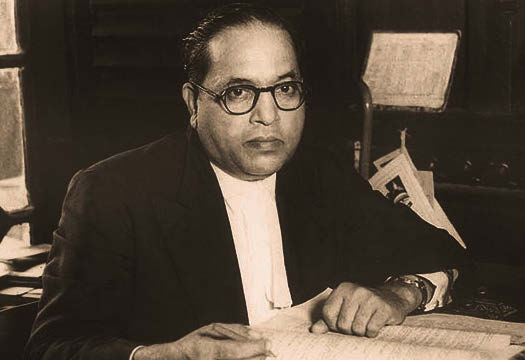
    Dr B R Ambedkar, popularly known as Babasaheb Ambedkar, was one of the architects of the Indian Constitution. He was a well-known politician and an eminent jurist. Ambedkar’s efforts to eradicate the social evils like untouchablity and caste restrictions were remarkable. The leader, throughout his life, fought for the rights of the dalits and other socially backward classes. Ambedkar was appointed as the nation’s first Law Minister in the Cabinet of Jawaharlal Nehru. He was posthumously awarded the Bharat Ratna, India’s highest civilian honor in 1990.

    “Unlike a drop of water which loses its identity when it joins the ocean, man does not lose his being in the society in which he lives. Man’s life is independent. He is born not for the development of the society alone, but for the development of his self.”

    Bhimrao Ambedkar was born to Bhimabai Sakpal and Ramji on 14 April 1891 in Madhya Pradesh. He was the fourteenth child of his parents. Ambedkar’s father was a Subedar in the Indian Army and posted at Mhow cantonment, MP. After the retirement of his father in 1894, the family moved to satara. Shortly after, his mother passed away. Four years later, his father remarried and the family shifted to Bombay, where he cleared his matriculation in 1908. His father Bhimabai Sakpal died in Bombay, in 1912.

    Ambedkar was a victim of caste discrimination. His parents hailed from the Hindu Mahar caste, which was viewed as “untouchable” by the upper class. Due to this, Ambedkar had to face severe discriminations from every corners of the society. The discrimination and humiliation haunted Ambedkar even at the Army school, run by British government. Fearing social outcry, the teachers would segregate the students of lower class from that of Brahmins and other upper classes. The untouchable students were often asked by the teacher to sit outside the class. After shifting to Satara, he was admitted to a local school but the change of school did not change the fate of young Bhimrao. Discrimination followed wherever he went. In 1908, Ambedkar got the opportunity to study at the Elphinstone College. Besides clearing all the exams successfully Ambedkar also obtained a scholarship of twenty-five rupees a month from the Gayakwad ruler of Baroda, Sayaji Rao III. Political Science and Economics were the subjects in which he graduated from the Bombay University in 1912. Ambedkar decided to use the money for higher studies in the USA.

    “Political tyranny is nothing compared to the social tyranny and a reformer who defies society is a more courageous man than a politician who defies Government.”

    After coming back from the US, Ambedkar was appointed as the Defense secretary to the King of Baroda. Even, there also he had to face the humiliation for being an ‘Untouchable’. With the help of the former Bombay Governor Lord Sydenham, Ambedkar obtained the job as a professor of political economy at the Sydenham College of Commerce and Economics in Bombay. In order to continue his further studies, in 1920 he went to England at his own expenses. There he was awarded honor of D.Sc. by the London University. Ambedkar also spent few months at the University of Bonn, Germany, to study economics. On 8 June, 1927, he was awarded a Doctorate by the University of Columbia.

    After returning to India, Bhimrao Ambedkar decided to fight against the caste discrimination that almost fragmented the nation. Ambedkar opined that there should be separate electoral system for the Untouchables and lower caste people. He also favored the concept of providing reservations for Dalits and other religious communities.

    Ambedkar began to find ways to reach to the people and make them understand the drawbacks of the prevailing social evils. He launched a newspaper called
    “Mooknayaka” (leader of the silent). It was believed that, one day, after hearing his speech at a rally, Shahu IV, an influential ruler of Kolhapur dined with the leader. The incident also created a huge uproar in the socio-political arena of the country.

    In 1936, Ambedkar founded the Independent Labor Party. In the 1937 elections to the Central Legislative Assembly his party won 15 seats. Ambedkar oversaw the transformation of his political party into the All India Scheduled Castes Federation, although it performed poorly in the elections held in 1946 for the Constituent Assembly of India.

    “For a successful revolution it is not enough that there is discontent. What is required is a profound and thorough conviction of the justice, necessity and importance of political and social rights.”

    Ambedkar objected to the decision of Congress and Mahatma Gandhi to call the untouchable community as Harijans. He would say that even the members of untouchable community are same as the other members of the society. Ambedkar was appointed on the Defense Advisory Committee and the Viceroy’s Executive Council as Minister for Labor. His reputation as a scholar led to his appointment as free India’s first, Law Minister and chairman of the committee responsible to draft a constitution.

    Bhimrao Ambedkar was appointed as the chairman of the constitution drafting committee. He was also a noted scholar and eminent jurist. Ambedkar emphasized on the construction of a virtual bridge between the classes of the society. According to him, it would be difficult to maintain the unity of the country if the difference among the classes were not met.

    In 1950, Ambedkar traveled to Sri Lanka to attend a convention of Buddhist scholars and monks. After his return he decided to write a book on Buddhism and soon, converted himself to Buddhism. In his speeches, Ambedkar lambasted the Hindu rituals and caste division. Ambedkar founded the Bharatiya Bauddha Mahasabha in 1955. His book “The Buddha and His Dhamma” was published posthumously.

    On October 14, 1956 Ambedkar organized a public ceremony to convert around five lakh of his supporters into Buddhism. Ambedkar traveled to Kathmandu to attend the Fourth World Buddhist Conference. He completed his final manuscript, “The Buddha or Karl Marx” on December 2, 1956.

    Since 1954-55 Ambedkar was suffering from serious health problems including diabetes and weak eyesight. On 6 December, 1956 he died at his home in Delhi. Since, Ambedkar adopted the Buddhism as his religion, a Buddhist-style cremation was organized for him. The ceremony was attended by hundreds of thousands of supporters, activists and admirers.

  • A Pluralist’s Republic Day Message to Indian Americans

    A Pluralist’s Republic Day Message to Indian Americans

    I am proud of the pluralistic ethos of my motherland, India and my homeland, America. It is a pleasure to call both the nations, “God’s own countries.” Let me explain why, and make a few suggestions that you can act upon as an individual to sustain the pluralistic ethos of India. Let’s do our bit in restoring dharma, the righteous living.

    Our nations, Democratic Republic of India and the United States of America are microcosmic representations of the universe we inhabit. We are blessed geographically with a range of topography from deserts to fertile lands, from mountains to the shining sea and the flat lands to valleys. Seasons wise, we enjoy all the four full seasons – winter, spring, summer and the fall. Indeed, we are blessed to be represented by every race, ethnicity and religion.

    Pluralistic ethos

    My interest as a social scientist is in sustaining the pluralistic ethos of India and America, which are threatened by a few short-sighted, but powerful rabble rousers among us.

    Pluralistic ethos simply means, living our life and letting others live theirs. It is accepting the God given uniqueness to each one of us. No matter what language we speak, how we look, what we eat, drink, wear, or how we worship the creator, we will accept each other’s uniqueness as legitimate, and then respect the otherness of others. You are who you are, and I am who I am.

    Hinduism talks about Vasudhaiva Kutumbukum, an idea that we are all part of one family despite our differences. Islam, Judaism and Christianity talk about having a common father and mother; Adam and Eve and we are an extended family. Sikhism blends us all under Wahe Guru and the Baha’i faith wraps all of us as many paths but one source, similarly Jainism, Buddhism, Tribalism and other traditions have richly contributed to the idea of cohesive societies.

    Cohesive Societies are communities where people mind their own business, live their own lives and let others live theirs, but yet, work together as one composite unit.

    As an example of cohesiveness, look at our own bodies, we are made up of several items like heart, brain, kidneys, lungs, liver, anus, mouth, nose, ears etc. No part can claim that his role is the most important one. Indeed, there was a battle once when the organs were arguing about their role in normal functioning of human body. The Anus claimed that he was the most important organ in the body, the other organs laughed and ridiculed him, and to show them, he decided to assert his claim and shuts down for two days causing unbelievable misery and havoc! Frustrated with the pain, the other organs acknowledged his importance, and rightfully called him an ass hole but begged him to start functioning, so others can function normally. A cohesive society is when all of us function together for common good.

    Every Indian and American has a need to feel that he or she is a part of the society, rejection will certainly create problems.

    Prime Minister Modi had surprised the nation with his inclusionary statement made on November 1, 2014. As a Pluralist, I whole heartedly welcomed that statement and congratulated him for taking that step. He said, “The BJP should be like a bouquet so that every Indian felt there was a flower in it that he or she could identify with. “And, “A poor and illiterate person living in a slum should think, ‘Yes, there is a flower for me in this bouquet’.

    At this precise juncture in our history, the Dalits do not feel like a flower in the bouquet. I do invoke the Prime Minister to act on his talk, and create an environment of inclusion. Unless he gets his party men to believe in what he has said, his leadership will remain a mere talk. A few rogue elements from his party are hell bent on throwing his bouquet into gutter; and his legacy is on the line.

    Modi can finish his term as another promiser and talker, or become the doer. The choice is clearly his, and he alone is the driver of his legacy. All he has to do is give a 3-minute speech on each major incident like Rape, farmers Suicide, Dalit Suicide, homicide of writers, and witch-hunting for beef and murder of Akhlaq, to assure the people that he does believe in the principle of Vasudhaiva Kutumbukum, and that he will not tolerate any Indian making the life of another Indian miserable. That is all it takes for Ram’s sake. We are losing the ideal of live and let live, and PM Modi can restore it far more effectively than any one in India at this time.

    As Indian Americans, most of us have cherished the values of America and have become Americanized. Being American is respecting and believing in the rights of others, and being American is to value others life liberty and pursuit of their happiness; being American is letting each faith member practice his or her faith, and build his or her place of worship; and being American is NOT drawing sadistic pleasure by denying others rights. Unfortunately, we have a few in both nations who have not imbued the great values of these nations, and it is our duty, and responsibility of each one of us to the be pracharaks of American values.

    The idea of Liberty is I don’t agree with you, but I’ll fight for your rights. Yes, if we the Indian Americans can truly call ourselves Americans, we have to speak up.

    Suggested actions for the organizations and individuals

    We have to have the following actions in building a cohesive India, where no Indian has to live in apprehension or fear of the other, and feel included in every sphere of life.

    1. Today, on this Republic Day, let India’s flag be hoisted together with fellow Indians who are Adivasis, Atheists, Bahá’ís, Bos, Buddhists, Christians, Dalits, Hindus, Jains, Jewish, Muslim, Sikhs, Tribal, Zoroastrians and every Indian representation. Let no Indian representation be left out. Reach out and bring them together at the Red Fort, and let them all proudly hoist our Tiranga, then go ahead and give them a hug, it will speak million words of our good intentions. It will generate the spirit of sab ka saath on a social basis.

    2. The Indian American Organizations can do the same, invite Indians of all hues to come together, and celebrate the Republic Day in the spirit of India. If your heart is dirty and a sewer runs through it, the people can see through you, and not come, clean it up, they will come. I will be happy to make the calls to those who are unwilling for the sake of India.

    3. Acknowledge that we see God as one, none and many; and in every form; male, female, genderless and non-existent, being and non-being, nameless and with innumerable names, and as Indians, we should not be biased towards any one.

    4. Today, proclaim that India is God’s own country, and is represented by every race, nationality, ethnicity, language, culture and religion. Announce that we are Adivasis, Native Americans, Atheists, Baha’is, Bos, Buddhists, Christians, Dalits, Hindus, and Jains, Jewish, Muslim, Pagans, Shinto, Sikhs, , Wicca, Zoroastrians and every possible grouping out there on God’s earth. We are Brown, Black, White, and Yellow and come in all the colors nature has produced us.

    5. Aspire for an India that the world can emulate; and not the other way around. India is a pluralistic democracy where everyone can eat, drink, wear or believe whatever he or she wants to in his or her pursuit of happiness.

    6. Announce that from this day forward, every Indian will have equal access to education, employment, housing, business loans, and entrepreneurial opportunities and if anyone is denied that opportunity, you will step up and stand up against the violators.

    7. Every Indian wants justice and demands a fair treatment of every one of the 1.31 billion Indians; rich or poor, connected or not, we must come to grips with the social and community life to create an exemplary India that will become a model nation in the world. Create an Equal Opportunity Commission based on US Model. Ask not what others will do, ask yourselves, are you capable of being a good Samaritan?

    Pledge to One India

    You can institute a pledge that every public office holder from the Peon to the President of India and everyone in between must take and live by it. Violation should disqualify him or her from holding the public office. Let it be monitored publicly.

    As Indians we can that pledge to both India and America on the Republic Day:

    1. I pledge allegiance to India, one nation that stands for liberty and justice for all.
    2. I pledge that I honor and treat every Indian with “full” dignity.
    3. I pledge that all individuals would be treated on par.
    4. I pledge that I will treat all religions with equal respect, equal access and equal treatment.
    5. I pledge that I will oppose any act that treats any Indian less than me.
    6. I Pledge that I will work for an India, where every individual can live with security and aspire for prosperity.
    7. I pledge that I will protect, preserve and value every inch of India and every human soul in India

    This would be the first step towards ensuring a just, peaceful and prosperous India that can sustain its progress and peace. If you can do it, then you can expect others to do it.

    I love my India.

    Jai Hind.
    Mike GhouseMike Ghouse – The author is a community consultant, social scientist, thinker, writer, news maker, and a speaker on Pluralism, Interfaith, Islam, politics, terrorism, human rights, India, Israel-Palestine and foreign policy.

  • Why  is the Cow a Political Animal?

    Why is the Cow a Political Animal?

    Vinoba  Bhave said, ” We stand on the shoulders of our ancestors so we can see much further than they saw, not be limited by their limitations.”

    Chaturvedi said the most appealing explanation he found for this transition was in the thoughts of Vinoba Bhave, MK Gandhi’s spiritual successor. A Sanskrit scholar who trusted his own reading over any rhetoric, Bhave was a complex figure, an ascetic with a fine aesthetic sense; one of modern India’s least understood leaders.

    “Several scholars have shown how the existing Hindu identity – or at least a significant part of it -draws from the colonial encounter. So, while some groups in India have eaten meat and beef since forever, the values of vegetarianism, non-violence and cow veneration have also been common”, says the author.

    In 1979, Bhave sat on a fast, demanding a ban on cow slaughter in Kerala and West Bengal, perpetrating a political crisis for the Morarji Desai government. (In fact, the satyagraha Bhave began became India’s longest-running fast, ending only recently after the Maharashtra government banned cow slaughter in the state.) Yet, in his speeches, he made it clear that if tractors kept rolling in, people should prepare to slaughter bullocks and eat them.

    Bhave’s most striking observation, Chaturvedi stressed, was his frank acknowledgement that ancient Sanskrit texts mention the eating of beef. So I pulled out my copy of Bhave’s Gita-Pravachan and found the section where he says we should not be surprised when we find out that some ancient rishis ate beef and meat was commonly eaten in India. He maintained it is a sign of evolution that such a large population accepted non-violence and turned vegetarian. Bhave said, “we stand on the shoulders of our ancestors so we can see much further than they saw, not be limited by their limitations.”

    I have looked for years, and not met any cow protection activists with the courage to accept the uncomfortable truth with such courage. They tend to emphasize only their reading of the Vedas, determined to bring back the Golden Vedic Age through cow protection. Which alienates me.

    My upbringing in a Hindu family has exposed me to the Gita and the Ramcharitmanas and the Bhagwat Puran, but never to the Vedas. When they need recourse to faith, most Hindus draw upon the devotional poetry of Tulsidas, Gyaneshwar, Meerabai, Raheem and scores of others; they do not chant verses from the Rigveda. In fact, ‘Vediya Dhor’ is an old term in folk culture to mock the carrier of Vedic knowledge as a beast of burden. The Vedic figure of Indra attracts little devotion, even as his nemesis Krishna is perhaps the most popular Hindu god.

    A summary for those not familiar with the story from the Bhagwat Puran: the boy Krishna stops his father from making sacrificial offerings to Indra. The god of rain gets angry and sends down a seven-day-seven-night deluge, causing a flood. Krishna lifts the Govardhan hill as refuge from the flood. Indra is humiliated. The story is as much about appreciating nature and ecology over and above a tyrannical god, as it is a lesson in karma-yog, which is explained in greater detail in the Gita.

    “Laws against cow slaughter will only criminalize the livestock trade, not protect the animals, said Ghotge. Only the smugglers and the law enforcement officials will benefit from the ban on cow slaughter, not the poor farmers or the livestock. Like the agriculture scientist Ramanjaneyulu, Ghotge holds that the cow protection laws are unjust; it is about powerful urban people outsourcing the burden of cow protection on the rural poor.”

    I noticed even at a young age that the term ‘Hindu’ doesn’t occur in any religious text. Several scholars have shown how the existing Hindu identity – or at least a significant part of it – draws from the colonial encounter. So, while some groups in India have eaten meat and beef since forever, the values of vegetarianism, non-violence and cow veneration have also been common – and not just in one or two caste groups, either. Despite the practice of sacrificing animals coming down sharply in the past century or so, several Hindus in India and Nepal still practice the rites of Bali, most prominently during the festival of Gadhimai and at the Kamakhya temple in Assam.

    This co-existence of meat-eating and vegetarianism is unique to India. How did this happen? In his Indian Food: A Historical Companion, after several pages describing meats eaten in India, Achaya explored the roots of vegetarianism and the beef taboo. He referred to the “sheer abundance and wide range of foodstuffs available even from Harappan times that could fashion vegetarian meals of high nutritional quality, and gustatory and aesthetic appeal. It is perhaps no exaggeration to say that nowhere else in the world except in India would it have even been possible to be a vegetarian in 1000 BC.”

    Then I stumbled into a remarkable book: The History of Vegetarianism and Cow-Veneration in India. First published in German in 1962, its English translation appeared in 2010. The author, German Indologist Ludwig Alsdorf, had spent several years studying Jainism, and is regarded the first man to apply the historical method to the vegetarianism question. While it extensively deals with material that Jha also uses, Alsdorf’s writing is free of polemics.

    Vegetarianism and cow-veneration are not directly related in history, neither was vegetarianism the basis of ahimsa (non-violence) to begin with, Alsdorf wrote. The idea of non-violence predates Jainism and Buddhism, even if it was the two movements that really made it popular in the face of Vedic sacrificial rituals. For example, it is believed that the ritual offering of coconut smeared with vermilion is a substitute for the severed head of an animal or even a human sacrificed at the altar; even Achaya refers to it. Which points to what Vinoba Bhave said about accepting our gory past.

    The Buddha was against ritual sacrifice of animals, but not against consumption of meat. His instruction to his monks was that no animal should be killed to feed them; but they were allowed to eat any food they received in alms, including meat. It is widely understood that the Buddha had consumed pork before he died. Yet the origin of vegetarianism and cow-veneration may never get elucidated by available sources, Alsdorf concluded: “For the Indologist, it is indeed not a new experience that the pursuit of pressing problems in the present leads him back to the dim and distant past.”

    The father of the ideology of Hindutva, Vinayak Damodar ‘Veer’ Savarkar, had a complex position on cow protection and cow worship. He saw cow protection as a symbol of compassion and humanism, but no holiness was above logic and nationalism for him. “When humanitarian interests are not served and in fact harmed by the cow and when humanism is shamed, self-defeating extreme cow protection should be rejected,” he wrote. “A substance is edible to the extent that it is beneficial to man. Attributing religious qualities to it gives it a godly status. Such a superstitious mindset destroys the nation’s intellect.”

    Every now and then, an admirer of Savarkar raises the topic. “Can anyone imagine that the ‘Father of Hindutva’ advocated beef-eating (in special circumstances), rejected the divinity of the Vedas, denounced the sanctity of the caste system and launched a virulent attack on the hypocrisy of the priests?” wrote Ved Pratap Vaidik, a journalist close to several Hindutva figures. “Incidentally, Savarkar was a beef-eater,” wrote Varsha Bhonsle on Savarkar’s birth anniversary, February 26, in 1998. “For he was, above all else, a rationalist – a true Hindu – and eons ahead of contemporary Hindutvawadis.”

    The cow’s holiness has long been a source of hurt and humiliation for Dalit communities.
    “There is no untouchable community which has not something to do with the dead cow. Some eat her flesh, some remove the skin, some manufacture articles out of her skin and bones,” wrote BR Ambedkar, the architect of India’s Constitution, in his 1948 book The Untouchables: Who Were They And Why They Became Untouchables.

    Dalit activists and scholars find the ban on cattle meat unethical and another example of caste hypocrisy. “Such laws are immoral,” said ‘Kuffir’ Naren Bedide, a thinker and social activist in Hyderabad, one of the editors behind Round Table India. He said this is about powerful castes imposing their sensibility on people who have consistently consumed beef, a source of cheap nutrition for poor people.

    “Caste-Hindus say this is a matter of their religious sensitivity. What about Dalit traditions and sensitivities? Are they worth nothing?” he asked.

    Why is an animal so sacred when human beings are considered so impure?

    Who needs cow protection laws?

    Not the farmers who are getting rid of cows and bullocks in favor of buffaloes and tractors. So will livestock breeders benefit from it? “Such laws will harm the poorest,” said Nitya Sambamurti Ghotge, a veterinary surgeon who heads Anthra, a group in Pune that has worked with rural livestock rearers since 1992.

    Giving the example of the Rajasthan government amending its cow protection laws to register cattle breeders, and track their animals through microchips, Ghotge called cow protection laws “environmentally daft”, because this will put a great burden on shrinking pastures and fodder resources. “The rich will anyway get what they want, but how will the poor farmers and animal rearers get so much fodder?” she asked. Historically, farmers and animal rearers have been able to get rid of animals in difficult times for their survival, she said; now, that will become difficult.

    Laws against cow slaughter will only criminalize the livestock trade, not protect the animals, said Ghotge. Only the smugglers and the law enforcement officials will benefit from the ban on cow slaughter, not the poor farmers or the livestock. Like the agriculture scientist

    Ramanjaneyulu, Ghotge holds that the cow protection laws are unjust; it is about powerful urban people outsourcing the burden of cow protection on the rural poor, she said.

    (Excerpted from the article “Why is the Cow a Political Animal?” by  Sopan Joshi. Read Full article: https://in.news.yahoo.com/why-is-the-cow-a-political-animal-110119929.html)

  • 2000-year-old Ashoka stupa restored in China

    2000-year-old Ashoka stupa restored in China

    NANGCHEN (TIP): A 2000-year-old lost stupa, one of the 19 built with Lord Buddha’s relics sent by Emperor Ashoka to China, has been renovated and restored with religious rites by an Indian monk in this remote Tibetan town, making it a symbol of the advent of Buddhism from India to China.

    The renovated stupa and Ashoka pillar along with a huge golden statue of Buddha was consecrated by Gyalwang Drukpa, the spiritual head of Drukpa lineage of Buddhism based in Ladakh, on Tuesday in China’s Qinghai province, located adjacent to Tibet Autonomous Region.

    Legend has it that over 2,500 years ago, Buddha’s disciples retrieved one skull bone, two scapulas, four teeth and 84,000 pearl-like sariras (relics) after Lord Buddha’s body was cremated.

    According to Buddhist records, Emperor Ashoka collected all of Sakyamuni’s sarira, stored them in pagoda-shaped shrines before sending them to different parts of the world.

    China is believed to have received 19 of them including the one in Nangchen but most of them have collapsed due to natural wear and tear as well as negligence.

    Three more such stupas were discovered in Chinese cities of Xian, Nanjing and near Ayuwang in Zhejiang Province.

    The Nangchen stupa is the first to be discovered in the Tibetan region. The fate of the other 15 sent by Ashoka to China is unknown.

    While the advent of Buddhism to China were well chronicled since 68 AD when first Buddhist temple White Horse was built in Luoyang by Chinese monk Xuanzan after a 17-year-long voyage to India, the Stupa signify efforts by Ashoka to spread the religion around the world.

    In the new temple here, the pillar with a stone containing an original inscription was prominently placed between a renovated structure and the Stupa, remnants of which according to monks was preserved by the locals from the ravages of invasions of Mongols and the Cultural Revolution of Mao Zedong.

    The parts of the original Stupa was preserved by locals by making them into hundreds of small stupas which were preserved in the new temple, one monk said. Over 300 tiny stupas were displayed around the main stupa of the temple.

    It was restored amid a big throng of Tibetan Buddhist monks and local population, signifying the revival of the Buddhist religious links between India and China in the Himalayan region strained after the Dalai Lama fled to India in 1959.

    “The inauguration of the Ashoka stupa in Nangchen is a historic moment for followers of Buddha everywhere. It is a testament to the greatness of Emperor Ashoka who is considered to be the architect of Buddhism in the world,” Gyalwang Drukpa said.

    “For India and China, this is represents a new area of informal engagement after the initiatives indicated by Prime Minister Modi and the positive response he has received from the Chinese leadership,” he said.

  • GANGTOK: A FRIENDLY HILL STATION

    GANGTOK: A FRIENDLY HILL STATION

    Wreathed in clouds, Gangtok, the capital city of Sikkim is located on a ridge at a height of 5500 feet. With a spectacular view of the Khangchendzonga, the town provides the perfect base for travel through the state. Once an important transit point for traders traveling between Tibet and India, it is today a busy administrative and business centre and presents an interesting mix of cultures and communities.

    Gangtok is a cosmopolitan town which offers the tourist all possible amenities. Hotels are available in a range of prices along with a variety of eateries serving cuisine for all tastes. Shopping complexes, cyber cafes, night clubs and pool parlours abound for those so inclined.

    MG Marg, the main street of Gangtok town is a great place to chill out. The countrys first litter and spit free zone, no vehicular traffic is allowed into the marg. You can sit at the Titanic Park or at the various benches stretched across the mall and take in the carnival like atmosphere, especially during the tourist season. The Mall is lined with shops on both sides of the road so shopping becomes an added pleasure.

    MG Marg is also the venue for the annual Gangtok Food and Culture festival held in December each year when Sikkims multi-cultural cuisine, along with music and dance performances are showcased. This event attracts a large number of locals and tourists each year.

    GANGTOK - Travel TramFor a birds eye view of Gangtok take a ride on the bi-cable Zig-back ropeway. The one kilometre ride from Deorali to Tashiling Secretariat costs Rs. 30 one way and is completed in 7 minutes. Each cabin has the capacity to ferry 25 people at a time. The ropeway has been fitted with fully computerized modern safety mechanism of international standards. On clear weather the ride offers a great view of the Khangchendzonga range apart from an overview of Gangtok town and the valley below. After you get off at Tashiling Secretariat you can walk to the Ridge Park and soak in the beautiful surroundings as well as visit the ongoing Flower Festival held just below the park.

    For a view of Gangtok and all its surrounding, one can got to Ganest Tok situated on a ridge at a distance of 7 kms from Gangtok. From this Spot one can get a view of sprawling Gangtok town, while across the hills Mt. Khang-chen-Dzonga and Mt. Siniolchu loom over the horizon. A cafeteria serves hot tea, coffee and snacks. The view from here is truly breathtaking with snow peaks providing the perfect backdrop for a panoramic view of Gangtok town.

    GANGTOK - Travel Hill Spot

    Hanuman Tok, a temple dedicated to Lord Hanuman, is situated at an altitude of 7200 feet at a distance of about nine kilometres uphill from Gangtok on a blissfully calm and quiet hilltop. The location is completely free from the pollution of city life. Apart from the clear view of the peaks surrounding Mount Khangchendzonga, some portions of Gangtok town, one also gets a bird’s eye view of the Selep water works, which supplies drinking water to Gangtok. Adjacent to this area is Lukshyama, the royal cremation ground having stupas and chortens. Here the mortal remains of the erst-while royal family members of Sikkim are cremated.

    Namgyal Research Institute of Tibetology is the most prestigious research institute of its kind in the world, NIT is a treasure of vast collection of rare Lepcha, Tibetan and Sanskrit manuscripts, statues and rare Thankas (colourful tapestries used in Buddhist liturgy). Apart from an attractive museum, it has over 200 Buddhist icons and other prized objects of art. As far as its collections are concerned, it is only next to an institute in Tibet. Today it is renowned world wide centre for study of Buddhist philosophy and religion. The institute was established in 1958 to promote serious study and research on Buddhism.

  • BUDDHA JAYANTI

    BUDDHA JAYANTI

    Buddha Jayanti, also known as Buddha Purnima, celebrates the birthday of Lord Buddha. It also commemorates his enlightenment and death. It’s the most sacred Buddhist festival.

    Buddhists regard Lumbini (which is now part of Nepal) to be the birthplace of Buddha. Named Siddhartha Gautama, he was born as a prince into a royal family sometime in the 5th or 6th century BC. However, at the age of 29 he left his family and began his quest for enlightenment after seeing the extent of human suffering outside the walls of his opulent palace.

    He became enlightened at Bodhgaya in the Indian state of Bihar, and is believed to have lived and taught mostly in eastern India.

    Buddha Jayanti is celebrated at the various Buddhist sites across India, particularly at Bodhgaya and Sarnath (near Varanasi, where Buddha gave his first sermon). Celebrations are widespread in predominantly Buddhist regions such as Sikkim, Ladakh, and Arunachal Pradesh as well.

    The festival is also celebrated in Buddha Jayanti Park, Delhi. The park is located on Ridge Road, towards the southern end of Delhi Ridge.

    How is the Festival Celebrated?

    Activities include prayer meets, sermons and religious discourses, recitation of Buddhist scriptures, group meditation, processions, and worship of the statue of Buddha.

    At Bodhgaya, the Mahabodhi Temple wears a festive look and is decorated with colorful flags and flowers. Special prayers are organized under the Bodhi Tree (the tree under which Lord Buddha attained enlightenment).

    Rituals Performed During Festival

    Many Buddhists visit temples on Buddha Jayanti to listen to monks give talks and recite ancient verses. Devout Buddhists may spend all day in one or more temples. Some temples display a small statue of Buddha as a baby. The statue is placed in a basin filled with water and decorated with flowers. Visitors to the temple pour water over the statue. This symbolizes a pure and new beginning. Other statues of Buddha are worshiped by offerings of incense, flowers, candles and fruit.

    Buddhists pay special attention to Buddha’s teachings Buddha Jayanti. They give money, food or goods to organizations that help the poor, elderly, and those who are sick. Caged animals are bought and set free to show care for all living creatures, as preached by Buddha. The usual dress is pure white. Non-vegetarian food is normally avoided. Kheer, a sweet rice porridge is also commonly served to recall the story of Sujata, a maiden who offered the Buddha a bowl of milk porridge.

    The Birth of the Buddha

    Twenty-five centuries ago, King Suddhodana ruled a land near the Himalaya Mountains.

    One day during a midsummer festival, his wife Queen Maya retired to her quarters to rest, and she fell asleep and dreamed a vivid dream. Four angels carried her high into white mountain peaks and clothed her in flowers. A magnificent white bull elephant bearing a white lotus in its trunk approached Maya and walked around her three times.

    Then the elephant struck her on the right side with its trunk and vanished into her.

    When Maya awoke, she told her husband about the dream. The King summoned 64 Brahmans to come and interpret it. Queen Maya would give birth to a son, the Brahmans said, and if the son did not leave the household he would become a world conqueror. However, if he were to leave the household he would become a Buddha.

    When the time for the birth grew near, Queen Maya wished to travel from Kapilavatthu, the King’s capital, to her childhood home, Devadaha, to give birth. With the King’s blessings she left Kapilavatthu on a palanquin carried by a thousand courtiers.

    On the way to Devadaha, the procession passed Lumbini Grove, which was full of blossoming trees. Entranced, the Queen asked her courtiers to stop, and she left the palanquin and entered the grove. As she reached up to touch the blossoms, her son was born.

    Then the Queen and her son were showered with perfumed blossoms, and two streams of sparkling water poured from the sky to bathe them.

    And the infant stood, and took seven steps, and proclaimed “I alone am the World-Honored One!”

    Then Queen Maya and her son returned to Kapilavatthu. The Queen died seven days later, and the infant prince was nursed and raised by the Queen’s sister Pajapati, also married to King Suddhodana.

    Aspects of this story may have been borrowed from Hindu texts, such as the account of the birth of Indra from the Rig Veda. The story may also have Hellenic influences. For a time after Alexander the Great conquered central Asia in 334 BCE, there was considerable intermingling of Buddhism with Hellenic art and ideas. There also is speculation that the story of the Buddha’s birth was “improved” after Buddhist traders returned from the Middle East with stories of the birth of Jesus.

    There is a jumble of symbols presented in this story. The white elephant was a sacred animal representing fertility and wisdom. The lotus is a common symbol for enlightenment in Buddhist art. A white lotus in particular represents mental and spiritual purity. The baby Buddha’s seven steps evoke seven directions – north, south, east, west, up, down, and here.

    In Asia, Buddha’s Birthday is a festive celebration featuring parades with many flowers and floats of white elephants. Figures of the baby Buddha pointing up and down are placed in bowls, and sweet tea is poured over the figures to “wash” the baby.

    Newcomers to Buddhism tend to dismiss the Buddha birth myth as so much froth. It sounds like a story about the birth of a god, and the Buddha was not a god. In particular, the declaration “I alone am the World-Honored One” is a bit hard to square with Buddhist teachings on nontheism and anatman.

    However, in Mahayana Buddhism it is said the baby Buddha was speaking of the Buddha-nature that is the immutable and eternal nature of all beings. On Buddha’s birthday, some Mahayana Buddhists wish each other happy birthday, because the Buddha’s birthday is everyone’s birthday.

    The Enlightenment of the Buddha

    Siddhartha sat beneath a sacred fig (Ficus religiosa), known ever after as the Bodhi Tree, and settled into meditation.

    The work of Siddhartha’s mind came to be mythologized as a great battle with Mara, a demon whose name means “destruction’ and who represents the passions that snare and delude us. Mara brought vast armies of monsters to attack Siddhartha, who sat still and untouched. Mara’s most beautiful daughter tried to seduce Siddhartha, but this effort also failed.

    Finally, Mara claimed the seat of enlightenment rightfully belonged to him. Mara’s spiritual accomplishments were greater than Siddhartha’s, the demon said. Mara’s monstrous soldiers cried out together, “I am his witness!” Mara challenged Siddhartha–who will speak for you?

    Then Siddhartha reached out his right hand to touch the earth, and the earth itself roared, “I bear you witness!” Mara disappeared. And as the morning star rose in the sky, Siddhartha Gautama realized enlightenment and became a Buddha.

  • By 2050, Hindus will become the world’s third largest population: Study

    By 2050, Hindus will become the world’s third largest population: Study

    WASHINGTON (TIP): Hindus will become the world’s third largest population by 2050, while India will overtake Indonesia as the country with the largest Muslim population according to a new study. According to the Pew Research Center’s religious profile predictions assessed data released on Thursday, the Hindu population is projected to rise by 34 per cent worldwide, from a little over 1 billion to nearly 1.4 billion by 2050.

    By 2050, Hindus will be third, making up 14.9 per cent of the world’s total population, followed by people who do not affiliate with any religion, accounting for 13.2 per cent, the report said.

    The people with no religious affiliation currently have the third largest share of the world’s total population.

    Muslims are projected to grow faster than the world’s overall population and that Hindus and Christians are projected to roughly keep pace with worldwide population growth, the report said.

    “India will retain a Hindu majority but also will have the largest Muslim population of any country in the world, surpassing Indonesia,” it said.

    “Over the next four decades, Christians will remain the largest religious group, but Islam will grow faster than any other major religion,” according to the report.

    The report predicted that by 2050 there will be near parity between Muslims (2.8 billion, or 30 per cent of the population) and Christians (2.9 billion, or 31 per cent), possibly for the first time in history.

    There were 1.6 billion Muslims in 2010, compared to 2.17 billion Christians.

    “The number of Muslims will nearly equal the number of Christians around the world,” it added.

    If the trend continues, Islam will be the most popular faith in the world after 2070, it said.

    By 2050, Muslims will make up about 10 per cent of the Europe’s population, up from 5.9 per cent in 2010.

    Over the same period, the number of Hindus in Europe is expected to roughly double, from a little under 1.4 million (0.2 per cent of Europe’s population) to nearly 2.7 million (0.4 per cent), mainly as a result of immigration, it said.

    In North America, the Hindu share of the population is expected to nearly double in the decades ahead, from 0.7 per cent in 2010 to 1.3 per cent in 2050, when migration is included in the projection models. Without migration, the Hindu share of the region’s population would remain the same.

    Buddhism is the only faith that is not expected to increase its followers, due to an ageing population and stable fertility rates in Buddhist countries, such as China, Japan and Thailand.

    The projections considered fertility rates, trends in youth population growth and religious conversion statistics.

  • Mummified 200-year-old monk found in Mongolia in ‘very deep meditation’: Buddhist academic

    Mummified 200-year-old monk found in Mongolia in ‘very deep meditation’: Buddhist academic

    MANGOLIA (TIP): A Buddhist academic has said a 200-year-old mummified monk discovered in Mongolia may not be dead but in a “very deep meditation”.


    The preserved body was discovered in the lotus position, covered in animal hide, last week in the Songinokhairkhan district, close to the Mongolian capital Ulaanbaatar.


    Forensic examinations are being carried out on the remains, which investigators believe belong to a man who may have been a Lama, or a teacher of Tibetan Buddhism.


    Now, an expert has claimed the monk may have been in a rare spiritual state known as “tukdam”.


    Ganhugiyn Purevbata, founder and professor of the Mongolian Institute of Buddhist Art at Ulaanbaatar Buddhist University, told The Siberian Times:

    “Lama is sitting in the lotus position vajra, the left hand is opened, and the right hand symbolizes of the preaching Sutra.”This is a sign that the Lama is not dead, but is in a very deep meditation according to the ancient tradition of Buddhist lamas.”


    The mummified remains have reportedly been taken for examination at the Ulaanbataar National Centre of Forensic Expertise, according to The Telegraph.The Siberian Times/Morning Newspaper Mongolia It has been suggested the mummified monk was a teacher of the Buryat Buddhist Lama Dashi-Dorzho Itigilov, who was born in 1852, and was reported to have died in 1927 while meditating.


    Body was examined by Buddhist monks in 1955 and again in 1973, Itigilov apparently remained in the lotus position and his body did not appear to show signs of decay.


    It is understood the body was reburied in a coffin packed with salt and left until 2002 when it was once again exhumed, 75 years after Itigilov’s death.According to a 2002 report in the The New York Times, a dozen witnesses were on hand to see the body had remained preserved.


    Vladislav L. Kozeltsev, an expert at the Centre for Biomedical Technologies, told the paper the preservation of the body may have been due to a defect in a gene in Itigilov’s body which hastened the decomposition of cells after death.

  • Communist officials in Tibet punished for helping Dalai Lama

    Communist officials in Tibet punished for helping Dalai Lama

    BEIJING (TIP): Investigators have found that 15 Communist Party officials in Tibet joined underground Tibetan independence organizations, provided intelligence to the Dalai Lama and his supporters or participated in activities deemed harmful to China’s security, a party agency said on January 28.


    The publicizing of party officials supporting Tibetan separatism was highly unusual and suggested continuing unrest in the Himalayan region, which has had a heavy security presence since a wave of riots and protests against Chinese rule in 2008. The involvement was uncovered last year during an investigation of a small group of party officials, according to a statement from the Communist Party Disciplinary Commission of Tibet posted on its website. Fifteen officials received unspecified punishment for violating party and political discipline, the commission said.


    It was not immediately clear why the cases were announced this week. The commission’s statement gave no details of the groups that the party members joined, the intelligence they provided or other activities that would have harmed national security. Calls to party representatives in Tibet were not answered, and the discipline commission’s phone number was not publicly available.


    Journalists’ access to Tibet is tightly restricted and all information from the region is extremely difficult to confirm. While details such as the name of the officials punished were not provided, it is likely they were ethnic Tibetans who traditionally practice a form of Tantric Buddhism of which the Dalai Lama is the spiritual leader.


    Ethnic minorities, including Tibetans and Muslim Uighurs from the neighboring Xinjiang region, make up about 6 percent of the Communist Party’s 86 million members. They are recruited to fill posts at various levels as a key component of the party’s united front policy, although the top party official in provinces and regions such as Tibet is always a member of China’s overwhelming majority Han ethnic group.

  • DEEPAVALI, THE ‘FESTIVAL OF LIGHTS’

    DEEPAVALI, THE ‘FESTIVAL OF LIGHTS’

    Deepavali or Diwali period is celebrated universally by Indians residing globally. It has significance to all major religions of India.

    Lord Rama’s return to Ayodhya from 14 years exile along with wife Sita, brother Lakshman, and devout Hanuman brought immense joy to the people who lighted lamps to illuminate the entire city

    Lord Vishnu as Vaman avatar, rescued Lakshmi from the prison of King Bali who was banished to the underworld on this day

    The Pandavas returned to Hastinapur after 12 years of banishment. Happy citizens lit earthen lamps in celebration

    Bandi Chorr Devas, festival of Sikhs celebrates the release of their sixth guru – Guru Hargobind Singh from the Gwalior Fort along with 52 other Hindu princes in 1619

    Foundation stone of Golden Temple was laid on the day of Diwali in 1577

    Ashok Vijaydashmi celebrates the conversion of emperor Ashoka to Buddhism on this day with prayers and decoration of the monasteries

    Diwali in Nepal is known as Tihar and celebrated with splendor

    Lord Mahavira, the last of the Jain Tirthankar of the era, attained eternal bliss or release of the soul viz. Nirvana or Moksha on this day at Pavapuri on lunar Chaturdashi of Kartika on 15 October 527 BC.

    According to the Kalpasutra by Archarya Bhadrabahu, 3rd century BC, many Gods were present there, illuminating the darkness with their divine light

    Diwali marks the end of harvest season in most of India. Farmers pray for a good harvest for the year to come

    Hindus pray to Lord Ganesha and Goddess Lakshmi to remove all the darkness and poverty from everyone’s lives, and to fill all our hearts with the sparkling golden light of peace, love, truth, and spiritual joy.

    The illumination of homes with lights and the skies with firecrackers is an expression of obeisance to the heavens for the attainment of health, wealth, knowledge, peace and prosperity.

    Deepavali delivers us from Darkness unto Light to commit ourselves to good deeds and thus approach divinity.

    FIVE DAYS OF DEEPAV


    29


    DAY 1: Dhanteras/Dhanvantari Trayodashi Goddess Lakshmi is worshiped to provide prosperity and well being. Dhanvantri, physician of the Gods is remembered for health and hygiene.

    DAY 2: Choti Deepawali / Narak Chaturdashi Naraka Chaturdasi marks the vanquishing of the demon Narakasur by Lord Krishna and his wife Satyabhama. Narakasur and his mother Bhudevi or Mother Earth wished his death to be occasion for rejoicing, rather than mourning.

    DAY 3: Main Deepawali / Lakshmi Puja Amavasya or new moon night marks the worship of Lakshmi, the goddess of wealth in her most benevolent mood, fulfilling the wishes of her devotees. Lord Vishnu, in his dwarf’s incarnation, vanquished the tyrant Bali to rescue her. Bali was allowed to return to earth once a year, on this day to light millions of lamps to dispel darkness and ignorance, and spread the radiance of love and wisdom.

    DAY 4: Pratipat / Padwa Puja / Govardhan Puja / Annakoot Mount Govardhan lifted by Lord Krishna on one finger formed an umbrella to protect people of Gokul from a deluge sent by Lord Indra. Annakoot means mountain of food. Prayers for plentiful are offered with obeisance to Lord Krishna on this day.

    Day 5: Yama Dvitiya / Bhai Dooj Yamraj, the Lord of death visited and gave his sister Yamuna a boon that whosoever visits her on this day shall be liberated from all sins. Traditionally, brothers visit their sisters. Lord Mahavir, the founder of Jainism had attained nirvana, or heaven. His brother King Nandivardhan was very distressed, and was comforted by their sister Sudarshana. Sisters have been revered since, symbolized by Bhai Dooj. In India, respect for women is seen in every aspect of festivals and celebrations. The creator is shown as sublime, divine, feminine force of Shakti, venerated in several Goddess forms like Durga on a lioness, or Kali, the fiery dark Goddess of strength. The myriad Gods and Goddesses depict the undefinable and limitless dimensions and facets of eternal divinity

  • VARANASI

    VARANASI

    THE ABODE OF LORD SHIVA AND PARVATI

    The land of Varanasi (Kashi) has been the famous pilgrimage spot for Hindus for ages. The holy city is situated on the banks of the river Ganges in the Indian state of Uttar Pradesh. Ganges in Varanasi is believed to have the power to wash away the sins of mortals. Often referred to as Benares, Varanasi is the oldest living city in the world. It is said to be the abode of Lord Shiva and Parvati. The name Kasi (another name for Varanasi) is mentioned in the Rig-Veda. It is often also referred to as “city of temples and learning”. Buddha preached his first sermon after enlightenment at Sarnath, just 10 km away from Varanasi. Knowledge, philosophy, culture, devotion to Gods, Indian arts and crafts has all flourished here for centuries.

    Ghats

    The city’s life revolves around its seven km long sweep of about 100 bathing ghats that skirt the west bank of the Ganges. Most of them are used for bathing. Some are used for cremating bodies. The most sacred ghats are the Asi, Dasashwamedh Ghat, Manikarnika and Panchganga. Pilgrims who bathe in each one consecutively believe their prayers will be fulfilled. A short boat trip from Manikarnika Ghat can be an interesting introduction to the river.

    It is believed that cremation at Manikarnika ghat ensures a safe place in Heaven, as the cremators of this ghat are believed to have the patronage of Shiva. The furthermost upstream ghat is Assi Ghat, which marks the confluence of the Ganges and the Assi rivers. It is said that after striking down demon Shumbha and nishumbha, Durga’s sword fell and created a curved ditch, which later became the Assi Channel. This Ghat is one of the five special ghats which pilgrims are supposed to bathe at in sequence during the ritual route called ‘ Panchatirthi Yatra’ ending in the Adikeshva ghat in the north. Nearby is the Tulsi Ghat, where Goswami Tulsidas lived till his death in 1623A.D.

    The Bachra Ghat is used by Jains and there are three riverbank Jain Temples. The Dandi Ghat is used by fakirs , yogis and ascetics and nearby is the very popular Hanuman Ghat. Dashashvamedh Ghat, Varanasi’s liveliest bathing place was constructed by Peshwa Balaji Baji Rao. It’s name indicates that Brahma sacrificed (medh) 10 (das) horses (aswa) here. It’s one of the most important ghats and is conveniently central. Nearby is the grand Man Mandir Ghat (1637) and an observatory both built by Sawai Raja Jai Singh of Jaipur in 1710. Mir Ghat leads to a Nepalese temple, which has erotic sculptures.

    Dattatreya Ghat bears the footprint of the Brahmin saint of that name in a small temple nearby. The Ram Ghat was built by the Raja of Jaipur. Panchaganga Ghat, where India’s five holy rivers are said to merge. The Trilochan Ghat has two turrets emerging from the river, and the water between them is especially holy. Another important cremation ghat is the Hirishchandra ghat, named after the king Harishchandra who worked as a cremator at the cremation grounds. The best time to visit the ghats is at dawn when the river is bathed in a magical light and pilgrims come to perform puja to the rising sun.

    The best view of the Ghats can be had from a boat midstream or from the Malviya bridge. Burning pyres, people getting their hair shaved off, the chanting of sacred slokas, giving of alms to Brahmins, Pandas (Brahmin Priests) sitting under huge umbrellas offering prayers for their clients, devotees praying and drinking water from the holy river are the common sight at these ghats.

    Vishwanath temple (Golden Temple)


    12


    The most sacred temple in Varanasi is the Vishwanath temple, located at Vishvanath Gali dedicated to Lord Shiva. Hindus believe Shiva lives here, so it’s far too holy a place for non-Hindus to view, the followers of other religions are permitted a view from the Naubat Khana (seat of temple choir). The shivalinga at the Vishwanath temple is among one of the 12 Jyotrilingas. The current temple was built in 1776 by Ahalya Bai of Indore with about 800 kg of gold plating on the towers, which gives the temple its colloquial name, Golden Temple. The gold plated spire, was the gift of the Sikh Maharaja Ranjit Singh of Lahore in 1835, more than 50 years later. The well of wisdom or ‘Gyan Vapi’ which is nearby is believed to have been built by Lord Shiva himself to cool the ‘linga’ of Vishwanath with water.

    Sarnath


    13


    The Buddha came to this hamlet, 10 Km. north-east of Varanasi, to preached his message “Maha-Dharma-Chakra Pravartan” (in Buddhist terminology, ‘turned the wheel of the law’) after he achieved enlightment at Bodhigaya. Later, the great Buddhist Emperor Ashoka built here the Dharmarajika Stupa and near it erected a pillar surmounted by the magnificent capital of four adored lions, which today forms the national emblem of India. Ashoka erected several memorial towers or stupas.

    Saranath probably derived its name from one of Buddha’s title, Saranganath, Lord of the Deer. The Chinese Buddhist pilgrims, Fa-hsien and Hiuen Tsiang who visited in the 5th and 7th centuries respectively, both recorded impressions of their stay. The huge swastika (110ft) covered Dhameskh Stupa dates from AD 500 and is thought to mark the place where Buddha gave his sermon. Sarnath has been a premier centre for Buddhism. It is a rich collection of ancient Buddhist relics and antiques comprising numerous Buddha and Bodhisatva images on display at the excellent Archaeological Museum (open 10am to 5pm except on Friday).

    Ramnagar

    The residential place of Kashi Naresh (Former Maharaja of Varanasi) across the Ganges at Ramnagar houses a museum with the exhibits of palanquins, costumes, swords, sabres, etc. Dussehra celebration of Ramnagar is an interesting event to witness.14 km. from Varanasi. The fort at Ramnagar houses a museum displaying the Royal collection which includes vintage cars, Royal palkies, an armoury of swords and old guns, ivory work and antique clock.

    The Durga Temple and Chhinnamastika Temple are also located at Ramnagar. Ramnagar Fort which was built in 1750A.D by the Maharaja of Banaras, is on the right bank of River Ganga. Built of red stones, it provides strength and stability to the city. Visit : Daily from 0900 t0 1200 and 1400 – 1500. It is the residential palace of the former Maharaja of Varanasi. The palace is an astronomical and astrological wonder. Inside the giant walls of the palace, there is a big clock. Besides showing year, month, week and day, it baffles the onlooker with astronomy of the sun, moon and constellation of stars.

    This wonder clock or Dharam Ghari was made by the court astronomer of Banaras in 1852A.D. The palace has a temple dedicated to Ved Vyas and a museum set up by the last Maharaja of Banaras, Vibhuti Narain Singh. The museum has a collection of brocade costumes, palanquins, weapons and has expensive coaches made of ivory. The palace is decorated majestically and it vibrates with colour and life, during Dussehra festival. The celebrations comes to an end on Vijayadashmi, when the huge effigies of demon king Ravana and his kinsmen are sent up in flames, signifying the victory of good over evil.

  • China snubs Dalai Lama, says it can appoint his successor

    China snubs Dalai Lama, says it can appoint his successor

    BEIJING (TIP): Rejecting the Dalai Lama’s views on ending the system of reincarnated Tibetan spiritual head, the Chinese government on September 11 said it will preserve the centuries old tradition among Tibetan Buddhists, saying it has the powers to appoint the next Dalai Lama. “The title of the Dalai Lama is conferred by the Chinese government,” said Chinese foreign ministry spokesperson Hua Chunying.

    China had a “set religious procedure and historic custom”, she said. “The 14th Dalai Lama has ulterior motives and is seeking to distort and negate history, which is damaging the normal order of Tibetan Buddhism,” Hua told reporters at a briefing. The Dalai Lama, 79, recently told German newspaper Welt Am Sonntag that the tradition of the spiritual and temporal head of the Tibetans could end with him. He said Tibetan Buddhism wasn’t dependent on a single person.

    He had earlier said he won’t be reborn in China if Tibet wasn’t free and that no country, including China, had the right to choose his successor “for political ends”. The Dalai Lama’s latest statement about an end to the tradition appears to have hurt the officially atheist Communist Party’s plans to maintain peace and order in Tibetan-speaking areas, which is spread across five Chinese provinces. “China follows a policy of freedom of religion and belief, and this includes respect to and protection of Tibetan Buddhism,” Hua said.

    In Tibetan Buddhism, senior-most Lamas can take years to identify a child deemed a reincarnation of the previous Dalai Lama. The search is usually limited to Tibet. But there is fear in China that the next Dalai Lama may be identified from some born in a country other than Tibet or China, and possibly the US, which might further complicate the situation.

    The reincarnation debate first surfaced in 1995 after the Dalai Lama named a boy in Tibet as the reincarnation of the previous Panchen Lama, the second highest figure in Tibetan Buddhism, The boy has not been seen since although government officials say he is growing up like a normal Chinese kid. China chose another boy and appointed him the Panchen Lama. The Panchen Lama occasionally makes statements supportive of Beijing’s policy on religious affairs.

  • BHUTAN REVISITED: BALANCING MODERNITY WITH TRADITION

    BHUTAN REVISITED: BALANCING MODERNITY WITH TRADITION

    Like a giant Brahminy kite swooping down on its prey, Drukair’s Airbus, plumed in the national colours of orange and yellow, veered sharply to the left over the Himalayas to head for an unexpected v-shaped opening in the mountains. To the collective gasps of its passengers – who had barely recovered from the excitement of flying alongside the world’s mountain peaks, including Mount Everest, Kanchenjunga, Jumolhari, Dhaulagiri and Makalu among others – it emerged through the gap to present a vista that was both panoramic and breathtaking.

    A long strip of asphalt beckoned below in a welcoming carpet at the quaint Paro airport, the gateway to the mystical kingdom of Bhutan. It was flanked on either side by verdant slopes of cypress, pine and oak, dotted in the foothills by pretty traditional cottages and chhordens (Buddhist stupas), with their fluttering white flags, and the sparkling chu (river) that gives company a good way during the one-hour journey from Paro to capital Thimphu.


    9

    Welcome to the country often described as “the last Shangri La on earth”, that Lonely Planet calls one of the world’s most enigmatic and intriguing nations. “Felicitations to the Royal Couple on their Wedding”, greeted a giant billboard with a coloured photo of HRH Jigme Kesar Namgyel Wangchuk, the fifth king of Bhutan, and his wife Gyaltusuen Jetsun Pema Wangchuk, as one set foot in a land whose benevolent rulers have chosen to measure their people’s well being through the unique concept of Gross National Happiness (GNH) rather than the universal metric of Gross National Product (GNP).

    Though the couple are observing their first wedding anniversary this month, the kingdom – it now calls itself a democratic constitutional monarchy – is still to get over the international attention it got when the world media came to cover the royal wedding last Oct 13. Immigration is a breeze (Indians require no visa but on the whole tourism has to be of high-value – other foreigners have to pay $200 each and travel in groups – ecologically friendly and cultural acceptable) and soon one is settled on the road to Thimphu in one of the Maruti Suzukis or Hyundai Santros that seem to predominate the 66,000 odd private vehicle population of the country.

    Although the snaking road to Thimphu is full of hairpin bends, no one honks because, as our driver put it sagely, the mountain gods “would feel disturbed”. Thimphu has changed since the time I was last here two decades ago. The city – which resembles an Indian hill town – of about 50,000 people is much more crowded, has many more markets, hotels and restaurants, and there is new construction everywhere, although everyone has to adhere to traditional Bhutanese architectural norms – white-washed rectangular buildings with sloping, crested roofs and gilded windows and all carrying the local icons of dragon and lotus.

    There is also the ubiquitous phallic symbol dangling from the eaves of Bhutanese homes to ward off malevolent spirits. In the words of a Bhutanese writer, “phallic rituals appear everywhere in our daily lives, marking events that range from the mundane to the momentous. “The birth of a calf, for instance, the purchase of a new truck, or the augury of a brand new home all merit a nod to the preeminent phallus.” Bhutan is a deeply spiritual nation of nearly 700,000 people whose history stretches back to the origins of Buddhism and who have developed a unique identity, derived largely from a religious and cultural heritage, designed for a harmonious evolution of man with nature.

    Such is the Bhutanese obsession with retaining their pristine lifestyle that the biggest media debate a few months ago was about the installation of the first traffic light at the busiest downtown crossing. Ultimately, the traditionalists, backed by the king, prevailed and the lights were dismantled. Today, a policeman directs traffic under a crafted canopy, traffic is orderly and noncacophonous and Bhutan, the land of the thunder dragon, continues with its delicate balance between tradition and modernity.

  • PLACES TO VISIT NEAR AHMEDABAD

    PLACES TO VISIT NEAR AHMEDABAD

    From glimpses of wildlife at Gir National Park to exploring the architectural marvels of Ajanta and Ellora to the charming hill town of Mount Abu, there are a range of places to visit near Ahmedabad. Offering a respite from the daily bustle of Gujarat’s commercial hub, these rejuvenating long weekend escapes will compel you to pack your bags and hit the road.

    SURAT

    From by-lanes lined with quaint eateries offering the most delectable Gujarati snacks to upscale markets housing massive jewellery showrooms, Surat is a city that offers almost everything you can ask for. One of the most rapidly growing cities in India, Surat is the second largest city in Gujarat and also known as the Diamond City. With the majestic Surat Fort and the Mughal-era monument Mughal Sarai for history buffs, the Lake Garden on the banks of Tapi River for those who want to take it easy, and a line-up of street markets for shoppers—Surat has a range of options for all kinds of travellers.


    25

    Baroda

    Formerly the seat of the Gaekwad dynasty, a Maratha clan which ruled over it from the mid-18th century till 1947, the erstwhile princely state of Baroda (also known as Vadodara), is today best known for its heritage and historic university. Often described as the cultural capital of Gujarat, much of modern Baroda was shaped by Sayajirao III, a far-sighted ruler in the late 19th century who patronised art and music, introduced free primary education, and established institutions such as the Bank of Baroda, a railway system and the university.

    The city’s beautiful old quarter filled with heritage buildings, and the historical city of Champaner – a UNESCO World Heritage Site – located an hour’s drive out of town, provide a fascinating insight into the past and will prove irresistible for history and culture buffs.

    Daman

    A short three-hour-long drive from Mumbai, the Union Territory of Daman (no, it’s not in Gujarat, which also means you’re good for a tipple) offers all the perks of a Goa vacation sans the teeming crowds. There are two beaches—Devka and Jampore—of which the latter is infinitely better for sun and sand.

    The Mirasol Lake Garden—replete with an artificial lake, swan boats and even a toy train chugging along the periphery—is a good spot if you’re travelling with kids in tow. For the more culturally inclined, this former Portuguese colony is dotted with architectural remains (Fort of Nani Daman, the lighthouse, Our Lady of Rosary Church) that speak of its bygone glory.

    Rann of Kutch

    Currently under consideration as a biosphere reserve, this salt wetland is abundant in biodiversity, and shrimp farming is one of the chief means of a livelihood in the area. With a host of wildlife sanctuaries, and rich presence of rare animals, this is one of Gujarat’s major tourist draws. Occupying about 4,953 square kilometres spread across the districts of Surendranagar, Banasakantha, Patan, Kutch and Rajkot, the topography of the Little Rann of Kutch features large marshlands interspersed with patches of soil supporting shrubbery. While you’re there, be sure to pay a visit to the Indian Wild Ass Sanctuary, which is one of the largest wildlife reserves in the country, and keep aside a morning to go bird spotting at Banjana Creek.

    Gir National Park

    No trip to Gujarat is complete without a visit to the Gir national Park. Sprawling across a vast expanse of 1412 square kilometres of dense forest, it is the natural abode of the lion – the only place outside of Africa where you get to experience the wild cats in their natural habitat. Take in the experience in its entirety by exploring everything, from the 250 species of chirping birds darting out of the thick canopy of trees overhead, to the crocs in the marsh waters.

    Spot the leopard, nilgai, hyenas, chinkara and antelopes, including the world’s only four-horned antelopes known as chousingha. Additionally, the Gir is the homeland of a tribe called the Maldharis, that thrives on pasturing and livestock. Spend a few days to really take it all in. We suggest a visit to the Crocodile Breeding Farm, and both the morning and evening safaris – the forest tells a different story after sundown.

    Ajanta and Ellora

    Ajanta and Ellora are two monumental rock-cut caves that define Indian art and architectural accomplishment. Though these two monuments are separated by a distance of approximately 100 km, they are often mentioned together since their aesthetics and importance are at par and the fact that both are situated in the Aurangabad district of Maharashtra.

    While Ajanta is mostly about beautiful paintings made on cave walls on the theme of Buddhism, Ellora is all about sculpture and architecture belonging to three different religions prevailing in the country during those times—Buddhism, Hinduism and Jainism. Ajanta is a cluster of 30 caves of different sizes excavated in a horseshoe shaped stretch of rock embedded in a hill facing a narrow stream called Waghora. Each cave was connected to the stream by a flight of steps, which are now demolished with few remnants left behind. These caves are named after a nearby village called Ajanta.

    It includes masterpiece paintings of Buddhist religious art, with figures of the Buddha and depictions of the stories that tell about the previous lives of Buddha. The caves were built in two phases— starting around the 2nd century BC, with the second group of caves built around 400- 650 AD. Buddhist monks used to retreat to this serene place during the monsoon, and as they had plenty of time during such retreats, they used it for deepening their religious quest through prayer and discussion.

    Jodhpur

    The second largest city (after Jaipur) in Rajasthan, Jodhpur is an architecturelover’s feast for sore eyes. The older historic section of the city of Jodhpur is located around the grand Mehrangarh Fort which is bounded by a wall and several gates. Winding streets and unending bazaars run throughout the city that are littered with shops and thronged by visitors throughout the year.

    Also referred to as the Blue City, Jodhpur is home to the magnificent Umaid Bhawan Palace. A fivehour- drive from the hill-station of Mount Abu, Jodhpur makes for a perfect getaway once the hill station’s charms stop making an impression on you.

  • SOUTH INDIA’S GOLDEN TRIANGLE IN HILLS

    SOUTH INDIA’S GOLDEN TRIANGLE IN HILLS

    TRAVELOGUE

    If there is a paradise down south, it is in its own Golden Triangle in the hills. The regions of Coorg in Karnataka, the Nilgiris in Tamil Nadu and Wayanad in Kerala form one contiguous landscape offering all that a traveller could ask for: Lush green forests, wildlife, great people, man-made attractions, breathtaking landscapes, tea and coffee estates and temperate climate all year round. You can seamlessly drive between these regions on beautiful mountain roads.

    Join Elephants in their ‘Bathrooms’ in Dubare, Coorg So what if Dubare is like a pet elephant facility? The camp is home to elephants of all ages, from babies to granddaddies. At around 9, they come out of their quarters and head for the water pool for their daily bath.

    Be careful when they come down: some amble, but some run. You don’t want to be in the way. You can watch them from the sides, and step into the water and give them a scrub yourself. Of course, elephants don’t know the difference between a bathtub and a toilet seat – they allow their poop to drop where they are. You can be sure you are stepping on some.

    Dubare is a nice place to hang around all day long – lounge in the shade when done with elephants, take a boat ride, go bird spotting, read a book or just picnic with some music from your iPod. Life will look wonderful.

    Reaching for the Clouds in Talacauvery, Coorg Located about 42 kms (26 miles) from Madikeri, Talacauvery is said to be the origin of the Cauvery river. Of course, you really don’t see any visible signs there: a spring feeding water into a holy tank in a temple complex there is said to be the origin.

    The temple is dedicated to Goddess Caveriamma and Lord Agastheeswara. A dip in the tank, especially on holy days, is considered auspicious by Hindus. A 407-step steep climb from the temple takes you atop the hill where you are supposed to get views of the surrounding mountain ranges – I only got to see the anatomy of clouds. Yes, I was literally standing inside one or many – I could not tell where one ended and another started.

    Chikmagalur, Karnataka – Coffee first grown here in India Raindrops are falling on my head…and I am having coffee on the road in Chikmagalur – where coffee was first grown in India.


    13

    About 350 years ago when a seer is believed to have smuggled a few seeds from Mecca in Arabia. At the twilight hour, surrounded by forests and coffee estates, in mountain country with its cool, crisp air – it is heaven on Earth. Depending upon when you go, you can enjoy the coffee blossoms – or the picking season. The whole countryside is one you would want to build a cottage and spend the rest of your life in.

    A Thriving Tibetan Community in Bylakuppe in Coorg If you want a flavour of Tibet and Buddhism, drop by at Bylakuppe – supposedly the second largest Tibetan settlement outside of Tibet after Dharamsala up North. It is located about 6 kms from Kushalanagara in Coorg. Over 30,000 Tibetans and 7,000 monks have made it to their homes since 1961.

    The stunning Namdroling Nyingmapa Monastery here is the largest teaching center of Nyingmapa – a lineage of Tibetan Buddhism – in the world. Check in to get a flavour of Tibetan shopping, food, lifestyle, dressing, culture, festivals and religion.

    The Nilgiri Mountain Railway: A Toy Train you must Ride Wheeeee! I am on a toy train ride. Starting from Ooty or Ootacamund, now officially renamed Udagamandalam, going downhill all the way to Mettuppalayam in Tamil Nadu. And it figures in UNESCO’s World Heritage List.

    The train passes through some picturesque tea estates, the Nilgiris mountains, villages and towns with some retaining their old world charm – and skies with changing colours. The train negotiates 208 curves, 13 tunnels and 250 bridges. A few years back, a diesel engine was introduced for the leg between Coonor and Ooty – it is a treat watching the process of changing to a steam locomotive at Coonor or vice versa. Book in advance to ensure a seat.

    Walk Through the Tea Estates of the Nilgiris What is more refreshing than a cuppa of tea? A walk in the tea estates – especially those that cover the rolling hills of the Nilgiris.

    Step out before the first light, and watch the colours of the ground and skies change around you. Birds chirp Good Morning to you and the cool air rejuvenates your skin and soul.

    On the Trail of Tigers and Elephants in Bandipur, Karnataka The Bandipur National Park in Karnataka is one of the many reserves in this region. And home to tigers, elephants and many other animals and birds. In fact, the forests all merge into one another, and into human habitats and roads. You can commonly expect to see herds of elephants on the highways. Don’t miss out on safaris when in this part of the country.

    A Temple Festival, Circus and Fair in Wayanad Everyone loves a festival in these parts. I attended one at the Valliyoorkavu temple on the outskirts of Mananthavady in Wayanad. Attended by tribal folk from surrounding areas, it was a long night of prayers, folk dances, processions, food, shopping, circus and fairground rides.

    Roads leading to it are marked with processions from all directions – converging at the temple from early evening onwards. Processions comprise musicians, dancers including a few in masks, elephants, priests and devotees walking along, some with lit oil lamps. It is fun – and religious – for all in one big celebration.

    Kuruva Island in Wayanad The evergreen forested Kuruva island (called Kuruvadweep locally) lying in one of the tributaries of Kabini river in Wayanad seems a popular picnic spot. Rightfully so. A cluster of islands that emerge or submerge with water levels, and home to a variety of birds, butterflies and orchids, you can choose to be with the crowds or find your own solitude.

    We hiked in extreme humidity on a warm, sunny day through rice fields and forests to eventually reach the local tribal temple – very serene setting, and the simplicity of the temples is what attracts you. Despite new houses, many a lifestyle remains unchanged. Women were dressed as they always have been, water is drawn from wells and farming is the main occupation. The fields were planted with rice, and ginger harvested recently was being sorted manually.

    Banasura Reservoir, Wayanad, Kerala – A sight to behold The Banasura Sagar dam in Wayanad is the largest earth dam in India. Without getting into technicalities or its environmental impact (if any), I would say it has resulted in creating some stunning features.

    The resulting reservoir is a large water body whose water level rises dramatically during the monsoons. Sprouting throughout are islands created when the reservoir submerged surrounding areas. And coming through are trees shorn of any leaves; they paint a ghostly image when it is misty and around sunset. A good place to film a horror flick.

  • INDIA’S ELECTION: Gujarat Model of Development Vs. Nation’s Conscience

    INDIA’S ELECTION: Gujarat Model of Development Vs. Nation’s Conscience

    The author is saddened at the turn of events in the 2014 elections. He fears the
    heterogeneity of the nation will receive a hard kick if Narendra Modi led BJP came to power.

    “It is India’s heterogeneity that has earned the admiration of the world and has received the label “mother of all civilizations”. The existence of multiple religions, cultures, languages, social groups have enabled the country to enjoy the boons of “unity in diversity” making it intriguing to the outside world as well as conducive to an egalitarian society”, says the author.

    Priyamvada Gopal, in the faculty of English at the University of Cambridge, writing in Independent stated that if Modi won the election, India would have crossed a moral Rubicon, a reference to the river Rubicon in north-eastern Italy, which means to pass a point of no return. It refers to Julius Caesar’s crossing of the river in 49 BC, which was considered an act of war, because crossing it with an army was forbidden by the Roman Senate.

    The writer appears to give a stern warning that India is at the crossroads where the electorate may soon decide whether the country that has been a functioning democracy with pluralist and inclusive agenda will remain the same or give way to installing Narendra Modi, as prime minister, thereby “crossing a blood-soaked moral Rubicon”. Many also fear that this election could fundamentally transform India to the point of no return beyond an open society, where all citizens, regardless of whether they belong to a majority or minority community, are treated equally before the law.

    While the BJP might have earned the right to pursue their agendas through the traditional process of democratic governance, do they need to radically alter the face of the nation? However, if they are to pursue the radical nature of their goals, there will be consequences, the first of which would be to divide the nation based on religion, caste and region. It is India’s heterogeneity that has earned the admiration of the world and has received the label “mother of all civilizations”. The existence of multiple religions, cultures, languages, social groups have enabled the country to enjoy the boons of “unity in diversity” making it intriguing to the outside world as well as conducive to an egalitarian society.

    Moreover, India is known as the land of spirituality and philosophy. It was the birthplace of three world religions: Hinduism, Buddhism and Jainism. Our great sages attained extraordinary scholarship; mastered power of meditation; and lived simple and sacrificial lives advocating punishment for the wicked and protecting the poor and weak. Fast forward to 2014 and listen to an average Indian on the street or an NRI who is on an overseas assignment. They tend to make very similarsound bytes as this Indian woman from Detroit: “Even if Narendra Modi was involved in Gujarat riots, I don’t care. His economic work wins out.

    I will vote for him.”One wonders as to what happened to our age old civilization that emphasized good over evil? As I was thinking of writing this article two images came to mind. One is that of Dr. Manmohan Singh, the current Prime Minister and the chief architect of India’s new economy. He has taken a centrally planned, inward looking, public-centered economy and reversed its direction. What he has accomplished is just phenomenal. Actually this dramatic change paints a picture of a man who is some sort of a revolutionary. If India entered the 21st century, the current Prime Minister has a lot to do with it. Take a look and see how fellow Indians perceive himnow and many of whom appear to be repeating every word ofthe western critics calling him an ‘under achiever’ or ‘a complacent leader’.

    The opposition party leaders even label him as the ‘weakest Prime Minister ever’! It is quite astounding thatmany Indians look at this brilliantman of integrity and honorwith almost disdain. On the contrary, Mr. Narendra Modi, has presided over a pogrom in Gujarat; ran an autocratic administration that instilled fear in people for the past 13 years; silenced the opposition while putting potentialrivals in their place; and ran a propaganda campaign on Gujarat model of development based on falsehoods.

    Yet, Indians appear to be in awe of this man who is being heralded as a Messiah of the nation! Are we missing something here? What happened to our value system that once promoted positive attributes in behavior and glorifiedcompassion and empathyfor fellow human beings? It is indeed a dramatic shift that is taking place in India though many are stillvery judgmental on the western materialism and its narcissist lifestyle. Modi’s campaign has been tremendously successful in creating a positive narrative and cultivatingthe mindset of the majority community. The campaign incites that the majority isincreasingly at a disadvantage in India, as minorities are raking in all the benefits and even occupying the higher echelons of power. This notion is sinking in and the Congress party, so far, has been unable to counter it.

    As someone who has visited Gujarat right after the riots, my perspectives are shaped by what I have witnessed in many refugee camps and affected villages. I was part of a NRI Sadhbhavana Mission team headed by Mr. Shrikumar Poddar to promote peace and harmony in a state torn by religious and sectarian violence in 2002. We were accompanied by Nishrin Jafri Hussain, daughter of former Congress Member of Parliament Ehsan Jaffri who was killed during the riots. Gulbarg Society, a complex of 18 bungalows and two apartment blocks once occupied by upper-middle-class Muslims in the largely Hindu neighborhood of Chamanpura, is now a cluster of door-less burned shells where at least 35 Muslims were hacked and burned to death, including Nishrin’s father Ehsan Jafri.

    In a recent New York Times report, Roopa Mody, who was a witness to this attack recalled the final minutes of the onslaught on this complex by the mob. “When the mob grew restive, attempting to knock down a wall of the compound, Mr. Jafri made a final call to Mr. Modi, the chief minister. “All he got in return were abuses,” Roopa said in an interview, reiterating what she said in deposition before the Supreme Court. “We prepared ourselves to die.Everyone says that Modi is a good leader who built roads and bridges, these roads are built on dead bodies.”

    Thane Richard, founder of the Dabba, an independent digital radio station poses this poignant question “Has India become so desperate for rapid economic growth, so blinded by the promise of prosperity, that she has forgotten basic humanity? It seems that, in the race towards higher GDP, the majority of India is willing to inject itself with steroids of bigotry or ruthlessness. Ethics be damned.”