Tag: Canada

  • Sukhbir Singh Badal Cancels Canada Trip For Fear Of Litigation

    Sukhbir Singh Badal Cancels Canada Trip For Fear Of Litigation

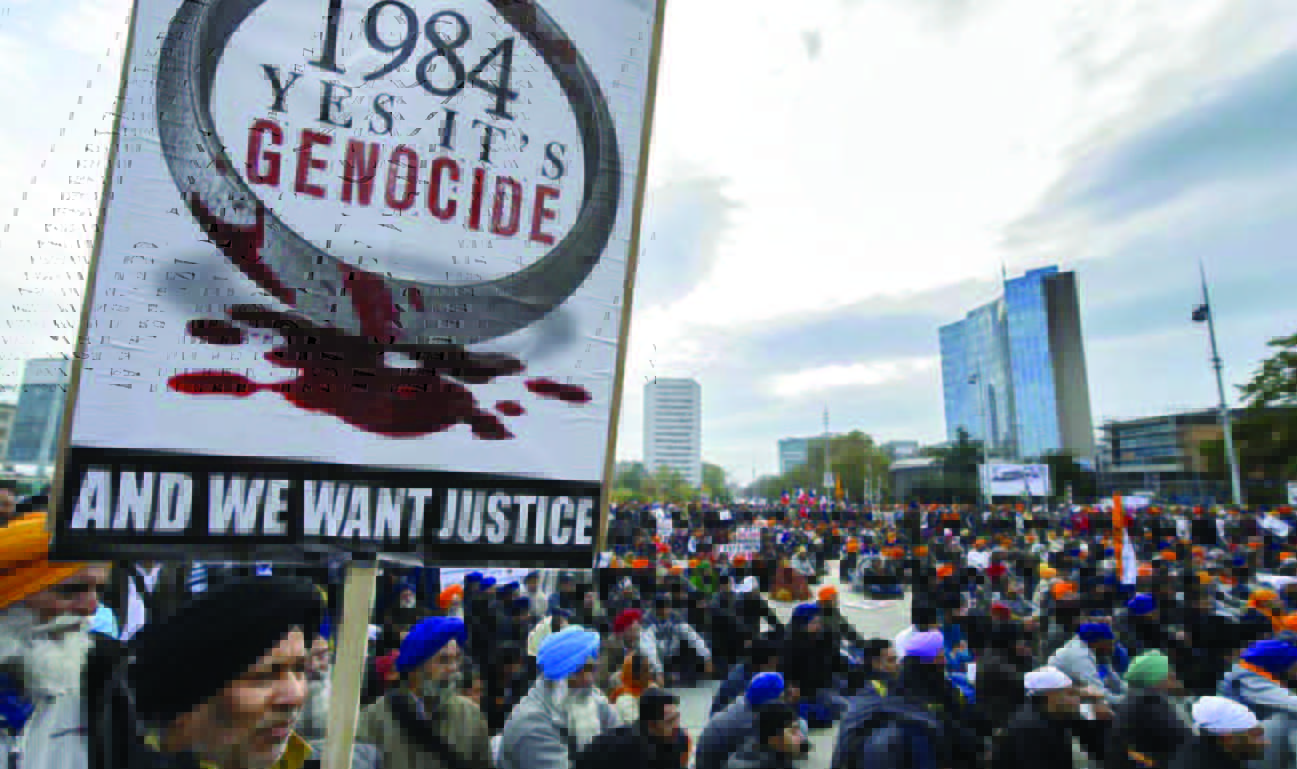
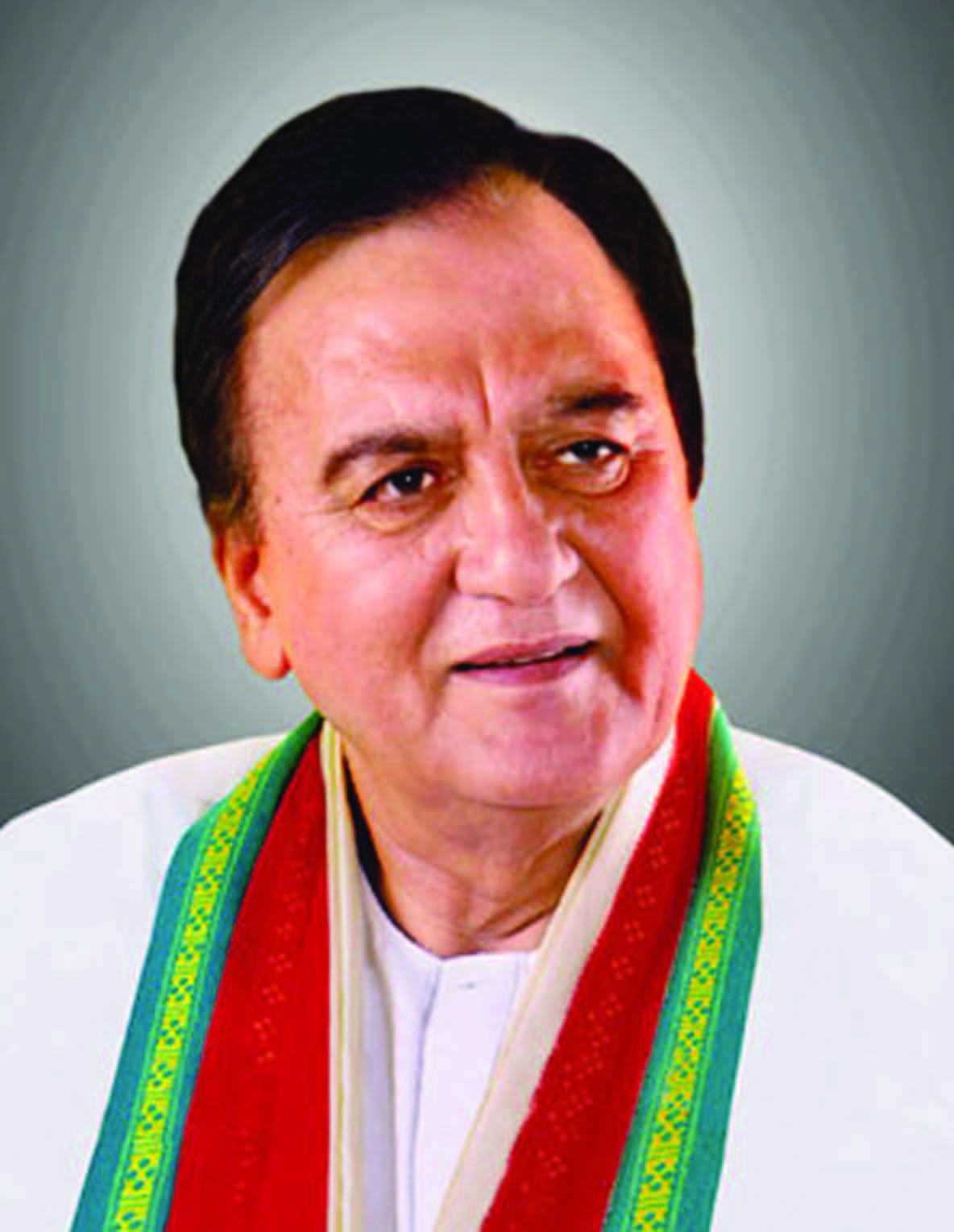
    TORONTO, CANADA (TIP): Punjab deputy chief minister Sukhbir Singh Badal cancelled his planned 10-day visit to Canada on Thursday, August 30 after the Canadian government said that they will not offer any immunity to him against any civil suit that may be filed against him there. They have also allegedly refused to provide him security during the trip. Sukhbir was scheduled to tour Canada to hold meetings with Canadian officials and business leaders from September 13 to 22. Holding Sukhbir and Punjab police chief Sumedh Singh Saini responsible for “war crimes and crimes against humanity”, American Sikhs groups through an NGO Canadian Sikh Coalition had tried to file a case against Sukhbir in a Canadian court. A confidential note sent on August 6 by the ministry of external affairs to the Punjab government, of which TOI has a copy, had warned Sukhbir to not go ahead with his scheduled visit. “MEA’s assessment is that the proposed visit is not without significant risks to dignity and legal standing of the deputy CM.

    The Canadian government has also refused to provide any assessment of legal risks that Sukhbir may be exposed to if he visits Canada,” the note by MEA joint secretary Vikram K Doraiswami said. The MEA admitted to having received inputs in the past of plans by a radical group Sikhs For Justice (SFJ) to file a criminal case against deputy CM if he were to visit Canada in the note. It said that it was unclear if there is immunity against criminal suit against Badal. Gurpatwant Singh Pannun, who practices human rights law in the United States says, “We are seeking the prosecution and arrest warrants of Badal under the Criminal Code of Canada (R.S.C., 1985, c. C-46) (Section 269.1) which provides that “every official, or every person acting at the instigation of or with the consent or acquiescence of an official, who inflicts torture on any other person is guilty of an indictable offence”. The SFJ which recently opened a branch in Canada had filed a similar case against Punjab chief minister Prakash Singh Badal last year during his visit to Milwaukee in the US, forcing him to cancel his planned visit to the US in June.

    The note was sent to Punjab chief secretary Rakesh Singh and additional director general of police of law and security Dinkar Gupta and also said that the Canadian government has refused to provide security to Sukhbir. “The Royal Canadian Mounted Police will provide security cover to a visiting dignitary only if he or she is an international protectee and is so recognized by the government of Canada…It is therefore likely that security may not be afforded to our visitors,” the note said citing the Canadian government’s reply. The MEA note went on to say that the Indian high commissioner in Canada has suggested that such an advance visit may not be necessary. “It is distinctly unlikely that a visit to the Canadian Prime Minister will materialize,” the letter said. Sukhbir hit back at the Canadian government, calling their decision “unfortunate”. “Whenever their heads of states visit we provide them full security. I am also heading a state. But it’s unfortunate that they have refused to give me security during this visit, which now stands cancelled,” he said. P

  • Medical Tourism to India: The Next Services Industry Revolution

    Medical Tourism to India: The Next Services Industry Revolution

    India ranked third in the world in medical tourism in 2012, with Thailand leading and Hungary in the second position. The hallmark of medical tourism in India is care. The author underscores this aspect: “India is still a caring society – though this is fast going.

    As many patients, both American and European have noted, this adds a subtle and intangible value added factor to the quality of medical care in India.” “Man does not live by bread alone. We have had in recent years super specialty hospitals rise where cutting-edge care is given at a pittance to the indigent. These are largely staffed by disciples of the leading gurus of India with a strong spiritual bent. For them medicine is now more a calling rather than a vocation”, says the author.


    img6

    Starting sometime in the early 1990s the IT revolution took off in India which has revolutionized many aspects of Indian industry. It led to the rise of Indian global IT giants and world class firms Infosys, Tata Consultants,Wipro and a host of others. Now in the 21st century it is the turn of the global medical industry to take advantage of world class quality and ultra-competitiveness of Indian medical services. There are estimates of 20% to 25% compounded annual growth in medical tourism to India for at least the foreseeable future.


    img7

    The first wave from SAARC (South Asian Association for Regional Cooperation) commenced some time ago. The second wave from the advanced European countries began not too long ago. With the rise of Obamacare it will now be the turn of the medical tourism rush from the US and Canada. In some ways it should be easier for the medical tourism industry to draw clients from the US since many of India’s leading doctors of today trained in the US and are intimately familiar with the culture, procedures and standards in the US. They dominate in several medical fields in the US at the leading research institutions. That apart there is a subtle factor.

    India is still a caring society – though this is fast going. As many patients, both American and European, have noted this adds a subtle and intangible value added factor to the quality of medical care in India. Plus there is the image of Indians in the US as being the most advanced and affluent immigrant community. In math, science, medicine, R&D and the teaching professions the reputation of Indians is unrivalled. More important Indians are not viewed as a hegemonistic / imperialistic threat anywhere in the world – our excessive non-violence (ahimsa) fetish has some use after all, vis a vis for example the Chinese.


    img8

    The other great civilization out of Asia is viewed with deep suspicion as monolithic, mercantilistic, hegemonistic all over the world. Now to speak in a larger context. Whether this medical tourism boom and the resulting affluence of the medical sector will lead to the improvement of general medical care for the vast impoverished masses of India is the real issue. One hopes that it will. The second factor is whether it will lead to the growth of cutting edge medical R&D establishments in India which will advance the frontiers of medical care. Once some 2000+ years ago in the time of Charaka and Susruta, c.f. Charaka Samhita and Ashtanga Hridayam, India nee Bharatavarsha led the world in the sophistication of its medical AND SURGICAL care theory and practice.

    With the wholesale destruction of the native culture through the millennia of Islamic conquest, rapine and genocide much of this vanished. Then it was the turn of the English for about 200 years. There has to be pride in one’s cultural heritage and a resolve / samkalpa to bring about a cultural renaissance where such services and arts will rise to the top again. We have been successful in the IT industry; it is true. But some 25 years after the boom began we have still not advanced as far as we could / should have to rise above the cyber coolie image.

    There is not as much real cutting edge IT innovation and research taking place in India as would have been possible. The cutting edge work is still being done in the US and Israel. As someone who worked in the consulting industry in a senior capacity, I have seen that the level of professionalism and training in even the best Indian IT firms is far below what it is at the elite global consulting firms out of the US / UK / France. The low level work was taken up by India / Indians.

    Now that India is being priced out the work is moving to Vietnam, Laos, Bangladesh and elsewhere. One hopes there will be more thoughtful and professional planning and assistance at the central government level for the medical services industry. There is an inherent advantage here which was not there in the case of the IT industry. Many of the medical professionals involved are wealthy to start with having been for decades in the US. They have the top level socio-political contacts. The issue is how much of a pro bono orientation will guide their actions. Man does not live by bread alone.

    We have had in recent years super specialty hospitals rise where cutting-edge care is given at a pittance to the indigent. These are largely staffed by disciples of the leading gurus of India with a strong spiritual bent. For them medicine is now more a calling rather than a vocation. With the rampant growth of materialism and conspicuous consumption aping the West, will much / any of the old values which made Indian Hindu society a survivor for some 5,000 years continue? That is the real question. Let us hope and pray and all do our bit to ensure that the age old values flourish in the India of today and the future. (The author is based in New York and can be reached at nagendrasrao@gmail.com)

  • NOVAK DJOKOVIC RALLIES TO REACH MONTREAL MASTERS QUARTERS

    NOVAK DJOKOVIC RALLIES TO REACH MONTREAL MASTERS QUARTERS

    MONTREAL (TIP): Novak Djokovic dropped the opening set but recovered quickly to earn a 2-6, 6-4, 6-4 win over Denis Istomin to reach the quarterfinals of the Montreal Masters. The top seed was ambushed by two breaks in the opening set by the Uzbek player. Djokovic, winner of the last two editions in Canada, notched his 12th straight victory at the tournament. He is bidding for a fourth career trophy here after also winning in 2007. He plays on Friday against French seventh seed Richard Gasquet, who beat Japan’s Kei Nishikori 1-6, 6-3, 6-3.

  • India To Help Build World’s Most Powerful Telescope

    India To Help Build World’s Most Powerful Telescope

    MUMBAI (TIP): India has signed a master partnership agreement to become a full-fledged partner of the $1.5-billion five-member international Thirty Metre Telescope (TMT) project. On completion, the Hawaii-situated TMT is said to “become the most advanced and powerful optical telescope on Earth”. Following the agreement signed on July 26, India will now be moving from its current observer status to becoming a full-fledged partner of the project with a 10% share.

    This implies a financial commitment of around Rs 1,000 crores, the department of science and technology said on Thursday. The department, along with the department of Atomic energy, will fund the Indian component. Set to become operational in 2022, the project has four other countries as partners, namely Canada, China, Japan and the US. TMT is promoted mainly by Caltech, the University of California and the Association of Canadian Universities for Research and Astronomy. The in-principle approval of India’s participation was accorded in 2010.

    However, the go-ahead from the legal section of the external affairs ministry came on July 24. Besides the Indian Institute of Astrophysics, the other participating institutions are the Inter-University Centre for Astronomy and Astrophysics, Pune, and the Aryabhatta Research Institute of Observational Sciences, Nainital. Much of India’s contribution will be in-kind, with Indian institutes and industry collaborating to build most of the telescope’s control systems. India will also be contributing the mirror coating systems of the telescope.

  • Ex-Gujarat Ranji Player Is Skipper Of Us National Team

    Ex-Gujarat Ranji Player Is Skipper Of Us National Team

    AHMEDABAD (TIP): Former Gujarat Ranji player Timil Patel has been appointed captain of US’s national cricket team for a series against Canada for the Auty Cup. The 29-year-old Amdavadi leg-spinner emigrated to the US with his family in 2010 after playing 38 first class games for Gujarat. He made his international debut for the US on November 14, 2012, against Canada in the previous edition of the Auty Cup played in Florida.

    “It is an honour to lead the US team,” Timil said on the phone from Canada. “We have young and talented players who have been performing consistently at the club level. Hopefully, we can bring positive results in the upcoming series.” Both the US and Canadian teams are dominated by migrants from the Indian subcontinent. Timil made his debut for Gujarat in 2002 and was part of the team for the next seven years.

    His last game was a Ranji Trophy match against Himachal Pradesh in Surat in 2009. Since settling down in Los Angeles, he has played for the Southern California Cricket Association. He has also played two T20 internationals against Canada and was made the stand-in captain in the first Twenty20 after skipper Steven Taylor suffered an injury.

  • OFBJP Organizes Public Reception For BJP President Rajnath Singh

    OFBJP Organizes Public Reception For BJP President Rajnath Singh

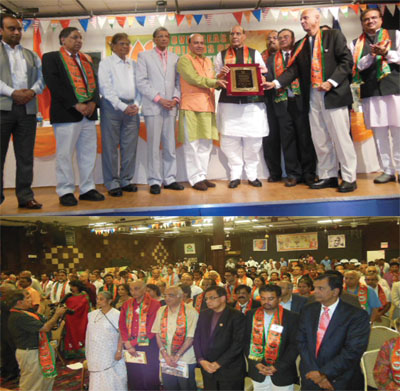
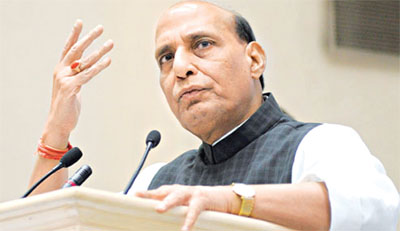
    EDISON, NJ (TIP): Indian American community of tri-state area (New Jersey, New York, and Connecticut) gave a rousing welcome to Rajnath Singh, President of Bharatiya Janata Party (BJP) and his BJP delegation Ananth Kumar, General Secretary; Sudhanshu Trivedi, National Spokesperson; and Vijay Jolly, Convener of Overseas Affairs and Overseas Friends of BJP (OFBJP) in TV Asia Studio Auditorium at Edison, NJ on Sunday July 21, 2013. The program was organized by OFBJP-USA as part of its community global outreach program.

    The program was broadcasted live on TV Asia across US reaching out to 1.5 million viewers. The program was also relayed live in India, Canada, UK, Europe and Middle East thru various channels. Addressing the jam-packed auditorium, Rajnath Singh said that he was elated by the warm welcome that had been accorded to him by the Indian Americans here in US. He said that trust and credibility have become a big problem in India and BJP is the only option. No party in India has grown bigger than Congress except the BJP.

    BJP is the only party that has not suffered a vertical split. Communists have lost relevance and Congress has no policy on any of the issues nor has any ideology. Since its inception in 1951 as Bharatiya Jan Sangh and later on as BJP, the party has been pursuing a policy of Nation first. He continued that Atal Behari Vajpayee led a 24 party coalition for 6 years and the NDA rule was far better than 55 years of Congress rule in every aspect.

    Corruption, Inflation and price rise are the signature of congress rule whereas NDA government controlled the inflation and price rise in spite of the prevailing severe drought and economic sanctions imposed by the entire West after Pokhran nuclear tests. NDA inherited a GDP growth of 4.8% and 10% inflation whereas BJP handed UPA a GDP of 8.4% and inflation 3.5% in 2004. Amidst applause from the audience he said that Pokhran test was a big step wherein the BJP led govt made India a nuclear power even though we knew economic sanctions were staring at us.

    Countries that are much smaller have become developed countries but India is still a backward country and not sure why 55 years of Congress rule did not change much. Congress has to answer as to how much time they need to make India better, to remove poverty. BJP invited FDI in telecom sector but encouraged Indian investors whereas Congress has opened up the telecom sector 100%, increased in the LIC sector from 26% to 49%. Foreign investors have pulled out $7.5 billion from India and no one is ready to invest.

    Even after 60 years of Independence we still have 67% of people who don’t get food and we need a food security bill. We need leaders with firm conviction and leaders with vision and when we come in power we will make India a super economic power in 10-15 years. National Highway development has seen tremendous growth during NDA rule. 50% of the highways that were built during 1980-2012 happened during 6 years of NDA rule and the other 50% were built during 26 years of non-BJP rule.

    Gujarat development has become a role model across the world. Madhya Pradesh agricultural growth (19%) is the highest in the world and very soon will be providing 24hrs of power supply. Chhattisgarh PDS system serves 90% of the population without any corruption and is a model for other states to emulate. Goa is the only state in India where Petrol is cheaper than Diesel. India has a GDP growth of 4.8% whereas BJP ruled states have 10% GDP growth. UPA government has no plan to tackle Naxalism or terrorism.

    Appeasement has become the state policy whereas BJP never links terrorism to any religion, caste or region. After Mumbai terror attack, Prime Minister made a statement that he will not talk to Pakistan until it gives an assurance that they will control terror activities and not support any groups that work against India but changed all that in a matter of few months. Our foreign policy is at its worst with no friendly neighbors around us. During NDA rule we maintained good relations with Russia and development excellent relations with US.

    We made US our strategic partner. He appealed to the US govt to lift the ban on visa to Narendra Modi, he said on one side US agencies rate Gujarat as the best state and Modiji as an excellent administrator and on the other hand they deny visa to him. It will be better if US takes a decision soon as they will be forced to take a decision anyway later. When BJP comes to power we will make India a power of Rishi and Krishi (knowledge and Prosperity), he said. Indian culture influenced the world for thousands of years.

    We never planned to dominate the world and even Swami Vivekananda came to Chicago on his own and had great influence on the world by his teachings. Citing the example of Newsweek columnist Lisa Miller who stated that by imbibing Yoga, Pranayam, Ayurveda and Organic farming people in the West are becoming Hindus whereas it is a crime in India if you say you are a Hindu.Talking on the recent controversy related to Narendra Modi statement that he is a Hindu and Nationalist, media created and pseudo secularists made a big fuss.

    Professing your Hindu culture became a communal word in India. He said that as per the Supreme Court, Hindutva is a way of a life. Hindutva teaches love not only for human beings but even for animals, plants, rivers, mountains etc. It is Hindutva that teaches us to serve milk to a snake and take care of animals like ants and birds. He called on the Indian American Community to support BJP to build a strong India.

    Shri Rajnath Singh was accorded standing ovation. Shri Rajnath Singh was honored by the OFBJP executive committee with a plaque for his contributions to the party and the country. Earlier, Ram Rakshpal Sood (Sr.Advisor, OFBJP) acting as the Emcee welcomed the audience, chief guests and the sponsors of the event. After the traditional lamp lighting ceremony amidst the chanting of Vedic mantras by Pandit Pravin Shastri and Chandrakant Trivedi and blowing of conch shell by Pravin Shashtri. Mrs. Vidya Labroo led the rendition of Vandemataram.

    Jayesh Patel (President, OFBJP) welcomed the distinguished guests and said that entire India is chanting Narendra Modi (NaMo) mantra and expressed hope that BJP will be able to get majority on its own merit in the next election. Ram Kamath (General Secretary, OFBJP) introduced Dr. Mahesh Mehta, National Coordinator of OFBJP-USA. Speaking on the occasion, Dr. Mehta said that mission 2014 is about transforming India into a global leader and Global Indians should contribute to be the part of this great movement that will eventually contribute to the development of India.

    Dr. Adapa Prasad (Immediate Past President) introduced Vijay Jolly, Convener of BJP Overseas Affairs and OFBJP, as a dynamic leader and former MLA who took on Delhi Chief Minister during the last election.

    In his electrifying speech, Vijay Jolly urged the audience to applaud for Rajnath Singh for honoring the feelings of the people by making NaMo as the chairman of the campaign committee. Stressing the fact the OFBJP is on a mission to develop leaders by inducting youth into the organization to dethrone the corrupt Congress regime in India. Stating that NRI’s have always made India proud, he said that OFBJP has setup its chapters in UK, Norway, Nepal, Kenya and other countries to work for the welfare of Indian diaspora.

    He got the past Presidents of OFBJP-USA honored by Rajnath Singh Introducing SudhanshuTrivedi, BJP National Spokesperson, Dr. Dinesh Agrawal (Former- President, OFBJP) said that as the national spokesperson, he is very active effective on TV channels spreading the message and its ideology of BJP. SudhanshuTrivedi reminded that July 21st the day of the program is a historical day when US astronauts landed on the moon. Edison town, the venue of the program, is also a historical town, named after the inventor of light bulb.

    Hence, he said that word Bharat stands for light and inspires us to take India to the pinnacle of glory. Stating that BJP is all set to form the next government is not based on hope but on facts. He concluded reciting a poem by A.B. Vajpayee. R.P. Singh (Org. Secretary, OFBJP) introduced Ananth Kumar, BJP general Secretary. Amidst thunderous applaud from the audience, Shri Ananth Kumar introduced himself as the Hanuman of South as Kishkinda, the birth place of Lord Hanuman is in Karnataka whereas Rajnath Singh is from U.P, the land of Ram. For Ram’s team to win we need Hanuman and he is there to lend services for the party and the country.

    India, he said is going through turbulent times and like A.B. Vajpayee model, we have Gujarat model of development under NaMo leadership and we will soon have NaMo model of governance. He said that BJP is already in battle mode, under NaMo and Rajnath Singh’s leadership we are all set to take on the corrupt congress government. Once in power, BJP will make India a global player not only in spirituality but in culture, strategic matters and will be a decisive player in the world. He urged the NRI’s to connect with their districts back home and work for BJP’s victory in 2014.

    Chandrakanth Patel introduced Rajnath Singh as a man of impeccable image in spite of being in political life for 40+ years. Born in a farmer’s family in Varanasi, he rose to be the president of BJYM. He was part of the J.P movement and became the Agricultural minister in A.B. Vajpayee’s government. He was the President of BJP between 2007-2009 and again became the President in January, 2013.

    Currently, he is a Member of Parliament from Ghaziabad, U.P. Earlier, the President of TV Asia and a well known community leader, Shri H.R.Shah addressed the gathering and said that TV Asia always supported India causes and he has been an admirer of Mahatma Gnadhi and Sardar Patel. He said he felt close to BJP principles and supported BJP. He wished that Narendra Modi would be elected as the Prime Minister. Krishna Reddy (Treasurer, OFBJP) presented the vote of Thanks.

  • Royal Baby Boy Born In London

    Royal Baby Boy Born In London

    Royal Baby Boy Born In London
    LONDON (AP) — It’s a boy! Prince William’s wife, Kate, has given birth to a boy, a child now third in line to the British throne. The child was born on July 22, after many Britons woke up to the news that Kate had gone into labor with the couple’s first child. The birth announcement, via a press release from Kensington Palace, said the boy was born at 4:24 p.m. weighing 8 pounds 6 ounces.

    The new royal baby was named George Alexander Louis. Kensington Palace revealed on July 25 that the third-in-line to the throne will be known as His Royal Highness Prince George of Cambridge. The last British royal named George was the child’s great-great-grandfather King George VI, who was Queen Elizabeth’s father. The royal birth recalled that of the baby’s father, William, in 1982, at the same central London hospital. Many remember the moment when he was carried out in his mother Princess Diana’s arms with proud father Prince Charles at their side.

    William and Kate’s son is expected to follow Charles and William to the throne. No one can tell what political and personal changes the intervening years will bring, but the baby can be expected to become the head of state of 16 countries, including Britain, Australia and Canada, and possibly the head of the Commonwealth, which covers 54 nations.

    The child will also eventually become Supreme Governor of the Church of England. The baby represents a living link to Britain’s imperial history — the infant is the great-great-great-great-great-grandchild of Queen Victoria, who ruled at the peak of British power. Many Britons had hoped that William and Kate would start a family shortly after their gala 2011 wedding, which drew a global television audience in the hundreds of millions.

    The couple waited, however, until William was nearly finished with his military work as a search and rescue helicopter pilot based at an air base in a remote island off the coast of Wales. That allowed Kate to ease into royal life, and to become more comfortable in the spotlight, before becoming a parent. It also allowed her to play a supporting role during Queen Elizabeth II’s Diamond Jubilee celebrations last summer.

    The first months of her pregnancy were not easy, and she was hospitalized in early December with acute morning sickness that left her weak and dehydrated. She seemed to recover her stamina fairly quickly and made a series of public appearances until the final weeks before giving birth, drawing praise for her poise and good cheer.

    The royal couple and their newborn are expected to spend much of their time in the coming years in renovated quarters at Kensington Palace, where William and Harry also spent much of their childhood. Royal officials say Kate and William will try to give their child as normal an upbringing as possible — which may be challenging in an age when the British royals are treated as major world celebrities.

  • BJP Has Sound Plans To Jumpstart The Stalled Indian Economy- Rajnath Singh

    BJP Has Sound Plans To Jumpstart The Stalled Indian Economy- Rajnath Singh

    NEW YORK, NY (TIP): “The BJP-led NDA government created 67 million jobs in less than five years whereas the Congress led UPA created less than 2.7 million jobs between 2004 and 2009. These figures are from the data collected by the federal government controlled agencies and not a figment of imagination”, Rajnath Singh said.

    He was speaking on what BJP will do to jumpstart the stalled Indian economy at a function organized by India-America Chamber of Commerce, July 25. Rajnath Singh who was in Washington for three days said he had discussions with the Congressmen and administration officials on the issue of difficulties faced by candidates in H1B and L1 visa to work legally in the US. The GDP cost burden will go up by 0.3 to 0.4 percent due to increase in fees.

    “We had lodged our protest against the comprehensive immigration reforms bill and they had raised the issue of patents and compulsory drug license issues. There was only one case under these CDL whereas Indonesia had six cases and Canada four cases,” he added. The US would do well to share its latest technology on green energy with nations such as India so that it can benefit the humanity. Once these inventions are ashared, they would help us more in a very rapid manner, he said.

    The BJP government will strengthen the village economy as over 70 percent of the people live in rural areas. We will do our best to stop urbanization and create more jobs in the rural areas as was done in the previous NDA government under the PURA scheme. More than 55 percent of the jobs for youth are in rural areas and there is a need to strengthen this sector. Turning to climate change, the BJP leader said while US that has been preaching, has a carbon emission rate of 20 ton per capita per annum, India has only 1.5 per ton per capita per annum.

    The global average is only 4.5 ton per capita per annum. You now decide who is on the right side and who is not. Addressing the members of the India- America Chamber of Commerce in Manhattan, he said India is now facing a serious financial crisis of grave magnitude despite the fact that no one in the global economy can ignore India. The economy of India is not something that makes us feel comfortable or feel proud of.

    But India was regarded as third largest economy of the world, he said. When the NDA government led by Atal Behari Vajpayee stepped down in 2004, the fiscal deficit was 2.5 percent and current account deficit was surplus. The revenue deficit was less than one percent. The economy witnessed a boom period during 1999 to 2004 when the country was ruled by the NDA and the slide started in 2004. “The boom that we created lasted till 2008 and then we are now witnessing is one of the worse economic downturns,” Singh said.

    “When I mentioned to the Speaker of the House yesterday at Washington that we had a surplus current account when we left power, he was surprised. There was a revenue deficit that went up from 4.5 percent to 6 percent in 2008. The current account of deficit shot to 6 percent. We passed the fiscal responsibility bill in the parliament and hence were able to bring some fiscal discipline.

    Inflation is now hovering around 7.7 percent,” he said. The rupee value has depreciated drastically to the US dollar from Rs 37 a dollar in 2008 to Rs 60 in 2013 almost doubling in five years. We thought this would be offset by increase in exports and that also did not happen; it went up by just one percent. It’s very unfortunate that savings that have been the biggest strength of India as it provided capital is now falling at a very rapid rate.

    The small businesses tend to grow with the increase in savings and in the absence they take a major hit. Savings drop and growth rates drop and what else to drop. The success of Indian story is over. The success story of India is waiting for the BJP to return to power. The UPA has ruined the economic structure of the country. How will the BJP restore investors’ confidence and fix the broken economy once it comes to power? We will do what we did from 1999 to 2004 and we had a unique development model which is not only a model for India to feel proud of but came as a surprise to the world.

    When we handed over the reins of the government to the Congress-led UPA, India’s growth rate was 8 to 9 percent and rate of inflation was around three percent. More than 50 percent of the highways were built during the Vajpayee government and the present Congress dispensation had admitted this in the court. Where had all the developments gone now? The BJP created a success story only to be mauled by the Congress, he added.

    We have proved in the BJP-ruled states how we prioritize economic reforms and Gujarat is a shining example of India. The whole world is now talking about Gujarat and foreign governments are keen to study the success story. Take the case of Madhya Pradesh that was considered a sick state with no economic development before the BJP Government took over. Agricultural growth rate has gone up to 19.1 percent in the state as against 4 percent of the federal government.

    Madhya Pradesh has replaced as country’s largest supplier of food grains to the central pool. In Chhattisgarh, more than 90 percent of the population is covered under the Public Distribution System and people enjoy social security compared to mass suicide by farmers in the Congress-ruled states. Goa is the only state in India where petrol is cheaper than diesel similar to what we see in the US.

    Do we have to prove anything more to assure the people that our first priority will be to fix the problems and take India on a different plane?, he asked. The average GDP of BJP-ruled governments is about 10 percent whereas the nation is only experiencing a growth rate of less than five percent. There are only two models – BJP model for growth and Congress model for destruction, he added. Earlier, Rajiv Khanna, President, India-America Chamber of Commerce welcomed Rajnath Singh and introduced the subject of talk.

    He pointed out that Indian economy has been weakening and this had caused considerable doubts in the minds of investors and wanted Singh to speak on how his party, if it came to power would jumpstart the stalled Indian economy. The talk by Rajnath Singh was followed by an interesting Q & AA session. Singh candidly answered the few questions put to him.

  • MoneyGram Hosts Iftar

    MoneyGram Hosts Iftar

    MoneyGram Iftar Food Trucks hit New York, New Jersey and Chicago and serve free Iftar to the community
    NEW YORK (TIP): During the last two weekends in Ramadan, MoneyGram branded food trucks will give out free Iftar to the Muslim community in Chicago, IL, Brooklyn, NY, Jackson Heights, NY, Harlem, NY, New York City and Jersey City, NJ. First 500 people will get a free iftar courtesy of MoneyGram as a sign of their respect and commitment to the Muslim community and to share in the spirit of giving that is very significant in this month of fasting.
    Chicago

    JULY 26TH
    Islamic Foundation
    Address: 300 W. High Ridge Road, Villa
    Park, IL 60181 T: 630.941.8800
    Timing 7:30 P.M. – 9:00 P.M.
    JULY 27TH
    Khan Barbeque Restaurant
    Address: 2401 W Devon Avenue,
    Chicago, IL 60659 T: 1.773.274.8600
    Timing: 7:30 P.M. – 9:00 P.M.
    JULY 28TH
    Sabri Nihari & Jama Mosque
    Address: 2502 W Devon, Chicago, IL
    60659 T: 1.773.465.3272
    Timing: 7:30 P.M. – 9:00 P.M
    New Jersey/New York
    AUGUST 2ND
    Jamia Mosque
    Address: 294 Grove Street, Jersey City,
    NJ 07302 T: 1.201.333.2500
    Timing: 7:30 P.M. – 9:00 P.M.
    AUGUST 3RD
    Gourmet Sweets, Brooklyn, NY
    Address: 1107 Coney Island Avenue,
    Brooklyn, NY 11230 T: 1.718.421.4100
    Timings: 7:30 P.M. – 9:00 P.M.
    AUGUST 4TH
    Gourmet Restaurant, Jackson Heights,
    Address: 72-08 Broadway, Jackson
    Heights, NY 11372 T: 1.718.533.8700
    Timing: 7:30 P.M. – 9:00 P.M.
    AUGUST 5TH
    AR RAHAMAN Mosque
    Address: 15 West 29th Street, NYC, NY
    10016
    Timing: 7:30 P.M. – 9:00 P.M.
    AUGUST 6TH
    AQSA MOSQUE – MGI Agent/ Petit
    Paris Fashion
    Address: 2136 8th Avenue, Harlem, NY
    10026 T: 1.212.316.9803
    Timing: 6:00 P.M. – 9:00 P.M.
    AUGUST 7TH
    CHAAND RAAT – MGI Agent
    Address: Coney Island Avenue,
    Brooklyn, NY 11230
    Timings: 10:00 P.M. – 12:00 MIDNIGHT

    As a global money transfer provider that helps people financially connect with family and friends around the world, MoneyGram is embracing the culture of its customers during the time of Ramadan and Eid. MoneyGram recently launched a global Ramadan and Eid media campaign across the United States and Canada along with the Iftar Food Trucks that will be making their way from Chicago to New York starting July 26th.

    “This is an important time of the year to send money for our Muslim customers and we want to make sure MoneyGram makes it easy for them with our fast, efficient service and competitive exchange rates’ – says Zainab Ali, Senior Marketing Manager. Please visit moneygram.com/iftartruck for more details about the Iftar truck and come join us for Iftar if you live in New York or Chicago. About MoneyGram MoneyGram, a leading money transfer company, enables consumers who are not fully served by traditional financial institutions to meet their financial needs.

    MoneyGram offers bill payment services in the United States and Canada and money transfer services worldwide through a global network of more than 300,000 agent locations – including retailers, international post offices and financial institutions – in 196 countries and territories. To learn more about money transfer or bill payment at an agent location or online, please visit moneygram.com or connect with us on Facebook.

  • First Time Ever Diwali At Times Square

    First Time Ever Diwali At Times Square

    Presented by Air India, Be ready for fun, food, festivities, laser lights show, fireworks & much more
    NEW YORK, NY (TIP): Diwali, the Festival of lights is the most significant festival for Asian Indians in the world. For the first time ever, Diwali will be celebrated at Times Square on 22nd September 2013. It is a full day of fun, food and festivities that has activities for all ages. This landmark event showcases the rich culture, heritage and diversity of India in the historic, world-famous Times Square.

    In the afternoon there will be a Cultural Festival which includes a wide variety of Indian food, dance classes, Diya/ Rangoli painting, Indian arts and crafts, a fashion show, photo booths with ethnic outfits, celebrity Autograph/Photo Booth and a lot more. In the evening, the excitement continues with Light Up Times Square, a concert showcasing performances by some of the biggest names in the entertainment industry.

    The concert will also display an orchestrated laser light show and fireworks on big screens, creating a unique visual experience. ASB Communications is organizing and managing the grand event, Neeta Bhasin, the President and CEO of ASB Communications, said “We want to show the world how rich Indian culture and heritage is and how diversified India is. We couldn’t think of a better place than the center of the Universe – Times Square.”

    Riwo Norbhu, Regional Manager- Americas for Air India, the official airline of India, said, “Air India is very pleased to be a part of this historic event. As India’s flying ambassador in the U.S. for over 50 years, Air India has been guided by a consistent vision — to promote everything that is best about India to the world. Diwali at Times Square is a perfect event to fulfill this vision.” ASB Communications is a full-service international multicultural advertising and marketing organization.

    ASB provides integrated marketing solutions to companies looking to target the ethnic market, including the Asian, South Asian, Middle Eastern, Eastern European and African markets in USA, UK and Canada. Since its inception in 1997, ASB has nurtured deep roots in the ethnic communities in North America. The company has taken part in over 3,000 events on behalf of its clients.

  • HATE CRIME? Hindu Temple In Canada Vandalized

    HATE CRIME? Hindu Temple In Canada Vandalized

    TORONTO (TIP): A Hindu temple in Canada has been vandalized by two men armed with baseball bats, outraging the country’s minority community which termed it as a “hate crime”. Video recordings show the men smashed three windows at the front entrance of the Laxmi Narayan Temple on June 23 in Surrey, British Columbia.

    “They left after breaking the windows and leaving those bats, which is self-explanatory,” a temple official was quoted as saying by local media. “When I came to know those facts I felt it’s not a regular break-in where somebody wants to damage, it’s a hate crime, which is unfortunate and disturbing,” said Parshotam Goel, president of the Vedic Hindu Cultural Society. Vinay Sharma, secretary for the society, said, “I was shocked.

    There was no robbery, there was no other damage, nobody tried to enter the building. Nobody has an idea that this kind of attack, or this kind or racism attack or hatred crime can happen here.” Surrey Royal Canadian Mounted Police (RCMP), who are probing the incident, said they don’t consider it as a hate crime. “A place of worship is one more place that people hold sacred. It’s a very personal attack,” said Surrey RCMP spokesman Dale Carr was quoted as saying by ‘CTV British Columbia’.

    According to reports, a bat with a ‘Sikh last name’ and a ‘khanda’ was recovered from the scene. The World Sikh Organization of Canada president Prem Singh Vinning, who visited the temple, has condemned the attack on the Temple. “Any attack on a place of worship must be strongly condemned. The perpetrators must be brought to justice as soon as possible.

    While we truly hope that this was not an attempt to create friction between the Sikh and Hindu community, the responsible thing to do is to let the RCMP complete its investigation before drawing any conclusions,” Vinning said. Meanwhile, Canadian minister of citizenship, immigration and multiculturalism Jason Kenney has condemned the attack.

  • Flooding May Force 100,000 From West Canada Homes

    Flooding May Force 100,000 From West Canada Homes

    HIGHWOOD RIVER (TIP): As many as 100,000 people could be forced from their homes by heavy flooding in western Canada, Calgary city officials said, while mudslides forced the closure of the Trans-Canada Highway, isolating the mountain resort towns of Banff and Canmore. Torrential rains and widespread flooding throughout southern Alberta on June 23 washed out roads and bridges, left at least one person missing and caused cars, couches and refrigerators to float away. Communities were hit hard just south of Calgary, a city of more than a million people that hosted the 1988 Winter Olympics.

    Officials said the evacuation would take place in stages over the next few days. The province reported that 12 communities were under states of emergency. One woman who had been stranded on top of a trailer was missing after it was swept away, STARS air ambulance spokesman Cam Heke said. Motorists who were trapped overnight Wednesday by water spilling over Canada’s main western highway had to be rescued by helicopter, Town of Canmore spokeswoman Sally Caudill said.

    “I woke up at about three o’clock in morning to the sound of this kind of rumbling, and it was the creek,” said Wade Graham, a resident of Canmore. “At first it was just intense, pretty powerful, amazing thing to watch. As daylight came, it just got bigger and bigger and wider and wider, and it’s still getting bigger and bigger and wider and wider.” He added, “I watched a refrigerator go by, I watched a shed go by, I watched couches go by. It’s insane.”

    Bruce Burrell, director of the Calgary Emergency Management Agency, said water levels on the Bow River aren’t expected to subside until Saturday afternoon. The Bow River Basin already has been battered with up to 100 mm (3.9 inches) of rain. “Depending on the extent of flooding we experience overnight, there may be areas of the city where people are not going to be able to get into until the weekend,” he told a news conference.

    In High River, Mounties asked people with motorboats to help rescue at least a dozen stranded homeowners. “We have people on their rooftops who were unable to evacuate fast enough,” said RCMP Sgt. Patricia Neely. Environment Canada issued a rainfall warning for the affected areas, estimating as much as 100 millimetres more rain could fall in the next two days.

  • Social Media And Our Responsibility: Individual And Collective

    Social Media And Our Responsibility: Individual And Collective

    While the Social media has undoubtedly revolutionized our communication and brought the world together, there are also multiple fallouts.
    Social media, especially the Facebook, Twitter and their multiple avatars, undoubtedly is a great revolution today. Perhaps, one of the greatest that humankind has witnessed. While we are yet to comprehend the impact of this media, the strides it has taken so far have been enormous – both on positive and negative aspects.

    Social media is not like any other media – print and electronic. It is unique and has revolutionized the interpersonal relationship and communication. Cutting across all boundaries – natural and manmade, the Social media today is in a different league, not affected by any of the limitations of print and electronic media. In fact, the evolution of technology in the recent decades, and the easy use of it by everyone is absolutely mind boggling.

    Consider the last three decades – perhaps from the early 1990s till this day. The introduction of mobile phones in the early 1990s and its subsequent wide use reduced the gap between us. Gone are those days when we patiently waited in STD/ISD shops, or the Post Office to make a phone call and speak to the other – either officially or personally. The growth of mobile phone and its reach is so much, that the telegrams today have become totally irrelevant and outdated.

    After being in use since the 1850s, the BSNL in India has officially decided to close down its telegram operations; those who would like to get nostalgic about sending and receiving telegrams, please try one last telegram before 14 July. Remember those days – sending telegrams on the arrival of new ones in our families, or the departure of older ones; marriage wishes; a happy note getting new job or promotion; intimation to our bosses of late returning to the work from our native village after being on leave and related multiple stories? Of course, we can’t blame the BSNL for closing it down.

    According to an estimate, today there are only 5000 telegrams sent all over the country every day, when compared to six million in 1985! Obviously, we have other means to reach out – to convey our personal and professional messages. From birth to death, from “I love you” to “Sorry, this will not work”, from “punctured tire; will be coming late to office,” to “seriously unwell. Give me leave”, the SMS has transformed our communication – both personal and official.

    Next came the internet, again in the 1990s, yet another communication revolution. It has thoroughly broken all the barriers of communication. Do we remember reading a newspaper from neighboring country or the region, on real time before the 1990s? Remember our personal letters and official communication before the 1990s? Remember our first leave letter, or the love letter? Remember our inland letter or the postcard to our father, asking for five hundred or thousand rupees extra for the month? Remember the long letters from our grandparents? Remember waiting for the postman? Today, the keyboards have taken over our handwriting skills; and never worry about your vocabulary or spelling; all you have to do is a right click! Today, we do not even have to remember our residential address. Emails and SMS will do the necessary communication.

    It has drastically revolutionized the way we communicate – in real time. A daughter can Skype (communicate on Skype) from any part of the world to her parents, with less or no cost. And parents witness the marriage of their children in Canada or Australia online! Then came the Social media during the last decade. Unlike the print media or the electronic media, where there is a gap between the speaker and the audience – physical and emotional, the social media puts the two directly in touch, that too in real time.We don’t have to wait to write to newspapers to get our response published; we send our responses immediately.

    All we need is a computer or a lap top, connected with the internet. However, the biggest revolution of the above three – is the complete merger of them, in terms one using the other. The mobile phones are connected to the internet; today we are talking about the super speed 3G connections and the use of Facebook and Twitter on our mobile. What this means is, we don’t have to wait to reach our computer or laptop, and ensure there is internet and electricity, before starting communication.

    If the internet has made us to access the rest of the world, the Facebook and Twitter are getting the world into our mobile network.We don’t have to read the newspapers in print, or even access their websites; they are delivered to us. Social media, does one thing even better; it enable us directly to contact someone who is sitting in a remote corner in Africa or Antarctica! All you need to do is to send a friend request. The Social media has completely broken any barrier that man has taken since the Treaty of Westphalia to distance each other.We can sit in the washrooms and keep communicating to our beloved ones.

    We can sit in front our parents in the dining table or in a classroom in front our teacher, yet messaging to our friends without anyone noticing. (And, where do children learn to message, keeping the phone below the table, but looking at you?). While the Social media has undoubtedly revolutionized our communication and brought the world together, there are also multiple fallouts. One great problem is the parenting; the children are hooked onto the Social media. In fact, this should be considered as one of the greatest dope that man has ever invented.

    We are addicted to the Social media; if anyone has a doubt, please notice, what the rest of us are doing while you travel next time in a public transport – either in train or bus. Second, there is a greater tendency to trivialize ourselves today. More than the event or experience, we would like to get that feeling across into our Facebook or Twitter. This has become common today: Oh, I should change my profile picture with this; wow, this picture will get more likes on my Facebook; I should have this in my twitter… It appears, instead of the Social media helping us to reach out to the other, is dangerously taking us in a path of reorienting our self.

    From “having a haircut” to “overcooked my chicken”, we seem to be in the path of becoming narcissistic, with ease and élan. Third and the most important aspect is the mayhem that it could create in distancing the people. As we could see in some of the recent conflict situations in Myanmar and Northeast, the Social media wreaked havoc in venting our anger and offending the other. Since Social media gives us the luxury to remain anonymous, and post any kind of messages, without realizing the impact. What is its greatest strength – the real time connectivity and mobility, is also the greatest liability in spreading hatred and venom.

    I can sit calmly in my washroom, yet create mayhem thousand miles away, without revealing my identity. I can tweet a harsh note, tweak a picture and pass it as real, and yet remain anonymous. Undoubtedly, Social media is a great revolution today; it has bulldozed all barriers between us in terms of distance and time. However, we also have a responsibility, to ensure that this revolution brings us closer, than divide us.

    The State cannot and should not attempt to regulate this; it should be left to our individual and collective conscience.We have a huge responsibility.

  • Moneygram Gives U.S. Consumers Chance To Watch ICC Champion’s Trophy Final

    Moneygram Gives U.S. Consumers Chance To Watch ICC Champion’s Trophy Final

    Promotion lets MoneyGram users enter for a chance to win all-expense-paid trip to Birmingham, UK, for the final
    NEW YORK (TIP): It was an easy, nostrings- attached deal: U.S. consumers who sent money to India, Pakistan, Bangladesh, Sri Lanka and Nepal between April 19 and May 19 were entered to win a trip to watch the 2013 ICC Champion’s Trophy Cricket final. The ICC Champions Trophy match runs June 6 through June 23, and is second only in importance to the Cricket World Cup (the winners of this year’s trophy will snag an estimated $2 million, the most since the game’s inception).

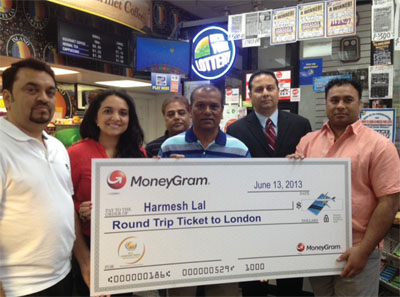
    The final game will be held June 23. All agent locations and online sends qualified for entry (consumers could also mail-in entry without purchase). The more transactions consumers made the more chances they had to win. Harmesh Lal from Bellerose, NY is the lucky winner. He sent money to his family in Hoshiarpur, India and was thrilled to learn that he would get a chance to experience the game up close.

    The transaction was sent at one of our top agent locations (Jai Hind) in the New York area, home to many immigrants using our services. The contest gave MoneyGram a chance to remind South Asian immigrants living in the U.S. that we are the official money transfer partner of the ICC. Plus, it promoted the sweepstakes and will send the lucky winner packing for one of the biggest games of the year.

    “Contests like these are a great way for MoneyGram to bring our consumers closer to the game of cricket and the memories they have of watching it in their home countries – it allows us to relate to our customers and give back to them a piece of what they might have left behind. It’s a way of thanking them for being a loyal consumer and increasing our brand awareness while doing so” says Zainab Ali, senior marketing manager.

    About MoneyGram MoneyGram, a leading money transfer company, enables consumers who are not fully served by traditional financial institutions to meet their financial needs. MoneyGram offers bill payment services in the United States and Canada and money transfer services worldwide through a global network of more than 300,000 agent locations – including retailers, international post offices and financial institutions – in 196 countries and territories. To learn more about money transfer or bill payment at an agent location or online, please visit moneygram.com or connect with us on Facebook.

  • MoneyGram joins NASDAQ

    MoneyGram joins NASDAQ

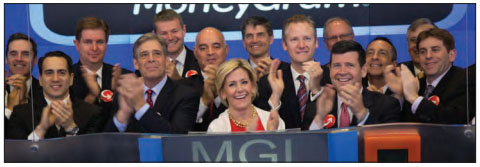
    NEW YORK, NY (TIP): MoneyGram International, Inc. (NYSE: MGI), a leading global money transfer company, moved its stock listing to the NASDAQ Global Select Market from the New York Stock Exchange, effective May 13, 2013. The Company will continue trading under the ticker symbol “MGI.””Upon being listed on the NASDAQ, MoneyGram joins the world’s most innovative companies,” said Pamela H. Patsley, chairman and chief executive officer. “NASDAQ is a global leader in advanced trading technologies, which will provide our shareholders with cost-efficient trading opportunities. MoneyGram will also benefit from reduced listing fees. As an innovative leader in the money transfer and payments industry, we are excited to be a part of the NASDAQ.” “We welcome MoneyGram to our growing list of leading companies that are innovators in their industries,” said Bruce Aust, executive vice president, NASDAQ OMX. “MoneyGram brings its customers closer by helping them send funds almost anywhere in the world through cash, bank account, online and mobile. Their versatility and forward thinking culture is perfectly aligned with NASDAQ’s family of listed companies.”

    About MoneyGram International
    MoneyGram, a leading money transfer company, enables consumers who are not fully served by traditional financial institutions to meet their financial needs. MoneyGram offers bill payment services in the United States and Canada and money transfer services worldwide through a global network of more than 310,000 agent locations – including retailers, international post offices and financial institutions – in 197 countries and territories. To learn more about money transfer or bill payment at an agent location or online, please visit moneygram.com or connect with us on Facebook

  • Australia mulls allowing Sikhs to wear turban at work

    Australia mulls allowing Sikhs to wear turban at work

    SYDNEY (TIP): Australian Prime Minister Julia Gillard has said that she would look into the issue of allowing Sikhs in her country to wear the turban while at work and also while riding motorcycles. “We will work with your community to help make the necessary changes requested on cultural and religious grounds,” the Blacktown Sun quoted her as saying Thursday during a visit to Gurdwara Sahib in the Sydney suburb of Glenwood.

    She said this during a closed door meeting with officebearers of the Australian Sikh Association. The Sikhs also asked Gillard to allow members of their community to wear the six-inch sword, called the kirpan, to official government functions and to differentiate Sikh students from other students in schools. Gurdwara spokesman Balvinder Singh Chahal was quoted as drawing the attention of Gillard to the fact that countries like Canada and Britain already allow Sikh civil engineers to wear the turban instead of the hard hat at work sites and while riding motorcycles.

    “I also would like to point out that the Punjabi language and Sikh religion were the fastest growing language and faith group – at the rate of 205 percent from 2006 to 2011, according to recent census,” he said. He also sought the inclusion of Punjabi language and Sikh history in the curriculum of schools, especially in western Sydney.

  • Highway bridge collapses between Seattle and Vancouver in US; no deaths reported

    Highway bridge collapses between Seattle and Vancouver in US; no deaths reported

    WASHINGTON (TIP): The major highway bridge linking Seattle with Canada and the rest of the Pacific Northwest region collapsed Thursday evening, dumping at least a handful of vehicles and people into a river, the Washington State Patrol said. There were no immediate reports of deaths, and three people were taken to hospitals.

    The fourlane Interstate 5 bridge more than half a century old collapsed about halfway between Seattle and Vancouver, British Columbia, Trooper Mark Francis said. Francis said he did not know what caused the collapse, which came at the start of one of the country’s busiest holiday weekends of the year. Xavier Grospe, who lives near the river, said he could see three partially submerged cars, and the apparent drivers were sitting either on top of the vehicles or on the edge of open windows.

    “It doesn’t look like anybody’s in danger right now,” Grospe said. The collapse came before sundown on a clear day. Helicopter footage aired by KOMO-TV in Seattle showed one rescue boat leaving the scene with one person strapped into a stretcher. A damaged red car and a damaged pickup truck were visible in the water, which appeared so shallow it barely reached the top of the car’s hood.

    Kari Ranten, a spokeswoman for Skagit Valley Hospital, said two people who were injured in the collapse were en route to the facility. She said another person was being taken to a different area hospital. A man told the local Skagit Valley Herald newspaper he felt a vibration and looked in his rear view mirror to see that the part of bridge he had just crossed was no longer behind him.

    “I thought something was wrong with my car at first,” he said. The collapse will raise questions about the state of the nation’s infrastructure, which has been a popular issue with President Barack Obama, who earlier this year warned against “raggedy” roads and wants to focus more money on rebuilding to improve the economy.

  • Hindus, Sikhs A Small Percentage Of Canada’s Population: Surveyra

    Hindus, Sikhs A Small Percentage Of Canada’s Population: Surveyra

    TORONTO (TIP): Hindus comprise 1.5 per cent, Sikhs 1.4 per cent and Muslims 3.2 per cent of Canada’s population of around 35 million, according to the 2011 National Household Survey conducted by Statistics Canada. Of the immigrants who arrived to this country between 2001 and 2011 Hindus, Muslims Sikhs and Buddhists account for 33 per cent, the new data released on Wednesday revealed, which is changing the religious makeup of this North American country.

    Over 22.1 million people identified themselves as belonging to a Christian group, Roman Catholics accounting for 12.7 million and United Church two million. The Muslim population is growing at the fastest rate in the country, even exceeding people who say they follow no religion. 17.4 per cent of the immigrants who arrived between 2001 and 2011 were Muslims.

    Hindus comprised 6.6 per cent, Sikhs 4.8 per cent, Buddhists 2.8 per cent, Jews 0.9 per cent and Christians 47.5 percent in the same period. “We have been experiencing this kind of steady increase for a while,” the Calgary Herald quoted Amin Elshorbagy, president of the Canadian Islamic Congress, as saying. “We can see this in terms of the need to expand our infrastructure. Most of our Islamic centres are becoming very crowded.

    ” South Asians, Chinese and blacks formed 61.3 per cent of the minority population. They were followed by Filipinos, Latin Americans, Arabs, southeast Asians, west Asians, Koreans and Japanese. However, the survey, which replaced the long-form census that was cancelled in 2010, warned that the data may not be completely accurate, given its voluntary nature.

    Indian-American to run for city council in US
    WASHINGTON (TIP): Vandana Slatter, an Indian-American clinical pharmacist has announced her candidacy for a city council seat in the US state of Washington.

    Announcing her decision to stand for Bellevue City Council, Slatter said in a statement on her website: “I chose to run in this race because I believe, at this time, I am uniquely qualified to bring leadership and a fresh perspective to Bellevue City Council.” “After careful consideration, I am pleased to announce I am running for City Council Position 06, currently held by incumbent Don Davidson,” the statement added.

  • Hundreds missing as Bangladesh toll tops 270

    Hundreds missing as Bangladesh toll tops 270

    DHAKA (TIP): The search for survivors from Bangladesh’s worst industrial accident stretched into a third day with the death toll rising to 273 after the collapse of a building housing factories that made lowcost garments for Western brands. Almost miraculously, 41 people trapped inside the rubble of the eight-storey building were rescued alive late on Thursday, government minister Jahangir Kabir Nanak said, about 40 hours after the disaster on the outskirts of Dhaka. Nanak said they had been working on the fourth floor of the Rana Plaza building and had all been found trapped in one room. Few other details were available.

    Around 2,000 people have been rescued over the past two days, at least half of them injured, but as many as 1,000 people remain unaccounted for. An industry official has said 3,122 people, mainly female garment workers, were inside the building despite warnings that it was structurally unsafe.

    Rescuers from Bangladesh’s army, navy and air force, as well as police and fire services, pored over huge piles of rubble and twisted metal in the search for survivors, using their bare hands as well as mechanical equipment. “We are not sure how many people are still trapped under the rubble,” said Dhaka District police chief Habibur Rahman, who updated the death toll early on Friday to 273. “Priority has been given to save people who are still alive,” he said. Wednesday’s disaster refocused attention on Western high-street brands that use Bangladesh as a source of low-cost goods. North American and European chains, including British retailer Primark and Canada’s Loblaw, said they were supplied by factories in the Rana Plaza building, which is in the commercial suburb of Savar, about 30 km (20 miles) from the capital.

    TRAPPED WORKERS CALL FOR HELP
    Savar residents and rescuers dropped bottled water and food on Thursday night to people who called out from between floors. Relatives identified their dead among dozens of corpses wrapped in cloth on the veranda of a nearby school. Police said the owner of the building, Mohammed Sohel Rana, a local politician from the ruling Awami League, was told of dangerous cracks on Tuesday. While a bank in the building closed on Wednesday because of the warnings, the five clothing companies told their workers there was no danger, industry officials said. Rana is now on the run, according to police. “We asked the garment owners to keep it closed,” said Bangladesh Garment Manufacturers and Exporters Association (BGMEA) President Mohammad Atiqul Islam.

    Despite the overnight rescue of 41 people, officials conceded the chances of finding more alive were growing slimmer. “We can’t be certain of getting them all out alive. We are losing a bit of hope,” fire brigade rescue worker Mizanur Rahman said earlier on Thursday. Special prayers will be offered at mosques, temples and pagodas across Bangladesh on Friday for the dead, injured and missing. The government declared a national day of mourning and flags were flown at half mast at all official buildings. Anger over the working conditions of Bangladesh’s 3.6 million garment workers, the overwhelming majority of them women, has grown steadily since the building collapse.

    More than 1,000 textile workers besieged the BGMEA on Thursday, pelting it with stones and clashing with riot police. The workers demanded all garment factories be shut and the owners harshly punished for accidents. Bangladesh is the world’s second-largest apparel exporter, with the bulk of exports – 60 percent – going to Europe. The United States takes 23 percent and Canada takes 5 percent. Primark, a unit of Associated British Foods, has confirmed one of its suppliers occupied the second floor of the building. Danish retailer PWT Group, which owns the Texman brand, said it had been using a factory in the building for seven years.

    Canada’s Loblaw, a unit of food processing and distribution firm George Weston Ltd, said one factory made a small number items for its “Joe Fresh” label. Primark, Loblaw and PWT operate under codes of conduct aimed at ensuring products are made in good working conditions. Documents including order sheets and cutting plans obtained by Reuters appeared to show that other major brands such as Benetton had used suppliers in the building in the past year. A Benetton spokesman said none of the factories were suppliers to the company. Spain’s Mango said it had an unfulfilled sample order at the plaza with Phantom Apparel.

  • Bhullar’s Death Sentence-International NGO’s File “Urgent Appeal” With United Nations

    Bhullar’s Death Sentence-International NGO’s File “Urgent Appeal” With United Nations

    NEW YORK (TIP): Seeking United Nations intervention, international human rights NGOs have approached UN’s Special Rapporteur on Torture after the denial of commutation plea by the Supreme Court of death row convict Devenderpal Singh Bhullar. The urgent appeal to Honorable Juan Méndez UN Special Rapporteur on Torture seeking immediate intervention, has been jointly filed by “Sikhs For Justice” (SFJ) a US based advocacy group, “Canadian Sikh Coalition” (CSC), a Canada based NGO and “Movement Against Atrocities and Repression” (MAAR) a Swiss NGO.

  • Dev Ratnam-Integrity, Charity, Modesty Propel This Visionary

    Dev Ratnam-Integrity, Charity, Modesty Propel This Visionary

    I am passionate about doing well not only in career but also in my community. I won’t say it’s a passion but I am very keen on being an honorable member in our community. I believe in being a good representative of India. Whatever obligations I have with the government, banks, other financial institutions of US and other countries, I want to deal with them with honor. I never want to escape from that. I never want to fail India, or my state. Life will always force you to deal with breaks, be it good breaks or bad breaks. How you deal with it is your legacy.

    Dev Ratnam began his career as a scientist. But he never wanted to be master at just one trick. He wanted to explore all the opportunities around him before settling into one. He tells us, “In true spirit, I am an entrepreneur, so I try many businesses. Though my education and experience is as a scientist from Penn state in 1977, I still wanted to venture beyond my degrees.” Dev graduated from Indian Institute of Science, Bangalore in Engineering and completed Masters in Engineering from Queens University, Canada and got a Ph.D. in Solid State Science from Penn State University in 1971. Yet, his dream was to always go back to India and set up his own business there. He tried his true best to fulfill that dream. Dev explains, “I was planning to buy a factory from Australia. The agent from Melbourne belonged to a big family.


    img12

    He used to be the Governor of Maharashtra and his son was my partner. We wanted to buy that factory and bring it to Chennai and set it up in India. But somehow the politics played its part after I reached Melbourne. I realized that I would be a minority party. And I had to walk away from my dream of setting up business in India. Of course, I tried to buy a factory from here and take the technology and equipment to India, but that never materialized. But in that search for a factory, I found a company in Long Island called Poly Mag Ink.

    A couple of partners and me bought it, but unforeseen factors didn’t allow it to be a big company. It still exists and it does have big clients like GM, Kodak, etc. Perhaps the location in Long Island was a disadvantage.” While many would give up and try to move on to something else, Dev Ratnam never stopped believing in himself. He defines himself as an eternal optimist and does not think giving up is an option. “I just never wanted to give up. In my years of experience, I have come through all the time. Yes, I did not perhaps see bright successes all over.

    But I have seen spurts of success and it was good with me.” Never to give up, even Dev Ratnam had to let go his dream of establishing business in India. But the blame for that lies on the political system of India. “I don’t want to sound negative, but in 40 years I have never succeeded with one project in India. But in China, South Korea or United States, it is entirely different. That does not make India bad.

    But I cannot recall one fruitful project, be in charity or investment in India.” His passion is what perhaps distinguishes him the most. He is a firm believer in the thought that a successful man is only successful enough if he can give back to his community. Dev explains, “I am passionate about doing not only well in career but also in my community.

    I won’t say it’s a passion but I am very keen on being an honorable member in our community. I believe in being a good representative of India. Whatever obligations I have with the government, banks, other financial institutions of US and other countries, I want to deal with them with honor. I never want to escape from that. I never want to fail India, or my state. Life will always force you to deal with breaks, be it good breaks or bad breaks. How you deal with it, is your legacy.” Dev Ratnam’s dreams and ambitions are just as extraordinary. His dream of helping others has paved the way for success in many people’s lives. He is on the Board of Interfaith Nutrition Network since 1995; had been a voice on the board on behalf of Indian community.

    He charts out a few of his projects. “I just want to do good things in life at this point. I have seen a couple of charitable programs that I want to take up. There is one in particular called Shri Chakra, which is an organization that concentrates on providing electricity through bicycle pedaling. It is on hold for now, due to some real-estate issues, but it’s a temporary hold. I want to provide electricity to rural parts of countries such as India, Afghanistan, Nepal, etc.

    That is my dream for sure. I am working with many major organizations. I am also working on some projects in my village in India too. My daughter is running for the marathon in Rwanda to commemorate the victims of the Rwandan massacre. I am helping her in this project through Rotary Hicksville. So I have a couple of such projects that I am extremely involved in.” Dev Ratnam was born in West Godavari in a small village in Andhra Pradesh and was the eldest son in his family. His father was the biggest influence on his life.


    img13

    Dev explains, “My father’s upbringing had a great impact on me. When he was 14, he had bought a car for marriage. He was a socialist. He too was involved in many ventures. He moved to Chennai with us and I completed my education there. I got a scholarship and went to Canada. From there, I moved here to the US and finished my PhD at Penn State. My father also had a tremendous passion to help people. He never had a formal education.

    Yet he went to Chennai and learnt English and began helping people in many ways. When he came to the US, he hand-drew the map of the US with all the 50 states and began learning about each state. Even before he came here, he knew about Edgar Allan Poe, an American writer and poet most Indians living here now don’t know about.

    But his thinking is what inspired me. Besides being a Socialist, he was able to understand the land of opportunity that United States really is.” Dev Ratnam’s biggest passion after social causes is perhaps traveling. His wife and he share a common interest in visiting and paying homage to the ancient civilizations of the world. “I am a citizen of the world. My wife and I love to travel. We have explored civilizations in Turkey, Greece, Cambodia and other places. We love to go to those places.

    Recently we went to Greece for a vacation. It was astounding to see the civilization there. We stood there and marveled at how the human culture evolved. We paid homage to all these cultures.” Dev admits that his ventures have not been a continual forerunner in their field. He only wishes that he had done his due diligence before beginning the investments. “Do I regret anything I have done? Well, maybe I was not too thorough. My son is 25 and he works for a venture cap holding. And when I see his company work, the immaculate attention to detail, I believe I did not do my due diligence. I guess that is my only regret. But on the other hand, almost all the real estate companies and other companies did just as bad since 2006. So I don’t know if it was just my choices.” He has a lot of praise for our community and believes that there is just as much misconduct in our community as in any other.

    But he commends our community’s foresight and achievements too. “They all belong to different strata. The ones who came in 70s came through education. They got good jobs and earned very well. So they are well adjusted in US. The ones who came in 80s came as immigrants, who basically were brought into the country by mainly extended relatives. They began setting up businesses. Now the people who belong to this group are becoming the core Indian community. They are aggressive, motivated and passionate about their ventures and see them succeeding. I believe they are easily the more successful than any other group of Indian community. So I would say this for our community, that we have an impeccable foresight. We know what can make us prosperous.” Dev Ratnam has an outstanding family too. His wife Prof.

    Runi Mukerji Ratnam is a dynamic leader in academics at SUNY in the entire New York State and a leader in several professional and social organizations. His daughter Romola Ratnam is an NYU graduate and is well known in the sports marketing field in Manhattan. She has also initiated several charity programs much like her father. His son Basudev graduated from Brown University and is an excellent tennis player. Dev Ratnam had ambitions to make his son a national level tennis player but unfortunately Basudev suffered a few injuries that dissuaded him from playing on national levels.

    At present, Basudev is working with a private equity company in Manhattan. Before I take leave, I ask him if he still has plans to move to India and realize his long lost dream. And to that he replies. “No it’s too late now. This is our home now.” From all the readers of The Indian Panorama we wish Mr. Dev Ratnam success in all his professional and social ventures.

  • Indian Canadian Student Gives Boost To Cancer Treatment

    Indian Canadian Student Gives Boost To Cancer Treatment

    OTTAWA (TIP): A Canadian high school student has improved an ineffective experimental cancer therapy with a simple tweak — pairing it with antibiotics — earning accolades pn Tuesday from a panel of eminent scientists. Cancer “photothermal therapy” — or PTT — involves injecting a patient with gold nanoparticles. These then accumulate in tumors and, when heated using light, attack the cancer cells.

    The idea has shown promise but is not very effective because the cancer cells fight back, producing heat-shock proteins to protect themselves. India-born high school student Arjun Nair, 16, showed how an antibiotic (17-AAG) may overcome the defenses deployed by cancer cells and make the treatment more effective.

    The discovery earned Nair the top prize in the 20th Sanofi BioGENEius Challenge Canada, after he spent two years working on his idea at the University of Calgary’s Nanoscience Labs in Alberta. “Proof-of-concepts were developed and tested in order to demonstrate the viability of PTT,” Nair said in a statement. “Moreover, after analyzing the literature a mathematical model was developed to evaluate a theoretical synergetic treatment.” In an interview with AFP, Nair said he began looking into this after his grandmother was diagnosed with cancer. “She suffered a lot through therapy, so I was looking at cancer in general and read a lot about treatments,” he said. At the same time, Nair noticed cancer projects had become staples of science fairs across Canada, and so decided to take on the challenge himself.

    A total of 208 high school students collaborating on 123 projects, all mentored in professional labs over several months, took part in the annual competition.

  • 2G case: Mittal, Ruia appear in trial court

    2G case: Mittal, Ruia appear in trial court

    NEW DELHI (TIP): Bharti group chairman Sunil Bharti Mittal and Essar promoter Ravi Ruia on April 11 appeared before a special CBI court in response to the summons issued by the court in the case pertaining to allocation of additional 2G spectrum during the NDA regime. Mittal’s counsel placed before special CBI judge O P Saini the Supreme Court order postponing proceedings in the case till April 16.

    Besides Mittal and Ruia, former telecom secretary Shyamal Ghosh, who was summoned by the special CBI judge, also appeared in pursuance to the summons issued against him. The court, after going through the apex court’s order on separate petitions filed by Mittal and Ruia, listed the matter on April 16 for further proceedings. The apex court will hear their pleas on April 15. The special court had on March 19 summoned Mittal, Ruia, who was then a director in one of the accused companies Sterling Cellular Ltd, and Asim Ghosh, the then managing director of Hutchison Max Telecom Pvt Ltd. Their names were not mentioned in the chargesheet filed by CBI on December 21 last year in the case.

    During the proceedings, the court was told that the summons against Canada-based NRI Asim Ghosh had “remained unserved”. Besides the three, the court had also summoned Shyamal Ghosh and three telecom firms — Bharti Cellular Ltd, Hutchison Max Telecom Pvt Ltd (now known as Vodafone India Ltd) and Sterling Cellular Ltd (now known as Vodafone Mobile Service Ltd). The three telecom firms were represented by their counsel in the court on April 11. Ruia had moved the apex court a day after it had postponed till April 16 the proceedings in the special CBI court against Mittal. When CBI had opposed the plea of Mittal in the Supreme Court saying evidence had been found against him during investigation, the apex court questioned the probe agency as to why he was not named in the chargesheet.

  • The Dragon Covets the Arctic

    The Dragon Covets the Arctic

    China’s lust for oil, minerals, rare earths, fish and desire for an alternative northern sea route boils the Arctic Geopolitics!
    Iceland is a small, sparsely populated island nation with a population of only 320,000 and area of 40,000 square miles. It is the only member of the NATO that does not have an army of its own. Icelandic banks were part of the 2008 global financial crisis and meltdown when they exposed the Icelandic government of huge financial risks by indulging in risky loans and speculative foreign currency transactions without having enough liquidity and capital reserves. The fiscal crisis led to a former Icelandic prime minister losing his job and being hauled to court of law for not supervising the banks enough. In an international capitalistic, mercantile system, if Iceland were a company, it was “sitting duck” for outright purchase and acquisition. Fortunately, foreigners are not allowed to buy any property or real estate in Iceland and need a special permit. And here comes the Peoples’ Republic of China, rich with $ 3.4 trillion in foreign exchange reserves in its kitty.

    It has built a palatial embassy in Reykjavik, Iceland worth $250 million with only 7 accredited diplomats. China is negotiating a free trade area with Iceland, the first with any European nation. Former Chinese Prime Minister Wen Jiabao even paid a state visit to Iceland for two full days in 2012. Other Chinese ministers and officials have also been very active in Iceland with bilateral visits and cultural events. In 2010, Huang Nubo, a “poetry loving” Chinese billionaire and former communist party official visited Iceland to meet his former classmate Hjorleifur Sveinbjornsson, a Chinese translator with whom he had shared a room in 1970s in the Peking University. He expressed his intense love for poetry and put up $ one million to finance Iceland-China Cultural Fund and organized two poetry summits, the first one in Reykjavik in 2010 and the second one in Beijing in 2011.

    Last year (2012), Huang Nubo and his Beijing based company, the Zhongkun group offered to buy 300 sq km of Icelandic land ostensibly to develop a holiday resort with a golf course. This Chinese billionaire wanted to pay $7million to an Icelandic sheep farmer to take over the land and build a $100 million 100-room five star resort hotel, luxury villas, an eco-golf course and an airstrip with 10 aircrafts.

    A state owned Chinese bank reportedly offered the Zhongkun group a soft loan of $ 800 million for this project. The deal was blocked by the Icelandic Interior Minister who asked many pertinent questions but reportedly got no answers. Huang would not take no for an answer and has submitted a revised bid for leasing the land for $ one million instead of outright purchase. He makes an unbelievable assertion that there is a market demand for peace and solitude: “Rich Chinese people are so fed up of pollution that they would like to enjoy the fresh air and solitude of the snowy Iceland”. The current Icelandic government, a leftof- center coalition has given this proposal a cold shoulder.

    But, with elections due in April 2013 in Iceland, China is hoping for a more sympathetic government to approve the project. Iceland looks like an easy bird of prey for the wily red Dragon with insatiable appetite. China is showing generosity to another poor and sparsely populated, self-governing island of Greenland by offering investments in mining industry with proposal to import Chinese crews for construction and mining operations. Greenland is rich in mineral deposits and rare earth metals. China wants Greenland to provide exclusive rights to its rare earth metals in lieu of the fiscal investments. Under one such proposal, China would invest $2.5 billion in an iron mine and would bring 5000 Chinese construction and mining workers whereas the population of the capital of Greenland, Nuuk is only 15000.

    Arctic Council Membership:
    There are eight members of the Arctic Council that includes Canada, Denmark (including Greenland), Finland, Iceland, Norway, Russia, Sweden and the USA. All these eight countries have geographic territories within the Arctic Circle. It was constituted in 1996 as an intergovernmental body but has evolved gradually from a dialogue forum to a geo-political club and a decision making body. There are continuing territorial disputes in Arctic Circle. Ownership of the Arctic is governed by the United Nations Convention of the Law of the Sea, which gives the Arctic nations an exclusive economic zone that extends 200 nautical miles from the land. Member countries signed their first treaty on joint search and rescue missions in 2011. A second treaty on cleaning up oil spills is being negotiated. The group established its permanent secretariat at Tromso, Norway in January 2013.

    Arctic Melting and Opening of Newer Sea Lanes:
    With global warming becoming a reality, the Arctic ice has started to melt rapidly opening the northern sea-lanes that were frozen earlier. In summer of 2012, 46 ships sailed through the Arctic Waters carrying 1.2 million tonnes of cargo. There are legal questions about the international status of the northern sea lanes.

    China’s Lust for Arctic Resources:
    The Arctic has 13% of the world’s undiscovered oil and 30% of gas according to the US Geological Survey. Greenland alone contains approximately one tenth of the world’s deposits of rare earth minerals. China which already has a monopoly on world’s rare earth metal trade wants to continue controlling this global trade. China piously claims that the Arctic resources are the heritage of the entire mankind while insisting that the South China sea is its exclusive sovereign territory. In 2004, China set up its first and the only Arctic scientific research station, curiously named “Yellow River Station” on the Svalbard Island of Norway.

    China, so far, has sent 6 arctic expeditions. China plans to build more research bases. In 2012, the 170- meters long ice-breaker “Snow Dragon” (MV Xue Long) became the first Chinese Arctic expedition to sail along the Northern Sea Route into the Barente Sea. Incidentally, as early as 1999, this 21000 metric ton research ice-breaker Xue Long had docked in the Canadian North-Western territory unexpectedly. China is building another 120-meter long ice-breaker with the help of Finland while the Polar Research institute in Shanghai trains scientists and other personnel for Arctic expeditions.

    China’s Previous Use of Deception:
    There is no mandarin character for word transparency. China has been known to use duplicity and deception since the Art of War was written by Sun Tzu. China’s rhetoric of “peaceful and harmonious rise” and hegemonic behavior are predictably diametrically opposite to each other. China’s use of deception to camouflage its intentions in geopolitical matters is not surprising. While China joined the NPT in 1991, it provided 50 kg of highly enriched uranium to Pakistan, provided that country with a nuclear weapon design and supervised Pakistan’s first nuclear test at the Chinese nuclear testing site of Lop Nur.

    China purchased in 1998 an unfinished aircraft carrier from Ukraine after the break-up of Soviet Union ostensibly for developing a floating casino. The same “floating casino” is now China’s first aircraft carrier projecting Chinese naval and maritime power in the South China Sea. China’s Application in Arctic Council Membership: China currently has an ad hoc observer status with Arctic Council. China’s application for permanent observer-ship was denied by Norway in 2012 owing to bilateral dispute over awarding of Nobel peace prize to China’s Liu Xiabo in 2010. China still has a pending application to be decided in May 2013 Arctic Council summit in Sweden when Canada takes over the chair for the next two years. With a permanent observer status, China would get full access to all Arctic Council meetings. Permanent observers do not have voting rights in the council but can participate in deliberations.

    China is trying to distinguish itself from the rest of the applicants as a “Near Arctic State” on the perniciously clever but fallacious grounds that the northernmost part of China in the province of Manchuria (the Amur river) is only one thousand miles south to the Arctic circle. The fallacy is that Manchuria was a separate, independent country that was annexed by China after the Communist take-over. Manchus had ruled over China for centuries during the reign of Manchu dynasty and last Chinese Emperor Pu Yi was actually the last Manchu emperor. Chinese ownership and annexation of Manchuria (Manchu-Kuo) is still not settled. A disputed territory cannot be used by China to make a geo-political claim for being a “Near Arctic State”.

    Other Pending Applications:
    Other countries or non-state actors with pending applications for permanent observer-ship status include Japan, South Korea, India, Singapore, European Union, and non-state actors like Greenpeace and the International Association of Oil and Gas Producers. All these applications will be decided one way or the other in May 2013. The vote has to be unanimous for acceptance and how the US and Russia will vote is the crucial issue. In the past, Norway had vetoed China’s membership application. Some of the Arctic Council members may not approve European Union’s application because of EU’s penchant for restrictive and narrow rulings. Whereas Sweden, Canada, Iceland and Denmark may support China’s application, there are doubts about Norway, Russia and the US. Russia is currently the most vociferous member of Arctic Council that has serious reservations in expanding the Arctic club.

    Strategic Issues:
    China has voracious appetite for new territories and has been seeking new frontiers for the last three hundred years with Inner Mongolia, Manchuria, Xinjiang and Tibet. China’s list of “core issues” is ever-expanding, starting with Taiwan and Tibet. China has included the whole the South China Sea and its islands as a core issue. China is aggressively claiming sovereignty on these islands based on historical maps and manufactured mythological evidence. China has now a license from the UN for deep sea bed mining for minerals in the Indian Ocean and has developed naval bases in Indian Ocean and Arabian Sea ports. If China manages to get a toehold in Arctic Circle, its behavior will become as belligerent in Arctic as it is in the South China Sea. It might claim sovereignty over the whole of the Northern route sea lanes based on “historical evidence”. If in 22nd century, China decides that the Arctic Circle is its core national issue, one would be seeing Chinese aircraft carriers in the Arctic Sea and Chinese nuclear powered submarines in the Barente Sea along with military bases with “Chinese characteristics” in the Iceland and Greenland.

  • Two die in shooting at Canada day care centre

    Two die in shooting at Canada day care centre

    GATINEAU (TIP): A man has shot dead another man at a day care centre in Quebec then killed himself, and the 53 children present were evacuated unharmed. Police said some may have watched the killings. For a moment, Canada feared its own version of last year’s deadly school shooting in the United States, where 20 young children were killed. The police on April 5 received a call about an armed man with a shotgun threatening people, Gatineau Police Chief Mario Harel said.

    They arrived to find one man dead with a shotgun beside him and a second man, an unidentified employee of the day care, also dead. Mr. Harel said the shooting seemed to be related to a recent separation between a couple but didn’t elaborate. The Racines De Vie Montessori day-care is located in two homes, and Sergeant Jean- Paul LeMay said police found a body in each one. LeMay said the children were safe at a nearby house. Police speculated that some children likely witnessed the killings. “It’s a small area, it’s a close space,” said Mr. Harel. “For sure, they should have been witness (to) the event.” Parents sobbed and hugged while they waited for investigators to bring them to their children.

    Omar Eltalawi rushed to the scene from his nearby home as soon as he heard about the shooting, fearful for his 3-year-old daughter, Zain. “It was horrible,” Eltalawi said as he described the fear of not knowing what was going on inside the day care. “You see these things on the news and you don’t expect it to happen to you.” Gatineau city is just across the river from Ottawa, the capital.