
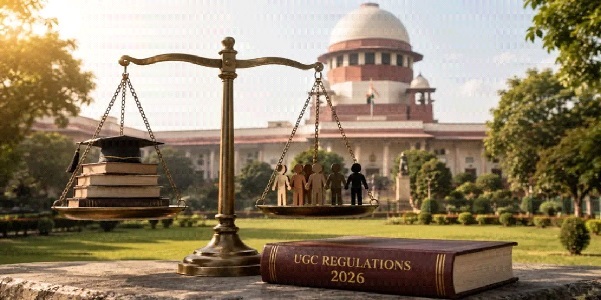

New Delhi (TIP): The Union government on Thursday told the Supreme Court that it is contemplating setting up a committee to reconsider the University Grants Commission’s (UGC) 2026 equity regulations, which had sparked protests by upper-caste groups over concerns that their communities will be targeted.
The developments come months before scheduled assembly elections in five states, including in Uttar Pradesh where the UGC norms have triggered several protests and where upper-caste communities are a key demographic being wooed by both the government and the Opposition.
The rules — which garnered support from marginalised groups fighting against caste bias in educational campuses — were stayed by the court in January over concerns that their vague provisions could be misused and have “dangerous impacts” on society.
The submission came after a bench headed by Chief Justice of India (CJI) Surya Kant and justice Joymalya Bagchi advised the Centre to revisit the regulations to ensure that the framework protects the interests of all students and does not leave any section feeling apprehensive or dissatisfied.
“Why don’t you revisit these regulations so that the next generation is taken care of? They should protect the interest of every student,” the bench told solicitor general Tushar Mehta, appearing for the Centre.
Mehta informed the court that the government was contemplating constituting a committee to revisit the regulations and was examining the issue to ensure that “no section feels dissatisfied or apprehensive”.
Adjourning the matter, the bench said: “We have given them advice. Let us see what they do.”The proceedings came a day after the Union Cabinet gave Agniveers, who fail to make the cut after the initial four-year service, an option to remain in service for two more years and a route to enrol as regular soldiers at the end of the extended period.
The move was seen as an outreach to young men and women in Uttar Pradesh, Uttarakhand and Punjab — all three states go to the polls in early 2027 — that contribute substantial numbers to the armed forces.
The UGC (Promotion of Equity in Higher Education Institutions) Regulations, 2026 were notified on January 13 and stayed by the Supreme Court on January 29, following challenges to their provisions.
The court had at the time expressed concern that the framework, in its existing form, was vague and capable of being exploited by mischievous elements, warning that it could divide society and have “dangerous impacts”.
It directed that UGC’s 2012 anti-discrimination regulations would continue to operate in the interim to ensure that students facing discrimination were not left without a remedy.
The 2026 regulations mandate universities, colleges and deemed institutions to set up equal opportunity centres and equity committees to address complaints of discrimination and promote inclusion in higher education institutions.
The framework — which was formulated by the university regulator after a Supreme Court petition by the mothers of two marginalised caste students who died by suicide following caste discrimination — was welcomed by anti-caste groups, who argued that the rules were necessary to stop bias in campuses.
But it faced opposition from several upper-caste organisations and students, who alleged that the provisions were one-sided and susceptible to misuse. On Tuesday, a group of upper-caste students protested outside the UGC headquarters in Delhi, demanding its withdrawal.
The petitions before the Supreme Court have primarily challenged Regulation 3(c), which defines “caste-based discrimination” as discrimination “only on the basis of caste or tribe” against members of the Scheduled Castes, Scheduled Tribes and Other Backward Classes.


Be the first to comment