Tag: Chhattisgarh

  • Exit Polls Indicate BJP Juggernaut & Congress Rout

    Exit Polls Indicate BJP Juggernaut & Congress Rout

    NEW DELHI (TIP): The Congress faces a blank-out in four states that have polled in assembly elections in November-December, while the BJP will certainly win in Madhya Pradesh and Rajasthan, is likely to retain Chhattisgarh and may just grab power in Delhi as well, according to exit polls and postpoll surveys released on December 4. If these polls prove to be accurate, it is very bad news for the Congress which faces a national election five months down the road. Equally, it is a bumper booster shot in the BJP’s arm and its prime ministerial candidate Narendra Modi.

    While Mizoram has also had assembly elections, no exit polls were available for the state and its outcome, in any case, can have little effect on the 2014 elections. While there were only minor differences among the different polls on Rajasthan, MP and Chhattisgarh, the estimates for Delhi varied widely, with two of the four polls predicting a hung assembly, but two others giving the BJP a clear though slim majority.

    One poll even suggested that debutant Aam Aadmi Party would emerge as the single largest party in the new assembly. On Delhi — the election that will be most closely watched as a pointer to the national mood — an ORG survey for Headlines Today suggested the BJP would win 41 seats, giving it a clear majority in the 70-member assembly. It said the Congress would win 20 seats, and AAP just six. The ABP News-AC Nielsen also predicted a BJP win with 37 seats, but predicted that the Congress with 16 and AAP with 15 would finish neck-and-neck.

    The C-Voter poll put the BJP tantalisingly short of a majority with 31 seats, the Congress and 20, AAP at 15 and others with four seats, which could end in a hung house. Today’s Chanakya had a radically different prediction, with AAP projected to win 31 seats, BJP 29 and Congress a mere 10. Obviously, the significant performance of newcomer AAP was seriously testing the science of psephology. The other relatively close contest appears to be in Chhattisgarh.

    Here, ORG and Today’s Chanakya gave BJP a clear majority, C-Voter predicted it would fall just short and the CNN-IBN-CSDS poll gave a range for the party of 45-55 seats in the 90-member house, which means it may or may not have a majority. What they all agreed on was that the Congress would not win, its tally ranging from a minimum of 32 to a maximum of 41 across the four polls. On Madhya Pradesh, there is unanimity that Shivraj Singh Chouhan will win a third term in style. The range of predicted tallies for the BJP in the 230-member is from a minimum of 128 in the C-Voter poll to a maximum of 161 in the poll done by Today’s Chanakya.

    The Congress tally in the state, if the polls are right, could be anywhere between 62 and 92. Rajasthan too is projected to deliver a landslide verdict in favour of the BJP, with its tally projected at 110-147 seats in the 200-member assembly across four different surveys and the Congress predicted to win at best 62 seats and at worst 39.

  • JSPL TO INVEST RS 2,000 CRORE IN TWO NEW REBAR UNITS

    JSPL TO INVEST RS 2,000 CRORE IN TWO NEW REBAR UNITS

    KOLKATA (TIP): Jindal Steel and Power Ltd (JSPL) is planning to invest close to Rs 2,000 crore in setting up two new bar mills. The new mills, each with a capacity of around 1.4 million (mt) tonne, are slated to come up at JSPL’s existing steel making facilities at Angul in Odisha and at Oman. “We have a 1.6 million tonne capacity at present. In three years, we hope to expand capacity to 4.5 mt by setting up two new bar mills. Each of these units is likely to require an investsment of around Rs 900 to Rs 1,000 crore,” V K Mehta, JSPL’s director (marketing) said. Mr Mehta was speaking to reporters at a press meet in the city on the company’s retail plans. “While the bar mill at Oman is due to come up in next 18 months, the one at Angul is likely to come up in 27 months,” he added. The TMT rebar is being produced at the TMT Rebar mill at Patratu in Jharkhand. It has a production capacity of one million tonne per annum (mtpa) and uses Siemens rebar production technology from the US. JSPL announced its foray into steel retail segment in August this year with the launch of a new retail brand. The first product to be launched under this is ‘Jindal Panther TMT Rebars’, a steel product used in building construction. The product will be supported by JSPL’s channel network of 40 distributors and over 1,000 dealers. JSPL is also investing Rs 125 crore in setting up head hardening facilities at its rail making facility at Raigarh in Chhattisgarh The facility is part of JSPL’s move to get ino high value product categories and is expected to be completed by January 2014.

  • Seemandhra employees call off strike after 66 days

    Seemandhra employees call off strike after 66 days

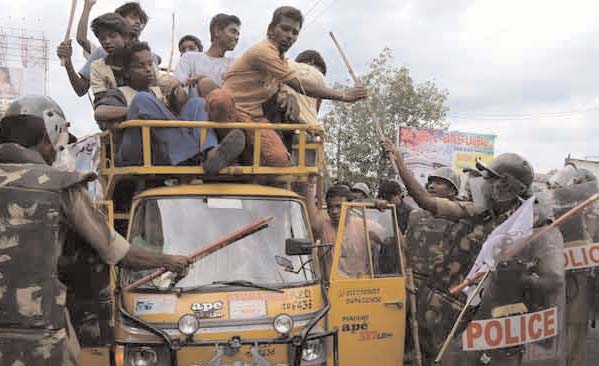
    HYDERABAD (TIP): In a major development that could help restore normalcy in Seemandhra, the Andhra Pradesh government employees from the region on October 17 decided to call off their indefinite strike to oppose the central government’s decision to carve out a separate Telangana. Leaders of various associations of employees agreed to temporarily call off the 66-day-long strike after talks with Chief Minister N. Kiran Kumar Reddy. State ministers Anam Ramnarayana Reddy and P. Satyanarayana announced after the talks that the employees would attend their duties from Friday. They said the associations agreed to call off their strike following some assurances given by the chief minister to address their concerns. Kiran Reddy assured employees that he would write a letter to Prime Minister Manmohan Singh on referring the Telangana resolution to state assembly. The chief minister, in his letter, would urge the prime minister to follow the Constitutional process adopted while carving out Jharkhand, Chhattisgarh and Uttarakhand, said a statement issued from the chief minister’s office.

    The employees wanted an assurance that the resolution would come before the assembly so that it could be defeated. Ramnarayana Reddy said all Seemandhra Congress leaders including the chief minister and state Congress chief were committed to defeat the resolution in the assembly. He said they would all work with the employees to keep the state united. Over 400,000 government employees of Seemandhra (Rayalaseema and coastal Andhra) were on strike since Aug 12 to oppose the decision to bifurcate the state. The strike had crippled the state administration in all 13 districts of the two regions. Over 200,000 teachers and employees of state-owned Andhra Pradesh State Road Transport Corporation (APSRTC) last week called off their strike. The chief minister had appealed to all employees to call off the strike as it has paralysed the administration and all welfare and development programmes in Seemandhra. Kiran Reddy noted that the employees participated in the strike for 66 days and did not draw Rs.2,700 crore salaries despite the hardships faced by their families. Assuring the employees that there is no change in his stand that the state should not be divided, he promised to provide them an opportunity to place their concerns before the group of ministers constituted by the union cabinet. Andhra Pradesh Non-Gazetted Officers (APNGOs) Association president P. Ashok Babu said they withdrew the strike temporarily. He warned that if a bill is tabled in parliament for formation of Telangana state, they would again go on strike. He quoted the chief minister as saying that Telangana issue would come to the assembly twice. Ashok Babu also demanded that Article 371 D be protected as it provides some safeguards to Seemandhra in recruitment of government employees.

  • AVANTHA POWER SYNCHRONISES 600 MW FIRST UNIT OF RAIGARH PROJECT

    AVANTHA POWER SYNCHRONISES 600 MW FIRST UNIT OF RAIGARH PROJECT

    MUMBAI (TIP): Avantha group company Avantha Power and Infrastructure Ltd has synchronised the first unit of 600 MW in its Raigarh, Chhattisgarh project, through its whollyowned subsidiary Korba West Power Company Ltd. The company’s generation capacity stands at 626.19 MW with the commissioning. Avantha Power and Infrastructure Ltd (APIL) is part of the Rs 25,000-crore ($4 billion) Avantha group. APIL began construction in August 2010 and executed the project in 38 months. BHEL supplied the boiler, turbine and generator equipment for the project. APIL has another 1,860 MW under various stages of construction and an additional 1,320 MW under planning. Gautam Thapar, Founder and Chairman of the Avantha Group, in a statement said APIL’s subsidiary, Korba West Power Company Ltd, signed the fuel supply agreement (FSA) with South Eastern Coal Ltd (SECL) in August 2013 for feeding the plant with uninterrupted coal supply. APIL’s Chief Operating Officer K. N. Neelkant said the company is going ahead with its plans for adding to the installed capacity. A second thermal power plant of 1260 MW is also under various stages of construction at Seoni, near Jabalpur, Madhya Pradesh, through the company’s project at Jhabua Power Ltd. APIL has a plant at Malanpur, Madhya Pradesh, with an installed capacity of 26 MW, and will have a total installed capacity of 3806 MW once all the projects achieve commercial operations.

  • PROGRESS BLOW TO GUJARAT

    PROGRESS BLOW TO GUJARAT

    Human indicators put state that brags about growth behind Tripura and Sikkim

    NEW DELHI (TIP): A new development index has identified Gujarat as a less developed state, while ranking Odisha and Bihar along with eight others as “least developed” and Goa and Kerala among the seven “relatively developed” states. A panel headed by Raghuram Rajan, now the RBI governor, which submitted its report to finance minister P Chidambaram, also recommended a fresh approach to devolution of funds to states and moved away from the special category classification to devise three categories – least developed, less developed and relatively developed. According to the index, there are 10 least developed states, 11 less developed and seven relatively developed states in the country. The slotting of Gujarat, which has attracted attention due to its development model, in the “less developed” category is likely to escalate the already bitter political debate on the ‘Gujarat model of development’.

    The other states in this category are Manipur, West Bengal, Nagaland, Andhra Pradesh, Jammu and Kashmir, Mizoram, Tripura, Karnataka, Sikkim and Himachal Pradesh. The least developed states include, apart from Odisha and Bihar, Madhya Pradesh, Chhattisgarh, Jharkhand, Arunachal Pradesh, Assam, Meghalaya, Uttar Pradesh and Rajasthan. The relatively developed states according to the index are Haryana, Uttarakhand, Maharashtra, Punjab, Tamil Nadu, Kerala and Goa. The panel has developed a multidimensional index of backwardness based on monthly per capita consumption expenditure, education, health, household amenities, poverty rate, female literacy, percent of SC-ST population, urbanisation rate, financial inclusion and connectivity.

    The panel said less developed states rank higher on the index and would get larger allocations based on the need criteria. “The committee has proposed a general method for allocating funds from the Centre to the states based on both a state’s development needs as well as its development performance,” Chidambaram told reporters. “The committee has recommended that each state may get a fixed basic allocation of 0.3% of overall funds, to which will be added its share stemming from need and performance to get its overall share,” Chidambaram said. The panel was set up after persistent demand from Bihar CM Nitish Kumar who insisted a the special category status to help access more funds for its development. This sparked off a demand from several other states such Odisha for the special category state status. While the new index will ensure more funds for Bihar from the central kitty, it has stopped short of conferring the “special category” tag on the state, Shaibal Gupta, seen as Nitish’s nominee on the panel to submit a 10-page dissent note.

    However on Thursday, Nitish concealed his disappointment, if any, to celebrate the recommendation as a triumph even as BJP taunted him for failing to have his way despite cozying up to Congress. “It is a very decent report. For example under this index Odisha is at the bottom of the list and then Bihar. Therefore it recognizes that Odisha, Bihar, Madhya Pradesh are among the most backward states of India. That is I think the demand,” Chidambaram said. “The demand of these states is please recognize the fact that for a variety of reasons we are the most backward states. I think this index captures the degree of backwardness and acknowledges that Bihar is among the most backward states of India. Special category is the present categorisation. Now they are moving away from that,” finance minister said while detailing the recommendations of the panel.

    “This is not an answer to all the demands of the states. This is meant only to be a way forward on how to devolve funds to the more backwards states and areas of India. He said the index better captures the stage of development in a state, how backward it is or how relatively less backward it is and is a good measure for planning and devolution of funds. “Because some states are small very limited resources it is necessary to have a threshold below which the devolution of funds does not fall. So the committee has recommended that each one of the states will get a basic allocation of 0.3%,” Chidambaram said. The finance minister said that the report will be examined by various stakeholders before being implemented. “It will not be in the current year. It has to go through the examination process and will be implemented in an appropriate time in the next financial year.

    To which funds this should be applied a decision will be taken,” Chidambaram said. The report said that the National Development Council had accorded the status of special category state to eleven out of 28 states. They were based on a number of characteristics such as hilly and difficult terrain, low population density and or sizeable share of tribal population, strategic location along the borders with neighbouring countries, economic and infrastructural backwardness and non-viable nature of state finances. State under this category have a low resource base and are not in a position to mobilise resources for their developmental needs even though the per capita income of some of these states is relatively high, the report said.

  • ‘AGGRESSIVE’ RAHUL RALLIES TRIBALS, TAUNTS GUJARAT CM

    ‘AGGRESSIVE’ RAHUL RALLIES TRIBALS, TAUNTS GUJARAT CM

    JAGDALPUR (TIP): Congress general secretary Rahul Gandhi on September 26 addressed a rally a mere 43km from the spot where the Maoists wiped out the entire party brass little more than three months ago, and said the leaders were killed to silence the voice of the common people. Showing rare aggression, he said the BJP government’s failure led to their slaughter. “Thirty-two people were killed in the Maoist attack. Where was the government? The tallest Opposition leader was killed, where was the government? When the leaders of tribals are not safe, what about masses?” he asked. Attacking the BJP and its prime ministerial candidate Narendra Modi, Rahul said just one man can’t run the nation. “The BJP thinks just one man can run the nation,” Rahul said, in a barb at Modi. He also took on the Raman Singh government for poor infrastructure and acquisition of tribal land. “Have you seen any doctor in hospitals and health centres in Bastar?” he asked. The crowd roared in the negative.

    “Our aim is to empower tribals by vesting power in their hands. We believe the nation is run by the people,” Rahul said. Criticising the BJP government for Chhattisgarh’s dilapidated health infrastructure, Rahul said hundreds of people die of gastroenteritis every year, but hospitals are in a shambles. “The land belonging to tribals is taken away. If they want land of the rich, they will buy it. If it’s of the poor, it’s acquired,” he said. The event brought leaders of warring factions of the state Congress on a common platform for the first time in more than three months in Rahul’s presence. How long will the warring groups led by former CM Ajit Jogi and Pradesh Congress chief Charandas Mahant remain on the same page is open to question. Criticising the Raman Singh government, Rahul said he had stopped at a village with a population of 2,000. “I tried to find out how many people have passed the 12th standard. There was one. What kind of government you have?” he said. The Centre has pumped in more than Rs 10,000 crore for development, but the government changed its names to take credit of Central schemes, he said.

  • SC TURNS COALGATE SPOTLIGHT ON STATES

    SC TURNS COALGATE SPOTLIGHT ON STATES

    NEW DELHI (TIP): A year after turning the searchlight on alleged irregular allotment of coal blocks, the Supreme Court on September 26 sought to know the role played by the seven coal producing states in the entire process, starting from allocation by the Centre to commencement of mining operations by private parties. A bench of Justices R M Lodha, Madan B Lokur and Kurian Joseph formulated four questions and sought responses to them from Jharkhand, Odisha, Chhattisgarh, Madhya Pradesh, Maharashtra, Andhra Pradesh and Maharashtra by October 29.

    With majority of these states ruled by parties who are not on the same political plane as the Congress-led UPA, they would not lose an opportunity to score brownie points against the Centre given the proximity of assembly polls and general elections. The issuance of notices to the states to understand their role in the coal block allocation process had become imperative after attorney general G E Vahanvati argued that the Centre had discharged its statutory role of a regulator by merely identifying the coal blocks while the rest of the formalities – signing of mining lease and all environment and forest clearances — squarely rested in the domain of states.

    Vahanvati had also said that coal block allocation letters, “at the highest”, could be treated as letters of intent conferring zero right on allottees as far as mining was concerned. “It is not a bankable document,” he had said. Apart from answering the issues raised in the two petitions – one by advocate M L Sharma and the other by NGO ‘Common Cause — the court asked the seven states to respond to four more questions: * How did the states understand the allocation of coal blocks by the central government? * What was the role of state governments in the allocation of coal blocks? * What was the role of state governments in the subsequent steps having regard to the provisions of Mines and Mineral (Development and Regulation) Act, 1957? * The details of agreements entered into by state public sector undertakings (PSUs), which were allotted coal blocks, with private parties in coal blocks located in their states.

    The last question about the status of joint ventures came to be included after intervenor Sudiep Srivastava through advocate Sanjay Parikh alleged that these joint ventures were illegally entered into by the PSUs, giving away coal mining rights to private parties. Moreover, many of the private allottees had no financial and technical capabilities to undertake the task. The court also sought the states’ view on competitive bidding. Vahanvati said, “States were crucially involved in coal mining operations.When the decision relating to competitive bidding was floated, most of them opposed it. They are the owners and that was their view.”

    He said the coal block allocation letter was mere initiation of the process, which was evident from the fact that many private companies, which were allotted coal blocks, were yet to sign mining leases given the reluctance of state governments to feed coal to projects situated outside their states. “As many as 27 mining leases in a particular state have not been executed and held up because it is saying why should it give coal to private parties whose projects are located outside the state,” the AG said. Though the AG did not take the name of the state, it was obvious that the state in question was Odisha.

    The AG said, “The state is saying why not use the coal for its own PSUs.We have taken up the matter with the chief minister and are persuading him that coal is a national asset. It is a very sensitive issue.” But the bench saw the flip side of such reluctance on the part of the states and asked, “If this is the ground reality after 11 years of allocation of coal blocks, they why did the Centre go on allocating fresh coal blocks without sorting out the issues with the states.”

  • 14 Naxals killed near Odisha-Chhattisgarh border

    14 Naxals killed near Odisha-Chhattisgarh border

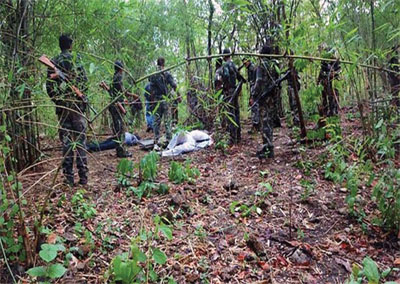
    BHUBANESWAR (TIP): A joint team of Special Operations Group (SOG) and the police shot dead at least 14 Naxals during a joint operation along Odisha-Chhattisgarh borders near Malkangiri district on September 13 night. This is being dubbed the biggest Naxals casualty in Odisha so far. The police have recovered a huge cache of arms and ammunitions during the operation. Earlier on August 23, dreaded Naxal leader Madhav alias Golla Ramullu, who carried Rs. 4 lakh reward on his head, was killed in an encounter with security forces in Odisha’s Malkangiri district. Madhav was involved in many incidents of murder including the killing of 38 security personnel in Chitrakonda reservoir, extortion and land mine blasts.

  • STRIKE A BALANCE BETWEEN GROWTH AND REDISTRIBUTION

    STRIKE A BALANCE BETWEEN GROWTH AND REDISTRIBUTION

    THE National Food Security Bill, just passed by the Rajya Sabha, constitutes a shift from the welfarebased approach to a rights-based approach. It gives a ground to the right holder to claim a defined quantity of food as his legal entitlement, and in case of denial, take recourse to courts for its enforcement. This makes India probably the only country to recognise that ensuring food security to citizens is not only moral and ethical but also a legal imperative as well. The Bill has generated a vociferous debate amongst political classes, economists and industrialists.

    The debate has raised certain valid concerns which need to be addressed to make the right effective such as restructuring of the Public Distribution System (PDS), identifying genuinely those for whom the law is meant and putting measures for ensuring proper and adequate funding with an effective monitoring of the system. In this regard the advocates of the Bill may draw lessons from Tamil Nadu, Andhra Pradesh and Himachal Pradesh, which have been quite efficient in running the PDS, as also from states like Chhattisgarh, Bihar and Orissa, which have seen an enhanced percentage of the population accessing cereals from the PDS along with a reduction in leakages. These states have achieved these results by largely using simple technological fixes such as computerisation, doorstep delivery and a global positioning system to track foodgrain movement and improve transparency in the system. Experience of these states can help in dispelling the notion that the food security proposal is impracticable.

    However, some of the arguments against the move are weak and misplaced. An argument especially made in political circles is about the timing and intention of the government in introducing the Bill after dithering or choosing to wait after four years of promising it. The introduction of the Bill at this stage is seen as a ‘game-changer’ for reaping electoral fortunes and for hoodwinking people and diverting public attention from inconvenient issues. Even if these arguments are assumed valid the question that remains is about their relevance in the working of democratic politics. It is undisputed that winning power is an integral aspect of democratic politics. The fundamental question is what vision, policy choices and priorities and how convincingly does a political party incorporate them in its pursuit for winning power. A piece of legislation that yields political capital can also be pro-people.

    MNREGA is an example that admittedly brought political dividend to the party and it simultaneously gave relief to a vast number of poor people. What matters is the political wisdom and acumen of a political party to assess how people would respond to its policy choices and the timing of its implementation. Another issue raised concerns the Bill’s financial burden. Some have described the Bill as a ‘nightmare’, while others as a ‘money-guzzling measure’. There may be some rationale behind these charges but a realistic assessment by many experts reveals an ‘exaggerated nature of these charges’. India at present spends about 0.9 per cent of its GDP on food subsidies. If the right to food as envisaged is accepted, the cost would rise to 1.25 per cent, entailing only an additional expenditure of 0.35 per cent of the GDP. Calling such a marginal enhancement a ‘nightmare’ or a ‘moneyguzzling’ step does not sound convincing, especially when India’s spending on social welfare entitlements is much lower than other countries in the South Asian region.

    According to the latest report of the Asian Development Bank, India spends only half the average social protection expenditure (as a proportion of the GDP) of what the lower middle income countries in Asia spend. The report gives India a score of 0.051, below most of its South-Asian peers. Enhancing social spending by just 0.35 per cent of the GDP should not cause any nightmares. It is significant to note that almost every political party has extended its support, in principle, to the Bill but at the same time insisted on the acceptance of its amendments as a precondition for the passage of the Bill. These amendments range from proposing the enhancement of the quantity of food entitlement, offering subsidised pulses in addition to wheat and rice, extending the coverage of the Bill from 67 per cent as presently suggested to 75 per cent of the population and some even asking for a universal coverage. Keen to ensure the passage of the Bill, the government has accepted some of the proposed amendments, at least partially if not fully.

    It is widely reported that the government is considering to undo a provision contained in the Ordinance that introduced a cut in the annual allocation of foodgrains in case of 18 states like Tamil Nadu which now will get extra grains (but at the existing APL rate of Rs. 8.30 a kg for rice and Rs.6.10 a kg for wheat). The move will cost an additional Rs 5,000 crore. It is obvious that such actions on the part of the government will put an additional burden on the treasury. What puzzles and hurts a common citizen who believes in and values the importance of parliamentary democracy is the doublespeak and a hypocritical position of various political parties. Should we describe such a development as ‘paradoxes of democracy’ (to sound charitable) or ‘vandalisation of democracy’? On the one side parties are vying with one another to demand that the government should take immediate and serious fiscal and economic decisions, removing policy paralysis to contain the rising fiscal deficient, food price inflation and the steep fall in rupee value; on the other, the same parties are proposing several amendments to the Bill as a precondition for its passage even if the acceptance of these amendments would put an ‘astronomical additional burden on the exchequer’. What is the ‘mystique’ behind parties taking such a ‘self-contradicting’ position? One does not need to guess too much.

    The continuous disruption of Parliament sometimes creates doubts in the mind of the common public about motives of both sides in the game. The attitude of the government equally sounds baffling. While on the one hand we see the government announcing day in and day out one or the other measure claiming them to be aimed at checking the developing economic crisis, restoring the climate of confidence for investment, clearing long-pending mega projects that were hampering the cause of growth; on the other hand it displays a desire to compromise its own economic prudence and principles of effective governance by moving at least 10 amendments to the Bill that incorporate major suggestions of opposition parties and supporting its allies to get the Bill passed. Suggestions contained in most of these amendments were strongly rejected by the same government earlier. If the country is convinced that growth has to be ensured and that it has to be inclusive and that the same should have the common man’s face and that its fruits, instead of remaining confined to the few, must trickle down to the bottom, then the answer lies in striking a balance between growth and redistribution.

  • A PICTORIAL HISTORY OF INDEPENDENT INDIA

    A PICTORIAL HISTORY OF INDEPENDENT INDIA

    A chronology of key events
    India has been home to several ancient civilisations and empires, some dating back to more than 2,000 BC. Culture and religions have flourished over the millennia, and foreign influence has ebbed and flowed. 1947 – End of British rule and partition of sub-continent into mainly Hindu India and Muslim-majority state of Pakistan.

    1947-48 – Hundreds of thousands die in widespread communal bloodshed after partition.
    1948 – Mahatma Gandhi assassinated by Hindu extremist.
    1948 – War with Pakistan over disputed territory of Kashmir.
    1951-52 – Congress Party wins first general elections under leadership of Jawaharlal Nehru. Regional tensions 1962 – India loses brief border war with China.
    1964 – Death of Prime Minister Jawaharlal Nehru.
    1965 – Second war with Pakistan over Kashmir.
    1966 – Nehru’s daughter Indira Gandhi becomes prime minister.
    1971 – Third war with Pakistan over creation of Bangladesh, formerly East Pakistan.
    1971 – Twenty-year treaty of friendship signed with Soviet Union.
    1974 – India explodes first nuclear device in underground test. Democratic strains
    1975 – Indira Gandhi declares state of emergency after being found guilty of electoral malpractice.
    1975-1977 – Nearly 1,000 political opponents imprisoned and programme of compulsory birth control introduced. 1977 – Indira Gandhi’s Congress Party loses general elections. 1980 – Indira Gandhi returns to power heading Congress party splinter group, Congress (Indira).
    1984 – Troops storm Golden Temple – Sikhs’ most holy shrine – to flush out Sikh militants pressing for self-rule.
    1984 – Indira Gandhi assassinated by Sikh bodyguards, following which her son, Rajiv, takes over.
    1984 December – Gas leak at Union Carbide pesticides plant in Bhopal. Thousands are killed immediately, many more subsequently die or are left disabled.
    1987 – India deploys troops for peacekeeping operation in Sri Lanka’s ethnic conflict.
    1989 – Falling public support leads to Congress defeat in general election.
    1990 – Indian troops withdrawn from Sri Lanka.
    1990 – Muslim separatist groups begin campaign of violence in Kashmir.
    1991 – Rajiv Gandhi assassinated by suicide bomber sympathetic to Sri Lanka’s Tamil Tigers.
    1991 – Economic reform programme begun by Prime Minister PV Narasimha Rao.
    1992 – Hindu extremists demolish mosque in Ayodhya, triggering widespread Hindu-Muslim violence. BJP to the fore
    1996 – Congress suffers worst ever electoral defeat as Hindu nationalist BJP emerges as largest single party. 1998 – BJP forms coalition government under Prime Minister Atal Behari Vajpayee.
    1998 – India carries out nuclear tests, leading to widespread international condemnation.
    1999 February – Vajpayee makes historic bus trip to Pakistan to meet Premier Nawaz Sharif and to sign bilateral Lahore peace declaration.
    1999 May – Tension in Kashmir leads to brief war with Pakistan-backed forces in the icy heights around Kargil in Indian-held Kashmir.
    1999 October – Cyclone devastates eastern state of Orissa, leaving at least 10,000 dead.
    2000 May – India marks the birth of its billionth citizen.
    2000 – US President Bill Clinton makes a groundbreaking visit to improve ties.
    2001 January – Massive earthquakes hit the western state of Gujarat, leaving at least 30,000 dead. 2001 April – 16 Indian and three Bangladeshi soldiers are killed in border clashes. A high-powered rocket is launched, propelling India into the club of countries able to fire big satellites deep into space.
    2001 July – Vajpayee meets Pakistani President Pervez Musharraf in the first summit between the two neighbours in more than two years. It ends without a breakthrough because of differences over Kashmir.

    2001 September – US lifts sanctions which it imposed against India and Pakistan after they staged nuclear tests in 1998. The move is seen as a reward for their support for the US-led anti-terror campaign. Kashmir tensions rise
    2001 October – India fires on Pakistani military posts in 1984 – Indira Gandhi assassinated by Sikh bodyguards, following which her son, Rajiv, takes over.

    1984 December – Gas leak at Union Carbide pesticides plant in Bhopal. Thousands are killed immediately, many more subsequently die or are left disabled.
    1987 – India deploys troops for peacekeeping operation in Sri Lanka’s ethnic conflict.
    1989 – Falling public support leads to Congress defeat in general election.
    1990 – Indian troops withdrawn from Sri Lanka.
    1990 – Muslim separatist groups begin campaign of violence in Kashmir.
    1991 – Rajiv Gandhi assassinated by suicide bomber sympathetic to Sri Lanka’s Tamil Tigers.
    1991 – Economic reform programme begun by Prime Minister PV Narasimha Rao.
    1992 – Hindu extremists demolish mosque in Ayodhya, triggering widespread Hindu- Muslim violence. BJP to the fore
    1996 – Congress suffers worst ever electoral defeat as Hindu nationalist BJP emerges as largest single party. 1998 – BJP forms coalition government under Prime Minister Atal Behari Vajpayee.
    1998 – India carries out nuclear tests, leading to widespread international condemnation. 1999 February –

    Vajpayee makes historic bus trip to Pakistan to meet Premier Nawaz Sharif and to sign bilateral Lahore peace declaration.
    1999 May – Tension in Kashmir leads to brief war with Pakistan-backed forces in the icy heights around Kargil in Indian-held Kashmir.
    1999 October – Cyclone devastates eastern state of Orissa, leaving at least 10,000 dead. 2000 May – India marks the birth of its billionth citizen.
    2000 – US President Bill Clinton makes a groundbreaking visit to improve ties. 2001 January – Massive earthquakes hit the western state of Gujarat, leaving at least 30,000 dead.
    2001 April – 16 Indian and three Bangladeshi soldiers are killed in border clashes. A high-powered rocket is launched, propelling India into the club of countries able to fire big satellites deep into space.
    2001 July – Vajpayee meets Pakistani President Pervez Musharraf in the first summit between the two neighbours in more than two years. It ends without a breakthrough because of differences over Kashmir.
    2001 September – US lifts sanctions which it imposed against India and Pakistan after they staged nuclear tests in 1998. The move is seen as a reward for their support for the US-led anti-terror campaign.

    Kashmir tensions rise
    2001 October – India fires on Pakistani military posts in the heaviest firing along the dividing line of control in Kashmir for almost a year.
    2001 December – Suicide squad attacks parliament in New Delhi, killing several police. The five gunmen die in the assault.
    2001 December – India imposes sanctions against Pakistan, to force it to take action against two Kashmir militant groups blamed for the suicide attack on parliament. Pakistan retaliates with similar sanctions, and bans the groups in January.
    2001 December – India, Pakistan mass troops on common border amid mounting fears of a looming war.
    2002 January – India successfully test-fires a nuclear-capable ballistic missile – the Agni – off its eastern coast.
    2002 February – Inter-religious bloodshed breaks out after 59 Hindu pilgrims returning from Ayodhya are killed in a train fire in Godhra, Gujarat. More than 1,000 people, mainly Muslims, die in subsequent violence. Police and officials blamed the fire on a Muslim mob, but a 2005 government investigation said it was an accident. In 2012 a court convicts 32 people over the Naroda Patiya riots in Ahmedabad. 2002 May – Pakistan test-fires three medium-range surface-to-surface Ghauri missiles, which are capable of carrying nuclear warheads.War of words between Indian and Pakistani leaders intensifies. Actual war seems imminent.

    2002 June – UK, US urge their citizens to leave India and Pakistan, while maintaining diplomatic offensive to avert war.
    2002 July – Retired scientist and architect of India’s missile programme APJ Abdul Kalam is elected president.
    2003 August – At least 50 people are killed in two simultaneous bomb blasts in Bombay. Kashmir ceasefire 2003 November – India matches Pakistan’s declaration of a Kashmir ceasefire. 2003 December – India, Pakistan agree to resume direct air links and to allow overflights.
    2004 January – Groundbreaking meeting held between government and moderate Kashmir separatists.
    2004 May – Surprise victory for Congress Party in general elections. Manmohan Singh is sworn in as prime minister.
    2004 September – India, along with Brazil, Germany and Japan, launches an application for a permanent seat on the UN Security Council.

    2005 7 April – Bus services, the first in 60 years, operate between Srinagar in Indianadministered Kashmir and Muzaffarabad in Pakistani-administered Kashmir.
    2006 February – India’s largest-ever rural jobs scheme is launched, aimed at lifting around 60 million families out of poverty. Nuclear deal 2006 March – US and India sign a nuclear agreement during a visit by US President George W Bush.

    The US gives India access to civilian nuclear technology while India agrees to greater scrutiny for its nuclear programme.
    2006 November – Hu Jintao makes the first visit to India by a Chinese president in a decade.
    2006 December – US President George W Bush approves a controversial law allowing India to buy US nuclear reactors and fuel for the first time in 30 years.
    2007 March – Maoist rebels in Chhattisgarh state kill more than 50 policemen in a dawn attack.
    2007 April – India’s first commercial space rocket is launched, carrying an Italian satellite.
    2007 May – At least nine people are killed in a bomb explosion at the main mosque in Hyderabad. Several others are killed in subsequent rioting.
    2007 May – Government announces its strongest economic growth figures for 20 years – 9.4% in the year to March. First woman president 2007 July – Pratibha Patil becomes first woman to be elected president of India. 2008 July – Congress-led coalition survives vote of confidence brought after left-wing parties withdraw their support over controversial nuclear cooperation deal with US. After the vote, several left-wing and regional parties form new alliance to oppose government, saying it has been tainted by corruption. India successfully launches its first mission to the moon, the unmanned lunar probe Chandrayaan-1. Mumbai attacks

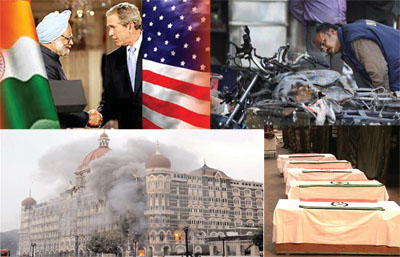
    2008 November – Nearly 200 people are killed and hundreds injured in a series of coordinated attacks by gunmen on the main tourist and business area of India’s financial capital Mumbai. India blames militants from Pakistan for the attacks and demands that Islamabad act against those responsible.
    2009 May – Resounding general election victory gives governing Congress-led alliance of PM Manmohan Singh an enhanced position in parliament, only 11 seats short of an absolute majority.
    2009 December – The government says it will allow a new state, Telangana, to be carved out of part of the southern state of Andhra Pradesh. Violent protests for and against break out.
    2010 May – The solve surviving gunman of the 2008 Mumbai attacks, Ajmal Amir Qasab, is convicted of murder, waging war on India and possessing explosives. 2010 June – A court in Bhopal sentences eight Indians to two years each in jail for “death by negligence” over the 1984 Union Carbide gas plant leak. Thousands died in this, the world’s worst industrial accident.
    Ayodha ruling 2010 September – Allahabad High Court rules that disputed holy site of Ayodhya should be divided between Hindus and Muslims; the destruction of a mosque on the site by Hindu extremists in 1992 led to rioting in which about 2,000 people died.
    2011 March – Results of 2011 census put India’s population at 1.21bn, an increase of 181 million over ten years.
    2011 August – Prominent social activist Anna Hazare stages 12-day hunger strike in Delhi in protest at state corruption.
    2011 November – Fourteen people including a government minister go on trial in one of India’s biggest ever corruption scandals – a telecoms deal alleged to have involved the selling of mobile phone licenses at knock-down prices in exchange for bribes.
    2012 May – Manmohan Singh pays first official visit to Burma by an Indian prime minister since 1987. He signs agreements aimed at providing border area development and an Indian credit line. 2012 June – Police in Delhi arrest a key figure allegedly involved in planning the 2008 Mumbai attacks. They say Abu Hamza, also known as Syed Zabiuddin, was the “handler” of the 10 gunmen. 2012 July – Pranab Mukherjee from the ruling Congress party is elected as president, comfortably beating his rival P.A. Sangma.

    2012 August – Court convicts 32 people over the 2002 religious riots in Gujarat and acquits 29 others. Among those convicted in the Naroda Patiya killings in Ahmedabad are former state minister Maya Kodnani and Babu Bajrangi, a former leader of the militant Hindu group Bajrang Dal.

    2012 December – The rape and murder of a young woman in Delhi triggers nationwide protests and a debate about sexual violence.
    2013 February – Two explosions in crowded Dilsukhnagar area of central Hyderabad kill 16 people. Police suspect the Indian Mujahideen Islamist armed group.
    2013 March – Five policemen are killed in a militant assault in Indian-administered Kashmir – the first major attack in the region in three years
    2013 August – In a deadly instance of firing on Indian Army troops on the Line of Control from Pakistan-occupied Kashmir, five Indian soldiers died in Poonch sector in Jammu and Kashmir.

  • AGRICULTURE AND RURAL DEVELOPMENT IN INDIA SINCE 1947

    AGRICULTURE AND RURAL DEVELOPMENT IN INDIA SINCE 1947

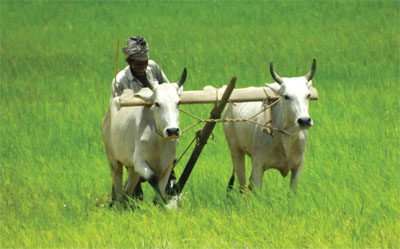
    Agriculture is the dominant sector of Indian economy, which determines the growth and sustainability. About 65 per cent of the population still relies on agriculture for employment and livelihood. India is the first in the world in the production of milk, pulses, jute and jute-like fibres; second in rice, wheat, sugarcane, groundnut, vegetables, fruits and cotton production; and is a leading producer of spices and plantation crops as well as livestock, fisheries and poultry.

    In the past few years, Indian agriculture has done remarkably well in terms of output growth. The 11th Five Year Plan (2007-12) witnessed an average annual growth of 3.6 per cent in the gross domestic product (GDP) from agriculture and allied sector. The growth target for agriculture in the 12th Five Year Plan is estimated to be 4 per cent. Indian agriculture is benefitting huge from rising external demand and the sector’s wider participation in the global economy.

    In order to boost investments in the sector, the Government of India has allowed 100 per cent foreign direct investment (FDI) under automatic route in storage and warehousing including cold storages. The government has also allowed 100 per cent FDI under the automatic route for the development of seeds. Department of Agriculture and Cooperation under the Ministry of Agriculture is the nodal organisation responsible for development of the agriculture sector in India.

    The organisation is responsible for formulation and implementation of national policies and programmes aimed at achieving rapid agricultural growth through optimum utilisation of land, water, soil and plant resources of the country. arket Dynamics Backed by policy impetus by the Government of India, the country ranks 10th in global agricultural and food exports, as per Economic Survey 2012-13. Agriculture accounts for about 10 per cent of the total export earnings and provides raw material to a large number of industries.

    “Exports of agricultural products are expected to cross US$ 22 billion mark by 2014 and account for 5 per cent of the world’s agriculture exports,” according to the Agricultural and Processed Food Products Export Development Authority (APEDA). Total exports of Indian agri and processed food products from April 2012 to February 2013 stood at Rs 11,254,275.51 lakh (US$ 20.74 billion) as compared to Rs 7,186,784.33 lakh (US$ 13.24 billion) during the same period last year, according to the data provided by APEDA.

    As of March 1, 2013, India has wheat stocks of around 27.1 million tonnes (MT), as against a requirement of mere 7 MT, while total food grains stocks in the central pool (including rice) is estimated to be almost 63 MT, as against a requirement of 21.2 MT. Wheat exports from India are expected to grow by 23 per cent to 8 MT in the financial year 2013-14, on the back of strong global prices and surplus domestic supply. Exports of rice are also expected to cross 10 MT from 7.3 MT during previous year due to robust demand from West Asia, Africa and South-East Asian countries.

    Major Developments and Investments The total planned expenditure for the Ministry of Agriculture has increased considerably to Rs 27,049 crore (US$ 4.98 billion) in the Union Budget 2013-14. The outlay is 22 per cent over the revised estimates of the year 2012-13. Further, the amount of Rs 1,000 crore (US$ 184.32 million) has been allocated to continue support to the new green revolution in Eastern States like Assam, Bihar, Chhattisgarh and West Bengal to increase the rice production.

    An outlay of Rs 500 crore (US$ 92.17 million) is also proposed for starting a programme of crop diversification that would promote technological innovation and encourage farmers to choose crop alternatives in the original green revolution States. Under the Rashtriya Krishi Vikas Yojana, an outlay of Rs 9954 crore (US$ 1.83 billion) and Rs 2250 crore (US$ 414.64 million) have been proposed for mobilizing higher investment in agriculture and the National Food Security Mission respectively.

    A memorandum of understanding (MoU) has been signed between Indian Council of Agricultural Research (ICAR) and Ramakrishna Mission Vivekananda University (RKMVU) for establishment of 632nd Krishi Vigyan Kendra (KVK) in South 24 Parganas district,West Bengal. The ICAR and the World Bank have been implementing a joint National Agricultural Innovation Project (NAIP) in the country to accelerate the collaborative development and application of agricultural innovations.

    Till date, an amount of Rs 727.93 crore (US$ 134.13 million) has been released by the World Bank for the project. The Chennai based Indian Overseas Bank (IOB) keeping its thrust on agricultural lending under priority sector area has proposed to open 15 special agricultural credit branches in Karnataka and Maharashtra. The bank intends to lend about Rs 500 crore (US$ 92.17 million) through these branches.

    Government Initiatives Some of the major initiatives taken by the Government of India are: The Union cabinet has approved the proposal of the department of agricultural research and education under the Ministry of Agriculture for the establishment of the National Institute of Biotic Stress Management (NIBSM) at Raipur, Chhattisgarh during the 12th Five Year Plan at an estimated cost of Rs 121.10 crore (US$ 22.31 million).

    The institute will address the impact of biotic stress and harness potentials of emerging tools of biotechnology in agriculture To provide relief to small and marginal farmers especially in drought prone and ecologically-stressed regions, the allocation for the Integrated Watershed Programme has been increased to Rs 5387 crore (US$ 992.79 million) from Rs 3050 crore (US$ 562.12 million) The National Livestock Mission will be launched in 2013-14 to attract investment and to enhance productivity of livestock, taking into account local agro-climatic conditions.

    Rs 307 crore (US$ 56.58 million) have been provided for the Mission In addition, Government has substantially improved the availability of farm credit and increased minimum Support Price to improve investment in the farm sector. The annual agriculture credit target for the financial year 2013-14 has been fixed at Rs 7,00,000 crore (US$ 128.98 billion) against the target of Rs 5,75,000 crore (US$ 105.95 billion) in 2012-13 The Government of India plans to set up a Regional Rural Bank (RRB) Credit Refinance Fund with a capital of US$ 2.1 billion to disburse short term crop loans to small and marginal farmers Road Ahead The Indian agriculture sector is now moving towards another green revolution.

    The transformations in the sector are being induced by factors like newfound interest of the organised sector, new and improved technologies, mechanised farming, rapid growth of contract farming, easy credit facilities, etc. The Ministry of Agriculture is promoting a new strategy for farm mechanization through its various schemes and programmes.

    A dedicated Sub-Mission on Agricultural Mechanization has been proposed for the 12th Plan which includes custom-hiring facilities for agricultural machinery as one of its major components. In the 12th Five Year Plan, the Government intends to increase the share of expenditure on agricultural research and development (R&D). The Government will focus on strengthening the Agricultural Technology Management Agencies (ATMA) concept through improved integration with Krishi Vikas Kendras (KVKs).

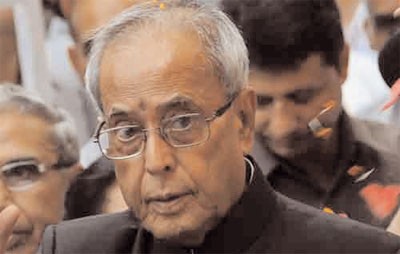
  • President Pranab Mukherjee Addresses The Nation

    President Pranab Mukherjee Addresses The Nation

    In his address to the nation on the eve of 67th Independence Day, President Pranab Mukherjee expressed serious concern over the way Parliament and legislatures function and said corruption has become a major challenge. Noting the “widespread cynicism and disillusionment” with governance and functioning of institutions, the President said elections next year is an opportunity to elect a stable government that will ensure security and economic development.

    Following is the text of the President of India, Shri Pranab Mukherjee’s address to the Nation on the eve of the 67th Independence Day: “Fellow citizens: On the eve of the 66th anniversary of our Independence, I extend warm greetings to you and to all Indians around the world. My thoughts turn first towards the Father of our Nation, Mahatma Gandhi, who shaped our liberation struggle and the martyrs who made supreme sacrifice for the freedom of our country and great patriots whose relentless struggle liberated our motherland from the colonial rule of nearly two hundred years.

    Gandhiji sought freedom from both foreign rule as well as the indigenous social chains that had imprisoned our society for long. He launched every Indian on a path of selfbelief and hope for a better future. Gandhiji promised Swaraj- self-rule based on tolerance and self-restraint. He promised freedom from want and deprivation. For nearly seven decades now we have been masters of our destiny.

    This is then the moment to ask: are we heading in the right direction? Gandhiji’s vision cannot be turned into reality if we spurn the very values that were compulsory to his cause: sincerity of effort, honesty of purpose and sacrifice for the larger good. Our founding fathers created the first oasis in the desert of a colonized world nourished by democracy.

    Democracy is much more than the right to vote every five years; its essence is the aspirations of the masses; its spirit must influence the responsibilities of the leaders and duties of the citizens every day. Democracy breathes through a vibrant Parliament, an independent judiciary, a responsible media, a vigilant civil society, and a bureaucracy committed to integrity and hard work. It survives through accountability, not profligacy. And yet we have allowed unbridled personal enrichment, selfindulgence, intolerance, discourtesy in behavior and disrespect for authority to erode our work culture.

    The biggest impact of the decay in the moral fiber of our society is on the hopes and aspirations of the young and the poor. Mahatma Gandhi had advised us to avoid, and I quote, “politics without principles, wealth without work, pleasure without conscience, knowledge without character, commerce without morality, science without humanity, and worship without sacrifice”, (unquote). We have to pay heed to his advice as we work towards building a modern democracy.

    The ideals of patriotism, compassion, tolerance, selfrestraint, honesty, discipline and respect for women have to be converted into a living force. Fellow citizens: Institutions are a mirror of national character. Today we see widespread cynicism and disillusionment with the governance and functioning of institutions in our country. Our legislatures look more like combat arenas, rather than fora that legislate. Corruption has become a major challenge.

    The precious resources of the nation are being wasted through indolence and indifference. It is sapping the dynamism of our society. We need to correct this regression. Our Constitution provides a delicate balance of power between various institutions of the State. This balance has to be maintained. We need a Parliament that debates, discusses and decides. We need a judiciary that gives justice without delays. We need leadership that is committed to the nation and those values that made us a great civilization.

    We need a state that inspires confidence among people in its ability to surmount challenges before us. We need a media and citizens who, even as they claim their rights, are equally committed to their responsibilities. Fellow citizens: A re-ordering of the society can be brought about through the educational system. We cannot aspire to be a world class power without a single world class university. History records that we were the cynosure of the world once.

    Takshashila, Nalanda, Vikramashila, Valabhi, Somapura and Odantapuri comprised the ancient university system that dominated the world for eighteen hundred years beginning Sixth Century BC. They were a magnet for the finest minds and scholars in the world. We must seek to regain that space. A university is the banyan tree whose roots lie in basic education, in a vast network of schools that build the intellectual prowess of our communities; we have to invest in every part of this knowledge tree, from seed, root and branch to the highest leaf.

    Fellow Citizens: There is a direct relationship between a successful democracy and a successful economy, for we are a people-driven nation. People serve their interests best when they participate in decision- making at the level of panchayat and other forms of local government. We have to rapidly empower the local bodies with functions, functionaries and finances to improve their performance. Faster growth has given us the resources, but larger outlays have not translated into better outcomes. Without inclusive governance, we cannot achieve inclusive growth.

    For a developing country of more than 1.2 billion people, the debate between growth and redistribution is vital. While growth builds the scope for redistribution, redistribution sustains growth over time. Both are equally important. A disproportionate emphasis on any one, at the expense of the other, can have adverse consequences for the nation. Fellow citizens: At the dawn of our Independence, we lit the glowing lamp of modernity and equitable economic growth.

    To keep this lamp aflame, our highest priority has to be the elimination of poverty. Though a declining trend in the poverty rate is clearly visible, our fight against this scourge is far from over. India has the talent, ability and the resources to overcome this challenge. Reforms that have enabled us to come this far have to be pursued at all levels of governance. Favorable demographic changes over the next two decades can pay us handsome dividends.

    It requires industrial transformation and rapid creation of employment opportunities. It also requires an orderly urbanization process. Several initiatives taken by the Government in the recent past including the New Manufacturing Policy, the renewal of urban infrastructure and the ambitious skill training programme will need close monitoring in the coming years. We have given our citizens entitlements backed by legal guarantees in terms of right to employment, education, food and information.

    We now have to ensure that these entitlements lead to real empowerment for the people. We need robust delivery mechanisms to make these legislations work. New benchmarks of efficient public service delivery and accountability have to be established. The Direct Benefits Transfer Scheme, launched earlier this year, will bring in greater transparency, enhance efficiency and eliminate wastage of precious resources. Fellow citizens: 13. In our race for development, we must be careful not to disturb the balance between man and nature. The consequences of such imbalance can be disastrous.

    My heartfelt condolences to the many who lost their lives, and the innumerable who suffered in Uttarakhand; and my salutations to those brave personnel of our security and armed forces, government and NGOs who did so much to alleviate suffering. This tragedy owes as much to the avarice of human nature as to the rage of Mother Nature. This was nature’s wake-up call. And it is time to wake up. Fellow citizens: We have seen in the recent past grave challenges to our security, internal as well as external. The barbaric face of Maoist violence in Chhattisgarh led to a loss of many innocent lives.

    Despite India’s consistent efforts to build friendly relations with neighbours, there have been tensions on the border and repeated violations of the Ceasefire on the Line of Control, leading to tragic loss of lives. Our commitment to peace is unfailing but even our patience has limits. All steps necessary to ensure internal security and protect the territorial integrity of the nation will be taken. I applaud the courage and heroism of our security and armed forces who maintain eternal vigilance and pay homage to those who have made the supreme sacrifice of the most precious gift of life in the service of the motherland.

    There will be a general election in our country before I have the privilege of addressing you again on the eve of our next independence day. This great festival of democracy, is an opportunity for us to elect a stable government which will ensure security and economic development. Every election must become a crucial milestone in our nation’s journey towards greater social harmony, peace and prosperity.

    Let me conclude by quoting from the great classic Bhagvad Gita where the Teacher propounds his views and then says, and I quote, “ÿatha icchasi tatha kuru” “even as you choose, so you do. I do not wish to impose my views on you. I have presented to you what I think is right. Now it is for your conscience, for your judgment, for your mind to decide what is right.” (unquote) On your decisions rests the future of our democracy.

  • NCP Supports Demand For Vidarbha , Suggests States Reorganization Commission Be Set Up

    NCP Supports Demand For Vidarbha , Suggests States Reorganization Commission Be Set Up

    NEW DELHI (TIP): A day after the historical decision to carve out Telangana as a separate state from Andhra Pradesh, National Congress Party (NCP) leader Praful Patel said his party supported the formation of Vidarbha so long as the people want it. e also suggested that a states reorganization commission is set up to address the rising demands for new states in the country. “As far as Vidarbha is concerned, it has been a long-pending demand for statehood. There have been, in the 1950’s and 1960’s, big agitations for Vidarbha.

    I am sure people were waiting to see what will happen to Telangana. Now that this decision has been taken, as NCP, I can say we are fully in support of the demand so long as the people of Vidarbha are keen to have it—that has been our stand not only now but even earlier and we stand by it,” Patel said. “I represent Vidarbha. My stance and my party’s stance has been very clear—If the people want, we will support,” Patel added. Commenting on the increasing number of demands for new states, Patel said that they should be considered. “I think such kind of demands will come and have been coming in the past from many regions in the country.

    So, it would not be a bad idea to have a second states reorganization commission set up to look at all these issues,” Patel suggested here. Noting that in the past smaller states have led to development in those regions, Patel said “There is no issue of states being big or small. The question is whether they are justified and viable and I think the states reorganization commission will look into it.” Patel’s remarks come after Congress Member of Parliament Vilas Muttemwar revived the demand to carve out Vidarbha from Maharashtra.

    “The demand of statehood for Vidarbha is stronger and older than Telangana,’ said Muttemwar, who is also a member of the Congress Working Committee (CWC) that finalised the decision to carve out Telangana from Andhra Pradesh. Vidarbha is the eastern region of Maharashtra and is made up of the Nagpur Division and the Amravati Division. Its former name is Berar. It occupies 31.6 percent of total area and holds 21.3 percent of total population of Maharashtra. It borders the state of Madhya Pradesh to the north, Chhattisgarh to the east, Andhra Pradesh to the south and Marathwada and Khandesh regions of Maharashtra to the west.

  • OFBJP Organizes Public Reception For BJP President Rajnath Singh

    OFBJP Organizes Public Reception For BJP President Rajnath Singh

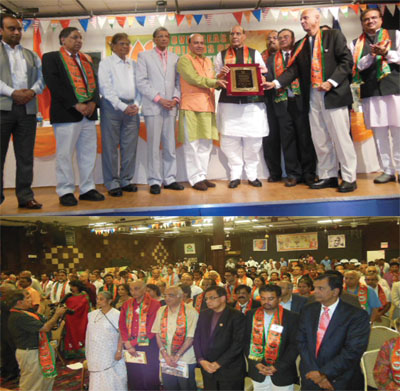
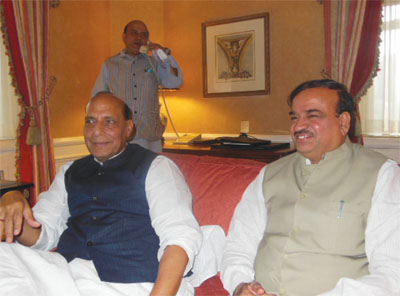
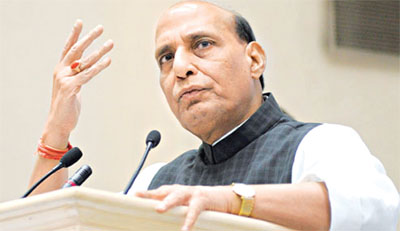
    EDISON, NJ (TIP): Indian American community of tri-state area (New Jersey, New York, and Connecticut) gave a rousing welcome to Rajnath Singh, President of Bharatiya Janata Party (BJP) and his BJP delegation Ananth Kumar, General Secretary; Sudhanshu Trivedi, National Spokesperson; and Vijay Jolly, Convener of Overseas Affairs and Overseas Friends of BJP (OFBJP) in TV Asia Studio Auditorium at Edison, NJ on Sunday July 21, 2013. The program was organized by OFBJP-USA as part of its community global outreach program.

    The program was broadcasted live on TV Asia across US reaching out to 1.5 million viewers. The program was also relayed live in India, Canada, UK, Europe and Middle East thru various channels. Addressing the jam-packed auditorium, Rajnath Singh said that he was elated by the warm welcome that had been accorded to him by the Indian Americans here in US. He said that trust and credibility have become a big problem in India and BJP is the only option. No party in India has grown bigger than Congress except the BJP.

    BJP is the only party that has not suffered a vertical split. Communists have lost relevance and Congress has no policy on any of the issues nor has any ideology. Since its inception in 1951 as Bharatiya Jan Sangh and later on as BJP, the party has been pursuing a policy of Nation first. He continued that Atal Behari Vajpayee led a 24 party coalition for 6 years and the NDA rule was far better than 55 years of Congress rule in every aspect.

    Corruption, Inflation and price rise are the signature of congress rule whereas NDA government controlled the inflation and price rise in spite of the prevailing severe drought and economic sanctions imposed by the entire West after Pokhran nuclear tests. NDA inherited a GDP growth of 4.8% and 10% inflation whereas BJP handed UPA a GDP of 8.4% and inflation 3.5% in 2004. Amidst applause from the audience he said that Pokhran test was a big step wherein the BJP led govt made India a nuclear power even though we knew economic sanctions were staring at us.

    Countries that are much smaller have become developed countries but India is still a backward country and not sure why 55 years of Congress rule did not change much. Congress has to answer as to how much time they need to make India better, to remove poverty. BJP invited FDI in telecom sector but encouraged Indian investors whereas Congress has opened up the telecom sector 100%, increased in the LIC sector from 26% to 49%. Foreign investors have pulled out $7.5 billion from India and no one is ready to invest.

    Even after 60 years of Independence we still have 67% of people who don’t get food and we need a food security bill. We need leaders with firm conviction and leaders with vision and when we come in power we will make India a super economic power in 10-15 years. National Highway development has seen tremendous growth during NDA rule. 50% of the highways that were built during 1980-2012 happened during 6 years of NDA rule and the other 50% were built during 26 years of non-BJP rule.

    Gujarat development has become a role model across the world. Madhya Pradesh agricultural growth (19%) is the highest in the world and very soon will be providing 24hrs of power supply. Chhattisgarh PDS system serves 90% of the population without any corruption and is a model for other states to emulate. Goa is the only state in India where Petrol is cheaper than Diesel. India has a GDP growth of 4.8% whereas BJP ruled states have 10% GDP growth. UPA government has no plan to tackle Naxalism or terrorism.

    Appeasement has become the state policy whereas BJP never links terrorism to any religion, caste or region. After Mumbai terror attack, Prime Minister made a statement that he will not talk to Pakistan until it gives an assurance that they will control terror activities and not support any groups that work against India but changed all that in a matter of few months. Our foreign policy is at its worst with no friendly neighbors around us. During NDA rule we maintained good relations with Russia and development excellent relations with US.

    We made US our strategic partner. He appealed to the US govt to lift the ban on visa to Narendra Modi, he said on one side US agencies rate Gujarat as the best state and Modiji as an excellent administrator and on the other hand they deny visa to him. It will be better if US takes a decision soon as they will be forced to take a decision anyway later. When BJP comes to power we will make India a power of Rishi and Krishi (knowledge and Prosperity), he said. Indian culture influenced the world for thousands of years.

    We never planned to dominate the world and even Swami Vivekananda came to Chicago on his own and had great influence on the world by his teachings. Citing the example of Newsweek columnist Lisa Miller who stated that by imbibing Yoga, Pranayam, Ayurveda and Organic farming people in the West are becoming Hindus whereas it is a crime in India if you say you are a Hindu.Talking on the recent controversy related to Narendra Modi statement that he is a Hindu and Nationalist, media created and pseudo secularists made a big fuss.

    Professing your Hindu culture became a communal word in India. He said that as per the Supreme Court, Hindutva is a way of a life. Hindutva teaches love not only for human beings but even for animals, plants, rivers, mountains etc. It is Hindutva that teaches us to serve milk to a snake and take care of animals like ants and birds. He called on the Indian American Community to support BJP to build a strong India.

    Shri Rajnath Singh was accorded standing ovation. Shri Rajnath Singh was honored by the OFBJP executive committee with a plaque for his contributions to the party and the country. Earlier, Ram Rakshpal Sood (Sr.Advisor, OFBJP) acting as the Emcee welcomed the audience, chief guests and the sponsors of the event. After the traditional lamp lighting ceremony amidst the chanting of Vedic mantras by Pandit Pravin Shastri and Chandrakant Trivedi and blowing of conch shell by Pravin Shashtri. Mrs. Vidya Labroo led the rendition of Vandemataram.

    Jayesh Patel (President, OFBJP) welcomed the distinguished guests and said that entire India is chanting Narendra Modi (NaMo) mantra and expressed hope that BJP will be able to get majority on its own merit in the next election. Ram Kamath (General Secretary, OFBJP) introduced Dr. Mahesh Mehta, National Coordinator of OFBJP-USA. Speaking on the occasion, Dr. Mehta said that mission 2014 is about transforming India into a global leader and Global Indians should contribute to be the part of this great movement that will eventually contribute to the development of India.

    Dr. Adapa Prasad (Immediate Past President) introduced Vijay Jolly, Convener of BJP Overseas Affairs and OFBJP, as a dynamic leader and former MLA who took on Delhi Chief Minister during the last election.

    In his electrifying speech, Vijay Jolly urged the audience to applaud for Rajnath Singh for honoring the feelings of the people by making NaMo as the chairman of the campaign committee. Stressing the fact the OFBJP is on a mission to develop leaders by inducting youth into the organization to dethrone the corrupt Congress regime in India. Stating that NRI’s have always made India proud, he said that OFBJP has setup its chapters in UK, Norway, Nepal, Kenya and other countries to work for the welfare of Indian diaspora.

    He got the past Presidents of OFBJP-USA honored by Rajnath Singh Introducing SudhanshuTrivedi, BJP National Spokesperson, Dr. Dinesh Agrawal (Former- President, OFBJP) said that as the national spokesperson, he is very active effective on TV channels spreading the message and its ideology of BJP. SudhanshuTrivedi reminded that July 21st the day of the program is a historical day when US astronauts landed on the moon. Edison town, the venue of the program, is also a historical town, named after the inventor of light bulb.

    Hence, he said that word Bharat stands for light and inspires us to take India to the pinnacle of glory. Stating that BJP is all set to form the next government is not based on hope but on facts. He concluded reciting a poem by A.B. Vajpayee. R.P. Singh (Org. Secretary, OFBJP) introduced Ananth Kumar, BJP general Secretary. Amidst thunderous applaud from the audience, Shri Ananth Kumar introduced himself as the Hanuman of South as Kishkinda, the birth place of Lord Hanuman is in Karnataka whereas Rajnath Singh is from U.P, the land of Ram. For Ram’s team to win we need Hanuman and he is there to lend services for the party and the country.

    India, he said is going through turbulent times and like A.B. Vajpayee model, we have Gujarat model of development under NaMo leadership and we will soon have NaMo model of governance. He said that BJP is already in battle mode, under NaMo and Rajnath Singh’s leadership we are all set to take on the corrupt congress government. Once in power, BJP will make India a global player not only in spirituality but in culture, strategic matters and will be a decisive player in the world. He urged the NRI’s to connect with their districts back home and work for BJP’s victory in 2014.

    Chandrakanth Patel introduced Rajnath Singh as a man of impeccable image in spite of being in political life for 40+ years. Born in a farmer’s family in Varanasi, he rose to be the president of BJYM. He was part of the J.P movement and became the Agricultural minister in A.B. Vajpayee’s government. He was the President of BJP between 2007-2009 and again became the President in January, 2013.

    Currently, he is a Member of Parliament from Ghaziabad, U.P. Earlier, the President of TV Asia and a well known community leader, Shri H.R.Shah addressed the gathering and said that TV Asia always supported India causes and he has been an admirer of Mahatma Gnadhi and Sardar Patel. He said he felt close to BJP principles and supported BJP. He wished that Narendra Modi would be elected as the Prime Minister. Krishna Reddy (Treasurer, OFBJP) presented the vote of Thanks.

  • Not In The Race For Prime Minister : RAJNATH SINGH

    Not In The Race For Prime Minister : RAJNATH SINGH

    NEW YORK (TIP): The Bharatiya Janata Party President Rajnath Singh on Saturday, July 20, categorically denied that he is in the race for Prime Minister of India if BJP returns to power at the Center. “I am more interested in getting the BJP back into power in Center and packing off the corruption-ridden bad governance of the Congress in my tenure as President of the party,” he said addressing a news conference of Indian-American media at Hotel Waldorf Astoria in Manhattan.

    On the question of party president not being projected as Prime Ministerial candidate in the Lok Sabha elections, he said it is not necessary that the two positions be placed in the hands of one person. “It’s not necessary that party president should also be a crowd puller and a prime ministerial candidate. I have an assignment to do for my party. I have a job to deliver – that is victory of the party in the 2014 elections.”

    “Seven months before the elections, I have nominated Gujarat Chief Minister Narendra Modi as chairman of the party campaign committee. What is unusual in that? We have nominated Modi like other parties do and why read between lines. I have named him as campaign head in view of his image, popularity and commitment to the party,” he said. He said Modi is certainly the most popular and the tallest leader of India.

    He is a crowd puller not only in Gujarat but also in Tamil Nadu, Andhra Pradesh, Uttar Pradesh and Bihar – from North to South, East to West. He is one single leader with a national appeal. His popularity will help the party in the elections. On the issue of visa rejection issue of Narendra Modi, he said he would take up the issue with the US lawmakers in Washington.

    “I will appeal to the US government to clear the US visa to the Gujarat Chief Minister.” People of India have now realized that BJP is the only solution after comparing the performance-oriented BJP led NDA Government and corruption-ridden inefficient Congress UPA dispensation, he said. The performances of several BJP-ruled states like Gujarat, Madhya Pradesh, Chhattisgarh are there for the people to see and if these states can provide 24 hour power supply, clean and efficient government, fillip to industries compared to poor performance of many Congressruled State governments what would people prefer? People have made up their mind, he said.

    Detailing steps taken by the BJP to face the national elections in 2014, he said the party had brought changes in organizational level by forming polling booth committees in every booth. “We have formed a committee consisting of 10 to 15 party men at grassroots level to strengthen the organization at village level,” he said Congress ruled for 10 long years at national level and what are their achievements other than wholesale corruption and compromise in national and international security, he asked.

    Indian voters are now realized that when the Center can’t guarantee growth rate of five percent or less, the growth rate in Gujarat, Madhya Pradesh and Chhattisgarh are approximately 10 percent. No one can fool Indian voters any more, he said. On the recent debacle of the party in Karnataka and setbacks in other states, the BJP President said assembly elections and municipal elections are different from parliament elections where people vote for a stable government.

    Voters are intelligent enough to compare the two governments and Congress will be out of power soon. They have ruled for 10 long years and now its time to give them rest, he said “We are confident that the failure of the Congress government will help BJP return to power in the center. Any political party that aspires to come to power should give good governance and satisfy the needs of the people.

    If they fail in this front, they will be out of power.” There is wholesale failure on economic front, compromise on internal and external security and diplomatic fronts as well. People are demanding a change very badly. If people want any change, the only choice is BJP who can provide an alternative to this government, he said. On allies deserting the party, he said BJP will try to get a clear majority in Lok Sabha polls but at the same time will not forget its allies – old and new.

    “Despite a clear majority in sight, we want our allies to participate in the government at the center. Now we have Shiv Sena and Shiromani Akali Dal and may get some nearer to the elections. There is also a possibility of post poll alliance with like minded parties if there is a need,” he said. In the coming Lok Sabha elections, Congress will be routed in Andhra Pradesh due to its ambiguity on Telengana issue.

    The BJP is the only national party that favors separate Telengana and it was passed as a resolution in our national executive committee meeting, he said. There is no ambiguity in the BJP unlike the Congress camp in the matter and BJP is in favor of Telengana. But it’s not in favor of bifurcation of UP and other states as Telengana issue is a totally different one. On the question of poll promises, he said BJP would rather go in for developmental debate than Ram Janma Bhoomi issue. “Ram temple was not a major poll issue anytime.

    It was at best a national issue but not an election issue,” he added. BJP government will consider instituting an inquiry commission to go into the corruption and scandals of the Congress government and will provide transparent and honest government with people’s interest as uppermost, he said. Ananth Kumar, party general secretary and chairman of Parliamentary Foreign Affairs Committee who is accompanying Rajnath Singh on the US tour, said the four member BJP delegation will meet members of the US Senate and House Representatives from both sides of the aisle – Democratic Party and the Republicans especially members of the Congressional Caucus of Indians and Indian Americans at the Capitol Hill.

    Ananth Kumar said Rajnath’s visit to the US is a two track outreach program – to outreach the Indian Diaspora to assess the mood of three million Indian-Americans across the nation who occupy important and powerful positions besides being opinion makers; and to meet with India Caucus Congressmen to impress on them that a change is sweeping in India on the heels of Lok Sabha elections.

    The other two members of the delegation are Dr. Sudhanshu Trivedi, party spokesman and advisor to the BJP President and Vijay Jolly, BJP national convener for Overseas Affairs and a former Delhi MLA. Jolly said the visit was to re-connect the Party President with the Indian-American Diaspora that plays a leading role in fostering friendship between the two countries. “We want to work closely with Non Resident Indians.” BJP – both as a government and party – will work with mainstream American and Indian-American business community on economic and investment matters.

    clearly is of the view that India and the US have a close correlation in internal and external security and they are strategic partners being natural allies, he said. Jolly said the Overseas Friends of BJP in the US has over 7000 members across the US and project a positive image of the party among Indian-Americans and policy makers. The Foreign Affairs Committee of the party will address the concerns of Indian Diaspora and include in them in the BJP parivar by assigning a major role in the ensuing elections.

    Rajnath Singh said it was NDA government under Vajpayee that gave voting rights to Non-Resident Indians and introduced Overseas Citizens Card (OCI) and Persons of Indian Origin (PIO) card. It was under Vajpayee’s leadership that the first Pravasi Bharatiya Divas was held in 2003 in New Delhi to bring all the Non- Resident and Diaspora Indians to work for the welfare of India. “All these were made possible due to the visionary leadership of Vajpayee and only the BJP has done a lot for NRIs and PIOs.”

    On the spate of killing of Hindu and BJP leaders in Tamil Nadu, he said he would appeal to Tamil Nadu Chief Minister to give protection to party leaders. “I appeal to Jayalalithaa to help stop the killing of Hindu and BJP leaders in Tamil Nadu. We will try to build pressure on state government so that it takes it seriously to put an end to such killings.”

  • BJP Has Sound Plans To Jumpstart The Stalled Indian Economy- Rajnath Singh

    BJP Has Sound Plans To Jumpstart The Stalled Indian Economy- Rajnath Singh

    NEW YORK, NY (TIP): “The BJP-led NDA government created 67 million jobs in less than five years whereas the Congress led UPA created less than 2.7 million jobs between 2004 and 2009. These figures are from the data collected by the federal government controlled agencies and not a figment of imagination”, Rajnath Singh said.

    He was speaking on what BJP will do to jumpstart the stalled Indian economy at a function organized by India-America Chamber of Commerce, July 25. Rajnath Singh who was in Washington for three days said he had discussions with the Congressmen and administration officials on the issue of difficulties faced by candidates in H1B and L1 visa to work legally in the US. The GDP cost burden will go up by 0.3 to 0.4 percent due to increase in fees.

    “We had lodged our protest against the comprehensive immigration reforms bill and they had raised the issue of patents and compulsory drug license issues. There was only one case under these CDL whereas Indonesia had six cases and Canada four cases,” he added. The US would do well to share its latest technology on green energy with nations such as India so that it can benefit the humanity. Once these inventions are ashared, they would help us more in a very rapid manner, he said.

    The BJP government will strengthen the village economy as over 70 percent of the people live in rural areas. We will do our best to stop urbanization and create more jobs in the rural areas as was done in the previous NDA government under the PURA scheme. More than 55 percent of the jobs for youth are in rural areas and there is a need to strengthen this sector. Turning to climate change, the BJP leader said while US that has been preaching, has a carbon emission rate of 20 ton per capita per annum, India has only 1.5 per ton per capita per annum.

    The global average is only 4.5 ton per capita per annum. You now decide who is on the right side and who is not. Addressing the members of the India- America Chamber of Commerce in Manhattan, he said India is now facing a serious financial crisis of grave magnitude despite the fact that no one in the global economy can ignore India. The economy of India is not something that makes us feel comfortable or feel proud of.

    But India was regarded as third largest economy of the world, he said. When the NDA government led by Atal Behari Vajpayee stepped down in 2004, the fiscal deficit was 2.5 percent and current account deficit was surplus. The revenue deficit was less than one percent. The economy witnessed a boom period during 1999 to 2004 when the country was ruled by the NDA and the slide started in 2004. “The boom that we created lasted till 2008 and then we are now witnessing is one of the worse economic downturns,” Singh said.

    “When I mentioned to the Speaker of the House yesterday at Washington that we had a surplus current account when we left power, he was surprised. There was a revenue deficit that went up from 4.5 percent to 6 percent in 2008. The current account of deficit shot to 6 percent. We passed the fiscal responsibility bill in the parliament and hence were able to bring some fiscal discipline.

    Inflation is now hovering around 7.7 percent,” he said. The rupee value has depreciated drastically to the US dollar from Rs 37 a dollar in 2008 to Rs 60 in 2013 almost doubling in five years. We thought this would be offset by increase in exports and that also did not happen; it went up by just one percent. It’s very unfortunate that savings that have been the biggest strength of India as it provided capital is now falling at a very rapid rate.

    The small businesses tend to grow with the increase in savings and in the absence they take a major hit. Savings drop and growth rates drop and what else to drop. The success of Indian story is over. The success story of India is waiting for the BJP to return to power. The UPA has ruined the economic structure of the country. How will the BJP restore investors’ confidence and fix the broken economy once it comes to power? We will do what we did from 1999 to 2004 and we had a unique development model which is not only a model for India to feel proud of but came as a surprise to the world.

    When we handed over the reins of the government to the Congress-led UPA, India’s growth rate was 8 to 9 percent and rate of inflation was around three percent. More than 50 percent of the highways were built during the Vajpayee government and the present Congress dispensation had admitted this in the court. Where had all the developments gone now? The BJP created a success story only to be mauled by the Congress, he added.

    We have proved in the BJP-ruled states how we prioritize economic reforms and Gujarat is a shining example of India. The whole world is now talking about Gujarat and foreign governments are keen to study the success story. Take the case of Madhya Pradesh that was considered a sick state with no economic development before the BJP Government took over. Agricultural growth rate has gone up to 19.1 percent in the state as against 4 percent of the federal government.

    Madhya Pradesh has replaced as country’s largest supplier of food grains to the central pool. In Chhattisgarh, more than 90 percent of the population is covered under the Public Distribution System and people enjoy social security compared to mass suicide by farmers in the Congress-ruled states. Goa is the only state in India where petrol is cheaper than diesel similar to what we see in the US.

    Do we have to prove anything more to assure the people that our first priority will be to fix the problems and take India on a different plane?, he asked. The average GDP of BJP-ruled governments is about 10 percent whereas the nation is only experiencing a growth rate of less than five percent. There are only two models – BJP model for growth and Congress model for destruction, he added. Earlier, Rajiv Khanna, President, India-America Chamber of Commerce welcomed Rajnath Singh and introduced the subject of talk.

    He pointed out that Indian economy has been weakening and this had caused considerable doubts in the minds of investors and wanted Singh to speak on how his party, if it came to power would jumpstart the stalled Indian economy. The talk by Rajnath Singh was followed by an interesting Q & AA session. Singh candidly answered the few questions put to him.

  • MAOISTS STRIKE AGAIN, KILL TOP COP, 5 POLICEMEN IN JHARKHAND

    MAOISTS STRIKE AGAIN, KILL TOP COP, 5 POLICEMEN IN JHARKHAND

    RANCHI (TIP): Armed Maoists on July 3 ambushed a police convoy killing a superintendent of police and five others near the West Bengal- Jharkhand border. The attack took place in a jungle stretch between Kathikund and Gopikanar in Dumka, around 350 km from Ranchi. The SP, known for his tough stance against the Red rebels, was returning to Pakur from Dumka after attending a meeting when the attack took place. “Pakur SP Amarjit Balihar and five policemen were killed in an ambush by Maoist guerrillas,” said Jharkhand Director General of Police Rajiv Kumar. The guerrillas first triggered a landmine blast and later fired indiscriminately on the convoy. The Maoists fired over 150 bullets at the policemen, who did not get a chance to retaliate, DIG (Dumka) Priya Dubey said, adding the rebels also looted the weapons of the policemen.

    Two other policemen who were injured have been admitted to a hospital, Dumka Deputy Commissioner Harsh Mangala said. Their condition is stated to be critical. Balihar, an IPS officer of 2003 batch, had been the commandant of the Jharkhand Armed Police. He was a target of the Maoists due to his tough stand against them ever since his posting at Pakur, sources said. He is the second SP to fall to the rebels’ bullets in the region. On October 4, 2000, the ultras of the People’s War Group, now merged with the CPI (Maoist), had killed Lohardaga SP Ajay Kumar Singh in undivided Bihar. Lohardaga later became part of Jharkhand.

    At least 200 Central paramilitary personnel have been rushed to the spot to nab the extremists who were involved in the attack. Police sources said the Maoists were trying to execute a big strike like the May 25 deadly attack on a Congress convoy in Chhattisgarh’s Bastar district. Many Congress leaders, including former Union Minister VC Shukla, were killed in the attack. After the attack, West Bengal Chief Minister Mamata Banerjee held meeting with senior police officials and reviewed the situation. Security has been beefed up in vulnerable areas of the state. Bengal DGP N Mukherjee spoke to his Jharkhand counterpart and discussed a strategy for combating the Maoist menace. He stressed on the need for launching massive joint operations in the border areas.

  • MAOISTS STRIKE AGAIN, KILL TOP COP, 5 POLICEMEN IN JHARKHAND

    MAOISTS STRIKE AGAIN, KILL TOP COP, 5 POLICEMEN IN JHARKHAND

    RANCHI (TIP): Armed Maoists on July 3 ambushed a police convoy killing a superintendent of police and five others near the West Bengal- Jharkhand border. The attack took place in a jungle stretch between Kathikund and Gopikanar in Dumka, around 350 km from Ranchi. The SP, known for his tough stance against the Red rebels, was returning to Pakur from Dumka after attending a meeting when the attack took place. “Pakur SP Amarjit Balihar and five policemen were killed in an ambush by Maoist guerrillas,” said Jharkhand Director General of Police Rajiv Kumar. The guerrillas first triggered a landmine blast and later fired indiscriminately on the convoy.

    The Maoists fired over 150 bullets at the policemen, who did not get a chance to retaliate, DIG (Dumka) Priya Dubey said, adding the rebels also looted the weapons of the policemen. Two other policemen who were injured have been admitted to a hospital, Dumka Deputy Commissioner Harsh Mangala said. Their condition is stated to be critical.

    Balihar, an IPS officer of 2003 batch, had been the commandant of the Jharkhand Armed Police. He was a target of the Maoists due to his tough stand against them ever since his posting at Pakur, sources said. He is the second SP to fall to the rebels’ bullets in the region. On October 4, 2000, the ultras of the People’s War Group, now merged with the CPI (Maoist), had killed Lohardaga SP Ajay Kumar Singh in undivided Bihar.

    Lohardaga later became part of Jharkhand. At least 200 Central paramilitary personnel have been rushed to the spot to nab the extremists who were involved in the attack. Police sources said the Maoists were trying to execute a big strike like the May 25 deadly attack on a Congress convoy in Chhattisgarh’s Bastar district. Many Congress leaders, including former Union Minister VC Shukla, were killed in the attack. After the attack, West Bengal Chief Minister Mamata Banerjee held meeting with senior police officials and reviewed the situation. Security has been beefed up in vulnerable areas of the state. Bengal DGP N Mukherjee spoke to his Jharkhand counterpart and discussed a strategy for combating the Maoist menace. He stressed on the need for launching massive joint operations in the border areas.

  • In Devastated Uttarakhand, Claims Of Rape And Robberyj

    In Devastated Uttarakhand, Claims Of Rape And Robberyj

    DEHRADUN (TIP): The police are in denial mode, but locals said rape, loot and killing of Uttarakhand disaster victims at Kedar Valley did happen. Victims too claimed to have been at the mercy of criminals of all hues. Locals said they helped the Ukhimath police arrest three men and recover R4lakh from them. But the police did not register any case against them, nor did they say where they were taken to. Most top police officers in Rudraprayag district remained incommunicado.

    Swatantra Verma, a victim from Raipur in Chhattisgarh, said he traded everything he had to prevent four persons from molested his daughter in the Jangalchatti area near Rambara. “They approached us on June 18 offering to take us to a safer location. Their attitude changed after it turned dark. No sooner did we reach Jangalchatti around 10pm than they pounced on my daughter,” he said. His wife Shalini said the experience was worse than the natural calamity they had escaped from. A similar incident happened with a group of pilgrims from Gujarat.

    They too had to hand over their belonging to criminals to save themselves. Gujarat principal secretary and disaster management commissioner PK Parmar said he didn’t receive any specific complaint of rape from Gujarat pilgrims but he had heard about women disrobed and harassed in Kedar Valley. There were also reports of miscreants chopping off body parts of corpses in front of the survivors. Police, however, said there were no criminal activities.

    “We haven’t received any complaint of loot or rape from anywhere. On the other hand, some 1,200 persons were screened at Rudrparyag area as a precautionary measure,” said RS Meena, IG (law and order). West Bengal transport minister Madan Mitra and state planning and development minister Rachhpal Singh alleged muleteers raped several pilgrims.

  • Cong-JMM Exploring Govt Formation In Jharkhand

    Cong-JMM Exploring Govt Formation In Jharkhand

    NEW DELHI (TIP): The Congress and JMM appear to be inching closer towards forming an alternative government in Jharkhand which has been under President’s Rule — imposed after the fall of the Arjun Munda government on January 8. Newly-appointed Congress general secretary in-charge of the state BK Hariprasad will hold talks in this regard with state leaders of the Congress and JMM tomorrow in Ranchi.

    Shibu Soren’s party, which is supporting UPA-II from outside, has been keen on forming an alternative government in the state in alliance with the Congress ever since it broke up with the BJP leading to the imposition of President’s Rule there on January 18. While a large number of Congress leaders in the state are in favour of forming a government with JMM’s support as 18 months are still left for the current state Assembly’s term to get over, the top brass of the party was initially reluctant towards any such move.

    The JMM and Congress, which have 18 and 13 MLAs, need the support of 11 more legislators to form a government in the 81-member state Assembly. The Congress had supported an Independent Madhu Koda-led government in the state and had to face criticism later as Koda got embroiled in serious corruption cases. Besides, there are cases pending against some JMM leaders even now.

    Hence, the party leadership was wary of any such tie-up in the state. There, however, appears to have been a re-think over the issue of alliances now. JVM(P), which had forged an alliance with the Congress for the 2009 Assembly elections, parted ways with it in April last year over the FDI issue. The Congress now appears to be veering around to the view that it has to tie up with some party for the next Lok Sabha elections there.

    Out of the 14 Lok Sabha seats in Jharkhand, the Congress has one MP Subodh Kant Sahay, while JMM has two members. They had fought the last General Election separately. In 2004 Lok Sabha elections, when both parties had fought in alliance, the Congress had won six and JMM four seats respectively bringing 10 seats in the UPA kitty. There are indications that the formation of government with JMM will depend on an amicable seat-sharing agreement between the two parties for the next General Election.

    Another talk in political circles is that Assembly elections in Jharkhand could be held along with those in Rajasthan, Chhattisgarh, Madhya Pradesh and Delhi if the JMM and Congress fail to reach an agreement on the issue. Central rule in Jharkhand will expire on July 18 and a decision has to be taken before that. JMM MLAs Vishnu Prasad Bhaiya and Paulus Surin had a few days back issued threats of resigning from the House membership if the Congress failed to take a decision on government formation before June 16.

    Announcing his intent to lend unconditional support to the JMM and Congress if they joined hands for government formation, senior RJD leader and MLA Janardhan Paswan had earlier said that the Congress must come forward to give a new alternative to the people who have given a mandate for five years. The BJP, Jharkhand Vikas Morcha (Prajatantric) and AJSU Party have been demanding dissolution of the House to seek a new mandate. Congress president Sonia Gandhi had on June 10 held consultations with senior party leaders, including AK Antony, Sushilkumar Shinde, Jairam Ramesh and vice-president Rahul Gandhi, on the way forward in Jharkhand.

  • Gujarat, Bihar, Tripura, Chhattisgarh Cms Oppose National Counter Terrorism Centre

    Gujarat, Bihar, Tripura, Chhattisgarh Cms Oppose National Counter Terrorism Centre

    NEW DELHI (TIP) Chief ministers belonging to parties not partners or allies of the ruling UPA alliance at the centre on June 5 expressed strong reservations over the proposed National Counter Terrorism Centre (NCTC), arguing that the mooted set-up was against the principle of federalism. Many chief ministers of opposition parties also pointed out that Naxalism was one of the biggest security threats facing the country. Gujarat chief minister Narendra Modi said: “On the NCTC, I think the new draft circulated has taken into consideration some of the concerns raised by the states.

    However, even on the new draft, some concerns remain. We have strong reservations about the proposed structure and functioning of the NCTC.” He said: “The proposed structure of the NCTC is not in congruence with the principles of federalism and the clear division of powers between the union and the states as envisaged under the constitution, as it essentially creates a federal police, a concept totally alien to our country”. Bihar chief minister Nitish Kumar stuck to the apprehensions he had expressed on the NCTC last year.

    “I had expressed serious apprehensions about the structure, powers and functions of the proposed NCTC. The draft order still suffers from several serious flaws,” he said at the Chief Ministers’ Conference on internal security here. Tripura chief minister Manik Sarkar said: “The state government fully appreciates the need for an effective mechanism for sharing intelligence between the centre and the states. However, the state government had expressed opposition to the manner in which the Ministry of Home Affairs had sought to set up the NCTC”.

    The chief ministers identified Naxal violence as one of the biggest security threats facing the country. Nitish Kumar said: “We are all aware that tackling the problem of Left-wing extremism is the acute need of the hour. Recent incidents have raised grim challenges. The complicated and widespread problem of LWE defies easy and superficial solutions that are often applied or prescribed for it”. “…it warrants a multi-disciplinary, multi-departmental and holistic approach,” he said. Chhattisgarh chief minister Raman Singh said: “Naxalism is the biggest threat to internal security.

    It is not just Chhattisgarh’s problem, but that of several states. It requires a single national policy to tackle this menace.” “We have always adopted the combined strategy of security and development to fight against Naxalism and we have worked continuously on both aspects. I firmly believe that Naxalism is a direct threat to the nation. To fight it, we have to put up a nationally united front and strong national policy,” he said.

    Modi claimed that the equitable distribution of benefits of development and progress to remote parts of his state had frustrated the designs of Left-wing extremist organisations in Gujarat, but the unveiling of an urban plan by the CPI (Maoist) was a matter of serious concern. “The spread of the benefits of development and economic progress to even the remotest parts of the state and a pervasive sense of socio-economic well-being have been the prime factors which have repeatedly and resolutely frustrated the designs of left-wing extremist organisations trying to enter Gujarat,” he said. “I would like to express my very serious concerns about the unveiling of the urban plan by the CPI (Maoist), which is a very innovative shift of strategy,” he said.

  • BASTAR MAOIST ATTACK: DID SOMEONE CHANGE ROUTE OF CONVOY?

    BASTAR MAOIST ATTACK: DID SOMEONE CHANGE ROUTE OF CONVOY?

    NEW DELHI (TIP): As investigations by different agencies into the Darbha massacre in Chhattisgarh gather momentum, it is now emerging that there may actually have been a last-minute change in the route of Congress cavalcade diverting it to Darbha Ghati where 28 people, including senior Congress leaders, were gunned down by Maoists in an ambush last week.

    Sources in CRPF, which conducted spot inquiry into the lapses that led to the attack, say that not only were there glaring mistakes committed by the security apparatus, there are also strong indications that someone got the route of the Congress rally changed at the last minute. Sources said it was natural for the Congress rally to come via Gadiras in Dantewada as it wanted to cover more areas in the tribal belt.

    “It had already done the Darbha Ghati route while going to Sukma from Jagdalpur. Several sources told us that the original plan to come to Jagdalpur was via Gadiras in Dantewada. However, it is not clear when, how and who suggested a change of route,” said an officer privy to the details of spot enquiry. The rally plan given to Chhattisgarh Police did not mention preference of route, said sources.

    It only mentioned about journey from Jagdalpur to Sukma and back. “The route plans were intimated orally to the police hours before taking them and accordingly security arrangements were made,” said the officer. The National Investigation Agency (NIA), which is probing the incident, will look into this matter, said sources. If the information is found to be correct, it would point to a conspiracy where the agency would have to ascertain whether the route change suggestion was given to save time — there is a difference of 50km between the two routes — or with prior knowledge of an ambush. Sources said, the security set up was found to be fairly inadequate as there were only three state police personnel with each company of CRPF.

    “That is why between Darbha and Togpal forces could do road opening only upto 5 km on each side on a stretch of 25 km. The incident occurred right in the middle,” the officer added. Enquiry found that Naxaliteleaning villagers were stationed at certain intervals on the route and gave real time relay signals of the approaching cavalcade to the Maoists.

    There were also lapses on part of the state police in failing to conduct even a coordination meeting on security where proper stock of the situation would be taken and responsibilities divided among central and state forces for rally security. All decisions were left to local police even as the district SP was absent.

  • NAXAL VIOLENCE: CHHATTISGARH MASSACRE AND THE SYSTEMIC ROT

    NAXAL VIOLENCE: CHHATTISGARH MASSACRE AND THE SYSTEMIC ROT

    Unfortunately, in this fight between the state and the Naxals, the local tribal’s welfare is neglected. They are becoming collateral damage to this protracted insurgency which is showing no signs of depleting. Unless the government looks at this problem from a fresh perspective of toughening its stance on the Naxals while reaching out to the tribals on their terms, there will be no change in the situation. In fact, the insurgency may spread to newer theatres and in days to come, we may see more such attacks”, says the author. .
    The attack on a Congress convoy in Chhattisgarh has reiterated two things: the power of the Naxals and the failure of security agencies. Does this attack stand to destroy what the development schemes stood for and were seemingly achieving in Chhattisgarh state? Where is the state failing in its anti-Naxal strategy? Is it time for the state to toughen its stance or is there still room for dialogue? The state’s efforts in combating Naxalism have been lauded by experts and the Planning Commission for being right on track.

    Since 2010, when a contingent of 76 CRPF troops were ambushed and killed in Tadmetla in present Sukma district, there hasn’t been a significant incident involving the Naxals. Their Public Distribution System is one of the best in the country and the state’s efforts in promoting primary education have gained considerable attention. However, the recent incident in which 28 people, including the state Congress chief, Nand Kumar Patel and the mastermind behind the controversial Salwa Judum movement, Mahendra Karma, is evidence of serious security lapses.

    This incident has pushed Chhattisgarh back a few years in terms of its progress in countering LWE. The mere fact that 200-250 armed cadres were mobilised without the local police stations or Central Paramilitary Forces getting even the slightest hint of it is proof enough that the ground level intelligence has failed miserably. For the movement of a high profile contingent of this nature, there are standard operating procedures (SOP) in place.

    Such was the complete breakdown of communication that in the isolated forested areas of Darbha, after a mine explosion, the extremists took their time to attack the convoy and still had time to celebrate before the police could react. They were not only armed with superior weapons, but were also one step ahead of the security agencies in intercepting. One question that lingers is could they have carried out an attack of this nature without some inside information. Perhaps in the ensuing investigation this would be clarified.

    In terms of the state’s implementation of welfare schemes and development initiatives to counter this menace, Chhattisgarh’s record has been comparatively better. However, being largely a tribal state, the authorities need to understand that the parameters of development that are followed at the Centre are not applicable to the rural and tribal parts of the country. In Chhattisgarh, especially, building a road may not get the desired impact that perhaps, strengthening the healthcare system may.

    Also, tribal villages in the state are substantially different from traditional rural set-ups. A village may stretch on for hundreds of kilometres with houses 2-3 kilometres apart, a factor that the government needs to consider while implementing schemes like setting up a dispensary or putting up a hand-pump. The state is failing in its anti-Naxal strategy in terms of garnering local ground level support. The local villagers, some out of fear and some by choice join the insurgency partly and provide ground level support to the Naxals.

    They may not be considered active cadres, but when the Naxals need foot soldiers, they approach these villagers to carry out their activities. The Chhattisgarh government, since 2011, when Salwa Judum was rendered unconstitutional by the Supreme Court on the grounds of human rights violation, has been attempting to revive it by re-appealing against the decision. Their justification is that Salwa Judum cadres were providing the security forces ground level intelligence and acting as force multipliers.

    Arming them in 2008, the state says, was in order to ensure they are not attacked by the Naxals. The Naxals have been attacking all the former Salwa Judum cadres and the state, in order to protect them, put them in heavily fortified camps. Mahendra Karma was one of the most vocal supporters of reinstating Salwa Judum. With his death, the state’s efforts to bring back Salwa Judum have suffered a serious setback.

    Instead of supporting reinstating Salwa Judum, the Centre in January 2013 sanctioned Rs 280 crore to set up a special elite force on the lines of the hugely successful Greyhounds in Andhra Pradesh to carry out targeted strikes in four LWE-affected states of Bihar, Jharkhand, Odisha and Chhattisgarh. This force is supposed to start operations within six months.

    This is a clear indication of the Centre toughening up its stance in combating LWE in the Red Corridor. Moreover, in an interview to CNN IBN this week, the Minister for Rural Development, Jairam Ramesh said, “You can’t have a dialogue with people who don’t want to have a dialogue. Maoists are not here for tribal welfare.” He has been accused in the past of taking a soft approach but after such an attack, the question remains, is there still room for dialogue? Unfortunately, in this fight between the state and the Naxals, the local tribal’s welfare is neglected.

    They are becoming collateral damage to this protracted insurgency which is showing no signs of depleting. Unless the government looks at this problem from a fresh perspective of toughening its stance on the Naxals while reaching out to the tribals on their terms, there will be no change in the situation. In fact, the insurgency may spread to newer theatres and in days to come, we may see more such attacks.

  • Maoists used 27-30 kg of explosives during Chhattisgarh attack: reports

    Maoists used 27-30 kg of explosives during Chhattisgarh attack: reports

    NEW DELHI (TIP): Maoists had used 27-30 kg of explosives during the recent attack on the Congress convoy in Chhattisgarh, according to media reports. Reportedly, the initial forensic report revealed that Naxals used commonly found explosive ammonium nitrate for the blast. The report further reveals that electric detonators with command wire were used by the Naxals to trigger the blast which left a big hole on the road and slowed down the convoy of the Congress leaders.

    Reportedly, 200-meter long wires used to detonate the explosives when the convoy of the Congress leaders reached the spot. The Maoists fired on the convoy after the blasts. The attack which took place at Darbha Ghati, a few kilometres from Jagdalpur in Chhattisgarh left Congress leader Mahendra Karma, Chhattisgarh Congress chief Nand Kumar Patel and his son Dinesh and former MLA Uday Mudaliyar dead.

    Many security personnel were also attacked. CRPF, police start massive Maoist hunt The Chhattisgarh Police supported by CRPF battalions on May 30 launched operations to engage 2,500 armed Maoist rebels and local militia in the jungles of Bastar even as perpetrators of the May 25 attack were believed to be moving towards Malkangiri in Odisha.

    About 5,000 state police personnel and five CRPF battalions (about 5,000 men) started combing the forests in Bastar – the notorious hideout of naxals – with 5.56mm INSAS rifles and communication gear. Besides hunting for 150 armed Maoists, they will try to get the main accused of the May 25 attack: Vinod Sema, secretary of the CPI-ML’s Darba committee, and Madkami Sema alias Surendra.

    Home minister Sushil Kumar Shinde told HT he would visit Chhattisgarh on Friday to review anti-Naxal operations with the state government and paramilitary commanders as well as meet the survivors of the attack. The Chhattisgarh Congress, meanwhile, boycotted the all-party meeting called by chief minister Raman Singh to discuss strategy to counter Maoist terror. The anti-Maoist operations were launched after the Chhattisgarh Police submitted a plan in two days after home secretary Raj Kumar Singh and other senior home ministry officials visited the state.

    According to state police sources, Singh wanted to launch the counter-Maoist operation immediately after his visit but postponed the plan after the police admitted to gaps in its penetration capabilities in the thickly-forested areas of Bastar. As many as 32 CRPF battalions are on standby in the state.

    While intelligence agencies are tracking the movement of various factions of Maoist rebels towards Odisha, the state police and paramilitary forces are likely to adopt the ‘hammer-and-anvil strategy’ to counter them. This entails injecting at least four battalions of paramilitary forces into the jungle to establish a base, which is then fed through aerial support, while the state police surround the forest. This is meant to trap armed Maoists and neutralize them.

  • President Confers Padma Awards

    President Confers Padma Awards

    NEW DELHI (TIP): President PranabMukherjee on April 5 conferred Padma Awards, the country’s highest civilian awards, to 108 personalities. The awards comprise 4 PadmaVibhushan, 24 PadmaBhushan and 80 PadmaShri Awards on Friday. 24 of the awardees are women and the list also includes 11 people in the category of foreigners, NRIs, PIOs and posthumous awardees. Noted physicist Yash Pal and space scientist Roddam Narasimha were chosen the second highest civilian honour Padma Vibhushan. Batting great Rahul Dravid and Olympic bronze medallist MC Mary Kom and late Bollywood actor Rajesh Khanna were named for the prestigious Padma Bhushan award, the third highest civilian award of the country. Renowned sculptor Raghunath Mohapatra and painter S Haider Raza were chosen for Padma Vibhushan.

    The list of 108 Padma awardees for this year also includes actress Sridevi, actors Nana Patekar and Malayalam star Madhu of Chemmeen fame and Olympians Yogeshwar Dutt and Vijay Kumar. Nobody was named for Bharat Ratna for this year too. The last awardee was late Bhimsen Joshi in 2008. Satirist Jaspal Bhatti, who died in a road accident last year, film maker D Rama Naidu, noted South Indian playback singer S Janaki, Bharatnatyam dancer Saroja Vaidyanathan, missile scientist Dr A Sivathanu Pillai of BrahMos programme, Industrialist Adi Godrej and R Tyagarajan, former bureaucrat M K Bhan were among the 24 Padma Bhushan awardees. In all four personalities were awarded Padma Vibhushan, 24 for Padma Bhushan and 80 Padma Shri. Of the awardees 24 are women, 11 belong to the category of foreigners, NRI, PIOs and posthumous.

    Padma Awards, the country’s highest civilian awards, are conferred in three categories, namely Padma Vibhushan, Padma Bhushan and Padma Shri.

    PADMA VIBHUSHAN
    Raghunath Mohapatra, Art, Orissa
    S Haider Raza, Art, Delhi
    Prof Yash Pal, Science and Engineering, Uttar Pradesh
    Prof Roddam Narasimha, Science and Engineering,Karnataka

    PADMA BHUSHAN
    Dr Ramanaidu Daggubati, Art, Andhra Pradesh
    Sreeramamurthy Janaki, Art, Tamil Nadu
    Dr (Smt) Kanak Rele, Art, Maharashtra
    Sharmila Tagore, Art, Delhi
    Dr (Smt) Saroja Vaidyanathan, Art, Delhi
    Abdul Rashid Khan, Art, West Bengal
    Late Rajesh Khanna, Art, Maharashtra
    Late Jaspal Singh Bhatti, Art, Punjab
    Shivajirao Girdhar Patil, Public Affairs, Maharashtra
    Dr Apathukatha Sivathanu Pillai, Science, Engineering,Delhi
    Dr Vijay Kumar Saraswat, Science and Engineering,Delhi
    Dr Ashoke Sen Science and Engineering,Uttar Pradesh
    B N Suresh, Science and Engineering, Karnataka
    Prof Satya N Atluri, Science and Engineering, USA
    Prof Jogesh Chandra Pati, Science and Engineering,USA
    Ramamurthy Thyagarajan, Trade and Industry,Tamil Nadu
    Adi Burjor Godrej, Trade and Industry, Maharashtra
    Dr Nandkishore Shamrao Laud, Medicine,Maharashtra
    Mangesh Padgaonkar, Literature and Education,Maharashtra
    Prof Gayatri Chakravorty Spivak, Literature & Education USA
    Hemendra Singh Panwar, Civil Service,Madhya Pradesh
    Maharaj Kishan Bhan, Civil Service, Delhi
    Rahul Dravid, Sports, Karnataka
    H Mangte Chungneijang Mary Kom, Sports, Manipur

    PADMA SHRI
    Gajam Anjaiah, Art, Andhra Pradesh
    Swami G C D Bharti alias Bharati Bandhu, Art,Chhattisgarh
    B Jayashree, Art, Karnataka
    Sridevi Kapoor, Art, Maharashtra
    Kailash Chandra Meher, Art, Orissa
    Brahmdeo Ram Pandit, Art, Maharashtra
    Vishwanath D Patekar alias Nana Patekar, Art,Maharashtra
    R Nageswara Rao alias Surabhi Babji, Art, Andhra Pradesh
    Lakshmi Narayana Sathiraju, Art, Tamil Nadu
    Jaymala Shiledar, Art, Maharashtra
    Suresh Dattatray Talwalkar, Art, Maharashtra
    P Madhavan Nair alias Madhu, Art, Kerala
    Apurba Kishore Bir, Art, Maharashtra
    Ghanakanta Bora Borbayan, Art, Assam
    Hilda Mit Lepcha, Art, Sikkim
    Sudha Malhotra, Art, Maharashtra
    Ghulam Mohammad Saznawaz, Art,Jammu and Kashmir
    Ramesh Gopaldas Sippy, Art, Maharashtra
    Mahrukh Tarapor, Art, Maharashtra
    Balwant Thakur, Art, Jammu and Kashmir
    Puran Das Baul, Art, West Bengal
    Rajendra Tikku, Art, Jammu and Kashmir
    Pablo Bartholomew, Art, Delhi
    Shri S Shakir Ali, Art, Rajasthan
    S K M Maeilanandhan, Social Work, Tamil Nadu
    Nileema Mishra, Social Work, Maharashtra
    Reema Nanavati, Social Work, Gujarat
    Jharna Dhara Chowdhury, Social Work, Bangladesh
    Late Dr Ram Krishan, Social Work, Uttar Pradesh
    Late Manju Bharat Ram, Social Work, Delhi
    Prof Mustansir Barma, Science and Engineering,Maharashtra
    Avinash Chander, Science and Engineering, Delhi
    Sanjay Govind Dhande, Science and Engineering,Uttar Pradesh
    Prof (Dr) Sankar Kumar Pal, Science, Engineering,West Bengal
    Deepak B Phatak, Science and Engineering,Maharashtra
    Dr Mudundi Ramakrishna Raju, Science and Engg,Andhra Pradesh
    Prof Ajay K Sood, Science and Engineering, Karnataka
    Prof Krishnaswamy Vijayraghavan, Science & Engg,Karnataka
    Dr Manindra Agrawal, Science and Engineering,Uttar Pradesh
    Dr Jayaraman Gowrishankar, Science & Engineering,Andhra Pradesh
    Prof Sharad Pandurang Kale, Science & Engineering,Maharashtra
    Vandana Luthra, Trade and Industry, Delhi
    Rajshree Pathy, Trade and Industry, Tamil Nadu
    Hemendra Prasad Barooah, Trade and Industry,Assam.
    Milind Kamble, Trade and Industry, Maharashtra
    Kalpana Saroj, Trade and Industry, Maharashtra
    Dr Sudarshan K Aggarwal, Medicine, Delhi
    Dr C Venkata S Ram alias Chitta, Venkata Sundara Ram, Medicine, Andhra Pradesh
    Dr Rajendra Achyut Badwe, Medicine, Maharashtra
    Dr Taraprasad Das, Medicine, Orissa
    Prof (Dr) T V Devarajan, Medicine, Tamil Nadu
    Prof (Dr) Saroj Chooramani Gopal, Medicine,Uttar Pradesh
    Dr Pramod Kumar Julka, Medicine, Delhi
    Dr Gulshan Rai Khatri, Medicine, Delhi
    Dr Ganesh Kumar Mani, Medicine, Delhi
    Dr Amit Prabhakar Maydeo, Medicine, Maharashtra
    Dr Sundaram Natarajan, Medicine, Maharashtra
    Prof Krishna Chandra Chunekar, Medicine,Uttar Pradesh
    Dr Vishwa Kumar Gupta, Medicine, Delhi
    Prof (Capt) Dr M Sharaf-eAlam, Literature & Education, Bihar
    Dr Radhika Herzberger, Literature & Education,Andhra Pradesh
    J Malsawma, Literature and Education, Mizoram
    Devendra Patel, Literature & Education, Gujarat
    Dr Rama Kant Shukla, Literature & Education, Delhi
    Prof Akhtarul Wasey, Literature & Education, Delhi
    Prof Anvita Abbi, Literature & Education, Delhi
    Nida Fazli, Literature & Education, Madhya Pradesh
    Surender Kumar Sharma, Literature & Education,Delhi
    Dr Jagdish Prasad Singh, Literature & Education,Bihar
    Late Shaukat Riaz Kapoor Alias Salik Lakhnawi,
    Literature & Education, West Bengal.
    Prof Noboru Karashima, Literature & Education, Japan
    Christopher Pinney, Literature & Education, UK
    Premlata Agrawal, Sports, Jharkhand
    Yogeshwar Dutt, Sports, Haryana
    Hosanagara Nagarajegowda Girisha, Sports,Karnataka
    Subedar Major Vijay Kumar, Sports, Himachal Pradesh
    Ngangom Dingko Singh, Sports, Maharashtra
    Naib Subedar Bajrang Lal Takhar, Sports, Rajasthan
    Ritu Kumar, Fashion Designing, Delhi
    Dr Ravindra Singh Bisht, Archaeology, Uttar Pradesh.