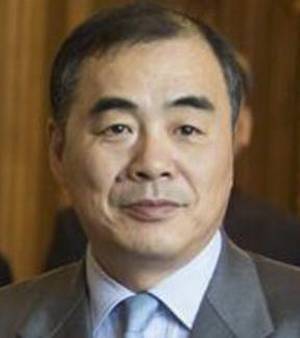
BEIJING(TIP): China has stepped up its diplomacy to ease tensions between India and Pakistan following the Pulwama attack by sending its special envoy to Islamabad.
Chinese Foreign Ministry spokesperson Lu Kang said on Wednesday, March 6, that Vice-Foreign Minister Kong Xuanyou was already in Islamabad to establish an “enabling atmosphere” that would help Pakistan to cooperate with “other parties”.
Mr. Lu said Mr. Kong’s mission was to “promote dialogue” between India and Pakistan by persuading both sides to exercise flexibility. “I hope the two sides can show some goodwill, embrace each other halfway, properly resolve their differences through dialogue. China will play a constructive role to promote dialogue between them.”
India has made it plain that it would start a dialogue only if Pakistan takes visible and verifiable steps to eliminate terrorism that targets India from its soil. “In fact, Pakistan has been making efforts and exercised policies to combat terrorism. We think we should encourage this,” Mr. Lu said.
Without referring to the Kashmir issue, Mr. Lu said that both ‘symptom” and “root cause” of terrorism should be addressed.
Asked to comment on the understanding reached between the Foreign Ministers of Russia, India and China (RIC) during their February 27 meeting in Wuzhen, the spokesperson said: “As to counter terrorism issue in the trilateral meeting, I shall say a key point is that terrorism is a complex issue. We should address the symptom and the root causes of terrorism that is the premise for what was proposed by Foreign Ministers of the three countries.”
Asked to comment on China’s stand on the resolution proposed in the UNSC 1267 committee to list Azhar as a global terrorist, Mr. Lu said China would take a “conducive decision” to resolve the differences. “China will have discussion with relevant bodies” as listing of terrorists “is a very serious issue”, he said.
Mao-Tse-Tung established Peoples Republic of China in 1949. It was backward and far behind India. China continued to be behind India till 1979. The USA opened diplomatic relations with China in 1979. President Reagan offered friendship and full cooperation to help and develop China. He sent his Treasury Secretary, Don Regan, former CEO of Merrill Lynch to China to offer investment in building infrastructure and modernizing China in exchange for China opening up and liberalizing its economy.
China gave carte blanche to the U.S. and allowed the U.S. business to implant capitalistic tools. The U.S. and China built huge large-scale factories to manufacture consumer and industrial goods for export to the U.S. and other countries. As there was no holds bar, the U.S. private industry was able to establish its presence in China. China, unmindful of its communist ideology did not hesitate to plant capitalism in China. This process, in the next twenty years from 1980 to 2000 brought prosperity to China. China had a comparative advantage with the U.S. resulting in the U.S. closing much of its manufacturing. The U.S. relied on importing from China everything it wanted at a lower price.
From almost nothing, China became the second global economic superpower, thanks to the U.S.A. and capitalism. China became the most modern nation. Everyone who has visited China is highly impressed and pleasantly shocked with the gigantic progress China has made within a short period of two decades.
India’s opportunity
President Trump has made India America’s closest ally on a par with the U.K. He has offered 100% transfer of U.S. technology. He has also made deals for joint military and naval exercises and drills. Because of comparative advantage and oversupply of professional managers, engineers and scientists , the US is eager to set up large scale manufacturing in India to produce military hardware, planes, missiles, etc.
The U.S. is ready and willing to replicate with India what it did with China. India does not have to invent a new wheel. The big question is whether India is willing to open and liberalize its economy as China did?
India needs to set up large scale factories to manufacture consumer, industrial and military goods for export and domestic consumption. This will create huge employment opportunities. India needs to find at least 10 million new jobs every year.
Progress and development contribute to democracy. If India is failing to feed the poor, it is no democracy. India has a comparative advantage with China now. Wages in India are much lower than in China. India is the largest English-speaking country in the world. It has a large supply of cheap labor and professional engineers and managers.
President Trump is interested in diversifying US imports from China to India. There has never been a better opportunity for India.
If the path is well trodden, India can legitimately hope to grow @ 12% for the next decade.
(Ven Parameswaran, MBA, Columbia Business School, was President & CEO, First Asian Securities Corporation, New York; Senior Adviser to Imagindia Institute, a think tank in New Delhi. He can be reached at vpwaren@gmail.com)
Rajan Gangahar packs his film on PTSD with emotion and drama
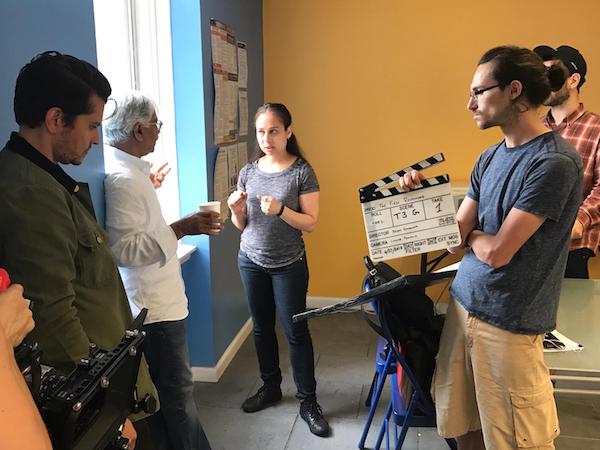
A film on the life and experiences of EMS workers is shot in and around New York
Essentially a loner and a voracious reader, US-based director-writer Rajan Gangahar, has just finished filming “The First Responder”, a short film in New York. Says Rajan,” When the Producer approached me to make a film on the life of EMS members’ life and experiences, I was not excited. To me, a film is about emotions not just visuals. I liked the perspective, but I wanted to add the most important dimension for a good film. Make it a human story, of a traumatic experience of the EMS worker”. Rajan has earlier written and made a feature film, “Khushiyan” in Punjabi, one of the most popular languages in India and won the Best Writer award for the film at PIFA in Toronto, a global film award mega event. “The film was about human relations and founded on emotions,” says Rajan.
Gangahar trained as an actor and worked in theater circuit in India for several years. “Stage performances offered a direct connect with the audience and helped me learn the value of touching the audience’s heart. It was instant,” he says while talking about his stage experience. Gangahar traveled with a theater group all across Canada and USA for his play. And the response was universal. It connected with the audience everywhere. “I was clear. Any form of creative work will connect and be successful if we can touch the heart”.
Whether it is a debate on India or the USA, Gangahar always tends to lean on the freedom of expression. Political or intellectual or creative or even religious subjects are deliberated with same zeal keeping the backdrop of human behavior. The Post Traumatic Stress Disorder (PTSD) in any profession, including EMS, is essentially due to some or the other form of guilt, which may be haunting the sufferer. And then the patient enters the state of denial. Whether it is the guilt or fear of facing it again or inability to confess, the person keeps running away from reality.
Whether it is a play or story-screenplay-dialogues or directing, Gangahar has never tried to rush into anything in a quest to do a lot. It’s not about lust of fame but the satisfaction of doing good quality creative work that drives the Gangahar. It’s not about telling the family and world of friends about making a film but “telling” the story in the right manner on screen or stage or television that stimulates Gangahar.
“When the producer of “The First Responder” shared the subject of the film which he had conceived as a documentary on the life of EMS workers, I was clear, it is a universal subject. Most amongst us have dealt with EMS as volunteers or when we sought their service or when one or other member in our family worked with EMS. We all know the essence of the EMS duty. But what interested me was to adapt it for a fiction short film yet depicting the life and trauma of an EMS staffer,” says Gangahar. And a short documentary was transformed into a docu-drama and then to a short film based on fiction, yet close to a real-life story.
“The hero or protagonist of my film has similar trauma. He is suffering every day as his experience haunts him. Days and nights. But he denies and even refuses to take professional help. It reaches an extreme when he can’t even take assignment lest he fail again. He wants to pretend and show off machoism yet all around him observe his suffering. He even contemplates suicide,” says Gangahar.
“A compassionate boss and a caring wife help him to take professional help. Finally, barriers are broken, and he hugs his wife in elevator while going back home after he completes the treatment,” he adds.
“I have been studying cinema for quite some time. Learning from the West, I believe in doing complete homework. It is not about the scale of the subject or canvass. A detailed and thorough pre-production work helps,” says Gangahar. With about 16 persons in crew and 10 actors, the unit was small. The creative team could focus on meaningful output especially keeping in mind the limited resources.
The filming has been completed in less than ten days while shooting all around in New York city. Gangahar expects to finish post-production work by end of August and then submit the film for festivals around the world.
Interview with RAJAN GANGAHAR
“Any story that deals with human emotions interests me”- Rajan
Director Rajan Gangahar
What attracted you to take on this project as a director?
I would say it was the subject. It is a story of EMT workers and their exposure to traumatic circumstances. We see EMT workers all the time and expect them to be first responders. In worst of the circumstances, constant exposure to these traumatic situations can lead to PTSD (Post-Traumatic Stress Disorder). This medical condition effects everyone around you, the family, friends, colleagues. Unfortunately, there is a macho culture and one considers a weakness to seek medical help. It is a story of When Helping Hurts.
Who wrote the story?
Ron Basci, a friend of mine, has written the script about an EMT worker and silently suffered from PTSD.
How did you select the cast and the crew?
Casting was a complicated process. The original casting call attracted more than 600 actors. The team brought it down to 30. Final auditioning went on for a week. All the hard work paid off and we were able to ensemble a cast of 9 — probably the best from theater and films.
How was the experience of working with an American unit including an American Producer?
It was an enriching experience since I was able to share my experience and also adopt to local technical crew. At the end of the day we have been able to create a believable human story.
How is it different from making an Indian film?
Internet has created a flat world for every field including in the field of film making. Though some ground realities will always influence working environment like availability of low-cost labor in Indian film industry. And that translates to multiple resources always available on call. On the contrary, the crew in America is comparatively smaller but better trained in latest technologies, though the gap is diminishing.
You have been an actor yourself. Why did you not act in the film?
It is always tempting but I avoid the temptation, especially when as a director the performance of the whole cast needs your undivided attention.
How is a short film different from making a feature length film?
Any film less than 50 minutes is considered a short film. The difference is less time to establish characters and still engaging the audience from conflict to resolution. The future of entertainment as predicted by experts would be shorter films because of shorter attention span of the younger generation.
What is most important to you in making a film?
Film making is a field of director, DOP Editor Maintaining a single, clear vision through communication before the shoot is the key. Since they all are telling same story in different languages with their respective tools. It is imperative for all of them to have single clear vision. Artistically, I am of the opinion in creating believable characters is the key and I am fascinated by the process of characterization. Acting is doing consciously what we do unconsciously in real life. Recreating that behavior is what creates a great performance.
What kind of cinema do you like as a film maker?
Any story that deals with human emotions interests me.
Where do you see Indian cinema today and five years from now, especially with Netflix and Amazon redefining boundaries?
With the availability of internet, we human are no longer confined by physical and imaginary boundaries. We are more aware of other cultures, there history, there struggles and sufferings and curious to listen to stories beyond barriers of language and culture. Corporates like Amazon, Netflix, Apple are trying to ride that wave by creating single international platform for everything from screening films to making films.
Indian films have recently created history by making almost $300 million in China? What is the reason? Do you see similar possibilities for Indian cinema in USA?
The present times are probably the best of times for the Indian film industry. India is producing realistic and sensitive cinema and global audience including in US, China, UK is accepting it. An era of films with universal issues that strike a chord with both foreign and domestic audience has commenced. Rest is a numbers game.
Why are Indian Directors not making films in Hollywood? Even top Indian actors rarely do films in Hollywood. Why? Do you see this changing in near future?
No one can live in isolation. There is so much to learn from experiences of each other. Both industries were catering to their own kind of audience, but it is changing. Hollywood studios are experimenting with adding in Indian actors in significant roles. Initially to get wider audience but with time they would be doing it for talent. Future is, both industries working with each other or for each other and launching joint ventures.
In your view, is human interest story a universal subject? Can a film appeal to all or majority of audiences across the world?
Yes, there is no doubt in that. Perfect example would be the play “Death of a Salesman” by Arthur Miller — a story of a middle-class family struggle in 1950. This play was translated and performed in every country and almost every language. So, yes emotions and feelings are universal, dressed in local cultures.
What is next for your short film? Do you see it appealing to all audiences across the world?
Yes, I am positive it will, emotions like music are universal.
What would you like to do next and in what capacity?
There are stories to be explored and told. I would love to remain a storyteller in any format — a film, a Play or a book… as a director, an actor or a writer.
The way China, an increasingly powerful nation in the midst of a great power competition with the United States, interacts with the rest of the world will have significant global implications. Syria could be a key test case of China’s willingness to intervene on a global scale in a more direct way in pursuit of its interests.
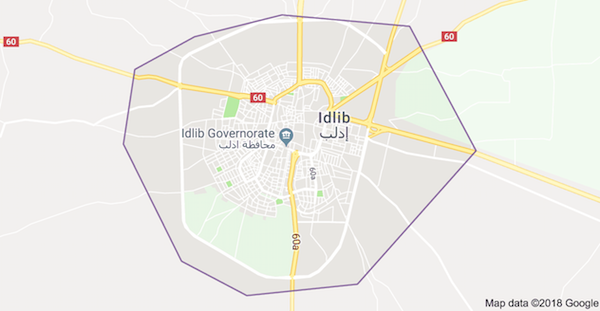
Both China’s ambassador to Syria as well as its military attaché in the country have raised the possibility of Chinese military operations in Syria alongside the Syrian government. Chinese Ambassador Qi Qianjin reportedly stated that the Chinese “military is willing to participate in some way alongside the Syrian army that is fighting the terrorists in Idlib and in any other part of Syria,” while military attaché Wong Roy Chang reportedly said the Chinese military could participate in an operation to retake rebel-held Idlib if Beijing made the political decision for it to do so.
It is important to stress that neither statement is a confirmation that China is about to send military forces to participate in combat operations in Syria. However, the comments, if true, would mark the closest confirmation we have had of such a possibility.
Active Chinese military involvement in Syria would mark a substantial step forward in overall Chinese involvement in the Middle East and in a global sense as well. Except for operations under the United Nations peacekeeper mandate, China has largely avoided military operations beyond its borders or its immediate region. A military operation in Syria could open the door for further such Chinese involvements around the globe.
China has also long been concerned about Uighur militants in the Turkistan Islamic Party (TIP) operating in Idlib. Given the extensive combat experience of TIP’s Syrian branch and its significant capabilities, Beijing has an interest in seeing Uighur militants destroyed before some of them return to Central Asia or even China. Primarily for that reason, it makes sense for China to consider a more active involvement in a battle to retake Idlib.
However, even if China does participate in the campaign to retake Idlib, which is far from certain, it’s involvement would remain fairly low key. China’s focus in Idlib would be to see key TIP leaders and fighters killed. To that end, the most likely Chinese deployment would primarily involve military advisers, intelligence personnel and perhaps some special operations forces for specific direct-action missions. In terms of the latter, this would likely involve small-scale deployments of specialized Chinese People’s Armed Police Force units such as the Snow Leopard Commando Unit, which has considerable counterterrorism experience. Still, even such a low-level commitment by China would mark a remarkable departure in the overall Chinese strategy and would signal a new approach by Beijing to its involvement in the Middle East and further afield.
If China decides to wade into the Idlib morass, it would have to factor in the large number of involved parties, including Russia, Turkey and Iran. Idlib technically falls under a “de-escalation status” arrangement agreed to by the listed countries in the Astana peace process. Nevertheless, significant differences remain between Russia, Turkey and Iran. Ankara, which has provided support for TIP in the past, is striving to maintain the de-escalation zone and prevent a loyalist offensive that could result in yet another massive spillover of refugees into Turkey. Moscow is also keen to maintain its de-escalation zone agreement with Turkey but is getting impatient with the continued existence of dangerous factions in Idlib such as TIP and Tahrir al Sham (known as HTS) that continue to attack Russian and loyalist targets. Finally, Tehran and Damascus would prefer to see the de-escalation zone agreement scrapped and a full offensive on Idlib launched, but they are wary of proceeding without active Russian support given the considerable Turkish presence in the province.
All of these considerations ensure that China will have to carefully approach any military involvement in Syria, particularly with regard to Idlib. Careful coordination with Russia, the Syrian government and Turkey would be necessary for Beijing to avoid severe complications in Syria, particularly given its substantially smaller footprint in Syria compared with the other countries.
“But India-U.S. relations will be better off without hype and grand theories, often encouraged by the government. Otherwise, every rescheduling of a meeting will be interpreted as the collapse of ties. Similarly, avoiding the hyperbole could help manage India’s troubles with Pakistan and China better. The U.S. has overlapping interests with China, and India has overlapping interests with both. The trouble with big-chest, small-heart hyper-nationalism in foreign policy is that it also causes short sightedness. The audacity of hype has its limits.”
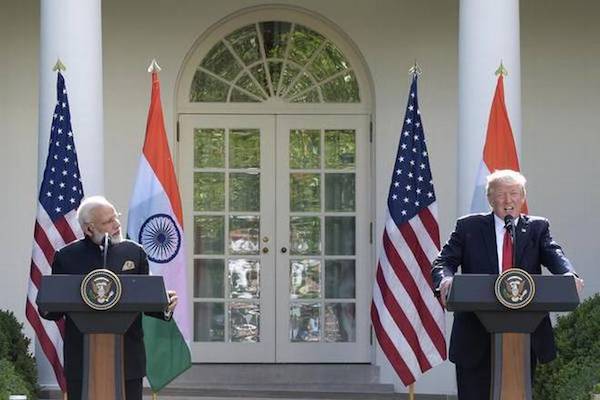
Prime Minister Narendra Modi and U.S. President Donald Trump have both built their politics on the promise of making their countries great again. Placing India and the U.S., respectively, as leaders on the world stage is the stated objective of their foreign policy. The project of regaining national glory is based on another assumption that they inherited a mess from their respective predecessors. Yet another shared trait is their love for spectacle over meticulous, prolonged and often frustrating pursuit of strategic goals.
Theatre as strategy
The postponement of the India-U.S. 2+2 dialogue between the Foreign and Defense Ministers of both countries, that had been scheduled for this week, has to be understood in the context of the similar personality traits of Mr. Trump and Mr. Modi. Hugging Mr. Trump may be a good spectacle for Mr. Modi, but the same may not be true for the former. Mr. Trump has set his eyes on spectacles that suit him. Mr. Trump, still basking in the denuclearization deal that he’s said to have struck with North Korea’s Kim Jong-un, is now looking forward to the next big event: a summit meeting with Russian President Vladimir Putin. His every move on the global stage enrages his domestic political opponents and the professional strategic community alike and he is happy, as this keeps his political base constantly on the boil.
North Korea, Syria, Afghanistan, trade deficit, and all global challenges before America are the faults of his predecessors, he repeatedly tells supporters. Most recently, at the G7 summit in Canada in June, he declared: “I blame our past leaders for allowing this to happen (trade deficits) …You can go back 50 years, frankly.” Such rhetoric may sound familiar to Indians. In Mr. Trump’s war on the legacy of all Presidents before him, India is on the wrong side. The remarkable growth in India-U.S. relations since the turn of the century had been nurtured by three U.S. Presidents, Bill Clinton, George W. Bush and Barack Obama, two Democrats and one Republican who have all been the target of Mr. Trump’s ire. India neither promises him the opportunity of a spectacle nor offers the grounds for destructing the legacy of a predecessor. So, he told Secretary of State Mike Pompeo to deal with North Korea and Russia, and 2+2 with India could wait. “Nobody wakes up in DC daily thinking of India,” says a former U.S. ambassador to India, pointing out that 16 months into the new administration, there is no Assistant Secretary of State for South and Central Asia in the State Department.
Impact on ties
To buttress one’s own claim to be a trailblazer by denying the achievements of predecessors may be good political tactics for these leaders but trying to wish away history itself is not a sustainable strategy. Against the backdrop of a programmatic negation of history in both countries, Mr. Trump’s bursts of unhinged rhetoric against China and Pakistan lend themselves to easy and convenient interpretations by supporters of improved U.S.-India ties as moments of enlightenment for the U.S., even as turning points.
But Mr. Trump cannot undo all the legacy with a magic tweet. U.S. relations with Pakistan and China took shape during the Cold War. Pakistan might be the longest ally of the U.S. after the U.K., first in the fight against communism, and then in the fight against terror that was created in the first fight. China used the Cold War to its own advantage in its ties with the U.S.
China today threatens the dominance of the U.S., but the America’s security establishment and political elite are obsessed with Russia. India gets caught in that internal American fight too, such as in the case of an American law that now requires the President to impose sanctions on any country that has significant security relations with Russia.
Mr. Trump sees the challenges posed by China, but not in a manner helpful for India. For, India and China are in the same basket for Mr. Trump on many issues that agitate him. He has repeatedly mentioned India and China in the same breath as countries that duped his predecessors on climate and trade deals. His administration considers India and China as violators of intellectual property laws, as countries that put barriers to trade and subsidize exports and use state power to control markets. The nationalists in the Trump administration, including U.S. Trade Representative Robert Lighthizer, Commerce Secretary Wilbur Ross and White House National Trade Council Director Peter Navarro are all gunning for China, and India is in the same firing line. Many Americans who think that China took the U.S. for a ride — many Democrats among them — suspect that India is trying to do the same thing.
But there are two constituencies in the U.S. that promote India against China: the Pentagon and the U.S. arms industry. This works to India’s favor. While the Obama administration could not overcome State Department objections to offer India even unarmed drones, the Trump administration has done so, offering armed drones. Here, Mr. Trump is not guided by any grand theories of ‘rule-based order’, etc. that professional strategists talk about, but by the opportunity to sell.
Given Mr. Trump’s views on trade, American companies that used to argue China’s case are now guarded in their approach. Still, companies such as General Motors and Ford have come out against a trade war with China. This has implications for India too. American companies that eye the Indian market are allies in the pushback against Mr. Trump’s nationalist trade policies. Mr. Modi has realized this dynamic that puts India and China in the same corner in Mr. Trump’s perspective — and that significantly explains his Wuhan summit with Chinese President Xi Jinping, the third big leader who is gaming for the glory of his country.
War against legacy
The enlightenment that Mr. Trump purportedly brought on America’s Af-Pak policy also appears to have been short-lived. If one looks at the tough messages from Nikki Haley, U.S. Ambassador to the UN, in New Delhi recently on Pakistan and Iran, it is clear where the political priorities of the Trump administration lies. Here again, Mr. Trump is determined to gut his predecessor’s legacy, a key component of which was rapprochement with Iran. The war in Afghanistan is the worst optics for Mr. Trump’s showman politics, and his administration’s approach has been to sweep it under the carpet. The Pentagon has restricted release of data on the war, but a report last month paints a picture of a deteriorating situation. The U.S.’s ability to arm-twist Pakistan has been limited anyway, and Mr. Trump’s determination to turn the screws on Iran makes it tougher. National Security Adviser John Bolton, who had advocated bombing Iran, believes that a hardline policy against Pakistan is not desirable.
All told, Mr. Trump might accept Mr. Modi’s invitation to be the chief guest at the 2019 Republic Day parade just ahead of the Lok Sabha campaign, triggering another round of commentary on their ‘body language’ and ‘chemistry’. A series of significant defense purchases and agreements could be concluded in coming months. But India-U.S. relations will be better off without hype and grand theories, often encouraged by the government. Otherwise, every rescheduling of a meeting will be interpreted as the collapse of ties. Similarly, avoiding the hyperbole could help manage India’s troubles with Pakistan and China better. The U.S. has overlapping interests with China, and India has overlapping interests with both. The trouble with big-chest, small-heart hyper-nationalism in foreign policy is that it also causes short sightedness. The audacity of hype has its limits.
(The author is an assistant editor with The Hindu. He can be reached at varghese.g@thehindu.co.in)
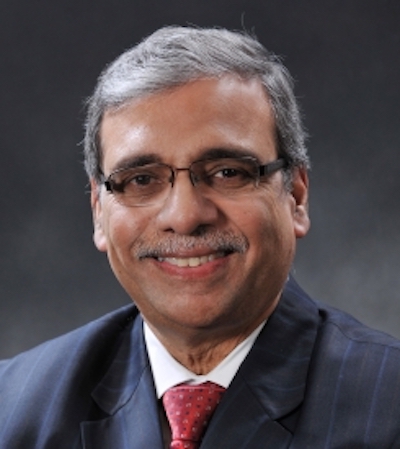
BEIJING(TIP): Dr. Dipak Jain, a prominent Indian professor in the US, has been appointed as the new head of a top global business school in China, according to a media report. Jain, 61, will take over as the European president of the Shanghai-based China Europe International Business School (CEIBS), replacing Pedro Nueno who held the position for 28 years.
Dr. Jain is the European President-Designate, Professor of Marketing and Global advisor at CEIBS. He is a globally recognized marketing and innovation expert whose insights have inspired a generation of business leaders to pursue success with significance. Dr. Jain’s influential career spans nearly four decades as an educator, a senior business school administrator, and a consultant to corporations and governments. Throughout his career, he had furthered a pedagogical model that combines academic excellence and business relevance to produce high-impact results with social significance.
Prior to being named Sasin’s Director in 2014, he served from 2011 to 2013 as Dean of INSEAD, an international business school with campuses in France, Singapore and Abu Dhabi. Before joining INSEAD, Dr. Jain was Dean of Northwestern University’s Kellogg School of Management from 2001 to 2009. In recognition of his many scholarly achievements and outstanding teaching, he also was named the Sandy and Morton Goldman Professor of Entrepreneurial Studies and Professor of Marketing at Kellogg, whose Marketing Department he joined as a faculty member in 1986.
Dr. Jain’s academic career began as a student in Tezpur, Assam India. He earned his bachelor’s degree in statistics (1976) with Honors from Gauhati University, where he taught for four years before enrolling in the University of Texas (Dallas), where he completed his Ph. D in Marketing in 1986.
An award-winning scholar in his own right, Dr. Jain’s areas of research expertise include the marketing of high-tech products; market segmentation and competitive market structure analysis; cross-cultural issues in global product diffusion; new product innovation; and forecasting models. He has published more than 60 articles in leading academic journals and has earned the prestigious John D.C. Little Best Paper Award. Among the many distinctions for his teaching and service, Dr. Jain received the Pravasi Bharatiya Samman from the Prime Minister of India, an award that recognizes exceptional leadership contributions of overseas Indians.
Jain, a former dean of two of the world’s leading business schools, the Kellogg School of Management and INSEAD, will work alongside his Chinese counterpart Li Mingjun. Brought up in Assam, Jain, who lives in Chicago and works in Shanghai for 10 to 15 days each month, has been teaching marketing at CEIBS since September last year when he took on the president-designate role.
Beijing vows to strike back against tariffs on US$34 billion worth of Chinese goods
NEW YORK(TIP): The big question is now that the first shots have been fired, what goods will be affected, who will pay the price and what could happen next?
China’s Ministry of Commerce, on July 5 (July 6 in China) said China will fight back against the US and report to the World Trade Organisation.
The remarks were in response to Washington’s decision to impose 25 per cent duties on a similar amount of Chinese imports, which also came into effect on Friday.
US President Donald Trump had threatened to target another US$400 billion in Chinese products with tariffs if Beijing continued to hit back.
On top of that, each country has prepared a second tariff list of goods worth about US$16 billion. The effective dates are pending as the office of the US trade representative is in the midst of a public comment period on its list.
The trade war became official after Trump repeatedly said he wanted to reverse the United States’ massive trade deficit with China, which rose to about US$375 billion last year. That number is US$100 billion higher than China’s own calculation.
In an updated list published on June 15, Washington dropped many China-made consumer goods, such as TVs and flat panel screens, and added more intermediary products like semiconductors and plastics, after opposition during a public hearing in May.
The second tariff list, which is still under review, focuses particularly on “Made in China 2025”, a Chinese industrial policy aimed at getting ahead in hi-tech industries. It includes electronic integrated circuits and the machines that produce them.
Washington has dropped many China-made consumer goods, such as TVs and flat panel screens, and added more intermediary products like semiconductors and plastics to its tariff list. Photo: Reuters
China struck back in April with a list of US$50 billion worth of US imports, many of which were agricultural products. Beijing later removed US$16.3 billion worth of US aircraft from the list and added more food such as fish and nuts.
The primary US goods affected are soybeans and vehicles, while it is mostly Chinese industrial goods hit by US tariffs.
Who bears the brunt of these rounds of tariffs? Eventually consumers.
Analysts said imposing tariffs on Chinese goods such as semiconductors would eventually increase prices for American consumers because they were key components of electronic products. And it’s not an easy business decision for US manufacturers to shift sourcing after tariffs are in place.
“Alternative sources do exist for most of the Chinese products on the targeted list, but less expensive products purchased by less affluent consumers are likely to see larger price hikes as manufacturers substitute more expensive parts for Chinese inputs facing tariffs,” Mary Lovely, a senior fellow at the Washington-based Peterson Institute for International Economics, wrote.
“These consumers may not see much difference in performance due to one higher-quality part, but they are likely to see a difference at the cash register.”
Chinese consumers, on the other hand, could pay higher prices for imported seafood and fruit.
It is just the beginning. What happens in the longer run will impact economic policies of many countries across the world.
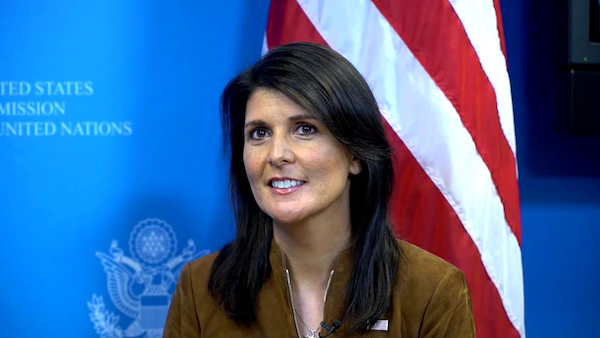
NEW DELHI(TIP): Pakistan becoming a haven for terror groups cannot be tolerated and the US has already delivered the message to Islamabad, US Ambassador to the UN Nikki Haley said here June 28.
“We cannot turn a blind eye to those harboring terrorists… Communicating to Pakistan that this cannot be tolerated,” she said while delivering a lecture at the Observer Research Foundation- a Think Tank.
She also said that India and the US must be global leaders in the fight against terrorism adding “we can and must do more.”
Touching upon a variety of issues, she said freedom of religion is very important and that a nation such as “ours can only be held together by tolerance.”
On China, she said the country was important but noted that its expansion in the region has been a matter of concern for the US and many other countries as Beijing does not share democratic values.
Referring to Prime Minister Narendra Modi’s recent remarks at the Shangri-La dialogue in Singapore to ensure freedom of navigation and stability in the Indo-Pacific, she said President Donald Trump also believes in this vision.
Haley said the US supports India’s membership in Nuclear Suppliers Group as it is a nuclear state which is widely respected.
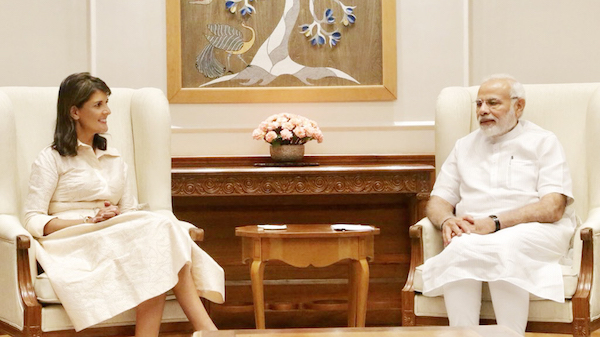
Haley who is on a 3-day visit to India called on Prime Minister Narendra Modi and External Affairs Minister Sushma Swaraj.
She also visited a church, a mosque, a temple and the Sikh Gurdwara Sis Ganj Sahib in Delhi where she and US Ambassador to India Kenneth Juster went to Langar Hall and rolled chapatis. Delhi Gurdwara Prabandhak Committee President Manjit Singh GK showed them round and explained how langar was being distributed free to thousands every day without any distinction of caste and creed.
The killings of Bukhari and Aurangzeb were meant to provoke New Delhi, which decided to be seen as tough
By KC Singh
“If India and the US let domestic politics color their approach to the protection of human rights in the 70th year of the Universal Declaration of Human Rights, it would prove that terrorism and illegal immigration have succeeded in making the two major democracies less liberal”, says the author.
The 47-member Geneva-based UN Human Right Council and the UN High Commissioner for Refugees (UNHCR) have been in focus the past week. First came an unprecedented report by the UNHCR Zeid al-Hussein on Jammu and Kashmir (J&K), Pakistan Occupied Kashmir and Gilgit Baltistan. While Pakistani knuckles were rapped mildly, the report, as conceded in its executive summary, is really about “widespread and serious human rights violations’’ in J&K from the death of militant Burhan Wani in July 2016 to April 2018.
Under separate headings it holds India guilty on account of lack of access to justice and impunity; military courts and tribunals blocking this access, excessive use of force and pellet-guns, arbitrary arrests, including of minors, torture and enforced disappearances, and sexual violence, etc. All through, even UN-listed terror outfits are referred to as “armed groups”. A former Indian diplomat writing elsewhere calls it more akin to a report by Organisation of Islamic Conference than a UN high official. India strongly rebutted it and could have probably ignored it, except that Zeid is on record saying he would recommend to the UN Human Rights Council (UNHRC), which convened on June 18 for one of its three annual sessions, an investigation.
Two events impinge on this development. One, Jammu and Kashmir has been placed under Governor’s rule with the BJP withdrawing from the coalition government. Two, US Ambassador to UN Nikki Haley announced, at the State Department, US withdrawal from the UNHRC, alleging lack of reform and it having become a “protector of human rights abusers and cesspool of political bias”. Both need closer examination.
The Trump administration has been threatening to withdraw from the UNHRC for some time, but the decision came a day after Zeid slammed the US for separating children from parents on border with Mexico when apprehending illegal immigrants. The media is also reporting illegal immigrants from India, many from Punjab, held in detention centers under sub-human conditions.
Republican Senator John McCain, terminally ill with brain cancer but combative as always, tweeted that the “administration’s current family separation policy is an affront to the decency of the American people, and contrary to the principles and values upon which our nation was founded’’. He later went on to oppose Trump’s nomination of Ronald Mortensen to lead the US refugee and migration policy, alleging he lacked empathy for people fleeing oppression. Thus, while the US is right that election to the UNHCR of nations like Venezuela and Congo (though the US omitted mentioning China) hardly makes it the custodian of global conscience on human rights, but neither does the US by its xenophobic immigration control creating gulags for apprehended illegal immigrants qualify it to lecture the council.
The J&K imbroglio raises many similar questions about India’s trajectory in dealing with terrorism at home. The PDP-BJP alliance raised hope that their Agenda of Alliance would provide a template for resolution of the Kashmir issue. The death of Mufti Sayeed at the beginning of 2016 and a long hiatus before his daughter Mehbooba effectively took charge probably doomed the experiment, if at all had any chance to succeed.
At the root of the problem was the Modi government’s Pakistan policy of “no dialogue” unless terror ends. On the contrary, the PDP had got elected promising dialogue with Pakistan, more political space even for separatists and improved trade and people-to-people links with Kashmiris across the Line of Control (LoC). The Pakistan army exacerbated these fault lines by keeping up support to militancy, provocatively killing Indian soldiers and turning the LoC into free-fire zone. The Governor’s rule now denies India the argument that J&K has a popularly elected government which is a guardian of people’s rights scrutinizing, if not overseeing, counter-terror operations of security forces. Pakistan, currently a member of the UNHRC, shall use the High Commissioner’s tendentious report and collapse of the alliance to pillory India in coming weeks.
The Modi government must surely have assessed the profit-loss outcome of its decision. The domestic implications would dominate New Delhi’s thinking as the government heads into literally the last six months of effective rule before the Lok Sabha election process kicks-in. It needs to ensure that no major breakdown of security order in Kashmir occurs till election, particularly during the Amarnath pilgrimage.
There may be information that leading to parliamentary election in Pakistan in July its army, having a freer hand than normal with a caretaker government in position, is planning to fling every last terror asset across the LoC in a make-or-break gambit. The targeted killing of moderate journalist Shujaat Bukhari and the taped torture and execution of soldier Aurangzeb were intended to provoke New Delhi. A big attack on pilgrims, as has happened in the past, could make the Union Government look extremely ineffective. Governor’s rule is the counter-move to ensure that despite the debate in Geneva on India’s human rights record the Modi government is seen as strong at home.
If India and the US let domestic politics color their approach to the protection of human rights in the 70th year of the Universal Declaration of Human Rights, it would prove that terrorism and illegal immigration have succeeded in making the two major democracies less liberal. The latest survey by Freedom House, a US think-tank, is called “Democracy in Crisis”. Last year was the 12th consecutive year when nations suffering democratic setbacks outnumbered those gaining. According to Democracy Index of The Economist Intelligence Unit, 89 countries regressed in 2017 and only 27 improved. Globalization and technology in the West and Pakistan-sponsored terror in South Asia are derailing the quest for liberal, law-based democratic rule. If a four-year political alliance between the PDP and BJP, representing disparate views on Kashmir, cannot develop a consensus for bridging the divide, the future is indeed bleak. A fresh attempt at reconciliation seems unlikely until after parliamentary elections in Pakistan and India. Till then, geopolitical haze in South Asia will be thick as the dust that enveloped northern India a week ago.
(The author is a former Secretary, Ministry of External Affairs, India)
With India recalibrating its relations with other powers, the India-U.S. equation is not quite balancing out
By Suhasini Haidar
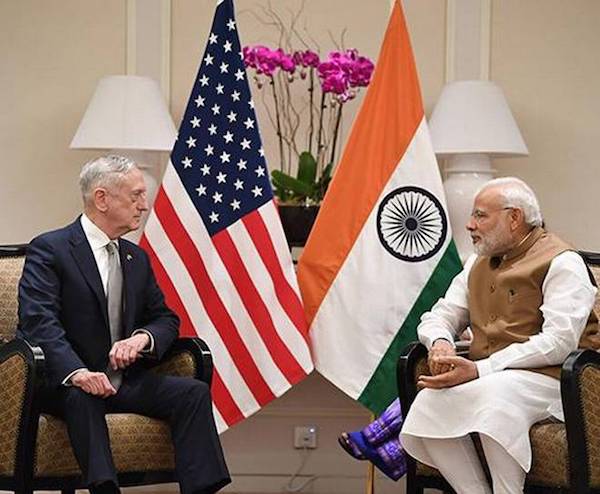
At his speech at the Shangri-La Dialogue in Singapore last week, billed as a major foreign policy statement, Prime Minister Narendra Modi spoke of India and the U.S.’s “shared vision” of an open and secure Indo-Pacific region. Yet his words differed so much from those of U.S. Defense Secretary James Mattis, who spoke at the same event, that it seemed clear that New Delhi and Washington no longer see eye-to-eye on this issue, and several others as well.
Oceanic gulf
To begin with, Mr. Modi referred to the Indo-Pacific, a term coined by the U.S. for the Indian and Pacific Oceans region, as a natural geographical region, not a strategic one, while Mr. Mattis called the Indo-Pacific a “priority theatre” and a “subset of [America’s] broader security strategy” for his military command, now renamed the Indo-Pacific Command. While Mr. Modi referred to India’s good relations with the U.S., Russia and China in equal measure, Mr. Mattis vowed to counter China’s moves in the Indo-Pacific and referred to the U.S. National Defense Strategy released this January, which puts both China and Russia in its crosshairs as the world’s two “revisionist powers”.
The divergence in their positions, admittedly, are due more to a shift in New Delhi’s position over the past year than in the U.S.’s, when Mr. Modi and President Donald Trump met at the White House. A year ago, the Modi government seemed clear in its intention to counter China’s growing clout in its neighborhood, especially post-Doklam, challenge the Belt and Road Initiative (BRI), and back a Quadrilateral grouping of India, the U.S., Japan and Australia to maintain an open Indo-Pacific. Today, the Doklam issue has been buried, the BRI isn’t as much a concern as before, and the government’s non-confrontational attitude to the Maldives and Nepal indicates a softened policy on China in the neighborhood. Meanwhile, Mr. Modi now essays a closer engagement with Chinese President Xi Jinping and a relationship reset with China after the Wuhan meeting.
The Quad formation, which is holding its second official meeting today in Singapore, has also been given short shrift. India rejected an Australian request to join maritime exercises along with the U.S. and Japan this June, and Navy Chief Admiral Sunil Lanba said quite plainly last month that there was no plan to “militarize” the Quad. Contrast this with India’s acceptance of military exercises with countries of the Shanghai Cooperation Organisation (SCO), the Russia-China led grouping it will join this week in Qingdao, and one can understand some of the confusion in Washington. Pentagon officials, who had come to accept India’s diffidence on signing outstanding India-U.S. foundational agreements, are now left scratching their heads as India publicly enters the international arena in the corner with Russia and China, while proclaiming its intention to continue energy deals with Iran and Venezuela in defiance of American sanctions.
Era of summits
In a world where summits between leaders have replaced grand strategy, the optics are even clearer. Mr. Modi will have met Mr. Xi and Russian President Vladimir Putin four-five times each by the end of the year, if one counts informal and formal summits, as well as meetings at the SCO, BRICS and G-20. In contrast, nearly half the year has gone in just scheduling the upcoming 2+2 meet of Indian and U.S. Ministers of Defense and Foreign Affairs.
Trade protectionism is clearly the other big point of divergence between India and the U.S., which have in recent months taken each other to the World Trade Organisation on several issues. There has been a surge in disputes between the two countries: on the new American steel and aluminum tariffs, the proposed cuts in H1B professional visas and cancellation of H4 spouse visas, on India’s tariffs and resistance to U.S. exports of dairy and pork products, on Indian price reductions on medical devices, and Reserve Bank of India rules on data localization on Indian servers for U.S. companies.
The row over Harley-Davidson motorcycles is a case in point, where what should have been a small chink in the relationship has ended up denting the discourse quite seriously. When Mr. Trump announced to Harley executives and union representatives in February last year that he would stop countries “taking advantage” of them, no one in New Delhi paid much attention. Over the year, Mr. Trump grew more vocal in this demand, including twice during meetings with Mr. Modi in Washington and Manila, calling for India to scrap its 75-100% tariffs, given that the U.S. imposes zero tariffs on the import of Indian Royal Enfield motorcycles. Mr. Modi tried to accommodate U.S. concerns, and even called Mr. Trump on February 8 this year to tell him that tariffs were about to be cut to 50%. But after Mr. Trump divulged the contents of their conversation publicly, trade talks were driven into a rut. Officials in Washington still say that if India were to slash its rates, it would see major benefits in other areas of commerce, while officials in New Delhi say that with Mr. Trump having gone public with Mr. Modi’s offer, it would be impossible to back down any further. In fact, a new cess has taken tariffs back up to 70%.
The biggest challenges to a common India-U.S. vision are now emerging from the new U.S. law called Countering America’s Adversaries Through Sanctions Act and the U.S.’s withdrawal from the Iran nuclear deal with the threat of more secondary sanctions. Both actions have a direct impact on India, given its high dependence on defense hardware from Russia and its considerable energy interests in Iran. In particular, India’s plans to acquire the Russian S-400 missile system will become the litmus test of whether India and the U.S. can resolve their differences. Clearly the differences over a big-ticket deal like this should have been sorted out long before the decisions were made; yet there is no indication that the Trump administration and the Modi government took each other into confidence before doing so.
In the face of sanctions
Defense Minister Nirmala Sitharaman’s avowal of the S-400 agreement, and Foreign Minister Sushma Swaraj’s open defiance of U.S. sanctions on Russia, Iran and Venezuela at separate press conferences this month couldn’t have helped. It also didn’t help that owing to Mr. Trump’s sudden decision to sack Rex Tillerson as Secretary of State in March, the 2+2 meeting in April, which may have clarified matters, was put off. The truth is, building a relationship with the Trump administration in the past year has been tricky for both South Block and the Indian Embassy in Washington, as more than 30 key administration officials have quit or have been sacked — they have had to deal with three National Security Advisers, two Chiefs of Staff, as well as two Secretaries of State as interlocutors.
It is equally clear that the India-U.S. equation isn’t balancing out quite the way it did last year, when Mr. Modi and Mr. Trump first announced the idea of the “2+2” dialogue. Ms. Swaraj, Ms. Seetharaman and their American counterparts have their work cut out for them during their upcoming meeting in Washington on July 6. If a week is a long time in politics, in geopolitics today a year is an eternity.
(The author is Deputy Resident Editor & Diplomatic Affairs Editor, The Hindu. She can be reached at suhasini.h@thehindu.co.in)
“China and North Korea want the U.S. to withdraw its base in South Korea and recall 40,000 of its army.China and North Korea are asking for total denuclearization of the entire Korean Peninsula, including B-52 nuclear equipped bombers in South Korea.The U.S. could save by withdrawing, provided North Korea fully complies”, says the author.
The Korean War ended in the Armistice Agreement of 1953.This Agreement was made possible because V. K. Krishna Menon’s proposal for the repatriation of prisoners belonging to different countries was accepted by the United Nations.President Eisenhower acknowledged and thanked India for its positive contribution that ended the Korean war.
President Trump deserves credit for his statesmanship and courage in negotiating with North Korean leader Kim-Jong-Un. This is made possible only because Ambassador Nikki Haley was able to convince China and Russia to vote for the severest sanctions against North Korea.Nobody knows why China changed its policy and decided to support the USA against its client State, North Korea. It must be pointed out that after the severest sanctions, North Korea has had no choice but to depend on China for its existence and political support.This is the reason Kim-Jong-Un made a private trip to Beijing by train before taking the initiative to seek a summit meeting with Trump.He also had meeting with Chinese leader Xi, after Trump canceled the meeting. Does this not show that China is more interested in getting along with Trump, and therefore, was prepared to be tough on North Korea?What are China’s goals?
China and North Korea want the U.S. to withdraw its base in South Korea and recall 40,000 of its army.China and North Korea are asking for total denuclearization of the entire Korean Peninsula, including B-52 nuclear equipped bombers in South Korea.The U.S. could save by withdrawing, provided North Korea fully complies.The U.S. Naval power and airpower are second to none and because of the latest and sophisticated technology, the U.S. can win wars without a land base.
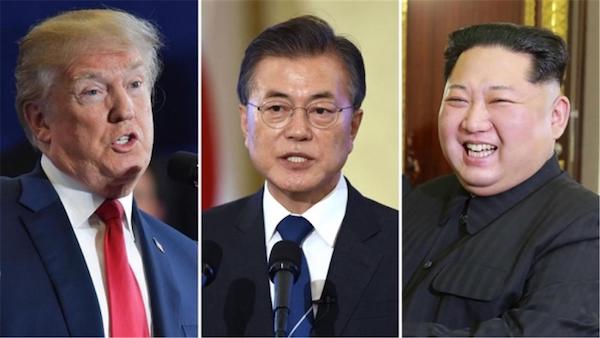
North Korea cannot afford to be the victim of the severest sanctions.North Korea is interested in economic development. Therefore, North Korea is trying to demonstrate that it can be trusted by destroying the nuclear test sites in front of the world media.Kim also created goodwill by releasing the U.S. prisoners. When Trump cancelled the June 12 Summit, Kim reacted positively.To prove, Kim of North Korea and Moon of South Korea met again, and the world saw mutual embrace and goodwill.
South Korea also seems to be more enthusiastic and positive about making sure the Summit takes place.Towards this end, Moon has been applying diplomatic pressure on Trump and the U.S. Secretary of State.
Trump has reiterated that the U.S. will not remove sanctions until North Korea is ready and willing to denuclearize North Korea first with international inspection control.Trump has also said that the US will be happy to help North Korea’s economy.
So far, Moon and Kim have demonstrated to the world that they are interested in ending the war and signing a peace accord with the approval of the US and China.Reunification of Koreas is also a possibility in the future as happened with the Germanys.
Japan was almost defenseless when North Korea dared to test its missiles over Japanese airspace.Japan is also interested in denuclearization of North Korea.
As of now, it appears that the historic Summit may take place on June 12, 2018 in Singapore, based on President Trump’s decision.Trump is a tough negotiator.He has decided to go for the Summit after calling it off.This is only because he could feel the goodwill generated by South Korea, North Korea and China. Preparations are going on and the diplomatic intercourse is heavy between Beijing, Pyongyang, Seoul and Washington.
President Trump said that he was willing to take the risk for the sake of peace of the Koreas and the world.If indeed the Summit takes place in Singapore as scheduled, Trump will be cheered by the world.” Presidents Bill Clinton, George W Bush, and Obama tried and failed, but Trump succeeded” will be the headline of the world media on the 12th June.
This is a great and golden opportunity for Kim-Jong-Un of North Korea to create trust and demonstrate that he really wants peace.So far, Trump has succeeded in changing the attitude of Kim, who has been uncompromising.It is heartening to note that Kim changed though he was provoked by John Bolten, National Security Adviser and the remarks by the US Vice President.
(The author, a 64-year resident of the USA is a Diplomat-in-Residence and Senior Adviser for the New Delhi Think Tank, Imagindia Institute. He resides in New York, and can be reached at vpwaren@gmail.com)
WASHINGTON(TIP): The Trump Administration on Wednesday, April 11, said it was encouraged by the remarks of Chinese President Xi Jinping but ruled out reversing its recent move to impose 25 per cent tariff on import of products from China amounting to USD 150 billion.
“Certainly, we are encouraged by President Xi’s words, and his kind words. But at the same time, we want to see concrete actions from China, and we’re going to continue moving forward in the process and in the negotiations until those happen,” White House Press Secretary Sarah Sanders told reporters at her daily news conference.
The White House remarks come after President Donald Trump praised Xi for his remarks.
“Very thankful for President Xi of China’s kind words on tariffs and automobile barriers…also, his enlightenment on intellectual property and technology transfers. We will make great progress together!” Trump tweeted.
The US State Department also suggested the same. “We’ve been clear with the Chinese government in areas that are of concern to US workers, US companies, and the overall trade balance. We have had those conversations with them, so I think we’re looking like we’re in a better place,” State Department Spokesperson Heather Nauert told reporters at her daily news conference.
“What we may be seeing is China coming to terms with some of our concerns about unfair trade practices and the United States saying. We stand by to engage with you, the government of China and President Xi, on that matter,” she said.
In his keynote address at the Boao Forum for Asia after he began his second five-year term last month with prospects of continuing in power for life, Xi said, “China’s door of opening up will not be closed and will only open wider.” Without mentioning Trump’s concern over the huge trade deficit, Xi said China does not seek trade surplus and have a genuine desire to increase imports and achieve greater balance of international payments under the current account.
The consistent undermining of multilateralism by the U.S. must be countered
This week has seen rounds of tit-for-tat tariffs between the U.S. and China, set off by U.S. President Donald Trump levying import duties of 25% and 10% on American steel and aluminum imports, respectively, in early March. Mr. Trump, who has repeatedly used the U.S. trade deficit of over $500 billion as a barometer for the country’s lot in the international trade order, has railed against the U.S. being treated “unfairly” by its trading partners, often singling out China. While it is true that China produces approximately half the world’s steel and that the European Union, India and other countries have complained about international steel markets being flooded with Chinese steel, only 3% of U.S. steel is sourced from China. Interestingly, among those exempted from the tariffs are Canada and Mexico, top sources for U.S steel imports. Mr. Trump has linked the threat of tariffs to the North American Free Trade Agreement, a trade deal among the U.S., Canada and Mexico that Mr. Trump has pried open for renegotiation. Earlier this week China retaliated with tariffs that would impact $3 billion worth of American goods. This was followed by the U.S. proposing tariffs on more than $50 billion of Chinese goods, including in the aerospace, robotics and communication industries — the outcome of an investigation of several months into whether Chinese policies were placing unreasonable obligations on U.S. companies to transfer technology and hand over intellectual property while setting up shop in China. Beijing responded with a second round of proposed tariffs impacting a similar value of U.S. imports into China. Mr. Trump has now asked the U.S. Trade Representative to examine if an additional $100 billion worth of goods can be taxed.
Since the proposed tariffs have not kicked off, there may be room for negotiation. The economic ties between the countries are deep; China holds some $1.2 trillion in U.S. debt, and it is in everyone’s interest to avoid escalating matters. However, the larger cause for concern here is that Mr. Trump continues to undermine the World Trade Organisation and the international world trade order, now that it has served the West well and developing countries are in a significantly stronger position than when the WTO came into existence in 1995. Mr. Trump has pulled out of the Trans-Pacific Partnership, is pushing changes to NAFTA and has withdrawn from the Paris Agreement to combat climate change. While large-scale protectionism and unilateralism may please some of Mr. Trump’s constituents in the short run, undermining existing rules arbitrarily serves no nation, including the U.S., in the long run. In the current climate, it is therefore especially important for India to be a good steward for responsible globalization.
“His (Trump’s) taking on China for its flagrant violation of the trade and intellectual property rights has given courage to Europe and Japan to chime in the American challenge on China’s practices. The challenge will spread as Trump succeeds further in controlling China’s behavior, and that will benefit the whole world”, says the author.
The implementation of China’s 75-year long project known as the “Great Trilogy of 21stCentury”that aims to erase the humiliating defeat China suffered at the hands of the British during the Anglo-Chinese trade wars or the Opium Wars of the 19thCentury and bring back its glorious past by taking the sole control of the world leadership. It started in 1978 and is to be completed by 2052. The strategy to achieve this populous goal involves benefiting from the laissez-faire policy of the free-market economies, particularly the USA and the countries in the Western Europe. Consequently, China decided to sell in these countries all types of products and services by applying predatory pricing policy with the goal to turn these countries into china’s captive markets.
China devised policy to conduct its foreign trade as means to provide cash to fund its ambitious goal to displace the USA as the global leader. It has continued to build its cash reserves by selling but not buying or buying very little. To subvert the nations’ ability to export to China, it wrote or rewrote its laws and regulations more than 10,000 times a year, more that the rest of the world combined. The purpose has been to keep out competitive imports of any kind to preserve its huge cash reserves built by trade surpluses. While it worked to indigenize all products, services, processes, and technologies, it also worked to bring Chinese culture back to its past. This included displacing Buddha with Confucius by using the “Da Tong” that teaches achieving deals in the world with harmony.
Since America is the world’s largest, freest market, China had larger designs to take over the US markets. It used its United Nations Security Council (UNSC) veto power as a strategy to achieve this goal. It used the veto power to negotiate the opening up of American import of goods from China whether it were apparels, consumer electronics, or whatever else. When so ever America got in conflict at any place in the world and went to the UNSC for its nod, China agreed to abstain from exercising its veto power against America for easing of Chinese imports into the USA. Also, this is how it made America have it become a member of the World Trade Organization and lift limits on import of apparel and other consumer goods that were supplied by many other smaller countries. In due course, it routed out other countries that competed against it in American market and turned America into China’s monopolistic market. Everything selling in the USA carried the China label.
To maintain hefty cash reserves for its Great Trilogy of 21stCentury goal, globally, China imported one-dollar worth of goods for each five dollars of exports it made. This behavior became apparent in 2009 when it tremendously cut back on its imports to preserve its foreign cash reserves when its exports to some countries went down after the 2008-09 recession.
In 2012, when the world was still going through an extended period of what was dubbed as “the greatest recession since the great depression”, China entered the global markets in a big strategic way with the cash it had preserved through the lopsided foreign trade. It started taking control of land and strategic natural resources and assets from mismanaged countries in Africa and Asia, and even in Europe by straightforward acquisition where possible or long-term leases. It started to build passageways to control its flow through the globe, building ports and strategic bases for monitoring and controlling global activities through international waters and to enhance the speed of its own movements along all continents. It started to claim its rights and, in some cases, forcibly take possession of lands based on its centuries, or in some cases millennia old dubious records.
American presidents from the early seventies, starting with President Richard Nixon slowly but steadily, for one reason or another, gave in to China. This went on unchecked until President Bill Clinton. President George W. Bush, who had a strategy to reduce America’s dependence on China and get closer to India and other democratic countries, gave up on it after 9/11 as he decided to fight the Islamic terrorism for which he needed China’s support in the United Nations. President Barack Obama, as a candidate, had huge plans to confront China on its trade practices, the stealing of America’s intellectual property and constantly hacking into American business and government installations. After his election, in November 2009, during his first visit to China, he brought along plans to ask China to address its huge trade surplus with America and to open its markets to the USA to plug it. Instead, he was harangued by the Chinese President Hu Jintao on free trade. The meeting was so embarrassing for Obama that he did not have the courage to check on China for its trade imbalance, the stealing of intellectual property or the cyber hacking during any of his meetings with the Chinese for all of his eight years in the White House. He was afraid that China would carry forward its threat to withdraw its deposits at the US Treasury and cause a monetary havoc. Obama with the desire not to unravel the economy, kept low and China became bolder.
No American president dared challenge China until President Donald Trump came in the White House. It is not just that Trump is bold to handle simultaneously problems along several fronts in the world but is smart and efficient to negotiate to get what is good for America. His taking on China for its flagrant violation of the trade and intellectual property rights has given courage to Europe and Japan to chime in the American challenge on China’s practices. The challenge will spread as Trump succeeds further in controlling China’s behavior, and that will benefit the whole world.
(The author is Business Professor at Seton Hall University. He can be reached at AD.Amar@shu.edu)
WASHINGTON(TIP): In a marked escalation of a trade war with China, President Trump said Thursday, April 5, that he will consider hitting China with an additional $100 billion in tariffs, on top of the $50 billion the White House has already authorized.In a statement late Thursday, President said that he was responding to China’s “unfair retaliation” against the United States, which this week outlined hundreds of Chinese products, like flat-screen TVs and medical devices, that could be subject to American tariffs. The Chinese, in response, detailed their own list of $50 billion worth of American products, like soybeans and pork, that would be hit with levies.
“Rather than remedy its misconduct, China has chosen to harm our farmers and manufacturers,” Trump said, adding that he has instructed the United States trade representative to determine if another $100 billion in tariffs were warranted and, “if so, to identify the products upon which to impose such tariffs.”
The timing of North Korean leader Kim Jong-un’s visit to China, his first foreign trip after assuming power in 2011, is not lost on anyone. After travelling to Beijing this week in an armored train, he held talks with Chinese President Xi Jinping and re-emphasized his commitment to the “denuclearization” of the peninsula, weeks before his scheduled April 27 summit with South Korean President Moon Jae-in. In May, Mr. Kim and U.S. President Donald Trump are expected to meet for a historic summit. By visiting Beijing now, Mr. Kim is sending a clear message: that he is serious about his offer of talks. The visit has also helped repair relations between Pyongyang and Beijing, which had come under some strain. China was not particularly happy with the North’s nuclear tests. Mr. Xi was under pressure from the West to exercise influence on Mr. Kim’s regime. And Beijing’s support for stringent UN sanctions on North Korea that have cut its exports of coal, seafood and other goods to China has dealt a blow to its already isolated economy. Mr. Kim reportedly rejected overtures from Beijing and purged officials who had close ties with the Chinese. But now, both leaders appear to have decided to set aside their differences.
China has historically played a role in inter-Korean relations. In 2000, Mr. Kim’s father and predecessor, Kim Jong-il, had visited China shortly before a summit with South Korea. In 2003, China launched the Six-Party Talks aimed at peacefully resolving the North Korean nuclear crisis, which eventually failed. Mr. Kim’s visit to Beijing has reinstated China’s central role in talks over the Korean crisis, which both countries see as mutually beneficial. For the Kim regime, China’s experience and guidance could come in handy when it is preparing to engage with two of its biggest rivals. China, for its part, would not like to be bypassed by the U.S. and the North in any diplomatic process. If the Kim regime’s fundamental objective is its own survival, China’s interest lies in a peaceful resolution to the crisis in a stable political environment in its neighborhood. This enables convergence of interest for both in the diplomatic process. But there is still much uncertainty over the peace process. Mr. Trump may have agreed to meet Mr. Kim. But since then he has inducted into his team two officials with hawkish views on North Korea — Mike Pompeo as Secretary of State and John Bolton as National Security Adviser. As of now, it is anybody’s guess what the U.S. would do next if the Trump-Kim summit fails to produce a breakthrough. In such a volatile context, robust multilateral intervention would be needed to stay the diplomatic course. The Xi-Kim meet could be a step in that direction if China agrees to be a balancing force and a facilitator of talks between the North and the U.S.
“The only way the U.S. can expand its lead in Science and Technology is by working together with the scientists in India. According to a recent report in the Times of India, India is all set to produce the world’s largest number of engineers. While 85% Indian men have shown interest in engineering, the number stands at a close 79% among women in India”, says the author.
“Science & Engineering Indicators”, a voluminous document, describing the state of American technology was just released by the National Science Foundation and National Science Board. This contains facts and figures on research and development, innovation and engineers. But the report’s startling conclusion lies elsewhere: China has become—or is on the verge of becoming—a scientific and technological superpower.
After all, science and technology constitute the knowledge base for economically advanced societies and military powers, and China aspires to become the world leader in both. Still, the actual numbers are breathtaking for the speed with which they have been realized.
25 years ago, China’s economy was tiny, and its high-tech sector barely existed. Since then, here is what has happened.
China has become the second largest R&D spender, accounting for 21 per cent of the world total of nearly $2 trillion in 2015. Only the U.S., at 26% ranks higher, but if present growth rates continue, China will soon become the biggest spender. From 2000 to 2015, Chinese R&D outlays grew an average of 18% annually, more than 4 times faster than the U.S. rate of 4%.
There has been an explosion of papers on technology by Chinese teams. Although the U.S. and the EU each produce more studies on biomedical subjects, China leads in engineering studies. American papers tend to be cited more often than the Chinese papers, suggesting that they involve more fundamental research questions, but China is catching up.
China has dramatically expanded its technology workforce. From 2000 to 2014, the annual number of bachelor’s degree graduates went from about 359,000 to 1.65 million. Over the same period, the comparable number of U.S. graduates went from 483,000 to 742,000. This includes graduates of Chinese and Indian origin, may be 50%.
Much of China’s high-tech production once consisted of assembling sophisticated components made elsewhere. Now, says the report, it is venturing into demanding areas such as “supercomputers and smaller jetliners.”
China still lags in patents received. Over the past decade, American firms and inventors account for about half the US patents annually. I should point out that there are so many eminent Indian American scientists and technologists who have accumulated large number of patents. 40% of start-ups in the Silicon Valley are started by Indians.
Zero and mathematics were invented in India. Algebra, Trigonometry, and Decimal /Fraction systems were invented in India. Albert Einstein said that without zero there is no computer or internet. The Indian Institute of Technology is the topnotch in the world. A degree from IIT is equal to combined degrees from Harvard, M.I.T. and Princeton stated Leslie Stahl, CBS 60 Minutes anchor after she visited the IIT’s in India. Sir C.V. Raman of Bangalore won a Nobel prize in Physics several centuries ago. So many other Indians have also won the Nobel prize in Science. Professor Ramanujan of Cambridge University, U.K. has made original contributions to advanced mathematics. Laser Technologist, Bhowmik of Los Angeles had 100 patents.
The only way the U.S. can expand its lead in Science and Technology is by working together with the scientists in India. According to a recent report in the Times of India, India is all set to produce the world’s largest number of engineers. While 85% Indian men have shown interest in engineering, the number stands at a close 79% among women in India.
In India, the Software services industry alone recruits about 300,000 people every year. Engineering tops the list of professions seen as most vital for economic growth.
TRUMP OFFERS TO SHARE 100% of U.S. TECHNOLOGY
President Trump has made a huge policy change benefitting India. Trump stated that the US will share 100 per cent of all its technology with India and treat India as its closest ally. This will enable American companies to set up shops in India and allow them to transfer technology to Indians. Because of comparative advantage and availability of large supply of engineers, these American companies in joint venture with Indian companies could contribute to scientific and technological revolution, especially R&D.
I recall that after India first tested nuclear bomb the US imposed heavy sanctions against India. This prevented Indian scientists from attending international conventions. This sanction continued for long and never lifted. Only after President George W Bush’s offer of nuclear civil agreement, such sanctions were removed.
If the U.S. and India work hand in hand, China will find difficult to compete for global leadership in Science and Technology.
(The author, a resident of Scarsdale, NY is a former President & CEO, First Asian Securities Corp, NY. An MBA from Columbia Business School, he is the Chairman, India, National Republican Asian Assembly, Washington D.C, and Senior Vice Chairman, Indian American Republican Committee)
Countries ‘benefiting’ from China’s ‘largesse’ will end in a debt burden
By G Parthasarathy
“Unable to repay its debts to China, Sri Lanka has been forced to convert Chinese investments into equity in Hambantota, giving the Chinese partial ownership of the port. Following discreet Indian expressions of concern, Sri Lanka has retained operational control of the port, ensuring that Chinese submarines and warships do not freely berth there. Some pre-emptive action has also been taken to ensure that the eastern port of Trincomalee does not become the next port of interest for Chinese strategic ambitions”, says the author.
China’s much-touted “Silk Roads” and “Maritime Silk Routes” trace their origin historically to its trade across Central Asia and the Indian Ocean. Interestingly, silk constituted a relatively small portion of Chinese trade, though it gave an exotic content to what was primarily commercial activity, in which China was the principal beneficiary. The Maritime Silk Route across the Indian Ocean was first set during the course of seven expeditions between 1404 and 1433 by a Chinese naval fleet headed by Admiral Zheng He, a Mongolian Muslim eunuch, appointed by Ming emperor Yongle. During the course of these expeditions to Indonesia, Malaysia, Sri Lanka and Calicut, Zheng brought back kings and princes to “kowtow” (genuflect) before the Ming emperor.
Indonesia has ensured that it responds cautiously to Chinese inducements and avoids getting closely drawn into a Chinese embrace. Beijing, however, seems to have drawn Sri Lanka into its spiders’ web, taking advantage of the island’s economic vulnerabilities. One has to recall what Admiral Zheng did to the hapless island-nation after a visit to Calicut in 1406, to “get the Buddha’s tooth relic”. He returned to Sri Lanka in 1411 with a large army to take revenge for an earlier perceived insult. Parts of the island were plundered and the Sri Lankan king, Vira Alakeswara, taken back to Nanjing to kowtow before the emperor, together with the holy relic. The king was replaced by a “malleable” ruler. While the humiliated king was returned to his people a few years later, the relic was returned six centuries later in 1960, by PM Chou en Lai, as a gesture of “goodwill”, Chinese style. Chinese trade was historically as exploitative as trade by the British East India Company!
Colombo is, nowadays, full of hoardings of China’s “magnanimity”, manifested in its “assistance” in infrastructure, industrial and construction projects. Beyond the Galle Main Road in Colombo is the $1.4 billion Port City Project to be filled with Chinese built, owned, or managed, luxury apartments, golf course, theme park, hotels and office buildings. All these projects will soon become part of Sri Lanka’s mounting official debt burdens and accentuate the already unbearable debt burden Colombo has accumulated, from earlier Chinese “aid”. The main instruments of this aid and plunder of natural resources are the China Communications Construction Company and its subsidiary, the China Harbour Engineering Company. World Bank has blacklisted both these companies across the world because of their corrupt practices, including bribery. The only well executed and profitable Chinese-built project in Sri Lanka is the Container Terminal in Colombo.
Apart from the crushing debt burden of the Colombo Port City Project, Chinese projects located in President Rajapakse’s own constituency, Hambantota, have imposed an unsustainable debt burden on Sri Lanka. Given Western aversion for his regime and Indian doubts about the project’s viability, President Rajapakse welcomed Chinese “assistance” to develop his constituency. He sought and obtained Chinese “support” to heavily finance projects ranging from the Hambantota Port to a power plant, an airport, an industrial park, a cricket stadium and a sports complex. All these investments have proved uneconomical. Hardly any ships visit Hambantota Port, barely one aircraft lands at the airport daily and the sports facilities remain unutilized, even as local opinion was outraged by the proposed construction of an industrial park. Sri Lanka has been spending 90 per cent of government revenues to service debts.
Unable to repay its debts to China, Sri Lanka has been forced to convert Chinese investments into equity in Hambantota, giving the Chinese partial ownership of the port. Following discreet Indian expressions of concern, Sri Lanka has retained operational control of the port, ensuring that Chinese submarines and warships do not freely berth there. Some pre-emptive action has also been taken to ensure that the eastern port of Trincomalee does not become the next port of interest for Chinese strategic ambitions, thanks to a timely initiative of Petroleum Minister Dharmendra Pradhan. The Indian Oil Corporation has established a business presence in Sri Lanka for progressive involvement in the use of Trincomalee for import and processing of petroleum products. It is imperative to build on this by constructing a modern petroleum refinery on equitable terms in Trincomalee.
China’s Belt and Road Initiative in Myanmar is primarily concentrated on developing the Bay of Bengal port of Kyaukpyu and connecting it to its neighboring Yunnan province by oil and gas pipelines and road and rail networks. But, Myanmar is wary of overdependence on China, among other reasons, because of Beijing’s insatiable quest for environmentally damaging energy projects and its yearning for access to precious metals and stones. Myanmar may, however, find it difficult to resist Chinese pressures on such projects unless India, Japan, South Korea, the US, the EU and neighboring ASEAN countries make a coordinated effort to strengthen economic relations with it. A similar approach would be needed to China’s approach to construction projects in Nepal and Bangladesh.
China’s “all-weather friend” Pakistan is also facing problems in implementing the much-touted CPEC. Despite high-level meetings, important projects like the Diamer-Bhasha Dam located in Gilgit-Baltistan, in POK, are stalled because of disagreements on financial terms set by the Chinese. There are also differences on implementing the railway projects based out of Peshawar and Karachi, apart from a series of road projects. Moreover, there is very little transfer of technology and knowhow, and minimal local participation in Chinese construction projects. Beijing has, after all, to utilize its vast surplus labor force and construction machinery and materials, abroad as its unprecedented domestic construction projects at home are completed.
Questions are now being raised in Pakistan about where resources will come from to repay the over $50 billion debt that will accrue from CPEC projects, where local participation is minimal. Moreover, Pakistan will soon be unable to credibly claim that it exercises its sovereignty in places like the Gwadar Port, which is all set to become a Chinese-run military base, close to the strategic Straits of Hormuz. Writing in the respected Dawn newspaper, columnist Khurram Hussein perceptively observes: “In reality, the China-Pakistan Economic Corridor is about allowing Chinese enterprises to assume dominant positions in all dynamic sectors of Pakistan’s economy, as well as a ‘strategic’ direction that is often hinted at, but never fleshed out.”
NEW YORK (TIP): Petrodollars have dominated the global energy markets for more than 40 years. But now, China is looking to change that by replacing the word dollars for yuan.
Nations, of course, have tried this before since the system was set up by former US secretary of state Henry Kissinger in tandem with the House of Saud back in 1974, ATimes reported.
Vast populations across the Middle East and Northern Africa quickly felt the consequences when Iraq’s Saddam Hussein decided to sell oil in euros. Then there was Libya’s Muammar Gaddafi’s pan-African gold dinar blueprint, which failed to create a splash in an oil barrel.
Fast forward 25 years and China is making a move to break the United States petrodollar stranglehold. The plan is to set up oil-futures trading in the yuan, which will be fully convertible into gold on the Shanghai and Hong Kong foreign exchange markets.
The Shanghai Futures Exchange and its subsidiary, the Shanghai International Energy Exchange, have already run four simulations for crude futures. It was expected to be rolled out by the end of this year, but that looks unlikely to happen. But when it does get off the ground in 2018, the fundamentals will be clear—this triple oil-yuan-gold route will bypass the mighty green back.
The Era of Petroyuan
Still, there are questions on how Beijing will technically set up a rival futures market in crude oil to Brent and WTI, and how China’s capital controls will influence it.
Bejing has been quite discreet on this. The petroyuan was not even mentioned in the National Development and Reform Commission documents following the 19th National Congress of the Communist Party last October.
What is certain is that the BRICS, the acronym for Brazil, Russia, India, China and South Africa, did support the petroyuan move at their summit in Xiamen earlier this year. Diplomats confirmed that to Asia Times.
Venezuela is also on board. It is crucial to remember that Russia is number two and Venezuela is number seven among the world’s top 10 oil producers. Beijing already has close economic ties with Moscow, while it is distinctly possible that other producers will join the club.
BRI Program
An extensive report by DBS in Singapore also hits most of the right notes, linking the internationalization of the yuan with the expansion of the grandiose Belt and Road Initiative. Next year, six major BRI projects will be on the table.
Mega infrastructure developments will include the Jakarta-Bandung high-speed railway, the China-Laos railway and the Addis Ababa-Djibouti railway. The other key projects will be the Hungary-Serbia railway, the Melaka Gateway project in Malaysia and the upgrading of Gwadar port in Pakistan.
HSBC has estimated that the expansive Belt and Road program will generate no less than an additional, game-changing $2.5 trillion worth of new trade a year.
It is important to remember that the “belt” in BRI is a series of corridors connecting Eastern China with oil-gas rich regions in Central Asia and the Middle East. The high-speed rail networks, or new “Silk Roads”, will simply traverse regions filled with, what else, un-mined gold.
But a key to the future of the petroyuan will revolve around the House of Saud, and what it will do. Should the Crown Prince, Mohammad bin Salman bin Abdulaziz Al Saud, also known as MBS, follow Russia’s lead? If it did, this would be one of the paradigm shifts of the century.
Yet there are signs of what could happen. Yuan-denominated gold contracts will be traded not only in Shanghai and Hong Kong but also in Dubai. Saudi Arabia is also considering issuing so-called Panda bonds, with close ally, the United Arab Emirates, taking the lead in the Middle East for Chinese interbank bonds.
Embracing the Yuan
In the end, it will be China which will dictate future terms. That may include extra pressure for Beijing’s participation in Aramco’s IPO. In parallel, Washington would see Riyadh embracing the petroyuan as the ultimate red line.
An independent European report pointed to what might be Beijing’s trump card– “an authorization to issue treasury bills in yuan by Saudi Arabia” as well as the creation of a Saudi investment fund and a 5% share of Aramco.
Nations hit hard by US sanctions, such as Russia, Iran and Venezuela, will be among the first to embrace the petroyuan. Smaller producers, such as Angola and Nigeria, are already selling oil and gas to the world’s second largest economy in Chinese currency.
NEW YORK (TIP): The Chinese cities of Beijing, Tianjin and Hebei will allow visitors from 53 countries to visit the region, without having to obtain a visa, for a six-day stay. The measure will be applied to visitors from 53 countries including the Schengen area member states, the US, Brazil, Mexico, Chile and Argentina.
WASHINGTON DC (TIP): US President Donald Trump announced a comprehensive review of the US South Asia policy in Afghanistan and the region. Calling out Pakistan’s duplicitous role in harboring agents of terror and violence on its soil, Trump called for further developing strategic partnership with India, ‘the world’s largest democracy and a key security and economic partner of the United States.’ Noting that billions of dollars were given as aid to Pakistan Trump declared, “They are housing the very terrorists we are fighting……That will have to change and that will change immediately. No partnership can survive a country’s harboring of terrorists.”
President Trump hailed India’s role in stabilizing Afghanistan, adding, “We appreciate India’s important contributions to stability in Afghanistan, but India makes billions of dollars in trade from the United States, and we want them to help us war with Afghanistan, especially in the area of economic assistance and development.” Even as Trump elevates India’s bilateral status as an un-declared ally, in Afghanistan, India has long shared cultural, social, economic and security ties with the beleaguered nation. In the region, India is the biggest regional donor to Afghanistan and globally the fifth largest donor with over $3 billion in assistance. India has been an active partner in the reconstruction and infrastructure development in Afghanistan, building critical infrastructure including roadways, highways, dams, electricity lines, educational centers and even the Afghan Parliament building. India also trains Afghan military officers. Reinforcing its partnership with India and rebuking Pakistan for its role in terror activities in the region, Trump is strengthening India’s image as a force for good, democracy and stability. This shift in American policy in South Asia carries huge implications regarding India’s role vis-a- vis both Pakistan and China.
Sanjay Puri, Chairman, US India Political Action Committee, said, “President Trump has recognized India’s key role in maintaining peace and stability in South Asia. As close strategic allies, India and the US can defeat ISIS and the Taliban and ensure stability in South Asia and Afghanistan.”
NEW DELHI (TIP): Congress vice-president Rahul Gandhi on Thursday hit out at the government for not being able to keep its promises and said Prime Minister Narendra Modi wanted to create a “Swachh Bharat” (Clean India) but people wanted a “Sach Bharat” (True India).
Addressing a meeting of opposition leaders, hosted by rebel Janata Dal (United) or JD(U) leader Sharad Yadav, Gandhi also took a dig at the government’s flagship programme ‘Make in India’, saying most products available in the country were made in China.
The Congress leader accused the Bharatiya Janata Party (BJP) of not fulfilling the promises made to the people during the 2014 general elections. These included bringing back black money stashed abroad and creating jobs for the youth.
The meeting, “Sanjhi Virasat Bachao” (save country’s composite culture), was also attended by former prime minister Manmohan Singh and other senior Congress members as well as Left party leaders, including CPM general secretary Sitaram Yechury and CPI national secretary D. Raja. “Modiji says he wants to create a Swachh Bharat but we want Sach Bharat. Wherever he goes he lies,” Gandhi alleged.
Gandhi also took a potshot at the Rashtriya Swayamsevak Sangh (RSS), BJP’s ideological arm, saying it was bent on changing the country’s Constitution. “One says this country is mine, other says I belong to the country. That’s the difference between RSS and us,” he said. Source: PTI
Two to three decades back, people emigrating from India was a rare occurrence. A decade back, it was a little more popular, but still only around 15-20% of the Indian population had some relative outside the country. Now, almost 40-50% of the Indians have some or the other relative residing outside the country. These days, hearing about someone’s spouse, aunt, uncle, parents, children, nieces or nephews living out of India is very common.
Whether to earn a better pay for their hard-work or to have a better way of living or to simply enjoy the work and life culture of a distant land – there are varied reasons for people opting to emigrate from India. However, what could be the reasons for the countries who are allowing so many immigrants?
Reasons for countries to allow immigrants
There may be various reasons for a country to allow – and even encourage to some extent – immigration. However, there are three main reasons for this, which are:
Shortage of skilled professionals: In an ideal world, every country has qualified personnel for each and every field in their country. However, in reality this is not so. Every country faces labor shortage in some or the other sector and, at times, there are professions that a select group of people can perform better than others. This is one of the core reasons for any country to accept immigrants.
Cost effective: Usually, the countries opting for immigrant workers are the First World countries. Hiring skilled workers or professionals from outside, especially from the Third World countries, is much more cost effective for these countries than employing the local residents. Most of the large companies and industries prefer transferring their employees from other branches in India, China, etc. A lot of money used for hiring and training new employees is saved this way.
Growth in economy: As immigration is a two-way beneficial set-up for both the applicant and the nation, every country opts for immigrants that belong to the skill-area they are facing a shortage in – mostly skilled professionals. These professionals in turn help not just the company they are working for but also contribute very well towards the growth of their adopted country’s economy.
However, there is another fact that is fast emerging as the main reason for countries to take up immigrants, and that is the ‘aging population’.
If we take up the example of Canada, according to a recent data released by Statistics Canada:
* With the front-end of the baby boom generation having reached 65 in 2011, the population of Canada is aging;
* Canadian society is urbanizing as more people are living in mid-sized and large cities;
* One-person households are more, reflecting high divorce rates and longer life spans; and
* As Immigration continues to shape Canada’s demographic profile, the population and workforce are becoming increasingly multi-ethnic.
The survey states that all of the above national-level trends are evident in B.C (British Columbia). The median age of British Columbians was 41.9 years by 2011. The median age has been steadily climbing for four decades. Twenty years ago, it was 34.7 and back in 1971, the typical B.C. resident was a youthful 28. Almost 700,000 were aged 65 and over out of the province’s 4.4 million people in 2011.
An important demographic development that needs to be mentioned is immigration and the role it plays in re-shaping the population. Measured relative to the size of the existing population, Canada stands near the top in the number of immigrants admitted globally. Canada welcomes 240,000 to 260,000 permanent newcomers in an average year, not counting the inflows of student and foreign temporary workers. According to the 2011 census, immigrants comprise 26% of British Columbia’s population; the proportion is much higher in the Lower Mainland — 41%.
The aforementioned statistics clearly display that with the average Canadian fast reaching the age of retirement, immigrants are the main driving force for Canada’s economic growth. This is the factor that is fast-emerging as one of the main reasons for Canada or any other country opting for skilled professional immigrants.
NEW DELHI (TIP): As many as 7,620 Indian nationals are lodged in foreign jails, with the highest number in Saudi Arabia. Of them, at least 50 are women
In response to a question raised in the Lok Sabha on Wednesday, August 9, minister of state for external affairs M J Akbar said due to strong privacy laws prevailing in many countries, local authorities do not share information on prisoners unless the person concerned consents to the disclosure of such information.
Of the 7,620 prisoners lodged in 86 jails, at least 50 are women, shows data available with the government. Most of these women are in prisons in south-east Asia, neighboring Sri Lanka, China and Nepal, the Gulf countries, the US and UK.
The Gulf countries account for 56% of all Indian nationals in foreign jails. The prisons in Saudi Arabia have the highest number of Indian nationals, with 2,084 of them confined on charges of financial fraud, burglary and bribery.
A number of them have also been arrested for drinking and selling alcohol in the country. It is illegal to produce, import or consume alcohol in Saudi Arabia.
In countries in south-east Asia – Thailand, Malaysia, Singapore and Indonesia – most of the 500 immured Indian nationals were charged with offences related to drug and human trafficking and immigration and visa violation.
In Pakistan, according to a list handed over by the government to the India envoy in Islamabad, at least 546 Indian nationals, including nearly 500 fishermen, are in Pakistani jails.
Fishermen in the southern parts of India have also entered troubled waters and landed in jails in alien soil, especially in Sri Lankan jails. Tamil Nadu prisoners were tracked in Bangladesh, Bhutan, Brunei and Ethiopia too.
In Australia and Canada, countries that see high migration from India, 115 prisoners are Indian nationals. Most of their offences relate to murder, sexual assault, money laundering and road accidents.
Most European countries like Germany, Italy, Greece and France did not furnish details of Indian nationals in their prisons.
The minister said since the enactment of the repatriation of Prisoners Act, 2003, 170 applications for repatriation had been received and 61 Indian prisoners had been repatriated from foreign prisons.
So far, India has signed treaties with 30 countries, under which Indian prisoners have been brought back. Besides this, India has also ratified the Inter American Convention by which India can receive and send requests to member countries for release of prisoners.
BEIJING (TIP): China is taking an increasingly tough line on a border row with India amid a rising crescendo of nationalism in state media, and President Xi Jinping looks set for an awkward encounter with Prime Minister Narendra Modi at a multilateral summit next month.
Diplomats say Beijing would like to resolve the border issue before a summit of the BRICS nations – that also groups Brazil, Russia and South Africa – in the Chinese city of Xiamen in early September, and ensure nothing dampens what China wants to be a show of cooperation and friendship among developing countries.
But that could be tough. On Wednesday, China ramped up the rhetoric, accusing India of “concocting” excuses over the illegal entry of the South Asian nation’s military into Chinese territory.
“China will take all necessary measures to safeguard its legitimate and lawful rights and interests,” the foreign ministry said.
The two sides’ troops are confronting each other close to a valley controlled by China that separates India from its close ally, Bhutan, and gives China access to the so-called Chicken’s Neck, a thin strip of land connecting India and its remote northeastern regions.
Most previous standoffs, such as one in 2014 just ahead of a rare trip to India for Xi, were resolved with both sides withdrawing their forces. There has been no shooting since a brief border war in 1962.
Talks are happening behind the scenes, but with little apparent progress. Meantime, Chinese and India media have been taking a strident approach, with a Chinese state-run newspaper last week saying China could use force. “The problem is the media on both sides are whipping things up. This makes it hard for China or India to back down,” said a Beijing-based source who is familiar with the discussions between the two sides.
The Indian government has asked political parties to refrain from politicising the issue and allow diplomacy to work. “Show what we are made of” : China’s defence ministry last week also warned India not to harbour any illusions about the Chinese military’s ability to defend its territory.
A source with ties to the military, who spoke recently to a senior Chinese officer involved in the stand off, said China has no appetite for conflict with India but could not be seen to be weak. “Nobody wants to fight about this, but if India keeps making trouble then we’ll have to show them what we’re made of,” the source said, citing the conversation with the senior officer.
China has repeatedly called on India to withdraw its forces. An Indian government source closely tracking the standoff said there was no change in the ground situation in Doklam, with the two sides remaining in a standoff.
Indian military expert Nitin Gokhale said India was prepared for a long haul. “The decision is to stay resolute on the ground and reasonable in diplomacy,” Gokhale said.
China has been briefing foreign diplomats on the stand off, saying it wants a resolution but that its patience won’t last for ever. “There’s no easy solution,” said an Asian diplomat, who attended a briefing, referring to both sides’ insistence that they are in the right. For the time being, China looks ready to keep things calm, said another Asian diplomat, familiar with China’s thinking on the issue. “China really wants to resolve this ahead of the BRICS summit. It doesn’t want anything to affect the atmosphere,” the diplomat said. “The gloves could come off after the summit though.” (Reuters)
Signup to our Newsletter!
Don’t miss out on all the happenings around the world