Tag: Connecticut

  • GM to pay $35 million US fine for delayed response to faulty ignitions

    GM to pay $35 million US fine for delayed response to faulty ignitions

    WASHINGTON (TIP): General Motors Co was slapped on May 16 with a $35 million US fine for its delayed response to an ignition switch defect in millions of vehicles, as federal regulators accused a long line of company officials of concealing a problem that is linked to at least 13 deaths.

    US transportation secretary Anthony Foxx announced the fine, which is the maximum the agency can impose. Other investigations into the automaker’s handling of the recall are being conducted by the federal government and could come with more severe punishments. It was unclear how those additional probes might be influenced by Friday’s actions by the Obama administration, especially after Foxx declared: “What GM did was break the law … They failed to meet their public safety obligations.”

    The ignition-switch defect was originally noticed by the largest US automaker more than a decade ago. But the first recalls began only in February of this year, despite years of consumer complaints. Furthermore, the acting chief of the National Highway Traffic Safety Administration (NHTSA), David Friedman, told reporters that GM employees ranging from engineers “all the way up through executives” were aware of the information years before the recall of 2.6 million vehicles.

    He did not name the executives, and said there was no information that Chief Executive Officer Mary Barra had earlier knowledge about the problems. Barra took over as CEO in mid-January, becoming the first female to head a major automaker. Friedman also slammed GM’s “corporate philosophy” and pointed to internal training documents that discouraged engineers from using the words “safety” and “defect” when identifying product risks.

    CLOSER SCRUTINY

    Besides announcing the $35 million fine, officials said that GM will come under closer scrutiny by federal regulators. The automaker will be required to hold regular meetings with NHTSA to report on efforts to catch safety problems and it also must give the agency monthly reports on any emerging defect issues.

    Democratic Senator Richard Blumenthal of Connecticut criticized NHTSA for failing to spot the defect earlier. “There is no question NHTSA bears part of the blame, a large part,” he said. The faulty ignition switches on Chevrolet Cobalts, Saturn Ions and other GM vehicles can cause their engines to stall, which in turn prevents air bags from deploying during crashes. Also, power steering and power brakes do not operate when the ignition switch unexpectedly moves from the “on” position to the “accessory” position.

    The fine is far from the end of GM’s problems. Congress, the department of justice, the US Securities and Exchange Commission and several states are conducting their own investigations, and GM’s internal probe is expected to be completed within the next two weeks. The company is also weighing whether and how to broadly compensate victims.

    Carl Tobias, who teaches tort and product liability law at the University of Richmond School of Law, said that while the NHTSA probe is separate from the ongoing criminal investigation, “I think it plays back on the DOJ investigation and I’m sure they will take it into account.” He added that GM’s admission that it failed to make a timely report of the ignition defect could increase the company’s exposure to civil lawsuits “principally because people could have gotten hurt in the interim when GM wasn’t making sufficient and timely reports to NHTSA.”

    The consumer group Center for Auto Safety called the $35 million fine a “slap on the wrist to a hundred billion dollar corporation.” It called on the justice department to impose a fine of at least $1 billion on GM.

    SHAKEUP GM

    in recent months has been trying to demonstrate that it is taking quality issues seriously, shaking up its internal safety team and taking other steps that it says will help protect consumers. But consumer advocates have accused GM of resisting moves such as urging owners of the recalled cars to park them immediately until they are repaired.

    Under the steps announced by the government on Friday, GM also agreed to take part in “unprecedented oversight requirements,” including providing full access to its internal investigation and notifying the government of any changes to GM’s effort to make repair parts, the government said.

    Transportation Secretary Foxx and NHTSA also used Friday’s announcement to push Congress to reset the maximum financial penalty to $300 million from $35 million. Prospects for passage of such legislation this year are uncertain. GM shares closed down slightly more than 1 percent at $34.00 on Friday, recovering somewhat from a drop of 2.5 percent earlier in the session.

  • Mayor Bill de Blasio takes part in the Sikh Day Parade, praises community’s contribution

    Mayor Bill de Blasio takes part in the Sikh Day Parade, praises community’s contribution

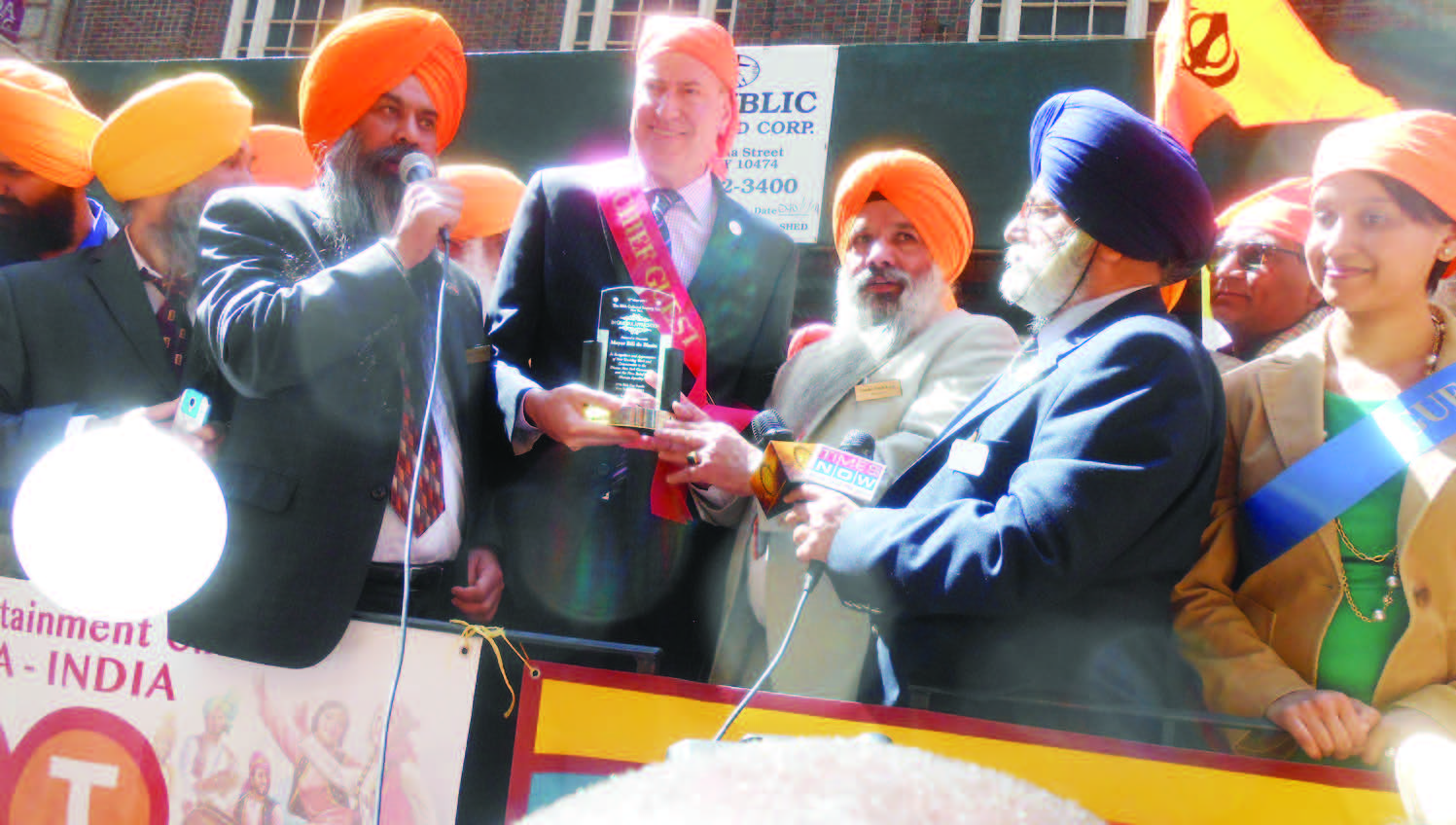
    NEW YORK CITY, NY (TIP): The 27th Sikh Day Parade in New York, the largest gathering of the Sikhs at an event on the East Coast, on April 26, 2014, proved out to be historic because of the participation of New York City Mayor Bill de Blasio.

    It was for the first time that Mayor of New York City participated in the 27 year old Sikh Day Parade. His participation is to be seen as recognition of the growing power of the Sikh community in this region. Bill de Blasio joined the parade a little after it started and stayed for a while on a float carrying the organizers and the TV crew covering the parade.

    In his brief remarks, whereas he congratulated the Sikhs on their day of creation, he was eloquent in praising the community as hard working. He said the community had greatly contributed to the growth of New York. The community leaders were obviously thrilled and excited to have the Mayor. Mr. Gurdev Singh Kang, President,Gurdwara Sikh Cultural Society, who honored the Mayor with a plaque, on behalf of the organizers of the Parade and the Sikhs of the Tri-States of New York, New Jersey & Connecticut, spoke highly of the Mayor’s concern for all New Yorkers.


    7
    Panj Piaras lead the Parade

    He appreciated Mr. de Blasio for keeping his word and described him as a great friend of the Sikh community. The Parade that started around 1 P.M. from 37th Street on Madison Avenue, took over 2 hours to reach its termination point on 25th Street on Madison Avenue. The Parade was led by the Panj Piaras (The Five Beloveds, the first five who were ordained as Khalsa by Guru Gobind Singh).

    Behind them was the float carrying the Living Master of the Sikhs, the Sikh Scripture-Shri Guru Granth Sahib, with priests in attendance and the Raagis doing kirtan (bards singing the holy hymns). Behind the float marched men, women and children. There were a number of floats depicting history and culture of the Sikhs. Dozens of Sikh organizations and institutions had their groups marching in the Parade, carrying banners, placards and small Khalsa flags and either reciting Gurbani or raising slogans in praise of God Almighty and the Sikh Religion.


    8
    The Sikh Cultural Society contingent

    The Mid-Town Manhattan Madison Avenue appeared to have been invaded by Kesari (Saffron) color. Most men wore Kesari turbans. Most women had Kesari dupatta (head covering) while kids had Kesari Patkas and turbans. A sea of humanity, over 50,000, according to the organizers, marched in the Parade. Then there were milling crowds, eager to watch the grandeur of the Parade, on either side of Madison Avenue, all along the route of the Parade. It was a sight that must have got embedded in the memory of people.

    Sikh martial arts in the form of Gatka drew attention of the bystanders watching the Parade on a fine day. A Sikh conference followed the Parade. A stage was set up for the conference from which Sikh leaders and the local politicians addressed the gathering. Amongst the political leaders and officials who greeted the Sikhs on the Sikh Day were a former Comptroller of New York City, John Liu who is a great friend of the community, Public Advocate Letitia James and Assemblyman David Weprin. Dr. Amarjit Singh, the Khalistan ideologue, made a comeback after 3 yearlong banishment.


    9
    Dr. Amarjit Singh, the Khalistan ideologue, addresses the gathering, flanked by organizers of the Parade

    His competitors Dr. G. S. Auluck and Dr. Paramjit Singh Ajarawat had succeeded in keeping Dr. Singh out for more than 3 years. However, Dr. Amarjit Singh seems to have turned the tables on them and succeeded in pushing them out. The two were not seen at the parade this year. Dr. Singh made a scathing attack on the government of India, accusing it of discrimination against Sikhs, denying them their rights, and carrying out the community’s systematic “genocide”.

    He spoke at length of the killings of thousands of youth during the struggle for Khalistan initiated by Sant Jarnail Singh Bhindranwale, the Operation Bluestar and the “genocide” of the Sikhs in the wake of Indira Gandhi’s assassination. Amid Khalistani slogans raised by his Sikh Youth of America volunteers and the attending gathering, Dr. Singh declared that Khalistan is a realty; it is only a question of time that the Sikhs will have a sovereign Khalistan. Among others from the community who spoke briefly, included Gurdev Singh Kang, President of the Sikh Cultural Society, the organizers of the Parade, who extended a word of welcome and recognized the guest speakers.


    10
    A view of the gathering

    TIP reporters who spoke to a cross section of people participating in the parade, found them praising the arrangements and the control of the Parade. Many praised, in particular, the langar arrangements. Only a small number complained that water supplies were not adequate, en route the Parade. All in all, the 27th Sikh Day Parade was being viewed as one of the best in the history of the Sikh Day Parade.

  • Indian American Muslim Council (NJ Chapter) Celebrates 65th Republic Day

    Indian American Muslim Council (NJ Chapter) Celebrates 65th Republic Day

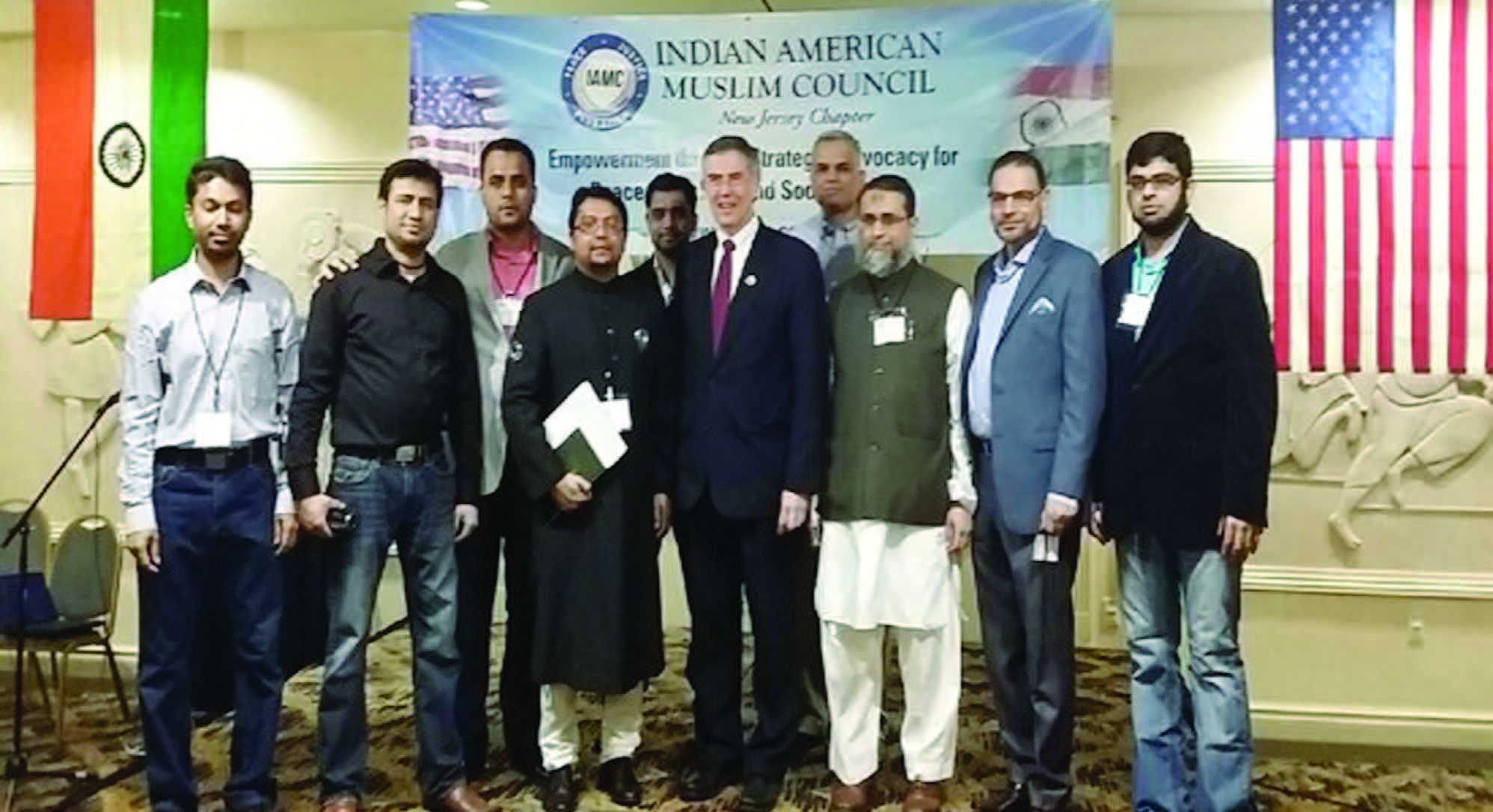
    NEW JERSEY (TIP): The New Jersey Chapter of the Indian American Muslim Council (http://www.iamc.com) an advocacy group dedicated to safeguarding India’s pluralist and tolerant ethos, celebrated India’s 65th Republic Day on Saturday February 1, 2014 at Clarion Inn (Ballroom) in North Brunswick., NJ. Hon. Rep. Rush Holt (D-NJ) from Middlesex County 12th Congressional District was the keynote speaker at the event, attended by over 160 people including Indian Americans from different faith communities.

    “The Constitution of India is truly a remarkable document. Through its declaration of India as a sovereign, secular Republic and its objectives of liberty, justice and equality for all its citizens, the Constitution provides a framework where all people, irrespective of race, creed and ethnicity can live together as a single nation”, said Minhaj Khan, President of IAMC-NJ.

    “As Indian Americans who are appreciative of the US as well as the Indian Constitutions, we have a special responsibility to uphold the ideals of both,” added Mr. Khan Congressman Rush Holt, NJ, congratulated India on its 65th Republic Day celebrations and Indian American Muslim Council in particular for honoring the plurality and integrity of the Indian Constitution.

    His message was “India will be stronger over the years if it embraces its diversity and if it protects religious freedom and the political rights of the minorities of all the states within India and this is clearly central to its traditions.” IAMC-NJ has been successfully organizing the India Republic Day event for the tri-state Indian Community for the past several years. This year’s event included Indian American attendees who had traveled from Connecticut to participate in the celebrations.

    The four hour event included fun activities for children including a Drawing Competition, as well as Fancy Dress and Spot Quiz Contests based on Indian themes. The US national anthem was followed by a soulful rendition of the national anthem of India, by Col. Virandra Tavathia. Imam Ahmed Chebli of Islamic Society of Central Jersey urged the audience to uphold the true Indian cultural heritage and the values that we brought as immigrants to the great land of opportunities which is the US.

    Speaking on the topic “Celebrating India’s Diversity and Pluralism”, IAMC Ex-President Shaheen Khateeb said, “this must be an occasion when we rededicate ourselves to maintaining harmony, peace and brotherhood. Most of all it is a time to look back and say how we have fared so far, and in which direction are we moving.We should not go in the direction of hate and destruction but on the path of building bridges and unity. All efforts should be made to protect this constitution and leave it intact for our future generations.” The attendees enjoyed delicious Indian food, followed by a great networking session. New Jersey is home to 292,256 Asian Indians, according to the 2010 census figures. The Indian American Muslim Council, established in 2002, has fifteen chapters nationwide. The Council’s mission is to advocate for peace, pluralism and social justice.

  • Newton documents yield chilling portrait

    Newton documents yield chilling portrait

    NEW HAVEN, CT (TIP):
    Connecticut police released thousands of pages Friday, December 27, from their investigation into the Newtown massacre, providing the most detailed and disturbing picture yet of the rampage and Adam Lanza’s fascination with murder, while also depicting school employees’ brave and clear-headed attempts to protect the children. Included in the file were photographs of the home the 20-year-old Lanza shared with his mother. They show numerous rounds of ammunition, gun magazines, shot-up paper targets, gun cases, shooting earplugs and a gun safe with a rifle in it.

    The documents’ release marks the end of the investigation into the Dec. 14, 2012, shooting at Sandy Hook Elementary School that left 20 first-graders and six educators dead. Lanza went to the school after killing his mother, Nancy, inside their home. He committed suicide with a handgun as police arrived at the school. The documents also fill in more details about how the shooting unfolded and how staff members looked out for the youngsters. The documents indicate investigators were gentle in their questioning of children, interviewing youngsters only if they or their parents requested it. Some of the parents thought talking openly about the shooting and getting accurate information out would help their children heal.

  • Same-sex marriage now legal in Utah & New Mexico

    Same-sex marriage now legal in Utah & New Mexico

    S. Saluja SALT LAKE CITY, UTAH (TIP): A federal judge, on December 20, struck down the state’s ban on same-sex marriage, saying the law “conflicts with the United States Constitution’s guarantees of equal protection and due process under the law.” In striking down the state law, which voters had approved in 2004, U.S. District Court Judge Robert J. Shelby wrote in a 53-page ruling that the state’s “current laws deny its gay and lesbian citizens their fundamental right to marry and, in so doing, demean the dignity of these same-sex couples for no rational reason.

    “Accordingly, the court finds that these laws are unconstitutional,” he said. A day earlier, on December 19, the New Mexico Supreme Court legalized same-sex marriage in the State, declaring in a ruling that it is unconstitutional to deny a marriage license to gay and lesbian couples. There are 18 States now that allow same sex marriage. 7 States have allowed pursuant to Court decision. These are California (June 28, 2013), Connecticut (Nov. 12, 2008), Iowa (Apr. 24, 2009), Massachusetts (May 17, 2004), New Jersey (Oct. 21, 2013), New Mexico (Dec. 19, 2013), Utah (Dec. 20, 2013). 8 States have allowed same sex marriage through State legislation.

    The states are Delaware (July 1, 2013), Hawaii (Dec. 2, 2013), Illinois (law will take effect June 1, 2014), Minnesota (Aug. 1, 2013), New Hampshire (Jan. 1, 2010), New York (July 24, 2011), Rhode Island (Aug. 1, 2013), Vermont (Sep. 1, 2009). 3 States have allowed same sex marriage by Popular Vote. These states are Maine (Dec. 29, 2012), Maryland (Jan. 1, 2013),Washington (Dec. 9, 2012). Massachusetts is the first State to allow same sex marriage while Utah is the latest to join. However, Illinois legislation to allow same sex marriage will take effect on June 1, 2014.

  • THE POLITICS OF THE GOVERNMENT SHUTDOWN

    THE POLITICS OF THE GOVERNMENT SHUTDOWN

    With the government having lurched into its first shutdown since the 1990s, many commentators are focusing on the potential ill effects that it might have for Republicans. Almost all of these analyses use the shutdowns of 1995- 1996 as their starting point. While I don’t think this development will be great for Republicans, many of the concerns are likely overwrought. Here are four points to ponder:
    1. While the GOP’s tactics are similar to those employed in the mid-’90s, the goals are different.
    The earlier budget debates were broad in nature and dealt with the scope of government. The 104th Congress, led by Newt Gingrich, believed that they were the culmination of the realignment supposedly begun by Ronald Reagan, that Bill Clinton’s election was a fluke caused by Ross Perot’s candidacy, and that they had been elected with a mandate to shrink the size and scope of government dramatically. They entered the shutdown believing that the public would rally to their side, that Clinton’s job approval would fall in the wake of the shutdown, and that he would ultimately cave on their demands. Despite the lore that has since sprung up, this wasn’t a completely harebrained view of the underlying politics: An earlier shutdown, in 1990, did play an important role in persuading George H.W. Bush to abandon his famous “no new taxes” pledge a few weeks later. Of course, that isn’t how it played out at all in 1995 and 1996; Bill Clinton was widely viewed as having held the line against the Republican onslaught, although he actually did give substantial ground on taxes and a number of other issues.

    The budget fight became the focal point of Democrats’ attempt to take back the House and Senate in the 1996 elections. But the Democrats didn’t actually use the shutdown itself as their main line of attack on Republicans. It was part of it, but the real attacks came over the Republicans’ motivation for the shutdown. Because of the expansive nature of the GOP’s cuts, the Democrats were able to focus on several unpopular portions of the GOP budget: the so-called M2E2 strategy. They commenced a mantra-like repetition of their opposition to Republican attempts to gut “Medicare, Medicaid, Education and the Environment” in favor of a “risky tax scheme” that benefited the rich. In other words, in evaluating 1996 as an illustration of what will happen to the GOP today, we probably have to separate the tactic of a shutdown from the substance of what motivates it. And today, the GOP is focused on defunding Obamacare, a law that isn’t particularly popular. For the analogy to 1995-96 to really stick, the GOP will probably have had to try something along the lines of shutting down government to implement the Paul Ryan balance-budget plan. While public opinion might be against the shutdown tactic, there probably won’t be the same level of outrage against the underlying policy motivation, which is what 1995-96 was mostly about. If Obamacare turns out to be the train wreck some conservatives predict (I have no clue whether it will or won’t), the tactic itself might be viewed as less of a negative.

    2. John Boehner is not Newt Gingrich, and Barack Obama is not Bill Clinton.
    This is a fairly minor point, but Gingrich’s public persona did play a part in bringing the shutdown to an unhappy end for the GOP. He was polarizing from the start, and the media didn’t bend over backwards to help him out. Case in point: The Daily News cover depicting him as a crybaby who shut down the government because he had to sit in the back of Air Force One. Boehner, on the other hand, has kept a much lower profile, and while he isn’t all that popular, he isn’t a lightening rod either (although Ted Cruz seems to be inching toward filling Gingrich’s shoes in that regard). At the same time, Obama is not really Clinton. The current president’s ability to present himself as a cautious centrist in political face-offs with Republicans to date have been mixed at best; his strength has always been energizing the liberal base for elections rather than tacking to the center. Clinton might be the most successful president of my lifetime when it comes to publicly framing a debate in a way favorable to his side (see, for example, the M2E2 strategy above). There are actually few examples, if any, of Obama rallying the public to his side in the various battles he’s fought; there are plenty of failures, with the fight over sequestration being the most recent case in point.

    3. The net effect of the shutdown was small in the 1990s.
    For all the talk of the sustained damage the Republicans suffered, the actual evidence for this is pretty weak. In 1994, Republicans won 230 seats in Congress. Five party switches and a special election victory later, they entered the 1996 elections with 236 seats. They emerged from those elections with 228 seats, for a loss of eight total (including the open seat of one of the Democratic Party switchers). So while Republicans lost seats, it ended up being something of an empty victory for Democrats: Americans elected a Republican Congress back-to-back for the first time since the 1920s. Republican candidates won the popular vote for the House, albeit very narrowly (Democrats won the vote only if you split up votes cast for candidates running on multiple party lines, e.g., a Republican also running on the Conservative Party line in New York). Republicans even gained a seat in a special election held in a Democraticleaning district in between government shutdowns, and only narrowly lost a Senate seat in Democratic-leaning Oregon immediately after the shutdown (Republicans proceeded to win another open Senate seat in the same state by four points in November). Those Republican House losses weren’t terribly surprising.

    Republicans were overexposed as a result of the 1994 “wave election” that swept a number of weak members into swing-to-Democratic-leaning districts. Losing representatives like Andrea Seastrand, Michael Flanagan and Fred Heineman was more a part of regression-to-the-mean than any wholesale rejection of Republicans. Of the 21 House seats that Democrats claimed from Republicans in 1996 (it was actually 22, but I don’t have presidential data for Louisiana’s 7th District), Clinton had carried 18 in 1992. The other four seats were all something of special cases: Bob Dornan in California, Gary Franks in Connecticut, David Funderburk in North Carolina, and Toby Roth’s open House seat in Wisconsin. This presents a problem for Democrats hoping to capitalize on the 2013 shutdown: The seats are much better sorted these days. Going into the 1996 elections, 79 Republicans occupied seats that had voted for Clinton in 1992. In other words, they lost 23 percent of their caucus from “Clinton seats.” Today, only 17 Republicans come from “Obama seats” to begin with. If Republicans suffered losses in unfriendly territory at the same rate as they did in 1996, they’d lose only four seats, before we start looking at the effect on Democrats from “Romney seats.” Perhaps Republicans would have fared better had they not attempted to shut down the government in the first place.

    Republicans picked up 10 open House seats and defeated three Democratic incumbents in 1996; absent the shutdown, perhaps they might have gained seats. In the Senate, Republicans narrowly lost open Democratic seats in Louisiana and Georgia, while missing good opportunities to defeat Tom Harkin in Iowa and Max Baucus in Montana. But as Harry Enten has ably demonstrated, Republicans did about as well in the House and in presidential elections as we would have expected given the performance of the economy, especially when you consider that exit polls showed Ross Perot pulling votes disproportionately from Republicans (unlike 1992, when he pulled evenly from both parties). Clinton’s comeback was likely due more to the flurry of good economic news in the run-up to the election than to anything else. Indeed, while Clinton’s job approval improved over the course of the shutdown, it had also improved in the months leading up to the shutdown at a similar rate. Senate losses in Louisiana and Georgia look bad today, but in 1996 both states were more Democratic; Clinton had carried both states in 1992 and only narrowly lost Georgia in 1996 while winning Louisiana by 12 points. Republicans had only won two narrow Senate elections in Georgia before 1996 (and hadn’t won the governorship since Reconstruction), while Republicans had never won a Senate election in Louisiana and were burdened by a controversial candidate in Woody Jenkins. Republicans were unable to defeat Harkin, Baucus or Mary Landrieu in the good GOP year of 2002.

    4. What happens to red state Senate Democrats?
    Of course, the real action for 2014 is not the House, where the GOP will continue to control the agenda except in the unlikely event that it loses 17 seats. The real fight is for control of the Senate, which in turn revolves around races in eight states: West Virginia, Arkansas, Kentucky, South Dakota, Louisiana, Alaska, Montana and North Carolina. Obama lost those states by, respectively, 27, 24, 23, 18, 17, 14, 14 and two points, respectively. The politics of a shutdown in these states are very different than in the nation as a whole. We can try to estimate the popularity of a shutdown by taking as a national baseline CNN’s recent finding that 46 percent of voters would blame Republicans for a shutdown vs. the 36 percent that would blame Obama. If we adjust these numbers according to the results of the presidential election in 2012, we would estimate that the president would shoulder the blame for a shutdown in each of those states save for North Carolina, and that outright majorities would blame the president in West Virginia, Arkansas and Kentucky. The last thing Democratic candidates in these states want is a public spat over a piece of legislation that is highly controversial, that might have a problematic rollout in the coming weeks and months, and that places them on the side of an unpopular president.

    If there’s an upside for the GOP, this is probably it. Even after the 1995-96 shutdowns, the GOP managed to gain Senate seats, largely by making gains in reddish states. Of course, none of this should be read as advocating the shutdown, or predicting that it could not possibly have any negative consequences for the GOP. For starters, a government shutdown is essentially lighting a fuse without knowing exactly where it will go. This is something that could easily get out of control if the shutdown stretches out for weeks and bleeds into the debt ceiling battle, which could be potentially catastrophic for the county. Moreover, it could give Democrats an issue to rally around. Unlike 1996, the economy is weak; the president’s job approval has suffered in recent months as a result of his perceived failure to move the Democratic agenda forward, and the aborted intervention in Syria. Many of these losses have come as a result of Democrats becoming dissatisfied with the president. If the election were held with the president’s job approval at its present level, Democrats would probably lose another 10 House seats or so, giving Republicans their largest House majority since 1946 (and possibly 1928). A dustup with congressional Republicans would probably help bring these Democrats back into the fold, especially if the president emerges victorious from the fight, helping to limit Democratic losses. Finally, we should also remember that the current weak recovery has been ongoing now for 52 months.

    It’s already longer than six of the 11 recoveries in the post-War era. By this time next year, it will be longer than seven of them. By 2016, only the booms of the mid-’60s, mid-’80s, and mid-’90s will have lasted longer. And, well, this recovery doesn’t much resemble those recoveries so far. In other words, there’s a decent chance that we’ll encounter a downturn in the economy in the next year, and a very good chance that we’ll encounter one in the next three years. Obama is probably reaching the end of the time period where his predecessor can be blamed for the state of the economy. But a lengthy shutdown could conceivably give Democrats ammunition to place the blame back on Republicans. The bottom line is this: The shutdown will probably not be a good thing for the GOP, and there’s a good chance Republicans won’t achieve their intended goal of limiting Obamacare’s reach. But at the same time, a lot of the prophecies of doom for Republicans are heavily overwrought. Unless things get too far out of control, the predictions of heavy GOP losses from a shutdown are likely overstated.

  • ABOUT SALEEM IQBAL

    ABOUT SALEEM IQBAL

    Saleem Iqbal is currently the President/CEO and Director of HAB BANK, a multi-state New York State chartered bank with headquarters in New York. Since 2000, Mr. Iqbal has led an extraordinary transformation of HAB BANK with ambitious strategic efforts designed to re-engineer processes and fuel sustained growth with diverse revenue streams. The Bank besides expanding its branch network saw its assets and deposits more than tripled since Saleem Iqbal assumed leadership in 2000. Shareholder’s equity also experienced more than triple digit increase during the same period. Before joining HAB and while with Habib Bank AG Zurich in 1991, Saleem Iqbal quickly established himself as a growth-oriented individual. He was responsible for an unparallel growth of Habib Bank AG Zurich Branches in UAE and Oman.

    In 2011, the Federal Reserve Bank of New York appointed Saleem Iqbal on its Community Depository Institutions Advisory Council (CDIAC) for a 3- year term. CDIAC consists of 12 CEOs selected from over 1200 Banks, Thrifts & Credit Unions in New York, New Jersey, Connecticut, Puerto Rico and US Virgin Island. Saleem is the only South Asian on the Council. Appointed by NYLIB (New York League of Independent Bankers) on its Advisory Board of Directors in 2012. In 2013, Saleem was among a select group of business leaders invited to The White House for the Export Finance Roundtable. The Round Table is the initiative of The White House Office of Public Engagement and The Export Import Bank of the United States. 4 Times winner of ‘Man of the Year Award’. This award is conferred to the best performing individual in Habib Group of Banks – worldwide. He is the only individual to have won this award 4 times Saleem serves on Board of Middlesex. Community College in NJ and Cerritos Community College in Cerritos, CA. He is a charter member of The Indus Entrepreneurs with chapters all over the US and holds an MPA (Masters in Public Administration).

  • SARATH KUMAR, RADIKAA enthrall audience in Tamil Sangam star nite

    SARATH KUMAR, RADIKAA enthrall audience in Tamil Sangam star nite

    NEW YORK (TIP): Attendance by top-ranking elected officials, entertainment by two prominent Tamil movie stars, honoring four Tamil-Americans who had excelled in their chosen field, game show for couples by actress and popular TV host Jaishree and dancers performing for popular Tamil movies marked the inauguration of America Tamil Sangam in New York on Aug 23. Supreme Star R. Sarath Kumar, a popular Tamil hero, president of South Indian Artists Association, member of Tamil Nadu Legislative Assembly and his actress wife Radikaa Sarath Kumar, a very popular TV personality dubbed as Queen of Indian television who were the parade marshals of the India Day Parade held by the Federation of Indian Associations (Tri-State) earlier in the week, enthralled the packed audience at the Hindu Community Center auditorium in Flushing.


    img32
    Radikaa cutting her birthday cake on stage while her husband and actor Sarath Kumar, their son Rahul Sarath Kumar and President of America Tamil Sangam Prakash M Swamy cheer.

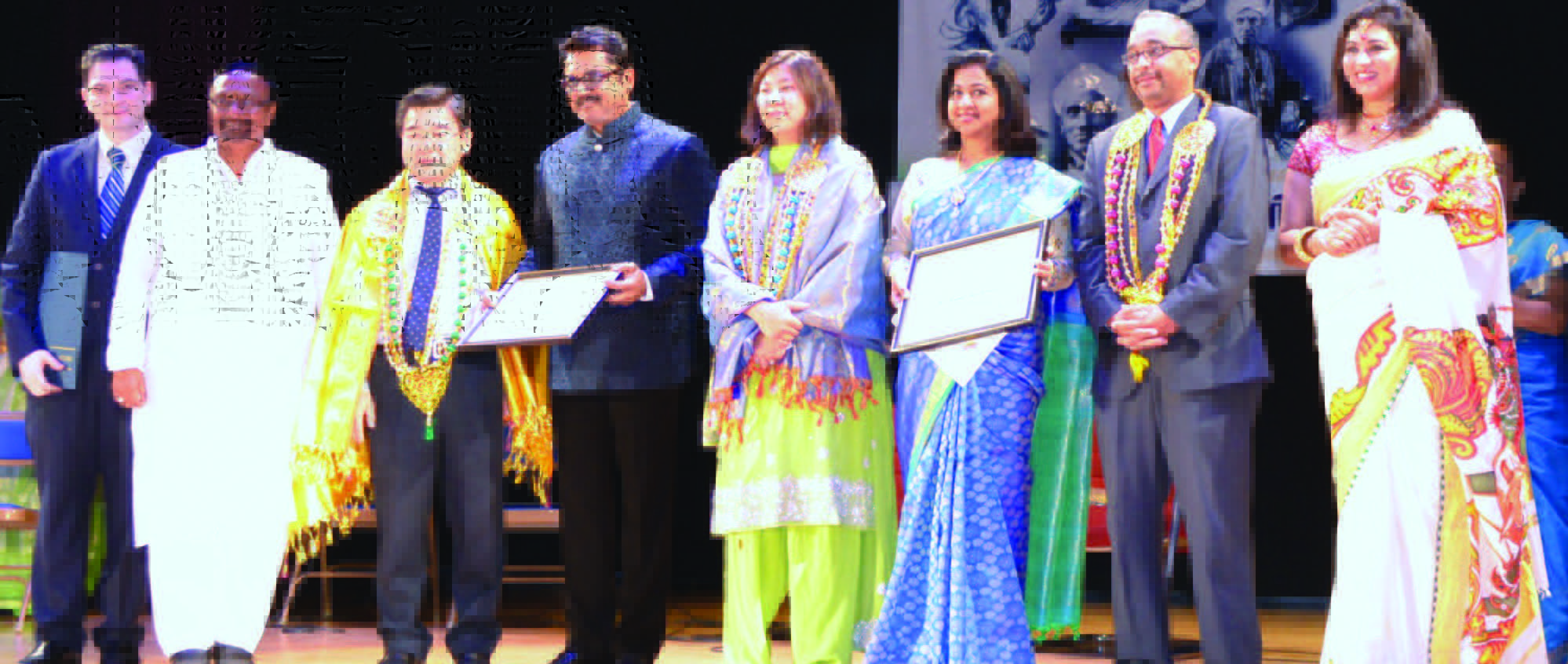
    The two took part as super couple in the game show specially designed for couples and telecast in Sun TV by actress and TV host Jaishree and gave valuable tips on family values, happiness in marriage laced with humor. They also addressed the gathering and took question and answers from the audience in the four-hour program. Four prominent Tamils in the US who had reached the zenith in their chosen field were bestowed with Tamil Ratna Awards. The awardees are Bharathanatyam exponent Padma Bhushan Kamala Lakshman who strode the film industry and dance stage like a colossus for fifty years; Dr Valavanur A Subramanian, world-renowned cardio-thoracic surgeon; Abel Laureate Prof Srinivasa Varadhan, distinguished professor of mathematics atNew York University and Dr. Prasad Srinivasan, Member of Connecticut General Assembly – the first Tamilan to become Assemblyman in any US Legislature. V. Perumal, Head of Chancery of Consulate General of India, released the first copy of the America Tamil Sangam souvenir brought out on the occasion and delivered the presidential address.


    img33
    Radikaa presenting Tamil Ratna Award to eminent Bharathanatyam exponent Kamala Lakshman while Sarath Kumar and Prakash Swamy cheer

    In his remarks, he recalled the contribution of Tamils in the development of India and the United States in various fields such as medicine, media, legal and politics. Congresswoman Grace Meng, New York City Comptroller and Mayoral candidate John Liu, New York State Senator Jose Peralta and Member of New York City Council Peter Koo wished the newly-formed America Tamil Sangam a great success and said urged them to improve voter registration and take active involvement in governance. Jose Peralta presented a proclamation from New York State Senate and Council Member Peter Koo presented the New York City Proclamation to the couple to commemorate their visit to the US and praising their contribution to Indian cinema. Dr. Sudhir Parikh, Padmashree awardee and philanthropist and Anil Bansal, Executive Chairman and Founder of Indus-American Bank were honored by Sarath Kumar for their community service. Students of Bina Menon, founder of Kalashri School of Arts in New Jersey and Jerumila Prema Dhayalan, founder of Prema Kalalayam presented dance from the movies of Sarath Kumar that made the audience tip-toe to the fast numbers.


    img34
    The Tamil Ratna awardees – Prof Srinivasa Varadhan, Kamala Lakshman, Sarath Kumar, Radikaa, John Liu, Dr. Valavanur Subramanian, Dr Prasad Srinivasan and Prakash Swamy.

    The dance gurus were honored by Radikaa Sarath Kumar. The event also witnessed the belated birthday celebrations of Radikaa Sarath Kumar with the actress cutting the cake of Cake Designer Parul Patel in the form of a huge film reel to the loud cheers of the audience. Representatives of other South Indian regional organizations such as Dr. B. R. Surendra, President of Kannda Koota, Mrs Krishnasri Gandham, President of Telugu Literary and Cultural Association (TLCA) and Malayalam organizations were felicitated on the occasion and promised to work in tandem with the new organization. R. Ramaswamy, assistant general manager of Bank of Baroda, KK Mehta, CPA and Kannan Arumugham, MD of Anjappar Chettinad Hotels were recognized for their service to Tamil community. Prakash M Swamy, President of America Tamil Sangam, said the new organization will promote Tamil language, literature and culture among third-generation Tamil-Americans and be a voice of the community. Chapters are being launched all across the US. Plans are afoot to conduct New York International South Indian Film Festival in New York in April 2014 and stars like Rajinikanth, Mamotty, Chiranjeevi, Prabhu Deva and AR Rahman were invited to attend. Calai Chandra, vice president of the Sangam proposed a vote of thanks.

  • Sanjay Gupta backs medical marijuana, apologizes for previous views

    Sanjay Gupta backs medical marijuana, apologizes for previous views

    NEW YORK (TIP): One of America’s most prominent doctors says he has shifted his stance in support of medical marijuana. Dr. Sanjay Gupta, chief medical correspondent at CNN and a CBS News contributing medical correspondent, wrote a post on CNN.com called,

    “Why I changed my mind on weed,” in which he describes his change of heart that occurred while filming a documentary, aptly titled, “Weed.” “Long before I began this project, I had steadily reviewed the scientific literature on medical marijuana from the United States and thought it was fairly unimpressive,” wrote Gupta. “Well, I am here to apologize.” Gupta says he was too dismissive of the “loud chorus” of legitimate patients whose symptoms improved with help from medical marijuana. He now says,

    “I mistakenly believed the Drug Enforcement Agency listed marijuana as a schedule 1 substance [a category of dangerous drugs] because of sound scientific proof.” “They didn’t have the science to support that claim, and I now know that when it comes to marijuana neither of those things are true,” wrote Gupta, citing patient cases including a 3-year-old whose seizures were dramatically reduced from 300 a week to three a month with medical marijuana’s help.

    He adds that marijuana does not have a high potential for addiction compared to cocaine, or even cigarettes. Gupta is a faculty member in the department of neurosurgery at Emory University School of Medicine in Atlanta and in 2009, reports suggested he was offered the post of Surgeon General by President Barack Obama. In the doctor’s new post, he did reference concerns about the drug. As a father, he worried about marijuana’s effects on the developing brain.

    Recent research suggests marijuana may affect a teen’s IQ or raise risk for psychiatric disorders like schizophrenia. He says he wouldn’t permit his own kids to try it until they are adults. Gupta also lamented on the challenges facing more research into medical marijuana for treating pain, including a stricter approval process that has to go through health agencies like the National Cancer Institute and the National Institute on Drug Abuse (NIDA).

    He pointed out tolerance is a real problem in existing medications: People are likely to overdose from a prescription drug every 19 minutes, but he couldn’t come across one case of a marijuana overdose. “We have been terribly and systematically misled for nearly 70 years in the United States, and I apologize for my own role in that,” said Gupta. Medical marijuana is currently legalized in 20 states and the District of Columbia: Alaska, Arizona, California, Colorado, Connecticut, Delaware, Hawaii, Illinois, Maine, Massachusetts, Michigan, Montana, Nevada, New Hampshire, New Jersey, New Mexico, Oregon, Rhode Island, Vermont and Washington State. Illinois became the most recent state to approve a law Aug. 1, according to the Marijuana Policy Project.

    Maryland also has a hospital-based medical marijuana program. Quantity limits and approved conditions vary by state, but can include chronic pain, epilepsy, HIV/AIDS and cancer. A recent survey in the New England Journal of Medicine also indicated support for medical marijuana. When told about a hypothetical case of a 68-year-old woman with breast cancer that had spread to her lungs, chest and spine, 76 percent of doctors surveyed said they would favor the use of marijuana for medicinal purposes. But support is not universal.

    The prestigious Mayo Clinic has come out and said it does not support the use of medical marijuana for young people with chronic pain, citing a link to psychological disease and that people under 25 are more prone to become addicted. New York City mayor Michael Bloomberg made headlines in June when he called medical marijuana one of the “great hoaxes of all time.” Recreational marijuana use is currently legalized in Colorado and Washington State, following the November 2012 elections.

  • Kannada Koota’s 40th Anniversary: Hamsalekha Enthralls

    Kannada Koota’s 40th Anniversary: Hamsalekha Enthralls

    NEW YORK (TIP): Kannada Koota’s 40th anniversary celebration – considered a landmark in the history of Kannada Koota in New York – was held for the first time in Long Island, New York at the newly built Madison Theater, Molloy College. This was a unique event held in the multicultural and financial capital of the world, New York. For the very first time, many of the local U.S. dignitaries were invited and honored. The inauguration program was started after a combination of Indian and Continental breakfast.

    The Indian Consul General in New York Dnyaneshwar M. Mulay was the chief guest of the occasion. George Margos, Comptroller of Nassau County, Judge Peter Skelos, Judge New York Supreme Court Appellate Division, Tom Suozzi former Executive of Nassau County, Prakash M. Swamy, president of American Tamil Association, Dr. Kishore Kuncham, President of Indian Association of Long Island, Bobby Kumar and Kamlesh C. Metha – community leaders, George Abraham, chairman of Indian National Overseas Congress, Amarnath Gowda, Dr. S. Rajoor – Kannada leaders; Syed Zahid, Nassau County Human Rights Commissioner and Dr. Yelleshpur Jayaram were among the guests present on the occasion.

    Many past presidents of KKNY were also honored. The inaugural program began with a welcome by Sanketha Geete -KKNY’s anthem – and U.S. National Anthem. President Dr. B. R. Surendra gave an introduction on the past four glorious decades of Kannada Koota and welcomed all the guests. The program was traditionally inaugurated by all the honorary guests by lighting the sacred lamp.

    While this happened, Committee Members sang Kannada Geethe, highlighting the lighting and praying for world peace. Mulay commenced his speech in Kannada and praised the richness of the Kannada language, culture and emphasized the culture of India as a whole. He praised the contributions and dedication of Kannada leaders to this land of opportunity. All the guests were honored traditionally with Mysore Peta (hat) and shawl. The chief guest George Margos spoke about his experience with Indians and his visit to Bengaluru, and appreciated KKNY’s contributions.

    Judge Peter Skelos addressed the audience by appreciating Kannada community for bringing a splendor of culture to Molloy. The Afternoon session of cultural extravaganza began with a presentation of Kannada Koota by Dr. Surendra, followed by Bharatnatyam and group dance by KKNY children. A cultural ambassador from India H. S. Murali presented a documentary – tribute to one of the greatest singers of Karnataka, Dr. P. B. Srinivos. Lunch was greeted with an authentic South Indian cuisine followed by a program to felicitate all who gave a hand in preparing the event.

    The highlight of the day was the sensational music concert by Nadabramha Hamsalekha and associates, who came from Bengaluru. The group presented a special program exclusively designed for KKNY: “Shanti Nudi Kannada, Clear Nuclear.” Kannada Koota honored Hamsalekha with the title of “Sahitya Sangeetha Sambhrat.” A wonderful program designed by Kannada Koota “Karnataka Express,” a dance-drama highlighting the unique cultures of the different regions of Karnataka, which was seen by passengers traveling in a train all over Karnataka.

    A hilarious drama from Connecticut members made everyone laugh until their stomachs hurt. Dinner was served with North Indian style cuisine. During the breakout sessions at the projection hall, a few presentations and a few award winning short-films were shown. The grand-finale of the day was by sensational Raghu Dixit and band that enthralled the audience.

  • OFBJP Organizes Public Reception For BJP President Rajnath Singh

    OFBJP Organizes Public Reception For BJP President Rajnath Singh

    EDISON, NJ (TIP): Indian American community of tri-state area (New Jersey, New York, and Connecticut) gave a rousing welcome to Rajnath Singh, President of Bharatiya Janata Party (BJP) and his BJP delegation Ananth Kumar, General Secretary; Sudhanshu Trivedi, National Spokesperson; and Vijay Jolly, Convener of Overseas Affairs and Overseas Friends of BJP (OFBJP) in TV Asia Studio Auditorium at Edison, NJ on Sunday July 21, 2013. The program was organized by OFBJP-USA as part of its community global outreach program.

    The program was broadcasted live on TV Asia across US reaching out to 1.5 million viewers. The program was also relayed live in India, Canada, UK, Europe and Middle East thru various channels. Addressing the jam-packed auditorium, Rajnath Singh said that he was elated by the warm welcome that had been accorded to him by the Indian Americans here in US. He said that trust and credibility have become a big problem in India and BJP is the only option. No party in India has grown bigger than Congress except the BJP.

    BJP is the only party that has not suffered a vertical split. Communists have lost relevance and Congress has no policy on any of the issues nor has any ideology. Since its inception in 1951 as Bharatiya Jan Sangh and later on as BJP, the party has been pursuing a policy of Nation first. He continued that Atal Behari Vajpayee led a 24 party coalition for 6 years and the NDA rule was far better than 55 years of Congress rule in every aspect.

    Corruption, Inflation and price rise are the signature of congress rule whereas NDA government controlled the inflation and price rise in spite of the prevailing severe drought and economic sanctions imposed by the entire West after Pokhran nuclear tests. NDA inherited a GDP growth of 4.8% and 10% inflation whereas BJP handed UPA a GDP of 8.4% and inflation 3.5% in 2004. Amidst applause from the audience he said that Pokhran test was a big step wherein the BJP led govt made India a nuclear power even though we knew economic sanctions were staring at us.

    Countries that are much smaller have become developed countries but India is still a backward country and not sure why 55 years of Congress rule did not change much. Congress has to answer as to how much time they need to make India better, to remove poverty. BJP invited FDI in telecom sector but encouraged Indian investors whereas Congress has opened up the telecom sector 100%, increased in the LIC sector from 26% to 49%. Foreign investors have pulled out $7.5 billion from India and no one is ready to invest.

    Even after 60 years of Independence we still have 67% of people who don’t get food and we need a food security bill. We need leaders with firm conviction and leaders with vision and when we come in power we will make India a super economic power in 10-15 years. National Highway development has seen tremendous growth during NDA rule. 50% of the highways that were built during 1980-2012 happened during 6 years of NDA rule and the other 50% were built during 26 years of non-BJP rule.

    Gujarat development has become a role model across the world. Madhya Pradesh agricultural growth (19%) is the highest in the world and very soon will be providing 24hrs of power supply. Chhattisgarh PDS system serves 90% of the population without any corruption and is a model for other states to emulate. Goa is the only state in India where Petrol is cheaper than Diesel. India has a GDP growth of 4.8% whereas BJP ruled states have 10% GDP growth. UPA government has no plan to tackle Naxalism or terrorism.

    Appeasement has become the state policy whereas BJP never links terrorism to any religion, caste or region. After Mumbai terror attack, Prime Minister made a statement that he will not talk to Pakistan until it gives an assurance that they will control terror activities and not support any groups that work against India but changed all that in a matter of few months. Our foreign policy is at its worst with no friendly neighbors around us. During NDA rule we maintained good relations with Russia and development excellent relations with US.

    We made US our strategic partner. He appealed to the US govt to lift the ban on visa to Narendra Modi, he said on one side US agencies rate Gujarat as the best state and Modiji as an excellent administrator and on the other hand they deny visa to him. It will be better if US takes a decision soon as they will be forced to take a decision anyway later. When BJP comes to power we will make India a power of Rishi and Krishi (knowledge and Prosperity), he said. Indian culture influenced the world for thousands of years.

    We never planned to dominate the world and even Swami Vivekananda came to Chicago on his own and had great influence on the world by his teachings. Citing the example of Newsweek columnist Lisa Miller who stated that by imbibing Yoga, Pranayam, Ayurveda and Organic farming people in the West are becoming Hindus whereas it is a crime in India if you say you are a Hindu.Talking on the recent controversy related to Narendra Modi statement that he is a Hindu and Nationalist, media created and pseudo secularists made a big fuss.

    Professing your Hindu culture became a communal word in India. He said that as per the Supreme Court, Hindutva is a way of a life. Hindutva teaches love not only for human beings but even for animals, plants, rivers, mountains etc. It is Hindutva that teaches us to serve milk to a snake and take care of animals like ants and birds. He called on the Indian American Community to support BJP to build a strong India.

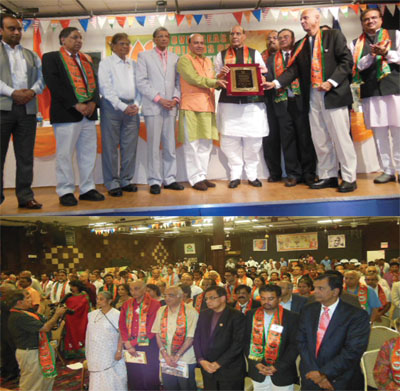
    Shri Rajnath Singh was accorded standing ovation. Shri Rajnath Singh was honored by the OFBJP executive committee with a plaque for his contributions to the party and the country. Earlier, Ram Rakshpal Sood (Sr.Advisor, OFBJP) acting as the Emcee welcomed the audience, chief guests and the sponsors of the event. After the traditional lamp lighting ceremony amidst the chanting of Vedic mantras by Pandit Pravin Shastri and Chandrakant Trivedi and blowing of conch shell by Pravin Shashtri. Mrs. Vidya Labroo led the rendition of Vandemataram.

    Jayesh Patel (President, OFBJP) welcomed the distinguished guests and said that entire India is chanting Narendra Modi (NaMo) mantra and expressed hope that BJP will be able to get majority on its own merit in the next election. Ram Kamath (General Secretary, OFBJP) introduced Dr. Mahesh Mehta, National Coordinator of OFBJP-USA. Speaking on the occasion, Dr. Mehta said that mission 2014 is about transforming India into a global leader and Global Indians should contribute to be the part of this great movement that will eventually contribute to the development of India.

    Dr. Adapa Prasad (Immediate Past President) introduced Vijay Jolly, Convener of BJP Overseas Affairs and OFBJP, as a dynamic leader and former MLA who took on Delhi Chief Minister during the last election.

    In his electrifying speech, Vijay Jolly urged the audience to applaud for Rajnath Singh for honoring the feelings of the people by making NaMo as the chairman of the campaign committee. Stressing the fact the OFBJP is on a mission to develop leaders by inducting youth into the organization to dethrone the corrupt Congress regime in India. Stating that NRI’s have always made India proud, he said that OFBJP has setup its chapters in UK, Norway, Nepal, Kenya and other countries to work for the welfare of Indian diaspora.

    He got the past Presidents of OFBJP-USA honored by Rajnath Singh Introducing SudhanshuTrivedi, BJP National Spokesperson, Dr. Dinesh Agrawal (Former- President, OFBJP) said that as the national spokesperson, he is very active effective on TV channels spreading the message and its ideology of BJP. SudhanshuTrivedi reminded that July 21st the day of the program is a historical day when US astronauts landed on the moon. Edison town, the venue of the program, is also a historical town, named after the inventor of light bulb.

    Hence, he said that word Bharat stands for light and inspires us to take India to the pinnacle of glory. Stating that BJP is all set to form the next government is not based on hope but on facts. He concluded reciting a poem by A.B. Vajpayee. R.P. Singh (Org. Secretary, OFBJP) introduced Ananth Kumar, BJP general Secretary. Amidst thunderous applaud from the audience, Shri Ananth Kumar introduced himself as the Hanuman of South as Kishkinda, the birth place of Lord Hanuman is in Karnataka whereas Rajnath Singh is from U.P, the land of Ram. For Ram’s team to win we need Hanuman and he is there to lend services for the party and the country.

    India, he said is going through turbulent times and like A.B. Vajpayee model, we have Gujarat model of development under NaMo leadership and we will soon have NaMo model of governance. He said that BJP is already in battle mode, under NaMo and Rajnath Singh’s leadership we are all set to take on the corrupt congress government. Once in power, BJP will make India a global player not only in spirituality but in culture, strategic matters and will be a decisive player in the world. He urged the NRI’s to connect with their districts back home and work for BJP’s victory in 2014.

    Chandrakanth Patel introduced Rajnath Singh as a man of impeccable image in spite of being in political life for 40+ years. Born in a farmer’s family in Varanasi, he rose to be the president of BJYM. He was part of the J.P movement and became the Agricultural minister in A.B. Vajpayee’s government. He was the President of BJP between 2007-2009 and again became the President in January, 2013.

    Currently, he is a Member of Parliament from Ghaziabad, U.P. Earlier, the President of TV Asia and a well known community leader, Shri H.R.Shah addressed the gathering and said that TV Asia always supported India causes and he has been an admirer of Mahatma Gnadhi and Sardar Patel. He said he felt close to BJP principles and supported BJP. He wished that Narendra Modi would be elected as the Prime Minister. Krishna Reddy (Treasurer, OFBJP) presented the vote of Thanks.

  • Sikhs Observe The Death Anniversary Of Sant Baba Prem Singh

    Sikhs Observe The Death Anniversary Of Sant Baba Prem Singh

    Sikhs of the tri-state area of New York, New Jersey and Connecticut organized in Queens, a day long memorial function for Sant Baba Prem Singh, a saintly figure who was a great social reformer. Sikhs in general and the Lobana community, in particular, revere him. Prayers, singing of hymns and sermons marked the occasion which was largely attended.

  • FIA’s Tall Claims Belie The Truth

    FIA’s Tall Claims Belie The Truth

    NEW YORK (TIP): Federation of India, New York, New Jersey, Connecticut announced with great fanfare on June 12 that it will celebrate India’s Independence Day on August 18 by organizing ‘India Day Parade’, which the organization claimed to be the ‘World’s largest India Day Parade outside of India’.

    The announcement was made by Sanjay Amin, president, FIA in the presence of the newly appointed Consul-General of India in New York, Dnyaneshwar Mulay, and a ball room full of people at ‘India House’ in midtown Manhattan. ‘India House’ happens to be the head quarter of the Consulate General of India in New York as well as the official residence of the Consul-General.

    The fact that FIA, an organization that has yet to prove its credentials for representing the culture and history of a country like India publicly, was allowed to use a Government of India facility for holding its kick-off meeting, gives it a legitimate status. Amused and bewildered by superlatives used by FIA officials while making exaggerated claims of achievements, Mr. Mulay nonchalantly highlighted some valid drawbacks in his scholarly speech, which were not fully understood by FIA authorities in appropriate contexts.

    Mr. Mulay advised FIA leadership to ensure representation of women in the leadership positions in the organization as women represented ‘Shakti’ in Indian culture. FIA chairman Ramesh Patel, in his effort to sound humorous, didn’t take the advise seriously and went on making fun of the issue. In a foolish remark Patel said that he had been facing Shakti all his life, referring casually to his wife.

    Taking the clue from their Chairman, other FIA functionaries also made similar out-of-the-context remarks about women, while none of them showed their concern or found it fit to explain why women were not included in the organizational hierarchy. Mulay also advised the organizers of ‘India Day’ parade to highlight India’s economic growth as a part of their celebration.

    None of the officials reacted appropriately to this suggestion except asking the government of India for financial help so guests could fly from India in the first class cabin of Air India or Jet Airways. One wonders if FIA realizes the concept of representing India in an intellectual fashion! FIA president Sanjay Amin informed the audience that his organization was successful in getting the Empire Estate Building illuminated in the tri-color of orange, green and white, symbolizing the three colors of the Indian national flag.

    He also said that FIA was honored to be invited by NASDAQ to ring the opening bell at NASDAQ. Of course these are great achievements but continue to remain symbolic in nature. There is nothing substantial that FIA could exhibit as India’s economic and cultural representations. The topmost priority of ‘India Day’ parade organizers’ remains working overtime to ensure presence of some Bollywood characters as Grand Marshall.

    The question is how many New Yorkers care about a Salman Khan or a Saif Ali Khan? Does a Bollywood celebrity represent the economic or cultural power of India? The crowds that watch the parade comprise of large number of New Yorkers, many of whom don’t belong to Indian origin. They don’t have much idea about India. They want to watch and know about India’s tradition, its history and its grand monuments.

    Unfortunately, FIA is entangled into an outdated notion of representing India with a Bollywood star who rides a float, which is nothing more than a crudely decorated publicity truck. It is absurd that FIA should claim that its parade is the biggest in the world because NYPD estimated that more than one hundred thousand people watched the India Day Parade on August 19, 2012 from the sidewalks of Madison Avenue.

    The parade took place in Midtown Manhattan that overflows with people on a Sunday anyway. Though FIA is a non-profit organization, it is controlled by a group of people who claim to be truly representing India in glamorous, spectacular and grand fashion from a Bollywood yardstick. The audacity of FIA bosses is such that they asked Mule to advise the Government of India for financial assistance for flying its guests in first class cabins of India’s national carriers. One hopes that Government of India stops legitimatizing such organizations by allowing its facilities to meet their shortsighted goals.

  • Young Indian-American girl appointed to United States Military Academy at West Point

    Young Indian-American girl appointed to United States Military Academy at West Point

    NEW YORK (TIP): It has been a long road from the small village in India where her parents were born, and her life began, but immigrating to the United States of America, becoming a naturalized American citizen, and on the cusp of becoming, perhaps, the first generation Indian woman cadet at the United States Military Academy at West Point, in the Academy’s prestigious 211-year history, is a “dream come true”, for a 18 year old Avon, Connecticut young lady.

    Sneha Singh, daughter of Amar Singh of Avon, is proof that hard work, discipline, a positive mental attitude, and remaining patient and focused, can result in turning dreams into reality. Sneha, a 2013 Avon High School graduate, will enter the prestigious United States Military Academy at West Point, on July 1st. Sneha will begin a 47 month odyssey that will culminate with a Bachelor of Science degree and a commission as a second lieutenant in the United States Army.

    Sneha hopes to pursue her dream of becoming a medical doctor and plans to study in a major that will prepare her for applying to medical school. Sneha’s appointment, by the directorate of admissions board at West Point, on behalf of the President of the United States, culminated a long journey, beginning in Sneha’s junior year of high school when she officially opened an admissions file at West Point.

    A turning point for Sneha was attending the West Point Summer Leadership Experience, a “one week” summer program that West Point offers to the top high school juniors in the country. During that experience, Sneha was able to experience “first hand”, Army life. She rose at 5am for physical training, marched to all of her activities, wore a uniform, communicated with her leadership utilizing military protocol, and experienced basic military training (which included a land obstacle course, an introduction to combatives; a form of military wrestling, and firing the Army M4 rifle in a laser simulation center).

    Sneha also had the opportunity to attend academic classes, social functions, participate in group sports, and at the conclusion of the seminar, be honored in a formal graduation ceremony. The bonds that Sneha formed with her fellow teammates enhanced her desire to serve her country. West Point Field Force Admissions representative major Nancy Bates, who is also a West Point graduate, met with Sneha and her parents during the admissions process and served as a mentor during Sneha’s candidacy.

    Major Bates explained the characteristics that West Point seeks in cadet candidates and why Sneha was such an exceptional young lady and pleasure to work with: “West Point evaluates each candidate utilizing a “whole person” concept. Over 15,400 young men and women applied during this past admission cycle, but in a typical year, only approximately 1,200 will ultimately be offered admission.

    Of those 1,200 candidates, approximately 200 will be women. It is a VERY competitive process. Each candidate offered admission must receive a nomination from his/her member of Congress, or a Presidential nomination (for service related candidates). Sneha received a nomination, last fall, from both United States Senator Joseph Lieberman and Connecticut 5th District Congressman Christopher Murphy.

    The nomination process involved submitting an extensive application package and a formal panel interview. In addition to each candidate receiving a Congressional or Presidential nomination, they must be qualified academically, medically and pass a rigorous candidate fitness assessment. Furthermore, each candidate must demonstrate leadership skills, through clubs, teams or organizations where they lead, as well as follow.

    Finally, each offered candidate must successfully pass a background investigation through law enforcement. In essence,West Point strives to identify candidates that are well rounded, given the difficulty and challenges of the West Point experience.West Point cadets must possess strength of body, strength of mind, and strength of character. Sneha particularly impressed me, not only because of her diverse and accomplished background, but her humble upbringing, maturity, dynamic and personable nature, infectious enthusiasm and positive mental attitude.

    Some candidates may be a “fit” for West Point, in terms of their background, but may not “fit in”, in terms of melding with the unique environment. After working with Sneha, I have absolutely no reservation that she will thrive at the academy.” Academically, Sneha was a top tier graduate in her 2013 high school graduating class, a National Honor Society member, and aggressively mastered Advanced Placement (college level) courses in Calculus, Statistics, Physics, Literature and Latin.

    Athletically, Sneha was the team captain of her high school track team and also received several varsity letters. She was also a member of her high school marching and Jazz band. Her leadership accomplishments included being a delegate to Girls State, and serving in class leadership and officer positions in various school clubs. In her spare time, Sneha volunteered within her community and was actively involved in figure skating.

    Her outside interests include classical piano, writing short stories, designing computer games, and spending time with friends. In her study of American history, Sneha drew inspiration from Eleanor Roosevelt, and her memorable quote “Believe in yourself. You gain strength, courage, and confidence by every experience in which you stop to look fear in the face……You must do which you think you cannot do!” Despite these impressive accomplishments, receiving the appointment to West Point; a full scholarship valued at over several hundred thousand dollars, would not have been possible, without the leadership, love and guidance provided by her parents.

    Sneha credits her father and mother with providing her the values, moral compass, work ethic and discipline, to enable her to achieve her dream. “It was my decision, and my decision alone, to attend the Academy and pursue a career as an Army Officer,” Sneha explains, “but without the love and support of my parents, I wouldn’t have reached this important milestone in my life.”

    In accepting the West Point appointment, Sneha has committed the next 12 years of her life, in service to this country. Following her 4 years at the academy, Sneha will serve on active duty for a minimum of five years, and then an additional three years in a Reserve/National Guard unit. Sneha’s final few weeks before “R” Day (Reception Day) will be spent with family and friends, while continuing to prepare physically and mentally for the challenges she will face during Cadet Basic Training and plebe year (West Point’s freshman year).

    In a few weeks, Sneha will grip hands with the members of the Long Gray Line, which came before her, but also leave a legacy for young women that choose to follow in her footsteps. Notable members of the Long Gray Line include military Generals such as: Robert E. Lee, Ulysses S Grant, George Custer, William Tecumseh Sherman, Thomas J. “Stonewall” Jackson, John “Black Jack” Pershing, George S. Patton Jr., Dwight D Eisenhower, Matthew Ridgway, Douglas MacArthur, Omar Bradley, Henry “Hap” Arnold, Creighton Abrams, Alexander Haig, Maxwell Taylor, and H Norman Schwarzkopf.

    Countless others, following military service, have had distinguished careers in business, medicine, law, sports, politics, and science. This includes 18 astronauts such as Frank Borman and Edwin “Buzz” Aldrin; George Washington Goethals (architect of the Panama Canal) Robert McDonald (chairman and CEO of Proctor and Gamble), James Kimsey (Founder of America Online) Mike Krzyzewski (head men’s basketball coach at Duke) and Pete Dawkins (Heisman Trophy recipient and accomplished business executive).

    Several graduates are members of Congress. What specific path Sneha Singh will travel over the next few decades has yet to be charted, but one thing remains certain as a chiseled stone….Sneha will succeed and her legacy as a future member of the Long Gray line will be remembered, and serve as a reminder that America is a beacon of hope and opportunity for immigrants from all corners of the earth.

    ABOUT WEST POINT
    Renowned as the world’s premier leader development institution, the United States Military Academy, America’s oldest Service Academy, founded in 1802, mission is “To educate, train and inspire the Corps of Cadets so that each graduate is a commissioned leader of character committed to the values of Duty, Honor, Country and prepared for a career of professional excellence and service to the Nation as an officer in the United States Army.” West Point accomplishes its mission by developing cadets intellectually, physically, ethically, spiritually and socially.

    West Point is this nation’s oldest military installation and also is the nation’s oldest engineering school. West Point holds a prestigious national ranking of 70 Rhodes Scholars, 31Truman Scholars, 4th in the nation in Hertz Scholars, and 6th in the nation in Marshall Scholars.

    Recent acknowledgements include Forbes pronouncing West Point as the “Best Public College or University in America for Undergraduate Education”, U.S. News and World Report proclaiming West Point the “Best Public Liberal Arts College in the Country”, and the Fifth best “Undergraduate Engineering Program”, and The Princeton Review designating the academy as one of the 100 Best Value Colleges, which included a “Top 10” ranking for, “Most to do on Campus”, “Most Accessible Professors” and “Best Classroom Experience”.

    The academic program at West Point offers over 37 majors in the sciences and humanities with the average student classroom to professor ratio; 8:1. The athletic and club activities offered at the academy is the most diverse in the country, with over 150 clubs and NCAA sports to choose from. Every year, the academy boasts “All-Americans”, Conference Championships and NCAA appearances in a wide variety of sports and competitive club activities.

    West Point can claim National Championships in recent years in women’s rugby, women’s and men’s boxing, orienteering, judo, pistol, women’s triathlon and team handball. Guided by its timeless motto; “Duty, Honor, Country”, West Point continues to prepare its graduates to serve as commissioned leaders of character in America’s 21st century Army.

  • GOPIO Organizes Community Interactive Session with Minister of Overseas Indian Affairs

    GOPIO Organizes Community Interactive Session with Minister of Overseas Indian Affairs

    NEW YORK (TIP): The Global Organization of People of Indian Origin (GOPIO), in collaboration with several community organizations and groups in the New York/New Jersey/Connecticut tri-state area, hosted a luncheon and interactive session on issues of interest to NRIs/PIOs with Vayalar Ravi, Minister of Overseas Indian Affairs (MOIA). The event held here on May 27 was well attended and the issues raised and questions posed to Minister Ravi concerned the Indian communities regionally and nationally.

    Preceding a formal welcome, GOPIO International president Ashook Ramsaran requested everyone to observe “a moment of silence on this Memorial Day to remember and pay homage to all who served and sacrificed for their country as well as for the victims of Chattisgargh and other tragedies”. Ramsaran then welcomed Minister Ravi and Ambassador D. Mulay, India’s Consul General in New York, as well as all attendees.

    GOPIO’s secretary J. Nami Kaur and Director of Diaspora Development Mridul Pathak presented to Minister Ravi GOPIO’s memorandum of community issues and matters of interest which were developed from various inputs, suggestions and recommendations received from chapters, membership and other organizations among the Indian American community in the United States.

    “Development of this memorandum is also based on GOPIO’s extensive knowledge, experience and interaction within GOPIO as well as with other individuals and groups in the Indian community regionally, nationally and globally”, said Ramsaran.

    The issues in the GOPIO memorandum included: OCI Card uniformity for all; Alternate documentation for PIO Card; OIC scheme; Changes in IDF procedures; alternate sites (US) for MBBS exams; NRI Tax beyond 60-day stay; uniformity of information, policies and practices; Reciprocity from India regarding US Immigration Bill for spousal employment; NRI Property Rights and Fast Track Judiciary; Research Visa, OCI/PIO Card holders; Indian Indenture Arrival Commemoration Plaques in PIO Countries; GOPIO’s support and collaboration on community outreach and feedback.

    There were other memoranda presented to Minister Ravi: one by Federation of Kerala Association (FOKANA) and another by Malayalee Organizations of New York. These memoranda focused primarily on OCI cards and associated issues. Following remarks by Ambassador Mulay and H. R. Shah, and introduction by GOPIO’s founding president Dr Thomas Abraham, Minister Ravi responded to all the issues and concerns raised in a very active and participatory session with attendees and the press.

    He was receptive to the questions posed and expressed appreciation to the NRI/PIO populations and their concerns for improving the procedures. “I will do all I can in my ministry (MOIA) to get you answers to your questions and help in any way I can”, said Ravi. The general consensus is that NRIs and PIOs look to MOIA to be the advocacy ministry in the Government of India to address Indian Diaspora issues of interest and concern with respective ministries within the Government of India as well as foreign governments – to seek remedy and redress to resolve current, critical issues affecting people in the Indian Diaspora.

    The issues raised have been hanging fire for a long time. In each interactive session with the minister the same issues have been raised and the minister has more often than not, been evasive and, at best has come up with what he said at this session: “I will do all I can in my ministry (MOIA) to get you answers to your questions and help in any way I can”.

  • Tlca Ugadi 2013 Program Held

    Tlca Ugadi 2013 Program Held

    NEW YORK (TIP): Telugu Literary and Cultural Association Ugadi 2013 program held on April 27th, 2013, was a thunderous success, the organizers claimed. The attendance from the Tristate, New York, New Jersey and Connecticut was overwhelming. The hall was packed even after making additional seating arrangement in the balcony. More than 1000 members witnessed the breathtaking program. The tri-state children presented various items like classical dances, songs and some never before items like Veena recital.

    Children of various ages have rendered various items with utmost precision. TLCA conducted TLCA’s Got Talent competition to encourage kids to showcase their talent in this program. Kids have participated in the program very enthusiastically. The winners were announced and prizes were distributed by the cine artists Sri Lakshmi, Hama Chandra and Ankita. The Guests relished the delicious dinner which is always a key for the success of the program.

    Authentic Ugadi pachchadi and Bobbatlu were offered along with the dinner. The post-dinner session had an auspicious start with our generous event donors Mallareddy garu and Mohan Badhey garu lighting the candles. TLCA offered Shradhanjali to the bereaved families of the pastpresidents and members of TLCA. All the members stood in silence praying for peace to the departed souls. State Senator Tony Avella graced the occasion and appreciated the programs conducted by TLCA. He was honored by the event sponsor donors. Edward P. Mangano, Nassau county Executive could not attend the function but sent his greetings.

    The Senator commended the donors for their generosity and presented mementos to the donors for their unstinted support to TLCA. Ticket to India, a dance ballet was presented as a part of TLCA encouragement to the youth. The kids performed excellent and the crowd cheered the performers and choreographers by standing ovation for presenting a wonderful ballet. TLCA’s Annual Souvenir was released by the Senator and the donors. The beautifully designed souvenir received every ones acclamation Later in the program the Stars rocked.

    Comedian Sri Lakshmi, Singers Hema Chandra and Sumangali and Actress Ankita entertained everyone with their performances. The songs, dances by the artists enthralled the audience. A lucky draw was taken and a 40″ LED TV sponsored by Maddipatla Foundation, was presented to the winner. President Krishnasri Gandham thanked all the donors that this would not have been possible without the generous donations from the event sponsors and all the other donors. She also thanked the entire Executive Committee and Board of Trustees for their help and support in organizing the event.

  • Indian American Community Organizations Welcome The New Consul General

    Indian American Community Organizations Welcome The New Consul General

    NEW YORK, NY (TIP): The Global Organization of People of Indian Origin (GOPIO), in collaboration with several community organizations and groups in the New York/New Jersey/Connecticut tri-state area, held a well attended and highly successful welcome reception and dinner in New York for incoming Indian Consul General Dnyaneshwar Mulay. The event was held on April 26, 2013 at the Asia Society in New York and provided a unique opportunity to welcome, meet and greet the new Consul General. The Indian Consul General in New York is a high profile position in the largest city in USA amongst the highest concentration of Non- Resident Indians (NRIs) and Persons of Indian Origin (PIOs), and host to numerous visits on a regular basis by prominent officials of the Government of India for meetings with US officials, the United Nations and the Indian- American community on issues of interest to NRIs and PIOs. The welcome reception and dinner was a combined community event, organized by GOPIO in partnership with GOPIO Chapters of New York, New Jersey and Connecticut; GOPIO Health, Cultural, Youth,Women’s & Business Councils; Life Members; GOPIO News Team. The event was co-sponsored by various prominent community organizations and companies, with support from media groups and others as co-sponsors. Sponsors include: Indian American Chamber of Commerce – USA, Tulsi Restaurant, Asia Society, Bharat Travel, Kingfisher, Parikh Media, HH-Resorts, Peter Advani, TV Asia, Society of Indian American Architects & Engineers of America (SIAEA); Media- Sponsors: Sahara, PIO TV, GloboSat, India Abroad; and participating organizations: Hyderbadi Cultural Assoc, Association of American Physicians of Indian origin (AAPI), Indian Dental Assoc, Indian Jewish Council IJC), National Federation of Indian Associations (NFIA), Association of Indians in America (SAIA); attending organizations: TelugU Association, Bengali Association, Gujarati Association, and several others. Also in attendance were Ambassador of Trinidad & Tobago to USA, Dr. Neil Parsan; Ambassador of Mauritius to United Nations Milan Meeterban; former Ambassador of Suriname to United Nations, Krishna Nandoe; Deputy Speaker of New Jersey Assembly Upendra Chivukula; New York City Councilwoman, Leticia James; John Bartlett, Jr, Freeholder of Passaic County in New Jersey. Event coordinator was J. Nami Kaur, Secretary of GOPIO International, ably assisted by Mridul Pathak, GOPIO’s Director of Diaspora Development. Other members of the organizing team included: Anita Bhat, Dr Asha Samant, Ashook Ramsaran, Jaswant Mody, Lal Motwani, Patsy Leopold, Quddus Mohammed, Dr. Renuka Misra, Sangeeta Ahuja, Dr. Thomas Abraham. Following a video biography highlighting Ambassador Mulay’s career and his impressive accomplishments, GOPIO International president Ashook Ramsaran made the formal welcome, stating that, “the Indian American community of the New York/New Jersey/Connecticut area is a significant population of NRIs and PIOs, very progressive, quite supportive – and also very vocal on matters of interest and concern”. Ramsaran added that, “we bid you a warm welcome with open hearts and open arms, with confidence that you will achieve much success during your tenure as Consul General if India in New York”. Ambassador Mulay thanked GOPIO and the community organizations for the warm and overwhelming welcome. In his remarks, he stated that, “huge opportunities exist for the Indian Diaspora in connecting India and the USA. India requires massive investments, is looking for technologies, continuously expanding education sector and health services and looks forward to proactive contributions of Diaspora in its developmental aspirations”. He added that, “the Government of India has taken enormous measures for promoting the wellbeing of the diaspora and connecting them with India. Since the setting up of the Ministry of Overseas Indian Affairs Ministry several special steps have been taken and a number of schemes introduced”. “Global Indian Diaspora – GOPIO Making an Impact” a comprehensive publication authorized by GOPIO, was presented to Amb Mulay as part of the New York release during the program. In addition, GOPIO’s founding life member and former secretary general Dr Jagat Motwani presented his latest book “India Reborn: Bharat Mahan, As Perceived by Westerners, Gandhi, Nehru, Tagore & Others” to Amb Mulay. GOPIO’s founding president, Dr. Thomas Abraham, spoke about GOPIO and its long history of serving the interests of the diaspora on a global scale. Prominent community leaders and supporters also welcomed Amb Mulay, extending good wishes and support: Dr. Sudhir Parikh (Parikh Media); H. R. Shah (TV Asia); Norman Solovay (Indian American Chamber of Commerce – USA); Upendra Chivukula (Deputy Speaker of New Jersey Assembly); and others. GOPIO presented to Ambassador Mulay a “Memorandum of critical issues and suggestions from the Indian American community of the New York/New Jersey/Connecticut area”. These issues include recommendation for improved communication with the Indian-American community, including more responsiveness to telephone calls placed to consulate and staff for regularly needed consular services; recommendation to provide answers on a timely basis to more FAQs on current issues on website, email advisory. Examples: OCI card, Passport Surrender procedures and fees; recommendation to set up a community feedback system on matters of interest and concern via community and consulate meetings, interactive forum, interviews on television and print, outreach to Indian- American community and other ethnic groups; posting a “calendar of events” which can be readily viewed for advance planning purposes; holding or collaborating on seminars on current critical issues such as youth, health, inter-generation, inter-ethnic, etc. – as well notable events such as Gadar Centennial Commemoration in USA. Media, however, was not invited to the event. (Based on a press release issued by Dr. Thomas Abraham)

  • Midtown NYC Boutique Co-Working and Technology Hub helps Innovative Start-Ups Secure Stability

    Midtown NYC Boutique Co-Working and Technology Hub helps Innovative Start-Ups Secure Stability

    NEW YORK, NY (TIP): Incubators, accelerators, and coworking spaces are becoming extremely important to the development of next generation entrepreneurs. INC39 (inc39.com) is uniquely positioned to help start-ups grow with our depth of resources, expertise, and experience. INC39 provides an open, hybrid membership model, with all of the advantages of a semester driven incubator that will provide freedom to the participating companies. Companies can gain access to co-working space, hardware, and important services vital to a startup technology company to stimulate technological innovations. INC39 is the only company that provides telecom switching, an onsite backup power generator, and a dedicated data center for companies who need onsite server access. INC39 is located in Midtown Manhattan a few blocks away from Grand Central Terminal making it easily accessible for people throughout all five boroughs as well as Connecticut, Long Island, and New Jersey.

    Under INC39 Qualified Start-Ups can:
    o Receive free prime location space, free technical support and funding.
    o Work side-by-side with dedicated experts to develop new technologies.
    o Exclusive access to a board-room, seminar room, printing facilities, and related incubator-style resources.
    o Attend dynamic lecture, mentoring and networking workshops with VC firms, academics and industry experts.
    o Participate in bi-monthly funding events, where each company has the possibility to receive funding.

    INC39’s founder, Kent Charugundla, believes in a holistic approach. As an alumnus of NYU, Kent is pleased to mentor, not only fellow NYU alumni but also, all aspiring entrepreneurs. INC39 aims to support a strong network of tech-entrepreneurs by creating a community and inspiring innovation.

    For more information, visit www.inc39.com . INC39 is located at 142 East 39th Street, New York, NY 10016. To schedule a tour contact: jesse@inc39.com

  • Sikhs Take Out An Impressive Sikh Day Parade In New York

    Sikhs Take Out An Impressive Sikh Day Parade In New York

    NEW YORK, NY (TIP): Organized by the Sikh Cultural Society, Richmond Hill, New York, the Sikh Day Parade on April 27 in Manhattan, New York, attracted, as usual, large crowds of Sikh men, women and children from the Tri -States area of New York, New Jersey and Connecticut. Besides, contingents came from as far as Philadelphia and Maryland.

    An estimated 30,000 ( according to the organizers, 50, 000) Sikhs participated. The parade that started from 36th street and Madison Ave wound its way through the city and ended up at 26th Street and Madison Ave for the conference. The event is held annually to mark Vaisakhi, the harvest festival of Punjab that coincides with the day the Tenth Master of the Sikhs, Guru Gobind Singh, created the order of Khalsa in 1699. All along and at the conference, placards with Prof. Davinderpaul Singh Bhullar’s photograph were carried by the participants who raised slogans for freedom for Bhullar and denounced government of India for being unjust to the Sikhs. Pro Khalistan slogans were also raised. The parade was dedicated to Prof. Davinderpaul Singh Bhullar who is in death row in India. The Parade passed a resolution requesting President of USA to secure freedom for Prof. Bhullar. The memorandum to US President alleged atrocities on Sikhs in India in 1984 (Operation Blue Star in which “1600 innocent Sikhs were killed” and killing of Sikhs in the wake of Indira Gandhi’s assassination when “3000 innocent Sikhs were brutally murdered”) and continued injustice to the community in India. It said Prof. Bhullar is being unjustly put to death even though there is no evidence of the crime he is said to have committed.

    The resolution read, inter alia, ” Sikh Cultural Society on behalf of this 50,000 strong peaceful gathering of Sikhs from the Tri-State area, but in spirit of all the Sikh Americans pass the resolution to request Mr. Barack Obama, the President of USA, to use his good offices and ask Indian government to stop the execution of Prof. Bhullar” . The resolution was received by Harpreet Singh Sandhu, an official with the Director of Public Engagement, White House. The first to be asked to speak was the President of Sikh Youth of America, the most vocal Khalistani organization that was founded by Dr. Amarjit Singh of Washington. Gurvinder Singh Manna, in his 8 minute long speech called upon the Sikhs all over the world to raise their voice of protest against death to Prof. Bhullar. He said that Prof. Bhullar’s confessional statement was obtained under duress and there is no witness nor any other corroborative evidence to prove his guilt. Even the judgment of the three judge bench was a split judgment when the presiding judge Justice Shah did not find Prof. guilty. The President of India who rejected Prof. Bhullar’s mercy petition did so without following the proper process of consulting the presiding judge, since the law says in the case of a split judgment, President should confer with the presiding judge in deciding on a mercy petition. Manna called upon Sikhs to work tirelessly to have their homeland without which they will always be subjected to injustice.

    Another noteworthy speaker at the parade conference was Ganga Singh Dhillon, one of the front ranking fighters for Sikh homeland, who, in spite of his frail health, was present to read out the resolution and present his viewpoint. He said, “sloganeering only helps government of India to brand Sikhs as separatists.” He noted that nothing could be achieved by raising slogans. The only way was to fight for Sikh homeland. Obviously, he was repeating himself when he went to Pakistan and from there organized the militant movement for Khalistan. Others who spoke included Boota Singh Kharaund, President of Shiromani Akali Dal , Mann (Simranjit Singh Mann ), Attorney Jaspreet Singh, Baljinder Singh Brar from Gurdwara Dashmesh Darbar, Carterot, Gurmej Singh, President, Gurdwara Baba Makhan Shah Lobana, New York, and Hardev Singh Padda, President, Sikh Gurdwara, Flushing. Two former Khalistani leaders, Gurmit Singh Auluck and Paramjit Singh Ajarawat, from Washington appeared to be ignored by the organizers. Auluck used to be the principal voice of Khalistanis some 20 years ago. He held sway up to 2000 and then faded out. Paramjit Ajarawat also was a potent Khalistani voice but now seems to have lost esteem with the Sikh leaders.

    They were invited to speak at the end when the gathering had almost left. Their disappointment was writ large on their faces. Contrary to their fate, resurrection of octogenarian Ganga Singh Dhillon, who has links in Pakistan, is surprising and intriguing. Among the political leaders and law makers present were Congresswoman Grace Meng, Council Member Mark Weprin, and Reshma Saujani who is seeking election to the Public Advocate in September, 2013. Gurdev Singh Kang, President of the Sikh Cultural Society which organizes the parade every year, expressed his gratitude to the participants for turning out in large numbers and celebrating the event in a befitting manner. He thanked the guest speakers, including the local politicians and law makers, for their time and valuable views they expressed.

  • 17 Indian American Students Named 2013 Goldwater Scholars

    17 Indian American Students Named 2013 Goldwater Scholars

    NEW YORK (TIP): Seventeen Indian American students from around the country who hope to become America’s next crop of researchers were recently named as Goldwater Scholars for 2013.

    The Barry Goldwater Scholarship and Excellence in Education Program was established by Congress in 1986 to honor Senator Barry M. Goldwater, who served his country for 56 years as a soldier and statesman, including 30 years of service in the U.S. Senate.

    The purpose of the Foundation is to provide a continuing source of highly qualified scientists,mathematicians, and engineers by awarding scholarships to college students who intend to pursue careers in these fields. Ameen Barghi, of the University of Alabama at Birmingham, who seeks a Ph.D. in Behavioral Neuroscience and wants to conduct research in rehabilitation medicine and teach at the university/graduate level. Ritankar Das, the University of California-Berkeley, seeking a Ph.D. in Computational Science and Engineering, wants to perform bio-molecular simulation research to find new energy sources at a national research lab, received the 2012 Pearson Prize for Higher Education.

    Ria Chandra Domier, University of Alabama, seeks a Ph.D. in Chemical and Biological Engineering, wants to conduct research in regenerative medicine and teach at the university level.

    Neeraj Sapra, University of California-San Diego, seeks a Ph.D. in Computational Physics, wants to conduct research in biophysics and teach at the university level. Ragini Phansalkar, University of Connecticut, seeks a Ph.D. in Computational Biology, wants to develop technologies to aid in the diagnosis and treatment of cancers.

    Gautam Goel, Georgia Institute of Technology, seeks a Ph.D. in Applied and Computational Mathematics, wants to develop the next generation of bioinformatics algorithms and teach at a university. Nikhil Bommakanti, University of Illinois at Chicago, seeks a M.D./Ph.D. in Biomedical Engineering, wants to conduct research in biomedical science and teach at the university. level. Manan Raval, University of Illinois-Urbana-Champaign, seeks a Ph.D. in Electrical Engineering, wants to conduct research in photonics and laser technology. Suraj Kannan, University of Louisville, seeks a M.D./Ph.D. in Regenerative Medicine, wants to conduct research in the mechanisms of stem cells and develop therapies for a variety of clinical pathologies. Nilay Kumar, Columbia University, seeks a Ph.D. in Fundamental Physics,wants to conduct research in fundamental (particle) physics and teach at the university level.

    Aparna Sajja, George Washington University, seeks a M.D./Ph.D. in Cardiology/Neuroscience, wants to conduct NIH funded neurovascular translational research and teach at the university level. Sandya Subramanian, Johns Hopkins University, seeks a Ph.D. in Biomedical Engineering, wants to conduct research in biomedical science and engineering and work in industry. Kamal Shah, Rice University, seeks a Ph.D. in Biomedical Engineering, wants to conduct research in low-cost, molecular bioengineering techniques and teach at the university level. Sheena Patel, Harvey Mudd College, seeks a Ph.D. in Physics, wants to conduct research in experimental physics. Ravi Uday Sheth, Rice University, seeks a Ph.D. in Bioengineering, wants to conduct research in Synthetic Biology and teach at the university level, research at a national lab or in industry.

    Sai Prashanth Gourisankar, University of Texas at Austin, seeks a Ph.D. in Materials Science, wants to conduct research in nanomaterials and catalysis, and teach at the university level. Kushal Seetharam, Duke University, seeks a Ph.D. in Applied Physics, wants to conduct research in electromagnetics and photonics using computational methods and teach at the university level.

  • Gun background check compromise, assault weapon ban fail in Senate

    Gun background check compromise, assault weapon ban fail in Senate

    WASHINGTON (TIP): The centerpiece proposal on background checks in the proposed changes to a gun control bill failed to win enough support in the Senate April 17. The vote on the so-called Manchin-Toomey amendment was 54 in favor, 46 against – failing to reach the 60-vote threshold needed to move ahead. Four Republicans supported it, and four Democrats voted no. A controversial Democratic plan to ban dozens of military-style assault weapons was also defeated by a vote of 40 to 60.

    The votes were a setback for President Obama, who angrily blasted Republicans for defeating the background check compromise, saying “the gun lobby and its allies willfully lied about the bill.” “All in all, this was a pretty shameful day for Washington,” Obama said, promising that “this effort is not over.” A number of other amendments also failed to earn the 60 votes necessary to pass: A GOP proposal including a number of changes, 52 to 48; a bipartisan amendment to stiffen penalties for “straw purchasers,” 58 to 42; a GOP-backed amendment that would have permitted “national reciprocity” of state-issued concealed carry permits, 57 to 43; and a GOP plan to extend gun rights for veterans, including those deemed unable to manage their financial affairs, 56-44.

    The raw emotion of the background check amendment defeat played out in the Senate gallery just after Vice President Biden read the vote count. “Shame on you!” at least two women were heard shouting. “We’re sick and tired of the death in this country and these legislators stand up there and think it’s a bunch of numbers,” said Haas, whose daughter, Emily, was wounded in the April 2007 shooting at Virginia Tech. “It’s a shame, it’s appalling, it’s disgusting,” she added. The chief architects of the plan to expand the national gun background check system, Sens. Joe Manchin III (D-W. Va.) and Patrick Toomey (R-Pa.), acknowledged in interviews early Wednesday, April 17 that their proposal lacked sufficient support. After the vote, Toomey expressed regret, but said that it was time to move on. “I did what I thought was the right thing for our country.

    I sought out a compromise position that I thought could move the ball forward on an important matter of public safety,” he said in a statement, adding later, “We have a lot of other very important issues to deal with such as getting the economy back on track, dealing with the debt ceiling and creating more jobs for Pennsylvanians.” Before the voting began, Biden, who is leading the Obama administration’s gun control effort, sounded quite frustrated with misinformation being spread by opponents to the bipartisan compromise Wednesday.

    Speaking during a “Google Hangout,” Biden reiterated that the proposal would not create or lead to the creation of a federal gun registry. “Nothing can be further from the truth,” he said. Biden also dismissed suggestions that the measures would infringe upon people’s constitutional right to bear arms. “There is no – zero – no infringement on the Second Amendment, not one single thing being proposed,” he said. In the hours before the vote, Senate Majority Leader Harry M. Reid (D-Nev.) also attempted to rally last-minute support for the bill by issuing an ominous warning to his colleagues. “If tragedy strikes again…if innocents are gunned down in a classroom, theater or restaurant, I would have trouble living with myself as a senator, as a husband, a father, or grandfather and friend, knowing that I didn’t do everything in my power to prevent that incident,” Reid said. Shortly before the vote, Sen.

    John McCain (R-Ariz.) said he would support the background check plan, saying that while he was a staunch defender of Second Amendment rights, the bipartisan proposal is “not overly burdensome or unconstitutional.” “Is this a perfect solution? No. will it prevent all future acts of gun violence? Of course not,” McCain said. “Would it have prevented the most recent acts of gun violence? In all likelihood, no. But it is reasonable, and it is my firm conviction that it is constitutional.” Meanwhile, only one day after suffering defeat, Senate Majority Leader Harry Reid on Thursday, April 18, set aside President Barack Obama’s plan to curb gun violence but promised to keep searching for a compromise.

    Reid said Democrats would keep negotiating on the proposals, even though the Senate rejected all the vital elements of the legislation prompted by the December massacre of 20 children and six adults at a school in Newtown, Connecticut.

  • US Senate agrees to debate gun bill

    US Senate agrees to debate gun bill

    WASHINGTON (TIP): The US Senate voted Thursday to debate the nation’s most ambitious gun safety legislation in almost two decades, after a bipartisan group of lawmakers agreed on expanding background checks.With relatives of the 20 children killed in the Newtown massacre watching from the visitors’ galleries, years of Senate refusal to address gun laws in the United States, and Republican obstruction, was swept aside.

    Some 16 Republicans joined the Democrats, setting up crucial votes next week on amendments to a bill that would tighten checks for firearms buyers, stiffen penalties for gun trafficking and boost school safety measures. “The hard work starts now,” top Democrat Harry Reid told his Senate colleagues moments after the 68-31 vote.

    White House spokesman Jay Carney said the “bipartisan progress” was encouraging, but stressed Thursday’s vote was just the “first stage in an effort to get sensible, common-sense legislation.” President Barack Obama, who has leaned heavily on Congress to adopt his proposals after the tragedy in Connecticut in December, called families of the Sandy Hook school shooting victims to congratulate them on the vote result and pledge his continued support in the fight.

    Jillian Soto, sister of slain Newtown firstgrade teacher Victoria Soto and who spent days pressing lawmakers on Capitol Hill to enact tighter gun laws, said she had hoped for a tougher background check amendment, but “I’m happy that we are getting somewhere.” The key ingredient in the complex gun control recipe is the compromise on background checks reached by Democrat Joe Manchin and Republican Pat Toomey.

    The deal waters down the universal background check system sought by Obama, which was opposed by scores of lawmakers including some Democrats who hail from conservative-leaning, pro-gun states. But it strengthens existing legislation, which only requires background checks for firearm purchases at licensed gun dealers, to require checks for sales at gun shows and on the Internet.

    It would still allow gun sales between relatives and friends to continue without such safeguards, however. The big question now is whether the legislation, in parts or as a whole, can pass the Senate and head to the House, where an even tougher vote is expected. Republican Mark Kirk of Illinois helped craft the compromise and is likely on board. And another moderate in the party, Susan Collins, has expressed her initial support, although she said she wants to study the bill’s language.

  • US Senate agrees to debate gun bill

    US Senate agrees to debate gun bill

    WASHINGTON (TIP): The US Senate voted Thursday to debate the nation’s most ambitious gun safety legislation in almost two decades, after a bipartisan group of lawmakers agreed on expanding background checks.With relatives of the 20 children killed in the Newtown massacre watching from the visitors’ galleries, years of Senate refusal to address gun laws in the United States, and Republican obstruction, was swept aside.

    Some 16 Republicans joined the Democrats, setting up crucial votes next week on amendments to a bill that would tighten checks for firearms buyers, stiffen penalties for gun trafficking and boost school safety measures. “The hard work starts now,” top Democrat Harry Reid told his Senate colleagues moments after the 68-31 vote. White House spokesman Jay Carney said the “bipartisan progress” was encouraging, but stressed Thursday’s vote was just the “first stage in an effort to get sensible, common-sense legislation.” President Barack Obama, who has leaned heavily on Congress to adopt his proposals after the tragedy in Connecticut in December, called families of the Sandy Hook school shooting victims to congratulate them on the vote result and pledge his continued support in the fight.

    Jillian Soto, sister of slain Newtown firstgrade teacher Victoria Soto and who spent days pressing lawmakers on Capitol Hill to enact tighter gun laws, said she had hoped for a tougher background check amendment, but “I’m happy that we are getting somewhere.” The key ingredient in the complex gun control recipe is the compromise on background checks reached by Democrat Joe Manchin and Republican Pat Toomey.

    The deal waters down the universal background check system sought by Obama, which was opposed by scores of lawmakers including some Democrats who hail from conservative-leaning, pro-gun states.

    But it strengthens existing legislation, which only requires background checks for firearm purchases at licensed gun dealers, to require checks for sales at gun shows and on the Internet. It would still allow gun sales between relatives and friends to continue without such safeguards, however.

    The big question now is whether the legislation, in parts or as a whole, can pass the Senate and head to the House, where an even tougher vote is expected. Republican Mark Kirk of Illinois helped craft the compromise and is likely on board. And another moderate in the party, Susan Collins, has expressed her initial support, although she said she wants to study the bill’s language

  • Gopio And Indian American Community To Organize Welcome Reception For New Indian Consul General In New York

    Gopio And Indian American Community To Organize Welcome Reception For New Indian Consul General In New York

    NEW YORK (TIP): In collaboration with several Indian-American organizations, groups and media, GOPIO is planning a community welcome reception and dinner for the incoming Indian Consul General in New York, Ambassador Dnyaneshwar Mulay, to be held on Friday, April 26, 2013. It is being planned as a combined community event by GOPIO chapters and many of the Indian-American organizations in the New York/New Jersey/Connecticut Tri-state area Amb. Mulay has just completed his term as Indian High Commissioner in Maldives.

    Interested organizations, groups and media are requested to assign one representative to be part of the planning team to GOPIO Secretary, J. Nami Kaur, at namique@gmail.com

  • US: Storm strikes mid-Atlantic; 250,000 lose power

    US: Storm strikes mid-Atlantic; 250,000 lose power

    WASHINGTON (TIP): A winter storm marched into the Mid-Atlantic region on Wednesday, dumping nearly two feet of snow in some places and knocking out power to about 250,000 homes and businesses. It largely spared the nation’s capital, which was expecting much worse and had all but shut down. Officials in Washington didn’t want a repeat of 2011, when a rush-hour snowstorm stranded commuters for hours, so they told people to stay off the roads and gave workers the day off. Dubbed the ” snowquester,” the storm closed federal government offices, just as the automatic budget cuts known as the sequester were expected to do. The storm pummeled the nation’s midsection on Tuesday, killing at least four people in weather-related traffic accidents.

    It was forecast to head to the northeast on Thursday, bringing strong winds, more snow and the possibility of coastal flooding to New England. The National Weather Service was predicting up to 7 inches of heavy, wet snow in southeastern Connecticut through Friday morning and wind gusts that could hit 50 mph, bringing possible power outages. A coastal flood warning was in effect starting Thursday morning for eastfacing shores in Massachusetts, with up to a 3-foot surge at high tide in some areas.

    Central Massachusetts was bracing for 4 to 8 inches of snow, while Boston was expected to get a little less. In Washington, where as much as 10 inches had been forecast, the storm did little but drop harmless snowflakes that rapidly melted amid warmer-than-expected temperatures. Federal offices in the region will be open Thursday. “They just say that it might snow and the whole city shuts down,” said Sheri Sable, who was out walking her two dogs in light rain and marveled at how even the dog park she frequents failed to open at 7am. There were bigger problems elsewhere in the region, though. On the Jersey Shore, still recovering from Superstorm Sandy, winds gusted past 60 mph in some parts.

    Winds raked the beachfront in Point Pleasant Beach, blowing drifts of sand onto Ocean Avenue, and shredding the decorative entrance canopy at a hotel across the street from the beach. Lashing winds also blew off part of the roof of a Stone Harbor, N.J., condominium complex and Ocean City officials advised residents to move their cars to higher ground in preparation of possible flooding. Maryland’s Bay Bridge, which connects Maryland’s Eastern shore with the Baltimore-Washington region, closed in both directions, because of wind gusts of up to 60 mph.

    A tractor-trailer overturned on the bridge and leaned against the guardrail. Kelly Kiley, an interior designer, was driving on the span soon after the accident. “The travel on the bridge was extremely scary,” Kiley said. “The crosswinds were terrible. Some of the taller box trucks were swaying.” The bridge reopened Wednesday evening. In North Carolina, state officials said high winds led to sound side flooding along N.C. 12 and brought the Hatteras-Ocracoke ferry run to a halt. In Virginia, governor Bob McDonnell declared a state of emergency and about 50 National Guard soldiers were sent out to help clear roads. Up to 20 inches of snow piled up in central and western parts of the state. More than 200,000 people in Virginia alone lost power and another 40,000 in New Jersey were left in the dark. Hundreds of wrecks were reported around the region. “Stay off the roads, stay inside, enjoy the day off,” McDonnell implored residents at an early-afternoon news briefing.

    In Richmond, most commuters appeared to be headed home by midday with the exception of Clint Davis, an attorney who was needed in US Bankruptcy Court. “Unless they canceled court, I had to be here,” said Davis, who was wearing a hooded slicker over his suit to shield himself from gobs of snow blown from trees. “I’ll be here for two or three hours and come out to a snow-covered car.” The storm dumped 2 feet of snow in parts of West Virginia, closing schools in more than half the state and leaving more than 20,000 customers without power. Some communities in Washington’s outer suburbs saw significant accumulation too, including in Loudoun County, which had 9 inches in some places.

    In Sterling, Va., a glaze of slush and snow coated major roads and side streets, but traffic was relatively light and plow trucks passed through repeatedly. Many retailers were closed. Only a handful of customers patronized the Glory Days Grill. Carolyn Donahue was working from home and trekked out with her husband, Tom, for a lunch break without any trouble on slushy but passable roads. “I don’t consider this a big storm,” he said. Downtown Washington was unusually quiet. Officials eager to avoid a repeat of 2011 pre-emptively shut down federal offices and canceled public schools. Nonemergency federal employees were treated to a paid snow day for the number of hours they were scheduled to work.

    Some congressional hearings were postponed, but the House of Representatives managed to approve legislation to prevent a government shutdown on March 27 and President Barack Obama was set to have dinner with GOP senators at a hotel on Wednesday night. “So far, knock on wood, we’ve dodged on this one,” said DC Homeland Security director Chris Geldart. “We’re keeping our fingers crossed that it remains the way it’s been.” The Baltimore-Washington area’s last major snowstorm struck Jan. 26, 2011. It hit Washington during the evening rush hour, causing some motorists to be stuck in traffic nearly overnight. It dropped 5 inches on Washington and 7.8 inches on Baltimore, knocked out power to about 320,000 homes and contributed to six deaths.

    The federal government later changed its policies to allow workers to leave their offices sooner or to work from home if major storms are expected. The current storm led to at least four deaths. A semi-trailer slid off a snowcovered interstate in western Wisconsin, killing two people. A central Indiana woman died when a semi-trailer plowed into her car after she lost control merging onto the highway, and a man from Columbia City in northeast Indiana was killed when his snowmobile left the road, headed across a field and crashed into a wire fence.

    The storm brought around 10 inches of snow to weather-hardened Chicago on Tuesday, prompting the closing of schools and the cancellation of more than 1,100 flights at the city’s two major airports. Hundreds more flights were canceled Wednesday at Dulles and Reagan National airports in the Washington area, according to FlightAware.com. In Pennsylvania and Ohio, many areas had 4 to 6 inches of snow. The weather service issued a winter storm warning for the Philadelphia area and parts of central Pennsylvania through morning.