NEW YORK (TIP): Walgreens expects to close 150 locations in the United States and 300 locations in the United Kingdom, Walgreens Boots Alliance CFO James Kehoe said in the company’s earnings call this week.
The pharmacy chain reported lower earnings on Tuesday , June 27, compared to the same quarter last year – $118 million, or 14 cents a share, compared to $289 million, or 33 cents a share, a year ago. The company is facing muted consumer spending and a pullback in demand for Covid vaccines. CEO Rosalind Brewer said the company was increasing its cost-savings efforts to $4.1 billion and “taking immediate actions to optimize profitability for our US healthcare segment.” Kehoe told analysts the company will have saved $3.3 billion by the end of this year, and is projecting to save “at least” $800 million in 2024. These store closures are part of its cost-cutting effort.
The chain operates almost 9,000 stores in the United States and expects to close the 150 US locations by the end of its next fiscal year, Aug 31, 2024, a spokesperson said. Kehoe said the company also eliminated more than 500 roles, or around 10% of its corporate and US office support workforce. Technology and its plans to build the “pharmacy of the future” will further drive savings, he said. “We are optimizing the model through our micro fulfillment centers, tech-enabled centralization of in-store activities and telepharmacy solutions,” Kehoe said.
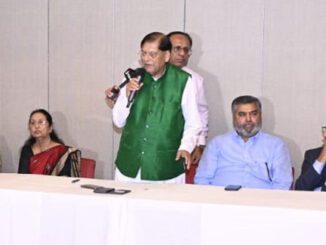
Dr. Bindeshwar Pathak and wife Amola Pathak were given a warm reception on arrival at the Mint Restaurant in Garden City. From L to R: Prof Indrajit Singh Saluja, Arvind Vora, Kamlesh Mehta, Amola Pathak, Pam Kwatra, Dr. Bindeshwar Pathak, Jagdish Sewhani, and Raj Wadhwa.
GARDEN CITY, NY (TIP): Prominent Indian American community leaders welcomed living legend Dr Bindeshwar Pathak at a meet-and-greet on June 19 in Long Island. A Padma Bhushan awardee, Dr Pathak is famous as the founder of Sulabh International, the largest NGO in India, which has built over 9,000 public toilets across the country.
Co-hosts of the dinner event at Mint restaurant near Roosevelt Field Mall included community leaders Pam Kwatra, Kamlesh Mehta, Eric Kumar, and Raj Wadhwa. Eminent speakers included Ragini Srivastava, Town Clerk, Town of North Hempstead, entrepreneur and philanthropist Mohan Wanchoo, The Indian Panorama Chief Editor Prof Indrajit Singh Saluja, President of AAPI-QLI Dr Vinni Jayam, Shanti Fund founder Arvind Vora, Dr Jagdish Gupta, Jagdish Sewhani and senior community leader Dr Narinder Kukar.
Eric Kumar as emcee drew the line from the pathfinding work of Dr Pathak to eradicate scavenging to Prime Minister Narendra Modi’s Swachch Bharat campaign. Ellis Island Medal honoree Pam Kwatra mentioned that the seed capital for Dr Pathak’s social enterprise came in the form of jewelry from his wife, Amola, who was present at the event. Amola Pathak was felicitated by Nimmi Mehta and Totee Wadhwa. Prominent guests who gave Dr Pathak a standing ovation included Harish Thakkar, Jaspreet Mayall, Ashish Srivastava, Parveen Chopra, Shomik Chaudhuri, Jay Raj, Dr. Manju Kukar, Ila Vora, Taranbir Kaur and Prasad ji. In his speech, Dr Pathak, a sociologist with a PhD from the University of Patna, acknowledged that his inspiration came from Mahatma Gandhi. A recipient of the Gandhi Peace Prize in 2016, Dr Pathak was on the 5-member jury this time which last week selected Gita Press, Gorakhpur (the world’s largest publisher of Hindu religious books since 1923) for the same prestigious award by the Government of India.
Dr Pathak’s accomplishments span the fields of sanitation technology, social enterprise, and healthcare education for millions of people in India, serving as a model for NGO agencies and public health initiatives around the world.
Born a Brahmin, he has worked tirelessly for the human rights of the manual scavengers who clean dry latrines, come from the lowest stratum of India’s caste-based system, and are mostly women. His actions aimed at rehabilitating them and providing alternative employment through skill development.
The most visible sign of his work is the Sulabh toilets in all major public places in India including at 36 railway stations which are used by approximately 20 million people every day.
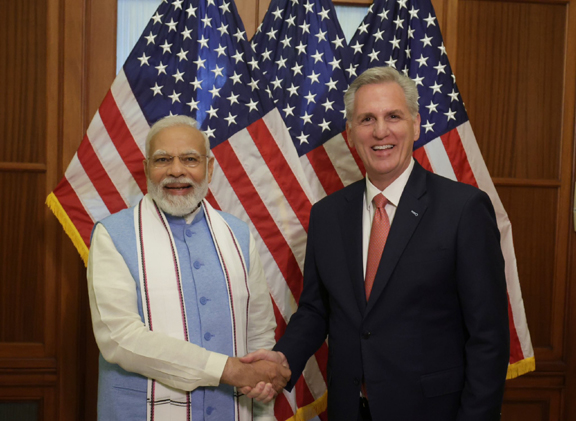
AIA Illinois Chapter President Hina Trivedi with PM Modi in Washington, D.C. on June 23, 2023
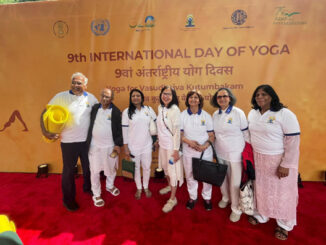
NEW YORK (TIP): Several current and former community leaders from the Association of Indians in America (AIA) participated in events welcoming the Honorable Narendra Modi, Prime Minister of India, during his visit to United States. “A rare honor afforded to a visiting head of state of any country, Prime Minister Modi received a red carpet welcome from President Joe Biden, members of the United States Congress and countless Americans of Indian origin,” said Mr. Gobind Munjal, National President of AIA. “We are delighted AIA was front and center in welcoming Mr. Modi.” In keeping with AIA’s motto of pride in “Indian Heritage and American Commitment,” several members of AIA – National, New York Chapter, and New Jersey chapters participated in the Yoga retreat at United Nations which was led by the prime minister.
(Pictures Enclosed)
Additionally, Mr. Gopal Khanna, former Vice President of AIA – National, along with his wife Anjali, a lifelong community worker, were at hand to welcome Prime Minister Modi In Washington, DC. “We were honored to be invited to attend the Joint Session of the Congress,” said Khanna who has served in the administration of two governors and two presidents, most recently as the Director of the Agency of Healthcare and Research for President Donald Trump. “A rare display of bipartisan support and heartfelt welcome afforded to PM Modi was evident on the floor of U.S. Congress. The prime minister’s message of AI – America and India partnership defining the new world order in the 21st century was appreciated with a standing ovation.”
“AIA organized the first ever trade delegation to India in 1979 to further U.S.- India ties. The relationship of our two counties has come a long way,” said Munjal. Khanna added, “I can see huge possibilities ahead, particularly in scaling business, technology and defense alliance. Of course, a lot will depend upon defining and crystallizing compelling strategic interests amongst the two nations. President Biden and Prime Minister Modi have set the course for building trust, investments and people to people exchange.”
Also, AIA Illinois Chapter President Hina Trivedi had the honor of meeting with prime minister Modi in Washington DC.
Earlier last month, AIA celebrated 75th anniversary of India’s independence and building of the nation’s democratic institutions. Senate Majority Leader Chuck Schumer and New York City Mayor Eric Adams joined prominent members of the Indian-American community at the Honor Banquet hosted by AIA on May 6th at the Terrace on the Park in Flushing Meadow Park, Queens, NY.
For more information, please reach out to NATIONAL PRESIDENT GOBIND MUNJAL at 646-209-8244 or gpmunjal@gmail.com; Or visit AIA National Website: www.aianational.org
About AIA: Established in 1967, the Association of Indians in America is the oldest national organization representing peoples of Indian origin in America.
India’s Prime Minister Narendra Modi arrived on his first State visit to US from June 21 to June 23 at the invitation of US President Joe Biden and the First Lady Jill Biden. He arrived in New York on the first leg of his visit on June 20, 2023. The same day he met with Nobel Laureates, CEO’s , Think Tank leaders and politicians.
On June 21, Modi participated in the International Day of Yoga celebrations at the United Nations where 175 nations were represented, and this being the largest gathering of diplomats at any event, it created a Guinness Book record.
On June 21, PM Modi had private dinner with Bidens at the White House.
On June 22 afternoon , PM Modi addressed the joint meeting of Congress. In the evening, Modi attended the State dinner in his honor at which about 400 guests were present. They included Mukesh Ambani, Sundar Pichai and many other CEO’s, eminent personalities from all walks of life, besides lawmakers and politicians.
On June 23 morning, PM Modi had a meeting with Vice President Kamala Harris and other leaders .
In the evening PM Modi attended Diaspora events at Kennedy House and Regan Center.
He was to depart for Egypt on June 24 morning.
We bring you here the visit of PM Modi in pictures. For articles on Modi’s visit, please turn to other pages.
Prime Minister Modi met with Elon Musk, CEO of Tesla , and Senator Chuck Schumer , Senate Majority Leader, among others on June 20.
Prime Minister Modi attended the International Day of Yoga at the United Nations on June 21 morning. The event was attended by diplomats from 175 nations, and the event got recorded in the Guinness Book of Records. President of the United Nations General Assembly Csaba Kőrösi was among those present.
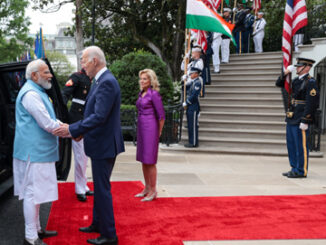
Prime Minister Modi arrived in Washington D.C. on June 21 afternoon to a warm welcome by Indian Americans , and by President Biden and the First Lady Jill Biden. Modi had a private dinner with the Bidens at the White House in the evening.
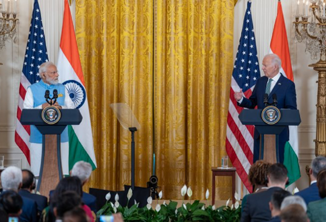
The next day, June 22 , US President Biden and India’s Prime Minister Modi had talks followed by a press conference.
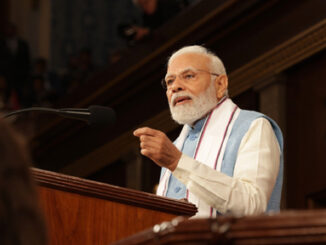
Prime Minister Modi, on June 22 afternoon, addressed the joint meeting of US Congress.
WASHINGTON, D.C. (TIP): The decision taken by General Electric to manufacture jet engines in India through transfer of technology is a landmark agreement, Prime Minister Narendra Modi said on Thursday, June 22, noting that this will give India-US defense cooperation a “new character”.
GE aerospace has announced it has inked a pact with Hindustan Aeronautics Limited (HAL) to jointly produce fighter jet engines for the Indian Air Force’s Light Combat Aircraft (LCA)-Mk-II Tejas.
“The decision taken by General Electric to manufacture engines in India through transfer of technology is a landmark agreement,” Prime Minister Modi told reporters at a joint news conference with US President Joe Biden at the White House.
This also opens up new job opportunities in both countries, he said and added that “this will give our defense cooperation a new character in the times to come”.
“The defense industries and startups of both countries are important partners in this cooperation. Bringing them together is the key objective of our defense industrial roadmap,” Modi said.
In a joint statement, President Biden and Prime Minister Modi hailed the landmark signing of the MoU between GE and HAL.
“This trailblazing initiative to manufacture F-414 engines in India will enable greater transfer of US jet engine technology than ever before. The leaders committed their governments to working collaboratively and expeditiously to support the advancement of this unprecedented co-production and technology transfer proposal,” it said.
Modi said the close defense cooperation between India and the US symbolizes the mutual trust and shared strategic priorities.
“Moving away from the old buyer seller relationship we had earlier, we have transitioned today to a relationship involving transfer of technology, co-development and co-production,” he said. Expressing their desire to accelerate defense industrial cooperation, the two leaders in the joint statement welcomed the adoption of a Defense Industrial Cooperation Roadmap.
This will provide policy direction to defense industries and enable co-production of advanced defense systems and collaborative research, testing, and prototyping of projects. Both sides are committed to addressing any regulatory barriers to defense industrial cooperation, according to the statement. Modi and Biden also noted the decision of India’s Ministry of Defense and the US’ Department of Defense to commence negotiations for concluding a Security of Supply arrangement and initiate discussions about Reciprocal Defense Procurement agreement.
They also welcomed India’s emergence as a hub for maintenance and repair for forward deployed US Navy assets and the conclusion of Master Ship Repair agreements with Indian shipyards, the statement said.
This will allow the US Navy to expedite the contracting process for mid-voyage and emergent repair.
It said as envisaged in the Defense Industrial Roadmap, both countries agree to work together for the creation of logistic, repair, and maintenance infrastructure for aircraft and vessels in India. The two leaders welcomed the setting up and launch of the US-India Defense Acceleration Ecosystem (INDUS-X).
The statement said as a network of universities, startups, industry and think tanks, INDUS-X will facilitate joint defense technology innovation, and co-production of advanced defense technology between the respective industries of the two countries.
The US Department of Defense’s Space Force has signed its first International Cooperative Research and Development Agreement with Indian start-ups 114 AI and 3rdiTech. Both companies will work with General Atomics to co-develop components using cutting edge technologies in artificial intelligence and semiconductors respectively, said the joint statement.
(Source: PTI)
WASHINGTON, D.C. (TIP): The US is set to introduce in-country renewable H-1B visas, a significant decision that would help thousands of Indian professionals in staying in the country to continue with their jobs without the hassle of travelling overseas for the renewal of their work visas.
This is part of the people-to-people initiative, a senior administration official said ahead of the bilateral meeting between Prime Minister Narendra Modi and President Joe Biden at the White House here on Thursday, June 22.
The much-sought-after H-1B visa is a non-immigrant visa that allows US companies to employ foreign workers in specialty occupations that require theoretical or technical expertise.
Technology companies depend on it to hire tens of thousands of employees each year from countries like India and China.
The United States last year issued 125,000 visas to Indian students, which is a record and they are on pace to become the largest foreign student community in the United States with a 20 per cent increase last year alone, the official explained.
“The second thing that we’re doing is the United States Department of State is going to launch a pilot to adjudicate domestic renewals of certain petition-based temporary work visas later this year, including for Indian nationals with the intent to implement this for an expanded pool of H-1 and L visa holders,” a senior Biden administration official said.
The programme would be eventually broadened to include other eligible categories. “It is good for people in India, good for people in the United States, really good for our businesses,” said the official.
Until 2004, certain categories of non-immigrant visas, particularly the H-1B, could be renewed or stamped inside the US. After that, for the renewal of these visas, in particular, those on H-1B, the foreign tech workers have to go out of the country, mostly to their own country to get the H-1B extension stamped on their passport.
The H-1B visas are issued for three years at a time.
For all the H-1B visa holders, when their visa is renewed, they need to get their passports stamped with renewal dates. This is required if they wish to travel outside of the US and re-enter the US. As of now, H-1B visa restamping is not allowed within the US. Restamping can only be done at any US consulate.
This was a big inconvenience for foreign guest workers and also for their employees, particularly at a time when the visa wait time is more than 800 days or more than two years.
(Source: PTI)
WASHINGTON, D.C. (TIP): India is ready to contribute in any way it can to restore peace in Ukraine, Prime Minister Narendra Modi said on Thursday, June 22, reiterating that New Delhi favors the resolution of the dispute through dialogue and diplomacy.
Prime Minister Modi’s remarks came during a joint news conference with President Joe Biden at the White House after their talks.
“From the very beginning of the events in Ukraine, India has laid emphasis on the resolution of the dispute through dialogue and diplomacy,” Modi, who is here on his maiden state visit, told reporters.
“We are completely ready to contribute in any way we can to restore peace. Under India’s G-20 presidency, we are emphasizing the spirit of one earth, one family, one future,” he said.
Since the Ukraine conflict began in February last year, Modi spoke to Russian President Vladimir Putin as well as Ukrainian President Volodymyr Zelenskyy a number of times during which he insisted that the conflict should be resolved through dialogue and diplomacy.
India has not yet condemned the Russian invasion of Ukraine. Biden said the two leaders talked about their shared efforts to mitigate the humanitarian tragedies unleashed by Russia’s brutal war in Ukraine and to defend the core principles of the UN Charter on sovereignty and territorial integrity.
WASHINGTON, D.C. (TIP): The US will open two new consulates in Bengaluru and Ahmedabad while India will establish a mission in Seattle to boost people-to-people relationships, a senior White House official said on Thursday, June 22 .
The official said the US issued a record 125,000 visas to Indian students last year. Indian students are set to become the largest foreign student community in the United States with a 20 per cent increase last year alone, the senior administration official said.
“The United States intends to open new consulates in Bengaluru and Ahmedabad. India is likewise welcoming the 2023 opening of its consulate in Seattle and look forward to also announcing a new consulate in the United States,” the official said.
The US Department of State is going to launch a pilot to adjudicate domestic renewals of certain petition-based temporary work visas later this year, including for Indian nationals with the intent to implement this for an expanded pool, the official said.
India has five consulates in the US in New York, San Francisco, Chicago, Houston and Atlanta, apart from the embassy in Washington.
The US embassy in New Delhi is one of the largest US diplomatic missions in the world. The embassy coordinates the activities of four consulates — in Mumbai, Kolkata, Chennai and Hyderabad – ensuring that the US-India relationship is strong throughout the country, according to the information on its website.
WASHINGTON, D.C. (TIP): Asserting that democracy is “in our spirit…and flows in our veins”, Prime Minister Narendra Modi on Thursday, June 22, said there is no question of discrimination in India on the grounds of caste or religion because his government follows the Constitution, which is formed on the basic values of democracy.
Responding to a question at a joint press conference with US President Joe Biden after their comprehensive deliberations, Modi also strongly defended India’s record on democracy and his government’s performance and human rights, saying that the basic foundation stone of his government has been ‘Sabka Saath, Sabka Vikas, Sabka Vishwas and Sabka Prayas’ which means together for everyone’s growth, with everyone’s trust.
“India is a democracy. And as President Biden said democracy is in the DNA of both India and America. Democracy is in our spirit. Democracy flows in our veins. We live democracy. Our forefathers moulded it in words, which we call the Constitution. Our government runs on the fundamental principles of this Constitution. We have proved that democracy can deliver. When I say deliver it means there is no place for discrimination on the grounds of caste, creed, gender, religion,” Modi said.
He was responding to a question about the steps taken by his government to improve the rights of minorities in India and uphold free speech. “When you talk of democracy, if there are no human values and there is no humanity, there are no human rights then that is not a democracy at all. So, when you talk about democracy and you accept democracy and when we live democracy, then there is absolutely no space for discrimination,” the Prime Minister asserted.
“That is why India believes in moving ahead with ‘Sabka Saath, Sabka Vikas, Sabka Vishwas and Sabka Prayas’. These are our foundation principles, which are the basis of how we operate and how we live our lives in India.
The benefits that are provided by the government are accessible to all whoever deserves those benefits is available to everybody,” the prime minister said.
“That is why in India’s democratic values there is absolutely no discrimination neither on the basis of caste creed or age or any kind of geographic location,” Modi said.
WASHINGTON, D.C. (TIP): Affirming a vision of the US and India as among the closest partners, Prime Minister Narendra Modi and President Joe Biden on Thursday, June 22, said that the diverse partnership between the two nations will serve the global good.
The US-India Comprehensive Global and Strategic Partnership are anchored in a new level of trust and mutual understanding and enriched by the warm bonds of family and friendship that inextricably link the two countries together, said a joint statement issued by the White House after the talks between Prime Minister and the President in the Oval Office and the Cabinet meeting room.
“Together, we will build an even stronger, diverse US-India partnership that will advance the aspirations of our people for a bright and prosperous future grounded in respect for human rights, and shared principles of democracy, freedom, and the rule of law,” said the joint statement.
“Our cooperation will serve the global good as we work through a range of multilateral and regional groupings – particularly the Quad– to contribute toward a free, open, inclusive, and resilient Indo-Pacific. No corner of human enterprise is untouched by the partnership between our two great countries, which spans the seas to the stars,” said the statement.
Upbeat about the relationship, Prime Minister Modi told reporters during a news conference that now even the sky is not the limit.
“In fact, in short for India and America partnership, even this — even the sky is not the limit. Friends, the most important pillar of our relations is our people-to-people ties,” he said.
“Two of the world’s largest democracies, India and America can together make an important contribution to global peace stability and prosperity. I’m confident that based on these values, we will be able to fulfil the expectations and aspirations of not only the people of our two countries but of the entire world,” he said.
Affirming that technology will play the defining role in deepening our partnership, the joint statement said the leaders hailed the inauguration of the initiative on Critical and Emerging Technology (iCET) in January 2023 as a major milestone in US-India relations.
“They called on our governments, businesses, and academic institutions to realize their shared vision for the strategic technology partnership. The leaders recommitted the United States and India to fostering an open, accessible, and secure technology ecosystem, based on mutual confidence and trust that reinforces our shared values and democratic institutions,” it said.
Observing that the US-India Major Defense Partnership has emerged as a pillar of global peace and security, the statement said that through joint exercises, strengthening of defense industrial cooperation, the annual “2+2” Ministerial Dialogue, and other consultative mechanisms, the two countries have made substantial progress in building an advanced and comprehensive defense partnership in which the militaries coordinate closely across all domains.
“The leaders appreciated the strong military-to-military ties, mutual logistics support, and efforts to streamline implementation of foundational agreements. They noted that information sharing and placement of Liaison Officers in each other’s military organizations will spur joint service cooperation.
They also reiterated their resolve to strengthen maritime security cooperation, including through enhanced underwater domain awareness. The leaders welcomed the launch of dialogues in new defense domains including space and Artificial intelligence, which will enhance capacity building, knowledge, and expertise, said the joint statement.
As climate action and clean energy leaders, the United States and India share a common and ambitious vision to rapidly deploy clean energy at scale, build economic prosperity, and help achieve global climate goals.
“They recognize the critical role of the US Inflation Reduction Act and India’s ambitious production-linked incentives scheme for cutting-edge clean and renewable technologies. The leaders highlighted the U.S.-India Climate and Clean Energy Agenda 2030 Partnership and Strategic Clean Energy Partnership (SCEP) as reflective of this commitment,” said the joint statement.
As global partners, the United States and India affirmed that the rules-based international order must be respected.
They emphasized that the contemporary global order has been built on principles of the UN Charter, international law, and respect for the sovereignty and territorial integrity of states, the joint statement said.
As two of the world’s largest democratic economies, the United States and India are indispensable partners in advancing global prosperity and a free, fair, and rules-based economic order, the joint statement said. Biden highlighted the impactful participation of Modi in the G7 Hiroshima Summit and looks forward to the G20 Summit in September in New Delhi.
He applauded India’s leadership in its ongoing G20 Presidency, which has brought renewed focus on strengthening multilateral institutions and international cooperation to tackle global challenges such as climate change, pandemics, fragility and conflict, along with work to accelerate the achievement of the UN Sustainable Development Goals, and lay the foundation for strong, sustainable, balanced, and inclusive growth, said the joint statement.
Joint Statement from the United States and India
June 22, 2023
President Joseph R. Biden, Jr. and Prime Minister Narendra Modi today affirmed a vision of the United States and India as among the closest partners in the world – a partnership of democracies looking into the 21st century with hope, ambition, and confidence. The U.S.-India Comprehensive Global and Strategic Partnership is anchored in a new level of trust and mutual understanding and enriched by the warm bonds of family and friendship that inextricably link our countries together. Together, we will build an even stronger, diverse U.S.-India partnership that will advance the aspirations of our people for a bright and prosperous future grounded in respect for human rights, and shared principles of democracy, freedom, and the rule of law. Our cooperation will serve the global good as we work through a range of multilateral and regional groupings – particularly the Quad– to contribute toward a free, open, inclusive, and resilient Indo-Pacific. No corner of human enterprise is untouched by the partnership between our two great countries, which spans the seas to the stars.
Charting a Technology Partnership for the Future
President Biden and Prime Minister Modi affirm that technology will play the defining role in deepening our partnership. The leaders hailed the inauguration of the Initiative on Critical and Emerging Technology (iCET) in January 2023 as a major milestone in U.S.-India relations. They called on our governments, businesses, and academic institutions to realize their shared vision for the strategic technology partnership. The leaders recommitted the United States and India to fostering an open, accessible, and secure technology ecosystem, based on mutual confidence and trust that reinforces our shared values and democratic institutions.
President Biden and Prime Minister Modi set a course to reach new frontiers across all sectors of space cooperation. The leaders applauded our growing cooperation on earth and space science, and space technologies. They welcomed the decision of NASA and ISRO to develop a strategic framework for human spaceflight cooperation by the end of 2023.The leaders hailed the announcement by NASA to provide advanced training to Indian astronauts at the Johnson Space Center in Houston, Texas, with a goal of mounting a joint effort to the International Space Station in 2024.The leaders celebrated the delivery of the NASA-ISRO Synthetic Aperture Radar (NISAR) satellite to ISRO’s U.R. Rao Satellite Centre in Bengaluru, India, and looked forward to NISAR’s 2024 launch from India. Welcoming India’s Space Policy – 2023, the leaders called for enhanced commercial collaboration between the U.S. and Indian private sectors in the entire value chain of the space economy and to address export controls and facilitate technology transfer. President Biden deeply appreciated India’s signing of the Artemis Accords, which advance a common vision of space exploration for the benefit of all humankind.
President Biden and Prime Minister Modi committed their administrations to promoting policies and adapting regulations that facilitate greater technology sharing, co-development, and co-production opportunities between U.S. and Indian industry, government, and academic institutions. The leaders welcomed the launch of the interagency-led Strategic Trade Dialogue in June2023 and directed both sides to undertake regular efforts to address export controls, explore ways of enhancing high technology commerce, and facilitate technology transfer between the two countries.
President Biden and Prime Minister Modi hailed the signing of an MoU on Semiconductor Supply Chain and Innovation Partnership as a significant step in the coordination of our countries’ semiconductor incentive programs. This will promote commercial opportunities, research, talent, and skill development. The leaders welcomed an announcement by Micron Technology, Inc., to invest up to $825 million to build a new semiconductor assembly and test facility in India with support from the Indian government. The combined investment valued at $2.75 billion would create up to 5,000 new direct and 15,000 community jobs opportunities in the next five years. The leaders also welcomed Lam Research’s proposal to train 60,000 Indian engineers through its Semiverse Solution virtual fabrication platform to accelerate India’s semiconductor education and workforce development goals, and an announcement by Applied Materials, Inc., to invest $400 million to establish a collaborative engineering center in India.
President Biden and Prime Minister Modi share a vision of creating secure and trusted telecommunications, resilient supply chains, and enabling global digital inclusion. To fulfill this vision, the leaders launched two Joint Task Forces on advanced telecommunications, focused on Open RAN and research and development in 5G/6G technologies. Public-private cooperation between vendors and operators will be led by India’s Bharat 6G Alliance and the U.S. Next G Alliance. We are partnering on Open RAN field trials and rollouts, including scaled deployments, in both countries with operators and vendors of both markets, backed by U.S. International Development Finance Corporation (DFC) financing. The leaders welcomed participation of Indian companies in the U.S. Rip and Replace Program. They endorsed an ambitious vision for 6G networks, including standards cooperation, facilitating access to chipsets for system development, and establishing joint research and development projects. President Biden and Prime Minister Modi also stressed the need to put in place a “Trusted Network/Trusted Sources” bilateral framework.
President Biden and Prime Minister Modi welcomed the establishment of a joint Indo-U.S. Quantum Coordination Mechanism to facilitate collaboration among industry, academia, and government, and our work toward a comprehensive Quantum Information Science and Technology agreement. The United States welcomes India’s participation in the Quantum Entanglement Exchange and in the Quantum Economic Development Consortium to facilitate expert and commercial exchanges with leading, like-minded quantum nations. The United States and India will sustain and grow quantum training and exchange programs and work to reduce barriers to U.S.-India research collaboration. The leaders welcomed the launch of a $2million grant program under the U.S.-India Science and Technology Endowment fund for the joint development and commercialization of Artificial Intelligence (AI) and quantum technologies and encouraged public-private collaborations to develop high performance computing (HPC) facilities in India. President Biden also reiterated his government’s commitment to work with U.S. Congress to lower barriers to U.S. exports to India of HPC technology and source code. The U.S. side pledged to make its best efforts in support of India’s Center for Development of Advanced Computing (C-DAC) joining the U.S. Accelerated Data Analytics and Computing (ADAC) Institute.
The leaders welcomed 35 innovative joint research collaborations in emerging technologies funded by the U.S. National Science Foundation (NSF) and the Indian Department of Science and Technology (DST). Under a new implementation arrangement between NSF and DST, both sides will fund joint research projects in computer and information science and engineering, cyber physical systems, and secure and trustworthy cyberspace. Furthermore, NSF and India’s Ministry of Electronics and Information Technology will bring fresh funding for joint projects in applied research areas such as semiconductors, next generation communication, cyber security, sustainability and green technologies and intelligent transportation systems.
Both President Biden and Prime Minister Modi acknowledge the profound opportunities and significant risks associated with AI. Accordingly, they committed to develop joint and international collaboration on trustworthy and responsible AI, including generative AI, to advance AI education and workforce initiatives, promote commercial opportunities, and mitigate against discrimination and bias. The United States also supports India’s leadership as Chair of the Global Partnership on AI. The leaders applauded Google’s intent to continue investing through its $10 billion India Digitization Fund, including in early-stage Indian startups. Through its AI Research Center in India, Google is building models to support over 100 Indian languages.
President Biden and Prime Minister Modi hailed our deepening bilateral cooperation on cutting-edge scientific infrastructure, including a $140 million in-kind contribution from the Indian Department of Atomic Energy (DAE) to the U.S. Department of Energy’s (DOE’s) Fermi National Laboratory toward collaborative development of the Proton Improvement Plan-II Accelerator, for the Long Baseline Neutrino Facility — the first and largest international research facility on U.S. soil. They also welcomed the commencement of construction of a Laser Interferometer Gravitational-Wave Observatory (LIGO) in India. The leaders called on their administrations to extend these partnerships to advanced biotechnology and biomanufacturing, and enhance biosafety and biosecurity innovation, practices, and norms.
Powering a Next Generation Defense Partnership
The U.S.-India Major Defense Partnership has emerged as a pillar of global peace and security. Through joint exercises, strengthening of defense industrial cooperation, the annual “2+2” Ministerial Dialogue, and other consultative mechanisms, we have made substantial progress in building an advanced and comprehensive defense partnership in which our militaries coordinate closely across all domains. The leaders appreciated the strong military-to-military ties, mutual logistics support, and efforts to streamline implementation of foundational agreements. They noted that information sharing and placement of Liaison Officers in each other’s military organizations will spur joint service cooperation. They also reiterated their resolve to strengthen maritime security cooperation, including through enhanced underwater domain awareness. The leaders welcomed the launch of dialogues in new defense domains including space and AI, which will enhance capacity building, knowledge, and expertise.
Expressing their desire to accelerate defense industrial cooperation, the leaders welcomed the adoption of a Defense Industrial Cooperation Roadmap, which will provide policy direction to defense industries and enable co-production of advanced defense systems and collaborative research, testing, and prototyping of projects. Both sides are committed to addressing any regulatory barriers to defense industrial cooperation. The leaders also noted the decision of India’s Ministry of Defense and the U.S. Department of Defense to commence negotiations for concluding a Security of Supply arrangement and initiate discussions about Reciprocal Defense Procurement agreement.
President Biden and Prime Minister Modi hailed the landmark signing of an MoU between General Electric and Hindustan Aeronautics Limited for the manufacture of GE F-414 jet engines in India, for the Hindustan Aeronautics Limited Light Combat Aircraft Mk 2. This trailblazing initiative to manufacture F-414 engines in India will enable greater transfer of U.S. jet engine technology than ever before. The leaders committed their governments to working collaboratively and expeditiously to support the advancement of this unprecedented co-production and technology transfer proposal.
President Biden and Prime Minister Modi also welcomed India’s emergence as a hub for maintenance and repair for forward deployed U.S. Navy assets and the conclusion of Master Ship Repair Agreements with Indian shipyards. This will allow the U.S. Navy to expedite the contracting process for mid-voyage and emergent repair. As envisaged in the Defense Industrial Roadmap, both countries agree to work together for the creation of logistic, repair, and maintenance infrastructure for aircrafts and vessels in India.
The leaders welcomed the setting up and launch of the U.S.-India Defense Acceleration Ecosystem (INDUS-X). As a network of universities, startups, industry and think tanks, INDUS-X will facilitate joint defense technology innovation, and co-production of advanced defense technology between the respective industries of the two countries. The U.S. Department of Defense’s Space Force has signed its first International Cooperative Research and Development Agreement with Indian start-up 114 AI and 3rdiTech. Both companies will work with General Atomics to co-develop components using cutting edge technologies in AI and semiconductors respectively.
President Biden and Prime Minister Modi welcomed India’s plans to procure General Atomics MQ-9B HALE UAVs. The MQ-9Bs, which will be assembled in India, will enhance the ISR capabilities of India’s armed forces across domains. As part of this plan, General Atomics will also establish a Comprehensive Global MRO facility in India to support of India’s long-term goals to boost indigenous defense capabilities.
Catalyzing the Clean Energy Transition
As climate action and clean energy leaders, the United States and India share a common and ambitious vision to rapidly deploy clean energy at scale, build economic prosperity, and help achieve global climate goals. They recognize the critical role of the U.S. Inflation Reduction Act and India’s ambitious production-linked incentives scheme for cutting-edge clean and renewable technologies. The leaders highlighted the U.S.-India Climate and Clean Energy Agenda 2030 Partnership and Strategic Clean Energy Partnership (SCEP) as reflective of this commitment. The leaders welcomed joint efforts to develop and deploy energy storage technologies, including through the establishment of a new task force under SCEP. The leaders welcomed the launch of the U.S.-India New and Emerging Renewable Energy Technologies Action Platform, which will accelerate cooperation in green hydrogen, offshore and onshore wind, and other emerging technologies. They will collaborate to achieve their respective national goals to reduce the cost of green/clean hydrogen under India’s National Green Hydrogen Mission and the U.S. Hydrogen Energy Earthshot. The United States welcomed India’s decision to co-lead the multilateral Hydrogen Breakthrough Agenda. The leaders called for the development of joint efforts in carbon capture, utilization, and storage, given their role in reducing emissions. The leaders welcomed India’s VSK Energy LLC’s announcement to invest up to $1.5 billion to develop a new, vertically integrated solar panel manufacturing operation in the United States and India’s JSW Steel USA’s plans to invest $120 million at its Mingo Junction, Ohio, steel plant to better serve growing markets in the renewable energy and infrastructure sectors.
President Biden and Prime Minister Modi underscored the importance of decarbonizing the transportation sector, including by accelerating the deployment of zero emissions vehicles, continued collaboration to promote public and private financing for electric transportation, and the development of biofuels, including sustainable aviation fuels. To this end, the leaders lauded the creation and development of the Global Biofuels Alliance, which will be launched in July 2023, with the United States as a founding member. Both leaders welcomed the signing of an MOU under which the U.S. Agency for International Development will support Indian Railways’ ambitious target to become a “net-zero” carbon emitter by 2030.The United States and India also announced plans to create a payment security mechanism that will facilitate the deployment of 10,000 made-in-India electric buses in India, augmenting India’s focused efforts in reducing greenhouse gas emissions, improving public health, and diversifying the global supply chain.
India and the United States committed to create innovative investment platforms that will effectively lower the cost of capital and attract international private finance at scale to accelerate the deployment of greenfield renewable energy, battery storage, and emerging green technology projects in India. The United States and India will endeavor to develop a first-of-its kind, multibillion-dollar investment platform aimed at providing catalytic capital and de-risking support for such projects.
President Biden and Prime Minister Modi reaffirmed their support for the mission of the International Energy Agency (IEA), and President Biden pledged to continue working with the Government of India, IEA members, the IEA Secretariat, and other relevant stakeholders toward IEA membership for India in accordance with the provisions of the Agreement on an International Energy Program.
President Biden and Prime Minister Modi affirmed the intention of the two governments, as trusted partners, to work together to ensure that our respective markets are well-supplied with the essential critical minerals needed to achieve our climate, economic and strategic technology cooperation goals. The leaders pledged to hasten bilateral collaboration to secure resilient critical minerals supply chains through enhanced technical assistance and greater commercial cooperation, and exploration of additional joint frameworks as necessary. The United States enthusiastically welcomes India as the newest partner in the Mineral Security Partnership (MSP), to accelerate the development of diverse and sustainable critical energy minerals supply chains globally while agreeing to the principles of the MSP including environmental, social, and governance standards. The leaders lauded the announcement of India’s Epsilon Carbon Limited’s plans toinvest $650 million in a U.S. greenfield electric vehicle battery component factory.
President Biden and Prime Minister Modi underscored the important role nuclear energy plays in global decarbonization efforts and affirmed nuclear energy as a necessary resource to meet our nations’ climate, energy transition, and energy security needs. The leaders noted ongoing negotiations between the Nuclear Power Corporation of India Limited (NPCIL) and Westinghouse Electric Company (WEC) for the construction of six nuclear reactors in India. They welcomed intensified consultations between the U.S. DOE and India’s DAE for facilitating opportunities for WEC to develop a techno-commercial offer for the Kovvada nuclear project. They also noted the ongoing discussion on developing next generation small modular reactor technologies in a collaborative mode for the domestic market as well as for export. The United States reaffirms its support for India’s membership in the Nuclear Suppliers Group and commits to continue engagement with likeminded partners to advance this goal.
The leaders recognize that addressing sustainable consumption and production is a key component to achieving the development, environment and climate ambitions of the 2030 Agenda for Sustainable Development and the SDGs. In this regard, President Biden welcomed Prime Minister Modi’s Lifestyle for Environment initiative (LiFE) as a successful national model to address the impacts of climate change, biodiversity loss, desertification and land degradation, and resolved to work together to implement the G20 High Level Principles on Lifestyles for Sustainable Development.
Deepening Strategic Convergence
As global partners, the United States and India affirm that the rules-based international order must be respected. They emphasized that the contemporary global order has been built on principles of the UN Charter, international law, and respect for sovereignty and territorial integrity of states.
President Biden and Prime Minister Modi expressed their deep concern over the conflict in Ukraine and mourned its terrible and tragic humanitarian consequences. The leaders underscored the serious and growing impacts of the war on the global economic system, including on food, fuel and energy security, and critical supply chains. They called for greater efforts to mitigate the consequences of the war, especially in the developing world. Both countries further pledge to render continuing humanitarian assistance to the people of Ukraine. They called for respect for international law, principles of the UN charter, and territorial integrity and sovereignty. Both countries concurred on the importance of post-conflict reconstruction in Ukraine.
The United States and India reaffirmed their resolve to counter any attempts to unilaterally subvert the multilateral system. The leaders underscored the need to strengthen and reform the multilateral system so it may better reflect contemporary realities. In this context both sides remain committed to a comprehensive UN reform agenda, including through expansion in permanent and non-permanent categories of membership of the UN Security Council. Sharing the view that global governance must be more inclusive and representative, President Biden reiterated U.S. support for India’s permanent membership on a reformed UN Security Council(UNSC). In this context, President Biden welcomed India’s candidature as a non-permanent member of the UNSC for the 2028-29 term, in view of India’s significant contributions to the UN system and commitment to multilateralism, as well as its active and constructive engagement in the Inter-Governmental Negotiations process on Security Council reforms, with an overall objective of making the UNSC more effective, representative, and credible.
President Biden and Prime Minister Modi recommitted themselves to empowering the Quad as a partnership for global good. The two leaders welcomed the progress made at the Hiroshima Summit last month among the four maritime democracies to further advance a positive and constructive agenda for peace and prosperity in the Indo-Pacific. The leaders welcomed progress on the Indo-Pacific Partnership for Maritime Domain Awareness, through which Quad partners are providing maritime domain data across the Indian Ocean, Southeast Asia, and the Pacific regions. The Quad to be hosted in India in 2024 would be another opportunity to continue the dialogue and consolidate cooperation. The leaders committed to continue working in partnership with regional platforms such as the Indian Ocean Rim Association, Indo-Pacific Oceans Initiative, and ASEAN to achieve shared aspirations and address shared challenges in the Indo-Pacific Region. Prime Minister Modi welcomed the United States joining the Indo-Pacific Oceans Initiative and President Biden welcomed India’s continued participation as an observer in the Partners in the Blue Pacific. 28. The leaders also welcomed the depth and pace of enhanced consultations between the two governments on regional issues including South Asia, the Indo-Pacific and East Asia and looked forward to our governments holding an inaugural Indian Ocean Dialogue in 2023.
President Biden and Prime Minister Modi reiterated their enduring commitment to a free, open, inclusive, peaceful, and prosperous India-Pacific region with respect for territorial integrity and sovereignty, and international law. Both leaders expressed concern over coercive actions and rising tensions, and strongly oppose destabilizing or unilateral actions that seek to change the status quo by force. Both sides emphasized the importance of adherence to international law, particularly as reflected in the United Nations Convention on the Law of the Sea (UNCLOS), and the maintenance of freedom of navigation and overflight, in addressing challenges to the maritime rules-based order, including in the East and South China Seas.
The leaders expressed deep concern about the deteriorating situation in Myanmar, and called for the release of all those arbitrarily detained, the establishment of constructive dialogue, and the transition of Myanmar toward an inclusive federal democratic system.
The leaders also condemned the destabilizing ballistic missile launches of the Democratic People’s Republic of Korea (DPRK), which violate relevant UN Security Council resolutions and pose a grave threat to international peace and security. They reaffirmed their commitment to the complete denuclearization of the Korean Peninsula and urged DPRK to comply with its obligations under these resolutions and engage in substantive dialogue. They stressed the importance of addressing the concerns regarding DPRK’s proliferation linkages related to weapons of mass destruction, their means of delivery, and related items in the region and beyond.
The United States and India stand together to counter global terrorism and unequivocally condemn terrorism and violent extremism in all its forms and manifestations. President Biden and Prime Minister Modi reiterated the call for concerted action against all UN-listed terrorist groups including Al-Qa’ida, ISIS/Daesh, Lashkar e-Tayyiba (LeT), Jaish-e-Mohammad (JeM), and Hizb-ul-Mujhahideen. They strongly condemned cross-border terrorism, the use of terrorist proxies and called on Pakistan to take immediate action to ensure that no territory under its control is used for launching terrorist attacks. They called for the perpetrators of the 26/11 Mumbai and Pathankot attacks to be brought to justice. They noted with concern the increasing global use of unmanned aerial vehicles (UAVs), drones and information and communication technologies for terrorist purposes and reaffirmed the importance of working together to combat such misuse. They welcomed the cooperation between our two governments on counterterrorism designations and homeland security cooperation, including in intelligence sharing and law enforcement cooperation, and called upon the Financial Action Task Force to undertake further work identifying how to improve global implementation of its standards to combat money laundering and the financing of terrorism.
The leaders reiterated their strong support for a peaceful, secure, and stable Afghanistan. They discussed the current humanitarian situation and concurred on the need to continue to provide immediate humanitarian assistance to the people of Afghanistan. The leaders urged the Taliban to abide by UNSC Resolution 2593 which demands that Afghan territory should never be used to threaten or attack any country, shelter or train terrorists, or plan or finance terrorist attacks. Committing to continue close consultations on the situation in Afghanistan, the leaders emphasized the importance of formation of an inclusive political structure and called on the Taliban to respect the human rights of all Afghans, including women and girls, and to respect freedom of movement.
President Biden and Prime Minister Modi looked forward to strengthening a long-term strategic partnership between the I2U2 countries of India, Israel, United Arab Emirates, and the United States to leverage markets to build more innovative, inclusive, and science-based solutions to enhance food and energy security, improve movement of people and goods across hemispheres, and increase sustainability and resilience.
President Biden and Prime Minister Modi reaffirmed their countries’ commitment to an open, secure, inclusive, safe, interoperable, and reliable Internet, and to continuing cooperation on a range of cybersecurity issues, including preventing and responding to cyber threats, promoting cybersecurity education and awareness and measures to build resilient cyber infrastructure. Both the United States and India are committed to sharing information about cyber threats and vulnerabilities, and to working together to investigate and respond to cyber incidents.
The United States and India reaffirm and embrace their shared values of freedom, democracy, human rights, inclusion, pluralism, and equal opportunities for all citizens. Both countries have a tradition of recognizing the diversity represented in their nations and celebrating the contributions of all their citizens. They reasserted that democracy, freedom, and rule of law are the shared values that anchor global peace and sustainable development. In keeping with the spirit of leaving no one behind, both leaders committed to working towards ensuring that fruits of economic growth and well-being reach the underprivileged. They also committed to pursue programs and initiatives that would facilitate women-led development, and enable all women and girls to live free from gender-based violence and abuse. President Biden underscored his appreciation for India’s participation in the Summit for Democracy process, and for efforts made by India toward sharing knowledge, technical expertise, and experiences with electoral management bodies of other democracies. The leaders also welcomed the re-launch of the Global Issues Forum, which would hold its next meeting at an appropriate time.
Propelling Global Growth
As two of the world’s largest democratic economies, the United States and India are indispensable partners in advancing global prosperity and a free, fair, and rules-based economic order. President Biden highlighted the impactful participation of Prime Minister Modi in the G7 Hiroshima Summit and looks forward to the G20 Summit in September in New Delhi. He applauded India’s leadership in its ongoing G20 Presidency, which has brought renewed focus on strengthening multilateral institutions and international cooperation to tackle global challenges such as climate change, pandemics, fragility and conflict, along with work to accelerate achievement of the UN Sustainable Development Goals, and lay the foundation for strong, sustainable, balanced, and inclusive growth.
President Biden and Prime Minister Modi are united in their determination to use the G20 to deliver on shared priorities for the G20 Leaders’ Summit, including improving the sovereign debt restructuring process; advancing the multilateral development bank evolution agenda, including mobilizing new concessional financing at the World Bank to support all developing countries; and raising the level of ambition on mobilizing private sector investment for quality, sustainable, and resilient infrastructure, including through the Partnership for Global Infrastructure and Investment. The United States looks forward to hosting the G20 presidency in 2026, nearly two decades after the first full-scale G20 Leaders’ Summit in Pittsburgh.
The United States and India recognize the potential of Digital Public Infrastructure (DPI) approaches for enabling open and inclusive digital economies. President Biden and Prime Minister Modi intend to work together to provide global leadership for the implementation of DPI to promote inclusive development, competitive markets, and protect individual rights. In this regard, the United States and India will explore how to partner together and align our efforts to advance the development and deployment of robust DPIs, including appropriate safeguards to protect, privacy, data security and intellectual property. They will explore developing a U.S.-India Global Digital Development Partnership, which would bring together technology and resources from both countries to enable development and deployment of DPIs in developing countries.
The leaders are committed to pursuing ambitious efforts to strengthen Multilateral Development Banks (MDBs) to address shared global challenges of the 21st century. In this regard, they emphasized the need for comprehensive efforts by MDBs to evolve their vision, incentive structure, operational approaches and financial capacity so that they are better equipped to address a wide range of SDGs and trans-boundary challenges including climate change, pandemics, conflicts and fragility. Recognizing multilateral efforts in this area, the leaders acknowledged the ongoing work under the Indian presidency of the G20 on strengthening MDBs including the report of the G20 Expert Group on Strengthening MDBs. By the G20 Leaders’ Summit in New Delhi, the United States and India will work together to secure G20 commitment to create a major new dedicated pool of funds at the World Bank to deploy concessional lending for global challenges, and to enhance support for crisis response in International Development Association recipient countries.
The leaders reaffirmed that the Indo-Pacific Economic Framework (IPEF) is an important pillar of our collective and collaborative efforts to build resilience in our supply chains, harness transformations in clean energy, and accelerate progress of our economies through anti-corruption efforts, efficient tax administrative practices, and capacity building measures. The leaders welcomed the substantial conclusion of negotiations on the proposed IPEF Supply Chain Agreement and committed to working with other partners expeditiously to conclude negotiations of the agreements under the clean economy and fair economy pillars to deliver concrete benefits that enhance the economic competitiveness and prosperity of countries in the Indo-Pacific. President Biden invited India to attend the APEC Summit in San Francisco in November 2023 as a guest of the host.
The U.S.-India trade and investment partnership is an engine for global growth, with bilateral trade exceeding $191 billion in 2022, nearly doubling from 2014. The leaders applauded the reconvening of the U.S.-India Commercial Dialogue and CEO Forum in March in New Delhi. They encouraged respective industries to take action on the recommendations from the CEOs for greater engagement and technical cooperation to build resilient supply chains for emerging technologies, clean energy technologies, and pharmaceuticals; promote an innovative digital economy; lower barriers to trade and investment; harmonize standards and regulations wherever feasible; and work towards skilling our workforces. The leaders support continued active engagement between the U.S. Treasury Department and the Indian Ministry of Finance under the Economic and Financial Partnership dialogue. They encouraged the U.S. Federal Insurance Office and the Insurance Regulatory and Development Authority of India to advance areas of mutual interest in the insurance sector under their existing MoU framework.
The United States and India have also taken steps toward deepening bilateral cooperation to strengthen our economic relationship, including trade ties. Underscoring the willingness and trust of both countries in resolving trade issues, the leaders welcomed the resolution of six outstanding WTO disputes between the two countries through mutually agreed solutions as well as their understandings on market access related to certain products of significance to the bilateral trade relationship. They also looked forward to reconvening the India-U.S. Trade Policy Forum before the end of 2023 to further enhance the bilateral trade relationship by addressing trade concerns and identifying further areas for engagement. India highlighted its interest in the restoration of its status under the U.S. Generalized System of Preferences program, which could be considered in relation to eligibility criteria determined by the U.S. Congress. The leaders supported intensifying the work to advance progress on issues related to the eligibility criteria. Prime Minister Modi also expressed India’s interest towards being recognized as a Trade Agreements Act-designated country by the United States to further enhance the integration of both economies and to further promote trade and investment between two countries. In this regard, the leaders welcomed the initiation of discussions between both sides at an official level on issues related to bilateral government procurement.
The leaders welcomed focused efforts under the re-launched U.S.-India Commercial Dialogue to expand cooperation in the areas of Talent, Innovation, and Inclusive Growth. President Biden expressed appreciation for the significant workforce development efforts undertaken by several of the Indian companies taking part in the U.S.-India CEO Forum to upskill more than 250,000 employees and promote STEM learning within local communities across the United States. Both leaders applauded the concept of an “Innovation Handshake” under the Commercial Dialogue that will lift up and connect the two sides’ dynamic startup ecosystems, address specific regulatory hurdles to cooperation, and promote further innovation and job growth, particularly in emerging technologies. The Innovation Handshake demonstrates the resolve on both sides to further bolster their shared vision of an elevated strategic technology partnership, leveraging the strength and ingenuity of their respective private sectors to identify new innovations and match them with industry requirements across the priority sectors identified under the iCET framework.
Recognizing the essential role that micro, small and medium-sized enterprises (MSMEs) play in advancing inclusive growth, expanding exports, and boosting employment across our respective cities, towns, and rural areas, the leaders welcomed plans under the Commercial Dialogue to organize a forum to promote the role and scope of MSMEs in bilateral trade and a digital commerce showcase to strengthen the engagement of women-owned and rural enterprises in particular. They commended the work of the U.S. Small Business Administration and the Indian Ministry of Micro, Small and Medium Enterprises, which are pursuing increased cooperation and intend to formalize their work through a MoU to support entrepreneurs and MSMEs.
President Biden and Prime Minister Modi again welcomed Air India’s historic agreement with Boeing to acquire more than 200 American-made aircraft. This purchase will support more than one million American jobs across 44 states and contribute to ongoing efforts to modernize the civil aviation sector in India. Boeing has announced a $100 million investment on infrastructure and programs to train pilots in India, supporting India’s need for 31,000 new pilots over the next 20 years. The leaders also welcomed Boeing’s announcement of its completion of a C-17 aftermarket support facility for MRO and a new parts logistics center in India to capture future synergies between defense and civil aviation.
Empowering Future Generations and Protecting the Health of our People
President Biden and Prime Minister hailed the growing bilateral education partnership between the United States and India. Indian students are on pace to soon become the largest foreign student community in the United States, with an increase of nearly 20 percent in Indian students studying in the United States last year alone. The leaders welcomed the establishment of a new Joint Task Force of the Association of American Universities and leading Indian educational institutions, including the Indian Institutes of Technology, and the nomination of councils on each side, and noted their interim recommendations for expanding research and university partnerships between the two countries. They also welcomed the establishment of Indo-U.S. Global Challenge Institutes to spark deeper research partnerships and people-to-people exchanges between a range of diverse institutions in the U.S. and India in semiconductors, sustainable agriculture, clean energy, health and pandemic preparedness, and emerging technologies.
The leaders welcomed an announcement by the U.S. Department of State that it would launch a pilot to adjudicate domestic renewals of certain petition-based temporary work visas later this year, including for Indian nationals, with the intent to implement this for an expanded pool of H1B and L visa holders in 2024 and eventually broadening the program to include other eligible categories.
The leaders affirmed that the movement of professional and skilled workers, students, investors and business travelers between the countries contributes immensely to enhancing bilateral economic and technological partnership. While acknowledging the important steps taken to augment processing of visa applications, they noted the pressing need to further expedite this process. The leaders also directed officials to identify additional mechanisms to facilitate travel for business, tourism, and professional and technical exchanges between the two countries.
Concomitant with the rapid growth in our strategic partnership and demand for travel, both sides intend to open new consulates in each other’s countries. The United States intends to initiate the process to open two new consulates in India in the cities of Bengaluru and Ahmedabad. India will take steps to operationalize its new consulate in Seattle later this year, and open two new consulates at jointly identified locations in the United States.
The leaders recognized the role of asocial security totalization agreement in protecting the interests of cross border workers and reaffirmed the intent to continue ongoing discussions concerning the elements required in both countries to enter into a bilateral social security totalization agreement.
President Biden and Prime Minister Modi celebrate the historic and active collaboration across the full expanse of our respective health sectors. They welcomed the opportunity for deeper collaboration to secure pharmaceutical supply chains. The leaders encouraged their administrations to continue their strong collaboration on pandemic preparedness, supported by epidemiology training; laboratory strengthening and point of entry surveillance, and food safety and regulation. The leaders applauded collaborations between research institutes of both countries on affordable cancer technology programs, including for the development of AI enabled diagnostic and prognosis prediction tools, and on diabetes research. The leaders committed to holding a U.S.-India Cancer Dialogue, hosted by President Biden’s Cancer Moonshot, to bring experts together from both countries to identify concrete areas of collaboration to accelerate the rate of progress against cancer. They also called for expanded collaboration on digital health platforms including responsible use of cutting-edge technologies like AI, and to explore cooperation in research and the use of traditional medicine. President Biden lauded Prime Minister Modi’s plan to eliminate tuberculosis in India by 2025, five years ahead of the target set by the UN’s sustainable development goals, hailing it as a big step forward that will inspire other countries to action.
President Biden and Prime Minister Modi welcomed the opportunity for deeper collaboration to secure, de-risk, and strengthen pharmaceutical supply chains, with a focus on active pharmaceutical ingredients, key starting materials, and key vaccine input materials. They also underscored the need for strengthening global collaboration network on research and development in medical countermeasures, vaccines, therapeutics and diagnostics to promote access to safe, effective, and innovative medical products in an affordable manner.
President Biden and Prime Minister Modi committed to work toward a broader and deeper bilateral drug policy framework for the 21st century. Under this framework, both countries aspire to expand cooperation and collaboration to disrupt the illicit production and international trafficking of illicit drugs, including synthetic drugs, such as fentanyl and Amphetamine Type Stimulants and illicit use of their Precursors. Toward this end, they committed to a holistic public health partnership to prevent and treat illicit drug use, address workforce shortages and skilling requirements, and showcase a secure, resilient, reliable and growing pharmaceutical supply chain as a model for the world.
Prime Minister Modi conveyed his deep appreciation for the repatriation of antiquities to India by the United States. Both sides expressed strong interest in working quickly toward a Cultural Property Agreement, which would help to prevent illegal trafficking of cultural property from India and enhance cooperation on the protection and lawful exchange of cultural property.
The Leaders welcomed the establishment of the Tamil Studies Chair at the University of Houston and reinstating the Vivekananda Chair at the University of Chicago to further research and teaching of India’s history and culture.
Prime Minister Modi looked forward to the visit of President Biden to the G20 Leaders’ Summit in New Delhi in September 2023.
Taken together, the leaders today affirmed that this document, in its breadth and depth, represents the most expansive and comprehensive vision for progress in the history of our bilateral relationship. Still, our ambitions are to reach ever greater heights, and we commit both our governments and our peoples to this endeavor, now and into the future.
WASHINGTON, D.C. (TIP): Prime Minister Narendra Modi doubled down on the “Make in India” push in the last leg of his power-packed US visit today, flagging it to a huge gathering of Indian expats in Washington. “Investments from US will give a boost to job creation, innovation in India,” he told them, listing the multiple tech-linked accords that would help India break new grounds — the jet engine technology, semi-conductor chain, big investments from Apple and Google.
Speaking at Washington’s Reagan Centre, PM Modi flagged not only the achievements of the country, but also the “new journey” it started with the US during his state visit, which will “reshape the world”.
“In these three days, in India and US relations, a new and glorious yatra has begun This new yatra is about our cooperation for Make in India, Make for the World,” said the Prime Minister, who was pitching India as an investment destination to US entrepreneurs a short while ago.
Together, US and India are “not just forming policies, we are shaping lives, dreams and destinies… Be it convergence on global issues or tech transfer, both countries taking strong steps for better future,” said PM Modi, whose landmark state visit saw US and India drawn together closer than ever, focusing on new areas to explore and collaborate on.
In his second address at the joint sitting of the US Congress on Thursday — a rare distinction for any world leader — PM Modi had spoken of India’s fast-growing economy, rapid pace of development in terms of infrastructure, digitization and commitment to democratic values.
As he left the US for Egypt today, PM Modi tweeted, “Concluding a very special USA visit, where I got to take part in numerous programs and interactions aimed at adding momentum to the India-USA friendship. Our nations will keep working together to make our planet a better place for the coming generations”.
WASHINGTOIN, D.C. (TIP): Indian Americans have played a significant role in the all-round development of the nation they live in and also in strengthening the India-US relationship, Prime Minister Narendra Modi said on Thursday.
Modi was addressing the State Dinner hosted in his honor by US President Joe Biden and First Lady Jill Biden at the North Lawn of the White House. More than 400 guests were invited for the dinner and they included big names in the tech world and billionaire industrialists such as Mukesh Ambani, Anand Mahindra, Google CEO Sunder Pichai, Microsoft CEO Satya Nadella and Apple CEO Tim Cook. During his address at the State Dinner, Modi raised a toast for his ‘wonderful’ hosts.
He raised it for good health, prosperity and the pursuit of happiness to liberty, equality and fraternity, and to the ever-lasting bonds of friendship between India and the US.
“With every passing day, Indians and Americans are getting to know each other better. We can pronounce each other’s names correctly. We can understand each other’s accent better. Children in India become Spider Man on Halloween, and America’s youth is dancing to the tune of ‘Naatu Naatu’,” the prime minister said.
Americans love baseball, but cricket is also becoming popular in the US, he said. “The American team is trying its best to qualify for the Cricket World Cup to be held in India later this year. I wish them good luck and success,” the prime minister said. Modi told Biden that he has gathered a group of exceptionally talented and remarkable people tonight. “I must commend you for that. These people symbolize so much about India-US relations, our energy, our dynamism and our nation,” he said.
“Indian Americans have come a long way in the US. They are proud of India’s values, democratic traditions and culture and have always found a respectful place in America’s melting pot. Indian Americans have played a significant role in further strengthening the inclusive society and economy of the US,” Prime Minister Modi said.
“Be it hospitals or hotels, universities or research labs, gas stations or logistics management, they are making their mark everywhere,” the prime minister said.
Modi spoke in Hindi with the speech being translated to English.
President Biden in his remarks said the bonds between India and the US stretch back to America’s earliest days.
“In 1792, our first president, George Washington, established one of the first consulates in Calcutta a hub of commerce and culture…,” he said. Biden said there are reasons the two democracies endure, allow and reflect to renew generation after generation.
“I see in my visit to India. I see in the diaspora here in America, in the arts, education, in the media, law, medicine, science and businesses of every size, in Spelling Bee champions, even in cricket clubs across the country, including back in my home state of Delaware and a record number of Indian Americans in Congress who are here tonight,” the President said.
Prime Minister Modi is visiting the US from June 21-24 at the invitation of President Joe Biden and the First Lady.
The guest list also included human rights activist Martin Luther King III, tennis legend Billie Jean King, filmmaker M Night Shyamalan, fashion designer Ralph Lauren, Grammy award winner Joshua Bell and entrepreneur Frank Islam.
Indian Americans lawmakers on the list were Pramila Jayapal, Shri Thanedar, Ro Khanna, Ami Bera and Raja Krishnamoorthi.
Members of the Biden family at the dinner included Hunter Biden, Ashley Biden, James Biden and Naomi Biden Neal. Vice President Kamala Harris, who will host a luncheon for Prime Minister Modi, was also present.
India’s National Security Advisor Ajit Doval and External Affairs Minister S Jaishankar attended the dinner along with US diplomats and members of the Biden administration.
(Source: PTI)
WASHINGTON, D.C. (TIP): India is the only G20 country that has fulfilled all the promises it made in Paris on climate change, Prime Minister Narendra Modi said on Thursday, asserting that India will not only fulfil its responsibilities but will also help others including the US in this critical area.
The Prime Minister was referring to obligations under the 2015 Paris Agreement.
As far as India is concerned, the environment, and climate, are extremely important in our cultural traditions for us. The environment is an article of faith. This is not just something that we need to do for convenience. We believe this. We do not believe in the exploitation of nature., Modi said in response to a question by PTI at a joint news conference with President Joe Biden in the East Room of the White House.
In order for all of creation to work, we can make nature — we cannot have exploitation of nature and we have always believed this,” he said.
And on the basis of these values, India is not only doing things for itself but is taking some global initiatives as well, he said.
You perhaps know that of the G20 countries, the promises they made in Paris, of all the G20 countries, India is the only country that has fulfilled all the promises it made at the G20. Not just that, in the area of solar energy in Glasgow, we have set ourselves a target to achieve 500GW of renewable energy by 2030, Modi said. India has set itself the target to make Indian Railways net zero.
And you must understand the scale of Indian Railways. When we talk about Indian Railways, it means that every day the entire population of Australia travels in wagons on our trains. And we have set ourselves the target to achieve net zero for our railways,” Prime Minister Modi said.
“We have also set ourselves targets for solar energy for ethanol, a 10 per cent mix of ethanol. We have completed this target before the set date, the prime minister asserted.
India is also working in the area of green hydrogen, he said.
We want India to be a green hydrogen hub and we are working towards this. International Solar Alliance has been launched by India and many countries have joined it and are working with India, he said.
We will not only fulfil our responsibilities, but we will also help you in the area of climate change There is a lot of destruction of infrastructure as well and therefore because of climate change, the kind of crisis we are feeling we need to develop infrastructure that is resilient, he said.
President Biden said climate change is an existential threat to humanity.
It’s the most serious problem we face as human beings. We have to keep it below 1.5 degrees Celsius. We’ve made enormous progress here in the United States in dealing with this issue by doing three things. Number one, by insisting that we move every one of our industries into a position where they can take advantage of cheaper and more extensive and more available renewable energy, he said.
Whether it’s solar or wind or hydrogen or green hydrogen. There’s a whole range of things we’ve been working on. In addition to that, we find ourselves in a position where what we’ve done is that we have significantly reduced for example, I made a commitment that we are going to make sure that by 2030, 30 per cent of all our land and sea and oceans, were in conservation, could not be developed, he said. The US is well on its way to doing that and that’s also absorbing carbon from the air as a consequence of that because of conservation, Biden said.
“We are in a position…we have provided for a significant increase in funding for a whole range of issues, not just for the United States but for the rest of the world, said the president.
We’re trying to work with other countries to maintain their carbon sinks so they don’t have to develop them like we did and causing pollution. And we’re trying to figure out how to work out to pay them not to develop certain areas like the Amazon and Brazil. But there’s a lot of technology that’s available that we’re sharing and we share with one another, he said.
We’ve learned how to make solar energy, which is considerably cheaper than fossil fuels. The same way dealing with not just solar but dealing with wind. So, there’s a lot of technology that we’ve developed and we’re well on our way to meeting the commitment we made in Paris, Biden said.
(Source: PTI)
When it comes to foreign relations, America’s policy is never based on “Human Rights Abuse” or “Religious Persecution” in a country. When White House can host Taliban Leaders in the past it makes it less controversial if they host a known communal and a criminal PM of India, Narendra Modi. US Foreign Relations are purely based on “Economics” and dictated by America’s vast Military and Industrial complex and its MNC’s to profit from the sales of their merchandise. India with its border with 2 enemies; China and Pakistan and a middle class of 350-450 million out of 1.425 billion population is a cash cow to sell high profit margin American War Toys, selective technology, Aircrafts, and junk food like Beverages, Burgers, Fries, Shakes, Pizzas in India.
For America there are 2 Indias – one with the middle class that is bigger than its own total population of 330 million, and the other is that they don’t care, with almost 1 billion people. Out of that, according to PM Modi, his government is providing subsidized food to 800 million every month merely to stay alive. This India is living under the very dark and thick smog of hunger, poverty, unemployment, lack of housing, healthcare, education, basic hygiene, drinking water etc. Surprisingly, it is invisible to well to do rich Indians, Indians abroad as well as foreigners. American politicians and Media have never bothered to discuss this India with any Indian PM even if they have an opportunity when they are in America on an “Official State Visit”.
Since 2002 Modi has not held a Press Conference or an interview within or outside India with Indian or Foreign Media. His event managers know money is not an issue; so, they have to create a narrative that looks good to the foreigners and, after editing, it can also be used in election campaigns in India.
Modi is a phony Showman with unlimited funds that he spends lavishly on his personal grooming like customized clothing made of exotic fabrics with most expensive accessories, makeup artist etc. Then he can have well organized high tech public Rallies with hired crowds stretching up to 15-25 kilometers in India. The other trait that he has which no other world leader has, is to organize well attended public events in foreign countries with 20,000 to 50,000 attendees along with top local & national top-ranking politicians including the President or Prime Minister of that country.
The first narrative specially created for American Public, Politicians and Media, after landing in America on 06-20-23, Modi went to pay homage to Mahatma Gandhi near the Indian Embassy i n Washington. For Modi it is a standard ritual; when in a foreign country, he must pretend to honor Mahatma Gandhi. While in India, the same Modi publicly worships Savarkar, a British stooge and his follower Nathuram Godse who killed Mahatma Gandhi!
Just on 06-09-23 in India, Modi’s Minister Giriraj Singh termed Nathuram Godse a ‘sapoot’ (worthy son) of India and said the assassin of Mahatma Gandhi was not an invader like Mughal rulers Babar and Aurangzeb as he was born in India. “If Godse was Gandhi’s assassin, he was also a worthy son of India.” And those who feel happy to call themselves children of Babar cannot be true worthy sons of India,”
But Modi, the man who turned Mahatma Gandhi’s spectacles into a logo for Swachh Bharat (Clean India Mission) by rebranding Nirmal Bharat Abhiyan (Total Sanitation Program started in 1999 by PM Atal Behari Vajpayee of Modi’s BJP), said nothing and takes no action to pull up his Minister Giriraj Singh for praising Mahatma Gandhi’s assassin Nathuram Godse.
Giriraj Singh is still a Minister in the Union Cabinet of Modi. In 2018 Singh was named in a case of grabbing land belonging to a Dalit in his native Bihar. When Modi never terminated him for this case; how you can expect Modi to terminate Singh for merely making a statement against Mahatm a Gandhi, who he also trashes and abuses in all his election rallies. Mahatma Gandhi’s name reminds me of an incident that happened in Howdy Modi, paid & managed by Modi in 2019 in Texas with almost 50,000 attendees. Modi who is used to bashing, rather abusing Father of the Nation Mahatma Gandhi and the first PM Jawahar Lal Nehru in his all-political rallies, was forced to learn history of India and how the foreigners look at India. US House Majority Leader Steny Hoyer said, “India, like America, is proud of its ancient traditions to secure a future according to Gandhi’s teaching and Nehru’s vision of India as a secular democracy where respect for pluralism and human rights safeguard every individual.” He also recalled that Nehru on the eve of Independence had spoken of Gandhi’s ambition “to wipe every tear from every eye” and that “as long as there are tears and suffering, so long our work will not be over.” “In that sense, the work of our country is not over.”
Still the shameless and self-praising Modi lied in 8-10 Indian languages, “All is well in India”. He is “Promoting Transparency, Public Participation , and is anti-corruption” by gutting the Right To Information, turning the CBI & ED into agencies that give Free Ride to the politicians & corporates that are on his side of the political divide and put anyone in jail who opposes Modi! Recently his government brought a Bill in Parliament that to be a Fact Checker you must have government approval. Bravo Modi Ji.
Then on June 21, 2023, Modi created a bigger extravaganza- a narrative – by promoting Yoga in USA to fool the American public. Modi will use this for his re-election campaign that he is the one who got Yoga international recognition and he is the only one who can promote Hindu ideology abroad and can protect Hindus in India.
Entire mainstream Indian Media owned by his billionaire friends who stole public wealth, since Ap ril 2023, is paddling Modi’s USA visit as if no other PM has ever been invited on a state visit to US, or to address the US Congress. PM Manmohan Singh was the first who visited USA on an “Official State Visit”, addressed US Congress and had dinner at the White House in 2009. Jawahar Lal Nehru, Rajiv Gandhi, PV Narasimha Rao, and Atal Behari Vajpayee of Modi’s BJP have also addressed US Congress before Singh & Modi.
It is customary for US President and the foreign leader on Official State Visit to have a joint press conference. First, Modi refused a press conference, and then agreed with a condition that only 2 reporters can ask questions. Modi’s aides insist that social media, which his party’s vast communications apparatus has mastered, has made news conferences redundant.
When questioned about India’s human rights record. Modi said, ‘I’m actually really surprised that people say so,’ he started his answer, then adding, ‘there’s absolutely no discrimination neither on the basis of caste, creed, or age’ or any kind of geographic location.’
Sabrina Siddiqui of the Wall Street asked both leaders about human rights, pointing to Modi that while India has ‘long prided itself as the world’s largest democracy’ a number of human rights groups have said ‘your government has discriminated against religious minorities and sought to silence its critics.’ Modi pushed back telling the journalist, ‘India is indeed a democracy.’
‘Democracy is in our DNA. Democracy is our spirit; democracy runs in our veins. We live democracy and our ancestors have actually put words to this concept and that is in the form of our Constitution,’ Modi continued.
‘Our constitution and our government have always proved that democracy can deliver. And when I say deliver, this is regardless of caste, creed, religion, gender, there’s absolutely no space for discrimination,’ Modi said.
Whereas the fact is under Modi since 2002 as CM of Gujarat and after becoming PM of India in 2014, minorities, namely Muslims, Christians, Sikhs, Buddhist, tribals and dissidents are undergoing intensely antidemocratic censorship, discrimination, and extrajudicial violence and long jail terms under repressive colonial British laws.
In India, Modi is not answerable to anyone including print and TV media on any matter related to the wellbeing of Indians or his anti-minorities policies or his party re-writing Indian history with false narratives. The Media’s job is only to praise Modi 24X7 in every Indian language, trash all the opposition leaders, Islam, Christianity, and other religious minorities including Tribals and Dalits. Neither Modi gives a chance to foreign media to ask him about minorities undergoing religious discrimination, public beatings, and lynchings, nor does he want to answer uncomfortable questions like India slipping to 107 out of 121 countries in UN’s Hunger Index or 132 in Human Development Index, or 135 out of 146 in Gender Gap Index of the World Economic Forum. Thomson Reuters Foundation calls India the world’s most dangerous country for women. Cato Institute, which measures human freedom, downgraded India between 2015 and 2022 from 75 to 112. India ranks 160 out of 180 countries in Press Freedom Index by Reporters Without Boarders in 2022. They cited violence against journalists with an average 3-4 journalists killed in connection with their work every year.
People should know that BJP and Modi’s own Cabinet of Ministers have the most criminals in the current Indian Parliament. Out of 303 BJP MP’s, 116 have criminal records, including one charged with bomb making, a terrorism accused, and 22 are in Modi Cabinet .Out of that number, 16 ministers have serious criminal cases registered against them. Serious criminal cases include terrorism, treason, arson, murder, rape, robbery, burglary, communal disharmony/hate speeches, electoral law violations, and kidnapping, among others.
Unfortunately, of the 539 winning candidates analyzed by the ADR, as many as 233 MPs or 43% have criminal charges. Nearly 29% of the cases are related to rape, murder, attempt to murder or crime against women. “There is an increase of 109% [in 2019] in the number of MPs with declared serious criminal cases since 2009,” it said. If that is the plight of India’s Parliament and government run by criminals; one can for sure say the states must be doing worse than that!
I leave it to the fellow Americans, especially the Indian Americans, to do some serious thinking why America under its morally and ethically corrupt politicians, is supporting foreign leaders who are communal and criminal, like Narendra Modi.
Comments are welcome.
(The author is a social activist, based in New Jersey. He can be reached at davemakkar@yahoo.com)
LONDON (TIP) : Over 40 Indian-origin medics, business leaders and community champions are among those on King Charles III’s first Birthday Honors List released by the UK government.
Dr Parvinder Kaur Aley, Director of Global Operations at the Oxford Vaccine Group, University of Oxford, has been honored as an Officer of the Order of the British Empire (OBE) for her services to vaccination during Covid-19.
Professor Prokar Dasgupta, Foundation Professor of Surgery, King’s Health Partners and Chair in Robotic Surgery and Urological Innovation at King’s College London, has also been conferred with an OBE for services to surgery and science.
Among the British Indian business leaders honored are Anuj Chande, Partner and Head of South Asia Business Group at Grant Thornton UK LLP, who receives an OBE for services to international trade and investment, and Member of the Order of the British Empire (MBE) for Hina Solanki, founder of Sol Cosmedics, for services to business and charity.
The list was released by the UK government in London on Friday night.
“This year’s honors list is a testament to ordinary people who have demonstrated extraordinary community spirit, and I pay tribute to all those who have been recognized today,” said Oliver Dowden, UK Deputy Prime Minister.
A total of 1,171 people have received an honor, of which 52 per cent are people who have undertaken outstanding work in their communities either in a voluntary or paid capacity and 11 per cent of the successful candidates come from an ethnic minority background. Among some of the topmost honors is a knighthood for novelist Martin Amis, who passed away recently, for services to literature. Also knighted is award-winning British filmmaker Stephen Frears. Fashion magazine ‘Vogue’ editor Dame Anna Wintour and author Sir Ian McEwan join the elite Companions of Honor.
Among some of the other Indian-origin recipients of honors include OBEs for consultant obstetrician and gynecologist Anju Kumar for services to women’s health and welfare in Wales; District Crown Prosecutor Varinder Hayre for services to law and order in London; and Sunand Prasad, Chair of UK Green Buildings Council, for services to regeneration.
Also receiving MBEs are Roma Bhopal, physiotherapist and specialist hand therapist, for services to physiotherapy; Bawa Singh Dhallu, lately Councilor and lately Mayor, Sandwell Metropolitan Borough Council, West Midlands, for political and voluntary service; violinist Jyotsna Srikanth for services to music; and Ritu Khurana, disc jockey and broadcaster, for services to music and broadcasting.
The list also covers around 10 British Empire Medal (BEM) recipients of Indian heritage, including Balvir Mohan Bhalla, founder Super Cool Friends Charity, for services to the community in Ilford, London Borough of Redbridge, particularly during Covid-19; Rekesh Chauhan, pianist and composer, for services to music, charity and mental health in the British Asian community, particularly during Covid-19; and Kailash Malhotra, Peer Educator Volunteer, Kidney Research UK, for services to kidney organ donation for minority ethnic groups.
LONDON (TIP): A 38-year-old Indian-origin man was stabbed to death outside an apartment block in south London and a 25-year-old man has been charged with his murder, as the Scotland Yard said its Specialist Crime Command is leading the investigation.
Aravind Sasikumar died after being found with stab injuries outside a residential property in Southampton Way in Southwark on Friday, June 16. The Metropolitan Police launched a murder investigation and charged Salman Salim (25) with murder on Saturday, when he appeared before Croydon Magistrates’ Court to be remanded in custody.
Salim is scheduled to appear at the Old Bailey court in London on Tuesday.
“The police were called at 1:27 hrs. (local time) on Friday after a man was found with stab injuries outside a residential address in Southampton Way,” the Met Police said, adding the family of Sasikumar, reportedly originally from Kerala, have been informed.
LONDON (TIP): Tanmanjeet Singh Dhesi, the first turban-wearing Sikh elected Member of Parliament in Britain, had a productive meeting in the UK Parliament with Caroline Rowett, the British Deputy High Commissioner to India. Expressing his enthusiasm, Dhesi, who is a native of Jalandhar, informed that he had discussed a wide array of topics aimed at strengthening ties, trade, and tourism between both nations; as well as the concerns of the diaspora around land disputes, British nationals imprisoned abroad and respect for human rights. Of particular importance was the urgent need for starting more direct flights between the UK and the Punjab at Guru Ram Das Ji International Airport in Amritsar and Shaheed Bhagat Singh International Airport in Chandigarh,” he added.
Dhesi reiterated that he has been tirelessly advocating for direct air connectivity between the UK and Punjab with different international airlines, besides the government of India, as well as with the Punjab Government. He emphasized such direct flights would benefit the large NRIs residing in the UK and Europe, enabling them to conveniently visit their families and relatives in Punjab. Moreover, improved air connectivity with the North region of India would facilitate seamless travel options for passengers from northern states.
Highlighting the significance of this demand, Dhesi stated, “We also need cheaper fares to ensure that everyone can afford to travel. The initiation of direct air routes between these destinations would not only enhance people-to-people contact, but also foster economic growth, cultural exchange and tourism opportunities for both regions.
“It’s good that we have a small number of direct flights every week between Amritsar and both London Gatwick and Birmingham, but we also need daily flights between London Heathrow and Amritsar, since Heathrow is the major hub for connectivity to other destinations in North America,” he emphasized.
WASHINGTON, D.C. (TIP): Seventeen Indian American state and local elected officials have urged President Joe Biden to establish a new Hindi language fund through the Asia Society to teach Hindi in American middle and high schools.
The officials made the request in a letter to Biden Thursday, June 22, during Indian Prime Minister Narendra Modi’s ongoing official state visit to the United States.
“Although there’s a strategic argument for such funding, we believe there’s an even stronger economic argument for investing in teaching Hindi in American schools,” they wrote, according to a media release.
The letter cites a recent Standard & Poor Global forecast that India would surpass Japan and Germany as the third largest economy in the world by the end of the decade. The officials argue that American foreign language offerings in American schools do not match the rapidly growing and evolving global economy.
“We believe a joint New Hindi Language Fund to teach Hindi in American schools would accelerate the need to address this mismatch where the federal government has failed to provide foreign language support in these growing foreign markets,” the officials wrote.
“Today, we have just 19 Hindi foreign language programs in our high schools across the country, even though the Indian economy will surpass $7.5 trillion in 2031,” said North Carolina State Senate Minority Whip Jay J. Chaudhuri, who led the effort to establish a joint language fund.
“Just as France’s President Macron did with his most recent initiative to provide more access to French during his official visit last December, we should do the same with Hindi,” the letter stated.
In December, French President Emmanuel Macron announced a new initiative to support access to French language instruction across the United States, including the French Dual Language Fund, a program that expands and supports K-12 programs in Title I schools, and the New Pathways to Teaching French Programs, a program that targets the shortage of foreign language instructors in American Schools. The latter program creatively leverages the skills of French-speaking Americans of all backgrounds by offering scholarships to train these new French teachers.
The request has the support from both Indian American Impact, a leading community organization, and the Asia Society, a national organization whose purpose is to navigate shared futures for Asia and the world across policy, arts and culture, education, sustainability, business, and technology, according to the release.
Indian American Impact president Neil Makhija said, “Indian American Impact strongly supports a joint New Hindi Language Fund to teach Hindi, the third most spoken language, in American middle schools and high schools.”
“This essential and strategic initiative would strengthen the relationship between the United States and India, enhancing the long-term economic prospects of both countries and foster greater inclusion and understanding of the rapidly growing Indian-American community.”
Neelam Chowdhury, Vice President of Education for The Asia Society, said, “As the world becomes increasingly interconnected, the importance of Hindi cannot be overstated. “
“It opens doors to a rich tapestry of literature, history, and traditions, while also facilitating business and diplomatic endeavors. By embracing Hindi, American students can bridge the gap between cultures, promote global harmony, and embark on a journey of personal growth and intellectual enrichment.”
SAN FRANCISCO (TIP): An Indian American doctor is facing sexual assault charges for inappropriately touching a co-worker at a medical facility in California. Rachandeep Singh, a medical director at the River Pointe Post-Acute Care Facility in Carmichael, was arrested on June 17 at the San Francisco International Airport and was booked into custody at the San Mateo County Jail.
He was released on bail the same day and is scheduled to appear in court in Sacramento on August 17 for his alleged sexual misconduct, the Sacramento County Sheriff Office said.
The Office began an investigation after receiving a report of a sexual assault on April 26.
The victim, an employee at the medical facility, alleged that Singh touched her sexually against her will.
Based on the subsequent investigation results, the District Attorney’s Office elected to file felony sexual battery charges against Singh.
According to the Sheriff’s Office, Singh was removed from the River Pointe Post-Acute Care Facility by their administration.
He oversaw at least two other facilities as the medical director in the City of Stockton and the San Joaquin County areas.
Due to Singh’s position in several areas throughout the region, detectives are looking for other potential victims, the Sheriff’s Office said.
A media report said that Singh graduated from Dayanand Medical College in Ludhiana in 2001 with a medical degree.
WASHINGTON, D.C. (TIP): Asserting that Immigration needs to be merit-based and not dictated by arbitrary caps, Indian American Congressman Shri Thanedar announced that he will be co-sponsoring a bill on eliminating visa backlogs.
Eliminating Backlogs Act of 2023, the bipartisan bill introduced in the House of Representatives earlier this year, seeks to effectively utilize the employment-based visas that are allocated each year under existing federal immigration law.
“Proud to co-sponsor the H.R. 1535 Eliminating Backlogs Act of 2023, bipartisan legislation which increases employment-based immigration visas. Immigration needs to be merit-based, not dictated by arbitrary caps,” Thanedar tweeted on Thursday.
The Congressman had earlier said that the long Green Card backlog is creating hardships for skilled workers, including Indians, at a time when American businesses need more immigrants.
According to estimates, there are only six available workers for every 10 job openings in the US. The bill, introduced by Congressmen Larry Bucshon and Raja Krishnamoorthi on March 10, would recapture the unused employment-based Green Cards accumulated over the past three decades, going back to 1992 when the current Green Card allotment system took effect.
Unused Green Cards are the ones left unissued due to bureaucratic delays and slow USCIS processing.
In addition, the bill would exempt these recaptured Green Cards from the 7 per cent per-country cap.
As a consequence of numerical limits, per-country caps, and administrative delays, the employment-based Green Card backlog reached 1.6 million by the end of Fiscal Year 2022, according to National Immigration Forum.
The US sets aside 140,000 employment-based green cards for skilled, unskilled, and professional workers from all around the world every year. In addition to the numerical limit, Congress has put a limit on the maximum number of Green Cards that can be allocated to nationals of a particular country. As per the existing federal law, individuals from any one country cannot be issued more than 7 per cent of the total number of Green Cards each year.
The existence of these per-country caps means that individuals from countries with high numbers of Green Card applicants, such as India, China, Mexico, and the Philippines, face backlogs lasting years or even decades.
AHMEDABAD (TIP): A young couple from Naroda in Gujarat’s Ahmedabad city who planned to enter the United States of America illegally has been held hostage in Iran by a Pakistani agent who has sought money for their release, a police official said here on Monday. A FIR in this regard is being lodged at Krushnanagar Police Station of Naroda area and the Ahmedabad city crime branch has started investigation, said Deputy Commissioner of Police (Crime) Chaitanya Mandlik.
Since the incident has taken place outside the country, crime branch will approach the Indian Embassy in Iran with all details to secure the release of the couple identified as Pankaj Patel and his wife Nisha Patel, both 29, the DCP informed.
According to the details shared with Krushnanagar police by the couple’s family, the two wanted to enter the US illegally and came in contact with a Hyderabad-based agent who arranged their air tickets.
As per the agent’s plan, the couple was supposed to land at Tehran in Iran and then proceed further as per instructions, police said.
However, after they landed at Tehran airport a few days back, a Pakistani agent took them to a hotel and held them hostage for ransom, officials said. The Pakistani agent and his accomplices thrashed Pankaj Patel and sent a video to his kin and sought a huge amount of money to release the couple, they added.
DUBAI (TIP): A team of doctors led by an Indian-origin fetal medicine expert in the UAE have successfully performed a potentially life-changing in-utero procedure on a pregnant patient from South America. Dr Mandeep Singh, a renowned fetal medicine expert, who became the first Indian-origin doctor to perform In-utero spina bifida repair surgery, says he is hopeful of collaborating with institutes and specialists in India to increase accessibility to such advanced treatments.
Singh, who has family roots in Mumbai, performed the highly complex surgery along with a team of doctors at The Burjeel Medical City Hospital in Abu Dhabi.
They repaired a spinal defect in a baby of 24 weeks gestation, a press release said on Tuesday.
The patient from Colombia underwent the rare open spina bifida fetal procedure in the hopes of preventing short-term and long-term complications for her baby, the hospital said.
Spina bifida is a birth defect that happens when the bones of the spine do not form, leading to the spinal cord being left exposed to amniotic fluid and resulting in permanent disability. The condition can often lead to permanent loss of bowel and urinary bladder control, paralysis, or weakness of both lower limb muscles.
Calling the procedure, a “cutting-edge treatment” that has the potential to greatly improve outcomes in babies, Singh said, “I am hopeful that collaborating with institutes and specialists in India, we can increase accessibility to such advanced treatments in the country, eliminating the need to travel abroad.”
In-utero spina bifida repair is not readily available everywhere and is performed by approximately only 14 centers worldwide.
Singh, a consultant at Fetal Medicine and Obstetrics and CEO of Burjeel Farha (a division of women and children) at the hospital, said that during the fetal repair surgery, a small incision is made on the uterus, and the back of the baby is exposed to allow the neurosurgeon to close the spina bifida defect.
“We use a synthetic patch to cover the defect. The amniotic fluid is then instilled back into the cavity, and the uterus is closed back up. The baby will remain in the womb for the remainder of the pregnancy and will be delivered by caesarean section at 37 weeks gestation,” said Singh, who has also worked as Consultant in Fetal Medicine at Fetal Medicine & Research Institute, King’s College Hospital, London.
LONDON (TIP): A 20-year-old Indian-origin man has been sentenced to six years and nine months’ imprisonment in the Welsh capital of Cardiff after admitting to have raped a woman in the city.
Preet Vikal was caught on a CCTV camera carrying the victim in his arms and later across his shoulders in Cardiff city center, Wales, in the early hours of June 4 last year. It was this footage, along with an Instagram message exchange between him and the victim that led to Vikal being identified and arrested by the South Wales Police. He was sentenced this week and has been directed to serve two-thirds of the sentence in custody and the remainder on license, or under strict parole conditions.
“Stranger attacks such as these are extremely unusual in Cardiff, but in Preet Vikal we had a dangerous individual,” said Detective Constable Nick Woodland of the South Wales Police. “He took advantage of an intoxicated and vulnerable young woman, who became separated from her friends. From the minute this was reported, we were absolutely 100 per cent committed to identifying the person responsible and bringing him to justice,” he said.
The victim told the court of being left shaken, unable to sleep, and feeling a sense of guilt as a result of the attack.
According to the police, Vikal came across the woman while she was on a night out with friends in Cardiff.
She began to walk home from The Friary area in the city center with friends but after an extensive trawl of CCTV footage from the night by the police she was later caught on camera being carried by Vikal on King Edward VII Avenue and North Road, a video released to the public showed this week. The police established Vikal continued to carry her to a property in the North Road area where she was raped. Officers praised the victim for bravely providing them with an account of what happened.
WASHINGTON, D.C. (TIP): Leaders of the Hindu community from across the country gathered at the US Capitol for the summit, organized by Americans4Hindus and supported by 20 other organizations. Dr Romesh Japra, Founder and Chairman of American4Hindus said that the event was the first-ever summit held for political engagement. He further claimed that Hindu Americans are being discriminated in the US, which is why the diaspora group thought of bringing all the organizations together.
“This is the first-ever summit we are holding for political engagement. We’ve done a lot of great work in every field but politically, we are way behind. We feel that Hindu Americans are being discriminated. That is why we thought it is a good idea to bring all the organizations together,” California-based Japra told ANI.
“The purpose of this caucus is not only to ensure that there is no hate against Hinduism, to ensure that there is no bigotry and no discrimination towards (the) Hindu religion and those who practice Hindu religion,” he further said.
During the summit, Indian-American Congressman Shri Thanedar announced plans to form a ‘Hindu Caucus’ in the US Congress that will bring like-minded lawmakers under one umbrella to ensure that there is no hate and bigotry against Hindus in the country.
“It is important that every person has a right to choose a religion, pray (to) a God that he or she chooses without persecution, without discrimination, without hate or for those who may choose not to pray to a God,” Thanedar, who represents the 13th District of Michigan, said.
“These are freedoms that are fundamental. These are fundamental human rights,” he added.
Congressional caucuses are groups of members of the US Congress that meet to pursue common legislative objectives. Caucuses are formed as Congressional Member Organizations through the US House of Representatives and governed under the chamber’s rules.
“With that thought in mind, I am pleased to work with Dr (Ramesh) Japra, I am pleased to work with Americans4Hindus to form a ‘Hindu Caucus’ in the United States Congress,” Thanedar said amid applause from the scores of Indian-Americans gathered at the Capitol Visitor Center here.
Community leaders applauded Thanedar for taking the lead in forming the caucus, which will be open to members of both the Democratic Party and the Republican Party. Indian-Americans now plan to reach out to their local representatives to join the caucus.
“Everybody’s welcome. This is an inclusive caucus. This is a positive caucus, not a hate caucus. We are not against anybody. We are for all the people and for improving the quality of life, opportunities for all. That is what we are going to focus on,” Thanedar said.
When asked about how far the caucus has progressed, Thanedar said it is at the early stages and they are inviting all members of the Congress to join.
WASHINGTON, D.C. (TIP): Donald Trump has pleaded not guilty to charges that he broke the law dozens of times by hiding classified documents in his Florida home as he was formally arraigned at a Miami court, becoming the first former US president to face federal criminal charges. Wearing a navy suit and red tie, Trump, 77, was brought in about 15 minutes before the hearing began on Tuesday at the federal courthouse in Miami, Florida, and sat slumped over in his chair, hands clasped in his lap, as he waited for the judge to arrive. Trump’s son, Eric Trump, accompanied his father to the courthouse for the historic case that could alter the country’s political and legal landscape ahead of the 2024 race for the White House.
Trump, who has announced his second bid for the presidency, looked down at the floor for most of the hearing and his lawyer waived a reading of the 49-page indictment, ABC News reported.
Federal prosecutors accused Trump, a Republican, of willfully withholding classified documents obtained during his presidency and obstructing justice in his efforts to conceal those materials from authorities, as a detailed indictment unsealed on Friday. The former president was charged with 37 federal counts, including 31 violations of the Espionage Act.
“We most certainly enter a plea of not guilty,” Trump’s lawyer Todd Blanche said at the arraignment in a small but packed courtroom.
Flanked by two of his lawyers, Blanche and Christopher Kise, the former president listened impassively as US Magistrate Judge Jonathan Goodman said he planned to order the former president not to have any contact with witnesses in the case — or his co-defendant, Waltine “Walt” Nauta — as the case proceeds. Trump did not speak except to whisper to Blanche and Kise.
Blanche objected to the judge’s proposal, saying that Nauta and a number of witnesses are members of Trump’s staff or security detail who rely on him for their livelihood. The facts of the case, Blanche said, revolve around “everything in President Trump’s life.”
The judge relented somewhat, saying that Trump should not speak to Nauta or witnesses about the facts of the case. As to which Trump employees might be affected by the restriction, the judge instructed the prosecution team to provide a list. During the hearing, Goodman repeatedly referred to Trump as the “former president,” while his attorneys referred to him as “President Trump.” Nauta did not enter a plea, because he did not have a local Florida lawyer to represent him. An arraignment for him was scheduled for June 27. There was no discussion during the 45-minute court hearing of when, or where, Trump must next appear in court.
Nauta served in the White House before and during Trump’s presidency and then followed him to Mar-a-Lago, the former president’s home and private club in Palm Beach. He is charged with conspiring with Trump to hide some of the classified documents from the government agents trying to recover them.
The first former US president to stand accused of federal crimes, Trump could be sentenced to years in prison if found guilty. He publicly attacked special counsel Jack Smith, who is leading the investigation, in the hours before his court appearance, calling the veteran prosecutor a “thug” and a “lunatic” in social media posts. Smith, who was tapped by Attorney General Merrick Garland in November, sat in the courtroom on Tuesday but did not speak at the hearing.
While Tuesday’s court appearance was the second time in a little over two months that Trump had pleaded not guilty to criminal charges in a courtroom – he also pleaded not guilty in April to charges brought by the Manhattan district attorney – the federal charges are a more serious legal threat to the former president, CNN said.
Trump, who is again seeking the Republican presidential nomination, faces the prospect of sitting at a defendant’s table for federal and state trials that may overlap with the presidential primaries or nominating conventions.
The former president and his body man Walt Nauta shuffled boxes containing the classified documents around Mar-a-Lago for months in an effort to elude federal authorities, moving the material from a ballroom to a bedroom, bathroom and storage room, the indictment says.
At Trump’s direction, prosecutors allege, Nauta also hid some of the material from the former president’s attorneys, causing them to wrongly tell the Justice Department and FBI in June 2022 that a “diligent search” in response to a grand jury subpoena had yielded only a few dozen documents. The FBI in August seized more than 100 classified documents kept in Trump’s private residence.
Meanwhile, Trump, received a hero’s welcome on Tuesday night as he returned to his New Jersey golf club for a private fundraiser after pleading not guilty. Trump told a couple of hundred supporters he had undergone “political persecution like something straight out of a fascist or communist nation.”
“They ought to drop this case immediately because they’re destroying the country,” the 45th president said during his 30-minute address. Trump alleged — without evidence — that President Joe Biden ordered his prosecution. He attacked special counsel Jack Smith as “a deranged lunatic.”
“Today we witnessed the most evil and heinous abuse of power in the history of our country. It’s a very sad thing to watch,” he said, a day before his birthday.
“A corrupt sitting president had his top political opponents arrested on fake and fabricated charges of which he and numerous other presidents would be guilty.” The former president, who is the frontrunner for the 2024 Republican nomination, argued he faces a double standard compared to Biden, whose handling of classified records from his vice presidency and Senate years is also under investigation by special counsel Robert Hur.
“Hillary Clinton broke the law. And she didn’t get indicted,” Trump said. “Joe Biden broke the law and in many other ways we’re finding out and so far has not gotten indicted. I did everything right and they indicted me”.
Trump argued that he refused to return the classified documents from Mar-a-Lago when asked to do so by the National Archives because he hadn’t found the time to go through the papers.
“Many people have asked me why I had these boxes, why did you want them? The answer, in addition to having every right under the Presidential Records Act, is that these boxes were containing all types of personal belongings — many, many things — shirts and shoes and everything … clothing, memorabilia and much much more,” Trump said.
“I hadn’t had a chance to go through all the boxes. It’s a long tedious job — takes a long time, which I was prepared to do, but I have a very busy life.” Trump said that Biden’s handling of classified records, some of which were stashed in his Wilmington garage, was worse.
“Classified documents were strewn all over his garage floor where his now-famous Corvette is stored. He’s so proud of that car. There was no security and the door was left open most of the time,” he said.
The ex-president argued that the Biden administration indicted him in a historical first to “distract” from corruption allegations linked to the first family’s foreign business dealings, including the recently surfaced allegation that then Vice-President Joe Biden and his son Hunter received USD 5 million apiece in bribes to do the bidding of corrupt Ukrainian natural gas company Burisma Holdings.
“(It’s” no coincidence that these charges against me came down the very same day evidence revealed Joe Biden took a USD 5 million bribe from Ukraine,” Trump said.
The former president sought to recast his federal criminal case as a potential boon to his candidacy.
The White House declined to comment on the case Tuesday, June 13 during a press briefing and Biden answered “no” when asked if he would share his reaction to the arraignment.
Trump supporters and anti-Trump protesters clashed outside the Miami courthouse during the day, and one man with a “Lock him up” sign was arrested for trying to halt the former president’s motorcade as it departed.
Tuesday’s hearing was handled by Magistrate Judge Goodman, but now the case will move into the courtroom of District Judge Aileen Cannon, a Trump-appointed judge whose prior rulings have raised questions about how she will handle the case, CNN said.
(source: Agencies)
Signup to our Newsletter!
Don’t miss out on all the happenings around the world