Tag: Facebook

  • Why social media needs to be regulated

    Why social media needs to be regulated

    By Manish Tewari

    The big social media platforms are not only monopolies in themselves but also the equivalents of a public square, albeit a digital one. The big five of the virtual civilization are now akin to public utilities and must be regulated as such. The argument, therefore, that they do not bear responsibility for content on their platforms is both dubious and disingenuous.

    It has been almost a month since the results of the General Election 2019 were announced. The time has come to seriously evaluate the role played by social media in spreading disinformation and hate speech in the election season. To do so it is imperative to first understand the structure of the social media platforms and for that, it is necessary to go back to the invention of the telephone itself.

    The telephone was invented by Alexander Graham Bell in 1875. Using tuned metal reeds, wire and magnets, he and his colleagues were able to harmonize a sending telephone with a receiver and reproduce sound. On March 10, 1876, Bell transmitted the first sentence, “Watson, come here, I want you”, through his contrivance. And, the communications revolution has not looked back since then.

    The telephone essentially is a platform that people still use to communicate with each other. Every telephone user has a number that he or she uses — that number is supposed to be linked to an identity. If the telephone network is misused for the purposes of making crank, anonymous or abusive hatemongering calls, the same can be invariably tracked to the miscreants.

    However, with the advent of calling cards that could be used from landline phones and later mobile telephony — the ubiquitous SIM cards — these networks are also abused. But the problem is not insurmountable.

    Telephone companies do not take responsibility for content transmitted over their networks, claiming that they are primarily network providers and how the subscriber uses the system is not their responsibility. With various value-added services getting added to the original voice transmission capacity over the past three decades, this paradigm also requires a revisit. Telecom operators globally should be made vicariously liable in certain instances when their networks become catalysts of mass social and economic disruption.

    Now fast-forward to the 1960s. The first practical model of the Internet came with the conception of ARPANET or the Advanced Research Projects Agency Network. Funded by the US Department of Defense, ARPANET utilized packet switching to allow multiple computers to interconnect over one specific network.

    By the 1970s, scientists conceptualized the Transmission Control Protocol and Internet Protocol, or TCP/IP, a communications template that set benchmarks on how data could be conveyed between manifold networks. ARPANET embraced TCP/IP on January 1, 1983, and from thereon began the interlinking of networks that became the modern Internet.

    The online world then took on a more discernible shape in 1990, when computer scientists developed the World Wide Web. While frequently confused with the Internet itself, the Web is essentially the most conjoint ways of accessing data online in the shape of websites and hyperlinks. It is the web that aided the propagation of the Internet among the masses. It functions as a critical tread in assembling the titanic trove of information that most of us now use on a daily basis.  The social media platforms like Facebook, WhatsApp, Twitter, Tik-Tok and a multitude of others are the flora and fauna of this World Wide Web.

    These social media platforms allow people to register themselves for using their services bereft of any tangible verification. As a consequence a number of individuals, companies, political parties, intelligence structures, non-state actors, terrorist groups and even governments abuse this anonymity in order to spread disinformation, abuse hate and vitriol that has serious implications including and not limited to interference in the sovereign and even democratic functioning of states, causing conflagrations, cyber warfare and interdiction of critical infrastructure to name but a few of the nefarious uses of this framework in the ether. This does not include the vicious dark net that requires very specific browsers to access.

    Human beings now live in two parallel civilizations concurrently — a physical and a virtual civilization. Notwithstanding as to whether the content in question is positive or negative, social media platforms claim that they neither have control over it nor can they verify it. They take no responsibility for allowing dissemination of content, irrespective of its portentous repercussions.

    Their rationale is that they are platforms and not content providers; therefore, they cannot and should not be expected to regulate content governed as they are there by the principles of free speech. They are also incorporated in jurisdictions that have strong freedom of expression laws that they hide behind to insulate themselves from lawsuits that could make them liable for what gets transmitted over their platforms.

    However, the big social media platforms are not only monopolies in themselves but also the equivalents of a public square, albeit a digital one. The big five of the virtual civilization are now akin to public utilities and must be regulated as such. The argument, therefore, that they do not bear responsibility for content on their platforms is both dubious and disingenuous.

    Recently, Assistant Attorney-General Makan Delrahim of the US Department of Justice and its anti-trust chief in a speech in Israel even alluded to the historic anti-trust actions against Standard Oil, AT&T and Microsoft and stated that there is no need for new anti-trust laws. Those on the books suffice for the new digital arena also, thereby implying that there is a case to break up these humongous digital monopolies.

    India has over 34 crore users who consume social media in over a dozen languages. Facebook is the preferred vehicle of this consumption. It has a serious disinformation problem, particularly during elections and in disturbed geographies. During the election season and in turbulent regions, posts with incendiary consequences are routinely shared, especially through the encrypted WhatsApp platform.

    While social media platforms may remove certain pages and delete certain users in response to an outrage, it is at best selective and at worst glaringly deficient in dealing with hate speech as I experienced firsthand during the recent elections. Though social media platforms claim that they have editorial filters, at a practical level they are virtually redundant.

    The effects of such content, circulated by social media in India, cannot be downplayed nor dismissed arbitrarily. In a society as disparate as ours, the cohesion we enjoy cannot be taken for granted in the face of unregulated technologies that people are not trained to use.

    In the context of the human, political, economic and even existential threats that manifest, it is irresponsible for social media outfits to refrain from taking responsibility for their content, especially when their actions undermine the very principles they profess as sacrosanct. An appropriate legal architecture to counter the enormous socio-political problem with its attendant national security implications should be the single biggest national security priority for us as a country.

    (The author  is a lawyer and a Member of India’s Parliament)

  • International Day of Yoga Celebrations Planned  in Houston

    International Day of Yoga Celebrations Planned in Houston

    Manu Shah

    HOUSTON, TX (TIP): The Consulate General of India, Houston in collaboration with Friends of Yoga, is organizing several events across Texas to celebrate the 5th International Day of Yoga.

    This ancient Indian practice received unprecedented global attention four years ago when the United Nations recognized June 21st as the International Day of Yoga. An initiative of India’s Prime Minister Narendra Modi, who himself starts his morning with yoga, the first IDY in 2015 saw people turning out in huge numbers stretching and breathing mindfully at public parks, convention centers and open spaces.

    Yoga’s soaring popularity can be seen from the crowds that join in the celebration every year. From serious yoga practitioners to curious beginners, each successive IDY has been drawing bigger crowds and garnering greater interest. As with every year, this year too will feature a lineup of common yoga practices, relaxation techniques and guided meditation by well-known yoga instructors. An added attraction is an Indian Vegetarian Food Festival which will be held at select places to mark the 150th year of Mahatma Gandhi’s birth anniversary,

    Houston will celebrate IDY on Friday, June 21 on the lush green lawns of Midtown Park (2811, Travis St, Houston Texas 77006).

    The event will begin at 6:00 pm with a demonstration of some of the more difficult yoga postures (asanas) and a cultural program. After brief remarks from the Consul General of India, Dr. Anupam Ray, the guided group yoga (Asanas or Postures), Relaxation, Pranayama and Meditation will be led by different yoga experts. The event will wrap up at 7:30 pm with a color powder dance party or Holi as it is known in India. (RSVP at yogadayoftexas2019.eventbrite.com)

    Coordinator of Houston’s yoga events and a firm believer in yoga for optimum health, Sharad Amin expressed his appreciation for the cooperation from Houston’s yoga community in celebrating IDY for the past four years. Yoga is a precious gift given by Indian sages to humanity, he noted, and emphasized the importance of practicing yoga for good health every day. “Each one should teach one” the health benefits of yoga as it is key to “being and well-being,” he added.

    The Hindu Temple of The Woodlands will host the event on Saturday June 22 from 7:30 -10am at the Town Green Park. (2099 Lake Robbins Drive, The Woodlands, TX 77380). Opening remarks will be made by Consul General Dr. Anupam Ray followed by yoga practices from participating yoga studios, Surya Namaskars or the Sun Salutation practice by HTW Yoga Group and the 35-minute yoga protocol set by the Government of India led by renowned yoga instructors Sriram Sarvotam and his wife Ekaterina Jeleva. The morning will conclude with a guided meditation session.

    Yoga Teachers

    The Consulate General of India, Houston has also planned a series of events in Austin, Dallas and San Antonio.

    IDY will be observed in front of the stately State Capitol building in Austin on Saturday June 15 at 6:00 pm (1100 Congress Ave. Austin, Texas 78701), in Dallas on 22nd June, Saturday at 8:00 am at the Mahatma Gandhi Memorial Plaza (1201 Hidden Ridge Dr., Irving, Texas, 75038) and in San Antonio on 21st June, Friday at 6:00 pm at the Riverwalk Mall (San Antonio, TX – 78205).

    In addition to these main events, multiple events are being organized at churches, temples, community centers, Arya Samaj Greater Houston, Brahma Kumaris, India House, Hindu Swayamsevak Sangh Shakas (HSS), Jamatkhanas and Patanjali Yogpeeth USA Trust between 15th and 23rd June.

    Please visit the following links for more information:

    Website : http://yogadayoftexas.org/

    Facebook : https://www.facebook.com/yogadayoftexas/

    Twitter : https://twitter.com/yogadayoftexas

    The events are free and open to all. Bring your yoga mats and plan to arrive 20 minutes ahead to find a comfortable spot.

    (The events are being organized in association with The Art of Living Foundation, Arya Samaj Greater Houston, Brahma Kumaris Texas, Ekal Vidyalaya, Hindus of Greater Houston, Hindus Swayamsevak Sangh, Hindu Temple of the Woodlands, His Highness Aga Khan Council for the Southwestern United States, IMAGH, India House, IDoYoga, Isha Foundation, JK Yog, Mahatma Gandhi Memorial of North Texas, Midtown Houston, Patanjali Yogapeeth USA Trust, Pralaya Yoga, Sahaj Yoga, Sewa International, Youniversoul Fest, Vyasa USA, Yoga Studios, Yoga Friends and volunteers.)

  • 2019 DRAMA LEAGUE AWARDS’ STAR STUDDED CEREMONY

    By Mabel Pais

    At the 85th Annual Drama League Awards Ceremony, the Drama League’s Executive Director, Gabriel Stelian-Shanks, announced the winners at a star-studded luncheon ceremony hosted by Kristine Nielsen and Julie White on Friday, May 17, 2019 in the Broadway Ballroom at the Marriott Marquis Times Square located at 1535 Broadway, New York City.

    Outstanding Production of a Musical, “Hadestown;

    Outstanding Production of a Play, “The Ferryman;”

    Outstanding Revival of a Musical, “Kiss Me, Kate;

    Outstanding Revival of a Play, “The Waverly Gallery;” and

    Distinguished Performance Award, Bryan Cranston.

    The festivities also celebrated the 2019 Special Awards Recipients: Tony®Award winning actress and singer Kelli O’Hara, currently starring in “Kiss Me, Kate!” on Broadway, received the Distinguished Achievement in Musical Theater Award; two-time Tony®Award nominated director Alex Timbers, of the upcoming “Beetlejuice” and “Moulin Rouge” on Broadway, received the Founders Award for Excellence in Directing; and MacArthur Genius Grant-winning playwright, actor, singer-songwriter, performance artist, director and producer Taylor Mac, writer of this season’s “Gary: A Sequel to Titus Andronicus” on Broadway, received the Unique Contribution to the Theater Award.

    During the ceremony, legendary writer Kenneth Lonergan and Director Lila Neugebauer introduced the 2019 Directing Fellows of The Drama League Directors Project: NJ Agwuna, Sharifa Elkady, Raz Golden, Chika Ike, Rebecca Marzalek-Kelly, Ismael Lara, Jr., Amanda McRaven, Lindsey Hope Pearlman, Ben Randle, Tai Thompson, Gabriel Torres, and Sophia Watt.

    The 85th Annual Drama League Awards Ceremony and Luncheon included a nominees cocktail reception, luncheon, and awards presentation held at the same venue. The Drama League Awards Event Chair is Bonnie Comley.

       About The Drama League Awards

    First awarded in 1922 and formalized in 1935, The Drama League Awards are the oldest theatrical honors in America. The Drama League Awards recognize distinguished productions, performances, and exemplary career achievements. The first Drama League Award was presented to Katharine Cornell in 1935; since then, the Distinguished Performance Award has been accorded to a roster of theatre legends such as Lin-Manuel Miranda, Chita Rivera, Neil Patrick Harris, Nathan Lane, Audra McDonald, Liam Neeson, Hugh Jackman, Patti LuPone, Glenn Close, Liev Schreiber, Sir John Gielgud, Harvey Fierstein, Cherry Jones, Alec Guinness, James Earl Jones, Helen Hayes, Jeremy Irons, Mary-Louise Parker, Sir Ian McKellen, Bernadette Peters, and Christopher Plummer.

    www.dramaleague.org

    www.facebook.com/dramaleague

    www.twitter.com/dramaleague


    KELLI OHARA


    Alex Timbers


    TAYLOR MAC


    Bryan Cranston

    Photos /Courtesy DLA 2019


  • Facebook loses $123 billion in value in a single day

    Facebook loses $123 billion in value in a single day

    NEW YORK(TIP): In possibly the biggest one-day drop of all time, Facebook shares, on July 26, opened at $174.89, down 19.6 percent compared to yesterday’s closing price of $217.50 (NASDAQ: FB).

    When it comes to market capitalization, Facebook was worth $629.6 billion yesterday. The company is now worth $506.2. In other words, Facebook has lost $123.4 billion in value overnight.

    Today’s performance isn’t due to yet another data misuse or election interfering scandal. The company has reported disappointing earnings. For the first time, Facebook’s growth is stalling.

    There are barely more people checking Facebook every day compared to previous quarter. Even worse, Facebook’s user base shrank in Europe. Facebook is still growing, but it’s clear that GDPR combined with a saturated market aren’t helping the company.

    That’s why Facebook is trying to change the narrative. For the first time, the company shared a new “family of apps audience” metric. There are 2.5 billion people using at least one of the company’s app — Facebook, Instagram, Messenger and WhatsApp.

    It’s clear that Facebook thinks Instagram and ephemeral stories represent the future of the company. But this is going to be a question mark in the coming months as it’s unclear if Instagram can generate as much money as Facebook’s main app.

    Most people have been focused on Facebook’s losses for now. It’s a staggering event. But it’s now time to look at Facebook’s business model and understand what’s happening.

    Facebook is an incredible success story. It became a massive business in just a few years. But the company has a dangerous business model. Thousands of employees are looking for ways to collect more data. Business teams can then sell expensive ads because they’re perfectly targeted.

    And the best way to optimize those efficient ads is by making addictive products. If you spend more time looking at stories, you’re going to be exposed to more ads.

    That’s why Facebook optimizes for engagement. You get outraged, you become sad, you like and you share. And Facebook makes money.

    This year is a turning point for Facebook. People will look back at this moment as an inflection point in the company’s trajectory. But it’s still unclear if Facebook has the answer to its structural issues.

    (Source: Queens Daily News Ticker)

  • My data also harvested, sold by Cambridge Analytica: Zuckerberg

    My data also harvested, sold by Cambridge Analytica: Zuckerberg

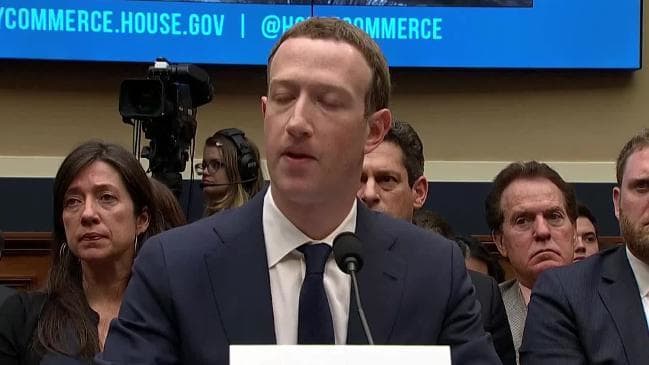
    WASHINGTON(TIP): Facebook CEO Mark Zuckerberg has told US lawmakers that his personal data was also harvested and sold by Cambridge Analytica and he intends to initiate legal action against the British firm accused of stealing personal information and using it for political purposes.

    Zuckerberg replied “yes” when asked if his personal data was included in the information sold to the “malicious third parties”by the lawmakers during a testimony before the House Energy and Commerce Committee yesterday.

    Cambridge Analytica compromised personal information of approximately 87 million users, half a million of whom were from India.

    The American people are concerned about how Facebook protects and profits from its users’ data, lawmakers said.

    Beginning this Monday, Facebook has started to notify those users whose data have been breached.

    Responding to a volley of questions, Zuckerberg, 33, said it would take some time to work through all the changes the company needs to make.

    “But I am committed to getting this right, and that includes the basic responsibility of protecting people’s information, which we failed to do with Cambridge Analytica,” he said.

    Zuckerberg said he was getting to the bottom of what the UK-based firm did and will tell everyone who may have been affected.

    “What we know now is that Cambridge Analytica improperly obtained some information about millions of Facebook members by buying it from an app developer that people had shared it with,” he said.

    “This information was generally information that people share publicly on their profile pages, like their name and profile picture and the list of pages that they follow. When we first contacted Cambridge Analytica, they told us that they had deleted the data. And then, about a month ago, we heard a new report that suggested that this was not true,” he said.

    Now the Facebook is working with governments in the US, the UK and around the world to do a full audit of what they’ve done and to make sure that they get rid of any data that they still have.

    Responding to a question, he told lawmakers that he intended to initiate legal action against the firm accused of stealing personal data and using it for political purposes in the 2016 US Presidential elections.

    To make sure that no other app developers are out there misusing data, Facebook is now investigating every single app that had access to a large amount of people’s information on Facebook in the past.

    “If we find someone that improperly used data, we’re going to ban them from our platform and tell everyone affected,” he said.

    To prevent this from ever happening again, Facebook is making sure developers can’t access as much information, going forward, he said.

    “The good news here is that we made some big changes to our platform in 2014 that would prevent this specific instance with Cambridge Analytica from happening again today. But there’s more to do, and you can find more of the details of the other steps we’re taking in the written statement I provided,” he said.

    Zuckerberg told lawmakers that Facebook had now removed the option for advertisers to exclude ethnic groups from targeting.

    “Every time, there is a control right there – not buried in settings somewhere, but right there, when they’re posting about who they want to share it with,” he added.

    Zuckerberg asserted that Facebook did not sell data.

    “We don’t sell data. That’s not how advertising works, and I do think we could probably be doing a clearer job explaining that, given the misperceptions that are out there,” he said in response to a question.

    Facebook is neither a media or a financial institution, he said.

    “I consider us to be a technology company, because the primary thing that we do is have engineers who write code and build products and services for other people,” he said.

    “There are certainly other things that we do, too. We do pay to help produce content. We build enterprise software, although I don’t consider us an enterprise software company. We build planes to help connect people, and I don’t consider ourselves to be an aerospace company,” he said.

    It is clear now that Facebook didn’t do enough to prevent these tools from being used for harm. That goes for fake news, foreign interference in elections and hate speech, as well as developers and data privacy, he said.

    “We didn’t take a broad enough view of our responsibility and that was a big mistake. It was my mistake, and I am sorry. I started Facebook, I run it, and, at the end of the day, I am responsible for what happens here. So, now, we have to go through every part of our relationship with people to make sure that we’re taking a broad enough view of our responsibility,” he said.

    (Source: PTI)

  • Facebook data breach: CEO Zuckerberg says it was a “mistake”, “I’m sorry”

    Facebook data breach: CEO Zuckerberg says it was a “mistake”, “I’m sorry”

    Vows tougher security steps to restrict developers’ access to such information.

    SAN FRANCISCO (TIP): Facebook Inc chief executive Mark Zuckerberg apologized on Wednesday, March 21, for mistakes his company made in how it handled data belonging to 50 million of its users and promised tougher steps to restrict developers’ access to such information.

    The world’s largest social media network is facing growing government scrutiny in Europe and the US about a whistleblower’s allegations that London-based political consultancy Cambridge Analytica improperly accessed user information to build profiles on American voters that were later used to help elect US President Donald Trump in 2016.

    “This was a major breach of trust. I’m really sorry this happened. We have a basic responsibility to protect people’s data,” Zuckerberg said in an interview with CNN, breaking a public silence since the scandal erupted at the weekend.

    Zuckerberg said in a post on Facebook the company “made mistakes, there’s more to do, and we need to step up and do it.” He said the social network planned to conduct an investigation of thousands of apps that have used Facebook’s platform, restrict developer access to data, and give members a tool that lets them to disable access to their Facebook data more easily.

    His plans did not represent a big reduction of advertisers’ ability to use Facebook data, which is the company’s lifeblood.

    Zuckerberg said he was open to additional government regulation and happy to testify before the US Congress if he was the right person. “I’m not sure we shouldn’t be regulated…. I actually think the question is more what is the right regulation rather than yes or no, should it be regulated?… People should know who is buying the ads that they see on Facebook.”

    Zuckerberg said Facebook was committed to stopping interference in the US midterm election in November and elections in India and Brazil. Zuckerberg, in an interview with The New York Times, referred to the artificial intelligence (AI) tools deployed by Facebook to detect fake accounts trying to manipulate news and influence the elections.

    Such a tool was deployed for the first time in the French elections in 2017. “The new AI tools we built after the 2016 elections found, I think, more than 30,000 fake accounts that we believe were linked to Russian sources who were trying to do the same kind of tactics they did in the US in the 2016 election. We were able to disable them and prevent that from happening on a large scale in France,” he said.

    This is for the first time that Zuckerberg has publicly talked about Facebook being allegedly used for influencing polls. “I feel a lot better about the systems now. At the same time, I think Russia and other governments are going to get more sophisticated in what they do, too. So, we need to make sure that we up our game,” he said.

    “This is a massive focus for us to make sure we’re dialed in for not only the 2018 elections in the US, but the Indian elections, the Brazilian elections, and a number of other elections that are going on this year that are really important,” Zuckerberg said.

    He said there is a lot of hard work that the Facebook needs to do to make it harder for nations like Russia to do poll interference. — Agencies

    FB to Enhance security for India elections

    Zuckerberg said Facebook is enhancing security features to ensure integrity of upcoming key elections in countries like India on its platform, as the social media giant faced flak over a major data breach scandal by a UK firm linked to Donald Trump’s poll campaign.

    Mark Zuckerberg says he is “sure someone’s trying” to use Facebook to meddle with US mid-term polls in Nov

    “I’m sure someone’s trying, “he said when asked about the possibility of meddling happening right now

    “I’m sure that there’s v2, version two, of whatever the Russian effort was in 2016, I’m sure they’re working on that,” he said

    Meanwhile, Facebook shares fell 1.5 per cent in premarket trading on Thursday, March 22, as the apology failed to quell Wall Street nerves

    The company has lost nearly $46 billion of its stock market value over the past three days

    Investors fear that any failure to protect personal data could deter advertisers and users and invite tougher regulation for the social media giant.

  • NOT OUR JOB TO RECRUIT JOURNALISTS FOR CONTENT, SAYS FACEBOOK

    NOT OUR JOB TO RECRUIT JOURNALISTS FOR CONTENT, SAYS FACEBOOK

    SAN FRANCISCO (TIP): In a clear message to news publishers, a top Facebook executive has emphasised that it is not their job to recruit people from media organisations for the content on the social media platform.

    At the “Code Media 2018” conference in California organised by the famous tech portal ReCode, Facebook’s Head of News Partnerships Campbell Brown said “her job is to make sure there is quality news on Facebook”.

    But “my job is not to go recruit people from news organisations to put their stuff on Facebook,” she was quoted as saying in The Verge late on Tuesday.

    Facebook hired former NBC and CNN anchor Brown to lead its news partnership team last year.

    When asked about why Brazil’s largest newspaper Folha de Sao Paolo had stopped publishing content to its six million Facebook followers, she said: “This didn’t come as a big surprise to me quite honestly”.

    “Folha hadn’t been publishing regularly on Facebook for a while, she said. And in any case, it wasn’t her job to persuade them,” the report added.

    “Publishers who want to be on Facebook Â…have a business model that works. If anyone feels this isn’t the right platform for them, they should not be on Facebook,” she was quoted as saying.

    Facebook in October launched a new programme that would allow publishers to sell subscriptions to their news sites on Facebook.

    At the event, Brown also announced a deal with Apple to commence the go-ahead of the subscription service programme in the Facebook iOS app.

    Facebook recently rolled out an update to its News Feed that will prioritise local news that have a direct impact on the users and they can discover what’s happening in their area.

    The update comes after the social media giant announced changes to News Feed that showed posts from friends and high-quality news sources.

    Users can choose which news sources, including local or national publications that they want to see at the top of their feed with the social media giant’s “See First” feature.

    According to Alex Hardiman, Head of News Product and Brown, there are no constraints on which publishers are eligible, which means large local publishers will benefit, as well as publishers that focus on niche topics like local sports, arts and human interest stories.

    Source: IANS

  • Indian origin Google AR director will lead Facebook’s AR platform

    Indian origin Google AR director will lead Facebook’s AR platform

    MENLO PARK, CA (TIP): Indian origin Nikhil Chandhok, Director of Product for Augmented Reality (AR) at Google, has joined Facebook to lead product management of its camera team working on AR.

    Chandhok took to social media on January 29th with the announcement and shared a post on Facebook saying, “I want to share an exciting update. Today is my first day at Facebook!”

    “Now, as I join the Camera/AR team at Facebook, I’m especially interested in building more conversation and momentum in cross-platform camera services,” Chandhok posted.

    “While I’m leaving the team at Daydream and Google, I’m proud of the work we did together. We gave developers ARCore and expanded access to augmented reality tools,” he said.

    “We also designed foundational aspects of AR platforms and explored how people use AR now and how they’ll use it in the future,” Chandhok added.

    He also tweeted on January 30th, “Today is my 1st day at Facebook! There are massive opportunities ahead for AR and I look fwd to joining Facebook as we bring more AR experiences to life – for more people!”

    Google, in a bid to bring the AR experience closer to Android users, in August 2017 released a new software development kit (SDK) called “ARCore”. The platform renders AR capabilities to existing and future Android phones.

    The company built on the fundamental technologies used in Tango, another AR platform by Google but ARCore is scalable across the Android ecosystem as it doesn’t require any additional hardware.


  • Indian American Executive agrees to plead guilty to Price-Fixing Conspiracy

    Indian American Executive agrees to plead guilty to Price-Fixing Conspiracy

    HOUSTON (TIP): An e-commerce company and its top executive of Indian origin have agreed to plead guilty to conspiring to fix prices for customized promotional products sold online to customers in the United States. Zaappaaz Inc. (d/b/a WB Promotions Inc., Wrist-Band.com and Customlanyard.net) and its president Azim Makanojiya agreed to plead guilty to a one-count criminal violation of the Sherman Act.

    Acting U.S. Attorney Abe Martinez, Acting Assistant Attorney General Andrew Finch of the Department of Justice’s Antitrust Division and Special Agent in Charge Perrye K. Turner of the FBI’s Houston Field Division made the announcement.

    According to the felony charges filed today in the U.S. District Court for the Southern District of Texas in Houston, the conspirators attended meetings and communicated in person and online. The investigation has revealed that the conspirators used social media platforms and encrypted messaging applications, such as Facebook, Skype and WhatsApp, to reach and implement their illegal agreements. Specifically, the defendants and their co-conspirators agreed, from as early as 2014 until June 2016, to fix the prices of customized promotional products sold online, including wristbands and lanyards. In addition to agreeing to plead guilty, Zaappaaz has agreed to pay a $1.9 million criminal fine.

    “As today’s charges show, criminals cannot evade detection by conspiring online and using encrypted messaging,” said Finch. “In addition, today’s charges are a clear sign of the Division’s commitment to uncovering and prosecuting collusion that affects internet sales. American consumers have the right to a marketplace free of unlawful collusion, whether they are shopping at retail stores or online.”

    “Schemes like the defendants’ cause financial harm to consumers who purchase goods and services and to businesses who sell goods and services in compliance with the laws of the United States,” said Martinez. “The United States will continue to investigate and prosecute individuals and businesses who seek to gain an illegal unfair advantage.”

    “The FBI stands ready to protect consumers from unscrupulous business practices,” said Turner. “Antitrust laws help protect the competitive process for the benefit of all consumers.”

    Makanojiya is charged with price fixing in violation of the Sherman Act which carries a maximum sentence of 10 years in federal prison and a maximum fine of $1 million for individuals. The maximum fine for an individual may be increased to twice the gain derived from the crime or twice the loss suffered by the victims of the crime if either of those amounts is greater than the statutory maximum fine.

  • SUKHPAL KHAIRA IS LEADER OF OPPN IN PUNJAB ASSEMBLY

    SUKHPAL KHAIRA IS LEADER OF OPPN IN PUNJAB ASSEMBLY

    CHANDIGARH (TIP): Bholath MLA Sukhpal Khaira was chosen as the Leader of Opposition in the Punjab Assembly today, with majority of the 19 other Aam Aadmi Party MLAs recommending his name in a one-on-one meeting with national party convener Arvind Kejriwal in New Delhi.

    HS Phoolka, who had resigned as the Leader of Opposition to focus on fighting cases of the 1984 anti-Sikh riot victims, also backed Khaira. Khaira got preference over other contenders after about 15 MLAs met in Chandigarh on July 17 where they agreed to support him on the ground that he was the only experienced legislator. One of the main contenders, Nazar Singh Mansahia, withdrew his name in Khaira’s favour in the meeting itself.

    Three MLAs, it is learnt, expressed strong reservation against Khaira’s name today, arguing that he would nurture his personal agenda more than toeing the party’s line and ideals. However, when Kejriwal and MP Bhagwant Mann announced that majority of the MLAs were in favour of Khaira, all MLAs gave their consent. The Leader of Opposition gets a Cabinet Minister rank and status. Talwandi Sabo MLA Baljinder Kaur was another contender for the post.

    Party sources said the Delhi leadership felt that the party may get divided if Khaira was not given a chance. Khaira, at present the Chief Whip of the party, had openly protested against the selection of Bhagwant Mann as state party president.

    Khaira faces a daunting task as he has to keep the party flag high in the Assembly, besides ensuring discipline. His first challenge would be to find a way out of privilege action against him by the Speaker. Khaira had during the Budget Session last month gone live on Facebook from the Assembly, against the rules. He was suspended for the session. A privilege committee will hear the allegation against him. Meanwhile, commenting on his election, Khaira said it was a moral victory of hard work and truth against sycophancy and money power. Khaira had remained a Congress MLA from 2007 to 2012. His father Sukhjinder Singh was an Akali leader who remained Education Minister twice.

  • JENNIFER GARNER SETS THE RECORD STRAIGHT ON BEN AFFLECK DIVORCE STORY

    JENNIFER GARNER SETS THE RECORD STRAIGHT ON BEN AFFLECK DIVORCE STORY

    The A-list movie star released a statement via Facebook on Wednesday afternoon, claiming that she did not pose for or authorize People magazine’s latest cover story detailing her divorce from Ben Affleck.

    “It has been brought to my attention that there is a People magazine cover and article out today that appear to be coming from me,” Garner wrote. “It isn’t unusual for me to receive calls from loved ones thinking I forgot to tell them I am pregnant–with twins!–(Geez Louise), but those are so ridiculous they’re easy to ignore.”

    The proud mom-of-three continued, “This isn’t a tragedy by any measure, but it does affect me and my family and so, before my mom’s garden club lights up her phone, I wanted to set the record straight.” “I did not pose for this cover. I did not participate in or authorize this article,”

    Garner shared. “While we are here, for what it’s worth: I have three wonderful kids and my family is complete.” “Have a beautiful day,” the Miracles From Heaven star concluded. “Love, Jen.” Garner officially filed for divorce from Affleck in mid-April after 10 years as husband and wife. The former couple filed the petition and response together, requesting joint legal and physical custody of Violet, 11, Seraphina, 8, and Samuel, 5.

    “It’s been a hard few months but you would never know,” an insider recently told E! News of how the celebrity is moving forward after the split. “Jen always has her head up high and a smile on her face. She does a great job of keeping it together for the kids.” Source: Eonline.com

  • Afghanistan blames Haqqani network, ISI for Kabul blast

    Afghanistan blames Haqqani network, ISI for Kabul blast

    KABUL/ISLAMABAD (TIP): The Afghan intelligence service, the National Directorate of Security (NDS), said on Thursday that early findings showed the Haqqani network with the assistance of Pakistan’s ISI carried out the attack in Kabul that killed at least 90 people.

    “These terrorists once again proved they don’t represent any religion and they only carry out such coward attacks to please their Pakistani masters which is against all Islamic and human rights principals,” the NDS said in a statement on Thursday.

    The Haqqani network has carried out a number of kidnappings and attacks against US interests in Afghanistan.

    The group is also blamed for several deadly attacks against Indian interests in Afghanistan, including the 2008 bombing of the Indian mission in Kabul that killed 58 people.

    Afghanistan cancels Pakistan games after Kabul attack Afghanistan also cancelled proposed home and away cricket fixtures with Pakistan after the Kabul bombing.

    Pakistan were set to play their first Twenty20 match in Kabul later this year in what was seen as an opportunity for the neighbours to ease tensions over border skirmishes and alleged proxy warfare.

    The Kabul match, set for July or August, would have been followed by a fixture in Pakistan and a full series at an unspecified date.

    But the Afghanistan Cricket Board issued a strongly worded statement late on Wednesday, cancelling the matches in light of a truck bombing in the city’s diplomatic quarter that killed at least 90 people.

    No group has claimed responsibility for Wednesday’s attack, although the Taliban has denied involvement.

    “The ACB hereby cancel all kinds of cricket matches and initial mutual relationship agreement with the Pakistan Cricket Board,” the Afghan board said on its Facebook page. “No agreement of friendly matches and mutual relationship agreement is possible with a country where terrorists are housed and provided safe havens.” The development leaves Pakistan’s cricketers even more isolated in the region.

    Pakistan rejects Afghan allegations Pakistan, however, strongly rejected as “baseless” the Afghan allegations that ISI was in any way involved in the Kabul attack. “The accusatory approach is unhelpful towards efforts to peace,” Pakistan’s Foreign Office (FO) spokesman Nafees Zakaria said during the weekly media briefing on Thursday. Zakaria said Pakistan suffered due to terrorism and has the highest stakes in Afghan peace and stability. “Our commitment to peace in Afghanistan is based on sincerity and is beyond any doubt,” he added. Zakaria said that it was highly disappointing that certain elements in Afghanistan were damaging relations between the two neighbours. (agencies)

  • Indian American Researchers win Young Investigator Award for 2017

    Indian American Researchers win Young Investigator Award for 2017

    ARLINGTON, VA (TIP): The Office of Naval Research’s Science and Technology Organization honored recently 34 young investigators nationwide with the 2017 Young Investigator Award.; four of them are Indian American researchers. They are:

    Dr. Dhruv Batra, Dr. Pavithra Prabhakar, Dr. Padmini Rangamani and Dr. Kaushik Sengupta Batra, of the Georgia Institute of Technology, was recognized for “Explainable and Trustworthy Intelligent Systems” in the Machine Learning, Reasoning and Intelligence program.

    Winner of 2017 Young Investigator Award Dr. Dhruv Batra.

    Batra is an assistant professor at Georgia Tech’s School of Interactive Computing. The Indian American is also a visiting researcher at Facebook AI Research and was a research assistant professor at the Bradley Department of Electrical and Computer Engineering at Virginia Tech. In addition to the Young Investigator Award, Batra has received an Amazon Academic Research Award for Visual Dialog. Batra, who earned his master’s and doctorate at Carnegie Mellon University, and his bachelors at the Indian Institute of Technology Banaras Hindu University, has also held visiting positions at Microsoft Research, Carnegie Mellon University and MIT.

    Winner of 2017 Young Investigator Award Dr. Pavithra Prabhakar.

    Prabhakar of Kansas State University was chosen for “Design of High- Assurance Cyber-Physical Systems” in the Science of Autonomy program. Prabhakar is a Michelle Munson- Serban Simu Keystone Research Faculty Scholar and an associate professor with tenure in the computer science department at Kansas State University. Her research interests include cyberphysical systems, formal verification, automata theory and logic. Prior to joining Kansas State in 2015, she served as an assistant professor at IMDEA Software Institute and was a postdoctoral researcher at the California Institute of Technology. She earned her bachelors from the National Institute of Technology Warangal, her Master’s from the Indian Institute of Science, and her doctorate from the University of Illinois at Urbana- Champaign.

    Winner of 2017 Young Investigator Award Dr. Padmini Rangamani.

    Rangamani of U.C. San Diego was selected for “Non-Equilibrium Thermodynamics of Biological Membranes” in the Undersea Medicine program. Rangamani is an assistant professor in the mechanical and aerospace engineering department and a faculty affiliate in the bioengineering department at U.C. San Diego’s Jacobs School of Engineering. Her research is focused on understanding the design principles of biological systems. Rangamani was a chancellor’s postdoctoral fellow in the Department of Molecular and Cell Biology and in the Department of Mechanical Engineering at U.C. Berkeley in 2013-14. The Indian American earned her Ph.D. in biological sciences in 2010 at the Icahn School of Medicine at Mount Sinai Medical Center in New York.

    Winner of 2017 Young Investigator Award Dr.
    Kaushik Sengupta.

    Sengupta of Princeton University was among the recipients for “Bit-to-THz: Universally Programmable THz Surfaces with Sub-Wavelength Field and Response Synthesis” in the Expeditionary Maneuver Warfare and Combating Terrorism Department program. Sengupta is an assistant professor of electrical engineering at Princeton. Among his research interests are Silicon based RF, mm-Wave and THz circuits and systems, on-chip active electromagnetic field synthesis and self-healing and reconfigurable integrated circuits and systems in silicon, among others. Sengupta, who earned a Bachelor’s from the Indian Institute of Technology, and a master’s and doctorate from the California Institute of Technology, was an IBM Fellow, an IEEE Fellow and Caltech Institute Fellow, as well as an IIT Kharagpur Prime Minister Gold Medal recipient.

  • Chandrababu Naidu honored with Transformative Chief Minister Award at Silicon Valley Summit

    Chandrababu Naidu honored with Transformative Chief Minister Award at Silicon Valley Summit

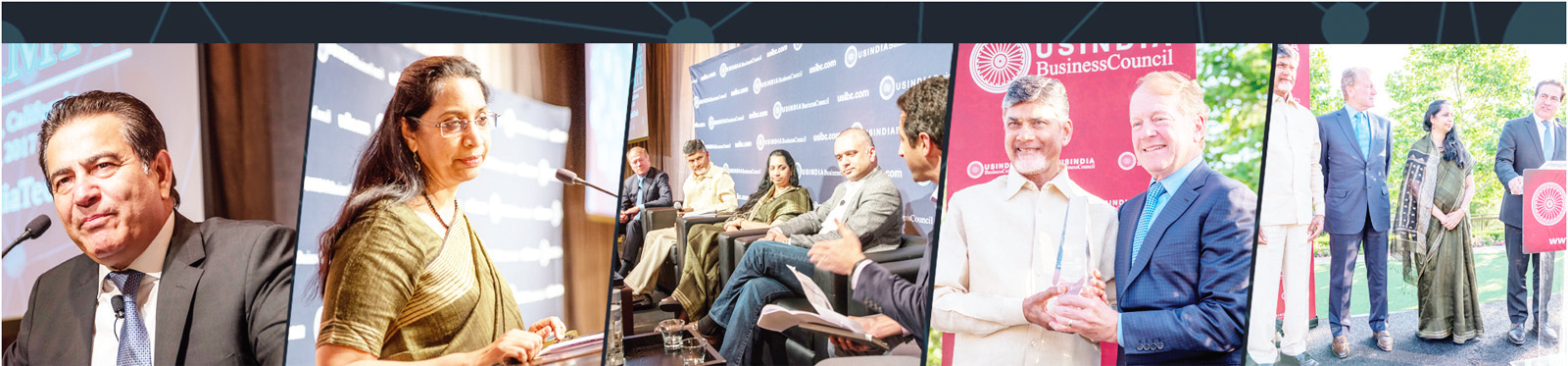
    WASHINGTON (TIP): Chief Minister of Andhra Pradesh Chandrababu Naidu was awarded the Transformative Chief Minister Award by The U.S.-India Business Council (USIBC) during their annual summit, an honor that has been instituted by the Council to acknowledge excellence in public service and recognize the honoree’s achievement in championing U.S.-India ties in the areas of trade, politics and culture. Recognized alongside Chief Minister Naidu, Secretary, Ministry of Electronics and IT, Aruna Sundararajan was honored with the USIBC Transformative Leadership Award for distinguished public service and her commitment to advancing U.S.-India cooperation and Digital India.

    USIBC hosted its annual summit in Silicon Valley in first week of May, calling for collaboration. The theme of this year’s summit was U.S.-India Technology Partnership. Industry and government leaders from the U.S. and India discussed the power of digital transformation to accelerate economic growth, create jobs, and encourage the start-up and entrepreneurial environment.

    USIBC brought together key stakeholders, including Government of India officials, industry leaders in fintech, digital payment service providers, IT, sharing economy, Ecommerce, and venture capitalists to renew key linkages and advance the convergent interests of the two countries.

    Senior policy makers and heads of global organizations held discussions on dynamic aspects of the U.S.-India commercial relationship that included panel discussions on: (1) Enabling Entrepreneurship and Corporate Responsibility; (2) Make in India; (3) Digital Payments, Internet of Things and Smart Planning; (4) Future of U.S.- India Technology Partnership featuring the Chief Minister of Andhra Pradesh Chandrababu Naidu and IT Secretary Aruna Sundararajan, alongside tech innovators Dheeraj Pandey, CEO of Nutanix, and USIBC Chairman and Cisco Executive Chairman, John Chambers. The panel was moderated by CNBC’s senior technology reporter, Ari Levy.

    Approximately 200 senior level business leaders and investors attended the summit. Attending companies at the summit included Amazon, PayPal, Deloitte, Facebook, iCreate, Nuveen, Mastercard, Mobility Infrastructure Group, Varian Medical, and Visa.

  • Russian Interference in US Elections 2016: Probe Tentacles Grow

    Russian Interference in US Elections 2016: Probe Tentacles Grow

    Jared Kushner Under Scrutiny in Russia Probe, Say Officials

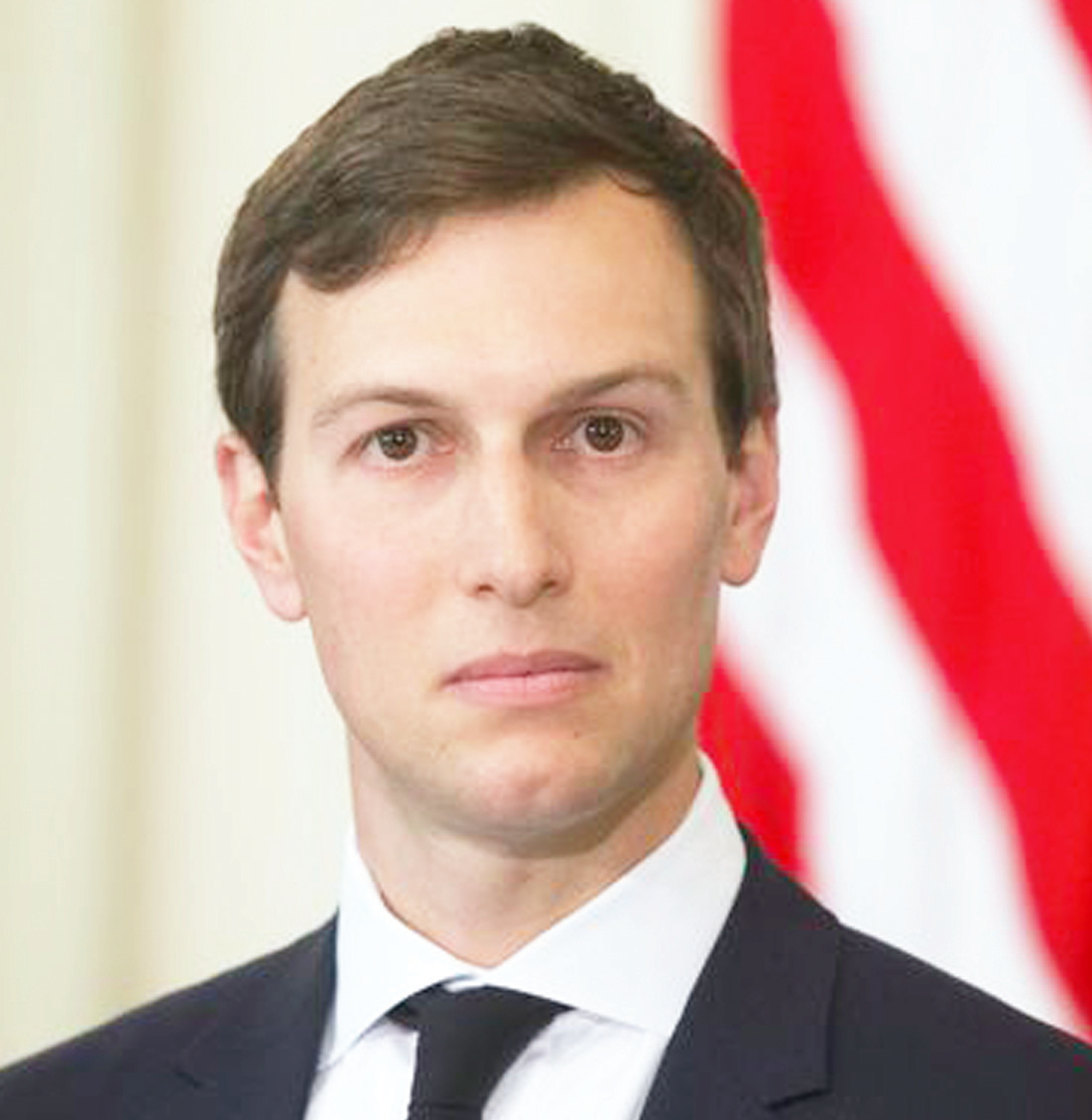
    WASHINGTON (TIP): An NBC News report said, May 25, quoting “multiple US officials” that Jared Kushner, the president’s son-in-law and one of his senior advisers, has come under FBI scrutiny in the Russia investigation. “Investigators believe Kushner has significant information relevant to their inquiry, officials said. That does not mean they suspect him of a crime or intend to charge him”, says the NBC News. CNN said in a report on May 25, “The FBI’s criminal probe of Russian meddling in the 2016 presidential election is increasingly touching on the multiple roles of senior White House adviser

    Jared Kushner on both the Trump campaign and the Trump transition team. “Points of focus that pertain to Kushner include: the Trump campaign’s 2016 data analytics operation; his relationship with former national security adviser Michael Flynn; and Kushner’s own contacts with Russians, according to US officials briefed on the probe”. CNN report says further:”Federal investigators have been taking a  closer look at the Trump campaign’s data analytics operation, which was supervised by Kushner, officials say, and are examining whether Russian operatives used people associated with the campaign — wittingly or unwittingly — to try to help Russia’s own data targeting.

    “Kushner, the president’s son-in-law, worked with and helped oversee the campaign’s data operation contractors based in San Antonio, Texas. “Kushner has described how, beginning last June, he began testing the use of data targeting to sell Trump merchandise.

    Eventually, according to a November Forbes magazine profile, the data operation helped the Trump campaign figure out where the candidate’s message was resonating in states like Michigan and Wisconsin, places where conventional political wisdom suggested they would be wasting time and money. “I called somebody who works for one of the technology companies that I work with, and I had them give me a tutorial on how to use Facebook micro-targeting,” Kushner told Forbes.

    A source connected to the data analytics group said the team has not been contacted about any Russia related probe. “We have not been contacted by anyone and don’t know anything formally about an investigation,” the source said.

    The FBI focus on Flynn also touches on Kushner because he led the presidential transition’s foreign policy efforts. Kushner’s impact grew during the transition, which one source says he effectively ran — along with another campaign aide Rick Dearborn — once New Jersey Gov Chris Christie was removed. This source says both Kushner and his wife Ivanka Trump wanted Flynn in as national security adviser. A source close to Kushner denied that he pushed for Flynn. Kushner has acknowledged meeting during the transition with Russia’s ambassador and separately with the head of a Russian bank.

    According to a source familiar with what transpired, neither meeting discussed sanctions but instead focused on establishing a backchannel to Russia’s president. Those meetings are of interest to the FBI.

    The FBI’s scrutiny of Kushner places the bureau’s sprawling counterintelligence and criminal investigation not only on the doorstep of the White House, but the Trump family circle. The Washington Post first reported last week that a senior White House official close to Trump was a “person of interest,” but did not name the person. The term “person of interest” has no legal meaning. The officials said Kushner is in a different category from former Trump aides Paul Manafort and Michael Flynn, who are formally considered subjects of the investigation.

    According to the Justice Department’s U.S. Attorneys’ Manual, “A ‘subject’ of an investigation is a person whose conduct is within the scope of the grand jury’s investigation.”

    Records of both Manafort and Flynn have been demanded by grand jury subpoenas, NBC News has reported. It is not known whether Kushner has received any records requests from federal investigators. Also unclear is what precisely about Kushner’s activities has drawn the FBI’s interest as it investigates whether Trump associates coordinated with the Russian campaign to interfere in the election. Former

    FBI Director Robert Mueller is now leading the probe as a special counsel. Kushner met at least once in December with the Russian ambassador, Sergey Kislyak, and he also met last year with a Russian banker, Sergey Gorkov.

    “Mr. Kushner previously volunteered to share with Congress what he knows about these meetings,” Kushner’s lawyer, Jamie Gorelick, told NBC News. “He will do the same if he is contacted in connection with any other inquiry.”

    Congressional aides have said they would like to question Kushner about that meeting, and Kushner has said he would voluntarily appear before the Senate intelligence committee as part of its Russia investigation.

    Gorkov is chairman of VneshEconomBank, a Russian governmentowned institution that has been under U.S. sanctions since July 2014. Gorkov studied at the training school for the FSB, one of Russia’s intelligence services.

    Kushner, whose family’s real estate empire is worth $1.8 billion, according to Forbes, wields significant power in the White House. He is married to Trump’s daughter, Ivanka.

  • THRIVENYC- FIRST LADY CHIRLANE MCCRAY ANNOUNCES EXPANSION OF MATERNAL DEPRESSION SCREENING TO ALL NYC HEALTH + HOSPITALS

    THRIVENYC- FIRST LADY CHIRLANE MCCRAY ANNOUNCES EXPANSION OF MATERNAL DEPRESSION SCREENING TO ALL NYC HEALTH + HOSPITALS

    Kicker:Removing stigma and identifying depression help women get the support they need

    NEW YORK CITY (TIP): First Lady Chirlane McCray announced, May 18, that all NYC Health + Hospitals locations citywide will now provide maternal depression screenings for pregnant women and new mothers. Through an expansion under ThriveNYC, depression screenings will be adopted as a routine part of care at pre-natal clinics at 12 NYC Health + Hospital sites, including all 11 hospitals and NYC Health + Hospitals/Gotham Health, Gouverneur, a large community health center on the Lower East Side.

    The Centers for Disease Control and Prevention estimates that 1 in 9 women experience maternal depression. Yet too often, maternal depression goes undiagnosed because many providers do not regularly provide screenings and women are afraid of the stigma associated with the condition. Universal screening ensures that pregnant women and new mothers get the support they need to recover and fully bond with their new babies.

    “Maternal depression is common. It’s also treatable – but only if women know to get help,” said the First Lady of NYC Chirlane McCray, who spearheads the city’s efforts on mental health and substance misuse. “Too often, women are afraid to admit that they’re struggling because they don’t understand that their pain is a real, clinical condition and they don’t want to be labeled a bad mom. Universal screening for maternal depression reminds women they should never feel ashamed for needing help. It also connects them to care early so they can recover and experience the joy of a new baby. I’m so proud that Health + Hospitals will be screening every new mother. We will continue to help transform the culture around postpartum depression and connect new families to essential resources.”

    Deputy Mayor for Strategic Policy Initiatives Richard Buery said, “Each year in New York City, several thousands of women experience depression after pregnancy, yet, for many, the fear of looking like a ‘bad mother’ prevents them from reaching out for the care they need. By making maternal depression screening available at all Health + Hospitals locations Citywide, ThriveNYC removes stigma as a barrier for seeking help and closes a critical treatment gap – providing new mothers the right interventions at the right time to ensure they and their newborn can have a healthy and stable transition into their new life together.”

    “Depression screening is the first step toward addressing the overall wellness of pregnant women and new moms,” said Gregory Calliste, CEO of NYC Health + Hospitals/Woodhull. “Once a need is identified it is essential to have services in place and ready to address the patient’s concerns. Woodhull’s Mothers Support Groups were designed to increase access to timely mental health services to address maternal depression and provide women with a necessary support system. We are encouraged by the impact the program has been having on the lives of the women we treat and look forward to expanding our efforts.”

    Every year, over 18,000 newborns are delivered in the NYC Health + Hospitals system. Since April 2016, NYC Health + Hospitals has screened over 6,500 pre-natal patients and over 2,700 post-partum patients. NYC Health + Hospitals expects to screen 15,000 patients over the next year through the expansion of the program.

    The screenings are conducted through a series of questions known as the PHQ-9 tool, which is typically self-administered by patients during the intake process. In the last year, nine percent of pre-natal patients screened positive for maternal depression. A continued effort to address stigma through ThriveNYC public awareness campaigns and other forms of outreach aims to further reduce the number of women who refuse treatment or fail to appear for follow-up appointments.

    The maternal depression screening project is an initiative of ThriveNYC, New York City’s comprehensive plan to overhaul the City’s approach to mental health by removing stigma as a barrier for seeking care and increasing the availability of treatment options. The initiative established a citywide collaborative to increase maternal depression screening at hospitals responsible for 80% of the live births in New York City, which includes members of the Greater New York Hospital Association.

    “Screening for maternal depression has been an important part of my Family- Friendly Brooklyn vision, a vision that promotes a borough where we raise healthy children and families,” said Brooklyn Borough President Eric L. Adams. “I have been proud to partner with organizations like the Seleni Institute to help train practitioners, and I’m pleased that NYC Health + Hospitals is expanding screenings across its system. I call on the State to fully fund maternal depression screening, as we look to support every pregnant woman and new mom in New York.”

    “By expanding these critical maternal depression screenings across our public health system, our City’s new moms and soon to- be-moms will be able to receive adequate support, resources and treatment,” said State Senator Gustavo Rivera. “I commend First Lady Chirlane McCray, Thrive NYC, and NYC Health + Hospitals for ensuring that new families across our City receive the assistance they need.”

    “Having a baby can be an incredible and rewarding experience for moms and families, but it is also a very challenging time,” said State Senator Liz Krueger. “Many women experience symptoms of maternal depression without knowing what’s happening to them, and without having access to diagnosis and treatment. But once diagnosed, maternal depression is very treatable. That’s why the First Lady’s initiative is so important. I thank her for her efforts on this issue, and NYC Health + Hospitals for looking after the mental health of New York’s new moms and families.”

    Assistant Speaker Felix W. Ortiz said, “I welcome additional screening for pregnant women and new mothers, a program I’ve long championed in Albany since I chaired the Mental Health Committee and where I have a bill to mandate this effort statewide. This is a welcome development for our growing communities with so many children and growing families. Healthy mothers lead to healthier families.”

    “I commend First Lady Chirlane McCray for this bold initiative,” said Assembly Member Roxanne Persaud. “Too long has mental health been something discussed only in the shadows. We must provide holistic health for all New Yorkers especially women when they are most vulnerable. The mental health of our mothers is vital to the overall health of the family unit.”

    “This is a tremendous step to making sure that new and expecting moms are getting the care they need,” said Council Member Andrew Cohen. “NYC Health + Hospitals will not only help diagnose women struggling with mental illness, they will break the stigma around maternal depression, which continues to be a barrier to proper treatment.”

    “Becoming a mom is one of the most beautiful and challenging experiences a woman can have,” said Council Member Julissa Ferreras-Copeland. “If a new mother is having difficulty transitioning, she should have the support and education she needs to ensure she can keep herself and her family healthy. I commend the First Lady for yet another valuable investment in the health of women through ThriveNYC. And I look forward to supporting this initiative so that New York City families may continue to grow here.”

    “As co-chair of the City Council Women’s Caucus and a mother, I want to commend NYC Health + Hospitals for including depression screening as part of the care plan for new mothers at all of its hospitals. It’s critical that all new moms get the physical and emotional support they need as soon as possible. Postpartum depression is treatable and should not be stigmatized. NYC HHC is leading the way in adopting a new approach to this not unusual result of childbirth,” said Council Member Helen Rosenthal.

    About NYC Health + Hospitals

    NYC Health + Hospitals is the largest public health care system in the nation, serving more than a million New Yorkers annually in more than 70 patient care locations across the city’s five boroughs. A robust network of outpatient, neighborhood-based primary and specialty care centers anchors care coordination with the system’s trauma centers, nursing homes, post-acute care centers, home care agency, and MetroPlus health plan-all supported by 11 essential hospitals. Its diverse workforce of more than 42,000 employees is uniquely focused on empowering New Yorkers, without exception, to live the healthiest life possible. For more information, visit

    www.nychealthandhospitals.org and stay connected on

    Facebook at https://www.facebook.com/NYCHealthandHospitals or

    Twitter at @NYCHealthSystem.

    About NYC Health + Hospitals/Woodhull

    NYC Health + Hospitals/Woodhull, a 388- bed, acute care hospital in Brooklyn, has been serving the residents of Williamsburg, Bushwick, Greenpoint, Fort Greene, and Bedford-Stuyvesant for 35 years. Its mission is to provide comprehensive, high-quality care in a culturally sensitive manner to all individuals, regardless of their ability to pay. A part of NYC Health + Hospitals, the largest public health care system in the nation, the hospital is affiliated with the New York University School of Medicine.


  • SNAPCHAT’S GROWTH STALLS IN FACEBOOK’S SHADOW IN 1Q REPORT

    SNAPCHAT’S GROWTH STALLS IN FACEBOOK’S SHADOW IN 1Q REPORT

    SNAPCHAT’S GROWTH STALLS IN FACEBOOK’S SHADOW IN 1Q REPORT

    Facebook has been bent on copying Snapchat ever since the social media giant tried unsuccessfully in 2013 to buy what was then an ephemeral photo-messaging app.

    Now, the company behind Snapchat is hoping to copy some of its larger rival’s own practices, at least with respect to courting new users — and, with them, advertisers. But it’s not going so well.

    On May 10, Snap Inc. announced a massive loss and a continued slowdown in user growth, while revenue fell below Wall Street’s expectations in its first earnings report as a public company. Just a week earlier, Facebook posted double-digit revenue growth for the first quarter — much as it has consistently since its initial public offering in 2012. Snapchat reported 166 million daily active users in the latest quarter, an increase of just 36 percent from a year earlier. In its first post-IPO report in 2012, Facebook also disappointed investors when its daily user base grew by only 32 percent. But at that point, Facebook had 552 million regular users, more than three times as many as Snapchat.

    Where the money went

    Almost $2 billion of Snap’s $2.2 billionloss in the January-March period involved stock compensation costs related to the company’s initial offering. Facebook had similar costs of roughly $1.3 billion. But Facebook’s revenue was $1.18 billion in its first quarter as a public company. Although Snap’s revenue nearly quadrupled in the latest quarter, it only rose to $150 million. And that still undershot the $158 million analysts polled by FactSet had expected. Snap’s stock fell $5.50, or 24 percent, to $17.48 in after-hours trading.

    Copycats

    Growth in Snapchat’s user base began to slow down last year after Facebook’s Instagram copied Snapchat’s “stories” feature, which lets users post short video clips that disappear after 24 hours. Not to miss out on the trend, Facebook also launched disappearing stories this year.

    And let’s not forget about WhatsApp, the Facebook-owned messaging service that came out with “status,” which lets people post photos and videos that disappear after 24 hours. See a trend here?

    All about the messaging

    Matt Britton, CEO of social media marketing company Crowdtap and an expert on millennials, believes Snapchat has “gotten ahead of itself” in pushing out new features, when what it does best — and what it’s most used for — is one – on- one messaging.

    “If you ask any teen how they use Snapchat, (most) say they use it to text people,” Britton said. He said he’s seen a lot of teens replace the telephone icon at the bottom of their phones’ most-used apps with the Snapchat app. Why call when you can snap, after all?

    Not a social network

    Snapchat’s Stanford-dropout CEO, Evan Spiegel, has long insisted that his company is not a social network but a “camera company.” Unlike Facebook, Twitter or Instagram, Snapchat isn’t connecting networks of people. You could use it with just one other person, if you wanted.

    Britton sees challenges for Snapchat’s non-messaging features, such as stories and a “discover” option that lets users keep up with news, sports or celebrities. These features aren’t what many users go to Snapchat for.

    Snapchat, like Facebook, is also experimenting with augmented reality, a blending of the virtual and physical worlds, but it’s still hard to tell how that will make money or have broad appeal.

    In Wednesday’s conference call with analysts, Spiegel sought again to distance Snapchat from the likes of Facebook, pointing out that its main focus was not to get as many users to sign up as possible.

    “If we had just in the beginning encouraged snapchatters to add all their friends in (their) contact book instead of just few of them, they might be really uncomfortable creating snaps and adding them to their stories,” he said, according to a transcript of the call.

    Source: AP


  • WHATSAPP FOR ANDROID GETS ‘NEW’ USER INTERFACE

    WHATSAPP FOR ANDROID GETS ‘NEW’ USER INTERFACE

    Facebook-owned WhatsApp has rolled out a new update for its Android app. Bearing version number 2.17.146, the update introduces some user interface changes to the app.

    After the update, WhatsApp’s Android app has a separate button for video calling. The placement of the attachment button has also been changed. A new video calling button is placed next to the voice calling button, on the top left corner of the upper bar.

    The attachment button now sits next to the camera icon in the text bar. Moreover, the shape of the text input field has been tweaked. It now has rounded corners instead of being rectangular in shape.

    Recently, an online report suggested that WhatsApp will soon introduce a new feature that’ll enable users to pin individual or group chats. The chat-pinning feature is available in WhatsApp for Android’s beta version 2.17.162 or 2.17.163.

    The feature allows users to select up to three chats (including individual or group chats) on top of the list, so that they don’t get lost. To pin a chat, users can long press on it and tap on the pin icon seen on the top bar. The icon is accompanied by other icons which can be used to access other options such as delete, mute or archive.

    The same method can also be used to unpin chats. Users will need to long press on the chat once again and tap the pin icon on the top to unpin it.

  • SOON, FACEBOOK TECH WILL LET OUR BRAINS TYPE

    SOON, FACEBOOK TECH WILL LET OUR BRAINS TYPE

    LOS ANGELES (TIP): Facebook is working on a new ‘silent speech’ technology that will allow people to type directly with their brains, drastically reducing the time it takes to convert our thoughts into written words.

    The silent speech system will be capable of typing 100 words per minute straight from the brain – five times faster than one can type on a smartphone today, Facebook said.

    At the annual two-day event F8, where developers come together to explore the future of technology – Facebook announced two projects focused on silent speech communications.

    “We shared a project we’re working on that will one day allow us to choose to share a thought, just like we do with photos and videos,” Facebook founder and CEO Mark Zuckerberg, said in a post.

    “Our brains produce enough data to stream 4 HD movies every second. The problem is that the best way we have to get information out into the world -speech – can only transmit about the same amount of data as a 1980s modem,” Zuckerberg said.

    “We’re working on a system that will let you type straight from your brain about 5x faster than you can type on your phone today,” he said.

    “Eventually, we want to turn it into a wearable technology that can be manufactured at scale. Even a simple yes/no “brain click” would help make things like augmented reality feel much more natural,” he added.

    “This isn’t about decoding your random thoughts. You take many photos and choose to share only some of them. Similarly, you have many thoughts and choose to share only some of them,” said Regina Dugan, head of Building 8.

    “This is about decoding those words you’ve already decided to share by sending them to the speech centre of your brain. It’s a way to communicate with the speed and flexibility of your voice and the privacy of text,” said Dugan.

    “We want to do this with non-invasive, wearable sensors that can be manufactured at scale,” she said.

    Building 8 is the product development and research team at Facebook focused on creating and shipping new, category-defining consumer products that are social first, and that advance Facebook’s mission.

    Products from Building 8 will be powered by a breakthrough innovation engine modelled after DARPA and shipped at scale.

    “We also have a project directed at allowing people to hear with their skin. We are building the hardware and software necessary to deliver language through the skin,” Facebook said.

  • Chicago police arrest 14 year-old in Facebook rape case

    Chicago police arrest 14 year-old in Facebook rape case

    CHICAGO (TIP): Police in Chicago arrested a 14-year-old boy in connection with the alleged gang rape of a teenage girl that was broadcast on Facebook Live, police and local news reported.

    “CPD arrested 1st of several juvenile offenders in Facebook sexual assault incident,” police department spokesman Anthony Gugliemi wrote on Twitter late Saturday.

    The boy, who is 14, faces at least three juvenile felony charges, The Chicago Tribune newspaper reported, citing city police. The victim was a 15-year-old girl who went missing on March 19 in the crime-plagued midwestern US city. She was found two days later and taken to a children’s hospital for treatment.

    Gugliemi promised more details at an 11 am (1600 GMT) Sunday press conference.

    City police got involved when the girl’s mother approached police with graphic photos taken from a Facebook Live video showing several young men assaulting the teen.

    It was the latest in a series of troubling incidents in which violent acts have been streamed live on Facebook, including two fatal shootings and the kidnapping and torture of a disabled 18-year-old.

    The social networking site said in a statement after the incident that it took seriously its “responsibility to keep people safe on Facebook.”

    The live online video of the alleged gang rape attracted as many as 40 viewers at one time, but no one contacted police, according to reports. The video was later taken down.

    Chicago has been grappling with a surge in violent crime. Last year, the city endured its highest number of shootings and murders in nearly two decades.

    Much of the violence is concentrated in a few impoverished areas, including the one where the teenage girl lives.

  • Facebook blocks 85% ‘blasphemous’ content in Pakistan, Islamabad high court still unhappy

    Facebook blocks 85% ‘blasphemous’ content in Pakistan, Islamabad high court still unhappy

    ISLAMABAD (TIP): Facebook has removed 85 percent of content considered insulting to Islam, but the high court in Pakistan’s capital is unhappy because there’s still “carpet bombing and drone attacks going on at our ideological boundaries”, The News reported.

    “(The) ideology of Pakistan, Sunnah of Hazrat Muhammad (PBUH) and the common binding force for all Muslims in the shape of love and respect for the Prophet (PBUH) regardless of color, creed and sect are the boundaries under attack”, said justice Shaukat Aziz Siddiqui of the Islamabad high court (IHC) yesterday.

    This is the same court that earlier this month ordered the Pakistan government to start an investigation into online “blasphemy” and threatened to block Facebook and other social media networks if they failed to censor content considered insulting to Islam.

    Following that order, Pakistan’s interior minister Nisar Ali Khan reached out to Facebook to comply.+

    “Now there’s only 15 percent of such content left to be removed”, the country’s interior secretary Arif Khan told the Islamabad High Court yesterday.

    “Facebook agreeing to our demands is a big achievement,” said the head of the Pakistan Telecommunication Authority.

    IHC isn’t that impressed.

    “If social media wages a war against us, what remedy (do) we have and where (is) our information technology wing,” the IHC bench asked, chastising the IT ministry for “behaving like silent spectator and having no mechanism to deal with the issue.”

    The IHC futrher sai it got no “satisfactory answer” from the state machinery on the preventive machinery against “he war waged through social media.”

    The top leadership of Pakistan needs to raise a “national firewall enabling Pakistan to monitor its’s internet traffic and all the users”, justice Siddiqui said.

    Pakistan previously banned Facebook for hosting allegedly blasphemous content for two weeks in 2010. As well, YouTube was unavailable from 2012 to 2016, over an amateur film about the Prophet Muhammad that led to global riots. (TOI)


  • INSTAGRAM GOES LIVE WITH FULL SCREEN ADS ON ITS STORIES FEATURE

    INSTAGRAM GOES LIVE WITH FULL SCREEN ADS ON ITS STORIES FEATURE

    Facebook-owned photo-sharing platform Instagram on Thursday said that it was launching full screen advertisements on Instagram’s stories feature globally.

    “Ads in stories let your business use targeting and reach capabilities that make your ads personally relevant to the people you want to reach. That, paired with measurement tools giving you the confident to know it works, is unmatched in a stories experience,” the company said in a statement. Earlier, Instagram in January had said that the advertisements would go live soon.

    “Today, businesses of every size around the world can start running ads in stories through the Marketing API, Power Editor and Ads Manager optimized for reach. By optimizing for reach, you can show your ads to the maximum number of people in your audience and control how often they see your ads. The reach objective for ads in stories will begin rolling out today and will be available globally in the next few weeks,” the company said.

    In a bid to explain the benefit of running the advertisement campaigns, the company had tied up with over 30 businesses to test the ads feature.

    “We saw a double digit point increase in ad recall from our experiences on Airbnb campaign that further justifies our investment in ads within stories as they have made a measurable impact for us,” Eric Toda, global head of social marketing and content, said, adding that “our ability to apply existing targeting and measurement in an experience to reach the right audience, in the right mindset, with the right story at scale has allowed us to achieve the results we were hoping for in a partnership with Instagram.”

  • WHATSAPP TO SOON ROLL OUT SNAPCHAT LIKE STORIES FEATURE IN IOS

    WHATSAPP TO SOON ROLL OUT SNAPCHAT LIKE STORIES FEATURE IN IOS

    Facebook-owned WhatsApp might be planning to soon add a new feature that might be very similar to Snapchar’s Stories feature.

    However, the feature will come to iOS (for iPhones) first and then later might be rolled out to Android. This means that iPhone users will be able to put forth photos and videos in their Status with their contacts if the latest leaked image is believed to be true. The feature is similar to Snapchat Stories, which will disappear after 24 hours.

    WABetaInfo tweeted an alleged image of the upcoming feature on iOS along with the text that read, “Status introduction text updated in WhatsApp beta for iOS 2.17.4+.” The feature has been on the cards since November 2016.

    The image that was leaked also shows that the new feature will come with privacy settings as well and there is a high possibility that the update will be soon rolled out.

    Facebook has been emulating Snapchat features and the new speculative feature comes as no surprise. Earlier reports also indicate that WhatsApp will soon allow users to track friends and follow them. Another new feature is also on cards which will notify users once their contacts change their status. Users will also be able to comment on the new status.

    Other reports also indicate that the company might be working on a feature that helps users edit sent messages or revoke them altogether.

    Also Read Below – Facebook introduces ‘security key’ to protect data

    To minimise data breach, Facebook has added a new login option with ‘security keys’ that requires a user to enter a special security code from their phone in addition to the password when they login from a new browser.

    According to a Facebook blog post, though most people get security code for login approvals from a text message (SMS) or by Facebook app to generate the code directly on their phones, SMS is not always reliable and having a phone back-up may not work well for them.

    “You can register a physical security key to your account so that the next time you log in after enabling login approvals, you will simply tap a small hardware device that goes in the USB drive of your computer,” said Brad Hill, security engineer at Facebook.

    Security keys can be purchased through companies like Yubico, a key manufacturing firm, and the keys support the open Universal 2nd Factor (U2F) — an authentication technology initially developed by Google — standard hosted by the ‘Fast IDentity Online’ (FIDO) Alliance.

    FIDO Alliance is a group of big corporations that collaborate on ways to make sign-ins safer and easier online.

    According to a report in Fortune, “a security key ensures that only the person in possession of it (and password) can access accounts so protected,” the report noted.

    Users can set up a security key to protect their account by buying one online at an e-commerce shop and then go to the Facebook ‘settings’.

    Click on ‘security’, where they can see an option for ‘security keys’.

    Simply select ‘add key’ and the account is secured. To add a security key from computer, users need to use the latest versions of Chrome or Opera browser. However, security keys have their own limitations currently.

  • FACEBOOK IS STILL THE ‘BIGGEST ENEMY’ OF YOUR SMARTPHONE BATTERY

    FACEBOOK IS STILL THE ‘BIGGEST ENEMY’ OF YOUR SMARTPHONE BATTERY

    According to Avast Software’s latest study into app use and performance drain, Facebook still tops the charts. What’s more, thanks to the impact of Instagram (6th place), Pages Manager (9th) and Facebook Messenger (10th), the company actually has four apps in the top 10.

    “These app performance charts are a great example of helping users understand how they can manage their app usage thoughtfully in order to get the most out of their devices, without limiting enjoyment of their favorite apps,” said Gagan Singh, SVP and GM Mobile Business, Avast.

    Avast puts together its quarterly charts by using anonymous data from 3 million Android handsets globally and by focusing only on the apps that are installed directly from Google Play and that are installed on at least 50,000 handsets in the sample. “Our research helps us identify all of the challenges our customers are facing in using their mobile devices and allows us to provide useful insights and advice [to consumers and developers],” said Singh.

    The top 10 list was compiled based on the apps that launch when a phone starts up and that have the biggest overall impact — i.e., data and storage use as well as battery drain.

    And while Facebook is still top, in at second place is a new entry, musical.ly, the lip syncing app. It can drain a Samsung Galaxy S6 battery completely in just two hours but, more worryingly, watching 25 clips a day via a 3G or 4G connection could add up to 3GB of data over a month.

    Avast points out that this could be a shock to parents as the app is aimed at teens who usually don’t pay the monthly network bills.

    Other new entries include WhatsCall — a Skype competitor that is always on is in fourth place — and the app for popular UK newspaper the Daily Mail debuts in fifth.

    Still there’s also good news. A host of previously resource-heavy apps have dropped out of the charts altogether thanks to some serious improvements. They include WhatsApp, SoundCloud, WeChat, ChatOn and the BBC iPlayer.

    Source: AFP


  • Spot lies, fake news and propaganda on #Facebook

    Spot lies, fake news and propaganda on #Facebook

    The Pope has endorsed Donald Trump for president.A Washington, DC, pizzeria is a front for a child sex abuse ring. George Soros will “bring down” the US by funding “black hate groups.” These are just some examples of viral stories circulated on social media recently that are completely untrue. Facebook on Thursday announced some steps it’s taking to stop the spread of such “fake news” on its huge social network.

    This includes working with outside fact-checking organizations and drying up financial incentives to what it calls the “worst of the worst” spammers that traffic in made-up stories. But there are basic things news readers can do themselves to spot fake news. And if you want, you can report them to Facebook, which can flag stories for fact-checkers to evaluate.

    Check the source

    Some hoax sites, designed to draw you in for advertising revenue, feature designs that resemble legitimate, well-known websites. Such “spoofing” can be quite effective _ but there are often telltale signs to indicate their true nature.

    For example, you should be vary of articles on sites whose addresses, or URLs, that end in “com.co,” writes Melissa Zimdars, a communications professor at Merrimack College whose own list of “fake news” sites went viral.(She has since taken it down and published a more general guide .) You can also check the website’s “about” page, its list of contacts, and other stories and photos on it. Poke around a little; if things look less-than-official, you’re probably on a spoof site.

    Grammar and emotions

    Random use of ALL CAPS? Lots of exclamation points? Does it make sense when you read it out loud? Can you imagine a TV newscaster reading it out loud? Is there something just off about it? Does it sound very angry, inflammatory, emotional? None of these are good signs.

    Poke around for other coverage

    If a story is real and really big, you will likely (though not always) see some version of it from multiple sources. Is it on sites like ABC News, The Associated Press, the New York Times, or other places you have heard of ? Is it featured in your local newspaper, the one printed on actual paper?

    Let’s put it this way: If the pope actually endorsed Trump, you’d see it everywhere.

    Sources, sources, sources

    Anonymous sources can appear in legit as well as made-up news stories. But Googling the people who are named in a story is a good way to check whether the story itself is real. They might have a LinkedIn profile, or appear in other news stories, for example. Someone says they are a university professor? Google the name of the university. Is it a health study on a new cure for cancer? Look it up.

    On Facebook

    Facebook users often share articles without reading them. Don’t be that person.

    Instead, click on the link and read the story before hitting the “share” button. If you believe a story someone shared is fake, you can post a comment, or report it to Facebook for outside fact-checking by clicking on the gray arrow on the upper right corner and selecting “report this post.” You’ll get an option for “It’s a fake news story.”

    • Source: AP