
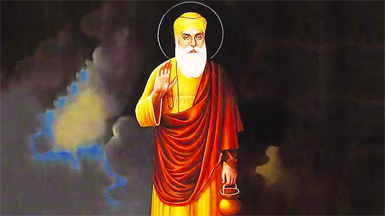

Guru Nanak Jayanti, also known as Gurpurb or Prakash Utsav, is one of the most sacred festivals in Sikhism. The day marks the birth anniversary of the first Sikh master, Guru Nanak. The 556th anniversary of the first Sikh master will be celebrated on Wednesday, November 5, this year. The Indian Panorama wishes its readers happy Gurpurb.
In a small village called Talwandi, nestled along the banks of the River Ravi in 1469, a child was born whose light would one day transcend borders, religions, and centuries. That child – Guru Nanak Dev Ji, the founder of Sikhism – came into a world fragmented by caste, creed, and inequality. Yet, through his words and actions, he offered a message that remains timeless: “There is no Hindu, there is no Muslim – there is only the One Divine Light that dwells in all.”
The Boy Who Questioned the World
From a young age, Nanak was unlike other children. While his peers were preoccupied with play, Nanak’s gaze often turned inward – to wonder, to question, and to understand the mysteries of life. At the village school, when his teacher asked him to recite the alphabet, Nanak asked profound questions that left his elders astonished. “What is the meaning of each letter?” he asked. “If every sound comes from the Divine, then shouldn’t every letter point toward Him?” His teacher, struck by the depth of this young boy’s inquiry, realized that Nanak’s learning was not of books alone – it was the intuitive knowledge of truth itself.
Another well-known childhood episode tells of the day Nanak’s father gave him money to do business. “Go and strike a good bargain,” he said, hoping to train his son in worldly affairs. But Nanak, walking through the marketplace, came upon a group of hungry sadhus. Without hesitation, he spent the money on food for them, saying, “This is the true business – the business of compassion.” When questioned by his father, he calmly replied, “This was the most profitable deal, for it brought joy to others.”
In yet another tale, Nanak’s innate empathy shines through. As a child, he once refused to partake in a ritual feast, seeing it as an act of vanity rather than devotion. Instead, he insisted that worship should be expressed through kindness, not ritual – through serving humanity, not through empty ceremony. These moments from his youth revealed the quiet defiance of a boy who sought meaning beyond custom, and whose heart beat in rhythm with the Divine.
The Revelation at Sultanpur
Years later, as an adult working as a storekeeper in Sultanpur Lodhi, Nanak’s life took a mystical turn. One morning, after his habitual bath in the river Bein, he disappeared for three days. The townspeople believed he had drowned. But when he returned, radiant and silent, he uttered the words that would define his mission:
“Na koi Hindu, na Musalman – There is no Hindu, there is no Muslim.”
This was not a denial of faiths, but a proclamation of oneness – that beneath names and divisions, all souls are part of the same divine essence. From that moment, Nanak devoted his life to spreading the message of truth (Sat), unity (Ik Onkar), and selfless service (Seva).
The Journey of a Saint
For the next three decades, Guru Nanak traveled far and wide – across India, Tibet, Arabia, and Persia – engaging with kings and peasants, saints and skeptics. His travels, known as Udasis, were more than pilgrimages; they were dialogues of understanding. He sang hymns of divine love accompanied by his faithful companion, Bhai Mardana, whose rebab turned each verse into a bridge between hearts.
Wherever he went, he denounced superstition, inequality, and exploitation. He emphasized that God is not found in temples or mosques, but in the heart that is pure and compassionate. His words, later compiled in the Guru Granth Sahib, carried the fragrance of simplicity and universal wisdom.
The Light of Gurpurab
Every year, on Guru Nanak Gurpurab, Sikhs and devotees around the world celebrate the birth of this eternal light. Gurdwaras are illuminated with lamps, hymns of Shabad Kirtan echo through the night, and Langar – the free community kitchen – serves all, regardless of status. It is a living expression of Nanak’s message: that serving humanity is serving God.
In Punjab and across the globe, processions carrying the Palki Sahib (palanquin) of the Guru Granth Sahib move through streets adorned with flowers, as devotees sing the Asa di Vaar and recall his teachings. Yet, beyond the festivity, the essence of Gurpurab is deeply spiritual – it is an invitation to rediscover the same light that shone in Nanak’s heart within ourselves.
The Eternal Message
Guru Nanak did not seek followers; he sought awakened souls. His message – of love without condition, faith without fear, and truth without boundaries – remains as relevant today as it was five centuries ago.
In an age divided by ideology and identity, Guru Nanak’s voice still whispers across time:
“Recognize all humanity as one. Walk in humility, speak in kindness, and see God in every face.”
His life reminds us that the truest worship is not in grand rituals or doctrines, but in the quiet compassion we extend toward one another. In that sense, Guru Nanak was not just the founder of a faith – he was the eternal child who questioned the world, and in doing so, illuminated it.
Contributions to Humanity
Guru Nanak’s preaching came at a time when there were conflicts between various religions. Mankind was so intoxicated with pride and ego that people had started fighting against each other in the name of God and religion. Hence, Guru Nanak began his teachings by saying that there are no Hindus and no Muslims. This implies the fact that God is one and that He is only seen differently through various religions. Guru Nanak’s teachings, although not intended, contributed to the unity of Hindus and Muslims to an extent. He also emphasized on the importance of equality of mankind. He condemned slavery and racial discrimination and said that all are equal.
Guru Nanak is one of the most important religious figures to have contributed to women empowerment in India. Guru Nanak appealed to his followers to respect women and to treat them as their equal. He said a man is always bound to women and that without women there would be no creation on earth. He also restored the faith in God by saying that the Creator is deeply involved in what man is trying to achieve on earth. While most of the major religions including the sects of Hinduism and Buddhism advocated monasticism in order to achieve salvation, Guru Nanak came up with a religion that supports the lifestyle of an average householder. Most importantly, he also taught his followers the methods to attain salvation while leading a normal life within the society. He, in fact, stressed on the importance of leading life with one’s family members. Not only did he teach his ideals, but he also served as a living example. When Guru Nanak left for the heavenly abode, nine other Gurus followed his teachings and continued to spread his message.
Death
According to the legend, when Guru Nanak approached his final few days, a debate between Hindus, Muslims, and the Sikhs arose as to who should be given the honor to perform the last rites. While Hindus and Sikhs wanted to cremate the mortal remains of their Guru as per their custom, the Muslims wanted to perform the last rites according to their beliefs. When the debate failed to conclude amicably, they decided to ask Guru Nanak himself as to what needs to be done. When they all approached him, Guru Nanak asked them to bring flowers and lay them next to his mortal remains. He asked the Hindus and the Sikhs to place their flowers on the right side of his body and the Muslims to place theirs on the left. He said that the honor of performing the last rites would go to the party whose flowers remain fresh for a night. When Guru Nanak breathed his last, the religious communities followed his instructions. When they came back the next morning to see whose flowers remained fresh, they were surprised to see that none of the flowers had wilted, but the biggest surprise was that Guru Nanak’s mortal remains had disappeared and all they could see in place of his body were fresh flowers. It is said that the Hindus and the Sikhs picked up their flowers and buried it, while the Muslims did the same with their flowers.

Be the first to comment