
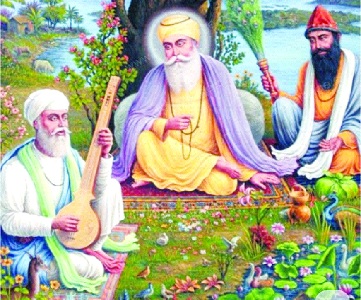

In a world overwhelmed by conflict, inequality, and disconnection, the words of a poet from 15th-century Punjab still offer astonishing clarity.
That poet was Guru Nanak Dev Ji (1469-1539) – the founder of Sikhism, a spiritual visionary whose hymns transcend time, creed, and geography.
He was not a prophet seeking followers, nor a reformer craving power. He was a seer of truth, a poet of the soul, and a philosopher of the human condition – who saw the Divine not in distant heavens but in the rhythm of everyday life.
His poetry, composed in the musical cadence of raag (melody), became a bridge between God and humanity – a living song that continues to guide millions through the Guru Granth Sahib, the Sikh scripture.
The Poet Who Sang the Universe
Guru Nanak’s poetry was unlike anything the subcontinent had ever heard. It spoke not of ritual or hierarchy, but of experience – the direct encounter with the Infinite.
In his opening verse, the Mool Mantar, he distilled the essence of existence into a few immortal lines:
“Ik Onkar, Satnam, Karta Purakh, Nirbhau, Nirvair…”
There is One Eternal Reality; Truth is Its Name; It is the Creator, without fear or enmity.
Every word radiates universality. In those few syllables, Guru Nanak erased the boundaries that divided man from man, religion from religion, self from the Divine.
His poetry did not describe God; it revealed oneness as a lived experience. For him, the cosmos itself was music – every being a note in the divine song of creation.
Guru Nanak’s journey was one of inquiry, not dogma. From childhood, he questioned blind faith and hollow ritual. When asked to wear the sacred thread that signified caste, he refused, asking:
“Make compassion the cotton, contentment the thread, and truth the knot – that is the sacred thread that never breaks.”
This poetic defiance carried a profound philosophical truth: spirituality is not inherited, it is earned through consciousness.
Throughout his life, Guru Nanak challenged systems that divided humanity – caste hierarchies, religious exclusivism, and gender inequality. His question was simple yet seismic:
“If all are born of the same Light, who is high and who is low?”
In an age where religion was often used as an instrument of control, Guru Nanak redefined it as a path to liberation through Naam (divine remembrance), Kirat (honest living), and Vand Chhakna (sharing with others).
He was both philosopher and reformer – merging metaphysics with social ethics, contemplation with action.
A Universal Thinker Before His Time
Long before the Enlightenment or modern humanism, Guru Nanak articulated a universalist philosophy that resonates deeply with the 21st century. He rejected religious exclusivity centuries before interfaith dialogue became fashionable. His belief that “God has many names, but the Light is one” speaks powerfully in our polarized times.
He envisioned a world without borders – of Sarbat da Bhala – the well-being of all. In an age obsessed with personal gain, this principle offers a moral compass rooted in empathy and collective upliftment.
His environmental insight was equally prophetic. In the Japji Sahib, he described air as the teacher, water as the father, and earth as the mother – a worldview that sees nature not as a resource but as kin.
“Pavan guru, pani pita, mata dharat mahat.”
Air is the Guru, water the father, and great earth the mother.
Centuries before the climate crisis, Guru Nanak understood that harmony with nature was harmony with the Divine.
The Relevance of Nanak’s Thought Today
Guru Nanak’s teachings address every crisis of our age – moral, ecological, and existential.
In an age of inequality, his message of oneness reminds us that no faith, gender, or race is inferior.
In an age of greed, his call for honest work (Kirat Karna) reaffirms the dignity of labour. In an age of anxiety, his principle of remembrance (Naam Japna) offers inner stillness amidst chaos. In an age of isolation, his teaching of sharing (Vand Chhakna) rebuilds community.
For a divided and restless planet, his words offer a path not backward into tradition, but forward into truth – a spiritual humanism rooted in awareness and compassion.
The Rhythm of Eternity:
Nanak’s Poetic Legacy
Guru Nanak’s compositions were not essays of philosophy but songs of realization. Each Shabad (hymn) was meant to be sung, felt, and lived. His companion, Bhai Mardana, would play the rabab as the Guru’s words flowed – transforming spiritual truth into sound, meditation into melody.
The Guru Granth Sahib, which contains 974 hymns of Guru Nanak, remains the world’s only scripture written entirely in poetic and musical form. Each hymn is placed under a specific raag, signifying the mood and emotion of divine experience.
This fusion of art and spirituality makes his philosophy accessible not just to the intellect, but to the heart. As long as there is music, Guru Nanak’s message will live – because his truth is sung, not spoken.
The Philosopher of Courage and Compassion
Guru Nanak was not merely a contemplative thinker – he was a moral rebel. When tyrants like Babur invaded India, causing immense suffering, Nanak raised his voice in divine protest.
“Eti maar payee kurlane, tai ki dard na aaya?”
Such cries of pain are heard, O Lord – did You not feel compassion?
It was perhaps the first poetic indictment of tyranny in Indian history – a saint confronting an emperor through song.
From that fearless moral inquiry was born the Sikh tradition of Sant-Sipahi – the saint-soldier who defends righteousness while remaining anchored in compassion.
Guru Nanak: For Every Seeker
Five hundred years on, Guru Nanak remains a teacher not bound by religion. His words speak to the monk and the activist, the scientist and the artist, the skeptic and the believer.
They do not ask for conversion – only for consciousness.
When he says, “Truth is high, but higher still is truthful living,”
he invites us to live our ethics, not merely preach them.
When he says, “See the light of God in all and never forget the One who dwells in all hearts,”
> he offers a solution to every conflict – the recognition of shared divinity.
Guru Nanak’s philosophy was never meant for a temple, but for life itself – to be lived in the marketplace, the home, the field, and the heart.
The Eternal Relevance
Half a millennium later, the world still struggles with the very divisions Guru Nanak sought to dissolve – inequality, intolerance, greed, and alienation. Yet his voice endures, as fresh and fearless as the day it first echoed along the banks of the River Bein.
To read Guru Nanak is to rediscover what it means to be human.
To sing his words is to awaken the soul to unity.
And to live his philosophy is to walk the timeless path of compassion – the path that leads from self to the infinite.
The Poet Who Became the Voice of the Eternal
Guru Nanak was a poet, yes – but not one who wrote for fame or empire.
He was a poet of awakening, whose verses still dissolve barriers and speak to the heart of a world in need of healing.
He was a philosopher without a school, whose thought continues to resonate with mystics, scholars, and seekers across cultures.
And above all, he was – and remains – a Guru for all humanity, a reminder that the truest wisdom is not in renouncing the world, but in redeeming it.
Be the first to comment