Tag: Google

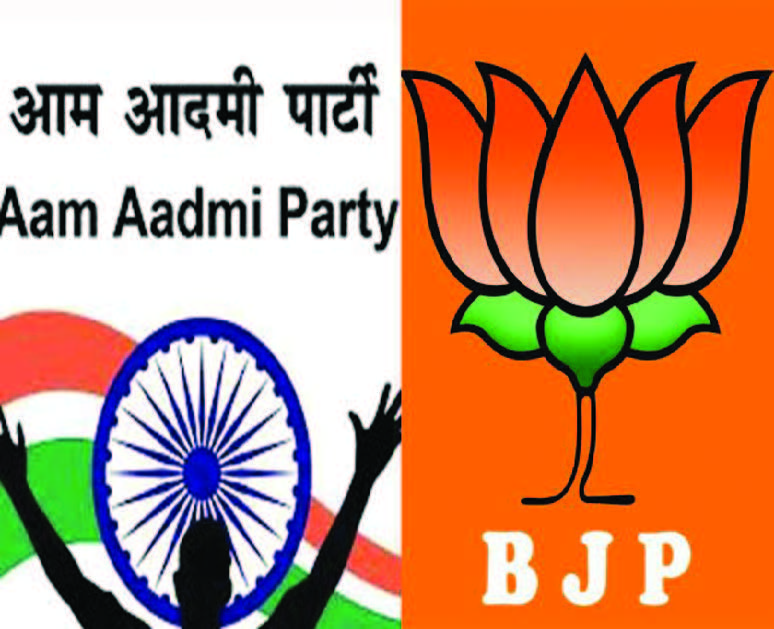
  • AAP counters Pak slur with disputed map on BJP site

    AAP counters Pak slur with disputed map on BJP site

    NEW DELHI (TIP): The war of words between BJP and AAP escalated on March 27 with the saffron party accusing Arvind Kejriwal of being an expert in “dumping issues halfway” while AAP retaliated with jeers that a “scared” BJP was diverting people’s attention from real issues.

    A day after BJP’s prime ministerial candidate Narendra Modi called Kejriwal a Pakistani agent and charged AAP with misrepresenting Kashmir on the map, AAP’s social media unit tweeted a grab of BJP’s official website that hosted a Google map indicating Kashmir as “disputed territory”. Dubbing AAP as “Arvind Apna Propaganda”, BJP accused Kejriwal of “dumping issues halfway” and running away from answering questions. “Kejriwal is known for dumping things halfway.

    His IRS (Indian Revenue Service) was dumped halfway. His India Against Corruption (IAC) was dumped halfway. Anna Hazare was dumped halfway. People of Delhi were dumped halfway. Now his candidates from all over the country are also dumped halfway,” BJP spokesperson Nirmala Sitharaman said. “Kejriwal said there are only two constituencies from AAP perspective — Varanasi and Amethi. So what happened to other candidates who are contesting all over the country? He has distanced himself from the rest of the candidates,” she said. “You have given away Jammu and Kashmir in your website.

    You have dumped people of J&K. Besides dumping of issues, he also ran away from answering our questions,” she added. Accusing Kejriwal and his party colleague Prashant Bhushan of going against the official line on Kashmir, BJP also screened video footage at the party briefing, simultaneously showing Modi’s speech in Jammu on Wednesday where he referred to Kejriwal as AK-49 and Bhushan’s earlier speeches. Responding to the attack, AAP leader Manish Sisodia said, “A scared BJP is trying to divert attention from real issues ever since AAP exposed its lie on gas pricing yesterday and made public the letter in which Gujarat government sought a $16 hike. AAP categorically denies that it has shown Kashmir as disputed on its official website.

    The party’s stand on the issue is clear. However, it is for BJP to clarify how Kashmir has been shown on its official website.” Earlier, AAP’s social media unit had tweeted a grab of the BJP website showing Kashmir as disputed on the map. BJP also raked up the controversy involving former Delhi law minister Somnath Bharti and his alleged misbehaviour with some African women residing in the capital. Sitharaman asked for whom did Kejriwal sit on dharna. “He sat on dharna for a person who had misbehaved with women, who misused his official position forcing Delhi Police to conduct a raid at midnight,” she said.

  • Indian Americans ensure a full house at FICCI FRAMES 2014 in Mumbai

    Indian Americans ensure a full house at FICCI FRAMES 2014 in Mumbai

    The 15th Annual FICCI FRAMES conference on the Media & Entertainment (M&E) industry is back at the Rennaissance Hotel & Convention Centre situated on the picturesque Powai Lake in Mumbai. It’s Wednesday, March 12th 2014; Day 1 of the event, and the Indian American community is here again in full strength; veterans from the media business, aspirants in the field of entertainment, panelists, delegates, you name it, the conference has them all.

    About FICCI FRAMES 2014
    FICCI FRAMES is Asia’s largest global conference on the business of Media and Entertainment. Spanning three days, the conference covers the entire spectrum of the M&E industry, with back-to-back presentation sessions, panel discussions & master-classes focused on microspecializations such as film, television, radio, print, internet/digital media, animation and gaming among others. This highly-anticipated & most-respected industry event currently draws over 2,500 participants from all over the world, with India & USA together accounting for over 80% of the attendees.

    The list of known names at the conference reads like a virtual Who’s Who of the global M&E industry. Attendees get to rub shoulders and interact one-on-one with top achievers in the business; for 2014, the list of presenters & panelists boasts (in alphabetical order of first name) Abhay Deol, Abhishek Bachchan, Anupam Kher, Arnab Goswami, Ajit Pai, Andy Paterson, Collin Burrows, Farhan Akhtar, Guneet Monga, Hiromichi Masuda, Javed Akhtar, Jim Egan, Kajol, Kazutaka Akimoto, Kirron Kher, Lakshmi Praturi, Mark Eyers, Michael Best, Nancy Silberkleit, Priyanka Chopra, Punit Goenka, Rajeev Masand, Rakeysh Omprakash Mehra, Ramesh Sippy, Roger Fisk, Sanjay Gupta, Shanker Tucker, Siddharth Roy Kapur, Sonam Kapoor, Shaan, Sudhanshu Vats, Sudhir Mishra, Stuart Haskayne, Stuart Sender, Uday Shankar and Vikram Chandra, to name a few.

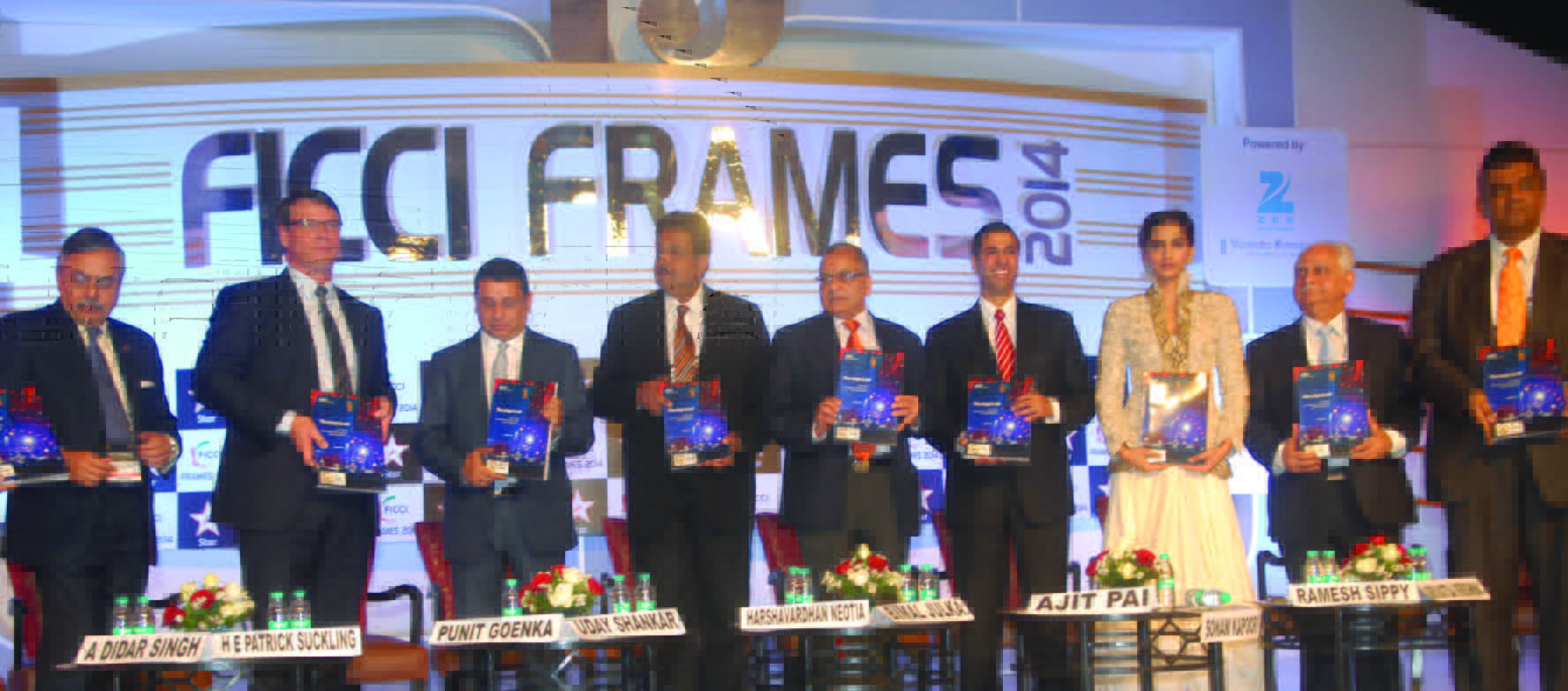
    Day 1 of the event saw the inauguration by actress Sonam Kapoor lighting the ceremonial lamp. This was followed by the welcome address from Harshavardhan Neotia, Vice President, FICCI. Harshvardhan highlighted critical developments within the M&E industry over the past 15 years. He spoke about the digitization of cable television, privatization of FM radio, clarifications in GST, introduction of a single window clearance system and future trends such as FDI in media, the mobile internet and simplification of policies. He ended his address by emphasizing the role of media in corporate governance and social responsibility. This was followed by opening remarks from Uday Shankar, Chairman, FICCI and also CEO, Star India.

    He discussed the role of government in the industry. Uday stated that government and the media needed to work together to sustain the vibrancy of the industry. He stressed that media’s role has evolved from mere reporting to seeking accountability & transparency from elected office-bearers of the nation. He also touched upon obstacles faced by the media when it published or broadcast coverage critical of the government of the day. He ended with the hope that the new government elected in May 2014 would look at media as a partner and not as an adversary. Punit Goenka, CEO, Zee Entertainment delivered the theme address next. He was followed by the vision statement from Bimal Julka, Secretary, Ministry of Information & Broadcasting.

    Bimal dwelt on the importance of censorship in the Indian media. Srivatsa Krishna, Secretary, Government of Karnataka (partner state for FRAMES 2014) was next; he emphasized the various initiatives being undertaken by his government in the field of media & entertainment. Finally, it was the turn of Ajit Pai, the dynamic young Commissioner of the FCC, USA (Federal Communications Commission). A second-generation Indian American, he shared insights about the role of FCC in America and the way in which the American government facilitates innovation within the M&E industry. He provided instances of successful partnerships between the government and key players from within the private sector in USA, which helps in enabling worldclass infrastructure for the industry. His address was very well-received by the audience.

    The FCC is an independent agency of the United States government, created by Congressional statute to regulate interstate and international communications by radio, television, wire, satellite, and cable in all 50 states, DC and US territories. The FICCI-KPMG 2014 report on the Indian Media & Entertainment industry was officially released after Ajit’s address; the highlight of this report is the growth registered by various disciplines within the industry. This inaugural session was followed by a series of presentations, panel discussions & master-classes. Detailed coverage of these sessions along with interviews of key presenters & panelists will be provided at the end of the conference.

    The list of media corporations at this year’s convention includes Archie Comics, BBC, Bloomberg, CNN IBN, Discovery Networks, Disney India, Fox Star Studios, Google, India Today, INK Salon, Microsoft, NBA, NDTV, Reliance Entertainment, Sony, Star India, Shochiku (Japan), Times Now, Turner International, TV France, Viacom18 and Zee Entertainment. The convention also features government bodies or political organizations such as the Australian High Commission (partner country for FRAMES 2014), BJP, CBFC, FCC (USA), INC, Ministry of Information & Broadcasting (India) and Obama’s Presidential Campaign Team for 2008 & 2012. Finally, there are a number of M&Ecentric corporations with booths at the event, looking to showcase a wide range of industry tools & accessories such as filmmaking & broadcasting equipment, studio apparatus, animation tools, software solutions & related technology.

    About FICCI
    Established in 1927, FICCI (Federation of Indian Chambers of Commerce & Industry) is the largest and oldest apex business organization in India. FICCI’s history is closely interwoven with India’s struggle for independence and subsequent emergence as one of the most rapidly growing economies globally. FICCI plays a leading role in policy debates that are at the forefront of social, economic and political change. A non-government, not-for-profit organization, FICCI is viewed as one of the major voices of India’s business and industry.

    It works closely with the government on policy issues, enhancing efficiency, competitiveness and expanding business opportunities for industry through a range of specialized services and global linkages. Partnerships with countries across the world carry forward it’s initiatives in inclusive development, which encompass critical issues such as health, education, livelihood, governance & skill development. Through its dedicated team of over 400 professionals, FICCI is active in 38 sectors of the global economy. FICCI’s stand on policy issues is sought out by think tanks, governments across the world and academia; it has joint business councils with 79 nations.

    Its publications are widely read for their in-depth research and policy prescriptions. FICCI’S Entertainment Division serves as the vital link between the Media & Entertainment industry, the Ministry for Information & Broadcasting (India) and global players. In addition to organizing FICCI FRAMES annually, this division conducts & releases pioneering studies related to the industry, assists in policy decisions and helps in scaling up the industry through various initiatives. The division is currently headed by Uday Shankar (Chairman) and Ramesh Sippy (Co-chairman).

  • New York City Explosion levels two buildings 8 Killed, 70 injured

    New York City Explosion levels two buildings 8 Killed, 70 injured

    NEW YORK, NY (TIP): An explosion leveled two buildings March 12 morning in East Harlem, sending flames and smoke billowing into the air. The initial number of 2 killed and about 20 injured has gone up to 8 killed and 70 injured. Speaking from the scene, Mayor Bill de Blasio said the explosion appeared to be caused by a gas leak.

    He said there are a “number” of people missing. prior to this evening’s discovery. Several people are reported missing and have not yet been found, Fire Department officials said. Four of the victims have been identified so far. Among them, 43-year-old Andreas Panagopoulos, a Greek musician who worked in advertising; 21-year-old Mexican national Rosaura Hernandez-Barrios; Griselde Camacho, who worked as a public safety officer at Hunter College; and Carmen Tanco, 67.

    Other bodies found overnight and this morning include two unidentified adult men and another adult female who was badly burned, city officials said. At least five people were unaccounted for, the NYPD reported before the eighth body was found this evening. One of those women, Rosaura Barrios Vazquez, 44, is believed to be the mother of the deceased Hernandez-Barrios, the Mexican consulate said. The most seriously injured survivor, 15-year-old Oscar Hernandez, is also thought to be related to those two women.

    At a news conference on March 12, Mayor Bill de Blasio said authorities are “continuing rescue operations hoping to find others alive.” “This city is no stranger to adversity,” de Blasio said. “We somehow persevere despite everything thrown at us.” At least 70 others were injured in the incident, which happened at 9:30 a.m. Wednesday in the building at 116th Street and Park Avenue in the East Harlem neighborhood of New York City. Con Edison was responding to a report of a gas odor when the explosion happened, city officials said. “There are still a lot of unknowns here and that only adds to the difficulty,” de Blasio said.

    There were no reports of gas leaks in 30 days preceding the incident, Fire Commissioner Sal Cassano said at the press conference. Con Edison also searched its records going back three years and the only reports were minor leaks in customer lines, not gas mains — the latest one in May 2013, said CEO John McAvoy. Before investigators can determine the cause of the explosion, the still smoldering fire will have to be extinguished and the rubble cleared, officials said. “What we need to do is get to the basement,” Cassano said, to find the source of ignition or leak. Google images of the building show two commercial storefronts on the ground floor with four floors of residential apartments above those storefronts. The NYPD has ruled out terrorism as a cause of the explosion, but the bomb squad and the FBI are both on the scene.

  • AT&T is bringing its super fast broadband service to Dallas

    AT&T is bringing its super fast broadband service to Dallas

    AT&T Inc. plans to soon offer its ultrahigh-speed fiber service to customers in North Texas. “We are going to launch this service in Dallas this summer,” CEO Randall Stephenson said at atechnology conference today in California.

    As the launch gets closer, the company plans to offer more details. Last December, AT&T introduced the service – which it calls U-verse with GigaPower – in Austin, in competition there with Google. At the time, Stephenson said his company was likely to offer the service in other cities. “The economics of fiber deployment are really starting to look good,” he said.

    In Austin, AT&T said its fiber Internet broadband network would deliver speeds up to 1 gigabit per second. Along with faster Internet access, the fiber connection will also deliver advanced TV services. In a statement today, March 6, the company said that sales of U-verse with GigaPower in Austin have surpassed expectations and are the reason the company is expanding service to twice as many Austin households this year.

  • High school girl who sued parents loses first round

    High school girl who sued parents loses first round

    WASHINGTON (TIP):
    Whoever said parenting is a thankless task can cite this as prime evidence. In a case that has caught the even rebels in a litigious society slack-jawed, an 18-year old high-school girl in New Jersey sued her parents to force them to pay for her schooling and living costs after storming out of the home because she didn’t want to follow some basic house rules they sought to establish – like helping with chores. Rachel Canning turned up in school uniform for the first day of hearing at a family court, but it didn’t go well for her. Judge Peter Bogaard scolded her and lamented the breakdown of the family after reading an expletive-laden message from Rachel to her mother, according to courtside reports.

    “‘Have you ever in your experience seen such gross disrespect for a parent?” he was quoted as saying. “What is the next step …are we going to open the gates for a 12-year-old to sue for an Xbox, a 13-year-old to sue for an iPhone… what about a 15-year-old asking for a 60 inch TV?” Rachel’s parents, Elizabeth and Sean Canning, broke down in court as details of how their family was torn apart were read out. But the high-schooler, on the cusp of going to college, stared ahead without remorse after the judge ruled that the parents did not have to pay her school fees amounting to $5,300 and denied her request for weekly allowance and additional financial support, including attorney fees of $13,000.

    He delayed a ruling on whether the parents must pay her college tuition from a fund they had set up, while asking lawyers to consider whether it’s wise to “establish precedent where parents live in fear of establishing rules of the house.” Rachel Canning, from all accounts a bright student who wants to be a bio-medical engineer, says that her parents kicked her out of their home when she turned 18 last October. She has claims her mother called her ‘fat’ and ‘porky,’ insults that led her to suffering bulimia. “My parents simply will not help me any longer.

    They want nothing to do with me and refuse to even help me financially outside the home although they certainly have the ability to do so. … I am unable to support myself and provide for my food, shelter, clothing, transportation and education,” she said in court documents. But her parents say she opted to leave because she didn’t want to follow their house rules that included being respectful, keeping a curfew, returning borrowed items to her two sisters, managing a few chores, and reconsidering or ending her relationship with a boyfriend the parents believe is a bad influence.

    “Private school, new car, college education; that all comes with living under our roof,” her father, Sean Canning, a retired police chief of the township where they live, told a local television station. “We’re heartbroken, but what do you do when a child says ‘I don’t want your rules but I want everything under the sun and you to pay for it?’” Canning told the local Daily Record, adding that his daughter’s college fund is available to her and not withdrawn or re-allocated, as she has alleged. “We love our child and miss her. It’s killing me and my wife.

    We’re not Draconian and now we’re getting hauled into court. She’s demanding that we pay her bills but she doesn’t want to live at home and she’s saying, ‘I don’t want to live under your rules’.” Meanwhile, the twitterati has weighed in on the case in what some say amounts to a witchhunt. “Rachel canning is a stupid idiot and her parents should kick her out! she is the daftest person on the planet #meanbiatch,” wrote one Twitterer. Another tweeted: “Rachel Canning is giving current teens a bad name, can we just ignore her already so she’ll crawl back in the bubble she came out of ?” A third warned: Wondering if #RachelCanning realizes that every future prospective employer will Google her. Rachel has reportedly been living with a school friend, whose lawyer father has been helping her with the litigation but not representing her.

  • Myanmar security forces arrest key protest leader

    Myanmar security forces arrest key protest leader

    Yangon (TIP): Myanmar security forces arrested on Thursday one of the main leaders of the campaign against military rule after ramming him with a car as he led a motorbike protest rally, friends and colleagues said. Opponents of a February 1 coup that ousted an elected government led by Nobel peace laureate Aung San Suu Kyi have kept up their campaign against the military this traditional New Year week with marches and various other displays of resistance. “Our brother Wai Moe Naing was arrested. His motorbike was hit by an unmarked police car,” Win Zaw Khiang, a member of a protest organising group, said on social media. Wai Moe Naing, a 25-year-old Muslim, has emerged as one of the most high-profile leaders of opposition to the coup. Earlier, Reuters spoke to Wai Moe Naing by telephone as he was setting off to lead the rally in the central town of Monywa, about 700 km (435 miles) north of the main city of Yangon. — Reuters

  • Strong Indian American challenge in US Congressional election in Silicon Valley

    Strong Indian American challenge in US Congressional election in Silicon Valley

    SAN JOSE (TIP): US Congressional election in Silicon Valley this year was being seen as a two-person race between incumbent Congressman Mike Honda (Democrat) and his main challenger Rohit “Ro” Khanna (Democrat) until recently. It all changed when Dr. Vanilla Mathur Singh (Republican), a member of Hindu American Foundation (HAF), entered the race in December 2013.

    The HAF first made headlines in 2005 with its failed attempt in California state to “improve 6th grade textbooks so that these books actually reflect their (Hindu) beliefs and their religious practices.” Media reports indicate that Singh was recruited to run by Shalabh “Shalli” Kumar, a Chicagobased Indian-American businessman and Republican fundraiser. Kumar is the founder of a super PAC, Indian Americans for Freedom, with close ties to Hindu Nationalists. He has been lobbying members of US Congress to help rehabilitate his “idol” Narendra Modi of India’s Hindu Nationalist Bharatiya Janata Party (BJP).

    Modi has been denied US visa multiple times by the State Department because of his widely suspected role in the killing of thousands of Muslims in 2002 Gujarat riots. Singh said that she raised $100,000 in the five days after declaring her candidacy, including $25,000 of her own money. The rest, she said, came from about “20 family and friends.” Kumar’s super PAC could change the dynamics of the South Bay race if he chooses to back Singh financially. In 2002, his super PAC spent $500,000 in an unsuccessful attempt to defeat Rep. Tammy Duckworth, D-Ill., including producing an ad set to Middle Eastern music that showed the double amputee Iraq war veteran wearing a headscarf during a visit to a local Muslim community center.

    Ro Khanna, a Silicon Valley patent attorney of Indian origin, is backed by many of Silicon Valley’s top VCs and executives at Google, Facebook, Yahoo and other tech companies. Other Notables include Marc Andreessen, the Netscape cofounder; John Doerr, the venture capitalist; and Randi Zuckerberg, the chief executive of Zuckerberg Media and the sister of Mark Zuckerberg and Sean Parker, former President pf Facebook. Four months before the primary, Khanna has $1,975,000 in cash on hand, or more than triple the incumbent’s $623,000, according to campaign finance records filed last Friday as reported by the New York Times.

    Khanna supporters expect him to win to push legislation in Congress to liberalize US visas for foreign workers needed to fill Silicon Valley tech jobs. He supports raising the number of H1-B visas, keeping a lid on capital gains taxes and cracking down on patent trolls while charting a progressive agenda on most social issues. Faced with the surprise new challenge from the Hindu Right, Ro Khanna has refused to denounce Narendra Modi for fear of alienating a significant chunk of the substantial pro-BJP Indian- American voters in Silicon Valley. Mike Honda, the incumbent congressman from 17th district, is a Japanese-American who was put by the United States in an internment camp as a child during World War II.

    He has been a featured speaker at many Muslim- American events where he has spoken out for American Muslims’ civil rights since the terrorist attacks of September 11, 2001. During a 2009 keynote speech at Human Development Foundation fund-raiser that I attended, Congressman Honda said the US foreign policy should have the same goals that the HDF has in Pakistan. Drawing from his experience as a US peace corps volunteer to support education and infrastructure development in Central America in the 1960s, he proposed a similar effort in restoring US credibility in Pakistan and Afghanistan. Honda praised the US emphasis on economic aid and said he supports the 80/20 rule that General Petraeus had outlined, with 80% emphasis on the political/economic effort backed by 20% military component to fight the Taliban insurgency.

    Honda says he has been a strong advocate for the tech industry in Congress. As a member of the House Appropriations Committee, he helped get millions of dollars in funding for BART extension to San Jose, a top priority for Valley leaders, as well as federal investment in nanotechnology research. His strong backing from organized labor and veteran Democrats reflects the decades he’s spent in public service. Honda also supports an increase in H1-B visas, although he’s also expressed concerns about its potential harm to the local labor pool.

    A number of polls in 17th district so far show that Honda enjoys a healthy lead over his challenger Khanna. Honda’s lead could increase if Singh takes a significant chunk of Indian-American votes away from Khanna. In spite of a powerful tech industry funded challenge by Ro Khanna, Honda remains a favorite to win. Honda also enjoys the strong endorsement of President Obama and Democratic Party’s establishment. Singh’s entry in the race could further help Honda extend his lead and keep his seat in Congress. I intend to vote for Mike Honda based on the Congressman’s strong record of service to Silicon Valley and his unambiguous procivil rights stance

  • Strong Indian American challenge in US Congressional election in Silicon Valley

    Strong Indian American challenge in US Congressional election in Silicon Valley

    SAN JOSE (TIP): US Congressional election in Silicon Valley this year was being seen as a two-person race between incumbent Congressman Mike Honda (Democrat) and his main challenger Rohit “Ro” Khanna (Democrat) until recently. It all changed when Dr. Vanilla Mathur Singh (Republican), a member of Hindu American Foundation (HAF), entered the race in December 2013.

    The HAF first made headlines in 2005 with its failed attempt in California state to “improve 6th grade textbooks so that these books actually reflect their (Hindu) beliefs and their religious practices.” Media reports indicate that Singh was recruited to run by Shalabh “Shalli” Kumar, a Chicago-based Indian-American businessman and Republican fundraiser.

    Kumar is the founder of a super PAC, Indian Americans for Freedom, with close ties to Hindu Nationalists. He has been lobbying members of US Congress to help rehabilitate his “idol” Narendra Modi of India’s Hindu Nationalist Bharatiya Janata Party (BJP). Modi has been denied US visa multiple times by the State Department because of his widely suspected role in the killing of thousands of Muslims in 2002 Gujarat riots.

    Singh said that she raised $100,000 in the five days after declaring her candidacy, including $25,000 of her own money. The rest, she said, came from about “20 family and friends.” Kumar’s super PAC could change the dynamics of the South Bay race if he chooses to back Singh financially. In 2002, his super PAC spent $500,000 in an unsuccessful attempt to defeat Rep. Tammy Duckworth, D-Ill., including producing an ad set to Middle Eastern music that showed the double amputee Iraq war veteran wearing a headscarf during a visit to a local Muslim community center.

    Ro Khanna, a Silicon Valley patent attorney of Indian origin, is backed by many of Silicon Valley’s top VCs and executives at Google, Facebook, Yahoo and other tech companies. Other Notables include Marc Andreessen, the Netscape co-founder; John Doerr, the venture capitalist; and Randi Zuckerberg, the chief executive of Zuckerberg Media and the sister of Mark Zuckerberg and Sean Parker, former President pf Facebook.

    Four months before the primary, Khanna has $1,975,000 in cash on hand, or more than triple the incumbent’s $623,000, according to campaign finance records filed last Friday as reported by the New York Times. Khanna supporters expect him to win to push legislation in Congress to liberalize US visas for foreign workers needed to fill Silicon Valley tech jobs. He supports raising the number of H1-B visas, keeping a lid on capital gains taxes and cracking down on patent trolls while charting a progressive agenda on most social issues.

    Faced with the surprise new challenge from the Hindu Right, Ro Khanna has refused to denounce Narendra Modi for fear of alienating a significant chunk of the substantial pro-BJP Indian-American voters in Silicon Valley. Mike Honda, the incumbent congressman from 17th district, is a Japanese-American who was put by the United States in an internment camp as a child during World War II. He has been a featured speaker at many Muslim- American events where he has spoken out for American Muslims’ civil rights since the terrorist attacks of September 11, 2001.

    During a 2009 keynote speech at Human Development Foundation fund-raiser that I attended, Congressman Honda said the US foreign policy should have the same goals that the HDF has in Pakistan. Drawing from his experience as a US peace corps volunteer to support education and infrastructure development in Central America in the 1960s, he proposed a similar effort in restoring US credibility in Pakistan and Afghanistan. Honda praised the US emphasis on economic aid and said he supports the 80/20 rule that General Petraeus had outlined, with 80% emphasis on the political/economic effort backed by 20% military component to fight the Taliban insurgency. Honda says he has been a strong advocate for the tech industry in Congress.

    As a member of the House Appropriations Committee, he helped get millions of dollars in funding for BART extension to San Jose, a top priority for Valley leaders, as well as federal investment in nanotechnology research. His strong backing from organized labor and veteran Democrats reflects the decades he’s spent in public service. Honda also supports an increase in H1-B visas, although he’s also expressed concerns about its potential harm to the local labor pool.

    A number of polls in 17th district so far show that Honda enjoys a healthy lead over his challenger Khanna. Honda’s lead could increase if Singh takes a significant chunk of Indian- American votes away from Khanna. In spite of a powerful tech industry funded challenge by Ro Khanna, Honda remains a favorite to win. Honda also enjoys the strong endorsement of President Obama and Democratic Party’s establishment. Singh’s entry in the race could further help Honda extend his lead and keep his seat in Congress. I intend to vote for Mike Honda based on the Congressman’s strong record of service to Silicon Valley and his unambiguous pro-civil rights stance.

  • Parliament erupts in chaos, pepper spray used as MPs shame India

    Parliament erupts in chaos, pepper spray used as MPs shame India

    NEW DELHI (TIP):
    Parliament erupted in chaos on February 13 over a bill to create Telangana, with angry MPs coming to blows, pulling out a microphone and pepper spraying the chamber. Waving banners and shouting slogans, lawmakers disrupted the lower house of Parliament as the Congress-led government introduced the contentious bill to create the new state called Telangana from an area in the existing state of Andhra Pradesh.

    The chamber quickly descended into farce, as lawmakers opposed to the new state pulled out an official’s microphone and one unleashed a can of capsicum spray, prompting a rush for the exit, TV channels reported. Several lawmakers had to be taken to hospital suffering breathing problems. Small fights also took place between MPs opposed to the bill and several trying to stop the chaos and restore order, as the parliament, known for its disruptions, was adjourned, the news agency said. Parliamentary affairs minister Kamal Nath slammed the unrest as a “big blot on our parliamentary democracy”, and called for the “strongest possible” action against the offending MPs.

    “It is the most shameful day in our parliamentary history,” Nath told reporters outside the Parliament. Seventeen MPs were later suspended by the Speaker of the Lok Sabha over the unrest, which also saw several lawmakers ripping up official papers and one smashing a glass. Cabinet last week approved the controversial move to create Telangana from Andhra Pradesh, after a long and violent campaign.

    41

    Mainly tribal groups have demanded Telangana be carved out of a northern, impoverished and drought-prone part of Andhra Pradesh, which supporters say has long been neglected by succesisve state governments. But wealthier regions of Andhra Pradesh, home to IT giants including Google and Microsoft, have strongly opposed the split because they say it would create economic upheaval. Observers say plans for Telangana were made by the Congress government in hopes of winning much-needed votes in the region at the national elections in coming months.

    But they warn the move may backfire amid an intensifying political battle in Andhra Pradesh. Violent demonstrations have erupted there since Congress announced the move last July, while three federal ministers have resigned in protest. Outside the Parliament building on Thursday, ugly clashes broke out between supporters of the Telangana state and police, an AFP photographer at the scene said. Police officers were seen dragging away protesters and bundling them into buses. Congress has denied trying to seek any political advantage from splitting Andhra Pradesh, insisting it is trying to fulfil a long-standing pledge.

  • GOOGLE SELLING MOTOROLA PHONE BUSINESS TO LENOVO FOR $2.9 BILLION

    GOOGLE SELLING MOTOROLA PHONE BUSINESS TO LENOVO FOR $2.9 BILLION

    SAN FRANCISCO (TIP): Google is selling Motorola’s smartphone business to Lenovo for $2.9 billion, a price that makes Google’s biggest acquisition look like its most expensive mistake.

    The deal announced on January 29 will rid Google Inc. of a financial headache that has plagued the internet company since buying Motorola Mobility for $12.4 billion in 2012. Motorola has lost nearly $2 billion since Google took over, while trimming its workforce from 20,000 to 3,800. Google had previously recovered some of the money that it spent on Motorola by selling the company’s set-top operations last year to Arris Group Inc. for $2.35 billion.

    Google is also keeping most of the patents that came with the Motorola purchase. It’s unclear if Google will have to absorb a charge to account for the difference between what it paid for Motorola Mobility and what it is getting back. The Mountain View, California, company may address the issue Thursday when it announces its fourth-quarter earnings after the market closes. Most investors viewed Motorola as an unnecessary drain on Google’s profit, a perspective that was reflected by Wall Street’s reaction to the sale.

    Google’s stock gained $28.08, or 2.5%, to $1,135 in extended trading. While Google is backpedaling, Lenovo Group Ltd. is gearing up for a major expansion. Already the world’s largest maker of personal computers, Lenovo now appears determined to become a bigger player in smartphones as more people rely on them instead of laptop and desktop computers to go online.

    Lenovo already is among the smartphone leaders in its home country of China, but it has been looking for ways to expand its presence in other markets, especially the US and Latin America. The company had been rumored to be among the prospective buyers for BlackBerry Ltd. when that troubled smartphone maker was mulling a sale last year. This marks Lenovo’s second highprofile deal this month. The company announced plans last week to buy a major piece of IBM Corp.’s computer server business for $2.3 billion.

    Buying Motorola will enable Lenovo to join Apple Inc. as the only major technology companies with global product lines in PCs, smartphones and tablets, putting Lenovo in a better position to become a one-stop shop for companies to buy all their devices from the same vendor, said Forrester Research analyst Frank Gillett. “This makes Lenovo a company to watch,” Gillett said in an email. “The personal device manufacturer business is consolidating, and manufacturers must compete in all three device markets, plus emerging wearable categories, or get left out of the next market shift.” After it takes over, Lenovo plans to retain a Motorola management team led by Dennis Woodside.

    Google had reassigned Woodside, one of its top executive, to run Motorola Mobility in hopes he could engineer a turnaround. Under Woodside, Motorola released two new smartphones last year, the Moto X and Moto G. The phones attracted lots of headlines, but didn’t sell as well as anticipated, analysts say. Lenovo executives also said they aren’t planning to lay off any more Motorola employees and that the subsidiary would remain based in its current headquarters in Libertyville, Illinois. “We buy this business, we buy this team as our treasure,” Lenovo CEO Yang Yuanqing said during a Wednesday conference call.

    Google is retaining most of Motorola’s portfolio of mobile patents, providing the company with legal protection for its widely used Android software for smartphones and tablet computers. Gaining control of Motorola’s patents was the main reason Google CEO Larry Page decided to pay so much for Motorola Mobility at a time the smartphone maker was already losing money and market share. Most analysts thought Page had paid too much money for Motorola and questioned why Google wanted to own a smartphone maker at the risk of alienating other mobile device makers that rely on Android. Selling Motorola’s smartphone operations will “enable Google to devote our energy to driving innovation across the Android ecosystem,” Page said in a statement. Lenovo is picking up about 2,000 Motorola patents in addition to the phone manufacturing operations.

  • AFTER FACEBOOK, GOOGLE BUYS STARTUP WITH INDIAN LINK

    AFTER FACEBOOK, GOOGLE BUYS STARTUP WITH INDIAN LINK

    BENGALURU (TIP): After Facebook’s acquisition of Bangalore-based Little Eye Labs earlier this month, it’s Google that has now bought a three-year-old startup that had two Indians — Vish Ramarao and Naveen Jamal — as co-founders and offices in Bangalore and California.

    The startup, Impermium, had a third co-founder Mark Risher. Jamal was based in Bangalore and looked after the office here, while Ramarao and Risher were based in California. All three had previously worked together in Yahoo and came out of it in 2010 to found Impermium. The startup focused on building security products for websites. Impermium’s website now has just a note from Risher, who was the CEO, with the headline ‘Impermium is joining Google’.

    It goes on to say: “By joining Google, our team will merge with some of the best abuse fighters in the world. With our combined talents we’ll be able to further our mission and help make the internet a safer place. We’re excited about the possibilities.” Impermium had received $9 million in funding from a host of venture firms including Accel Partners, AOL Ventures, Charles River Ventures and Highland Capital Partners. Google has not disclosed the terms of its deal with Impermium. Acquisitions of India-based startups by the likes of Google and Facebook are expected to provide a big boost to the startup ecosystem. Not too many Indiabased startups have had great exits yet, but the latest instances look to be changing that trend.

    Software product startup associations like iSpirt are actively engaged in trying to marry Indian startups with global ones. Jamal is originally from Thanjavur in Tamil Nadu, went to the US to study, worked as a software engineer in a small US company and then joined Yahoo in 1998. He moved to Bangalore around the time Impermium was being founded and established the office here. Ramarao is from Bangalore, went to the US for higher studies, and has since been there. Prior to Impermium, all three cofounders were in Yahoo Mail, where they dealt with problems of spam, web security and fraudulent account creation. In an interview to TOI early last year, Risher said they realized that the problems they dealt with weren’t an issue with just Yahoo’s services but rather a problem with every website on the internet, and that encouraged them to found Impermium.

    Risher said the company had built a number of services that worked as a riskdetermination system, which could help identify when an account had been compromised. The system calculates the risk from parameters like where you accessed the account from, the device software and historical usage pattern of the links you’re posting. And Risher then had this to say about his new employer: “Security is always a balance between convenience and safety. And a complete overhaul (of the password system) becomes difficult. Google talked about an RFID ring that you would wear and which would transfer a secure certificate. Yes it would work but it would be a hassle and everybody would have to buy a reader. It’s not going to happen overnight.” Impermium has said it has 300,000 clients, including Tumblr, Pinterest, CNN, ESPN, Typepad and Washington Post.

  • Need strong ties with US to fight terror: Shinde

    Need strong ties with US to fight terror: Shinde

    NEW DELHI (TIP): Conceding that both India and the US were leading targets of transnational terror groups, Union home minister Sushilkumar Shinde on Wednesday sought enhanced cooperation between the two countries to “secure our cities and our people”. Addressing the India-US police chiefs’ conference — the first ever mega-city policing cooperation between the Americans and another country — Shinde said most attacks in India were launched from across the border, an indirect reference to Pakistan, and intended to cause greatest disruption of peace.

    Recalling the 9/11 attacks in New York as well as the 26/11 Mumbai strikes, the minister underlined how terrorists would typically target large and densely populated urban areas to inflict maximum damage. “An effective megacity policing system must serve as an effective deterrent against terrorists and their masters, who launch targeted attacks on the nerve centres of a country… our objective must be to make our cities safe, and therefore our countries, safe by reducing our vulnerability to such challenges,” he told the gathering of police chiefs from various key cities in the US and from across India.

    The two-day police chiefs’ conference is being organized by the Union home ministry as part of the India-US Homeland Security Dialogue, an outcome of US President Barack Obama’s discussions with Prime Minister Manmohan Singh during the former’s visit here in November, 2010. The dialogue has seen four ministeriallevel meetings and more than a 100 bilateral engagements covering training, briefings, exchanges and visits. While Shinde and home secretary Anil Goswami are leading the Indian side, assistant secretary for policy, US department of homeland security, David Heyman, heads the US delegation of police chiefs.

    Also present at the inaugural session on Tuesday was US ambassador to India, Nancy Powell, who described the Indo-US homeland security dialogue as one of the most robust pillars of bilateral cooperation between the two countries. The visiting side comprises representatives of leading American companies offering technological solutions for policing in the US, who will explore business opportunities in India. Heyman said that while the US was working to facilitate and expedite sharing of log details by prominent American internet giants like Google, Facebook and Twitter to aid investigations here, it expected reciprocity in terms of India offering opportunities for the US companies to succeed here.

    Shinde, in his inaugural address on Tuesday, exhorted the two sides to share the unique and innovative solutions that police forces of either side have developed while dealing with mega-city policing challenges. “There is…a need for better integration of security inputs and information that different law enforcement agencies generate, as well as mechanisms by which regional and federal agencies work with each other,” he told the police chiefs. The home minister also raised the issue of application of enhanced technological solutions in policing.

    “Increasingly, sophisticated technologies are being adapted…to assist police forces in early detection of crimes, identification of perpetrators, improved coordination among agencies and expedited response time… there is much we can do together as partners to enhance the use of appropriate technology for our police forces,” he said.

  • 2 million Google, Facebook, Twitter passwords stolen

    2 million Google, Facebook, Twitter passwords stolen

    BOSTON (TIP): Security experts have uncovered a trove of some 2 million stolen passwords to websites including Facebook, Google, Twitter and Yahoo from internet users across the globe. Researchers with Trustwave’s SpiderLabs said they discovered the credentials while investigating a server in the Netherlands that cybercriminals use to control a massive network of compromised computers known as the “Pony botnet.”

    The company said that it has reported its findings to the largest of more than 90,000 websites and internet service providers whose customers’ credentials it had found on the server. The data includes more than 3,26,000 Facebook accounts, some 60,000 Google accounts, more than 59,000 Yahoo accounts and nearly 22,000 Twitter accounts, according to SpiderLabs. Victims’ were from the United States, Germany, Singapore and Thailand, among other countries. Representatives for Facebook and Twitter said the companies have reset the passwords of affected users. A Google spokeswoman declined comment.

    Yahoo representatives could not be reached. SpiderLabs said it has contacted authorities in the Netherlands and asked them to take down the Pony botnet server. An analysis posted on the SpiderLabs blog showed that the most-common password in the set was “123456,” which was used in nearly 16,000 accounts.

    Other commonly used credentials included “password,” “admin,” “123” and “1.” Graham Cluley, an independent security expert, said it is extremely common for people to use such simple passwords and also re-use them on multiple accounts, even though they are extremely easy to crack. “People are using very dumb passwords. They are totally useless,” he said.

  • HANUKKAH

    HANUKKAH

    Afestival is a collective celebration of an achievement in a given community. The Festival of Hanukkah is a Jewish celebration, and it is celebrating the recovery and re-dedication of the Jewish Temple in Jerusalem in 165 B.C. Hanukkah is spelled in many different ways in case you want to Google it; Hanuka, Chanukah, Chanuka, Hanuka, Hanukka and other variations. Hanukkah is celebrated for eight days and nights. It is also called the festival of lights. It starts on the 25th of the Jewish month of Kislev each year. The actual date differs due to the lunar calendar.

    It is about 11 days earlier in each successive year. The Jews, Muslims and some Hindu festivals follow the moon for observing their holidays and the date is different every year. This year the festivities will begin with the lighting of Menorah on Thursday, November 28th and will continue thru December 5, 2014. This year, I found one of the best pieces written by Rabbi Michael Lerner, who and I met in Melbourne, Australia and have kept up writing to each other since then. Rabbi Michael Lerner wrote about Chanukah, describing it as “the holiday celebrating the triumph of hope over fear, light over darkness, and the powerless over the powerful.”

    He went on to say that Chanukah is about “understanding that when we connect with the transformative power of the universe, the Force of Healing and Transformation, YHVH, we become aware that the powerless can become powerful, that oppression of any sort is in contradiction to the fundamental nature of human beings as loving, kind, generous, free, creative, intelligent, attuned to beauty, caring for and needing each other beings created in the image of God. When that energy and awareness permeates our consciousness, no ruling elite and no system of exploitation can possibly last for very long.”

    The Hanukkah Story

    Here is a story I received in email that tells the story and significance of Hanukkah. In 168 B.C.E. the Jewish Temple was seized by Syrian-Greek soldiers and dedicated to the worship of the god Zeus. This upset the Jewish people, but many were afraid to fight back for fear of reprisals. Then in 167 B.C.E. the Syrian-Greek emperor Antiochus made the observance of Judaism an offense punishable by death. He also ordered all Jews to worship Greek gods. Jewish resistance began in the village of Modiin, near Jerusalem.

    Greek soldiers forcibly gathered the Jewish villages and told them to bow down to an idol, and then eat the flesh of a pig – both practices that are forbidden to Jews. A Greek officer ordered Mattthias, a High Priest, to acquiesce to their demands, but Mattthias refused. When another villager stepped forward and offered to cooperate on Matthias’ behalf, the High Priest became outraged. He drew his sword and killed the villager, then turned on the Greek officer and killed him too.

    His five sons and the other villagers then attacked the remaining soldiers, killing all of them. Matthias and his family went into hiding in the mountains, where other Jews wishing to fight against the Greeks joined them. Eventually they succeeded in retaking their land from the Greeks. These rebels became known as the Maccabees, or Hasmoneans. Once the Maccabees had regained control they returned to the Temple in Jerusalem. By this time it had been spiritually defiled by being used for the worship of foreign gods and also by practices such as sacrificing swine. Jewish troops were determined to purify the Temple by burning ritual oil in the Temple’s menorah for eight days.

    But to their dismay, they discovered that there was only one day’s worth of oil left in the Temple. They lit the menorah anyway and to their surprise the small amount of oil lasted the full eight days. This is the miracle of the Hanukkah oil that is celebrated every year when Jews light a special menorah known as a hanukkiyah for eight days. One candle is lit on the first night of Hanukkah, two on the second, and so on, until eight candles are lit.

    Significance of Hanukkah
    Muslims, Hindus, Buddhists and others have figured out a way to keep their children in the joyous mood of receiving gifts, so they have their own version of Christmas. Similarly, Jewish children receive gifts for Hanukkah – often one gift for each of the eight nights of the holiday. Many parents hope that by making Hanukkah extra special their children won’t feel left out of all the Christmas festivities going on around them. America is an amazing land!


    26

    Hanukkah Traditions
    Every community has its unique Hanukkah traditions, but there are some traditions that are almost universally practiced. They are: lighting the hanukkiyah, spinning the dreidel and eating fried foods. Get a Hanukkiah. The most basic thing you need to celebrate Hanukkah is a 9- branched candelabra, called a Hanukkiah (or often a Menorah, although technically aMenorah is a 7-branched candelabra), and candles. Eight of the branches represent the eight nights, while the last one (at a different height, usually higher than the rest) is called theshamash or helper candle, and is used to light the rest of the candles. The Hanukkiah is usually lighted at or right after sunset.

  • Get Your Business Online program begins

    Get Your Business Online program begins

    GARLAND, TX (TIP): In partnership with Google, Mayor Douglas Athas is working with local businesses on an initiative to get Garland’s businesses online through Google’s Get Your Business Online program. Although 97% of internet users are now looking online to find local products and services, 58% of American businesses still do not have a website. Through increased participation in the Get Your Business Online program, Mayor Athas hopes to close that gap for Garland businesses.

    Get Your Business Online provides small business owners with a custom domain name, web hosting and access to educational resources – all free for one year. Since its debut in July 2011, the program has helped more than 135,000 businesses nationwide successfully get online and start growing. “Small businesses are the backbone of our economy and our community. We are constantly looking at ways to help Garland businesses grow and create jobs; this is an excellent tool to help. For example many shoppers use Google maps to find their destination.

    This is an opportunity for businesses to be listed and have basic information like business hours, instantly available,” said Mayor Athas. “The success stories from other businesses are why I am proud to launch this initiative in Garland.” Mayor Athas’ announcement adds Garland to a growing list of communities planning to take advantage of Google’s Get Your Business Online program this year. “Businesses have to be where their customers are, and that is online,” said Mayor Athas. Interested business owners can visit www.gybo.com for more information.

  • US Senate panel approves some limits on surveillance

    US Senate panel approves some limits on surveillance

    WASHINGTON (TIP): Leaders of a Senate panel that oversees US intelligence issues said on October 31, it has approved a plan to scale back how many American telephone records the National Security Agency can sweep up. But critics of US surveillance programmes and privacy rights experts said the bill does little, if anything, to end the daily collection of millions of records that has spurred widespread demands for reform. Legislation by the Senate Intelligence Committee, which was approved by an 11-4 vote, would increase congressional and judicial oversight of intelligence activities. It also would create 10-year prison sentences for people who access the classified material without authorization, according to a statement released by committee chairwoman Sen. Dianne Feinstein, a Democrat, and Sen. Saxby Chambliss, the panel’s top Republican. Just how far it would scale back the bulk collection of Americans’ telephone records was unclear. The statement said the plan would ban bulk collection of records “under specific procedures and restrictions.” Chambliss spokeswoman Lauren Claffey said some of the telephone metadata collection would continue, so long as intelligence officials followed rules for how it can be used. Only certain people would have access to the phone data, according to the bill. It also would bar the NSA from obtaining the content of the phone calls.

    The current programme only allows the NSA to collect phone numbers and times of calls and cannot listen in on phone calls without a warrant from a secret court. “The threats we face _ from terrorism, proliferation and cyberattack, among others _ are real, and they will continue,” Feinstein said in the statement. “Intelligence is necessary to protect our national and economic security, as well as to stop attacks against our friends and allies around the world.” She said “more can and should be done” to increase transparency of the surveillance and build public support for privacy protections. But Rep. Adam Schiff, a Democrat who sits on the House Intelligence Committee, said the legislation allows the bulk collection to continue under certain safeguards. He called the safeguards a positive first step but said the NSA should stop sweeping up Americans’ phone records and only obtain those that are connected to a specific terror plot. Privacy advocates who have long called for the end of broad government snooping objected to the bill, which they said would merely legalize the surveillance that the NSA has quietly undertaken since 2006.

    David Segal, executive director of advocacy group Demand Progress, said “Lawmakers must immediately recognize this legislation for the sham that it is _ and reject it outright.” The Senate intelligence bill rivals one put forward earlier this week, by House and Senate judiciary committees, that would eliminate the phone data collection program that was revealed earlier this year in classified documents that were released to the media by NSA leaker Edward Snowden. The dueling legislation means that Congress ultimately will have to decide how broadly the US government can conduct surveillance on its own citizens in the name of protecting Americans from terror threats. Polls indicate that Americans widely oppose the surveillance programme. Meanwhile, the NSA issued a more forceful statement rejecting reports that it illegally collected millions of records from communications links between Yahoo and Google data centers around the world.

  • Top American Technology Companies hail passage of US Immigration Bill

    Top American Technology Companies hail passage of US Immigration Bill

    WASHINGTON (TIP): CEOs representing top American technology companies including Google, Yahoo, Microsoft and Cisco have hailed the passage of the comprehensive immigration reform bill by US Senate, arguing that this would give a big boost to the economic growth and attract high skilled workers. “In passing this legislation on a strong bipartisan basis, the Senate broke the logjam on immigration and high-skilled worker reforms,” said John Chambers, chairman and CEO of Cisco and co-chair of TechNet, the coalition of CEOs of US tech companies.

    “America’s economic success stems from our culture of innovation and the constant infusion of new ideas from a skilled and talented workforce. Now – as the House of Representatives takes up the issue – Cisco will continue to work with our legislative leaders to ensure that the reforms help attract the best, the brightest and the most ambitious minds from around the world to our shores,” he said. Steve Ballmer, CEO of Microsoft said by passing the comprehensive immigration reform, US Senate took a significant step toward reforming the nation’s outdated immigration policies. “If enacted, these changes will strengthen our economic security, foster innovation and enable continued job growth in the US.

    Equally important, the legislation makes critical investments in our workforce by strengthening STEM education in the United States, including instruction focused on computer science,” Ballmer said. “Microsoft applauds the Senate’s bipartisan collaboration and leadership in addressing this issue. As the House of Representatives moves forward, we will continue working on a bipartisan basis to enact much-needed reforms to immigration and education policies that will promote American competitiveness and opportunity,” the Microsoft CEO said. But according to USIBC the bill will really affect developing nations like India. “The Bill unfairly targets American companies trying to remain globally competitive by reducing their ability to contract with global IT service providers and restricting their access to the international expertise they need,” USIBC president Ron Somers said.

    “Comprehensive changes to our outdated immigration system are important for the US economy to remain the global leader in innovation,” said Safra Catz, co-president & CFO, Oracle and a member of TechNet’s executive council. “With approval of this bill, the Senate is sending a powerful signal that America is open for business, strengthening our economy and providing new opportunities for our workers,” he said. “The passage of this monumental, bipartisan legislation is a terrific victory for our country,” said John Doerr, general partner at Kleiner Perkins Caufield & Byers and co-chair of TechNet. “America’s economic success has always been based upon its ability to attract the best talent, no matter where they were born. We applaud the broad, bipartisan support for this measure in the Senate,” Doerr said. (Source: SiliconIndia News)

  • Google India ties up with Getit Infomedia

    Google India ties up with Getit Infomedia

    HYDERABAD (TIP): Google India has tied up with Getit Infomedia to help SMEs in the South to go online. Google’s Global Channel Sales Managing Director Todd Rows said that the company has so far tied up with 16 partners for this initiative with a total sales force of 3,000. The company targets to reach out to 10 lakh SMEs. “We have so far covered 2 lakh and will cross 5-lakh mark by 2015,’’ he said.

  • Twitter Lawyer Nicole Wong Appointed To Senior White House Technology Role

    Twitter Lawyer Nicole Wong Appointed To Senior White House Technology Role

    WASHINGTON (TIP): The Obama administration has appointed Twitter lawyer Nicole Wong to a new senior advisory position to focus on internet and privacy policy, a White House official said on June 20. Wong will work with federal chief technology officer Todd Park, and will join the White House as Obama focuses more attention and resources on fighting hackers.

    Her appointment comes as the Obama administration grapples with issues that arose from the US government’s surveillance of internet and phone communications in its antiterrorism effort. Rick Weiss, a spokesman for the White House Office of Science and Technology, said Wong is joining as deputy US chief technology officer and will work with Park on internet, privacy and technology issues. “She has tremendous expertise in these domains and an unrivaled reputation for fairness, and we look forward to having her on our team,” Weiss said.

    Congress and the White House have been arguing about how best to address cybersecurity for more than a year. Last month, the House of Representatives passed a new cybersecurity bill which will next be considered by the Senate. It is designed to help companies and the government share information on cyber threats, though concerns linger about the amount of protection it offers for private information. Wong, who was legal director at Twitter, has testified before Congress about her concerns about internet censorship in countries around the world.

    In 2010, when she was Google’s vicepresident and deputy general counsel, Wong told a Senate Judiciary Committee hearing that the US government should make internet freedom a key part of foreign policy. At Google, Wong was nicknamed “the Decider,” author and law professor Jeffrey Rosen has written, because part of her job was deciding whether to remove content from YouTube and links from Google that governments objected to.

  • A Nano Scientist Turned Social Reformer Speaks To The Indian Youth In America

    A Nano Scientist Turned Social Reformer Speaks To The Indian Youth In America

    NEW YORK (TIP): Overseas Volunteer for Better India (OVBI) organized a first-of-its-kind Google Hangout with upcoming youth icon, farmer’s champion and anticorruption activist Balasaheb Darade. This event was organized to update NRI community about relief work done by Balasaheb for Maharashtra drought relief and how can overseas Indians be a part of this movement.

    In the past few months, he has brought relief to over 100000 farmers and developed 20 model villages in Buldhana district. NRI community came in great support for he cause and more than 550 people attended the one hour interactive session with Balasaheb. OVBI (www.ovfabi.org) is a platform formed by like minded NRIs who came together to make a direct impact on the social issues in India.

    Balasaheb,an entrepreneur and nano technologist in the United States had returned to India to serve Vidarbha region of Maharashtra and has been working for last three years on various farmers issues. His integrity, effort and contributions won him a landslide victory in the local municipal elections over incumbent political candidates with no bribes and no underhand dealings.

    In the hangout, Balasaheb revealed his insight and inspiration in his extraordinary journey of transformation through service, resolve and integrity. He described his beginnings with the Shankara Rural Transformation Project that nurtures leadership among youth to uplift the standard of living of rural India. He then touched upon his journey with the India Against Corruption (IAC) movement.

    He concluded with a summary of the multiple projects he is running now, including the Jal Jagruti Abhiyan, a project that has brought relief to hundreds of thousands of farmers across drought-hit Maharasthra. He shared his motivation, “Be the change that you want to see in society”.

    Darade showcased his plan of action, covering far reaching topics from solutions for the farmer suicide phenomena that is plaguing India, to business and policy solutions for bringing about rural prosperity, to organic chemical free farming and more in his hour long session. The attendees comprised OVBI supporters, ex-IAC members, Darade’s ex-colleagues and concerned Indians.

    Inspired by Balasaheb’s vision, Indian overseas community has pledged financial support and will organize multiple fund-raising events all across the United States in August to support his initiatives. “We started the Overseas Volunteer For A Better India movement with a vision that the solution to the dramatic problems that afflict Indian Society lies in the heart and resolve of everyday people.

    I am enthused and inspired to see how many of us overseas Indians turned out to attend this event and am inspired by the support they all showed.We intend to keep this momentum going in the days to come with similar events,” shared Satej Chaudhary, one of the directors of the OVBI program.A recording of the video is now available at OVBI’s website.(www.ovfabi.org)

  • Cell phone charging in 20 Secs device invented by Indian-American teen S

    Cell phone charging in 20 Secs device invented by Indian-American teen S

    SARATOGA, CA (TIP): An 18-year-old Indian-American girl has invented a super-capacitor device that could potentially charge a cell phone in less than 20 seconds. Eesha Khare from Saratoga in California was awarded the Young Scientist Award by the Intel Foundation after developing the tiny device that fits inside mobile phone batteries that could allow them to charge within 20-30 seconds.

    The so-called super-capacitor, a gizmo that can pack a lot of energy into a tiny space, charges quickly and holds its charge for a long time, NBC News reported. Ms Khare has been awarded $50,000 for developing the tiny device. She has also attracted the attention of tech giant Google for her potentially revolutionary invention. According to the teenager, her device can last for 10,000 charge-recharge cycles, compared to 1,000 cycles for conventional rechargeable batteries.

    “My cell phone battery always dies,” she said, when asked about what inspired her to work on the energystorage technology. Super-capacitors allowed her to focus on her interest in nanochemistry – “really working at the nanoscale to make significant advances in many different fields.” The gadget has, so far, only been tested on an LED light, but the good news is that it has a good chance of working successfully in other devices, like mobile phones, the report said.

    Ms Khare sees it fitting inside cell phones and the other portable electronic devices proliferating in today’s world. “It is also flexible, so it can be used in rollup displays and clothing and fabric. It has a lot of different applications and advantages over batteries in that sense,” she added.

  • Gun background check compromise, assault weapon ban fail in Senate

    Gun background check compromise, assault weapon ban fail in Senate

    WASHINGTON (TIP): The centerpiece proposal on background checks in the proposed changes to a gun control bill failed to win enough support in the Senate April 17. The vote on the so-called Manchin-Toomey amendment was 54 in favor, 46 against – failing to reach the 60-vote threshold needed to move ahead. Four Republicans supported it, and four Democrats voted no. A controversial Democratic plan to ban dozens of military-style assault weapons was also defeated by a vote of 40 to 60.

    The votes were a setback for President Obama, who angrily blasted Republicans for defeating the background check compromise, saying “the gun lobby and its allies willfully lied about the bill.” “All in all, this was a pretty shameful day for Washington,” Obama said, promising that “this effort is not over.” A number of other amendments also failed to earn the 60 votes necessary to pass: A GOP proposal including a number of changes, 52 to 48; a bipartisan amendment to stiffen penalties for “straw purchasers,” 58 to 42; a GOP-backed amendment that would have permitted “national reciprocity” of state-issued concealed carry permits, 57 to 43; and a GOP plan to extend gun rights for veterans, including those deemed unable to manage their financial affairs, 56-44.

    The raw emotion of the background check amendment defeat played out in the Senate gallery just after Vice President Biden read the vote count. “Shame on you!” at least two women were heard shouting. “We’re sick and tired of the death in this country and these legislators stand up there and think it’s a bunch of numbers,” said Haas, whose daughter, Emily, was wounded in the April 2007 shooting at Virginia Tech. “It’s a shame, it’s appalling, it’s disgusting,” she added. The chief architects of the plan to expand the national gun background check system, Sens. Joe Manchin III (D-W. Va.) and Patrick Toomey (R-Pa.), acknowledged in interviews early Wednesday, April 17 that their proposal lacked sufficient support. After the vote, Toomey expressed regret, but said that it was time to move on. “I did what I thought was the right thing for our country.

    I sought out a compromise position that I thought could move the ball forward on an important matter of public safety,” he said in a statement, adding later, “We have a lot of other very important issues to deal with such as getting the economy back on track, dealing with the debt ceiling and creating more jobs for Pennsylvanians.” Before the voting began, Biden, who is leading the Obama administration’s gun control effort, sounded quite frustrated with misinformation being spread by opponents to the bipartisan compromise Wednesday.

    Speaking during a “Google Hangout,” Biden reiterated that the proposal would not create or lead to the creation of a federal gun registry. “Nothing can be further from the truth,” he said. Biden also dismissed suggestions that the measures would infringe upon people’s constitutional right to bear arms. “There is no – zero – no infringement on the Second Amendment, not one single thing being proposed,” he said. In the hours before the vote, Senate Majority Leader Harry M. Reid (D-Nev.) also attempted to rally last-minute support for the bill by issuing an ominous warning to his colleagues. “If tragedy strikes again…if innocents are gunned down in a classroom, theater or restaurant, I would have trouble living with myself as a senator, as a husband, a father, or grandfather and friend, knowing that I didn’t do everything in my power to prevent that incident,” Reid said. Shortly before the vote, Sen.

    John McCain (R-Ariz.) said he would support the background check plan, saying that while he was a staunch defender of Second Amendment rights, the bipartisan proposal is “not overly burdensome or unconstitutional.” “Is this a perfect solution? No. will it prevent all future acts of gun violence? Of course not,” McCain said. “Would it have prevented the most recent acts of gun violence? In all likelihood, no. But it is reasonable, and it is my firm conviction that it is constitutional.” Meanwhile, only one day after suffering defeat, Senate Majority Leader Harry Reid on Thursday, April 18, set aside President Barack Obama’s plan to curb gun violence but promised to keep searching for a compromise.

    Reid said Democrats would keep negotiating on the proposals, even though the Senate rejected all the vital elements of the legislation prompted by the December massacre of 20 children and six adults at a school in Newtown, Connecticut.

  • Google pays $100 mn to Indian-American Neal Mohan to keep him from Twitter

    Google pays $100 mn to Indian-American Neal Mohan to keep him from Twitter

    NEW YORK (TIP): Google has paid a staggering bonus of $100 million to Indian- American executive Neal Mohan, just to keep him from accepting a job at Twitter. Mohan is the man in charge of display ads for Google. He launched and developed the company’s approach and execution for that side of Google’s business. According to Business Insider which carries an excellent detailed profile of Mohan, He has a “special ability to understand what’s newly possible thanks to technology, and how this might be applied to serve a business strategy.” He is expected to bring in an estimated $7billion for Google this year. The report added that the bonus had come just as Mohan was on the verge of accepting an offer by Twitter to become chief of product in 2011.

    A report in TechCrunch estimated that he was paid $100 million then, and Business Insider says that given the current value of Google stock, those shares are probably worth around $150 million today. The stock options will fully vest in three years. Mohan graduated from Stanford in 1996 and worked for Accenture and NetGravity, before the latter was acquired by DoubleClick.

    According to Daily Mail, “a private equity firm bought the company for $1.1billion and the CEO hired Mr. Mohan to help rehabilitation. About 18 months later, after Mr. Mohan implemented an aggressive plan to streamline and focus the business, Google bought it for $3.1billion.Since then, he has overseen Google’s acquisition of start-up companies to help bolster Google’s ad market.” He reportedly also has a free rein to develop the display ad business as he sees first.

    Business Insider had also collected a number of descriptions about Mohan from his co-workers who said things like, “He’s not a screamer or a big tablebanger” and “”He doesn’t bullshit. If our numbers were going bad, I heard from him”. His clients were equally impressed saying things like “”He is the quiet assassin. He’s not a big show-boater.”

  • Us Entices Future Techies  With H-1b Visas, Green Cards

    Us Entices Future Techies With H-1b Visas, Green Cards

    WASHINGTON (TIP): The United States is poised to turn the so-called outsourcing visa into a skill importing programme. American lawmakers are on the verge of overhauling immigration laws, including the infamous H-1B visa, which critics say has been widely misused by bodyshoppers and outsourcing giants to bring in underspaid foreign (mainly Indian) technology workers to displace Americans from the workforce.

    Under new proposals being considered by a senate panel, the number of H-1B visas will actually be doubled from the current 65,000 to 130,000 to address the continued shortage of specific skilled workers in the US. But the primary beneficiaries will not be outsourcing firms who rotate workers between the US and home countries, but foreign students who come to study in America, who will be enticed to stay back, work here, and contribute to the US economy. Industrious foreign students who pay top dollar to graduate from US universities in science, technology, engineering and math ( STEM) subjects will literally have H-1B visas – eventually leading to Green Cards – stapled to their degrees, if the proposals go through. Over 100,000 Indians students are enrolled in US universities at any given time, with thousands coming in each year. The student inflow is already said to contribute more than $3 billion annually to the US economy. In the process, family members of US citizens waiting to immigrate to America may get shafted.

    Among the proposals under consideration is one which will reduce the number of green cards to siblings, parents and grown children of immigrants who have become US citizens. The restriction will not apply to spouses and underage children. In effect, Washington is gradually shifting its immigration policy from being “family unification” centered to economic and skill-based immigration. In other words, prospective immigrants will have a better chance of moving to America if they have a required skill set rather than just having a relative in the US.

    Tough negotiations are going on in the Congress on all aspects of the visa makeover. Powerful technology giants such as Microsoft, IBM, and Google want foreign workers because they say there is a genuine skills’ shortage in the US and they have benefited from infusion of foreign talent. In a letter to President Obama and lawmakers last week, a number of high-profile CEOs, including Facebook’s Mark Zuckerberg and Yahoo’s Marissa Mayer, said that being able to hire more high-skilled workers and retain foreign students enrolled in US schools is key to keeping American companies globally competitive.

    Tech companies fear that American schools are failing to produce enough graduates with advanced science and engineering degrees. But lawmakers are also buffeted by a vicious anti-immigrant sentiment on the ground, including some directed against the H1-B visa program and Indian workers. Not that pro-H1B groups are keeping quiet. A Washington Post story on the subject elicited hundreds of comments, many of them xenophobic and borderline racist.

  • Sundar Pichai Replaces Andy Rubin as Head of Android at Google

    Sundar Pichai Replaces Andy Rubin as Head of Android at Google

    NEW YORK (TIP): Andy Rubin, co-founder of Android, has stepped down from his role as head of Google’s Android division and will be replaced by Sundar Pichai, an Indian American computer engineer and IIT Kharagpur alumnus, who was the Senior Vice President of Chrome, Google Apps. Google, chief executive officer, Larry Page, through a blog post said, “Andy’s decided it’s time to hand over the reins and start a new chapter at Google.” He further adds, “Going forward, Sundar Pichai will lead Android, in addition to his existing work with Chrome and Apps. Sundar has a talent for creating products that are technically excellent yet easy to use – and he loves a big bet. Take Chrome, for example. In 2008, people asked whether the world really needed another browser.

    Today Chrome has hundreds of millions of happy users and is growing fast thanks to its speed, simplicity and security. So while Andy’s a really hard act to follow, I know Sundar will do a tremendous job doubling down on Android as we work to push the ecosystem forward.” Pichai was brought up in Tamil Nadu and studied B.Tech from the Indian Institute of Technology, Kharagpur. Google has several Indian Americans at very senior levels including Nikesh Arora, senior vice president and chief business officer, Amit Singhal, senior vice president, Sridhar Ramaswamy, senior vice president, engineering and Vic Gundotra, senior vice president, engineering and is very active on Google+.