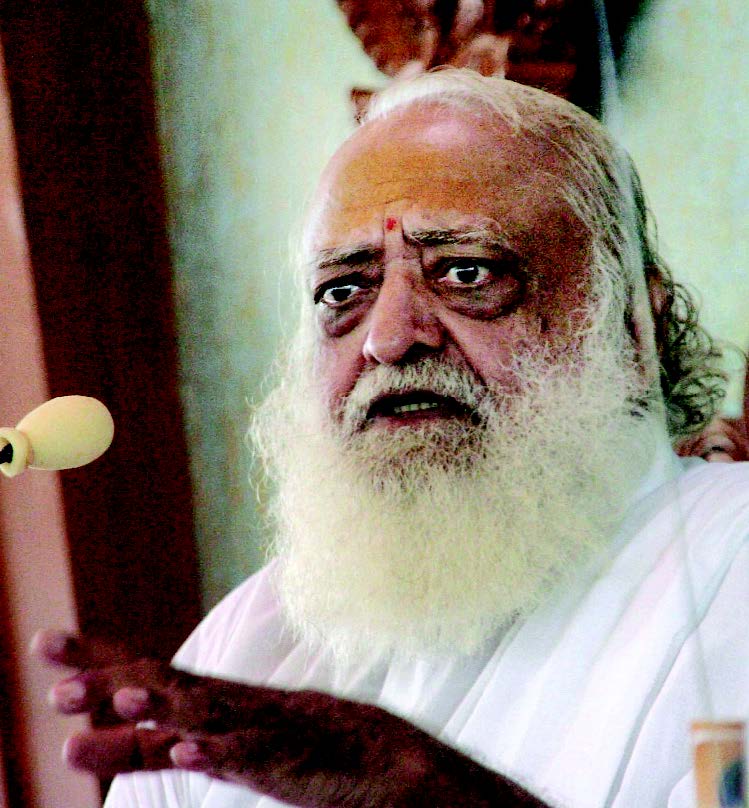
JAIPUR (TIP): A court in Rajasthan’s Jodhpur town on October 11 extended, till October 25, the judicial custody of spiritual guru Asaram Bapu, arrested for sexually assaulting a minor girl. The 72-year-old Asaram has been lodged in Jodhpur Central Jail since September 01. The court of the district and sessions judge (Jodhpur rural) will, meanwhile, decide on the plea by a Gujarat police team seeking custody of the jailed self-styled godman for questioning him in connection with a sexual assault case lodged by two sisters from Surat against him and his son. Armed with a warrant, the police team had moved a Jodhpur court on Thursday. The District and Session Court had adjourned the matter till Friday after the police team from Ahmedabad appeared before it with the production warrant issued against 72-year-old Asaram by a Gandhinagar court. The Surat Police had registered the two complaints – one against Asaram and another against son Narayan Sai – of rape, sexual assault, illegal confinement and other charges. The complaint against Asaram was transferred to Chandkheda police station in Ahmedabad as the incident took place in Asaram’s ashram here. A 16-year-old girl on August 20 lodged a police complaint, accusing Asaram of sexually assaulting her at his ashram near Jodhpur. Asaram was arrested from his ashram in Indore, Madhya Pradesh, and brought to Jodhpur on September 01.
Tag: Gujarat
-

President seeks clarifications on ordinance protecting convicted lawmakers
NEW DELHI (TIP): President Pranab Mukherjee has sought clarifications from senior Cabinet ministers on the justification for bringing an ordinance that allows convicted lawmakers to hold on to their seats in Parliament and state legislatures. The President, who was forwarded the ordinance cleared by the Cabinet on Tuesday, sought clarifications separately from home minister Sushil Shinde, parliamentary affairs minister Kamal Nath and law minister Kapil Sibal. The inquiry came against the backdrop of demands from the BJP, the Left, the Aam Aadmi Party and civil society activists that the President reject the ordinance. Government sources sought to play down the President’s queries, saying that as a stickler for norms, he was doing due diligence and may approve the ordinance after meeting the AAP delegation on Friday.
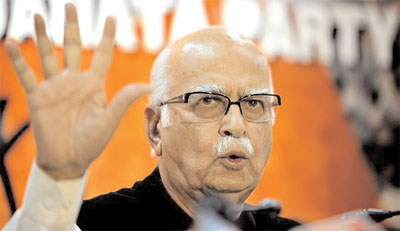
Ordinances are meant for urgent situations during the periods when Parliament is not in session. Opposition and others have argued that in this instance, there is no urgency except the government’s anxiety to save RJD boss Lalu Prasad from a possible setback in a Ranchi court which is trying him for complicity in the fodder scam. The politically crucial judicial order is set for Monday. The government strongly supported the ordinance disregarding growing concern within its own ranks that the ordinance would boomerang on the Congress at a time when it’s already facing heat over corruption, particularly in urban areas. A BJP delegation led by L K Advani and comprising Leaders of Opposition in the two Houses, Sushma Swaraj and Arun Jaitely, earlier called on President to urge him to reject the Ordinance. “The Indian government is trying to dilute this (convicted lawmakers) decision of the Supreme Court.
It should realize that the ordinance is against the Constitution,” Advani told reporters after meeting the President.With the debate escalating, finance minister P Chidambaram questioned the BJP’s opposition to the ordinance, saying the main opposition party was changing its stand. He cited the case of a BJP minister in Gujarat who continued to hold office despite being convicted. “Mr Bokhiria is minister of mines and belongs to the BJP. He has been convicted for a period of three years,” Chidambaram told reporters.
-

PROGRESS BLOW TO GUJARAT
Human indicators put state that brags about growth behind Tripura and Sikkim
NEW DELHI (TIP): A new development index has identified Gujarat as a less developed state, while ranking Odisha and Bihar along with eight others as “least developed” and Goa and Kerala among the seven “relatively developed” states. A panel headed by Raghuram Rajan, now the RBI governor, which submitted its report to finance minister P Chidambaram, also recommended a fresh approach to devolution of funds to states and moved away from the special category classification to devise three categories – least developed, less developed and relatively developed. According to the index, there are 10 least developed states, 11 less developed and seven relatively developed states in the country. The slotting of Gujarat, which has attracted attention due to its development model, in the “less developed” category is likely to escalate the already bitter political debate on the ‘Gujarat model of development’.
The other states in this category are Manipur, West Bengal, Nagaland, Andhra Pradesh, Jammu and Kashmir, Mizoram, Tripura, Karnataka, Sikkim and Himachal Pradesh. The least developed states include, apart from Odisha and Bihar, Madhya Pradesh, Chhattisgarh, Jharkhand, Arunachal Pradesh, Assam, Meghalaya, Uttar Pradesh and Rajasthan. The relatively developed states according to the index are Haryana, Uttarakhand, Maharashtra, Punjab, Tamil Nadu, Kerala and Goa. The panel has developed a multidimensional index of backwardness based on monthly per capita consumption expenditure, education, health, household amenities, poverty rate, female literacy, percent of SC-ST population, urbanisation rate, financial inclusion and connectivity.
The panel said less developed states rank higher on the index and would get larger allocations based on the need criteria. “The committee has proposed a general method for allocating funds from the Centre to the states based on both a state’s development needs as well as its development performance,” Chidambaram told reporters. “The committee has recommended that each state may get a fixed basic allocation of 0.3% of overall funds, to which will be added its share stemming from need and performance to get its overall share,” Chidambaram said. The panel was set up after persistent demand from Bihar CM Nitish Kumar who insisted a the special category status to help access more funds for its development. This sparked off a demand from several other states such Odisha for the special category state status. While the new index will ensure more funds for Bihar from the central kitty, it has stopped short of conferring the “special category” tag on the state, Shaibal Gupta, seen as Nitish’s nominee on the panel to submit a 10-page dissent note.
However on Thursday, Nitish concealed his disappointment, if any, to celebrate the recommendation as a triumph even as BJP taunted him for failing to have his way despite cozying up to Congress. “It is a very decent report. For example under this index Odisha is at the bottom of the list and then Bihar. Therefore it recognizes that Odisha, Bihar, Madhya Pradesh are among the most backward states of India. That is I think the demand,” Chidambaram said. “The demand of these states is please recognize the fact that for a variety of reasons we are the most backward states. I think this index captures the degree of backwardness and acknowledges that Bihar is among the most backward states of India. Special category is the present categorisation. Now they are moving away from that,” finance minister said while detailing the recommendations of the panel.
“This is not an answer to all the demands of the states. This is meant only to be a way forward on how to devolve funds to the more backwards states and areas of India. He said the index better captures the stage of development in a state, how backward it is or how relatively less backward it is and is a good measure for planning and devolution of funds. “Because some states are small very limited resources it is necessary to have a threshold below which the devolution of funds does not fall. So the committee has recommended that each one of the states will get a basic allocation of 0.3%,” Chidambaram said. The finance minister said that the report will be examined by various stakeholders before being implemented. “It will not be in the current year. It has to go through the examination process and will be implemented in an appropriate time in the next financial year.
To which funds this should be applied a decision will be taken,” Chidambaram said. The report said that the National Development Council had accorded the status of special category state to eleven out of 28 states. They were based on a number of characteristics such as hilly and difficult terrain, low population density and or sizeable share of tribal population, strategic location along the borders with neighbouring countries, economic and infrastructural backwardness and non-viable nature of state finances. State under this category have a low resource base and are not in a position to mobilise resources for their developmental needs even though the per capita income of some of these states is relatively high, the report said.
-

‘AGGRESSIVE’ RAHUL RALLIES TRIBALS, TAUNTS GUJARAT CM
JAGDALPUR (TIP): Congress general secretary Rahul Gandhi on September 26 addressed a rally a mere 43km from the spot where the Maoists wiped out the entire party brass little more than three months ago, and said the leaders were killed to silence the voice of the common people. Showing rare aggression, he said the BJP government’s failure led to their slaughter. “Thirty-two people were killed in the Maoist attack. Where was the government? The tallest Opposition leader was killed, where was the government? When the leaders of tribals are not safe, what about masses?” he asked. Attacking the BJP and its prime ministerial candidate Narendra Modi, Rahul said just one man can’t run the nation. “The BJP thinks just one man can run the nation,” Rahul said, in a barb at Modi. He also took on the Raman Singh government for poor infrastructure and acquisition of tribal land. “Have you seen any doctor in hospitals and health centres in Bastar?” he asked. The crowd roared in the negative.
“Our aim is to empower tribals by vesting power in their hands. We believe the nation is run by the people,” Rahul said. Criticising the BJP government for Chhattisgarh’s dilapidated health infrastructure, Rahul said hundreds of people die of gastroenteritis every year, but hospitals are in a shambles. “The land belonging to tribals is taken away. If they want land of the rich, they will buy it. If it’s of the poor, it’s acquired,” he said. The event brought leaders of warring factions of the state Congress on a common platform for the first time in more than three months in Rahul’s presence. How long will the warring groups led by former CM Ajit Jogi and Pradesh Congress chief Charandas Mahant remain on the same page is open to question. Criticising the Raman Singh government, Rahul said he had stopped at a village with a population of 2,000. “I tried to find out how many people have passed the 12th standard. There was one. What kind of government you have?” he said. The Centre has pumped in more than Rs 10,000 crore for development, but the government changed its names to take credit of Central schemes, he said.
-

Smriti Irani Inaugurates OFBJP National Convention
Urges Indian Diaspora to Take Active Part in Mission 2014: BJP 272+
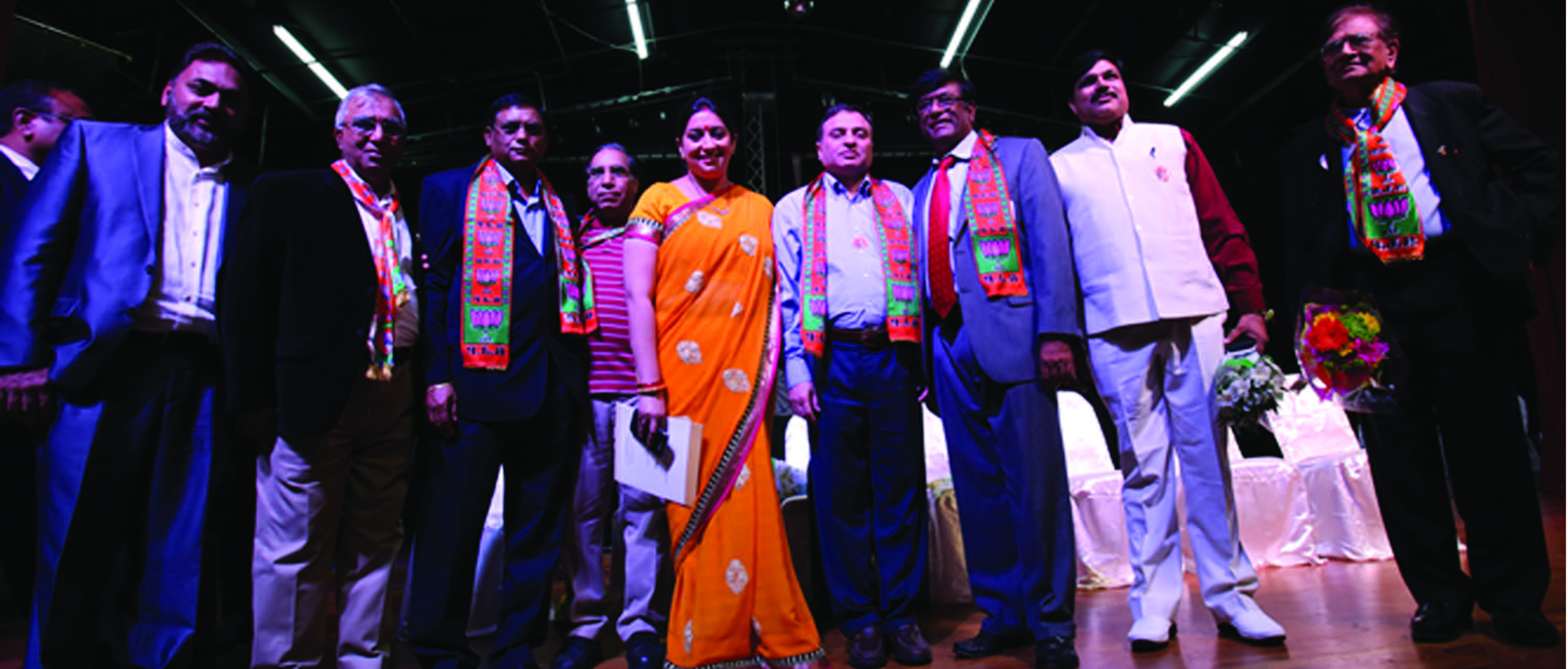
TAMPA (TIP): Smt. Smriti Irani, BJP national Vice President, inaugurated the annual national convention of Overseas Friends of BJP (OFBJP) – USA on Friday September 20, 2013 at India Cultural Center (ICC) in Tampa, FL. Over 150 delegates including members of National Council and Executive Committee, and Advisory Council participated. The delegates representing OFBJP’s 22 chapters in USA had assembled to brain storm and evolve an effective strategy to achieve the goal of Mission 2014: a clear majority for the BJP in the next Parliamentary elections. Over 500 people attended the inaugural session on Friday evening. The theme of the convention was Mission 2014:BJP 272+. Smt. Irani highlighted the achievements of Gujarat government headed by its visionary Chief Minister, Shri Narendra Modi through sheer hard-work and good governance under trying circumstances. She said that Modi has brought the good governance on the electoral agenda through his growth oriented stellar performance.
She said that a person who used to sell tea in his early childhood at the railway platform and became chief minister, and now prime ministerial candidate of BJP tells some-thing of the personal discipline, hard work, dedication and commitment to serve India and hard work of Shri Narendra Bhai. She continued that only in BJP, an ordinary worker can aspire to attain such a high position unlike Congress party where legacy and lineage are the primary components of leadership positions. She said that people of India are looking forward to elect NDA government headed by Shri Narendrabhai Modi and usher in India’s all round development and good governance; and bringing her to the top echelons in the international arena. Earlier, while addressing the women and youth forum during a panel discussion along with Prodyut Bora, national executive member of the BJP,Mrs. Irani said that Modi has become a “youth magnet” of India towards whom the entire young generation is looking with great hopes to solve India’s complex problems. To a question related to violence against women in the context of women gang rape cases,Mrs. Irani listed 10 strong steps to provide safety and protection to the women in the country.
To another question related to BJP’s plan for women welfare and arresting child labor, she said that India is one of the countries that has the concept of Ardhanareeshwara, depicting equality between male and female. She personally fought for women’s bill of right to work in the Parliament and showcased amazing schemes implemented in Madhya Pradesh and Gujarat. Good examples are “Ladli Lakshmi Yojana” – girl’s economic security; “Pravash Utsav and Kanya Yojana” – girls’ right to education; and “Kanya Dhan Yojana” – giving a start-up kit for newly married couples. She also described about a 1,700 crore rupees revenue generation scheme called “Mission Mangalam” – a selfhelp group, in which 2.25 lakh companies have helped 32 lakh women and gave them employment. To a question related to youth, panelist Shri Prodyut Bora said that 50% of India’s population is below 26 years of age and asked the youth to reach out to colleges and universities to motivate them to register to vote and then vote for BJP. He also stressed that both education and experience are equally important in politics and reminded the youth that working from grass roots helps shape the character and personality in the long run. To another question related to Bangladesh infiltration, Prodyut Bora said that it is indeed a sorry state of affairs and the Congress government is responsible for this plight as they indulge in vote bank politics. He said that there are strict orders to Border Security guards to let their guard down and the migrants are rewarded with ration cards and voter ID cards. In fact, Delhi high court declared that 10 lakh illegal immigrants from Bangladesh live in Delhi and they must return to their country. The situation in Mumbai, Bhubaneswar, and Bangalore is same as in Delhi. He said that it has nothing to do with the religion but it’s the sanctity and integrity of the nation that is at stake.
-

BJP will emerge as single largest party in LS polls: Survey
NEW DELHI (TIP): BJP will emerge as the single largest party in the coming parliamentary elections, a survey has claimed. “BJP has emerged as a clear winner across the country, (more so in north and west). Majority of young people, in the age group of 18 to 30, favoured the party. While in south, both BJP and Congress were running neck to neck,” a survey by AC Nelson-ABP News said. Majority of people from north (around 42%) were unhappy with the performance of UPA-2 and in a setback to Prime Minister Manmohan Singh, the respondents rated his performance “even below his government’s performance”, it claimed. Narendra Modi has emerged as the favourable prime ministerial candidate as more than 60% people expressed satisfaction on his performance, the survey said, adding that majority of people feels that the Gujarat chief minister should be declared as BJP’s PM candidate.
More than 60% have rated Modi’s performance as good or very good, he was more popular among the voters from north, younger generation and affluent. 70% respondents in Gujarat rated Modi’s performance as very good or good, with a mean score of 4.3, the survey said. Modi clearly emerged as front runner for the post of PM, followed by Congress vice-president Rahul Gandhi and Manmohan Singh. Across all zones except south, Modi emerged as the clear choice for the post of PM, while in south, he was neck to neck with Rahul Gandhi. Singh’s performance was rated as poor and very poor among the north Indian voters, who rated his performance even below the performance of UPA-2 government. Around 40% of the respondents feel that Singh was responsible for poor economic situation of the country. But surprisingly, in southern states, 45% people held finance minister P Chidambaram responsible for it. Congress may be calling itself as secular but people held both Congress and BJP equally responsible for communalisation of politics.
-

Floods wreak havoc in MP
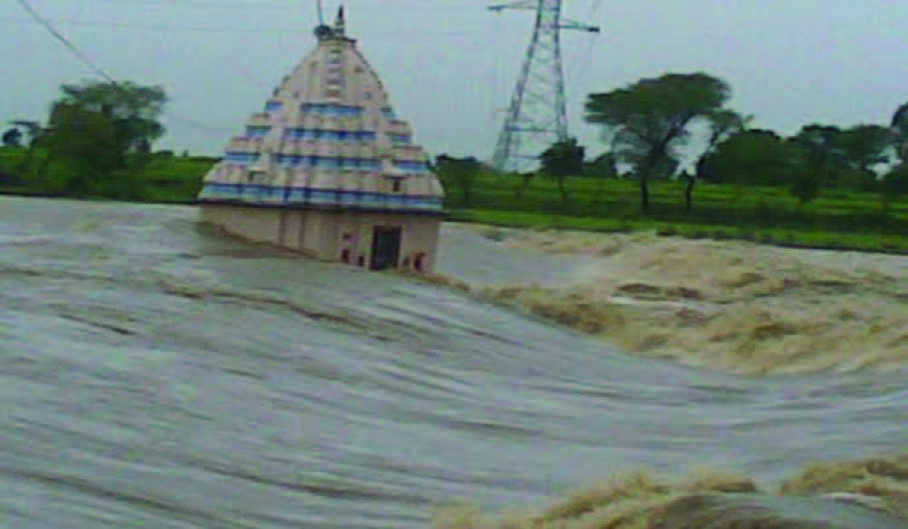
BHOPAL/BHARUCH (TIP): The army and air force were pressed into service on Aug 23 to expedite relief and evacuation in flood-hit areas of Madhya Pradesh. At least 21 people have died in flash floods in the past 36 hours taking the toll to 106. Heavy rains have devastated at least 12 districts of the state, the worst-hit being Hoshangabad and Vidisha. More than 24,000 houses have been destroyed. And with the Narmada and Betwa rivers flowing above the danger mark, the state government has sounded an alert. Chief minister Shivraj Singh Chouhan chaired a high-level meeting to review the situation. All trains bound for south India, passing through Madhya Pradesh have been delayed. A 30- metre railway track between Barbatpur and Magardoh railway station in Betul was washed away early on Friday. Hoshangabad remained and cut off from the rest of the state and more than 3,000 villagers have been evacuated.

In Gujarat, the Bharuch district administration has pressed the panic button following heavy rains in the catchment areas of Narmada river in MP. The heavy influx of water from Omkareshwar dam in MP into Sardar Sarovar dam has resulted in Narmada flowing at 32 ft at the Golden Bridge, eight feet above danger mark. According to Adra Agrawal, in-charge collector of Bharuch, nearly 1,670 people living in low-lying areas of Bharuch, Ankleshwar and Jhagadia have been shifted to safer locations due to flood threat.
The administration had to use boats to shift people after Narmada waters inundated many low-lying areas in old Bharuch towns like Katopor Bazar, Furja Road, Pirkanthi, Bhrugu Rushi Temple and Dandia Bazar. An alert has been sounded in 32 villages of Bharuch, Narmada and Vadodara. Rafiq Sheikh, a shopkeeper in Pirkanthi area, said, “This is the second time this month that our areas were flooded. We have lost business in festival season.” Meanwhile, the Sardar Sarovar dam touched a new high of 129.70 meters on Aug 23. Earlier, it had touched the highest level of 129.50 meters on August 3. “The dam is overflowing since July 17. If the influx of water from Omkareshwar dam continues, the dam level is expected to touch 130.40 m by Saturday,” said PM Patel, chief engineer, Sardar Sarovar Narmada Nigam Ltd.
-

ADVANI Wants India To Unlock Unlimited Potential
NEW DELHI (TIP): On a day when Gujarat chief minister Narendra Modi took on Prime Minister Manmohan Singh in his Independence Day speech, senior BJP leader L K Advani struck an optimistic note, saying “India has unlimited potential for the future”. In his address after hoisting the national flag at his residence, Advani said, “This past decade, which, as the prime minister said today, will get over in 2014.
He has enumerated the achievements and the shortcomings of this decade. We should now be concerned about making the decade starting from 2014 an unprecedented one in India’s history. We should give it the best performance we can.” Striking a positive note, the BJP veteran said no one should be critical of each other on this occasion, rather each one should try to put in their best to ensure that India’s potential to shine in the 21st century is exploited.
Since Advani was speaking moments after Modi’s speech in Gujarat, there was speculation that he was being critical of the Gujarat CM. However, the BJP veteran is learnt to have been unaware of the contents of Modi’s speech. Since the function at Advani’s residence was soon after the Red Fort event, which he attended, he was not aware of what Modi had said about the PM in his speech, it is learnt.
Talking about a book on black money, which he is currently reading, Advani said, “The theme of the book is that though capitalism is good, if ethics and morality are set aside and people indulge in corruption, then it gives capitalism a bad name.” Leader of opposition in Lok Sabha Sushma Swaraj took a dig at the PM for not mentioning the name of his immediate predecessor and BJP veteran Atal Bihari Vajpayee while lauding the work of earlier prime ministers.
“Dr Manmohan Singh referred to four prime ministers who contributed to the making of India — all from the Congress party. He forgot even Lal Bahadur Shastri there. The contribution of Morarji Desai and Atal Bihari Vajpayee has been no less. This partisan approach does not go with the solemnity of this great occasion,” Swaraj said on Twitter.
Later, BJP described the PM’s speech as “lacklustre and an outright disappointment” but hoped that the coming year — in which general elections are due — will usher in a new decade of growth. Party general secretary Rajiv Pratap Rudy described the PM’s speech as “an outright disappointment”. “The country had large expectations from the prime minister on his parting Independence Day speech which was full of hollow claims.
Country would have the PM to express his stand on issues of national security, especially in the backdrop of Pakistan attacking Indian soldiers and China intruding into Indian territory,” Rudy said. BJP president Rajnath Singh said if voted to power his party will tackle internal and external security challenges facing the country. He described the recent communal violence in Kishtwar as a “challenge to democracy”.
-

A PICTORIAL HISTORY OF INDEPENDENT INDIA
A chronology of key events
India has been home to several ancient civilisations and empires, some dating back to more than 2,000 BC. Culture and religions have flourished over the millennia, and foreign influence has ebbed and flowed. 1947 – End of British rule and partition of sub-continent into mainly Hindu India and Muslim-majority state of Pakistan.1947-48 – Hundreds of thousands die in widespread communal bloodshed after partition.
1948 – Mahatma Gandhi assassinated by Hindu extremist.
1948 – War with Pakistan over disputed territory of Kashmir.
1951-52 – Congress Party wins first general elections under leadership of Jawaharlal Nehru. Regional tensions 1962 – India loses brief border war with China.
1964 – Death of Prime Minister Jawaharlal Nehru.
1965 – Second war with Pakistan over Kashmir.
1966 – Nehru’s daughter Indira Gandhi becomes prime minister.
1971 – Third war with Pakistan over creation of Bangladesh, formerly East Pakistan.
1971 – Twenty-year treaty of friendship signed with Soviet Union.
1974 – India explodes first nuclear device in underground test. Democratic strains
1975 – Indira Gandhi declares state of emergency after being found guilty of electoral malpractice.
1975-1977 – Nearly 1,000 political opponents imprisoned and programme of compulsory birth control introduced. 1977 – Indira Gandhi’s Congress Party loses general elections. 1980 – Indira Gandhi returns to power heading Congress party splinter group, Congress (Indira).
1984 – Troops storm Golden Temple – Sikhs’ most holy shrine – to flush out Sikh militants pressing for self-rule.
1984 – Indira Gandhi assassinated by Sikh bodyguards, following which her son, Rajiv, takes over.
1984 December – Gas leak at Union Carbide pesticides plant in Bhopal. Thousands are killed immediately, many more subsequently die or are left disabled.
1987 – India deploys troops for peacekeeping operation in Sri Lanka’s ethnic conflict.
1989 – Falling public support leads to Congress defeat in general election.
1990 – Indian troops withdrawn from Sri Lanka.
1990 – Muslim separatist groups begin campaign of violence in Kashmir.
1991 – Rajiv Gandhi assassinated by suicide bomber sympathetic to Sri Lanka’s Tamil Tigers.
1991 – Economic reform programme begun by Prime Minister PV Narasimha Rao.
1992 – Hindu extremists demolish mosque in Ayodhya, triggering widespread Hindu-Muslim violence. BJP to the fore
1996 – Congress suffers worst ever electoral defeat as Hindu nationalist BJP emerges as largest single party. 1998 – BJP forms coalition government under Prime Minister Atal Behari Vajpayee.
1998 – India carries out nuclear tests, leading to widespread international condemnation.
1999 February – Vajpayee makes historic bus trip to Pakistan to meet Premier Nawaz Sharif and to sign bilateral Lahore peace declaration.
1999 May – Tension in Kashmir leads to brief war with Pakistan-backed forces in the icy heights around Kargil in Indian-held Kashmir.
1999 October – Cyclone devastates eastern state of Orissa, leaving at least 10,000 dead.
2000 May – India marks the birth of its billionth citizen.
2000 – US President Bill Clinton makes a groundbreaking visit to improve ties.
2001 January – Massive earthquakes hit the western state of Gujarat, leaving at least 30,000 dead. 2001 April – 16 Indian and three Bangladeshi soldiers are killed in border clashes. A high-powered rocket is launched, propelling India into the club of countries able to fire big satellites deep into space.
2001 July – Vajpayee meets Pakistani President Pervez Musharraf in the first summit between the two neighbours in more than two years. It ends without a breakthrough because of differences over Kashmir.2001 September – US lifts sanctions which it imposed against India and Pakistan after they staged nuclear tests in 1998. The move is seen as a reward for their support for the US-led anti-terror campaign. Kashmir tensions rise
2001 October – India fires on Pakistani military posts in 1984 – Indira Gandhi assassinated by Sikh bodyguards, following which her son, Rajiv, takes over.1984 December – Gas leak at Union Carbide pesticides plant in Bhopal. Thousands are killed immediately, many more subsequently die or are left disabled.
1987 – India deploys troops for peacekeeping operation in Sri Lanka’s ethnic conflict.
1989 – Falling public support leads to Congress defeat in general election.
1990 – Indian troops withdrawn from Sri Lanka.
1990 – Muslim separatist groups begin campaign of violence in Kashmir.
1991 – Rajiv Gandhi assassinated by suicide bomber sympathetic to Sri Lanka’s Tamil Tigers.
1991 – Economic reform programme begun by Prime Minister PV Narasimha Rao.
1992 – Hindu extremists demolish mosque in Ayodhya, triggering widespread Hindu- Muslim violence. BJP to the fore
1996 – Congress suffers worst ever electoral defeat as Hindu nationalist BJP emerges as largest single party. 1998 – BJP forms coalition government under Prime Minister Atal Behari Vajpayee.
1998 – India carries out nuclear tests, leading to widespread international condemnation. 1999 February –Vajpayee makes historic bus trip to Pakistan to meet Premier Nawaz Sharif and to sign bilateral Lahore peace declaration.
1999 May – Tension in Kashmir leads to brief war with Pakistan-backed forces in the icy heights around Kargil in Indian-held Kashmir.
1999 October – Cyclone devastates eastern state of Orissa, leaving at least 10,000 dead. 2000 May – India marks the birth of its billionth citizen.
2000 – US President Bill Clinton makes a groundbreaking visit to improve ties. 2001 January – Massive earthquakes hit the western state of Gujarat, leaving at least 30,000 dead.
2001 April – 16 Indian and three Bangladeshi soldiers are killed in border clashes. A high-powered rocket is launched, propelling India into the club of countries able to fire big satellites deep into space.
2001 July – Vajpayee meets Pakistani President Pervez Musharraf in the first summit between the two neighbours in more than two years. It ends without a breakthrough because of differences over Kashmir.
2001 September – US lifts sanctions which it imposed against India and Pakistan after they staged nuclear tests in 1998. The move is seen as a reward for their support for the US-led anti-terror campaign.Kashmir tensions rise
2001 October – India fires on Pakistani military posts in the heaviest firing along the dividing line of control in Kashmir for almost a year.
2001 December – Suicide squad attacks parliament in New Delhi, killing several police. The five gunmen die in the assault.
2001 December – India imposes sanctions against Pakistan, to force it to take action against two Kashmir militant groups blamed for the suicide attack on parliament. Pakistan retaliates with similar sanctions, and bans the groups in January.
2001 December – India, Pakistan mass troops on common border amid mounting fears of a looming war.
2002 January – India successfully test-fires a nuclear-capable ballistic missile – the Agni – off its eastern coast.
2002 February – Inter-religious bloodshed breaks out after 59 Hindu pilgrims returning from Ayodhya are killed in a train fire in Godhra, Gujarat. More than 1,000 people, mainly Muslims, die in subsequent violence. Police and officials blamed the fire on a Muslim mob, but a 2005 government investigation said it was an accident. In 2012 a court convicts 32 people over the Naroda Patiya riots in Ahmedabad. 2002 May – Pakistan test-fires three medium-range surface-to-surface Ghauri missiles, which are capable of carrying nuclear warheads.War of words between Indian and Pakistani leaders intensifies. Actual war seems imminent.2002 June – UK, US urge their citizens to leave India and Pakistan, while maintaining diplomatic offensive to avert war.
2002 July – Retired scientist and architect of India’s missile programme APJ Abdul Kalam is elected president.
2003 August – At least 50 people are killed in two simultaneous bomb blasts in Bombay. Kashmir ceasefire 2003 November – India matches Pakistan’s declaration of a Kashmir ceasefire. 2003 December – India, Pakistan agree to resume direct air links and to allow overflights.
2004 January – Groundbreaking meeting held between government and moderate Kashmir separatists.
2004 May – Surprise victory for Congress Party in general elections. Manmohan Singh is sworn in as prime minister.
2004 September – India, along with Brazil, Germany and Japan, launches an application for a permanent seat on the UN Security Council.2005 7 April – Bus services, the first in 60 years, operate between Srinagar in Indianadministered Kashmir and Muzaffarabad in Pakistani-administered Kashmir.
2006 February – India’s largest-ever rural jobs scheme is launched, aimed at lifting around 60 million families out of poverty. Nuclear deal 2006 March – US and India sign a nuclear agreement during a visit by US President George W Bush.The US gives India access to civilian nuclear technology while India agrees to greater scrutiny for its nuclear programme.
2006 November – Hu Jintao makes the first visit to India by a Chinese president in a decade.
2006 December – US President George W Bush approves a controversial law allowing India to buy US nuclear reactors and fuel for the first time in 30 years.
2007 March – Maoist rebels in Chhattisgarh state kill more than 50 policemen in a dawn attack.
2007 April – India’s first commercial space rocket is launched, carrying an Italian satellite.
2007 May – At least nine people are killed in a bomb explosion at the main mosque in Hyderabad. Several others are killed in subsequent rioting.
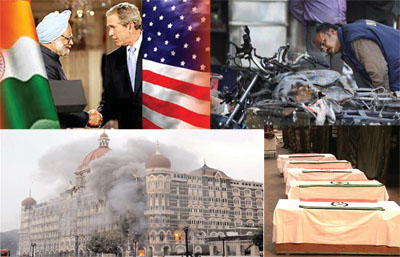
2007 May – Government announces its strongest economic growth figures for 20 years – 9.4% in the year to March. First woman president 2007 July – Pratibha Patil becomes first woman to be elected president of India. 2008 July – Congress-led coalition survives vote of confidence brought after left-wing parties withdraw their support over controversial nuclear cooperation deal with US. After the vote, several left-wing and regional parties form new alliance to oppose government, saying it has been tainted by corruption. India successfully launches its first mission to the moon, the unmanned lunar probe Chandrayaan-1. Mumbai attacks2008 November – Nearly 200 people are killed and hundreds injured in a series of coordinated attacks by gunmen on the main tourist and business area of India’s financial capital Mumbai. India blames militants from Pakistan for the attacks and demands that Islamabad act against those responsible.
2009 May – Resounding general election victory gives governing Congress-led alliance of PM Manmohan Singh an enhanced position in parliament, only 11 seats short of an absolute majority.
2009 December – The government says it will allow a new state, Telangana, to be carved out of part of the southern state of Andhra Pradesh. Violent protests for and against break out.
2010 May – The solve surviving gunman of the 2008 Mumbai attacks, Ajmal Amir Qasab, is convicted of murder, waging war on India and possessing explosives. 2010 June – A court in Bhopal sentences eight Indians to two years each in jail for “death by negligence” over the 1984 Union Carbide gas plant leak. Thousands died in this, the world’s worst industrial accident.
Ayodha ruling 2010 September – Allahabad High Court rules that disputed holy site of Ayodhya should be divided between Hindus and Muslims; the destruction of a mosque on the site by Hindu extremists in 1992 led to rioting in which about 2,000 people died.
2011 March – Results of 2011 census put India’s population at 1.21bn, an increase of 181 million over ten years.
2011 August – Prominent social activist Anna Hazare stages 12-day hunger strike in Delhi in protest at state corruption.
2011 November – Fourteen people including a government minister go on trial in one of India’s biggest ever corruption scandals – a telecoms deal alleged to have involved the selling of mobile phone licenses at knock-down prices in exchange for bribes.
2012 May – Manmohan Singh pays first official visit to Burma by an Indian prime minister since 1987. He signs agreements aimed at providing border area development and an Indian credit line. 2012 June – Police in Delhi arrest a key figure allegedly involved in planning the 2008 Mumbai attacks. They say Abu Hamza, also known as Syed Zabiuddin, was the “handler” of the 10 gunmen. 2012 July – Pranab Mukherjee from the ruling Congress party is elected as president, comfortably beating his rival P.A. Sangma.2012 August – Court convicts 32 people over the 2002 religious riots in Gujarat and acquits 29 others. Among those convicted in the Naroda Patiya killings in Ahmedabad are former state minister Maya Kodnani and Babu Bajrangi, a former leader of the militant Hindu group Bajrang Dal.
2012 December – The rape and murder of a young woman in Delhi triggers nationwide protests and a debate about sexual violence.
2013 February – Two explosions in crowded Dilsukhnagar area of central Hyderabad kill 16 people. Police suspect the Indian Mujahideen Islamist armed group.
2013 March – Five policemen are killed in a militant assault in Indian-administered Kashmir – the first major attack in the region in three years
2013 August – In a deadly instance of firing on Indian Army troops on the Line of Control from Pakistan-occupied Kashmir, five Indian soldiers died in Poonch sector in Jammu and Kashmir. -

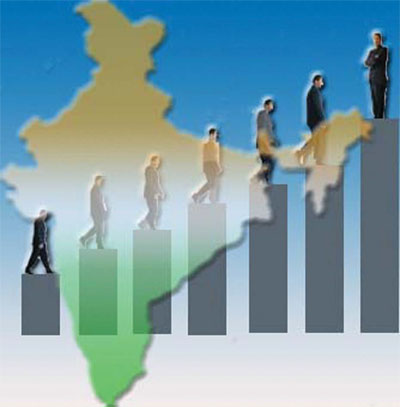
INDIA’S JOURNEY TO BECOMING AN ECONOMIC SUPERPOWER
The economic development in India followed socialist-inspired policies for most of its independent history, including state-ownership of many sectors; India’s per capita income increased at only around 1% annualised rate in the three decades after Independence. Since the mid-1980s, India has slowly opened up its markets through economic liberalisation.
After more fundamental reforms since 1991 and their renewal in the 2000s, India has progressed towards a free market economy. In the late 2000s, India’s growth reached 7.5%, which will double the average income in a decade. Analysts] say that if India pushed more fundamental market reforms, it could sustain the rate and even reach the government’s 2011 target of 10%. States have large responsibilities over their economies.
The annualised 1999-2008 growth rates for Tamil Nadu (9.8), Gujarat (9.6%),Haryana (9.1%), or Delhi (8.9%) were significantly higher than for Bihar (5.1%), Uttar Pradesh (4.4%), or Madhya Pradesh (6.5%). India is the tenth-largest economy in the world and the third largest by purchasing power parity adjusted exchange rates (PPP). On per capita basis, it ranks 140th in the world or 129th by PPP. The economic growth has been driven by the expansion of services that have been growing consistently faster than other sectors.
It is argued that the pattern of Indian development has been a specific one and that the country may be able to skip the intermediate industrialisationled phase in the transformation of its economic structure. Serious concerns have been raised about the jobless nature of the economic growth. Favourable macroeconomic performance has been a necessary but not sufficient condition for the significant reduction of poverty amongst the Indian population.
The rate of poverty decline has not been higher in the post-reform period (since 1991). The improvements in some other non-economic dimensions of social development have been even less favourable. The most pronounced example is an exceptionally high and persistent level of child malnutrition (46% in 2005-6). The progress of economic reforms in India is followed closely. The World Bank suggests that the most important priorities are public sector reform, infrastructure, agricultural and rural development, removal of labour regulations, reforms in lagging states, and HIV/AIDS.
[5] For 2012, India ranked 132nd in Ease of Doing Business Index, which is setback as compared with China 91st and Brazil 126th. According to Index of Economic Freedom World Ranking an annual survey on economic freedom of the nations, India ranks 123rd as compared with China and Russia which ranks 138th and 144th respectively in 2012. India ranks second worldwide in farm output.
Agriculture and allied sectors like forestry, logging and fishing accounted for 18.6% of the GDP in 2005, employed 60% of the total workforce and despite a steady decline of its share in the GDP, is still the largest economic sector and plays a significant role in the overall socioeconomic development of India. Yields per unit area of all crops have grown since 1950, due to the special emphasis placed on agriculture in the five-year plans and steady improvements in irrigation, technology, application of modern agricultural practices and provision of agricultural credit and subsidies since the green revolution.
India is the largest producer in the world of milk, cashew nuts, coconuts, tea, ginger, turmeric and black pepper. It also has the world’s largest cattle population (193 million). It is the second largest producer of wheat, rice, sugar, groundnut and inland fish. It is the third largest producer of tobacco. India accounts for 10% of the world fruit production with first rank in the production of banana and sapota. The required level of investment for the development of marketing, storage and cold storage infrastructure is estimated to be huge.
The government has implemented various schemes to raise investment in marketing infrastructure. Amongst these schemes are Construction of Rural Go downs, Market Research and Information Network, and Development / Strengthening of Agricultural Marketing Infrastructure, Grading and Standardisation.
Main problems in the agricultural sector, as listed by the World Bank, are:
-

MOVERS & SHAKERS
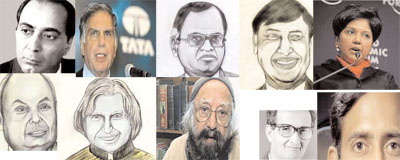
Famous Indian nuclear physicist Homi Jehangir Bhabha was born on 30 October 1909 in Mumbai. Bhabha played a key role in the development of the Indian atomic energy program. Widely referred to as the father of India’s nuclear weapons program, Bhabha had his education at the Elphinstone College and the Royal Institute of Science before obtaining his doctorate from the University of Cambridge in 1934.
He was influenced greatly by the legendary Paul Dirac. Bhabha was a research scientist at the Cavendish Laboratories at Cambridge. When he was stranded in India as a result of the Second World War, he set up the Cosmic Ray Research Unit at the Indian Institute of Science, Bangalore under Nobel Laureate C. V. Raman in 1939. Dr. Bhabha is credited with establishing the Tata Institute of Fundamental Research(TIFR) with the help of eminent industrialist J. R. D. Tata.
After India won independence from the British, Bhabha established the Atomic Energy Commission of India in 1948. He represented India in various international forums including the United Nations and his tenure represented a high in terms of the progress of India’s atomic energy programme. The climax of this programme came on May 18, 1974 when India exploded a nuclear device at Pokhran, Rajasthan joining a select club of nations.
Ratan Tata
Ratan Tata is one of the most well-known and respected Indian businessman. He served as the Chairman of the Tata Group from 1991 till 2012. As a Mumbaibased conglomerate, he is also a member of the prominent Tata family of Indian industrialists and philanthropists. Ratan Tata was born on December 28, 1937 in Mumbai. When he was a child his parents separated and he was brought up by his grandmother Lady Navajbai.He went to Campion School in Bombay, Bishop Cotton School in Shimla and finished his schooling from Cathedral and John Connon School in Mumbai. He graduated with a degree in Architecture and Structural Engineering from Cornell University in 1962 and also did the Advanced Management Program from Harvard Business School in 1975. He is also a member of the Alpha Sigma Phi fraternity of Yale University, United States. In 1962, Ratan Tata began his career in the Tata group.
At first he used to work on the shop floor of Tata Steel, shoveling limestone and handling blast furnace. In 1991, JRD Tata stepped down as the chairman of Tata Industries and named Ratan Tata as his successor. Under Ratan’s stewardship, Tata Tea attained Tetley, Tata motors attained Jaguar Land Rover and Tata Steel attained Corus. These triumphs turned Tata from a large India-centric company into a global business with 65% revenues from abroad. He also contributed in the development of Indica and Nano.
Ratan Tata has also served in various organizations in India and abroad. He is a member of the Prime Minister’s Council on Trade and Industry and he is also on the board of governors of the East-West Center, which is the advisory board of RAND’s Center for Asia Pacific Policy. He also serves on the program board of the Bill & Melinda Gates Foundation’s India AIDS initiative. He was awarded the Padma Bhushan by the Government of India in January 2000.
He serves on the boards of several leading organizations, both in the public as well as the private sector in India. He is a member of the International Investment Council set up by the President of South Africa and serves on the programme board of the Bill & Melinda Gates Foundation’s India AIDS initiative. Ratan Tata is credited for leading Tatas’ successful bid for Corus, an Anglo-Dutch steel and aluminum producer, which was acquired for an estimated £6.7 billion by Tata Sons.
N.R. Narayanamurthy
N.R. Narayana Murthy, the founder of Infosys Technologies is one of the most famous personalities in India’s I-T sector. Born on August 20, 1946, he obtained a degree in electrical engineering from the National Institute of Engineering under University of Mysore in 1967 and went on to do his Masters from IIT Kanpur in 1969. He joined Patni Computer Systems in Pune. While at Pune, he met his wife Sudha Murty.In 1981, he founded Infosys alongwith with six otherpeople. He served as president of the National Association of Software and Service Companies, India from 1992 to 1994. Murthy was the CEO of Infosys for twenty years, and was succeeded by Nandan Nilekani in March 2002. He functioned as the Executive Chairman of the Board and Chief Mentor from 2002 to 2006.
Dhirubhai Ambani
Dhirajlal Hirachand Ambani was born on 28 December 1932, at Chorwad, Junagadh in Gujarat, When he was 16 years old, he moved to Aden,Yemen. Initially, Dhirubhai worked as a dispatch clerk with A. Besse & Co. Married to Kokilaben. Dhirubhai also worked in Dubai for sometime. He returned to India and founded the Reliance Commercial Corporation with an initial capital of Rs 15000.Dhirubhai set up the business in partnership with Champaklal Damani from whom he parted ways in 1965. Dhirubhai started his first textile mill at Naroda, near Ahmedabad in 1966 and started the brand “Vimal”. Dhirubhai Ambani is credited with having started the equity cult in India.With the passage of time, Dhirubhai diversified into petrochemicals and sectors like telecommunications, information technology, energy, power, retail, textiles, infrastructure services, capital markets, and logistics.
Lakshmi Nivas Mittal
Lakshmi Nivas Mittal was born on June 15, 1950 in Sadulpur, Rajasthan, India and is presently the CEO & Chairman of Arcelor Mittal. Lakshmi Nivas Mittal was listed in the Forbes List of Billionaires in 2006 as the the richest Indian and the fifth richest man in the world with an estimated wealth around of $25.0 billion and is the richest man in the United Kingdom. Young Lakshmi Nivas Mittal spent his first years in Sadulpur, before his father moved to Kolkata. Lakshmi graduated from St. Xavier’s College, Calcutta. He founded Mittal Steel in 1976, which soon became a global steel producer with operations on 14 countries. His success mantra lies in the identification, acquisition and turnaround of many loss making steel companies all across the world.Dr. A.P.J. Abdul Kalam
Dr. A.P.J. Abdul Kalam, former President of India, graduated in aeronautical engineering from the Madras Institute of Technology in 1958 and joined the Defense Research and Development Organization (DRDO). In 1962, Kalam joined the Indian Space Research Organization (ISRO). In 1982, he rejoined DRDO as the Chief Executive of Integrated Guided Missile Development Programme (IGMDP). Dr. Kalam is credited with the development and operationalization of India’s Agni and Prithvi missiles.He worked as the Scientific Adviser to the Defence Minister and Secretary, Department of Defence Research & Development from 1992 to 1999. During this period, the Pokhran-II nuclear tests were conducted. Dr. Kalam held the office of the Principal Scientific Advisor to the Government of India from November 1999 to November 2001. Dr. Kalam has received a host of awards both in India and abroad. He was awarded the Padma Bhushan in 1981, Padma Vibhushan 1990 and the Bharat Ratna in 1997.
He is of the view that we should work wholeheartedly to make India a developed nation by 2020. Besides being a bachelor, Kalam is a strict disciplinarian, a complete vegetarian and teetotaler. Among the many firsts to his credit, he became India’s first President to undertake an undersea journey when he boarded the INS Sindhurakshak, a submarine, from Visakhapatnam. He also became the first president to undertake a sortie in a fighter aircraft, a Sukhoi-30 MKI.
Khushwant Singh
One of the most prominent novelists and journalists of India, Khushwant Singh was born on 2 February 1915 in Hadali, presently in Pakistan. He writes a weekly column, “With Malice towards One and All”, published in several leading newspapers all over the country. He graduated from Government College, Lahore before studying law at King’s College, London. He has been the editor of Yojana, The Illustrated Weekly of India, The National Herald and the Hindustan Times.He also served as a member of the Rajya Sabha. Though he was awarded the Padma Bhushan in 1974, he returned it in 1984 to protest the siege of the Golden Temple by the Indian Army. He was awarded the Padma Vibhushan in 2007. Some of his notable works include: The Sikhs; Train to Pakistan; The Sikhs Today; Ranjit Singh: The Maharajah of the Punjab; Delhi: A Novel; Sex, Scotch and Scholarship: Selected Writings; Not a Nice Man to Know: The Best of Khushwant Singh; Paradise and Other Stories; Death at My Doorstep; The Illustrated History of the Sikhs etc.
Amartya Sen
Nobel Prize winner Amartya Sen was born on 3 November 1933 in Santiniketan, West Bengal. Besides being a worldrenowned economist, Amartya Sen is also a philosopher. He served as a Master at the Trinity College at Cambridge University, the first Asian academic to head an Oxbridge college. Currently the Lamont University Professor at Harvard University, Amartya Sen traces his roots to an illustrious lineage. His father, Ashutosh Sen, taught chemistry at the Dhaka University.Amartya completed his high-school education from Dhaka in Bangladesh in 1941. After his family migrated to India in 1947, Sen studied at the Presidency College, Kolkata and at the Delhi School of Economics before moving over to the United Kingdom to complete his higher studies. He earned his doctorate from the Trinity College, Cambridge in 1959. He has taught at various reputed Universities including the University of Calcutta, Jadavpur University, Oxford, London School of Economics, Harvard and many others. His works helped to develop the theory of social choice.
In 1981, he published his famous work Poverty and Famines: An Essay on Entitlement and Deprivation, where he showed that famine occurs not only due to shortage of food, but from inequalities in the mechanisms for distributing food. He had personally witnessed the Bengal famine of 1943. He has done valuable work in the field of development economics, which has had a tremendous influence on the formulation of the United Nations Development Programme’s Human Development Report.
Sabeer Bhatia
Sabeer Bhatia-co-founder of Hotmail, is one among select group of people who have made it big in America’s Silicon Valley. Born in Chandigarh, Sabeer Bhatia did his schooling from St. Joseph’s Boys’ High School, Bangalore. He graduated from Caltech and went to Stanford to pursue his MS in Electrical Engineering. Sabeer attended many lectures by famous like Steve Jobs and was determined to make it big. After completing his Masters, he joined Apple computers. He left Apple soon after.He teamed up with his partner to create a web-based e-mail system Microsoft bought Hotmail on December 30th, 1997, for a reported sum of $400M. After the success of Hotmail, Bhatia in April 1999, he started another venture, Arzoo Inc, which however had to be shut down. In 2006, Arzoo was relaunched. Bhatia has won many awards. Among the notable ones include the “Entrepreneur of the Year” awarded by the venture capital firm Draper Fisher Jurvetson in 1997, the “TR100” award, presented by MIT to 100 young innovators expected to have the greatest impact on technology in the next few years. Besides, he was named by TIME magazine as one of the “People to Watch” in International Business in 2002.
Indra Nooyi
Indra Nooyi is the president and chief executive officer of PepsiCo and is the highest-ranking Indian-born woman in corporate America. She helped to start PepsiCo’s fast-food chains in 1997. After a Bachelor’s degree from Madras Christian College and a Post Graduate Diploma in Management from the Indian Institute of Management Kolkata, she moved on to the Yale School of Management.She started her career with The Boston Consulting Group (BCG), moving on to companies like Motorola and Asea Brown Boveri.She serves on the board of directors of several organizations. In August 2006, she succeeded Steve Reinemund as chief executive officer of PepsiCo. She has been named the Most Powerful Woman in Business in 2006 by Fortune Magazine. Her name was included in the Wall Street Journal’s list of 50 women to watch in 2005.
Kiran Bedi
The first woman to join the coveted Indian Police Service (IPS) in 1972, Kiran Bedi was born on 9 June 1949 in Amritsar, Punjab. Recently appointed as Director General of India’s Bureau of Police Research and Development, Kiran Bedi has had an illustrious career, earning widespread adulation for her no-nonsense attitude and devotion to work. She served as Police Advisor in the United Nations peacekeeping department and was honored with the UN medal for outstanding service. She earned the nickname ‘Crane Bedi’ for towing away the then Indian PM Indira Gandhi’s car for parking violation.Kiran Bedi graduated in English before securing a Master’s degree in Political Science from Punjab University, Chandigarh. This gutsy police officer went on to secure an LL.B degree in 1988 from Delhi University and a Ph.D. from the Indian Institute of Technology, New Delhi, even while she was in service. She was good at sports too, having been an all- India and all-Asian tennis champion.
She has served creditably in a host of appointments ranging from Deputy Inspector General of Police, Mizoram, Advisor to the Lieutanent Governor of Chandigarh, Director General of Narcotics Control Bureau and many others.
Rakesh Sharma
The first Indian to fly into space, Rakesh Sharma was born on January 13, 1949 in Patiala, Punjab. He was a squadron leader with the Indian Air Force, when he flew into space in 1984 as part of a joint programme between the Indian Space Research Organisation (ISRO) and the Soviet Intercosmos space program.He spent eight days in space on board the Salyut 7 space station. He joined two other Soviet cosmonauts aboard the Soyuz T- 11 spacecraft which blasted off on April 2, 1984. He was awarded the Hero of Soviet Union award on his return from space. The Government of India honoured him with the Ashok Chakra. He retired with the rank of Wing Commander. He joined the Hindustan Aeronautics Limited in 1987 and served as Chief Test Pilot in the HAL Nashik Division until 1992, before moving on to Bangalore to work as the Chief Test Pilot of HAL. He retired from test flying in 2001.
Dr. Verghese Kurien
The “father of the white revolution” in India, Dr. Verghese Kurien is acknowledged worldwide as the brain behind the success of the largest dairy development programme in the world by the name of Operation Flood. Also known as the “Milkman of India”, he was the chairman of the Gujarat Co-operative Milk Marketing Federation Ltd. (GCMMF) and his name became synonymous with the Amul brand. Born on November 26, 1921 in Kozhikode, Kerala, he graduated in Physics from Loyola College, Madras in 1940 and pursued a B.E.(Mechanical) course from the Madras University. He was instrumental in the success story of AMUL. -

Indian-American doctors to hold Global Healthcare Summit in January
WASHINGTON (TIP): The influential Indian American doctor’s community on Tuesday, July 30th, announced to hold their “Global Healthcare Summit” in Ahmedabad next January for bringing affordable world class healthcare for Indians. “The Association of American Physicians of Indian Origin (AAPI) would like to make a positive and meaningful impact on the healthcare in India,” said the AAPI president, Dr Jayesh Shah, on his return from India along with other members of the organization.
Shah, who is from Gujarat, as are most members of AAPI, said Global Healthcare Summit 2014 which will be held in Ahmedabad from January 3-5 next year and is aimed at advancing the accessibility, affordability and quality of world-class healthcare to the Indian people. Among other areas, the Summit will focus on prevention, diagnosis, treatment options and share ways to truly improve healthcare transcending global boundaries, he said.
Nothing that healthcare in India is one of the largest sectors in terms of revenue and employment, Shah said, “AAPI has been engaged in harnessing the power of Indian Diasporas to bring the most innovative, efficient, cost effective healthcare solutions to India.” So far AAPI has organized seven Indo-US Global Healthcare Summits and has developed strategic alliances with various organizations.
-

PM Manmohan Singh To Visit US In September, To Strengthen Ties
NEW DELHI (TIP): Prime Minister Manmohan Singh will participate in the United Nations General Assembly(UNGA) in New York in the month of September but the highlight of his visit will be his bilateral meeting with President Barack Obama in Washington DC. The US has finally confirmed the dates for PM Manmohan Singh’s visit from September 25 to 30, government sources said.
The confirmation of the dates has come as a huge relief for the Indian side as south block wanted the bilateral meeting to take place during Singh’s visit for United Nations General Assembly. This is what Indian officials had conveyed to US after Obama invited Singh for what is going to be their second bilateral meeting in US capital. The meeting in September, they said, would spare PM the trouble of traveling to the US for the second time in quick succession as his participation in UNGA was certain.
As secretary of state John Kerry said during his visit to India in June, India and U.S. are looking to finalize a commercial agreement between NPCIL and Westinghouse for a nuclear reactor in Gujarat. If the 2 countries can circumvent India’s contentious nuclear liability law and conclude negotiations by then, it would be the main takeaway from Singh’s meeting with Obama.
Both sides are trying hard to fight the gloom enveloping the ties between them and realize that one way of doing this is by encashing the civil nuclear agreement. Talking about the significance of Obama’s invite to Singh, foreign minister Salman Khurshid had said earlier that it is only befitting Singh’s reputation as having nurtured the India-US relations that he visit the US in the final year of UPA II.
-

Ex-Gujarat Ranji Player Is Skipper Of Us National Team
AHMEDABAD (TIP): Former Gujarat Ranji player Timil Patel has been appointed captain of US’s national cricket team for a series against Canada for the Auty Cup. The 29-year-old Amdavadi leg-spinner emigrated to the US with his family in 2010 after playing 38 first class games for Gujarat. He made his international debut for the US on November 14, 2012, against Canada in the previous edition of the Auty Cup played in Florida.
“It is an honour to lead the US team,” Timil said on the phone from Canada. “We have young and talented players who have been performing consistently at the club level. Hopefully, we can bring positive results in the upcoming series.” Both the US and Canadian teams are dominated by migrants from the Indian subcontinent. Timil made his debut for Gujarat in 2002 and was part of the team for the next seven years.
His last game was a Ranji Trophy match against Himachal Pradesh in Surat in 2009. Since settling down in Los Angeles, he has played for the Southern California Cricket Association. He has also played two T20 internationals against Canada and was made the stand-in captain in the first Twenty20 after skipper Steven Taylor suffered an injury.
-

OFBJP Organizes Public Reception For BJP President Rajnath Singh
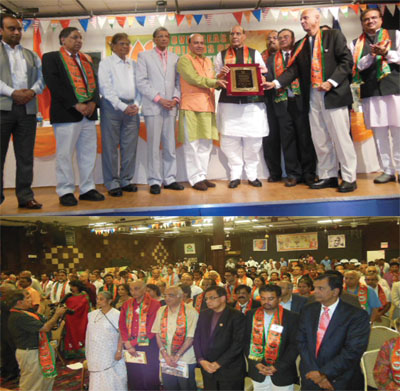
EDISON, NJ (TIP): Indian American community of tri-state area (New Jersey, New York, and Connecticut) gave a rousing welcome to Rajnath Singh, President of Bharatiya Janata Party (BJP) and his BJP delegation Ananth Kumar, General Secretary; Sudhanshu Trivedi, National Spokesperson; and Vijay Jolly, Convener of Overseas Affairs and Overseas Friends of BJP (OFBJP) in TV Asia Studio Auditorium at Edison, NJ on Sunday July 21, 2013. The program was organized by OFBJP-USA as part of its community global outreach program.
The program was broadcasted live on TV Asia across US reaching out to 1.5 million viewers. The program was also relayed live in India, Canada, UK, Europe and Middle East thru various channels. Addressing the jam-packed auditorium, Rajnath Singh said that he was elated by the warm welcome that had been accorded to him by the Indian Americans here in US. He said that trust and credibility have become a big problem in India and BJP is the only option. No party in India has grown bigger than Congress except the BJP.
BJP is the only party that has not suffered a vertical split. Communists have lost relevance and Congress has no policy on any of the issues nor has any ideology. Since its inception in 1951 as Bharatiya Jan Sangh and later on as BJP, the party has been pursuing a policy of Nation first. He continued that Atal Behari Vajpayee led a 24 party coalition for 6 years and the NDA rule was far better than 55 years of Congress rule in every aspect.
Corruption, Inflation and price rise are the signature of congress rule whereas NDA government controlled the inflation and price rise in spite of the prevailing severe drought and economic sanctions imposed by the entire West after Pokhran nuclear tests. NDA inherited a GDP growth of 4.8% and 10% inflation whereas BJP handed UPA a GDP of 8.4% and inflation 3.5% in 2004. Amidst applause from the audience he said that Pokhran test was a big step wherein the BJP led govt made India a nuclear power even though we knew economic sanctions were staring at us.
Countries that are much smaller have become developed countries but India is still a backward country and not sure why 55 years of Congress rule did not change much. Congress has to answer as to how much time they need to make India better, to remove poverty. BJP invited FDI in telecom sector but encouraged Indian investors whereas Congress has opened up the telecom sector 100%, increased in the LIC sector from 26% to 49%. Foreign investors have pulled out $7.5 billion from India and no one is ready to invest.
Even after 60 years of Independence we still have 67% of people who don’t get food and we need a food security bill. We need leaders with firm conviction and leaders with vision and when we come in power we will make India a super economic power in 10-15 years. National Highway development has seen tremendous growth during NDA rule. 50% of the highways that were built during 1980-2012 happened during 6 years of NDA rule and the other 50% were built during 26 years of non-BJP rule.
Gujarat development has become a role model across the world. Madhya Pradesh agricultural growth (19%) is the highest in the world and very soon will be providing 24hrs of power supply. Chhattisgarh PDS system serves 90% of the population without any corruption and is a model for other states to emulate. Goa is the only state in India where Petrol is cheaper than Diesel. India has a GDP growth of 4.8% whereas BJP ruled states have 10% GDP growth. UPA government has no plan to tackle Naxalism or terrorism.
Appeasement has become the state policy whereas BJP never links terrorism to any religion, caste or region. After Mumbai terror attack, Prime Minister made a statement that he will not talk to Pakistan until it gives an assurance that they will control terror activities and not support any groups that work against India but changed all that in a matter of few months. Our foreign policy is at its worst with no friendly neighbors around us. During NDA rule we maintained good relations with Russia and development excellent relations with US.
We made US our strategic partner. He appealed to the US govt to lift the ban on visa to Narendra Modi, he said on one side US agencies rate Gujarat as the best state and Modiji as an excellent administrator and on the other hand they deny visa to him. It will be better if US takes a decision soon as they will be forced to take a decision anyway later. When BJP comes to power we will make India a power of Rishi and Krishi (knowledge and Prosperity), he said. Indian culture influenced the world for thousands of years.
We never planned to dominate the world and even Swami Vivekananda came to Chicago on his own and had great influence on the world by his teachings. Citing the example of Newsweek columnist Lisa Miller who stated that by imbibing Yoga, Pranayam, Ayurveda and Organic farming people in the West are becoming Hindus whereas it is a crime in India if you say you are a Hindu.Talking on the recent controversy related to Narendra Modi statement that he is a Hindu and Nationalist, media created and pseudo secularists made a big fuss.
Professing your Hindu culture became a communal word in India. He said that as per the Supreme Court, Hindutva is a way of a life. Hindutva teaches love not only for human beings but even for animals, plants, rivers, mountains etc. It is Hindutva that teaches us to serve milk to a snake and take care of animals like ants and birds. He called on the Indian American Community to support BJP to build a strong India.
Shri Rajnath Singh was accorded standing ovation. Shri Rajnath Singh was honored by the OFBJP executive committee with a plaque for his contributions to the party and the country. Earlier, Ram Rakshpal Sood (Sr.Advisor, OFBJP) acting as the Emcee welcomed the audience, chief guests and the sponsors of the event. After the traditional lamp lighting ceremony amidst the chanting of Vedic mantras by Pandit Pravin Shastri and Chandrakant Trivedi and blowing of conch shell by Pravin Shashtri. Mrs. Vidya Labroo led the rendition of Vandemataram.
Jayesh Patel (President, OFBJP) welcomed the distinguished guests and said that entire India is chanting Narendra Modi (NaMo) mantra and expressed hope that BJP will be able to get majority on its own merit in the next election. Ram Kamath (General Secretary, OFBJP) introduced Dr. Mahesh Mehta, National Coordinator of OFBJP-USA. Speaking on the occasion, Dr. Mehta said that mission 2014 is about transforming India into a global leader and Global Indians should contribute to be the part of this great movement that will eventually contribute to the development of India.
Dr. Adapa Prasad (Immediate Past President) introduced Vijay Jolly, Convener of BJP Overseas Affairs and OFBJP, as a dynamic leader and former MLA who took on Delhi Chief Minister during the last election.
In his electrifying speech, Vijay Jolly urged the audience to applaud for Rajnath Singh for honoring the feelings of the people by making NaMo as the chairman of the campaign committee. Stressing the fact the OFBJP is on a mission to develop leaders by inducting youth into the organization to dethrone the corrupt Congress regime in India. Stating that NRI’s have always made India proud, he said that OFBJP has setup its chapters in UK, Norway, Nepal, Kenya and other countries to work for the welfare of Indian diaspora.
He got the past Presidents of OFBJP-USA honored by Rajnath Singh Introducing SudhanshuTrivedi, BJP National Spokesperson, Dr. Dinesh Agrawal (Former- President, OFBJP) said that as the national spokesperson, he is very active effective on TV channels spreading the message and its ideology of BJP. SudhanshuTrivedi reminded that July 21st the day of the program is a historical day when US astronauts landed on the moon. Edison town, the venue of the program, is also a historical town, named after the inventor of light bulb.
Hence, he said that word Bharat stands for light and inspires us to take India to the pinnacle of glory. Stating that BJP is all set to form the next government is not based on hope but on facts. He concluded reciting a poem by A.B. Vajpayee. R.P. Singh (Org. Secretary, OFBJP) introduced Ananth Kumar, BJP general Secretary. Amidst thunderous applaud from the audience, Shri Ananth Kumar introduced himself as the Hanuman of South as Kishkinda, the birth place of Lord Hanuman is in Karnataka whereas Rajnath Singh is from U.P, the land of Ram. For Ram’s team to win we need Hanuman and he is there to lend services for the party and the country.
India, he said is going through turbulent times and like A.B. Vajpayee model, we have Gujarat model of development under NaMo leadership and we will soon have NaMo model of governance. He said that BJP is already in battle mode, under NaMo and Rajnath Singh’s leadership we are all set to take on the corrupt congress government. Once in power, BJP will make India a global player not only in spirituality but in culture, strategic matters and will be a decisive player in the world. He urged the NRI’s to connect with their districts back home and work for BJP’s victory in 2014.
Chandrakanth Patel introduced Rajnath Singh as a man of impeccable image in spite of being in political life for 40+ years. Born in a farmer’s family in Varanasi, he rose to be the president of BJYM. He was part of the J.P movement and became the Agricultural minister in A.B. Vajpayee’s government. He was the President of BJP between 2007-2009 and again became the President in January, 2013.
Currently, he is a Member of Parliament from Ghaziabad, U.P. Earlier, the President of TV Asia and a well known community leader, Shri H.R.Shah addressed the gathering and said that TV Asia always supported India causes and he has been an admirer of Mahatma Gnadhi and Sardar Patel. He said he felt close to BJP principles and supported BJP. He wished that Narendra Modi would be elected as the Prime Minister. Krishna Reddy (Treasurer, OFBJP) presented the vote of Thanks.
-

Not In The Race For Prime Minister : RAJNATH SINGH
NEW YORK (TIP): The Bharatiya Janata Party President Rajnath Singh on Saturday, July 20, categorically denied that he is in the race for Prime Minister of India if BJP returns to power at the Center. “I am more interested in getting the BJP back into power in Center and packing off the corruption-ridden bad governance of the Congress in my tenure as President of the party,” he said addressing a news conference of Indian-American media at Hotel Waldorf Astoria in Manhattan.
On the question of party president not being projected as Prime Ministerial candidate in the Lok Sabha elections, he said it is not necessary that the two positions be placed in the hands of one person. “It’s not necessary that party president should also be a crowd puller and a prime ministerial candidate. I have an assignment to do for my party. I have a job to deliver – that is victory of the party in the 2014 elections.”
“Seven months before the elections, I have nominated Gujarat Chief Minister Narendra Modi as chairman of the party campaign committee. What is unusual in that? We have nominated Modi like other parties do and why read between lines. I have named him as campaign head in view of his image, popularity and commitment to the party,” he said. He said Modi is certainly the most popular and the tallest leader of India.
He is a crowd puller not only in Gujarat but also in Tamil Nadu, Andhra Pradesh, Uttar Pradesh and Bihar – from North to South, East to West. He is one single leader with a national appeal. His popularity will help the party in the elections. On the issue of visa rejection issue of Narendra Modi, he said he would take up the issue with the US lawmakers in Washington.
“I will appeal to the US government to clear the US visa to the Gujarat Chief Minister.” People of India have now realized that BJP is the only solution after comparing the performance-oriented BJP led NDA Government and corruption-ridden inefficient Congress UPA dispensation, he said. The performances of several BJP-ruled states like Gujarat, Madhya Pradesh, Chhattisgarh are there for the people to see and if these states can provide 24 hour power supply, clean and efficient government, fillip to industries compared to poor performance of many Congressruled State governments what would people prefer? People have made up their mind, he said.
Detailing steps taken by the BJP to face the national elections in 2014, he said the party had brought changes in organizational level by forming polling booth committees in every booth. “We have formed a committee consisting of 10 to 15 party men at grassroots level to strengthen the organization at village level,” he said Congress ruled for 10 long years at national level and what are their achievements other than wholesale corruption and compromise in national and international security, he asked.
Indian voters are now realized that when the Center can’t guarantee growth rate of five percent or less, the growth rate in Gujarat, Madhya Pradesh and Chhattisgarh are approximately 10 percent. No one can fool Indian voters any more, he said. On the recent debacle of the party in Karnataka and setbacks in other states, the BJP President said assembly elections and municipal elections are different from parliament elections where people vote for a stable government.
Voters are intelligent enough to compare the two governments and Congress will be out of power soon. They have ruled for 10 long years and now its time to give them rest, he said “We are confident that the failure of the Congress government will help BJP return to power in the center. Any political party that aspires to come to power should give good governance and satisfy the needs of the people.
If they fail in this front, they will be out of power.” There is wholesale failure on economic front, compromise on internal and external security and diplomatic fronts as well. People are demanding a change very badly. If people want any change, the only choice is BJP who can provide an alternative to this government, he said. On allies deserting the party, he said BJP will try to get a clear majority in Lok Sabha polls but at the same time will not forget its allies – old and new.
“Despite a clear majority in sight, we want our allies to participate in the government at the center. Now we have Shiv Sena and Shiromani Akali Dal and may get some nearer to the elections. There is also a possibility of post poll alliance with like minded parties if there is a need,” he said. In the coming Lok Sabha elections, Congress will be routed in Andhra Pradesh due to its ambiguity on Telengana issue.
The BJP is the only national party that favors separate Telengana and it was passed as a resolution in our national executive committee meeting, he said. There is no ambiguity in the BJP unlike the Congress camp in the matter and BJP is in favor of Telengana. But it’s not in favor of bifurcation of UP and other states as Telengana issue is a totally different one. On the question of poll promises, he said BJP would rather go in for developmental debate than Ram Janma Bhoomi issue. “Ram temple was not a major poll issue anytime.
It was at best a national issue but not an election issue,” he added. BJP government will consider instituting an inquiry commission to go into the corruption and scandals of the Congress government and will provide transparent and honest government with people’s interest as uppermost, he said. Ananth Kumar, party general secretary and chairman of Parliamentary Foreign Affairs Committee who is accompanying Rajnath Singh on the US tour, said the four member BJP delegation will meet members of the US Senate and House Representatives from both sides of the aisle – Democratic Party and the Republicans especially members of the Congressional Caucus of Indians and Indian Americans at the Capitol Hill.
Ananth Kumar said Rajnath’s visit to the US is a two track outreach program – to outreach the Indian Diaspora to assess the mood of three million Indian-Americans across the nation who occupy important and powerful positions besides being opinion makers; and to meet with India Caucus Congressmen to impress on them that a change is sweeping in India on the heels of Lok Sabha elections.
The other two members of the delegation are Dr. Sudhanshu Trivedi, party spokesman and advisor to the BJP President and Vijay Jolly, BJP national convener for Overseas Affairs and a former Delhi MLA. Jolly said the visit was to re-connect the Party President with the Indian-American Diaspora that plays a leading role in fostering friendship between the two countries. “We want to work closely with Non Resident Indians.” BJP – both as a government and party – will work with mainstream American and Indian-American business community on economic and investment matters.
clearly is of the view that India and the US have a close correlation in internal and external security and they are strategic partners being natural allies, he said. Jolly said the Overseas Friends of BJP in the US has over 7000 members across the US and project a positive image of the party among Indian-Americans and policy makers. The Foreign Affairs Committee of the party will address the concerns of Indian Diaspora and include in them in the BJP parivar by assigning a major role in the ensuing elections.
Rajnath Singh said it was NDA government under Vajpayee that gave voting rights to Non-Resident Indians and introduced Overseas Citizens Card (OCI) and Persons of Indian Origin (PIO) card. It was under Vajpayee’s leadership that the first Pravasi Bharatiya Divas was held in 2003 in New Delhi to bring all the Non- Resident and Diaspora Indians to work for the welfare of India. “All these were made possible due to the visionary leadership of Vajpayee and only the BJP has done a lot for NRIs and PIOs.”
On the spate of killing of Hindu and BJP leaders in Tamil Nadu, he said he would appeal to Tamil Nadu Chief Minister to give protection to party leaders. “I appeal to Jayalalithaa to help stop the killing of Hindu and BJP leaders in Tamil Nadu. We will try to build pressure on state government so that it takes it seriously to put an end to such killings.”
-

BJP President Criticized For Violating The Spirit Of India’s Constitution
NEW YORK (TIP): Juned Qazi, president of Madhya Pradesh unit of Indian National Overseas Congress (I), who is vigorously campaigning for a Congress (I) ticket from Aligarh Lok Sabha constituency, strongly criticized Rajnath Singh, BJP president, for violating the secular spirit of India’s constitution in speeches made in New Jersey, USA, July 21.
Qazi, who recently returned from a whirlwind BHARAT NIRMAN SANDESH tour of Aligarh, UP, criticized Singh for advocating ‘Hindu nationalism and Hindutva’ as a political strategy at a public reception hosted by ‘Overseas Friends of BJP’ in Edison, NJ on July 21, 2013. In a strongly worded press release Qazi pointed out that people of India can’t allow religion-based politics any more.
“Such politics clearly violates the fundamental values of our nation upon which our constitution is based”, he said. “India is a secular country which clearly states the establishment of a secular, socialist and democratic nation”, Qazi said. “With its religion based politics, BJP is tempering with the secular nature of our constitution.” Qazi said that India is fortunate to have a very progressive and modern constitution, which is capable of taking the nation to new heights in 21st century.
“We are a nation of young people who have no interest in promoting the bogey of religion for serving the political needs of outdated politicians. India’s constitution was created under the leadership of visionaries such as Dr. Baba Saheb Ambedkar who wanted to build India as a strong nation based secular and democratic values”, he pointed out. “BJP is a narrow-minded party whose leaders foolishly mislead the people of India by dragging religion in politics”, Qazi commented adding that BJP president Rajnath Singh spoke in USA as if he was speaking to people ignorant of outside world.
BJP president Rajnath Singh urges Overseas friends of BJP to lobby US lawmakers and US Department of State to issue a US visa to tainted BJP leader Narendra Modi. Mr. Juned Qazi would like to ask the BJP president, why it is that BJP is unable to come to terms with the fact that Narendra Modi is in-fact responsible for the heinous systematic massacre(s) in Gujarat. With technical legal maneuvers, political arm twisting, witness/evidence tampering the BJP ruling apparatus was able to temporarily fool the Indian judiciary and procured a clean chit for the tainted leader.
Why is it that the state department revoked Mr. Modi’s tourist/business visa and refused to let Modi into the United states on a diplomatic visa? As clearly cited in the official state department communiqué and various un-biased reports published by human rights groups, Modi and his government were directly responsible for systematic violation of human rights in the state of Gujarat.
-

BJP Has Sound Plans To Jumpstart The Stalled Indian Economy- Rajnath Singh
NEW YORK, NY (TIP): “The BJP-led NDA government created 67 million jobs in less than five years whereas the Congress led UPA created less than 2.7 million jobs between 2004 and 2009. These figures are from the data collected by the federal government controlled agencies and not a figment of imagination”, Rajnath Singh said.
He was speaking on what BJP will do to jumpstart the stalled Indian economy at a function organized by India-America Chamber of Commerce, July 25. Rajnath Singh who was in Washington for three days said he had discussions with the Congressmen and administration officials on the issue of difficulties faced by candidates in H1B and L1 visa to work legally in the US. The GDP cost burden will go up by 0.3 to 0.4 percent due to increase in fees.
“We had lodged our protest against the comprehensive immigration reforms bill and they had raised the issue of patents and compulsory drug license issues. There was only one case under these CDL whereas Indonesia had six cases and Canada four cases,” he added. The US would do well to share its latest technology on green energy with nations such as India so that it can benefit the humanity. Once these inventions are ashared, they would help us more in a very rapid manner, he said.
The BJP government will strengthen the village economy as over 70 percent of the people live in rural areas. We will do our best to stop urbanization and create more jobs in the rural areas as was done in the previous NDA government under the PURA scheme. More than 55 percent of the jobs for youth are in rural areas and there is a need to strengthen this sector. Turning to climate change, the BJP leader said while US that has been preaching, has a carbon emission rate of 20 ton per capita per annum, India has only 1.5 per ton per capita per annum.
The global average is only 4.5 ton per capita per annum. You now decide who is on the right side and who is not. Addressing the members of the India- America Chamber of Commerce in Manhattan, he said India is now facing a serious financial crisis of grave magnitude despite the fact that no one in the global economy can ignore India. The economy of India is not something that makes us feel comfortable or feel proud of.
But India was regarded as third largest economy of the world, he said. When the NDA government led by Atal Behari Vajpayee stepped down in 2004, the fiscal deficit was 2.5 percent and current account deficit was surplus. The revenue deficit was less than one percent. The economy witnessed a boom period during 1999 to 2004 when the country was ruled by the NDA and the slide started in 2004. “The boom that we created lasted till 2008 and then we are now witnessing is one of the worse economic downturns,” Singh said.
“When I mentioned to the Speaker of the House yesterday at Washington that we had a surplus current account when we left power, he was surprised. There was a revenue deficit that went up from 4.5 percent to 6 percent in 2008. The current account of deficit shot to 6 percent. We passed the fiscal responsibility bill in the parliament and hence were able to bring some fiscal discipline.
Inflation is now hovering around 7.7 percent,” he said. The rupee value has depreciated drastically to the US dollar from Rs 37 a dollar in 2008 to Rs 60 in 2013 almost doubling in five years. We thought this would be offset by increase in exports and that also did not happen; it went up by just one percent. It’s very unfortunate that savings that have been the biggest strength of India as it provided capital is now falling at a very rapid rate.
The small businesses tend to grow with the increase in savings and in the absence they take a major hit. Savings drop and growth rates drop and what else to drop. The success of Indian story is over. The success story of India is waiting for the BJP to return to power. The UPA has ruined the economic structure of the country. How will the BJP restore investors’ confidence and fix the broken economy once it comes to power? We will do what we did from 1999 to 2004 and we had a unique development model which is not only a model for India to feel proud of but came as a surprise to the world.
When we handed over the reins of the government to the Congress-led UPA, India’s growth rate was 8 to 9 percent and rate of inflation was around three percent. More than 50 percent of the highways were built during the Vajpayee government and the present Congress dispensation had admitted this in the court. Where had all the developments gone now? The BJP created a success story only to be mauled by the Congress, he added.
We have proved in the BJP-ruled states how we prioritize economic reforms and Gujarat is a shining example of India. The whole world is now talking about Gujarat and foreign governments are keen to study the success story. Take the case of Madhya Pradesh that was considered a sick state with no economic development before the BJP Government took over. Agricultural growth rate has gone up to 19.1 percent in the state as against 4 percent of the federal government.
Madhya Pradesh has replaced as country’s largest supplier of food grains to the central pool. In Chhattisgarh, more than 90 percent of the population is covered under the Public Distribution System and people enjoy social security compared to mass suicide by farmers in the Congress-ruled states. Goa is the only state in India where petrol is cheaper than diesel similar to what we see in the US.
Do we have to prove anything more to assure the people that our first priority will be to fix the problems and take India on a different plane?, he asked. The average GDP of BJP-ruled governments is about 10 percent whereas the nation is only experiencing a growth rate of less than five percent. There are only two models – BJP model for growth and Congress model for destruction, he added. Earlier, Rajiv Khanna, President, India-America Chamber of Commerce welcomed Rajnath Singh and introduced the subject of talk.
He pointed out that Indian economy has been weakening and this had caused considerable doubts in the minds of investors and wanted Singh to speak on how his party, if it came to power would jumpstart the stalled Indian economy. The talk by Rajnath Singh was followed by an interesting Q & AA session. Singh candidly answered the few questions put to him.
-

Erosion Of Public Faith
“It is a sad commentary on politicians”. The nation’s problem is how to reignite the spirit of confidence and idealism. Alas, no political party, even in the states, comes up to that standard. Whether the next election throws up such people is in the realm of conjecture. Persons like me are still optimistic that India would return to the path of values which it took after winning Independence”, says the author.
In the penultimate year of nearly onedecade rule by Prime Minister Manmohan Singh’s government, I find the biggest casualty is the people’s confidence in political parties, particularly the ruling Congress. In fact, the public is so exasperated that it has come to believe that dishonesty and politics are synonymous and those who have come to politics have done so only to make money.I was aghast to find that many wellplaced people have not contributed to the Prime Minister’s Relief Fund because they suspect that the money given for the Uttarakhand victims would be used by the Congress in elections. I can understand the argument that the assistance is mismanaged, but the suspicion about the PM’s Fund should awaken the rulers to the extent that the people have lost faith in them.
The scandals like the 2G Spectrum regarding the mobiles and the allotment of coal blocks to unknown persons have, no doubt, damaged the credibility of the Congress. But the inference that those in positions, to whichever party they belong, are all corrupt is a sad commentary on politicians. Consequently, there is a question mark against any report or probe conducted by the government. Even a judicial verdict is taken with a pinch of salt.
The fault is not that of the people, but the manner in which the affairs have been conducted since the seventies. Very little has been done to restore confidence. In fact, official machinery is in disarray. Take the case of Ishrat Jahan encounter. The Home Ministry at the Centre and the state government had taken the stand that Ishrat, along with her three accomplices, were terrorists who were killed in an encounter with the police suspecting them to have a plan to assassinate Gujarat Chief Minister Narendra Modi.
The Central Bureau of Investigation (CBI) said that it was a coldblooded murder. The agency found no evidence to involve Pakistan and Lashkar-e-Toiba which the Intelligence Bureau (IB) had done. Who does the public believe? Both the CBI and the IB are parts of the same government. The public is further confused because the CBI has alleged that Ishrat and her accomplices were picked up from different places and shot dead.
The weapons they had on them were allegedly planted by the police and none of these had been used for days. Assume that Ishrat and the others were terrorists. Does the police force have the right to kill them without proving in a law court that they were terrorists? If this rule is to apply, the killers of Mrs. Indira Gandhi and Rajiv Gandhi should have been shot dead in encounters instead of proceedings even in the Supreme Court.
We should not have spent crores of rupees on the trial of Mohammad Kasab, who was hanged, and done away with him for the attacks on Mumbai. The food security law which will subsidies food for 65 per cent of the population is a prey to suspicion. The government is to be blamed for introducing the measure through an ordinance when the Parliament session was only three weeks away (It has now been postponed to August after the ordinance).
Most political parties are in favor of the food Bill but want a legitimate discussion in Parliament before it is enacted. The Congress prefers the route of ordinance on the plea that political parties, particularly the BJP, have not allowed Parliament to function. This is true. But the ordinance too has to be passed by Parliament. For that a consensus would be required. Why couldn’t the government bring about it before the ordinance? There is something in the allegation that the Congress eyes are fixed on the parliamentary elections which are due in May 2014.
It is possible that the polls may take place in November or December. Such are the suspicions which have nullified the food security ordinance which would enable roughly 850 million people of limited means to buy rice at Rs. 3, wheat at Rs. 2 and bajra for Rs 1a kg. The case of the CBI’s autonomy is yet another example worth dwelling on. People have no faith in the supervision by the three retired High Court judges. The suspicion is that the government would appoint pliable judges. Since the CBI will be under the government, any measure it takes fails to evoke faith.
The other main political party, the BJP, is suspect because it is selling the Modi thesis of Hindutva. The latest is the building of the Ram temple at the site where the Babri Masjid stood before its demolition. The party should realize that the religious card cannot be played again and again. The demand for a temple and a uniform civil code is supposed to be part of development, a camouflage for Hindutva.
The party is as much engaged in power politics as the Congress is. That the leftist parties have social justice and federalism on their agenda is to the liking of a preponderant majority. To their admiration, a convention of the leftist parties in Delhi last week reiterated the two points. Indeed, the Manmohan Singh government has made the rich richer and has made a mockery of political autonomy.
Yet the CPI (M) was found wanting during its rule of 15 years in West Bengal. The Sachar Committee has said that the Muslim community in the state was the most backward in education (only 2.7 per cent). The CPI supported the authoritarian rule of Indira Gandhi during the Emergency. The Janata Dal (United) evokes hope to be a third alternative because its chief, Sharad Yadav, has said that his party will fight totalitarianism of communists and communalism of the BJP.
Bihar Chief Minister Nitish Kumar has shown in his rule that a government can rise above gimmicks. Rightly Nitish Kumar has asked for the National Investigation Agency to probe the Bodh Gaya bomb blasts. The nation’s problem is how to reignite the spirit of confidence and idealism. Alas, no political party, even in the states, comes up to that standard.
Whether the next election throws up such people is in the realm of conjecture. Persons like me are still optimistic that India would return to the path of values which it took after winning Independence.
-

Ishrat Jahan’s Family Cites Threat To Life, Seeks Security
NEW DELHI (TIP): Ishrat Jahan’s family cites threat to life, seeks securityThe family members of Ishrat Jahan, the 19-year-old college student killed by Gujarat police in a “fake” encounter in 2004, on Thursday have claimed threat to their lives and wrote to the Centre demanding adequate security. Ishrat’s mother Shamima Kauser, through her lawyer, wrote to Union home secretary Anil Goswami, claiming “grave threat to life, liberty and security” to her, her children as well as Rauf Lala and Mohinuddin Ismail Sayed, who have been supporting her fight for justice, and sought protection.
In New Delhi, according to official sources, home minister Sushilkumar Shinde has instructed that the family’s request should be looked into at the earliest. At a press conference in Mumbai, Ishrat’s sister Mushrat said: “My family and those supporting us are facing threat to their lives. Those who don’t want us to fight for justice are terrorising us.” “Around 2.30am [on Thursday], some people claiming to be policemen started knocking on our door. They said they wanted to speak to us. But we did not open the door,” she said.
“When we enquired with the Mumbra police station, we were told that they did not send anybody. The constable posted outside our house was missing. When we tried calling him, we found we had been given a wrong phone number.” Citing another incident, Ishrat’s uncle Rauf Lala said he and his family members were returning home in a car from the airport on the intervening night of June 18-19 when two armed men attacked the vehicle and broke its rear glass. “The attackers were nabbed by a crowd and taken to Mumbra police station.
A country made firearm was recovered from them. It was clear that the accused fired at the vehicle. But the police diluted the crime, registered a road accident case and let off the two,” he said. Shivshankar Munde, senior inspector, Mumbra police station, however, said the people knocking on the door at night were policemen. “Our beat marshals and people patrolling in the night went to check on them. The constable had probably stepped out,” he said. But the inspector remained mum about the wrong phone number.
-

Visiting Parliamentarians Felicitated
LONG ISLAND, NY (TIP): At a special gathering held on 25th June 2013 here Mrs. and Subba Rao Anumolu hosted the Telugu Association of North America (TANA)’s felicitation of 12 Indian parliament members who were visiting USA. The distinguished group of parliamentarians included CM Ramesh (Andhra Pradesh), Shadilal Batra (Haryana), Bharat Kumar Raut (Maharastra), Bhubaneswar Kalita (Assam), Mrs. Poonam Jat (Gujarat), Mrs. Smriti Z Irani(Gujarat), Vivek Gupta (West Bengal), YS Chowdary (Andhra Pradesh), Harish Choudhary( Rajasthan), Modugula Venugopala Reddy(Andhra Pradesh), Ramesh Chandran (Kerala), and Badnore VPS (Rajasthan).
These parliamentarians had attended the Leadership and Management Training Program at Yale University in New Haven and upon the request of TANA attended the facilitation event in Long Island before their departure to India. Mohan Nannapaneni, President of Telugu Association of North America (TANA) welcomed the Parliament members and thanked them for attending the event despite their hectic schedule. Nannapaneni introduced the host, Rao Anumolu who has an outstanding record of professional achievements, philanthropy and community service which have been already being recognized with the highest honor and acclaim in USA. Vijayawada’s Anumolu is the President & CEO of Long Island (New York) based, internationally known, high tech firm – ASR International Corporation.
Anumolu is the only Asian Indian to have been cited by the US Congress for the contributions made towards homeland security in USA. He is also the recipient of the 2010 Ellis Island Medal of Honor. This prestigious award, highest civilian award for immigrants, recognizes recipients for outstanding contributions to their communities, their nation and the world. Both the United States House of Representatives and Senate have officially recognized the Ellis Island Medal of Honor and the recipients are read into the Congressional Record. Past medalists include six US Presidents.
Anumolu has the unique distinction of being the only Asian Indian to have the dual honor of being cited by the US Congress and also the recipient of the Ellis Island Medal of Honor. Mrs. Smriti Irani, on behalf of the group, expressed deep condolences for the flood victims of Uttarkhand, and the audience observed a moment of silence. The parliament members addressed the gathering and expressed their vision for India in the near future. They predicted that India would become a dominant contributor for world economic and energy development within the next decade. All the parliament members were felicitated by TANA, with a shawl and a memento. The reception to visiting parliamentarians was attended by many well known Indian Americans from various walks of life. Jayasekhar Talluri, Chairman TANA Foundation conveyed vote of thanks to the attendees.