

A visionary whose message of oneness, equality and compassionate living continues to inspire historians, philosophers and seekers across the world
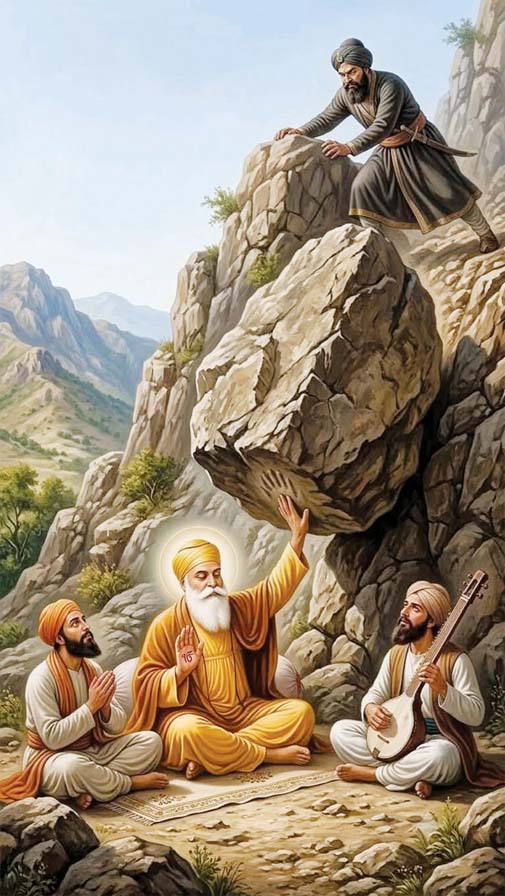 Five centuries after his time, Guru Nanak Dev Ji remains one of the most compelling figures in the spiritual and intellectual history of the Indian subcontinent. His life and teachings have been examined by historians, interpreted by philosophers, celebrated by spiritual leaders and embraced by millions seeking a deeper understanding of faith and humanity. Yet, the more closely one studies him, the more difficult it becomes to confine his significance to a single description. He was a mystic who spoke of the infinite, a poet whose compositions transformed spiritual expression, a social critic who challenged entrenched inequalities and a visionary who established a community founded on devotion, honest work and service.
Born in 1469 at Rai Bhoi Ki Talwandi, now Nankana Sahib in Pakistan, Guru Nanak emerged in a society marked by rigid social hierarchies, religious divisions and elaborate ritual practices. His declaration of the oneness of the Creator and the spiritual equality of humanity challenged the assumptions of his age. He questioned religious formalism, condemned hypocrisy and insisted that genuine spirituality must be reflected in the way people treated one another.
For Sikhs, he is the founder of their faith and the First Sikh Guru. For historians, he is a transformative figure whose compositions and community-building efforts shaped a new religious tradition. For philosophers, his teachings raise profound questions about the self, the Divine, knowledge and ethical living. For spiritual seekers, his message offers a path that connects inner awakening with responsibility towards the world.
The perspectives of scholars and spiritual thinkers reveal the many dimensions of a personality whose influence has endured because his message was not merely about believing in the Divine, but about learning to live in harmony with that truth.
THE HISTORIAN’S GURU: A FIGURE WHO TRANSFORMED HIS AGE
The academic study of Guru Nanak has developed into an important field of Sikh and South Asian studies. Among the scholars who shaped modern research was W. H. McLeod, whose 1968 book, Guru Nanak and the Sikh Religion, brought systematic historical attention to the Guru’s life, compositions and the development of the early Sikh community.
McLeod’s work examined the Janamsakhi narratives, the historical sources available to researchers and the challenges of distinguishing historical evidence from the devotional traditions that grew around Guru Nanak. His conclusions generated considerable discussion and criticism among Sikh scholars, but his work helped establish a framework for subsequent academic research.
The debate is important because Guru Nanak’s life is remembered through several kinds of sources: his own compositions, writings of early Sikh followers and successors, historical places associated with his life, and Janamsakhi accounts that preserve the community’s memory of his teachings and travels. These sources need to be read with care, particularly when traditional narratives are used to reconstruct precise dates and events.
Historian Gurinder Singh Mann offers another important perspective. In his chapter Guru Nanak’s Life and Legacy: An Appraisal, published in the 2012 volume Punjab Reconsidered: History, Culture, and Practice, Mann argues that Guru Nanak should not be viewed only as an individual mystic concerned with personal spiritual liberation. He emphasises that the Guru founded a distinct community, established institutions and worked to ensure the continuity of his mission.
This interpretation brings Kartarpur into focus. There, Guru Nanak’s teachings took practical form through collective worship, honest labour, sharing and community life. His followers did not simply gather to listen to a spiritual teacher; they became part of a community shaped by a distinctive vision of faith and social responsibility.
The historian’s perspective therefore reveals an essential dimension of Guru Nanak’s greatness: he did not leave behind only a philosophy to be admired. He created a living tradition in which that philosophy could be practised.
THE PHILOSOPHER’S GURU: THE POWER OF SHABAD
Guru Nanak’s compositions are among the most profound expressions of spiritual thought in the Sikh tradition. They explore the nature of the Divine, the limitations of the human ego, the relationship between the individual and creation, and the possibility of attaining spiritual awareness while living in the world.
The Stanford Encyclopedia of Philosophy, in its 2026 entry on Sikh philosophy, places Guru Nanak at the foundation of a distinctive South Asian tradition of thought and practice. It explains that Sikh philosophy is deeply rooted in the concept of Gurmat — the wisdom and teaching of the Guru — and cannot be adequately understood by separating ideas from the practices through which they are lived.
One of the most illuminating examples appears in Sidh Gosht, Guru Nanak’s dialogue with the Siddhas, spiritual ascetics known for their yogic practices. When asked who his Guru was, Nanak identifies Shabad as the Guru and the consciousness attuned to it as the disciple. This places the Divine Word, rather than outward authority or ritual display, at the centre of spiritual transformation.
The significance of this teaching is immense. Shabad is not merely a collection of words to be recited. It is divine wisdom to be heard, contemplated and incorporated into one’s life. Its purpose is to transform consciousness, overcome ego and lead the individual towards a more truthful relationship with the world.
The opening of Japji Sahib, through the Mool Mantar, establishes the foundation of this vision: Ik Onkar — the One Reality. The Divine is beyond fear and enmity, timeless and self-existent, realised through grace. This understanding challenges the tendency to divide humanity according to religious labels and outward identities.
Guru Nanak’s compositions repeatedly examine haumai, or ego-consciousness, which creates separation between individuals and distances them from the Divine. Spiritual growth, in this understanding, is not the accumulation of religious status or the performance of impressive rituals. It is the transformation of the self through humility, remembrance and truthful conduct.
THE SCHOLAR WHO INTRODUCED GURU NANAK TO THE WORLD
Max Arthur Macauliffe, the British scholar and administrator who devoted much of his work to Sikh history and scripture, played a significant role in introducing Sikh teachings to English-reading audiences.
His translation of Japji, published in the Journal of the Royal Asiatic Society in January 1900, described the composition as a concise expression of Guru Nanak’s understanding of God, religion, ethics and the universe. Macauliffe also recognised its central place in Sikh daily prayer.
Although his interpretations belong to the scholarship of his time and should be read critically, his work helped draw international attention to the literary and spiritual depth of Sikh scripture.
The importance of Japji Sahib lies in its extraordinary range. It asks questions about the origin of creation, the limits of human understanding, the nature of divine order and the discipline required for spiritual awakening. Its five Khands — stages or realms described in the composition — provide a framework for reflecting on the movement from ethical living towards spiritual fulfilment.
For a reader approaching Guru Nanak through philosophy, Japji Sahib offers much more than devotional poetry. It is an exploration of existence and the human search for truth.
THE SPIRITUAL MASTER’S GURU: FAITH MUST BE REFLECTED IN ACTION
Perhaps the most distinctive feature of Guru Nanak’s teachings is his refusal to separate spirituality from everyday life. He did not advocate abandoning the world in pursuit of liberation. Instead, he demonstrated that spiritual fulfilment could be pursued while working, raising a family, participating in society and serving others.
The three principles commonly used to summarise his teachings — Naam Japo, Kirat Karo and Vand Chhako — express this practical philosophy. Remember the Divine, earn through honest labour and share with others. Together, they connect inner devotion with ethical responsibility.
These principles are often presented as a convenient three-part summary of Guru Nanak’s message rather than a formally enumerated formula in his compositions. Their value lies in the way they bring together the central concerns of his teaching.
Naam Japo calls for a life of remembrance and awareness of the Divine. Kirat Karo gives dignity to honest work and rejects exploitation and dishonesty. Vand Chhako turns individual prosperity into an opportunity to support others.
For spiritual seekers, this is a demanding understanding of faith. Prayer cannot be separated from conduct. A person who recites sacred words but exploits the vulnerable has failed to understand their deeper meaning. Religious observance becomes meaningful when it produces humility, compassion and a sense of responsibility.
The institution of Langar, rooted in the community at Kartarpur and strengthened by the succeeding Gurus, gives visible expression to this philosophy. People from different backgrounds sit together and share a meal. The act challenges distinctions of caste, wealth and social position, turning equality into an everyday experience.
MAHATMA GANDHI’S TRIBUTE: A VOICE FOR RELIGIOUS HARMONY
Among modern leaders who drew attention to Guru Nanak’s universal message was Mahatma Gandhi. His remarks at a prayer meeting in New Delhi on September 26, 1947, are particularly significant because they were delivered during the violence and communal upheaval surrounding Partition.
Reflecting on the teachings of the First Sikh Guru, Gandhi said that Nanak recognised God by several names, including Allah, Rahim and Khuda. He observed that Guru Nanak had tried to bring different religions together.
Gandhi’s words, recorded in the Collected Works of Mahatma Gandhi and reproduced by Gandhi Bhavan Bengaluru, were not simply a historical reference. They were an appeal to people living through a moment of extraordinary religious hostility.
At a time when communities were being divided by fear and violence, Gandhi invoked Guru Nanak as an example of spiritual understanding that transcended religious boundaries. His interpretation highlighted the moral responsibility that accompanies belief in one Divine presence.
Guru Nanak’s message, however, was not that all religious traditions were identical or that their differences should be ignored. He questioned the arrogance of those who claimed exclusive spiritual superiority and called upon people to pursue sincerity, humility and truth.
Gandhi’s reflection reminds us that the Guru’s message of harmony is not passive tolerance. It demands that people reject hatred and recognise the dignity of others.
A VISION OF EQUALITY: THE WOMAN, THE WORKER AND THE MARGINALISED
Scholars have also drawn attention to the social implications of Guru Nanak’s teachings. His rejection of caste-based superiority challenged a social order in which birth often determined status, opportunity and dignity.
The practice of Sangat brought people together in collective worship, while Pangat — sitting together to share food — expressed equality through a shared community experience. These practices challenged social divisions not merely through words but through the organisation of everyday life.
His compositions also contain a striking affirmation of women’s dignity. In Asa Di Var, Guru Nanak asks:
“So kio manda aakhiye jit jammeh raajaan.”
Why call her inferior, from whom even kings are born?
The verse challenges the contempt directed towards women and questions the assumptions on which such prejudice rests.
Scholar Nikky-Guninder Kaur Singh has made an important contribution to the study of gender in Sikh thought. In The Feminine Principle in the Sikh Vision of the Transcendent, she examines the significance of feminine imagery and the place of women in Sikh scripture and spiritual understanding. Her work encourages readers to consider how the egalitarian possibilities of Sikh teachings must find expression in social and political life.
This is a particularly relevant way of reading Guru Nanak today. Equality cannot remain a beautiful idea in scripture; it must be reflected in the treatment of women, workers, disadvantaged communities and all those denied dignity.
THE ENVIRONMENTAL THINKER: NATURE AS A SACRED RELATIONSHIP
Guru Nanak’s spiritual vision also offers a remarkable perspective on the natural world. In Japji Sahib, he writes:
“Pavan Guru, Pani Pita, Mata Dharat Mahat.”
Air is the Guru, water the father and the great earth the mother.
The verse places human life within a relationship of dependence, gratitude and reverence towards nature. Air, water and earth are not simply resources for human consumption; they are essential elements of existence.
In an age of climate change, polluted rivers, declining groundwater and ecological destruction, this teaching carries a powerful contemporary message. It encourages a relationship with the environment based on responsibility rather than limitless exploitation.
The ecological significance of Guru Nanak’s thought emerges from his larger understanding of creation. If the Divine presence permeates the universe, nature cannot be treated as spiritually insignificant. Respect for creation becomes part of a responsible spiritual life.
THE GURU WHO CONTINUES TO SPEAK
The many perspectives on Guru Nanak — historical, philosophical, literary and spiritual — do not diminish one another. They illuminate different aspects of a legacy that is too rich to be contained within a single interpretation.
Historians help reconstruct the world in which he lived and understand the community he established. Philosophers explore the depth of his ideas about Shabad, ego, the Divine and human consciousness. Spiritual thinkers draw attention to the transformation of personal conduct that his teachings demand. His own Bani remains the central source through which Sikhs encounter his spiritual vision.
At a time when religious identity is frequently used to create divisions, economic inequality remains widespread and environmental crises threaten the future, Guru Nanak’s message has renewed relevance. Ik Onkar calls humanity towards an understanding of oneness. Naam Japo encourages inner awareness. Kirat Karo upholds the dignity of honest labour. Vand Chhako reminds people that prosperity carries an obligation to share.
Perhaps the most meaningful tribute to Guru Nanak Dev Ji is not simply to study his life, admire his travels or celebrate his birth anniversary. It is to allow his teachings to shape the way we live.
More than five centuries after his time, his voice continues to challenge the powerful, comfort the seeker, question the hypocrite and inspire those who believe that faith must lead to compassion.
His legacy lives not only in historical scholarship, sacred spaces and the pages of Sri Guru Granth Sahib Ji, but wherever people choose truth over falsehood, humility over pride, equality over discrimination and service over self-interest.



Be the first to comment