
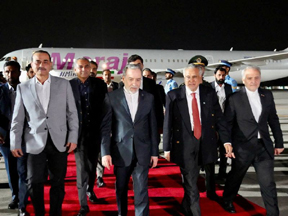

Anxieties about Iran’s missile capabilities, proxy networks and nuclear ambitions have quietly accelerated new patterns of security cooperation across West Asia and the Caucasus

For decades, Israel imagined itself as a lonely fortress in a hostile West Asia. Today, however, a quieter reality is emerging: an undeclared regional coalition stretching from the Caucasus to the Gulf, united less by ideology than by a common anxiety about Iran.
The alliance is not formal. There are no NATO-style communiqués or public military headquarters. Instead, it operates through intelligence channels, commercial partnerships, drone technology, cyber-security cooperation and discreet political understandings.
The recent confrontation between Israel and Iran revealed glimpses of this hidden architecture.
According to reports in the New York Times, later cited by the Guardian, Israeli officials privately expressed frustration at aspects of the later-stage American negotiations with Tehran and were said to be relying increasingly on “regional allies and their espionage networks surveilling Iran’s leadership.”
The phrase attracted little attention. Yet it points towards one of the least examined geopolitical developments in modern West Asia: Israel’s growing network of tacit regional partners.
Even as Washington continues indirect contacts with Tehran, regional anxieties about Iran’s missile capabilities, proxy networks and nuclear ambitions have quietly accelerated new patterns of security cooperation across West Asia and the Caucasus.
For years, many of these relationships existed in the shadows. In January 2010, alleged Mossad operatives moved through Dubai hotel corridors disguised as tourists and tennis players during the assassination of Hamas commander Mahmoud al-Mabhouh at the Al Bustan Rotana hotel in Dubai. Dubai police later released extensive CCTV footage showing surveillance teams changing wigs, monitoring elevators and tracking the target through hotel lobbies.
The Dubai police chief, Lt Gen Dhahi Khalfan Tamim, declared afterwards that he was “99% if not 100%” certain that Mossad had carried out the operation.
The assassination triggered diplomatic outrage at the time. European governments protested over the use of forged passports, while Gulf officials publicly condemned the killing.
Yet 16 years later, the geopolitical landscape has changed dramatically.
The covert contacts and intelligence understandings that once operated through hotel rooms, commercial fronts and unofficial intermediaries have increasingly become formalized through the Abraham Accords and expanding regional security cooperation.
Today, Israeli businessmen travel openly to the United Arab Emirates. Cyber-security partnerships are publicly advertised. Defense officials attend the same conferences. Intelligence coordination against Iran is no longer merely whispered about in diplomatic circles. What was once deniable has, in part, become institutionalized.
The most intriguing relationship may be with Azerbaijan. The small, oil-rich former Soviet republic shares a long border with Iran and maintains deep security ties with Israel. During a 2016 visit to Baku, Benjamin Netanyahu openly acknowledged the scale of the relationship, declaring: “The contracts signed between Israel and Azerbaijan amount to $5 billion.”
The remark was widely reported at the time by Reuters and Israeli media.
The Stockholm International Peace Research Institute (SIPRI) has since documented extensive Israeli arms sales to Azerbaijan, including drones and missile systems, which later proved decisive during the Nagorno-Karabakh conflict.
Iranian officials have repeatedly voiced concern about Israeli influence on their northern frontier. In 2021, Iran’s Supreme Leader, Ali Khamenei, issued an unusually pointed warning against the presence of “foreigners” in the region bordering Iran — language widely interpreted as referring to Israel.
Tehran’s anxieties are heightened by demographics. Millions of ethnic Azeris live inside north-western Iran, creating fears among Iranian security officials that outside powers could exploit ethnic tensions and separatist sentiment.
Further west lies another discreet Israeli partnership: the Kurds. Relations between Israel and Kurdish groups date back decades, particularly in northern Iraq. Israeli officials have periodically expressed support for Kurdish autonomy as a strategic counterweight to hostile regional states.
In 2014, Netanyahu explicitly stated: “The Kurds are a fighting people who have proven political commitment and political moderation.” The comment was interpreted internationally as a rare public acknowledgment of longstanding informal ties.
The Kurdish regions also offer geography valuable to intelligence services: mountainous borders, smuggling routes and difficult terrain extending into Iran.
Further south, the UAE has emerged as perhaps Israel’s most sophisticated regional partner since the Abraham Accords normalized relations in 2020. The UAE’s Ambassador to Washington at the time, Yousef Al Otaiba, described the accords as creating “a better path” for the region — diplomatic language that masked rapidly expanding security and technological cooperation. Trade between Israel and the UAE accelerated sharply after normalization, especially in cyber-security, surveillance systems and artificial intelligence.
Even Saudi Arabia, despite lacking formal diplomatic relations with Israel, has quietly moved closer through parallel fears of Iran’s missile programme and regional proxy network.
The result is a West Asia that would have been almost unimaginable a generation ago. Israel, once regionally isolated, increasingly operates within a loose but expanding ecosystem of states and non-state actors linked less by ideology than by a shared determination to contain Iran.
The relationships remain deliberately ambiguous because public opinion across the Arab world still imposes limits on overt alignment with Israel.
Yet ambiguity itself has become part of the strategy. In today’s West Asia, alliances are often expressed not through treaties, but through cyber cooperation, intelligence exchanges, drone technology and quiet understandings conducted far from public view.
(Shyam Bhatia is London Correspondent with The Tribune. His X handle is @ShyamBh83243946)



Be the first to comment