

New Delhi desists from choosing between Washington and Beijing

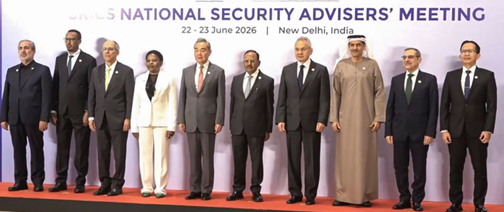
The 16th BRICS National Security Advisers’ (NSA) Meeting, hosted earlier this week by New Delhi and chaired by India’s NSA Ajit Doval, brought together the 11 member nations. They exchanged views on security challenges such as terrorism, cyber threats and the impact of emerging technologies. No joint statement was issued — this was indicative of the sharp divergence among members on critical macro-security issues.
The grouping was formed in June 2009 in Yekaterinburg (Russia), initially as BRIC (Brazil, Russia, India and China); South Africa was admitted in 2011. The bloc currently has 11 full members: Brazil, China, Egypt, Ethiopia, India, Indonesia, Iran, Russia, Saudi Arabia, South Africa and the United Arab Emirates. NSAs and other representatives from these countries attended the June 22-23 event; China was represented by Foreign Minister Wang Yi.
The fact that Delhi, as the current chair of BRICS, convened such a meeting amid two wars (Ukraine and Iran) and ensured the participation of regional rivals is testimony to the deft diplomatic acumen that India brings to the global table. This was a preparatory meeting in the run-up to the BRICS summit to be held in India in September.
The more significant outcomes of the deliberations can be reviewed along two symbiotic tracks — the multilateral relating to BRICS and the India-China bilateral. Since the bloc’s inception, it has been evident that the relationship between the two Asian giants has a bearing on the credibility and relevance of BRICS in global geopolitics.
Both the US and China are cognizant of this reality. Ever since India was admitted into the global nuclear order in late 2008 as an exceptional state, how Delhi has positioned itself in relation to the two major powers has impacted the geopolitical framework. In keeping with its traditional stance of non-alignment, now transmuted to strategic autonomy and multi-engagement, India has maintained this continuity.
The underlying message emerging from the BRICS forum was that Delhi would highlight security issues relevant to the Global South. At the same time, Delhi tempered US expectations that India would align against China and dampened Beijing’s hope that BRICS would project anti-US/West unity. Clearly, a warming of US-China ties would alter the BRICS dynamic.
Specific to the Delhi deliberations, three tangible outcomes can be inferred, each with implications that go beyond BRICS. First, the NSAs agreed that the most urgent security challenges were no longer just tanks, ships, aircraft and missiles. The theme was “Non-traditional security challenges”, which include terrorism enabled by emerging technologies, cyberattacks on critical infrastructure, weaponization of supply chains, food, fertilizers and energy insecurity and the abiding yet intractable climate-induced instability.
The NSAs reviewed the work of BRICS Joint Working Groups on Counterterrorism and ICT (information and communication technology) security. For Delhi, chairing BRICS in 2026 lends a subtle leverage. It shifts BRICS from a China-centric economic club to a security dialogue, where India’s priorities such as cross-border terrorism, terror financing and cyber norms get equal billing. For the Global South, it signals that BRICS can produce policy language the West cannot ignore, especially on supply chain resilience, digital governance and the impact on human security.
The second strand was the closely watched Doval-Wang Yi meeting, which may be summarized as a case of managing a complex and long-festering rivalry within the current framework of multilateralism. Both sides described the talks as “constructive and forward-looking”, but the readouts diverged sharply.
India stressed “gradual normalization” and “stable, predictable, constructive” ties. The subtext is that no reset would be possible until the LAC (Line of Actual Control) stabilizes. Peace on the contested border remains the precondition for a broader engagement.
China pushed to “respect each other’s core interests” and “place the China-India border issue in an appropriate position, so that it doesn’t affect the overall situation”. This translates into compartmentalizing the border issue, resuming trade and flights and beginning technology transfer as the first step. The gap is one of sequencing — India wants trust to be established first and then ties to be normalized, while China is keen to delink the LAC and move ahead without any consensual settlement. This would be undesirable, given that Beijing ramps up its claim on Arunachal Pradesh when relations are tense and uses the Pakistan card to stoke Indian anxiety.
Hosting Wang while sticking to its stand shows Delhi’s new approach: engage with rivals multilaterally but do not concede bilaterally. In the run-up to the September BRICS summit, this gives India space to lead without letting border tensions derail its presidency theme: “Building for Resilience, Innovation, Cooperation and Sustainability”.
The third strand was the manner in which India’s plurilateral security diplomacy was burnished when Doval met his counterparts from Brazil, Ethiopia, South Africa and Iran’s Deputy Secretary for Defense Affairs. The subtext: BRICS is not China-plus.
Delhi used this meeting to deepen ties with Africa and West Asia, discuss developmental cooperation and review the West Asia situation amid the tenuous US-Iran detente. It is evident that BRICS is becoming India’s preferred platform to highlight issues relevant to the Global South without being seen as anti-West.
The Delhi NSAs’ meeting did not address the India-China border dispute or create a standing BRICS army. It did something quieter: it proved that BRICS can function despite core rivalries and that India can chair it without choosing between Washington and Beijing.
For global geopolitics, that means a more fragmented and contradictory order — a contrapolar world. The US no longer sets the global security agenda and China cannot command BRICS loyalty. India has the potential to emerge as a swing state that can consensually manage emerging contradictions. Towards this end, Delhi must introspect objectively and course-correct, based on lessons learnt from the recent tilt with regard to West Asia. Is a new geopolitical grammar evolving?
(C Uday Bhaskar is a retired Commodore and the Director, Society for Policy Studies. His X handle is @theUdayB)


Be the first to comment