

Six elected to Congress; Aruna Miller retains Maryland office; Nithya Raman wins Los Angeles mayoral race; dozens secure state and local positions
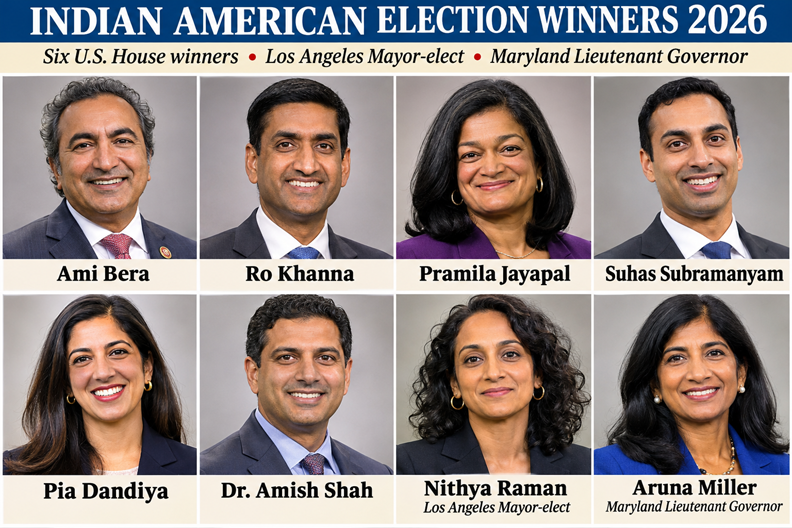
WASHINGTON, D.C. (TIP): Indian Americans emerged as a significant presence in the November 3 midterm elections, winning seats in Congress, state legislatures, county governments and municipal councils across the United States.
The victories extended far beyond the familiar Indian-American faces on Capitol Hill. A new generation of candidates won legislative seats, several incumbents secured additional terms, and candidates of Indian origin achieved historic breakthroughs in states where their community had previously enjoyed little representation.
According to a post-election tally published by India Tribune, 30 Indian-American candidates won state legislative races, including eight who faced no opposition. The tally identified 28 Democratic victories among 33 decided contests involving Indian-American Democrats. The figures remain subject to final reconciliation with official results.
The election also brought setbacks, notably Republican Vivek Ramaswamy’s defeat in the Ohio gubernatorial contest.
Six Indian Americans Elected to Congress
The Indian-American delegation in the U.S. House of Representatives will include four returning lawmakers and two newcomers.
Ami Bera (California, Democrat) won another term representing the state’s 3rd Congressional District. A physician and the longest-serving Indian American in Congress, Bera was first elected in 2012 and has been active in healthcare, foreign affairs and U.S.–India relations.
Ro Khanna (California, Democrat) retained his seat in the 17th Congressional District, defeating fellow Indian-American candidate Ritesh Tandon, a Republican. Khanna represents the Silicon Valley region and is known for his work on technology, manufacturing and economic policy.
Pramila Jayapal (Washington, Democrat) won re-election from the 7th Congressional District. Born in India, Jayapal became the first South Asian-American woman elected to Congress in 2016. She remains a prominent voice on immigration, healthcare and workers’ rights.
Suhas Subramanyam (Virginia, Democrat) secured a second term representing the 10th Congressional District. A former White House technology adviser and Virginia legislator, Subramanyam became the first Indian American elected to Congress from Virginia in 2024.
Pia Dandiya (Florida, Democrat) defeated Republican Casey Askar in the 22nd Congressional District. A former teacher and high school principal, Dandiya is among the most notable newcomers, becoming the first Indian-American woman elected to the U.S. House from Florida.
Dr. Amish Shah (Arizona, Democrat) defeated Republican Jay Feely in the 1st Congressional District, becoming the first Indian American elected to Congress from Arizona. Shah, a physician and former state representative, campaigned on healthcare and economic concerns.
The two newcomers replace some of the Indian-American representation lost when Raja Krishnamoorthi and Shri Thanedar were defeated in earlier primary contests.
Aruna Miller and Other Statewide Victories
Aruna Miller, Maryland’s Indian-born lieutenant governor, won another term alongside Democratic Governor Wes Moore. Miller, who immigrated from Hyderabad as a child, previously worked as a transportation engineer and served in the Maryland House of Delegates.
In Wisconsin, Josh Kaul won re-election as attorney general. The Democratic incumbent has served as the state’s chief legal officer since 2019.
These victories demonstrate that Indian-American participation in public life now extends to senior executive and legal offices, not merely legislative positions.
Historic Breakthroughs in State Legislatures
Among the most significant state legislative victories was that of Jyot Singh, who won Georgia’s House District 97. His election makes him the first Indian American and first Sikh American elected to Georgia’s General Assembly.
In Texas, Pooja Sethi won House District 47, becoming the first Indian-American woman elected to the Texas Legislature.
Illinois produced several important victories. Nabeela Syed, previously a member of the Illinois House, defeated Republican Darby Hills in Senate District 26, flipping a Republican-held seat.
Saba Haider, born in India, won Illinois House District 84, defeating Republican Brian Scopa. Ram Villivalam retained his state Senate seat, while Kevin Olickal secured another term in the Illinois House without opposition.
In Michigan, Ranjeev Puri, the Democratic House minority leader, won re-election from District 24. With Democrats regaining control of the state House, Puri has emerged as a potential candidate for Speaker. Such an appointment would mark another milestone for Indian-American and Sikh-American political representation.
Arizona’s Priya Sundareshan, the Democratic Senate minority leader, retained her seat in District 18. Her party’s legislative gains have also placed her among potential candidates for a senior leadership position in the Arizona Senate.
Indian-American Victories in New York
New York produced several notable results.
Lisa Kaul, a Democrat, defeated Republican incumbent Rob Rolison in State Senate District 39, representing a significant political breakthrough in the Hudson Valley.
Jeremy Cooney won another term representing State Senate District 56 in the Rochester area. Born in Kolkata and adopted by an American mother, Cooney has often spoken about his personal journey and the opportunities provided by American democracy.
Republican Anil Beephan Jr. retained his seat in the New York State Assembly, demonstrating that Indian-American electoral success was not confined to one political party.
The victories are particularly relevant to the large Indian-American community in New York, whose political participation continues to grow.
Victories Across Other States
Indian-American candidates also registered successes in several other state legislatures.
In North Carolina, Democratic State Senator Jay Chaudhuri won re-election from District 15. A senior Democratic figure in the state Senate, Chaudhuri has served in public office for a decade.
In Pennsylvania, physician Arvind Venkat retained his state House seat. Venkat became the first Indian-American physician elected to the Pennsylvania legislature in 2022.
In Connecticut, Sujata Gadkar-Wilcox secured another term in the state Senate.
In Minnesota, pediatrician Krish Subrahmanian won Senate District 49.
In Maryland, Amar Mukunda, an engineer and military veteran, won the State Senate District 39 contest without opposition.
In Vermont, Kesha Ram Hinsdale retained her Senate seat, while Nikhil Goyal won election to the chamber.
In California, Ash Kalra won another term in the State Assembly. Kalra, who represents the San Jose area, has been a prominent Indian-American voice in California politics.
In Washington state, Manka Dhingra retained her state Senate seat.
In Ohio, physician Anita Somani won re-election to the state House.
In Wisconsin, Renuka Mayadev secured a state legislative victory.
In Tennessee, Republican Sabi “Doc” Kumar, a physician, retained his state House seat.
Additional Indian-American candidates won uncontested legislative races in several states, including Iowa, Kentucky, Nevada, New Mexico and Washington, although a fully reconciled national roster was not yet available.
Indian Americans Make Their Mark in Local Government
The election also demonstrated the increasing presence of Indian Americans in municipal and county administration.
In California, Nithya Raman defeated incumbent Karen Bass in the Los Angeles mayoral contest. Raman, born in Kerala, previously served on the Los Angeles City Council and campaigned on housing, homelessness and municipal services. Her election marks a major breakthrough in the leadership of one of America’s largest cities.
In Oakland, Janani Ramachandran won re-election to the City Council. A public-interest attorney, Ramachandran has focused on housing, public safety and neighborhood concerns.
Other reported local winners included Kashef Qaadri in Dublin, California, and Vipan S. Bajwa in Union City, California, where election returns placed them ahead in their council contests.
In Washington, D.C., Aparna Raj won the Ward 1 Council race.
Indian Americans also registered victories in county government. Reported winners included Neil Manimala in Hillsborough County, Florida; Rohit Malhotra in Fulton County, Georgia; Ranjan Rohatgi in St. Joseph County, Indiana; and Mona Singh in Wake County, North Carolina.
In Utah, Sim Gill won re-election as Salt Lake County district attorney.
New Jersey, home to a substantial Indian-American population, also saw reported municipal victories involving Ketan Bhuptani in Livingston, Mansi Patel in Long Hill, Aakash Shah in Tenafly and Anita Chadha in South River.
Some municipal results remained unofficial as ballot counting continued.
Not All Indian-American Candidates Won
The November 3 elections also brought defeats for several candidates of Indian origin.
The most prominent was Republican Vivek Ramaswamy, who lost Ohio’s gubernatorial election to Democrat Amy Acton despite receiving President Trump’s endorsement.
In New York, Republican Saritha Komatireddy lost the attorney general’s contest to incumbent Democrat Letitia James.
Other unsuccessful Indian-American candidates included Ritesh Tandon in California, Nirav Sheth in Washington state, Mahesh Ganorkar in North Carolina and independent Anil Kumar in Michigan.
These results underline the political diversity of the Indian-American community, whose candidates contested elections across party lines.
A Growing Presence in American Democracy
The breadth of Indian-American participation in the 2026 elections reflects a significant transformation in the community’s political life.
Once primarily identified with achievements in medicine, technology, education and entrepreneurship, Indian Americans are increasingly seeking positions where public policy is debated, formulated and implemented.
Their presence in state legislatures is particularly consequential. State lawmakers influence education, healthcare, taxation, infrastructure, business regulation and numerous policies affecting everyday life.
The emergence of Indian-American candidates in city councils, county commissions and school governance also signals a willingness to engage directly with the concerns of local communities.
Here are some who won in the State Houses and Legislatures.
State Indian-American winners Office
Illinois: Nabeela Syed, Ram Villivalam,
Saba Haider, Kevin Olickal State legislature
New York: Lisa Kaul, Jeremy Cooney, Anil Beephan Jr. State legislature
Vermont: Kesha Ram Hinsdale, Nikhil Goyal State Senate
Arizona: Priya Sundareshan State Senate
Michigan: Ranjeev Puri State House
Texas: Pooja Sethi State House
Georgia: Jyot Singh State House
Minnesota: Krish Subrahmanian State Senate
Maryland: Amar Mukunda State Senate
North Carolina: Jay Chaudhuri State Senate
Pennsylvania: Arvind Venkat State House
Connecticut: Sujata Gadkar-Wilcox State Senate
Wisconsin: Renuka Mayadev State House
Ohio: Anita Somani State House
California: Ash Kalra State Assembly
Washington: Manka Dhingra State Senate
Tennessee: Sabi “Doc” Kumar State House
The election results should be viewed not merely as an ethnic community’s achievement, but as another expression of America’s evolving democratic character.
As the United States commemorates 250 years of independence, the expanding participation of Americans of Indian origin provides another illustration of the opportunities available in a nation shaped by successive generations of immigrants.
Their electoral victories bring recognition. Their performance in office will determine the lasting value of that recognition.
Ultimately, their responsibility, like that of every elected representative, is to serve not one community alone, but We the People.
Be the first to comment