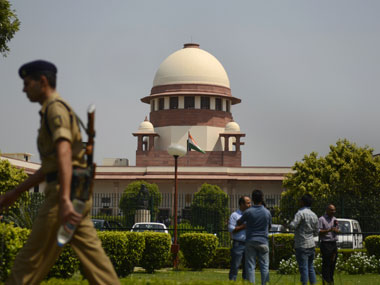
NEW DELHI (TIP): Amid raging controversy over authenticity of electronic voting machines (EVMs), the Supreme Court on April 13 issued notices to the Centre and the Election Commission on petitions alleging that EVMs can be easily hacked to favour a particular candidate or a political party. The petitions demanded paper trail on all EVMs.
A Bench headed by Justice J Chelameswar asked the NDA government and the EC to respond to the petition filed by the Bahujan Samaj Party and Samajwadi Party MLA Ataur Rehman by May 8, the next date of hearing.
After tasting poll defeat, BSP chief Mayawati and AAP convener and Delhi Chief Minister Arvind Kejriwal had alleged that EVMs were tampered with. The BSP alleged that large-scale tampering of EVMs helped the BJP to win the UP Assembly polls. The Congress and Trinamool Congress told the court that they, too, wanted to be heard in the matter.
“The views of technicians working in this field are important and not of what political parties say,” the Bench told senior counsel P Chidambaram who appeared for both the BSP and Rehman. The Bench said EVMs were a remedy to several ills that plagued the voting system before it was introduced. Chidambaram pointed out that a 2013 verdict of the SC made it mandatory for the EC to install VVPAT. Despite the EC writing to the government 10 times since June last, including the Chief Election Commissioner’s letter to the Prime Minister, the government didn’t release funds for paper trail machines. “They need Rs 3,000 crore for having this system,” he told the Bench.
He, however, chose to withdraw the BSP’s prayer for deferring forthcoming elections until paper trail machines were made available after the Bench said it would not like to get drawn into political controversies.
On behalf of the Congress, senior counsel Kapil Sibal said EVMs were not used in any democracy, except a couple of countries in latin America. “But, this system was introduced when your party was in power,” the Bench commented. Noting that it would not decide the issue on the basis of which country was using or not using it, the Bench said: “We would purely go on the basis of law and technical data.”
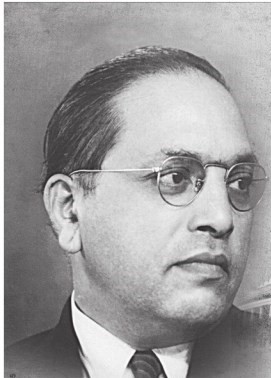
In a speech to the Constituent Assembly in 1949, B.R. Ambedkar stressed on the need to have social democracy, and not only political democracy. He spoke of the need to shun the grammar of anarchy and avoid hero worship of political figures. According to him, in 1950, the Republic will enter a phase of contradictions. In politics, we will have equality and in social and economic life there will be inequality.
On January 26, 1950, India will be an independent country. What would happen to her independence? Will she maintain her independence or will she lose it again? This is the first thought that comes to my mind. It is not that India was never an independent country. The point is that she once lost the independence she had. Will she lose it a second time? It is this thought which makes me most anxious for the future.
What perturbs me greatly is the fact that not only India has once before lost her independence, but she lost it by the infidelity and treachery of some of her own people.
In the invasion of Sindh by Mahommed-Bin-Kasim, the military commanders of King Dahar accepted bribes from the agents of Mahommed-Bin-Kasim and refused to fight on the side of their king. It was Jaichand who invited Mahommed Gohri to invade India and fight against Prithvi Raj and promised him the help of himself and the Solanki kings. When Shivaji was fighting for the liberation of Hindus, the other Maratha noblemen and the Rajput kings were fighting the battle on the side of Moghul Emperors. When the British were trying to destroy the Sikh rulers, Gulab Singh, their principal commander sat silent and did not help to save the Sikh kingdom. In 1857, when a large part of India had declared a War of Independence against the British, the Sikhs stood and watched the event as silent spectators.
Will history repeat itself? It is this thought which fills me with anxiety. This anxiety is deepened by the realisation of the fact that in addition to our old enemies in the form of castes and creeds, we are going to have many political parties with diverse and opposing political creeds. Will Indians place the country above their creed or will they place creed above country? I do not know. But this much is certain that if the parties place creed above country, our independence will be put in jeopardy a second time and probably be lost for ever. This eventuality we must all resolutely guard against. We must be determined to defend our independence with the last drop of our blood.
On January 26, 1950, India would be a democratic country in the sense that India from that day would have a government of the people, by the people and for the people. The same thought comes to my mind. What would happen to her democratic Constitution? Will she be able to maintain it or will she lose it again? This is the second thought that comes to my mind and makes me as anxious as the first.
Democratic system
It is not that India did not know what is democracy. There was a time when India was studded with republics, and even where there were monarchies, they were either elected or limited. They were never absolute. It is not that India did not know Parliaments or parliamentary procedure.
A study of the Buddhist Bhikshu Sanghas discloses that not only there were Parliaments — for the Sanghas were nothing but Parliaments — but the Sanghas knew and observed all the rules of parliamentary procedure known to modern times. They had rules regarding seating arrangements, rules regarding Motions, Resolutions, Quorum, Whip, Counting of Votes, Voting by Ballot, Censure Motion, Regularisation, Res Judicata, etc. Although these rules of parliamentary procedure were applied by the Buddha to the meetings of the Sanghas, he must have borrowed them from the rules of the political assemblies functioning in the country in his time.
This democratic system India lost. Will she lose it a second time? I do not know. But it is quite possible in a country like India — where democracy from its long disuse must be regarded as something quite new — there is danger of democracy giving place to dictatorship. It is quite possible for this new-born democracy to retain its form but give place to dictatorship in fact. If there is a landslide, the danger of the second possibility becoming an actuality is much greater.
Three warnings
If we wish to maintain democracy not merely in form, but also in fact, what must we do?
The first thing in my judgement we must do is to hold fast to constitutional methods of achieving our social and economic objectives. It means we must abandon the bloody methods of revolution. It means that we must abandon the method of civil disobedience, non-cooperation and satyagraha. When there was no way left for constitutional methods for achieving economic and social objectives, there was a great deal of justification for unconstitutional methods. But where constitutional methods are open, there can be no justification for these unconstitutional methods. These methods are nothing but the “Grammar of Anarchy” and the sooner they are abandoned, the better for us.
The second thing we must do is to observe the caution which John Stuart Mill has given to all who are interested in the maintenance of democracy, namely, not “to lay their liberties at the feet of even a great man, or to trust him with power which enable him to subvert their institutions”. There is nothing wrong in being grateful to great men who have rendered life-long services to the country. But there are limits to gratefulness. As has been well said by the Irish Patriot Daniel O’Connel, “No man can be grateful at the cost of his honour, no woman can be grateful at the cost of her chastity and no nation can be grateful at the cost of its liberty”. This caution is far more necessary in the case of India than in the case of any other country. For in India, Bhakti or what may be called the path of devotion or hero-worship, plays a part in its politics unequalled in magnitude by the part it plays in the politics of any other country in the world. Bhakti in religion may be a road to the salvation of the soul. But in politics, Bhakti or hero-worship is a sure road to degradation and to eventual dictatorship.
The third thing we must do is not to be content with mere political democracy. We must make our political democracy a social democracy as well. Political democracy cannot last unless there lies at the base of it social democracy. What does social democracy mean? It means a way of life which recognises liberty, equality and fraternity as the principles of life. These principles of liberty, equality and fraternity are not to be treated as separate items in a trinity. They form a union of trinity in the sense that to divorce one from the other is to defeat the very purpose of democracy.
Liberty cannot be divorced from equality, equality cannot be divorced from liberty. Nor can liberty and equality be divorced from fraternity. Without equality, liberty would produce the supremacy of the few over the many. Equality without liberty would kill individual initiative. Without fraternity, liberty would produce the supremacy of the few over the many. Without fraternity, liberty and equality could not become a natural course of things. It would require a constable to enforce them.
We must begin by acknowledging the fact that there is complete absence of two things in Indian society. One of these is equality. On the social plane, we have in India a society based on the principle of graded inequality. We have a society in which there are some who have immense wealth as against many who live in abject poverty. On January 26, 1950, we are going to enter into a life of contradictions. In politics we will have equality and in social and economic life we will have inequality. In politics, we will be recognising the principle of one man, one vote and one vote, one value. In our social and economic life, we shall, by reason of our social and economic structure, continue to deny the principle of one man, one value. How long shall we continue to live this life of contradictions? How long shall we continue to deny equality in our social and economic life? If we continue to deny it for long, we will do so only by putting our political democracy in peril. We must remove this contradiction at the earliest possible moment or else those who suffer from inequality will blow up the structure of political democracy which this Assembly has so laboriously built up.
The second thing we are wanting in is recognition of the principle of fraternity. What does fraternity mean? Fraternity means a sense of common brotherhood of all Indians — of Indians being one people. It is the principle which gives unity and solidarity to social life. It is a difficult thing to achieve. How difficult it is, can be realised from the story related by James Bryce in his volume on American Commonwealth about the United States of America. The story is — I propose to recount it in the words of Bryce himself:
“Some years ago the American Protestant Episcopal Church was occupied at its triennial Convention in revising its liturgy. It was thought desirable to introduce among the short sentence prayers a prayer for the whole people, and an eminent New England divine proposed the words `O Lord, bless our nation’. Accepted one afternoon, on the spur of the moment, the sentence was brought up next day for reconsideration, when so many objections were raised by the laity to the word ‘nation’ as importing too definite a recognition of national unity, that it was dropped, and instead there were adopted the words `O Lord, bless these United States.” There was so little solidarity in the USA at the time when this incident occurred that the people of America did not think that they were a nation. If the people of the United States could not feel that they were a nation, how difficult it is for Indians to think that they are a nation?
A great delusion
I remember the days when politically minded Indians, resented the expression “the people of India”. They preferred the expression “the Indian nation.” I am of opinion that in believing that we are a nation, we are cherishing a great delusion. How can people divided into several thousands of castes be a nation? The sooner we realise that we are not as yet a nation in the social and psychological sense of the world, the better for us. For then only we shall realise the necessity of becoming a nation and seriously think of ways and means of realising the goal. The realisation of this goal is going to be very difficult — far more difficult than it has been in the United States. The United States has no caste problem. In India there are castes. The castes are anti-national. In the first place because they bring about separation in social life. They are anti-national also because they generate jealousy and antipathy between caste and caste. But we must overcome all these difficulties if we wish to become a nation in reality. For fraternity can be a fact only when there is a nation. Without fraternity, equality and liberty will be no deeper than coats of paint.
These are my reflections about the tasks that lie ahead of us. They may not be very pleasant to some. But there can be no gainsaying that political power in this country has too long been the monopoly of a few and the many are only beasts of burden, but also beasts of prey. This monopoly has not merely deprived them of their chance of betterment, it has sapped them of what may be called the significance of life. These down-trodden classes are tired of being governed. They are impatient to govern themselves. This urge for self-realisation in the down-trodden classes must not be allowed to devolve into a class struggle or class war. It would lead to a division of the House. That would indeed be a day of disaster. For, as has been well said by Abraham Lincoln, “a House divided against itself cannot stand very long”. Therefore the sooner room is made for the realisation of their aspiration, the better for the few, the better for the country, the better for the maintenance for its independence and the better for the continuance of its democratic structure. This can only be done by the establishment of equality and fraternity in all spheres of life. By independence, we have lost the excuse of blaming the British for anything going wrong. If hereafter things go wrong, we will have nobody to blame except ourselves. There is great danger of things going wrong.
Times are fast changing. People including our own are being moved by new ideologies. They are getting tired of Government by the people. They are prepared to have Governments for the people and are indifferent whether it is Government of the people and by the people. If we wish to preserve the Constitution in which we have sought to enshrine the principle of Government of the people, for the people and by the people, let us resolve not to be tardy in the recognition of the evils that lie across our path and which induce people to prefer Government for the people to Government by the people, nor to be weak in our initiative to remove them. That is the only way to serve the country. I know of no better.
British English (Excerpts from the last speech by B.R Ambedkar to the Constituent Assembly on November 25, 1949).
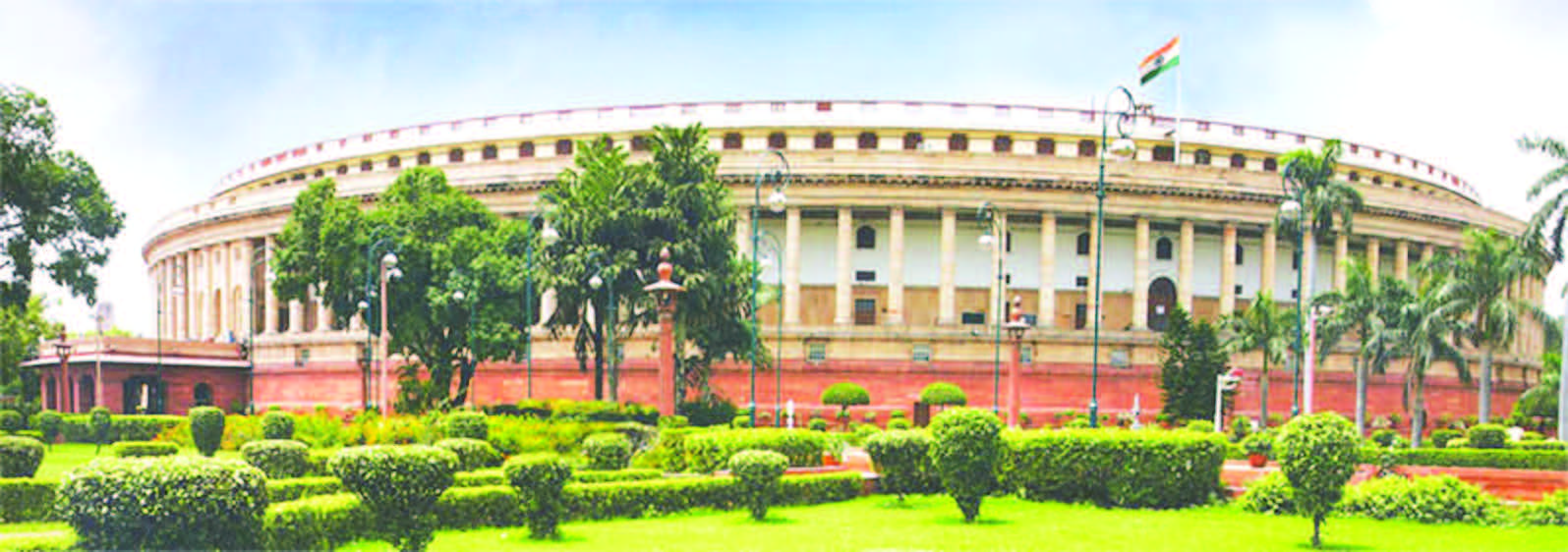
NEW DELHI (TIP): Parliament on April 6 passed four GST-related bills, paving the way for the new indirect tax to be implemented nationwide.
Parliament passed four GST-related bills on April 6 with the Rajya Sabha’s support, bringing the new tax reform closer to being implemented nationwide in July
The bills were supported by the Rajya Sabha without any amendments, and follows after the Lower House passed them last week. They will now be presented before the President for his consent, following which, states will pass another legislation, readying the country for a uniform Goods and Services Tax (GST).
The four bills are the Central Goods and Services Tax Bill (CGST), the Integrated Goods and Services Tax Bill (IGST) the Goods and Services Tax (Compensation to States) Bill and the Union Territory Goods and Services Tax Bill (UTGST).
The CGST will give powers to the Centre to charge a tax after levies of excise, service tax and additional customs duty is subsumed. The IGST will be a tax to be levied by the Centre on inter-state movement of goods and services. Besides, GST compensation law allows for imposition of cess on certain luxury goods like tobacco, high-end cars and aerated drinks to create a fund for compensating states for any loss of revenue in the first five years after implementing the new indirect tax.
The UTGST is for UTs like Chandigarh and Daman and Diu which do not have assemblies.
The State GST or SGST law that will allow them to levy sales tax after levies like VAT are subsumed.
“The broad approach of every member has been to support the legislation. Even the Constitutional Amendment Bill was supported overwhelmingly,” finance minister Arun Jaitley said while summing up the debate at the Upper House.
“Not only did both the Houses of Parliament support the GST bills, all the states have arrived at a consensus,” he added. In the backdrop of a reconciliatory mood, Rajya Sabha members showed consensus that the new indirect tax is the biggest reform since Independence and is the need of the hour. But still, concerns were raised about the sweeping powers of the GST council, the GST network and the GST rates. Allegations were also levelled against BJP trying to steal all credit of implementing this landmark tax reform.
CPI-M’s Sitaram Yechury was among the many MPs who raised the issue of the overarching power that the GST council. “The proposals before GST council should also come before the Parliament,” he said. In the new tax regime, this council will be the highest decision making body; this led to many Opposition members claiming that this provision takes away from the Parliament’s authority. Highlighting the federal structure of the Council, Jaitley said 32 representatives from the Centre and states are finalising the GST rules.
“We have had 14 meetings at the GST Council…and arrived at a consensus on all issues,” he said, adding there has been no voting on any issue.
“Mr Jaitley is only giving final touches to a reform that was set rolling many years ago by his predecessors,” said Congress MP Jairam Ramesh.
Congress’ Kapil Sibal and CPI’s D Raja raised concerns about data privacy under a private company in-charge of the IT backbone of GST or the GST-N.
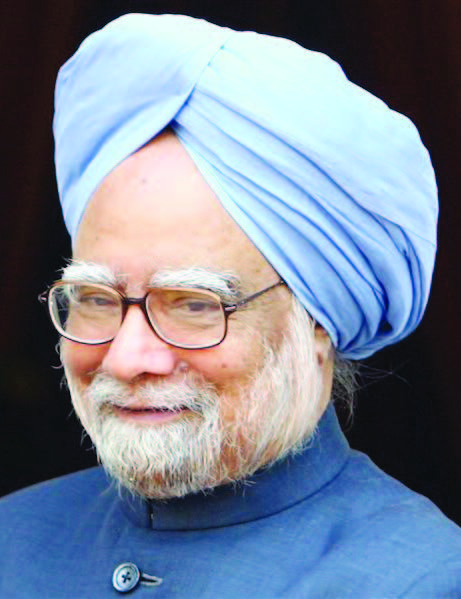
NEW DELHI (TIP): Former PM Manmohan Singh lent his strong backing to the goods and services tax (GST) bills on Thursday. As amendments to the bills were being taken up in Rajya Sabha by deputy chairman PJ Kurien, Congress MP Jairam Ramesh said he was not moving them. “Former PM Manmohan Singh has taken this approach in the spirit of consensus and in respect of the federal structure,” he said.
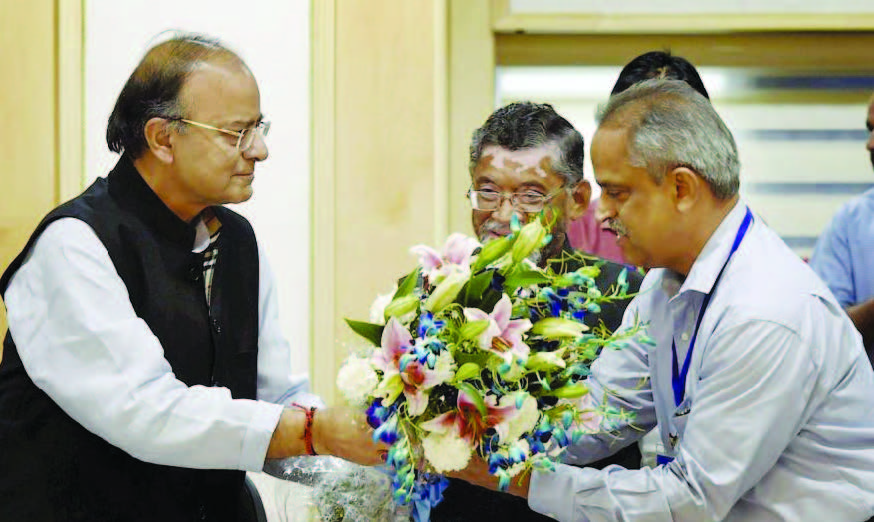
As soon as the four bills were cleared, finance minister Arun Jaitley walked up to Singh and shook his hands. Singh congratulated the BJP member on passage of the bills.
Manmohan Singh termed the move a game changer. “It could be a game changer but can’t assume there will be no difficulties on the way,” the former PM said after the bills were passed.
The answers to our problems lie outside the system
What form this revolution will take, and how much time, cannot be predicted, but what certainly can be predicted is that it is coming.
The test of every government is one, and only one: is the standard of living of the masses rising under it? From this standpoint the Modi government, like the previous Manmohan Singh government, is a total failure”, says the author who is a former Judge, Supreme Court of India, and a former Chairman, Press Council of India.
India is inevitably heading for a revolution. Why do I say so? Let me explain. India could potentially be a highly developed country, but is actually a poor and backward country.
It is potentially a highly developed country because it has two of the basic requirements to be a highly developed country-a huge pool of technical talent, and immense natural resources.
This was not the position in 1947 when India became independent. The British policy was broadly to keep India backward, feudal and largely unindustrialised, so that Indian industry may not emerge as a big rival to British industry. So, we were not permitted by our British rulers to set up a heavy industrial base, but were permitted only some light industries like textiles, plantations, etc which, too, for a long time were mainly under British ownership. So, till 1947 we had very few industries and very few engineers
What has happened to the slogan “sab ka saath, sab ka vikas?” It seems it was only a “jumla.”
The position today in 2017 is very different. Today we have a heavy industrial base, and a huge pool of competent engineers, technicians, scientists, managers, etc. Our IT engineers are manning Silicon Valley in California, and American universities are full of our mathematics and science professors.
In addition, we have immense natural wealth. India is not a small country like England or Japan. It is almost a continent.
So, we have all that is required to be a first-rate, modern, highly developed country, like North America or Europe.
And yet the reality is that we are an underdeveloped, poor country, with massive unemployment, malnourishment, lack of healthcare, good education, etc for our masses.
We can consider some facts:
The level of unemployment can be gathered from two facts:
(a) 1 crore youth are entering the Indian job market every year, but only 1.4 lakh jobs are being created annually in the organised sector. So where do the remaining 9.86 million youth go? They become hawkers, street vendors, bouncers, criminals, the girls often become prostitutes, and many end up as suicides.
(b) In 2015, the UP govt. advertised 358 jobs of peons (i.e. class 4 employees) for which there were 23 lakh applications; 250 of the applicants had Ph.D. degrees, 2500 were M.Sc., M.B.A. engineers, etc and all were begging for a peon’s job. Something similar happened when vacancies police constables were advertised in Madhya Pradesh, and peon’s jobs in West Bengal.
Fifty percent of Indian children are malnourished, which is a situation far worse than in sub-Saharan countries of Africa like Somalia.
A UNICEF report says that one out every three malnourished child in the world is an Indian child.
Poor people in India have hardly any access to healthcare. There are no doubt some excellent hospitals in the big cities, but they are exorbitantly expensive. Poor patients simply cannot afford good doctors. AIIMS (All India Institute of Medical Sciences, Delhi) looks like a railway station, with thousands of people sitting there, and no one caring for them, unless they happen to be rich or powerful. So where do the poor people go when they fall sick? They go to quacks. Quackery is rampant in India.
The test of every government is one, and only one: is the standard of living of the masses rising under it? From this standpoint the Modi government, like the previous Manmohan Singh government, is a total failure…
The government spends a huge amount of money on IITs and elite institutions like JNU, but hardly anything for primary schools in villages, where the foundation of knowledge is laid.
Just 57 individuals in India control 70% of India’s wealth.
Far from there being any ‘vikas’, the Indian economy is lying stagnant, with chances of genuine growth remote. Whatever “growth” there has been has only benefited a handful of crony capitalists, but not the Indian masses.
According to Mark Twain, there are three kinds of lies: lies, damned lies, and statistics. Statistics is such a wonderful thing that with its help one can manufacture any figure one wants, like a conjuror pulling a rabbit out of a hat.
The latest figures given by the government of India authorities claiming 7.9% growth in GDP in the last quarter is an excellent example, and reminds one of Lord Haw Haw (William Joyce), or the Nazi propaganda minister, Dr Goebbels, who kept proclaiming on radio to the German people right till the very end that Germany was winning the Second World War, when in fact it was losing.
According to this claim, the Indian economy is the fastest growing economy of the world, outstripping the growth in GDP of the Chinese economy, which grew by only 6.9% in the same period. Evidently, according to this figure, we are heading for an El Dorado sometime in the future, and as Dr Pangloss would say (see Voltaire’s Candide), quoting the German philosopher Leibniz, this is the best of all possible worlds.
But a scrutiny of these figures throws up several doubts. Are the figures true or dressed up, like a Potemkin village? Also, assuming they are true, is this GDP growth benefiting the Indian masses, or only a handful of big businessmen?
Exports have fallen from $187.29 billion in the period April -October 2014, to $156.29 billion in the period April-October 2015-that’s a drop of 17.6%. So, if exports have fallen, and manufacturing has grown by 9%, as claimed by the Union Ministry of Statistics and Programme Implementation, where have the increased quantity of goods manufactured been sold? In the home market?
Apart from a huge pool of technical talent and huge natural resources, there is a third requirement to become a developed country… and that is a modern minded, patriotic political leadership.
But India is a poor country, with 80% people holding little purchasing power. And with the sharp escalation in food prices, real incomes have really gone down.
According to a statement of Raghuram Rajan, the RBI governor, most factories are running at 70% of their capacity, while in 2011-2012 they were running at 80%. This apparently shows manufacturing decline, rather than growth. According to a Business Standard report, corporate profitability is below 1% on an average.
Bad loans by banks continue to mount. According to CARE, non-performing assets during July-September 2015 stood at about ?3.37 lakh crore, an increase of ?71,000 crore. According to a report by Morgan Stanley, the number of stalled projects-the bulk of them in the manufacturing and infrastructure sectors-went up. Small and medium enterprises are having a difficult time trying to survive. The real-estate sector, which provides a lot of jobs, is down in the dumps, with construction of new buildings going down, and the number of unsold homes going up.
An article by Andy Mukherjee published by Reuters states that the GDP growth of the Indian economy is one-third a statistical mirage, and real GDP growth is more likely to be about 5 percent rather than 7.4 percent as claimed by the Indian authorities. Mukherjee says:
“The illusion comes from a recent supposed improvement in the way India calculates its Gross Domestic Product. In theory, Indian authorities claim that Indian GDP is close to international standards. In practice it has become utterly unreliable.”
But just how sluggish is the economy really? Breakingviews tried to answer that question by looking at three indicators: corporate earnings, auto sales and imports of computer software. The logic is straightforward: retained earnings finance new investment projects; auto sales are a proxy for consumer demand; while software imports reflect productivity gains. Mixing the three in a simple index suggests that growth in the most recent quarter was closer to 5 percent.”
But let us assume that the 7.9% figure is correct. The further question that still remains is: is this GDP growth benefiting the Indian masses, or just a handful of big businessmen? Is the rich-poor divide growing? Dilip Shanghvi, Gautam Adani, Mukesh Ambani, Aziz Premji, Pallonji Mistry, etc are worth billions of dollars, while the majority of Indians are struggling to make both ends meet, as prices of food soar.
What has happened to the slogan “sab ka saath, sab ka vikas?” It seems it was only a “jumla.” The communal fire is being stoked again in UP and elsewhere. When there is an economic crisis which the government cannot resolve, it resorts to fascist methods, as happened in Germany and Italy with the rise to power of Hitler and Mussolini.
India stands at the 131st rank in human development out of the approximately 200 countries in the world.
To solve all this, and raise the standard of living of our people-that is what must be the goal of all patriotic modern minded people. We have to create a modern, highly industrialised country in which all our citizens are getting decent lives.
But what has this government done in this direction? The answer is: a big zero, and only jumlas and dramas.
The test of every government or system is one, and only one: is the standard of living of the masses rising under it or not? If not, the government or system is a failure. From this standpoint (and it is the only correct standpoint), the Modi government, like the previous Manmohan Singh government, is a total failure on all fronts.
The interest of our country, and the interest of our politicians are diametrically opposite to each other. How, then, can our country progress?
The question once again naturally arises that when we have all that is required to be a first-rate highly developed country, why is India still poor and backward?
The answer is that apart from a huge pool of technical talent and huge natural resources, there is also a third requirement to become a developed country, which unfortunately we do not have, and that is a modern minded, patriotic political leadership. Let me explain this in some detail.
India borrowed the parliamentary system of democracy from England, and incorporated it into our Constitution. Now parliamentary democracy is based on majority vote, but the truth is that the vast majority of people in India are intellectually very backward, their minds full of casteism, communalism and superstitions. So, when most Indians go to vote they do not see the merit of the candidate (whether they are good people, whether they are educated) but only see their caste or religion (or the party representing a caste or religion). That is why there are so many people with criminal antecedents in our legislatures.
Our cunning politicians take advantage of this, and have learnt the skill of manipulating caste and religious vote banks.
The interest of the nation is to rapidly modernise, for which it is necessary to destroy feudal forces like casteism and communalism. On the other hand, the interest of our politicians is to win the next elections, and for that they have to appeal to, and therefore perpetuate, casteism and communalism, which are feudal forces. Therefore, the interest of our country, and the interest of our politicians are diametrically opposite to each other. How, then, can our country progress?
What form this revolution will take, and how much time, cannot be predicted, but what certainly can be predicted is that it is coming.
Most of the Indian politicians are rogues, rascals, goondas, criminals, scoundrels, looters and gangsters. They have no genuine love for the country, but only seek power and pelf. They are shameless and incorrigible, and cannot be reformed. They are experts in manipulating caste and communal vote banks, and they polarise society by spreading caste and communal hatred. Don’t such people deserve to be treated like the aristocrats in the French Revolution?
It is thus obvious that parliamentary democracy is not suited to India. Our Constitution has exhausted itself, our “democracy” has been hijacked by feudal-minded people, and all our state institutions have become hollow and empty shells.
On the other hand, the socio-economic distress of our people keeps mounting.
I submit that the solutions to the massive problems of India lie outside the system, not within it. No amount of reforms will do, what is now required is a revolution. What form this revolution will take, and how much time, cannot be predicted, but what certainly can be predicted is that it is coming.
It is only after such a revolution, which will be led by some genuinely patriotic, modern-minded persons, that a just social order will be created in India, in which our masses get decent lives, and a high standard of living.
(The article is part of a lecture by the author who is a former Judge of the Supreme Court of India, and a former Chairman of Press Council of India)
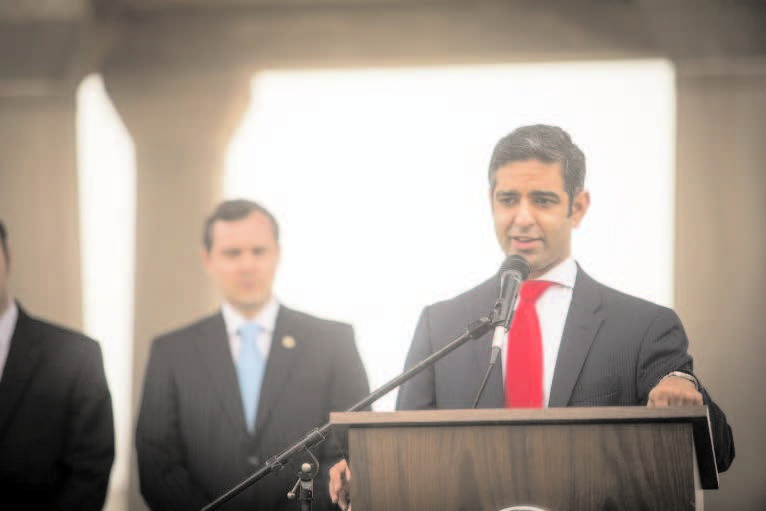
EDISON, NJ (TIP): Hirsh Vardhan Singh, a 31-year-old Indian-American entrepreneur has entered the governor’s race in New Jersey. The Republican announced his run for the top elected position in the State earlier this month and urged people of New Jersey to give fresh ideas a chance. He also unveiled several points of his plan including: cutting property taxes and fixing the school funding formula to bring back prosperity to the residents of New Jersey, fix transportation infrastructure, and make New Jersey a national leader in technological innovation.
Announcing his candidacy for the New Jersey Governor’s seat, Singh emphasized his goal to bring back jobs to New Jersey. “We need to fix our economy, we need to get going in the right direction”, Singh said. During his speech, he mentioned the need for fresh and innovative ideas “we’ve tried bankers from Goldman Sachs before and we’ve tried lawyers”; “Now if you give me the support I bring my engineering background as a problem solver”.
But Singh will face a tough Republican primary on June 6, 2017, battling with least four popular Republican candidates in the race – Assemblyman Jack Ciattarelli, Lt Governor and Secretary of State Kim Guadagno, Nutley Commissioner of Public Affairs Steven Rogers and businessman Joseph Rudy Rullo.
If elected in the November gubernatorial elections, Singh would succeed outgoing Republican Governor Chris Christie and would be the third Indian-American ever elected as a Governor of a State after Bobby Jindal and Nikki Haley.
Born in Atlantic City as the middle of three children, Hirsh attended a public high school in Egg Harbor Township. Through high school, Hirsh got involved in many extracurricular activities, which encouraged him to take on many leadership roles during his time in college at the New Jersey Institute of Technology. Hirsh went on to receive a Bachelor of Science from NJIT in Engineering.
NEW DELHI (TIP): Political analysts must not predict figures — such as winning margins or the number of seats a party is likely to win — in their comments during polls, the Election Commission announced on March 30.
This is the crux of a fresh advisory by the commission, which widened the ambit of rules that prohibit exit poll until all rounds of voting are completed. The new rule will apply in all future elections.
“The commission is of the view that predictions of results of elections in any form or manner by way of predictions etc., by astrologers, tarot readers, political analysts or by any persons during the prohibited period is violation of the spirit of Section 126A,” the advisory said.
According to the communiqué, sent to the National Broadcasters Association and Press Council of India among others, all political analysis citing numbers will be considered as exit poll.
The poll panel has set limits, a first in the world’s largest democracy, on what can be said by political commentators without violating the Representation of People’s Act, 1951 —the federal law governing Indian elections.
The law bans exit poll in the middle of an election, as it could influence voting in later rounds.
The opposition Congress welcomed the advisory, saying analysts put forth views that are as good as an exit poll.
“It is a forward step. The EC must also take cognizance of so-called surveys conducted by parties during elections,” party spokesperson Tom Vadakkan said.
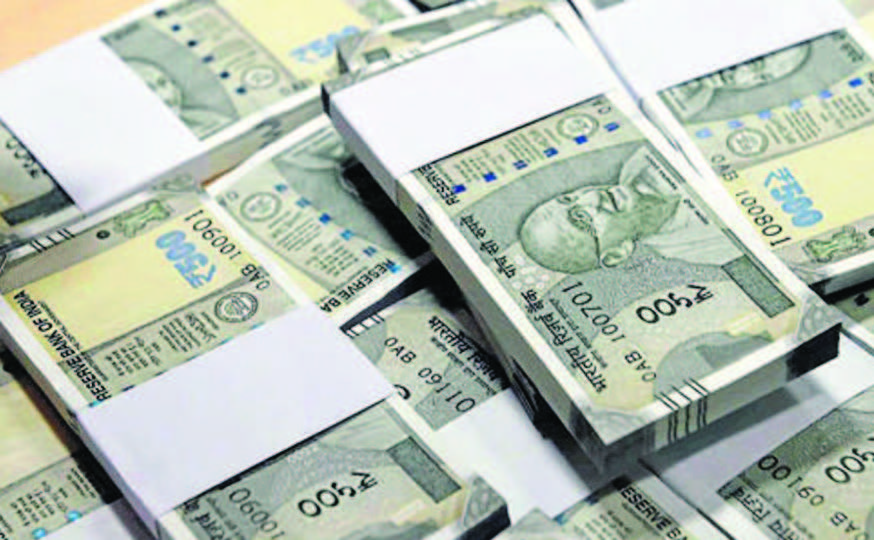
Large cash deposits in savings bank accounts of citizens have been under scrutiny after the government scrapped high-value banknotes from November 9, 2016
NEW DELHI (TIP): The taxmen or bank officials may question anyone receiving high-value funds in his account, even if it is through an electronic transaction.
A transaction above Rs 2.5 lakh by an individual is considered “high value”.
Large cash deposits in savings bank accounts of citizens have been under scrutiny after the government scrapped high-value banknotes from November 9 in a multi-pronged crackdown on tax dodgers and counterfeiting.
Tax officials have also been keeping an eye on big sums being transferred electronically, especially funds coming from new bank accounts and Jan Dhan accounts, meant for the poor.
Several savings accounts were opened under the Pradhan Mantri Jan Dhan Yojana, and there are reports that some of these were used to deposit illegal cash after the demonetization exercise.
Government sources said a spurt in fresh deposits in dormant savings accounts or Jan Dhan accounts is being investigated.
“Many Jan Dhan accounts have been used to convert black money into white, investigations will be carried out and notices will be sent,” a senior official said on Thursday.
The government had asked people not to allow anybody to use their Jan Dhan accounts to park undisclosed cash.
“We will track the flow of funds and based on our findings, appropriate steps will be taken,” the official said. “Genuine cases need not worry.”
There were more than 230 million Jan Dhan accounts last August. That went up to more than 250 million in November and currently stands at 280 million.
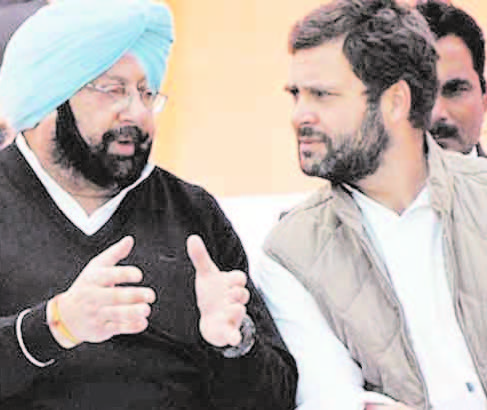
Captain Amarinder Singh is often referred to as ‘Raja’ for his authoritarian style and imposing mannerism dealing with complex issues involving people. However, he has proved once again that a strong and charismatic leadership can inspire confidence in the cadre and motivate them to work hard for the success of the party. That is the basic essence of political leadership, Gandhiji has taught us- the sheer ability to motivate and mobilize the masses,” says the author – George Abraham.
Amid the talk of the Modi Tsunami in Uttar Pradesh, the election victory by Congress Party in Punjab hasn’t received the needed attention it deserved. Captain Amarinder Singh, the leader of the Congress Party in Punjab scored a very impressive win surprising even the most ardent supporters while embarrassing many pundits in the media who predicted that AAP would form the next Government.
What is significant about this decisive victory in Punjab is that Captain Amarinder Singh is credited for his charisma, inspiring leadership and simply plain hard work in motivating the party cadre to make this victory possible. Therefore, in the midst of a sea of failures during the 2017 election, Punjab stands out not only as a bright spot for the Congress Party but as a case study in planning for the future.
There is indeed a rush to judgment when the party loses, often laying the entire blame at the foot of the Gandhi family. Ultimately, the leadership at the top bears a greater responsibility for success or failure of any entity. However, the collective failures of many in the senior leadership who concentrated on self-development while they were in power and marginalization and decimation of the party cadre during the UPA I and UPA II regimes have much more to do with the falling fortune of the party now than anything else.
However, that does not absolve the tactical errors or strategic failures at the top in dealing with elections and more importantly running the daily operations in a diverse and complex environment. At present, there is too much power concentrated at the top and its inability to communicate in a timely fashion, and failure to address recurring conflicts at the local level, appear to have done some damage to the credibility and standing of the party apparatus. Many in the top leadership, who are decision makers, are said to be living in their own bubble totally detached from real people never having to see them or even ask for their votes.
If the party has strong leadership at the top – a perception of the public that is critical for influencing events and changing mindsets – similar to the days of Nehru and Indira Gandhi, there would be discipline within the cadre and strict adherence to party directives across the board. However, the current dispensation calls for a rethinking of the status quo with the goal of decentralizing control and ceding more of the decision-making powers to the local level.
History teaches us that when the party had stronger regional leadership, it has performed better in those States. K. Karunakaran (Kerala), Sharad Pawar (Maharashtra), Kamaraj Nadar (Tamil Nadu) and YSR (Andhra Pradesh) are among some of the notable regional leaders who have managed the party and governed their states with the great success of their own.
There has been a strong suspicion among the pundits that many in the High Command were not thrilled about strong personalities at the local level. Consequently, ‘groupism’ was allowed to flourish in every State thereby weakening the local leadership and leaving all the decision making powers at the top. Therefore, those local leaders were forced to travel to Delhi for even minor decisions and wait for days to get resolutions to some of their pressing issues and often the same wait merely to get an appointment to air their grievances. Stories have been abounding of people returning home without an appointment, and some have simply left the party in disgust and joined the opposition simply to vent their frustrations. It is common knowledge that many in the top leadership wouldn’t even acknowledge a letter or an email from the grass roots willing to share their ideas to improve the party’s sagging fortune!
The ‘Introspection’ by the Congress Party after every election is turning into a butt of jokes in many circles simply because little or no action has been accompanied by that process. However, here is an opportunity to look at the Punjab election and re-learn some of the lessons from the past. Captain Amarinder Singh is often referred to as ‘Raja’ for his authoritarian style and imposing mannerism dealing with complex issues involving people. However, he has proved once again that a strong and charismatic leadership can inspire confidence in the cadre and motivate them to work hard for the success of the party. That is the basic essence of political leadership, Gandhiji has taught us- the sheer ability to motivate and mobilize the masses.
If the party can cultivate a new generation of influential leaders at the local level, it is bound to bounce back.
Narendra Modi could only keep up with his polarizing and misleading rhetoric for so long, and a day of the reckoning appears to be not too far away. However, Congress needs a new awakening, and it can only happen with some decisive restructuring at the top which will allow a new dynamism to flourish and spread across every facet of the party’s life. Only a reinvigorated Congress Party could defend the vision of an inclusive India envisaged by Nehru and Ambedkar, the founding architects of the modern India.
Those who have written off the 2019 election already for another Modi sweep may be making a grave error of judgment. History has taught us that in a democracy two years is a long period to sustain any momentum. A lot could happen in these uncertain times between now and April 2019. For example, in a lesson learned for ages, in 2004, the BJP was so sure of its ‘India Shining’ campaign and confident of a big victory yet they fell short of their goals. Therefore, this moment of disappointment is a time to find new resolve and to fight, not to surrender.
Along with empowering local leadership, Congress party needs go to work urgently with like-minded parties to create a grand coalition, similar to the one that was cobbled up during the election in Bihar. In 2014, BJP was able to collect only 31 percent of the votes cast, and in the just concluded UP election, their vote share zoomed to 42 percent in total. It proves that the plurality of the votes was still cast for secular-minded parties and the Congress Party should do everything in its power to make alliances with regional parties towards a higher index of opposition unity for the ultimate purpose of defeating BJP in 2019.
Undoubtedly, BJP has won UP on a platform of polarization of religious communities, and if they continue to succeed along those lines while splintering the non-BJP vote, the future of a plural India will be at stake. A gain of a 2/3 majority in both houses would even embolden them to transform the nation from a democratic one to a majoritarian one, and hence, history would never forgive the grand old party for its colossal failure in preserving the very idea of India for which their founding fathers have fought and died. If it takes the ‘Captain model’ of change that we have just witnessed in Punjab to reverse the current tide, go for it!
(The author is a former Chief Technology Officer of the United Nations and the Chairman of the Indian National Overseas Congress, USA. He is a regular contributor to The Indian Panorama. He can be reached at inocusa@gmail.com)
NEW YORK (TIP): ‘It is a recipe for disaster for the state of Uttar Pradesh however; it is part of a carefully calibrated plan by the BJP to further sow the seeds of polarization and conflict to profit from especially looking at the upcoming Parliamentary election. The real face of the RSS will be on full display soon’ said George Abraham, Chairman of the Indian National Overseas Congress, USA.
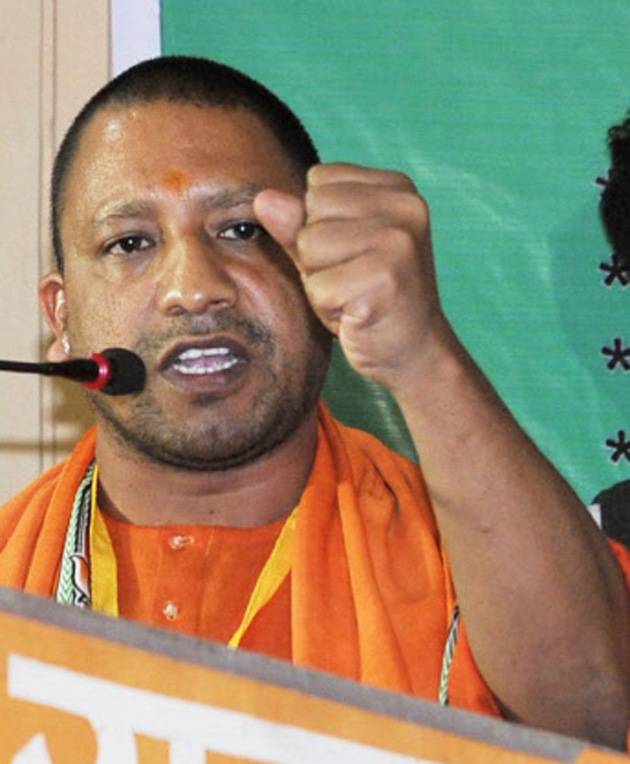
‘We are indeed shocked to see that this firebrand Yogi Adityanath whose virulent public pronouncements often borders outright contempt for the minorities in India is anointed by the Narendra Modi-Amit Shah combine as the Chief Minister of Uttar Pradesh, the largest state in India’ said Harbachan Singh, the Secretary-General of INOC.
According to the New York Times report, Mr. Adityanath, 44, was born Ajay Mohan Bisht, and studied mathematics before joining the priesthood. He rose to prominence as part of the campaign to rebuild the Ram temple, and has repeatedly been charged with fanning religious tensions.
In 2007, he spent 15 days in jail on charges of inciting riots, The Hindustan Times reported. He was booked again later in the year, when riots broke out after he made a speech. He is still facing trial in the two cases, the newspaper reported.
Mr. Adityanath was a forceful defender of the Hindu mob who lynched Muhammad Ikhlaq, a Muslim man suspected of slaughtering a cow, and argued that Mr. Ikhlaq’s family should be prosecuted for possessing the meat. When some Indians complained that they should not be required perform a “sun salutation” as part of International Yoga Day celebrations, saying it was a religious act, he recommended that those who were offended should “drown themselves in the sea.”
Mr. Adityanath has openly called for India to be enshrined as a “Hindu Rashtra” and supports the rebuilding of the temple in Ayodhya in place of razed 16th-century mosque. During the State Assembly polls, Adityanath was a major campaigner for the party across UP. The Gorakhpur-based politician enjoys a substantial following in Eastern U.P. where he founded Hindu Yuva Vahini whose volunteers are known to use strong-arm tactics during communal riots, cow-protection drives and to prevent ‘love-jihad.’
INOC urges the NRIs in America to strongly express their disapproval of the selection of a Hindutva extremist to be the leader of the most important state in India. ‘Opposing Trumpism in America while remaining silent on the fundamentalist ascendance in India would tantamount to nothing less than duplicity’ the statement added.
Modi’s preoccupation with domestic politics may continue through the Delhi municipal elections or even till elections in Gujarat. But he must not let foreign policy issues adrift………The Prime Minister cannot alternate between a pugnacious fighter at home and occasionally a statesman abroad,” says the author – KC Singh.
March 11 marked a significant landmark for Modi’s evolution as a dominant national political force, the future of AAP and its leader Arvind Kejriwal and the fate of ‘young’ leaders, 43-year-old Akhilesh Yadav and 46-year-old Rahul Gandhi. The murmurs are the loudest in the Congress against leadership, particularly when despite winning more seats than the BJP in Goa and Manipur, the governments have been formed by the latter.
After winning an unprecedented mandate in Uttar Pradesh, the most populous state of India, Modi could have shown humility in victory and espoused more collegial governance. Instead, he seems succumbing to hubris, as the BJP, particularly in Goa – despite their Chief Minister and six ministers being rejected by the electorate – have induced Independents, including those who campaigned on anti-BJP platform, with ministerial berths to devise an unethical coalition. The Supreme Court Bench of the Chief Justice disappointed in ignoring past guidelines in judgments and advice in commissions by worthy predecessors like Justices Sarkaria and Punchhi on how Governors should deal with split verdicts. Even if the swearing-in of Manohar Parrikar had to go ahead when the floor test was being advanced, how were all non-BJP supporters allowed to be sworn in as ministers?That clearly taints the process.
The April-end municipal elections in Delhi are now critical for the Congress, and even more so for the AAP. Gujarat, where the Patel agitation and poor governance post-Modi has created political uncertainty, looms next and there is talk of election, due later this year, being advanced to keep opponents from regrouping. Gujarat is literally the last hurdle beyond which Modi’s path to re-election in 2019 should be clear.
He is now like Indira Gandhi in her prime, the predominant figure to beat. But strange are the ways of the Indian masses as they both feed the rise of a strong leader and then resist power accumulation. The AAP in Delhi or the Janata Dal in Bihar benefited from this counter urge. Henry Kissinger in his book ‘On China’, comparing India and China, writes that the latter has continuously been a unitary state since 221 BC. India, contrariwise, only thrice: the Mauryas, Guptas and the British, as even the Mughals never controlled the entire south. Indira Gandhi realized after imposing the Emergency in 1975 that she now ruled over a sullen people waiting to punish her. Modi can ignore this lesson of history at his own peril.
Meanwhile, the external Indian environment has evolved drastically while Modi has been in the domestic mode. Victory of Donald Trump and the coming elections in Europe, in the Netherlands on March 15 and then in France and later Germany, can rewrite the future of the European Union. President Xi Jinping of China, with greater power accretion than any leader since Mao, faces the quinquennial 19th party congress later this year when new faces that may lead China in future should emerge. While the fourth generation ruled from 2003 to 2012, it remains to be seen if Xi will pass the baton to a successor in 2022, accepting the 10-year leadership change principle, or will linger as China faces a slowing economy and a mutating and less benign global order. India-Pakistan relations continue to fester as Pakistan is far from isolated. They have just joined Saudi Arabia’s Sunni coalition by sending troops to defend their border with Yemen. Pakistani economy is also on the mend, returning to 5 per cent GDP growth.
Modi’s preoccupation with domestic politics may continue through the Delhi municipal elections or even till elections in Gujarat. But he must not let foreign policy issues adrift. The first concern is to insulate gains in India-US relations over the last two US administrations from vagaries of Trump’s immigration policy, approach to Asia and global regimes. Second is India-Pakistan relations in state of persistent tension. That is hardly a strategy to deal with a nuclear weapon-possessing neighbor. Thirdly, relations with China are getting testier over India’s unwillingness to kowtow over the Dalai Lama while the Chinese become intransigent over Indian membership of the NSG and the listing of Pakistan-based terrorists by the UN Security Council sanctions committee.
Pakistan policy has, time and again, been on hold while Modi fights domestic electoral battles, including subliminally using terror emanating from there as an electoral weapon. Starting with the Maharashtra and Jammu and Kashmir elections in 2014, it has been a recurring tactic. By what definition was the terror attack in Uri comparable to the 26/11 carnage or attack on Indian Parliament in 2001 or the 2006 Mumbai train bombings? When red-lines are shifted to the walls of Indian cantonments then peace is unattainable, as any two terrorists can disrupt it with, or without, Pakistani support.
On the other hand, Pakistan in the last few months has been sending subtle signals. A new army chief, handpicked by PM Nawaz Sharif, appears in line with him. The detention of Hafiz Saeed and some associates may be a beginning that can be reversed or sharpened. Indian Punjab gets a new government with Capt Amarinder Singh, known to be sensitive to Punjabiyat, as a nebulous and diminishing link between the two divided Punjabs. Modi needs to test the window reopening for engagement and the calibrated resumption of normalization, or even talks.
For a start, Indian NSA Ajit Doval needs to talk to his counterpart, who is a former general, with a line to army chief Gen Qamar Javed Bajwa. Signals at a recent India-Pakistan track II were that General Bajwa may indeed be the partner Nawaz has been seeking since 1998, when Vajpayee travelled by bus to Lahore. The cultural and ideological space needed for this can be created between the twin cities of Amritsar and Lahore.
The Prime Minister cannot alternate between a pugnacious fighter at home and occasionally a statesman abroad. He has a limited opportunity to test Pakistani signals and build a consensus behind a new approach to Pakistan. Forcing Pakistan deeper into Chinese arms complicates dealing with both, particularly in an uncertain Trumpian world, when the need to defend Indian diaspora, whether holding Indian citizenship or not, can sour relations. The foreign policy ball has rolled back down the hill which Modi must, like Sisyphus, re-climb.
(The author is a former Secretary, Ministry of External Affairs, Government of India)
NEW DELHI (TIP): After the poll debacle in Uttar Pradesh and Uttarakhand, the Congress has admitted that it alone cannot counter Prime Minister Narendra Modi.
The grand old party would now explore state-specific alliances with regional parties to put up a formidable challenge to the BJP in the 2019 Lok Sabha elections.
As demands for structural changes grew louder, the Congress said the promised changes would be rolled out as the party gears up to face a “new reality” and “by the end of 2018, you will see that we are heading along with a proper strategy”.
“We will do everything that is required to challenge and expose Modi’s politics. We will be looking at state-specific political challenges. It can vary from state to state,” AICC spokesperson C P Joshi said here.
Joshi said the political narrative had changed in the country post the Lok Sabha elections in 2014, and Congress vice president Rahul Gandhi was the first to sense the change and counter it through a grand alliance in Bihar.
Senior Congress leader Mani Shankar Aiyar even suggested that the Congress should give up the leadership role of such an alliance.
However, Joshi asserted that the “legitimate central place” was with Rahul, indicating that the party would not like to cede the position to leaders like Bihar Chief Minister Nitish Kumar or his counterpart in West Bengal, Mamata Banerjee. The former Union minister pointed out that a grand alliance between the Congress, RJD and JD(U) had succeeded in stopping the Modi juggernaut in Bihar. A similar move did not work in Uttar Pradesh because of a strong dislike between SP chief Akhilesh Yadav and BSP supremo Mayawati.
He pointed out that the BSP had polled 23% of the popular vote, while the Congress-SP alliance had 29% of the vote. “Even after anti-incumbency, we (the Opposition) have 52% vote. Wait for 2019, there will be no space for the BJP in UP,” Joshi said. The Congress leader did not rule out a political understanding with even the Shiv Sena in Maharashtra.
Manohar Parrikar won the trust vote on the floor of the House on Thursday, March 16.
PANAJI (TIP): The Manohar Parrikar-led coalition government in Goa won the floor test in the legislative assembly on Thursday, March 16, by getting 22 votes to 16 in the 40-member Goa assembly, one more than the simple majority figure of 21.
One MLA was made the speaker for the trust vote and did not vote while one Congress legislator walked out during the floor test against his own party. Congress MLA Vishwajeet Rane walked out during the floor test and later submitted his resignation to the pro tem speaker. Rane, son of Congress veteran Pratapsinh Rane who himself won his 11th term as an MLA in the Goa assembly elections, also resigned as a Congress member. He said he would re-contest from Valpoi constituency.
Apart from the Bharatiya Janata Party’s 13 MLAs, Parrikar also got support from three legislators of Maharashtrawadi Gomantak Party (MGP), three legislators of Goa Forward party (GFP), two independents, and Nationalist Congress Party’s lone member Churchill Alemao.
Before the floor test began, Rane told reporters that the delay caused by the Congress leadership in staking claim to form the government had demoralized the people of Goa. “They have lost the trust of voters in Goa,” he said.
Hours after the Goa governor appointed Parrikar as the chief minister, Rane had said that as many as 13 of the 17 Congress legislators were angry that the party leadership could not elect a legislative party leader. Later, Rane and other Congress legislator Jennifer Monserrate blamed All India Congress Committee general secretary and Goa observer Digvijay Singh for this delay. Singh hit back on Wednesday with a tweet asking Rane “what he was doing with Parrikar in a Goa hotel”.
A triumphant Parrikar told reporters at a press conference later that the BJP was always confident of winning the trust vote. “The Congress did not have the numbers ever. Today’s floor test was a voluntary vote for us. No MLA was hidden in a hotel or anything,” Parrikar said. The Goa chief minister, who earlier this week resigned as the defence minister and made some deft moves in Goa to stitch together a BJP-led coalition, said “all eyes in India were on this floor test”.
The floor test was ordered by the Supreme Court after the Congress party in Goa filed a petition on 13 March challenging Goa governor Mridula Sinha’s decision to appoint a BJP-led government.
Parrikar was sworn in on 14 March along with eight other ministers.
The chief minister said after winning the trust vote that portfolios would be announced on 18 March. Ministers from MGP and GFP are likely to get important portfolios. In the 40-member Goa assembly, the BJP won 13 seats in the recent elections and later received support from 9 others.
The Congress won 17 seats and emerged the single largest party but never staked claim to form the government. On Thursday morning itself, it became clear that the BJP would sail through the trust vote as the MGP and GFP leaders reiterated their support to the BJP.
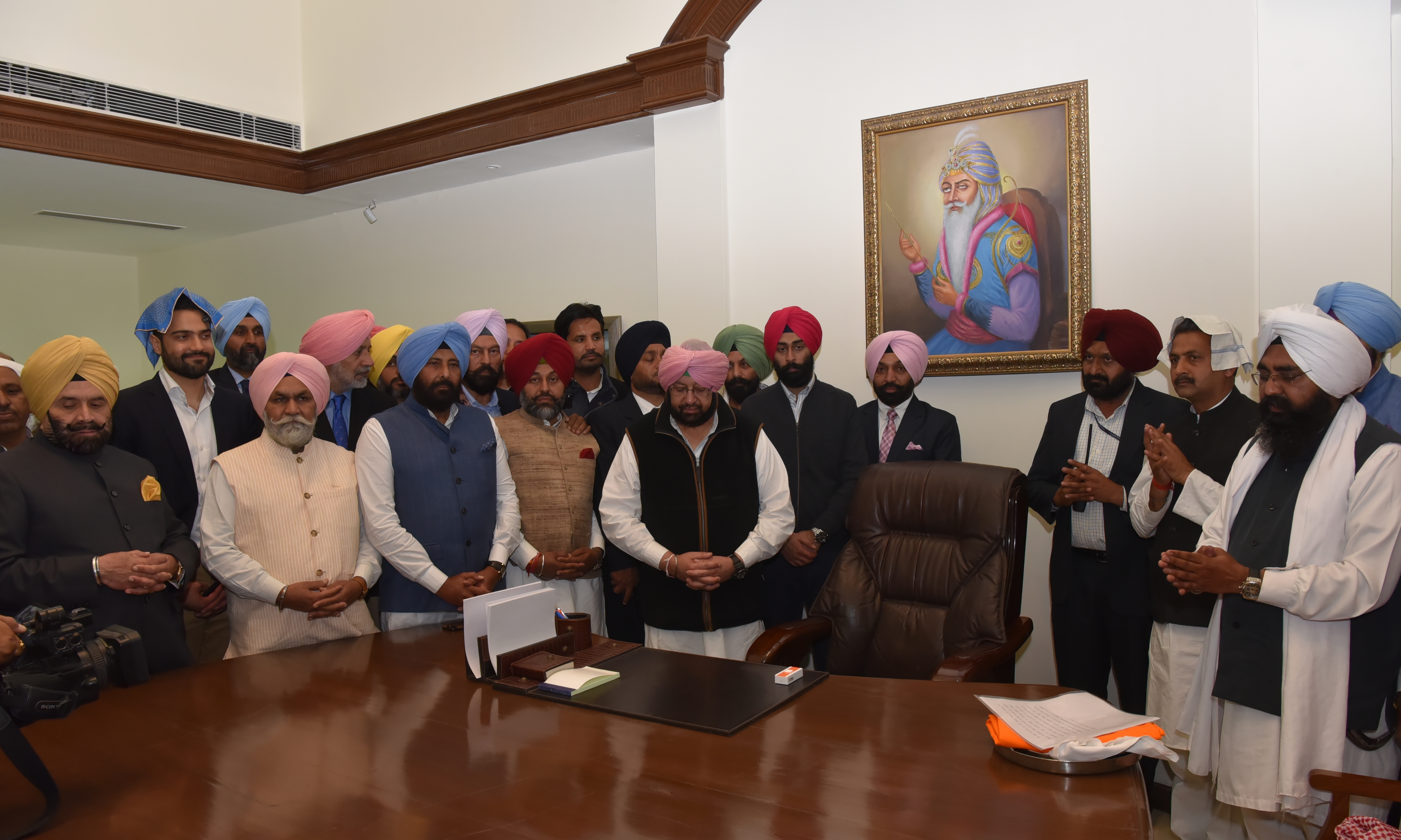
Capt Amarinder Singh, the new Chief Minister of Punjab, has put together a Cabinet that represents a selection of veterans which, if tea leaves are to be read, portends well for the state. He has managed a delicate balancing act. Although there are some who have been ministers before, many are new to a ministerial assignment. Brahm Mohindra, Manpreet Singh Badal and Tripat Rajinder Singh Bajwa have held ministerial assignments, but the untested Navjot Singh Sidhu, Rana Gurjit Singh and Charanjit Singh Channi are no spring chickens. Some kind of balance has been attempted among Malwa, Majha and Doaba regions. The ministers come from various castes and communities, and two of the Cabinet members are women.
The new Chief Minister needs to be complimented for weaving together a team of administrators, and the initial selection is of officers known for both integrity and efficiency, essential for working towards all-round development of the state. The temptation for any new political chief is always to seek the familiar. This can often be a mistake, more so in the case of Capt Amarinder Singh, whose coterie politics was widely believed to have been a major cause of discontent during his last term as Chief Minister. His successor, Parkash Singh Badal, succumbed to nepotism, which can equally be the undoing of any power figure.
Now that Capt Amarinder Singh’s core team is in place, the pressure would be on him from Day 1 to deliver on the promises, which would, of course, include those made behind closed doors as well as those to the public. If he concentrates on the latter, he will be able to ignore the puerile. The relatively simple swearing-in ceremony should set the tone. Punjab has had to bear the burden of ‘adjusting’ political and other ‘leaders’ in public offices rather than appointing capable individuals who may do justice to the responsibilities assigned. Change is expected by the voters, and those who entrusted with delivering it must keep their focus on the larger interests of Punjab, not just political gymnastics that have long been the bane of the state.
As expected the Manohar Parrikar government in Goa was able to prove its majority on Thursday, March 16, following a Supreme Court directive. Once the Governor had decided to invite the former Defence Minister, Parrikar to form the government, even though the Congress had emerged as the largest party, the dice got loaded in favor of the BJP.
In the end, the BJP with just 13 MLAs in a house of 40 managed to conjure up a slate of 22 legislators for voting in favor of chief minister Parrikar. The vote and the outcome are in perfect harmony with the Goan political culture of smaller parties and independents making themselves available for the highest bidder.
As the BJP is politically ascendant nationally and is flush with resources and imbued with resourcefulness, there was little doubt about its ability to win this round in Goa. Even before the final vote on Thursday, the Congress was making allegations of money changing hands.
It is the irony of our times that the winner not only gets to write the history but also re-writes the norms; it would be seen as cussedness to point out the ethical dimension of the denouement: the BJP was in power and it lost the majority in the election, ending up with only 13 MLAs yet storming its way back into power. Most curious and inexplicable is the case of all the three MLAs, belonging to the Goa Forward Party, siding with the BJP; in disgust, the GFP president, Professor Prabhakar Timble resigned from the party, accusing the BJP of inflicting a ‘political mafia raj’. So be it. The BJP’s cocky leadership would have the satisfaction of having one more state government under its belt.
Within days all the righteous anger about a ‘stolen government’ would subside. No one should be surprised if some of the Congress MLAs end up crossing over to the winning side. Goa would return to its happy and carefree habits and preferences. Above all, Manohar Parrikar’s exile in Delhi ends. Goa gets a chief minister it deserves and the country will, hopefully, get a defence minister it badly deserves.
Bundle of nerves: Are we getting paranoid about freedom of speech?
KC Singh
The rise of Modi and the continued Cabinet slots for those preaching sectarian hatred is not much different from President Trump listening to the whisperings of Rasputin-like Stephen Bannon, erstwhile publisher of Breitbart News – the mouthpiece of ‘alt-right’, who is White House chief strategist”, observes the author – KC Singh
Two events over the last few days, on opposite continents of the world, raise questions about the future of democracy in the US, the world’s most powerful, and India, the world’s most populous. On February 22, Srinivas Kunchibhotla was gunned down in Kansas, sharing a drink with a friend after work, by a white US navy veteran, in patently a hate crime. In India, at Ramjas College, New Delhi, a fracas broke out when BJP-aligned students’ union, ABVP, disrupted a function organized by campus students not aligned to them and invitees from JNU. The passively observant police intervened, more to rough-up the organizers than restrain ABVP disruptors. The allegation is that anti-national slogans were in the air.
The attention got diverted from the melee when a young student, Gurmehar Kaur posted on social media placards denouncing the ABVP high-handedness, arguing that like her father – martyred fighting militants in Kashmir when she was little – she was unafraid to confront intolerance. The battle lines got promptly drawn, with intemperate remarks or tweets by an actor, a cricketer, a Union minister of state, and so on. In Gurmehar’s defense rose up senior journalists, retired soldiers, television anchors, etc. By nightfall, BJP spokesmen began distancing themselves from Gurmehar’s tormentors as their standard dubbing of any critic as anti-national did not work against a martyr’s daughter. The elections in UP also made it unwise to offend serving and retired servicemen.
The distraction aside, the issues in the US and India are not that apart. The rise of Modi and the continued Cabinet slots for those preaching sectarian hatred is not much different from President Trump listening to the whisperings of Rasputin-like Stephen Bannon, erstwhile publisher of Breitbart News -the mouthpiece of ‘alt-right’, who is White House chief strategist. Both leaders prefer political rallies and one-way communication with chosen media outlets than transparent and frank interaction with the media. If Modi has never contradicted ministerial colleagues tarring the media with the abusive phrase ‘presstitutes’, Trump does one better by directly and almost daily referring to ‘The Fake News’. At a Florida rally, he confidently advocated -uncaring that independent media strengthens democracy – that media ‘is not my enemy, it is the enemy of the American people’. A former President, George Bush, has been constrained to contradict Trump’s condemnation of the media, despite both being Republicans.
Both the racist killing of an Indian techie in Kansas and the ABVP use of violence to drown alternative views spring from identical philosophies and narrow visions. In case of India, it brings up the freedom of speech, while in the US it raises the spectra of nativism fed by a mix of xenophobia and fear of Islam. It is thus supremely ironical that while the Indian Government sends Foreign Secretary S Jaishankar to intervene with the US on the rising danger to Indian diaspora from white vigilantism, when under their noses similar intolerance is being happily marketed daily from election platforms in UP.
Illustratively, RL Stevenson related the story about George Meredith, author of the 19th century novel, The Egoist, written to purge Victorian England of this evil, that when a young friend of the writer complained that the protagonist ‘Willoughby is me’, the writer replied: ‘No, my dear fellow, he is all of us.’
The issues arising need a closer analysis. At stake in India is the definition of freedom of speech. Having inherited the common law-based criminal justice system from the British, India clings to antiquated laws on sedition. In the US too, immediately after their independence they enacted a sedition Act, which was allowed to lapse in 1801 as the nation matured and gained self-confidence. Following the Bolshevik Revolution in Russia, the fear of Communism made the US pass the Federal Espionage Act in 1917. Thus, while the British Common Law treats freedom of speech as ‘residual freedom’, circumscribed by societal needs of morality and public order, the US Supreme Court started treating it as a ‘fundamental right’ flowing from the First Amendment from 1925. In 1969, it upheld the right of students to wear black bands to protest Vietnam War. Justice OW Holmes ruled that while a nation is at war, many things that can be said in time of peace are taboo, but the test has to be whether there is ‘clear and present danger’ of sedition, not merely the expression of an opinion or a thought. What a person, in the exercise of his freedom of expression, is doing must be more than public inconvenience or annoyance, or even unrest.
India, with a concept of ‘Fundamental Rights’ borrowed from the US practice has to assess if what happened at JNU earlier, or now at Ramjas College, passes the Holmes test. The definition of nationalism cannot be crafted in Nagpur and implemented by an evangelical lynch mob. Is that not the same question that the US is today required to answer, whether ordinary whites carrying guns can ask any non-white to prove their immigration status, or why they are in the US at all. So, the diaspora that came to Madison Square Garden to chant ‘Bharat Mata ki Jai’, in response to Modi’s incantations, are being put to the kind of test of loyalty that misguided flag-carriers of the BJP, or fringe organizations of the Sangh Parivar, have been putting to their own countrymen. How does India ask Trump to be more considerate when President Obama reminded the Modi government before emplaning for the US in 2015, in his speech at Siri Fort, that Article 25 ensured freedom of conscience and it was the government’s responsibility to uphold it.
While it is true that the Indian geo-political environment does compel the government to be ever-alert to forces endangering Indian territorial integrity or sovereignty, but surely campus students holding placards, or sloganeering do not compose such a threat. As Voltaire, some say wrongly quoted, said: ‘I disapprove of what you say, but I will defend to the death your right to say it.’ Perhaps like the US Supreme Court, India’s highest court needs to re-balance the fundamental rights and the State’s obligations, and in the process, re-educate the lawyer-ministers of the BJP.
(The author, KC Singh, is a former Secretary, Ministry of External Affairs, Government of India)
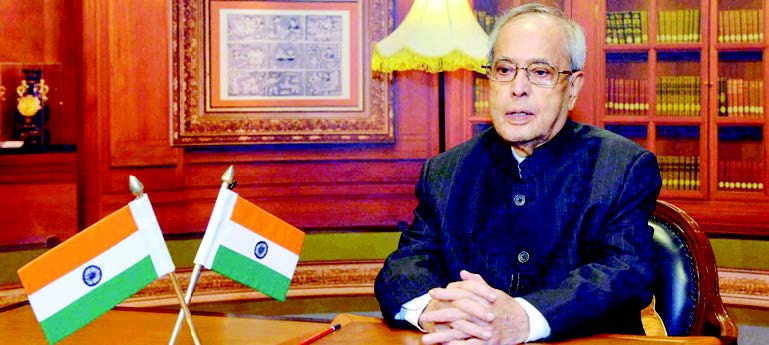
KOCHI (TIP): There is no room in this country for an intolerant Indian and students in India’s universities must engage in “reasoned discussion and debate” rather than “propagate a culture of unrest”, President Pranab Mukherjee said on March 2.
“There should be no room in India for the intolerant Indian,” President Mukherjee said while delivering the 6th KS Rajamony Memorial Lecture on “India@70” today in Kerala’s Kochi district. “Those in universities must engage in reasoned discussion and debate rather than propagate a culture of unrest. It is tragic to see them caught in the vortex of violence and disquiet,” he said. Although Mukherjee did not mention the Ramjas College row, his comments came amid the Left and right-wing groups engaged in a bitter, and even violent, debate over whether free speech is unpatriotic.
FREEDOM OF SPEECH GUARANTEED TO EVERY INDIAN:
President Pranab Mukherjee asserted that freedom of speech and expression is guaranteed to every Indian by the Constitution. “There must be space for legitimate criticism and dissent,” he said.
“India has been since ancient times a bastion of free thought, speech and expression. Our society has always been characterized by the open contestation of diverse schools of thought and debate or discussion. Freedom of speech and expression is one of the most important fundamental rights guaranteed by our Constitution,” he said.
In an apparent reference to the hounding of Delhi University student Gurmehar Kaur for questioning the RSS-backed Akhil Bharatiya Vidyarthi Parishad (ABVP), Mukherjee said the acid test for any society is how it treats it women and children.
“I do not consider a society or state to be civilized if its citizens’ behavior towards women is uncivilized. When we brutalize a woman, we wound the soul of our civilization. The acid test of any society is its attitude towards women and children,” he said.
POLITICIANS MUST NOT TAKE PEOPLE FOR GRANTED:
Addressing India’s politicians, Mukherjee said they should not take the people for granted. “The leaders or political activists must listen to people, engage with them, learn from them and respond to their needs and concerns. Our lawmakers must never take the people for granted. They must focus on the fundamental task of law making and raising of issues of concern to the people,” he said.
Mukherjee, however, did not dismiss the virtues of patriotism. “The time has come for collective efforts to re-discover the sense of national purpose and patriotism. Sense of national purpose and patriotism alone can lift our nation on to the road of sustained progress and prosperity. The nation and the people must always come first,” he said.
NEW DELHI (TIP): Aam Aadmi Party’s (AAP) national convener and Delhi chief minister Arvind Kejriwal has called a meeting of state in charges on Saturday to discuss the party’s national plan post-Punjab and Goa elections.
AAP will focus on the assembly elections in Gujarat later this year and Madhya Pradesh and Chhattisgarh next year, party sources said.The Aam Aadmi Party launched a multi-pronged attack against the BJP accusing it of engineering violence at Delhi’s Ramjas college to communally charge the Uttar Pradesh election and its governments in Gujarat and Chhattisgarh for unleashing police brutalities on farmers and tribals.
On a day the party’s highest decision making body — the political affairs committee —met to firm up the plan, AAP leaders in Delhi also raked up the issue of an alleged spy racket in MP in which a local BJP leader was arrested.
Party leader Kumar Vishwas accused the BJP along with its affiliate, the Akhil Bharatiya Vidyarthi Parishad — Rashtriya Swayamsewak Sangh’s student wing, of fomenting violence at Delhi University in the last two days.
“ABVP’s actions in Delhi University are triggered by the BJP’s impending defeat in UP,” Vishwas said. “They are trying to communalise the election,” he added. Party leader Gopal Rai, who is in charge of Gujarat, MP and Chhattisgarh led a delegation of farmers from Gandhinagar and tribals in Bastar to the National Human Rights Commission against alleged police atrocities.
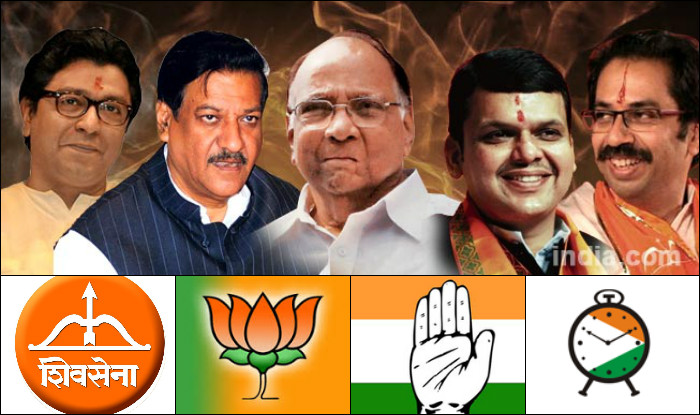
MUMBAI (TIP): The Shiv Sena on Thursday (February 23) emerged as the largest party in the Brihanmumbai Municipal Corporation (BMC) elections with 84 seats, but the BJP, which made massive gains, said it could take control of the civic body with the backing of independents.
Shiv Sena activists celebrated earlier in the day as it appeared it was set to take control of the BMC, but at the end it finished with just 84 of the 227 seats. The BJP came close with 82 seats.
Any party or combine will need 114 corporators for a simple majority.
Across Maharashtra, however, the Bharatiya Janata Party made major gains in elections held for municipal bodies. The Shiv Sena victory came in Thane.
BJP Mumbai president Ashish Shelar said the party had bagged 82 seats in Mumbai and had the support of four independents and that it was in a position to claim the crucial post of mayor.
“This is a historic victory for the BJP … We are only three seats less than the Shiv Sena … The credit goes to the development agenda of Prime Minister Narendra Modi and Chief Minister Devendra Fadnavis,” he said.
An aggressive Shiv Sena had snapped ties with the BJP+ ahead of the municipal elections and its leader Uddhav Thackeray had expected the Sena to win at least 100 seats, if not an outright majority.
The BMC, which is also the country’s largest municipal body, has an annual budget of Rs 37,000 crore in 2016-17.
The Congress trailed at a distant third in Mumbai, forcing its city unit chief Sanjay Nirupam to accept moral responsibility. He has offered to resign from the post.
The Maharashtra Navnirman Sena (MNS) of Raj Thackeray, Uddhav’s estranged cousin, finished with seven seats. The Nationalist Congress Party (NCP) bagged nine seats and the Hyderabad-based Majlis-e-Ittehadul Muslimeen three. The BJP’s solid gains came in other major cities of Maharashtra. The BJP raced towards victory in the Pune Municipal Corporation, pushing the ruling NCP to a poor second spot. The Shiv Sena, the MNS and the Congress fared poorly in the state’s cultural and IT capital.
The contest was close in Pimpri-Chinchwad Municipal Corporation near Pune, with the ruling NCP leading in 27 seats and the BJP at the second place with 21 seats.
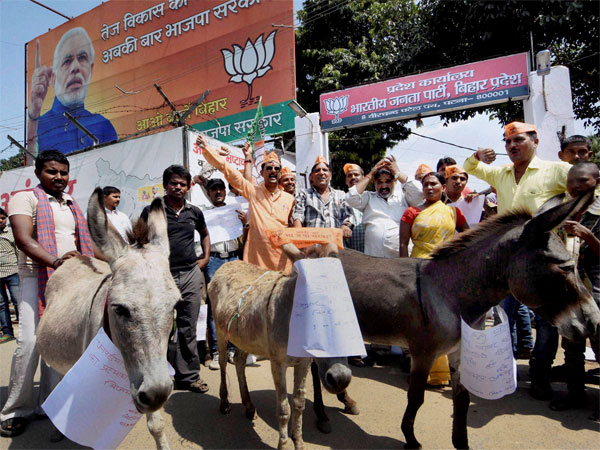
LUCKNOW (TIP): Countering Chief Minister Akhilesh Yadav’s ‘donkeys from Gujarat’ jibe, Prime Minister Narendra Modi on Feb 23 (Thursday) said he drew inspiration from the animal.
Modi also said the remark reflected Akhilesh’s “casteist” mentality. “You can attack me or the BJP, but why attack the donkeys? Why are you scared of them… they are hundreds of miles away,” Modi said, addressing an election rally at Bahraich.
Spare the animal, says PM
“It shows your (Akhilesh’s) casteist mentality… it is discriminating among animals,” the prime minister said, adding that the SP regime was known for employing the entire government machinery in tracing a lost buffalo.
“The donkey also inspires me… it remains loyal to its master and keeps on working even if tired, hungry or sick. I perform tasks that the people of the country ask me to do. I work on an empty stomach, without taking leave,” he said.
Modi reminded Akhilesh that the previous Congress-led UPA government had released a postal stamp on donkeys. “It (Congress) is your (SP’s) alliance partner now,” he said.
Akhilesh had on Monday launched a veiled attack on Modi for promoting the donkeys of Gujarat and asked actor Amitabh Bachchan not to endorse them. “Gujarat ke log ab wahan ke gadhon ka bhi prachar karwa rahen hain…kahin gadhon ka prachar hote dekha hai?”
(even the donkeys of Gujarat are being promoted… have you ever seen the promotion of donkeys?),” Akhilesh said at an election rally in Raebareli.
“I urge Amitabh Bachchan to stop promoting the donkeys of Gujarat,” he said, referring to the ad campaign on the Wild Ass Sanctuary in Gujarat.
The Indian media display certain defects. These should ideally be addressed and corrected in a democratic manner. But if the media prove incorrigible, harsh measures may be called for.
The time has come when some introspection by the Indian media is required. Many people, not only those in authority but even ordinary people, have started saying that the media have become irresponsible and wayward, and need to be reined in.
Only a couple of days back I read in the newspapers that the Union government has issued some regulations regarding licenses for news channels, to which there was a lot of reaction. Under the Constitution of India, freedom of the media is part of the freedom of speech guaranteed by Article 19 (1) (a). However, no freedom can be absolute, and reasonable restrictions can be placed on it. One of the basic tasks of the media is to provide truthful and objective information to the people that will enable them to form rational opinions, which is a sine qua non in a democracy. But are the Indian media performing this role properly?
I may only mention certain defects in the functioning of the India media today.
Twisting facts
One of the defects is that the media often twist facts. I would like to give an example.
One day, a leading English newspaper published on its front page a photograph of Justice Gyan Sudha Misra of the Supreme Court with the caption: “Supreme Court Judge says that her daughters are liabilities.” This was a distorted and fallacious item of news, published on the front page.
Supreme Court Judges have to disclose their assets and liabilities. Against the liabilities column, Justice Misra had written: “two daughters to be married.” Strictly speaking, it was not necessary to mention this because liabilities mean legal liabilities, for example, housing loan, car loan, and so on. Justice Misra’s intention was obviously to say that she would have to spend on her daughters’ future marriage. She has three daughters (no son), only one of whom has been married. Justice Misra never said, nor intended to say, that her daughters were liabilities. The news was false and defamatory, with the obvious intention of creating a sensation.
Paid news
A second defect concerns the issue of paid news that has become prominent of late. In the 2009 elections, it was a scandal. How this vicious practice could be stopped needs to be discussed. Incidentally, in compliance with an order of the Chief Information Commissioner dated September 19, 2011, we have placed the 71-page report of the Committee consisting of Paranjoy Guha Thakurta and Sreenivas Reddy on our website, www.presscouncil.nic.in with the disclaimer that the Press Council had rejected this report at its meeting held on April 26, 2010.
Non-issues as real issues
A third defect is that the media often portray non-issues as real issues, while the real issues are sidelined. The real issues in India are economic, that is, the terrible economic conditions in which 80 per cent of our people are living, the poverty, unemployment, lack of housing and medical care and so on. Instead of addressing these real issues, the media often try to divert the attention of people to non-issues. Such as that the wife of a film actor has become pregnant, whether she will give birth to a single child or to twins, and so on. Are these the real issues facing the nation?
At a Lakme India Fashion Week event, there were 512 accredited journalists covering the event in which models were displaying cotton garments, while the men and women who grew that cotton were killing themselves at a distance of an hour’s flight from Nagpur, in the Vidharbha region. Nobody told that story, except one or two journalists, locally.
Is this a responsible way for the Indian media to function? Should the media turn a Nelson’s eye to the harsh economic realities facing over 75 per cent of our people, and concentrate on some ‘Potemkin villages’ where all is glamour and show biz? Are not the Indian media behaving much like Queen Marie Antoinette, who said that if the people had no bread, they should eat cake?
No doubt, sometimes the media mention farmers’ suicides, the rise in the price of essential commodities, and so on, but such coverage is at most 5 per cent to 10 per cent of the total. The bulk of the coverage goes to showing the life of film stars, pop music, fashion parades, cricket and astrology.
Tendency to brand
Here is a fourth defect. Bomb blasts have taken place near the Delhi High Court, in Mumbai, Bangalore and so on. Within a few hours of such a bomb blast, many TV channels started showing news items that said that the Indian Mujahideen or the Jaish-e-Mohammed or the Harkatul-Jihad-e-Islam had sent e-mails or text messages claiming responsibility. The names of such alleged organizations will always be Muslim ones. Now, an e-mail can be sent by any mischievous person, but by showing this on TV channels and the next day in the newspapers, the tendency is to brand all Muslims as terrorists and bomb-throwers.
The truth is that 99 per cent of the people of all communities, whether Hindu, Muslim, Christian or Sikh, and of whatever caste or region, are good. But the manner in which such news is shown on TV screens and published in newspapers tends to create the impression that all Muslims are terrorists, and evil – which is totally false. The person who sends such e-mails or text messages obviously wants to create hatred between Hindus and Muslims, which is the old British divide-and-rule policy continuing even today. Should the media, wittingly or unwittingly, become part of this policy of divide-and-rule?
No doubt there are defects not only in the media but in other institutions also, for example, the judiciary, the bureaucracy, and so on.
There are two ways to remove these defects in the media. One is the democratic way, that is, through discussions, consultations and persuasion – which is the method I prefer. The other way is by using harsh measures against the media, for example, by imposing heavy fines on defaulters, stopping government advertisements to them, suspending their licenses, and so on.
In a democracy we should first try the first method to rectify the defects through the democratic method. For this purpose, I have decided to have regular get-togethers with the media, including the electronic media, so that we can all introspect and ourselves find out ways and means to rectify the defects in the media, rather than this being done by some government authority or external agency.
I propose to have such get-togethers once every two or three months, at which we will discuss issues relating to the media and try to think of how we can improve the performance of the media so that it may win the respect and confidence of the people.
If the media prove incorrigible, harsh measures may be required. But in my opinion, that should be done only as a last resort and in extreme situations. Ordinarily, we should first try to resolve issues through discussion, consultation and self-regulation. That is the approach which should be first tried in a democracy. I, therefore, request the Union government to defer the implementation of its recent decision regarding news channel licenses, so that we can ourselves discuss the issue thoroughly, and ourselves take corrective measures.
Till now the function of the Press Council was only adjudication. I intend to make the Press Council an instrument of mediation in addition, which is in my opinion the democratic approach. For this purpose, I need help, cooperation and advice from the media.
India is passing through a transitional period in its history, from a feudal agricultural society to a modern industrial society. This is a very painful and agonizing period. The media must help society in going through this transitional period as quickly as possible, and by reducing the pain involved. This they can do by attacking feudal ideas, for example, casteism and communalism, and promoting modern scientific ideas.
(This is the edited text of a speech delivered by Justice (retired) Markandey Katju
(Courtesy The Hindu)
PATIALA (TIP): Top leaders of the Indian National Lok Dal (INLD), including Abhay Chautala, 18 other MLAs and two MPs, were arrested by Punjab Police at Shambhu barrier on the Punjab-Haryana border on Thursday after they, along with several supporters, entered the state to undertake digging of the Sutlej-Yamuna Link (SYL) Canal.
They were rounded up for violating prohibitory orders and were sent to Patiala jail in judicial custody till February 27. A case under Section 188 (Disobedience to order duly promulgated by public servant) of the Indian Penal Code (IPC) was registered against Abhay and 72 other party leaders, who courted arrest, after the police refused to allow them to enter the state.
The INLD leaders had threatened to march into Punjab along with their shovel-carrying supporters towards the contentious canal, but heavy force was deployed to thwart their attempt. Punjab Police responded by constructing a 10-feet high wall of iron barricades and deployed about 5,000 armed personnel to stop the protesters from marching into the state.
When the INLD workers reached the Punjab-Haryana border at the Shambhu barrier, they were clearly outnumbered by the police. They first tried to climb up the barricades to cross into Punjab, but failed and symbolically started the digging work of the SYL Canal right there. As slogans of SYL being their legal right rent the air, Abhay delivered a short speech. He accused the Centre of being biased against Haryana, saying that Prime Minister Narendra Modi is not implementing the court decision on the SYL canal.
After his speech was over, Abhay and his supporters turned to go back, but suddenly stopped to have a brief consultation with party leaders. He then changed his mind and decided to court arrest by entering Punjab. Police officials held brief parleys with the protesters before making an announcement on loudspeaker that whosoever enters Punjab will be arrested for breaching the prohibitory orders. Abhay and other party leaders did not resist the arrest and were taken to the Shambhu Serai where a temporary control room of Punjab Police had been set up.
After his arrest, Abhay warned that his party would not allow any Punjab leader who is opposed to the SYL Canal to travel through Haryana.
Earlier in the morning, INLD supporters started gathering at the new grain market in Ambala City for the “Jal Yudh Sammelan”. Though the number of workers at the venue was modest at the start, it began to swell rapidly after 12.30pm.
The venue was packed by the time Abhay arrived. After a quick round of speeches, they started marching on National Highway-1 (also known as GT Road) towards the Punjab border, about 2km from the rally spot. The party leaders were ferried in tractor-trailers. Though Haryana Police had made heavy bandobust, they did little to stop protesters from entering Punjab.
No traffic was allowed on the highway from Rajpura onwards and traffic to Ambala was diverted through Sirhind via Landran. They were stopped by Punjab Police which had deployed 10 companies of paramilitary, anti-riot squads at all entry points, besides using a helicopter and drones to keep vigil to avert any untoward situation, director general of police (DGP law and order) Hardeep Dhillon, along with inspector general, Patiala, B Chandra Sekhar, was in command of the operation.
Meanwhile, Punjab Police also didn’t allow All India Sikh Students Federation and Bains brothers’-led Lok Insaaf Party workers to reach the Punjab-Haryana border as they had announced to take the INLD head-on.
NEW DELHI (TIP): In tax returns filed a year before they were elected, 72 pc BJP and Congress MPs and MLAs claimed they earn less than Rs 10 lakh, according to an analysis of affidavits of 4,848 (of 4,910) lawmakers.
About 75 pc of MPs and MLAs nationwide declared annual income less than Rs 10 lakh. Around 35 pc of lawmakers said their annual income is less than Rs 2.5 lakh while 40 pc declared income between Rs 2.5 lakh and Rs 10 lakh.
As many as 1,141 (24 pc) MPs and MLAs claimed exemption from income tax or have no income at all.
If the annual incomes of family (incomes of spouse and dependents, as declared in their respective tax returns) are added to the incomes of MPs and MLAs, 62 pc legislators’ households have an income less than Rs 10 lakh.
Of 1,843 MPs and MLAs with family incomes of more than Rs 10 lakh, 106 declared household assets of less than Rs 1 crore. Only 25 pc (1,236 of 4,848) of MPs and MLAs declared in tax returns that their annual incomes were more than Rs 10 lakh; 35 pc (1,676 of 4,848) declared income less than Rs 2.5 lakh.
While 63 pc Lok Sabha MPs declared annual income of less than Rs 10 lakh, only 13 pc Rajya Sabha MPs declared annual incomes of less than Rs 10 lakh. Among states, over 80 pc of MLAs in Uttar Pradesh, Bihar, West Bengal and Odisha declared annual incomes less than Rs 10 lakh.
NEW DELHI (TIP): The Centre-appointed Special Investigation Team (SIT) has filed chargesheets in only four of the 59 anti-Sikh riot cases taken up for further probe. Almost 3,000 people were killed, most of them in Delhi, in the riots that broke out after the assassination of then PM Indira Gandhi on October 31, 1984.
In a status report filed in the Supreme Court, the Ministry of Home Affairs (MHA) has said while 38 cases have been closed, 17 are under investigation. “It is being ensured that the investigation is carried out expeditiously and thoroughly,” the report, filed on the directions of the apex court, says. The MHA, which extended the SIT tenure till August 11 this year, has written to the Delhi Government and the Delhi High Court for designating a single court to hear the cases. The SIT has been notified as a police station with jurisdiction over the entire Delhi.
Also, of the 293 cases taken up for scrutiny, 199 have been closed with preliminary enquiries (PEs) held in 35 cases. “A large number of representations related to these cases were received from the Delhi Sikh Gurdwara Management Committee and private persons/bodies, which are being examined by the SIT,” says the report. The SIT has recorded statements of more than 1,000 witnesses, including one from New York.
HARDOI (TIP): Calling himself the “adopted son” of UP, Prime Minister Narendra Modi today said the future of the state cannot be ensured without ridding it of the SP, BSP and Congress.
Invoking Lord Krishna at an election meeting here to suggest a strong connect between Gujarat and UP, Modi, who represents Varanasi Lok Sabha constituency, said the state was his ‘mai-baap’ (parents) and he would not desert it.
“Lord Krishna was born in UP and made Gujarat his ‘karam bhoomi’ (land of work). I was born in Gujarat and UP has adopted me…Uttar Pradesh is my ‘mai-baap’. I am not the son who would betray his ‘mai-baap’. You have adopted me and it is my duty to work for you,” he said in an emotional speech at a poll rally here.
“Vote for a full majority to the BJP government. I promise to show you the ways of all problems you are facing within five years,” he said, telling the crowd that all pollsters have predicted BJP getting massive support in the first two phases of polling.
Highlighting the problems faced by the state and its national importance, Modi said poverty would be removed from the country only when it is eradicated from UP. “This is the land of Ganga and Yamuna where the land is most fertile with crores of labourers but poverty still exists here…why is this so? There is nothing wrong with the people here or their capabilities or shortage of resources,” he said. “It is the problem of the government’s lack of intention (which is responsible for it). SP, BSP and Congress have not thought as to how the state should be developed…all those who had been at the helm have only worked to safeguard their vote bank, help them in whichever way possible…the future of UP cannot be changed till it is freed of SP, BSP and Congress,” he said.
SP-Cong alliance to continue for LS poll
Senior Congress leader Ghulam Nabi Azad on Thursday said the SP-Congress alliance will continue for the 2019 Lok Sabha elections and that other secular parties would also be part of this coalition
When asked whether BSP will be part of this grand alliance, Azad said they were asking all secular parties to come together and fight the saffron party
“The secular parties suffered a loss during the 2014 elections and BJP gained from this and that is why they were able to win 73 seats in UP. However, if Congress, SP and RLD fight the 2019 Lok Sabha elections together, BJP will only be able to get 10-15 seats in the state,” Azad said
‘Inexperience’ barb: Akhilesh hits back
CM Akhilesh Yadav on Thursday made light of the PM’s ‘inexperience’ barb at him, saying he has learnt to cycle fast so that neither BSP’s elephant nor BJP’s lotus can come anywhere near the SP
A day after the PM questioned as to how the SP chief could form a coalition with
‘those who tried to murder’ his father, Akhilesh said Modi’s advisers could have done better by telling him to cite a more recent example of Firozabad
“Modiji said in Kannauj that by entering into an alliance with Congress, I have shown inexperience…we have done this so as to remove all doubts about government formation,” he said
Signup to our Newsletter!
Don’t miss out on all the happenings around the world