
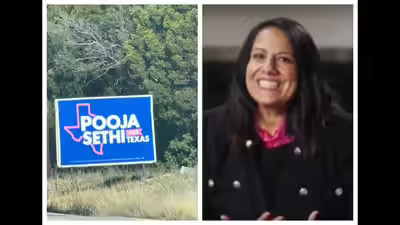

AUSTIN (TIP): A wave of Indian American candidates navigated a complex political landscape during Tuesday’s primaries, securing pivotal wins while facing significant setbacks in high-stakes races across the United States.
From the tech hubs of Texas to the suburbs of California, the results underscored the growing influence and the internal challenges of a community increasingly visible in the American legislative process.
In Texas House District 47, Pooja Sethi emerged victorious in the Democratic primary, a race that gained national attention after she publicly pushed back against what she described as attacks on her Indian heritage.
After her decisive primary win over 20-year U.S. Army veteran Joseph Kopser with Sethi receiving 76% votes to Kopser’s 24%, she will now face Republican nominee Jennifer Mushtaler in the November general election.
Sethi, an attorney and community advocate, framed her campaign around inclusivity and civil rights. Her win sets the stage for a general election where she hopes to bring a background in grassroots organizing to the state capital in Austin. Supporters celebrated her victory as a testament to the resilience of minority candidates facing cultural scrutiny.
However, the night was not without its disappointments for the community. In the race for Texas’s 22nd Congressional District, Sri Preston Kulkarni, who had previously come close to flipping the seat, struggled to regain the same momentum in a reshaped political map.
Despite a robust fundraising effort and a platform focused on healthcare and climate change, the math did not favor a comeback, illustrating the volatility of swing districts in a polarized climate.
In California, the results were equally mixed. Incumbent Representative Ami Bera easily advanced in his bid for reelection, maintaining his status as one of the longest-serving Indian Americans in U.S. Congress. Bera’s steady hand in foreign policy and healthcare has made him a fixture in Sacramento-area politics.
Meanwhile, in the Silicon Valley area, several younger Indian American candidates vying for local and state assembly seats saw varying degrees of success, with some moving to the general election and others falling short in crowded “top-two” primary fields.
These outcomes highlight a “human element” often lost in the data: the personal sacrifice of first and second-generation immigrants stepping into the line of fire.
For winners like Sethi, the primary was about more than policy; it was an assertion of belonging. For those who lost, the results often reflected the grueling reality of gerrymandering and the difficulty of building multi-ethnic coalitions in a divided nation.
As the focus shifts to November, the primary results suggest that the Indian American electorate is no longer a monolith. The diverse array of platforms ranging from Sethi’s civil rights focus to Bera’s pragmatic centrism shows a community that is refining its voice and expanding its reach within both the Democratic and Republican parties.
Though the “Samosa Caucus” in Washington may see shifts in its roster, the March 3 primaries proved that the drive for South Asian representation remains a permanent fixture of the American story.

Be the first to comment