Tag: International day of yoga

  • Yoga -a spiritual experience

    Yoga -a spiritual experience

    In the East, as well as in the West, there tend to be two rather different approaches to spirituality – that of the scholar and that of the practitioner. The scholar tends to be abstract, and studies world religions as one might study bugs or rocks or fossils – merely another field for the detached intellect. The idea of actually practicing a spiritual or contemplative discipline rarely seems to dawn on the scholar. Indeed, to practice what one is studying is held to interfere with one’s “objectivity”- one has become a believer and therefore nonobjective.

    Practitioners, on the other hand, although admirably engaged in an actual discipline, tend to be very uninformed about all the various facets of their tradition. They may be naive about the cultural trappings of their particular path, or about its actual historical origins, or about how much of their path is essential truth and how much is simply cultural baggage.

    The essence of Yoga is very simple: It means yoking or joining. When Jesus said, “My yoke is easy,” he meant “My Yoga is easy.” Whether East or West, Yoga is the technique of joining or uniting the individual soul with absolute Spirit. It is a means of liberation. And it is therefore fiery, hot, intense, ecstatic. It will take you far beyond yourself; some say it will take you to infinity.

    YogaYoga is like an ancient river with countless rapids, eddies, loops, tributaries, and backwaters, extending over a vast, colorful terrain of many different habitats. In this volume I have provided a bird’s-eye view, giving the reader the broader picture and, I hope, a deeper appreciation of the inviting waters of Yoga and of the checkered cultural landscape through which the river of Yoga has flowed in the course of its millennia-long development. Occasionally, however, I have zeroed in on a particularly relevant feature, exploring it as space and available sources permitted.

    Our last glance fell on the riverine current of Hatha-Yoga, that aspect of Tantrism which seeks to accomplish both spiritual enlightenment and bodily immortality. It is this branch of the meandering river of Yoga that carries us to the ocean, the world beyond India. For Yoga has definitely come West. There are today millions of Hatha-Yoga practitioners around the world who benefit from this age-old technology of bodily wholeness and personal growth. There are also millions of practitioners of meditation. They enjoy glimpses of the secrets of consciousness and its astonishing capacity to lift itself up by its own bootstraps-that is, to go beyond its own conditioning.

    Yet, only a few people deeply and consistently commit themselves to exploring the intricate psychotechnology of the various branches of the Yoga tradition. It is they who are discovering that consciousness, the human body-mind, is a well-equipped laboratory in which can be found, through ecstatic self-transcendence, the philosopher’s stone – the alchemical elixir of enlightenment. Admittedly, not everyone is able to follow their example.

    YogaNonetheless, the tradition of Yoga, for which there are still representative masters to be found, offers a wonderful opportunity to delve into the psychic and spiritual” dimensions that our postindustrial civilization has tended to neglect and even shun. We can study the scriptures of Yoga, both ancient and modern, and allow their esoteric knowledge and wisdom to enrich our understanding of human nature. With guidance, we can even try to verify in our own person some of the claims made by Yoga authorities past and present. This should, of course, never be a matter of merely imitating the East, but we can learn from its triumphs and its failures.

    Certainly, Yoga deserves far more careful attention from scientists than it has so far been granted. Our modern Western civilization, which now exerts a strong influence in all reaches of the globe, is in desperate need of a psychotechnology that can counterbalance the baneful effects of the excesses of scientific technology and the deficient consciousness that created and developed it. Scientists, who are after all committed to under-standing reality, have a special obligation to explore the great intuitions of the spiritual traditions of the East, which vigorously challenge the current scientific view of the world.

    The limitations of the materialistic paradigm have become increasingly apparent in the course of the twentieth century. More and more scientists are less and less certain of what it is they are trying to observe, measure, describe, and comprehend. This newly won virtue of uncertainty is a possible open door to a more spacious worldview that also accommodates the psychospiritual aspects of existence. The insights and findings of India’s spiritual traditions, painstakingly gathered over many millennia, can give us a glimpse of what we are likely to find on the other side of the door once present scientific dogmas have been transcended.

    Practitioners of such a reformed science will then truly be able to sift reality from fiction, and creative imagination (mythology) from mere wishful thinking. They will also be in a position to create the new language that is undoubtedly necessary to describe what they will encounter. Above all, they will learn to stand again in awe of the great Mystery of existence and be humbled and transformed by it. This challenge of the spirit confronts us all, and today it confronts us more pressingly than ever before in human history.

    Collectively and individually we will definitely have to find our own answers – our own Yoga.

  • MALLIKA SHERAWAT TAKES YOGA TO FRANCE

    MALLIKA SHERAWAT TAKES YOGA TO FRANCE

    Mallika Sherawat is having a gala time while on a vacation in France. After stunning us with her red carpet appearances at the Cannes Film Festival, looks like the diva decided to stay back and enjoy the sights that France had to offer.

    But while there, Mallika is not compromising on her workout regime. The actress, who is fit as a fiddle, swears by yoga for her impeccably sculpted figure. Staying committed to her routine, the actress practised yoga against the lush background, somewhere in France.

    From the pictures, it is evident that Mallika is quite a pro when it comes to yoga. Not only has she managed to strike a pose perfectly, she also looks calm and composed while doing so.

    Well, Mallika’s picture is all the fitness inspiration we need to begin the week!

  • OHMKriyaa will hold International Yoga Day on June 16, 2016, in New Jersey

    OHMKriyaa will hold International Yoga Day on June 16, 2016, in New Jersey

    EDISON, NJ (TIP): After a successful launch of OHMkriyaa in November 2015, OHM Group of Companies with Dr. Larra Shah, a renowned Natural Life Science Facilitator, Celebrity Aura Expert and Founder of “Energy Orb” will hold their first major event which will be open to all on Thursday, June 16, 2016, from 7 p.m. to 9 p.m. at Royal Albert’s Palace in New Jersey. The doors will open at 6 p.m. for social meet and greet and the program will start at 7 p.m. sharp. Dr. Shah will demonstrate the science of “Mudra Yoga and Mudra Meditation” during this evening session. Dr. Larra fondly also known as “IshvaGuru” is a well-known name in India as a holistic healer, researcher and practitioner in Vedic Therapies and natural medicine. She has designed a holistic module SECRETS TO “THE SEVENTH SENSE” – SEVEN STEPS TO WELLNESS TM for those seeking professional and personal excellence. She has a natural gift to be able to see auras, the past and the future. This gifted lady has also aced her expertise as a Certified Yoga Teacher, Geopathic Stress Healer, and a qualified Feng Shui Expert from renowned F.S.R.C Canada. Dr Larra’s ability to sense energies and read auras has been the guiding light in helping her clients who come from different walks of life including leadingathletes, movie stars and business leaders to help them achieve Success & Happiness andenhance their spiritual or physical journey.

    Having won several awards and accolades including a gold medal in 2016 from the Indian Board for her research on EMR and its effects, Dr. Shah has also hosted her own Television show on one of India’s leading channels Star Plus’ subsidiary Star News. Apart from her academic merits, she’s also authored a best-selling book called ‘Miracle Cards’ which provides guidelines and tips on how to live a more fulfilling life. Her client base includes the who’s who of Bollywood namely Farah Khan, Gauri Khan, Hema Malini, Chitrangda Singh, Meher Jessia, Rohit Behl, Miss Malini, Arjun Rampal to name a few and it certainly also expands into the crème de la crème societies in countries such as USA, Canada, UK, Italy, Belgium, UAE, South Africa, Malaysia, Singapore, and India.

    Dr. Larra is pioneering “Ohmkriyaa” an American enterprise, a platform for wellness and humanitarian programs. Through Ohmkriyaa’s platform, Dr. Larra provides educational and self-developing programs which offer powerful techniques and tools to eliminate stress and foster abundance and wellbeing. In the high stressed environment and ever changing and high demanding technology era, body and mind need relaxation and rejuvenation practices to live stress free and positive life. Dr. Shah’s various natural therapies can help people effortlessly with complete ease and feel inner happiness.

    For more information about Dr. Larra and her services at Ohmkriyaa, please visit her Web site http://larrashah.com. Dr. Larra can be reached via toll free number in the U.S. at 877-493-5052 or e-mail at larra@ohmkriyaa.com

  • New York gears up for second International Day of Yoga celebrations

    New York gears up for second International Day of Yoga celebrations

    NEW YORK CITY (TIP): After the overwhelming success of last year’s maiden International Day of #Yoga celebration, New York City is all set to make it larger in the second year. Instead of a single day celebration, as it happened in 2015 on June 21, this time it’s going to be a 19 daylong event from June 10 to 28 in and around New York. But 2016 Yoga day will be a little less glamorous as it’s not going to be attended by any celebrity.

    While addressing the 69th session of UNGA in September, 2014, Prime Minister @NarendraModi urged the world community to adopt an International Day of Yoga. On December 11, 2014, the 193 member UNGA approved the proposal by consensus to declare 21 June as “International Day of Yoga.” In its maiden year IDY became hugely popular around the globe.

    Like last year the Consulate General of India, New York in association with local Indian community and associations, would be organizing a series of Yoga related events in and around New York from 10th – 28th June 2016.

    The Consulate General of India in New York on June 8 hosted a gathering to review the preparations for upcoming second International Day of Yoga in New York City.
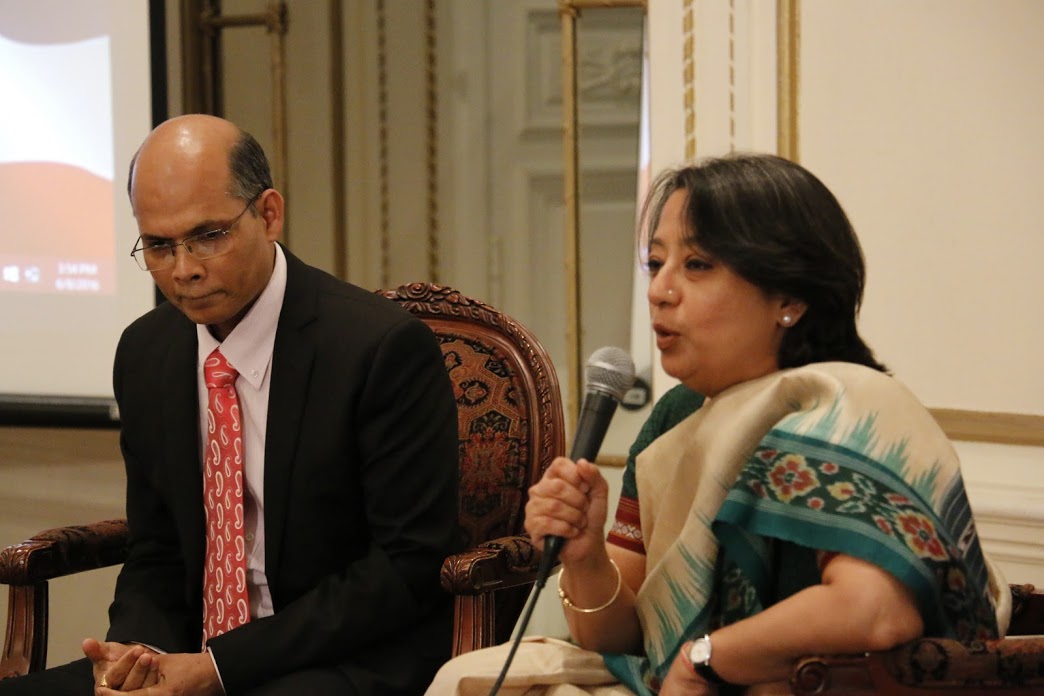
    Consul General Ms Riva Ganguly Das and Deputy Consul General Dr Manoj Kumar Mohapatra chaired the meeting. Members of the media and leaders of local cultural institutions attended the conference.

    Other speakers who addressed the gathering included Mr. Mahesh from Mallakhamb Federation USA, Ruchika Lal from The Art of Living Foundation, Jagdish Sewhani from HSS, Chaitanya Sonar from Sahaja Yoga, Sanjay Attara from Hindu Temple Society of North America, Guru Dilipji from World Yoga Community and Malini Shah representing Queens Museum.

    Consul General Riva Ganguly Das informed that in the city of New York and adjoining cities, several high profile events are being organized to celebrate IDY. “We are getting overwhelming support from the community. We want to thank you all”, she said.

    Deputy Consul General Dr Manoj Kumar Mohapatra gave the details of the events. The Consulate is partnering with more than 25 organizations/ associations to arrange these events. Their main partners for the events are Queens Museum, Mallakhamb Federation USA, The Art of Living Foundation, Hindu Swam Sevak (HSS), Federation of Indian Association (FIA) – Ohio, Indian Cultural Association of North America, Sahaja Yoga, The Hindu Temple of North America, World Yoga Community Inc., New England International Day of Yoga, Times Square, Indian American Association of Westchester, EWR International Airport, JFK International Airport, South Asian Art Council and Sahaja Yoga – Pennsylvania Chapter.

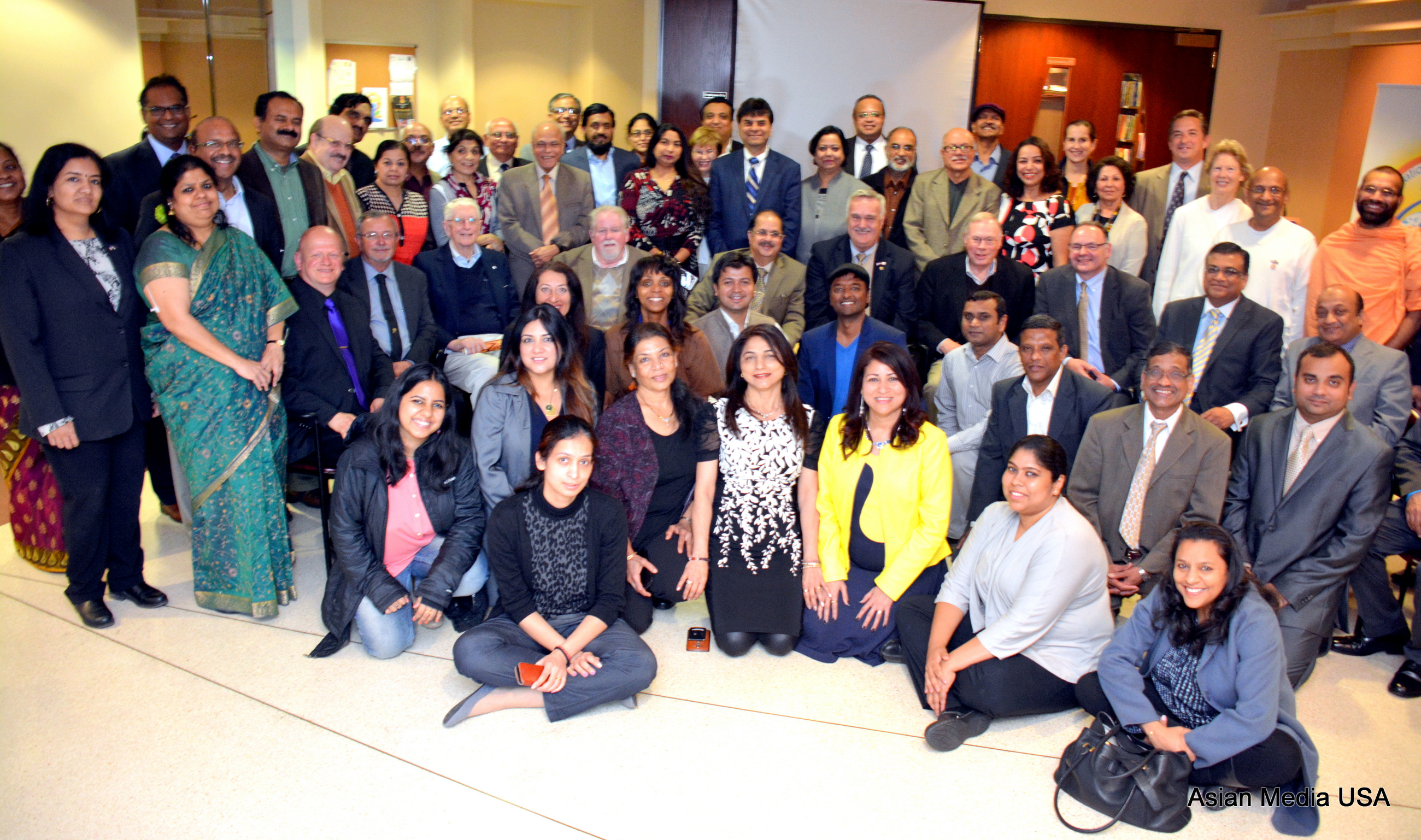
    Representatives of organizations participating in the second IYD with the Consul General Riva Ganguly Das
    Representatives of organizations participating in the second IYD with the Consul General Riva Ganguly Das

    Dr Mohapatra said that MIT is hosting Yoga sessions for its students. The Massachusetts police also take part in Yoga sessions.

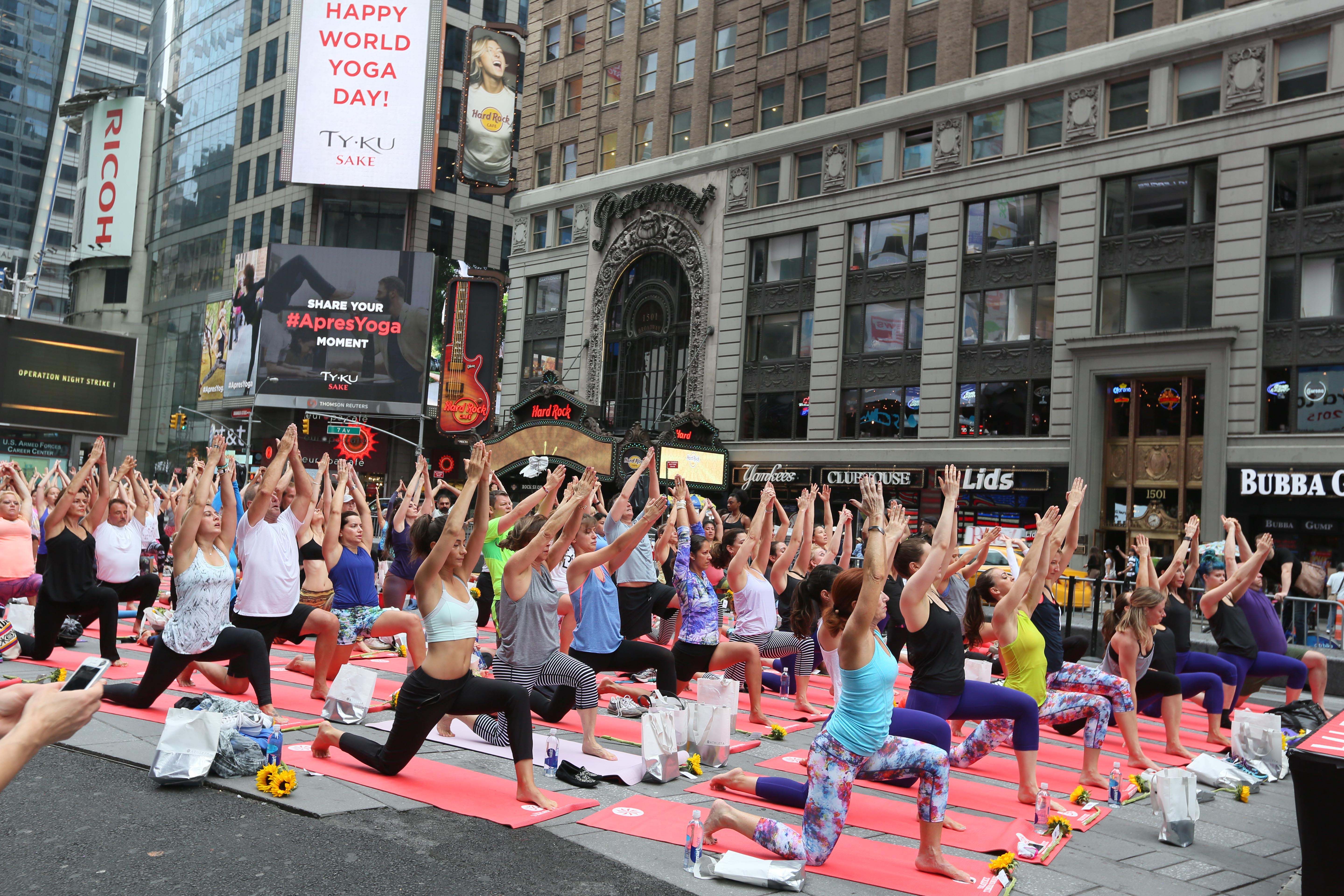
    The Curtain Raiser will be held on June 11 at Queens Museum, New York City Building, Flushing Meadows Corona Park. Summer Solstice at Times Square will be held on June 20 from 7 am to 8:30 pm. The Consulate have also organized yoga lecture-cum-demonstration at the JFK and Newark airport. Passengers can practice yoga while waiting in transit. “This year there will be 30 minutes Yoga demonstrations in the airports so that incoming and outgoing passengers can easily participate”, informed Dr Mohapatra.

    But unlike last year no delegation from India is coming this year for the celebration. Last year the delegation led by External Affairs Minister Sushma Swaraj represented the Government of India at Times Square and the Hindu Temple Society of North America, Flushing. Congresswoman Tulsi Gabbard, who introduced a Resolution in the Senate in support of the IDY, Madhur Bhandarkar, Film Director, also participated and cheered up the participants at the Times Square where close to 20,000 people participated throughout the day.

  • THE IMPULSE TOWARDS TRANSCENDENCE

    THE IMPULSE TOWARDS TRANSCENDENCE

    REACHING BEYOND THE EGO-PERSONALITY

    The desire to transcend the human condition, to go beyond our ordinary consciousness and personality, is a deeply rooted impulse that is as old as self-aware humanity. We can see it at work in the magically charged cave paintings of Southern Europe and, earlier still, in the Stone Age burials of the Middle East. In both cases, the desire to connect with a larger reality is expressed. We also encounter that desire in the animistic beliefs and rites of archaic Shamanism, and we see its flowering in the religious traditions of the neolithic age—in the Indus-Sarasvati civilization, and in Sumer. Egypt, and China.

    But nowhere on Earth has the impulse toward transcendence found more consistent and creative expression than on the Indian peninsula, the civilization of India has spawned an almost overwhelming variety of spiritual beliefs, practices, and approaches. These are all targeted at a dimension of reality that far eclipses our individual human lives and the orderly cosmos of our human perception and imagination. That dimension has variously been called God, the Supreme Being, the Absolute, the (transcendental) Self, the Spirit, the Unconditional, and the Eternal.

    Diverse thinkers, mystics, and sages—not only of India but from around the world—have given us a plethora of images or explanations of the ultimate Reality and its relation to the manifest universe. All, however, are in agreement that God, or the Self, transcends both language and the mind. With few exceptions, they are also unanimous in making three related claims, namely that the Ultimate:

    1. is single– that is, an undivided Whole complete in itself, outside which nothing else exists;

    2. is of a higher degree of reality than the world of multiplicity reflected to us through our senses; and

    3. is our highest good (nihshreyasa; Latin: summum bonum), that is, the most desirable of all possible values.

    Additionally, many mystics claim that the ultimate Reality is utterly blissful. This bliss is not merely the absence of pain or discomfort, nor is it a brain-dependent state. It is beyond pain and pleasure, which are states of the nervous system. This goes hand in hand with the insistence of mystics that their realization of the transcendental Identity is not an experience, as ordinarily understood. Such adepts simply are that Reality. Therefore, in connection with this highest accomplishment on the spiritual path I prefer to speak of God- or Self-realization as opposed to mystical experience. Other terms used are “enlightenment” and “liberation”.

    India’s spirituality, which goes by the name of Yoga, is undoubtedly the most versatile in the world. In fact, it is hard to think of any metaphysical problem or solution that has not already been thought of by the sages and pundits of ancient or medieval India. The “sacred technicians” of India have experienced and analyzed the entire spectrum of psychospiritual possibilities—from paranormal states to the unitive consciousness of temporary God-realization to permanent enlightenment (known as sahaja-samadhi, or “spontaneous ecstasy”).

    The methods and lifestyles developed by the Indian philosophical and spiritual geniuses over a period of at least five millennia all have one and the same purpose: to help us break through the habit patterns of our ordinary consciousness and to realize our identity (or at least union) with the perennial Reality. India’s great traditions of psychospiritual growth understand themselves as paths of liberation. Their goal is to liberate us from our conventional conditioning and hence also free us from suffering, because suffering is a product of our unconscious conditioning. In other words, they are avenues to God-realization, or Self-realization, which is an utterly blissful condition.

    God, in this sense, is not the Creator God of deistic religions like Judaism, Islam, and Christianity, Rather, God is the transcendental totality of existence, which in the nondualist schools of Hinduism is referred to as brahman, or “Absolute”. That Absolute is regarded as the essential nature, the transcendental Self, underlying the human personality. Hence, when the unconscious conditioning by which we experience ourselves as independent, isolated egos is removed, we realize that at the core of our being we are all that same One. And this singular Reality is considered the ultimate destination of human evolution. As the modern yogin-philosopher Sri Aurobindo put it:

    We speak of the evolution of Life in Matter, the evolution of Mind in Matter; but evolution is a word which merely states the phenomenon without explaining it. For them seems to be no reason why Life should evolve out of material elements or Mind out of living form, unless we accept the Vedantic solution that Life is already involved in Matter and Mind in Life because in essence Matter is a form of veiled Life, Life a form of veiled Consciousness. And then there seems to be little objection to a farther step in the series and the admission that mental consciousness may itself be only a form and a veil of higher states which are beyond Mind. In that case, the unconquerable impulse of man towards God, Light, Bliss, Freedom, Immortality presents itself-in its right place in the chain as simply the imperative impulse by which Nature is seeking to evolve beyond Mind, and appears to be as natural, true and just as the impulse towards Life which she has planted in certain forms of Matter or the impulse towards Mind which she has planted in certain forms of Life…Man himself may well be a thinking and living laboratory in whom and with whose conscious co-operation she wills to work out the superman, the God.

    Or shall we not say, rather, to manifest God?

    The idea that the impulse toward transcendence is a primary and omnipresent, if mostly hidden, force in our lives has been vocalized by a number of eminent transpersonal Psychologists, notably Ken Wilber. He speaks of this force as the “Atman project”.
    Development is evolution; evolution is transcendence…and transcendence has as its final goal Atman, or ultimate Unity Consciousness in only God. All drives are a subset of that Drive, all wants a subset of that Want, all pushes a subset of that Pull – and that whole movement is what we call the Atman project: the drive of God towards God. Buddha towards Buddha, Brahman towards Brahman, but carried out initially through the intermediary of the human psyche, with results that range from ecstatic to catastrophic.

    The impulse toward transcendence is thus intrinsic to human life. It manifests itself not only in humanity’s religio-spiritual search but also in the aspirations of science, technology, philosophy, theology, and art. This may not always be obvious, especially in those areas that, like contemporary science, are anxious to deny any associations with metaphysical thought, and instead pay homage to the twin idols of skepticism and objectivity. Nevertheless, as perceptive critics of the scientific enterprise have pointed out, in its passionate quest for knowledge and meaning, science is merely usurping the supreme place that was once accorded to religion and theology.

    Today, the metaphysical roots of science are rendered visible especially by quantum physics, which undermines the materialistic ideology that has been the creed of many, if not most. Scientists for the past two hundred years. In fact, avantgarde physicists like David Bohm and Fred Alan Wolf have formulated broad quantum-physical interpretations of reality that converge in many respects with traditional Eastern ideas about the structure of the world: The universe is a single and ultimately unimaginable- sea of energy (“quantum foam”) in which differentiated forms – things – appear and disappear, possibly for all eternity. Gary Zukav writes:

    Quantum mechanics, for example, shows us that we are not as separate from the rest of the world as we once thought. Particle physics shows us that the “rest of the world” does not sit idly “out there”. It is a sparkling realm of Continual creation, transformation, and annihilation. The ideas of the new physics, when wholly grasped, can produce extraordinary experiences. The study of relativity theory, for example, can produce the remarkable experience that space and time are only mental constructions!

    It is clear from the work of such creative scientists as those mentioned above that science, like every other human endeavor, harbors within itself the impulse toward transcendence. Rightly, John Lilly called science a “simulation of God”. What Lilly meant by this phrase is this: We humans try to describe and understand ourselves and the world that apparently surrounds us. In doing so, we create models of reality and programs by which we can maneuver in our conceptualized, simulated worlds. All the while, however, we are pushed – or pulled – to reach beyond our models and programming, beyond our mind.

    If we look upon science and technology as forms of the same impulse toward transcendence that has motivated India’s sages to explore the inner universe of consciousness, we can see many things in a radically new perspective. We need not necessarily regard science and technology as perversions of the spiritual impulse, but rather as unconscious expressions of it. No moral judgment is implied here, and we can simply set about introducing a more comprehensive and self-critical awareness into the scientific and technological enterprise. In this way, we can hope to transform what has become a runaway obsession of the left brain into an authentic and legitimate pursuit in service of the whole human being and the whole of humankind.

    In Rabindranath Tagore’s delightful work Gitanjali, there is a line that sums up our modern attitude, which is one of dilemma: “Freedom is all I want, but to hope for it I feel ashamed”. We feel ashamed and awkward because we feel that the pursuit of spiritual freedom, or ecstasy, belongs to a bygone age, a lost worldview. But this is only a half-truth. While certain conceptions and approaches to spiritual freedom are clearly antiquated, freedom itself and its pursuit is as important and relevant today as it has ever been. The desire to be free is a timeless urge and concern. We want freedom, or abiding happiness, but we seldom acknowledge this deep-seated wish. It remains on the level of an unconscious program, secretly motivating us in all our undertakings—from scientific and technological ingenuity to artistic creativity, to religious fervor, to sports, to sexuality, to socializing., and, alas, also to drug and alcohol addiction. We seek to be fulfilled, made whole or happy by all these pursuits. Of course, we find that whatever happiness or freedom we gain is frustratingly ephemeral, and we take this as an incentive to continue our ritual quest for self-fulfillment by seeking further stimulation.

    Today, however, we can take encouragement from the new vision embodied in quantum physics and transpersonal psychology, and boldly raise this urge to the level of a conscious need. In that event, the unrivaled wisdom of the liberation teachings of India and the Far East will assume a new significance for us, and the present-day encounter between East and West can fulfill itself.

    (Excerpted from Yoga Tradition by George Feuerstein, Ph.D.) 

  • Kick off Ceremony of 2nd International Yoga Day

    Kick off Ceremony of 2nd International Yoga Day

    CHICAGO: The second International Day of Yoga will be celebrated by the Consulate General of India in collaboration with the City of Sandwich on 25th June, 2016 at Timber creek Inn, 3300 Drew Ave, Sandwich, Illinois. In this connection, the kick off ceremony of 2nd International of Yoga Day was celebrated on 17th May, 2016 in the Consulate premises.

    The Hon’ble Mayor of city of Sandwich, Rick Olson, attended the ceremony with the representatives of City of Sandwich including Mr. Jim Teckenbrock, Executive Director, Sandwich Economic Development Corporation, Mr. Cort Carlson, Executive Director, Aurora Area Convention and visitor’s Bureau and Chief of Police of city of Sandwich, Jim Bianci. The ceremony was also attended by different community organizations, established yoga and spiritual centers and members of the Media. O.P. Meena, Consul, welcomed the guests. The ceremony started with screening of extracts of Messages of Prime Minister of India, EAM & Minister [IC] derived from Common Yoga Protocol 2016.

    During kick off ceremony, Dr. Ausaf Sayeed, Consul General, addressed the gathering & shared information with participants on celebration of 2nd International Yoga Day.
    The following are the important details.
    Second International Yoga Day celebrations in US Mid-west is from 10:00 AM to 05:00 PM on Saturday, June 25th, 2016 at Timber Creek Inn, 3300 Drew Ave, Sandwich, Illinois.

    Participating Organizations:
    The Art of living Foundation, Isha Foundation, Brahma Kumaris Meditation Centers, SEWA International, Science of Spirituality, Hindu Swayamsevak Sangh, Yog Sadhan Ashram, Sahaj Yoga Ashram, Temple of Harmony, Swami Sahajananda, Balaji Temple, BAPS Swaminarayan Mandir, American Association of Retired Asians (AARA) and Metropolitan American Federation of Seniors [MAFS]

    The following events would be organized as part of the Second International Yoga Day:
    Book Exhibition: A special book exhibition on Yoga will be exhibited on the occasion.
    Photo exhibition: Selected photographs on Yoga will be displayed
    Screening of the documentary films
    Common Yoga Protocol / demonstration of Common Asanas and
    Breathing Techniques by The Art of Living Foundation.
    Guided Meditation Workshop & Children’s Activiti ties by the Brahm Kumaris Meditation Center
    Surya Namaskar Demonstration by the Hindu Swayam Sevak Sangh
    Talk on the science of Kriya Yoga and meditation by Swami Sahajananda
    Surat Shabd:’Yoga An Ageless Technique’ by The Science of Spirituality
    Hath Yoga posture & Cleansing demonstration by Yog Sadhan Ashram
    Cyclic Meditation Workshop (Stop Diabetes Movement) by SEWA International
    Chair Yoga demonstration for seniors by American Association of Retired Asians (AARA)

    Last year, several organizations in different parts of the US-Midwest are also anticipated to organize series of activities to mark the International Yoga Day.

    The Consulate is expecting the participation of several local dignitaries and elected officials in the inaugural ceremony of the International Yoga Day. The City of Sandwich has declared its support to the celebrations and would be issuing a special proclamation declaring the Day by the city as International Yoga Day.

    Consul General appreciated willingness of the Mayor of City of Sandwich and thanked for taking initiative to collaborate with Consulate for celebration of 2nd International Yoga Day in the City of Sandwich. Consul General also appreciated Mr. Deepak Kant Vyas, Chairman & CEO, Red berry for offering the venue, Timber Creek Inn, for celebration of 2nd International Yoga Day event free of cost.

    The Consul General concluded the Meeting and urged all the Community organizations and Media partners to extend whole-hearted support in celebrating the Second International Day of Yoga in a befitting manner not only in the City of Sandwich but in the entire US Midwest.

    (Photographs and Press release by: Asian Media USA)

  • Global Harmony, Yoga, Social Issues discussed at Dharma Conference

    Global Harmony, Yoga, Social Issues discussed at Dharma Conference

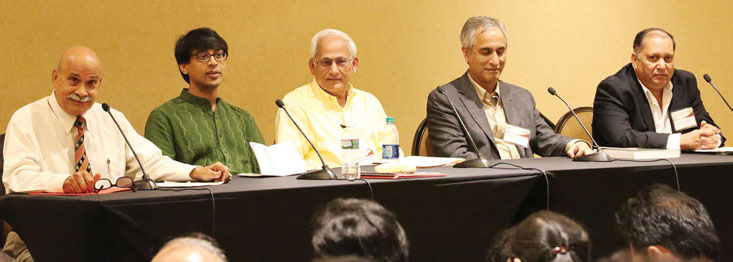
    EDISON, NJ (TIP): Attendees representing 13 countries now have greater insight into the philosophy of “Dharma” for a conflict free and pluralistic world as well as ancient spiritual roots of yoga and the social issues faced by Hindus globally. The largest Hindu students’ organization in North America brought more than 40 saints, scientists, yogis and experts to New Jersey on the “Never Forget” September 11th anniversaries for Dharma and world harmony.

    Organized by the Hindu Students Council and supported by over 35 organizations, the conference featured luminaries such as Sri Sri Ravi Shankar, the founder of Art of Living, Swami Paripoornananda, the head of Sreepeetham in India, Dr. HR Nagendra, Chairman of the Indian Government’s Experts Committee for the International Day of Yoga, Fields Medalist Dr. Manjul Bhargava and many others. Sri Sri Ravi Shankar provided insights on how the principles of Dharma can help develop a conflict free society, while Dr. Nagendra discussed Indian Government’s efforts in making yoga available to millions of Indian people in order to appreciate its roots and medical benefits.

    The Council also recognized Indian Prime Minister Narendra Modi, who will be visiting the US this month, along with Sri Sri Ravi Shankar, Swami Dayananda Saraswati and Dr. HR Nagendra, with the “Light of Yoga Award” for their pioneering contributions in making the International Day of Yoga a major success.

    “The fact that some of the most renowned saints, a former NASA scientist, a Fields Medalist and 40 others came together on HSC’s platform is testament to the organization’s 25 year history and brand value,” added HSC Chairman and Conference Chair Nikunj Trivedi. “This conference is therefore a celebration of HSC’s legacy and an opportunity to map out the course for decades to come.”

    The conference opened with HSC students chanting the sacred symbol “Om”, which was followed by a moment of silence for the victims of the September 11th terrorist attacks.

    Dr. Bhargava, along with physicist Dr. GNR Tripathi, computer scientist Dr. Subhash Kak and Professor Alok Kumar, discussed the need to recognize the significant contributions of ancient Hindus in the field of science and mathematics. For example, Dr. Bhargava argued that the number system used today should be called “the Hindu Number System” rather than Arabic Number System and the Fibonacci Sequence (of integers) outlined in the 12th century, should be renamed “Hemchandra Numbers” after Jain scholar Acharya Hemchandra who developed them 900 years earlier.

    In his keynote speech at the opening plenary session, Dr. David Frawley
    (Vamadeva Shastri), founder of the American Institute of Vedic Studies and the winner of the prestigious Padma Bhushan award by the Government of India, said that yoga was a gift of the ancient Hindu sages and should be not cut-off from its roots and holistic benefits.

    On a panel on women’s empowerment, female monk Swamini Svatmavidyananda, female yogi Shambhavi Chopra, and Dr. Indrani Rampersad challenged western feminism, which often does not take into account transnational and spiritual concerns, and proposed ways in which females can find strength in understandings of gender found within the Indic traditions. Another panel on Human Rights featured noted human rights activist Tapan Ghosh of Hindu Samhati and Dr. Ali Alyami, Executive Director and founder of the Center for Democracy and Human Rights in Saudi Arabia. Both spoke passionately about the persecution of Hindus around the world and implored the global community to take action to protect the rights of Hindus where they are minorities and are denied religious freedom.

    An inter-faith panel, moderated by noted public intellectual and writer Rajiv Malhotra, discussed a framework for a pluralistic world order. It featured Rabbi Justus N. Baird, Dean of Auburn Theological Seminary in New York, Pastor David Davis of the Nassau Presbyterian Church in Princeton, Buddhist Monk Venerable Bhante Kondanna, Jain Monk Venerable Amrinder Muni, noted Sikh speaker Ratanjit Sondhe and Hindu leader Dr. Mahesh Mehta.

    “What you see here is youth taking charge of Dharma and moving it forward in a bold and holistic way”, remarked Ravindra Jaishankar, HSC President and Conference Program Chair. “The conference, while epic in its scale, also marks a new beginning for the American Hindu youth and their engagement with the community and the greater society.”

    Along with a weekend of intellectual and spiritual rejuvenation, the conference included an international concert emceed by former Miss America Nina Davuluri. It featured thrilling classical Indian dances, a dramatic Balinese theatrical act based on the Hindu epic Ramayana as well as a mesmerizing musical performance by renowned Flautist Rakesh Chaurasia, Mandolin player U Rajesh, Ghatam (Indian clay pot) player Giridhar Udupa and Percussionist Rajeev Mahavir.

    Allegra Lovejoy, a recent graduate of Princeton University, noted: “I was deeply inspired to see so many people – both presenters and attendees – who exhibited a humble and dedicated seva [selfless service] attitude. Many traditions and backgrounds were represented, and I learned something from each person I interacted with. Participating in this conference has motivated me to learn and practice dharmic spirituality much more seriously than before.”

    As the conference came to a close, attendees appreciated the multiple applications of Dharma beyond religion as well as the need to preserve the holistic nature of yoga beyond exercises. The Council hopes that future conferences produce an even greater impact regarding Dharma’s potential to guide and support sustainable society throughout the world.

    About HSC:

    Hindu Students Council (HSC) is an international forum providing opportunities to learn about Hindu heritage and culture. It is the largest Hindu youth organization in North America, with over 50 chapters across university campuses. Over 130,000 students and youth have participated in HSC activities since its inception in 1990. For more information, please visit www.hindustudentscouncil.org or email us at info@hindustudentscouncil.org.

  • International Day of Yoga (IDY) the Consulate General of India

    International Day of Yoga (IDY) the Consulate General of India

    Yoga at the United Nations
    Yoga at the United Nations
    Photos: Mohammed Jaffer-SnapsIndia & Jay Mandal
    Photos: Mohammed Jaffer-SnapsIndia & Jay Mandal
    Yoga at the JFK
    Yoga at the JFK
    Yoga at the United Nations . UN Secretary General Ban ki moon and his wife, and Ambassador Asoke Mukerji doing Yoga
    Yoga at the United Nations . UN Secretary General Ban ki moon and his wife, and Ambassador Asoke Mukerji doing Yoga
    Sri Sri Ravi Shankar at Lincoln Center
    Sri Sri Ravi Shankar at Lincoln Center
    Sushma Swaraj at the Hindu Temple
    Sushma Swaraj at the Hindu Temple
  • Thousands thronged the celebrations organized by Times Square, Hindu Temple, Lincoln Center, JFK Airport were the venues

    Thousands thronged the celebrations organized by Times Square, Hindu Temple, Lincoln Center, JFK Airport were the venues

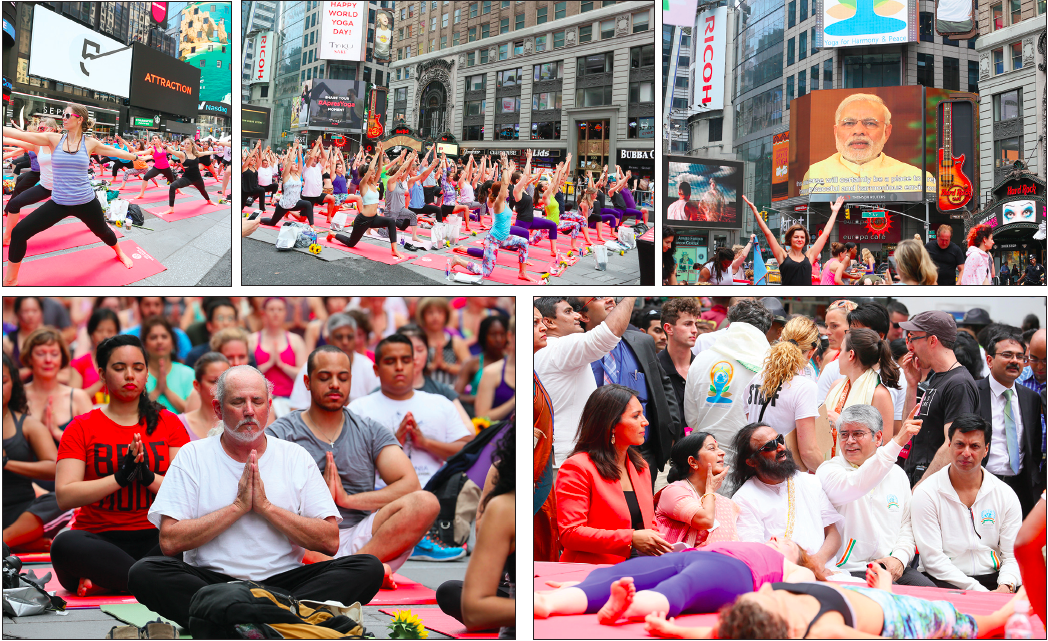
    NEW YORK (TIP): The Consulate General of India, along with several socio-cultural organizations based in and around New York, organized International Day of Yoga (IDY) celebrations on June 21, 2015 at more than 50 places in and around the city. Thousands participated in these events with great pride and enthusiasm.

    External Affairs Minister Sushma Swaraj represented the Government of India at the Annual  Event of Yoga (Summer Solstice) at Times Square and the Hindu Temple Society of North America, Flushing. Congresswoman Tulsi Gabbard, who has introduced a Resolution in the Senate in support of the IDY and Madhur Bhandarkar, Film Director, also participated and cheered up the participants at the Times Square where close to 20,000 people participated throughout the day.

    India's External Affairs Minister Sushma Swaraj addresses the huge gathering of Yoga lovers at the iconic Times Square in New York
    India’s External Affairs Minister Sushma Swaraj addresses the huge gathering of Yoga lovers at the iconic Times Square in New York , June 21. Seen in the picture, from L to R: Congresswoman Tulsi Gabbard, Sushma Swaraj, Ambassador Asoke Mukerji, Consul General Dnyaneshwar Mulay

    With the support of the Consulate, the Art of Living Foundation (Sri Sri Ravi Shankar), Global Citizen Forum (B.K. Modi Group) organized a three hours program, including yoga, meditation, dance drama on yoga and finally East Meets West by  Bhappi Lahri and Judge M. Kelly, famous Jazz maestro. Sri Sri Ravi Shankar, B.K. Modi, Judge Kelly, Bhappi Lahiri, Ambassador Arun Kumar Singh and Ambassador Nassir Abdulaziz Al-Nasser addressed the 2700 strong supporters of yoga at the auditorium. Similarly, Hindu Temple Society of North America organized a day-long yoga and related events. External Affairs Minister participated in the closing ceremony and released a book titled “Yoga-Bharat’s Invaluable Gift to the World” by Mr. V. Ravi Kumar Iyer. The Consulate had also organized yoga lecture-cum-demonstration at the airports of New York and New Jersey. Passengers practiced yoga while waiting in transit. Photos of these events are available on www.indiacgny.org

    The State Senates  of New Jersey, New York, Massachusetts and Westchester as well as several City Councils have issued Proclamations and felicitation messages to support and commemorate the first International Day of Yoga. Several Senators, Congressmen, Mayors and Councilmen have sent their appreciation letters to the Consulate on the occasion.

    Indian-American communities represented by several Socio-Cultural organizations including the Overseas Volunteers for Better India (OVBI) were wholeheartedly involved in these events. The Consulate was also supported by  Tech Mahindra, the leader in digitalization and business re-engineering for organizing these events.

    Following the United Nations Resolution to declare International Day of Yoga on June 21 every year, the Consulate had been organizing yoga related various Curtain Raisers as well as yoga events in areas under the consular jurisdiction of this Consulate. Curtain Raisers were organized in Albany and Queens on June 9 and June 13 respectively. Yoga and related events would continue to be organized throughout the year at different places by this Consulate from time to time.

  • International Day of Yoga celebrated at the United Nations

    International Day of Yoga celebrated at the United Nations

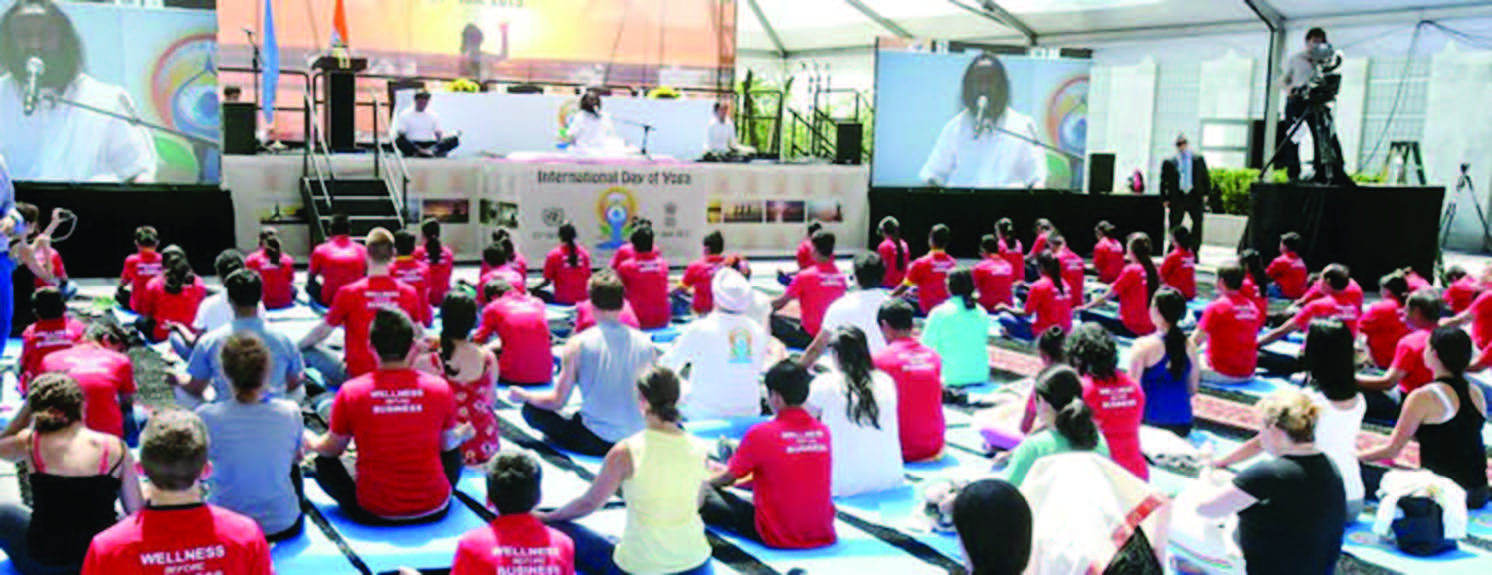
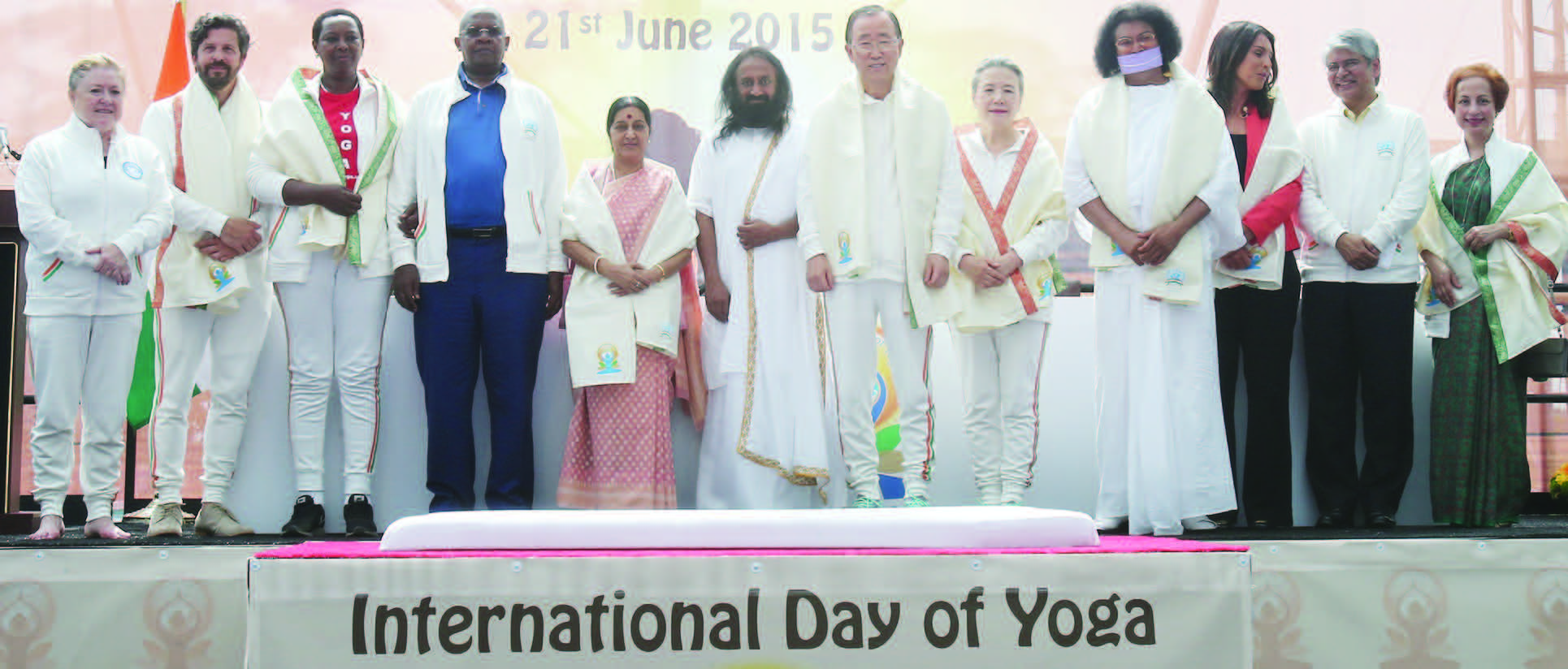
    NEW YORK (TIP): The First International Day of Yoga was celebrated at the United Nations on Sunday, 21st June.

    The Function, held under the threat of heavy rain, was presided over by the External Affairs Minister of India Sushma Swaraj and attended by the UN Secretary General, the President of the 69th UN General Assembly, diplomats and Congresswoman Tulsi Gabbard.

    It also featured a special lecture cum demonstration by the Founder of Art of Living Foundation, Sri Sri Ravi Shankar.

    The function was broadcast live globally on UN TV, as well as to an audience of thousands at Times Square, New York, where another celebration of the Solstice Day was observed with thousands performing yoga exercises.

    Around 250 persons participated in the yoga conducted by Sri Sri Ravi Shankar. The UN Secretary General Ban ki moon and his wife; Congresswoman Tulsi Gabbard; diplomats; as also Permanent Representative of India to the United Nations Ambassador Asoke Mukerji and Consul General Dnyaneshwar Mulay joined in the yoga  exercises. It will be pertinent to recall that the 69th Session of the United Nations General Assembly adopted by acclamation draft Resolution A/Res/69/131 in December 2014, with a record number of 177 countries co-sponsoring it. The Resolution established the International Day of Yoga for observance by the United Nations on 21st June each year.

    The idea for declaring an International Day of Yoga at the United Nations was formally proposed by the Prime Minister of India, Narendra Modi, in his maiden address to the 69th UNGA on 27 September 2014. The Prime Minister had said:

    “We need to change our lifestyles. Energy not consumed is the cleanest energy. We can achieve the same level of development, prosperity and well being without necessarily going down the path of reckless consumption. It doesn’t mean that economies will suffer; it will mean that our economies will take on a different character. For us in India, respect for nature is an integral part of spiritualism. We treat nature’s bounties as sacred. Yoga is an invaluable gift of our ancient tradition. Yoga embodies unity of mind and body; thought and action; restraint and fulfillment; harmony between man and nature; a holistic approach to health and well being. It is not about exercise but to discover the sense of oneness with yourself, the world and the nature. By changing our lifestyle and creating consciousness, it can help us deal with climate change. Let us work towards adopting an International Yoga Day.”

    The  Prime Minister had indicated that 21st June, one of the two solstices, which is the longest day in the Northern Hemisphere, has special significance in many parts of the world, and could be considered for adoption as the International Day of Yoga by the United Nations each year.

  • Indian PM & World Stretches Together: 10 Best Pics of Yoga Day from India

    Indian PM & World Stretches Together: 10 Best Pics of Yoga Day from India

    Delhi’s India Gate all decked up for Yoga Day: Prime Minister Narendra Modi, who practices Yoga daily, launches the celebrations to mark the International Yoga Day. PM Modi made Yoga Day a key initiative of his government. “Yoga has the power to bring the entire humankind together!” PM Modi tweeted last year after pitching the idea of celebrating an International Yoga Day, during his speech to the UN General Assembly.
    Delhi's India Gate all decked up for Yoga Day
    Indian Army personnel doing yoga at Kargil
    Indian Army personnel doing yoga at Kargil
    Ravi Shankar Prasad takes part in International Yoga Day
    Ravi Shankar Prasad takes part in International Yoga Day
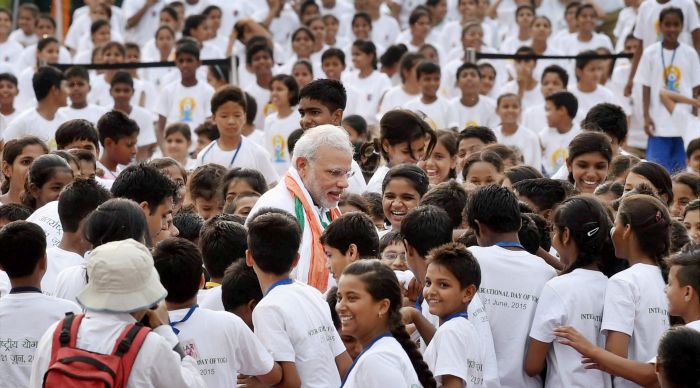
    New Delhi: Prime Minister Narendra Modi meeting with school children after participating in a mass yoga session to mark the International Day of Yoga 2015 at Rajpath in New Delhi on Sunday. PTI Photo by Atul Yadav(PTI6_21_2015_000081B)
    New Delhi: Prime Minister Narendra Modi meeting with school children after participating in a mass yoga session to mark the International Day of Yoga 2015 at Rajpath in New Delhi on Sunday. PTI Photo by Atul Yadav(PTI6_21_2015_000081B)
    The yoga asanas performed during the International Yoga Day at Rajpath were according to the Common Yoga Protocol
    The yoga asanas performed during the International Yoga Day at Rajpath were according to the Common Yoga Protocol
    Delhi Chief Minister Arvind Kejriwal, who practices yoga daily alongwith Deputy Chief Minister Manish Sisodia joined PM Modi
    Delhi Chief Minister Arvind Kejriwal, who practices yoga daily alongwith Deputy Chief Minister Manish Sisodia joined PM Modi
    Jharkhand Chief Minister Raghubar Das, taken as he performed Yoga.
    Jharkhand Chief Minister Raghubar Das, taken as he performed Yoga.
    New Delhi: Prime Minister Narendra Modi performs yoga along with thousands of others at a mass yoga session to mark the International Day of Yoga 2015 at Rajpath in New Delhi on Sunday. PTI Photo by Atul Yadav(PTI6_21_2015_000026B)
    New Delhi: Prime Minister Narendra Modi performs yoga along with thousands of others at a mass yoga session to mark the International Day of Yoga 2015 at Rajpath in New Delhi on Sunday. PTI Photo by Atul Yadav(PTI6_21_2015_000026B)
    New Delhi: Prime Minister Narendra Modi performs yoga along with thousands of others at a mass yoga session to mark the International Day of Yoga 2015 at Rajpath in New Delhi on Sunday. PTI Photo by Atul Yadav(PTI6_21_2015_000014B)
    New Delhi: Prime Minister Narendra Modi performs yoga along with thousands of others at a mass yoga session to mark the International Day of Yoga 2015 at Rajpath in New Delhi on Sunday. PTI Photo by Atul Yadav
  • ALL SET FOR INTERNATIONAL DAY OF YOGA CELEBRATIONS AT THE UN

    ALL SET FOR INTERNATIONAL DAY OF YOGA CELEBRATIONS AT THE UN

    NEW YORK CITY (TIP): Massive preparations are underway to commemorate the first International Day of Yoga on Sunday, June 21 at the United Nations and other locations in New York.

    Giving out details of the celebration of the first International Day of Yoga on June 21, India’s Permanent Representative to the United Nations Ambassador Asoke Mukerji, on June 17, told the media that the headline event will be at the UN headquarters where India’s external affairs minister Sushma Swaraj will be joined by UN Secretary General Ban Ki-moon, President of the General Assembly Sam Kutesa, Indian spiritual leader Sri Sri Ravi Shankar and several other diplomats.

    Mukerji said 256 cities in 192 counties, including Pakistan, Saudi Arabia, and Malaysia will be celebrating the first annual day of Yoga.

    It is estimated that “two billion (people) will have participated by the end of June 21 in commemorating the yoga day,” Mukerji added.

    He said Swaraj will reach New York on Saturday and will preside over the two-hour commemoration next day at the world body to be attended by hundreds, including school children from India and the UN International School.

    He added that Swaraj will be representing India as the country which had initiated the idea of having an annual international yoga day.

    Swaraj, along with the UN Chief and the UNGA President, would then head to Times Square where an estimated 30,000 people would perform Yoga and where the UN celebrations would also be broadcast live on the giant screens.

    Swaraj is also expected to attend a lecture and demonstration of Yoga at the Hindu Temple Society of North American and at an event at Lincoln Centre featuring Sri Sri Ravi Shankar.

  • HIGHER REACHES OF YOGA

    HIGHER REACHES OF YOGA

    You are healthy, fairly happy, and well-settled in life. Yet, there is a vague vacuum, a nagging feeling that there should be more to life. This amorphous condition ails many, often unbeknown even to them, but is known in psychiatry and psychology, more so in the past few decades when at least one of the streams of psychology started looking beyond mental illness at enhancing life and happiness, if not imbuing life with meaning.

    The hierarchy of needs in the model of human development postulated by Abraham Maslow, an American psychologist. The peak in this pyramid almost converges with the higher states of consciousness as described in mystic traditions.
    The hierarchy of needs in the model of human development postulated by Abraham Maslow, an American psychologist. The peak in this pyramid almost converges with the higher states of consciousness as described in mystic traditions.

    That stream is known as Humanistic Psychology-Transpersonal Psychology, which goes beyond the established Freudian and behaviorist schools. The most well known of the third school has been Abraham Maslow (1908-1970), an American psychologist who introduced a model of developmental psychology that has become well known not only in the field of psychology, but also in management and other human sciences. It describes five developmental stages, which are based on what Maslow calls human needs. Thus, his model is known as Maslow’s hierarchy of needs and depicted as a pyramid.

    At the base of this pyramid is Physiological Needs, including food, water, air, and sleep. And then on to Safety Needs Social Needs and Esteem Needs. At the peak is the need for Self-Actualization. In between Esteem and Self-Actualization needs, Maslow also later acknowledged the needs for aesthetics and knowledge.

    Point to be noted is that what the most enlightened, modern psychology is asserting lately has been addressed eons ago by the yogic sciences of India. Here we are, of course, talking about authentic yoga, which while possibly including body work or asana-pranayama as a foundation, is actually about encountering, examining, exploring, integrating and transcending the many levels, currents and crosscurrents of mind and consciousness.

    Most of us routinely experience three states of consciousness, namely, sleep, waking and dreaming states. In meditation, even a novice has flashes of a fourth state, when you subjectively feel you had blanked out, but coming out it did not feel like sleep. Brain wave pattern using the electro-encephalogram will confirm that you were not sleeping, you were alert yet in a deep state of rest. In yoga they call the state Samadhi. It is better understood as pure consciousness –  you are conscious, not of anything outside or inside, but of consciousness itself. It is like the snake eating its own tail. Beyond time and space, samadhi is transcendence of our mundane experience. Perhaps the craving for this transcendence goads so many to experiment with drugs, in particular psychedelics. There is also bliss.

    It is, however, important to note that there is a great difference between the terms Self-Actualization as postulated by Maslow and Self-Realization as in spirituality, with the former having to do with higher levels of fulfillment at the personality level, while still in relation to worldliness. Self-Realization has to do with that knowing of pure consciousness (or many other such terms), which is beyond, transcendent, or transpersonal. Maslow, too, in his later years, expanded his model to include the higher levels of human experience.

    But the bliss and beatitude that we see and sense in depictions of a Buddha, Mahavir, Nanak, Jesus or Krishna seem many times more. That is because they have attained enlightenment  (often shown in pictures as a halo) where they are able to sustain the bliss, the transcendence, the pure consciousness alongside other three states of consciousness. Guru Nanak described it as ‘naam khumari Nanka chadi rahe din raat’.

    A still higher state of consciousness is when pure consciousness experienced within is also witnessed as the stuff of which everything in the universe – animate and inanimate- is made of. I am That, Thou art That, All This is That – declare the three Veda mahavakyas, containing the highest knowledge uttered so simply yet profoundly. Science and spirituality are converging again because Quantum Theory too has reached the point where the source of all matter and energy is described as a vacuum, a nothingness that contains all the possibilities of everything that has ever existed or could exist.

    Mystics and munis would rather say that it is Immanent God that permeates everything. As Pope Francis wrote this week in his encyclical (a controversial document because it calls upon the human world to combat climate change to save the earth),
    “The universe unfolds in God, who fills it completely. Hence, there is a mystical meaning to be found in a leaf, in a mountain trail, in a dewdrop, in a poor person’s face.” The Pope quotes a ninth century mystical Muslim poet Ali-al-Khawas to bridge the gap between the creatures of the world and the interior experience of God: “The initiate will capture what is being said when the wind blows, the trees sway, water flows, flies buzz, doors creak, birds sing, or in the sound of strings or flutes, the sighs of the sick, the groans of the afflicted.”

    Most of us, caught as we are in our daily struggles, transient desires, grasping at this and that, have no time and inclination to take the road not taken – not in these times of ever-present distractions of text messages and YouTube videos and many forms of instant gratification. But the untrodden path promises untold riches, and sublime experience beyond the reach of our ordinary mind and intellect. The mystic streams of major world religions offer the wherewithal to guide the seeker on the odyssey and shining examples in the many prophets and men of God who scaled the higher reaches of yoga and lived to tell the world.

  • Everything you always wanted to know about Yoga

    Everything you always wanted to know about Yoga

    What is Yoga?

    Yoga is essentially a spiritual discipline based on an extremely subtle science which focuses on bringing harmony between mind and body. It is an art and science for healthy living. The word “Yoga” is derived from the Sanskrit root yuj meaning “to join”, “to yoke” or “to unite”. According to Yogic scriptures, the practice of Yoga leads to the union of individual consciousness with universal consciousness. According to modern scientists, everything in the universe is just a manifestation of the same quantum firmament. One who experiences this oneness of existence is said to be “in Yoga” and is termed as a yogi who has attained a state of freedom, referred to as mukti, nirv?na, kaivalya or moksha.

    “Yoga” also refers to an inner science comprising of a variety of methods through which human beings can achieve union between the body and mind to attain self-realization. The aim of Yoga practice (sadhana) is to overcome all kinds of sufferings that lead to a sense of freedom in every walk of life with holistic health, happiness and harmony.

    Brief history and development of Yoga

    The science of Yoga has its origin thousands of years ago, long before the first religion or belief systems were born. According to Yogic lore, Shiva has seen as the first yogi or
    ?diyogi and the first guru or ?diguru. Several thousand years ago, on the banks of lake Kantisarovar in the Himalayas, ?diyogi poured his profound knowledge into the legendary saptarishis or “seven sages”. These sages carried this powerful Yogic science to different parts of the world including Asia, the Middle East, northern Africa and South America. Interestingly, modern scholars have noted and marveled at the close parallels found between ancient cultures across the globe. However, it was in India that the Yogic system found its fullest expression. Agastya, the saptarishi who traveled across the Indian subcontinent, crafted this culture around a core Yogic way of life.

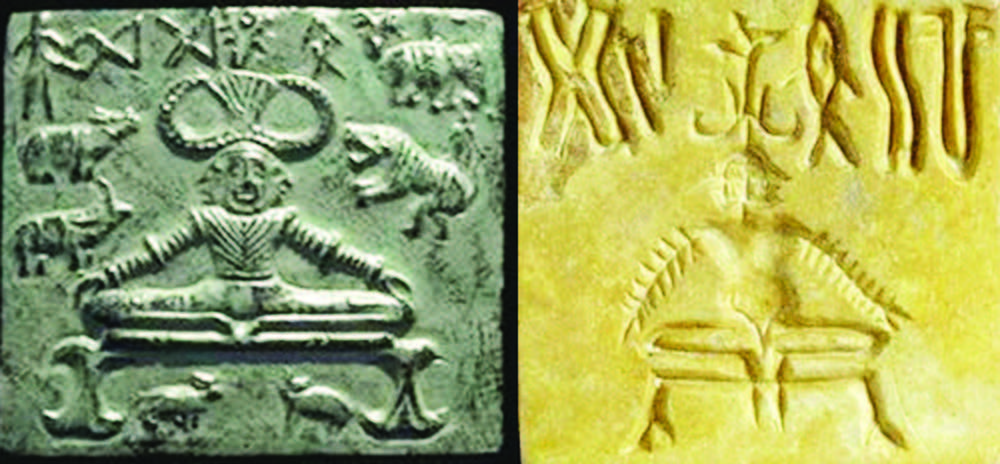
    Yoga is widely considered as an “immortal cultural outcome” of the Indus Saraswati Valley Civilization – dating back to 2700 BC – and has proven itself to cater to both material and spiritual uplift of humanity. A number of seals and fossil remains of Indus Saraswati Valley Civilization with Yogic motifs and figures performing Yoga sadhana suggest the presence of Yoga in ancient India. The seals and idols of mother Goddess are suggestive of Tantra Yoga. The presence of Yoga is also available in folk traditions, Vedic and Upanishadic heritage, Buddhist and Jain traditions, Darshanas, epics of Mahabharata including Bhagawadgita and Ramayana, theistic traditions of Shaivas, Vaishnavas and Tantric traditions. Though Yoga was being practiced in the pre-Vedic period, the great sage Maharishi Patanjali systematized and codified the then existing Yogic practices, its meaning and its related knowledge through Patanjali’s Yoga Sutras.

    After Patanjali, many sages and Yoga masters contributed greatly for the preservation and development of the field through well documented

    Fundamentals of Yoga

    Yoga works on the level of one’s body, mind, emotion and energy. This has given rise to four broad classifications of Yoga: Karma Yoga where we utilize the body; Jn?na Yoga where we utilize the mind; Bhakti Yoga where we utilize the emotion and Kriya Yoga where we utilize the energy. Each system of Yoga we practice falls within the gamut of one or more of these categories.

    Every individual is a unique combination of these four factors. Only a guru (teacher) can advocate the appropriate combination of the four practices and literature. Yoga has spread all over the world by the teachings of eminent Yoga masters from ancient times to the present date. Today, everybody has conviction about Yoga practices towards the prevention of disease, maintenance and promotion of health. Millions and millions of people across the globe have benefited by the practice of Yoga and the practice of Yoga is blossoming and growing more vibrant with each passing day.

    Traditional schools of Yoga

    The different philosophies, traditions, lineages and guru-shishya paramparas of Yoga led to the emergence of different traditional schools. These include Jn?na Yoga, Bhakti Yoga, Karma Yoga, Patanjala Yoga, Kund? a? lini Yoga, Ha?ha Yoga, Dhyana Yoga, Mantra Yoga, Laya Yoga, Raja Yoga, Jain Yoga, Bouddha Yoga etc. Each school has its own approach and practices that lead to the ultimate aim and objectives of Yoga.

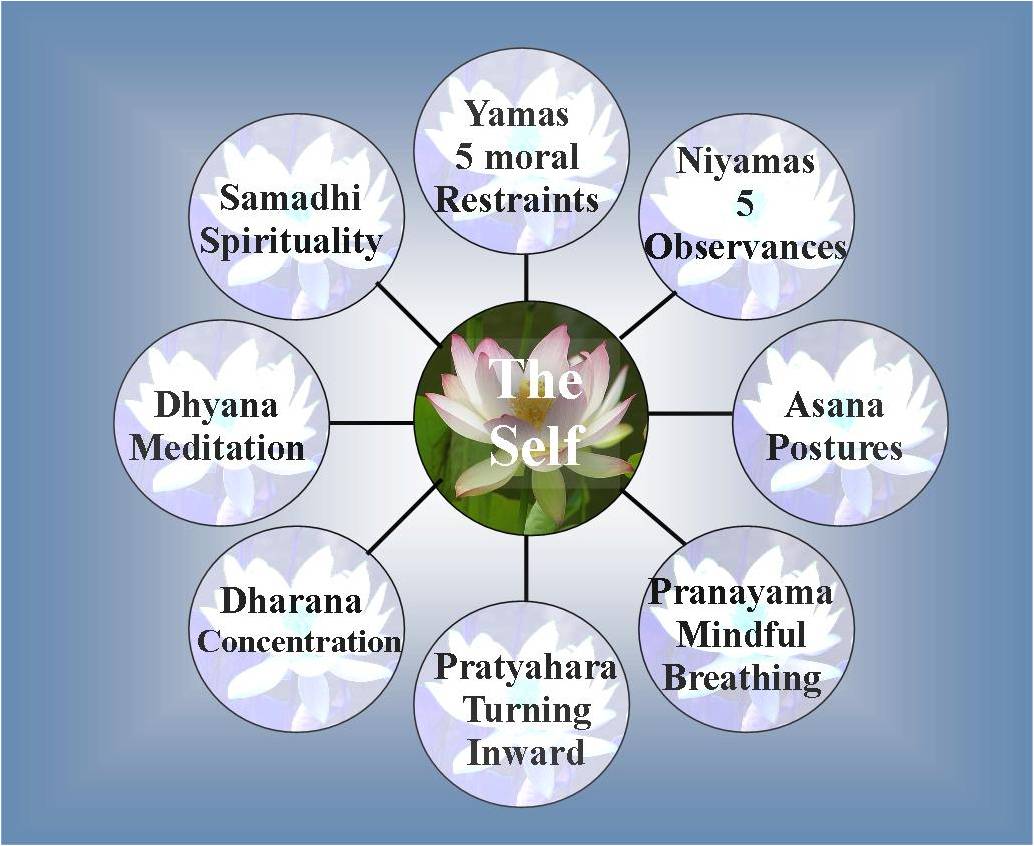
    The widely practiced Yoga sadhanas are: Yama, Niyama, ?sana, Pr?n?y?ma, Praty?hara, Dh?rana, Dhy?na, Sam?dhi, Bandhas and Mudras, Shatkarmas, Yukt?h?ra, Mantra-japa, Yukta-karma etc. Yamas are restraints and Niyamas are

    observances. These are considered to be pre-requisites for further Yogic practices. ?sanas, capable of bringing about stability of body and mind, “kuryat-tadasanam- sthairyam”, involve adopting various psycho-physical body patterns and giving one an ability to maintain a body position (a stable awareness of one’s structural existence) for a considerable length of time.

    Pranayama consists of developing awareness of one’s breathing followed by willful regulation of respiration as the functional or vital basis of one’s existence. It helps in developin awareness of one’s mind and helps to establish control over the mind. In the initial stages, this is done by developing awareness of the “flow of in-breath and out-breath” (sv?sa-prasv?sa) through nostrils, mouth and other body openings, its internal and external pathways and destinations. Later, this phenomenon is modified, through regulated, controlled and monitored inhalation (sv?sa) leading to the awareness of the body space getting filled (puraka), the space(s) remaining in a filled state (kumbhaka) and it getting emptied (rechaka) during regulated, controlled and monitored exhalation (prasv?sa). Praty?hara indicates dissociation of one’s consciousness (withdrawal) from the sense organs which connect with the external objects.
    Dh?rana indicates broad based field of attention (inside the body and mind) which is usually understood as concentration.

    Dhyana (meditation) is contemplation (focused attention inside the body and mind) and Samadhi (integration).

    Bandhas and Mudras are practices associated with Pranayama. They are viewed as the higher yogic practices that mainly adopt certain physical gestures along with control over respiration. This further facilitates control over mind and paves way for higher Yogic attainment. However, practice of dhy?na, which moves one towards self-realization and leads one to transcendence, is considered the essence of Yoga Sadhana. karmas are detoxification procedures that are clinical in nature and help to remove the toxins accumulated in the body. Yuktahara advocates appropriate food and food habits for healthy living.

    Yoga in the White House. US  First Lady Michelle Obama has promoted Yoga in the White House
    Yoga in the White House. US First Lady Michelle Obama has promoted Yoga in the White House

    General Guidelines for Yoga Practice 

    A Yoga practitioner should follow the guiding principles given below while performing Yogic practices:

    BEFORE THE PRACTICE

    • Sauca means cleanliness – an important prerequisite for Yogic practice. It includes cleanliness of surroundings, body and mind.
    • Yogic practice should be performed in a calm and quiet atmosphere with a relaxed body and mind.
    • Yogic practice should be done on an empty stomach or light stomach. Consume small amount of honey in lukewarm water if you feel weak.
    • Bladder and bowels should be empty before starting Yogic practices.
    • A mattress, Yoga mat, durrie or folded blanket should be used for the practice.
    • Light and comfortable cotton clothes are preferred to facilitate easy movement of the body.
    • Yoga should not be performed in state of exhaustion, illness, in a hurry or in acute stress conditions.
    • In case of chronic disease/ pain/ cardiac problems, a physician or a Yoga therapist should be consulted prior to performing Yogic practices.
    • Yoga experts should be consulted before doing Yogic practices during pregnancy and menstruation.

    DURING THE PRACTICE

    • Practice sessions should start with a prayer or invocation as it creates a conducive environment to relax the mind.
    • Yogic practices shall be performed slowly, in a relaxed manner, with awareness of the body and breath.
    • Breathing should be always through the nostrils unless instructed otherwise.
    • Do not hold body tightly, or jerk the body at any point of time.
    • Perform the practices according to your own capacity. ·It takes some time to get good results, so persistent and regular practice is very essential.
    • There are contra-indications/ limitations for each Yoga practice and such contra-indications should always be kept in mind.
    • Yoga session should end with meditation/ deep silence / ?h?nti pa?ha.

    AFTER THE PRACTICE

    • Bath may be taken only after 20-30 minutes of practice.
    • Food may be consumed only after 20-30 minutes of practice.

    FOOD FOR THOUGHT

    A few dietary guidelines can ensure that the body and mind are flexible and well-prepared for practice. A vegetarian diet is usually recommended, and for a person over 30 years, two meals a day should suffice, except in cases of illness or very high physical activity or labor.

    HOW YOGA CAN HELP

    Yoga is essentially a path to liberation from all bondage. However, medical research in recent years has uncovered many physical and mental benefits that Yoga offers, corroborating the experiences of millions of practitioners. A small sampling of research shows that:

    • Yoga is beneficial for physical fitness, musculoskeletal functioning and cardio-vascular health.
    • It is beneficial in the management of diabetes, respiratory disorders, hypertension, hypotension and many lifestyle related disorders.
    • Yoga helps to reduce depression, fatigue, anxiety disorders and stress.
    • Yoga regulates menopausal symptoms.
    • In essence, Yoga is a process of creating a body and mind that are stepping-stones, not hurdles, to an exuberant and fulfilling life.
  • Modern Masters of YOGA

    Modern Masters of YOGA

    Tirumalai Krishnamacharya
    Tirumalai Krishnamacharya (1888 – 1989)

    He is considered “The Father of Modern Yoga. Certainly, one of the most influential yoga teachers of the 20th century and is credited with the revival of hatha yoga.

    While under the patronage of the Maharaja of Mysore, Krishnamacharya traveled around India giving lectures and demonstrations to promote yoga, including such feats as stopping his heartbeat. He is widely considered as the architect of vinyasa, in the sense of combining breathing with movement. Underlying all of Krishnamacharya’s teachings was the principle “Teach what is appropriate for an individual.”

    Some of Krishnamacharya’s students include many of yoga’s most renowned teachers: his son T.K.V. Desikachar (born 1938), Indra Devi (1899-2002), K. Pattabhi Jois (1915- 2009), and brother-in-law B. K. S. Iyengar (1918-2014).


    B.K.S. Iyengar
    B.K.S. Iyengar (1918 – 2014)

    “Yoga, an ancient but perfect science, deals with the evolution of humanity. This evolution includes all aspects of one’s being, from bodily health to self – realization.”

    “Yoga means union-the union of mind with consciousness, and consciousness with the soul. Yoga cultivates the way of maintaining a balanced attitude in day to day life and endows skill in the performance of ones’ actions.”

    “The light that Yoga sheds on life is something special. It is transformative. It does not change the way we see thing; it transforms the person who sees.”

    “Yoga is like music. The rhythm of the body, the melody of the mind, and the harmony of the soul create the symphony of life.”

    Iyengar was the founder of the style of yoga known as
    “Iyengar Yoga” and was considered one of the foremost yoga teachers in the world. He was the author of many books on yoga practice and philosophy including Light on Yoga, Light on Pranayama, Light on the Yoga Sutras of Patanjali, and Light on Life. Iyengar was one of the earliest students of Tirumalai Krishnamacharya. He has been credited with popularizing yoga, first in India and then around the world, with his headquarters in Pune. His use of yoga aids like ropes and blocks during asana practice was innovative.

    Iyengar was awarded the Padma Shri in 1991, the Padma Bhushan in 2002 and the Padma Vibhushan in 2014. In 2004, Iyengar was named one of the 100 most influential people in the world by Time magazine.


    Sri K. Pattabhi Jois  (1915-  2009)

    Gurubhai of BKS Iyengar, he developed the popular style of yoga referred to as Ashtanga Vinyasa Yoga or Ashtanga Yoga, which has been popular in the West. In 1948, Jois established the Ashtanga Yoga Research Institute  in Mysore. In his book “Yoga Mala” he recommends staying 5-8 breaths in a posture, or, staying for as long as possible in a posture. Breathing instructions given are to do rechaka and puraka (exhale and inhale) as much as possible.


    Sivananda Saraswati (1887 - 1963)
    Sivananda Saraswati (1887 – 1963)

    Swami Sivananda was a Hindu spiritual teacher and a proponent of Yoga and Vedanta. Born Kuppuswami in Tirunelveli district of Tamil Nadu, he studied medicine and served in British Malaya as a physician for several years before taking up monasticism. He lived most part of his life in Rishikesh.
    He was the founder of the Divine Life Society, and author of over 200 books on yoga, Vedanta and a variety of subjects. Some of his main disciples went on to start worldwide yoga movements.


    Vishnudevananda Saraswati (1927 - 1993)
    Vishnudevananda Saraswati (1927 – 1993)

    He was a disciple of Sivananda Saraswati, and founder of the International Sivananda Yoga Vedanta Centres and Ashrams. He established the Sivananda Yoga Teachers’ Training Course, one of the first yoga teacher training programs in the West. His books The Complete Illustrated Book of Yoga (1959) and Meditation and Mantras (1978) established him as an authority on Hatha and Raja yoga. Vishnudevananda was a tireless peace activist who rode in several “peace flights” over places of conflict, including the Berlin Wall prior to German reunification.


    Yogi Bhajan  (1929 - 2004)
    Yogi Bhajan (1929 – 2004)

    Harbhajan Singh Khalsa (later Yoga Bhajan) was born in 1929 into a Sikh family in Gujranwala district, in what is now Pakistan’s province of Punjab. He was a spiritual leader and entrepreneur who introduced Kundalini Yoga to the United States. He was the spiritual director of the 3HO (Healthy, Happy, Holy Organization) Foundation, with over 300 centers in 35 countries. Under his influence, tens of thousands turned to Sikh way of life. He passed away in Espanola, New Mexico.


    Satyananda Saraswati/Bihar School of Yoga (1923 -2009)

    He was a sannyasin, yoga teacher and guru in both his native India and the West. He was a student of Sivananda Saraswati, and founded the Bihar School of Yoga in 1964 in Munger, Bihar. He wrote over 80 books, including Asana Pranayama Mudra Bandha. In 1988 he  handed over the active work of his ashram and organization to his spiritual successor, Niranjanananda Saraswati, and left Munger.


    Born in Calcutta and having a yoga empire in America, Bikram Choudhury has a yoga style name after him. Bikram Yoga is a system of yoga that he synthesized from traditional hatha yoga techniques  and popularized beginning in the early 1970s. All Bikram Yoga Beginning Series classes run for 90 minutes and consist of the same series of 26 postures, including two breathing exercises. Bikram Yoga is ideally practiced in a room heated to 40 °C (104 °F) with a humidity of 40%. All official Bikram classes are taught by Bikram-certified teachers.

    Bikram ChoudhuryBikram Choudhury made claims starting 2012 that the postures of his yoga practice, were under copyright and that they could not be taught or presented by anyone whom he had not authorized. But the United States Copyright Office issued a clarification that yoga postures  could not be copyrighted in the way claimed by Bikram.

    In another controversy, at least five women were suing Bikram Choudhury with allegations including sexual harassment and sexual assault.

  • Let us Celebrate Yoga

    Prime Minister of India , Narendra Modi  is known to be deeply steeped in the Hindu tradition. Imbibing pristine Hindu values early on in his life through his association with Rashtriya Swayamsevak Sangh (RSS) , Modi well understands the significance  of traditional values  and  the importance of culture.

    Ever since he came in to politics, and more particularly, on the national political scene, India has witnessed  a clear inclination on the part of the government to promote  the tradition and values of the age old Hindu culture. Modi’s concern is pretty obvious the way changes are sought to be brought about in the domain of education and culture.

    Moving on to Yoga, a distinct mark of Hindu way of life  from olden times, Yoga has always  been placed on a high pedestal and considered to have  a formative and curative power. In the words of one of the earliest and the greatest practitioners of Yoga, B.K.S. Iyengar, “Yoga means union – the union of body with consciousness, and consciousness with the soul. Yoga cultivates the way of maintaining a balanced attitude in day to day life, and endows skill in the performance of one’s actions”.

    Yoga is health giving- an aspect of Yoga which is the most popular one. And it is this aspect which more or less gets emphasized and proves attractive to people.

    Thus, on the suggestion of Prime Minister of India, during his address to the UN General Assembly in October, 2014 , 177 member  nations  of the United Nations adopted unanimously a resolution to observe June 21 as International Day of Yoga.

    It is heartening to know that an old science of India has received such overwhelming  support among the nations of the world who are now all set to celebrate the day this coming Sunday.

    On the purely material side, Yoga holds promise of a multi-billion dollar business. A Yogi Harbhajan not only created  a large following in the US but also made a lot of money through Yoga. One can expect great job opportunities for thousands of yoga instructors and gurus who would  reach over to distant parts of the world, and like Yogi Harbhajan, create their own empires. One can expect these people to bring to India a lot of foreign exchange. Yoga then would be a sound business proposition and Prime Minister Modi understands business well, as he himself has claimed.

    Let us celebrate, them, with all enthusiasm and zeal, the first International Day of Yoga, this coming Sunday, June 21, 2015.

  • 30,000 Expected at New York’s International Yoga Day Celebration

    30,000 Expected at New York’s International Yoga Day Celebration

    As the world celebrates International Day of Yoga on Sunday in a unique event that is in many ways an endorsement of the Indian way of life, more than 30,000 people are expected to participate in a mass demonstration of the ancient art in the city’s Times Square after global leaders and diplomats from around the world launch the observance at the UN headquarters.

    Secretary-General Ban Ki-moon is to deliver the keynote address at the start of the day’s celebrations at the UN headquarters in an open plaza along the East River, India’s Permanent Representative Asoke Kumar Mukerji told reporters in New York on Tuesday. General Assembly President Sam Kutesa and External Affairs Minister Sushma Swaraj are slated to speak on the occasion along with representatives of some of the nations that co-sponsored the International Day of Yoga resolution.

    Sri Sri Ravishankar, the founder of the Art of Living Foundation is to give a lecture on the benefits of yoga and lead a demonstration by several hundred people at the UN and, through a video link, the thousands on Times Square, which is known as “the crossroads of the world.”

    The UN celebrations are to be webcast on the UN network and also shown on the NASDAQ market building’s giant, seven storey-tall video screen and others on Times Square.

    “Yoga offers a simple, accessible and inclusive means to promote physical and spirtual health and well-being,” Ban Ki-moon said in his message for International Day of Yoga. “It promotes respect for one’s fellow human beings and for the planet we share.”

    He said that he had tried out yoga by doing the tree pose or Vrksasana and “appreciated the simple sense of satisfaction that yoga can bring.”

    A manifestation of the universal value of “vasudhaiva kutumbakam” — the world is one family, the UN General Assembly resolution for International Day of Yoga was co-sponsored by 177 nations and adopted by acclamation by the 193-member organisation, Mr Mukerji said. This was the largest number of co-sponsors ever for such a resolution, he added.

    The idea of an International Day of Yoga was proposed by Prime Minister Narendra Modi in his address to the General Assembly last September, calling yoga “a holistic approach to health and well-being” and to finding “the sense of oneness with yourself, the world and the nature.”

    “Yoga embodies the unity of mind and body; thought and action; restraint and fulfilment; the harmony between man and nature; a holistic approach to health and well-being. It is not about exercise but to discover the sense of oneness with yourself, the world and the nature.”

    For yoga day to be observed starting this year, Mr Mukerji said the resolution for it had to be passed by the General Assembly before the end of last year but the calendar had already been set with no room for fresh items.

    The Indian Mission found a way around this by invoking the association of PM Modi made between health and yoga, Mr Mukerji said. They had the Yoga Day resolution introduced as part of the health agenda that was already on the calendar for December, he said.

    The Mission brought the full force of multilateral diplomacy to bear on the project, he said. The Indian diplomats were able to have the 18 co-sponsors they initial had snowball to reach a total of 177 co-sponsors. And when both the United States and China signed on, the effort gained momentum.

    Asked by a reporter about the role of Muslim countries as co-sponsors and the controversies raised in India by some Muslims, Mr Mukerji said yoga was presented as a health matter with no religious undertones and he pointed out that 47 of the 56 members of the Muslim grouping, the Organisation of Islamic Cooperation, joined as co-sponsors. While Pakistan and Saudi Arabia did not co-sponsor, they did not object to the resolution either.

  • YOGA IS SKILL IN ACTION

    YOGA IS SKILL IN ACTION

    HELPFUL TIPS FOR YOGA PRACTICE sideThough spelt yoga in English, the Hindi-Sanskrit pronunciation is yog. Every schoolboy in India knows the meaning of yog as ‘to add’. But here we are talking about  the meaning of yoga as “to join” or “to unite” from the root yuj.

    Although yoga as philosophy and system was codified by Sage Patanjali around 200 BC, it is much older, its references are found in Vedic literature.

    To understand the spiritual dimension of yoga, here we will confine ourselves to the definition of yoga by Patanjali himself and two widely known  and quoted fragments of verses in Bhagavad Gita.

    First, Patanjali. In the very second of his 192 sutras, he says,

    (Yogash chitta vritti nirodhah).
    (Yogash chitta vritti nirodhah)

    It means, yoga is the cessation of the fluctuations of the mind or thought impulses. In other words, you are doing yoga in order to achieve a stillness and clarity of mind. But many meditators take it to mean consciously and forcefully trying to stop thoughts. That is difficult to achieve. What does work is creating the right conditions allowing the mind to settle down. In Indian spirituality mind is often compared to a monkey, difficult to control. But lead the monkey to a bunch of bananas, and it will settle down. So it is with the mind. Lead it with meditation  towards the source of happiness within (the Kingdom of God is within you, said Jesus), and it gravitates towards that and thoughts subside, eventually leading to the yogic state of samadhi.

    In a later sutra, Patanjali also lists five things that cause klesha or obstacles in achieving a state of yoga. These are: ignorance, I-ness, desire, aversion and attachment. And he suggests ways to be rid of them.

    Now Gita.

    Screen Shot 2015-06-13 at 3.31.12 PM

    In this verse, Lord Krishna is advising Arjuna to perform action while established in yoga, or dwelling in union with the Divine, and at the same time renouncing all attachments. He is advising Arjuna to remain in a state of equipoise in both success and failure. This is Karma Yoga philosophy that leads to equilibrium or equanimity of mind. When all our actions are performed while dwelling in Divine in this manner, we truly start living the ‘Work is Worship’ philosophy. One common misinterpretation of this verse is: never desire the fruits of action. It is wrong because results are inevitable. Action begets reaction. It is the worrying about the desired results that causes anxiety.

    Yoga again is central to this statement of Gita.

    Screen Shot 2015-06-13 at 3.33.54 PM
    (Yogah Karmasu Kaushalam)

    It simply means, ‘yoga is skill in action’. Even the reverse may be true. Skill in action is yoga.

    The full verse ending in Yogah Karmasu Kaushalam says: One who is equipped with equanimity in this life discards both merit and sin. Therefore remain established in yoga; yoga results in perfect action.

    This is where Krishna starts addressing Arjuna’s inaction – almost a catatonic state. The warrior prince is bedeviled by doubts arising from concerns about fighting and slaying his uncles and cousins. Krishna argues that if one performs svadharma with equanimity, one doesn’t have to constantly ponder whether an action will beget merit or sin. We begin to detach ourselves from the results or fruits of our actions, we will also not get attached to merit and sin.

    Interestingly, Indian philosophy for long was considered renunciatory and escapist, for which partly to blame was this simplistic understanding of Gita: Karam karo phal ki ichcha mat karo. Imagine, the sermon of Gita is given on a battleground, the acme of action!

    You may think this is spiritual mumbo-jumbo, and ask, “What is in this for me in practical terms?”  Well, one can show ‘yoga is skill in action’ translating as increased efficiency and improved productivity. Yes, since the 1950 there have been umpteen research studies on meditation’s psycho-physiology  and the effects of regularly experiencing the meditative state (yoga)  on everyday life.

    What is well established by now is that meditation slows down the metabolism while mental alertness instead of reducing  (as seen when one is  drowsy) is actually enhanced. This unique state of consciousness called restful alertness is different from the three states of consciousness, which we normally experience, namely sleep, dreaming and wakefulness. And it washes away tension and stress. As a result, quality of sleep improves. There is relief in psychosomatic diseases like high blood pressure, ulcers, and migraine. Brain waves (as graphed by EEG or electroencephalogram) become more coherent and synchronous. More energy, ability to concentrate and a positive attitude all add up to improve efficiency and in turn productivity. The overall quality of life becomes better.

    From the various forms of meditation, Transcendental Meditation or TM as taught by Maharishi Mahesh Yogi ruled the roost for a few decades. Lately, mindfulness is finding favor in the corporate world as well as hospitals and health centers in America. Mindfulness comes from Buddhism if not the Buddha himself and has been popularized in our time by France based Vietnamese Zen master Thich Nhat Hanh. Mindfulness is a state of active, open attention on the present. When you’re mindful, you observe your thoughts and feelings from a distance, without judging them good or bad. Instead of letting your life pass you by, mindfulness means living in the moment and awakening to experience.

    As you can see, there is no religious symbolism, no belief system involved here. It is as secular as you can get. So is yoga.


  • All set for celebration of International Day of Yoga

    All set for celebration of International Day of Yoga

    NEW YORK CITY (TIP):”Our aim is to make Yoga the mantra of our time”, said Consul General Dnyaneshwar Mulay at the meeting, June 12, to review the preparations for celebrating the International Day of Yoga on June 21.


    “The Indian Consulate has taken the lead to bring together a lot many Indian American organizations, Americans and people from various communities to celebrate the day in the true spirit of “Yoga” – the union.”


    Ambassador Mulay said, “177 countries co-sponsored the United Nations resolution to declare International Day of Yoga (IDY) on June 21st every year” which was being celebrated in 191 countries across the world. He also gave out the news that the New York State will celebrate Indian Heritage Month in August when India will be celebrating its Independence.


    The meeting was attended by a number of organizations which are involved in organizing Yoga camps in and around New York. These included Art of Living, represented by Ruchika Lal; Global Citizens’ Forum, represented by Dr. B.K. Modi; Tech Mahindra, represented by Ram Chatty; Overseas Volunteers for a Better India (OVBI), represented by Anil Sharma; Hindu Temple Society of North America, represented by Indira Narasimharajan and a few others. Each of the organizing groups briefed the gathering which included local media, about the preparations they had made.


    The Deputy Consul General Manoj Mohapatra informed about the visits by India’s Finance Minister Arun Jaitley on June 17th and 18th, and by the Maharashtra Chief Minister later in month. He also announced that the Foreign Affairs Minister of India, Mrs. Sushma Swaraj will be attending the celebrations of IDY in New York as a representative of government of India.


    Mr. Mohapatra also outlined the proposal to have the media persons transported to various yoga locations. This is something new which was appreciated by the media present at the meeting.


    Earlier, the Consul General listed some major yoga locations. The day (June 21) will start with International Day of Yoga being celebrated at the United Nations. The second major event will be at the Times Square. The third is the Yoga camp at the Hindu Temple in Flushing. And to cap it all, at the Lincoln Center which is being organized by The Art of Living Foundation.


    The Indian Consulate released a press note saying ,” Following the resolution, with the support of Tech Mahindra, the Indian Consulate in New York intends to bring together a large number of diverse Indian-American Communities and institutions for celebrating the first International Day of Yoga (IDY) in a befitting manner in and around New York on 21 June, 2015. Tech Mahindra, a leader in digital transformation, consulting and business reengineering, is the technology partner for the IDY.  The company has been extensively involved in making the iYoga Day and corresponding events across the country successful and impactful.  Besides the Consulate, they also directly support the IDY events at Airports in New York, Lincoln Center and Boston.


    “To represent the Government of India, a high-level delegation led by Minister for External Affairs Smt. Sushma Swaraj would be visiting New York from June 20-22, 2015. Besides her participation in the International Day of Yoga at the United Nations in the morning on June 21st, she is expected to participate in the Annual Event of Yoga (Summer Solstice) by Time Square Alliance (Venue: Time Square) from 1230-1300 hrs; Lecture and Demonstration of Yoga at Hindu Temple Society of North American (Venue: Ganesh Temple) from 1530 -1600 hrs and Yoga – A new dimension with Sri Sri Ravi Shankar (Art of Living Foundation) & Dr. B. K. Modi (Global Citizen Forum) [Venue: Lincoln Centre] from 1900-1930 hours. Details of the major events are given on the backside.


    “In its resolution, the UNGA recognised that Yoga provides a holistic approach to health and well-being and wider dissemination of information about the benefits of practicing Yoga for the health of the world population. Yoga also brings harmony in all walks of life and thus, is known for disease prevention, health promotion and management of many lifestyle-related disorders. Keeping these in mind, the Government of India has adopted IDY Logos and a Common Yoga Protocol, a booklet intended to give a brief overview about Yoga and Yogic practices in order to orient the readers towards comprehensive health for an individual and the community. The details are available on www.indiacgny.org”.

  • HELPFUL TIPS FOR YOGA PRACTICE

    HELPFUL TIPS FOR YOGA PRACTICE

    If you have been practicing yoga asana for some time, some of these tips won’t be new to you. For the neophyte, certainly the advice will come handy.

    HELPFUL TIPS FOR YOGA PRACTICE sidePREPARATION: Best time to practice asanas is in the morning. Finish your ablutions, have a bath, and practice before breakfast. Wear loose, comfortable clothes. No shoes or belts. Best is to buy a sticky yoga mat (costs $10 onward) though a folded soft blanket will do too. The surface to do yoga should be neither too soft, nor too hard.

    YOGA STUDIO: In America, most neighborhoods have yoga studios, with varying price structures. Shop around. Look at lineage if any. Prefer one belonging to a larger organization, solid affiliation or certification.

    SELF-LEARNING: It is best to learn yoga from an experienced teacher or yoga master. At the same time, one can argue that while the results you  get from yoga practice may be profound and far-reaching, and its effects on the body-mind system subtle, the practice of asanas itself is not rocket science. You can learn on your own.

    [quote_center]Yoga apps and online[/quote_center]

    We know Baba Ramdev got his first surge of popularity when hundreds of thousands of people started practicing yoga following his instructions on his TV program on Aastha and other channels. Here in America with its DIY culture, many yoga studios and health clubs are offering online yoga classes that allow people to practice at home. Smartphone apps makes it still easier. Digital yoga lets beginners try it out away from strangers’ gaze, and without investing much. Yoga-gear giant Gaiam Inc has acquired the Yoga Studio app, which features 65 classes. It costs $3.99 but many other popular apps are free. While 60- to 90-minute classes are standard in a studio, online viewers often gravitate toward targeted workouts as short as 10-15 minutes. Adriene Mishler, an Austin, Texas,-based yogi, offers her classes free online at her YouTube channel, Yoga With Adriene.

    DO NOT OVER-REACH: Remember the only sutra in Patanjali’s Yoga Darshana about postures is – sthira sukham asanam. A posture should be stable and comfortable. You aspire and move towards the final position of the posture, but if you can reach only halfway, that is fine then. With regular practice you will get there one day. Some yoga schools like Iyengar’s have props like cubical blocks and ropes as aids, but better not try them on your own.

    [quote_center]A basic set of asanas[/quote_center]

    HELPFUL TIPS FOR YOGA PRACTICE INNERIf you can spare just 10-15 minutes a day for yoga practice, this is one set of asanas and sequence to follow: Vajrasana (legs folded, sitting on soles of feet), Paschimottanasana (sitting forward bend), Sarvangasana (shoulder stand), Halasana (plough), Bhujangasana (cobra), Shalabhasana (locust), Ardha Matsyendrasana (spinal twist), and  Pada Hastasana (standing forward bend). Finish with shavasana or copse posture. Mind you, the best known asana – shirsasana or the headstand – is discouraged by many masters these days.

    SHAVASANA: You always end a session of yoga asanas with Shavasana, literally, the corpse pose. Many yoga classes may have an elaborate/longer version of the Shavasana. In the basic pose, you lie down on the back with legs stretched and about one foot apart; arms on the sides 6 inches away from the body; neck tilted to one side. Relax. Lie down in Shavasana after every asana or as and when you feel tired or strained.

    BREATHING DURING ASANAS: One idea is to keep aware of breathing during asanas. And, of course, in some asanas, automatically you will feel like exhaling long and deep and pausing for a while before inhaling – that is the way to consciously do it too.

    ANULOM VILOM PRANAYAMA: Thereare many elaborate pranayama (for example, Kapalbhati, which is Baba Ramdev’s favorite). Anulom vilom (alternate breathing) is the easiest and simple to practice. Sit erect in any meditative pose. Press your middle and ring finger on the left nostril and breathe out gently through the right nostril. Inhale through the right nostril. Now press down with the thumb on the right nostril and exhale through the left. Inhale through the left. Exhale through the right, and so on for about 5 minutes.

    SURYA NAMASKAR: Surya Namaskar or the Sun Salutation is one of the most well-known yoga routines. As stand alone you can do a few rounds of Surya Namaskar when having limited time available. Best done early in the morning  for several health benefits. The routine consists of 12 sequenced forward and backward bending movements that stretch and flex the spinal column. It has a deep effect in detoxifying the organs through copious oxygenation and has a deeper relaxing effect.

    COMPLEMENTARY/CONTRARY POSTURES: A forward bending asana should be followed by backward bending posture; a downward bending asana balanced by an upward bending.

    Yoga must before meditation When overzealous meditators start doing long sittings, the experienced teachers dissuade them and strongly recommend first grounding the mind with asana and pranayama. It is not a crass thing to focus too much on the body. Being physically fit is important in spiritual pursuits too. In fact, the yogis and rishis of yore devised
    asana/pranayama and even ayurveda so the spiritual aspirants stay healthy, physically and mentally. The higher chakra over-activation, caused by meditation without the grounding power of asanas and karma yoga can have deleterious consequences. I remember in the advanced residential courses I attended while in the Transcendental Meditation movement, each 20-30 minute meditation session was preceded by 10 minutes of yoga and 5 minutes of anulom vilom pranayama. Together this set was called a rounding. Depending on time available one could do 2-3 rounding in the morning and 2-3 in the evening.

  • For International Yoga Day – PM Modi the Show Stopper

    For International Yoga Day – PM Modi the Show Stopper

    A-grade star cast. Bollywood actors Amitabh Bachchan, Akshay Kumar and Shilpa Shetty along with cricketer Virat Kohli and wrestler Sushil Kumar will be the brand ambassadors for Yoga Day on June 21.

    The show stopper at the mega event, however, will be Prime Minister Narendra Modi performing yoga along with an estimated 35,000 people on Rajpath, the main ceremonial avenue in Delhi that stretches from Rashtrapati Bhawan, the presidential palace, to the majestic India Gate.

    Some of his ministers are expected to join PM Modi. Among those who will also perform yoga exercises along with the PM will be about 10,000 defence and paramilitary personnel, said Sripad Naik, minister for the newly set up AYUSH ministry, which is organising the mega event.
    He said about 15,000 people will be drawn from yoga institutes like that of Baba Ramdev, the yoga teacher.

    Mr Naik said the programme will begin at 7 am on Sunday, June 21 – which has been designated International Day of Yoga by the United Nations after adopting a measure proposed by the Modi government. It will end at 7.35 am.

    Simultaneous yoga programmes will be organised in state capitals and all the 190 Indian missions across the world, the minister said.

    Last year, PM Modi had used his first speech at the UN General Assembly to call for an International Yoga Day to be recognised.

    Yoga lets people “discover the sense of oneness with yourself, the world and the nature”, PM Modi had said at the time.

    PM Modi is an enthusiastic practitioner of yoga. He says he performs Yoga exercises every day and credits them with giving him energy so he only needs a few hours of sleep each night.

    The Prime Minister had appointed Mr Naik as India’s first minister for AYUSH or Ayurveda, Yoga and Naturopathy, Unani, Siddha and Homoeopathy to promote yoga and traditional medicines in November, as he embarked on a mission to increase awareness about home-grown health treatments.

  • The text and context of yoga

    The text and context of yoga

    [quote_box_center]“It will be worthwhile putting asanas in the context of the complete discipline of yoga – Patanjali’s ashtanga yoga or eight-limbed system as expounded in only 196 pithy sutras in his treatise titled Yoga Darshan. The eight parts are: Yama, Niyama, Asana, Pranayama, Pratyhara, Dharana, Dhyan and Samadhi. Yama (like nonviolence and truthfulness) and Niyama (like purity and contentment) are don’ts and do’s which are commandments universal in nature and common with ethical practices of world religions”.[/quote_box_center]

    YogaThe practice of yoga – even if it is only asanas or postures as is ubiquitous today – can serve as a window to the holistic and perennial philosophy of India. Frankly, the term ‘Indian philosophy’ is a misnomer. The Sanskrit equivalent is ‘Darshan’, which denotes seeing, witnessing, experiential learning. The font of Indian philosophy are, of course, the Vedas, which are considered ‘apaurashya’, meaning they are not what somebody wrote down, but a record of what our rishis (literally, seers) experienced in their consciousness. The truths and knowledge dawned in their consciousness after preparatory practices and tapas.

    Yoga is one of the six systems of Indian philosophy (Shat Darshan) that take their authority from the Vedas. These are Nyaya, Vaisheshik, Samkhya, Yoga, Purva Mimansa and Uttar Mimansa (Vedanta). There is enough play given to logic (as in Nyaya), or theoretical exposition of consciousness (as in Samkhya). But in time, Yoga and Vedanta have emerged as the cornerstone of Vedic religion, full flowering of the long-standing Indian tradition: Vedanta reaching the highest and noblest understanding of the ultimate reality as pure consciousness that underlies all creation animate and inanimate; and yoga offering practical and time-tested ways and means – asanas, pranayama and meditation – to experience that pure consciousness first hand. This is also considered the royal spiritual path- Raja Yoga.

    True, most of us, caught up in our mundane lives and struggles, are not worried overmuch about esoteric subjects like the ultimate reality, or pure consciousness. Yet we all wish for health and happiness. That is where yoga appeals. Once you attend a yoga class, you notice right away how it goes beyond mere physical exercise. The structured set of asanas also relaxes the body and mind, creating equanimity. The health and other benefits of yoga are well-known (we will review them in another article in this series) and the reason the western world has cottoned on to this Indian import.

    But, it will be worthwhile putting asanas in the context of the complete discipline of yoga – Patanjali’s ashtanga yoga or eight-limbed system as expounded in only 196 pithy sutras in his treatise titled Yoga Darshan. The eight parts are: Yama, Niyama, Asana, Pranayama, Pratyhara, Dharana, Dhyan and Samadhi. Yama (like nonviolence and truthfulness) and Niyama (like purity and contentment) are don’ts and do’s which are commandments universal in nature and common with ethical practices of world religions. They are suggested but not a pre-requisite to starting the practice of asanas and meditation. In fact, the system of yoga is as secular as you can get. You are not asked to worship any Hindu deity or sacred book, or have belief in God or a supreme power. Yoga can even claim to be scientific. As in any science experiment, if you practise yogic techniques properly and regularly, results are bound to accrue precisely like in H2+O making water. Asanas are physical postures. Pranayama is breathing practices. Pratyhara is withdrawal of the senses from sense objects. Dharana is concentration and cultivating inner perceptual awareness.

    Besides devising the elaborate sets of asanas and breathing techniques, what tells Vedic religion and yoga apart from Occidental religions is in the enormous R&D in meditation or Dhyan, the seventh limb of yoga. Numerous practices, varying in complexity and degree of difficulty, have come down to us, thanks mainly to the guru-shishya parampara and the oral tradition. They are better learnt from a teacher; some are easily accessible like Transcendental Meditation or TM as taught by Maharishi Mahesh Yogi of the Beatles fame. Buddhism too digged deep into states of mind and developed meditation practices such as Vipassana as popularized by S.N. Goenka from Igatpuri in Maharashtra, and mindfulness, which has caught on lately in certain medical and corporate circles in America. Jains rediscovered Preksha Dhyan a couple of decades ago at the behest of Acharya Tulsi.

    Samadhi is the meditative absorption attained by the practice of dhyāna. The mind becomes still. There are no thoughts; only consciousness, not of anything outside but of itself. That is why it is called pure or transcendental consciousness. Regular experience of this mystical state leads to it stabilizing outside the meditation sitting too. As Guru Nanak said in Japji sahib, ‘Naam khumari Nanka charhi rahe din raat’ – a permanent state of bliss and beatitude. Patanjali Yoga aims for Kaivalya or liberation. Buddhism targets Nirvana. Enlightenment and cosmic consciousness are terms used by others for the final fruit of a spiritual life.

    So, let a thousand yoga studios and classes bloom. Nobody can take away from the fact that yoga originated in India. At the same time, no faith or system can claim a copyright over the mystical states which are potentially accessible to and a birthright of every human on this earth.

  • International Day of Yoga – A GLOBAL CELEBRATION

    International Day of Yoga – A GLOBAL CELEBRATION

    YogaYoga has been growing exponentially – and organically -worldwide in the past few decades, but credit goes to Indian Prime Minister Narendra Modi for taking the initiative to get United Nations to declare June 21 as International Day of Yoga to be observed every year.

    The resolution in the UN General Assembly on Dec 11, 2014, endorsed by a record 177 members, recognized that “yoga provides a holistic approach to health and well-being, and that wider dissemination of information about the benefits of practicing yoga would be beneficial for the health of the world population.” The resolution invited all nations, UN and world organizations as well as civil society and NGOs to observe IDY to raise awareness of the benefits of practicing yoga.

    The UN resolution followed Modi’s call during his address to UNGA on Sept 27 last year wherein he stated: “Yoga is an invaluable gift of India’s ancient tradition. It embodies unity of mind and body; thought and action; restraint and fulfillment; harmony between man and nature; a holistic approach to health and well-being. It is not about exercise but to discover the sense of oneness with yourself, the world and the nature.”

    June 21 was suggested for yoga day because it is the Summer Solstice (longest day of the year in the northern hemisphere), and from the perspective of yoga, it marks the transition in the Sun’s celestial passage from north to south. This year June 21 falls on a Sunday.

    Lauding Modi for IDY, the Art of Living founder Sri Sri Ravi Shankar, who himself had earlier lent support for a yoga day, said, “It is very difficult for any philosophy, religion or culture to survive without state patronage. Now, official recognition by the UN would further spread the benefit of yoga to the entire world.” Sri Sri and Sadhguru Jaggi Vasudev (founder of Isha Yoga) are traveling around the world headlining events attended by thousands in the run up to the International Day of Yoga.

    Yoga is at least 5,000-year-old and one of the six systems of Indian philosophy. It was codified by Maharishi Patanjali in 200 AD as Yoga Darshan, containing 195 Yoga Sutras. The core essence of Patanjali is the eightfold path or Ashtanga Yoga containing observances and practices for the holistic growth of a human being – physical, moral, mental and spiritual. Yoga’s literal meaning of union (of individual consciousness with universal consciousness) lays out its higher reaches.

    In today’s world, though, yoga to most people has come to mean the practice of asanas – physical postures, but Patanjali’s treatise has only one sutra about postures- sthira-sukham asanam (2.46), which translated from Sanskrit means: posture should be stable and comfortable. So where are the numerous asanas practiced in yoga classes coming from?

    The answer is, they originate from the age-old Hatha Yoga tradition, one treatise for which is called Hatha Yoga Pradipika.

    The modern revival of yoga can be traced to T. Krishnamacharya, who started teaching it from Mysore in 1924. Among his students prominent in popularizing yoga in the West were B.K.S. Iyengar (Iyengar Yoga) and K. Pattabhi Jois (Viniyasa Yoga). Another major stream of influence within India and and abroad has been Swami Sivananda of Rishikesh and his equally formidable disciples including Swami Vishnu-devananda (Sivananda Yoga Vedanta Centers), Swami Satyananda (Bihar School of Yoga) and Swami Satchidananda (Integral Yoga). In India lately, Baba Ramdev has taken his yoga-pranayama mix for curing ailments to every nook and corner of the country.

    Yoga also received a fillip with the introduction of Indian spirituality to the West starting with Swami Vivekananda’s iconic address to the Parliament of the World’s Religions in 1893 in Chicago. Followed meditation movements of Yogananda Paramahamsa (‘Autobiography of a Yogi’; fame), TM guru Maharishi Mahesh Yoga, Swami Muktananda, Osho Rajneesh, Yogi Bhajan, and more recently Sri Sri Ravi Shankar. These too had a yoga component.

    Today, yoga is practiced by an estimated 300 million people worldwide. In the western countries, you can find a yoga studio almost every few blocks. In the US, the number pf yoga practitioners is estimated to be over 30 million. A survey by the redoubtable National Institutes of Health (NIH)  reported that in 2012, nearly 10% of US adults and 3% of children participated in yoga, almost double than 5% of adults and 2% of children a decade earlier.

    The purists can argue that in its current form, yoga has been reduced to a system of physical exercises. But the practitioners must be liking it, enjoying it and benefiting from it enough to continue to spend their time and energy and money on the practice. Besides, one can also argue that the asana practice, unlike gym workouts, does create a sense of peace and equanimity –  a meditative state in short. Interest is also kindled in practitioners about yoga’s other dimensions and its origins.

    Yoga is part of India’s great heritage. UNESCO’s director general Irina Bokova, who met PM  Modi in Paris earlier this year, affirmed that yoga is in the list of elements to be considered by the Intangible Heritage Committee for inscription on UNESCO’s register. She also told an Indian daily that “UNESCO’s general conference in October will also look to endorse the International Day of Yoga”.

    Modi launched a portal (www.Idayofyoga.Org) for the International Day of Yoga onApril 10 from Paris while addressing a gathering at UNESCO headquarters. The portal gives details of events and venues connected with the IDY, besides videos on individual yoga postures.

    The Government of India has planned to celebrate the IDY in countries around the world, including United States. In Washington DC, on June 21, Embassy of India is organizing a day-long event at the National Mall in collaboration with various yoga organizations, practitioners, and community organizations. In New York, Times Square is the leading official public site for  IDY and dignitaries from the UN and Indian government are scheduled to attend the day long event. It is special because Times Square Alliance has been holding a mass yoga event on Summer Solstice for the last 13 years at the Crossroads of the World.

    Undoubtedly, the global observance of the International Day of Yoga and related events will make  millions of people to become aware of the tenets of yoga, encouraging many to follow a yogic lifestyle, a life that is healthy and harmonious. In turn, IDY is an opening for the world community to realize human oneness, and move beyond war and strife towards peace and harmony.

  • The Hindu Temple Society of North America, New York to celebrate the first International Day of Yoga, June 21

    The Hindu Temple Society of North America, New York to celebrate the first International Day of Yoga, June 21

    NEW YORK (TIP): A press release from the Hindu Temple Society of North America, New York says that it will be celebrate “International Yoga Day on June 21st 2015 as declared by the Honorable Prime Minister, Mr. Narendra Modi.”

    According to the information provided by the Society, Bowne Street between Holly Avenue and 45th Avenue in Flushing will be blocked with the permission of the local authorities for vehicle and traffic on June 21st. Blocked area will be used for education and publishing activities, primarily to get access to various Yoga related materials like books, clothes, etc. Tents will be installed within the temple complex. The tent area will be used for suryanamaskar /aasana presentation and practice, lectures, video presentation and various consultation activities. Temple has created a dedicated website for the International Yoga Day (
    www.621yogaday.com), which has all the essential information.

    Leading up to the event day, starting from May 24th –  One identified Yoga posture will be demonstrated every week. Participants will be encouraged with guided practice, explanation of technique, variations in the same posture, benefits and areas to watch. A similar education will be provided for an identified pranayama and meditation technique. The same information will be available at the website.

    The program for the day -June 21- will start at 10:00 AM with special prayers, invocation by the temple priest, and blowing the conch. The event is planned to start and end with meditation. The program for the day features Yoga workshops to cater to individual & group needs, special lectures, group performances, demonstrations, pranayama (breathing exercise), meditation, Sun Salutations (Surya Namaskar), Satvic
    (wholesome) food, consultations with experts in the field of Ayurveda, Nutrition, Pulse Reading, Video and audio presentations. Guided performance of Sun salutations, along with Pranayama, is designed at every hour, starting 10 AM. Special lectures from eminent scholars include ‘Why Yogasana’ by Sharmila Desai, ‘Karma and Reincarnation’ by Professor Dr. Prasad and ‘Ayurveda and its influence on Yoga’ by Dr. Naina Marballi.

    Tributes will be paid to the great Yogis like HH Swami Buaji, Sri BKS Iyengar, Sri Krishnamachari, Sri HH Swami Sivananda etc, the Yogis who truly believed and lived their lives through yogic practices.

    Special events are designed for senior citizens, children and workaholics. A special feature of the event includes desk yoga – a technique that brings yoga to the desk for sedentary occupation (people who need to spend majority of their time at the desk as part of the job) and senior citizens. As part of this, nine techniques will be introduced that will focus on neck, shoulder, hands, wrists, palms, elbow movements and eyes. Health specialists in Nutrition, Ayurveda and Pulse Reading will be available during the event for
    one-on-one consultation. Events will conclude by 5:00 PM.

  • Celebrating International Day of Yoga

    Celebrating International Day of Yoga

    How does a common man picture Yoga?  Thanks to proponents of Yoga, like Baba Ramdev, yoga is just pranayam and asanas. But, in fact, Yoga is much more than the asanas, though asanas are an important part of the Yoga.

    My friend Parveen Chopra has written an excellent article on Yoga which our readers can find on page 16 of this edition (web Link –International Day of Yoga – A GLOBAL CELEBRATION). Tracing the history and concept of Yoga, he writes,” Yoga is at least 5,000-year-old and one of the six systems of Indian philosophy. It was codified by Maharishi Patanjali in 200 AD as Yoga Darshan, containing 195 Yoga Sutras. The core essence of Patanjali is the eightfold path or Ashtanga Yoga containing observances and practices for the holistic growth of a human being – physical, moral, mental and spiritual. Yoga’s literal meaning of union (of individual consciousness with universal consciousness) lays out its higher reaches.

    “In today’s world, though, yoga to most people has come to mean the practice of asanas – physical postures, but Patanjali’s treatise has only one sutra about postures- sthira-sukham asanam (2.46), which translated from Sanskrit means: posture should be stable and comfortable. So where are the numerous asanas practiced in yoga classes coming from? The answer is, they originate from the age-old Hatha Yoga tradition, one treatise for which is called Hatha Yoga Pradipika.

    Undoubtedly, the global observance of the International Day of Yoga and related events will make millions of people to become aware of the tenets of yoga, encouraging many to follow a yogic lifestyle, a life that is healthy and harmonious. In turn, IDY is an opening for the world community to realize human oneness, and move beyond war and strife towards peace and harmony.”

    I feel tempted to use Mr. Chopra’s words, yet again, to conclude,” Undoubtedly, the global observance of the International Day of Yoga and related events will make millions of people to become aware of the tenets of yoga, encouraging many to follow a yogic lifestyle, a life that is healthy and harmonious. In turn, IDY is an opening for the world community to realize human oneness, and move beyond war and strife towards peace and harmony.”