Tag: Investments

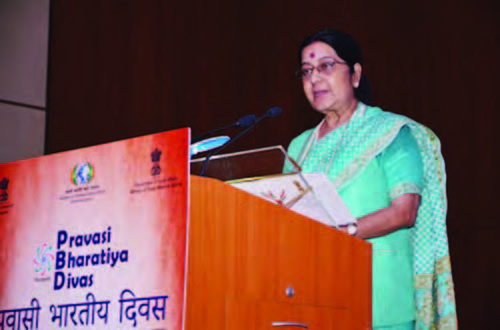
  • PRAVASI BHARATIYA DIVAS 2015

    PRAVASI BHARATIYA DIVAS 2015

    The 13th edition of Pravasi Bharatiya Divas is being organized at Gandhinagar, Gujarat from January 7 to 9, 2015. It is the first time that PBD has gone to Gujarat.

    The PBD 2015 is dedicated to Mahatma Gandhi, the greatest non-resident Indian who on January 9, 1915 had come back to India from his pravas.

    To connect India to its vast overseas diaspora and bring their knowledge, expertise and skills on a common platform, the PBD Convention – the flagship event of Ministry of Overseas Indian Affairs (MOIA), Government of India is organized from 7th-9th January every year since 2003.

    Pravasi Bharatiya Divas (PBD) is celebrated on 9th January every year to mark the contribution of Overseas Indian community in the development of India. January 9 was chosen as the day to celebrate this occasion since it was on this day in 1915 that Mahatma Gandhi, the greatest Pravasi, returned to India from South Africa, led India’s freedom struggle and changed the lives of Indians forever.

    PBD conventions are being held every year since 2003. These conventions provide a platform to the overseas Indian community to engage with the government and people of the land of their ancestors for mutually beneficial activities. These conventions are also very useful in networking among the overseas Indian community residing in various parts of the world and enable them to share their experiences in various fields.

    During the event, individuals of exceptional merit are honored with the prestigious Pravasi Bharatiya Samman Award to appreciate their role in India’s growth. The event also provides a forum for discussing key issues concerning the Indian Diaspora.

    Inaugurating the Youth Pravasi Bharatiya Divas (PBD) at Mahatma Mandir in Gandhinagar on January 7, Sushma Swaraj, Union Minister for External Affairs and Overseas Indian Affairs exhorted the Indian youth diaspora to ‘connect, celebrate and contribute’ to the transformational change being witnessed in India in the making of ‘Ek Bharat, Shreshth Bharat’.

    Sushma said, “The Indian youth diaspora can become ambassadors of the ‘new’ India as “you have retained a bit of India in your heart and each one of you have a bit of ‘Bharat’ in you.”

    PRAVASI BHARATIYA DIVAS 2015 1

    The Minister said that Youth PBD was not just about interacting with the young people of this country but has emerged as an important platform for the diaspora to discover and nurture their roots.

    She appealed to the youth to connect with the young generation of Indians – over 50% of the Indian people were under 25 years. Youth PBD, she said, was an occasion to celebrate India’s traditions, art and culture, even as the country strives to empower its youth with technology.

    “What excites the world today is India’s growth story,” Swaraj said and pointed to the government’s success in bringing about a complete transformation of the business sentiment in the country. This, she added, was the outcome of the numerous steps undertaken by the government to improve the ease of doing business.

    Swaraj said the diaspora could contribute significantly to the development of India through programs such as ‘Make in India’, ‘Digital India’, creation of smart cities and other physical infrastructure.

    Prime Minister Narendra Modi, on January 8, announced a string of facilities for expatriate Indians that seek to free them of regulations on their arrival to India and within the country.

    Inaugurating the 13th Pravasi Bharatiya Divas (PBD), organized by the Ministry of Overseas Indian Affairs (MOIA) in partnership with the Ministry of Youth Affairs & Sports and the Government of Gujarat, the Prime Minister said life time visa will now be granted to PIO cardholders and as a mark of respect to them, the regulation requiring them to visit a police station to verify their credentials once every week, has been scrapped.

    Modi said while the PIO and OCI cards have been merged, allowing similar facilities to either cardholder, electronic authorization of visa has commenced, apart from extending the facility of visa on arrival from 43 countries. In addition, the Pravasi Bharatiya Centre will be operational in Delhi soon. The Prime Minister said engaging with the pravasis was not a one-way street; “not everything should be seen in terms of pounds or dollar” he said, adding that overseas Indians need to be given unstinted support so that they feel enthusiastic in contributing to India’s development.

    The Prime Minister suggested that an online quiz competition could be started from the PBD platform on ‘Bharat ko Jano’ for teams of young people worldwide. This would help project India’s development effort in the right perspective. The competition, he said, could be conducted round the year so that the campaign for knowing India becomes a global movement.

    Modi urged the pravasis to actively participate in the government’s ambitious ‘Clean Ganga’ initiative by sharing their expertise in technology, innovations, ideas and resources. “There are opportunities for all along the river – in agriculture, water transport, city development and village rejuvenation and even adventure sports,” the Prime Minister said.

    On the occasion of the centenary of Mahatma Gandhi’s return to India from South Africa, the Prime Minister released Rs 25 and Rs 5 commemorative stamps and Rs 100 and Rs 10 coins.

    The Chief Guest at the PBD, Donald R. Ramotar, President of the Republic of Guyana, said India’s has seen a transformational change in recent years. The time has come arrived for India to demonstrate its mature political leadership to guide other developing countries, participate more actively in internal forums, look outwards for channelizing investments to other countries and strengthen air and maritime links with the rest of the world.

    He assured Guyana’s commitment to India’s pursuit of reform of the UN Security Council and expressed total support for India’s candidature for a permanent seat in an expanded Security Council.

    Maite Nkoana-Mashabane, Minister of International Relations and Cooperation, Republic of South Africa, the Guest of Honour, pointed out that the political, economic and cultural bonds between South Africa and India were strong. These were cemented by the community of Indians in South Africa, the second largest outside India. The bonds must be further strengthened by addressing the triple challenges of poverty, unemployment and under-development.

    She stressed the need for closer cooperation between the two countries in the fields of IT, healthcare and renewable energy and expressed confidence that India would support South Africa in its development efforts. Sushma Swaraj, Union Minister for External Affairs and Overseas Indian Affairs, emphasized that successful and politically influential diaspora is an asset to India. She called upon the diaspora to pursue a mutually rewarding participation in developing India.

    Anandiben Patel, Chief Minister of Gujarat, said that the new economic and social initiatives launched by the Central Government have unleashed a new wave of enthusiasm among the people. The pravasis with the sincere hard work had raised India’s image internationally, while keeping the links with the land of their origin alive.

    The three- day kumbh of the NRIs has attracted NRIs from all parts of the world. For most Gujaratis abroad it is a welcome visit home.

  • Cabinet clears 49% FDI in insurance

    Cabinet clears 49% FDI in insurance

    NEW DELHI (TIP): The Cabinet on Thursday approved 49% foreign investment in insurance companies through the FIPB route ensuring management control in the hands of Indian promoters. “The Cabinet Committee on Economic Affairs has approved raising of FDI cap in insurance sector to 49% from 26%,” sources said after a meeting of the CCEA, headed by Prime Minister Narendra Modi. With the Cabinet approving the amendments to the long pending Insurance Laws (Amendment) Bill, it will now be taken up by Parliament.

    In his budget speech, finance minister Arun Jaitley had said that the insurance sector is investment starved and there is a need to increase the composite cap in the sector to 49%, with full Indian management and control, through the FIPB route. The move would help insurance firms to get much needed capital from overseas partners. The proposal to raise FDI cap has been pending since 2008 when the previous UPA government introduced the Insurance Laws (Amendment) Bill to hike foreign holding in insurance joint ventures to 49% from the existing 26%. However, the bill could not be taken up in the Rajya Sabha because of opposition from several political parties, including the BJP.

    The insurance sector was opened up for private sector in 2000 after the enactment of the Insurance Regulatory and Development Authority Act, 1999 (IRDA Act, 1999). This Act permitted foreign shareholding in insurance companies to the extent of 26% with an aim to provide better insurance coverage and to augment the flow of long term resources for financing infrastructure.The industry has been demanding for long to increase the FDI limit for adequate funds for expansion of the sector.

  • A mixed Blessing for India

    A mixed Blessing for India

    Lower petroleum prices hold obvious advantages for Indian consumers, but a bearish global oil market could also hurt several segments of the country’s economy

    The Oil Ministers of 12 member states of Organization of the Petroleum Exporting Countries (OPEC) concluded their meeting in Vienna on November 27 by deciding to continue with their three-year-old production quota of 30 million barrels per day (mbpd). Thus, they calculatingly ignored nearly one mbpd oversupply in the global oil market which has pushed the crude prices down by over 30 per cent since June 2014.

    The global oil glut, in turn, has been caused by a number of factors which include OPEC’s own overproduction, rising non-OPEC production (particularly by the U.S.- based “Shale Revolutionaries”) and lower demand from China and Europe. By declining to cut their output to shore up the prices, OPEC in general, and Saudi Arabia in particular, have refused to play the role of global “swing producer.” As most factors responsible for the current global demand-supply disequilibrium are systemic in nature, the world faces prospects for relatively bearish oil prices over the foreseeable future.

    Indeed, the prices have continued to fall with the Indian basket touching $72.51/barrel on November 27 – a decline of nearly $9 from the average during the first fortnight of the month. As the world’s fourth largest importer of crude, India can afford to exult at this precipitous crude price decline. Still, given the strategic importance of this development, a more comprehensive analysis is desirable.

    A virtuous cycle in the economy From the limited perspective of India’s consumer economy, lower global oil prices undoubtedly augur well. Lower pump prices reduce pressure on the consumer who can spend the savings elsewhere, spurring the demand side of the economy. As petroleum products form a large part of the consumer price indices, lower crude prices result in reduced inflation, which in turn paves the way for lower interest rates and greater buoyancy in investments.

    Thus, lower oil prices can trigger a virtuous cycle in the Indian economy. After all, with India’s imports running at an estimated 3.7 mbpd in 2013, a $30/barrel decline in oil prices amounts to a $40 billion savings bonanza on annual imports. The impact would be best felt on the petroleum sector where marketers have been groaning under subsidy burden. The transport sector would also be a direct beneficiary. If we widen the impact analysis to consider the totality of the Indian economy, some challenges also appear.

    First, as oil producers are India’s major markets and investment destinations, their economic decline may affect the country. Recent decline in the share prices of Bharti Airtel and Bajaj Auto due to the devaluation of the Nigerian Naira illustrates this more complex trend. Second, apart from being the fourth largest oil importer, India is also the world’s sixth largest petroleum product exporter earning over $60 billion annually – nearly a fifth of global exports.

    A bearish oil market would hurt this segment with reduced demand, lower unit prices and lower margins. Third, the oil price decline coincides with resumed foreign interest in investing in India. It is difficult to assess their mutual correlation, but lower oil revenues may attenuate arrival of petrodollars into India. Fourth, whenever oil revenues decline, countries that export Gulf oil try to tighten their belts by emphasizing local production and downsizing their foreign labor force in which Indians dominate. Thanks largely to over five million Indian expatiates there, India was the world’s largest recipient of remittances which topped $70 billion in 2013. The possibility of these remittances being reduced cannot be ruled out. This would have a serious impact on remittance-dependent States such as Kerala and Goa.

    Fifth, lower crude prices may cast a shadow over the sputtering controversy over natural gas pricing norms in India as the latter generally follow the oil prices. Future investment decisions in oil-related sectors may get delayed. Sixth, lower pump prices may cause higher fuel consumption as sales of automotive products soar. This would worsen commuter woes as well as cause increased urban pollution. Finally, a decline in oil prices generally accompanies a global decline in commodity prices, particularly those of minerals and agricultural products. India remains a major exporter of these and would see lower realization, particularly of Guar Gum, a critical input for the shale industry.

    The long-term impact of lower oil prices is likely to be felt beyond the economic domain. Geopolitically, persistent lower oil revenue could propel a number of emerging exporters towards domestic political instability as the ruling elites lose their capacity to provide “stomach infrastructure” to the common man. Countries with lower per capita oil revenue such as Nigeria, Iran, Algeria and Venezuela may be more at risk. In general, however, lower oil revenues may have a dampening effect on regional or domestic disputes. Measures to leverage oil prices India can leverage the current low oil prices for long-term gains. To this end, the following measures can be considered.

    One, it can foster long-term crude supply relationships with exporters in return for stable prices, upstream engagements, inbound investments, etc.

    Two, it can enter into oil-for-infrastructure barter deals to boost project exports.

    Three, it can restructure public sector oil companies to make them more productive and globally proactive for leaner times ahead.

    Four, it can channel some of the oil bonanza to mitigate the increased cost disadvantage of renewable and alternative energy sources.

    Five, it can build its own strategic oil reserves. The current downturn in oil prices underlines the cyclic nature of commodity trade and illustrates OPEC’s reduced regulatory capacity consequent to it supplying only a third of global demand.

    While Shale Revolution may be a new and price-sensitive factor, it is unlikely to vanish with time or with lower prices. During past oil bear-hugs in 1986, 1993-99 and 2008, the lower prices invariably spurred consumption and the oil bounced back.

    There is no reason to believe that the oil prices shall not rise again. India would do well to recall an old oil adage, “The cure for high oil price is high oil price itself” – and use this rare, cyclic opportunity for long-term gains.

    (The author has served as Indian ambassador to Algeria, Norway and Nigeria – all major oil exporting countries.)

  • Citing trade, Beijing seeks bigger role

    Citing trade, Beijing seeks bigger role

    KATHMANDU (TIP): The shadow of China seeking a greater role in the South Asian Association for Regional Cooperation (SAARC) and its presence in the eight-member grouping could not be missed here as the 18th Summit got underway. Over the past few days, reports emerged about Beijing pushing the envelope on the issue and today leaders from Bangladesh, Maldives, Pakistan and Sri Lanka advocating a greater role for observers in the regional grouping. SAARC has Australia, China, European Union, Japan, South Korea, Mauritius, Mynamar and the USA as observers and since 2007 have been invited to attend the summit meeting.

    Today as the summit opened, Pakistan Prime Minister Nawaz Sharif emphasised the importance of SAARC observers and the benefit the grouping can draw from its interactions with them. “We should build on convergences and minimise divergences and most of all seek to augment complimentaries for the greater good of the people of the region”, he said. Similar sentiments were expressed by leaders of Bangladesh, Maldives and Sri Lanka. While none of them mentioned China, on his part Deputy Foreign Minister of China Liu Zhenmin, who participated, underscored the role Beijing was playing in the region and prepared for a larger role.

    He mentioned that while China’s trade in the countries of the region stood at $150 billion, the country has $ 30 billion investments in the pipeline, clearly underscoring the economic muscle of Beijing. While New Delhi has not made any move to counter it, India maintained that the priority among member-countries of SAARC should be to ensure cooperation among the eight countries instead of seeking to expand the grouping in a horizontal direction.

  • Xoom Announces Instant Deposit Service to Kotak Mahindra Bank Accounts in India

    Xoom Announces Instant Deposit Service to Kotak Mahindra Bank Accounts in India

    SAN FRANCISCO, CA (TIP): Xoom Corporation (NASDAQ: XOOM), a leading digital money transfer provider, is now offering instant deposits to Kotak Mahindra Bank accounts in India. This revolutionary service allows Xoom customers to instantly deposit money into their recipients’ Kotak Mahindra Bank accounts, 365 days a year, including bank holidays.

    Instant deposits to Kotak Mahindra Bank are processed through Xoom’s partnership with Punjab National Bank., a press release said. “Through our partnership with Punjab National Bank and the breakthrough IMPS technology, we are thrilled to expand our instant deposit service to Kotak Mahindra Bank,” said Julian King, Senior Vice President of Marketing and Business Development for Xoom. “Instant deposits are available 365 days, including bank holidays, so customers will never have to wait. Speed and convenience are what customers expect from Xoom’s service and we continue to do just that in our mission to provide instant deposit to even more banks in India.”

    In addition to Kotak Mahindra Bank, Xoom also offers instant deposits to ICICI Bank, HDFC Bank, Punjab National Bank, Bank of Baroda, Union Bank of India, Federal Bank and Yes Bank. Xoom provides great locked-in exchange rates for money transfers to India, and there is no fee when customers send more than $1,000 and pay with their U.S.-based bank account. Plus, Xoom continues to provide fast bank deposits within four hours to all other banks in India, including to NRE and NRO accounts, when sent during bank processing hours in India. Customers can also download the Xoom App for Android and iOS mobile devices for free. Visit https://www.xoom.com/india for more information.

    About Xoom

    Xoom is a leading digital money transfer provider that enables consumers to send money to 30 countries in a secure, fast and cost-effective way, using their mobile phone, tablet or computer. During the 12 months ended June 30, 2014, Xoom’s more than 1.1 million active customers sent approximately $6.3 billion to family and friends. The company is headquartered in San Francisco and can be found online at www.xoom.com.

    About Kotak Mahindra Bank

    Established in 1985, the Kotak Mahindra group is one of India’s leading financial services conglomerates. In February 2003, Kotak Mahindra Finance Ltd. (KMFL), the group’s flagship company, received banking license from the Reserve Bank of India (RBI). With this, KMFL became the first nonbanking finance company in India to become a bank – Kotak Mahindra Bank Ltd (KMBL).

    KMBL offers complete retail financial solutions for varied customer requirements. The Savings Bank Account goes beyond the traditional role of savings, and provides range of services through a comprehensive suite of investment services and other transactional conveniences like Online Shopping, Bill Payments, ASBA, Netc@rd, ActivMoney (Automatic TD sweep-in and Sweep-out) etc. Kotak’s Jifi, a first-of-its-kind fully integrated Social Bank Account, redefines digital banking by seamlessly incorporating social networking platforms like Twitter and Facebook with mainstream banking.

    KMBL also offers an Investment Account where Mutual Fund investments are recorded and can be viewed in a consolidated fashion across fund houses & schemes. Further, the Bank offers loan products such as Home Loans, Personal Loans, Commercial Vehicle Loans, etc. Keeping in mind the diverse needs of the business community, KMBL offers comprehensive business solutions that include Current Account, Trade Services, Cash Management Services and Credit facilities.

  • Texas Leads Best States For Future Job Growth

    Texas Leads Best States For Future Job Growth

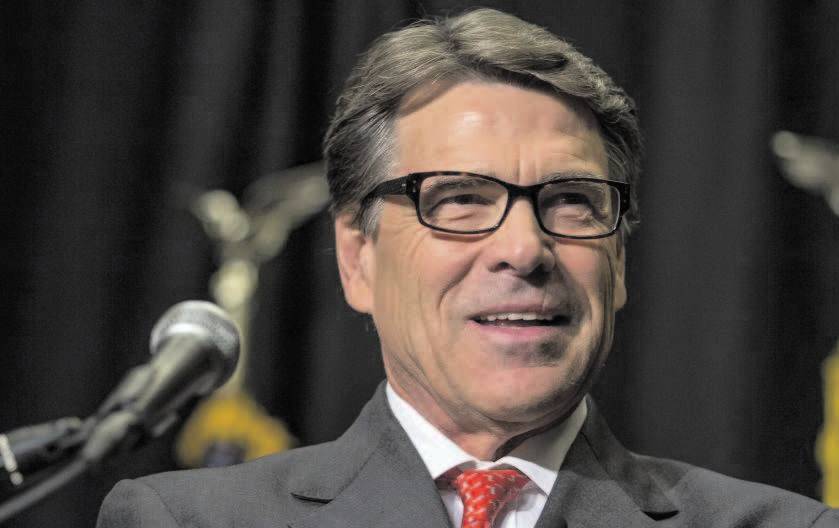
    DALLAS (TIP): Rick Perry ascended from Lieutenant Governor to Governor of Texas in December 2000 when thengovernor George Bush resigned after being elected the 43rd President of the United States. Perry will retire in January with the tenth longest gubernatorial tenure in U.S. history. Perry made job creation one of his principle mantras, and he has overseen remarkable employment gains under his watch with 2.1 million jobs added during his tenure.

    The total represents 30% of the jobs added in the U.S. since 2000 and more than twice as many as any other state. The so-called “Texas miracle” does not show any signs of slowing either with 413,000 jobs added over the last 12 months. Texas is expected to have the nation’s fastest annual job growth rate at 2.7% over the next five years, according to data from Moody’s Analytics. Texas has low taxes and light regulation, but Perry’s record also has benefited from the headwinds at his back regarding energy. Oil prices hovered around $30 a barrel between 1986 and 2002 before a stunning climb that peaked at $145 in 2008. Prices plummeted during the Great Recession and over the past month, but oil is still trading around $80 a barrel. The higher prices have propelled massive investments in Texas both financially and in regards to human capital. “Texas has done well primarily because it is an energy center.

    You really can’t get around that,” says Edward Friedman, an economist who tracks Texas for Moody’s Analytics. “Every major energy and oil company has realized over the last 15 years that the only place to be is Houston.” Texas’ prosperity and pro-business environment have led companies outside of the energy sector to flock to the state in recent years. Toyota announced plans to move its North American headquarters from California to a new campus in Plano that will create 4,000 jobs. The Texas Enterprise Fund granted Toyota $40 million to sweeten the pot.

    San Francisco brokerage firm Charles Schwab is moving hundreds of jobs out of California with Austin and El Paso targeted for company expansion. Apple is undergoing an expansion that will roughly double its Austin workforce by hiring 3,600 new employees. Texas ranks first for both its current economic climate and growth prospects in our annual study on the Best States for Business. There are 118 of the largest companies in the U.S. based in Texas, including heavyweights like AT&T ,Exxon Mobil and Dell .

  • New Balance of Power in Asia? India is challenging China’s assertiveness

    New Balance of Power in Asia? India is challenging China’s assertiveness

    “India must increase investments in education and infrastructure, achieve more equitable economic development if it is to emerge as a major driver of the global economy. Only then will it be able to make a significant contribution to Asian and international security and contribute to a new peace-promoting balance of power in Asia”, says the author.

    By Anita Inder Singh

    India’s decision to help Vietnam boost its defense modernization – against China’s wishes – raises yet again the question whether a new balance of power is emerging in Asia. India, Vietnam and Japan will try to coordinate security and economic policies. That suggests India is challenging China’s assertiveness in the Asia-Pacific region and staking a claim to explore the energy-rich resources of the South China Sea. Economic and strategic diplomacy were intertwined when Prime Minister Modi visited Japan and the US – and when Chinese President Xi Jinping visited India in mid-September.

    India needs investment to improve its rickety infrastructure and Japan, China and the US have come forward with offers to help India renew it. Companies in all three countries seek new investment destinations and potentially India is one of the biggest. Mutual economic interests are not enough for India to increase its contribution to Asian and global security. The simultaneous interest of Japan and the US in India’s development and its greater role in Asian security only highlight India’s economic weakness and the blunt fact that its ability to enhance its regional role will hinge on its economic performance improving quickly and steadily.

    India has much to gain – and learn – from closer ties with Japan, which is Asia’s oldest democracy. Neither history, nor political/territorial disputes divide India and Japan. As Asia’s post-1945 economic wunderkind Japan had surpassed India, China and many west European countries by the early 1960s. India and Japan are already collaborating on maritime security, counter-terrorism, and energy security. At their summit talks, Modi and Prime Minister Shinzo Abe decided to strengthen defense ties and forge a special strategic global partnership, emphasizing that a developed India and a prosperous Japan were important for Asia and for global peace and security.

    Economics and strategy mixed again when Modi met Japanese business leaders. The 21st century, Modi asserted, would belong to Asia – exactly how would depend on “how deep and progressive” the Indo-Japanese relationship is. This is the immediate context in which he deplored the “expansionist” tendencies among countries, caught in an 18th-century time-warp, to “engage in encroachment” and “intrude” into the seas of others. Evidently Modi was not letting trading interests blur the real political differences with such countries. These comments, made before President Xi Li Ping visited India, were widely interpreted as anti-China. The state-steered Chinese Global Times has downplayed any idea that China counted less than Japan with India.

    “China’s GDP is five times that of India’s. Mutual trust between Beijing and New Delhi, facing strategic pressure from the north, is difficult to build as there is also an unresolved border conflict between the two,” its editorial said. That appeared more of a threat than an olive branch to India. Modi carefully avoided running China down. Before leaving for the US he stated that the world should trust China to observe international law. But Xi’s visit did not enhance trust between New Delhi and Beijing. Even as Xi assured Modi of $20 billion in investment in Gujarat Chinese troops made one of their frequent forays into north-eastern Indian territory, which Beijing claims belongs to China.

    Those forays followed a pattern. China unilaterally invokes “history” (its version) when referring to territorial conflicts with India – and other neighbors. China’s attitude to India echoes that with its Asian neighbors, including Japan, Vietnam and the Philippines. By claiming a territory in the name of history it creates a dispute, dispatches its ships or aircraft – (or in India’s case, troops) – to back up that claim. That is how it unilaterally outlined last November an “air-defense identification zone” over an area of the East China Sea covering Senkaku islands that are also claimed by Japan (and Taiwan). Strong trading ties have not stopped China from using history to make claims on neighboring territories.

    In fact Japan is the largest foreign investor in China. And China is ASEAN’s largest trading partner. In New Delhi Xi’s reference to historical ties between ancient civilizations was marred by the assertion that the Sino-Indian border dispute had historical roots. Such statements imply that the border disputes will remain unsettled; more importantly, that Beijing will continue to lay claim to the Arunachal Pradesh and Ladakh regions. In that case India – like Japan and Vietnam – may find itself simultaneously taking up the politicalstrategic gauntlet and engaging in much-needed trade with China.

    China does nothing to dispel the fears of its neighbors and insists on bilateral solutions. Its claims to un-demarcated maritime waters, including the East and South China Seas (Beijing defines the latter as a ‘core’ interest) are contested by its neighbors, who want the disputes those claims give rise to be settled through international arbitration. That explains why, without naming China, the Obama-Modi communiqué, called on all parties to avoid the use, or threat of use, of force in advancing their claims. It also urged a resolution of their territorial and maritime disputes through all peaceful means, in accordance with the international law, including the UN Convention on the Law of the Sea. At another level, China has taken advantage of America’s planned withdrawal from Afghanistan and is increasing investments there. It is also securing its energy supplies in the oil and gas fields of Central Asia. Moreover, it is India’s main competitor for influence in the Indian Ocean area, which is bounded by Asia on the north, on the west by Africa, on the east by Australia, and on the south by the Southern (Antartic) Ocean.

    There is nothing improper about these activities. But they alarm China’s neighbors and the US, none of whom wants China to gain primacy in Asia. Unsurprisingly, Obama and Modi stressed the need to accelerate infrastructure connectivity and economic development corridors for regional economic integration linking South, Southeast, and Central Asia. The US and India want to promote the India- Pacific Economic Corridor, which will link India to its neighbors and the wider Asia-Pacific region, with a view to facilitating the flow of commerce and energy. That will not be lost on China. Meanwhile uncertainty hovers over the nature of America’s rebalance or pivot to Asia since it has been announced at a time when Washington is cutting defense expenditure. India must increase investments in education and infrastructure, achieve more equitable economic development if it is to emerge as a major driver of the global economy. Only then will it be able to make a significant contribution to Asian and international security and contribute to a new peace-promoting balance of power in Asia.

    (The author is a visiting professor at the Centre for Peace and Conflict Resolution, New Delhi)

  • RIL to sell 49.9% stake in US joint venture

    RIL to sell 49.9% stake in US joint venture

    NEW DELHI: Reliance Industries is looking to sell its 49.9% stake in a US joint venture that owns a 460 miles pipeline network for transportation of shale oil and gas. RIL, as well as its partner Pioneer Natural Resources Co, are seeking a buyer for their stakes in Eagle Ford Midstream venture as they focus on shale oil production. “Pioneer Natural Resources today announced that the company is pursuing the divestment of its 50.1% share of the Eagle Ford Shale Midstream business. “Reliance Holding USA, Inc owns the remaining 49.9% of the EFS Midstream business and also plans to pursue the divestment of its share in a joint process with Pioneer,” the Dallas-based independent oil and gas producer said in a statement. RIL, through its subsidiary Reliance Holding USA Inc. had acquired 49.9% stake in EFS Midstream LLC in June 2010. Current investments in EFS Midstream LLC is $208 million.

  • Emergency was a blunder; Operation Bluestar an unmitigated disaster

    Emergency was a blunder; Operation Bluestar an unmitigated disaster

    Operation Bluestar was grievously handled. Everything that could go wrong did go wrong. I know that Indira Gandhi’s instructions were disregarded by those who in Amritsar were in charge of the operation. The Golden Temple complex could have been cordoned, electric and water supply could have been switched off. Instead tanks entered the complex. The rest is too well known. It cost Indira Gandhi her life. The Sikh community both in India and abroad was not only outraged, it was deeply hurt, deeply offended”, says the author.

    What was I doing in the morning of 31st October 1984? I was getting ready to leave for Bharatpur to do some politicking. The RAX telephone rang. It was H.Y. Sharada Prasad, “Natwar, this is the worst day of our lives. PM has been shot. Come over to No 1 Akbar Road, as soon as you can.” I asked a dazed Sharada, “What happened. Who shot her?” “She was walking from 1 Safdarjung Road to 1 Akbar Road to be interviewed by film actor and producer Peter Ustinov.

    When she was walking on the glass “river” (presented by the government of Czechoslovakia), which led to 1 Akbar Road, she was shot by the two Sikh guards at the gate leading to 1 Akbar Road. I heard the shots, but thought it must be someone playing with fire crackers… it was over in a few seconds.” I walked up to the gate to see the spot where she had fallen. Her blood had not dried. Her spectacles, chappals and bag were still lying on the glass river. Peter Ustinov’s camera men had recorded the sound of the shots. It took Sharda and me a long time to persuade Ustinov not to use that portion of the film. He eventually agreed.

    I met him in 1997 at a seminar in Valencia, Spain, I reminded him our conversation on 31.10.1984. “I remember it well. I never used the ‘shots’ recording.” She was 19 days short of her 67th birthday on that fateful and searing day. Even after three decades her fame and name, her achievements, her qualities as a leader have not been forgotten. For me, it is not easy to sum up her life objectively. My affection and respect for her have not diminished. In more ways than one she enriched, uplifted my life. She broadened the contours of my vision. To some readers this may sound as crass sentimentalism and melodramatic. I worked in her secretariat for five years, 1966-71, meeting her every other day, sometimes three times a day.

    Jawaharlal Nehru never faced the challenges she did. Nehru’s leadership was never questioned for 15 years. In the last two years of his life he encountered serious dissatisfaction in the Congress party. Indira Gandhi’s road to power between 1966 and 1969 was strewn with boulders. The syndicate was breathing down her neck. Several were patronising and treated her as the daughter of Nehru and not as the Prime Minister. Krishna Menon referred to her as “that chit of a girl”. Ram Manohar Lohia was vicious.

    In Parliament she was nervy, tense and diffident. She was not comfortable in the Cabinet or in meetings with her elderly colleagues – Kamraj, Nijilingappa, Morarji Desai, S.K Patil, Swaran Singh, Y.B Chavan and Jagjivan Ram. They too felt uneasy with a woman Prime Minister. They did not take her seriously. Later they would. Gradually her diffidence and shyness began to erode. By 1970 she had come to grips with her job and responsibilities. The jeering stopped. The cheering began. She had a flair for foreign affairs. Her international image grew by the week.

    At the UN she was heard with respect. At NAM and Commonwealth summits, she often stole the show. In 1983 she was the chairperson of the NAM and Commonwealth summits, both held in New Delhi. She strengthened the Non- Aligned Movement – “the greatest peace movement in the world”, she called it. At the Commonwealth Summit she produced awe in Margaret Thatcher. I one day asked her what she thought of the Iron lady. Her response: “What Iron lady. I saw a nervous woman sitting at the edge of the sofa.” She wrote an article in the October 1972 issue of “Foreign Affairs” magazine.

    She wrote, “India’s foreign policy is a projection of the values which we have cherished through centuries as well as our present concerns.We are not tied to the traditional concepts of a foreign policy, designed to safeguard overseas possessions, investments, the carving out spheres of influence and the creation of cordons sanitaires.We are not interested in exporting ideologies.” Her finest hour came in 1971. She created a new nation – Bangladesh. She isolated Nixon and Kissinger, won over the Western media and liberal members of the US Congress.

    Teddy Kennedy was one of them. We now come to the other side of the Indira Gandhi coin. The Emergency was a blunder, Operation Bluestar an unmitigated disaster. In the words of P.N. Dhar, her Principal Secretary for half a decade, “the Emergency changed the basic relationship between the citizen and the state and indeed threatened to change the character of the Indian State.” During the Emergency I was the Deputy High Commissioner in London. There it was impossible to ‘sell’ the Emergency. I wrote to the PM, “I know what to say to our critics but do not know what to say to our friends”.

    Untypically she did not respond. Professionally it was the duty of High Commissioner B.K. Nehru and myself to defend the Emergency.We suppressed our conscience. Operation Bluestar was grievously handled. Everything that could go wrong did go wrong. I know that Indira Gandhi’s instructions were disregarded by those who in Amritsar were in charge of the operation. The Golden Temple complex could have been cordoned, electric and water supply could have been switched off. Instead tanks entered the complex. The rest is too well known. It cost Indira Gandhi her life.

    The Sikh community both in India and abroad was not only outraged, it was deeply hurt, deeply offended. If one were to take an overall view of Indira Gandhi’s life and labours, she would still rank very high in the Prime Ministerial pecking order. Even today her admirers outnumber her detractors. I remain an admirer. (The author is a diplomat turned politician) (British English. Courtesy The Tribune, Chandigarh)

  • Indians join the wave of investors in condos and homes in US

    Indians join the wave of investors in condos and homes in US

    WASHINGTON (TIP): Arun Kumar owns three apartments in New Delhi, where he has carved out a comfortable life as part of India’s rapidly expanding middle class. Not long ago, he also became a global landlord, picking up an inexpensive three-bedroom house and a duplex nearly 8,000 miles away, in St. Louis.

    For Kumar and other affluent Indians, US real estate is a security blanket. Faced with what some have considered a bubble in real estate prices in major Indian cities and a sometimes jittery Bombay Stock Exchange, they are joining a wave of buyers from other countries who see the recovering US housing market as one of the best places to put their money these days.

    The wealthy elite from China, Latin America and elsewhere have bought pieds-a-terre in glassy towers in Manhattan, luxury condos in Miami and homes along the West Coast. Law enforcement investigations have found that some foreign investors are using US real estate holdings, at least in part, to hide cash and other assets from authorities in their home country.

    But many less-than-superrich foreign investors just want a safe place to put extra savings, and their investments tend to be much less grandiose than the trophy properties that have drawn most of the attention. And for Indians in particular, who long trusted in gold to protect their wealth, US real estate offers a “very, very attractive destination,” said Subir Gokarn, director of research at Brookings India in New Delhi.

    Jed Kolko, chief economist at Trulia, an online marketplace for residential real estate, said the most popular property searches for people from India were in and around Silicon Valley, where technology firms heavily recruit from India; in the Boston and Philadelphia areas near universities that have numerous students from India; and in suburban areas of New Jersey and in Queens, where there are established Indian-American communities.In an echo of the late 1980s, foreign investment in US real estate has taken off again. A survey from the National Association of Realtors estimates that from April 2013 to March of this year, total sales to international clients were about $92.2 billion, a 35 percent increase over the previous 12 months. The figure includes purchases by recent immigrants. Foreign buyers now make up 7 per cent of total existing-home sales of $1.2 trillion, according to the survey. Of those, Indians represent 6 per cent of the purchases, spending $5.8 billion, up from $3.9 billion over the same period a year ago and on par with buyers from Britain. Canadians have long bought US property and still do so in big numbers, with purchases centered for the most part in Arizona, Florida and more recently in Las Vegas. Canada still accounts for the largest share of buyers, but China is the fastest-growing source of clients, according to the Realtors’ group.

    And Chinese buyers are bigger spenders. Their real estate purchases in the United States nearly doubled from last April to last March, increasing to $22 billion from the previous period. They accounted for nearly a quarter of all international sales in the current period.

    “Most people who can come here, they are pretty wealthy,” said Grace Tian, a broker with Realty Mark Associates in Philadelphia who often works with Chinese clients. In contrast, buyers from India are a more eclectic group. These include parents living in India who buy apartments for students attending college, making sure the units have concierge service and an extra bedroom so they can visit for extended periods, several real estate agents said. After the students leave college, the parents often keep the apartment and rent it out.

  • MAKE IN INDIA

    MAKE IN INDIA

    The Prime Minister’s call for making India a manufacturing hub and creating jobs should boost small and medium enterprises as well

    By Charan Singh Prime Minister Narendra Modi’s ‘Make in India’ campaign is creating waves both in India and abroad. Given the government’s intention to boost domestic manufacturing and create new jobs, its proposal to introduce a new policy for Micro, Small and Medium Enterprises (MSMEs) deserves a closer look. While Mr. Modi’s invitation to international companies to make investments has been receiving a lot of attention, the government’s close interaction with industry associations from different regions and sectors within India to discuss specific problems inhibiting domestic enterprises deserves equal consideration. India’s MSME sector has recorded more than 10 per cent growth in recent years despite the economic slowdown. MSMEs contribute nearly eight per cent to the national GDP, employing over eight crore people in nearly four crore enterprises and accounting for 45 per cent of manufactured output and 40 per cent of exports from India. Thus, the focus of the government on MSMEs at this juncture is justified given their potential for providing growth and employment.

    Significant initiatives In view of the significance of the sector, the government had announced a number of measures in its first budget. Some of the significant initiatives were setting up of Rs.10,000 crore of venture capital fund and establishing a nationwide, district-level incubation and accelerator program for encouraging entrepreneurship. Other important budgetary announcements included establishing a network of Technology Centers; revising the definition of MSMEs for providing higher capital ceiling, friendly legal bankruptcy framework to enable easy exit, a program to facilitate forward and backward linkages with multiple value chain of manufacturing and service delivery to be put in place, and launching the Skill India movement for youth with an emphasis on employ ability and entrepreneurship. A committee was also proposed to examine the financial architecture with a view to removing bottlenecks and creating new rules and structures for the sector.

    The government recently inaugurated a holistic, innovative and low-cost National Small Industries Corporation’s online e-commerce shopping portal for buying and selling of products produced by MSMEs. MSMEs are mainly classified as manufacturing and service enterprises. There is a specific stipulated limit on investment in plant and machinery for each of the respective micro, small and medium segments in manufacturing with a maximum limit of Rs.10 crore, and for equipment in service enterprises with a maximum limit of Rs.5 crore. MSMEs with 94 per cent of units unregistered are highly diverse in terms of their size and the level of technology employed. The production in the sector ranges from output of grass-root village industries and auto components, to microprocessors, electronic components and electro-medical devices. Since 1948, successive governments have been making intense efforts to encourage MSMEs but the sector continues to be under stress. The office of Development Commissioner for MSMEs was set up in 1954 and a dedicated Ministry for MSMEs in 1999. The Small Industries Development Bank of India (SIDBI), established in 1990, is the principal financial institution for promotion, financing and development of the MSMEs in addition to commercial banks, State financial corporations, and State industrial development corporations. Despite such efforts, some of the key problems faced by MSMEs continue to be related to availability of technology, infrastructure and managerial competence, and limitations posed by labor laws, taxation policy, market uncertainty, imperfect competition and the skill level of the workforce. The problems faced by MSMEs need to be considered in a disaggregated manner for successful policy implementation as they produce very diverse products, use different inputs and operate in distinct environments. In general, there is need for tax provisions and laws that are not only labor-friendly but also entrepreneur-friendly. More importantly, there is need for skill formation and continuous upgrade both for labor and entrepreneurs. While the government has to strengthen the existing schilling efforts for labor, there is an urgent need for managerial skill development for entrepreneurs running MSMEs – an area that is considerably neglected. These programs for entrepreneurs could be offered in a structured way in Industrial Training Institutes and management schools to include modules on management, labor laws, accounting, financial markets, procurement and marketing skills. Further, the government could consider dedicated television and radio programs, similar to agriculture, to help educate entrepreneurs running small businesses. Consumer tastes have been evolving as greater integration with global markets takes pace. In order to keep pace with changing tastes, large corporate firms have made substantial investment in extensive research and developing suitable product ranges. However, due to shortage of office space and financial resources, many micro and small enterprises are unable to invest in R&D and develop new products, and perish as a result. Therefore, government support in undertaking research to help develop new products that are being produced by MSMEs could be very helpful, similar to what agriculture universities do. Similarly, to encourage products manufactured by MSMEs, India could illustratively showcase and promote their products such as phulkari of Punjab, bamboo works of Assam and West Bengal, and cotton weaving of Tamil Nadu via galleries and museums.

    Credit crunch Issues related to credit, like adequacy, timely availability, cost and mortgages continue to be a concern for MSMEs. Consequently, 93 per cent of units in the MSME sector are dependent on self-finance. Profit margins are extremely thin due to stiff competition and the small size of firms. The government drive for financial inclusion could benefit MSMEs. The government could consider dedicating specialized financial schemes for addressing difficulties in assessing and providing credit for the MSMEs, as also providing line of credit to firms which are under financial stress. Given the grand financial inclusion initiative, maximum employment and growth with minimum difficulty to the entrepreneur will augur well for the country. (Charan Singh is RBI Chair Professor of Economics, IIM Bangalore.)

  • ESCORTS’ NOVEAU TRACTORS TO HAVE PORSCHE’S TOUCH

    ESCORTS’ NOVEAU TRACTORS TO HAVE PORSCHE’S TOUCH

    CHENNAI (TIP): The Porsche brand is no stranger to Indian roads but is commonly associated with luxury cars and SUVs. Now an Indian tractor major – Escorts – will roll out a range of top-ofthe- line tractors designed by the famed Porsche design house. Escorts said its new range of under-development tractors will be rolled out in export markets like Europe.

    However, the company is tightlipped about the timeline as well as investments pumped into this hush-hush project. Said S Sridhar, CEO, Escorts agri machinery business: “We are developing a product targeting the mid to top end of the European market. We are using the services of Porsche as a design house and they are working with us exclusively. This is the first time they will be designing a tractor for an Indian company.” Escorts has already tied up with the Ferrari brand to introduce high-end luxury tractors in India and discussions are on with them about local assembly as well.

    Luxury brand Porsche used to have its own tractor portfolio when it first started out. The first blue print of the Porsche tractor was created in the 1930s but after the war Mannesmann AG decided to license Porsche’s complete tractors in 1956 and began production. Between 1956 and 1963, when the license agreement ended, over 125,000 Porsche tractors were produced and sold. Escorts’ designed-by-Porsche tractor platform will be a critical part of the company’s export plans.

    “Right now we use our top-end models in the 50hp-plus category and pitch them as value products in Europe,” said Sridhar. “The bottom-of-the-pyramid segment comprises 15% of the European market so in volume terms it is not the biggest chunk but the margins are better.” The company, whose Farmtrac Heritage tractor is currently being homologated for a German and Polish debut, wants to take its export strategy to the next level riding on its existing range and on Farmtrac Heritage.

    “Farmtrac Heritage was displayed in Hanovar last year and we rolled it out in South Africa in May and in Bangladesh last week. Once the homologation certificate comes in, it will be available in Germany and Poland as well as South Africa and Bangladesh,” he added. Escorts is already exporting around 2,000 units a year to 30-odd countries. “We now enjoy 12% market share in India in the 50 hp-plus segment and we are adapting those same products for the bottom-end of the European market,” said Sridhar.

    Next on the agenda are other markets in Europe and Africa and of course Asean including countries like Laos, Vietnam and Cambodia. Exports currently comprise a topline of Rs 200 crore for the company but by next fisc the target is to double the pickings in volume terms. Currently exports comprise around 7-8% of the total Indian tractor market which is the largest in the world in volume terms.

  • PRIME MINISTER MODI’S SPEECH AT MADISON SQUARE GARDEN, NEW YORK

    PRIME MINISTER MODI’S SPEECH AT MADISON SQUARE GARDEN, NEW YORK

    “I have written this article imaging and imagining what PM Modi may say or could say at the MSG address to NRI’s on September 28th,” says the author.

    When we were students in India, we were occasionally asked to write an essay on “What would I tell the people if I was the Prime Minster of the country”. This was as much an exercise in essay writing as it was letting us young people wonder what indeed would we do and say if we were to be the PM of a country as large and diverse as India! Today I am tempted to write once again with the impending visit of India’s new Prime Minister to address the NRI’s and other dignitaries at the world famous arena, Madison Square Garden, in New York city, where NRIs from all over the US will have the opportunity to listen and hear what Mr. Modi has to say to all of us.

    To begin with , I will resist the temptation to give an election speech and focus on establishing India’s leadership role in the new world , the opportunity India’s new economy will offer to the world and the importance of the NRI community not only in the US but all over the world. In the process, I will ensure that I tell the truth the way it is because this is the moment to face reality and the truth as no one can hide from it anymore. So here I go with an outline of Mr. Modi’s address at MSG on 28th Sep, 2014: My dear NRI brothers and sisters of America.

    I am truly honored and humbled that you have accorded me this wonderful opportunity to directly talk to you and see you in person. This is the world’s most famous arena where Muhammad Ali and Joe Frazier showed their amazing talents. This is the home ground of New York basketball and ice hockey teams, the Knicks and the Rangers. This is the place where so many brilliant musicians and show masters have given their outstanding performances. By honoring me here, you have given the Pradhan Sevak from India his moment of glory. Please do not judge my performance against the brilliance of those who have performed here in the past, after all I am only a “chaiwala” having a new “chai per charcha” with you today.

    Thank you for coming in such large numbers and giving me the honor of addressing you in this arena and allowing me to set a record with your massive team work. I sincerely thank the organizers and every single person, volunteers and guests today. Please accept my sincere gratitude. Thank you again. It is said we are living in interesting times! Actually, for India it is perhaps the most crucial of all times because we have to collectively respond to the challenges we are facing as a country both from within and outside.We need to revive the economy to fulfil the hopes and aspirations of millions of young people that somehow got affected adversely in the past ten years.

    I cannot roll back those years but I have promised to establish a performance based culture in India which will lead to good governance and economic growth for all its people. That is the mandate our party has received from the people of India and I am holding myself, my government and my party responsible and accountable for. No excuses, no alibis and no nonsense. Yes, we will make mistakes and sometimes circumstances will overwhelm us, but we will recover, correct our path and march forward again. In that effort and journey we will need your support, understanding and patience.

    Let me begin by saying that in the first 100 days, we have taken some very bold steps to inspire confidence in the people of India – that we can do and achieve more than we have become accustomed to accepting and living with. I have already promised the Japanese Government that we will offer the red carpet and not the red tape for the investments coming from that country. Let me assure you, we will do the same for American investors and businesses who are keen to invest in India.

    To that end we have begun the work of establishing practices that will enable us roll out the red carpet to you. The India you will see, now onwards, will not be the India you have known in the past. The people of India are up to that challenge and ready to embrace the change that the mool mantra of “Growth and governance” will do for them. This is also the moment to eliminate the evil of corruption that puts us in really bad light in the world business community. I want to promise that India will move up in two specific rankings, the corruption index and doing business index.We are better than where we are today and to that end I will personally do my best to make us feel proud of who we are and what we are capable of being and doing.

    India will be the new engine of economic growth for the world we live in and our goal is to make sure that happens in all seriousness. Secondly, I am here for the UN General Assembly gathering of world leaders. It is a great experience to meet, greet and share friendship with so many leaders of the world at this annual event in New York. As we all know the world is going through very difficult and dangerous times with some groups of people hell bent on destabilizing the much needed peace that is essential for men, women and children of the world. The death of so many innocent people including the helpless children cannot be an acceptable way of life anywhere in the world. To abuse religion in that way is abusing the Will of God himself.

    Leaders of every single country in the world must stand united in fighting the evil of murder and forcible conversions of helpless or face death scenarios causing untold sufferings to the helpless and innocent lives. The coalition of the willing needs to be established and there is no way any country can justify partnering with the perpetrators of terrorism for reasons of political expediency. It is this very fact that destabilizes the trust factor in the world leadership and bilateral relationships.

    I do believe India has earned the right to become a permanent member of the Security Council but we are not going to bend our principles to get a seat on the Council . I believe India will continue to make its impact on the world economy , politics and social lives and the world will learn the power and virtue of diversity that India is home to.While the United States is the most authentic melting pot, India has always believed in the philosophy and practice of “Vasudhaiv Kutumbakam”- the world is home for all! Our country is home to every single religion who practice their faith without fear. Yes there may be incidents that affect people adversely but those are isolated in practice.

    Thirdly, America is not a great country because it is a beautiful country – it is a great country because it has given outstanding leadership to the world, created opportunities for its people and strongly believes in “Life, liberty and pursuit of happiness” as the main source of life and living. It would be unfair to single out a few leaders but who can forget the inspiring words of President Kennedy , who said ” Ask not what the country can do for you but what you can do for your country” . And on another occasion when he said, “we are not going to the moon because it is easy to do so. We are going to the moon because it is difficult to do so”.

    Leaders such as JFK inspired the people to rise above their normal being who began to see things differently. It is this spirit of enterprise, self-pride and adventure that I want to take back from here and I invite you to bring these values to India with you whenever you happened to visit India. I have accepted the challenge to rebuild India and reposition India on the world map not because it is easy to do so but because it is difficult and I seek your support , cooperation and patience in making it happen.

    I am proud of you NRIs as you stand united as Indians under the banner of NRI. Whatever language you may speak, you are NRIs first! You are, from my point of view, the New Responsible Indians and every Indian in India must become the new NRI – the New Responsible Indian! You have prospered here because you got an opportunity to be what and who you are , working hard , retaining family values and culture , taking care of children , contributing to the communities you live in and being good citizens of America! We are proud of you as you are the true representatives and ambassadors of your original homeland. Come join me and those back home to create a new India.

    Finally, there are great expectations from the strategic relationship and partnership between the US and India. I am here to offer the United States my country’s commitment to fight against the evil of terrorism. I am here to offer unprecedented economic cooperation. I am here to do what it takes to help India and Indians achieve economic freedom and prosperity.

    I am here to bring prosperity to Americans living here. I promise that the US and President Obama will receive my full cooperation in the fight against terrorism and boosting economic relationships between our two great countries upholding our essential beliefs, values and causes we believe in. I am sure you will support all of us in this task and endeavor. Jai Hind!

    (The author is a prolific writer. He can be
    reached at vibhutijha@aol.com)

  • India offers essential 3Ds to Japan – democracy, demography & demand

    India offers essential 3Ds to Japan – democracy, demography & demand

    Tokyo (TIP): Inviting Japanese investors to ‘Make in India’, Prime Minister Narendra Modi said, “There is no better place than India for Japanese investors.

    India is one of the most competitive markets in the world.” Addressing Japan’s Nikkei Exchange, Modi said that India offers the three essential ‘Ds’ for businessmen to thrive namely; Democracy, Demography and Demand. “It is important for Japan to move to low cost hubs of manufacturing.” Promising a conducive environment for investors, Modi said, “Foreign investors need a proper environment to grow in India.

    We are working towards improving ease of doing business in India.” “There is no red tape but red carpet in India. We have eased off a lot of regulations,” Modi sought to assure. Talking about Japan’s prowess in hardware manufacturing, Modi advocated India’s robust software industry. “India is known for its software services, Japan for its hardware.

    Let’s work together to enhance the two,” Modi said. He told Japanese investors that India is a “god gifted location” for reaching out to global markets. Modi said his government is ready to offer whatever is required to promote foreign investment into India. “Without Japan, India is incomplete and without India, Japan is incomplete”, he said.

    Modi also said that India plans to roll out metro trains in at least 50 cities. Government is focused on promoting small & medium industries, Modi added. “India has a government that is working on development, to increase manufacturing.” Confident of great results from India-Japan ties, Modi said, “India & Japan can create history by working together in several sectors such as digital, solar energy, technology, skills.”

    Citing the recent spurt in GDP growth, Modi said, “Within 100 days of our government, we have managed to achieve a 5.7% growth. GDP growth indicates that our policies, decisions and ease of business are yielding results.” Hardselling India as a manufacturing destination, Prime Minister Narendra Modi invited Japanese investments, saying the era of “red tape” has been replaced by “red carpet” with ease of doing business and liberalisation.

  • Modi’s Japan visit: Top 10 initiatives

    Modi’s Japan visit: Top 10 initiatives

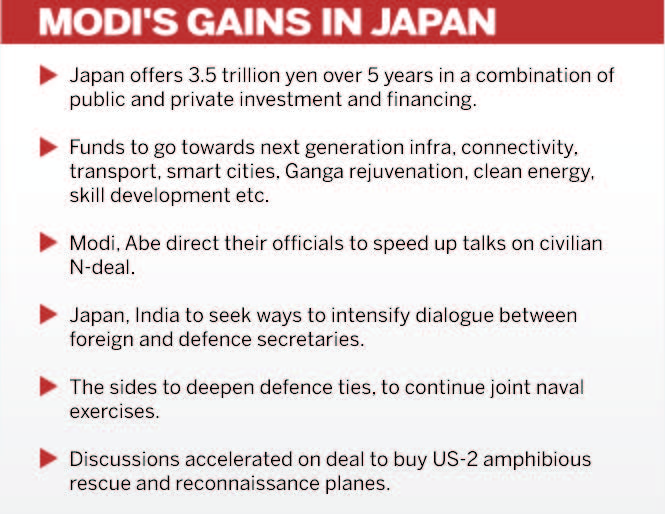
    1) Japan has committed to doubling its current investment in India to $35 billion over the next five years. This will be primarily towards developing India’s infrastructure and will involve Japanese firms. The agreement also envisages a doubling of Japanese firms doing business in India.

    2) Japan has also pledged $500 million towards the Public-Private Partnership Infrastructure Financing Project to the India Infrastructure Finance Company Limited (IIFCL). Additionally, Japan will also provide about $156 million for the Guwahati Sewerage Project in Assam.

    3) Both countries will work towards industrial infrastructure development with the creation of Smart Community projects in six Indian states as part of the Delhi Mumbai Industrial Corridor (DMIC) Project. The DMIC project will involve cooperation in developing power plants, assured water supply, high-volume urban transport, logistics facilities and skill development programmes for youth in regions along the corridor.

    4) Ponneri in Tamil Nadu, Krishnapatnam in Andhra Pradesh and Tumkur in Karnataka have been marked as potential industrial nodes, and officials from both countries have been instructed to finalise the Master Plan and the Development Plan of these cities by March 2015.

    5) Modi also inked a Memorandum of Understanding (MoU) between the Ministry of New and Renewable Energy of India and the Japan Bank for International Cooperation (JBIC) in the field of new and renewable energy. Both sides have also asked their officials to move forward on the civil nuclear energy program, which has been held up from the Japanese side since India’s nuclear weapons tests in 1998. Additionally, both countries will cooperate on building highly efficient and environment-friendly coal-fired power plants, and on cooperation in Clean Coal Technologies (CCT).

    6) India and Japan signed an agreement on the development of the Shinkansen system Bullet trains for India, starting with the Mumbai- Ahmedabad corridor. As part of this deal, Japan will provide technical, financial and operational support for such trains. Japan also said it would help India improve connectivity with its neighbouring countries, besides improving transport routes to the North Eastern states.

    7) Japan has agreed to ease foreign end-user entities list for India. As a starter, it has removed 6 Indian space defence-related entities from its restricted list. Both countries will also conduct talks to identify future areas of cooperation.

    8) The Joint Working Group will work on speeding up cooperation on the US-2 amphibian aircraft, which will include transfer of the aircraft and its technology to India. Both countries will also work on the roadmap for development of the Indian aircraft industry.

    9) Japan will work with India on creating smart cities, starting with the Kyoto-Varanasi project. As part of this, Japan will help India Varanasi – Modi’s Parliamentary constituency – develop urban infrastructure to make it a ‘smart’ city. Japan will also help India improve basic amenities across selected cities.

    10) Modi will set up a Special Management Team within the Prime Minister’s Office to deal exclusively with Japanese investment. This special cell will facilitate Japanese investments so that they do not get bogged down in red tape.

  • A New Sunrise

    A New Sunrise

    India and Japan have enjoyed the best of relations over the decades. Yet, their trade and economic partnership has, strangely, been underperforming, belying the promise and potential. Bilateral trade at $16.29 billion in 2013-14 accounted for just 2.13 per cent of India’s total trade and barely 1 per cent of Japan’s.

    The low-profile trade relationship is especially disappointing considering how much Japan has to offer in terms of investment and technology, and how much India needs both. India may be one of the largest recipients of Japanese ODA (Official Development Assistance), but when it comes to foreign direct investment (FDI), it ranks low, well behind China.

    Between April 2000 and February 2014, Japanese companies cumulatively invested $15.97 billion in India, accounting for just 7.46 per cent of total FDI inflows into India, which in a way epitomises the state of the economic relationship between the second and third largest economies of Asia. All this could change for the better, post-Prime Minister Narendra Modi’s visit to Japan, which seems to have breathed new life into economic relations.

    Japan has said it would invest 3.5 trillion yen ($33.5 billion) in India in the next five years in the sectors of infrastructure, manufacturing, transport and clean energy, and on smart cities, all thrust areas for development for the Modi government. To be sure, this is not the first time we have seen positive intent in the leadership of the two Asian giants to improve trade and investment. Ever since India liberalised in the early 1990s, there has been steady interest among Japanese companies and investors – but they have often been frustrated by complicated procedures and cumbersome processes.

    Actually, Japanese companies willingly ceded market space in India to competitors from South Korea and China rather than deal with the red tape. It is in this context that Mr. Modi’s promises of “red carpet, not red tape”, and a special track in the Prime Minister’s Office to facilitate Japanese investments, have to be seen. Mr. Modi harped on all the right themes including the three Ds that India can boast of, namely democracy, demography and demand, while making his pitch to Japanese business.

    With manufacturing costs increasing in China and given the political issues between the two countries, Japanese businesses are looking to diversify, and India presents a good choice with its huge market. New projects such as those for superfast trains and smart cities are ideal destinations for Japanese investments. The Modi government has to now move quickly to fulfil its promises of easing procedures and facilitating investment to capitalise on the optimism and goodwill generated from what has clearly been a successful visit in economic terms.

    British English (The Hindu)

  • Narayana Murthy invests in realty, Azim Premji to follow suit

    Narayana Murthy invests in realty, Azim Premji to follow suit

    BANGALORE (TIP): Property has always been a major investment avenue of the rich. Now, some of the people one would expect to focus on enterprising ventures are also looking at rent-yielding property. Infosys co-founder NR Narayana Murthy’s family office has bought high-end luxury apartments in Bangalore and Mumbai, said sources familiar with the development. Catamaran Ventures, which manages part of Murthy’s wealth, has previously invested in e-commerce, FMCG and education ventures.

    Another source said that Premji Invest, the family office of Wipro chairman Azim Premji, is also scouting for real estate assets in metros. A couple of years ago, Premji, in his personal capacity, had picked up a few properties in Mumbai that were subsequently rented out, sources in the real estate industry said. Sources said Catamaran Ventures, which manages Rs 600 crore of funds, had invested at the pre-launch phase, providing scope for steep appreciation once the projects are completed.

    TOI couldn’t ascertain whether Catamaran is also considering investment in commercial real estate. An email sent to Catamaran remained unanswered at the time of going to press. Murthy’s colleague and former Infosys CEO S D Shibulal’s penchant for real estate has been much reported. His family office, Innovations Investment Management, has property investments in the US, including in New York and Seattle, as also in Germany and India. In Seattle, it has a portfolio of over 700 apartments.

    The real estate investments, managed by a professional team, comprise both residential and commercial assets. Another Infosys co-founder NS Raghavan, through his family office Nadathur Estates, manages an investment portfolio of multiple asset classes, including hospitality and real estate. “Residential real estate does not bring the highest yields globally, but it is a reliable source of rental revenue coupled with capital appreciation and relatively better monetizing potential than commercial real estate,” said Anuj Puri, country head of real estate consultancy JLL India. While A-grade commercial office space gives a annual yield of 10% in India, residential properties give an average yield of 3%-4%.

    In some luxury residential properties, the yield could touch 7%. “Residential properties sit well on balance sheets and in inheritances, too. Not surprisingly, it is a preferred investment class for Indian HNIs with global reach and business interests,” said Puri. J Vishnu Shankar, founder of real estate consultancy firm Crorepati Homes, said that much of the investment action by family offices has been happening in top dollar markets like Mumbai and New Delhi. “My guess is that Bangalore has a limited number of properties that cost Rs 20 crore upwards, which is the typical asset class that interests such high-profile buyers,” he said.

  • Government notifies FDI liberalization in Railways

    Government notifies FDI liberalization in Railways

    NEW DELHI (TIP): The government on August 27 notified the liberalized FDI norms for the Railways, permitting 100 per cent foreign direct investment through automatic route in several areas, including high speed trains. Other segments of the Railways in which FDI will be allowed include suburban corridor projects through public private partnership (PPP), dedicated freight lines, rolling stock including train sets, locomotives/coaches manufacturing and maintenance facilities, railway electrification, signalling systems, freight terminals, passenger terminals and infrastructure in industrial parks like railway line/sidings. However, proposals involving FDI beyond 49 per cent in sensitive areas, from security point of view, will be placed before the cabinet committee on security (CCS) for approval by the Railway Ministry on a case-to-case basis, said a press note of the department of industrial policy and promotion (DIPP).

  • Oceanside’s Andrew T. Berman named to New York Life’s Executive council

    Oceanside’s Andrew T. Berman named to New York Life’s Executive council

    OCEANSIDE, NY (TIP):
    Andrew T. Berman has been named a member of the 2014 Executive Council of New York Life Insurance Company. Members of the Executive Council are among the most successful of New York Life’s elite sales force of 12,250 licensed agents. Berman has been a New York Life agent since 2012, and is associated with New York Life’s Greater New York General Office in Midtown Manhattan.

    Berman works with business owners highly compensated sales professionals (with an emphasis in real estate and mortgage sectors) and local families in the area of life insurance, retirement planning, college planning and business planning. He resides in Oceanside, N.Y. with his two daughters and wife who inspire him to help other successful professionals like himself. “I’m honored to receive this recognition” said Berman. “My clients have trusted me for their financial and insurance needs, and for that, I would like to thank them.

    At a young age, I learned that we need to fight to keep every hard earned dollar that we earn in our pocket, to protect against worst case scenarios and plan for the future.” Please visit Andrew’s Web site at andrewtberman.com for more information. New York Life Insurance Company, a Fortune 100 company founded in 1845, is the largest mutual life insurance company in the United States and one of the largest life insurers in the world.

    New York Life has the highest possible financial strength ratings currently awarded to any life insurer from all four of the major credit rating agencies: A.M. Best (A++), Fitch (AAA), Moody’s Investors Service (Aaa), Standard & Poor’s (AA+). Headquartered in New York City, New York Life’s family of companies offers life insurance, retirement income, investments and long-term care insurance.

    New York Life Investments provides institutional asset management and retirement plan services. Other New York Life affiliates provide an array of securities products and services, as well as retail mutual funds. Please visit New York Life’s Web site at www.newyorklife.com for more information.

  • Basics very much in Indian economy’s favor

    Basics very much in Indian economy’s favor

    INDIA’S JOURNEY TO DEVELOPMENT AND CHALLENGES

    The economy of India is the tenthlargest in the world by nominal GDP and the third-largest by purchasing power parity (PPP).The country is one of the G-20 major economies, a member of BRICS and a developing economy that is among the top 20 global traders according to the WTO.

    India was the 19th-largest merchandise and the 6th largest services exporter in the world in 2013. India’s economic growth slowed to 4.7% for the 2013-14 fiscal year, in contrast to higher economic growth rates in 2000s. However, India’s decisive election outcome has created the potential for further structural reform that could result in a near 7 per cent GDP growth rate over the coming decade, and bank capital injections could enable banks to facilitate funding for that growth.


    32


    This would have meaningful implications for India’s fixed income markets. It is believed that the next decade for India’s foreign exchange (FX) and fixed income markets will be marked by policy-driven reforms driving accelerated growth with increasing market liberalization. Recent figures already appear more encouraging than the dynamics that have been supporting stagflationary recession conditions: The country’s balance of payments has improved, spurred by FX depreciation and the Reserve Bank of India’s (RBI’s) non-conventional measures. The growth outlook has turned moderately positive, helped by a global recovery; and bad loan formation, even at state-owned banks, may now be moderating.


    33


    The narrative for Indian markets began to brighten even before the elections. Following the second stage of India’s economic liberalization and the foreign direct investment (FDI) reforms initiated in September 2012, foreign investment will likely be a major contributor to a jump in private investment. However, despite liberal FDI limits, it has remained moderate, constrained, in part, by administrative hurdles. As the obstacles are reduced, we expect FDI to lead an investment boom over the next decade, similar to China’s mid-1990s experience. We project FDI will rise to an average of 2.5 per cent of GDP (FY2014-24) from an average of 1.5 per cent of GDP (FY2008-14). We believe such foreign capital flow will lend significant support to India’s balance of payments trajectory.

    Improving public health

    Health care services in India have undergone a vast change over the past few decades and encompass the entire nation. The industry is expected to supersede China by 2030 in terms of population expansion. Hence, it becomes one of the essential duties of the state to raise the nutrition level, the standard of living of the people together with improving public health.

    Health care Industry of India The rapidly increasing health care industry of India is one of country’s largest sectors, both in terms of revenue and employment. It has been estimated that the healthcare industry of India is will grow by & 40 billion. The continuous increase in the population of India is considered one of the principal reasons for the growth in the healthcare industry of India. The rise in the infectious as well as chronic degenerative diseases has contributed to the rise in the healthcare sector of India. Additionally, because of diseases like AIDS and several lifestyle diseases of India, the healthcare sector of India will have a constant growth.

    In spite of the fact that the Indian healthcare industry is rapidly expanding, healthcare infrastructure in India is very poor. A noticeable percentage of India suffers from poor standard of healthcare services. Most of the healthcare facilities of India provided by the various healthcare services are limited and of low standard. In order to understand the current status of the healthcare services in India, it is important to know about the different healthcare services found in the country.

    Public health services, essential public health services, preventive health services, mental healthcare services, home health services, magellen health service and school health services are some of the healthcare services found in India. Companies providing Health Insurance in India The various companies providing health insurance policies in India can also be put under the healthcare services of India. Some of the companies that provide health insurance coverage in India are Appollo DKV Insurance Company Ltd., Bajaj Alliance General Insurance Co. Ltd., Birla Sun Life Insurance, Aviva Life Insurance and the like.

    Points to note

    1).It has been found out that while the private health services have been rising for meet the needs of the rich citizens and foreigners, public health services in India are lagging behind and suffering in a major way.

    2).It has also been found out that less than 1% of the GDP is spent on the public health care services in India.

    3).Surveys made throughout India points out that 65% of the Indian population cannot access to modern medicines.

    4).In addition, a number of drugs and even many diagnostic tests are still unavailable in the public health care sector of India.

    5).Most of the hospitals, one of the prime healthcare services in India, are located in the urban areas, thereby making it almost impossible for the rural people to access.

    Indian industry sees green shoots of manufacturing growth
    A green shoots of revival have started to appear in the manufacturing sector, which is critical for job creation, with a majority of segments likely to post higher output, according to industry bodies. The survey conducted by CII-Ascon for the April-June quarter indicates positive growth in important sectors like consumer durables including the vehicle industry and white goods industry, which recorded a growth of 5- 10 per cent, leading to improvement in the overall industry growth.

    The FICCI survey found that eleven out of fourteen sectors are likely to show improvement in production during the second quarter (Jul-Sept) of the current fiscal. Over 64 per cent respondents are not likely to hire additional workforce in the next three months, though this proportion is less than that of the previous quarter (75 per cent), indicating improvement in hiring outlook in coming months.

    The survey gauges the expectations of manufacturers for Q2 for fourteen major sectors namely textiles, capital goods, metals, chemicals, cement, electronics, automotive, leather and footwear, machine tools, FMCG, tyre, textile machinery and more. Responses have been drawn from 392 manufacturing units from both large and small and medium (SME) segments with a combined annual turnover of over Rs 4 lakh crore.

    An upturn in demand condition is also reflected in the improved order books of the manufacturers, said Ficci survey. While only 36 per cent respondents reported higher order books for the April-June quarter in the last survey, 43 per cent respondents reported higher order books for July-September quarter.

    Foreign relations
    Soon after the 2014 Lok Sabha election results declared a thumping victory for the BJP-led NDA government, Prime Minister Narendra Modi invited the heads of all the SAARC countries including Pakistan, Bangladesh, Sri Lanka, Nepal, Maldives, Bhutan and Afghanistan, for his oath-taking ceremony, sending a major diplomatic signal to the global community.

    Credited with being a focused administrator, Modi signalled that his decisive win would reshape India’s foreign relations and leverage the diaspora to increase investments, business opportunities and better relations. Modi went on to choose neighbouring country Bhutan over others for his first foreign visit.

    “I will follow the (foreign) policies of the Vajpayee-led NDA government, and that also applies to the relationship with the United States. I don’t think a decision taken by any individual or one event should impact the overall policy,” Modi said in an interview. The winds of change were clearly being felt at home and abroad.


    29


    SAARC: A refocus on the neighbourhood
    For the first time, leaders of all South Asian Association Regional Corporation (SAARC) countries were invited for the swearing-in ceremony of an Indian Prime Minister. The presence of all seven countries, Pakistan Prime Minister Nawaz Sharif, Afghanistan President Hamid Karzai, Sri Lanka President Mahinda Rajapaksa, Bhutan Prime Minister Tshering Tobgay, Maldives President Abdulla Yameen Abdul Gayoom, Nepal Prime Minister Sushil Koirala, Speaker of Jatiyo Sangshad in Bangladesh Shirin Sharmin Chaudhury, was a welcome step towards strengthening India’s relations with the SAARC countries. However, political parties in Tamil Nadu voiced their displeasure at Sri Lanka’s president Mahinda Rajapaksa attending the ceremony and held demonstrations against him.


    30


    Bhutan visit: Asserting influence in South Asia
    PM Narendra Modi’s maiden foreign trip to Bhutan was intended to show that in the new scheme of things, the neighbourhood enjoys high priority. Inaugurating Bhutan’s Supreme Court building that was built with India’s assistance, Modi also laid the foundation stone of the 600MW Kholongchu Hydro-electric project, a joint venture between the two countries.

    He also proposed to hold a joint sports festival between Bhutan and north-eastern states of India, doubling scholarships for Bhutanese students in India and establishing e-libraries in 20 districts in Bhutan Though his faux pas of referring to Bhutan as Nepal while addressing the Bhutan Parliament caused some embarrassment, Modi went ahead to say that “when Bhutan calculates its happiness quotient, having a friend in India is also a major factor.”

    Meet with Pakistan Prime Minister Nawaz Sharif: Picking up the threads
    Relations between India and Pakistan have always been tense, but differences between the two countries had escalated after the 26/11 Mumbai terror attack. Modi’s invitation to Pakistan’s Prime minister Nawaz Sharif for his oath ceremony was seen as an attempt at cooperation rather than confrontation, which was reciprocated by his Pakistani counterpart.

    In their first meeting, Modi pressed for confidence-building measures, peace and security as well as enhancing bilateral trade, sending a positive message among the people of both the countries. Modi struck a pragmatic note with Sharif, underlining India’s concerns on terrorism and urging his Pakistani counterpart to crack down on militants and speed up trial of the 2008 Mumbai attack suspects.

    Sharif also responded to the meeting positively, accepting the fact that the two countries must strive for better cooperation. In the interaction which was widely seen as an “icebreaker”, the leaders also decided that their foreign secretaries would be in touch and discuss a way forward on talks that had been suspended since January 2013.

    BRICS Summit: New inroads
    Pushing for better international governance, Narendra Modi said he favoured an open, rule-based, international trading regime which is critical for global economic growth. Modi’s first BRICS summit saw significant inroads towards the establishment of the New Development Bank and though the headquarters of the bank is slated to be in China, its first President will be from India.

    Addressing the BRICS leaders, Modi also pressed for zero tolerance towards terrorism. He also met Chinese President Xi Jinping and both addressed the need for a solution to the boundary question. Further, Modi also favoured broadening the strategic partnership with Russia in nuclear, defence and energy sectors and invited President Vladimir Putin to visit the Kudankulam atomic power project during his trip in December.

    India poised to make further progress on UN’s development goals
    India has made progress on different indicators such as health and nutrition under the UN’s Millennium Development Goals and is expected to improve further upon them. “There has been progress in all the indicators and further progress is expected to be made in the remaining period up to 2015,” Planning Minister Rao Inderjit Singh had said recently.

    Challenges
    As far as India is concerned, 8 MDGs with 12 targets are relevant which are sought to be achieved during the period 1990 to 2015, the minister said. MDGs are international development goals that UN member states and numerous international organizations, including India, have agreed to achieve by the year 2015.

    Eradicating poverty
    These include eradicating extreme poverty and hunger; achieving universal primary education; promoting gender equality; reducing the child mortality rate and ensuring environmental sustainability. The minister’s said India had achieved the MDG target regarding poverty eradication. India had to halve the proportion of people whose income is less than one dollar a day between 1990 and 2015.

    In 1990, India had 47.8 per cent such poor people and thus the proportion of this population is to be reduced to 23.9 per cent. However, India’s poverty ratio was 21.92 per cent for 2011-12. Similarly, India has to half the proportion of people who suffer from hunger by 2015 to 26 per cent. However, the latest figure for 2004-05 reveal that the percentage of such population was 40 per cent.

    Education: Improving enrolment ratio
    In the education sector, India has to improve the net enrolment ratio in primary schools to 100 per cent by 2015. The country achieved 99.89 per cent enrolment in primary education in 2011-12. The proportion of pupils starting grade 1 who reach grade 5 was 86.05 per cent in 2011- 12 against the target of 100 per cent. The literacy rate in India was 61 per cent in 1990. It went up to 86 per cent in 2017-08.

    The ratio of girls to boys in primary education was 0.73 in 1990 which went up to 1.01 in 2011-12. Similarly the ratio of literate women to men (15-25 years) was 0.67 in 1990, which was 0.88 in 2007-08. MDGs target for both ratios is 1. The mortality ratio among children under the five-year age was 126 per 1,000 live births in 1990 which was brought down to 52 in 2012. The MDGs target is 42 for that.

    Infant mortality ratio
    The infant mortality ratio was 80 per 1,000 live births in 1990 which was brought down to 42 in 2012 against the MDGs target of 27. The proportion of one year old children immunized against measles was 42.2 per cent in 1990 which was improved to 74.1 per cent against targeted 100 per cent coverage.

    Similarly, the maternal mortality ration per 1,00,000 live births was 437 in 1990 which was brought down to 178 by 2011-12 against targeted 109 by 2015.

  • Govt say no to FDI in multi-brand retail

    Govt say no to FDI in multi-brand retail

    NEW DELHI (TIP): The Modi government has made it clear it would not open the doors for FDI in multi-brand retail in India. Commerce minister Nirmala Seetharaman said in Rajya Sabha on August 13 that the BJP government was voted to power on the basis of the party’s election manifesto which clearly said it is against FDI in multi-brand retail. “The mandate given to government is on the basis of our manifesto … we do not entertain FDI in multi-brand retail,” she said.

    The government though is yet to initiate any move to scrap the UPA-II government’s decision to allow FDI in the same sector. She said FDI flows have not been consistent in the past few years. “During the last three years FDI inflow has fluctuated. FDI inflow decreased by 26.33% in 2012-13 and increased by 6.12% in 2013-14,” she said.

    FDI flow is dependent on the business environment and how decisions are made, she said, adding it has been skewed in favour of Mauritius which accounted for $80.809 billion out of $222.89 billion that came to India between 2000 and 2014. “We are using FIPB (Foreign Investment Promotion Board) to carry out check (on investing companies),” she said. Even in sectors where FDI is allowed under automatic route, Reserve Bank of India (RBI) scrutinises the funds flow, she said.

    RBI and department of revenue, through FIPB, scrutinise investments coming into India, she said. “Under the liberalised economic environment, investment decisions of investors are based on the macro-economic policy framework, investment climate in the host country, investment policies of the trans-national corporations and other commercial considerations,” the minister said.

  • Murdoch reboots internet play in India

    Murdoch reboots internet play in India

    MUMBAI (TIP): Media mogul Rupert Murdoch’s News Corp has charted a fresh investment plan to tap into India’s fast-growing consumer internet story more than a decade after he took bets on domestic digital properties like Indya.com and Baazee. The media giant is rebooting tactical investments as part of a strategy to aggressively expand the group’s digital play in markets like India, sources aware of the development said.

    Murdoch’s comeback coincides with euphoric investor sentiment around India’s recent billion-dollar internet and digital startups. News Corp’s senior vice-president for strategy Raju Narisetti is leading the media giant’s investment interests in India, a source cited earlier who did not want to be named said. The New York-based media giant, which split its publishing and broadcasting units last year, has been making “targeted investments” into digital assets in south-east Asian markets recently.

    “Because it is widely known that News Corp has no debt and started its new journey with $2-billion plus in cash, I am constantly and relentlessly pitched by investment bankers on potential deals. If it makes strategic sense, I tend to take a closer look and from that point of view, most of Asia, including India, will always be on the radar,” News Corp’s Narisetti said.

  • Modi government deserves appreciation for opening up wide to FDI

    Modi government deserves appreciation for opening up wide to FDI

    The recent decision of Modi government on foreign direct investment (FDI) should be seen as a positive step in the right direction. The process of liberalization set in motion by the Congress government in 1991 paved the way for financial and economic reforms. It is nearly 23 years that the much touted process of liberalization was initiated, to the chagrin of the socialists who saw in reforms doom for the common man.

    However, much though there is a wide difference in the perceptions of pro and anti liberalization elements in the country, the fact remains that India, after the liberalization process was set in, did make significant progress and achievements in various fields. India managed to come out of its primitive image and move forward in the fields of science, technology, particularly, information technology. Financial liberalization threw open resources for businesses. Infrastructure came to be created. Investment coming from various sources speeded the growth rate. But all was not well, mainly because of half hearted measures.

    It is heartening to find that Prime Minister Modi has taken a bold decision to replicate Gujarat model to invite investment. It is well known that India does not have the financial resources to create the much needed infrastructure. Nor does the country have enough resources to modernize the defense system which the country needs so badly, given the hostility of some neighbors. Countries all over the world obtain the resources they require for their development from every part f the world.

    America, the “number one nation” of the world got Indian techies to help in their growth. They got Indian doctors and nurses. They got work force from every part of the world. Whether it is human resource or material resource, it does not matter. It does not require super intelligence to understand that an investment will mean work which will mean employment, which in turn, will mean, means of living and, in course of time, better living. India needs to open up still more to let the world come and invest.

    We still have the dubious reputation of being a corrupt nation where nothing works without bribery. Modi government needs to do some hard thinking about it. Foreign investors may feel dissuaded if they come across difficult situations in entering in to a business or being harassed later. All in all, Modi government should be congratulated for raising foreign direct investment in defense from 26% to 49″ and allowing 100% FDI in the railways, where a lot of investment is required to modernize a depleted system. The bullet train as of now seems a far cry.

  • Indian Union cabinet approves increased FDI in defense, railways

    Indian Union cabinet approves increased FDI in defense, railways

    NEW DELHI (TIP): The Indian Union Cabinet on Wednesday, August 6 approved a proposal to raise the cap on Foreign Direct Investment (FDI) in the defense sector from 26% to 49%, a move aimed at accelerating indigenization and bringing in modern technologies to meet the requirements of the armed forces. Finance minister Arun Jaitley had announced in his budget speech that the FDI cap in defense manufacturing would be increased to 49%, with full Indian management and control through the Foreign Investment Promotion Board (FIPB) route.

    Foreign firms haven’t made significant investments or set up defense manufacturing facilities, with the 26% cap on FDI dampening their enthusiasm to pump money into the country. Barely $5 million of FDI has flowed into India since the defense sector was thrown open to private companies in 2001 by the then NDA government. However, it remains to be seen if lifting the FDI cap to 49% would lead to a significant inflow of foreign investment into the country and lead to greater indigenization as there are some who have been advocating raising the limit to 74%. Former defense minister AK Antony had opposed lifting the 26% cap on FDI.

    He had attacked the NDA government last month for increasing the FDI cap to 49% in the Budget, saying that it would hurt national security. He had said, “I know a very strong lobby is working. Their demand is 100% FDI in defense. Successive governments since 1991 have overcome such pressure tactics. Their decision not to grant FDI beyond 26% was well thought out.” However, the commerce ministry under the UPA regime had batted for raising the FDI cap to 74% to encourage foreign firms to invest in India.

    The government also approved a proposal to allow 100% foreign direct investment (FDI) for building railways infrastructure. Foreign capital in railways was not allowed till now. However, the new government led by Prime Minister Narendra Modi has been pushing for it to build infrastructure projects such as high-speed railways and railway lines to and from coal mines and ports. Currently, the cash-strapped railways cannot fund these projects without private participation. Foreign players from Japan and China are said to be keen to participate in building up of the railway infrastructure.

  • Budget 2014 displays pragmatic & pro-growth policy stance: Sanjay Nayar, KKR India

    Budget 2014 displays pragmatic & pro-growth policy stance: Sanjay Nayar, KKR India

    Presenting his first budget, Finance Minister Arun Jaitley summed up the prevailing economic situation as continuing to present a great challenge to the economic health of the country.

    Emphasising the need to move quickly to revive the economy, he recognised the need to boost India’s economic growth as well as introduce prudent measures to enforce fiscal consolidation and discipline. The budget was eagerly awaited and was expected to present a bold strategy by the new government to revive growth, curb the fiscal deficit and improve investor sentiment in the country.

    It seems to have delivered on those counts. The new government provided a realistic budget, with a clear focus on better governance. The proposed reforms are a fairly good start. The growth strategy seems positive and the drift towards consolidation is much appreciated.

    The budget displays a pragmatic and progrowth policy stance adopted by the government. There is a clear focus on job creation and accelerating bank allowances. This will give a much-needed fillip to sectors such as power, infrastructure, manufacturing, agriculture and small and medium enterprises.

    Through the budget, the government has aimed at reducing uncertainty and enabling clarity in tax matters, seen as crucial to bring back investor confidence to boost the slowly recovering Indian economy. The government has committed to medium-term consolidation and has announced measures to attract capital inflows and boost investments.

    The question is, what is the real number of the subsidies ultimately (I’m not implying that the new government would have all the answers within 45 days), will that mean a curbing of planned expenditure towards investment to meet the 4.1% fiscal deficit target and finally the feasibility of raising .`63,200 crore disinvestment target. Having said the above, clearly the government has given a message that they are open for business. They have sincerely tried to tackle a couple of issues upfront and have given a message that they are ready to sit across the table to put India firmly on the 8% growth path over the next few years.