Tag: Iran

  • EXODUS: EUROPE, ASIA, AND BEYOND

    EXODUS: EUROPE, ASIA, AND BEYOND

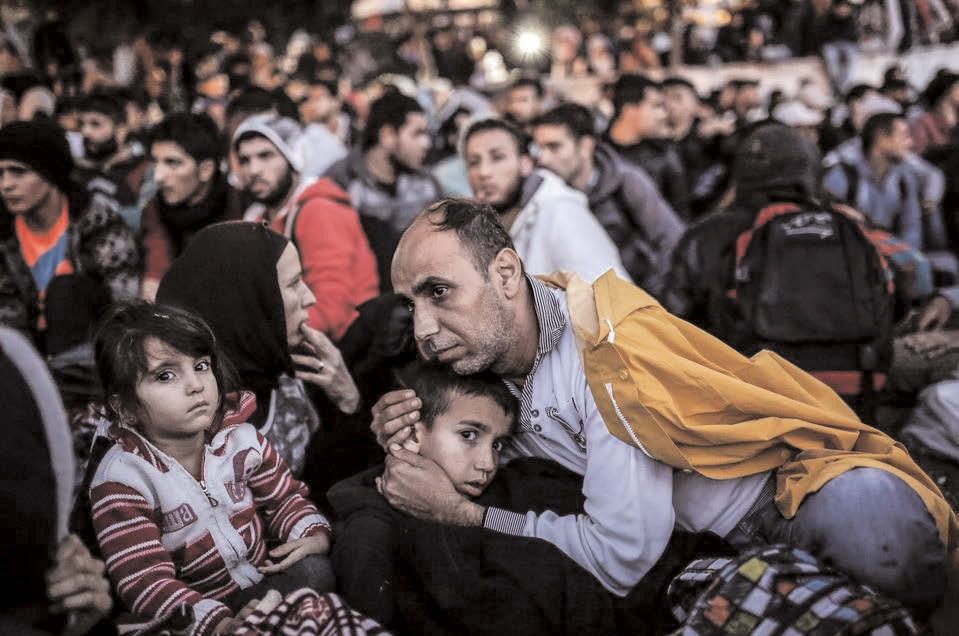
    As the battles raged in Syria and Iraq, millions of innocent civilians have sought refuge elsewhere to escape the dire straits in their home countries. Their prime destination: Europe. They came via planes, trains, ships, boats, cars, and for many, on foot: hundreds of thousands of displaced people fleeing a war no one asked for, leaving behind everything – their careers, property, families, their lives.

    Most of the world, at first, did not seem to notice the crisis. Not until the photo of a boy in a red shirt, lying lifeless, face down on the sands of a Turkish beach, came up in newspapers, websites, and social media.

    Three-year-old Syrian refugee Aylan Kurdi’s death shocked the world into consciousness, and spurred western governments to act on the worsening humanitarian crisis.

    By the end of 2015, more than one million migrants and refugees reached the continent, nearly 970,000 of which made the journey crossing the waters of the Mediterranean. It wasn’t only Syrians and Iraqis fleeing the mess in their home countries; there were also thousands escaping poverty and persecution, mainly from other Mideast and African states.

    Europe and other western countries scrambled to address the exodus, as the crisis became another test for the EU. Following a slew of emergency summits this year, EU leaders have acknowledged they were too slow to carry out a joint strategy to tackle Europe’s worst refugee crisis since World War II. Other countries have also stepped up, like Canada, which has already welcomed its first batch of Syrian refugees.

    Asia, in particular Southeast Asia, also had its own refugee crisis. Impoverished, persecuted, and with nowhere to go, Rohingya took to rickety boats in their bid to escape the quagmire they were in. The crisis came to a head around May, when thousands of these refugees, mainly from Myanmar’s Rakhine state, were left abandoned at sea, setting off a regional crisis. Horror stories of kidnap, coercion, and hunger emerged from the hundreds who staggered ashore or were eventually rescued by Thai, Indonesian, and Malaysian authorities after weeks at sea.

    Refugee exodus is seen as logical outcome of Syrian president's survival strategy.
    Refugee exodus is seen as logical outcome of Syrian president’s survival strategy.

    The crisis has ebbed somehow in the past few months, thanks to some action of regional governments involved, as well as due to the monsoon season. But with the monsoon ending, the crisis might again surge forward into the headlines – and a solution still seems far away.

    Tensions defused? The Iran nuclear deal

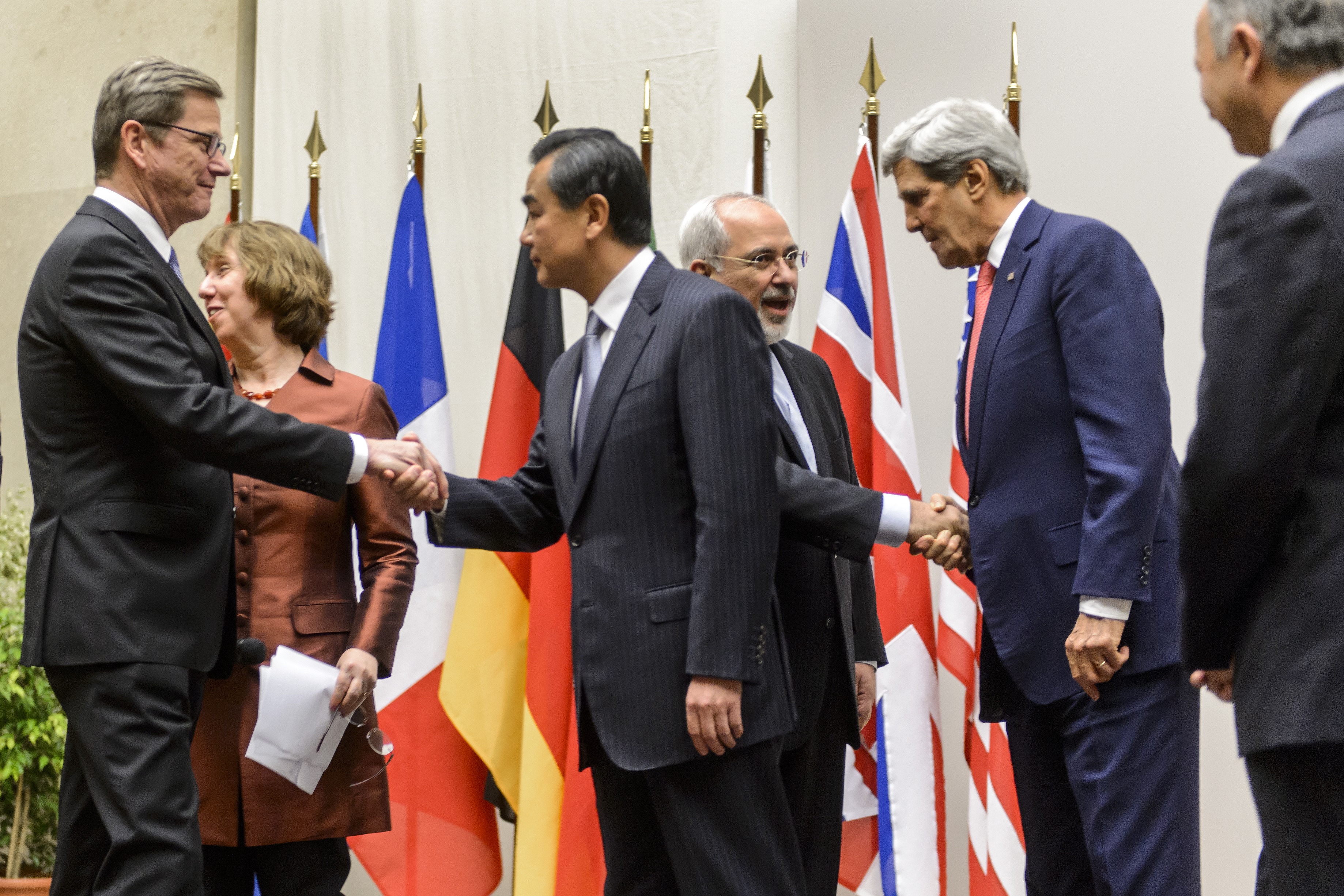
    The odds were stacked against it, but on July 14, weary foreign ministers from the US, Britain, France, China, Russia, Germany, the EU, and Iran announced to the world that a deal to curb Iran’s nuclear ambitions had been forged. It was a diplomatic victory for the parties involved, especially for Iran, which has been trying to shake off its long-time image as a pariah state.

    The ministers of foreign affairs of France, Germany, the European Union, Iran, the United Kingdom and the United States as well as Chinese and Russian diplomats announcing the framework for a Comprehensive agreement on the Iranian nuclear programme (Lausanne, 2 April 2015).
    The ministers of foreign affairs of France, Germany, the European Union, Iran, the United Kingdom and the United States as well as Chinese and Russian diplomats announcing the framework for a Comprehensive agreement on the Iranian nuclear programme (Lausanne, 2 April 2015).

    Under the deal, Iran pledged to slash the number of centrifuges – which enrich uranium – from around 19,000 to 6,104, of which 5,060 will still enrich. It also has to change the design of a new nuclear reactor being built and shrink its stock of low-enriched uranium, shipping it to Russia. In return, outside powers will end some of the international sanctions that have severely squeezed the Iranian economy.

    The road to the deal, however, wasn’t an easy one. For years, Iran has maintained that its nuclear program was for peaceful, civilian purposes, but a weary West always eyed it with suspicion. In the past few years, the two sides have see-sawed between coming close to a deal and coming close to conflict. The relative success of the deal was a result of months of non-stop negotiations, as well as the presence of a more moderate government in Tehran, led by President Hassan Rouhani.

    The question now: Will both sides honor the deal?

    Greek tragedyA country teetering on the brink of bankruptcy due to years of financial mismanagement. A hardline, leftist government. An economic bloc avoiding a region-wide collapse. These were the elements of a Greek tragedy that unfolded throughout the better part of 2015, as Greece and the European Union negotiated to save the Balkan nation from crashing out of the eurozone.

    Greek Meltdown Fed up with the hated “troika” – the European Commission, European Central Bank, and the International Monetary Fund -Greeks in January voted into power their first leftist government, led by Alexis Tsipras’ SYRIZA party. Tsipras came into power with the promise to lead the country out of the debt crisis. However, after months of intense, pressure-filled negotiations and despite voters saying “no” to a new deal, Greece caved in to its creditors’ demands and signed its latest bailout deal. The deal, worth 86 billion euros ($93 billion) to be spread out over a 3-year period, ultimately saved the country from crashing out of the eurozone, but it came with strict conditions.

    The fallout: Tsipras resigned August 20 after accepting the deal, reneging on a promise to stand its ground against the country’s creditors. A snap poll in September, however, saw Tsipras and his SYRIZA party hold on to power. Adding to Greece’s economic woes is the refugee crisis, with the country acting as migrants’ main gateway to the EU, straining the already burdened nation.

    Russia and China: Show of force

    From ISIS to Iran, Russia – long overshadowed by richer and more influential countries in the West – continued to assert itself as it seeks to revive its power and influence. From Ukraine to Syria, it has made its presence felt, mostly through its military. It has been steadily fortifying its army, building and expanding bases in the Arctic, growing its defense budget, and taunting its neighbors with its planes, submarines, and ships with clandestine – and in one case, deadly – side trips outside its territory.

    China: Show of force.
    China: Show of force.

    Russia has also been making inroads on the political front, participating in some of the year’s major diplomatic issues, such as the Iran nuclear deal. But the centerpiece in the past 12 months has been Syria, as President Vladimir Putin’s government seeks to keep and gain more influence in the Middle East.

    Meanwhile, China has also made aggressive moves economically, diplomatically, and militarily. As other world powers became stuck in other issues, bogged down by economic and political matters, the Middle Kingdom continued to expand its reach, primarily through billions of dollars in economic aid and infrastructure projects.

    Despite winning a lot of new friends, China has one major thorn on its side: its long-simmering maritime and territorial disputes with its Asian neighbors. The East and South China Seas have become sensitive spots in the region – particularly the Spratlys, where Beijing has been building artificial islands in its attempt to bolster its claims in the area. The waters are now being tested by militaries from other countries, including the US and Australia, with an increasing number of confrontations near the disputed “islands.” China also lost in round one of an arbitration case lodged by the Philippines at the global maritime tribunal.

  • Iran and Saudi Arabia: Islamic Intolerance or Oil Intolerance | In-depth Coverage & Analysis

    Iran and Saudi Arabia: Islamic Intolerance or Oil Intolerance | In-depth Coverage & Analysis

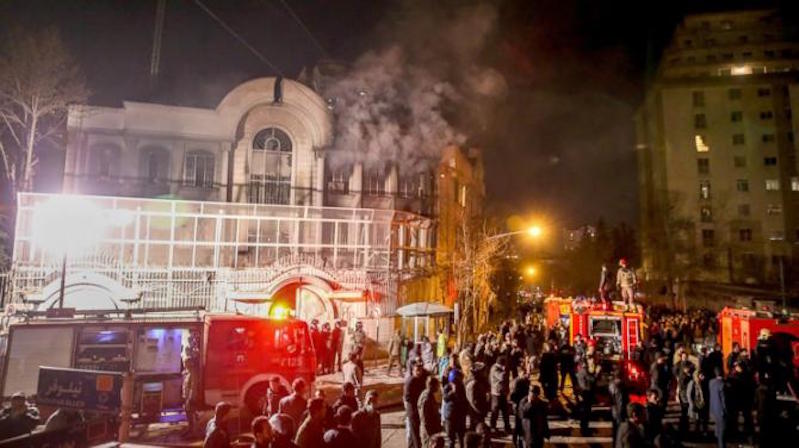
    Saudi Arabia has announced it is severing diplomatic ties with Iran following Saturday’s (January 2) attack on its embassy in Tehran during protests against executions in the kingdom.

    Adel al-Jubeir, the Saudi foreign minister, made the announcement on Sunday while the foreign ministry said it was asking Iranian diplomatic mission to leave the kingdom within 48 hours.

    The Saudi foreign ministry also announced that the staff of its diplomatic mission had been evacuated and were on their way back to the kingdom.

    Later reports said the flight carrying the Saudi embassy staff had landed in Dubai in the UAE.

    Saudi Arabia’s interior ministry announced on Saturday the execution of 47 people on terrorism charges, including a convicted al-Qaeda leader and a Shia religious leader.

    Many of the men executed had been linked to attacks in Saudi Arabia between 2003 and 2006, blamed on al-Qaeda.

    Four of those executed were said to be Shia.

    Nimr al-Nimr, the Shia leader, was accused of inciting violence and leading anti-government protests in the country’s east in 2011. He was convicted of sedition, disobedience and bearing arms.

    He did not deny the political charges against him, but said he never carried weapons or called for violence.

    Nimr spent more than a decade studying theology in predominantly Shia Iran.

    His execution prompted demonstrations in a number of countries, with protesters breaking into the Saudi embassy in Tehran late on Saturday night and starting fires.

    At Sunday’s press conference in Riyadh, Jubeir said the Saudi diplomatic representative had sought help from the Iranian foreign ministry when the building was stormed, but the requests were ignored three times.

    He accused the Iranian authorities of being complicit in the attack, saying that documents and computers were taken from the embassy building.

    Calling the incident an act of “aggression”, he said Iran had a history of “violating diplomatic missions”, citing the attacks on the US embassy in Tehran in 1979 and the British embassy in 2011.

    “These ongoing aggressions against diplomatic missions are a violation of all agreements and international conventions,” he said, calling them part of an effort by Iran to “destabilise” the region.

    – With Inputs from Al Jazeera

    IRANIAN ACTION

    Earlier on Sunday, Iranian President Hassan Rouhani ordered the arrest and prosecution of individuals involved in the embassy attack, while also condemning the execution of Nimr.

    Asked at the press conference what other steps the Saudis would take against Iran, Jubeir said “we will cross each bridge when we will get to it”.

    “We are determined not to allow Iran to undermine our security,” he said.

    Ellie Geranmayeh, an Iran expert at the European Council on Foreign Relations, said the Saudi decision was likely to have repercussions for the region, particularly concerning the Syrian negotiations.

    “Western powers must increase efforts to safeguard this process and encourage the Saudis and Iran to continue their participation [in the Syria peace talks],” she told Al Jazeera from London.

    “These events further set back the urgently needed rapprochement between Tehran and Riyadh, and spell further trouble for an already fragile region.”

    BAHRAIN, UAE AND SUDAN RALLY TO SAUDI SIDE IN IRAN ROW

    Saudi Arabia’s regional allies have stepped up diplomatic pressure on Iran, breaking or downgrading relations with the country following an attack on the Saudi embassy in Tehran, which followed executions in the kingdom.

    Bahrain announced on Monday that it was closing its embassy in Iran, and called upon Iranian diplomats to leave the country within 48 hours.

    Bahrain frequently accuses Iran of being behind protests among its majority Shia population.

    Within hours of the announcement, Sudan also said it was cutting off diplomatic relations with Iran “in solidarity with Saudi Arabia”.

    For its part, the UAE said it was downgrading its ties with Iran, replacing its ambassador with an embassy officer-in-charge.

    Saudi Arabia announced on Sunday it was severing diplomatic relations with Iran and urged its allies to follow its move.

    The decision came after Iranian protesters attacked its embassy in Tehran, following the kingdom’s decision to execute Shia religious figure Nimr al-Nimr along with 46 other mostly Sunni convicts on terrorism charges.

    Shia minorities across the Middle East have been demonstrating after Nimr’s execution.

    Saudi Arabia is adamant Nimr got a fair trial. Many of the men executed had been linked to attacks in Saudi Arabia between 2003 and 2006, blamed on al-Qaeda.

    Saudi Arabia further announced on Monday that it was cutting commercial ties with Iran and cancelling all flights to and from Iran, according to Reuters.

    In an interview with the news agency, Adel al-Jubeir, Saudi foreign minister, said the kindom was banning all its citizens from travelling to Iran.

    However, Iranian pilgrims are still welcome to visit Saudi Arabia and Mecca, Islam’s holiest site, he said.

    Earlier, Abdul Latif bin Rashid al-Zayani, secretary-general of the Gulf Cooperation Council, condemned the attack in Tehran and held Iranian authorities fully responsible for failing to protect the Saudi diplomatic mission.

    IRANIAN PERSPECTIVE

    It is not the first time diplomatic relations have been cut between Saudi Arabia and Iran. However, there are fears it could lead to more violence.

    Iran’s foreign ministry said Saudi Arabia was using the attack on its embassy in Tehran as a pretext to fuel tensions..

    The statement came after Iran was given a 48-hour deadline to remove its diplomatic mission from Riyadh.

    “Iran … is committed to providing diplomatic security based on international conventions. But Saudi Arabia, which thrives on tensions, has used this incident as an excuse to fuel the tensions,” Hossein Jaberi Ansari, Iran’s foreign ministry spokesman, said in televised remarks on Monday.

    On the other hand, Jubeir has accused Iranian authorities of being complicit in the attack, saying that documents and computers were taken from the embassy building.

    He said the Saudi diplomatic representative had sought help from the Iranian foreign ministry when the building was stormed, but the requests were ignored three times.

    Hamid Soorghali, a UK-based Iran observer said, the attack of the Saudi embassy “only works to damage and affect the image of Iran”.

    He said while the leadership in Iran is unified in condemning the execution of Nimr, it is divided in terms of the reaction.

    “We get different responses from different institutions and leaders in Iran. We get a harsher message from Iran’s supreme leader, which very much reverberates in the mood and scenes of protesters in front of the embassy,” he told Al Jazeera.

    ‘NO LOVE LOST’

    Ghanbar Naderi, a journalist with Kayhan, a publication closely linked to Ayatollah Ali Khamenei, Iran’s supreme leader, said the breaking of diplomatic relations between Saudi Arabia and Iran was inevitable.

    “It was going to happen today or tomorrow. This is a natural outcome of what has been going on for the past four or five years in Syria, Iraq and Yemen,” he told Al Jazeera.

    “Make no mistake about it, there is no love lost between the Iranians and the Saudis.”

    Al Jazeera’s James Bays, reporting from New York, said diplomats at the UN have expressed worries over the escalating war of words.

    “What we are seeing is the fallout across the Gulf countries,” he said. “In terms of the relationship between Saudi Arabia and Iran, I think most people think that this is probably as bad as you can get.”

    On Sunday, Ban Ki-moon, UN secretary-general, issued a statement saying he was “concerned” about both sides of the diplomatic dispute, while criticising both the executions and the attack on the Saudi embassy in Tehran.

    Ban was to send Staffan de Mistura, the UN special representative for Syria, to Riyadh and Tehran on Monday, a UN official told Al Jazeera.

    In a call on Monday, Ban conveyed his concerns to the foreign ministers of Saudi Arabia and Iran, a UN statement said.

    The statement said he urged the two countries “to avoid any actions that could further exacerbate the situation between two countries and in the region as a whole”.

    THE OIL PRICE, IRAN AND SAUDI’S ECONOMY

    Analysis: How Iran’s return to global oil markets may impact Saudi Arabia’s 2016 budget.

    During last month’s OPEC meeting, Saudi Arabia again declined to cut oil production despite the world being awash with oil.

    The great unanswered question for Saudi Arabia is: How low can prices go, and for how long?

    Saudi Arabia’s refusal to reduce oil output shows no sign of abating, but its determination to drive out US shale producers is taking a toll on the kingdom’s economy, recent data suggests. And with the expectation of Iran’s return to global oil markets already undermining fragile prices, Riyadh’s strategy looks increasingly like it might be a gamble with declining odds.

    Although the kingdom has substantial reserves, it appears to be burning through its financial war chest at an alarming rate. According to the Saudi Arabian Monetary Agency, foreign exchange reserves fell to $648bn at the end of October from $742bn a year earlier.

    OIL PRICES AND OPEC

    If OPEC does not compensate for the increase in Iran’s oil exports by cutting oil production, the International Monetary Fund says oil prices could fall between five and 10 percent in the medium term. Energy giant BP estimates that Iran has the fourth-largest proven oil reserves in the world after Venezuela, Saudi Arabia and Canada, as well as the second-largest gas reserves, according to the IMF.

    How quickly Iran can ramp up production is up for debate, but a consensus appears to be emerging. Industry Think Tanks believe that Iran will add between 0.5 to one million barrels a day within a year, while the IMF forecasts an increase of around 0.6 million barrels a day in 2016.

    Bijan Zangeneh, Iran’s oil minister, is considerably more bullish about the country’s ability to bolster output but, whatever the figure, it is expected to increase pressure on Saudi’s economy, in which about 90 percent of government revenues are derived from hydrocarbons.

    At the same time, there are signs that the Saudi campaign against US shale is having an impact. There is mounting evidence that shale production in the United States is beginning to wane, while energy consumption in advanced economies is rising. Elsewhere in the world, major energy companies have shelved a number of projects – a move that will support of prices in the medium term.

    SAUDI ECONOMY

    Even so, the IMF predicts that the gross domestic product in Saudi Arabia will grow by only 2.2 percent in 2016, compared with 4.4 percent in Iran.

    Eduard Gracia, a principal at the AT Kearney consulting firm, says Saudi Arabia’s decision not to cut production is due in part to the supply-demand dynamics of the global market.

    “It only makes sense ‎to cut production if the supply situation is such that a small output reduction results in a substantial price increase,” Gracia told Al Jazeera. “In a situation of global oversupply this may not be the case, so the appeal of a production-cutting strategy is not clear.”

    By the end of this year, Saudi Arabia’s budget deficit will reach 20 percent of GDP, according to a December report from Capital Economics. The situation has prompted the IMF to warn that Saudi could exhaust its reserves within five years if policies remain unchanged. Riyadh has responded with cutbacks in spending, and is under intense pressure to reduce expensive energy subsidies.

    The IMF estimates that these implicit subsidies cost the government $83bn in 2014, one of the highest totals in the Gulf Cooperation Council countries, second only to Bahrain. Attention is now turning to Saudi’s 2016 budget. It is expected to be one of mostly heavily scrutinised budgets in years, as investors seek reassurance that the kingdom’s finances are under control.

    According to press reports, leaked memos from King Salman to the Ministry of Finance in October ordered government entities to stop new infrastructure projects and to postpone purchases of new cars and furniture. Mounting economic uncertainty led Standard & Poor’s to downgrade Saudi’s rating from AA-/A-1+ to A /A-1 in October, with a warning of a possible further downgrades.

    The downgrade pushes up the costs of borrowing at a time when government revenues have fallen sharply. There has also been speculation in financial markets about how this could affect the Saudi riyal, with the spread between forward and spot rates recently widening to the highest level since 2003.

    However, according to Capital Economics, that scenario would be the last resort, and Saudi has other options that could include tapping into the international bond markets early in 2016 – something it has never done before. Authorities are currently issuing around SAR 20bn ($5bn) of debt per month to local banks, reducing the amount local banks have left to lend to the private sector, according to an estimate from Capital Economics.

  • Prabhu Dayal serves hot Karachi Halwa

    Prabhu Dayal serves hot Karachi Halwa

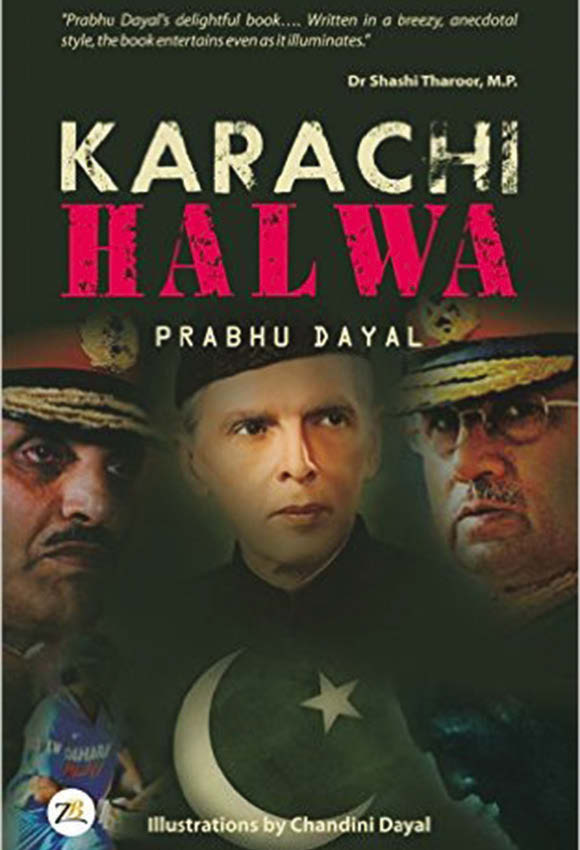
    NEW YORK (TIP): Why would Zia want to climb five floors of a hotel? Why did someone think Zia could fix his TV? Was Zia practicing Urine therapy? What did Christopher Lee and Alyque Padamsee have in common?

    Prabhu DayalAmbassador Prabhu Dayal who had a very highly successful diplomatic career as Indian Consul General in New York for five years has penned all his memories of his posting in Pakistan and aptly named the book “Karachi Halwa”.

    Karachi Halwa is witty and insightful portrayal of Zia ul Haq’s rule in Pakistan. Ambassador Prabhu Dayal shares his recollections of that period and keeps you laughing throughout his account of the bumpy ride of Pakistan’s domestic politics and its relationship with India. He tells you how a Sahiwal cow was brought into the equation, and where an elephant comes in.

    Karachi HalwaHe says, ‘The past, the present and the future are in one continuous motion. Whatever I witnessed in Pakistan during Zia’s rule extends its long shadow not only over the present times but will do so well into the future also’. He poses the ultimate question whether the two South Asian giants can live as friends, offering his own suggestions.’

    Ambassador Prabhu Dayal is an illustrious officer of the Indian Foreign Service with a career spanning 37 years. He served in various diplomatic positions in Egypt, Pakistan, Iran and the Permanent Mission to the UN at Geneva before being appointed as Consul General, Dubai in 1994. This was followed by his appointment as Ambassador to Kuwait (1998-2001) and to Morocco
    (2004-2008). He also served as Deputy Secretary (Pakistan) and later as Joint Secretary (SAARC).

    He was Consul General, New York from 2008 until his retirement in 2013-ranking next in seniority to the Ambassador. From the magnificent heritage building in Manhattan which houses the Consulate General of India, he handled matters relating to 10 US States–New York , New Jersey, Pennsylvania, Ohio, Connecticut, Rhode Island, Massachusetts, Vermont, Maine, New Hampshire. His jurisdiction also included Puerto Rico and the US Virgin Islands.

    Having been a student of International Relations at the University of Allahabad, it was perhaps natural for him to opt for the Foreign Service when he stood second in the Order of Merit in the Civil Services Examination. “Nation states have always engaged in warfare and diplomacy” he says, adding “the world needs skillful diplomats more than ever before in history”. He puts his rich experience and intellectual abilities to good use in his first book- ‘Karachi Halwa’. His wife Chandini Dayal has provided illustrations with her deft pen for all the chapters.

    ‘Karachi Halwa’ is published in India by Zorba Books and kindle books are available online at Amazon. The hard copy version is being sold at a moderate price of Rs.199 on Amazon.in and Flipkart. It is also available on uRead.com, which will deliver worldwide.

    Karachi HalwaIn his prologue, Prabhu Dayal says: “My diplomatic career has taken me to several continents, but I must admit that in no country did I feel such an overpowering sense of a common heritage as I did in Pakistan. In both countries, the issues in focus are the ones which divide us. This is of course unfortunate since present day India and Pakistan have existed under similar influences for millennia and have remarkable similarities in a number of areas such as language, literature, art and architecture.

    “I found that there was something rather unique about the experience of living amidst my colonial cousins. The warmth and affection which I often received was very moving, and many occasions remain etched in my memory”.

    Dayal recalls in his book: “One occasion that I remember fondly was when I wanted to buy a camel-skin lamp and found a shop which had just what I wanted. As I was paying the bill, the elderly shop keeper somehow figured out that I was from India, and asked me as to which city did I hail from. When I told him that I was from Allahabad, he refused to take any money from me as his wife was also from there! Finally, he agreed to let me pay, as long as I would accept two lamps for the price of one”.

    “During my stay in Karachi, I met several people who were the very embodiment of sophistication and refinement. Remnants of the legendary ‘Nawabi’ era, they were a charming blend of wealth and culture– poignant reminders of an age that was fast receding into the past, he said.

    “Again, there were also many enchanting evenings which I spent at spell-binding concerts of Pakistani maestros or attending mushairas (Urdu poetic symposia) graced by the participation of renowned Pakistani poets. I felt truly enriched by such cultural fiestas.

    “Then there were those equally enjoyable evenings which I spent just relaxing in the company of a few close Pakistani friends. These occasions gave me the opportunity to savor the best of Karachi humor, always original though at times, somewhat cynical.

    “These and many other memories fill me with sweetness even today. On the other hand, I was often witness to that unabashed lying and duplicity which Pakistani leaders have developed into a fine art. Their pronouncements were often at such variance with ground realities that they were difficult to digest. “Though I embarked on my stint in Karachi with no hint of enthusiasm, the three and a half years which I spent turned out to be unforgettable in several respects and fill me with nostalgia even today after the passage of three decades, he recollects with nostalgia.

  • Finding a Niche in the Emerging World Order

    Finding a Niche in the Emerging World Order

    Prime Minister Narendra Modi’s apparently impromptu visit to Lahore on Christmas day is readily explained by the need to contain the Taliban and ensure regional stability and connectivity in the ‘Heart of Asia’ after the US-led International Security Assistance Force withdraws next year. The visit follows growing realization in capitals across the region that mutual security interests must supersede Cold War alliances or ideological mindsets to avoid the fate of nations like Iraq and Syria. The Taliban and/or its mutants cannot be permitted to spread in the Afghan neighborhood, which includes Central Asia, Iran, Pakistan and India, an effort that calls for convergence between Kabul, Islamabad and New Delhi. One can discern the benign presence of Moscow and Beijing as both have huge stakes in a revitalized Asian economic boom independent of Western hegemony.

    Besides China’s Silk Road project, several multi-nation projects centre on Afghanistan, viz, the Turkmen railways, transmission lines, highways, oil pipelines and gas pipelines including the Turkmenistan-Afghanistan-Pakistan-India pipeline. India wants to join the Afghanistan-Pakistan trade and transit agreement so that Afghan products can directly enter India and its products reach Afghan and Central Asian markets.

    These mega-development prospects doubtless prompted Mr. Modi to engage with Pakistani Prime Minister Nawaz Sharif on the sidelines of the Paris climate conference in late November. Thereafter the National Security Advisors met in Bangkok and smoothened the way for External Affairs Minister Sushma Swaraj’s visit to Islamabad for the Heart of Asia-Istanbul Process conference on Afghanistan. India has huge stakes in the integration of Central Asia, East Asia and West Asia.Though not opposed, India does not expect a lasting peace to emerge from talks between the Afghan Government and Afghan Taliban groups. A better option is state-level engagement which Kabul too prefers. Hence, it is inconceivable that as he went through his Kabul engagements – inaugurating the India-built $90 million Parliament House, gifting three Mi-25 attack helicopters and 500 new scholarships for children of martyrs of Afghan security forces -Mr. Modi would not have discussed the Lahore stopover with President Ashraf Ghani and CEO Abdullah Abdullah. It seems equally likely he mentioned it to Russian President Vladimir Putin before departing from Moscow. It may be relevant to note that since Russia began bombing IS positions in Syria, Pakistan does not favor regime change in Damascus.

    Pakistan Tehreek-e-Insaaf party leader Imran Khan’s presence in India (possibly to deliver the Sharif family wedding invitation) and the mature welcome to Mr. Modi’s stopover by Pakistan political parties (as opposed to the Congress’s petty squabbling) suggests that the Pakistani polity may have achieved some degree of cohesion in tackling terrorism. The Peshawar school attack last year is a grim warning of the danger from non-state actors.

    Mr. Modi’s first state visit to Russia, as part of the 16th Annual Bilateral Summit, has revitalized India’s most tried and trusted friendship and sent a signal to the international community that President Putin cannot be downsized by Western machinations. Mr. Modi secured Mr. Putin’s backing for India’s permanent membership of the UN Security Council and reiterated the commitment of both nations to a multipolar world order. Both nations already cooperate in forums like Brics and the Shanghai Cooperation Organisation (where Russia helped in India’s full membership), the G20 and the East Asia Summit.

    Syria, Afghanistan and the common threat posed by terrorism figured in the talks, but the summit’s main takeaway was Russia’s big bang return to India’s defense and nuclear energy sectors. Mr. Modi’s Make in India project in the defense sector got a major boost with the deal to jointly manufacture 200 Kamov-226T light military helicopters.

    The real triumph is the acquisition of five S- 400 Triumf surface-to-air missile systems (and 6,000 missiles). Literally the ‘crown jewels’ of Russia’s defense capability, the S-400 can destroy aircraft that use stealth technology, other fighter aircraft, cruise missiles and tactical missiles from up to 400 kilometers away, as effectively demonstrated earlier this month when Russia deployed the system to protect its Hmeimim airbase in Syria after Turkey downed a Russian jet.

    This will give India the ability to engage multiple targets at long range and restore the strategic balance with China and Pakistan. With Prime Minister Modi reportedly budgeting $150 billion to upgrade India’s military, with the Navy planning to order three Russian frigate warships and a possible joint development of a fifth generation fighter aircraft, New Delhi could be Moscow’s salvation as the latter faces a second year of recession amid Western sanctions.

    With the Paris climate conference failing to yield a comprehensive deal, the burden of combating global warming with clean energy expectedly fell upon individual nations. Mr. Modi having previously identified nuclear energy as pollution-free, the two nations are moving ahead with plans to build at least 12 nuclear power plants in India with the highest safety standards in the world, over the next 20 years. Two plants are slated to come up in Andhra Pradesh under the Make in India program. A vibrant partnership, however, calls for deeper economic integration. The Indian Prime Minister hopes to take advantage of the US-led Western sanctions against Russia to meet the latter’s demand for dairy products, seafood, and other goods and to attract Russian cash-rich billionaires to invest in India’s infrastructure fund, since they are no longer welcome in the old European financial havens due to Mr. Putin’s resistance to Western geo-political agendas to dismember West Asian and African countries on the lines of the old Yugoslavia.

    Access to Russian capital for his Make in India campaign would empower Mr. Modi’s drive to build a strong indigenous manufacturing base to generate employment and export revenues. Given the sharp downturn in Russo-Turkey relations, Mr. Modi hopes that Russian tourists will flock to India (not just in Goa) and tasked the tiny Indian community in Russia to motivate Russian families to discover India.

    Another gain is Russia’s commitment to ship 10 million ton of oil annually to energy-starved India in the next 10 years. Both countries plan to intensity collaboration in developing space exploration, rocket manufacture and engine manufacture, nano-technology, metallurgy, optics and software sectors. In substance, the visit announced that the Asian quest to forge a rational world order has moved to a new level. Mr. Modi’s short and informal visits to Afghanistan and Pakistan may be read as an invitation to take a seat of honor at the evolving new world concert.

    (The author is a social development consultant and a columnist with The Pioneer, a leading newspaper of Delhi).

  • Saudi Arabia in Recession | Cuts Spending to Shrink Deficit

    Saudi Arabia in Recession | Cuts Spending to Shrink Deficit

    A glut of oil, the demise of OPEC and weakening global demand combined to make 2015 the year of crashing oil prices. The cost of crude fell to levels not seen for 11 years – and the decline may have further to go with Iran’s supplies joining the global supply pool in 2016.

    Pressured by low oil prices and costly wars in the Middle East, Saudi Arabia announced a sharp reduction in its 2016 budget to control a worsening deficit, which is steadily draining the kingdom’s financial reserves.

    The official Saudi news media reported that the Finance Ministry would cut spending, adopt new taxes and reduce price subsidies for fuel, water and power.

    The cost of some grades of domestic gasoline, among the first to be affected, could rise as much as 50 percent, a potentially unsettling spike in a country where mass transit does not exist and cars are a basic necessity.

    The IMF has raised the prospect that Saudi Arabia could go bankrupt in five years without changes to its economic policy, cuts in support to foreign allies seem inevitable.

    In our next issue – How the Oil powers have been affected

    The price of oil, Saudi Arabia’s most important export, has tumbled this year because of reduced global demand and fierce competition by producers — including the Saudis — to keep their share of the market. The market is expected to be increasingly competitive because Iran could soon be free to sell its oil under relaxed international sanctions after Tehran’s nuclear agreement with world powers. In the summer of 2014, oil exceeded $100 a barrel, but it is now trading well below $40.

    The falling price has benefited oil-consuming nations while putting severe financial pressure on exporters like Saudi Arabia, Russia and Venezuela.

    At the same time its revenue has slowed, Saudi Arabia has increased military spending, financing rebels in Syria and intervening in Yemen, where Saudi warplanes have been bombing the insurgent Houthi movement since March.

    The Saudi kingdom has been spending more than it takes in, and by some estimates it could exhaust its foreign exchange reserves, now roughly $640 billion, by 2020 without deep cuts in spending, a big rise in the price of oil, or a combination of both.

    The government ran a record deficit of about 367 billion riyals, or roughly $98 billion, in 2015, according to the Saudi-owned Al Arabiya news channel. Under the 2016 budget, the goal is to reduce the deficit to 326 billion riyals, or about $87 billion.

    The Finance Ministry projected the 2016 budget to be about 840 billion riyals, down from 975 billion riyals this year, Al Arabiya reported.

    Analysts examining the budget said the Saudis were assuming that a barrel of oil would average about $45 in 2016. But some said even that projection was overly optimistic.

  • Al-Qaida in South Asia head is an Indian

    Al-Qaida in South Asia head is an Indian

    The head of Al-Qaeda’s South Asian wing is Sanaul Haq, a one-time resident of Sambhal, in Uttar Pradesh, over 150 km from the national capital, intelligence sources have confirmed to The Indian Express. Known to the world as Maulana Asim Umar, Haq was appointed amir of al-Qaeda in the Indian Subcontinent, or AQIS, by its overall chief, Ayman al-Zawahiri, last year.

    Haq was identified, sources said, on the basis of the questioning of Sambhal resident Mohammad Asif and Cuttack-based cleric Abdul Rehman, who the Delhi Police said, had been tasked by Haq with setting up “AQIS recruitment networks” in India.

    Rehman, 37, was arrested by a joint team of the Special Cell of Delhi Police and Bhubaneswar-Cuttack Commissionerate police from his house at Paschima Kachha village under Jagatpur police station early this morning. Asif was arrested in Delhi on December 14. Rehman, who holds two PhDs in Arabicand Islamic Studies from Deoband, runs a madrasa in the Tangi area of Cuttack district.

    Haq’s operational deputy, sources said, has also been identified as an Indian national from Sambhal, Said Akhtar. Investigators say they have evidence that at least five Indian nationals are part of the organisation’s network in Pakistan.

    Haq’s identification marks a breakthrough in the international hunt for the Pakistan-based AQIS chief who has never been photographed or appeared in propaganda videos without a digital mask. Last year, The Indian Express was the first to report on the speculation that newly appointed AQIS chief was suspected of being an Indian national.

    Delhi Police Special Commissioner Arvind Deep said today that Asif, who had grown up along with Haq, travelled to Pakistan through Iran in 2012, along with two other Uttar Pradesh men — whose identities have been withheld — to train at a jihadist camp in Miranshah, in Pakistan’s north-west. There, he said, Asif, a 37-year-old father of two, received only ideological instruction, because of ill health, before being sent home in October 2014, to recruit more Indian nationals.

    For his part, Rehman is alleged to have recruited at least one Odisha resident for training with AQIS.

    Earlier this year, the United States announced it had destroyed what it said was the largest al-Qaeda camp detected in Afghanistan where upwards of 150 AQIS personnel were thought to have been training. Pamphlets and videos recovered from the site threw up evidence that many of the recruits spoke Urdu and Bengali, officials said.

    Educated at the famous Dar-ul-Uloom seminary at Deoband, from where he graduated in 1991, Haq became allegedly involved in jihadist circles following the demolition of the Babri Masjid in December 1992, investigators say they had been told by his alleged lieutenants whose arrest was announced today. He disappeared from Sambhal in 1995, severing contacts with his family.

    Maulana Ashraf Usmani, a spokesperson for the Deoband seminary, said he could not immediately confirm or deny if Haq had been a student there and added that there were no records for many students who dropped out before completing their theological education.

    From Pakistani sources familiar with the jihadi movement, though, The Indian Express learned that Haq arrived in Pakistan that year, beginning studies at the Jamia Uloom-e-Islamiaa Karachi seminary that has produced several jihadist leaders, including Maulana Masood Azhar, the leader of the Jaish-e-Muhammad; Qari Saifullah Akhtar, who headed the Har-kat-ul-Jihad-al-Islami, and Fazl-ur-Rehman Khalil, the leader of Harkat-ul-Mujahideen.

    Haq, sources said, was mentored by Nizamuddin Shamzai, a cleric closely linked to the Taliban who once bragged of being treated as a “state guest” in Mullah Muhammad Omar’s Islamic Emirate of Afghanistan.

    In the late 1990s, after finishing his studies in Karachi, Haq is believed to have joined Fazlur-Rehman Khalil’s Harkat-ul-Mujahi-deen, teaching briefly at the Dar-ul-Uloom Haqqania seminary in Peshawar, and serving at the Harkat-ul-Mujahideen’s training camps in PoK . Following the events of 9/11, sources said, Haq moved back to Karachi, living from 2004-2006 at the Harkat-ul-Mujahideen’s of-fice in Haroonabad.

    Haq’s turn towards al-Qaeda began in the summer of 2007, after General Pervez Musharraf ordered the storming of Lal Masjid in Islamabad, a seminary run by Jamia Uloom-e-Islamia alumnus Maulana Abdul Rashid Ghazi. He made contact with Muhammad Ilyas Kashmiri, a top jihadist with close links to al-Qaeda. Interestingly, jailed 26/11 perpetrator David Headley had told the FBI of a “Karachi project” run by Kashmiri, with plans to target India.

    In 2013, Haq delivered the first exhortations specifically targeting Muslims in India — the first of its kind in global jihadist writing. He invoked anti-Muslim communal violence in India, saying “the Red Fort in front of the mosque cries tears of blood at your slavery and mass killing at the hands of the Hindus”.

    Bhubaneswar-Cuttack Police Commissioner Rajendra Prasad Sharma said the Delhi Police got to know know of Rehman’s links with the al-Qaeda group after tracking his telephone call records. The team, which landed in Bhubaneswar, yesterday raided Rehman’s residence in Paschima Kachha village last night. Rehman’s mobile phone, a tablet and his passport were seized.

  • Assad Can Stay, for Now | US changes stance for peace

    Assad Can Stay, for Now | US changes stance for peace

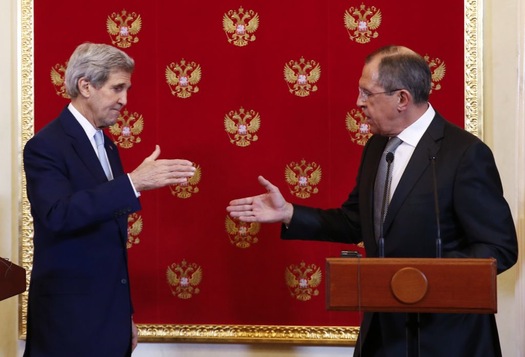
    WASHINGTON (TIP): U.S. Secretary of State John Kerry on Tuesday, December 15, accepted Russia’s long-standing demand that President Bashar Assad’s future be determined by his own people, as Washington and Moscow edged toward putting aside years of disagreement over how to end Syria’s civil war.

    Kerry announced this critical shift in Moscow where he met Russian President Vladimir Putin and Foreign Minister Sergey Lavrov to discuss the ongoing conflicts in Ukraine and Syria.

    “The United States and our partners are not seeking so-called regime change,” Kerry told reporters in the Russian capital after meeting President Vladimir Putin.

    This means Assad can stay in power for a bit longer if Russia and America cooperate together in overseeing the transition from Assad’s chaos to peace.

    A major international conference on Syria would take place later this week (Friday) in New York, Kerry announced.

    Assad is the very kind of “dictator” the US prides itself in fighting to remove. For the past four years, President Obama has called for Assad to step down. From Assad’s alleged use of chemical gas to barrel bombs to ISIS overtaking Syrian territory, Assad attracts a very diverse response from world leaders on how to achieve peace because the situation in Syria is so complex.

    But after a day of discussions with Assad’s key international backer, Kerry said the focus now is “not on our differences about what can or cannot be done immediately about Assad.” Rather, it is on facilitating a peace process in which “Syrians will be making decisions for the future of Syria.”

    Within the United States, where political debates are increasingly revolving around foreign policy — especially to do with Assad and ISIS — the presidential candidates (as well as politicians in general) find themselves equally divided on the Syrian solution. In fact, shifting positions on Assad seems to be the norm.

    The world is better off when Russia and the U.S. work together, Kerry added, calling Obama and Putin’s current cooperation a “sign of maturity.”

    “There is no policy of the United States, per se, to isolate Russia,” Kerry stressed.

    Below is a brief timeline of major American politicians on their stances regarding Assad and Syria, especially in relations to Putin and Russia.
    August 2011

    Secretary of State Hillary Clinton tells the press “it’s not going to be any news if the United States says, ‘Assad needs to go.’”

    A week later, US President Barack Obama announces for the first time — after weeks of political pressure — that Assad “must step down”.

    The American announcement happened in coordination with key allies’ announcements: Germany, France, and the UK, amongst others, also called for Assad’s departure from his presidency position around this time.

    February 2012

    Western powers reportedly ignore a Russian proposal to securely remove Assad from his position, as the US, French, and British leaders believe the Syrian president would not last much longer in power.

    September 2013

    President Obama addresses the nation, detailing the brutalities of the Assad regime and announces the US will strike Assad’s forces to deter the regime from the use of chemical weapons.
    The US and Russia then pushed for Syria to become party to the Chemical Weapons Convention, which banned the use of chemical and biological weaponry in warfare.

    November 2014

    President Obama states at the G20 press conference that “there’s no expectation that we are going to in some ways enter an alliance with Assad. He is not credible in that country.”

    The US president continues on to say that “we are looking for a political solution eventually within Syria that is inclusive of all the groups who live there — the Alawite, the Sunni, Christians. And at some point, the people of Syria and the various players involved, as well as the regional players — Turkey, Iran, Assad’s patrons like Russia — are going to have to engage in a political conversation.”

    August 2015

    Four years later, increased diplomacy between major powers — especially the US and Russia — start to cause US leaders to soften their “Assad must go” position.

    The New York Times quotes an unnamed senior American official as saying, “It’s encouraging, but we’re still a long ways off [on a solution for Assad].”

    September 2015

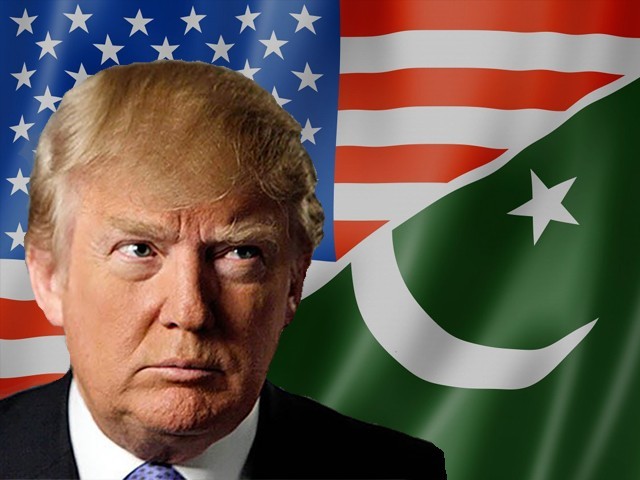
    Donald Trump tells Americans to let Russia take care of Assad and ISIS.

    “Let Syria and ISIS fight. Why do we care? Let ISIS and Syria fight. And let Russia, they’re in Syria already, let them fight ISIS. Look, I don’t want ISIS. ISIS is bad. They are evil. When they start doing with a head chopping … these are really bad dudes. … Let Russia take care of ISIS. How many places can we be? … Russia likes Assad seemingly a lot. Let them worry about ISIS. Let them fight it out.”

    October 2015

    Hillary Clinton, now a presidential candidate and no longer Secretary of State (since 2013), states removing Assad is America’s top priority, four years after she said it wouldn’t make US news.

    December 2015

    A month after the Paris attacks, a week after the San Bernardino attack, the day Los Angeles shut down its public schools due to a bomb threat, and the last Republican debate of the year before the holidays. Also the day Kerry meets Putin and Lavrov in Moscow.

    The Secretary of State officially reverses the position of the US on Assad, while Republican contenders for the 2016 election spar over what to do. The more memorable quotes are anti-Russian and anti-intervention.

    Donald Trump: “Spend the money [used in striking in the Middle East] in the US… It’s a tremendous disservice to humanity, and for what? [The Middle East is] a mess, [a] total and complete mess.”

    John Kasich: “In regard to Syria, understand that Assad is an ally of Iran who wants to extend that Shi’i radicalism all the way across the Middle East. He has to go. And for the Russians, frankly, it’s time to punch the Russians in the nose. They’ve gotten away with too much in this world, and we need to stand up against them, not just there, but also in Eastern Europe where they threaten some of our most precious allies.”

    Rand Paul: “We need to confront Russia from a position of strength.”

    Chris Christie: “Reckless was inviting Russia into Syria.”


    As of now, President Obama has yet to make an official statement confirming Kerry’s comments in Moscow. Kerry maintained that it is in the best interest for the world when Russia and the US cooperate, and that this cooperation is “a sign of maturity” between the two presidents.

    While it’s great for the US and Russia to be on slightly better terms again, time will only tell if this rekindling of relations will bring Assad to justice and peace to the Syrian people.

  • Fighting the Islamic State: Role of the P-5 Nations and India

    Fighting the Islamic State: Role of the P-5 Nations and India

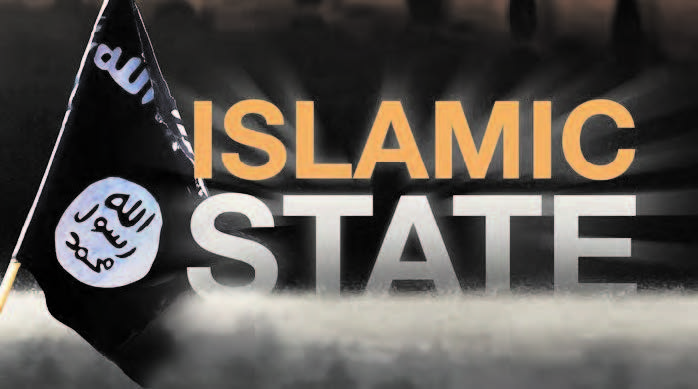
    In the course of one week in November 2015, militants from Abu Bakr Al-Baghdadi’s self-proclaimed Islamic Caliphate – also called ISIS, ISIL and Daesh – struck multiple targets in Beirut, Paris and Mali. Earlier, on October 31, ISIS claimed to have brought down a Russian civilian aircraft flying from Sharm al-Sheikh to St. Petersburg.

    The ISIS militia, numbering between 20,000 and 30,000, now controls approximately 300,000 square kilometre of territory straddling the Syria-Iraq border. Its brand of fundamentalist terrorism is gradually spreading beyond West Asia and the militia is slowly but surely gaining ground. In Africa, ISIS fighters and their associates have been active in Algeria, Lebanon, Libya, Mali, South Sudan and Tunisia in recent months. Boko Haram, the militant Islamist group in Nigeria, has pledged allegiance to ISIS.

    Fighting Back
    Recent acts of terrorism have steeled the resolve of the international community. Significant help is being provided to the government of Iraq by the US and its allies. The Peshmerga, forces of the Kurdistan Regional Government (KRG) which had captured oil-rich Kirkuk, have joined the fight against the ISIS and recaptured the Syrian (Kurdish) border town of Kobani.

    The US began launching air strikes against the ISIS militia about a year ago, while simultaneously arming anti-Assad forces like the Free Syrian Army with a view to bringing about a regime change in Syria. The US has been joined in this endeavour by Australia, Britain, Canada, Denmark, France and Netherlands as well as five Arab countries (Bahrain, Jordan, Saudi Arabia, Qatar and the United Arab Emirates). The air strikes have resulted in substantial collateral damage. It is being gradually realised that the ISIS militia cannot be defeated from the air alone.

    Putin’s Russia joined the fight on September 30, 2015 with the twin aims of defeating the ISIS and destroying anti-Assad forces. However, the initial air strikes launched by the Russian Air Force were directed mainly against the forces opposed to President Assad of Syria. Russian ground troops are also expected to join the fight soon. The Russians have also descended on Baghdad to establish a military intelligence coordination cell jointly with Iran, Iraq and Syria – a move that has not been appreciated by the Americans.

    In a rare show of unity after the Paris attacks, the United Nations Security Council passed a unanimous resolution stating that “The Islamic State in Iraq and the Levant constitutes a global and unprecedented threat to international peace and security,” and called upon all member states to join the fight against the ISIS.

    Diplomatic moves have been initiated to coordinate operations and work together for peace and stability in the region. The US and Russia agree that the objective of their interventions should be to end the civil war in Syria through a political deal and that both Iraq and Syria should retain their territorial integrity. They also agree that the ISIS extremists must be completely eliminated. Iran has agreed to join the negotiations to resolve the conflict in Syria. However, while the political objectives are similar, the methods being used to achieve them are different and are designed to extend the influence of each of the protagonists in the region.

    Implications for South Asia
    Al-Baghdadi has openly proclaimed the intention of ISIS to expand eastwards to establish the Islamic state of Khorasan that would include Afghanistan, the Central Asian Republics, eastern Iran and Pakistan. The final battle, Ghazwa-e-Hind – a term from Islamic mythology – will be fought to extend the caliphate to India. An ISIS branch has already been established in the Subcontinent. It is led by Muhsin al Fadhli and is based somewhere in Pakistan. Some factions of the Tehrik-i-Taliban Pakistan have declared their allegiance to al-Baghdadi. Afghanistan’s new National Security Adviser, Mohammad Hanif Atmar, has said that the presence of Daesh or the ISIS is growing and that the group poses a threat to Afghan security. And, some ISIS flags have been seen sporadically in Srinagar.

    Instability and major power rivalry in West Asia do not augur well for India’s national security and economic interests. Combined with the increase in force levels in the Indian Ocean, the heightened tensions in West Asia may ultimately lead to a spill-over of the conflict to adjacent areas. India now imports almost 75 per cent of the oil required to fuel its growing economy and most of it comes from the Gulf. The long-drawn conflicts of the last two decades of the 20th century had forced India to buy oil at far greater cost from distant markets, with no assurance of guaranteed supplies. The 1991 oil shock had almost completely wrecked India’s foreign exchange reserves. The situation could again become critical. Oil prices had shot up to USD 115 per barrel in June 2014, soon after the Caliphate was proclaimed, but have since stabilised around USD 50 to 60 per barrel.

    Since the early 1970s, Indian companies have been winning a large number of contracts to execute turnkey projects in West Asia. The conflict in the region has virtually sealed the prospects of any new contracts being agreed to. Also, payments for ongoing projects are not being made on schedule, leading to un-absorbable losses for Indian firms involved, and a dwindling foreign exchange income from the region.

    India also has a large Diaspora in West Asia. A large number of Indian workers continue to be employed in West Asia and their security is a major concern for the government. Some Indian nurses had been taken hostage by ISIS fighters, but were released unharmed. All of these together constitute important national interests, but cannot be classified as ‘vital’ interests. By definition, vital national interests must be defended by employing military force if necessary.

    US officials have been dropping broad hints to the effect that India should join the US and its allies in fighting ISIS as it poses a long-term threat to India as well. India had been invited to send an infantry division to fight alongside the US-led Coalition in Iraq in 2003. The Vajpayee government had wisely declined to get involved at that time as it was not a vital interest.

    It must also be noted that India has the world’s third largest Muslim population. Indian Muslims have remained detached from the ultra-radical ISIS and its aims and objectives, except for a handful of misguided youth who are reported to have signed up to fight. This could change if India sends armed forces to join the US-led coalition to fight the ISIS militia.

    Prime Minister Narendra Modi proposed at the G-20 summit in Antalya last week that the war against terrorism must isolate and contain the sponsors and supporters of terrorism. He clearly implied that India is willing to join the international coalition against the ISIS and other non-state actors. Besides contributing to the global war against terrorism, India’s participation would help to isolate the Pakistan Army and the ISI – the foremost state sponsors of terrorism.

    Direct Indian military intervention against the ISIS militia would depend on the manner in which the situation unfolds over the next one year. It could become necessary if ISIS is able to extend the area controlled by it to the Persian Gulf as that would affect the supply of oil and gas from the Persian Gulf to India – clearly a vital national interest. For the time being, India should cooperate closely with the international community by way of sharing information and intelligence and providing logistics support like port facilities if asked for. India should also provide full diplomatic support and work with the United Nations for evolving a consensual approach in the fight against the ISIS.

    A concerted international effort is needed to first contain and then comprehensively defeat the ISIS and stabilise Iraq and Syria, failing which the consequences will be disastrous not only for the region, but also for most of the rest of Asia and Europe. Helping the regional players to gradually eliminate the root causes of instability will not be an easy challenge for the international community to address. As an emerging power sharing a littoral with the region, India has an important role to play in acting as a catalyst for West Asian stability.


  • Pakistan PM fails to win US support against India

    Pakistan PM fails to win US support against India

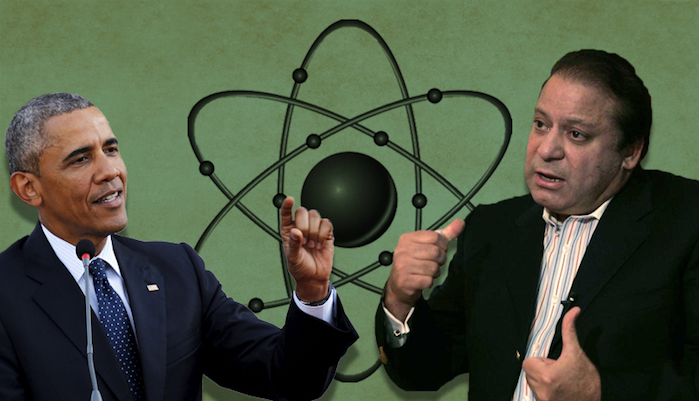
    WASHINGTON (TIP): Pakistan Prime Minister must be a disappointed man. His bilateral with US President Barack Obama is being viewed as a diplomatic failure. India has watched the Sharif-Obama summit in Washington keenly, and while it is clear that Prime Minister Nawaz Sharif returns to Islamabad without any big announcement to show for the bilateral, and no progress on US-Pakistan civil nuclear negotiations, there are many parts to the 2015 joint statement issued by the two that could  be worrisome for India.

    Here are the key statements in the US-Pakistan joint statement which may cause concern to India.

    1.  Hydroelectric projects in PoK/Gilgit-Baltistan 

    President Obama expressed support for Pakistan’s efforts to secure funding for the Diamer Bhasha and Dasu dams to help meet Pakistan’s energy and water needs.

    India has opposed the construction of hydro-electric projects in the disputed region of Kashmir that includes PoK and Gilgit-Baltistan. Most recently, External Affairs Minister Sushma Swaraj had called the China-Pakistan Economic Corridor (CPEC) unacceptable because it includes these projects, while India had told the UNGA that “India’s reservations about the proposed China-Pakistan Economic Corridor stem from the fact that it passes through Indian territory illegally occupied by Pakistan for many years.”

    In recent years, the 4,500 m W Diamer Bhasha dam (DBD) project, that the Pakistan government says will halve its electricity shortfall when constructed, had come to a standstill over funding. In 2013, prospective investors – the ADB, China and Russia – had asked Pakistan to obtain an NOC (No objection certificate) from India before they could proceed on loans. Even after the announcement of the China-Pakistan Economic Corridor by President Xi Jinping for projects including dams in PoK in April 2015, China has shown a preference for the $1.6 billion Karot project, rather than DBD, which would now cost an estimated $14 billion. It is significant that the US wants to play ‘White Knight’ on these two dams, and for India, the construction of major projects like these endorsed by the US would be a blow to its claim on PoK. Earlier this month, reports suggested India had protested over a USAID event aimed raising funding for DBD, where US firm Mott McDonald has been contracted to perform a technical engineering review.

    2.  Talks with the Taliban
    President Obama commended Pakistan for hosting and facilitating the first public talks between the Afghan government and the Taliban in July 2015 and highlighted the opportunity presented by Pakistan’s willingness to facilitate a reconciliation process that would help end insurgent violence in Afghanistan.

    India has felt cut out of the Taliban peace process, and relations with President Ghani’s government underwent a strain when New Delhi learned that Pakistan would be allowed to host the talks in Murree. “This is an open acknowledgement that Pakistan controls the Taliban,” a senior official had told The Hindu at the time, “And rather than castigate Pakistan for not curbing the Taliban’s violence, these talks will legitimize its actions.”

    When the talks collapsed over the announcement of Mullah Omar’s death, it was felt Pakistan’s claim of being a ‘peacemaker’ rather than a sponsor of Taliban-terror would end. However, despite a surge in violence by the Taliban, including the brutal siege of Kunduz that was overthrown by Afghan and US special forces last month, the Joint statement seems to indicate the US is prepared to let Pakistan host the talks again.

    3.  Resume India-Pakistan talks
    President Obama and Prime Minister Sharif stressed that improvement in Pakistan-India bilateral relations would greatly enhance prospects for lasting peace, stability, and prosperity in the region. The two leaders expressed concern over violence along the Line of Control, and noted their support for confidence-building measures and effective mechanisms that are acceptable to both parties. The leaders emphasized the importance of a sustained and resilient dialogue process between the two neighbors aimed at resolving all outstanding territorial and other disputes, including Kashmir, through peaceful means and working together to address mutual concerns of India and Pakistan regarding terrorism.

    For over a decade, the US has stayed away from openly pushing India towards talks with Pakistan. In the period between 2003-2008, this was because India and Pakistan were engaging each other, and both the composite dialogue and back-channel diplomacy yielded many important confidence building measures between them. After the Mumbai 26/11 attacks, the US recognized India’s legitimate anger over the attacks being planned and funded in Pakistan, and abstained from making any comments on the resumption of India-Pakistan dialogue, restricting itself only to “welcoming” talks between their leaders in Thimphu, Delhi, New York and Ufa. The US-Pakistan joint statement doesn’t just put the importance of “sustained and resilient dialogue process” (codeword for comprehensive dialogue) back in focus, it makes a new mention of “violence along the LoC” which India squarely blames Pakistan for initiating. India believes ceasefire violations are aimed at “infiltrating terrorists”, a charge the government repeated when the NSA talks were cancelled. Of particular worry for India will be the US-Pakistan joint statement’s reference to “mutual concerns of terrorism”, as it comes in the wake of Pakistan’s latest claims of Indian support to terrorism inside Pakistan. Pakistan NSA Sartaj Aziz had told the press that Indian agency “involvement” in Balochistan and FATA would be taken up during the summit.

    4.  Action on LeT?
    In this context, the Prime Minister apprised the President about Pakistan’s resolve to take effective action against United Nations-designated terrorist individuals and entities, including Lashkar-e-Tayyiba and its affiliates, as per its international commitments and obligations under UN Security Council resolutions and the Financial Action Task Force.

    Action against the LeT has been India’s most sustained demand from Pakistan, especially after the 26/11 attacks, when the LeT’s top leadership was charged with planning and executing the carnage in Mumbai. Yet years later, chief Hafiz Saeed is free, LeT operations chief Zaki Ur Rahman Lakhvi is out on bail, and there seems little evidence that Pakistani forces have conducted any sort of crackdown on the Lashkar e Toiba, especially when compared to action against other groups after the Peshawar school attack of December 2014. While the US-Pakistan joint statement doesn’t note President Obama’s acceptance of Pakistan’s claims of keeping its “international commitments and obligations”, it is significant that the US has not raised the obvious violation of the UNSC and FATF requirements earlier this year during the bail process of Lakhvi. Despite Indian representations to the US and UN, there has been little pressure on Pakistan how Lakhvi raised the funds when according to the UNSC 1267 Committee rules, a designated terrorist cannot be allowed recourse to finances.

    5.  Nuclear talks
    The leaders noted Pakistan’s efforts to improve its strategic trade controls and enhance its engagement with multilateral export control regimes. Recognizing the importance of bilateral engagement in the Security, Strategic Stability and Non-Proliferation Working Group, the two leaders noted that both sides will continue to stay engaged to further build on the ongoing discussions in the working group.

    Both, the US and Pakistan, have denied a report in the Washington Post that they had planned what it called a “diplomatic blockbuster”: negotiations over a civil nuclear deal on the lines the US and India signed in 2005. Pakistan’s foreign secretary reacted to the report with a detailed account of Pakistan’s “low-yield tactical nuclear weapons” aimed at India, to calm fears in Pakistan that the government was giving up its weapons program. Even so the details in the Post have left lingering doubts over what the US intends, including pushing for a possible NSG waiver for Pakistan in exchange for limiting Pakistan’s missile capability. The report goaded the MEA into counseling the US on taking a closer look at Pakistan’s past on supplying nuclear weapons to North Korea and Iran, “Whosoever is examining that particular dossier should be well aware of Pakistan’s track record in proliferation. And when India got this particular deal, it was on the basis of our own impeccable non-proliferation track record,” the MEA spokesperson said on October 9, given that India will watch this space closely, particularly the phrase on “engagement with multilateral export regimes” mentioned in the US-Pakistan joint statement.

  • Iran to begin full implementation of nuclear deal

    TEHRAN, IRAN (TIP): The Iranian government will begin fully implementing the landmark nuclear deal reached with world powers “with good will,” and the work will be done while keeping in mind concerns voiced by Iran’s supreme leader, President Hassan Rouhani said on Oct 22. A letter posted on Rouhani’s website, president.ir, addressed to supreme leader Ayatollah Ali Khamenei said Iran will be keeping close watch to make sure other parties to the deal fulfill their obligations.

    “The government of the Islamic Republic of Iran will start `full implementation’ of the Joint Comprehensive Plan of Action with good will and based on Your Excellency’s considerations and requirements and the decisions of the Supreme National Security Council and the Parliament,” Rouhani said in the letter.

    “The other side’s fulfillment of its obligations will be vigilantly monitored and the Supreme National Security Council will adopt the needed decision to take the proper course of action,” he said.

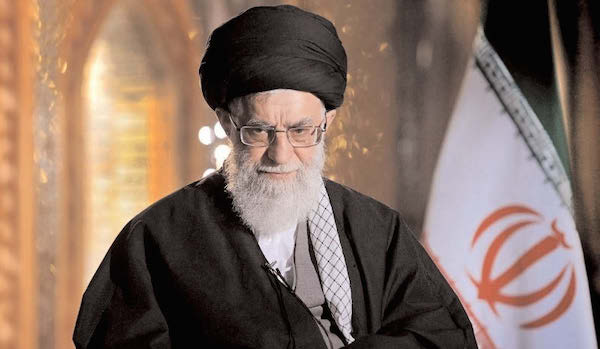
    Khamenei on Wednesday endorsed the deal but warned the government to be vigilant, saying the United States cannot be trusted. He also said the agreement “suffers from multiple structural weaknesses and ambiguous points that can lead to present and future great harms to the country in the absence of precise and constant vigilance.” He added that “any remarks saying the structure of sanctions will remain in place are considered a breach” of the agreement.

    The agreement reached in July with the U.S., Britain, France, China, Russia and Germany curbs Iran’s nuclear activities in exchange for lifting crippling international sanctions. Western nations have long suspected Iran of pursuing nuclear weapons alongside its civilian program, charges rejected by Tehran, which insists its program is entirely peaceful. The agreement has been the subject of fierce debate within Iran, with hard-liners arguing that the negotiators gave up too much ground. They also fear the agreement could lead to a broader rapprochement with the United States, which they deride as the “Great Satan.”

  • China’s Ocean Hegemony and Implications for India

    China’s Ocean Hegemony and Implications for India

    The fifth generation of CCP leadership under Xi Jinping has de facto abandoned the Deng doctrine of keeping low profile internationally. China has become more ambitious of becoming a superpower and has been extending its sovereignty claims on the land and the sea. As a rising hegemon, China has started to challenge the existing international strategic order. China has been in the news recently for building artificial islands with air-landing strips in the South China Sea. It has demanded 12 nautical miles exclusive economic zone around these artificial, man-made reefs. China is a signatory to the law of the Seas (UNCLOS). Chinese attempts to claim the bulk of the South China Sea goes against both the letter and the spirit of the law of the sea. Beijing will invoke its EEZ for its own economic benefits while denying the same rights to other claimants. Brushing aside the ASEAN Code of Conduct in the SCS, China claims sovereignty over all of the SCS which is disputed by Vietnam, the Philippines, Malaysia, Brunei and Taiwan.

    For the last several years, Chinese official media has been harping on safeguarding China’s “Ocean Sovereignty”. The PLA navy’s goal is to have a “Thousand Ships Navy”. This stated “TSN” Goal is to further Chinese supremacy in the Indo-Pacific region and exploit the mineral & hydrocarbon wealth in the international sea-beds. PLAN has been entrusted to fight future wars for China’s security as per the former President Hu Jintao. On December 6th 2011, while addressing the PLA Navy, Hu Jintao pronounced that PLAN should make “extended preparations for warfare in order to make greater contributions to safeguard national security”. China unilaterally declared an air-defense identification zone in the East China Sea in November 2013. Recently, a Chinese admiral declared similar intentions of setting up an air defense identification zone in the future above the disputed areas of the South China Sea if Beijing thought it was facing a strategic threat.

    China has created not only facts on the ground but also facts on the Ocean in a very predictable manner of claiming sovereignty with the “Chinese Characteristics”. China always makes maximalist claims against other countries, disputes sovereignty, and alters the facts on the grounds of medieval history or economic reasons, bullies the smaller adversaries into submission, demands mutual concessions while later on sending its armed forces. China has constructed a couple of lighthouses in the South China Sea to provide a fig-leaf for its naked hegemony and sea-resources grabbing activities. China has successfully converted the South China Sea into a virtual private lake affecting the freedom of navigation for the entire world. India has vital maritime interests in the South China Sea. 55% of Indian maritime trade passes through the South China Sea. China has objected vehemently to ONGC’s oil drilling in collaboration with Vietnam in the South China Sea and PLAN ships have started to harass the Indian drilling rigs.

    Once the heat of the South China Sea is gone and Beijing has de facto acquired the marine resources of the South China Sea, the dragon will spread its strategic tentacles into the Indian Ocean. Warning bells are already ringing in the Indian Ocean. PLAN started its naval forays in Indian Ocean up to the Gulf of Aden in 2010 under the garb of anti-piracy operations to control Somali pirates. China’s string of pearl initiative got absorbed in the 21st Century Maritime Silk Road. China did acquire significant naval facilities in Hambantota, Chittagong, Maldives, and listening & communication facilities in the Coco Islands in Myanmar besides building the naval port in Gwadar. Incidentally, India has gifted the Coco islands to Myanmar in Nehru’s realm. Gwadar port was offered to India by Oman but Nehru declined and Pakistan became the owner and the beneficiary. China also acquired naval facilities for recuperation and re-fueling in Seychelles in December 2011. China has already signed an agreement with the UN backed International Seabed Authority to gain exclusive rights to explore poly-metallic sulfide ore deposits in 10,000 square-kilometers of international seabed in Indian Ocean for 15 years. China has been sending nuclear powered submarines to Sri Lanka and Pakistan. Pakistan will receive eight Chinese nuclear powered submarines effectively neutralizing the Indian second strike capabilities in case of a nuclear attack on India. China plans to buy an island from the Maldives for $ 1 billion under the current Maldivian Government of President Abdulla Yameen.

    China’s response to Malabar naval exercises in 2007 when trilateral format included Japan was very negative leading to non-invitation to Japan later on after 2007. India plans to invite Japan in the upcoming Malabar exercises and Chinese reaction would be worth watching. China remains very paranoid about the US “Pivot to Asia” doctrine. Chinese paranoia about the Asian Quadrilateral led to Australia pulling out of that mechanism for maritime cooperation in the Indo-Pacific.

    China had sent trial balloons to US for a G2 condominium by which US will take over the Atlantic Ocean whereas China will have rights over the Pacific Ocean. Unlike Tibet, Indo-Pacific is too important to be given to China on a platter. As a trading nation with vital economic and maritime interests, India will have to safeguard the sea-lanes of communication, ensure freedom of navigation and take the strategic ownership of her maritime interests.

    China’s foreign exchange reserves were at the peak of almost $4 trillion in June 2014. Despite a recent decline in Chinese economy, China’s foreign exchange reserves totaled $3.514 trillion at the end of September 2015. China still has the largest foreign exchange reserves in the world. China will continue to extend its strategic footprints under the much enlarged One Belt, One Road (OBOR) project because it has plenty of spare cash. China also proposes to use the Beijing sponsored AIIB as the financing arm for the OBOR which will ultimately require $ 1.4 trillion in investments. China has already sanctioned$46 billion on China-Pakistan Economic corridor as part of the OBOR connectivity without taking India’s sensitivities about CPEC passing through the POK. While India has cooperated with China in the BCIM (Bangladesh, China, India, and Myanmar) Corridor project, the GOI has been deliberately silent about any synergistic cooperation with the 21st Century Maritime Silk Road project.

    read-more

  • A US-Pak nuclear deal would be a threat to India’s security

    A US-Pak nuclear deal would be a threat to India’s security

    If a report in a US newspaper is to be believed, a US-Pakistan nuclear deal might be on the cards. The report says that such a deal is being considered around Prime Minister Nawaz Sharif’s visit to Washington this month.

    The report would not have appeared credible but for the evasive comment of the State Department on the subject and the official reaction of the spokesperson of our Ministry of External Affairs cautioning the US authorities against any such decision.

    Ever since the India-US nuclear deal was signed, the Pakistanis, obsessed with the idea of parity with India, have been seeking a similar deal.

    Besides calling the India-US nuclear deal discriminatory, Pakistan has condemned it as threat to its security and warned that it would take all necessary steps to safeguard its interests. Pakistan’s Foreign Affairs Adviser Sartaj Aziz aggressively reiterated this on the occasion of President Barack Obama’s visit to India in January this year.

    By remaining silent, the US has only encouraged this absurd posturing by Pakistan.

    US soft on Pakistan

    Some western nonproliferation specialists have been advocating for some time a nuclear deal with Pakistan in order to remove its sense of grievance. They feel it would give Pakistan an incentive to limit the expansion of its nuclear arsenal and stabilize the nuclear situation in the sub-continent.

    Such advocacy is largely prompted by negative attitudes towards India which, with its historical opposition to the NPT, is seen as the one responsible for nuclearizing South Asia. In their eyes, this is one way of denying India any one-sided advantage in nuclear status.

    Until now, the US Administration has been differentiating India’s case from that of Pakistan and disclaiming any move to offer the latter a similar deal, thought the tenor of its statements has not been sufficiently convincing.

    In fact, both the US and China, to different degrees, have aided Pakistan in achieving its nuclear and missile ambitions.

    A US-Pak nuclear deal will erode the strategic importance of the Indo-US nuclear deal

    In the past, knowing the China-Pakistan nuclear and missile nexus, the US has waived the application of its laws for larger geopolitical reasons linked to the combat against the Soviets in Afghanistan. The Afghanistan factor has, unfortunately, continued to condition US thinking on Pakistan’s nuclear and other errant behavior.

    The US was remarkably soft with Pakistan on the AQ Khan case. It has tolerated Pakistan’s tactics to obstruct discussions on the FMCT at Geneva at a time when fissile material control was still on the US agenda.

    It has overlooked supplies of additional Chinese nuclear reactors to Pakistan in violation of China’s NSG commitments.

    One could speculate that having settled the nuclear question with India, this was one way for the US to allow Pakistan to be a beneficiary of external cooperation in its nuclear sector, as part of the traditional policy of “hyphenation”.

    US agencies and think tanks have been propagating information about the frenetic pace at which Pakistan has been expanding its nuclear arsenal, without any visible reaction from the US government.

    At one time, worried about the rise of radicalism in the country, the US was expressing concern about the security of Pakistan’s nuclear arsenal. But such fears are no longer being expressed.

    US conduct over the years suggests that it has favored the idea of a Pakistani nuclear capability to balance India’s. Remarkably, its complaisance towards the Pakistani nuclear program has continued long after the end of the Cold War.

    Adding to all this, US treatment of Iran’s nuclear ambitions contrasts strikingly with its handling of Pakistan’s nuclear transgressions. While draconian sanctions have been applied on Iran, in Pakistan’s case the US has argued that sanctions might hasten its slide towards failure as a state and increase the risk of its nuclear assets falling into the hands of religious extremists.

    This is specious logic as the US has not taken any precautionary step to curb the development of Pakistan’s nuclear assets, including its decision to introduce tactical nuclear weapons in the subcontinent. An expanded Pakistani nuclear arsenal is even more likely to fall into the wrong hands.

    US reaction to Pakistan’s loose talk about using nuclear weapons against India has been, moreover, notably mild. It could and should have been much stronger.

    The hesitation to impose sanctions on Pakistan contrasts also with the willingness to impose sanctions even on a powerful country like Russia, including its most senior leaders and functionaries.

    What inhibits the US to strong arm Pakistan despite its provocations remains unclear.

    The argument that for dealing with the situation in Afghanistan the US needs Pakistan’s assistance is not convincing. The US needs Russia even more for dealing with yet more complex and fraught problems as Iran and West Asia in general, including the rise of the Islamic State, not to mention the fall-out of mounting tensions in Russia-West relations.

    China-Pakistan axis

    It is mystifying why the US should want to politically legitimize Pakistan’s nuclear conduct through an India-like nuclear deal.

    In India’s case, the US wanted to make a geopolitical shift with the rise of China in mind. It saw India as a counterweight to China in Asia, but for this the nonproliferation issue which inhibited India’s international role had to be resolved.

    Pakistan is in fact China’s closest ally. The geopolitical purpose of a nuclear deal with Pakistan will only legitimize the China-Pakistan nuclear and security relationships and undermine India’s strategic interests vis-a-vis both these adversaries.

    The US has wanted to build a strategic relationship with India largely around shared interests in the Indian Ocean and Asia-Pacific regions in view of mounting signs of Chinese political and military assertiveness and its ambitious naval expansion program.

    Through the China-Pakistan Economic Corridor and the development of Gwadar, Pakistan is facilitating an increased Chinese strategic presence in the Indian Ocean, which contradicts this US strategy.

    Shocking rationale

    According to reports, the underlying reasoning offered by the US, if correctly reported, is almost shocking. In return for an NSG waiver, Pakistan will be asked to restrict its nuclear program to weapons and delivery systems that are appropriate to its actual defense needs against India’s nuclear threat, and not to deploy missiles beyond a certain range.

    This implies that the US accepts that India’s nuclear program is Pakistan-centric and that it poses a threat to Pakistan.

    The Chinese threat to India is being overlooked and the fact that India faces a double Pakistan-China nuclear threat – in view of the close nuclear collaboration between the two countries- is being ignored.

    The US, it appears, would be comfortable if only India would be exposed to the Pakistani nuclear threat, not others.

    US has been consistently soft on Pakistan’s errant behavior in matters like nuclear weapons

    But then, Pakistan’s nuclear arsenal, according to its own leaders, is India-centric. Pakistan is not threatening China, Iran or Saudi Arabia with its nuclear weapons. Which are the countries that the US wants to protect against the use of nuclear weapons by Pakistan?

    Pakistan is developing delivery systems to reach any point in India. The US would apparently be comfortable with that, but not if it developed missiles of longer range. But whose security is US worried about if Pakistan did that? US itself, Japan, Australia, Singapore, China, Iran, Saudi Arabia, Israel?

    China, we know, opposes India’s NSG entry without Pakistan. It would seem the US would be willing to accommodate both China and Pakistan if the latter limited its nuclear threat to India.

    By implication then, the US has no stakes in India’s security from an unstable and adventurous Pakistan, despite our so-called strategic partnership.

    A reward for Pakistan’s military

    The timing of a nuclear deal would be odd too. It is now universally recognized that it is General Raheel Sharif and not Nawaz Sharif who really hold the reins of power in the country. A nuclear deal will be a reward for the Pakistan military and not the civilian power, as Pakistan’s nuclear program is under military control.

    Does the US want to reward the Pakistan military for its operations in North Waziristan against the Pakistani Taliban and is this considered meritorious contribution to the fight against Al Qaeda and terrorism?

    One would have thought far more important for the US and the West is the rise of the Islamic State and its ideology. Compared to which North Waziristan is a side-show. In any case, the Pakistani military is not fighting the Haqqani group.

    Worse, while Pakistani is being accepted as an honest mediator in the Afghan reconciliation process, the Taliban showed its mounting force by occupying Kunduz.

    One hopes that the US report does not accurately reflect President Obama’s thinking.

    If it does, it will show how hollow is the strategic relationship between India and the US, and why it would not be wise to trust the US.

    The India-US nuclear deal will be eroded of much of its strategic importance bilaterally, as result. The US would have, in addition, administered a big political blow to Prime Minister Narendra Modi who has gone out of his way to improve strategic understanding with the US.

    But then, news reports are news reports, and they could merely be political kite-flying. In which case, the India-US relationship will not receive a big jolt for all the reasons mentioned in this article.

    (The author is a former foreign secretary of India. He has also served as India’s ambassador to Turkey, Egypt, France and Russia. He can be reached at sibalk@gmail.com)

  • UN AID CHIEF DEMANDS PROBE OF YEMEN WEDDING BOMBING

    UN AID CHIEF DEMANDS PROBE OF YEMEN WEDDING BOMBING

    UNITED NATIONS (TIP): The top United Nations aid official has called for a swift investigation of a suspected Saudi-led air strike that killed dozens of people at a wedding in Yemen.

    Stephen O’Brien, the UN under-secretary-general for humanitarian affairs, yesterday said he was “deeply disturbed” by the news that civilians had been killed in Wednesday evening’s bombing.

    “I call for a swift, transparent and impartial investigation into this incident,” O’Brien said in a statement.

    “Real accountability for parties to conflict, whether they are states or non-state groups, is urgently needed, to ensure that the commitment under international law to protect civilians is meaningful,” he added.

    O’Brien quoted Yemen’s ministry of public health as saying that at least 47 people were killed and 35 were injured, among them many women and children, in the strike.

    Medical sources confirmed at least 28 deaths to AFP.

    The raid hit a house where dozens of people were celebrating in the town of Sanban in Dhamar province, 100 kilometers south of the capital Sanaa, residents said.

    It was the second alleged air strike by the Saudi-led coalition on a Yemeni wedding party in just over a week.

    But the coalition, under mounting criticism over the civilian death toll of its bombing campaign against Iran-backed Shiite rebels, denied any involvement in the latest attack.

    O’Brien noted that 4,500 civilians have been killed or injured since the Saudi-led coalition began air strikes against rebels in Yemen in March.

    “That is more than in any country or crisis in the world during the same period,” he noted.

    The strongly-worded statement underscored that the sides have a responsibility under international law to avoid damage to homes and other civilian structures.

  • US in talks with Pakistan over capping its nuke range

    US in talks with Pakistan over capping its nuke range

    WASHINGTON (TIP): The Obama administration is exploring a possible civilian nuclear deal with Pakistan ahead of Prime Minister Nawaz Sharif’s visit to Washington later this month, a Washington Post columnist has reported, citing a sole source “familiar with the talks” who said Islamabad has been asked to consider “brackets” relating to the deal.

    Brackets, in diplomatic parlance, are numerous alternative formulations that are negotiated towards an eventual agreement. According to the report, the deal centers around a civilian nuclear agreement similar to the one the United States arrived at with India, in exchange for a Pakistani commitment that would “restrict its nuclear program to weapons and delivery systems that are appropriate to its actual defense needs against India’s nuclear threat.”

    Pakistan might, for example, agree not to deploy missiles capable of reaching beyond a certain range, the report said, citing the source, who indicated that the US might support an eventual waiver for Pakistan by the 48-nation Nuclear Suppliers Group (NSG), the same way it has done for India.

    The Obama administration said it was in “regular contact” with the Government of Pakistan on “a range of issues” as it prepared for the visit on October 22 of Prime Minister Sharif, but declined comment on the specifics of the discussions.

    “The United States urges all nuclear-capable states, including Pakistan, to exercise restraint regarding nuclear weapons and missile capabilities. We encourage efforts to strengthen safety and security measures and continue to hold regular discussions with Pakistan on a range of global issues, including nuclear security, counterterrorism, and international norms,” an administration spokesperson said in a tacit acknowledgement that some sort of dialogue is taking place on the nuclear issue.

    Successive US administrations both under Presidents Bush and President Obama, have knocked down the idea of a deal for Pakistan like the one Washington arrived at with India, saying the background and circumstances surrounding the US-India civilian nuclear agreement was entirely different, and pointing to Pakistan’s record of nuclear proliferation.

    However, President Obama’s recent track record vis-a-vis Iran and Cuba, both regarded for a long time as outlaw nations, suggests there may be some substance to a nuclear outreach towards Pakistan. There is also less pathology about Pakistan in Washington’s official circles, where many veterans have a romanticized recall of Islamabad’s role in the Cold War when it offered its services to Washington, for a price. The strategy helped Pakistan circumvent nuclear non-proliferation roadblocks that the US all too readily winked at.

    In recent months, Pakistan has tried to project itself as a responsible nuclear power, although some of its politicians and generals reflexively brandish the country’s nuclear weapons to assure themselves and their constituents about security against India. “We are a nuclear-armed country and we know how to defend ourselves,” Pakistan’s National Security Advisor Sartaj Aziz boasted recently in a suo motu assertion although no one had talked of a nuclear war.

    While a few regional experts have floated the idea of a nuclear deal for Pakistan in the past, most analysts are aghast at the prospect. It will be “sheer madness wrapped in folly,” said Sumit Ganguly, a South Asia scholar at Indiana University, among several experts who have critiqued Washington frequent free passes to a country that has a reckless history of nuclear proliferation and home-grown terrorism.

    The WaPo report however conceded that inasmuch as Pakistan prizes its nuclear program, “negotiations would be slow and difficult, and it’s not clear that Islamabad would be willing to accept the limitations that would be required.” But, it said, the issue is being discussed quietly in the run-up to Prime Minister Nawaz Sharif’s visit to Washington on October 22.

  • US-Pakistan Nuclear Deal | India is the check to Pakistan, Donald Trump declares

    US-Pakistan Nuclear Deal | India is the check to Pakistan, Donald Trump declares

    WASHINGTON: The Obama administration is exploring a possible civilian nuclear deal with Pakistan ahead of Prime Minister Nawaz Sharif’s visit to Washington later this month, if media reports are to be believed.

    One of Washington’s well-briefed columnists, David Ignatius, has revealed this week the outlines of a nuclear agreement that the US is said to be negotiating with Pakistan. These talks could be at the top of US President Barack Obama’s agenda with Pakistan.

    In a Washington Post column on Wednesday, Ignatius says the US is ready to lift international restrictions against civilian nuclear commerce with Pakistan in return for significant voluntary restraints on its nuclear weapons programme.

    According to the report, the deal centers around a civilian nuclear agreement similar to the one the United States arrived at with India, in exchange for a Pakistani commitment that would “restrict its nuclear program to weapons and delivery systems that are appropriate to its actual defense needs against India’s nuclear threat.”

    Pakistan might, for example, agree not to deploy missiles capable of reaching beyond a certain range, the report said, citing the source, who indicated that the US might support an eventual waiver for Pakistan by the 48-nation Nuclear Suppliers Group (NSG), the same way it has done for India.

    The Obama administration said it was in “regular contact” with the Government of Pakistan on “a range of issues” as it prepared for the visit on October 22 of Prime Minister Sharif, but declined comment on the specifics of the discussions.

    “The United States urges all nuclear-capable states, including Pakistan, to exercise restraint regarding nuclear weapons and missile capabilities. We encourage efforts to strengthen safety and security measures and continue to hold regular discussions with Pakistan on a range of global issues, including nuclear security, counterterrorism, and international norms,” an administration spokesperson said in a tacit acknowledgement that some sort of dialogue is taking place on the nuclear issue.

    Successive US administrations both under Presidents Bush and President Obama, have knocked down the idea of a deal for Pakistan like the one Washington arrived at with India, saying the background and circumstances surrounding the US-India civilian nuclear agreement was entirely different, and pointing to Pakistan’s record of nuclear proliferation.

    In 10 years, Pakistan will have largest N-stockpile after US and Russia, report suggests

    However, President Obama’s recent track record vis-a-vis Iran and Cuba, both regarded for a long time as outlaw nations, suggests there may be some substance to a nuclear outreach towards Pakistan. There is also less pathology about Pakistan in Washington’s official circles, where many veterans have a romanticized recall of Islamabad’s role in the Cold War when it offered its services to Washington, for a price. The strategy helped Pakistan circumvent nuclear non-proliferation roadblocks that the US all too readily winked at.

    In recent months, Pakistan has tried to project itself as a responsible nuclear power, although some of its politicians and generals reflexively brandish the country’s nuclear weapons to assure themselves and their constituents about security against India. “We are a nuclear-armed country and we know how to defend ourselves,” Pakistan’s National Security Advisor Sartaj Aziz boasted recently in a suo motu assertion although no one had talked of a nuclear war.

    While a few regional experts have floated the idea of a nuclear deal for Pakistan in the past, most analysts are aghast at the prospect. It will be “sheer madness wrapped in folly,” said Sumit Ganguly, a South Asia scholar at Indiana University, among several experts who have critiqued Washington frequent free passes to a country that has a reckless history of nuclear proliferation and home-grown terrorism.

    The WaPo report however conceded that inasmuch as Pakistan prizes its nuclear program, “negotiations would be slow and difficult, and it’s not clear that Islamabad would be willing to accept the limitations that would be required.” But, it said, the issue is being discussed quietly in the run-up to Prime Minister Nawaz Sharif’s visit to Washington on October 22.


    On an American radio show, Republican presidential hopeful Donald Trump called Pakistan “probably the most dangerous” country in the world today, adding that the only country that can “check” Pakistan is India.

    Pakistan is “a serious problem” because they have nuclear weapons that work and “a lot of them”, just like North Korea and its “mad man”, Trump explained.

    It wasn’t enough that he clubbed Pakistan with North Korea. “India is the check to Pakistan,” continued Trump, adding insult to Pakistan’s injury. “You have to get India involved … They have their own nukes and have a very powerful army. They seem to be the real check … I think we have to deal very closely with India to deal with it (Pakistan),” said Trump, about his foreign policy goals.

  • China as a Peer of the United States: Implications of the Joint Statement

    China as a Peer of the United States: Implications of the Joint Statement

    China is emerging as a peer and partner of the United States in international affairs. India’s response should be to work with China in the Asia Infrastructure Investment Bank and in China’s ‘Road and belt’ initiative to make the ‘Asian Century’ a reality as well as in the G20, which China will chair in 2016 (and India in 2018), to begin shaping the future global agenda, ‘global goods’ and institutions, including reform of the United Nations, while maintaining strategic autonomy to safeguard its maritime trade routes.

    New partners in climate change

    In the US-China Joint Statement on Climate Change, President Obama has met the criticism of the US Senate that unilateral emissions reductions should not give China a competitive advantage while President Xi has achieved for developing countries what the G77 collectively was finding difficult to attain.

    On 25 September, Xi and Obama outlined their “Vision for the Paris Climate Conference”,(re) defining the principle of common but differentiated responsibilities as a system that provides flexibility to developing countries “in light of their capacities” and “that differentiation should be reflected in relevant elements of the agreement in an appropriate manner”.

    They also agreed on joint support for a “global transition to a low carbon economy, renewed focus on adaptation “as a key component of the long-term response” to build resilience and reduce vulnerability and the “crucial role of major technological advancement in the transition”.

    The Statement recognizes that transparency provisions have to include both ‘action’ as well as ‘support’ provided to developing countries – a long standing demand of developing countries. Also, transparency provisions are expected to “provide flexibility to those developing countries that need it in light of their capacities”, emphasizing differentiation.

    The Joint Statement moves beyond the post-colonial North-South dichotomy and welcomes the provision of resources from countries “willing to do so;” it is no longer seen as a commitment based on notions of historical responsibility. Both countries will provide USD 3 billion each to help poor countries, with China announcing the establishment of a China South-South Climate Cooperation Fund. This puts pressure on all developed countries to enhance contributions towards the USD 100 billion to be provided by 2020. The need for bilateral investments to encourage low-carbon technologies and climate resilience, equating mitigation and adaptation (even though these terms are not mentioned) provides an opening to discuss the role of public finance in the transition.

    By endorsing a global goal of “low-carbon transformation” within the 21st century -convergence on an overarching meta-global goal is a significant development which the Sustainable Development Goals (SDGs) were not able to achieve – the statement also serves to define the ‘Objective’ of the Convention; something which has eluded the multilateral process since 1992.

    New forms of international co-operation

    Xi used his address to the United Nations General Assembly to reiterate China’s call for a “new type of international relations based on win-win cooperation.” He added: “We should resolve disputes and difficulties through dialogue and consultation,” as “the law of the jungle leaves the weak at the mercy of the strong.”

    Xi emphasized that China represents less powerful nations through its seat on the Security Council (“China’s vote at the U.N. will always belong to developing countries”) and projected China as a champion of the developing countries.

    The trip was planned so there would be major funding announcements on each of the three days Xi was at the UN General Assembly in New York, as that is what concerns the G77 the most. He pledged establishment of an assistance fund for South-South cooperation to implement the SDGs with USD 2 billion dollars; increasing investment in LDCs to USD 12 billion by 2030; and the exemption of debt owed by LDCs, LLDCs, and SIDS on interest-free loans; a USD 10 million contribution to the UN women’s agency, a USD 1 billion ‘peace and development’ fund and USD 100 million in military aid for the African Union. He also co-hosted a women’s summit at the UN.

    China already contributes more peacekeepers than other permanent members of the Security Council. Xi promised to send the first Chinese helicopter squad to join peacekeeping in Africa, train 2,000 peacekeepers from other countries in China over the next five years, and build a peacekeeping standby force of 8,000 troops. Xi’s largesse portrays China as a contributor to global growth and security amid international concerns about China’s economic stability and military ambitions.

    Global rules for the new services and knowledge economy  

    Over time, Xi’s success in implementing sweeping market reforms aimed at changing China’s economic model from an investment and export-driven one to an innovative consumer-driven and service-oriented one may be the critical factor in shaping Beijing’s economic and foreign policies in the future, as the economic relationship with the US will remain key.

    Cyber issues are now among larger concerns in the economic relationship, with bilateral trade totaling USD 590 billion in 2014 and China holding USD 1.2 trillion in US Treasury bonds. On cyber-security it was agreed that “neither country’s government will conduct or knowingly support cyber-enabled theft of intellectual property, including trade secrets or other confidential business information, with the intent of providing competitive advantages to companies or commercial sectors.” In addition, Xi and Obama agreed to create a cabinet-level mechanism and a hotline to address concerns. Both pledged to cooperate in creating a global code of conduct for cyber security. The Bilateral investment treaty Talks stalled as each side offered “negative lists” of items to be excluded and these lists can wall off industries considered strategic such as energy, aviation, telecommunications or access to state-owned industry procurement.

    New co-operative multilateralism

    The United States and China will remain the key global actors in developing a multilateral consensus on global issues as long as they successfully represent the concerns of the others. In an inter-connected world, the outcome will be a new model of co-operative multilateralism supplemented by bilateral understandings between national stakeholders that do not require the mediation of the United Nations Secretariat and prolonged negotiations over obscure texts.

    The post-world war multilateralism involved agenda setting by the G7 balanced by the G77 laying out their interests, or positions, at the start of a multilateral negotiation. Subsequent rounds of negotiations were designed to narrow the differences with secretariat documents suggesting consensus language and calls to capitals. Last minute compromises and trade-offs are very much part of the process, leaving most developing countries unhappy. The result has been continuing tension and the need for a United Nations secretariat to help mediate between the groups, siding more with the funders in achieving their goals. This arrangement has, at least for climate change, now lost its relevance.

    The 21st century, characterized by the majority of the middle class living in cities, a post-industrial knowledge economy and global trade dominated by services rather than goods, needs to respond effectively to global concerns through means for agenda-setting and securing a global consensus very different to those adopted for a fractured world emerging from colonialism and world war. With the two largest economies and most powerful countries that cut across the political divide emerging as peers and partners, agenda setting will require wider consultation in the G20, which China will chair next year. India, too, must shape the contours of the new multilateralism by working with China.

    New military and strategic balance in Asia

    The Dongfeng (East wind) 21D “carrier-killer” missile, which made a public appearance in a military parade on 3 September 2015, with a range of 1,550 km and a projected 10 times the speed of sound (faster than anything that could intercept it) after re-entering the atmosphere can manoeuvre on to a target, making it theoretically capable of landing a large warhead on or near a moving ship. Some analysts say such missiles reduce the threat from aircraft carriers – which form the basis of current US naval strategy – just what aircraft carriers themselves did to battleships with Japan’s 1941 attack on Pearl Harbor. While the potency of the DF-21D is debated in the defense community, these capabilities are changing the balance of power in Asia against the United States requiring it to strengthen its alliance system.

    The geopolitical world order established by the United States after World War II is unraveling because of the geo-economic shift to Asia. China’s Asian Infrastructure Investment Bank has served to focus minds in Europe and East Asia. The new Bank will be a rival to the IMF and World Bank and the US risks losing its ability to shape international economic rules, and global influence that goes with it. The UK described the decision as an “irresistible opportunity” and brought accusations from Washington about London’s “constant accommodation” of China, reflecting the two world-views on the emerging global order.

    For India, the lesson from the failed US attempt to obstruct the new bank is that, as Asia’s urbanization will require more than USD 8 trillion to be spent on infrastructure in this decade, countries in the region will welcome all the support they can get. Rather than be suspicious of China’s motives and seek to prevent the ‘Belt and road’ initiative, it should deal with the strategic concerns by joining in the development projects, for example, by providing the software packages required in the management of the ports. A mutual recognition of special interests of each other in the South China Sea and the Indian Ocean should be a strategic objective, and will be a strategic win-win for both.

    The ‘Asian Century’ provides an integrating theme to focus minds on shaping the economic integration of Asia, where two-thirds of future global growth is going to come from, and the alignment of the rail, road, sea routes and gas pipelines from Iran, for example, can position India as a node for South and Western Asia. Including a services component in the projects will add to their productivity and support cooperation between the Asian giants; trade is a win-win proposition.

    Conclusion

    The global trend is that countries are gaining in influence more because of the strength of their economy than the might of their military. India can either drift into the future remaining in its periphery or it can shape the future jointly with China to become one of the two engines of the Asian economy. China is likely to remain the world’s largest producer of goods and India has the potential to be the largest producer of services in the largest consumer market. According to McKinsey and Company, the services sector will be the real driver of growth in Asia as affluence will be concentrated in cities. The ability to design, finance, build and implement the big data-technology systems will be the defining comparative advantage in the future, and India and China can work together to make this happen sharing their respective expertise. The complex interdependencies will be a strong stabilizing force.

    According to Prime Minister Modi, China and India are “two bodies, one spirit” and President Xi has emphasized the “need to become global partners having strategic coordination”. The G20 meeting in 2016 provides the opportunity for the Asian giants to work together to define a global agenda, ‘global public goods’ and institutions to respond to the global middle class and the Asian Century with two centers of gravity, with India seeking to achieve this joint agenda when it chairs the G20 in 2018.

    (The author is an Ex civil servant and diplomat) – IDSA


  • Israel PM calls for peace talks with Palestinians

    Israel PM calls for peace talks with Palestinians

    UNITED NATIONS (TIP): Israel’s prime minister went to the United Nations on Oct 1 to call for an immediate resumption of peace talks with the Palestinians and to savage the international community’s nuclear deal with Iran.

    “I am prepared to immediately, immediately resume direct peace negotiations with the Palestinians without any conditions whatsoever,” Benjamin Netanyahu told the general assembly.

    Addressing Palestinian leader Mahmud Abbas directly, he said:

    “President Abbas, I know it’s not easy. I know it’s hard.”But we owe it to our peoples to try. To continue to try. Because together … if we actually sit down and try to resolve this conflict between us … we can do remarkable things for our people,” Netanyahu added.His remarks come with Netanyahu scheduled to speak with US President Barack Obama at the White House in November — their first meeting after a deep row about the Iranian nuclear row.Their frosty relations plummeted further during Netanyahu’s re-election campaign when he rejected a two-state solution for peace with the Palestinians.

    With the peace process in deep freeze, there are growing fears that tensions like those flaring at Jerusalem’s flashpoint Al-Aqsa mosque compound could spark a broader Palestinian uprising.Abbas told the United Nations on Wednesday that Israel’s refusal to release Palestinian prisoners and stop settlement activity, meant that Palestinians could no longer feel bound by past agreements.

    “They leave us no choice but to insist that we will not remain the only ones committed to the implementation of these agreements, while Israel continuously violates them,” he said.

    “We cannot continue to be bound by these signed agreements with Israel and Israel must assume fully all its responsibilities as an occupying power,” Abbas added, saying Palestinian patience “has come to an end.”

    Netanyahu used the first part of his speech to criticize the international community for reaching the nuclear deal with Iran.

    During his speech, he fell silent for 45 seconds after slamming the UN general assembly’s “deafening silence” in the face of repeated calls from Iran for the destruction of the Jewish state.

    “The response from this body,” he said, “has been absolutely nothing. Utter silence. Deafening silence.”

    Israel will do whatever it takes to defend itself and will not allow Iran to develop nuclear weapons, Netanyahu said.

    “Israel will not permit any force on earth to threaten its future,” he said. “Israel will do whatever it must do to defend our state and to defend our people.”

  • Yemen mosque bombing kills 25

    SANAA (TIP): A suicide bomber struck a mosque in Yemen’s rebel-held capital on Thursday in an attack targeting Shiites that killed at least 25 people and wounded dozens during holiday prayers.

    There was no immediate claim of responsibility but Sanaa has been shaken by a string of bombings by the Islamic State (IS) jihadist group in recent months targeting Shiites.

    Iran-backed Shiite Huthi rebels, considered heretics by the Sunni extremists of IS, seized control of Sanaa a year ago.

    Thursday’s blast ripped through the Balili mosque, located near a police academy, where the rebels and their supporters go to pray, according to witnesses. It came as Muslims marked Eid al-Adha, the Feast of the Sacrifice, the most important holiday of the Islamic calendar.

    Witnesses said after a first blast inside the mosque, a suicide bomber detonated an explosives belt at the entrance.

  • At least 717 killed, hundreds injured in Mecca stampede

    MECCA, SAUDI ARABIA (TIP): A stampede has killed at least 717 people and injured hundreds more at the hajj in Saudi Arabia in one of the worst-ever tragedies at the annual Muslim pilgrimage.

    It was the second deadly accident to hit the pilgrims this month, after a crane collapse in Mecca killed more than 100.

    The stampede broke out in Mina during the symbolic stoning of the devil ritual, the Saudi civil defence service said.

    Australian officials said they were still working to determine whether any Australians were among the dead or injured.

    Video posted online showed bodies in piles, surrounded by discarded personal belongings and flattened water bottles.

    In some areas rescue workers laid bodies in long rows on stretchers, limbs protruding from beneath white sheets.

    The civil defence said it was still counting the dead, who included pilgrims from different countries.

    At least 863 people were hurt, the agency said.

    Iran announced that 90 of its nationals were among the dead, and accused Saudi Arabia of safety errors.

    King Salman ordered “a revision of the plans” for hajj organisation so that pilgrims can “carry out their rituals in complete safety”, the official Saudi Press Agency said.

    Nearly two million people from across the globe were attending the hajj, one of the largest annual gatherings in the world.

    A Saudi minister blamed the pilgrims for the tragedy, saying they had not followed hajj rules.

    “Many pilgrims move without respecting the timetables” set for the hajj, Health Minister Khaled al-Falih told El-Ekhbariya television.

    “If the pilgrims had followed instructions, this type of accident could have been avoided.”

  • Iran’s Khamenei backs parliamentary vote on nuclear deal with powers – state TV

    Iran’s Khamenei backs parliamentary vote on nuclear deal with powers – state TV

    ANKARA (TIP): Iran’s supreme leader said on September 3 he favoured a parliamentary vote on its nuclear deal reached with world powers and called for sanctions against Tehran to be lifted completely rather than suspended, state television reported.

    President Hassan Rouhani, a pragmatist whose 2013 election paved the way to a diplomatic thaw with the West, and his allies have opposed such a parliamentary vote, arguing this would create legal obligations hampering the deal’s implementation.

    “Parliament should not be sidelined on the nuclear deal issue … I am not saying lawmakers should approve the deal or reject it. It is up to them to decide,” said Ayatollah Ali Khamenei, who has the final say on all state policy in Iran.

    “I have told the president that it is not in our interest to not let our lawmakers review the deal,” he said in remarks broadcast live on state television.

    Khamenei himself has not publicly endorsed or voiced opposition to the Vienna accord, having only praised the work of the Islamic Republic’s negotiating team.

    A special committee of parliament, where conservative hardliners close to Khamenei are predominant, have begun reviewing the deal before putting it to a vote. But Rouhani’s government has not prepared a bill for parliament to vote on.

    The landmark deal, clinched on July 14 between Iran and the United States, Germany, France, Russia, China and Britain in July, curbs Iran’s nuclear activities to help ensure they remain peaceful in exchange for a removal of economic sanctions.

    US president Barack Obama appeared to secure enough Senate votes on Wednesday to see the nuclear deal through Congress, but hardline Republicans pledged to pursue their fight to scuttle it by passing new sanctions on Tehran.

    Khamenei said that without a lifting of sanctions that have hobbled Iran’s economy, the deal would be jeopardised.

    “Sanctions …. should be lifted and not only suspended … If not, then we will only suspend our nuclear activities … and there would be no deal if the sanctions are only suspended.”

    Khamenei also criticised the United States’ Middle East policy, ruling out normalisation of ties with Iran’s arch-foe. “Our officials held only nuclear (negotiations) with America. We will never support America’s policies on Syria and Iraq.”

  • Iran may have built extension at disputed military site: UN nuclear watchdog

    Iran may have built extension at disputed military site: UN nuclear watchdog

    VIENNA (TIP): Iran appears to have built an extension to part of its Parchin military site since May, the UN nuclear watchdog said in a report on Thursday delving into a major part of its inquiry into possible military dimensions to Tehran’s past atomic activity.

    A resolution of the International Atomic Energy Agency’s Parchin file, which includes a demand for fresh IAEA access to the site, is a symbolically important issue that could help make or break Tehran’s July 14 nuclear deal with six world powers.

    The confidential IAEA report, obtained by Reuters, said: “Since (our) previous report (in May), at a particular location at the Parchin site, the agency has continued to observe, through satellite imagery, the presence of vehicles, equipment, and probable construction materials. In addition, a small extension to an existing building appears to have constructed.”

    The changes were first observed last month, a senior diplomat familiar with the IAEA investigation said.

    The IAEA says any activities Iran has undertaken at Parchin since UN inspectors last visited in 2005 could jeopardise its ability to verify Western intelligence suggesting Tehran carried out tests there relevant to nuclear bomb detonations more than a decade ago. Iran has dismissed the intelligence as “fabricated”.

    Under a “roadmap” accord Iran reached with the IAEA parallel to its groundbreaking settlement with the global powers, the Islamic Republic is required to give the Vienna-based watchdog enough information about its past nuclear activity to allow it to write a report on the long vexed issue by year-end.

    “Full and timely implementation of the relevant parts of the road-map is essential to clarify issues relating to this location at Parchin,” the new IAEA report said.

    According to data given to the IAEA by some member states, Parchin might have housed hydrodynamic experiments to assess how specific materials react under high pressure, such as in a nuclear blast.

    “We cannot know or speculate what’s in the (extended) building. The building itself is not related to the most interesting building for us … It’s something we will technically clarify over the course of the year,” the senior diplomat said.

    Groundbreaking nuclear accord 

    Under its Vienna accord with the powers, Iran must put verifiable limits on its uranium enrichment programme to create confidence it will not be put to developing nuclear bombs, in exchange for a removal of sanctions crippling its oil-based economy. Iran has said it seeks only peaceful nuclear energy.

    Iran has for years been stonewalling the IAEA inquiry into possible military dimensions (PMD) to its nuclear project. But the Islamic Republic delivered on a pledge under the roadmap to turn over more information by August 15.

    The IAEA report said the agency was still reviewing the PMD information Iran provided. Agency director-general Yukiya Amano said on Tuesday that the information was substantive but it was too early to say whether any of it was new.

    A second diplomat familiar with the Iran file said he did not expect any breakthrough from the documents provided by Iran.

    While sticking to its mandate of securing compliance with its non-proliferation mandate, diplomats see the IAEA as being keen not to imperil Iran’s pact with the powers, who tout it as crucial to reducing conflict in the Middle East.

    The success of that deal will hinge on IAEA verification of Iranian compliance, but the agency must still issue reports that are technically sound. “It’s a question of how they will reflect this in a more or less elegant way,” a third diplomat said.

    The IAEA has come under pressure, especially from US lawmakers who will hold a critical vote next month on whether to ratify the deal between Iran and the powers, for not publishing its roadmap agreement with Tehran.

    On that point, the senior diplomat said: “The agency is doing nothing in Iran in this area that it hasn’t been doing or is not doing somewhere else. There are no cutting corners in Iran.”

    Amano last week rejected as “a misrepresentation” suggestions from hawkish critics of the nuclear accord that the IAEA had quietly agreed to allow Iran to inspect sections of Parchin on the agency’s behalf.

  • Clear $6.5bn oil dues in 2 months, Iran tells India

    Clear $6.5bn oil dues in 2 months, Iran tells India

    NEW DELHI (TIP): Iran has asked India to pay within two months $6.5 billion in past oil dues, partly in rupees and rest in dollars or euros, a top official said.

    “The payment will be in at least three installments. The modalities of installments and the route are being worked out,” he said.

    The dues to Iran on crude oil that refiners buy have accumulated as Western sanctions blocked payment routes since 2013. About 45% of the oil import bill is paid in rupees in a Uco Bank branch and the rest has accumulated.

    The official said the payment to Iran can be either through Reserve Bank of India (RBI) – in that case refiners will hand over the money to the central bank which will then do the onward transmission to Iran, or through a gateway notified by the government. Iran will open a new account with one of the Indian banks for receipt of the rupee payment.

    Iran will use the rupee payments to settle bills for goods and commodities it imports from India. The official said the new account will be different from the Uco Bank account which is a non-interest bearing account.

    “They want the payments to be made to an interest-bearing account.”

    Since February 2013, refiners like Mangalore Refinery and Petrochemicals (MRPL) and Essar Oil have been paying 45%of payment due on purchase of crude oil from Iran in rupees through Uco Bank, Kolkata. The remaining has been accumulating, pending finalization of a payment route and mechanism. They had last year paid nearly $3 billion in six installments through a limited payment channel following start of nuclear talks between the West and Iran. The outstanding has since climbed to over $6.5 billion.

  • Nuclear deal not intended to ‘reform’ Iran regime: Kerry

    Nuclear deal not intended to ‘reform’ Iran regime: Kerry

    WASHINGTON (TIP): The Iran nuclear deal is not intended to push Tehran’s regime to reform but to prevent it building a bomb, secretary of state John Kerry told skeptical US lawmakers on July 31.

    In his second appearance before Congress in a week, America’s top diplomat stressed that the plan reached this month with Tehran was the best deal achievable.

    The suggestion by his Republican critics that a tougher US negotiating stance could have forced a complete climb-down by the Iranians was, he argued, naive wishful thinking.

    “Let me underscore: the alternative to the deal that we have reached is not some kind of unicorn fantasy that contemplates Iran’s complete capitulation,” Kerry warned before the house foreign affairs committee.

    Rejecting the deal as Congress has the power to do would essentially give Iran a green light to return full-speed to its enrichment efforts.

    “It’s clear. If Congress rejects this, Iran goes back to its enrichment, the ayatollah (Iran’s supreme leader Ayatollah Ali Khamenei) will not come back to the table (and) Iran will say, ‘We’re free. We can go about, back to our program,’” Kerry said.

    Skepticism has soared among US lawmakers since Washington and five world powers reached a historic accord with Iran that would rein in the Islamic republic’s nuclear program in exchange for an easing of the sanctions that have crippled Iran’s economy.

    Last week, senior Republican senators accused Kerry of being “fleeced” by Tehran during hard-fought negotiations. Several Republicans, including many who are running for president in 2016, advocate walking away from the deal.

    Amid the debate, the American public has wavered. A CNN/ORC poll released Tuesday revealed that 52 percent of respondents say Congress should reject the deal, while 44 percent say it should be approved.

    That contrasts with some major polls in recent weeks that showed most Americans supportive of the agreement.

    With Congress having a crucial say, the White House has launched a full-court press to win over enough members to prevent the accord from collapsing.

    And while some have criticized the deal because it does not oblige Iran to recognize Israel or require Tehran to renounce support for terrorist activities, Kerry said it was vital that lawmakers recognize the deal focuses purely on nuclear weapons.

    “This plan was designed to address the nuclear issue alone, not to reform Iran’s regime, or end its support for terrorism, or its contributions to sectarian violence in the Middle East,” Kerry told the panel during a four-hour grilling.

  • Iran’s Nuclear Deal

    Iran’s Nuclear Deal

    Iran and six world powers sealed a historic accord to curb the Islamic Republic’s nuclear programme in return for ending sanctions, capping two years of tough diplomacy with the biggest breakthrough in decades.

    Diplomats reached the deal in Vienna on Tuesday, July 14, their 18th day of talks.

    US President Barack Obama said it blocks “every path to a nuclear weapon” for Iran, while Iranian foreign minister Mohammad Javad Zarif called it a “win-win”.

    Banks including Goldman Sachs Group Inc. and Barclays Plc say it would take 6-12 months for the holder of the world’s fourth largest crude reserves to revive production by about 500,000 barrels a day. Sanctions cut the country’s crude exports by more than half from a peak of more than six million barrels a day in the 1970s.

    With new oil flows expected to hit an oversupplied market, Brent, the global benchmark, fell as much as 2.1% to $56.63 a barrel in London and was trading $57.87 at 9.02pm India time. Iran’s benchmark TEDPIX Index, led by oil and gas companies, advanced 0.3% at the close, the highest since April.

    In China, Europe and Russia, the agreement will be welcomed by companies eager to access an untapped market of 77 million people. With an economy bigger than Thailand’s and oil reserves rivalling Canada’s, Iran is the most important market still closed to major equity investors, according to investment bank Renaissance Capital.

    Ending economic penalties could open Iran’s stock market to investors in early 2016, Renaissance’s Charles Robertson and Daniel Salter wrote in a report on Monday. Inflows could total $1 billion in the first year, they said.

    Oil-importing countries such as India should use the period of subdued oil prices to strengthen their monetary policy framework along with fuel pricing and taxation reforms, the International Monetary Fund (IMF) recommended in a report released, coincidentally, on Tuesday.

    Low oil prices could boost India’s gross domestic product (GDP) by 0.4-0.6 percentage point over this year and next.

    Boon for oil importers

    India follows the US, China and Russia in energy use, accounting for 4.4% of global energy consumption. Petroleum product consumption in India has been growing. According to the oil ministry, it grew 3.14% to around 163.17 million tonnes in 2014-15.

    In its report tiled Global Implications of Lower Oil Prices, IMF said: “Oil importers, in deciding how much of the windfall to save, should balance rebuilding policy space with managing domestic cyclical risks. Those with significant vulnerabilities should save much of the windfall, while those facing large output gaps should spend it.”

    It added that “countries should use this period as an opportunity to strengthen their monetary policy frameworks; evidence of second-round disinflationary effects could open space for reducing policy rates in some countries”.

    The fund said countries such as India will reap modest benefits from lower global oil prices as it does not fully pass on the benefits to consumers. While lower oil prices are expected to boost global growth by one percentage point in 2015 and 2016, the IMF said India’s GDP is expected to get a boost of between 0.4 and 0.6 percentage point in the same period.

    The multilateral agency is right to point out that governments like India may be absorbing the benefits of lower oil prices to meet their budget deficit targets and are not passing on the benefits to consumers, which could be less growth-inducing, said Madan Sabnavis, chief economist at CARE Ratings. “There is nothing wrong or correct about it. The Indian government has a huge subsidy burden and it is using the opportunity to correct it,” he said.

    Low international crude prices have helped the National Democratic Alliance (NDA) government bring retail inflation below 5%, better its fiscal deficit target of 4.1% of GDP for 2014-15, and bring the current account deficit to 1.6% of GDP in the January-March quarter, against 2% in the preceding three months.

    “Low oil prices provide a window of opportunity to undertake serious fuel pricing and taxation reform in both oil-importing and oil-exporting countries,” the report said.

    In October, the government freed diesel prices. When crude oil prices fell, it cut fuel prices but simultaneously raised excise duties. This way, the government garnered additional revenue, while resisting the temptation to fully pass on the benefit of lower crude oil prices.

    Crude oil prices in the Indian energy basket averaged at $61.75 per barrel in June, against $84.16, $105.52, $107.97 and $111.89 in 2014-15, 2013-14, 2012-13 and 2011-12, respectively.

    The fall in prices has also presented countries such as India an opportunity to revise terms of imports. India has made a pitch for price and terms correction with the Organization of the Petroleum Exporting Countries (Opec) and has asked for a concession rather than having to pay the so-called Asian premium.

    “India alone is not going to benefit. Japan, China, Korea are also going to benefit. We are talking together at many forums and will be raising it together as well. We are the largest buyers for the Opec, so we need a favourable treatment and things are on right track. There is a positive signal from the seller side also,” said oil minister Dharmendra Pradhan in a 16 June interview.

    India is one of the major consumers of Opec’s production, with the group accounting for 85% and 94% of India’s crude oil and gas imports, respectively.

    “This is a very good time to review this practice and to provide more fair conditions for all parties,” Fatih Birol, chief economist at Paris-based International Energy Agency (IEA), said in an interview published on 2 July.

    Bouyed by the subdued crude oil prices, the 2015-16 budget has estimated India’s subsidy bill at Rs.2.43 trillion, around 9% less than the revised estimate of Rs.2.66 trillion for 2014-15.

    The petroleum subsidy is estimated at Rs.30,000 crore for 2015-16, 50% less than the revised estimate of Rs.60,270 crore. The difference between market prices and retail fuel rates—to be borne by oil marketing firms this fiscal year—is estimated at Rs.42,500 crore.

    The budget has earmarked Rs.22,000 crore for subsidy on domestic cooking gas and Rs.8,000 crore for kerosene. While petrol and diesel prices are deregulated, the prices of domestic cooking gas and kerosene continue to be set by the government.

    The Iran deal

    Full implementation depends on Iran meeting obligations to curb its nuclear programme and address concerns about possible military dimensions of its work. Iran has until 15 December to answer 12-year-old questions about its weapons capabilities. Once inspectors verify compliance, the oil-rich nation will be allowed to ramp up energy exports, re-enter the global financial system, and access as much as $150 billion in frozen assets.

    “This is probably going to go down in history as one of the biggest diplomatic successes of the century,” Ellie Geranmayeh, a policy fellow at the European Council of Foreign Relations, said by phone from London.

    Congress has 60 days to review the document in Washington, where it will meet resistance from lawmakers who oppose making any nuclear compromises with Iran.

    Israel, which has threatened military action to prevent Iran from getting a nuclear bomb, said it will use “every means” possible to persuade Congress to reject it, though Obama vowed to veto such a move. The House and Senate would each need a two-thirds majority to override a veto.

    Israeli Prime Minister Benjamin Netanyahu denounced the deal as a “historic mistake”, saying in a statement that “sweeping concessions were made in all areas meant to block Iran from the ability to arm itself with nuclear weapons”.

    Should the agreement survive review, it would become one of the biggest foreign policy achievements for Obama, who kicked off the initiative with a call to Iranian President Hassan Rouhani nearly two years ago. The US cut diplomatic ties with Iran in 1980, after revolutionaries seized the American embassy in Tehran and held hostages for more than a year.

    Iran agreed to cut 98% of its stockpile of enriched uranium and eliminate two-thirds of its centrifuges, according to a copy of the accord obtained by Bloomberg.

    “This is a sign of hope for the entire world,” European Union (EU) foreign policy chief Federica Mogherini said in Vienna. “And we all know this is very much needed in these times.”

    Relief, including sales of aircraft by companies including Boeing Co., would be phased in after 15 December if Iran complies. The United Nation’s (UN) International Atomic Energy Agency will negotiate access to all suspect sites, including military bases such as Parchin.

    Once UN monitors verify Iran has taken all steps to curb its nuclear activities, the US and the EU will also lift restrictions on most of its financial institutions except those sanctioned for terrorism or human rights abuses. Iranian banks, including the central bank, will be able to process transactions once again through SWIFT, the leading global financial messaging system, US officials said.

    The US and the EU will also allow any nation to buy Iranian oil and ease curbs on trading refined products, chemicals and natural gas. Iran holds the second largest gas reserves in the world, after Russia.

    “If Iran violates the deal, all these sanctions will snap back into place,” Obama said at the White House.

    The UN ban on conventional weapons imports and exports by Iran will remain in place for five years, while the UN embargo on ballistic missiles will hold for eight years, according to the draft. The unilateral US arms embargo will stay in place.

    Utpal Bhaskar is with Mint. Bloomberg’s Stepan Kravchenko in Vienna, Nafeesa Syeed in Dubai, Gregory Viscusi in Vienna, Kambiz Foroohar in New York and Angela Greiling Keane in Washington and Mint’s Asit Ranjan Mishra in New Delhi contributed to this story.

  • Saud al-Faisal, former Saudi foreign minister, dies

    RIYADH (TIP) (Saudi Arabia): Saudi Arabia’s prince Saud al-Faisal, who was the world’s longest-serving foreign minister with 40 years in the post until his retirement this year, has died, the ministry spokesman said July 9. He was 75.

    The tall, stately Prince Saud was a fixture of Mideast diplomacy, representing the oil-rich Gulf powerhouse as it wielded its influence in crisis after crisis shaking the region _ from Lebanon’s civil war in the 1970s and 1980s, through multiple rounds of Arab-Israeli peace efforts, the 1990 Iraqi invasion of neighboring Kuwait and the subsequent Gulf War, al-Qaida’s Sept. 11, 2001, attacks in the United States, the 2003 U.S.-led invasion of Iraq to the current day’s tensions between the Arab Gulf bloc and Iran, Arab Spring uprisings, Syria’s civil war and the spread of Islamic State group extremists.

    The country’s government-owned media announced Saud’s death after midnight Friday. The official announcement, carried by state television, did not state the cause of death. The prince had undergone multiple surgeries in recent years for his back, which left him walking with a cane, and for other ailments.

    Word of his passing first emerged late Thursday when Saudi Foreign Ministry spokesman, Osama Nugali, wrote on his official Twitter feed, “The eye tears, the heart saddens. We all are saddened to be separated from you.”

    The prince, who took the ministry post in 1975, retired on April 29, citing health reasons. At the time, U.S. Secretary of State John Kerry hailed him, saying he “has not just been the planet’s longest-serving Foreign Minister but also among the wisest.” He was succeeded in the post by Adel al-Jubeir, who before that was Saudi Arabia’s ambassador in Washington.

    Kerry expressed his condolences to Saud’s family and friends, King Salman and to the people of Saudi Arabia, saying the prince was “a man of vast experience, personal warmth, great dignity, and keen insights who served his country loyally and well.” “I personally admired him greatly, valued his friendship, and appreciated his wise counsel,” Kerry added. “His legacy as a statesman and diplomat will not be forgotten.” President Barack Obama said in a statement that generations of U.S. leaders and diplomats benefited from Saud’s “thoughtful perspective, charisma and poise, and diplomatic skill.”