WASHINGTON (TIP): The Pentagon will offer medical examinations and long-term health monitoring to service members and veterans who were exposed to chemical warfare agents in Iraq, the army and navy said in separate statements this week, as part of a review of how the military handled encounters with thousands of abandoned chemical munitions during the American occupation. The review was ordered by defense secretary Chuck Hagel in response to an investigation by The New York Times of how troops who were exposed to nerve and mustard agents were treated by the military’s medical and awards systems.
The report found that while the United States had gone to war looking for an active weapons of mass destruction program, troops instead quietly found and suffered from the remnants of the long abandoned arsenal built by Saddam Hussein with help from the West. Since that article was published on Oct. 15, detailing several instances of exposure that the military kept secret in some cases for nearly a decade, more veterans and active-duty service members have come forward with their own accounts of exposure and inadequate treatment. To date, neither the Pentagon nor any of the services have released a full list of chemical weapons recoveries and exposures. The investigation by The Times found that the military did not follow its own health care guidelines in the initial care of many patients, and did not establish a means for following their health over time, as the guidelines also required.
It also found that the services applied different standards for awarding Purple Hearts, a medal that recognizes wounds received in action, engendering bitterness and feelings of betrayal among troops and veterans who were exposed. In response, two senior Army doctors said in interviews this week that new medical examinations for troops and veterans who were exposed to chemical munitions would begin in early 2015. Maj. Gen. Gary Cheek, deputy commanding general for army operations, said the veterans’ accounts of poor medical care and follow-up were disturbing. “I am not going to try to excuse it,” he said. “The No. 1 thing for us is to make sure we are taking care of soldiers” and veterans, he said, and added that the military planned to work with the department of veterans affairs to ensure exposures were documented and treated if necessary.
But he defended the continued secret classification of chemical-weapons incidents, saying that the military did not want to provide information to insurgents that Iraq’s old chemical munitions “could be effective.” “These are some of the rationales for keeping this stuff within secret channels,” he said. Rear Adm. John Kirby, Mr. Hagel’s spokesman, suggested that position was now under review. “The secretary obviously remains committed to preserving operational security but also recognizes the value in making available as much information as possible to veterans preparing — or continuing to file — VA claims,” he said.
The new accounts increase to at least 25 the total number of American troops exposed to chemical agents from some of the thousands of aged and corroding munitions that the troops found in abandoned stockpiles or came across in roadside bombs made from those old munitions. The latest accounts mostly fit a pattern that is now familiar. They include two army bomb disposal technicians who picked up a mustard shell at a roadside bombing in 2004; two navy disposal technicians who handled mustard shells in separate incidents in 2006 and 2007; and members of an army infantry platoon who said they were denied decontamination and swift medical evaluation after inhaling mustard vapors in 2008, when soldiers were destroying a buried chemicalmunitions stockpile.
“It was a failure of leadership,” said Reid Wilbraham, a former sergeant and squad leader in B Company, First Battalion, 14th Regiment, who said that his platoon leader had pressed more senior officers to allow soldiers to be examined but was rebuffed for days. Wilbraham said that while the two soldiers with chemical burns had been evacuated to a military hospital and then to Germany, those with inhalation complaints were told to remain at their posts. “They told us to burn our uniforms and take showers,” Wilbraham said. The soldiers may have contaminated each other in the close quarters they shared, he said.
Tag: Iraq
-

US to check troops for chemical exposure in Iraq
-

US SAYS BAGHDAD IS NOT UNDER ‘IMMINENT THREAT’ FROM IS
WASHINGTON (TIP): The Iraqi capital Baghdad is not facing immediate danger from Islamic State jihadists despite battlefield gains by the group in the country’s west and recent car bombings in the city, the US military said on October 16. Pentagon spokesman Rear Admiral John Kirby acknowledged several deadly bombing attacks in Baghdad earlier on October 16, including one claimed by the IS group, but said the city’s defenses were solid. “We don’t believe that Baghdad is under imminent threat,” Kirby told a news conference.
“It’s not the first time in recent weeks or even months that there’s been IED attacks inside Baghdad,” he said, using the military’s abbreviation for an improvised explosive device or homemade bomb. The car bomb blasts in and around Baghdad killed at least 26 people and wounded dozens, Iraqi police and medical sources said. One double car bomb attack was claimed by the IS group, which said it targeted a group of Shiite volunteer fighters. But Kirby said Baghdad was not encircled or about to be overrun.
“There are not masses of formations of ISIL forces outside of Baghdad about to come in,” he said. Iraqi security forces “continue to stiffen their defensive positions in and around the capital, and in a very competent, capable way.” Despite a US-led air campaign in Iraq that began on August 8, the IS group has been steadily pushing back Iraqi government forces in western Anbar province, raising fears the militants could soon begin to pile pressure on the outskirts of Baghdad. US military officers have said Iraqi forces have been struggling in Anbar but there have been few coalition air strikes in the area this week, while dozens of bombing raids have targeted the IS group near Kobane in northern Syria.
Kirby said “terrible” weather and sand storms in recent days had hampered US-led air strikes in Iraq. “It’s made it very hard for us to get intelligence surveillance and reconnaissance platforms up over to see what we’re trying to do in Iraq,” he said. The poor weather had freed up American aircraft for additional bombing strikes near Kobane in Syria, where Kurdish fighters have been holding out for weeks against an assault by the IS group, Kirby said. “One of the reasons you’ve seen additional strikes (near Kobane) in the last couple of days is because we haven’t been able to strike quite as much or quite as aggressively inside Iraq,” he said.
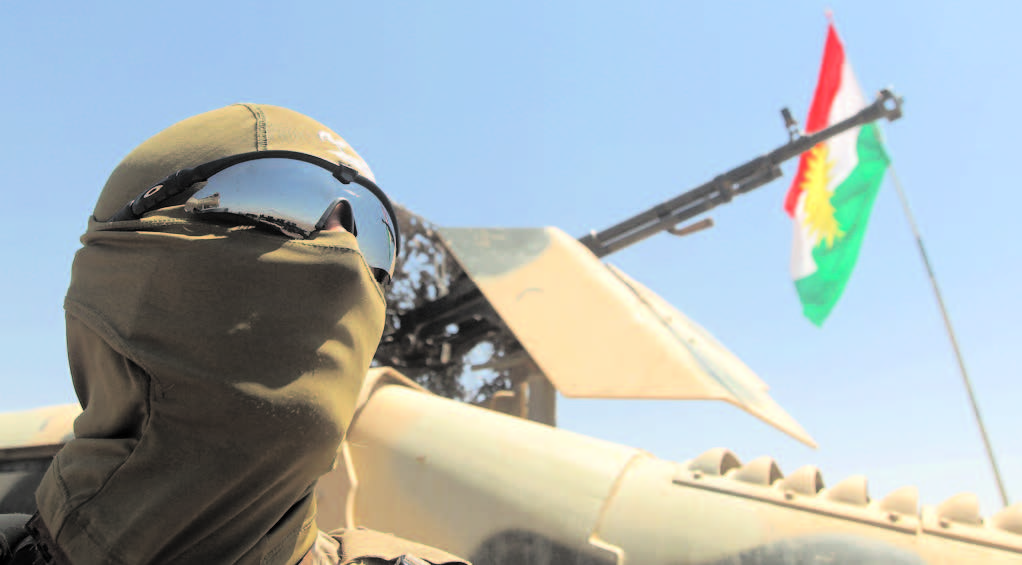
Local Kurdish leaders say they have pushed back the IS extremists in some parts of Kobane and US officials believed dozens of air strikes in recent days had helped halt the advance of the jihadists. “While the security situation there does remain tenuous, ISIL’s (IS’s) advances appear to have slowed, and we know that we have inflicted damage upon them,” Kirby said. The Pentagon press secretary denied the ramped-up air attacks near Kobane represented a change in strategy and said IS forces had exposed themselves in their bid to seize the town. -

Venezuela, New Zealand win UN security council seats but Turkey rebuffed
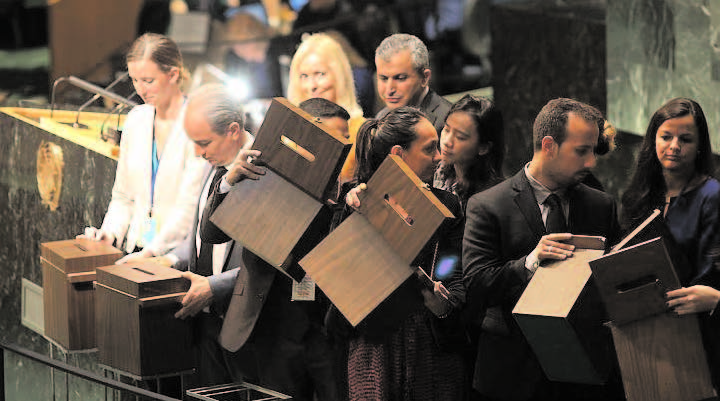
UNITED NATIONS (TIP): Angola, Malaysia, New Zealand, Spain and Venezuela won coveted seats at the UN security council on October 16, but Turkey suffered a humbling defeat in its bid to join the world’s “top table.” The five countries garnered the required two-thirds support from the 193 countries of the UN General Assembly during three rounds of voting that ended with Turkey picking up only 60 votes.
Turkey had been competing against New Zealand and Spain for two seats and had dispatched Foreign Minister Mevlut Cavusoglu on a high-profile mission to New York this week to lobby for votes. Angola, Malaysia and Venezuela were virtually assured to win election as their candidacies had been put forward by their region and they ran unopposed on their slates. After New Zealand’s resounding victory in the first ballot, Foreign Minister Murray McCully called the outcome a “strong vote of confidence” in his country, capping a 10-year campaign for the ultimate diplomatic prize.
“To receive the success that we have had this morning means a lot to us and we will work very hard to make sure we give good service on the council,” McCully told reporters at UN headquarters. Venezuela won 181 votes despite criticism from rights groups and the United States over its support for Iran, Syria and other hardline regimes that are at loggerheads with the West. Venezuela’s President Nicolas Maduro called the vote “a victory, a world record of support, love and confidence. One hundred eight-one countries have said here we are, we support you.””We should feel happiness and joy in our hearts that Venezuela is beloved country in the world,” he added, speaking in Caracas. “To those birds of ill omen who say Venezuela is isolated in the world — who is isolated? The country that received 181 votes?” US Ambassador Samantha Power urged Venezuela to work cooperatively on the council.
“Unfortunately, Venezuela’s conduct at the UN has run counter to the spirit of the UN Charter and its violations of human rights at home are at odds with the Charter’s letter,” she said. Rights groups have pointed to Venezuela’s record on the UN Human Rights Council as a cause for worry and diplomats have also expressed concern about its stance on the war in Syria. Over the three rounds of voting, Turkey saw its support dwindle from 109 votes to 73 and finally 60, surprising many who saw the regional player as a strong contender.
Angola won 190 votes, Malaysia picked up 187, New Zealand 145 and Spain 132. The elections came at a busy time for the council, which is grappling with crises on many fronts, from the jihadist offensive in Iraq and Syria, to the Ebola outbreak in West Africa. Russia’s actions in eastern Ukraine, conflicts in Syria, South Sudan and Central African Republic and the faltering Israeli-Palestinian peace process are also at the top of the council’s agenda. A seat at the Security Council raises a country’s profile several notches, boosts influence and provides knockoff benefits in bilateral ties.
The five elected countries to the 15- member council will join the five permanent powers — Britain, China, France, Russia and the United States — for a two-year term. Five other countries elected last year are mid-way into their term. These are Chad, Chile, Jordan, Lithuania and Nigeria. As the most powerful body of the United Nations, the security council can impose sanctions on countries and individuals, refer suspects for war crimes prosecution, endorse peace accords and authorize the use of force. It also oversees 16 peacekeeping missions in the world, with a budget of close to $8 billion. The five elected countries will replace Argentina, Australia, Luxembourg, Rwanda and South Korea, and begin their stint on January 1. -

US-Turkish militaries to meet on IS threat
WASHINGTON (TIP): A joint US-Turkish military team will meet next week in Ankara to discuss the fight against Islamic militants after Washington October 9 pressed Turkey to join a US-led coalition.
Two top US envoys met Thursday in Ankara with Turkish leaders seeking to win their Nato ally’s support to defeat the Islamic State (IS) group, which has seized a swath of territory in Iraq and Syria.
Although state department spokeswoman Jen Psaki did not outline any specific commitments made by Turkey, she said the two countries held “detailed and constructive talks.”
Retired general John Allen and US pointman on Iraq, Brett McGurk, had “discussed several measures to advance the military line of effort against ISIL,” Psaki said.
She highlighted that “a joint military planning team will visit Ankara early next week to follow up in military-to-military channels.”
“Both sides also agreed that we will continue a dynamic and deepening bilateral consultation process across the multiple lines of effort against ISIL,” which included military support as well as battling foreign fighters and choking off funds to IS.
The two US officials had “emphasized that urgent steps are immediately required to degrade ISIL’s military capabilities and ongoing ability to threaten the region,” Psaki said in a statement.
There has been frustration in Washington that Ankara has yet to commit its well-equipped and well-trained forces to the fight against the militants, also known by the acronym ISIL.
The crisis has been deepened by the battle for the Syrian Kurdish town of Kobane, just across the border with Turkey, amid fears it may soon fall into the militants’ hands.
Psaki insisted earlier: “It’s not a situation where we are making demands.”
“We are having a discussion with Turkey that’s been ongoing, but certainly will continue today about what role they’re willing to play in the coalition efforts.”
But, she acknowledged, “there is no question that Turkey is well-positioned to contribute.”
Turkish Foreign Minister Mevlut Cavusoglu however said earlier that Ankara could not be expected to act alone.
“It’s not realistic to expect that Turkey will lead a ground operation on its own,” he said.
-

Suicide car bomb kills 10 in Iraq’s Baquba
BAQUBA: A suicide car bomb blast at a police checkpoint in the Iraqi city of Baquba Thursday killed at least 10 people and wounded 11, security and medical sources said. “At least 10 people, including seven policemen, were killed when a suicide attacker rammed his car bomb into a police checkpoint at an entrance of the Shifta neighbourhood,” an army officer said. Shifta is a central district of Baquba, a city which lies around 60 kilometres northeast of the capital Baghdad. The army officer said the attack occurred at around 4:00 pm (1300 GMT) and also wounded 11 people, including seven policemen. A senior local police official and a doctor at Baquba general hospital both confirmed the casualty figures. Baquba is the capital of the restive and religiously mixed province of Diyala, where Kurdish peshmerga, federal forces and allied militia have been battling the Islamic State jihadist group.
-

BRITAIN’S PRIME MINISTER ON SURPRISE VISIT TO AFGHANISTAN
KABUL (TIP): Britain’s Prime Minister David Cameron on October 3 pledged support for Afghanistan’s newly sworn-in president and the country’s new unity government, saying during a surprise visit to Kabul that Britain is committed to helping Afghans build a more secure and prosperous future.
Cameron was the first of world leaders to meet Ashraf Ghani Ahmadzai, Afghanistan’s second elected president, since his inauguration on Monday. The two had a meeting in Kabul on Friday morning and later held a joint press conference.
“Britain has paid a heavy price for helping to bring stability to this country,” Cameron said, paying tribute to the 453 British servicemen and women who died while serving in Afghanistan.
“An Afghanistan free from al-Qaida is in our national interest — as well as Afghanistan’s,” he said. “And now, 13 long years later, Afghanistan can — and must — deliver its own security.”
But, “we are not leaving this country alone,” he added. “In Britain you will always have a strong partner and a friend.”
Cameron arrived a day after visiting British pilots in Cyprus who are taking part in air strikes on Islamic State group targets in Iraq. British warplanes have been conducting combat missions over
Iraq since Saturday, after Britain joined the US-led coalition of nations that are launching air strikes against the militants.
“The work of defeating Islamist extremist terror goes on elsewhere in the world,” Cameron said in Kabul. “And because this threatens us at home, we must continue to play our part.”Ghani Ahmadzai thanked the British for their sacrifices in Afghanistan, especially the families who lost loved ones in the war. “They stood shoulder to shoulder with us and we will remember,” he said.
Ghani Ahmadzai’s inauguration this week marked the start of a new era for his country, with a national unity government poised to confront a resilient Taliban insurgency.
A day after he was sworn in, his administration signed a security agreement allowing the United States to keep about 9,800 troops in the country to train and assist Afghan national security forces.
A separate agreement was signed with Nato, outlining the parameters of 4,000 to 5,000 additional international troops— mostly from Britain, Germany, Italy and Turkey — to stay in a non-combat role after Nato’s combat mission ends on Dec. 31.
Former President Hamid Karzai had refused to approve the deal, and the results of a June presidential runoff to replace Karzai took months to resolve, finally coming to a conclusion with Ghani Ahmadzai’s swearing in and the establishment of a national unity government.
Ghani Ahmadzai’s former rival for the presidency, Abdullah Abdullah, was appointed the country’s new chief executive, a post akin to prime minister.
Cameron lauded both Afghan men, saying they put national interests ahead of “personal power” when they struck a power-sharing deal. “I look forward to working with both of you in the years ahead,” he said. Ghani Ahmadzai also praised his former rival, saying the two of them “have managed a first, which is really rare in the Muslim world — a democratic transfer of authority, not power.”
-

MARINE IS FIRST US DEATH IN OPERATIONS AGAINST ISLAMIC STATE
WASHINGTON (TIP): A US Marine who went into the sea from a V-22 Osprey during a flight mishap over the northern Gulf this week was the first American killed in US military operations against the Islamic State group in Iraq and Syria.
Corporal Jordan Spears, 21, of Memphis, Indiana, was a crewman aboard a V-22 tilt-rotor aircraft flying off the USS Makin Island and went into the sea when the aircraft lost power shortly after takeoff, the Navy said on Friday.
The V-22 descended to the surface of the ocean during the mishap on Wednesday. Spears and a second air crewmen went into the water when it appeared the tilt-rotor aircraft was about to crash, but the two pilots were able to regain control of the craft and landed it safely back on board the Makin Island.
One air crewman was recovered and was in stable condition aboard the Makin Island. A search and rescue operation for the missing crewman was called off on Thursday and the Navy said he was presumed lost at sea.
Rear Admiral John Kirby, the Pentagon press secretary, confirmed on Friday that the Marine’s unit had been supporting current operations in the Gulf, including the current battle against the Islamic State in Iraq and Syria.
“That squadron and that ship were in the Gulf supporting Central Command operations,” Kirby said, referring to the combatant command responsible for U.S. forces in the Middle East region.
“Some of those operations included operations in Iraq and Syria, at least tangentially,” he said. “So there’s no question that this Marine’s death is related to the operations that are going on in some form or fashion.”
The Navy and Marine Corps are investigating the cause of the mishap.
The V-22 takes off and lands vertically like a helicopter but the twin rotors at the end of its wings tilt after takeoff and allow it to fly like an airplane.
The V-22 had a rocky start because of mishaps during development, but it has won kudos for performance since entering into service.
-

US edges up to Mission Creep in Middle East
WASHINGTON (TIP): Mission Creep, a term that has come to describe a gradual shift in objectives during the course of a military campaign, often resulting in unplanned long-term commitment, came into the American lexicon during the Somali civil war in the 1990s. On Tuesday, it crept back into US parlor talk after a top American general suggested ground forces may be required to meet President Barack Obama’s pledge to degrade and destroy the Islamic State terrorists in Iraq and Syria.
US Army Gen. Martin Dempsey, the chairman of the Joint Chiefs of Staff and the President’s top military adviser, laid it out tactfully. ”My view at this point is that this (American-led) coalition is the appropriate way forward.
I believe that will prove true,” General Dempsey said at a Congressional hearing, expressing confidence that the IS could be defeated. ”But if it fails to be true, and if there are threats to the United States,” he added, he would go back to the President and ”make a recommendation that may include the use of US military ground forces.” The remarks jolted the capital’s punditry, which has been stewing about an American return to the Middle-East minefield just three years or so after Obama fulfilled his campaign pledge to pull out US troops from the region after a decade-long war that cost the country more than a trillion dollars.
On his part, Dempsey acknowledged that recommending re-induction of US forces would run counter to the president’s policy, but the President, he said, ”has told me as well to come back to him on a case-by-case basis.” The White House demurred about any change in policy, saying, ”It’s the responsibility of the president’s military advisers to plan and consider all the wide range of contingencies,” and what Dempsey was referring to was a ”hypothetical scenario.” Obama has repeatedly said there will be no boots on the ground in the sense of US troops having combat missions, but administration officials have indicated that military advisors and special forces may be inducted on a case-by-case basis to train and guide Iraqi and Kurdish forces taking on the ISIS.
Already, the US has inducted more than 1,600 military advisors and special troops, ostensibly to safeguard US diplomatic missions and personnel. But some are also believed to be helping pinpoint airstrikes and train pro- American forces. The fear in the capital and across the country is that this may creep up to tens of thousands. Some war enthusiasts are already asking how the 5000 Syrian rebels the US is training can take on an Islamic State force that the CIA estimates to be more than 30,000. -

Iranian President Rouhani terms US led anti-ISIS coalition ‘ridiculous’
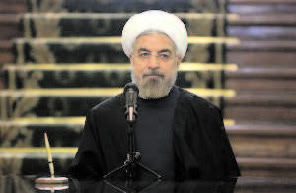
WASHINGTON (TIP): Iranian President Hassan Rouhani has decried the US-led international coalition against Islamic State in Syria and Iraq (ISIS) describing this as “ridiculous,” move and alleged that some of the 40-member of this group had previously supplied the terror group with arms and training.
“Are Americans afraid of giving casualties on the ground in Iraq? Are they afraid of their soldiers being killed in the fight they claim is against terrorism?” Rouhani told the NBC news in an interview which was taken in Tehran yesterday. “If they want to use planes and if they want to use unmanned planes so that nobody is injured from the Americans, is it really possible to fight terrorism without any hardship, without any sacrifice? Is it possible to reach a big goal without that? In all regional and international issues, the victorious one is the one who is ready to do sacrifice,” Rouhani said.
It is necessary for airstrikes in some conditions and some circumstances, he said. “However, air strikes should take place with the permission of the people of that country and the government of that country,” the Iranian President said in his interview to the major American television network. Responding to questions, Rouhani said the brutal murder of two American journalist and one British national by ISIS is against the tenants of Islam. “They want to kill humanity,” he said.
“And from the viewpoint of the Islamic tenets and culture, killing an innocent people equals the killing of the whole humanity. And therefore, the killing and beheading of innocent people in fact is a matter of shame for them and it’s the matter of concern and sorrow for all the human and all the mankind,” Rouhani told the NBC News in his interview. According to the NBC news, Rouhani alleged that many members of the US-led coalition had helped ISIS with weapons and training.
But he declined to name the countries. Rouhani said Iran will give Iraq any support it requests for combating ISIS, but made a point of saying religious sites must be protected. “When we say the red line we mean the red line. It means we will not allow Baghdad to be occupied by the terrorists or the religious sites such as Karbala or Najaf be occupied by the terrorists,” he said. The Iranian President said he believes that the latest round of nuclear talks can still lead to a resolution. “Maybe the time could be arguable, either today or tomorrow. “However, we have no doubt that the only solution to the nuclear issue goes through negotiation,” he said. Rouhani also called for close relationship between US and Iran. -

U.S. Involvement in Iraq
How far are we from sending our soldiers in to the battlefield in Iraq again? It is a question which comes to the mind of every American. First, we admitted we had no business to be in Iraq. We should not have entangled ourselves in a war that was never ours, we said. And we said we will withdraw all our troops and will expect Iraqis to manage their affairs.
We were really tired of “a stupid involvement”. We were equally tired of the prolonged and unyielding struggle in Afghanistan. And we realized we were losing American lives for a failing cause. We said that the civilian government in Afghanistan must take care of the security aspect of the nation and that US soldiers will be withdrawn by the end of 2014. However, we seem to have all wrong stars on our side. We are back in action in Iraq, with one more nation added-Syria. This time, the threat is from the Islamic State of Iraq and Syria (ISIS). ISIS has challenged American might and the US has accepted the challenge.
Obama said the other day that the ISIS terrorists must know what we did to Al Qaeda. They must know they will not get safe haven anywhere in the world. They must know we will find them and deal with them. The US and its allies have vowed to “degrade and ultimately destroy” the ISIS, the terrorist organization that now calls itself Islamic State. The US has got an endorsement from 40 countries for its campaign of air strikes and what it promises as a “comprehensive and sustained counter-terrorism strategy.”
What is also obvious is that other countries have shown reluctance to commit their military resources to the operation, and thus boots on the ground are going to be a problem even in Iraq, let alone Syria, where their writ does not run. President Obama’s top military adviser, Gen. Martin E. Dempsey, the chairman of the Joint Chiefs of Staff, told the Senate that he would recommend deploying troops to serve as ground forces providing tactical and targeting advice if the current air strikes were not sufficient to vanquish the militant group, the Islamic State.
But, a day later, on September 17, President Obama promised a military audience in Tampa, Florida that he would not send troops into combat in the campaign against Islamic militants in Iraq, an attempt by the White House sought to dispel growing confusion over exactly what role American soldiers are going to play on the battlefield in the unfolding operation. -

CIA triples estimate of Islamic State strength
WASHINGTON (TIP): Islamic State militants in Iraq and Syria now have about 20,000 to 31,500 fighters on the ground, the Central Intelligence Agency said on Sep 11, much higher than a previous estimate of 10,000. Among those in Syria are 15,000 foreign fighters including 2,000 Westerners, some of whom have joined IS, a US intelligence official told AFP.
The figures were revealed one day after President Barack Obama vowed to expand an offensive against IS extremists, a plan which foresees new air strikes against IS in Syria, expanded attacks in Iraq and new support for Iraqi government forces. “CIA assesses the Islamic State of Iraq and the Levant (IS) can muster between 20,000 and 31,500 fighters across Iraq and Syria, based on a new review of all-source intelligence reports from May to August,” CIA spokesman Ryan Trapani said in a statement. “This new total reflects an increase in members because of stronger recruitment since June following battlefield successes and the declaration of a caliphate, greater battlefield activity, and additional intelligence,” he said.
Senior US officials have voiced concern at the presence of foreign fighters among the Sunni extremists who hold Western passports, potentially enabling them to return from the battlefield prepared to carry out terror attacks in Europe or the United States. IS militants have seized large swathes of territory in Iraq in recent months, displaying brutal tactics and releasing videos of the grisly executions of two American reporters. The White House has insisted that President Barack Obama is authorized to strike IS in Iraq and Syria under a law passed by Congress after the September 11 attacks in 2001. -

John Kerry downplays talk of ‘war’ against IS
WASHINGTON (TIP): US Secretary of State John Kerry warned against “war fever” on September 11 and said the new American campaign against the so-called “Islamic State” should be understood as a counter-terrorism mission. Speaking the day after President Barack Obama announced a “relentless” campaign of air strikes against IS militants in Iraq and ultimately in Syria, Kerry declined to call the operation a war.
“What we are doing is engaging in a very significant counter-terrorism operation,” Kerry told CNN in Jeddah, Saudi Arabia, during a tour of regional allies to drum up support for joint action. “It’s going to go on for some period of time,” he warned. “If somebody wants to think about it as being a war with ISIL, they can do so, but the fact is it’s a major counter-terrorism operation that will have many different moving parts.” Separately, CBS reporter Margaret Brennan tweeted that Kerry had told her: “I don’t think people need to get into war fever on this.” Meanwhile, the Pentagon announced that US warplanes would start using a base outside the Iraqi Kurdish capital Arbil, having previously been operating from airbases and carriers outside the country. -

Leaders: US, UK will ‘not be cowed’ by militants
NEWPORT, WALES (TIP): Faced with a mounting militant threat in the Middle East, US President Barack Obama and British Prime Minister David Cameron declared on Thursday that their nations will “not be cowed” by extremists who have killed two American journalists. “We will be more forthright in the defense of our values, not least because a world of greater freedom is a fundamental part of how we keep our people safe,” the leaders wrote in a joint editorial in the Times of London.
Their comments come as world leaders gather at a golf resort in Wales for a high-stakes NATO summit. While the official agenda will focus on the crisis in Ukraine and the drawdown of the NATO combat mission in Afghanistan, the rise of the Islamic State group in Iraq and Syria will dominate discussions on the sidelines of the summit. The militants have claimed responsibility for murdering two American journalists, releasing gruesome videos of their beheadings.
Both the US and Britain are deeply concerned about the potential threat to their homelands that could come from the foreign fighters who have joined the violent Islamic State group. Cameron on Monday proposed new laws that would give police the power to seize the passports of Britons suspected of having traveled abroad to fight with terrorist groups. Obama and Cameron appear to suggest that NATO should play a role in containing the militants, but were not specific in what action they would seek from the alliance.
The two leaders were to visit with students at a local school Thursday morning before joining their counterparts from France, Germany and Italy to discuss the crisis in Ukraine. New Ukrainian President Petro Poroshenko was also to join the discussion in a show of Western solidarity with his embattled nation. Ukraine and Russia have been locked in a standoff for months, with pro- Moscow forces stirring instability in eastern Ukrainian cities. On the eve of the NATO summit, Russia and Ukraine said they were working on a deal to halt the fighting, but Western leaders expressed skepticism, noting it wasn’t the first attempt to end the deadly conflict.
NATO leaders are expected to agree this week on the creation of a rapid response force that would set up in nations in the alliance’s eastern flank to serve as a deterrent to Russia. Baltic nations and others in the region fear Moscow could set its sights on their borders next. “We must use our military to ensure a persistent presence in Eastern Europe, making clear to Russia that we will always uphold our Article 5 commitments to collective self-defense,” Obama and Cameron wrote.
Under Article 5 of the NATO charter, an attack on one member state is viewed on an attack on the whole alliance. Obama reiterated his support for that principle Wednesday during a visit to Estonia, one of the newer NATO members set on edge by Russia’s provocations. -

Al-Qaida announces India wing, renews loyalty to Taliban chief
DUBAI (TIP): Al-Qaida leader Ayman al Zawahri on Wednesday announced the formation of an Indian branch of his militant group he said would spread Islamic rule and “raise the flag of jihad” across the subcontinent. In a 55-minute video posted online, Zawahri also renewed a longstanding vow of loyalty to Afghan Taliban leader Mullah Omar, in an apparent snub to the Islamic State armed group challenging al- Qaida for leadership of transnational Islamist militancy.
Zawahri described the formation of “al-Qaida in the Indian subcontinent” as a glad tidings for Muslims “in Burma, Bangladesh, Assam, Gujurat, Ahmedabad, and Kashmir” and said the new wing would rescue Muslims there from injustice and oppression. Counter-terrorism experts say al-Qaida’s ageing leaders are struggling to compete for recruits with Islamic State, which has galvanised young followers around the world by carving out tracts of territory across the Iraq-Syria border.
Islamic State leader Abu Abu Bakr al-Baghdadi calls himself a “caliph” or head of state and has demanded the loyalty of all Muslims. The group fell out with Zawahri in 2013 over its expansion into Syria, where Baghdadi’s followers have carried out beheadings, crucifixions, and mass executions. As well being an indirect repudiation of Islamic State, the announcement could pose a challenge to Prime Minister Narendra Modi.
However, while al-Qaida is very much at home in the Afghanistan-Pakistan border area, due to influential contacts and a long presence there, it is a minnow compared to local militant groups in terms of manpower and regional knowledge.
Safe haven
Over the years Zawahri and his predecessor Osama bin Laden, killed by US forces in 2011, repeatedly pledged allegiance to Mullah Omar, in return for the safe haven he granted their followers in Afghanistan. The statement did not mention Islamic State or Baghdadi, but it appear to take a subtle dig at the group’s efforts at administering areas it has seized in Iraq and Syria.
Islamic State’s effort at state-building is something never attempted by al-Qaida’s central leaders, who traditionally have preferred to plot complex attacks on targets in the West. Zawahri called for unity among militants and criticised “discord” — echoing a common al-Qaida complaint against Islamic State’s record of clashing with rival Islamist groups in Syria. The statement also warned al-Qaida’s new wing against oppressing local populations — another complaint levelled against Islamic State by critics in Iraq and Syria.
“If you said that you are doing jihad to defend the sanctities of the Muslims, then you must not transgress against them or their money or honour, and not even transgress your mujahideen brothers by word and action,” he said. “Discord is a curse and torment, and disgrace for the believers and glory for the disbelievers,” he said.
“If you say that by your jihad you do not want but the pleasure of Allah, then you must not race for governance and leadership at the first opportunity.” Muslims account for 15 percent of Indians but, numbering an estimated 175 million, theirs is the third-largest Muslim population in the world. -

Steven Sotloff, U.S. hostage slain by ISIS, was also a citizen of Israel
NEW YORK (TIP): The beheading of Steven J. Sotloff, the American journalist from Miami who had been held hostage by the Islamic State in Iraq and Syria, suddenly loomed larger for many Israelis on Wednesday, September 3, when it emerged that he held Israeli citizenship and had lived and studied in the country for a few years. Sotloff’s family broke a yearlong media blackout about his case two weeks ago after he appeared in an Internet video in which a black-clad, knife-wielding militant of the extremist group marked him as the next hostage to die after the American journalist James Foley.
Yet the Israeli connection was kept well hidden. As long as there was a chance Sotloff was still alive there was fear that exposure of his Jewish roots and Israeli past could put him in further danger. As a freelance reporter, Mr. Sotloff contributed to the Israel-based Jerusalem Report magazine along with Western publications like Time magazine, The Christian Science Monitor and World Affairs Journal. ISIS terrorists released a video Tuesday that claimed to show the beheading of American journalist Steven Sotloff.
In the gruesome footage, titled “A second message to America,” Sotloff can be seen kneeling in orange garb in front of his black-masked executioner after news footage of President Obama talking tough about the Syrian terror group. Sotloff, with his hands tied behind his back, stoically tells the camera that he is “paying the price” for US intervention in Syria. “Obama, your foreign policy of intervention in Iraq was supposed to be for the preservation of American lives and interests.
So why is it that I have to pay the price of your interference with my life? Am I not an American citizen?” Steven said. The killer of Steven then said, “I’m back, Obama, and I’m back because of your arrogant foreign policy towards the Islamic State. “Just as your missiles continue to strike our people, our knife will continue to strike the necks of your people.” As Sotloff struggles and tries to stand, his killer starts to slit his throat.
The camera cuts out to black, then footage shows what appears to be Sotloff’s severed head placed on his stomach. The terrorist said a British captive, David Cawthorne Haines, would be the next. Footage of Haines, believed to be a security worker for humanitarian-aid groups, was shown in the same kneeling position as Foley and Sotloff before their executions. -

US mobilizes allies to widen assault on ISIS
WASHINGTON (TIP): The United States has begun to mobilize a broad coalition of allies behind potential American military action in Syria and is moving toward expanded airstrikes in northern Iraq, administration officials said on August 26. President Obama, the officials said, was broadening his campaign against the Sunni militants of the Islamic State in Iraq and Syria and nearing a decision to authorize airstrikes and airdrops of food and water around the northern Iraqi town of Amerli, home to members of Iraq’s Turkmen minority.
The town of 12,000 has been under siege for more than two months by the militants. “Rooting out a cancer like ISIL won’t be easy, and it won’t be quick,” Obama said in a speech on Tuesday to the American Legion in Charlotte, NC, using an alternative name for ISIS. He said that the United States was building a coalition to “take the fight to these barbaric terrorists,” and that the militants would be “no match” for a united international community.
Administration officials characterized the dangers facing the Turkmen, who are Shiite Muslims considered infidels by ISIS, as similar to the threat faced by thousands of Yazidis, who were driven to Mount Sinjar in Iraq after attacks by the militants.
The United Nations special representative for Iraq, Nickolay Mladenov, said in a statement three days ago that the situation in Amerli “demands immediate action to prevent the possible massacre of its citizens.” As Obama considered new strikes, the White House began its diplomatic campaign to enlist allies and neighbors in the region to increase their support for Syria’s moderate opposition and, in some cases, to provide support for possible American military operations.
The countries likely to be enlisted include Australia, Britain, Jordan, Qatar, Saudi Arabia, Turkey and the United Arab Emirates, officials said. The officials, who asked not to be named discussing sensitive internal deliberations, said they expected that Britain and Australia would be willing to join the United States in an air campaign. The officials said they also wanted help from Turkey, which has military bases that could be used to support an effort in Syria.
Turkey is a transit route for foreign fighters, including those from the United States and Europe who have traveled to Syria to join ISIS. Administration officials said they are now asking officials in Ankara to help tighten the border. The administration is also seeking intelligence and surveillance help from Jordan as well as financial help from Saudi Arabia, which bankrolls groups in Syria that are fighting President Bashar al-Assad.
On Monday the Pentagon began surveillance flights over Syria in an effort to collect information on possible ISIS targets as a precursor to airstrikes, a senior official said. The Syrian Observatory for Human Rights, an organization that monitors the humanitarian consequences of the conflict in Syria, reported that “non-Syrian spy planes” on Monday carried out surveillance of ISIS positions in the eastern province of Deir Ezzor.
Although America’s allies in the region have plenty of reasons to support an intensified effort against ISIS, analysts said, the United States will have to navigate tensions among them. “One of the problems is that different countries have different clients among the fighting groups in Syria,” said Robert S. Ford, a former American ambassador to Syria. “To get them all to work together, the best thing would be for them to pick one client and funnel all the funds through that client. You’ve got to pick one command structure.” -

UN chief condemns American journalist’s killing
UNITED NATIONS (TIP):
UN secretary general Ban Ki- moon on August 20 strongly condemned the killing of American journalist James Foley by extremist Islamist militants, calling it “an abominable crime”. “The secretary-general condemns in the strongest terms the horrific murder of journalist James Foley, an abominable crime that underscores the campaign of terror the Islamic State of Iraq and the Levant (ISIL) (now called Islamic State) continues to wage against the people of Iraq and Syria,” Xiinhua quoted a statement issued here by Ban’s spokesperson as saying.
“The perpetrators of this and other such horrific crimes must be brought to justice,” Ban stressed. The UN chief also extended his deepest condolences to the family, friends and colleagues of Foley. A video released by the IS militants Tuesday purported to show the beheading of Foley and contained threats to kill the other in retaliation against the recent US intervention in Iraq.
A masked fighter was shown beheading a man kneeling in an orange jumpsuit said to be Foley, a 40-year-old freelance journalist who disappeared in northwest Syria in 2012. Earlier on August 20, the White House said that the video showing the beheading of Foley had been authenticated by the US intelligence community. -

Kerry arrives in Afghanistan to meet candidates
KABUL, AFGHANISTAN (TIP): The US and its allies are growing increasingly concerned as Afghanistan shows signs of unraveling in its first democratic transfer of power from President Hamid Karzai. With Iraq wracked by insurgency, Afghanistan’s dispute over election results poses a new challenge to President Barack Obama’s effort to leave behind two secure states while ending America’s long wars. US Secretary of State John Kerry made a hastily arranged visit to Afghanistan on Friday to help resolve the election crisis, which is sowing chaos in a country that the US has spent hundreds of billions of dollars and lost more than 2,000 lives trying to stabilize. He was to meet with the two candidates claiming victory in last month’s presidential election runoff.
“I’ve been in touch with both candidates several times as well as President (Hamid) Karzai,” Kerry said before leaving Beijing, where he attended a USChina economic meeting. He called on them to “show critical statesmanship and leadership at a time when Afghanistan obviously needs it.” “This is a critical moment for the transition, which is essential to future governance of the country and the capacity of the (US and its allies) to be able to continue to be supportive and be able to carry out the mission which so many have sacrificed so much to achieve.” With Iraq wracked by insurgency, Afghanistan’s power dispute over the election results is posing a new challenge to President Barack Obama’s 5 1/2-year effort to leave behind two secure nations while ending America’s long wars in the Muslim world. -

US official: More airstrikes in Iraq
WASHINGTON (TIP):
American fighter jets and drones continued to pound Islamic State militants in Iraq on August 20, and military planners weighed the possibility of sending a small number of additional US troops to Baghdad, US officials said, even as the insurgents threatened to kill a second American captive in retribution for any continued attacks.
The airstrikes came in the hours after militants released a gruesome video Tuesday showing US journalist James Foley being beheaded and underscored President Barack Obama’s vow on Wednesday afternoon to continue attacks against the group despite its threats. According to a senior US official, the number of additional troops currently under discussion would be fewer than 300, but there has been no final decision yet by Pentagon leaders.
Officials said that the forces were requested by the State Department and, if approved, would mainly provide extra security around Baghdad. The 14 latest airstrikes were in the area of the Mosul Dam and were aimed at helping Iraqi and Kurdish forces create a buffer zone at the key facility. The strikes, which now total 84 since operations began, have helped Iraqi and Kurdish troops reclaim the dam from the insurgents.
The militants threatened to kill Steven Sotloff, an American journalist who is also being held captive, if the US continued to conduct airstrikes.The officials were not authorized to discuss the ongoing operations publicly and spoke on condition of anonymity.
It was not clear Wednesday if Obama would have to adjust his recent notifications to Congress under the War Powers Act to accommodate the higher US troop level in Iraq if more soldiers and Marines are deployed. There are about 748 US forces in Iraq, in addition to the approximately 100 troops that have routinely been assigned to the Office of Security Cooperation in Baghdad. -

U.S. Military Conducts Air strikes Against ISIL near Mosul Dam
WASHINGTON (TIP):
U.S. military forces continued to attack ISIL terrorists in support of Iraqi Security Force operations, using fighter and attack aircraft to conduct six air strikes in the vicinity of the Mosul Dam, an August 21 press release off US Central Command said. The strikes destroyed or damaged three ISIL Humvees, one ISIL vehicle, and multiple IED emplacements. All aircraft exited the strike area safely.
These strikes were conducted under authority to support Iraqi security forces and Kurdish defense force operations, as well as to protect critical infrastructure, U.S. personnel and facilities, and support humanitarian efforts. Since Aug. 8, U.S. Central Command has conducted a total of 90 air strikes across Iraq. Of those 90 strikes, 57 have been in support of Iraqi forces near the Mosul Dam. -

Commemorative Event hosted by India at the United Nations to mark the contribution of Indian soldiers in the First World War
UNITED NATIONS (TIP):
The Permanent Mission of India to the United Nations organized a Special Commemorative Event to highlight the sacrifices of Indian soldiers who lost their lives in the First World War. Ten other Missions to the United Nations including the Missions of Belgium, Egypt, France, Greece, Iraq, Jamaica, Kenya, Nigeria, South Africa and Tanzania joined as co hosts of the special event.
The immense sacrifices and widespread destruction caused by the War resulted in the decision of the participants in the Paris Peace Conference of 1919 to establish the world’s first intergovernmental organization, the League of Nations. As a signatory of the Treaty of Versailles, India became a founder – member of the League of Nations, the precursor of today’s United Nations. The Event featured an audio visual presentation of the various War Memorials in Europe, West Asia and Africa where Indian soldiers are commemorated.
On the occasion, the UN Secretary General H.E. Ban ki Moon and the President of the UN General Assembly H.E. John Ashe jointly released a publication “Indian War Memorials of the First World War”, which was conceived and edited by the Permanent Representative of India to the United Nations, Ambassador Asoke K Mukerji. Speaking on the occasion, Mr. Ban kimoon, UN Secretary General reminded the distinguished audience to “never forget the roll call of carnage” of the First World War.
Quoting excerpts from an Indian Garhwali solider, the UNSG recounted the sacrifices of more than 60000 Indian soldiers who had given their lives, and stated “history often ignores such sacrifices”. Full text of his remarks at Ambassador John Ashe, President of the 68th UN General Assembly in his remarks highlighted the key lessons from the First World War, which had impacted on people across the world, primarily that of loss, and termed the war as being a “great tragedy”.
Ambassadors of over 60 countries, senior UN officials, and members of civil society attended the Event, which was followed by a Photo Exhibition of the First World War Memorials attended by Mr. Jan Eliasson, Deputy Secretary-General of the United Nations.
The Event was organized on the eve of the hundredth anniversary of Mahatma Gandhi’s historic letter of 14 August 1914 to the British Government in which Gandhiji had stated that India’s assistance to the War effort was guided by the idea “to share the responsibilities of membership of this great Empire, if we would share its privileges.” -

Iraq PM Al-Maliki steps down
BAGHDAD (TIP):
Iraq’s embattled Prime Minister Nouri al-Maliki has stepped down in the face of international and domestic pressure to give up his post to a rival politician. The move defuses a political deadlock that has plunged Iraq into uncertainty and opens way for the formation of a new government that could take on a growing insurgency by Sunni militants that has engulfed much of the country.
Al-Maliki made the announcement on national television late Thursday, August 15, standing alongside senior members of his Islamic Dawa Party, including rival Haider al- Abadi. He said he was stepping aside in favor of his “brother,” in order to “facilitate the political process and government formation.”
The premier-designate al-Abadi, a veteran Shiite lawmaker, now faces the immense challenge of trying to unite Iraqi politicians. The country’s major political factions deeply distrust each other and the army seems unable to regain territory in the north and west taken by militants from the Islamic State group.
Al-Maliki had been struggling for weeks to stay on for a third four-year term as prime minister amid an attempt by opponents to push him out, accusing him of monopolizing power and pursuing a fiercely pro-Shiite agenda that has alienated the Sunni minority.
The United States, the U.N. and a broad array of political factions in Iraq had backed al-Abadi, saying only a new leader could unify a country under siege from the Islamic State extremists who have captured large swaths of Iraqi territory. Al-Maliki said his decision reflected a desire to “safeguard the high interests of the country,” adding that he would not be the cause of any bloodshed.