Tag: Iraq

  • IRAQ SEEKS INDIAN HELP TO REBUILD COUNTRY

    IRAQ SEEKS INDIAN HELP TO REBUILD COUNTRY

    NEW DELHI (TIP): Iraq on Aug 23 invited Indian business to participate in the rebuilding of the warweary country which is moving toward normalcy. “India’s experience will help, we are depending much on India’s experience,” visiting Iraqi Prime Minister Nouri Kamil al-Maliki said. “Iraq is in the process of rebuilding its democratic system,” he added. The Iraqi premier was addressing a meeting of Iraqi and Indian business leaders organized by industry chambers Confederation of Indian Industry (CII), Federation of Indian Chambers of Commerce and Industry ( FICCI) and Associated Chambers of Commerce and Industry of India ( Assocham). Iraq, he said, is rich not only in oil and gas, but offered greater opportunities for India in other sectors like infrastructure, ports, airports, health and education.

    This is the first visit by an Iraqi Prime Minister to India, and during the trip, the two countries will sign four agreements. Two of the agreements deal with energy and water management. The other two are at the diplomatic level for enabling consultation between both countries on foreign affairs and training of diplomats at the foreign services institutions of both the countries. Iraq is now India’s second largest supplier of crude oil. The agreement on energy cooperation is expected to be of significant upgrading of energy relationship from a buyer-seller one to a “strategic engagement”, sources said.

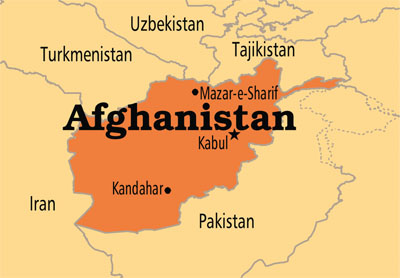
  • Could Taliban Talks Lead To Partition Of Afghanistan?

    Could Taliban Talks Lead To Partition Of Afghanistan?

    The big question for the Afghans is: what happens in the long term? What will Kabul require to maintain the Afghan form of security and peace after the US/NATO troops leave, or will Afghanistan willy-nilly pitch itself right into yet another bloodletting civil war – like what followed the Soviet troop withdrawal in 1989? “, says the author.
    The much-expected talks between the Taliban and the United States in Doha have not yet begun, and there is no clear indication when the two parties, busy settling their list of pre-negotiation do’s and don’ts, will finally sit down to discuss the features of post-2014 Afghanistan and determine role of various parties in the future. Meanwhile, some within Afghanistan have expressed concern that if indeed talks progress between the Taliban and the Americans, it may lead to the partition of Afghanistan.

    As of now it seems that one important party, the Government of Afghanistan led by President Hamid Karzai, has suspicions that the Americans are working toward allowing the Taliban to carve out some territory of its own as part of the so-called solution to the Afghan imbroglio, and has remained unwilling to participate in these talks. President Karzai demands Afghan-to- Afghan talks unfettered by the presence of foreigners – particularly those who invaded, fought the Taliban unsuccessfully for more than a decade, and are now looking for a conditional getaway.

    President Karzai’s hard stance may change. After all, he also knows that he will have to depend on these foreigners’ money to keep Kabul secure after the 100,000-plus foreign troops leave Afghanistan by mid-2014. What happens next? However, these are short-term logistical problems. What is certain at this point is that the vast majority of foreign troops will leave Afghanistan according to the timetable set by US President Barack Obama.

    The big question for the Afghans is: what happens in the long term? What will Kabul require to maintain the Afghan form of security and peace after the US/NATO troops leave, or will Afghanistan willy-nilly pitch itself right into yet another bloodletting civil war – like what followed the Soviet troop withdrawal in 1989? At that time, the Afghan strongman Najibullah, a friend of the Soviets and a gritty Pushtun, had held on to power for almost five years fighting various Mujahideen groups.

    Most of those groups were propped up by the West, the Saudis and Pakistan in the 1980s using “Islamic Jihad” as the battle cry to fight the Soviet military. After the Soviets left, some of these groups continued to receive active Pakistani help to topple Najibullah, then the Afghan symbol of the godless Soviets. The question is: Will the withdrawal in 2014 usher in the same players that we saw in 1989, killing at random to get control of Kabul? Who knows? The current tiff between Kabul and Washington that is receiving attention in the mainstream media is part of a power play in progress between President Karzai and the United States.

    This, too, will pass. But what is not certain is what the talks will in fact bring in. Will they bear the fruit that the Obama administration is hoping for? Max Fisher of the New York Times noted that the so-called peace talks are already on shaky ground for three reasons. First, on the same day Washington announced the opening of “peace talks,” the Taliban claimed responsibility for an attack that killed four Americans.

    Second, Afghan President Hamid Karzai announced he was no longer planning to participate in either the talks or a separate troop-level negotiation with the United States. And, third, the Taliban’s new office in Doha flew a banner labeled “Islamic Emirate of Afghanistan” and a flag from its days of ruling the country. “All three are individually bad signs that represent much larger challenges for peace in Afghanistan,” said Fisher.

    “In some ways, though, it’s the flag that’s most serious” (“The ultimate symbol of why Afghan peace talks will be so difficult,” Max Fisher, New York Times, June 19, 2013). Maybe Fischer is overstating here. This little summer thunderstorm may pass in no time. But, the problem is that even if the talks turn out to be “successful,” will that be any good for the Afghans? There is no reason to believe that President Obama is losing sleep over that.

    As far as he is concerned, a peaceful withdrawal from Afghanistan – unlike the kind of withdrawal from Vietnam that resembled so starkly the fearful retreat of a defeated military – is all that he cares about, even if that means supping with the devil. All the rest of the verbiage that comes out of Washington is rhetoric.

    Appeasing the Taliban? That, however, also means that Washington needs to keep the Taliban in good humor, and that means allowing the group to have some sort of authority in Kabul when the foreigners are gone – or, most of them. There is a distinct possibility that the upcoming talks will include this as an important item. Some in Washington have long claimed that the Taliban is not really that bad.

    In a December 2011 interview with Newsweek/Daily Beast, US Vice President Joseph Biden said as much. “We are in a position where if Afghanistan ceased and desisted from being a haven for people who do damage and have as a target the United States of America and their allies, that’s good enough. That’s good enough. We’re not there yet,” said Biden. “Look, the Taliban per se is not our enemy. That’s critical,” he insisted.

    “There is not a single statement that the president has ever made in any of our policy assertions that the Taliban is our enemy because it threatens US interests…” What Biden says is clear. The United States has zero problem with the Taliban. But it has loads of problems with the al- Qaeda. In Afghanistan, however, those problems have been mostly resolved.

    In fact, Washington claims that it has virtually decimated al-Qaeda – the real bad guys – and the upcoming deal with the Taliban will include the condition that the Taliban cannot allow al-Qaeda to set up shop in Afghanistan once again. If all these negotiating points work out, the Taliban could have a legitimate presence in Kabul.

    Some in Afghanistan claim that long before that becomes a reality, talks with the Taliban – who have a put up a plaque in Doha claiming themselves to be the representatives of the “Islamic Emirate of Afghanistan,” as opposed to the citizens of the Islamic Republic of Afghanistan, the actual name of the Afghan Government – will pave the way for partition of Afghanistan.

    Afghanistan’s Weesa Daily, in its June 19 editorial referring to these developments, said attention should be paid to several major points: First, the opening of the office is an understanding between the Taliban and the United States, and the Taliban now think that US forces in Afghanistan have been defeated and are escaping while the US considers how to leave the ongoing war to Afghans so that it can merely watch.

    If there is no crisis following President Karzai’s term and if peace talks advance as planned, the Taliban, according to their recent statement, will hold talks with all involved sides. But, notes Weesa Daily, “these talks of the Taliban with all involved sides would resume based on the plans suggested by US Senator Dana Rohrabacher and US Vice- President Joe Biden, who have suggested Afghanistan’s division – which may result in civil war.”

    Partition of Afghanistan? Well, US Vice President Biden has talked about the “soft partition” of Iraq, but never about the partition of Afghanistan; while Congressman (not Senator) Rohrabacher has participated in deliberations where partition/decentralization of Afghanistan was addressed as an issue. But before Rohrabacher got into the act, former US Ambassador to India and US National Security Council Deputy for Iraq (2003-2004) Robert Blackwill, a neo-con, had identified the partition of Afghanistan as Plan B.

    In a July 2010 article in Politico, Blackwill was highly critical of the Karzai administration (“Afghan President Hamid Karzai’s deeply corrupt government – as unpopular as the Taliban – shows no sign of improvement”) and implied that the “corrupt governance” of Kabul was the prime reason behind US/NATO’s failure to “win” the war in Afghanistan. He called for a ‘de facto partition’ of Afghanistan and urged the Obama administration to “accept that the Taliban will inevitably control most of its historic stronghold in the Pashtun south.”

    But, Blackwill added, “Washington could ensure that north and west Afghanistan do not succumb to jihadi extremism, using US air power and special forces along with the Afghan army and likeminded nations.” Blackwill also stated: “Given the number of US combat forces now fighting, the Taliban cannot be sufficiently weakened in Pashtun Afghanistan to drive it to the negotiating table on any reasonable timeline. True, the Afghan Pashtun are not a unified group. But they do agree on opposing foreign occupation and wanting Pashtun supremacy.”

    In January 2012, Chairman of the Europe, Eurasia, and Emerging Threats Subcommittee of the US House Foreign Affairs Committee Dana Rohrabacher (RCalifornia) went to Berlin at the head of a bipartisan congressional group represented by Reps. Louie Gohmert (R-Texas), Steve King (R-Iowa) and Loretta Sanchez (DCalifornia).

    In Berlin, the delegation met with well-known National Front leaders such as Ahmed Zia Massoud, chairman of the National Front [Jebha-e-Melli]; General Abdul Rashid Dostum, leader of the National Islamic Movement of Afghanistan [Jumbesh-e-Milli]; Haji Mohammad Mohaqiq, leader of the People’s Unity Party of Afghanistan [Hezb-e Wahdat-e Mardom]; and Amrullah Saleh, former director of the Afghan National Security Directorate.

    Together, they had signed a document advocating major changes in the Afghan constitution, designed to create a federal system which would devolve power from the centre to the provinces. Of the existing governmental arrangements in Afghanistan they had the following to say: “The current system has fatally concentrated decision-making to whoever is president of the country. The Afghan president appoints the governors of each province and district, the mayor of every town, every provincial chief of police, one third of the entire Senate, and even every judge in Afghanistan.”

    “This centralized power has led to massive corruption, disenfranchisement of a large segment of the Afghan people, obstacles to economic development, massive abuses of power, increasing political instability, poor governance, and a vast undermining of law and order.” Almost instantly Kabul reacted sharply to the statement. In April 2012, Rep. Rohrabacher was stopped in Dubai as he was leading a delegation to Kabul.

    Officials say that while the other members of the delegation had visas for Afghanistan, Rohrabacher was denied a visa. Afghan officials had told the BBC that in addition to his criticisms of the president, Rohrabacher was being shunned because of meetings he had held in Berlin with Afghan politicians about the creation of a decentralized form of government.

    According to the BBC, Afghan officials viewed that as tantamount to interference in the country’s internal affairs. “Anyone who speaks against the good of Afghanistan and tries to interfere in our internal affairs is ineligible for an Afghan visa,” one official told the BBC. Though strong, President Karzai’s reaction was not impulsive. At the time of the Berlin meetings – in fact, two meetings took place over three days (Jan. 9-11) – he had made known his discontent.

    Given the lack of clarity in the US strategy on Afghanistan, Karzai had every reason to suspect that the Berlin outcome could become the official strategy one day, particularly since Blackwill had already called for a ‘de-facto partition’ of Afghanistan a few months before. According to available reports, there was also another reason why President Karzai reacted so sharply.

    Accompanying Rohrabacher and the three other representatives was an American confidant of Gen. Dostum, Charles Santos. Santos, who had been advocating the concept of federalism and the powerful role of democratically elected local and regional governments in Afghanistan through various articles, was not listed among the participants in Berlin.

    President Karzai might have wondered: what was that all about? Reports indicate that an angry President Karzai personally called the German Foreign Office, though the meeting was already over, and leaned on then US Ambassador Ryan Crocker to de-legitimize the Berlin proceedings. On Jan 10, Ambassador Crocker issued a short statement, titled “The United States Supports Afghan Unity.”

    The statement said: “In response to recent press [sic] reports, the US Embassy reaffirms the longstanding support of the United States for a unified Afghanistan based on the Afghan Constitution. Any assertions to the contrary are entirely without foundation. Reconciliation and the political process in Afghanistan are led by the elected government and the Afghan people.

    Any statement to the contrary is inaccurate.” Subsequently, at a Jan. 21 press conference in Kabul, then-US Af-Pak envoy Marc Grossman made efforts to cool down the Afghan president by reiterating that a peace deal could only be negotiated by Afghans and would not be hijacked by US officials, despite current appearances to the contrary. It is evident from many reactions within Afghanistan that the Afghans do not want partition of their country, and some news editorials express fear that the Taliban-US talks could lead to just that.

    Afghan analysts point out that the country suffered the pains of partition when the British Raj drew a border (known as the Durand Line) between Afghanistan and then British- India in 1893. The aim of that partition was to divide and weaken the Afghan tribes. More than a century later, the Durand Line remains one of the most disputed borders in the world. Further, Afghans rightly note that during the past three decades, Afghanistan has had no functioning government, yet nonetheless remained united against foreign invasions.

    Except for two or three of the country’s 33 provinces, each province has a distinct ethnic mix; and, perhaps because of this phenomenon, separatism has never raised its ugly head in Afghanistan. During Afghanistan’s civil war in the early 1990s, when a fierce internal competition for control of Kabul was raging, no ethnic group and no warlord ever called for partition. The anti-Soviet resistance in the north remained always as strong as in the south.

    “And let’s not forget that there are millions of Pushtun in the north as well,” as one analyst pointed out. In other words, should Washington try to partition Afghanistan to provide the Taliban a permanent home and hope that will prevent an all-out civil war, it might ensure US troops a peaceful retreat; but it could also lead to huge opposition within Afghanistan, triggering a civil war.

  • Prince Harry Pays Tribute To Us War Dead

    Prince Harry Pays Tribute To Us War Dead

    WASHINGTON (TIP) Prince Harry, in the dress uniform of his British army regiment, paid tribute Friday to US soldiers killed in Iraq and Afghanistan on day two of a US tour dedicated in good part to war veterans. With white-gloved hands behind his back, he strolled alone through rows of white headstones in a section of the sun-kissed Arlington National Cemetery reserved for those who died in America’s most recent wars.

    He wore the dark blue uniform of the Blues and Royals cavalry regiment, which he joined in 2006, together with a powder blue beret representing his role as an Apache attack helicopter pilot in the British army’s air wing.

    On a floral arrangement, the 28-year-old captain — who has twice deployed in Afghanistan — left a signed handwritten note: “To my comrades-in-arms of the United States of America, who have paid the ultimate sacrifice in the cause of freedom,” it said. Harry also laid a wreath at the Tomb of the Unknown Soldier at Arlington, watched by a youthful crowd of T-shirted tourists kept at a distance behind a metal barricade, and paused at the grave of president John F Kennedy, assassinated 50 years ago this November.

    Later in the day, he crossed town to the Walter Reed National Military Medical Center to mingle with US soldiers undergoing physical therapy and get a private briefing on the latest breakthroughs in prosthetics. On the weekend, Harry will be in Colorado for the Warrior Games, where 200- plus wounded servicemen and women will compete in such sports as archery, cycling, swimming, track and field, and wheelchair basketball. Harry, who last visited Washington a year ago, is on his best behavior after cellphone naked photos of him partying in a Las Vegas hotel suite spilled onto the Internet last August.

    Like his father Prince Charles and older brother Prince William, he is assuming a bigger share of royal duties on behalf of his grandmother Queen Elizabeth II, who turned 87 last month.

  • Transition in Afghanistan: A War of Perceptions

    Transition in Afghanistan: A War of Perceptions

    While the US and NATO and the Afghan security officials are willing to underline the latter’s ascending capacities, such views have been viewed with considerable skepticism among civil society and women groups, NGO’s and people in Afghanistan . The impressive performance of the ANSF during some of the high-profile and well coordinated insurgent attacks has been cited as evidence of its growing strength and capabilities. Analysts insist that they have come of age and no longer the ‘rag tag’ men in uniform they used to be.

    At the same time, concerns still exist on the ANSF capability to gather adequate intelligence on the planning and execution of well-coordinated multiple sieges, an insurgent tactic that has gained predominance. Example is cited of the multicity Taliban attack on 15 April 2012, when Taliban suicide attackers carried out attack on Kabul, and three other eastern provinces – Nangarhar, Logar and Paktia. The fact that the insurgents could slip into the protected capital evading several security check points with a huge stockpile of weapons and penetrate the most secure inner circle of Kabul’s ring of steel is a matter of deep worry. NATO commended the ANSF for effectively defending the city and ultimately quelling the attack. But observers are quick to point out that the operation appeared impossible to conclude without the back-up support from NATO helicopters and Special Forces.

    NATO’s praise for the ANSF is understandable, for it is on such success that the exit strategy is predicated. The ANA has been primarily employed to augment the international forces’ COIN campaign. In 2011, over 90 per cent of ISAF operations were conducted in conjunction with the ANA, an increase from 62 per cent of such operations in spring and summer of 2008. However, this projected conjunction could actually be a misnomer. According to a recent US Department of Defense report in 2012, only 13 out of the 156 Afghan Army battalions are classified as ‘independent with advisers’ and only 74 are seen as ‘effective with advisers’. In effect, there is very little to indicate that the ANA will be able to act autonomously over large swathes of the countryside in the next two or three years. Especially remote in the coming years is the possibility of transferring responsibility for the protection of the provinces bordering Pakistan to the Afghan army. Alongside the questions of capacities, maintaining a huge security force establishment is a financial impossibility for the resource-starved Afghan government.

    The total strength of the ANSF in October 2011 reached 306,903 (170,781 soldiers and 136,122 policemen). Future plans envisage an increase to 352,000 personnel (195,000 ANA and 157,000 ANP) by October 2012. Final ANSF end-strength post-2014, however, remains to be determined by prevailing security, political and financial conditions. The government in Kabul is bound to face the most formidable challenge of mentoring the forces and finding continuous funding for such a huge project.. These numbers would be highly unsustainable for an external aid dependent state whose core annual budget is barely US$2.685 billion for the 2012-13 financial year. It was after much deliberation, the US and its allies at the Chicago summit, envisaged a force of 228,500 with an estimated annual budget of $4.1 billion. This amounts to what the U.S. currently spends every 12 days in Afghanistan The greater worry, however, lies in the scenario of acceleration of training impinging on the quality of the forces. Analysts suggest that the ANSF is already ‘unmanageable’ and hence, the term ‘expansion’ is nothing but a paradox.

    While observers perceive some success in terms of raising a capable and independent ANA, serious concerns have been expressed about the capabilities of the ANP and the convoluted attempts in establishing rule of law. Analysts point out that while the ANA is seen as a relative success vis-a-vis the ANP, the chronic deficiencies and problems of funding, equipment, training, desertion, ethnic balancing and infiltration cannot be overlooked. There are serious concerns of creating a ‘hyper-militarized’ state. The feasibility of building a large army without addressing larger issues of civil-military relations has been questioned, particularly when the government in Kabul is perceived to be weak. The lingering concerns of ethnic balancing and representation combined with the challenges of building a national army on meritocratic lines remain.

    Despite major efforts by the NATO Training Mission in Afghanistan (NTM-A) in recent years, the development of the institutional capacity of the ANSF will take years. The ANSF’s quality, its professional and institutional capability and its capacity to function in an unstable and conflict-ridden environment are bound to be tested in the coming years. The rising incidence of ‘green on blue attacks’, i.e. rogue soldiers and police turning their weapons on their ISAF mentors, remains a serious concern. In 2011, 35 NATO soldiers and trainers were killed in 21 incidents of such ‘green on blue’ attacks by the Afghan soldiers. In the first half of 2012, there have been 32 such incidents, killing 40. The Taliban are quick to claim credit for such attacks, claiming infiltration of its cadres into the ANSF ranks. NATO commanders, on the other hand, argue that many such attacks are driven by personal grudges rather than loyalty to the Taliban or other groups.

    In addition to problems associated with inadequate vetting mechanisms and background checks due to the rush to recruit, the increased number of attacks has led to a ‘trust deficit’ between the Afghan soldiers and their mentors leading to scaling down of the NATO’s training and mentoring assistance. While the ANA is construed to be relatively successful, the Afghan National Police (ANP) is bedeviled with problems. The ANP is expected to perform law enforcement, border protection and counter-narcotics functions. However, the ANP is not only perceived to be ineffective, corrupt and illdisciplined, it faces the problems of funding, training, recruitment, equipment, infiltrations and desertions. ANP’s development has been hindered by lack of institutional reform, widespread corruption, insufficient international military trainers and advisors. As a result, ANP has minimal control over the urban centers, with almost no presence in Afghan villages where they are most needed.

    To address the inadequacies of the ANP, a stop-gap measure of recruiting tribal militias under the Afghan Local Police (ALP) has been initiated. In a spate of anti-Taliban uprisings, on the lines of the Anwar Awakening in Iraq, these forces have been successful in repelling the harsh Taliban edicts, school closings in Ghazni, music bans in Nuristan, beheadings in Paktia and murders in Laghman, among other causes. However, concerns remain of such independent and ‘well-stocked armoriesmilitias and they typically behave like the Taliban with a different name’. The project of replicating the Iraq model runs imminent danger of a contravention of the efforts of long-term institution-building and reforms in the security sector. These persisting weaknesses and ‘quick fixes’ are bound to affect the ANSF performance in the long term. Political Sector, Constitutional and Electoral Reform While most of the debate on transition has veered towards security sector, meaningful discussion on the transition in the political sector, particularly when the year of handover of responsibility coincides with the 2014 presidential elections in Afghanistan, seems to be missing. Analysts posit that ‘placing sole responsibility for Afghanistan’s future stability on the ANSF without making progress in creating a stronger political consensus among Afghanistan’s diverse factions, both armed and unarmed, is a highrisk gamble’.

    Over the past decade, the highly centralized executive form of political system has been constantly challenged, both by the insurgent campaign to discredit the present political system and also by the challenges from within the system. The constant bickering between the President and Parliament, deteriorating security, poor governance and the near-absence of rule of law have sparked debates inside and outside Afghanistan for the need for wide-ranging political sector reforms. The magnitude of the problem and simmering discontent has led observers to forewarn: ‘If in 2001 the West was afraid that the absence of a strong centralized government in Kabul would prompt Afghanistan’s dissolution, by 2011 the West has come to fear that a dysfunctional centralized government could cause this same outcome.’ In addition to the existing challenges in the political sector, the complexity of holding elections in the year of handover of authority is daunting. Analysts point out: ‘The Afghan presidential election slated for 2014 is an uninspiring prospect given the skyhigh levels of corruption, nepotism, and patronage that beleaguers the Afghan political system.

    To make things worse, President Hamid Karzai has suggested holding the elections in 2013 to avoid an overlap with the planned end of NATO’s combat mission. And there is still no functional plan in place for a smooth transfer of political power to a post-Karzai government.’ In the absence of large scale political sector and electoral reform, the danger of repeat of previous instances of electoral malpractices at a crucial time of transition is cause for widespread concern. The challenges associated with institutionbuilding in the political sector stem from inadequate steps taken by the international community to help build a robust political system based on a sound understanding of the nature of the Afghan state and the political processes, which shape the local preferences.

    Abstract

    A decade after the military intervention that dislodged the Taliban-Al Qaeda combine, peace and stability continues to elude Afghanistan. There is still no consensus in Western capitals on what constitutes the ‘end-state’ in Afghanistan. The Western public’s frustration with a long-drawn war has coalesced with the global economic slowdown, the Euro crisis and the pressures of electoral campaign politics in the United States – thereby complicating the efforts for the long-term stabilization of Afghanistan. Premature announcements of exit and dwindling financial assistance have added to the Afghan anxieties of being ‘abandoned’ once again. This paper brings to light the divergent perceptions among the key stakeholders in Afghanistan and in the international community (IC) on the trajectory of the ‘inteqal’ (transition) process. The paper argues that the war in Afghanistan is essentially a war of perceptions on progress made thus far. This widening gap in perceptions is bound to complicate the transition and long term stabilization process.

    To be continued next week

  • Obama, ex-presidents honor George Bush at new museum

    Obama, ex-presidents honor George Bush at new museum

    DALLAS (TIP): President Barack Obama praised his predecessor at the dedication of his library for showing strength and resolve in the days after the September 11 attacks and said if Congress passes immigration reform “it will be in large part thanks to the hard work of President George W Bush.” Obama spoke along with all four living former presidents in a rare reunion honoring one of their own at the opening of the George W Bush Presidential Center. “To know President George W Bush is to like him,” Obama said. The presidents — Bush, Barack Obama, Bill Clinton, George HW Bush and Jimmy Carter — were cheered by a crowd of former White House officials and world leaders as they took the stage together to open the dedication.

    They were joined on stage by their wives — the nation’s current and former first ladies — for the outdoor ceremony on a sun-splashed Texas morning. It was a day for recollections and reveries, and no recriminations or remorse. The five men have been described as members of the world’s most exclusive club, but Obama said they are “more like a support group.” “Being president above all is a humbling job,” Obama said. He there were moments that they make mistakes and wish they could turn back the clock, but “we love this country and we do our best.” He said Bush started an important conversation by speaking to the American people about the United States as a nation of laws and a nation of immigrants and he hopes Congress will act this year to pass reform, which Bush wasn’t able to achieve. The leaders put aside the profound ideological differences that have divided them for years for a day of pomp and pleasantries. For Bush, 66, the ceremony also marked his unofficial return to the public eye four years after the end of his deeply polarizing presidency. “Oh happy day,” Bush said as he took the stage. President George HW Bush, who has been hospitalized recently for bronchitis, spoke haltingly for just about 30 seconds while seated in his wheelchair, thanking guests for coming out to support his son.

    A standing ovation lasted nearly as long as his comments, and his son and wife helped him to his feet to recognize the applause. Clinton, too, was warmly received by the heavily Republican crowd, who applauded and laughed along with Clinton’s joke-peppered speech. He concluded on a serious note about the importance of the leaders coming together. “Debate and difference is an important part of every free society,” Clinton said. President Jimmy Carter praised Bush for his role in helping secure peace between North and South Sudan in 2005 and his approval of expanded aid to the nations of Africa. “Mr. President let me say that I am filled with admiration for you and deep gratitude for you about the great contributions you’ve made to the most needy people on earth,” Carter said.

    Former first lady Laura Bush said the library isn’t just about her husband, but reflects the world during his time as the first president as the 21st century. “Here we remember the heartbreak and heroism of Sept. 11 and the bravery of those who answered the call to defend our country,” she said. In a reminder of his duties as the current Oval Office inhabitant, Obama planned to travel to Waco in the afternoon for a memorial for victims of last week’s deadly fertilizer plant explosion.

    Presidential politics also hung over the event. Ahead of the ceremony, former first lady Barbara Bush made waves by brushing aside talk of her son, former Florida Gov. Jeb Bush, running for the White House in 2016. “We’ve had enough Bushes,” said Mrs Bush, the wife of George HW Bush and mother of George W Bush.

    She spoke in an interview with NBC’s “Today” show. Yet George W Bush talked up the presidential prospects of his brother in an interview that aired Wednesday on ABC.”He doesn’t need my counsel, because he knows what it is, which is, ‘Run,”‘ Bush said.

    Key moments and themes from George W Bush’s presidency — the harrowing, the controversial and the inspiring — would not be far removed from the minds of the presidents and guests assembled to dedicate the center, where interactive exhibits invite scrutiny of Bush’s major choices as president, such as the financial bailout, the Iraq War and the international focus on HIV and AIDS. On display is the bullhorn that Bush, near the start of his presidency, used to punctuate the chaos at ground zero three days after 9/11.

    Addressing a crowd of rescue workers amid the ruins of the World Trade Center, Bush said: “I can hear you. The rest of the world hears you. And the people who knocked these buildings down will hear all of us soon.” “Memories are fading rapidly, and the profound impact of that attack is becoming dim with time,” Bush told The Associated Press earlier this month. “We want to make sure people remember not only the lives lost and the courage shown, but the lesson that the human condition overseas matters to the national security of our country.”

  • US aims to expand India arms trade by “billions of dollars”

    US aims to expand India arms trade by “billions of dollars”

    WASHINGTON (TIP): The United States has already made “tremendous progress” in expanding weapons sales to India since 2008, and US companies could see “billions of dollars” in additional sales in coming years, a senior US State Department official said on april 18.

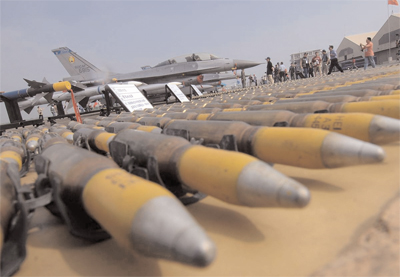
    Andrew Shapiro, assistant secretary of state for politicalmilitary affairs, said US sales of military equipment to India had grown from zero in 2008 to around $8 billion, despite a decision by India to choose a French-built plane in a closely-watched fighter plane competition. “While that fighter competition loss was disappointing, we have made tremendous progress in the defense trade relationship,” he told a news briefing. “There’s going to be billions of dollars more in the next couple of years.” He said a major arms trade initiative headed by Deputy Defense Secretary Ashton Carter was making good progress and should lead to “an ever greater pace of additional defense trade.” He gave no details on future possible arms sales. US weapons makers including Lockheed Martin Corp (LMT.N), Boeing Co (BA.N), Raytheon Co (RTN.N) and others, are keen to sale their wares to India, the world’s largest arms importer, especially since US military spending is now declining after a decade of sharp growth fueled by the wars in Iraq and Afghanistan. India plans to spend about $100 billion over the next decade upgrading its mostly Sovietera military hardware.

    Shapiro, who is due to leave the State Department at the end of this week, said he had seen news reports about delays in India’s talks with France’s Dassault Aviation (AVMD.PA) about a $15 billion purchase of 126 Rafale fighter jets. But he said the US State Department had not received word from India that it planned to reopen that competition or move ahead with a separate Indian naval fighter competition. Lockheed and Boeing were eliminated from the Indian fighter competition in April 2011.

    Shapiro said the State Department was seeing continued demand for US weaponry from the Middle East and Asia, but US companies faced stiff competition from European weapons makers, who are also facing declining demand in their home markets. He declined to discuss any specific arms sales, but noted that Singapore, Indonesia, and Australia had been key partners in defense trade in recent years. South Korea is also expected to announce the winner of its 60-fighter competition soon.

    Shapiro said his office had dramatically increased its advocacy for US weapons makers under former Secretary of State Hillary Clinton, and her successor, John Kerry, planned to continue the “economic diplomacy” initiative. Shapiro said State Department representatives planned to attend a major air show in Paris in June, despite mandatory budget cuts required under a process known as sequestration, but said officials would have to be conservative about the number of air shows they attended. He said sequestration-related furloughs could also slow the Pentagon’s work on export license requests, which threatened to slow or reverse progress made by the State Department in accelerating work on the licenses to 17 days on average now from 40 to 60 days several years ago. “Those processing times are likely to increase at a time when we’re trying to increase our defense trade. That’s not the best signal to send,” Shapiro said.

  • Obama sends Congress $3.8 trillion budget plan

    Obama sends Congress $3.8 trillion budget plan

    WASHINGTON (TIP): President Barack Obama sent Congress a $3.8 trillion budget plan that hopes to tame galloping deficits by raising taxes on the wealthy and trimming America’s most popular benefit programs. In aiming for a compromise between Republicans who refuse to raise taxes and Democrats who want to protect those benefits, he’s upset some on both sides. The White House wants to break away from the current cycle of moving from one fiscal crisis to another while the government skirts the brink of a shutdown.

    Deep political divisions have blocked substantial agreements to address the country’s gaping debt. It’s unlikely that Congress will begin serious budget negotiations before summer, when the government once again will be confronted with the need to raise its borrowing limit or face the prospect of a first-ever default on US debt.

    Obama on Wednesday night hosted a private dinner at the White House with a dozen Republican senators as part of efforts to win over the opposition. Republican Sen. Johnny Isakson said in a statement, “Sitting down to talk about how to get our arms around our debt is a good first step to what I hope will be an ongoing discussion and a path forward to solving our nation’s problems.” The president’s budget proposal includes $1.8 trillion in new deficit cuts as the US tries to wrestle down its debt. The last time the government ran an annual surplus was in 2001, the year of the 9/11 attacks that led to the wars in Afghanistan and Iraq. The Treasury Department said the US deficit was on pace to finish below $1 trillion for the first time in five years. The deficit hit a record $1.41 trillion in budget year 2009.

    Obama’s budget blueprint for 2014 assumes that Washington reverses the recent deep budget cuts that have become a daily reality for the military. It calls for a base Defense Department budget of $526.6 billion and $52 billion more than the level established by the blunt spending cuts, which had been designed to force the White House and Congress to reach a fiscal deal to avoid them. The budget plan includes an $88.5 billion placeholder for additional war costs in Afghanistan as Obama decides on the pace of the drawdown of US combat troops next year.

  • Obama To Israel  ‘You Are Not Alone’

    Obama To Israel ‘You Are Not Alone’

    JERUSALEM (TIP): President Obama’s whole visit to Israel can be summed up in one Hebrew phrase he uttered to a packed auditorium of Israeli students: You are not alone. Acknowledging the deep insecurity of a people that has experienced millenniums of persecution, not least of all Holocaust, Obama reassured them of America’s unwavering support as they grapple with a host of regional challenges, including Iranian nuclear development, civil war in Syria, the rise of Islamist powers, and ongoing tensions with their Palestinian neighbors. “Those who adhere to the ideology of rejecting Israel’s right to exist might as well reject the earth beneath them and the sky above, because Israel is not going anywhere,” he said, speaking to a select group in Jerusalem’s convention center. “Today, I want to tell you – particularly the young people – that so long as there is a United States of America, atem lo lavad.” Obama’s demeanor, words, and gestures on his first trip to Israel as president mark a decided departure from his 2009 Cairo speech to the Muslim world, in which he sought to show that the US took interest in regional affairs beyond their impact on Israel and thus rebuild credibility in a region roiled by the Iraq war and the larger war on terror.

    While not all Israelis have been impressed by the opening scene of Obama’s Act II in the Middle East, many are grateful for his unequivocal expression of support for Israel.

    Some suggest it reflects a maturing in his views, shaped in part by the turmoil of the Arab revolts of the past two years – although others see it as a preemptive charm offensive before asking the Israelis to make some tough compromises on Iran and the Palestinian issue. “In Cairo, he came to talk about peace, democracy, rights, new rules. And in a few days history changed in a scary way there. I think he understands things are different than what he thought,” says Tamar Asraf, who lives in the West Bank settlement of Eli. “And he’s coming not as the messiah, not as the sheriff; he’s coming as the president of the US, the best friend of Israel. I feel like he’s coming to support us, to help us.”

    CEMENTING THE FRIENDSHIP
    Indeed, from the moment Obama stepped off Air Force One yesterday, he exuded a spirit of friendship that carried with it both deep commitment and informal ease, shedding his suit coat barely half an hour into the visit. From an Israeli point of view, he has said all the right things and is visiting all the right places, acknowledging not only the modern state of Israel but also the Jewish people’s ancient claims to the land. But all he really had to do was land in the country for his first visit as president, a strong message of support no matter what he said or did. As Israel Hayom English editor Amir Mizroch put it, “Stop it, stop it.

    You had me at Shalom,” referring to Jerry McGuire winning his wife back with a simple “hello.” Obama, however, had much more to say than shalom. “My main goal on this trip has been to have an opportunity to speak directly to the Israeli people at a time when obviously what was already a pretty tough neighborhood has gotten tougher and let them know that they’ve got a friend in the US, that we have your back, that we consider Israel’s security of extraordinary importance to us,” he said last night at a press conference with Prime Minister Benjamin Netanyahu. “Not just because of the bonds between our peoples, but also because of our own national security interests.” Such assurances may give Obama political capital that he can cash in later, perhaps to rein in Israeli impulses to attack Iran or Syria, or to push them to make hard compromises on the Palestinian issue.

    After barely mentioning the Palestinians yesterday and spending only a few hours of his 48-hour visit in Ramallah with Palestinian Authority President Mahmoud Abbas today, Obama reaffirmed America’s commitment to a two-state solution in his Jerusalem speech.And the young Israelis in attendance were receptive, cheering loudly when he said “the Palestinian people’s right to self-determination and justice must also be recognized.” Among them was Rona Keha, an undergraduate studying political science at Ben Gurion University in Beersheva. Now, she says, “He needs to put some pressure on the Israeli government.

    He needs to start conversations and negotiate between Israel and the Palestinians. He needs to press on our government in order to start doing so,” says Ms. Keha, who spent three hours in line waiting to get into the speech. “I think this visit is one way to do it. And I hope that this visit will bring us some change.”

    BOOSTING PEACE, OR BOOTING IT DOWN THE LINE?
    Nadav Tamir, a policy advisor in Peres’s office who confessed to being emotional after Obama’s “amazing” speech, says Obama’s reassurances to the Israeli public would enable them to move forward more confidently toward peace. “I think it was the balance between showing very strong and deep care for Israel, for the history, for the future, for Zionism, but on the other hand, you know, that he told us you Israelis should feel safe enough to be proactive in terms of the peace process,” says Mr. Tamir. “When the Israeli public feel that they can trust [our] most important ally and the strongest superpower, I think it will help leaders to move the peace process forward….

    When President Obama is telling you, ‘I have your back,’ it’s very helpful.” But there is also a fair amount of skepticism that Obama will be able to follow up his eloquent words with concrete progress. “Israeli media talks about the fact that conflict in Middle East has become a kind of hobby for world leaders, and I tend to believe it is also true in the case of Obama,” says Hila Volpo, a graduate student studying political communication from Jerusalem. “I don’t think Obama believes within himself that it’s something he’s capable of doing.” Many American presidents have tried to solve the Israeli-Palestinian conflict, but even someone as engaged as former President Bill Clinton, who personally engaged in furious shuttle diplomacy, was unable to secure a deal.

    Obama, by contrast, got Israel to agree to a one-time settlement freeze but when talks stalled in September 2010, he was either unwilling or unable to pressure Israelis and Palestinians to resume talks.

    Obama also made clear in the Ramallah press conference today that he’s done an about-face on Israeli settlements, saying that a fresh freeze on Israeli settlement growth in the West Bank – a key Palestinian precondition for returning to the peace table – would just delay substantive peacemaking. That was deeply disappointing to Palestinians, but to Israelis it was a welcome change. “I heard he understood that it’s not the way [to press on settler issue], that he does not achieve anything.

    I think freezing or not freezing is not the question, the question is how does he see the future here and does he understand that he has to let Israel lead the process,” says Ms. Asraf of Eli. “I feel that he came with a lot of love, and a lot of respect, and it doesn’t seem like here is a sheriff to make everything peaceful back again … it seems like he comes as a friend

  • Gender equality in India among worst in world: UN

    Gender equality in India among worst in world: UN

    NEW DELHI (TIP): When India’s Human Development Index is adjusted for gender inequality, it becomes south Asia’s worst performing country after Afghanistan, new numbers in the UNDP’s Human Development Report 2013 show. Pakistan, Nepal and Bangladesh, which are poorer than India and have lower HDIs, all do comparatively better than India when it comes to gender equality. The new UNDP report, released on March 14, ranks India 136th out of 186 countries, five ranks below postwar Iraq, on the HDI.

    The HDI is a composite indicator composed of three equally weighted measures for education, health and income. On the newly constituted Multidimensional Poverty Index (MPI), which identifies multiple deprivations in the same households in education, health and standard of living, only 29 countries do worse than India (though data-sets are from varying periods of time across nations). The MPI puts India’s poverty headcount ratio at 54%, higher than Bangladesh and Nepal.

    This was even as India did extremely well economically. India and China doubled output per capita in less than 20 years, at a scale the UNDP has said was “unprecedented in speed and scale”. “Never in history have the living conditions and prospects of so many people changed so dramatically and so fast,” the UNDP said; it took Britain 150 years to do the same after the Industrial Revolution and the United States, which industrialized later, took 50 years. On the whole, developing countries have been steadily improving their human development records, some faster than others.

    No country has done worse in 2012 than in 2000, while the same was not true for the preceding decade. India, Bangladesh and China are among 40 countries that have done better on the HDI than was predicted for them in 1990. By 2030, more than 80% of the world’s middle class is projected to be in the global South; within Asia, India and China will make up 75% of the middle class. The HDR identifies three drivers of human development transformation in the countries of the global South – proactive developmental states, tapping of global markets and determined social policy innovation.

  • A Player but no Superpower

    A Player but no Superpower

    Why China’s military shouldn’t scare the United States.

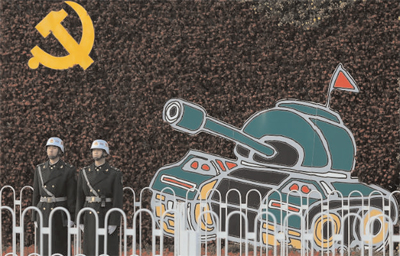
    On March 5, at the opening of the National People’s Congress, Beijing announced its official 2013 defense budget: roughly $114.3 billion, a 10.7 percent increase over the previous year and, in nominal terms, nearly four times the official budget a decade ago. This level of spending is enough to make China a force in its neighborhood, but not one to engage in combat overseas. Beijing has long faced a much more problematic geostrategic position than Washington has. The United States borders two friendly neighbors and is buffered by massive oceans to its east and west.

    It enjoys abundant natural resources and the most allies in the world. China, by contrast, borders 14 countries (including four states with nuclear weapons) and has ongoing disputes with all its maritime neighbors, including its powerful rival, Japan. Since the early 1990s, China has been surprisingly forthright about the reasons it is strengthening its military: to catch up with other powers, to construct a more capable and modern military force in order to assert its outstanding territorial and maritime claims, and to secure its development on its own terms. It also wants to acquire prestige as a full-fledged “military great power” — a status its leaders appear to increasingly see as necessary to enhance China’s international standing. Despite technological inferiority through most of the last two decades, the People’s Liberation Army (PLA) utilized its geographical proximity to potential hot spots in what it calls the “Near Seas” (the Yellow, East China, and South China seas) to develop deterrents based on asymmetric technologies aimed at exploiting the vulnerabilities in potential adversaries’ expensive military technologies.

    China’s ballistic and cruise missiles, for example, are cheaper to produce, deploy, and use to attack enemy surface ships than the defensive systems necessary to protect would-be targets. In short, China is increasing the potential cost for the United States to intervene in the Near Seas. Beijing is still spending well within its means. Its defense budget is the world’s second-largest, but so is its economy. China’s military-spending growth is roughly consistent with its rising GDP and is actually outpaced by Beijing’s rapid increase in state financial expenditures.

    China is no Soviet Union, whose military spending ultimately stunted its economy, reaching unsustainable levels — far higher proportionally than that of China today, even when compared with high-end estimates of Beijing’s actual spending. China’s official defense budget still doesn’t capture all defense-related spending, but no country’s does.

    U.S. spending on nuclear weapons, as well as the hundreds of billions of dollars in supplemental appropriations that George W. Bush’s administration used to fund operations in Iraq, doesn’t appear in the official Pentagon budget. U.S. defense-related spending appears clearly in other official documents, but the same is true for at least one major item China excludes from its defense budget: spending on its paramilitary force, the People’s Armed Police, which is published in annual statistical yearbooks — albeit without significant details — under “Public Security.” Although China’s official budget figure remains far less transparent than Pentagon spending, it appears increasingly accurate. The U.S. Defense Department estimates that China’s “total military-related spending” in relation to Beijing’s official defense-budget figure has fallen from approximately 325 to 400 percent of official figures for 2002, to 143 to 214 percent for 2008, to 113 to 170 percent for 2011 — a significant trend in Chinese budget transparency. Meanwhile, the United States is convulsed by debate over whether it can afford to maintain current defensespending levels.

    In China, however, rapid economic and tax-revenue growth has provided a rising budgetary tide, allowing Chinese leaders the luxury of avoiding many tough decisions about spending priorities. And there’s no end in sight: The U.S. National Intelligence Council predicts that China’s GDP will surpass that of the United States in purchasing-power-parity terms in 2022, and near 2030 at market exchange rates, suggesting that high defense spending may be sustainable for a long time.

  • India Sixth Most Favourable Nation For Americans: Poll

    India Sixth Most Favourable Nation For Americans: Poll

    WASHINGTON (TIP): India is the sixth most favourable nation for Americans, while at least eight out of 10 do not like Pakistan, making it the third most unfavourable nation after Iran and Korea, according to a latest poll.

    According to the Gallup Polls, nearly seven (68 per cent) out of every 10 persons interviewed for the poll favoured India, thus ranking it sixth after Canada (91 per cent), Great Britain (88 per cent), Germany (85 per cent), Japan (81 per cent) and France (73 per cent).

    In fact Israel, the traditional American ally ranks seventh after India with 66 per cent while Mexico get only 47 per cent favourable votes. Opinion about Russia is equally divided among favourable and unfavourable rating while 52 per cent of the Americans put China in the unfavourable category. Nine out of 10 Americans have an unfavourable view of Iran, making it the worst rated country out of 22 surveyed. Seven other countries – Libya (72 per cent), Iraq (76 per cent), Afghanistan (80 per cent), the Palestinian Authority (77 per cent), Syria (75 per cent), Pakistan (81 per cent) and North Korea (84 per cent)– also receive unfavourable ratings of 70 per cent or more. “Eight countries with the most negative ratings are currently or over the past decade were involved in wars, disputes, or turmoil — in a number of instances, in ways that are hostile to the US,” Gallup said. It said the currently “hostile” category includes Iran and North Korea.

    Libya was hostile toward the US under the government of Muammar Gaddafi and more recently Ambassador Christopher Stevens and three other Americans were killed there. “The US-Pakistani relationship is beset with rockiness despite the strained cooperation between the two on military matters. Americans also strongly favour Israel’s enduring conflict with Palestinian Authority,” the survey said.

  • Ah! Chavez

    Ah! Chavez

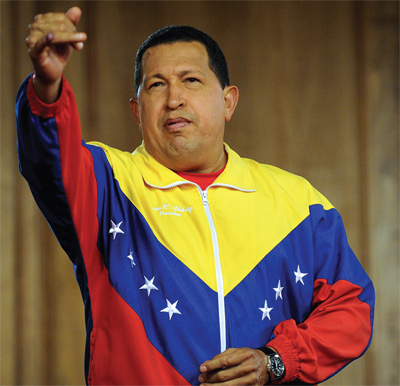
    NAME: Hugo Rafael Chávez Frías
    OCCUPATION: World Leader
    BIRTH DATE: July 28, 1954
    DEATH DATE: March 05, 2013
    EDUCATION: Venezuelan Academy of Military Sciences

    CARACAS (TIP): Venezuela president Hugo Chavez died on 6th March, 2013. He was 58 and was suffering from cancer since a couple of months. With the death of Chavez, the future of Latin America is now uncertain.

    The news of death of Chavez was announced by Vicepresident Nicholas. He spoke to the television reporters from Caracas military hospital. Chavez was seen as a populist leader by the supporters. His critics called him neo fascist. He was an engaging speaker and charismatic personality.

    Hugo Chavez was admitted into the hospital on 18th February, 2013. It was decided to continue the chemotherapy treatment. Earlier, he was operated for cancer in Cuba. That was the fourth cancer surgery he underwent since June, 2011. Hugo Chavez was the president of Venezuela for 14 years.

    He became the symbol of Latin America. In December 2012, he went to Cuba and was out of public sight. There were many rumors about his health. A few photos were released in January which showed him on the bed in a hospital. He was looking at his two daughters who were beside him. Chavez was the favorite leader for poor. He spent the country’s revenue earned from oil on building houses for poor, health, food and education of them. Other Latin America leaders who followed Chavez have lost a good friend with the death of Chavez. Chavez’s body is kept in the military academy for people and other leaders to visit.
    Biography
    Born in Sabaneta, Venezuela, on July 28, 1954, Hugo Chávez attended the Venezuelan military academy and served as an army officer before participating in an effort to overthrow the government in 1992, for which he was sentenced to two years in prison.

    Chávez became president of Venezuela in 1999. Early into his presidency, he created a new constitution for the country, which included changing its name to the Bolivarian Republic of Venezuela. He later focused his efforts on gaining control of the state-run oil company, which stirred controversy and led to protests, strained relations with the United States and other nations, and Chávez briefly being removed from power. His actions included selling oil to Cuba and resisting efforts to stop narcotic trafficking in Columbia. In 2006, Chávez helped create the Bolivarian Alternative for the Americas, a socialist free-trade organization. He died on March 5, 2013, at age 58, following a long battle with cancer.
    Failed Coup Attempt
    Born Hugo Rafael Chávez Frías on July 28, 1954, in Sabaneta, Venezuela, Hugo Chávez was the son of schoolteachers. Before becoming known for his reform efforts and strong opinions as president of Venezuela (1999-2013), Chávez attended the Venezuelan Academy of Military Sciences, where he graduated in 1975 with a degree in military arts and science. He went on to serve as an officer in an army paratrooper unit.

    In 1992, Chávez, along with other disenchanted members of the military, attempted to overthrow the government of Carlos Andres Perez. The coup failed, and Chávez subsequently spent two years in prison before being pardoned. He then started the Movement of the Fifth Republic, a revolutionary political party. Chávez ran for president in 1998, campaigning against government corruption and promising economic reforms.
    Venezuelan President
    After taking office in 1999, Chávez set out to change the Venezuelan constitution, amending the powers of congress and the judicial system. As a part of the new constitution, the name of the country was changed to the Bolivarian Republic of Venezuela. As president, Chávez encountered challenges both at home and abroad.

    His efforts to tighten his hold on the state-run oil company in 2002 stirred up controversy and led to numerous protests, and he found himself removed from power briefly in April 2002 by military leaders. The protests continued after his return to power, leading to a referendum on whether Chávez should remain president. The referendum vote was held in August 2004, and a majority of voters decided to let Chávez complete his term in office.

    Hostility Towards the U.S.
    Chávez was known for being outspoken and dogmatic throughout his presidency, refusing to hold back any of his opinions or criticisms. He insulted oil executives, church officials and other world leaders, and was particularly hostile with the United States government, which, he believed, was responsible for the failed 2002 coup against him. Chávez also objected to the war in Iraq, stating his belief that the United States had abused its powers by initiating the military effort. He also called President George W. Bush an evil imperialist.

    Relations between the United States and Venezuela have been strained for some time. After taking office, Chávez sold oil to Cuba-a longtime adversary of the United States-and resisted U.S. plans to stop narcotics trafficking in nearby Colombia. He also helped guerrilla forces in neighboring countries. Additionally, during his presidency, Chávez threatened to stop supplying oil to the United States if there was another attempt to remove him from power. He did, however, donate heating oil to help the victims of Hurricane Katrina and Hurricane Rita, which destroyed numerous fuel-processing facilities.
    International Collaboration
    Regardless of the state of Venezuela’s relationship with the United States, while in office, Chávez leveraged his country’s oil resources to form connections with other nations, including China and Angola. In 2006, he helped create the Bolivarian Alternative for the Americas, a socialist free-trade organization joined by Fidel Castro, president of Cuba, and Evo Morales, president of Bolivia. Chávez was also an active member of the Non-Aligned Movement, a group of more than 100 countries, including Cuba, Iran and several African nations.
    Declining Health and Death
    Chávez discovered that he had cancer in June 2011, following a surgery to remove a pelvic abscess, and from 2011 to early 2012, he underwent three surgeries to remove cancerous tumors. Prior to his third surgery, in February 2012, Chávez acknowledged the severity of the operation as well as the possibility of not being able to continue his service as president, and subsequently named Venezuelan Vice President Nicolas Maduro as his successor.

    Due to his declinging health, Chávez was prevented from being inaugurated for a fourth term in January 2013. Following his years-long battle with cancer, Hugo Chávez died on March 6, 2013, at age 58, in Venezuela. He was survived by his wife, Maria Isabel Rodriguez, and five children: Rosines, María Gabriela, Rosa Virginia and Hugo Rafael.

  • Joseph Dunford: ‘Fighting Joe’ To Lead Us Out Of Afghanistan

    Joseph Dunford: ‘Fighting Joe’ To Lead Us Out Of Afghanistan

    Gen Dunford, formerly theassistant commandant of theUS Marine Corps, haspromised to complete the transition ofsecurity duties to Afghan forces and to”set the conditions for an enduringpartnership with the Afghan people”.He replaces another Marine: GenJohn Allen, who was recently clearedof misconduct after an investigationinto “potentially inappropriate”communication with a Floridasocialite.Gen Allen this week said he wouldretire from the military instead ofaccepting President Barack Obama’sappointment as supreme Natocommander in Europe, citing familyhealth issues.

    While Gen Allen was busy finishinghis recommendations to the WhiteHouse on how quickly to withdrawtroops from Afghanistan next year,Gen Dunford was studying up andpreparing for deployment.As the second-ranking MarineCorps officer, Gen Dunford has visitedAfghanistan many times.Maren Leed, senior adviser at theCenter for Strategic and InternationalStudies, says Gen Allen’s departurewill not lead to a major revision in theUS exit plan from Afghanistan. As itstands now, the US is to finish itsmission in Afghanistan by the end of2014.”What you will see is [Dunford]spending time building and nurturingrelationships, trying to keep moraleup, and keep pressure on the Afghangovernment to make sure that theyare progressing and meeting theircommitments,” she says.

    While some Republicans suggestGen Dunford will be susceptible topolitical pressure from the WhiteHouse, Ms Lees says the generalrejects this notion.”Once he is in command, if heperceives that [withdrawal] deadlineto be counter-productive or to be tooearly, he absolutely would make thatvery clear to the White House,” shesays.Gen Dunford earned the nickname”Fighting Joe” in the Iraq war, whenhe led the initial attack into Iraq andon to Baghdad. Subsequently, GenDunford shot rapidly up the chain ofcommand, faster than almost anyonein recent Marine history.

    Afghanistan may prove GenDunford’s most challengingassignment yet. Ms Leedsummarised the tasks ahead:
    finish negotiations on legalframework governing how remainingUS forces are treated in Afghanistancontinue the military campaigndiscuss with Washington the paceand size of the troop withdrawalweigh in on the roles andresponsibilities of remaining USforceskeep morale high and troopscommitted to the missionThe arrival of the war-wise Marinegeneral as the new top Natocommander provides the US with anopportunity to reassure Afghans thatwhile America’s longest war is ending,the Americans are not leavingcompletely anytime soon.

  • Republicans Delay Chuck Hagel’s Defence Secretary Vote

    Republicans Delay Chuck Hagel’s Defence Secretary Vote

    NEW YORK (TIP): Republican senatorshave delayed a vote to confirm PresidentObama’s nominee for US secretary ofdefense.They say questions remain about SenatorChuck Hagel but have agreed to an up-ordownvote later this month.Mr Hagel’s backers say the US militaryneeds a leader in place while troops remainin Afghanistan and North Korea has justtested a nuclear device.Outgoing Secretary of Defense LeonPanetta is to remain in his post until MrHagel is confirmed.

    ‘Not without consequence’
    White House press secretary Jay Carneydenounced the delay, saying SenateRepublicans had put political posturingahead of America’s national security.”A clear majority in the US Senatesupports Sen Hagel’s confirmation, sotoday’s action runs against both themajority will of the Senate and our nation’sinterest,” he said in a statement.”This waste of time is not withoutconsequence. For the sake of nationalsecurity, it’s time to stop playing politicswith our Department of Defense and tomove beyond the distractions and delay.”

    But Republicans, who have agreed to avote following an upcoming 10-day recess,have said they need more time to weighoutstanding questions about Mr Hagel.South Carolina Senator Lindsey Grahamalso said he would continue to use theconfirmation vote as leverage in his effortto wring more information from the WhiteHouse about the response to the 11September attack on a US consulate inBenghazi, Libya.Mr Hagel was a private citizen at thetime of the attack.”There seems to not be much interest tohold this president accountable for anational security breakdown that led to thefirst ambassador being killed in the line ofduty in over 30 years,” Sen Graham said.”No, the debate on Chuck Hagel is notover. It has not been serious. We don’t havethe information we need. And I’m going tofight the idea of jamming somebodythrough until we get answers about whatthe president did personally when it cameto the Benghazi debacle.”

    One vote short
    On Thursday, Republicans forced thedelay with a parliamentary manoeuvreblocking the Senate Democratic leader’smotion to end debate on Mr Hagel’snomination and proceed to an up-or-downvote on confirmation.Even though the Democrats command amajority of 55 votes, Senate rules in thiscase require them to come up with 60 to enddebate. They fell one short.Mr Hagel, a decorated and twicewoundedveteran of the Vietnam War,served in the Senate for 12 years.But correspondents say he is seen bysome of his former colleagues as arenegade for breaking with Republicanranks on issues such as the Iraq War.He has also been criticised during theconfirmation process for comments hemade years ago claiming “the Jewish lobby”had too much influence over Americanpolicy.His remarks in 1998 that a nominee foran ambassadorial post was “openly,aggressively gay” have also raisedeyebrows. Mr Hagel has since apologisedfor that comment.

  • United States Condemns Attack on Worshippers in Iraq

    United States Condemns Attack on Worshippers in Iraq

    WASHINGTON (TIP): “The United States strongly condemns the terrorist attack on innocent worshipers today (January 23) in northern Iraq. The United States stands with the Iraqi people and will continue to support the Government of Iraq, both against terrorist groups and to promote a religiously tolerant and diverse country”, says a pres statement issued by Victoria Nuland, Department Spokesperson of the US Department of State .

    The statement further says, “As demonstrated over the past month, these terrorists are willing to target all Iraqis, regardless of their religion or ethnicity, and expressly undermine the will of the Iraqi people who overwhelmingly support stability and security. We express our deepest sympathies to the families of the victims and will do our utmost to help the Government of Iraq as it works to bring to justice those behind these horrific and heinous acts.”

  • Obama Vows To Take America Forward

    Obama Vows To Take America Forward

    WASHINGTON (TIP): The second inauguration of Barack Obama as the 44th President of the United States took place in a private swearing-in ceremony on Sunday, January 20, 2013 in the Blue Room of the White House.

    A public ceremony marking the occasion took place the following day, on Monday, January 21, 2013 at the United States Capitol building. The inauguration marked the beginning of the second term of Barack Obama as President and Joe Biden as Vice President. The inauguration theme was “Faith in America’s Future”, a phrase that draws upon the 150th anniversary of President Abraham Lincoln’s Emancipation Proclamation and the completion of the Capitol dome in 1863. The theme also stresses the “perseverance and unity” of the United States, and echoes the “Forward” theme used in the closing months of Obama’s reelection campaign.

    The inaugural events held in Washington, D.C. from January 19 to 21, 2013 included concerts, a national day of community service on Martin Luther King, Jr. Day, the swearing-in ceremony, luncheon and parade, inaugural balls, and the interfaith inaugural prayer service. The presidential oath was administered to Obama during his swearing-in ceremony on January 20 and 21, 2013 by Chief Justice of the United States John G. Roberts.

    While Beyonce sang the National Anthem at the ceremonial swearing-in for President Barack Obama at the U.S. Capitol during the 57th Presidential Inauguration, it was Richard Blanco, the 44-year-old Madrid-born Cuban-American poet who read his poem “One Today” at the swearing-in ceremony for President Obama. Blanco is only the fifth poet – Robert Frost (1961), Maya Angelou (1993), William Miller (1997) and Elizabeth Alexander (2009) were the previous ones – reading at a presidential inauguration. He is also the first Hispanic as well as the first openly gay one. In his 18 minute speech, Obama tied current issues to founding principles.

    He sought to link the past and future, tying the nation’s founding principles to the challenges confronting his second term in a call for Americans to fulfill the responsibility of citizenship.

    Eschewing poetic language for rhetorical power, Obama cited the accomplishments of the past four years while laying out a progressive agenda for the next four that would tackle thorny issues like gun control, climate change and immigration reform. “We have always understood that when times change, so must we; that fidelity to our founding principles requires new responses to new challenges; that preserving our individual freedoms ultimately requires collective action,” he said. “My fellow Americans, we are made for this moment and we will seize it so long as we seize it together,” he added later.

    Analysts called the speech politically astute and an important expression of new forcefulness by the president as he enters his second term following re-election last November. “It’s a real declaration of conscience, about principles, about what he believes in,” said CNN Senior Political Analyst David Gergen. “He basically said, ‘When I came in the first term, we had all these emergencies, we had these wars. We’ve now started to clear the decks.

    Let’s talk about what’s essential.’” The foundation of the address, and Obama’s vision for the future, were the tenets he quoted from the Declaration of Independence — “that all men are created equal, that they are endowed by their Creator with certain unalienable rights, that among these are life, liberty, and the pursuit of happiness.” “Today, we continue a neverending journey, to bridge the meaning of those words with the realities of our time,” Obama said to gathered dignitaries and flag-waving throngs on the National Mall. “For history tells us that while these truths may be self-evident, they have never been self-executing; that while freedom is a gift from God, it must be secured by His people here on Earth.” In particularly pointed references, the president made a forceful call for gay rights that equated the issue with the struggle for women’s rights in the 19th century and civil rights in the 1960s. “We, the people, declare today that the most evident of truths — that all of us are created equal — is the star that guides us still; just as it guided our forebears through Seneca Falls, and Selma, and Stonewall,” Obama said, mentioning landmarks of the women’s, black and gay rights movements. “It is now our generation’s task to carry on what those pioneers began,” he continued, prompting the loudest applause and cheers of his address when he said “our journey is not complete until our wives, our mothers, and daughters can earn a living equal to their efforts.” More cheers came when Obama called for “our gay brothers and sisters” to be treated “like anyone else under the law — for if we are truly created equal, then surely the love we commit to one another must be equal as well.” According to observers, it was the first time a president championed gay marriage in an inaugural address. With further mention of topical issues such as immigration reform and gun control, Obama came to his key point — that adhering to America’s bedrock principles requires taking action on today’s challenges. “Being true to our founding documents does not require us to agree on every contour of life; it does not mean we will all define liberty in exactly the same way, or follow the same precise path to happiness,” he said. “Progress does not compel us to settle centuries-long debates about the role of government for all time — but it does require us to act in our time.” A deep partisan divide in Washington and the country characterized Obama’s first term, with Congress seemingly paralyzed at times and repeated episodes of brinksmanship over debt and spending issues bringing the first-ever downgrade of the U.S. credit rating.

    Acknowledging the political rift, Obama called for leaders and citizens to work for the greater good of the country. “We cannot mistake absolutism for principle, or substitute spectacle for politics, or treat name-calling as reasoned debate,” he said. “We must act, knowing that our work will be imperfect.” At the same time, he made clear he would fight for the central themes of his election campaign. “For we, the people, understand that our country cannot succeed when a shrinking few do very well and a growing many barely make it,” he said.

    While “we must make the hard choices to reduce the cost of health care and the size of our deficit,” he said, “we reject the belief that America must choose between caring for the generation that built this country and investing in the generation that will build its future.” In particular, he defended the need for popular entitlement programs that provide government benefits to senior citizens, the poor and the disabled, saying they were part of the American fabric. “The commitments we make to each other — through Medicare, and Medicaid, and Social Security — these things do not sap our initiative; they strengthen us,” Obama said. “They do not make us a nation of takers; they free us to take the risks that make this country great.” On Monday, Senate Republican leader Mitch McConnell, one of Obama’s harshest critics, called the president’s second term “a fresh start when it comes to dealing with the great challenges of our day; particularly, the transcendent challenge of unsustainable federal spending and debt.” Other issues also appear difficult, if not intractable.

    Obama made a reference to gun control, saying that the nation needed to ensure that “all our children, from the streets of Detroit to the hills of Appalachia to the quiet lanes of Newtown, know that they are cared for, and cherished, and always safe from harm.” However, congressional Republicans and some Democrats, as well as the powerful gun lobby, have rejected proposals Obama recently announced in response to the Connecticut school shootings that killed 20 Newtown first-graders last month.

    In citing climate change as a priority, Obama raised the profile of the issue on the national agenda after a presidential campaign in which it was almost never mentioned. “We will respond to the threat of climate change, knowing that the failure to do so would betray our children and future generations,” he said, warning of a “long and sometimes difficult” path to sustainable energy sources in a nation dominated by its fossil fuel industries such as oil and coal. “America cannot resist this transition; we must lead it,” Obama said. “We cannot cede to other nations the technology that will power new jobs and new industries — we must claim its promise.” Obama infused his speech with references to two assassinated American icons — President Abraham Lincoln and civil rights leader Martin Luther King Jr. In one passage, Obama cited “blood drawn by lash and blood drawn by sword” in mentioning the Civil War and slavery.

    It mimicked Lincoln’s second inaugural address in 1865, when he spoke of the possibility that “every drop of blood drawn with the lash shall be paid by another drawn the sword.” Of King, Obama referred to those who came to Washington almost 50 years ago “to hear a preacher say that we cannot walk alone; to hear a King proclaim that our individual freedom is inextricably bound to the freedom of every soul on Earth.” The inauguration coincided with the national holiday honoring King.

    The president concluded by urging Americans to fulfill their responsibility as citizens by meeting “the obligation to shape the debates of our time — not only with the votes we cast, but with the voices we lift in defense of our most ancient values and enduring ideals.” At a little more than 2,100 words, Obama’s speech was about 300 shorter than his first inaugural address four years earlier.

    In 2009, he was fresh off his historic election as the nation’s first African- American president, facing an economic recession, wars in Iraq and Afghanistan and the ongoing terrorist threat.

    David Maraniss, author of the book “Barack Obama: The Story,” said the difference from four years ago was palpable, adding: “I could feel his heart beating this time.” The inauguration was attended by approximately a million people.

    Obama Inauguration:
    The Inaugural Poem WASHINGTON (TIP): Inaugural poet Richard Blanco read his poem “One Today” at the swearing-in ceremony for President Obama. Blanco, the 44-year-old Madrid-born Cuban-American poet, is only the fifth poet – Robert Frost (1961), Maya Angelou (1993), William Miller (1997) and Elizabeth Alexander (2009) were the previous ones – reading at a presidential inauguration. He is also the first Hispanic as well as the first openly gay one.
    Here is the Poem
    One sun rose on us today, kindled over our shores,
    peeking over the Smokies, greeting the faces
    of the Great Lakes, spreading a simple truth
    across the Great Plains, then charging across the Rockies.
    One light, waking up rooftops, under each one, a story
    told by our silent gestures moving behind windows.

    My face, your face, millions of faces in morning’s mirrors,
    each one yawning to life, crescendoing into our day:
    pencil-yellow school buses, the rhythm of traffic lights,
    fruit stands: apples, limes, and oranges arrayed like rainbows
    begging our praise. Silver trucks heavy with oil or paperbricks
    or milk, teeming over highways alongside us,
    on our way to clean tables, read ledgers, or save livesto
    teach geometry, or ring-up groceries as my mother did
    for twenty years, so I could write this poem.

    All of us as vital as the one light we move through,
    the same light on blackboards with lessons for the day:
    equations to solve, history to question, or atoms imagined,
    the “I have a dream” we keep dreaming,
    or the impossible vocabulary of sorrow that won’t explain
    the empty desks of twenty children marked absent
    today, and forever. Many prayers, but one light
    breathing color into stained glass windows,
    life into the faces of bronze statues, warmth
    onto the steps of our museums and park benches
    as mothers watch children slide into the day.

    One ground. Our ground, rooting us to every stalk
    of corn, every head of wheat sown by sweat
    and hands, hands gleaning coal or planting windmills
    in deserts and hilltops that keep us warm, hands
    digging trenches, routing pipes and cables, hands
    as worn as my father’s cutting sugarcane
    so my brother and I could have books and shoes.

    The dust of farms and deserts, cities and plains
    mingled by one wind-our breath. Breathe. Hear it
    through the day’s gorgeous din of honking cabs,
    buses launching down avenues, the symphony
    of footsteps, guitars, and screeching subways,
    the unexpected song bird on your clothes line.

    Hear: squeaky playground swings, trains whistling,
    or whispers across café tables, Hear: the doors we open
    for each other all day, saying: hello, shalom,
    buon giorno, howdy, namaste, or buenos días
    in the language my mother taught me-in every language
    spoken into one wind carrying our lives
    without prejudice, as these words break from my lips.

    One sky: since the Appalachians and Sierras claimed
    their majesty, and the Mississippi and Colorado worked
    their way to the sea. Thank the work of our hands:
    weaving steel into bridges, finishing one more report
    for the boss on time, stitching another wound
    or uniform, the first brush stroke on a portrait,
    or the last floor on the Freedom Tower
    jutting into a sky that yields to our resilience.

    One sky, toward which we sometimes lift our eyes
    tired from work: some days guessing at the weather
    of our lives, some days giving thanks for a love
    that loves you back, sometimes praising a mother
    who knew how to give, or forgiving a father
    who couldn’t give what you wanted.

    We head home: through the gloss of rain or weight
    of snow, or the plum blush of dusk, but always-home,
    always under one sky, our sky. And always one moon
    like a silent drum tapping on every rooftop
    and every window, of one country-all of usfacing
    the stars
    hope-a new constellation
    waiting for us to map it,
    waiting for us to name it-together.

  • In Mutual Interest: India And Iran

    In Mutual Interest: India And Iran

    Inits first major diplomatic engagement of the New Year, India hosted Iran’s supreme national Security Council secretary and chief nuclear negotiator, Saeed Jalili, last week. Jalili was in Delhi at the invitation of the national security advisor, Shiv Shankar Menon, and met not only Menon but also the finance minister, P. Chidambaram, and the foreign minister, Salman Khurshid. In spite of bilateral ties between Delhi and Teheran losing their past sheen, Jalili underscored that “there are very good relations between the two countries” and that the two nations remain “friends”.

    The visit was also significant because Jalili is considered as a potential successor to the present Iranian president, Mahmoud Ahmadinejad, who completes his two terms in office this year. The economic situation in Iran has deteriorated rapidly over the last few months.

    Because the Central Bank of Iran has been having trouble maintaining its currency peg of 12,260 rials to the dollar, more and more Iranians are trying to trade their rials for foreign currency. This has led to a free fall in the value of the rial.

    The Western sanctions have blocked Iran international bank networks, making it difficult for Iranian businesses to borrow money at a time when the CBI is having difficulty meeting demands for dollars. As a consequence, Iran is facing its worst financial crisis since the Iran-Iraq war of the 1980s. It has therefore become urgent for Iran to reach out to non-Western nations to seek help. Russia, China and India are natural players in this context and so Jalili’s high-profile visit to Delhi is important. Jalili tried to project Iran as a destination where countries like India can fill the vacuum by suggesting that international economic sanctions on Iran were not a “threat”, but an “opportunity”. Even the Iranian healthcare system is close to collapse under the weight of sanctions and Teheran has reached out to India for help with life-saving drugs. India is now exporting one of its largest consignments of medicines ever to Iran.

    Iran is also trying to make a case to Delhi that it could be a reliable provider of energy security to India even though the past experience of India has been rather problematic. But Jalili argued that “Iran’s capability is not just supplying oil and gas. Providing security of energy is one of the principles of Iran’s policy in this respect. We have the best capability [among all neighboring countries] in providing energy security for the region”. Jalili made a case for the extension of the gas pipeline with Pakistan to India underlining that Iran “has the capacity to provide security”.

    But India has been trying to reduce its dependence on Iranian oil for some time now and it is not entirely clear if there will be a change of heart in New Delhi because of Jalili’s visit, although India recognizes the benefits of using Iranian territory as a transit route into Afghanistan and Central Asia. In terms of energy security, actions by the United States of America and the European Union considerably impede India’s pursuit of resources in Iran, where India is the third-largest recipient of exported oil. This is well-illustrated by recent EU sanctions banning European companies from insuring tankers that carry Iranian energy resources anywhere in the world. With nearly all tanker insurance based in Western nations, Indian shipping companies are reportedly forced to rely on state insurance, which only covers tankers for $50 million as opposed to the estimated $1 billion in coverage typically offered by European agencies. Shippers therefore face great risk in transportation. Western efforts to undermine financial institutions in Iran have also complicated payments for Iranian oil exports. An executive order issued by the White House in November 2011 authorizes the US secretary of state to impose financial sanctions on any entity failing to satisfactorily curb support of the Iranian market according to US terms, thus pressuring countries such as India to reduce imports supporting the Iranian economy.

    China, like India, has a massive demand for energy security. China is present in nearly every geographic area of importance to India’s energy security and Chinese State-owned companies have proved more willing and able to secure deals at any cost than Indian companies. This intricate challenge of remaining competitive with China and close to the US is manifest in Iran. While New Delhi faces pressure from the West to curb its ties with Iran, Beijing continues to pursue close bilateral relations with Teheran under a firm policy of non-interference to ensure the security of its energy and strategic interests. Beijing was a highly significant factor in Iran’s acquisition of capabilities throughout the 1980s and early 1990s that helped initiate its nuclear program. Although China curbed official support of Iran’s nuclear program in 1997 under heavy US pressure, American officials suspect the continuation of informal support under the auspices of non-governmental entities. China continues to supply arms to Iran as well, and although the value of these transfers declined in the first decade of the 2000s, Chinese arms are still presumed to be supporting proxy militant groups in the Middle East via Iran, much to the dismay of Washington. China also functions as a diplomatic ally that can offer leverage to Iran within the International Atomic Energy Agency and United Nations Security Council.

    Beijing is vocal in its support for diplomacy rather than force in dealing with Teheran and is adamant in denouncing unilateral or bilateral sanctions that prohibit economic interactions to isolate Iran. China thus retains significant value for Iran in a manner that would be difficult for India to emulate, particularly given its greater dependency on good relations with the US and basic objections to Iran’s nuclear program. Teheran and the P-5+1 (the five permanent UN security council members plus Germany) are set to resume talks later this month, although the place and date for the negotiations have not been finalized. The talks would be the first highlevel negotiations over Iran’s nuclear program since the negotiations in Moscow in June, offering at least the prospect of a thaw in a standoff that has grown increasingly tense in recent months. A Washington-Teheran rapprochement will allow India greater strategic space to pursue its diplomatic interests and, as the situation in Afghanistan continues to unravel, this will be useful in shaping the regional environment to India’s advantage.

  • 2 Indian-Americans Sworn in as Members of US House of Representatives

    2 Indian-Americans Sworn in as Members of US House of Representatives

    WASHINGTON (TIP): Indian- Americans Ami Bera and Tulsi Gabbard were sworn in as members of the US House of Representatives January 4, much to the delight of the small but powerful community in the country.

    Born of immigrant parents from Punjab, California-based physician Bera is only the fourth Indian American to be a member of the US House of Representatives, while Iraq war veteran Tulsi Gabbard is the first Hindu ever to win Congressional election.

    The 113th Congress commenced on January 3, 2013 with the swearing-in ceremony for newly elected Members of Congress. The new Congress in session till January 3, 2015 has 43 African American members (all but one in the House of Representatives), a record high number of 100 female, seven LGBT members, and one member of the Kennedy family returning to elective federal office after a brief pause from public service from the family.

    Bera, 47, from seventh Congressional District from California and Gabbard, 31, from Hawaii’s second Congressional District, are reflective of the diversity of the new Congress. Both are from the Democratic Party of President Barack Obama. Hindus represent less than one per cent of the current US population.

  • US May Leave No Troops In Afghanistan: Officials

    US May Leave No Troops In Afghanistan: Officials

    WASHINGTON (TIP): The Obama administration gave the first explicit signal that it might leave no troops in Afghanistan after December 2014, an option that defies the Pentagon’s view that thousands of troops may be needed to contain al-Qaida and to strengthen Afghan forces. The issues will be central to talks this week as Afghan President Hamid Karzai meets with President Barack Obama and Defense Secretary Leon Panetta to discuss ways of framing an enduring partnership beyond 2014.

    “The US does not have an inherent objective of ‘X’ number of troops in Afghanistan,” said Ben Rhodes, a White House deputy national security adviser. “We have an objective of making sure there is no safe haven for al-Qaida in Afghanistan and making sure that the Afghan government has a security force that is sufficient to ensure the stability of the Afghan government.” The US now has 66,000 troops in Afghanistan, down from a peak of about 100,000 as recently as 2010. The US and its NATO allies agreed in November 2010 that they would withdraw all their combat troops by the end of 2014, but they have yet to decide what future missions will be necessary and how many troops they would require.

    At stake is the risk of Afghanistan’s collapse and a return to the chaos of the 1990s that enabled the Taliban to seize power and provide a haven for Osama bin Laden’s al-Qaida network. Fewer than 100 al-Qaida fighters are believed to remain in Afghanistan, although a larger number are just across the border in Pakistani sanctuaries. Panetta has said he foresees a need for a US counterterrorism force in Afghanistan beyond 2014, plus a contingent to train Afghan forces. He is believed to favor an option that would keep about 9,000 troops in the country. Administration officials in recent days have said they are considering a range of options for a residual US troop presence of as few as 3,000 and as many as 15,000, with the number linked to a specific set of military-related missions like hunting down terrorists.

    Asked in a conference call with reporters whether zero was now an option, Rhodes said, “That would be an option we would consider.” Karzai is scheduled to meet Thursday with Panetta at the Pentagon and with secretary of state Hillary Rodham Clinton at the State Department. Karzai and Obama are at odds on numerous issues, including a US demand that any American troops who would remain in Afghanistan after the combat mission ends be granted immunity from prosecution under Afghan law. Karzai has resisted, while emphasizing his need for large-scale US support to maintain an effective security force after 2014. In announcing last month in Kabul that he had accepted Obama’s invitation to visit this week, Karzai made plain his objectives. “Give us a good army, a good air force and a capability to project Afghan interests in the region,” Karzai said, and he would gladly reciprocate by easing the path to legal immunity for US troops.

    Without explicitly mentioning immunity for US troops, Obama’s top White House military adviser on Afghanistan, Doug Lute, told reporters Tuesday that the Afghans will have to give the US certain “authorities” if it wants US troops to remain. “As we know from our Iraq experience, if there are no authorities granted by the sovereign state, then there’s not room for a follow-on US military mission,” Lute said. He was referring to 2011 negotiations with Iraq that ended with no agreement to grant legal immunity to US troops who would have stayed to help train Iraqi forces. As a result, no US troops remain in Iraq. David Barno, a former commander of US forces in Afghanistan and now a senior fellow at the Center for a New American Security, wrote earlier this week that vigorous debate has been under way inside the administration on a “minimalist approach” for post-2014 Afghanistan.

    In an opinion piece for ForeignPolicy.com on Monday, Barno said the “zero option” was less than optimal but “not necessarily an untenable one.” Without what he called the stabilizing influence of US troops, Barno cautioned that Afghanistan could “slip back into chaos.” Rhodes said Obama is focused on two main outcomes in Afghanistan: ensuring that the country does not revert to being the al-Qaida haven it was prior to September 11, 2001, and getting the government to the point where it can defend itself. “That’s what guides us, and that’s what causes us to look for different potential troop numbers – or not having potential troops in the country,” Rhodes said.

    He predicted that Obama and Karzai would come to no concrete conclusions on international military missions in Afghanistan beyond 2014, and he said it likely would be months before Obama decides how many US troops – if any – he wants to keep there. Rhodes said Obama remains committed to further reducing the US military presence this year, although the pace of that withdrawal will not be decided for a few months. Last year the U.S. military pulled 23,000 troops out of Afghanistan on Obama’s orders.

  • Pak Strategy: Deny India Nuclear Victory

    Pak Strategy: Deny India Nuclear Victory

    Pakistan’s relations with two of its neighbors-India and Afghanistan – are strained, and a third border, with Iran, marks the Sunni-Shia divide within Islam. Domestic social services are in decline. Governance is widely conceded to be poor at both the national and provincial level. Many extremist groups have found shelter in Pakistan.

    Some fight the military, others have colluded with it. Over the past five years, Pakistan ranks second (only to Iraq) in the incidence of mass-casualty deaths due to sectarian and politicallyinspired domestic violence.

    Amidst these indicators of national decline – and in the face of concerted efforts by the US and other nations to prevent Pakistan from crossing key production thresholds — Pakistan now possesses a considerable and growing nuclear arsenal, which is publicly estimated to include perhaps 90-110 weapons.

    It is hard to identify another governmental or military enterprise in contemporary Pakistan that has been more successful in identifying goals and implementing them than Pakistan’s nuclear weapon-related programs. Most Pakistanis who bemoan the problems they face in everyday life feel pride in the accomplishments of testing and producing nuclear weapons. They begrudge governmental corruption and incompetence, but not money spent on the Bomb.

    Start of N-pursuit
    Pakistan’s serious pursuit of nuclear weapons began with Zulfikar Ali Bhutto, who famously declared in 1965 — well before taking charge of the country and the program that his compatriots would “eat grass” and suffer other deprivations in order to possess nuclear weapons. This priority became more focused after the 1971 war with India that resulted in Pakistan’s grave humiliation, vivisection, and Bhutto’s ascendancy as President, and subsequently, as Prime Minister.

    Ghulam Ishaq Khan, a powerful political figure who became President of Pakistan from 1988 to 1993, provided continuity of oversight over the nuclear program after Bhutto’s demise and during a period of revolving Prime Ministers. As with other nuclear programs in other countries, “first generation” scientists in defense establishments also played key roles in nuclear development programs, most notably Munir Khan and Samar Mubarakmand of Pakistan’s Atomic Energy Commission and A.Q. Khan of the Khan Research Laboratories.

    The transfer of Pakistan’s nuclear weapon-related programs to military control was realized in stages, beginning with the imprisonment in 1977 and subsequent execution of Zulfikar Ali Bhutto by General Zia-ul-Haq. Military supremacy in all military-related nuclear matters was reaffirmed after Ghulam Ishaq Khan’s forced resignation from the Presidency in 1993, and was consolidated further when, in February, 2000, then-Chief Executive and Chief of Army Staff, Gen. Pervez Musharraf, implemented plans for a directorate to focus on operational issues — the Strategic Plans Division (SPD) at Joint Staff Headquarters — that the recently deposed Prime Minister Nawaz Sharif had dawdled over.

    High-end nuclear strikes
    While high-end Pakistani nuclear strike packages probably include some military targets, the standard way for new nuclearweapon states to define minimal, credible deterrence is by means of counter-value targeting, i.e., being able to destroy an adversary’s large metropolitan areas. There are ten cities in India with populations over three million: Mumbai, Delhi, Bangalore, Hyderabad, Ahmedabad, Chennai, Kolkata, Surat, Pune, and Jaipur.

    Mumbai is a centre of commerce, culture, and nuclear infrastructure. New Delhi is the seat of government. Chennai and Kolkata are significant regional hubs. Bangalore and Hyderabad represent the new, “rising” India, fueling India’s economic growth. Placing these cities, some of which contain very significant Muslim populations, at risk is one way to check perceived Indian designs on Pakistan’s territorial integrity.

    This analysis hypothesizes very modest requirements for Pakistani counter-value targeting. Assuming ten cities and three weapons per city, thirty weapons delivered on targets would be required. These numbers are notional; they may vary from city to city and could be revised upward or downward. Those responsible in Pakistan for planning counter-value targeting against Indian cities would also have to assume losses of nuclear weapon delivery vehicles and storage sites to Indian preemptive or retaliatory strikes.

    Consequently, if there is a fixed requirement for the laydown of a certain number of weapons against Indian cities, a multiple of this number would presumably be applied to compensate for expected losses. In any event, counter-value strikes against Indian cities could entail a very substantial use of nuclear weapons.

    All of these planning factors are closely held, so this assessment is highly conjectural. Indian leaders and hawkish analysts have expressed the view that their country could survive a nuclear war, whereas Pakistan would not.

    As former Defense Minister George Fernandes said in a 2002 interview, “[I]f he should finally take that kind of step, perhaps out of desperation, he should realize that India can survive a nuclear attack, but Pakistan cannot.” Army Chief S. Padmanabhan echoed these sentiments when he reportedly said that “India would severely punish any state that is ‘mad enough to use nuclear weapons against any of our assets.’ Padmanabhan added, ‘the perpetrator shall be so severely punished that his very existence will be in doubt. We are ready for a second strike.’” Likewise, hawkish analyst Bharat Karnad wrote, “The problem here is not one of preventing nuclear war, but with believing that Pakistan can annihilate India, which is not possible, even as the reverse is eminently true.”

    A targeting doctrine
    These assertions have not gone unnoticed by those who set Pakistan’s requirements for nuclear weapons. It would be out of character for Pakistan’s military leadership to accept the survival of India and the death of Pakistan in a nuclear war. Thus, in this conjectural analysis, Rawalpindi is likely to pursue a “victory denial” strategy in the event of a complete breakdown in deterrence.

    The growth of Pakistan’s nuclear stockpile is commensurate with a targeting objective to exact overwhelming damage sufficient to prevent India from recovering as a functioning society. Denying India “victory” in a nuclear war would constitute the high end of Pakistan’s targeting objectives. These might include, in addition to India’s largest cities, its leadership, key industrial facilities, ports, nuclear power plants, dams, and other critical infrastructure that are not necessarily situated in large metropolitan areas.

    A targeting doctrine to deny India victory in a nuclear slugfest would be an unusual and exacting way to define minimal, credible deterrence, but it could well explain Pakistan’s production capacity for nuclear weapons and the prospective growth of its stockpile. Peter R. Lavoy has argued that Pakistan’s nuclear deterrence strategy is predicated on a commitment to “escalation dominance.” During the Cold War, hawkish US strategists held the view that victory was still possible in nuclear exchanges, even at great cost. Failing that, an adversary’s victory could still be denied – and deterrence reaffirmed – by means of expansive nuclear inventories and targeting capabilities.

    Do the managers of Pakistan’s nuclear deterrent believe that they can fight and win a nuclear war with India? In their foundational essay, Agha Shahi, Zulfiqar Ali Khan and Abdul Sattar wrote that Pakistan was “not so unrealistic as to entertain” thoughts of the “use of nuclear weapons for war-fighting or seek to develop capability for preemptive attack.” These authors argue that, “India is too large and too well armed to be vulnerable to a disabling strike.” This line of reasoning is reaffirmed as long as India’s strategic assets grow, are properly diversified, become more operationalized for deterrence purposes, and if New Delhi becomes more serious about command and control arrangements.

    It would not require Herculean efforts for Indian leaders to dissuade Rawalpindi that a Pakistani victory in the event of a nuclear war is not achievable.

    A strong case can be made, however, that New Delhi has been lax in assuring retaliatory capabilities and proper force management. While the achievement of victory by Pakistan in a nuclear war with India seems far-fetched, the denial of an Indian victory is another matter.

    The build-up of Pakistan’s nuclear forces is entirely consistent with this objective. Pakistan’s nuclear requirements are set by very few military officers and one retired officer, Lt. General Khalid Kidwai, with very little civilian oversight or ability to question military requirements. After taking charge of the SPD in 2000, Gen. Kidwai was promoted to Lt. General in October, 2001, and then received an extension in service in 2004 to stay at its helm – a highly unusual personnel action. Gen. Kidwai faced retirement in 2005 because his time on active duty would extend beyond those who were about to outrank him.

    His boss, Chief of Army Staff (and President of Pakistan) Pervez Musharraf decided on his retirement, while keeping him in place at the SPD. While many retired military officers have been given plum assignments overseeing civilian institutions in Pakistan, the appointment of a retired military officer to be in charge of a most sensitive joint staff assignment is unprecedented. Gen. Musharraf’s decision survived his banishment from Pakistan. Gen. Kidwai’s extended tenure at the SPD has meant that his views regarding Pakistan’s nuclear requirements will be very hard to overrule. How many other individuals help determine the requirements to implement nuclear doctrine is a matter of conjecture.

    Presumably, a small core group of very senior military officers are instrumental in making such decisions, beginning with the Chief of Army Staff, the Chairman of the Joint Chiefs of Staff Committee, the head of the Strategic Forces Command, and the Chiefs of the Air Force and Navy. A larger group of military officers, scientists, and civil servants provides input to these decisions and implements them.

    Decisions on nuclear matters

    Sitting atop Pakistan’s National Command Authority, which was initially promulgated as an administrative regulation at the outset of Gen. Musharraf’s rule, and then codified into an ordinance nearing the end of his tenure, is the Head of Government. With Musharraf’s exit, the Head of Government became a civilian in the person of President, Asif Ali Zardari. In November, 2009, President Zardari revised this ordnance, placing the Prime Minister, then Yusuf Reza Gilani, at the top of the NCA. This passing of the baton was orchestrated in the context of clarifying the transition from a Presidential- to a Prime Ministerial-led government.

    Under the Musharraf set-up, the Prime Minister served as Vice Chairman of the NCA. Now it appears that the Vice Chairmanship is vacant. Two subsidiary bodies of the NCA – an Employment Control Committee and a Development Control Committee — have Deputy Chairmen. The Deputy Chairman of the all-important Employment Control Committee is the Foreign Minister, a position currently held by Hina Rabbani Khar. The Deputy Chairman of the Development Control Committee is the Chairman of the Joint Chiefs of Staff Committee.

    Three civilian Cabinet Ministers also serve on the Employment Control Committee: the Minister for Defense; the Minister for Interior, and the Minister for Finance. According to an interview Gen. Kidwai gave in 2002, when Gen. Musharraf sat atop the NCA, “practically all (99%) of the nuclear decisions pertain[ed] to the Head of Government.” One can certainly envision that when the Army Chief of Staff sat atop the NCA, he held the ultimate authority in determining employment and developmental decisions relating to nuclear weapons. It would strain credulity to assert that this remains the case under a civilian Head of Government – Prime Minister Gilani, his successor, Raja Pervaiz Ashraf, and under the Deputy Chairmanship of Foreign Minister Khar.

    While notional authority now resides in the office of the Prime Minister, and while Cabinet Ministers on the NCA are involved in these decisions, real authority lies with the Chief of Army Staff, the Chairman of the Joint Chiefs of Staff, Gen. Kidwai, and a few others, some of whom may not be involved in decision-making under extreme duress.

  • Anglican leader Rowan Williams steps down

    Anglican leader Rowan Williams steps down

    LONDON (TIP): The head of the Church of England is leaving office after a decade as the spiritual leader of the world’s 80 million-strong Anglican Communion. Rowan Williams, the 104th Archbishop of Canterbury, will be replaced by 56-year-old former oil executive Justin Welby, the Bishop of Durham.

    The ten years in which the 62-yearold Williams held office saw him struggling to maintain unity within the Anglican Communion amid bitter disagreements over female bishops and church teachings on gay relationships.

    Williams has been praised for engaging with church critics and atheists including Richard Dawkins, but he has also raised eyebrows with his opinions on controversial issues including the war in Iraq and Sharia law. Williams will step down on Monday to start a new role as Master of Cambridge University’s Magdalene College.

  • Restrictions on Tourist visa re-entry within two months lifted

    Restrictions on Tourist visa re-entry within two months lifted

    NEW YORK (TIP): The government of India has reviewed the provision relating to two months gap between two visits of a foreign national to India on a tourist visa. A Press Release from Indian Consulate in New York says the restriction has now been lifted except for nationals of China, Iran, Pakistan, Iraq, Sudan, Bangladesh, Afghanistan, foreigners of Pakistan and Bangladesh origin and stateless persons.

  • As I See It:Welcome Change

    As I See It:Welcome Change

    One must congratulate the Government of India for taking the bold step of joining the 138 nations voting ‘Yes’ for the resolution to upgrade Palestine to a non-member observer state in the United Nations.

    What is commendable is that despite India’s recent strategic overtures to the United States and its cooperation with Israel on defense matters, India demonstrated independence and courage in voting for the Palestinians. In the past, while India made some feeble noises in spurts regarding the Palestinians’ cause and about international morality, India’s policy had seen several flip-flops and had lacked boldness. It was the usual customary dubious statements after every incident involving or affecting the Palestinians; the nature and careful wording of the official statements after the fact reflected its spineless foreign policy.

    Gladly, this time it was different. Along with the newly found courage, one hopes that the policy is backed by a firm sense of purpose. This sense of purpose should be revealed in its reaction to America’s actions in Syria, another Arab country. Barack Obama, weighed down by the difficult task of showing results in the domestic economy and particularly in the unemployment rate during his second and last term of presidency, may take cover under results in his foreign policy.

    After his tacit approval of the happenings so far in Syria, he may now plan for a stronger action to dislodge President Bashar Assad. As it is, the effects of the uprising against Assad and the suppression of the unrest by the present Syrian government have been devastating for the people of that country. There is a humanitarian crisis, as US’s ally UK’s prime minister David Cameron has said recently.

    But, it is going to be complicated further by escalating the armed conflict in that country. The first step the US and its allies may take is to deploy surface to air missiles in Turkey, thus dragging the latter into almost a war. Will India show its true mettle by advising its new strategic partner – the US – against any misadventure in Syria? If India believes in the larger issue of peace and justice, it should put it in practice by being able to prevent escalation of the Syrian conflict to Turkey and then its further spread elsewhere. After the George W Bush era, the Americans have agreed, if not very vocally, that the ‘weapons of mass destruction’ theory was a lie. The threat of biological war by Iraq was also an unfounded fear.

    Indian foreign policy had been to keep its lips zipped through the entire episode. It was neither for the Arabs nor against them. Not a good policy for a country that depended so much on the Arab world by importing oil and exporting labor force in large numbers.

    No significant help
    What India got in return was some leniency in the international nuclear power production regime and nuclear reactors that the US and its European allies anyway wanted to sell us during their recessionary times. That a highly risk-prone nuclear power production would not help our energy crunch in any significant way is another matter. Since the fall of Saddam Hussein, the Arab world has seen increasing turmoil and the western world has become bolder in its initiatives in the Arab countries.

    There is a huge room for doubt regarding the genesis of the so-called ‘Arab Spring’. Hosni Mubarak of Egypt was toppled by what seemed like a popular uprising against his rule which lasted over three decades. His replacement, Mohamed Morsi who has enacted draconian laws giving him sweeping powers, does not appear to be any messenger of democracy for the people of that country.

    The effect for the Arab region and the countries nearby has been one of some degree of destabilization. Whatever may have been the demerits of the Hosni Mubarak government, it had an influence in holding the regional countries together. Egypt had a moderating influence in a region that was moving towards increasing fundamentalism. During the entire Tahrir Square movement, India remained a mute spectator, as though a strategy of non-commitment was a prudent policy. It remains unsure even now.

    The fall of and killing of Colonel Muammar Gaddafi of Libya was another sordid saga in which, again, India practiced silence. Gaddafi may have been a dictator, but the situation that has replaced his regime is no better; Libya has not gone any farther after Gaddafi; if any, it has sunk into endless internal squabbles. India did not take any active diplomatic interest to defuse the crisis and better the prospects of the country. Arabs and now Iran are at the receiving end from the western powers that obviously have an eye on the oil resources in this part of the world. Peace, stability and prosperity of that region are in the best interests of India.

    If India does not support their cause out of a sense of helplessness, then the same sense of vulnerability will manifest when it has to deal with the border problems with China and Pakistan and several other issues with Bangladesh, Myanmar, Sri Lanka and Maldives. If an era of toughness and principled stand has indeed commenced for India as indicated in the case of the recent UN vote on Palestine, it is a significant event. India needs to be firm and focused as regards its relations with the outside world. It needs to be candid with its strategic allies like the United States.

  • Shriram EPC bags $230-million contract in Basra

    Shriram EPC bags $230-million contract in Basra

    CHENNAI (TIP): Shriram EPC Ltd has bagged a $230 million contract for setting up a storm water and sewer system in Basra, Iraq. The Rs 1,150- crore order will be carried out through a joint venture with the Mokul Group, a service provider with a global presence across diverse industries.

    According to a press release from Shriram EPC, the order involves setting up a basic sanitary system in Basra, including engineering, supply, installation of pipelines, pumping stations and road works.

    Shriram EPC will oversee the laying of over 240 km of sewer pipelines, 160 km of storm pipelines and 8 km of trunk sewer pipelines and road works in the next three years. T. Shivaraman, Managing Director and CEO, Shriram EPC said in the release, “this is our first order in the Middle East.

    It will result in sustained revenues over the three-year execution period. This is also one of the first major public infrastructure projects in southern Iraq which aims to improve basic infrastructure in the country. Successful execution of this contract would open up new opportunities for us in Iraq.” The contract adds to the order backlog of Rs 2,923 crore as of September 2012. Shriram EPC is a service provider of integrated design, engineering, procurement, construction and project management services for power plants, renewable energy projects, process and metallurgical plants and municipal service sector projects.

  • Indian-Americans Elected To House Of Representatives

    Indian-Americans Elected To House Of Representatives

    WASHINGTON (TIP): Dr Ami Bera becomes the third Indian-American ever to be elected to the US House of Representatives, after Dalip Singh Saund, elected in 1950’s and Governor of Louisiana Bobby Jindal who was a House member from 2005 to 2008. Bera, 45, had a lead of just 184 votes against his Republican rival and incumbent Dan Lungren, when all the votes were counted for the Seventh Congressional District in California. But the Secretary of State, California put the results in the category of “Close Contest”, in which there is less than a two per cent difference between the first and second place for candidates or between yes and no votes for ballot measures.

    According to the Office of the Secretary of State, California, Bera had received 50.1 per cent of the total votes counted, while Lungren had received 49.9 per cent of the votes. Bera received 88,406 votes, while Lungren got 88,222 votes. Bera whose parents migrated to the US some 50 years ago was endorsed by charismatic Bill Clinton, the former US president, last month who campaigned for him. Bera had outraised his opponent in fund raising.

    Born and raised in Southern California, Dr. Bera served Sacramento County as Chief Medical Officer before becoming a Clinical Professor of Medicine and Associate Dean for Admissions and Outreach at UC Davis. Ami and his wife Janine live in Elk Grove with their daughter, Sydra. Tulsi Gabbard is the first Indian American woman and the first Hindu woman to win an election to House of Representatives. 31-year-old Gabbard defeated K. Crowley of the Republican Party with a handsome margin in Hawaii’s second Congressional district. Her victory has been cheered by the Hindu-American community across the country. The heavily Democratic district also elected one of two Buddhists to have ever served in the Congress, Mazie Hirono, who won her seat in 2006 but is now running for the US Senate.

    Born in American Samoa to a Catholic father and a Hindu mother, Gabbard moved to Hawaii when she was two

    In 2002, at age 21, she was elected to the Hawaii state legislature. The next year, she joined the Hawaii National Guard, and in 2004 was deployed to Baghdad as a medical operations specialist. After completing officers’ training, she was deployed to Kuwait in 2008 to train the country’s counterterrorism units. “Although there are not very many Hindus in Hawaii, I never felt discriminated against.

    I never really gave it a second thought growing up that any other reality existed, or that it was not the same everywhere,” Gabbard said in a statement soon after she took an unbeatable lead over her Republican challenger. “On my last trip to the mainland, I met a man who told me that his teenage daughter felt embarrassed about her faith, but after meeting me, she’s no longer feeling that way,” Gabbard said.

    “He was so happy that my being elected to Congress would give hope to hundreds and thousands of young Hindus in America, that they can be open about their faith, and even run for office, without fear of being discriminated against or attacked because of their religion,” Gabbard said. At 21, Gabbard became the youngest person elected to the Hawaii legislature.

    At 23, she was the state’s first elected official to voluntarily resign to go to war. At 28, she was the first woman to be presented with an award by the Kuwait Army National Guard. She is a deeply committed Vaishnava Hindu who is a strict vegetarian and is very knowledgeable about the Bhagavad Gita. She has also served with distinction as an officer of the US Army – twice, in Iraq and Kuwait.