CHENNAI (TIP): Sitting in Parappana Agrahara jail on Bengaluru’s outskirts, VK Sasikala has the mother of all battles on her hands: her party, on which she had had an unassailable sway for over three decades, is now intent on getting rid of her.
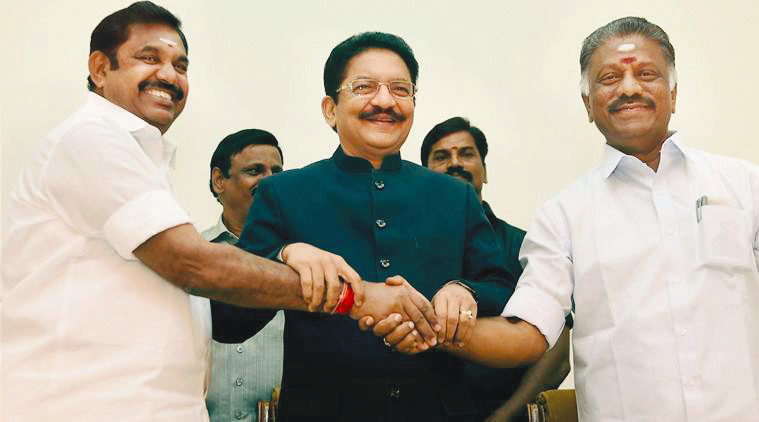
Apparently steered by the Bharatiya Janata Party (BJP), which is looking for a foothold in Tamil Nadu, the two factions of the All India Anna Dravida Munnetra Kazhakam (AIADMK) recently merged after an acrimonious period in the wake of party supremo J Jayalalithaa’s death last December. The BJP views Sasikala as having too much baggage.
But the 60-year-old still has some fight left in her, orchestrating her moves through her nephew, TTV Dinakaran. So 19 MLAs supporting him have met governor C Vidyasagar Rao to give him letters withdrawing their support to the Chief Minister. This potentially reduces the EPS–led government to a minority one.
When Jayalalithaa loyalist O Panneerselvam (OPS) made Sasikala’s exit from the party a condition for the merger, Chief Minister Edappadi Palaniswami (EPS) said the party’s general council will soon be convened to remove her from the post of general secretary.
For Sasikala, the AIADMK has been as much part of her life, as Jayalalithaa herself was and, for over three decades, she was the go-to person for most AIADMK leaders. Observers, commenting on the developments, say that the BJP perhaps did not want Sasikala to become another Jayalalithaa.
“The BJP saw in Jayalalithaa’s death an opportunity and is clearly exerting control over the AIADMK. This would not have been possible [with] Sasikala becoming powerful. The fact that Prime Minister Narendra Modi met Paneerselvam four times in a week before the merger establishes BJP’s role. When was meeting Modi so easy for a leader from Tamil Nadu?” asks senior journalist R Ramasubramaniam. Source: HT
CHENNAI (TIP): Tamil Nadu Chief Minister Edappadi K. Palaniswami on Thursday announced that an inquiry commission headed by a retired High Court judge would be constituted to probe the death of former Chief Minister Jayalalithaa in December last year.
A decision on the judge who will head the commission will be taken in due course, Palaniswami said, flanked by several senior Cabinet Ministers at the Secretariat. Palaniswami also said that ‘Veda Nilayam’, the erstwhile residence of Jayalalithaa in Poes Garden here, would be converted into a public memorial, an announcement that was slammed by Jayalalithaa’s niece Deepa Jayakumar, who questioned the unilateral decision sans consultations with heirs. Till date, it is not clear if Jayalalithaa left behind a will bequeathing her vast estate to anyone.
The sudden announcements are essentially seen as a move to put pressure on the AIADMK (Puratchi Thalaivi Amma) to come forward for negotiating a quick merger with the ruling AIADMK (Amma) and to checkmate “ousted” deputy general secretary T.T.V. Dhinakaran, who is in a combative mood.
The Panneerselvam faction had laid down two conditions for a merger — an inquiry into Jayalalithaa’s death (varying from a CBI probe to a judicial probe) and expelling Sasikala and her family from the AIADMK. During Jayalalithaa’s 75- day hospitalisation, only Sasikala and the doctors and paramedical staff had access to her.
A campaign to convert the Veda Nilayam into a memorial was also launched by Panneerselvam.
Two days after AIADMK (Amma) opened doors to its rival faction, the two camps have again hardened their stand.
? The O Pannerselvam-led faction termed the truce call by the EPS faction a “drama” authored by Sasikala.
CHENNAI (TIP): Two days after AIADMK (Amma) announced it would free the party and the government from the influence of the V K Sasikala family, and opened doors to its rival faction for merger talks , the two camps hardened their stand and flung barbs at each other. The central player in the political drama, party deputy general secretary TTV Dhinakaran, meanwhile, remained out of sight on Thursday.
Dhinakaran loyalists and MLAs Thanga Tamilselvan and P Vetrivel visited chief minister Edappadi K Palaniswami at the secretariat on Thursday after a brief meeting with Dhinakaran at his Adyar residence in Chennai. Vetrivel later said Dhinakaran had directed them to meet the chief minister and extend their cooperation forsmooth functioning of the government. “Dhinakaran will remain our deputy general secretary,” said Vetrivel.
The O Pannerselvam-led faction dug in its heels, terming the truce call by the EPS faction a “drama” authored by Sasikala, her husband M Natarajan, and brother V Dhivakaran, using Dhinakaran as the ‘pagadaikai’ (dice). It also laid down threeconditions, including withdrawal of an affidavit filed by the Palaniswami group on the appointment of Sasikala as general secretary, officially removing her and Dhinakaran+ from their posts and instituting a CBI investigation into former chief minister J Jayalalithaa’s death.
For its part, the EPS camp got several of its leaders to hit back, setting the tone for fiery talks ahead. Jayakumar took on OPS over his remarks that Dhinakaran’s ouster was his “first victory”, saying, “Will he also say that he was the force behind ((US President) Trump’s victory?” Law minister C Ve Shanmugam asked how his party’s affidavit could be withdrawn when it was the OPS camp which moved the EC to challenge the appointment of general secretary and to stake claim for the ‘two leaves’ symbol.
We have the family format now firmly consecrated. The Chautalas, the Badals, the Muftis, the Abdullahs, the Gandhis, the Deve Gowdas, the Karunanidhis, the Lalu Yadavs, and many other aberrations have mocked our democratic pretensions. Yet there was something so blatant, so ignominious in the Sasikala’s chief ministerial push that it disturbed our collective equanimity”, says the author – Harish Khare
Tamil Nadu has a new chief minister. And the new chief minister’s name is not VK Sasikala. Even if the new man, Edappadi K Palaniswami happens to be a Sasikala proxy, the Indian democracy has something to celebrate. A judicial intervention has stopped a power grab in its tracks. Instead of lording over the secretariat at Chennai, Ms Sasikala now has to do with the crowded quarters in cell number 9234 in Bengaluru Central Prison. Why this sense of relief ?
Over the decades the Indian democracy has indeed become inured to many aberrations and absurdities. After all, we have had the spectacle of a Rabri Devi presiding over Bihar, in circumstances somewhat similar to what prevailed after Jayalalithaa’s death. We have the family format now firmly consecrated. The Chautalas, the Badals, the Muftis, the Abdullahs, the Gandhis, the Deve Gowdas, the Karunanidhis, the Lalu Yadavs, and many other aberrations have mocked our democratic pretensions. Yet there was something so blatant, so ignominious in the Sasikala’s chief ministerial push that it disturbed our collective equanimity. Rabri Devi was 1997; 20 years later, we do not feel we need to countenance ‘a chief minister Sasikala’. Have we not evolved as a polity? Has our democracy not deepened these last two decades? Why was the sense of a cheapening of our democracy felt so acutely, not just in Tamil Nadu but across the land?
Maybe we were offended because Ms Sasikala sought to extend the principle of ‘family’ to ‘household’ control. Her only claim to the AIADMK leadership was/is that she was a trusted aide and a confidante of “Amma” and, therefore, was best equipped to carry forward the revolutionary leader’s legacy. Suddenly, we felt our democratic sensibilities violated. Irrespective of whatever help and assistance and comfort she provided to Jayalalithaa in the privacy of the Poes Garden, this companionship did not qualify her for a public role. What the country witnessed was how an established political party, with a sizeable presence in the two Houses of Parliament, had got reduced to a den of intrigue and conspiracy. All of a sudden we understood that why our political parties have become so devoid of legitimacy and respectability.
Admittedly, Tamil Nadu is no stranger to this household syndrome. Not long ago, the Karunanidhi household had produced its own script of warring sons, greedy cousins, rapacious daughters, formal and informal wives, each more wayward than the other, each extracting corrosive rent from the formal structure of government. That type of family control and its collateral benefits were deemed ‘normal’ and acceptable. But the stench could be smelled all the way up in New Delhi. The DMK’s first family can claim the dubious honor of blue-printing this family control and command model. The only redeeming aspect of the Karunanidhi clan was that its major honchos got themselves sanctified and certified in the electoral arena.
Despite this familiarity was the family nexus, there was something deeply disagreeable about Sasikala’s hijacking of the AIADMK leadership. It is bad enough that political parties stand reduced to family heirlooms, but a profound transformation was inflicted in converting a political outfit into a household arrangement. And it was her chief ministerial putsch that got our democratic goat. As has been pointed out by every sensitive observer, Ms Sasikala has had no experience of public or political life. As part of the Jayalalithaa household she may have domain knowledge of the AIADMK’s internal affairs but these limited encounters in intrigue and conspiracy could not make up even remotely for her total unfamiliarity with the rites and obligations of public office. Whatever trust or confidence Jayalalithaa reposed in this domestic impresario could not be deemed as certificates of competence for a chief ministerial innings.
This narrow escape should also make us re-state the meaning and purpose of an electoral ‘mandate.’ In this time and age of democratic discontent no leader or a political party can claim that a certain number of seats in the Vidhan Sabha/Lok Sabha bestows a license for experiments in authoritarianism. Political parties in India are beyond the reach of most institutional arrangements of accountability.
Sasikala could come so close to a total usurpation of the chief ministerial gaddi because as a political party the AIADMK is beyond public scrutiny. Henceforth, this immunity would need to be justified and located in public good.
And, it also follows that just because a ‘leader’ is successful in leading a political party to victory at the hustings does not necessarily mean that he or she be granted god/goddess-like reverence and obeisance. No chief minister or prime minister need be elevated beyond the democratic mortal ordinariness. Nor does a victory in an election give to anyone a mandate to subvert the established procedures of decision-making and lawful conduct of authority.
Tamil Nadu is a good example of governing arrangements being reduced to rogue operations. It is no consolation that the DMK and the AIADMK could take turns in allowing their leaders, cadres and activists to inflict unhappiness on the citizens. Time has come to note that such delinquencies go unchallenged only because the bureaucracy becomes an enabling agent. Had the Sasikala chief ministerial gambit come to pass, she would have not had any difficulty in securing the requisite acquiescence of a handful of IAS and IPS officers and their state-level counterparts. This nexus has to be smashed, not just in Tamil Nadu but all over India and in New Delhi as well.
No one can foresee whether the new chief minister of Tamil Nadu would allow himself to be dictated to by the Sasikala-aligned mafia. But it must be devoutly hoped by one and all that trappings and pomp of the office would make the worm turn, sooner than later. Any attempt to govern decently and reasonably would garner its own public goodwill and support – two basic ingredients in good governance. Civil society has found its voice and it must not allow itself to be shut down by the new goons.
Perhaps it is possible to suggest that we are entering an inflection phase in our national political life. In a changing India we seem ready to demand that political arrangements justify themselves in terms larger and nobler than just a will of the ‘leader’ or the ‘demand of the cadres’ or the ‘internal affairs’ of a party. It is inevitable that sooner or later our democratic energy and vibrancy would demand that the political parties become an institution of popular aspiration rather than a handmaiden of private control and command. This Tamil Nadu spasm has painful lessons way above the Deccan plateau.
(The author is the editor-in-chief of Tribune group of newspapers)
CHENNAI (TIP): The political potboiler in Tamil Nadu ended on February 16 with the swearing-in of jailed AIADMK general secretary VK Sasikala’s proxy, Edappadi K Palaniswami, as the chief minister.
A long-time confidante of former AIADMK supremo and chief minister J Jayalalithaa, Sasikala’s hopes to become the CM were dashed when the Supreme Court sent her to prison for four years in a two-decade-old corruption case, prompting her to name Palaniswami as her successor and brought two nephews into the party who were expelled by Jayalalithaa.
Palaniswami retained almost all the ministers in the O Panneerselvam government, barring the ousted chief minister as well as education minister MF Pandiarajan who have rebelled against Sasikala. Governor C Vidyasagar Rao administered the oath of office to the chief minister and his 30-member council at a function in which Sasikala’s family members took the front row, leaving no room for guesswork as to where the party leaders draw their strength from. The governor invited Palaniswami to form the government after he presented a list of 124 AIADMK lawmakers supporting him. The new chief minister will have to take a floor test in the assembly in a fortnight to prove that he enjoys support of the majority of legislators.
The AIADMK posted on its twitter handle that the trust vote will be held on Saturday.
Senior party leaders said the leadership wanted to get it done without delay – lest some of the legislators changed their mind and crossed over to the Panneerselvam camp that has vowed to fight the “wrongdoing”.
Tamil Nadu chief minister Edappadi K Palaniswami after taking the oath of secrecy administered by governor Vidyasagar Rao during the swearing-in ceremony at Raj Bhavan in Chennai on February 16. Photo courtesy PTI
Until then the MLAs would remain at Golden Bay resort at Kuvathur, 80km from Chennai, where they have been staying since Sasikala corralled them there last Wednesday night to stop them from switching loyalties.
Panneerselvam backers were confident about several legislators joining their side.
“During the floor test, even if seven MLAs switch sides, the government will be in a minority. Wait and see what happens,” former education minister Pandiarajan said.
The Panneerselvam camp requested the election commission to nullify the election of Sasikala as the AIADMK general secretary, alleging that the process violated the party constitution.
“Freeing the party from the control of Sasikala is the larger battle and this is a step in that direction,” said Rajya Sabha member V Maitreyan, who went to poll panel with the request in New Delhi.
The 61-year-old Sasikala – a long-time confidante of former AIADMK supremo and chief minister J Jayalalithaa – had been anointed as the late leader’s successor by the ruling party and was due to be sworn in last week.
But she was pulled into a bruising power struggle by Panneerselvam, who alleged he was forced to resign. Since then, he has been backed by several MPs and MLAs who have switched sides but a majority of the party lawmakers is said to be behind Sasikala.
Her hopes were dashed when the Supreme Court sent her to prison for four years in a two-decade-old corruption case, prompting her to name Palaniswami as her successor and brought two nephews into the party who were expelled by Jayalalithaa.
The conviction disqualifies her from holding a public office and contesting elections for the next 10 years. She is now lodged in Bengaluru central jail as prisoner number 9324, but political analysts said she would wield the remote control with a proxy heading the government.
Panneerselvam, also known as OPS, vowed to free the state from the clutches of Sasikala and her family.
“We will defeat them in the assembly,” he told his supporters outside his home in Chennai. But for now, the initiative appears lost in the rebel camp. Sasikala supporter and senior minister OS Manian was confident that the government would complete its term, a little more than four years to the next assembly elections. “Most of the MLAs with OPS will return to us. You wait and see,” he said, hinting that the cabinet would be expanded after trust vote.
The lawmakers would prefer to complete their term, rather than going for fresh elections without their charismatic leader, Jayalalithaa, and with the burden of an ugly power spat. The fear of facing the ballot will bind the AIADMK legislators, political analysts said.
She battled every odd in her life and won, most of the times; but she lost the battle of life, much though she fought it bravely and for, perhaps, a long period.
Jayaram Jayalalithaa, six- time chief minister of Tamil Nadu, died after protracted illness at Apollo Hospital December 5, Chennai where she was being treated. She was 68.
Draped in Tricolour, Jayalalithaa lies in state. Prime Minister Narendra Modi, along with Governor Vidyasagar Rao, pays tribute to Jayalalithaa at Rajaji Hall in Chennai on Tuesday, 6 December 2016 Photograph: @AIADMKOfficial/Twitter
She was buried with full state honors into the ground in a sandalwood casket next to the memorial of her mentor, MG Ramachandran at Chennai’s Marina Beach. Lakhs of people had gathered at Marina Beach to get a final glimpse of their beloved “Amma” or “mother”. Prime Minister Narendra Modi visited Chennai’s Rajaji Hall, a large public auditorium where J Jayalalithaa’s body was placed for people to pay their respects.
Jayalalithaa first came into prominence as a leading film actor in the mid 1960s. Though she had entered the profession very reluctantly, only upon the urging of her mother to help support the family, Jayalalithaa worked prolifically. She appeared in 140 films from 1961 to 1980, primarily in the Tamil, Telugu and Kannada film industries. Jayalalithaa was especially praised for her versatility, having portrayed a wide variety of characters in films spanning several genres, and for her dancing skills. Among her frequent co-stars was M. G. Ramachandran, or MGR, a Tamil cultural icon who leveraged his immense popularity with the masses into a successful political career.
In 1982, when MGR was serving his second term as chief minister, Jayalalithaa joined the AIADMK, the party MGR founded. Her political rise was rapid; within a few years she was made AIADMK propaganda secretary and was elected to the Rajya Sabha. After MGR’s death in 1987, Jayalalithaa proclaimed herself his political heir and, having fought off the faction headed by Janaki Ramachandran, MGR’s wife, emerged as the sole leader of the AIADMK. Following the 1989 election, she served an often-dramatic stint as Leader of the Opposition to her bête noire Karunanidhi’s DMK government.
In the 2011 assembly election, the Jayalalithaa-led AIADMK and its allies routed the ruling, scandal-tainted DMK’s alliance. Sworn in as chief minister for the fourth time, her government embarked on an ambitious program of social welfare and development. However, three months into her tenure, a trial court convicted her in a disproportionate assets case in September 2014, rendering her disqualified to hold office. After eight months, which included a twenty-day stint in jail, Jayalalithaa was acquitted of all charges by the Karnataka High Court and once again sworn-in as chief minister in May 2015. In the 2016 assembly election, she became the first Tamil Nadu chief minister since MGR in the 1980s to be voted back into office. In her victory speech, she commented, “Even when 10 parties allied themselves against me, I did not have a coalition and I placed my faith in God and built an alliance with the people. It is clear that the people have faith in me and I have total faith in the people.”
Populist schemes under the popular ‘Amma’ brand became the hallmark of Jayalalithaa’s tenure as Chief Minister. From the Amma canteens to Amma gymnasiums and parks, the brand became synonymous with her name.
Such outpouring of grief in every nook and corner of Tamil Nadu
CONDOLENCES
Condolences from various leaders and celebrities poured in as soon as the news of her demise spread.
President Pranab Mukherjee – “Heartfelt condolences on the sad demise of Ms. Jayalalithaa, Chief Minister of Tamil Nadu #President Mukherjee”
Prime Minister Narendra Modi – Jayalalithaa ji’s connect with citizens, concern for welfare of the poor, the women & marginalized will always be a source of inspiration.
DMK chief M. Karunanidhi -“I offer deep condolences on the passing away of Jayalalithaa. Wishes of lakhs of her followers will make her immortal”.
Finance Minister Arun Jaitley – “Saddened by the untimely passing away of J Jayalalithaa ji, an exceptional leader & Chief Minister of Tamil Nadu.”
Former Prime Minister Manmohan Singh – “I join millions of admirers of Jayalalithaji in mourning her sad and untimely demise. She was a charismatic leader who will be remembered forever as the beloved Amma by the people of Tamil Nadu. She was an outstanding leader who was passionately devoted to the welfare of the people of Tamil Nadu.”
Former Union Minister P. Chidambaram – Jayalalithaa was most dominant political personality of Tamilnadu in last 25 years. Share grief of millions
Arvind Kejriwal, Chief Minister of Delhi – V sad to hear the demise of Amma. A very popular leader. Aam admi’s leader. May her soul rest in peace.
Mamata Banerjee, Chief Minister of West Bengal “Popular, strong, bold, efficient, people friendly, charismatic leader, Amma. Always at the heart of people. Big loss. I am shocked, saddened.”
Chandrababu Naidu, Chief Minister of Andhra Pradesh – In deep anguish over the demise of Tamil Nadu CM Jayalalithaa, a long-time friend & a leader with indomitable spirit who is loved by all.
In New York, Tamil community is grief stricken. A representative organization of Tamils here-America Tamil Sangam condoled the death of Jayalalithaa. ATS said it would be difficult to see another leader like her in the decades to come.
“Struggle was her middle name and victory was her last name. Any other leader in her place would have given up and vanished from the scene but she was a born fighter. As a propaganda secretary of her party, as Member of Parliament, as Opposition Leader and as Chief Minister her path was strewn with thorns and rocks but she overcame all with her unmatched grit and determination.” said Prakash M Swamy, president of the Sangam.
John Joseph, Chairman of America Tamil Sangam said she introduced numerous public welfare programs like giving free laptop to school children and grant to perform wedding of girls and remained a charismatic leader till she breathed her last.
Koshy O Thomas, President of US Friends of AIADMK and a staunch supporter of Amma in New York, said Tamils all over the world have lost a true leader who was a mother to them. It’s a terrible and unbearable loss and it struck like a lightening making us speechless. We have become orphans and no words can console us. We will pray for soul to rest in peace.”
Jaya Sundaram, Vice President of America Tamil Sangam said she was an embodiment of modern women who rode like a colossus in the male dominated society. Her concern for poor and vision for development will long be remembered in the decades to come. She created her own branding in politics – amma restaurants, amma cement, amma salt all at subsidized price to help the poor. She was a leader of regional party with national presence.
The Indian Panorama joins billions in condoling the death of the beloved leader of India.
Jayalalithaa was only 16 years old when she starred opposite M.G.R in Ayirathil Oruvan. The entire cast & crew would stand up every time the veteran actor walked in, but the Church Park educated, English speaking Jayalalithaa sat there with her legs crossed, reading her book. It was this audacity that went on to define the rest of her political career. Obviously, she was a charming, multi-faceted actor who was trained in various dance forms. But not so obviously, she was well read and witty, she was intelligent and she knew it. It was not merely her affair with MGR that drew her to politics, it was her prolific ability to speak in English & Hindi with an intellect that could match an economist. When MGR died, she sat conspicuously at his head for an entire two days, relegating his wife Janaki to a sidelined spot. Janaki’s aids tried to push her away, in fact pinched her, stepped on her feet, but she refused to budge. When she got on to the carriage for the final procession, she was visibly pushed off it in front of all television cameras. This effrontery was what would help her survive all those years of politics that would follow. The entire party split into two after MGR’s death, but four years later united under her leadership to form one formidable opposition.
She won against all odds. She was a white skinned Brahmin in a party that thrived due to its Dravidian anti-class rhetoric. She was a glamorous actor who cannot be taken seriously. Above all, she was a woman trying to ascend to power in 1980s in Tamil Nadu. An unmarried, childless woman. To put it in context, she was not only walking a path of thorns, she did it in an oxygen less chamber while her arms and legs were tied. It’s a feat that she survived at all, not to mention that she thrived. In 1989, when she opposed Karunanidhi’s presentation of the budget, she was almost disrobed in the assembly. This was in addition to being the recipient of lewd comments and hair pulling. This is probably the highest documented insult that a woman has ever faced in a state Assembly. Yet she persisted. She came out of that incident more guarded than ever before. She wrapped herself in layers of clothing and stopped wearing any jewelry at all. She succeeded at ‘desexualizing’ herself and branded herself as ‘amma’ (mother), the only known way to gain respect in that highly testosterone filled environment.
Everyone knows her as the person who silences opposition and who creates sycophants who fall at her feet and worship her. This was the only possible way she could command, consolidate and hold on to the otherwise elusive power. If she was any more cordial than this, she might have as well been an airhostess.
She played popular politics. When the DMK promised laptops, she provided table fans, mixers and grinders instead all branded with her cherubic photograph on it. She accumulated disproportionate assets in 1996, and has faced her share of atonement. However, no one else, not even men, could have been a formidable opposition to the DMK that has systematized corruption and nepotism in ways that she couldn’t. Forget her followers who baselessly immolate themselves or cut off their fingers in a spree of blind devotion towards her. I have spoken to several civil servants of the state who claim they function with lesser interference under her leadership than under the other party.
And with four and a half years of her term left, there is no single leader that can fill her void. It will be several years, even decades, before another woman can even remotely achieve what she did in a state like Tamil Nadu. Now her statues will come up all over the state, and for once I’m glad. In a few generations, all that will matter is that there is a woman’s statue as well, and that statue is not a mere kannagi who was venerated because she was a perfect wife, but of a woman who was a true and powerful leader of her own merit and her own making.
CHENNAI (TIP): Apollo Hospitals chairman Dr Prathap C Reddy on Nov 25 said that Tamil Nadu Chief Minister J Jayalalithaa has started speaking well and would walk soon. He said Jayalalithaa is undergoing static and active body physiotherapy. “Now, the next thing is to see that she (Jayalalithaa) stands up and walks, and then she is ready to go home,” Reddy said.
Jayalalithaa was admitted to Apollo Hospitals on September 22 following fever and dehydration. Since then, she has been constantly monitored by experts and specialists from the UK and AIIMS.
Reddy said that most of the time Jayalalithaa is breathing without respiratory support, and now she has started talking with the help of a speaking device.
Explaining that it is not easy for people to talk with a speaker (device) since they have to hold their breath, Reddy said for now Jayalalithaa is only using the speaker for a few minutes. “It is only temporary,” he said.
CHENNAI (TIP): Tamil Nadu Chief Minister Jayalalithaa’s lung infection has been cured and she is breathing without respiratory support and may be discharged from hospital any day, her party AIADMK said.
“Amma’s (Jayalalithaa) health has improved excellently. She is (continuing) undergoing physiotherapy and she may be discharged any day,” AIADMK spokesperson C Ponnaiyyan said.
Her lung infection and respiratory problem was totally cured and she “is breathing on her own” without respiratory support, he told reporters here.
Other health parameters of Jayalalithaa, who has been undergoing treatment at the Apollo Hospital since September 22, including heart (functioning) are “excellent”, he said. “She is having food by herself, she is sitting, she is able to talk freely… she is cheerful,” Ponnaiyyan said. He said she thanked the Almighty for her recovery and the people for their prayers. Jayalalithaa was admitted to the hospital after she complained of fever and dehydration.
Later, the hospital had said she was being treated for infection with respiratory support.
On November 13, the 68-year old leader said she has taken “rebirth” and that she was waiting to resume her duties after complete recovery.
CHENNAI (TIP): Three doctors from the All India Institute of Medical Sciences (AIIMS), New Delhi, have come to Chennai to treat chief minister J Jayalalithaa who is undergoing treatment at the Apollo Hospitals on Greams Road.
There was no press release from the hospital or the government, but officials in the Union health ministry confirmed that doctors including pulmonologist Dr G C Khilnani, cardiologist Dr Nitish Nayak and anesthesiologist Dr Anjan Trikha had left for Chennai.
“Some left on Wednesday evening. We cannot say more at this point,” the official said.
Jayalalithaa was admitted to the hospital+ on September 22 with complaints of “fever and dehydration.”
On Sunday , the hospital said the chief minister had infection, and that a team of doctors, including Dr Richard Beale from the London Bridge Hospital in the UK, were giving her antibiotics to treat her condition.
Dr Beale left the city on Sunday. On Monday, the hospital said she was on respiratory support and was being treated for infection with antibiotics and allied clinical measures.
Tuesday’s bulletin said she continued to show improvement. There was no medical bulletin from the hospital on Wednesday . Among the many public prayers conducted for the health of Tamil Nadu chief minister J Jayalalithaa+ , who is undergoing treatment at Apollo Hospitals, was a religious procession organised at her constituency RK Nagar on Monday . Pictures have emerged of young children with their faces pierced with metal rods+ taking part in the ceremony organised by party workers, a ritual usually followed while worshipping Lord Muruga.
In a statement on Wednesday, PMK leader S Ramadoss described the incident as a “human rights violation”. He alleged that of the hundreds of people who took part in the procession, there were more than 20 children, aged 5 to 12, who had their bodies pierced against their wishes. He added that children should not be forced to do such things. AIADMK MLA P Vetrivel told TOI that he helped organise the event, but “participation was entirely voluntary”.”They were praying for Amma’s [Jayalalithaa’s] health. Ramadoss is insulting our traditions and the people,” he said.
CHENNAI (TIP): Senior DMK leader MK Stalin was taken into preventive custody on Friday after staging a rail roko at the Egmore Railway station in Chennai. Rajya Sabha MP Kanimozhi also courted arrest as the entire state witnessed a shutdown over the ongoing Cauvery water-sharing dispute and the violence against Tamils living in Karnataka.
The bandh, which will last from dawn to dusk, was called by all political parties and their affiliated trade organisations, barring the ruling AIADMK and its allies.
More than 12,000 policemen have been deployed across Chennai to maintain order. Police stated that no attempt to disrupt public peace or prevent the free movement of transportation would be tolerated.
The senior DMK leaders, who launched their protest rallies in Egmore station and on Anna Salai, are currently courting arrest.
MDMK leader Vaiko and his party cadre were arrested earlier in Tiruchy after attempting to stage a rail roko.
The Supreme Court on Thursday slammed both the governments of Karnataka and Tamil Nadu for failing to prevent violence over its order, and stated that its verdict had to be complied with. But the dispute has seen large-scale violence across Karnataka – especially in Bengaluru – where rampaging mobs have torched vehicles and damages property worth crores.
NEW DELHI (TIP): After being subject to months of haggling and histrionics, the Goods & Services Tax (GST) finally had its historic day in the Rajya Sabha with the passage of the Bill to amend the Constitution, paving the way for what is popularly referred to as the concept of “one nation, one tax.”
Barring the AIADMK, which staged a walkout on the plea that it violated federalism, all others, including the Congress, voted for the Bill.
Led by the former Finance Minister P. Chidambaram, the Congress, supported by members of some other parties, made a valiant effort to extract an assurance from Finance Minister Arun Jaitley that as and when he would introduce the subsequent legislation to operationalize the GST, it would be as finance rather than money bills. This was to ensure that they would also be voted in the Rajya Sabha.
However, Jaitley refused to yield, stating that he could not give a commitment on future legislation whose contours would be decided by the Centre and the States together.
The Rajya Sabha passed the constitutional amendment by two-thirds majority, as all parties, except the AIADMK, pledged support. The amendments moved by Jaitley were also put to vote. The Bill will now be returned to the Lok Sabha for its approval.
The constitutional amendment will enable both the Centre and the States to simultaneously levy the GST, which will subsume all indirect taxes currently levied, including excise duties and service tax. It will be levied on consumption rather than production.
Two components
The GST will have two components keeping in mind the federal structure of India: the Central GST (CGST) and the State GST (SGST).
The shift to the GST regime will lead to a uniform, seamless market across the country. It will be a uniform rate, will check evasion, and boost growth rates, Jaitley said initiating the debate.
Earlier in the day, lead speaker for the Congress, Chidambaram, made it clear that the main Opposition party will support the long-pending Bill only if the government gave firm assurances on two things: keeping the GST rate capped at 18 per cent in the subsequent legislation needed for the GST’s roll-out and bringing forth these as financial bills rather than money bills, which the Upper House will not just discuss but also vote on.
Jaitley hopes GST rates will be moderate
The Union Finance Minister also refused to give an assurance on demands put forth by Congress leader P. Chidambaram and others but did give the Rajya Sabha his word that the government will go by the Constitutional provisions and precedents at the time of bringing in the subsequent GST Bills.
Congress voted in favor
The Finance Minister said that his discussions with States led him to believe that the rates would be moderate and less onerous than the combined burden of the Central and State taxes on goods and services, which comes at present rates to about 27%. However, he said that it was not possible for him to give an assurance on legislations that had not yet been drafted. Before the Bill was put to vote, the AIADMK members staged a walkout from the House.
Putting on record that the GST was originally initiated by his predecessor, Chidambaram, Jaitley expressed gratitude to leaders of all political parties for the consensus that he was able to build on the Bill. “A legislation of this kind cannot be made on the basis of a partisan approach…,” he said.
The Indian Panorama received some reactions to the GST Bill which was passed in the Rajya Sabha unanimously on August 3.
K Ganesh
K Ganesh says: “The passage of the Goods and Services Tax (GST) Bill in the Rajya Sabha is a progressive measure as it can facilitate seamless movement of goods across inter-state borders enabling better efficiency and spurring growth of the (eCommerce) sector. However, like every regulation, it needs to be implemented correctly, and should not make lives of eCommerce players even more complicated by burdening them with more administrative hassles,” said K Ganesh, Serial Entrepreneur, Partner – GrowthStory and Promoter of sector leaders such as BigBasket, Bluestone, FreshMenu, Housejoy, Homelane, Portea etc. “For the consumer, the price points of many products should come down or remain at the current levels (depending on the GST rates) as there will be free flow of credits since the total indirect tax cost embedded in the price (of products) is likely to decrease”.
Hari Menon
Hari Menon, CEO, BigBasket commented: “The passage of the Goods and Services Tax (GST) Bill in the Rajya Sabha is a progressive reform, and we welcome it. If implemented correctly, it will bring relief from one of the key issues faced in the e-commerce segment – cascading taxes. We are hopeful that in the long-run the creation of a unified marketplace will reduce the tax burden, inventory cost and logistical issues; and ensure seamless movement of goods across the country. This will help bring efficiency, transparency and boost profitability and growth of the sector.”
Dhiraj Agarwal
Dhiraj Agarwal, Co-Founder, Campus Sutra observed: “From the point of e-commerce there are two points in which we are awaiting clarity. First being mechanics of GST across each state as online orders are not location dependent. Secondly, as a fashion e- commerce player we are eagerly waiting to see whether apparel continues to be in the necessity category and hence attracts a lower GST than the standard rate.”
NEW DELHI (TIP): Efforts to hammer out a consensus on the long pending Goods and Services Tax bill gathered momentum on July 28 for its likely tabling in the Rajya Sabha next week with the government reaching out to opposition parties even as the Congress described the exercise as “constructive and positive”.
Finance Minister Arun Jaitley and Chief Economic Adviser Arvind Subramanyam on July 28 held several rounds of talks with leaders of Congress and other parties including the Samajwadi Party, JD(U) and CPI(M).
Former Finance Minister P Chidambaram, Anand Sharma and Leader of the Opposition in Rajya Sabha participated in the discussions with Jaitley. There were two rounds with the Congress leaders.
“Serious effort is being made to bring a consensus on the GST bill,” Sharma said without disclosing details on whether the Congress was insisting on its standing about putting a cap on the levy in the Constitution bill.
Congress sources said party Vice President Rahul Gandhi also expects a positive outcome from these consultations. They said the discussions have entered a “decisive and positive phase”.
“Talks are on with various parties on GST and so far things are moving forward as expected,” a senior government functionary said adding the effort is on to present it in the Rajya Sabha next week.
Sources say Jaitley told the opposition leaders that government wants to bring consensus on the GST and was ready for talks with any leader even during the weekend to hear out and address their concerns on the issue.
A top congress leader, however, said they were awaiting the draft of the legislation after “extensive talks” with the government and hoped for a “positive outcome”.
At the meeting of Business Advisory Committee (BAC) of Upper House today evening, the GST bill was not discussed as it has already earmarked five hours for the bill last week.
Jaitley also met SP leader Ram Gopal Yadav and CPI(M) general secretary Sitaram Yechury and held talks with other leaders also.
Sources add that the government is also in touch with AIADMK chief J Jayalalithaa on the key bill. Prime Minister Narendra Modi talked to Yadav when the Rajya Sabha was adjourned briefly during the Question Hour. Modi remained seated in the House during the brief adjournment and spoke to Yadav and another SP member Neeraj Shekhar.
Meanwhile, five parties, including the Left, on Thursday asked the Centre to assure states that their financial needs will be taken care of before the GST Bill is brought, which they allege seeks to take away states’ right to raise resources.
This was conveyed by them to Jaitley when leaders of the parties in Rajya Sabha belonging CPI(M), CPI, Trinamool Congress, Samajwadi Party and BJD met him.
CPI(M) leader Sitaram Yechury said the Constitution amendment bill would make the states “to come with a begging bowl to the Centre, placing them at the Centre’s mercy.”
He said the GST Bill would deprive the states of their “right to raise resources” through sales tax, surcharge or cess.
“The state governments will be deprived of their only right to raise revenue as this right will be abolished with the Bill” as they would not be able to impose any cess even during an emergency or natural disaster, he said, adding that this was conveyed to the Finance Minister at the meeting.
“The GST Bill is only meant for imposing a tax. It does not deal with Centre-State relations. So, a resolution has to be found outside the Bill and the government has to come out with an assurance,” the CPI(M) leader said, adding that “we will have to see how the government addresses this issue.”
Regarding the meeting, Yechury said “we were merely informed about the discussion the government had with the Congress. There was no scope for a discussion.”
He also said there is “nothing in writing so far” on what the latest bill actually says.
Accusing the Narendra Modi government of going by the strength of the parties in Parliament to hold discussions on the GST Bill, he said “so we are immaterial in terms of number of seats we have. It is a game between the BJP and the Congress”.
Asked whether Jaitley indicated by when the bill will be brought to Rajya Sabha, the CPI(M) leader said “there is no indication. It will all depend on what is happening between the BJP and the Congress.”
The government is working to address the concerns raised by opposition parties, including Congress, on the Constitution (122nd Amendment) Bill, known as the Goods and Services Tax (GST) Bill. The Bill seeks to introduce a system for uniform taxation across the country and has been pending for a long time.
NEW DELHI (TIP): The recent Rajya Sabha elections have given the BJP and allies a numerical edge over the Congress-led UPA in the Upper House, where the government hopes to finally push through the Goods and Services Tax or GST bill in the Monsoon session of Parliament.
After a meeting with state finance ministers this week, Union Finance Minister Arun Jaitley expressed relief at a broad consensus over GST, which affects a unified tax regime in the country.
The Congress, which has so far stalled the GST bill in the Rajya Sabha, is still adamant that it will not support it without amendments it wants and the question being asked is – can the government pass the bill in the Monsoon session even if the Congress opposes it?
“The government will try to get everyone on board but if the situation comes we are ready,” Mr Jaitley told NDTV recently.
The BJP and its allies, along with seven nominated members are now a bloc of 81 lawmakers. The UPA has 68. Others, the non-NDA and non-UPA parties are 91 lawmakers.
On GST, parties that have traditionally allied with the Congress are not necessarily on the same page. The Nationalist Congress Party, Trinamool Congress, Samajwadi Party, Janata Dal (United), Bahujan Samaj Party and the Biju Janata Dal have already announced their support for the bill.
These parties together have 60 MPs, which means that GST has the avowed support of 141 lawmakers in the 245-member Rajya Sabha.
The anti-GST club has 80 – the Congress’ 60 and 20 others including the Left and Lalu Yadav’s RJD, which opposes the bill even though whose partner JDU led by Bihar Chief Minister Nitish Kumar supports it as GST benefits Bihar.
A constitutional amendment needs two-thirds of the House to support it, which means the government needs 164 votes. Enter J Jayalalithaa’s AIADMK, with 13 lawmakers. It opposes the bill because GST will bring losses for states like Tamil Nadu which are manufacturing states. But the government still hopes to bring the AIADMK on board. If it does, it will be just 10 short of a two-thirds majority. If the AIADMK abstains, the strength of the house will be down to 232 and the two-thirds magic mark will be at 155. The government will then be short of 14 votes.
Among the undecided are parties like the YSR Congress, Telangana Rashtriya Samiti, Janata Dal Secular and Independents, together six lawmakers.
The worry for the government is that even if it collects adequate support for the bill, the Congress could stall it simply by disrupting House.
Keenly watched is the stand nominated MPs like Sachin Tendulkar and actor Rekha will take.
Will they stay loyal to the Congress which nominated them or end up helping the government with crucial votes?
KOLKATA (TIP): The Trinamool Congress chief Mamata Banerjee was sworn in as the Chief Minister of West Bengal on Friday, May 27, thus beginning her second stint in the once-Left dominated State.
She had already submitted her recommendations on council of Ministers to Governor Keshari Nath Tripathi. Forty-one ministers, including 17 new faces, were sworn in along with her in batches at a function at Red Road in Central Kolkata.
Her council of ministers include five Minister of States (Independent Charge) and 8 Ministers of State (MOS). “There will be representation from all districts, except Malda. In Malda we don’t have any representation,” Ms. Banerjee had said. Darjeeling and Malda are the two districts where the Trinamool failed to open its account.
Union Finance Minister Arun Jaitley and Minister of State for Urban Development Babul Supriyo attended Friday’s swearing- in ceremony.
On Thursday, her Tamil Nadu counterpart Jayalalithaa extended her good wishes to Ms. Banerjee.
Over 30,000 guests attended the event. Most of roads reaching central areas of the city were diverted resulting in traffic chaos as the cabinet is took oath in the main arterial road connecting south to central Kolkata.
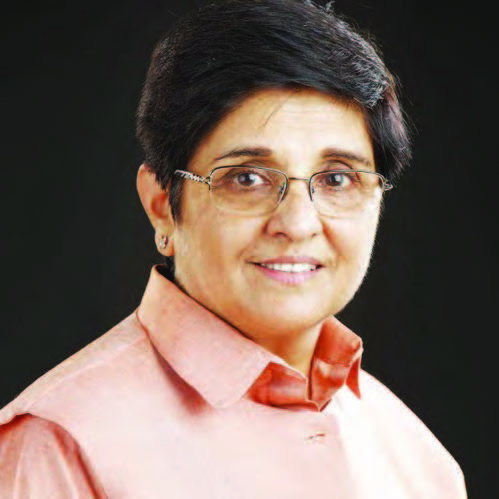
BJP leader and former IPS officer Kiran Bedi was today appointed as Lt Governor of Puducherry, a post which was under the additional charge of Lt Governor of Andaman and Nicobar Island for nearly two years.
A Rashtrapati Bhawan communique said “the President has been pleased to appoint Ms Kiran Bedi, to be the Lt. Governor of Puducherry with effect from the date she assumes charges of her office.”
“I look forward to giving every bit of myself to the responsibility. I am there for the benefit of the country. I am here to give my best every day, each day. I am grateful for the government’s decision. They trusted me,” said 66-year-old Bedi, who is the country’s first woman IPS officer and who had led the BJP campaign for the 2015 Delhi Assembly polls without any success,
The appointment came three days after the Congress-DMK alliance won 17 seats in the 30-member state Assembly. AIADMK, which contested the elections on its own, won four seats while BJP could not get even a single seat.
The LG post in the Union territory had been lying vacant after the Narendra Modi Government had sacked UPA nominee Virendra Kataria on July 12 barely a year after he had been appointed. Lt Governor of Andaman and Nicobar Island Lt Gen Ajay Singh had been given additional charge of Puducherry.
Born on June 9, 1949, Bedi had led the BJP campaign in the 2015 Delhi Assembly elections but had to face the worst defeat in her maiden political innings with Arvind Kejriwal-led AAP winning 67 of the 70 seats.
An IPS officer of 1972 batch, Bedi had sought voluntary retirement from the service in 2007. She was then posted as Director General, Bureau of Police Research and Development.
A sports lover and an author, Bedi is a recipient of Ramon Magsaysay Award as well as UN Medal for outstanding service. She was one of the pioneers of anti-corruption crusade in 2011 along with Anna Hazare and Kejriwal against the then UPA government.
She also earned a law degree at Delhi University in 1988 and a PhD from IIT Delhi’s Department of Social Sciences in 1993.
NEW DELHI (TIP): The BJP’s big win in Assam will not immediately benefit the party in increasing its tally in the Rajya Sabha as there will not be any vacancy in the Upper House from the state until June, 2019. But, the AIADMK with its impressive show in Tamil Nadu would be able to increase its number by gaining one additional seat in the council of states after its biennial election next month.
Similarly, the assembly election results of West Bengal, Kerala and Puducherry will not impact the position of any political party in the Rajya Sabha in near future as there will not be any vacancy in the Upper House from these three states this year.
West Bengal will report six vacancies in August next year while Kerala will report three vacancies in July, 2018. Puducherry’s lone Rajya Sabha seat will be vacant in October, 2021.
However, the NDA will for the first time cross the overall tally of the UPA with the BJP and its ally TDP together possibly getting seven additional seats in the June 11 biennial election.
Thursday’s assembly election results reveal an unmistakable trend: the BJP has expanded its footprint to Assam, while the Congress is on the retreat.
After the Delhi and Bihar setbacks the Modi-Amit Shah duo has regained legitimacy for their autocratic leadership. A further debilitated Congress will add to the worries of Sonia Gandhi and Rahul Gandhi. For the leadership the challenge in UP and Punjab next year becomes more crucial.
Despite odds, Mamata Banerjee and Jayalalithaa have regained power, beating anti-incumbency. For the CPM the loss is humiliating. The Left had compromised on its ideology and slept with an enemy. After MGR, Jayalalithaa becomes the second Tamil Nadu leader to occupy the CM’s chair twice consecutively.
For Tarun Gogoi, however, anti-incumbency was too strong. A fourth term as Chief Minister was an uphill task. Kerala has kept the tradition of voting out a ruling party. The state is set to witness a leadership tussle between the old war-horse, VS Achuthanandan, who has scripted the LDF victory, and Pinarayi Vijayan, the preferred choice of the party rank and file. Puducherry is a small consolation prize for the DMK-Congress combine. Voter behavior defies logic. People ignore issues analysts tend to flag. Price rise was nowhere on the agenda. Nor unemployment. Corruption also seems to be an elite concern. Mamata Banerjee faced two scams: first Saradha in which poor villagers lost their savings in a Ponzi scheme, and then Narda, in which ministers and leaders of the Trinamool Congress were caught on camera accepting bribes. In Tamil Nadu the People’s Welfare Front (PWF) alliance tried to emerge as an alternative to the two “poisonous plants” – DMK and AIADMK – accusing them of making Tamil Nadu one of the most corrupt states. Yet voters did not buy the argument. Corruption figured in the mainstream media in Kerala. Yet despite his taint-free image, Chief Minister Oommen Chandy lost his job.
Personalities matter prominently in polls. The BJP grabbed Assam by presenting Union Sports Minister and former Asom Gana Parishad (AGP) leader Sarbananda Sonowal as the chief ministerial face apart from tying with the AGP and the Bodo People’s Front. Cashing in on an anti-incumbency wave against Tarun Gogoi, the party also fanned the divisive anti-foreigner sentiment to its advantage. Maybe a younger CM face could have helped the Congress retain power. In West Bengal the election revolved around one personality: that of Mamata. It was to be her win, or her defeat. The Congress and the Left had no matching leader of stature and mass appeal. Buddhadeb Bhattacharya is a tired old horse unfit for a fierce race. Dubbed a party of oldies, the CPM and its ideology don’t seem to enthuse young Bengalis. In Tamil Nadu Karunanidhi’s age mattered as also his son, Stalin’s unreliability. In Kerala a 93-year-old veteran has got the comrades back in power. Badal can draw solace from him as Sukhbir can learn from Stalin’s mistakes.
Local factors play a significant role. In Tamil Nadu the November floods’ mishandling did not spoil Jayalalithaa’s victory chances. Surprisingly, prohibition became a key issue -not unemployment, not a stagnant economy, not even an empty treasury and ballooning debt. Few discussed how liberal freebies they promise would be funded if prohibition is introduced. To woo women all parties promised to shut liquor shops, even though distilleries are run by AIADMK and DMK activists. In Kerala the UDF’s decision to stop liquor sales attracted women voters, but not enough to make it a win at the hustings. Chief Minister Chandy had focused on urban development, infrastructure and kick-started Kochi Metro. Yet all this did not get him a second term. On the other hand, under Didi development has suffered in West Bengal. The state has faced a slow industrial and agricultural growth and poor employment generation. There was a rise of “syndicates”, equivalent of the contract system run by CPM goons. But her pro-poor image, personal integrity and welfare programs like ‘Khadya Saathi’, ‘Konyashree’ and ‘Sabuj Saathi’ won her peasantry support and rural votes apart from the urban middle class.
If a party wins, its dirty past gets white-washed. Jayalalithaa’s arrogance and inaccessibility, and Trinamool Congress leaders’ corruption are forgotten and forgiven. A winner is asked no questions. A loser, however, gets advice from all – do introspection, rectify mistakes. The Congress has become a party of part-timers from select, comfortably placed families who refuse to go out in the village and listen to people. It lost going solo (Assam) and also lost with alliances (West Bengal, Tamil Nadu, Kerala). The BJP has clever, focused, whole-time drivers with not many diversions. They know, and play, every trick of the trade.
NEW DELHI (TIP): The lotus bloomed in Assam for the first time as the BJP stormed to power, trouncing a 15-year-old Congress government on May 19 (Thursday) and two women chief ministers – Mamata Banerjee of West Bengal and J Jayalalithaa of Tamil Nadu – overcame anti-incumbency to register impressive victories.
The Congress’ electoral downslide continued as its scandal-tainted coalition government lost to the Left in Kerala. The party which has lost six state elections since the 2014 Lok Sabha polls, however, picked up a consolation prize of sorts in Puducherry by defeating the regional All India NR Congress (AINRC). Broadly speaking, across five states, the Congress is looking to be a big loser, the BJP looks set to be a big gainer and the Left appears it will be left about even.
Mamata Banerjee’s TMC sweeped West Bengal despite being closely associated with two big corruption scandals, the Narada and the Sarada scams. The TMC has won 177 seats of the 294 Assembly seats in West Bengal. Including those wins, the TMC is leading in 212 seats. The Left’s alliance with the Congress was seen for what it exactly was – opportunism. The alliance has won a mere 60 seats and is ahead in 13, which puts it ahead in a paltry 73 seats.
The Left-Congress combine’s projected chief minister Surjya Kant Mishra has actually lost his Narayangarh seat for the first time since 1991. Mishra was seen as one of the architects of the Congress-CPM alliance. The Left’s loss was the BJP’s gain. It has actually won 3 seats here and is ahead in 2 – in 2011 it didn’t win a single seat. Its vote share has actually gone up to 10% from 4% in the 2011 Assembly polls.
Tamil Nadu: A vote against nepotism
As for J Jayalalithaa’s AIADMK, it didn’t just buck incumbency, it made history by being the first party since 1984 to win two consecutive terms in Tamil Nadu. The AIADMK has won 92 seats and is ahead in 40 seats, giving it an unassailable lead of 132 seats. The DMK won 67 seats and was leading in 32 seats, putting it ahead in 99 seats.
Jayalalithaa decided to go it alone while the DMK tied up with the Congress. In the end, though, the people of Tamil Nadu showed decisively how fed up they are of opportunism and more so, that that they’ve had just about enough of DMK supremo K Karunanidhi and his nepotism toward his large extended family.
Assam: A vote against arrogance
Assam threw out the three-term Congress government giving way to the BJP, that’s set to emerge a clear winner. This result can hardly be called anti-incumbency considering the BJP -registering its first footprint in the Northeast – has won in 67 seats and is ahead in 18 seats, thus putting it ahead in a whopping 84 of 126 seats. Consider this – in the last Assam Assembly elections, the BJP and its allies won just 27 seats.
The BJP’s decision to field Sarabananda Sonowal as the chief ministerial candidate marked a big strategic shift for the party. The BJP has come to believe it lost last November’s Assembly elections in Bihar because it ignored strong local leaders. Its gambit worked. The three-time Congress CM Tarun Gogoi paid a price for his arrogance and his nepotism lost him a major ally, Himanta Biswa Sarna. When Gogoi introduced his son Gaurav to politics he alienated a big section of the Congress unit in Assam.
Kerala: A Left Surge
Kerala was, in fact, the only state where corruption and anti-incumbency played a role. The opposition CPM-led Left Democratic Front (LDF) won a cool 85 of 140 seats leaving the corruption-tainted incumbent, the Congress-led United Democratic Front (UDF) eating humble pie with a mere 46 seats.
The BJP, here, got its first seat ever, O Rajagopal, the first BJP MLA in Kerala. The UDF was plagued by the bar bribery scam, the solar scam and an alleged sex scandal. It gave several tarnished candidates tickets in the election and is beset with factionalism. As well, despite what people within the CPM might think, VS Achuthanandan remains a huge draw.
Puducherry: Consolation Prize for Cong, DMK
And last but not least, in tiny Puducherry, the final results showed the Congress-DMK alliance winning the day, beating the incumbent All India NR Congress (AINRC). You could say this was a consolation prize for the Congress and the DMK – the latter having lost in Tamil Nadu and the Congress having been convincingly thrown out of Assam.
Lucky pollsters?
This time around, the pollsters didn’t have to hang their heads in shame like they had to after the Bihar assembly elections last November. The results of the five states’ Assembly polls were largely in line with Monday’s exit polls.
NEW DELHI (TIP): The BJP, Congress, Trinamool Congress and Left parties are now all set for a mega electoral battle.
Chief Election Commissioner Naseem Zaidi said on Friday that the 126-member Assam Assembly will go to polls in two phases on April 4 and 11. Polling for 294 seats in West Bengal will be held in six phases between April 4 and May 5. Kerala, Tamil Nadu and Puducherry will vote on May 16 to elect 140, 234 and 30 members respectively.
The results of all the state elections will be out on May 19.
The BJP, which now leads the rulingcoalition at the Centre, has tied up with the Asom Gana Parishad and the Bodo People’s Forum in Assam. It is keen to pose a tough challenge to the Congress which has been in power in since 2001.
The All India United Democratic Front led by Badruddin Ajmal is likely to be another key player in the poll.
The Congress and the Left parties are exploring possibilities of a tie-up in West Bengal to pose a tough challenge to ruling Trinamool Congress led by Chief Minister Mamata Banerjee.
The CPM and other Left parties, however, will take on ruling Congress led by Chief Minister Oommen Chandy in Kerala.
While the ruling AIADMK led by Chief Minister J Jayalalitha is going it all alone to seek re-election in Tamil Nadu, the Congress already declared alliance with main Opposition party DMK.
The DMDK is yet to announce if it would join the Congress-DMK alliance. The PMK, too, has not made public its electoral strategy.
The Model Code of Conduct came into force in the four states and Puducherry soon after the EC announced the poll-schedule on Friday. Zaidi, flanked by Election Commissioners O P Rawat and A K Joti, said that the EC, after visiting the poll-bound states, had directed a time-bound and systematic drive for “improvement in the quality and health of their respective electoral rolls, so as to enhance their fidelity for the conduct of free and fair elections”.
He said that the Special Electoral Roll Purification Drive from February 15 to 29 focussed on enrolment of all eligible voters, removal of multiple entries and names of dead voters, correction of various types of errors in Electoral Photo Identity Cards and roll data.
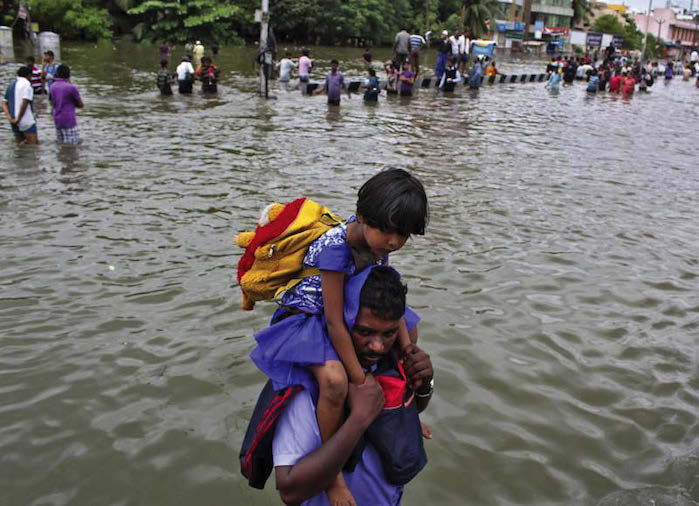
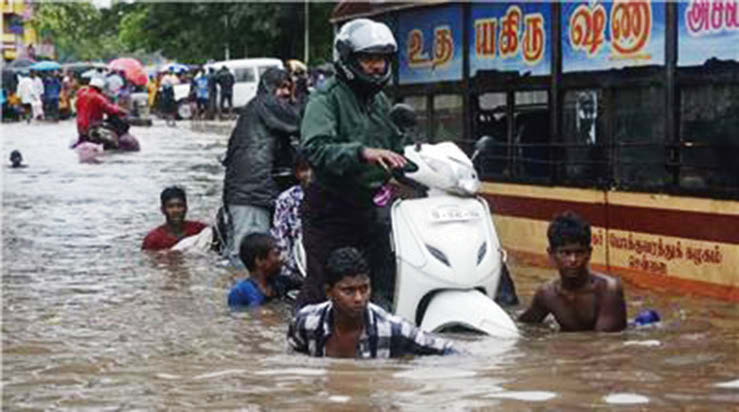
CHENNAI (TIP): After days of chaos, there was finally some relief for the flood-battered people of Chennai, as a break in rain overnight helped reduce water levels of the Adyar and Kumbh rivers, thus easing large-scale flooding.
While intermittent rain has been forecast for Chennai over the next 24 hours, coastal and interior Tamil Nadu will receive more rain in that period.
NDRF chief O P Singh said the situation had improved in the city overnight as water levels in many areas receded. There was a sharp fall in the discharge of waters from Chembarapakkam, Pondi and Puzhal lakes as well, leading to reduction in the water levels of the two rivers that criss-cross the city.
Rescue and relief operations are continuing in full swing and the National Disaster Response Force will intensify its operations in the affected areas on Friday.
“5 NDRF teams from Punjab have reached Chennai at 3am on Friday morning,” the NDRF head said, adding, “We’ve rescued more than 9,000 people so far.”
He added that power has been restored in several areas that were not waterlogged and the communications network has also improved.
Officials said that from a discharge of 30,000 cusecs of water from Chembarampakkam, one of the key sources of drinking water supply to Chennai city, it has come down to 13,000 cusecs in the afternoon and 5,000 cusecs at night after there was no fresh rain on Thursday.
Similarly, there has been considerable decline in discharge of water from Puzhal, Pondi and Madurantakam lakes among others.
Still, Chennai city remained virtually cut off from the rest of the country with all air, rail and road transport services continuing to be suspended. Public transport was crippled because of flooding of the arterial main roads, including Mount Road over the Marmalong bridge.
The Grand Southern Trunk Road that links Chennai with Madurai and beyond was cut off after breaches in several places in Kanchipuram district.
The Southern Railway announced cancellation of all inter- and intra-state train services till Saturday while the airport operations will remain suspended till Sunday.
Prices of milk, vegetables and food items skyrocketed because of short supply and people were forced to fork out huge amount of money for buying essentials.
With the flood wreaking havoc, Prime Minister Narendra Modi on Thursday undertook an aerial survey of the flood-hit areas of Chennai and its suburbs and the neighbouring districts of Kancheepuram and Tiruvallur.
Later he held consultations with Jayalalithaa at the naval base “INS Adyar” and announced Rs 1,000 crores in aid for relief work. This amount is over and above the Rs 940 crores given by the Centre to Tamil Nadu during the earlier spell of heavy rain in November.
Jayalalithaa also made a separate aerial survey of the affected areas on Thursday.
In a brief statement that began in Tamil, PM Modi said he has seen the extent of damage suffered by the state and shared the misery of people of Tamil Nadu. “I will stand in support of you,” he said in his remarks after the review meeting with the chief minister.
Teams of NDRF, Army personnel and police and fire service men swung into action to rescue people from their flooded homes in Kotturpuram, Nandanam, Jafferkhanpet, Saidapet and the suburban areas of Velacheri, Madipakkam, Tambaram and Mudichur localities, where water had reached up to the first floor.
A total of 28 NDRF teams with over 1,200 personnel were deployed in Chennai where they rescued around 5,000 marooned people by deploying over 110 boats. Two NDRF teams were deployed in Puducherry.
Air Force personnel dropped food packets providing succour to the distressed people living on roof tops after floods displaced them from their homes. A total of 14 lakh food packets were distributed, Tamil Nadu government said.
255 Navy personnel were pressed into service with 12 boats and 15 helicopters for reaching relief.
Heavy rain continued to lash coastal Cuddalore district, one of the worst affected areas ever since northeast monsoon fury started early last month, and Villupuram and Kanyakumari districts and Puducherry as the death toll in the state mounted to 269.
Chennai will remain overcast with possibility of intermittent rains. Fishermen have been warned not to go to sea, Area Cyclone Warning Centre Director SR Ramanan told reporters.
CHENNAI (TIP) While the world is talking about climate change. Delhi is smog laden; Chennai is flooded. Lakshadweep, Andamans, Kolkata, Mumbai may face annihilation, if earth’s temperature keeps rising at the pace it has been since industrial revolution.
The severe flooding in Chennai again questions India’s preparedness for extreme weather events like rains, droughts and cyclonic storms which are becoming more frequent and intense.
Flooding in Chennai, the country’s fourth-largest city, has killed more than 40 people in the past 48 hours, authorities said Thursday, December 3, bringing the death toll to 260 since last month.
A large-scale rescue operation is under way, amid neck-high water in some areas as Chennai continues to bear the brunt of the deluge. Daily downpours threaten to worsen the already severe flooding situation around Chennai, into early next week after the city endured its wettest December day in more than 100 years of record-keeping.
Rainfall from both a weak tropical low and moisture from the Bay of Bengal will continue put southern India at risk for new and worsening flooding problems into early next week.
New flooding problems may develop in eastern Tamil Nadu and far southern Kerala with additional rainfall of 100-200 mm (4-8 inches) expected through Sunday.
Hundreds of soldiers and sailors from India’s armed forces have been deployed to assist in relief efforts after weeks of heavy rains since the start of November.
Home Minister Rajnath Singh told lawmakers that the government had released 9.4 billion rupees ($141 million) for flood relief and restoration. On his arrival in Chennai Thursday, December 3, evening, PM Modi announced an additional 10 billion rupees for relief operations. “The Government of India stands shoulder to shoulder with the people of Tamil Nadu in this hour of need,” he said.
In November, PM Modi had said the torrential rains in Chennai were a result of climate change. “We are feeling climate change’s fast-growing impact now,” he said.
Others blamed rampant construction, including building in areas close to the city’s rivers, for the flooding. “Development in the city has not taken into account that many parts are low-lying,” said Anil Kumar Gupta, head of policy planning at India’s National Institute of Disaster Management.
Television footage showed residents in the city wading through muddy waters and complaining about the sluggish pace of relief operations.
Tamil Nadu’s chief minister, J. Jayalalithaa, was quoted as saying in November that “losses are unavoidable when there’s very heavy rain.”
“Swift rescue and relief alone are indicators of a good government,” NDTV quoted Ms. Jayalalithaa as saying during the first spell of downpours during the monsoon.
Chennai’s international airport, closed on Wednesday, November 2, because the runway was under seven feet of water, will remain shut until at least midday on Sunday, according to the state-run Airports Authority of India.
The rains have left more than 30 aircraft stranded at the airport, the Airports Authority of India said in a statement. Almost 300 passengers had been sent by bus to the neighboring city of Bangalore to catch flights from there, but over 2000 more remained stranded at the airport, the AAI said.
Anurag Gupta, a senior official in the National Disaster Management Authority, said efforts are underway to ferry stranded passengers in helicopters to a naval air station in Arakonnam, about 60 miles away. They are to be flown from there to other cities.
The inundated airport, lack of mobility owing to poor roads and a breakdown of telecommunication links has severely hampered rescue operations, Mr. Gupta said.
The National Disaster Response Force has deployed more than 1,000 personnel and 130 boats to Chennai.
So far, they have evacuated more than 2,000 people. Meanwhile, on Twitter, social-media users were organizing help through hashtags #ChennaiRainsHelp and #ChennaiRains, with users offering food, medicines and tweeting details of shelters where those affected could take refuge.
CHENNAI: On a day of quick developments, Tamil Nadu Governor K Rosiah Friday invited AIADMK chief J Jayalalithaa to form a government, marking yet another milestone in Dravidian politics. At around 8.15am, chief minister O Panneerselvam handed over his resignation to the Governor, making way for his party chief to take over the administrative reins.
A Raj Bhavan press release issued at 8.30am by principal secretary to the Governor said he accepted the resignation of Panneerselvam and his council of ministers with effect from forenoon of May 22. “The Governor has requested the CM and his present council to function until alternative arrangements are made,” the release said.
Another press release said the Governor had invited Jayalalithaa to form the ministry at the earliest and requested her to send the list of persons to be appointed as ministers with their portfolios. The AIADMK chief is scheduled to meet Rosiah at around 2pm today to stake claim to form the government. She is likely to be sworn in as chief minister at a gala ceremony in the city on Saturday morning.
Popularly referred to as ‘caretaker CM’, this was Panneerselvam’s second stint as Tamil Nadu chief minister, both for brief periods. Around 8.15am, Panneerselvam, accompanied by the AIADMK’s core committee members, went to Raj Bhavan and handed over his resignation as per schedule, ending his nearly eight-month stint.
CHENNAI (TIP): AIADMK general secretary J Jayalalithaa’s widely expected swearing-in as chief minister has reportedly been delayed over a possible appeal by Karnataka against her acquittal in a corruption case on May 11 and a few other reasons.
Senior AIADMK leaders said there were no hurdles within the party for her return as CM. “The governor has greeted Amma on her victory which means he will not hesitate to swear her in. But Amma is not in a hurry as we already have a government led by O Panneerselvam in place,” said a senior leader.
Even four days after the Karnataka high court’s favourable verdict, there is no official announcement about the convening of the meeting to elect Jayalalithaa as the legislature party leader and the subsequent swearing-in of a new cabinet under her leadership.
“We have not yet received any communication from our leadership on the MLAs’ meeting. We are waiting in Chennai with anticipation,” an AIADMK MLA from western Tamil Nadu said. Sources in the governor’s office also said there was no official communication from the ruling party regarding the swearing-in ceremony of Jayalalithaa.
A senior minister who visited Jayalalithaa’s Poes Garden residence on Wednesday said she only spoke to a selected group of ministers over intercom very briefly. Significantly, a Jaya TV unit which was deployed there returned without taking any visuals. Though the state secretariat has been hurriedly preparing for Jayalalithaa’s return, senior officials are clueless about the possible day.
Meanwhile, opposition parties have started raising questions on her non-appearance in public. “It is a mystery that even so many days after the Karnataka high court delivered its verdict in the wealth case, Jayalalithaa has not showed up in public. Who is going to explain the mystery behind her non-appearance?” TNCC president EVKS Elangovan asked in a statement. “AIADMK celebrations lasted only for a few hours and now the cadres are stranded without any clue,” he said.
NEW DELHI (TIP): The government agreed to convene an all-party meeting to discuss its proposal to give NRIs the right to exercise their franchise by e-postal ballots or through proxy voting.
Law Minister DV Sadananda Gowda accepted the demand of opposition parties in the Rajya Sabha that their views should be taken into consideration while enacting legislation to grant voting rights to NRIs and domestic migrant labor.
Replying to a calling attention motion moved by Leader of Opposition Ghulam Nabi Azad, the Law Minister made it clear that the government was acting on the Election Commission report regarding voting rights of over one crore NRIs and not as directed by the Supreme Court.
During the debate, Opposition members charged the government with taking up the matter against the backdrop of the Supreme Court’s directions, with Leader of Opposition Ghulam Nabi Azad saying they were not opposed to voting rights for NRIs but the way the Government has moved the proposal without discussing it with the political parties.
The Minister said the report had recommended the options of the e-postal ballot system and proxy voting and the government had submitted before the Supreme Court accepting the recommendations.
To ensure that secrecy and methodology is maintained, Gowda said “e-postal and postal ballot voting methodologies are being worked out for the voting rights of the NRIs”.
However, he agreed for an all-party meeting as demanded by several opposition parties including AIADMK, DMK, BJD, CPI, SP and JD-U.
Signup to our Newsletter!
Don’t miss out on all the happenings around the world