Tag: Judiciary

  • Consensus on rape law still eludes government

    Consensus on rape law still eludes government

    NEW DELHI (TIP): Differences of opinion over the draft Criminal Law (Amendment) Bill – seeking to reintroduce the word ‘rape’ instead of ‘sexual assault’ in the anti-rape law and lower the age of consensual sex from 18 to 16 – forced the government to defer bringing it before the Union Cabinet on March 7.

    It is learnt that the law ministry has expressed reservations over the home ministry’s draft replacing ‘sexual assault’ with ‘rape’ while the ministry of women and child development may not be in sync with bringing down the age of consent from 18 to 16 years. “The bill has to stand the scrutiny of Parliament and later judiciary.

    A consensus is must for the government before moving ahead. In all likelihood, the draft bill will not undergo major changes now and will soon be brought before Cabinet,” said an official privy to concerns expressed by different ministries. Law minister Ashwani Kumar, however, said there was no divergence of opinion within the ministries. “It is delayed because the home ministry is still giving final touches to the bill. As soon as it is ready, it will be brought before the Cabinet,” he added.

    The home ministry’s draft has, in fact, reversed what the previous Criminal Law (Amendment) Bill, 2012 and the Ordinance on Criminal Law, 2013 had done in the case of the two contentious provisions and preferred to go by the recommendation of the Justice J S Verma committee’s recommendation which insists on retaining the word ‘rape’ in the law. The ordinance – making the antirape law much more stringent — was promulgated by the President on February 3 in the wake of public outrage over the December 16 gangrape of Nirbhaya.

    Making sexual crimes gender neutral, the ordinance replaced ‘rape’ with ‘sexual assault’ in tune with provisions of the pending bill. Sources said though hectic interministerial consultations were still on to fine-tune the draft keeping concerns of different ministries in mind, there were indications that the home ministry’s opinion on retaining the word ‘rape’ would prevail.

    They said the home ministry would at the most widen the definition of ‘rape’ and put certain caveats while treating voyeurism as sexual abuse. It has to bring the fresh draft before the Cabinet as early as possible because government needs to bring it to Parliament within six weeks of the ordinance getting promulgated. Bringing down the age of consent from 18 to 16 years is likely to be opposed by the WCD ministry since it will be run contrary to a recent law protecting children from sexual offences and the Child Marriage (Prohibition) Act.

    The Protection of Children from Sexual Offences Act, which was passed by Parliament last year, was enacted following recommendations by a parliamentary panel and a range of experts suggesting that the age of consent provision was being misused for child trafficking for sex, labour and domestic work.

    The WCD ministry had also reasoned that the provision was used to slap false cases against young couples who were targeted for not conforming to social norms. The ministry had faced the wrath of child rights activists at the time who felt that stringent punishment like life imprisonment for sexual assault could be used to criminalize teenage sex, making any intercourse below 18 years of age an offence under this law.

  • Ambassador Nirupama Rao And Congressman Ted Poe Discuss Positive Developments In India-U.S. Relations

    Ambassador Nirupama Rao And Congressman Ted Poe Discuss Positive Developments In India-U.S. Relations

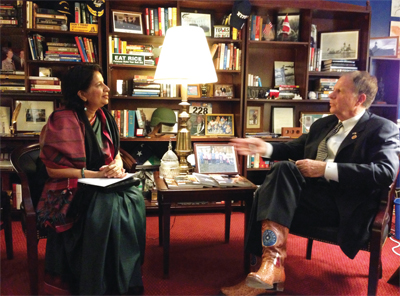
    WASHINGTON (TIP): Ambassador Nirupama Rao met Congressman Ted Poe from Texas on February 28, 2013 at Capitol Hill in Washington D.C. Congressman Ted Poe is serving his 5th term in the U.S. House of Representatives, representing the 2nd District of Texas. He holds a number of important committee assignments in the Congress. He sits on the House Foreign Affairs Committee, where he is the Chairman of its Subcommittee on Terrorism, Nonproliferation and Trade, as well as a Member of the Subcommittee on Europe, Eurasia and Emerging Threats.

    Congressman Poe is also a Member of the Committee on the Judiciary, where he is the Vice Chairman of the Subcommittee on Immigration and Border Security. Ambassador Rao and Congressman Poe discussed the recent positive developments in India-U.S. relations, including cooperation in counterterrorism. Underscoring the shared values and interests of the two countries, Congressman Poe expressed confidence in the future of the India- U.S. strategic partnership. He fondly recalled his visit to India in September 2012, which he described as “very educational”.

    He agreed with Ambassador Rao that sectors like education, health and energy had emerged as important pillars of this multi-faceted partnership. Ambassador Rao noted that Governors of a number of U.S. states were now visiting India to explore new opportunities for closer cooperation, reflecting the widening base and the depth of the India-U.S. partnership. They also exchanged views on the regional situation in South Asia. Congressman Poe said that the U.S. looked upon India as an anchor of stability in the region and as an important partner in promoting regional and global peace, security and development.

  • Interview : Ambassador Prabhu Dayal

    Interview : Ambassador Prabhu Dayal

    Q. In your time as the Consul General ofIndia in New York, what were the mostsignificant highs and lows that youexperienced?
    Well, New York is the center of theUniverse. Although I have served in manyother places, I would say the stint in NewYork is different because of the sheerbunch of activities here. I enjoyed everysingle moment. I wouldn’t say I had anylows. Of course there was the court casewhich was filed by my former domesticassistant which gave me a certain amountof stress. But that is happily now out of theway. That has been settled. As far as myhighs, I had several many because NewYork is the best. East or West, New York isthe best. I really enjoyed my posting here.Particularly for the fact that I came to suchclose contact with some of the mostdistinguished members of the Indo-American community. And the IndianAmerican community of New York is veryvibrant. It is a bridge of friendship withIndia and the United States of America.This is the high point, so to say as I had theopportunity to serve such a vibrantcommunity.

    Q.Most people find the easiest way tosettle in America and get a Green Card isby coming in the country as a domesticservant. You have suffered significantlydue to the conniving schemes of suchpeople. What is your opinion aboutIndians who do such things?
    I have nothing to comment on that. Firstof all, it was a court case that has beensettled. I do not want to really go into anyother aspect to suggest if this is commonin the community. I have the highestrespect for the American judiciary which Ihave seen at close quarters.

    Q. You described the Indian communitysettled here as vibrant. How would youdefine this vibrancy of the IndianAmerican community?
    The Indian American community hassucceeded in all areas of activities. Such asbusiness, architecture, literature, culture,journalism, finance, etc. So this success isan account to the fact that this is a veryintellectually stimulating group. So it hasachieved this high level of success becauseit is a group that has a very high level ofcompetency. My experience recalls thecommunity as vibrant which goes down tothe fact that this very intellectual group ofpeople.

    Q. Do you see any weaknesses in thecommunity? What are your suggestionsto address these shortcomings?
    There are strengths and weaknesses inall communities. Sometimes I feel that thecommunity could be more united. This wayit would be able to get its act together asone community. We have too manydivisions. We have Punjabis, Malyalees,Gujaratis, etc. Although they do all cometogether on many occasions such as theIndia Day parade but they can be morehomogenous. Because one they come outIndia, it doesn’t matter what state, city orreligion they come from. The only thingthat matters is that they are all Indians.Americans only treat them as Indians notas Indians belonging to different states. Sowe must be more homogenous and unitedand in doing so we will be able to bring theIndian American relationship even closer.

    Q.You took a number of initiatives tointegrate the India America community.The Indian Consulate was open to allcommunities. Do you believe that wasright things to do or do you have anyregrets?
    Absolutely not, the consulate has alwaysopened its door for its community and it ispart of our mandate and responsibilities toserve this community in any way possible.We cannot do this by hiding behind closeddoors. So I try to organize many events forthis cause. Such as all the days of nationalimportance or Christmas, Eid andHanukkah for the Indian Jewishcommunity. We have organized manyevents were distinguished musicians fromIndia have performed for the communityhere. My only regret is that perhaps Ihaven’t done as much as I could have. Butthere are always many restraints onaccount of time or on account of the factthat the people in New York city are verybusy. Now that my term is coming to anend, I am reminded of the lines that say,”Fakirana Aaye Sada Kar Chale , MiyanKhush Raho Hum Dua Kar Chale”

    Q. In the troubled times that we live in itdoesn’t take too long to have discord orconflicts to destroy a good relationshipsuch as the one of India and America.What would be your word of advice foryour successor who will take up thepost?
    My successor should continue theefforts of all the Indian Americandiplomats here to both the communitiescome together. Ultimately, it is up to thecommunity to take the significant steps tomake this happen. We must realize that anIndian outside is just and Indian. If theyare in America then we are an IndianAmerican. And all the differences wecreated on the basis of geography orreligion or linguistics must be eliminated.This way we can strengthen ourrelationship with America even moresuccessfully.

    Q. Do you have any message for the Indo-American community here?
    My message to them is that they shouldcontinue to do the great work they havebeen doing. They have been a bridge offriendship between India and America.And they should continue to work atstrengthening this relationship.

    Q. Mr. Dayal, what are your future plans?
    Live life to fullest. I haven’t reallydecided to do with the remains of my life.There are a million ideas in my mind, butthere aren’t any clear agendas. For the nearfuture, maybe play gold, meet and greet ourfamily in India that would be theuppermost priority.

    Q. Mrs. Dayal, you are the first lady ofthis India away from India. How wouldyou recount your experience with theIndian American community here?
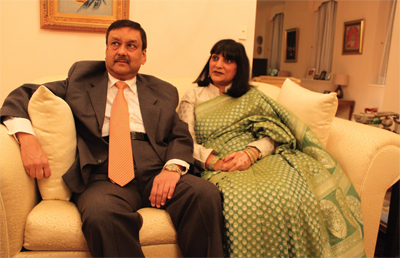
    They have been very affectionate andextremely supportive and I wish them thevery best. They have a special place in ourhearts. We will miss them. We go todifferent countries and we have to leavethem to go to another place. That is howour life is. So no matter where we went, wehave a special place in our hearts for allthe lovely people we met.

    Q. What is your most memorableexperience, Mrs. Dayal?
    I enjoyed all the times when I met newpeople. I also loved the times when mychildren come to visit me. So, in all, Ienjoyed every moment of it all.

  • Indian Constitution

    Indian Constitution

    When India gained freedom from the British on August 15, 1947 there was the need to regulate the meaning of freedom.Therefore, to have a set of rules and regulations that would guide the nation, the Constituent Assembly met on December 9,1946.The Constituent Assembly was convened and appointed a committee with Dr. B.R.Ambedkar as Chairman to draft the Constitution. Borrowing from the Constitutions of other countries, for example, the parliamentary form of government from Britain, supremacy of judiciary from the United States, federal system with a strong centre from Canada, directive principles of state policy from Ireland, the idea of concurrent powers and co-operative federalism from Australia, the system of procedure established by law from Japan, the Indian Constitution is an amalgam of all these. The Indian Constitution, the longest in the world, consist 397 articles and 12 schedules which provides for a single citizenship for the whole of India.The constitution of India was originally written in English It gives the right to vote to all citizens of 18 years and above, unless they are disqualified. Fundamental rights are guaranteed to the citizens, equality of religion and so on.

    National motto:
    Satyameva Jayate (In sanskrit it means Always Truth Alone Triumphs)

    The Great Indian Flag:
    This is an ancient Indian symbol associated with the powers and changes of nature. Officially, the Orange color stands for Courage and sacrifice. The White color signifies Peace and truth. While Green symbolises Faith and Chivalry. It is the duty of every Citizen to realise the significance of our flag and pay the honour and respect its commands.

    Official language:
    Hindi,English Having being declared a Democratic Republic, the people starting governing themselves according to the Constitution written by the Constituent Assembly. With this, Republic Day became the most important day in the history of India. It is therefore natural that the festivities for the day are a lot more elaborate than that for Independence Day.

  • Murder accused Himachal MLA takes oath

    Murder accused Himachal MLA takes oath

    SHIMLA (TIP): Congress legislator Ram Kumar Chaudhary, who has been booked in the Jyoti murder case and lodged in the Ambala jail, took oath as an MLA here today. Speaker Brij Bihari Lal Butail administered oath to him in his chamber in the Vidhan Sabha complex. Ram Kumar was elected from the Doon constituency in Solan district recently. He had been trying to evade the police ever since he was charged with murder by the Haryana Police and could not take oath with other MLAs during the winter session held in Dharmasala early this month. He surrendered before the police on January 8 after the high court rejected his plea for anticipatory bail.

    The Haryana Police brought him to the Vidhan Sabha complex here from Ambala under heavy security cover. Ram Kumar claimed he was innocent and had never confessed to the crime. “I am innocent, it is conspiracy by my political opponents,” he said. He said he would continue to serve his constituency from the jail. He had already submitted his list of priorities to the Speaker, he said. He said he had faith in the judiciary and would come out clean.

  • Pakistan’s Crisis Could End In A Military Coup

    Pakistan’s Crisis Could End In A Military Coup

    ISLAMABAD (TIP): Experts are not ruling out the possibility of a military takeover in Pakistan after the country’s top court ordered the arrest of the PM. Antigovernment protesters continue with their sit-in outside parliament. An anti-government protest in Islamabad enters its third day as tens of thousands of people demand the resignation of the Pakistan People’s Party’s (PPP) government and that an “impartial,” interim government backed by Pakistan’s powerful army and newly-independent judiciary be formed.

    The so-called “long march” is led by a moderate Pakistani-Canadian cleric Tahirul- Qadri, who is demanding major reforms in the electoral system of the country ahead to this year’s parliamentary elections. The cleric has threatened to storm the parliament if his demands are not met. The political turmoil in the Islamic Republic worsened with the Supreme Court’s order on Monday for the arrest of Prime Minister Raja Pervez Ashraf on corruption charges. Ashraf and his party assert their innocence.

    Pakistan’s non-governmental Human Rights Commission of Pakistan (HRCP) said in a statement following the Supreme Court order that the arrest order of the prime minister threatened the democratic set up of the country any derailment of the democratic system at this juncture will imperil Pakistan’s integrity and undermine the prospects of the future generations,” HRCP chairperson Zohra Yousuf said in statement on Tuesday.

    ‘Orchestrated’
    Many analysts in Pakistan believe it is no coincidence that the apex court ordered the prime minister’s arrest at a time when the agitation against his government is at its peak. “Tools of the establishment have now been exposed,” Asma Jahangir, prominent human rights activist and former president of the Supreme Court Bar Association, told the media at a press conference in Karachi on Tuesday. She said Tahir-ul-Qadri’s “long march” and the court’s order appeared “preplanned.” Supporters of President Asif Ali Zardari’s PPP government are of the view that the judiciary, backed by the army and its Inter- Services Intelligence (ISI) spy agency, are trying to undermine the supremacy of parliament and civilian democracy. In a controversial verdict in June last year, the Pakistani Supreme Court disqualified former Prime Minister Yousuf Raza Gilani from holding office, following a contempt conviction two months earlier.

    An ‘unpopular’ government
    But experts say that the new crisis seems to be more detrimental than the previous ones, as the country is heading towards general elections. They say that Qadri’s sudden arrival from Canada to Pakistan and the success of his well-financed campaign looked all well-timed. “Most people in Pakistan think Qadri is being backed by the Pakistani establishment, particularly the Pakistani army,” Ghazi Salahuddin, a senior journalist in Karachi, told DW, adding that the possibility of the military coup in this situation could not be dismissed. Pakistani has seen three military coups throughout its 65-year history.

    Analysts say Pakistani generals call the shots even when the civilian government is in power. Salahuddin was of the opinion that the government had become extremely unpopular and a lot of people did not want to see them in power anymore. He, however, criticized the way in which Qadri was trying to dislodge the government. “The PPP’s governance has been dismal over the last five years. The Quetta killings and the way the government dealt with it made people angrier with the government. It is true that this government has been shaken,” Salahuddin commented. Independent researcher and political activist Sartaj Khan believes the liberal intelligentsia is opposing Qadri because he challenges the status-quo.

    “The liberals want to save the corrupt PPP government and are ready to tolerate it for another five years in the name of ‘fake democracy.’ What is important about the antigovernment protests is not who Qadri is but what he stands for. People are fed up with this system,” Khan told DW. He said that PPP supporters were trying to scare people with the idea of military rule in the country to prolong their rule. But Islamabad-based human rights activist Tahira Abdullah said that the democratic process would take time, and would only be possible through elections. “We know that the rulers are corrupt but people can vote them out in elections. Only regular elections can guarantee good governance,” she said.

    Regional implications
    Experts say the US, Pakistan’s biggest aid donor, is closely observing the deepening crisis in the nuclear-armed state. Recent border clashes between South Asian arch rivals Pakistan and India have also alarmed the US and other Western countries whose armed forces are preparing to leave Afghanistan in 2014. Tensions between India and Pakistan can have a negative impact on the stability of Afghanistan and its peace process. Experts point out that political chaos in a volatile country like Pakistan and its tensions with India are disturbing not only to the region but to the entire international community. “Pakistan’s history is marred by these kinds of political crises. The international community does not trust us. The regional situation is very complex. The recent political developments in Pakistan cannot be looked at in isolation,” Zaman Khan, a Lahore-based activist, told DW. Nuclear-armed Pakistan is struggling with a weak economy and bloody Islamist insurgency led by the Taliban.

  • Lanka President Sacks First Woman Top Judge Over Graft

    Lanka President Sacks First Woman Top Judge Over Graft

    COLOMBO (TIP): Sri Lankan President Mahinda Rajapaksa on Jan 13 sacked the country’s first woman chief justice Shirani Bandarnayake after ratifying her impeachment by parliament which held her guilty of corruption, notwithstanding widespread protests by lawyers and others. The 54-year-old Bandaranayake was served a notice ordering her to quit her post, two days after the parliament overwhelmingly voted to impeach her deepening a standoff between the judiciary and the government. The impeachment of Bandaranayake had earlier been ruled as unconstitutional by courts and a finding by the parliamentary committee that found her “guilty” had been quashed.

    The parliamentary committee on December 8, 2012, had ruled that Bandaranayake was guilty of three of the 14 charges in the impeachment proceedings against her moved by the ruling UPFA coalition legislators. The three charges were of financial impropriety based on non-declaration of assets and conflict of interest in a case involving a failed investment company. She denied all the charges against her. On December 6, she stormed out of the impeachment hearing in parliament, saying she would not be given a fair trial. She also claimed verbal abuse by the government members of the parliamentary panel. On Friday, the House voted 155 to 49 to dismiss Bandaranayake, whose recent rulings had gone against government.

  • Rajapaksa Names His Man As Sri Lanka’s New Chief Justice

    Rajapaksa Names His Man As Sri Lanka’s New Chief Justice

    COLOMBO (TIP): Sri Lankan President Mahinda Rajapaksa on Jan 15 appointed his cabinet’s legal adviser as the country’s new chief justice to succeed Shirani Bandaranayake, whose impeachment created much furore both inside and outside the nation. Rajapaksa sworn in new Chief Justice Mohan Peiris to replace Sri Lanka’s first woman chief justice who was impeached by the parliament in a controversial move. Peiris, a British qualified solicitor who retired in 2011 as the Attorney General was serving as the legal advisor to the Cabinet.

    He is being seen as a favourite of the government. Peiris has lobbied for Sri Lanka during the sessions of the United Nations Human Rights Council in recent years. He is also supervising the implementations of recommendations by Sri Lanka’s post war reconciliation commission (LLRC). Presidential officials said Peiris took over as the new chief justice today after the sacking of Bandaranayake following a parliamentary ratification last week of the impeachment against her. Bandaranayake’s impeachment came despite the Supreme Court’s ruling of the process against her illegal.

    She had walked out of the parliamentary investigation citing bias. National and international rights groups have severely criticised the government of Sri Lanka over the issue. Rights groups have questioned the legality of the impeachment that has pitted the judiciary against the government. In keeping with the opposition, Civil society think tank, the Centre for Policy Alternatives filed a fundamental rights petition in the Supreme Court seeking an order restraining Peiris from taking office. The legal fraternity was up in arms against the impeachment and had vowed not to cooperate with her successor.

  • Delhi Gang Rape Accused Says Police Tortured Him

    Delhi Gang Rape Accused Says Police Tortured Him

    NEW DELHI (TIP): One of the five men charged with the gang rape and murder of a 23-year-old woman said police tortured him in custody and he and at least three of his co-defendants say they are innocent, lawyers said on. The five accused arrived in court for a closed hearing with their faces covered by scarves, and accompanied for the first time by defense lawyers. The physiotherapy student died on December 29, two weeks after being beaten and raped on a moving bus in New Delhi, then thrown bleeding onto the street. Nationwide protests followed against the government’s perceived failure to stem rising violence against women. One of the men, Mukesh Singh, the brother of a bus driver who police say was the leader of the gang, will base his defense on police brutality, his lawyer said.

    “Mukesh was illegally tortured in the custody of the police,” said the lawyer, Manohar Lal Sharma. The five face charges of murder, gang rape and abduction, prosecutors have said they will seek the death penalty. A sixth suspect is being investigated separately to determine if he is below the age of 18, as he says he is. The case has shone a light on a widespread problem of violence against women but also the failure of the criminal justice system to bring the guilty to justice in a country where official statistics show a rape is reported every 20 minutes.

    The bus driver and alleged gang leader Ram Singh said he was innocent during a two-hour meeting with his lawyer, VK Anand, in Delhi’s Tihar jail, the lawyer said. Two other accused, gym assistant Vinay Sharma and bus cleaner Akshay Kumar Singh, say they were falsely implicated, said their lawyer, AP Singh. ‘I will … prove their innocence,’ the lawyer said after the hearing. The fifth man has yet to be assigned a lawyer and it is not known what he has told court or how he intends to plea. Charges against the sixth member of the group have not been brought while police complete an inquiry to confirm his age. If he is found to be below 18 he will be tried in a juvenile court and if convicted will go to a correctional home, not a prison, to serve a maximum term of three years.

    GROUNDS FOR APPEAL?
    For days after their arrest, soon after the December 16 assault on the woman and a male companion, none of the men had a lawyer. Most members of the judiciary refused to represent them because of the outrage over the attack. Police conducted extensive interrogations of the men in the absence of any lawyer and they say they have recorded confessions. The hearings, which are closed to the media, are taking place in a court across the street from a cinema where the victim watched a movie before boarding the bus with a friend who was also severely beaten. Prosecutors say they have a large file of evidence, including statements and DNA samples taken from blood-stained clothing recovered by police. But legal experts had said the earlier lack of representation for the five suspects could give grounds for appeal if they were found guilty. Convictions in similar cases have often been overturned years later. The woman lived for two weeks after the attack but died in a Singapore hospital where she had been taken for treatment. She was identified by a British newspaper on the weekend but Reuters has opted not to name her. Indian law generally prohibits the identification of victims of sex crimes to protect their privacy in a country where the social stigma associated with rape can be devastating.

  • AS I See It:Restricting Guns: Now It Is Between Lawmakers And National Rifle Association

    AS I See It:Restricting Guns: Now It Is Between Lawmakers And National Rifle Association

    Adam Lanza, clad in ‘black battle fatigues and a military vest’ picked up the deadliest arms as if to wage a battle against his enemies and thus become a ‘martyr’ to the memory of his countrymen. The monstrosity and evil attached to his crime didn’t deter him the least from raising one of the fiercest guns on the weakest, meekest, and the most defenseless offspring of our society. He killed the very womb that engendered him and destroyed the very school that taught him to live his life. He inflicted unbearable pain on parents of twenty first graders, and family members of six adult women. The hurt that refuses to heal prompted American citizens to indulge in dillydallying debate over banning guns which many believe should not have been in hands of the civilians at all. The momentum of discussion fizzled out within a week after the tragedy. The menacing gun enthusiasts and their National Rifle Association lobbied for more guns both in hands of the bad guy and in hands of the good guy.The sheer apathy and cruelty of Lanza’s action stirred the emotions of the nation and choked the president who so far remained very careful and restrained in exhibiting his feelings in public. ‘The Slaughter of Innocence,’ however, has hardly prompted the lawmakers to stand for the weak and defenseless citizens. When the National Rifle Association commented on massacre of children, it appeared a reasonable solution could be found to the gross abuse of ‘the right to bear Arms,’ as provided in the American constitution. But the much awaited press conference of the NRA, proved a damp squib as nothing afresh could come out of its perception of the tragedy in Newtown. . Their wellknown recipe, “The only thing that stops a bad guy with a gun is a good guy with a gun,” is nothing less than a sadistic understanding of the rising violence in public life. It is testing time for American legislature, the executive and the judiciary to frame suitable laws so that Americans never live under the reign of fear unleashed by some deranged lot of the society. At this time there are very few options. Mental health, guns, culture of violence in entertainment, and the media representation are some of the factors that have been blamed for the rising violence. The correlation of all these factors in so many tragedies can’t be wholly denied. But what are the possible solutions? It is true that had Adam Lanza not had access to the most dangerous weapons, he could not have killed 20 children and six adults. The case of a deranged man attacking 22 children with a knife on the same day in China provides a clear contrast. Had he access to AR-15, he would have killed hundreds of them. But fortunately, no children died in the attack. There is no doubt that worsening mental health of Americans is at an alarming point, but so is of many other industrialized countries. What can government do in the personal relations of husband and wife, their alleged paramours, children, stepchildren? Mental problems are most difficult to diagnose when 70% of the patients and their families remain in the denial mode. Many of the mentally unhealthy people show no signs of concern and even don’t have anything objectionable in their backgrounds. The point that mental situation can take U-turn in a flash of seconds is hard to tackle in the given circumstances. But what can be done during such a mental situation? Let’s keep guns like AR-15 out of the way of people who suffer occasionally from hallucinations and panic attacks. Culture of violence in entertainment industry and the media representation of it in actual life are said to cause tragic incidences of violence. But there are no immediate and foreseeable solutions to these problems. Even if we try to work on reducing violence in the entertainment industry, its real effect won’t be seen for years to come. The problem of gun violence in the meanwhile may become more intractable and cause more hurt on our psyche as a nation. Media representation of violence, indeed, is one of the problems that make gun violence representative in most news briefings, psychodramas, documentaries, and movies. But that alone isn’t the cause of rising gun violence. The problem of violence in media is undoubtedly worldwide, but why are Americans alone more affected than anybody else in the world? According to Washington Post columnist, Fareed Zakaria, the solution to gun violence isn’t complex at all, if there is a political will to solve it. The problem that stares in our faces is that we are 5 percent of world population, but we own 50 percent of world’s guns. Gun violence in America is thirty times that of Australia and France and twelve times higher that of other countries. The interesting thing is that American Bill of Rights by which second amendment ‘right to bear Arms’ was provided, is based on British Bill of Rights of 1689. In order to fully understand the intent of Second Amendment in our constitution, we should go back to all debates and views of the founding fathers. Their main concern was safety, security and freedom of speech so that organized government may not trample individual rights provided in the Bill of Rights. But such privileges were never unrestricted if some antisocial, instead of government, start threatening the very safety, security and freedom of speech. The Second Amendment should have occasioned some laws that would have checked any transgression to safety, security and freedom of speech. But in the absence of declared laws for more than two hundred years, frequent mass shootings are considered unrelated and isolated incidences. How can they be unrelated when access to the very automatic guns used in the crime has been made possible due to the Second Amendment? It is pertinent to dwell here on the British Bill of Rights, 1689 which founding fathers consulted to draft American Bill of Rights. John Lilburne (1614-1657), who was the background inspiration for philosopher John Locke, the key influence in ensuring individual liberties of common people states: For where there is no law declared, there can be no transgression.

    Therefore it is very requisite that the parliament would declare their privileges to the whole commons of England, that so no man may through ignorance (by the parliament’s default) run causelessly into the hazard of the loss of their lives, liberties, or estates.

    For here it is acknowledged by themselves that their power is limited by those that betrust them, and that they are not to do what they list but what they ought, namely, to provide for the people’s weal and not for their woe: so that unknown privileges are as dangerous as unlimited prerogatives being both of them secret snares, especially for the best-affected people. – John Lilburne, The 150th Page [1645] In the above statement made 367 years ago, Lilburne warns that Parliament’s failure to declare law and privileges to the whole commons of England may lead some men ‘through ignorance run ceaselessly into the hazard of the loss of their lives, liberties or estates. The English Bill of Rights that was adopted in 1689 reflects Lilburne’s viewpoints.

    In England, the Catholic King was replaced with a Protestant one. The rights of all protestants were preserved in the Bill of Rights adopted in 1689. The following text of clauses 7, 9, and 13 throws sufficient light on the intents and purposes of American Bill of Rights:
    7. That the subjects which are protestants, may have arms for their defense suitable to their conditions, and as allowed by law.
    9. That the freedom of speech, and debates or proceedings in parliament, ought not to be impeached or questioned in any court or place out of parliament.
    13. And that for redress of all grievances, and for the amending, strengthening, and preserving of the laws, parliaments ought to be held frequently.It is right time for Congress and the Senate to take up defining the Bill of Rights so that it becomes quite evident that the Second Amendment was designed for ‘people’s weal not for their woe.’

  • Delhi gangrape: NYPD and London might offer some solutions

    Delhi gangrape: NYPD and London might offer some solutions

    Indian laws against rape are amongst some of the toughest in the world. Owing to regular interpretation of Section 376 of the Indian Penal Code (IPC), the victim’s word is now considered substantive proof to convict the accused and send him to jail for a minimum of seven years. In fact, in one case even the lack of conclusive medical evidence to show that a woman was raped did not prevent the Supreme Court from ordering a jail sentence for the accused. In a deeply conservative society, rape is an emotional subject which perhaps explains why the judiciary has been so recipient to making it easy to secure convictions.

    However, this approach as a crime prevention strategy has little value as it is reactive. It comes into play after a crime has already been committed.

    Research has shown that though we may like to believe that harsh sentences act as deterrents to future criminals, there is little evidence in favor of this belief. Most criminals either truly believe that they will get away with the crime, or are unable to think through the consequences of crime they are about to commit. The crime prevention premise on which First World criminal justice systems (which includes police, prosecutors, judges) now work is that criminals are deterred by their proximal conditions, and not the prospect of a distant punishment.

    Thus incidents of sexual harassment, and drug dealing in public toilets in London dropped drastically with the introduction of better lighting, and signs warning that plainclothes policemen often used those facilities. Similarly, to prevent cases of rape there is a need to view it as a crime in isolation from the emotional rhetoric that surrounds it. The most influential crime prevention philosophy of the last decade stated that a crime takes place when there is presence of a likely target (i.e. victim), and the absence of a capable guardian (examples : policeman, guard, a responsible elder, or even a good lock).

    Building on this notion police forces in cities like London, and New York write what are called ‘crime scripts’ of common crimes. Simply put, the policemen put themselves in shoes of a criminal and write down a detailed step by step procedure in the commissioning of a crime. Thereafter, they concentrate on ‘script disruption’, where interventions at certain stages of the criminal’s actions prevent him for carrying out his criminal act. For instance: jails in Australia reported several cases of inmates scalding other prisoners with hot liquids. The solution came in the form of thermos flasks with narrow opening that did not allow liquids to be thrown at each other. In case of Delhi too it would not be impossible for police to build a script of rapes that are committed. The ease with which criminals can use means of public transportation to pick up unsuspecting victims comes immediately to mind. Moreover, little application of mind would show that crimes against women are concentrated in time and space, or go in conjunction with other crimes. That could serve as a starting point for police in Delhi to frame a strategy on how to best use its limited resources for maximum deterrent effect.

    It is by using such scientific means that police forces in developed countries have been able to reduce crime rates to lowest than they have ever been. As is the case every time, after this rape case in Delhi too, we hear platitudes about falling moral standards of society, with the blame for the crime being laid on factors as wide ranging as erosion of family values to deindividualization of people in a metro. This kind of approach in reality is a disservice to women as it offers no solutions. At this stage it would be pertinent to remember that the instances of perverts making lewd calls to women – which was a common phenomena in 1990s – dropped to virtually nil within a few years not because the Indian male underwent some sort of moral renaissance, but because phones started coming with caller IDs, and in a way disrupted the script.

  • DELHI GANG RAPE: Protests outside Rashtrapati Bhavan

    DELHI GANG RAPE: Protests outside Rashtrapati Bhavan

    NEW DELHI (TIP): A large number of women activists and students today marched towards Rashtrapati Bhavan to protest against the gang rape of a young girl in a moving bus and demand stringent action against rapists. The protesters under the aegis of AIDWA, YWCA and JNUSU among others started their march from Rajpath and as they reached Vijay Chowk, they went past the barricades erected at the entrance of Raisina Hills and moved towards Rashtrapati Bhavan and South and North Blocks. Police stopped the protesters near Rashtrapati Bhavan. Carrying placards and shouting slogans, the protesters demanded stringent punishment for rapists.

    Two days ago in a similar protest, around 200 people had gathered near North Block. They dispersed only after home minister Sushilkumar Shinde agreed to meet a delegation of JNUSU students. A girl identified as Swati managed to go near the Rashtrapati Bhavan but was escorted back later. “They say we need permission to enter there. Why do we need permission? When we are attacked and harassed, nobody needs any permission. We are here to raise our voices and for that we need permission,” she said. The protesters at Raisina Hills later marched towards India Gate. A group of people also staged protest outside Safdarjung Hospital and blocked traffic for sometime. The protesters demanded speedy justice for the victim.

    Meanwhile, Delhi Police detained the fifth accused in connection with the heinous incident in a late night raid on Thursday. The police detained the fifth accused, named Raju, in Badaun, Uttar Pradesh. “The fifth accused has been arrested in the rape case. His age is being verified before giving details. If minor, we have to hold back his particulars as per law,” Delhi Police commissioner Neeraj Kumar said on Twitter. With this, five persons have been arrested in the Sunday night incident which sparked widespread outrage across the country.

    Sources said the fifth accused was arrested from Badaun in Uttar Pradesh even as there were reports that the sixth accused has been picked from Bareilly. However, police is yet to confirm it. One of the four accused in the case was “identified” by the victim’s friend during a Test Identification Parade (TIP) at Tihar Jail here. The 23-year-old victim’s male friend, an engineer in a software company, identified Mukesh during TIP, a senior police official said. Out of the four accused, only Mukesh had agreed to TIP when he was produced before a court here. Other accused – Ram Singh, Pawan and Vinay – had refused to undergo TIP.

    According to the official, the positive identification of Mukesh by the friend, who was also beaten up by thegang before the men allegedly raped the girl, is a shot in the arm of the prosecution as it would help them nail the other culprits. Police have invoked the stringent charges of attempt to murder and destruction of evidence against the accused. Investigators had earlier pressed charges against them under sections 365 (kidnapping or abducting), 376 (2)(g) (gang rape), 377 (unnatural offences), 394 (hurting in committing robbery) and 34 (common intention) of IPC.

    Indian laws against rape are amongst some of the toughest in the world. Owing to regular interpretation of Section 376 of the Indian Penal Code (IPC), the victim’s word is now considered substantive proof to convict the accused and send him to jail for a minimum of seven years. In fact, in one case even the lack of conclusive medical evidence to show that a woman was raped did not prevent the Supreme Court from ordering a jail sentence for the accused. In a deeply conservative society, rape is an emotional subject which perhaps explains why the judiciary has been so recipient to making it easy to secure convictions.

    However, this approach as a crime prevention strategy has little value as it is reactive. It comes into play after a crime has already been committed. Research has shown that though we may like to believe that harsh sentences act as deterrents to future criminals, there is little evidence in favor of this belief. Most criminals either truly believe that they will get away with the crime, or are unable to think through the consequences of crime they are about to commit. The crime prevention premise on which First World criminal justice systems (which includes police, prosecutors, judges) now work is that criminals are deterred by their proximal conditions, and not the prospect of a distant punishment.

    Thus incidents of sexual harassment, and drug dealing in public toilets in London dropped drastically with the introduction of better lighting, and signs warning that plainclothes policemen often used those facilities. Similarly, to prevent cases of rape there is a need to view it as a crime in isolation from the emotional rhetoric that surrounds it. The most influential crime prevention philosophy of the last decade stated that a crime takes place when there is presence of a likely target (i.e. victim), and the absence of a capable guardian (examples : policeman, guard, a responsible elder, or even a good lock). Building on this notion police forces in cities like London, and New York write what are called ‘crime scripts’ of common crimes.

    Simply put, the policemen put themselves in shoes of a criminal and write down a detailed step by step procedure in the commissioning of a crime. Thereafter, they concentrate on ‘script disruption’, where interventions at certain stages of the criminal’s actions prevent him for carrying out his criminal act. For instance: jails in Australia reported several cases of inmates scalding other prisoners with hot liquids. The solution came in the form of thermos flasks with narrow opening that did not allow liquids to be thrown at each other. In case of Delhi too it would not be impossible for police to build a script of rapes that are committed. The ease with which criminals can use means of public transportation to pick up unsuspecting victims comes immediately to mind.

    Moreover, little application of mind would show that crimes against women are concentrated in time and space, or go in conjunction with other crimes. That could serve as a starting point for police in Delhi to frame a strategy on how to best use its limited resources for maximum deterrent effect. It is by using such scientific means that police forces in developed countries have been able to reduce crime rates to lowest than they have ever been. As is the case every time, after this rape case in Delhi too, we hear platitudes about falling moral standards of society, with the blame for the crime being laid on factors as wide ranging as erosion of family values to deindividualization of people in a metro.

    This kind of approach in reality is a disservice to women as it offers no solutions. At this stage it would be pertinent to remember that the instances of perverts making lewd calls to women – which was a common phenomena in 1990s – dropped to virtually nil within a few years not because the Indian male underwent some sort of moral renaissance, but because phones started coming with caller IDs, and in a way disrupted the script.

  • Oak Creek, WI Investigation Report Released

    Oak Creek, WI Investigation Report Released

    UNITED SIKHS wants the attack to be labeled a hate crime NEW YORK (TIP):
    Teresa Carlson, special agent in charge of the FBI’s Milwaukee office, announced on Tuesday, Nov 20. 2012 that the agency has finished its probe into the Oak Creek, Wisconsin shooting on August 5, 2012, that killed six Sikh worshippers and injured four individuals. The FBI concluded that the shooter, Wade Michael Page, acted alone. They found no evidence that he had help or was carrying out any orders from any white supremacist group. She went on to state that nothing in this attack suggests any ongoing threat to the Sikh community.

    The events that transpired on August 5, 2012 in Oak Creek, Wisconsin serve as a stark reminder that despite having coexisted in America for more than 100 years, the Sikh identity is not accepted. And it is this fact that should concern everyone. The shooting that occurred in Wisconsin shows us that we have allowed individuals such as Wade Michael Page, a “frustrated neo-naz i” who led a white supremacist music group, to steer the direction of America. He used his privilege as a white supremacist member of society to show America that diversity must be counteracted with violence, hate, and ethnic cleansing.

    This is not the message that we want to send to the world, or to our children. The UNITED SIKHS said in a statement that whether Wade Michael page acted alone or at the direction of a white supremacist group, the fact that he took it upon himself to take innocent lives on that fatal day, reminds us of the lack of tolerance within our society. It is a well known fact that the Sikh community has been the target of attacks by extremists in the aftermath of 9/11. Threats from extremist groups has kept the fear of personal attacks alive within the Sikh community. Wisconsin massacre was that fear coming true. It is time our government took concrete measures to track previous attacks, take stern action and create awareness.

    No one is oblivious of the fact that the massacre was fueled by hate. We want FBI to acknowledge this fact, akin to the statement issued by Attorney general Eric Holder on August 10, 2012 where he called the attack a “hate crime”. Sen. Dick Durbin also labeled it as hate crime – “The recent shooting at a Sikh temple in Oak Creek, Wisconsin, was a tragic hate crime that played out on TV around the country,” said Sen. Dick Durbin, D-Illinois, who chaired the hearing for a Senate Judiciary subcommittee. “It was not the first tragedy based on hate, and, sadly, it won’t be the last,” Durbin said of the shooting. But it should cause all of us to redouble our efforts to combat the threat of domestic terrorism.” Unless this fact is acknowledged, measures cannot be taken to address it.

    UNITED SIKHS asks that the FBI label this as an act of hate and take real and constructive action to prevent future similar acts. Lets all do our part in creating this awareness and asking for justification and real actions to prevent such a heinous act ,that took six innocent lives with it, from happening again. We cannot afford to lose more innocent lives.

  • PM, Judiciary be Brought Under Lokpal: Hegde

    PM, Judiciary be Brought Under Lokpal: Hegde

    NEW DELHI (TIP): There is nothing wrong in bringing the Prime Minister under the jurisdiction of Lokpal as like others he is also a public servant, former Supreme Court judge and erstwhile Karnataka Lokayukta N Santosh Hegde said. “What is wrong in the Lokpal having jurisdiction over the Prime Minister? Is the Prime Minister not a public servant? Aren’t there cases of corruption against PMs in other countries?

    In Japan, you find every other year a Prime Minister is prosecuted. (Former US President Richard) Nixon was prosecuted… What is so great about the PM?,” he asked Noting that the position of the Lokpal was akin to “giving a dog a bad name and kicking it”, he said there have been allegations of corruption against PMs in the past and added that only the President and governors are excluded from being prosecuted and not the PM. “We have had allegations of corruption against two former PMs – Bofors and the JMM bribery case.

    In a democracy, how can a person merely because he is holding an office be excluded from prosecution? The Constitution excludes the prosecution of the President and the Governors in some cases…One can’t apply the same principle on a man who passes executive orders on a daily basis,” he told PTI. Responding to a query as to how he expects Arvind Kejriwal’s newlylaunched Aam Aadmi Party to perform, Hegde raised doubts about its success saying it was not an “easy job”. “My only apprehension is how far will a political party survive because of the very many demands of the political system, these days.

    It requires a huge amount of money to elect nearly 546 Members of Parliament from Kashmir to Kanyakumari. It is not going to be an easy job. “It is a good thing in principle, but in reality, can it succeed?” he asked. On being queried on Kejriwal’s possible expose on corruption in judiciary, Hegde said, “Haven’t we heard of malpractices in judiciary? We have had one Supreme Court judge against whom impeachment proceedings had started, but it was not completed. We had one Chief Justice against whom impeachment proceedings had been initiated- Justice Dinakaran- he resigned, so it came to an end.” “We had Soumitra Sen from Calcutta high court. Impeachment process started against him (and then) stopped didn’t go anywhere. We have a charge sheet filed against Justice Nirmal Yadav of Punjab high court. We have 34 judges of the Allahabad high court, who are being investigated by the CBI. “So, there is corruption there and therefore, he must be having some material against some judges,” he said.

  • Egypt Mass Protests Challenge Islamist President Mohammed Morsi

    Egypt Mass Protests Challenge Islamist President Mohammed Morsi

    CAIRO (TIP): The same chants used against Hosni Mubarak were turned against his successor on Tuesday as more than 200,000 people packed Egypt’s Tahrir Square in the biggest challenge yet to Islamist President Mohammed Morsi. The massive, flag-waving throng protesting Morsi’s assertion of near-absolute powers rivaled some of the largest crowds that helped drive Mubarak from office last year.

    “The people want to bring down the regime!” and “erhal, erhal” — Arabic for “leave, leave” — rang out across the plaza, this time directed at Egypt’s first freely elected president. The protests were sparked by edicts Morsi issued last week that effectively neutralize the judiciary, the last branch of government he does not control. But they turned into a broader outpouring of anger against Morsi and his Muslim Brotherhood, which opponents say have used election victories to monopolize power, squeeze out rivals and dictate a new, Islamist constitution, while doing little to solve Egypt’s mounting economic and security woes.

    Clashes broke out in several cities, with Morsi’s opponents attacking Brotherhood offices, setting fire to at least one. Protesters and Brotherhood members pelted each other with stones and firebombs in the Nile Delta city of Mahalla el-Kobra, leaving at least 100 people injured. “Power has exposed the Brotherhood. We discovered their true face,” said Laila Salah, a housewife at the Tahrir protest who said she voted for Morsi in last summer’s presidential election. After Mubarak, she said, Egyptians would no longer accept being ruled by an autocrat. “It’s like a wife whose husband was beating her and then she divorces him and becomes free,” she said. “If she remarries she’ll never accept another day of abuse.”

    Gehad el-Haddad, a senior adviser to the Brotherhood and its political party, said Morsi would not back down on his edicts. “We are not rescinding the declaration,” he said.

  • Pakistan All Set to go to Polls in May

    Pakistan All Set to go to Polls in May

    LAHORE (TIP): Pakistan’s next general election will be held in May, information minister Qamar Zaman Kaira said on Tuesday, offering for the first time a specific timeframe for the polls. “The general election will be held in May next year. In the presence of a vibrant media and independent judiciary , there is no chance of postponement of the elections,” Kaira said . The Pakistan Peoples Party-led government will ensure free and fair polls under an independent interim caretaker set-up and the election commission , he said. In the recent past, several leaders, including President Asif Ali Zardari, have said the polls will be held on time after the government completes its five-year term.

  • Law Minister to Review Judge Gag Clause in Judicial Bill

    Law Minister to Review Judge Gag Clause in Judicial Bill

    NEW DELHI (TIP): In a departure from the rigid stand taken by his predecessor, Union law minister Ashwani Kumar has sought to review the controversial clause in the Judicial Standards and Accountability Bill that prohibits judges from making unwarranted comments against any constitutional authority in open court during hearing of cases.

    Kumar, who called for the file immediately after joining office, has hinted to his officials that Section 3(2)(g) of the bill that has been at the centre of a spat between the higher judiciary and the government, should be dropped and a revised draft of the bill be introduced in the winter session of Parliament. Former law minister Salman Khurshid, who has taken over as external affairs minister, was firm that the specific provision would stay in the Judicial Standards and Accountability Bill 2012. Khurshid had said the government had taken note of certain remarks by some higher courts on constitutional bodies and other authorities in open court, which were seldom reflected in writing during judicial pronouncements.

    “That is why a specific provision has been proposed to be made under Section 3 of the chapter on judicial standards to be followed by judges, in the Judicial Standards Bill,” Khurshid had said. Section 3(2)(g) of the bill prohibits judges from making unwarranted comments against the conduct of any constitutional or statutory authority at the time of hearing matters, which are pending before them or are likely to arise for judicial determination. The government also proposes to accord statutory sanction to the Restatement of Values of Judicial Life, which was adopted by a resolution at the full court meeting of the Supreme Court in 1997, by making it a part of the Judicial Standards and Accountability Bill.

    The Judicial Standards and Accountability Bill was passed by the Lok Sabha on March 29 and is pending consideration in Rajya Sabha after the introduction of fresh amendments. After changes are incorporated and the bill is passed by the upper House, it will again have to be presented in the Lok Sabha. The spat between the judiciary and the government over the gag clause has been going on for some time with critics saying that judges make comments to play to the gallery as many such observations don’t find mention in the verdicts. Judges themselves are split on the issue. Some say that the questions they raise on constitutional authorities may put a misleading picture on the issue under consideration.

  • As I see it:Judgment call

    As I see it:Judgment call

    By Kalyan Mitra

    It can hardly be disputed that judicial activism is now a central feature of every system that vests adjudicatory power, like Mr. Justice PN Bhagwati pointed out, in a free and independent judiciary.

    The judiciary is the last bastion of democracy and it may well be said that judicial activism is the elan vital, the essence of social justice.

    Preservation of the rule of law in a wide perspective is indeed the primary remit of the judiciary. For this, the wellspring of the common law evolved in England and subsequently followed in India was a body of laws refined by imaginative and wise application of the principles of ethics, fair play and good conscience. Thus maxims of equity were propounded for delivering justice and the principle of promissory estoppels makes it imperative that no one (including the state) reneges on a promise on the basis of which another had altered his position to his detriment. Also, that one who seeks equity must do equity, and that all must come before the court with clean hands. The concern of the judges who helped evolve the common law was not just maintenance of status quo but also rendition of true justice, especially social justice.

    The Indian Constitution with its unique provisions of fundamental rights and the Directive Principles of State Policy enjoins upon the judiciary to be dynamic so that rights are defended in keeping with the Directive Principles. The country’s apex judiciary acted very boldly in the face of strong ad hoc political actions to impulsively amend the Constitution under Article 368 to suit immediate political purposes. In the landmark Keshavananda Bharati case (AIR 1973 SC1461), the Supreme Court, sitting en bloc, held that the basic structure of the Constitution could not be changed by an amendment to the Constitution and that fundamental rights could not be abridged. In the recent 2G case, the court cancelled 120 2G licences on the ground that arbitrary and wrongful procedure had been followed in giving away of material resources of the country. In a case related to the proclamation of President’s Rule in Bihar, the Supreme Court had even held the proclamation to be in breach of the Constitution. All this is indicative of a strain of judicial activism dedicated to preserve a stable social order for the fulfillment of social justice.

    The Supreme Court has gone far in upholding the role of Articles 14 and 21 of the Constitution with imaginative and positive interpretation, especially in the area of human rights. For this, it has relied extensively on the Universal Declaration of Human Rights. The Supreme Court has thus fine-tuned immunity against torture or cruel or inhuman or degrading treatment or punishment to defend fundamental rights enshrined in Article 21 of the Constitution. The treatment of women in police lock-ups has also been addressed by the country’s highest court admirably.

    Very recently, the Supreme Court ordered that the privacy and dignity of an endangered, simple-minded tribe in the Andamans be protected against indecent, vulgar and sadistic intrusion by foreign photojournalists. This is an example of positive and imaginative interpretation of the Constitution for protection of the dignity and liberty of the vulnerable people of India.

    In the Francis Coralie Mullin case (1981) 2 SCR 516, the Supreme Court had asserted that Article 14 of the Constitution did not just guarantee right to life but also the right to live with basic human dignity intact as also basic necessities of life. So, the court went on to hold that the right to life included the right of society to a clean and healthy environment. Such a view is far-sighted and increasingly relevant considering growing environmental pollution and depleting ecological balance that are currently ravaging the planet. More so, as industrial wastes and effluents as well as hazards posed by technological developments are defiling nature and adversely affecting social welfare. A much-cleansed Ganges owes a lot to judicial activism in India.

    It is judicial activism again that has made jurisprudence more inclusive. The poor and disadvantaged can now petition the courts with more confidence as can socially-active persons or groups. To give an example, this has brought judicial relief to bonded laborers or legal assistance to poor undertrials. The Supreme Court has also introduced a very purposive innovation in setting up socio-legal committees to examine issues and report to it. Such findings are to be made available to all parties as evidence. The Bandhua Mukti case (AIR 1981 SC 802) that concerned resettlement of tribal people affected by construction of a dam is a case in point. A few weeks ago, the Supreme Court awarded very substantial compensation to the family of a victim of a road accident who was its sole breadwinner. A special leave petition before the Court in this regard had remained unheard for several years. The court has, in several cases, directed the state to award compensation for its failure to protect human rights without entertaining arguments of sovereign immunity.

    The country’s highest court has set healthy precedents for the High Courts and lower judiciary for dealing with the problems of the socially-vulnerable and people who become victims of exploitation by organized vested interests. But despite the positive and pioneering attitude of the higher judiciary, caution must be urged. Judges must not go overboard in their zeal for unrestrained judicial intervention. Some judges have observed that such over-zealousness should not lead to the subversion of the Constitution and the existing framework of law and precedents. They have also pointed out that there is a need to steer clear of the by-lanes of judicial sophistry. Judges, as also the entire legal fraternity, must practice introspection, keep on acquiring knowledge as well as wisdom and should not get carried away either by motivated public approbation or censure.

  • US House seeks hate crime data against Sikh Americans

    US House seeks hate crime data against Sikh Americans

    WASHINGTON D.C. (TIP): As many as 81 members of the US House of Representatives have introduced a resolution supporting a call to the Justice Department to begin collecting comprehensive data on hate crimes committed against Sikhs.

    Introduced in the wake of the Aug 5shooting at a Sikh gurdwara in Oak Creek, Wisconsin, the resolution honours the contributions of the Sikh-American community to the United States and condemns the string of attacks against Sikhs and their religious institutions over the past year. In April, 93 members of Congress had signed a letter urging the Federal Bureau of Investigation (FBI) to document and quantify the commission of hate crimes against Sikh-Americans.”This resolution recognizes that America is proud of the Sikh-American community, their hundred year history in this country and their countless achievements and contributions to the nation,” said Joe Crowley, a Democrat member from New York and a former chair of the India Caucus.”Tragically, the brutal attack in Oak Creek and attacks over the previous year shed light on the ongoing threats faced by Sikh-Americans in the United States,” he said.”Unfortunately, this was not a onetime event and what’s clear is that there is a disturbing and violent trend that must be confronted and brought to an end,” Crowley added. Meanwhile, a diverse group of more than 150 organizations, led by the Sikh Coalition, have applauded a Senate panel’s announcement that it will hold a hearing on the threat posed by hate and extremist groups in the United States.

    The hearing, entitled “Hate Crimes& the Threat of Domestic Extremism, “will be held before the Senate Judiciary Subcommittee on the Constitution, Civil Rights, and Human Rights, chaired by Democratic senator Dick Durbin Sep 19.”We commend Senator Durbin’s leadership in calling for this unprecedented hearing,” said Amar deep Singh, Co-founder and Program Director for the Sikh Coalition, America’s largest Sikh civil rights organization.”We join our partner organizations in bringing light to the issue of hate violence which is on the rise, and in providing policy solutions that can make our country a safer place,” saidDeepa Iyer, Executive Director of South Asian Americans Leading Together (SAALT).

  • Senate Sub Committee to hold a Hearing on Hate Crimes

    Senate Sub Committee to hold a Hearing on Hate Crimes

    NEW YORK, NY (TIP): In the wake of the tragic, hate motivated shootings in Oak Creek, Wisconsin, a United States Senate Subcommittee announced September 12that it will hold a hearing on threats posed by extremist hate groups in the United States.

    The announcement was motivated in part by a request from a diverse group of more than 150 organizations, led by the Sikh Coalition, that the Senate hold hearings on hate crimes and domestic extremism.

    The hearing, entitled “Hate Crimes & the Threat of Domestic Extremism,” will be held before the Senate Judiciary Subcommittee on the Constitution, Civil Rights, and Human Rights, chaired by Senator Dick Durbin (D-IL), on Wednesday, September 19, 2012 in the Dirksen Senate Office Building, Room 226, Washington, DC starting at 2:30 p.m.