
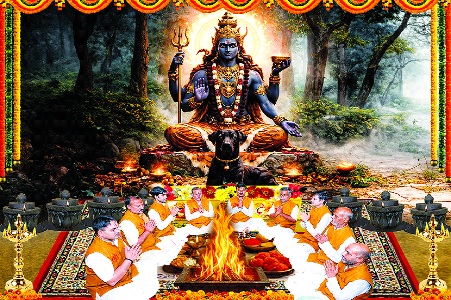

In Hindu spirituality, the divine is worshipped in many forms, each reflecting a different aspect of existence. Some manifestations represent peace, compassion and creation, while others embody strength, transformation and the destruction of evil. Kaal Bhairav is one such powerful manifestation of Lord Shiva, whose fierce appearance conceals a deeper spiritual purpose.
Revered as the Lord of Time and the guardian of dharma, Kaal Bhairav represents the power that destroys ignorance, punishes arrogance and protects those who walk the path of truth. His presence reminds devotees that time is the ultimate force governing worldly existence and that no human being, irrespective of wealth or power, can escape its influence.
Kaal Bhairav Jayanti, also known as Bhairav Ashtami or Kalashtami, commemorates the divine manifestation of Kaal Bhairav. It falls on the eighth day of the Krishna Paksha (waning phase of the moon) in the Hindu month of Margashirsha, according to the Purnimanta calendar. In 2026, the festival will be observed on December 1.
For devotees, the occasion is an opportunity to seek divine protection, overcome personal fears and renew their commitment to spiritual discipline.
The Legend of Kaal Bhairav’s Birth
The origin of Kaal Bhairav is associated with an important episode in Hindu mythology involving Lord Brahma, the creator, and Lord Vishnu, the preserver.
According to a traditional account in the Shiva Purana, a disagreement arose between Brahma and Vishnu over their supremacy. As their argument intensified, Lord Shiva appeared before them in the form of an enormous pillar of light, known as the Jyotirlinga, which had neither a visible beginning nor an end. He challenged the two deities to discover its limits. Vishnu assumed the form of a boar and travelled downwards in search of its base, while Brahma transformed into a swan and flew upwards to find its summit.
Vishnu eventually accepted his inability to locate the end of the divine manifestation. Brahma, however, falsely claimed to have reached its summit. His dishonesty and arrogance angered Shiva, who manifested Kaal Bhairav to humble him.
In the familiar version of the story, Bhairav severed Brahma’s fifth head. The act symbolised the destruction of false pride and the restoration of cosmic order.
However, the story did not end there. Carrying Brahma’s skull, Kaal Bhairav wandered as a mendicant until he reached Kashi, where he was freed from the burden of the sin. Shiva subsequently established him as the divine guardian of the sacred city.
The legend conveys an important message: even divine power must operate within the principles of cosmic order, and arrogance has no place in the pursuit of truth.
Why Is Kaal Bhairav Known as
the Lord of Time?
The word ‘Kaal’ has several meanings in Sanskrit, including time, death and destiny. ‘Bhairav’ signifies a powerful and fearsome manifestation of the Divine. Together, Kaal Bhairav represents the supreme force that governs time and reminds humanity of the impermanence of worldly existence.
Time is perhaps the greatest teacher. It brings change, tests human character and eventually brings every individual face to face with the consequences of their deeds. Kaal Bhairav symbolises this universal truth.
His worship encourages people to use their time wisely, overcome destructive habits and understand that material possessions and worldly achievements cannot provide permanent happiness.
He is also regarded as the protector against negative forces, fear and obstacles. Devotees believe that sincere prayers to Kaal Bhairav bring courage, confidence and the strength to face difficult circumstances.
The Fierce Appearance and
Its Spiritual Symbolism
Kaal Bhairav is generally depicted with a dark complexion, dishevelled hair, a garland of skulls and multiple arms carrying weapons such as a trident, sword and drum. His fierce appearance represents the destruction of ignorance and the triumph of divine power over evil.
Every element of his form carries a deeper meaning.
n The skulls: They represent the impermanence of life and the inevitability of death.
n The trident: It symbolizes the power to overcome the three fundamental afflictions of existence and destroy negative tendencies.
n The drum: It represents the cosmic rhythm and the eternal cycle of creation and dissolution.
n The dark complexion: It signifies the infinite and all-encompassing nature of the Divine.
n The dog: His vahana represents loyalty, alertness and protection.
His frightening appearance is therefore not intended to terrify devotees. Rather, it represents the destruction of fear itself. He is fierce towards evil but compassionate towards those who approach him with sincere devotion.
Kaal Bhairav, the Guardian of Kashi
Among the many sacred traditions associated with Kaal Bhairav, his relationship with Varanasi holds exceptional importance.
Kashi, regarded as one of the oldest continuously inhabited cities in the world, is considered a sacred place of spiritual liberation. Here, Kaal Bhairav is worshipped as the Kotwal, or divine guardian, of the city.
According to religious tradition, Lord Shiva entrusted him with the responsibility of protecting Kashi and maintaining its spiritual sanctity. Devotees believe that seeking his blessings is an important part of a pilgrimage to the holy city.
The famous Kaal Bhairav Temple in Varanasi attracts thousands of worshippers throughout the year. Devotees offer flowers, incense, mustard oil and prayers, seeking protection from difficulties and guidance on their spiritual path.
His association with Kashi reflects a profound belief: the journey towards liberation requires discipline, humility and freedom from ego.
Observing Kaal Bhairav Jayanti
The festival is marked by fasting, temple visits, devotional singing and special prayers. Devotees wake up early, bathe and prepare their homes and prayer spaces for worship.
An image or idol of Kaal Bhairav is placed on an altar and worshipped with flowers, incense, lamps and traditional offerings. Many devotees light a mustard oil lamp and offer black sesame seeds, coconut and sweets according to their family traditions.
Special significance is attached to evening and night worship. Temples organise devotional programmes, recitations and aarti, while devotees chant the deity’s name and seek his blessings.
Reciting the Kalabhairava Ashtakam, a devotional hymn traditionally attributed to Adi Shankaracharya, is another important practice.
The mantra commonly chanted by devotees is:
Om Kaal Bhairavaya Namah.
It is recited as an expression of surrender and devotion, with the intention of seeking courage, protection and spiritual strength.
Many devotees observe a day-long fast. Some abstain from food, while others consume fruits and milk. The fast is concluded according to individual religious customs after prayers.
Feeding Dogs: An Act of Devotion
One of the distinctive customs associated with Kaal Bhairav worship is feeding dogs. In Hindu tradition, the dog is regarded as his vehicle and is associated with vigilance, loyalty and protection.


Be the first to comment