Tag: Kenya

  • US deploys small team of military advisers to Somalia

    US deploys small team of military advisers to Somalia

    WASHINGTON (TIP): The United States has sent a handful of military advisers to Somalia in recent months to help bolster an African Union force fighting Islamist militants there, officials said on January 10. The deployment marks the first stationing of US troops in the troubled country since 1993, when two Blackhawk helicopters were shot down and 18 Americans were killed in a disastrous operation. “The US has established a military coordination cell in Somalia to provide planning and advisory support to the African Union Mission in Somalia (AMISOM) and Somali security forces to increase their capabilities and promote peace and security throughout Somalia and the region,” US Africa Command spokesman Colonel Tom Davis said in a statement.

    The small team, which was launched in October and became fully operational last month, numbers “fewer than five” troops, a defence official told AFP on condition of anonymity. The troops will be based at Mogadishu airport, working alongside the AU mission to confront resurgent extremist militants, the official said, confirming the previously undisclosed deployment. The African Union mission supports Somali government forces, which have rolled back Shebab fighters out of key cities over the past 18 months. The US move comes as Washington steps up military assistance across Africa amid growing concern over Al-Qaida-linked militants in Libya, Mali, Somalia and other countries. The Pentagon has provided cargo aircraft and intelligence to French forces battling Islamists in Mali and uses airfields in Djibouti, Ethiopia and elsewhere to fly US drone aircraft.

    In October, Navy SEAL commandos carried out a raid on the seaside home of a al-Shabaab militant but the operation had to be aborted and the operative was not captured. Although the al-Shabaab militia has suffered battlefield setbacks in Somalia, it has orchestrated a number of attacks in other East African countries, including a bloody four-day siege of a shopping centre in Nairobi in September that killed dozens. The UN security council in November approved an increase of 4,400 troops to the African Union mission in Somalia, expanding it from 17,700 to more than 22,100. The force is comprised of troops from Burundi, Djibouti,Kenya, Sierra Leone and Uganda. For the United States, the deployment of a handful of advisers reflects a gradual shift in approach as previously any boots on the ground were considered out of the question given the 1993 debacle in Somalia,which later became the subject of a best-selling book and film, “Blackhawk Down.”

  • Seventy-two people

    Seventy-two people

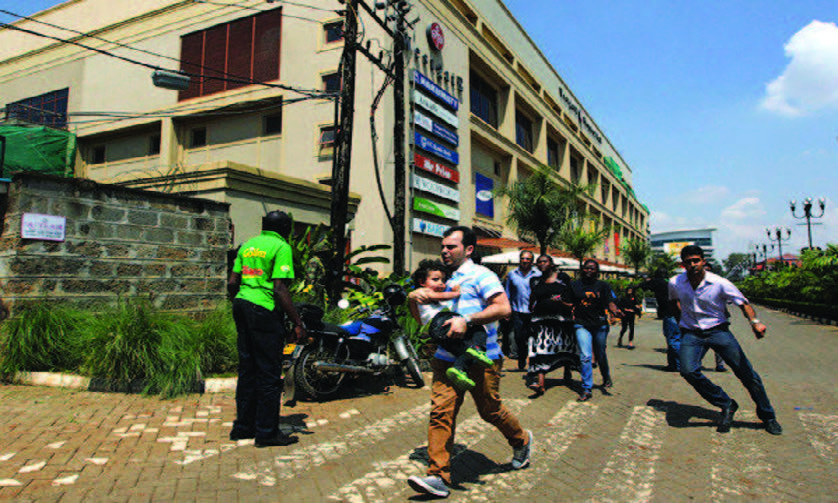
    Seventy-two people were killed after the famous Westgate Shopping Mall in Nairobi in Kenya was attacked by unidentified gunmen on September 21.

  • DR. TINNA RUNS HIS 22ND MARATHON

    DR. TINNA RUNS HIS 22ND MARATHON

    NEW YORK (TIP): Dr. Avtar Singh Tinna, a dentist by profession, has added yet another Marathon to his long career in running Marathons. On Sunday, November 3rd, 2013, he ran his 22nd NYC Marathon. Since 1991, Dr. Tinna has been a regular in the 26.2-mile New York City Marathon-running with his club -Sikhs of America. Donning their signature Tshirts labeled “Proud to be a Sikh” the teammates run with their saffron (kesri) turbans, attracting an enormous crowd of spectators as they trek through the city’s five boroughs. This year, in fact, a staggering 2 million spectators watched the event along on the city’s streets and more than 315 million via international live broadcast. A new addition this year to Dr. Tinna’s loud pageantry was the fact that he ran the entire race while carrying a Nishan Sahib, the sacred flag of the Sikhs. He ran this year alongside his two friends (and strong patrons of the community) Satnam Singh Parhar and Dr. Ashok K. Dogra. Dr. Tinna, a dentist by profession, maintains a practice in Queens, New York City.

    He was born in Punjab, India in the village of Seh Jhangi, Jalandhar. Having studied at DAV College in Jalandhar and graduating from Punjab Government Dental College and Hospital in Amritsar, Dr. Tinna moved to New York in 1980 where he lives with his wife and four children. Famed marathoner Fauja Singh, a 102- year old Sikh from the United Kingdom captured the attention of the Guinness Book of World Records. As it so happened, Dr. Tinna himself personally drew crowds this week-many runners and supporters frantically cheering “Fauja Singh! Fauja Singh!” as he made his trek. Nevertheless, Dr. Tinna and Fauja Singh do share some history: in 2003, Sikhs in America invited Fauja Singh to run the NYC Marathon. This proved to be a pivotal moment for Fauja Singh, earning him the world’s admiration in this prestigious event. Since the 2003 Marathon, the two have maintained an appreciable personal and professional correspondence. According to Dr. Tinna, he runs for Sikh identity.

    Championing for years a place for the Sikhs in an increasingly globalized society, Dr. Tinna encourages young Sikhs to take up the cause and run. Dr. Tinna trained Satnam Singh Parhar and Dr. Ashok Dogra both in their sixties who ran for the first time and completed the Marathon quite comfortably. If anyone is interested in participating in next year’ s Marathon please feel free to contact Dr. Tinna at 718-291-1200. It was heartening to find that many Indian ran the Marathon this year. Besides Satnam Singh Parhar and Dr. Ashok Dogra, others who ran included Mandeep Singh Sobti, Piara Singh, Lakhvir Singh and Hamesh Singh, all of the Sikhs. Is it an impact of Bhaag, Milkha, Bhaag? Marathon 2013 had 50,304 runners participating. It was the 43rd NYC Marathon. Last year there was no Marathon because of the Superstorm Sandy. The Marathon this time had a tighter security in view of an earlier terrorist attack in Boston in the month of April. Geoffrey Mutai of Kenya was the first male to finish in 2:08:24 and the female to finish first was Priscah Jeptoo of Kenya who finished in 2:25:07.

  • India looks to the Diaspora with a lot of Expectations – BOB CMD Mundra

    India looks to the Diaspora with a lot of Expectations – BOB CMD Mundra

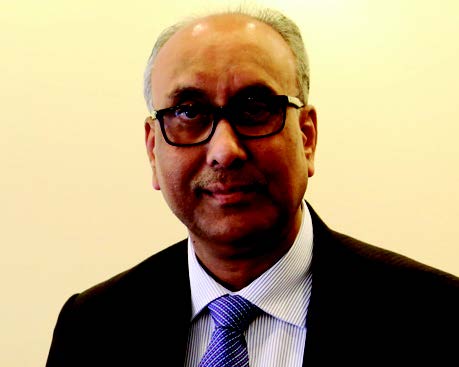
    Bank of Baroda Chairman and Managing Director, Mr. S.S. Mundra visited New York from September 16th to 18th. It was his first visit to New York after he took over as Chairman and Managing Director of the second largest public sector bank of India, second only to State Bank of India. Mr. Mundra met with customers and the Indian American community and also launched the internet banking. A reception to Mr. Mundra was hosted by the Indian Consulate where he met the Consul General Dnyaneshwar Mulay and a cross section of Indian American community.


    img49

    He also addressed the gathering and spoke about banking industry in general and, the Bank of Baroda operations in US in particular. He spoke about the synergy that can be developed through Bank of Baroda. Mr. S. S. Mundra was born on 18th July, 1954. After completing his Masters in Commerce, he joined Bank of Baroda as a Probationary Officer on 21st March, 1977. In his first stint in Bank of Baroda, he rose to the level of General Manager in 2007. During his illustrious career in Bank of Baroda, he held several challenging assignments which included a stint as Head of Bank’s Maharashtra & Goa Zone and Global Treasury Operations for over 5 years. During his overseas assignments, he served with Bank of Baroda (Uganda) Ltd. and was also Territorial Head of Bank’s European Operations, headquartered at London during the period 2008 – 2010.

    Mr. Mundra was elevated as Executive Director in Union Bank of India in September, 2010. During his tenure at Union Bank of India, he handled many important portfolios including Treasury, International, Large Corporate and Alternate Channels. On his elevation as Chairman and Managing Director on 21st January, 2013, he joined Bank of Baroda a premier Public Sector Bank (PSB) in India having a branch network of over 4000 branches including Bank’s overseas operations spread over 24 countries with a global business of over INR 8 trillion (USD 131 bn). Bank of Baroda is second largest Public Sector Bank of India only after State Bank of India in terms of Balance Sheet size.


    img51

    It has 100 branches/ offices outside India. He is on the Board of many national and international organizations which include EXIM Bank, National Institute of Bank Management (NIBM), Bank of Baroda (Uganda) Ltd., India International Bank Malaysia Bhd, Bank of Baroda (New Zealand) Ltd., BOBCARDS Ltd., India First Life Insurance, Baroda Pioneer Mutual Fund etc. He has remained Director on the Board of The Clearing Corporation of India Ltd. (CCIL), Central Depository Services (India) Ltd. (CDSL), MITCONConsulting and Engineering Services Ltd., BOB Asset Management Company, India Infrastructure Finance Corporation (UK) Ltd. (IIFCL), Star Union Dai-Ichi Life Insurance Company Ltd., National Payments Corporation of India Ltd (NPCI) and Bank of Baroda (Kenya) Ltd. He has also served on many Committees of RBI, IBA, NIBM, CII etc.

    He has also attended many training programs, seminar/ conferences both in India and abroad, in the area of Banking and Finance. He has widely traveled abroad. The countries he visited include UK, Belgium, France, USA, Japan, China, Hong Kong, Singapore, various African countries etc. With the blend of wide overseas and domestic banking exposure at top management level, he has immensely contributed to the improvement of policy framework of the banking industry. As recognition of his contributions in the field of banking, finance, industry and commerce, he has won many Awards and accolades, latest being his inclusion in the list of India’s top 100 CEOs in CD-ET (Corporate Dossier – Economic Times) Survey after a stringent process of selection while Bank of Baroda is also ranked as 20th Best Indian Brand by Brand Equity – Economic Times.

    The Indian Panorama chief editor Prof. Indrajit S Saluja interviewed Mr. Mundra. Here are excerpts from the interview.

    Q. You have launched internet banking. How does it help your customers?

    In today’s wired world, customers should have the right to have information in real time. At the moment, we are providing to our customers viewing facility. As of now, we are not providing transaction facility, which is a little complicated affair. However, there is no fee for the facility we are providing.

    Q. When, do you think, you will provide the real time transaction facility?

    There has to be an enhanced security level. Also, there has to be a higher comfort level for both the customers and the bank before we can go in for providing this facility. Q. Are there any legal or procedural difficulties in providing transaction facilities? Not so. Internet banking is an internationally accepted practice. There is no legal problem, as such. Yes, there could be procedural problems. There has to be a robust procedure that ensures the comfort level of customers. After all, the facility is meant to give comfort to customers.

    Q. What are your impressions of your meetings with customers here?

    I am glad our customers spoke highly of the services being provided by New York branch. All felt very happy with the staff and the cooperation they were getting.We look forward to long term relationship with our customers.We believe in making and cementing relationship. Of course, some suggested that we start retail banking. But then, there is no plan with the bank as of now.

    Q. We hear of banks in India committing irregularities and being pulled up. Did your bank ever face this kind of situation?

    We are a conservative bank, so to say.We are acutely compliant. There has never been a complaint about our not being compliant. However, there could some times be some small and inconsequential matters. But there always is room for improvement. Please remember, we are the second largest public sector bank, after State Bank of India.We have 42,000 employees and a customer base of 50 million. The total business of the bank, as on 31st march, 2013 , was 8 lac 50 thousand crore.

    Q. What do you think about the future of Indian economy?

    I believe the fundamentals of Indian economy are very strong. From a distance, the Diaspora may some times not be able to see the clear picture and have misgivings about the strength of the economy. But let me assure the Diaspora that Indian economy is strong and has the capacity to withstand knocks.

    Q. Your message to the NRIs?

    Indians abroad are doing very well. They are doing good to their genetic mother and also to their adopted mother. India is proud of them. And India looks up to them with great expectations.

  • Interpol issues Red alert for the ‘White Widow’ after Nairobi attack

    Interpol issues Red alert for the ‘White Widow’ after Nairobi attack

    LONDON (TIP): Interpol on Thursday issued an international wanted people alert known as the Red Notice for the arrest of British motherof- three Samantha Lewthwaite for her role in the recent terrorist attack in Nairobi. Known around the world as the “White Widow,” Interpol has circulated the arrest notice to all 190 Interpol member countries including India. Red Notice is one of Interpol’s most powerful tools in tracking international fugitives. The global security watchdog said the notice is being issued at the request of authorities in Kenya. Lewthwaite is the widow of Germaine Lindsay, one of the four bombers involved in the July 7 terror attacks in London in 2005 in which 52 people were killed and many more injured. Lewthwaite is the prime suspect behind the Mumbai-style Nairobi shopping mall massacre which has killed nearly 70 people. Interpol secretary general Ronald K Noble said, “Lewthwaite, aged 29, who is also believed to use the alias ‘Natalie Webb’, is wanted by Kenya on charges of being in possession of explosives and conspiracy to commit a felony dating back to December 2011. By requesting an Interpol red notice, Kenya has activated a global ‘tripwire’ for this fugitive.”

    He said that the public’s help in identifying and locating the white widow fugitive was crucial. “Through the notice, Kenyan authorities have ensured that all 190 member countries are aware of the danger posed by this woman, not just across the region but also worldwide,” said the head of Interpol. Containing identification details and judicial information about a wanted person, the red notices communicate to police worldwide that a person is wanted by a member country and request that the suspect be placed under provisional arrest pending extradition. Daughter of a former British soldier, Lewthwaite is one of Al Qaeda’s primary recruiters in east Africa besides being the official spokesperson for the banned outfit Al-Shabaab. On the run for the past year, she is wanted in several countries including UK for terrorist activities. She is originally from Northern Ireland and holds a British passport. The terrorist group has taken responsibility for the Nairobi attack. The Kenyan anti-terrorist police recently revealed a video footage showing a balaclava clad white woman holding a gun and controlling the terrorist operation from within the mall. In a Twitter message later, Al- Shabaab praised the “White Widow” – the mother of three and boasted that she was with them.

  • BOB Chairman & MD visiting New York

    BOB Chairman & MD visiting New York

    NEW YORK, NY (TIP): Bank of Baroda Chairman and Managing Director, Mr. S.S. Mundra will be visiting New York from September 16th to 18th. It is the first visit of Mr. Mundra to New York after he took over as Chairman and Managing Director of one of the largest public sector banks of India. Bank of Baroda Chief Executive for Americas, Mr. Dhimant Pradyumna Trivedi informed TheIndian Panorama that during his visit to New York Mr. Mundra would be meeting customers and the Indian American community besides launching internet banking. Mr. Trivedi said that a reception to Mr. Mundra is being hosted by the Indian Consulate on Monday, September 16th where he will be meeting the Consul General Dnyaneshwar Mulay and a cross section of Indian American community.

    He will also address the gathering and, while talk about banking in general, he is likely to speak about the synergy that can be developed through Bank of Baroda. Read below a brief biography of Mr. Mundra. Mr. S. S. Mundra was born on 18th July, 1954. After completing his Masters in Commerce, he joined Bank of Baroda as a Probationary Officer on 21st March, 1977. In his first stint in Bank of Baroda, he rose to the level of General Manager in 2007. During his illustrious career in Bank of Baroda, he held several challenging assignments which included stint as Head of Bank’s Maharashtra & Goa Zone and Global Treasury Operations for over -5- years. During his overseas assignments, he served with Bank of Baroda (Uganda) Ltd. and was also Territorial Head of Bank’s European Operations, headquartered at London during the period 2008 – 2010.

    Mr. Mundra was elevated as Executive Director in Union Bank of India in September, 2010. During his tenure at Union Bank of India, he handled many important portfolios including Treasury, International, Large Corporate and Alternate Channels. On his elevation as Chairman and Managing Director on 21st January, 2013, he joined Bank of Baroda a premier Public Sector Bank (PSB) in India having a branch network of over 4000 branches including Bank’s overseas operations spread over 24 countries with a global business of over INR 8 trillion (USD 131 bn). Bank of Baroda is second largest Public Sector Bank of India only after State Bank of India in terms of Balance Sheet size.

    It has 100 branches/ offices outside India. He is on the Board of many national and international organizations which include EXIM Bank, National Institute of Bank Management (NIBM), Bank of Baroda (Uganda) Ltd., India International Bank Malaysia Bhd, Bank of Baroda (New Zealand) Ltd., BOBCARDS Ltd., India First Life Insurance, Baroda Pioneer Mutual Fund etc. He has remained Director on the Board of The Clearing Corporation of India Ltd. (CCIL), Central Depository Services (India) Ltd. (CDSL), MITCONConsulting and Engineering Services Ltd., BOB Asset Management Company, India Infrastructure Finance Corporation (UK) Ltd. (IIFCL), Star Union Dai-Ichi Life Insurance Company Ltd., National Payments Corporation of India Ltd (NPCI) and Bank of Baroda (Kenya) Ltd. He has also served on many Committees of RBI, IBA, NIBM, CII etc. He has also attended many training programs, seminar/ conferences both in India and abroad, in the area of Banking and Finance. He has widely traveled abroad.

    The countries he visited include UK, Belgium, France, USA, Japan, China, Hong Kong, Singapore, various African countries etc. With the blend of wide overseas and domestic banking exposure at top management level, he has immensely contributed to the improvement of policy framework of the banking industry. As recognition of his contributions in the field of banking, finance, industry and commerce, he has won many Awards and accolades, latest being his inclusion in the list of India’s top 100 CEOs in CD-ET (Corporate Dossier – Economic Times) Survey after a stringent process of selection while Bank of Baroda is also ranked as 20th Best Indian Brand by Brand Equity – Economic Times

  • Bolt made to work for 100m win at Weltklasse

    Bolt made to work for 100m win at Weltklasse

    ZURICH (TIP): Usain Bolt considered it his worst race of the season, yet he still won the 100 meters at the Weltklasse Diamond League meeting in 9.90 seconds. The world and Olympic champion had the slowest reaction out of the starting blocks, and was led deep into the race on August 29 (Thursday) by fellow Jamaican Nickel Ashmeade. Bolt got down to work and muscled through the slight headwind to hit the front at the 85-meter mark. Ashmeade clocked 9.94 for second place, and Justin Gatlin of the United States was third in 9.96 “That was the worst race of the season,” said Bolt, who timed 9.95 when losing to Gatlin in Rome in June.

    “The longer the season goes, the worse my style gets. This race, it was really hard. I was a little sore. It’s time to get home now.” With a parade of new world champions in action, the sold-out Zurich stadium fell silent to watch Ukrainian high jumper Bohdan Bondarenko’s latest attempt to break the 20-year-old world record of 2.45 meters set by Javier Sotomayor of Cuba. But Bondarenko crashed through the bar at 2.46. He’d earlier won the event with a clearance at 2.33. In a stirring women’s 5,000 meters duel between Ethiopian greats, Meseret Defar surged past Tirunesh Dibaba in the final straight. Still, Bolt was the main attraction as usual and put on a typical pre-race act for the crowd, taking center stage seconds after Bondarenko’s record attempt.

    The sprinting superstar pressed his hands together in a prayer-like pose, head bowed before breaking into karate-style moves. He bowed again as the camera moved along the line. On a cool evening, Bolt labored at the start and a rare defeat seemed possible at halfway. “The more I run, the worse my reaction time gets,” Bolt acknowledged. “My coach (Glen Mills) knows that when it comes to the end of the season, I am not the perfect athlete.” Yet Bolt allowed himself a smile on crossing the finish, looking across to Ashmeade two lanes on his left and world silver medalist Gatlin two to his right. Like Bolt, Shelly-Ann Fraser- Pryce of Jamaica completed the sprint gold triple of 100, 200 and 4×100 relay this month at the world championships in Moscow. She won a low-key 200 in 22.40 on Thursday. For once, distance runners took the spotlight with a rare Defar vs.

    Dibaba clash outside a major championship. Dibaba, the world and Olympic champion at 10,000, forced a frontrunning pace at the bell, with world and Olympic 5,000 champion Defar poised on her shoulder entering the final straight. Defar passed her great rival with 70 meters to go and extended her lead all the way to the finish, crossing in 14 minutes 32.83 seconds. Dibaba timed 14:34.82. “On the last 100 meters, I am going to 100 percent,” Defar said. The stellar lineup helped pull American Jenny Simpson through to a personal best time of 14:56.26 in seventh place. Americans David Oliver, LaShawn Merritt and Nick Symmonds ran to victories in the 110-meter hurdles, 400 and 800, respectively. World champion Oliver was a clear winner in 13.12 in the hurdles, and Symmonds clocked 1:43.57 in the 800, just two-hundredths outside his season’s best set when taking silver in Moscow. Merritt timed 44.13 to win after holding off a strong challenge from Olympic champion Kirani James of Grenada.

    In the 1,500, world champion Asbel Kiprop placed only sixth, with Kenya compatriot Silas Kiplagat winning in 3:30.97. World champions Eunice Jepkoech Sum of Kenya and Zuzana Hejnova of the Czech Republic sustained their winning form: Jepkoech Sum clocked 1:58.82 in the women’s 800 and Hejnova took the 400 hurdles in 53.32 and completed her Diamond League season unbeaten. Caster Semenya of South Africa, the 2009 world champion, was a distant seventh though ran her season’s best time of 2:01.83. The surprise long jump winner was Zarck Visser of South Africa, only weeks after failing to qualify for the final in Moscow. He won with a personal best leap of 8.32, and world champion Aleksandr Menkov of Russia was sixth, at 7.94. Dwight Phillips, the 2004 Athens Olympics gold medalist and four-time world champion, leaped 7.53 to place eighth in his final event before retiring. “Hopefully I left a great legacy like other big long jumpers like Carl Lewis,” the 35-year-old Phillips said. In shot put events staged Wednesday at Zurich’s central rail station, world and Olympic champion Valerie Adams of New Zealand set a world-leading mark of 20.98 meters to win the women’s event. With a winning mark of 22.03, Ryan Whiting of the US also earned the diamond on offer as season-long champion.

  • Drone strikes in Yemen kill 12 alleged Al Qaeda militants; 2 arrested in Saudi Arabia

    Drone strikes in Yemen kill 12 alleged Al Qaeda militants; 2 arrested in Saudi Arabia

    NEW YORK (TIP): As a security alert kept millions on edge throughout the Muslim world, suspected U.S. drone attacks in Yemen killed 12 alleged militants Thursday, August 8, and Saudi security forces arrested two foreign men they say were plotting suicide attacks in the region, a Los Angeles Times report says.

    The drone strikes and the arrests in Saudi Arabia of a Yemeni and a Chadian — reported to have issued “messages of incitement and hatred” through social media — reflected the intense vigilance pervading police and military forces across the Middle East, Africa and South Asia at the end of the Muslim holy month of Ramadan. The three drone strikes in Yemen brought the total since July 27 to eight and the death toll to 34.

    The stepped-up pace of targeted killings may be thinning the ranks of Al Qaeda-aligned extremists, but it has also intensified anger among Yemeni citizens who consider the aerial bombardments a violation of their sovereignty and a reckless practice that at times kills innocents. The latest drone strikes were reported by the Yemen Post, among other media, which took note of the growing public alarm over the rockets fired from unmanned aircraft. Yemeni authorities tolerate the strikes as they work with U.S.

    special forces to drive out Al Qaeda-affiliated militants who took refuge in the mountainous hinterlands two years ago, when the country was racked by widespread protests against then-President Ali Abdullah Saleh. The autocrat who ruled for more than 30 years was forced out early last year and replaced by Abed Rabbo Mansour Hadi, who has collaborated with U.S. forces in a campaign to eradicate the strongholds where terrorists train and plot attacks on Western targets.

    Counter-terrorism efforts have been directed at Yemen in recent days because of intercepted militant “chatter” that suggested terrorist attacks were being plotted between the head of the global Al Qaeda network, Ayman Zawahiri, who is believed to be in Pakistan, and its Yemeni affiliate, Al Qaeda in the Arabian Peninsula. Intelligence sources have said that Zawahiri has deputized AQAP leader Nasser Wuhayshi to carry out plots against U.S. and Western citizens and interests in connection with Wednesday’s end of the Muslim holy month of Ramadan and the Eid al-Fitr holiday.

    The U.S. State Department issued a worldwide terror alert Friday and closed more than 20 embassies and consulates in the Muslim world to protect its staff in the event of an attack. American diplomats based in Yemen’s capital, Sana, were evacuated from the country Monday, as were British and French nationals. Yemeni security officials reported Wednesday that they had foiled an Al Qaeda plot to seize two port cities on the Gulf of Aden and blow up pipelines and other vital oil infrastructure.

    Few details were disclosed by authorities, and the claimed thwarting of the attack did little to ease fears of impending violence in the region. On Thursday, the Saudi Press Agency reported the arrest of two men it said had “recruited themselves” and discussed via social media plans to launch suicide operations. Neither the nature nor the targets of the alleged plot were disclosed.

    In addition to the religious holiday, this week marks the 15th anniversary of the Aug. 7, 1998, synchronized bombings of U.S. embassies in Kenya and Tanzania, which killed 223 people and wounded more than 4,000. The attacks were the first major demonstration of Al Qaeda’s ability to carry out coordinated operations on multiple targets, a hallmark of its strategy that was seen again three years later on Sept. 11, 2001.

  • OFBJP Organizes Public Reception For BJP President Rajnath Singh

    OFBJP Organizes Public Reception For BJP President Rajnath Singh

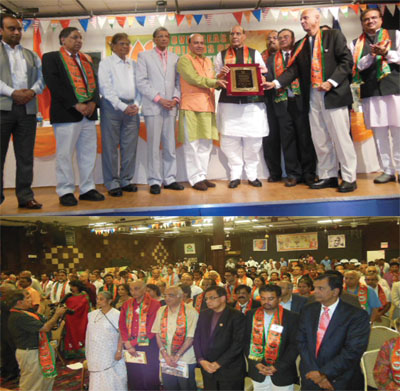
    EDISON, NJ (TIP): Indian American community of tri-state area (New Jersey, New York, and Connecticut) gave a rousing welcome to Rajnath Singh, President of Bharatiya Janata Party (BJP) and his BJP delegation Ananth Kumar, General Secretary; Sudhanshu Trivedi, National Spokesperson; and Vijay Jolly, Convener of Overseas Affairs and Overseas Friends of BJP (OFBJP) in TV Asia Studio Auditorium at Edison, NJ on Sunday July 21, 2013. The program was organized by OFBJP-USA as part of its community global outreach program.

    The program was broadcasted live on TV Asia across US reaching out to 1.5 million viewers. The program was also relayed live in India, Canada, UK, Europe and Middle East thru various channels. Addressing the jam-packed auditorium, Rajnath Singh said that he was elated by the warm welcome that had been accorded to him by the Indian Americans here in US. He said that trust and credibility have become a big problem in India and BJP is the only option. No party in India has grown bigger than Congress except the BJP.

    BJP is the only party that has not suffered a vertical split. Communists have lost relevance and Congress has no policy on any of the issues nor has any ideology. Since its inception in 1951 as Bharatiya Jan Sangh and later on as BJP, the party has been pursuing a policy of Nation first. He continued that Atal Behari Vajpayee led a 24 party coalition for 6 years and the NDA rule was far better than 55 years of Congress rule in every aspect.

    Corruption, Inflation and price rise are the signature of congress rule whereas NDA government controlled the inflation and price rise in spite of the prevailing severe drought and economic sanctions imposed by the entire West after Pokhran nuclear tests. NDA inherited a GDP growth of 4.8% and 10% inflation whereas BJP handed UPA a GDP of 8.4% and inflation 3.5% in 2004. Amidst applause from the audience he said that Pokhran test was a big step wherein the BJP led govt made India a nuclear power even though we knew economic sanctions were staring at us.

    Countries that are much smaller have become developed countries but India is still a backward country and not sure why 55 years of Congress rule did not change much. Congress has to answer as to how much time they need to make India better, to remove poverty. BJP invited FDI in telecom sector but encouraged Indian investors whereas Congress has opened up the telecom sector 100%, increased in the LIC sector from 26% to 49%. Foreign investors have pulled out $7.5 billion from India and no one is ready to invest.

    Even after 60 years of Independence we still have 67% of people who don’t get food and we need a food security bill. We need leaders with firm conviction and leaders with vision and when we come in power we will make India a super economic power in 10-15 years. National Highway development has seen tremendous growth during NDA rule. 50% of the highways that were built during 1980-2012 happened during 6 years of NDA rule and the other 50% were built during 26 years of non-BJP rule.

    Gujarat development has become a role model across the world. Madhya Pradesh agricultural growth (19%) is the highest in the world and very soon will be providing 24hrs of power supply. Chhattisgarh PDS system serves 90% of the population without any corruption and is a model for other states to emulate. Goa is the only state in India where Petrol is cheaper than Diesel. India has a GDP growth of 4.8% whereas BJP ruled states have 10% GDP growth. UPA government has no plan to tackle Naxalism or terrorism.

    Appeasement has become the state policy whereas BJP never links terrorism to any religion, caste or region. After Mumbai terror attack, Prime Minister made a statement that he will not talk to Pakistan until it gives an assurance that they will control terror activities and not support any groups that work against India but changed all that in a matter of few months. Our foreign policy is at its worst with no friendly neighbors around us. During NDA rule we maintained good relations with Russia and development excellent relations with US.

    We made US our strategic partner. He appealed to the US govt to lift the ban on visa to Narendra Modi, he said on one side US agencies rate Gujarat as the best state and Modiji as an excellent administrator and on the other hand they deny visa to him. It will be better if US takes a decision soon as they will be forced to take a decision anyway later. When BJP comes to power we will make India a power of Rishi and Krishi (knowledge and Prosperity), he said. Indian culture influenced the world for thousands of years.

    We never planned to dominate the world and even Swami Vivekananda came to Chicago on his own and had great influence on the world by his teachings. Citing the example of Newsweek columnist Lisa Miller who stated that by imbibing Yoga, Pranayam, Ayurveda and Organic farming people in the West are becoming Hindus whereas it is a crime in India if you say you are a Hindu.Talking on the recent controversy related to Narendra Modi statement that he is a Hindu and Nationalist, media created and pseudo secularists made a big fuss.

    Professing your Hindu culture became a communal word in India. He said that as per the Supreme Court, Hindutva is a way of a life. Hindutva teaches love not only for human beings but even for animals, plants, rivers, mountains etc. It is Hindutva that teaches us to serve milk to a snake and take care of animals like ants and birds. He called on the Indian American Community to support BJP to build a strong India.

    Shri Rajnath Singh was accorded standing ovation. Shri Rajnath Singh was honored by the OFBJP executive committee with a plaque for his contributions to the party and the country. Earlier, Ram Rakshpal Sood (Sr.Advisor, OFBJP) acting as the Emcee welcomed the audience, chief guests and the sponsors of the event. After the traditional lamp lighting ceremony amidst the chanting of Vedic mantras by Pandit Pravin Shastri and Chandrakant Trivedi and blowing of conch shell by Pravin Shashtri. Mrs. Vidya Labroo led the rendition of Vandemataram.

    Jayesh Patel (President, OFBJP) welcomed the distinguished guests and said that entire India is chanting Narendra Modi (NaMo) mantra and expressed hope that BJP will be able to get majority on its own merit in the next election. Ram Kamath (General Secretary, OFBJP) introduced Dr. Mahesh Mehta, National Coordinator of OFBJP-USA. Speaking on the occasion, Dr. Mehta said that mission 2014 is about transforming India into a global leader and Global Indians should contribute to be the part of this great movement that will eventually contribute to the development of India.

    Dr. Adapa Prasad (Immediate Past President) introduced Vijay Jolly, Convener of BJP Overseas Affairs and OFBJP, as a dynamic leader and former MLA who took on Delhi Chief Minister during the last election.

    In his electrifying speech, Vijay Jolly urged the audience to applaud for Rajnath Singh for honoring the feelings of the people by making NaMo as the chairman of the campaign committee. Stressing the fact the OFBJP is on a mission to develop leaders by inducting youth into the organization to dethrone the corrupt Congress regime in India. Stating that NRI’s have always made India proud, he said that OFBJP has setup its chapters in UK, Norway, Nepal, Kenya and other countries to work for the welfare of Indian diaspora.

    He got the past Presidents of OFBJP-USA honored by Rajnath Singh Introducing SudhanshuTrivedi, BJP National Spokesperson, Dr. Dinesh Agrawal (Former- President, OFBJP) said that as the national spokesperson, he is very active effective on TV channels spreading the message and its ideology of BJP. SudhanshuTrivedi reminded that July 21st the day of the program is a historical day when US astronauts landed on the moon. Edison town, the venue of the program, is also a historical town, named after the inventor of light bulb.

    Hence, he said that word Bharat stands for light and inspires us to take India to the pinnacle of glory. Stating that BJP is all set to form the next government is not based on hope but on facts. He concluded reciting a poem by A.B. Vajpayee. R.P. Singh (Org. Secretary, OFBJP) introduced Ananth Kumar, BJP general Secretary. Amidst thunderous applaud from the audience, Shri Ananth Kumar introduced himself as the Hanuman of South as Kishkinda, the birth place of Lord Hanuman is in Karnataka whereas Rajnath Singh is from U.P, the land of Ram. For Ram’s team to win we need Hanuman and he is there to lend services for the party and the country.

    India, he said is going through turbulent times and like A.B. Vajpayee model, we have Gujarat model of development under NaMo leadership and we will soon have NaMo model of governance. He said that BJP is already in battle mode, under NaMo and Rajnath Singh’s leadership we are all set to take on the corrupt congress government. Once in power, BJP will make India a global player not only in spirituality but in culture, strategic matters and will be a decisive player in the world. He urged the NRI’s to connect with their districts back home and work for BJP’s victory in 2014.

    Chandrakanth Patel introduced Rajnath Singh as a man of impeccable image in spite of being in political life for 40+ years. Born in a farmer’s family in Varanasi, he rose to be the president of BJYM. He was part of the J.P movement and became the Agricultural minister in A.B. Vajpayee’s government. He was the President of BJP between 2007-2009 and again became the President in January, 2013.

    Currently, he is a Member of Parliament from Ghaziabad, U.P. Earlier, the President of TV Asia and a well known community leader, Shri H.R.Shah addressed the gathering and said that TV Asia always supported India causes and he has been an admirer of Mahatma Gnadhi and Sardar Patel. He said he felt close to BJP principles and supported BJP. He wished that Narendra Modi would be elected as the Prime Minister. Krishna Reddy (Treasurer, OFBJP) presented the vote of Thanks.

  • Reliance building on real estate interests in Kenya

    Reliance building on real estate interests in Kenya

    MUMBAI (TIP): Reliance Industries is expanding its presence in the real estate sector in Africa. In its second major foray, the Mukesh Ambani-owned Reliance Industries has acquired 10 prime plots of land in Kenya’s capital, Nairobi, for around Rs 202 crore ($33.9 million). The land, which has a developable area of about 1.2 million sq. ft., has been acquired for commercial and residential property development. Reliance Industries’ (RIL) real estate interests in Africa started around 2008, through Delta Corporation East Africa, a local subsidiary.

    According to people familiar with the development, RIL entered Africa’s real estate market with a few small buys. In 2011, the company extended its foray into Kenya’s real estate market with a series of office and residential property developments. The company bought prime plots of land in Nairobi, and developed them for residential and commercial use. In some instances, it also sold or rented plots to global agencies, private firms and some government organisations.

    For the 10 Nairobi plots, Reliance Industries is the major stakeholder with a 60 per cent shareholding, while Delta Corp has a 40 per cent holding. Through Delta Corporation, RIL is currently building office towers in Nairobi’s Upper Hill and Westlands areas. Delta Corporation is also developing a multi-million dollar residential estate along the Athi River. Nilesh Shah, executive director, Delta Corporation East Africa, could not be reached for comment. In a recent annual report, Delta Corporation said it has four projects under development. The company owns around 27.5 acres of land. Real estate major Knight Frank has ranked Nairobi as the city with the fastest growth rate in rentals for high-end commercial property in 2012.

  • Movie Review – Shortcut Romeo

    Movie Review – Shortcut Romeo

    Cast: Neil Nitin Mukesh, Ameesha Patel, Puja Gupta
    Direction: Susi Ganesh
    Genre: Thriller
    Duration: 2 hours 15 minutes

    STORY: A jobless ruffian hits gold when he spots a millionaire memsaab having an extra-marital affair. He blackmails, she betrays – spinning into an endless chase for lust, love and money.

    MOVIE REVIEW: Welcome to the wild – lions, zebras, giraffes, deer, and leopards aplenty (film is shot in the stunning landscapes of Maasai Mara, Kenya). And of course, amongst them all lives the beastly man who hunts, hacks and kills his own kin for survival.

    This story has one such fierce and furious being called Suraj (Neil). His aimless life takes a sudden turn when he spots Monica (Ameesha), a wealthy businessman’s biwi (leading a sexless life) playing ‘ball-games’ at night (read: golf). Suraj sleazily captures her one-night ‘sexcapade’ with her golf-trainer, and blackmails her into being his lifelong ATM. He takes off on a vacation to Kenya, where he meets Sherry (Puja) and love blossoms (surprise!).

    Suddenly turning from loafer to loverboy; greedy for pyaar over paisa. At the other end, Mona darlin’ gives him a tough run for his maal and gal, which ends up in a wild chase where everyone falls prey to the call of the beast. Susi Ganesh has attempted to ‘Bollywoodize’ his first Hindi film (remake of Tamil film Thiruttu Payale). Desperately throwing in Munnis, Sheilas & Jalebi bais – of Kenyan origin. There are twists and (blind) turns, over-dramatized scenes with little shock value that’s mostly predictable.

    The supporting cast and dialogues (sample this: “Ek baar karogi toh galti lagegi, baar baar karogi toh style ban jayega”. Oof!) paralyze the feeble screenplay. Kenya is well shot; action junkies may enjoy some fight sequences and the climax saves the day. The songs puncture the pace and the plot doesn’t pulsate with the edginess of a thriller. Neil performs well as always, he looks good (he needs to tone down his physicality for such roles) and proves that actors like him need better scripts to justify their true potential. Ameesha is competent in her evil element. Puja makes a pretty picture with little scope to perform.

  • In A First, UK Pays Kenyans £20 Million For The Torture During Colonial Rule

    In A First, UK Pays Kenyans £20 Million For The Torture During Colonial Rule

    LONDON (TIP): Britain on Ju ne 6 announced its first ever financial compensation for those tortured under its rule. In a development that could pave the way for many other claims from around the world including from India, UK foreign secretary William Hague announced a compensation payment of £19.9 million for 5,228 elderly Kenyans tortured during the Mau Mau uprising. UK has also said it will support the construction of a memorial in Nairobi to the victims of torture and illtreatment during the colonial era. Hague admitted that the British used capital punishment on a large scale and sanctioned harsh prison regimes in their colonies.

    He said, “The British Government recognizes that Kenyans were subject to torture and other forms of ill treatment at the hands of the colonial administration. The government sincerely regrets that these abuses took place, and that they marred Kenya’s progress towards independence. Torture and ill treatment are abhorrent violations of human dignity which we unreservedly condemn.

    ” In December this year, Kenya will mark its 50th anniversary of independence from Britain. During the eight-year Mau Mau insurgency, up to 30,000 Kenyan deaths were recorded, both insurgent and loyalist. Around 80,000 to 300,000 people were detained in a network of camps, where many were tortured.

  • TCS FORAYS INTO US GOVT SPACE

    TCS FORAYS INTO US GOVT SPACE

    BANGALORE (TIP): After tasting fair amount of success in India and a few other emerging countries, Tata Consulting Services (TCS), India’s leading information technology (IT) services company, is foraying into the government vertical in the US. Initially, the company is focusing on states and local governments in the US, as working with the federal government requires it to fulfil stringent conditions.

    Among US states, TCS has already started working with the Mississippi government and is in the process of bagging a contract from another state, an announcement on which is expected soon. “We are mostly focusing on state and local governments and we are finding a lot of traction in the unemployment insurance and city taxation areas because of our expertise in working on tax automation with a number of states in India,” Tanmay Chakrabarty, vicepresident & global head (government industry solutions unit, TCS, told Business Standard.

    He said the company had already made inroads into the city taxation space in the US, through which cities collect taxes on behalf of the federal, state and local governments. The company is implementing tax automation systems in seven cities across the US. TCS has wide experience in automating tax collection in India — it automated value-added tax collection in 13 states. Subsequently, it also worked with a few countries in east Africa, including Uganda, Zambia and Kenya, in automating their taxation systems.

    For TCS, the government business unit is one of the fastest growing areas, growing 35-40 per cent a year. Chakrabarty said though the business unit was a single-digit contributor to the company’s overall revenues, “our target is to make it a double-digit revenue contributor in the next three years”. For the year ended March, TCS reported revenues of Rs 62,989 crore ($11.6 billion).

    Industry experts say so far, TCS is the most successful company in the government vertical in India, compared to other Indian or global IT services companies. Despite the belief that government business wasn’t substantially profitable, TCS made early investments in developing specific solutions and frameworks to address issues involving governance. Now, the company is trying to replicate its success in this segment in a few emerging countries in the east Africa and Latin America, as well as developed markets such as the US and the UK.

    Recently, the company had bagged a core system integrator contract from the Department of Posts, tipped as one of the most prestigious egovernance contracts in the country. The contract was valued at about Rs 1,100 crore. It was said this was the second-largest contract for the company in Indian government space, after the Rs 2,000-crore Passport Seva Project of the Ministry of External Affairs.

    “Our philosophy is to build in India, demonstrate the scale and complexity here, and then take it to the rest of the world. That is what we are doing,” Chakrabarty said. TCS is also focusing on countries such as Columbia and Mexico, targeting opportunities in their financial and healthcare segments.

    Passport Seva completes 3 years in Bangalore
    Passport Seva Project, the mission mode programme of the Ministry of External Affairs, has completed three years of operations in Bangalore. In 2010, a pilot phase of the project was launched in Bangalore. Since the project was implemented, 1.17 million passport applications have been processed in Bangalore. TCS had bagged the project in 2008.

  • Maryland honors Bollywood director at Shortcut Romeo promo event

    Maryland honors Bollywood director at Shortcut Romeo promo event

    NEW YORK (TIP): State of Maryland has honored Bollywood film director Susi Ganeshan with a citation for his contribution to Indian cinema. Recalling his 15 years of service and hard work to promote Indian movies, especially Tamil and now Hindi, Maryland Governor Martin O’Malley said in his citation that the State of Maryland is proud to bestow the honor for his contribution to the entertainment industry.

    Dr. Rajan Natarajan, Deputy Secretary of State of Maryland and one of the highranking Indian-American political appointees, presented the citation signed by Governor Martin O’Malley and the replica of great seal of the State of Maryland to Ganeshan at an event in New York attended also by Bollywood actress Puja Gupta, the heroine of his soon-to-be released movie Shortcut Romeo. Dr. Natarajan said Maryland is keen to support Bollywood and would provide all facilities to filmmakers keen to shoot movies in his picturesque state.

    The Governor led a delegation to India recently and is keen on doing business with India. Recently, during his trip to Chennai Dr. Natarajan met with Superstar Rajnikanth and bestowed on him special honor by Maryland Governor. Ganeshan and his team were in New York to promote their latest Bollywood movie Shortcut Romeo after screening the movie and doing red carpet at Cannes Film Festival along with Ameesha Patel and Puja Gupta. Addressing a press conference in Tulsi restaurant last week organized by Varli Media, Molecule Communications and Pria Haider, actress Puja Gupta said as an actress she doesn’t have any limitations.

    “I don’t have any limitations as an actor. As an actor you shouldn’t limit yourself. An actor should have the liberty to do whatever they want to and the director is the one who will decide.” The model-turned-actress has featured in two films F.A.L.T.U. and Go Goa Gone so far and said: “I love that I have become an actress. I never thought I will be an actress. I will try to do the best with the roles given to me…I will do bold roles if I am comfortable with it.

    “The 24-year-old describes Ameesha Patel, with whom she will share the screen space in Shortcut Romeo, as a “wonderful costar”. “She is so gorgeous. She is senior to me and has spent a decade in the industry. There is lot to learn from her.” This is Susi Ganeshan’s first Hindi movie and the remake of Tamil Nadu Government award winning Tamil movie Thiruttu Payale.

    Ganeshan addressed several differences between the two versions, starting with, Why a remake in the first place? Noting a current trend for remakes in Indian cinema, Ganeshan pointed to the vast Bollywood marketplace-and audience for Bolly films–compared with that of Tamil language films. He then related the challenges faced by a director who decides to remake one of his own films.

    To distinguish Shortcut Romeo from Thiruttu Payale, Ganeshan chose a different location, setting it in Kenya instead of India and Australia. He said Kenya provided a location unexposed to Indian film goers, who have now journeyed just about everywhere else in the world on screen. “I filmed in Melbourne for the previous film and don’t want to go to a place I previously used,” he explained.

    “As a creator, I get bored if I copy my own stuff.” When shooting the Hindi version he faced a dilemma in differentiating the camera shots from the Tamil original. “There must be a small change at least,” he said. On an even more fundamental plane, he noted that it was “tough learning Hindi,” as his “mother tongue” is Tamil. Hence, it was also tough “finding an exact match” in Hindi for the original Tamil title, with Shortcut Romeo serving to evoke the search among the generation represented by the film’s characters for shortcuts to money, fame and success.

    “The only barrier” he said, “is achieving the right performance, and feel. “Feel” was especially important when it came to the music for Shortcut Romeo, which was composed by hit Bollywood composer Himesh Reshammiya. “He’s a more popular music director than anyone in [Tamilspeaking] South India, and I needed the right music director for the different musical structure of Bollywood,” said Ganeshan. “I explained to him, ‘This is what I want,’ and he gave me a number of options to choose from.

    We came up with the correct mix of melody songs-which I always loveand fast-paced, peppy dance numbers.” He singled out the soundtrack’s “Khali Salam Dua,” a melodic romantic ballad sung by Mohit Chauhan, as did Bollywood newcomer Pooja Gupta, the 2007 Miss India Universe, who has a key role in Shortcut Romeo. “It’s very meaningful music, subtle and mellow, with the beat of the soul,” said Gupta.

    “It touches your heart.” Shortcut Romeo is an Indian romantic crime thriller film directed and produced by Susi Ganeshan under the banner of Susi Ganesh Productions. It is the Hindi remake of the director’s own Tamil film Thiuttu Payale (2006), starring Neil Nithin Mukesh in the title role with Puja Gupta as his love interest and Ameesha Patel in a negative character. The film was screened at Marche du Film at Cannes Film Festival.

    It is releasing on June 21 all over the world. Himesh Reshmmiya has scored the music and N K Ekambaram is the Director of Photography. Dilip Deo and Hardik Singh Reen have taken care or editing. Susi Ganeshan has directed some award winning movies in Tamil such as Virumbukiren, Five Star, Thiruttu Payale and Kanthaswamy.

  • Hero MotoCorp starts ops in Africa, LatAm

    Hero MotoCorp starts ops in Africa, LatAm

    NEW DELHI (TIP): The country’s largest twowheeler maker, Hero MotoCorp, said it had commenced operations in Africa, Latin and Central America. Pawan Munjal, managing director & chief executive officer, Hero MotoCorp, said: “We have started despatches to our new international markets in Central and Latin America and Africa. Our first consignments of twowheelers have already been shipped to Peru in Latin America, El Salvador, Guatemala and Honduras in Central America and to Burkina Faso and Ivory Coast in Africa.” The company is set to despatch the first lot of twowheelers to Kenya later this month. It has already appointed new distributors and channel partners in these markets, where retail sales of the Hero two-wheelers is likely to commence in the first quarter of this financial year. Hero motorcycles to be sold in these markets include a mix of models from the 100cc and 125cc range.

    Hero MotoCorp has earmarked Rs 1100 crore as capital expenditure for the current financial year. It includes an investment of about Rs 600 crore on the company’s upcoming fourth plant and global parts centre at Neemrana, and Rs 100-150 crore on a state-ofthe- art integrated R&D centre at Kukas (near Jaipur in Rajasthan). These initiatives are in line with Hero MotoCorp’s vision of reaching a total of 10-million unit volumes in a few years’ time, and garnering a million units — 10 per cent of that — from international business. The company currently registers around 2.5 per cent of its volumes from sales in overseas markets. To meet this objective, the company has already short-listed as many as 30 countries across Latin America, Central America, Africa and South East Asia. Colombia is the only country in Latin America where Hero MotoCorp currently exports to. The other international markets where Hero two-wheelers are sold include Sri Lanka, Bangladesh and Nepal.

  • Raina, Rohit Lead India To Series Triumph

    Raina, Rohit Lead India To Series Triumph

    MOHALI (TIP): As Virat Kohli had promised before the match, the Indian team didn’t leave anything to chance and sealed the one-day series right here with a comprehensive five-wicket win over England. With this win, India have taken an unassailable 3-1 lead in the series, with one match still to play. It was apt that Ravindra Jadeja hit the winning runs on Wednesday, since his allround show throughout the series has helped the team at crucial junctures. India’s 258-run chase was powered by an unbeaten 89 (79 balls; 9×4, 1×6) from Suresh Raina, who was given the Man of the Match award.

    Raina was involved in two fifty-run partnerships, one each with Rohit Sharma (83; 93b, 11×4, 1×6) – playing a new role as opener – and skipper Mahendra Singh Dhoni. The series win will come as some relief for India in home conditions after they lost the Test series to England and an ODI series to Pakistan. India’s chase, though, was far from ideal. In the second erroneous decision of the day, umpire Steve Davis gave Gautam Gambhir out caught behind even though there was a clear gap between bat and ball. England could have had Rohit Sharma too, but Kevin Pietersen couldn’t latch on to a difficult chance at mid-off in the eighth over.

    Virat Kohli (26), after a 52-run partnership with Rohit Sharma, got out tamely, offering a return catch to James Tredwell. The English off-spinner made it four out of four against Yuvraj Singh, having accounted for him in the previous three games too, by trapping the southpaw leg before. At the other end, Rohit Sharma not only completed 2000 one-day runs but went on to score his 13th half-century. Sharma (83) was unlucky to miss out on a century, courtesy a second contentious decision by umpire Steve Davis, who adjudged him LBW though the ball appeared to be missing leg stump. Earlier, Dhoni made sure that his fast bowlers got the best use of a fresh wicket by winning the toss and electing to field. Cook hit Shami Ahmed for three boundaries in the sixth over to break the shackles, but the mounting pressure soon resulted in the wicket of Ian Bell (10), who tried to give Ishant Sharma the charge but only managed to give a skier to Bhuvneshwar Kumar at third man.

    After that Kevin Pietersen and Cook resurrected the England innings, adding 95 runs for the second wicket. Cook brought up his fifty in the 22nd over and went on to score 76 (106 balls; 13×4) but umpire Sudhir Asnani’s error of judgment ended the English skipper’s promising innings. Cook was wrapped on the pads by a quicker delivery from R Ashwin, but the ball had clearly pitched outside leg stump. England slumped to 142/4 by the 37th over but Joe Root, along with Kevin Pietersen, forged a partnership of 78 runs off 56 balls. KP, who had been unusually quiet, suddenly broke loose, hitting Ishant Sharma for 4, 4, and 6 in the 46th over before Ishant uprooted his stumps with a yorker. Root’s unbeaten 57 (45 balls; 8×4, 1×6) gave England the final impetus, but it was not enough.

    ICC ODI Championship
    Team Rating
    India 120
    England 117
    Australia 113
    South Africa 111
    Sri Lanka 110
    Pakistan 107
    West Indies 88
    New Zealand 80
    Bangladesh 78
    Zimbabwe 50
    Ireland 35
    Netherlands 16
    Kenya 11

  • Obama’s Half-Brother Eyes Kenya Political Role

    Obama’s Half-Brother Eyes Kenya Political Role

    KOGELO (TIP): President Barack Obama’s Kenyan half-brother has launched his own political career by announcing his intention to run for a Kenyan county gubernatorial seat in the upcoming March 4 elections. Malik Obama, 54, who shares a father with the US president, said in an interview late on Wednesday that the achievements of his brother have “inspired and challenged” him to get into active politics in his homeland. “When I look at the success that my brother has had in the US, I feel I would have let down my people if I do not follow in his footsteps and end their suffering through dedicated, honest and focused leadership,” Malik said in his ancestral home of Kogelo in western Kenya. The trained economist said he is the right candidate to deal with the “endless cycle of poverty and unemployment that bedevils my people”.

    “I can confidently say that of all the people who are vying for the position, I am the best placed candidate … by virtue of my second name alone, I have the connections to bring development to Siaya,” he said, referring to his home county 100 km from the lakeside city of Kisumu. Although he says he is charting his own path, Malik Obama is using his now famous second name to try and get an edge over his competitors, who include the younger brother of Kenyan Prime Minister Raila Odinga. In a country polarized by dominant political parties, Malik Obama is running as an independent. He said his links to Washington will help him clinch the seat. “Why would my people settle for a local connection when they have a direct line to the White House,” he said as he weaved his way through a group of supporters, the slogan “Obama here, Obama there” looming on posters.

  • World Kabaddi Cup a Step in the Right Direction

    World Kabaddi Cup a Step in the Right Direction

    The ancient game of Kabaddi is enshrined permanently in the mind of every son of the soil Punjabi. In olden times, it used to be played on the dusty grounds of village common land. There used to be no hard and fast rules of the game. Sometimes the raiders indulged in tactical cheating during chanting of words “Kabaddi Kabaddi” or “Kaudi Kaudi”. In Punjabi style one raider was the attacker and one defender used to stop him. A deliberate touch by a raider targeting two attackers resulted in the point going to the defenders. In a reverse situation, if two stoppers tried to stop the raider one after the other or simultaneously, the point went to the raider.

    Throwing the opponent, raider or defender, out of the ground resulted in a point. This has always been the game of strength, stamina, lung power and agility on the part of the raiders and the defenders. Prior to the independence of India, this game was quite popular in all the five administrative divisions of the Province of Punjab. It was more popular in Lahore and Jalandhar divisions and least popular in Ambala division.

    But now it is popular all over the Indian Punjab and is played equally passionately across the Radcliffe Line in Pakistan’s Punjab. Needing just a pair of shorts and not even requiring formal shoes, this used to be and still is a very inexpensive game. But in order to stay physically fit, the player has to be given strength and stamina building diet and exercise. In olden times a lot of stress was laid on eating butter.

    This culture still prevails, but now some of the athletes are eating a lot more diverse diet. During the nineteen fifties, a lot of Sikh youths settled in the United Kingdom. At about the same time and a decade and two later, Sikh Diaspora spread to Canada also. These expatriate Sikhs passionately love Kabaddi. When they visit their ancestral homes in India, they want to see Kabaddi being played in their respective villages. In order to see that they spend quite a considerable amount of money to arrange Kabaddi tournaments in their mostly non-descript villages. These impromptu tournaments have become very popular in the rural areas of the Punjab.

    In the last two decades there were hundreds of such tournaments held in villages all across Punjab during the six month window from October to April. As the game is flourishing, rules are also getting defined and enforced meticulously. Now the raider has to return to the dividing line in half a minute. Crossing to one’s own side after touching a defender at any spot, other than the designated return line, results in a point being awarded to the defender.

    Slapping the opponent, raider or the defender, results in point being awarded to the opponent. Sensing the enormous popularity of Kabaddi, the Punjab Government in India decided to embrace it. Deputy Chief Minister Sukhbir Singh Badal started the first edition of World Kabaddi Cup in 2010 in a grand style. The matches were held over several venues all over the Punjab. Kabaddi is now played regularly in Pakistan, the United Kingdom, Canada and the United States. India won the inaugural cup and a handsome amount of money.

    The tournament was telecast by PTC TV channel all over India and in several countries, where PTC’s footprint exists. Last year (2011) saw more teams participating. Nice arrangements were made for board and lodging of the teams. Italy was a surprise entry into the semifinal. Several players from the United States and the Canadian teams were disqualified after being found positive in dope tests. In addition to men, several women’s teams were also invited to participate. This created gender equality in this hitherto rural sport. India had a decisive edge in women’s group. In the year 2012, the “Third World Cup Kabaddi Tournament” was held from the first to the 15th of December. The matches were spread in several locations all over the state.

    A glittering several hours long opening ceremony was held in Bathinda on December 1st. The other venues included the holy and premier tourist city of Amritsar, Gurdaspur, Chohla Sahib (Tarntaran), Jalandhar, Hoshiarpur, Fazilka, Faridkot, Mansa, Sangrur, Ropar, Bathinda and Ludhiana. In the men’s category in addition to the host nation India, Argentina, the USA, Canada, England, Scotland, Norwey, Italy, Sierra Leone, Kenya, Iran, Afghanistan, Pakistan, New Zealand and Srilanka accepted the invitation to participate.

    In the women’s section, USA, Canada, England, Denmark, Malaysia, Turkmenistan and India participated. Nepal eventually failed to show up for the matches. The winning team in men’s section in 2012 was offered two crore of rupees and the runners-up team was offered a prize of one crore of rupees. The team finishing at number three was offered half a crore of rupees. These are indeed huge prizes unseen in the history of the game. There have been some problems in the organizational structure of the tournament.

    The buildings of the stadiums are quite good, but the playing fields left much to be desired. Barring a couple of stadiums in Amritsar and Ludhiana, rest of the playing fields were devoid of a decent grass cover and the soil was very hard. Kabaddi players in the European and American countries are used to play on lush green grass turfs. When they are made to play on hard dry soil, their performance level suffers. That is one reason as to why the Canadian and the American teams could not perform to their capacity.

    The teams that entered the semifinal included three teams from Asia. These are Iran, Pakistan and India. The fourth qualifier was the Canadian team. The team from the USA was narrowly beaten by Iran. Both India and Pakistan toyed with their semifinalist rivals. Indian crushed Iran and Pakistan mauled team Canada. In the women’s group also the competition in 2012 was of a much higher level. The Canadian and the Malaysian teams consisted of mostly players of Indian descent. The out of practice Canadian girls played poorly, but the hard working Malaysians covered themselves with glory and entered the final. Two European teams, the English and the Denmark teams also were impressive. Turkmenistan team was very good too. But the Indian players were outstanding.

    This successfully conducted tournament is likely to boost the economy of Punjab. A lot of tourists have been visiting the state to watch this tournament. Some of the participating teams are staying behind in Punjab to play in several village level tournaments to be held in the months of December and January. The two African teams Kenya and Sierra Leone are also staying behind to get more match practice and to master the finer points of the game.

    Both finals and the grand closing ceremony were held in the multipurpose Guru Nanak Stadium in Ludhiana on the night of Saturday December 15th. In the men’s final India crushed arch rivals Pakistan by 59 points to 22. Canada crushed Iran on December 13th in Jalandhar to win the third place and a prize of one hundred thousand dollars. In the final of women’s category on December 15th, in a one sided encounter India toyed with Malaysia.

    The third place in women’s group was won by Denmark by defeating England on December 13th. This was a very closely contested match. The young school and college going girls from Denmark impressed everyone. The dazzling closing ceremony was dominated by the film industry of Bollywood. Katrina Kaif was the star of the night. Film and pop singers Diljit Singh and Sukhvinder Singh kept the jam-packed stadium entertained. Punjab’s most popular TV anchor Satinder Satti was the master of ceremony. In the end there was an impressive show of fireworks. At the end the flame was extinguished, with a promise to hold another edition in 2013. Katrina Kaif and troupe entertain at one of the venues

  • Indian-American doctor couple donates $12 million to US varsity

    Indian-American doctor couple donates $12 million to US varsity

    TAMPA, FL (TP): An Indian-American doctor couple, Drs. Kiran C. and Pallavi Patel have donated $12 million to the University of South Florida in a new endowment aimed at creating the Patel College of Global Sustainability, expanding on nearly a decade of worldleading applied research to advance sustainability around the globe and improve the lives of the world’s most vulnerable people.

    Pending approval from university panels, the new college will elevate the work of the Patel School of Global Sustainability to a new level that allows it to build on its far-reaching portfolio of projects focused on improved urban systems, water and transportation. The gift is the Patels’ latest contribution to the ongoing USF: Unstoppable fundraising campaign.

    The new endowment brings the Patel’s contributions to USF to $25,798,329 through a series of donations and state matching funds in which the Patels have focused attention on sustainable global development and health care. Past giving has supported the Dr. Kiran C Patel Endowment Fund; the construction of the Patel Center for Global Solutions; the Dr. Kiran Patel Center for Global Solutions Operating Fund and USF Health. Since 2010, the Patel School of Global Sustainability has served as a graduate-level program in the education of new engineers, entrepreneurs and environmental managers to lead sustainability projects around the world.

    “The Earth is God’s gift to humanity and we believe that the current generation must ensure that while meeting our present needs, we do not compromise the ability of future generations to meet their needs,” the Patels said in a joint statement

    “The world’s rapidly depleting resources and growing population require us to become more efficient and think of new ways to develop sustainable and renewable sources of clean water, energy, food and transportation. We envision the new Patel College of Global Sustainability will deploy the intellectual capital of the University of South Florida, its professors and students to find solutions to the challenges facing our world today. The new college will create lasting changes that will improve and preserve the standard of living of global communities for many generations to come.”

    USF President Judy Genshaft commended the Patels for their leadership and influence in helping shape USF, now a Top 50 research university, with an international perspective that has become a hallmark of its applied research programs.

    “The new college will give the next generation the tools it needs to build a healthier and more sustainable future for our planet and its people, while developing a global network of leaders to put the most effective new tools and plans to work,” Genshaft said.

    “We are inspired by the Patels’ vision of a world where all people have a real chance to reach their full potential in a clean and healthy environment. We are humbled that they have entrusted the University of South Florida to be a partner in making the vision of a better tomorrow a reality,” she added.

    Patel School of Global Sustainability Executive Director Kalanithy Vairavamoorthy said the new college will focus on demand-lead, outputoriented research and teaching that “results in real and measurable changes on the ground in order to create healthy, livable and resilient cities.”

    “It will also train a new generation of sustainability leaders equipped with the skills necessary to advance the growing green economy, both in the United States and across the globe,” he added.

    Born in India, Pallavi Patel and the Zambia-born Kiran Patel first met while studying medicine in Ahmedabad, India. Both doctors received their advanced specializations in New York at Columbia University; he in cardiology, and she in pediatrics. As the successful founders of a physician-owned and run managed care plan, the Patels have turned their attention in recent years to philanthropic endeavors. They have earned a reputation for generosity for developing and funding a variety of programs in health, education, arts and culture. The Dr. Kiran C. Patel Center for Global Solutions was launched in 2005.

    From the Patel Conservatory in downtown Tampa to a school, job training center and hospital in the village in India where Kiran Patel’s father was born to matching donations to tsunami victims in South Asia, the couple has specifically targeted their philanthropy to organizations and efforts that directly touch the lives of those most in need.

    Pallavi Patel is known for defining the Patel School of Global Sustainability as a “do tank, not a think tank” in reference to its many projects aimed at applied research that can quickly be employed to improve lives in the developing world.

    To those ends, the Patel School recently became the first North American university in a research and strategy partnership with the UNHabitat Partner University Initiative. USF and UN-Habitat agreed to establish the Urban Futures research hub at the Patel School, which will promote education, professional development and policy advice on emerging cities.

    Also, the World Bank has selected the Patel School to help develop and implement its urban water strategy in Africa, including the development of strategic papers for the “Cities of the Future in Africa” program. The Patel School’s research team is now developing innovative integrated urban water solutions coupled with demonstration activities, for towns and cities in Kenya, Uganda and Cameroon.

    Later this year, the Patel Grand Challenge – an international design competition to build an effective and inexpensive water filtration system that can easily be provided to the most remote and water-challenged areas of the world – will select its winner. The $100,000 prize will allow the inventors – all from nations in the developing world – to turn the new device into a reality.

    Closer to home, the Patel School has created Resilient Tampa Bay, an multiyear learning and research partnership with water management experts in the Netherlands in an effort to prepare the Tampa Region for urban flooding challenges brought by hurricanes and rising sea levels. The program is now helping guide future development and mitigation efforts to protect areas of the community vulnerable to severe flooding.

  • Amarnath dropped from selection committee, Patil new head

    Amarnath dropped from selection committee, Patil new head

    MUMBAI (TIP): Mohinder Amarnath, widely predicted to be the next chairman of selectors, has been dropped from the selection committee following its reconstitution on September 28.

    Sandeep Patil, Amarnath’s World Cup winning team-mate, is the new chairman of selectors, and Vikram Rathour is his replacement from North Zone. Roger Binny from South Zone, Saba Karim from East Zone, and Rajinder Hans from Central Zone make up the rest of the committee. The decision was taken at the BCCI’s 83rd AGM in Mumbai. Ever since Amarnath joined the committee last year, it was widely assumed that he would take over from outgoing chairman Kris Srikkanth, but there had been murmurs of a falling-out between Amarnath and the board.

    One of the reasons believed to be behind Amarnath’s ouster is his being a resident of Mumbai; state associations from North Zone were reported to be unhappy because it prevented him from spending enough time watching young cricketers in the North Zone.

    The board chief, N Srinivasan, though, refused to divulge reasons for Amarnath’s exclusion. He said that the contract of selectors is reviewed annually, and by no means was Amarnath assured a four-year term. “The term of the selector is maximum of four years, to be elected annually,” Srinivasan said. “This is BCCI’s decision, and that is not a subject of public discussion.

    The fact is, the BCCI possibly wanted a new-look selection committee, which is what they have [now].” Patil’s name was a bit of a surprise because former India quick Abey Kuruvilla was considered a certainty from the West Zone. Srinivasan said the board felt a need for a big name as the chairman. “We wanted a person of sufficient stature, a tall man. I think he fits that need.” Patil played 29 Tests and 45 ODIs for India in the 1980s, and was a middle order stalwart for Mumbai. He has also coached India, Kenya and Oman, and was most recently chairman of India’s National Cricket Academy.

    Srinivasan said Patil’s name was not picked out of a hat overnight. “There is a process of consultation,” he said. “We went through that consultation. It is not as if the process went on this morning only.

    The process has been on for some time. There has been extensive consultation among board members for some time.” For Patil this is a transfer from Bangalore, where he was the chairman of the National Cricket Academy. Also from Bangalore comes Binny, a medium- pace bowling all rounder, who was part of the 1983 World Cup-winning side.

  • Mass graves found after tribal fighting in Kenya

    Mass graves found after tribal fighting in Kenya

    MOMBASA (TIP): Two mass graves were found in Kenya’s coastal Tana River region and 20 people were charged with murder, police said, after a wave of inter-tribal fighting that killed more than 100 people over the past month.

    The scale of the recent unrest has left many Kenyans convinced it was politically instigated and it has raised fears of serious tribal fighting before elections next March.

    The graves were discovered in the village of Kilelengwani, where raiders shot, hacked and burnt to death 38 people last week, including nine police officers.

    On Tuesday, police charged 20 people with murder in connection with the killings. It was not immediately clear if they all came from one particular tribe or village.

    “The men, while armed with weapons, listed as guns, machetes, knives, bows and arrows, attacked villages namely Kilelengwani, Kipini and Ozi and set houses ablaze as they killed up to 108 local innocent citizens,” the charge sheet read.

    David Kiprotich, a local government official, said the suspects were found hiding in a forest in possession of crude weapons, military uniform and binoculars.

    President Mwai Kibaki imposed a curfew last week and sent extra security forces to the area to try to end the violence, intensified by an influx of weapons in the last few years.

    Regional police chief Aggrey Adoli said the bodies would be exhumed from the mass graves once the courts gave approval. “We don’t know yet whether they are attackers who died while in confrontation with security personnel, or were just victims killed by attackers during the clashes and buried,” Adoli said.