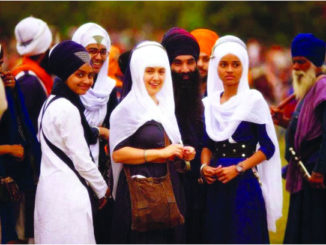
Tag: Khalsa

  • An Unparalleled Sacrifice in History

    On the Martyrdom of the Four Sons of Guru Gobind Singh

    By Prof. Indrajit S Saluja
    Prof. Indrajit S Saluja

    The history of the world bears testimony to countless acts of bravery and sacrifice, but few compare to the monumental story of Guru Gobind Singh, the Tenth Guru of the Sikhs, and the ultimate sacrifice of his four young sons—Sahibzada Ajit Singh, Sahibzada Jujhar Singh, Sahibzada Zorawar Singh, and Sahibzada Fateh Singh. Their martyrdom is not only an integral part of Sikh history but a chapter of unparalleled valor and commitment to righteousness in human history.

    Guru Gobind Singh, the founder of the Khalsa in 1699, envisioned a faith rooted in equality, justice, and the fight against tyranny. Living in a time of severe oppression under Mughal rule, Guru Gobind Singh sought to instill courage and a sense of identity in his followers. The Khalsa, with its distinctive identity and unyielding commitment to justice, emerged as a force against injustice and a beacon of hope for the oppressed. The creation of the Khalsa marked a revolutionary moment in history, but it also drew the ire of tyrannical rulers who sought to crush this growing resistance.

    Guru Gobind Singh’s life was a saga of relentless battles and unwavering resolve. His personal sacrifices were profound—he became the only figure in history to offer his entire family, including his four sons, for the cause of righteousness. The heartbreaking story of his sons, who faced death with unparalleled bravery, stands as a testament to their faith, principles, and courage.

    The two elder sons of Guru Gobind Singh, Sahibzada Ajit Singh (18 years old) and Sahibzada Jujhar Singh (14 years old), embraced martyrdom during the Battle of Chamkaur in December 1704. Outnumbered by the Mughal forces, they stood firm alongside their father and other brave warriors. Despite the overwhelming odds, Sahibzada Ajit Singh led the Khalsa soldiers into battle with extraordinary valor. When he fell, Sahibzada Jujhar Singh took up the mantle, fearlessly plunging into the battlefield to uphold the honor of the Khalsa.

    Their sacrifices exemplified unwavering faith and the courage to stand against injustice, inspiring generations of Sikhs to remain steadfast in the face of adversity.

    While Guru Gobind Singh and his elder sons faced battle, his two younger sons, Sahibzada Zorawar Singh (9 years old) and Sahibzada Fateh Singh (7 years old), were captured along with their grandmother, Mata Gujri, by Mughal forces. Imprisoned at the fort of Sirhind, they were subjected to immense psychological pressure to renounce their faith and convert to Islam. Despite their tender age, the young Sahibzadas displayed an unshakable commitment to their beliefs.

    On December 26, 1704, when they refused to abandon their Sikh faith, the tyrannical Mughal governor Wazir Khan ordered them to be bricked alive. This inhuman punishment shocked the conscience of all who heard of it. Even as the bricks enclosed them, the young sons of Guru Gobind Singh recited Sikh prayers and remained resolute in their faith, demonstrating courage far beyond their years. Their martyrdom stands as a poignant reminder of the ultimate price they paid for their principles.

    The martyrdom of the Sahibzadas is commemorated annually as Veer Bal Divas (The Brave Children’s Day) on December 26. This day serves as a moment of reflection and reverence for their bravery and the values they upheld. It is a day to remember not only their sacrifices but also the teachings of Guru Gobind Singh, who believed in unwavering commitment to righteousness: Shubh Karman te Kabahon na Taron (Never turn away from righteous deeds).

    Guru Gobind Singh’s life and the sacrifices of his family remind us of the cost of freedom and justice. They exemplify the highest ideals of humanity—courage, selflessness, and steadfastness in the face of tyranny.

    In an age where principles often waver under pressure, the story of Guru Gobind Singh and his sons serves as a beacon of inspiration. Their sacrifices remind us to stand firm in the face of injustice, to uphold the values of equality and freedom, and to remain committed to righteous causes, no matter the personal cost.

    As we remember the Sahibzadas on Veer Bal Divas, let us pledge to honor their legacy by embodying their values in our own lives. Their story is not just a part of Sikh history—it is a universal testament to the triumph of the human spirit against oppression, a chapter in history that will forever inspire generations to come.

  • The creation of Khalsa

    The creation of Khalsa

    Khalsa, the purified and reconstituted Sikh community, instituted by Guru Gobind Singh on March 30, 1699 (Vaisakhi Day). His declaration had three dimensions: it redefined the concept of authority within the Sikh community; it introduced a new initiation ceremony and code of conduct; and it provided the community with a new religious and political vision. Khalsa is used to denote both the body of initiated Sikhs and the community of all Sikhs.
    The early Sikh community had been shaped by three levels of authority: the masands (“Guru’s deputies”) were responsible for local congregations; the Guru was the active central authority; and the revealed word as recorded in Sikh scriptural text served as the symbolic base. With the establishment of the Khalsa, the authority of the masands was eliminated. They were expected either to become members of the community on a par with all others or to leave the fold.
    Gobind Singh also introduced a new initation rite. More commonly called amrit pahul (“the nectar ceremony”) but also known as khande ki pahul (literally, “ceremony of the double-edged sword”), it was centred on a belief in the transformative power of the revealed word. The word was recited while water for initiation was stirred with a double-edged sword. Every Sikh who underwent the ceremony became a member of the Khalsa, was assigned the name Singh (“Lion”), and was expected to observe a rigorous code of conduct (rahit) symbolized by the wearing of five items: kes (long hair), kangha (a comb), kachha (a pair of shorts), karha (a steel bracelet), and kirpan (a sword). The names of these items begin with the Punjabi letter k and thus came to be known as the five Ks. The Singhs were also expected to forswear tobacco, alcohol, and certain types of meat.
    In its third aspect the Khalsa embodied a concrete political agenda: the pledge to realize the rule of the Sikh community (Khalsa Raj, “kingdom of God”) in the Punjab. These three interlocking dimensions have made the institution of the Khalsa perhaps the most powerful force in shaping Sikh identity during the past three centuries. Initially a male institution, it is now open to women (who take the name Kaur [“Princess]) as well, though Khalsa authority remains firmly in male hands.
    The story of creation of Khalsa
    It was the Baisakhi. The year was 1699. As usual, Sikhs from far and near had gathered together at Anandpur to celebrate the New Year Festival. However, the gathering was a bit different that day. This year Guru Gobind Rai had sent a message that every Sikh who could afford to come, must come to the annual fair. They should come to Anandpur with their hair and beard uncut; and that they should wear turbans instead of caps or scarves.
    By noon, well over twenty thousand Sikhs (eighty thousand by one estimate) had assembled in the fair ground at Anandpur to participate int he festivals of the Baisakhi Day. Everybody was excited and looked forward to meeting the Guru as if tis unusual ‘message’ was especially sent for him. Also, there was a large and richly festooned tent pitched on a hillock overlooking the extensive fair grounds.
    It was afternoon. Word went round that the Guru was in the marquee and he would be coming out soon to meet his Sikhs. All eyes were turned towards the tent and everyone was waiting patiently for Guru’s Darshan (appearance) and to receive his blessings. But it took a little longer than expected.
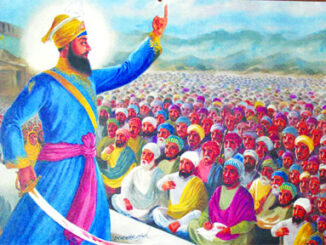
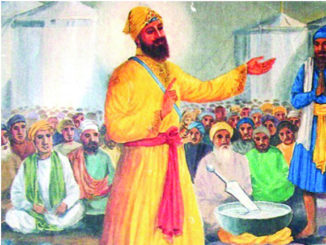
    At last their patience was rewarded. Guru Gobind came out of the tend clad in a strangely coloured uniform. It was saffron coloured from top to toe with a blue waist band. There was a long sword hanging from his left side. He walked briskly and came to a specially erected platfrom near the tent. The skies were clear and bright; and the Guru seemed to be standing so near, although he was actually at some distance from the people in the back. He had a strange smile on his face. Suddenly he stopped staring at the crowd, he pulled his sword out and raised it high with his right hand. There were a million voices and then a sudden hush.
    Now, like a thunder, the Guru spoke, “My dear Sikhs, I am glad to see so many of you here today. Today I have planned to offer you something special. but for this I need your help. Indeed, I need your head. I need the head of a Sikh who claims his faith in me.”
    There was a deadly silence all around. Everybody was too stunned to walk away or even whisper. Then the Guru flashed his sword again, raised his voice and repeated, “My Sikhs, I want a head and nothing less than a head. If anyone among you claims to be a true Sikh, then come forward and prove it.” He looked so fierce and blood thirsty.
    Before he had finished his last sentence, a tall lean Sikh was already moving forward towards the Guru on the platform. His name waas Daya Ram and he was from Lahore. Reaching the Guru, he folded his hands, bent his head forward and said, “O, Lord, the true Guru, I claim to be your humble Sikh. My head is ready for you. Please take it.”
    Hurriedly, the Guru held him by the arm and led him into the tent. Soon after the crowd inside heard the sound of a sword striking a body. They then heard a voice, Waheguru and then a loud thud. Then they saw the Guru coming out of the tent, looking even more fierce. Fresh blood dripped down his sword. The crowd was truly horrified. Nobody needed to be told what had happened inside the tent.
    Once again the Guru stood on the platform. Once again he raised his sword and addressed the crowd, “Well, my Sikhs! I want a second Sikh who would willingly offer his head to me.” This new demand made the people even more scared. But they dare not ask or challenge the Guru for his seemingly wrongful act. However, as he was repeating his strange call, another Sikh began to move forward. His name was Dharam Das, and he was from Delhi.
    Dharam Das stood before the Guru and said in a humble voice, “O, my true king, I offer my head to you, please take it, it is yours.” Now the Guru seemed pleased as he quickly took him inside the tent. This time again, the crowd heard a voice saying Waheguru and then a loud thud.Everyone gasped. They were sure that Dharam Das, too, had been put to death.
    Again the Guru emerged from the tent with a sword drenched in blood. He looked as fierce as before. With a terrifying look in his eyes he agains shouted to the crowd, “Come, come my Sikhs, who comes next. I still want some more. Now I want a third head. I want a Sikh who has faith in me.”
    The people were terrified. They thought perhaps the Guru had gone mad. He was asking too much. Now they were no longer spell bound by the events which had taken place just before. They could think. They began to move; they whispered with each other. They began to slip away from the crowd. Some just fled for their lives.
    In the mean time another Sikh named Mohkam Chand had reached the Guru on the platform. He was from Dwarka. With folded hands he requested the Guru to accept his head. The Guru did not wait or waste a minute, and did the same as he had done with the other two.
    For the fourth time, the Guru stood before the crowd and repeated his demand for yet another head. Now the crowd was even more restless. Some people were slinking away but most stood their ground. They all were really scared, and it did not take long before they saw yet another Sikh on the platform offering his head to the Guru. His name was Sahib Chand and he was from Bihar. The Guru dealt with him in the same way as with the other three before him.
    The crowd was getting thinner every moment. By the time the Guru came back and asked for a fifth head, only the very faithful had stayed behind. But there seemed to be no shortage of volunteers. Soon, another Sikh named Himmat Rai moved forward. He was, at once, led to the tent, but this time the Guru did not return quickly. The people outside began to wonder. Their horror began to change into hope. At least the Guru had stopped asking for more heads. They waited nervously and prayed ‘Waheguru’.
    Then the Guru appeared. He was followed by five other men. They, too, were dressed in saffron colour, with blue scarved tied round their waists and turbans. They looked very much like the Guru himself. All stood on the platform facing the crowd. Their faces beamed with joy and satisfaction.
    As soon as the people near them recognised that they were the same Sikhs who they thought had been killed by the Guru, they immediately started cheering them and saluted them with loud shouts of ‘Sat Siri Akal!’ Soon everybody joined in, and the whole atmosphere was vibrant with the deafening sounds Sat Siri Akal. Many people who had left the fair ground in fear and disappointment heard these cheers and rushed back to see what was happening. They could not believe their eyes. Everything had happened so fast. They could not understand. ‘Had the dead been brought back to life?’
    When the cheering crowd had stopped, the Guru spoke to the crowd, “My dear Sikhs; we all remember that when Guru Nanak gave a test to his Sikhs only one passed it. His name was Lehna, who then became Guru Angad. Now two hundred years after the first test, I have given you another final test. However this test was not for Guruship, but for the ‘nationhood’. I call it the Khalsa, the brotherhood of the pure at heart. You have witnessed the birth of the Khalsa. These Sikhs standing beside me are my Panj Piaray (five beloved ones). Each of them is a saint and a soldier in one. These five Sikhs are dedicated and daring enough to lead; and strong enough to support the edifice of the Khalsa.”
    Later the Guru introduced his Sikhs to a new kind of initiation ceremony called the Amrit (Baptism). First he Baptised the ‘Panj Piaray’ and gave them a new name – ‘Singh’. Then he himself was baptised by ‘the five’ and called himself Gobind Singh. After this all Sikhs present at the fair ground were asked to receive Amrit. It was estimated that well over 20,000 Sikhs were baptised the same day.
    Significance of the creation of the Khalsa
    The creation of the Khalsa by Guru Gobind Singh was the greatest achievements of his genius.It gave birth to a movement which had far reaching effects. It brought a new belief into being and released a new dynamic force into the arena of Indian History.
    Khalsa produced men of uncommon bravery and sacrifice
    By the creation of the Khalsa, the Great Guru laid the foundation of a brotherhood, which produced in the fullness of time, men of uncommon bravery, unique and devotion and rare spirit of sacrifice. Men like Banda Bahadur, Bhai Mani Singh, Baba Deep Singh, Bhai Taru Singh and Jassa Singh Ahluwalia were among them which the Khalsa produced within only fifty years after its inception.
    He converted the Sikhs into a race of saint-soldiers
    The Khalsa created brotherhood who though worshipped the supreme Being at heart, was ever ready to take up arms against injustice and oppression. Guru Gobind Singh “withdrew followers from the undivided attention which their father had given them to regard the sword as their principal stay in their world.”
    It brought a tremendous change in the character and psychology of the Hindus
    Before the creation of the Khalsa, the bulk of the Hindus were cowardly, disunited and ill-organized. They were prey to mutual jealousies. They had no love for religion, race or country, Centuries of suppression had reduced them to mere dregs of humanity were changed as it by magic into something rich and strange.The sweepers, the barbers, the washermen and the confectioners who had for generations lived as crawling slaves, became doughty warriors who were ready to rush into the jaws of death at their bidding of their Guru.It has been aptly remarked that the tenth Guru transformed “Jackals into lions and sparrows into hawks.” Guru Gobind Singh effectually roused the dormant energies of a vanquished people and filled them with a lofty although fitful longing for social freedom and national ascendancy.”
    The Khalsa was purified of superstitions and blind faith
    The creation of the Khalsa freed the Sikhs from superstitions and unnecessary ritual practices. They had no faith in idol worship and of ostentations. They were enjoined upon to be in one True Lord. Gobind Singh took away from his followers their ancient solace of superstitions.
    It gave new life to depressed and down trodden communities
    The creation of the Khalsa had a miraculous effect in uplifting the depressed and down trodden communities. The members of the low castes who were regarded as unclean and polluted in the Hindu society became leaders among men of high birth. They came forward as Sikhs and fought side by side with the Kshatriyas and Brahmans for the cause of Dharma. The members of the low castes proved to be the backbone of the Khalsa and proved to be real patriots and doughty warriors who made sacrifices for their country and faith.
    It made the Sikhs a unified community
    The creation of the Khalsa made all the Sikhs equal. They considered themselves as blood relations having acquired common heritage from their common Gurus. The external marks of Sikhism i.e, the five K’s gave them a sense of brotherhood, equality and religious unity. Their eating in the common kitchen, sitting together, gave a death-blow to the caste system. The status of one Sikh was in no way superior to that of the other. This principle of equality led to unity and cohesion amongst the followers of the Gurus.
    It led to wars between the Guru and the hilly Rajas
    One of the immediate results of the foundation of the Khalsa was that it excited the jealousy of hilly chiefs and brought Guru Gobind Singh into conflict with them. They saw in the democratic teachings and the military zeal of the Guru a threat to their influence and power. Besides, they thought that they would be the first victims of Guru’s ambition. Consequently, the hilly chiefs felt much concerned and lost no time in initiating hostilities against the Guru. Thus was started the long drawn warfare between the two parties.
    It made Sikhism distinct from Hinduism
    The distinguished marks of the Khalsa namely the five K’s, the appellation of Singh, the new mode of salutation and total abstention from smoking- the essential tenets of the Khalsa made Sikhism more distinct from Hinduism. Thereafter, the possibilities of the Sikhism being absorbed by the Hinduism became very remote.
    Khalsa saved Hinduism from annihilation
    The creation of the Khalsa saved Hinduism from annihilation. Aurangzeb had started a program of wholesale conversion of the Hindus. His officers followed a policy of religious persecution of Hindus, demolished their temples and subject them to unheard cruelties. At such a juncture, the creation of the Khalsa gave a new lease of life to the Hindus religion. By their military valor, sacrifice and services, they saved them from the tyranny of the Mughal Government. Even after the death of Guru Gobind Singh, the Khalsa continued its struggle against injustice and oppression and did not rest till it had completely overpowered the enemy.
    It gradually made the Khalsa political power in the Punjab
    The great legacy of the creation of the Khalsa was the “Sikh struggle for independence” in the Punjab. The Khalsa first thought against the Mughals and then against the Afghans and did not rest till it had achieved the goal after a long and determined struggle for almost a century the Punjab under Ranjit Singh became a sovereign state.
    Guru Gobind Singh in no way gave up the essentials of Guru Nanak’s teachings. Like his predecessors, Guru Gobind Singh insisted on the worship of the One True Lord, with the same ideal, devotion and humility and for the same glorification of the Name. He did not want his followers to forget their Lord in the worldly pursuits.

  • Contributions of Guru Gobind Singh

    Guru Gobind Singh succeeded his father Guru Teg Bahadur at the age of 9. His teachings were different from his predecessors’ – he believed that no power could exploit the Sikhs.
    He spent his childhood years studying Persian and Sanskrit, and was skilled in the art of war. His mission was to uphold right in every place and destroy sin and evil. In 1699 he chose the festival day of Vaisakhi as the occasion to transform the Sikhs into the Khalsa, a family of soldier saints. Guru Gobind Singh introduced many of the customs that Sikhs practise today.
    Sikhs who have been through the Amrit ceremony of initiation become Amritdhari, initiated Sikhs. They take new names and wear the 5 Ks – five physical symbols that Sikhs must wear.
    He declared the the Sikh holy book as his successor instead of a human being. The Guru Granth Sahib would thus be the Sikhs’ guide forever. Sikhs give it the same status and respect as a human Guru.
    In 1699 the tenth guru, Guru Gobind Singh, chose Vaisakhi as the occasion to transform the Sikhs into a family of soldier saints, known as the Khalsa Panth.
    Guru Gobind Singh founded the Khalsa in front of thousands at Anandpur Sahib.
    During the Vaisakhi festival Guru Gobind Singh came out of a tent carrying a sword. He challenged any Sikh who was prepared to give his life to come into the tent. The Guru returned alone with his sword covered in blood. He then requested another volunteer and repeated the same action four times until five men disappeared into the tent. The crowd was very concerned until they saw five men return wearing turbans with the Guru.
    These five men became known as the Panj Piare, or ‘Beloved Five’.
    The men were then baptised into the Khalsa by the Guru. He sprinkled them with Amrit (‘immortalising nectar’: the Sikh term for holy water) and said prayers. This is the basis of the Sikh baptism ceremony.
    Vaisakhi is celebrated in much the same way as Gurpurbs. Gudwaras are decorated and visited. Parades, dancing and singing happen throughout the day. Many Sikhs choose to be baptised into the Khalsa brotherhood on this day.
    The festival is marked with nagar kirtan processions: processions through the streets (nagar means “town”) which form an important part of Sikh culture and religious celebrations.
    Kirtan is a term meaning the singing of hymns from the Guru Grath Sahib, the Sikh holy book. Celebrations always include music, singing and chanting scriptures and hymns.
    The processions are led by traditionally dressed Panj Piaras.
    The Guru Granth Sahib will be carried in the procession in a place of honour.
    Amrit Ceremony
    Sikhs who have been through the Amrit Ceremony of initiation, or Amrit Sanskar, become baptised Sikhs, take new names, and wear the 5 Ks.
    The Amrit Ceremony is the initiation rite introduced by Guru Gobind Singh when he founded the Khalsa in 1699. A Sikh can go through this initiation as soon as they are old enough to understand the full committment that they are making.
    The ceremony takes place in a Gurdwara, before the Guru Granth Sahib, and in the presence of 5 initiated Sikhs (who represent the Panj Piyaras, the first 5 Sikhs to be initiated). During the ceremony, hymns are recited from the Sikh scripture, prayers are said, and the principles of Sikhism are affirmed. Then amrit is prepared. Amrit is a mixture of sugar and water that has been stirred with a double-edged sword. The candidates for initiation drink some of the amrit from the same bowl, and have it sprinkled on their eyes and hair.
    Each then recites the Mool Mantra (the fundamentals of Sikhism). There are readings from the Guru Granth Sahib and an explanation of rules of Sikhism.
    The ceremony ends with the eating of the ceremonial karah parshad. Parshad is a sweet tasting food which has been blessed. It is made from semolina, sugar and ghee.
    Khalsa initiation
    The 5 Ks date from the creation of the Khalsa Panth by Guru Gobind Singh in 1699.
    The Guru introduced them for several reasons:
    – Adopting these common symbols would identify members of the Khalsa
    – Because all members of the Khalsa wear the 5 Ks the members of the community are more strongly bound together
    – Each K has a particular significance. The meaning of the 5 Ks
    The 5 Ks taken together symbolise that the Sikh who wears them has dedicated themselves to a life of devotion and submission to the Guru. The 5 Ks are 5 physical symbols worn by Sikhs who have been initiated into the Khalsa.
    The five Ks are:
    – Kesh (uncut hair)
    – Kara (a steel bracelet)
    – Kanga (a wooden comb)
    – Kaccha – also spelt, Kachh, Kachera (cotton underwear)
    – Kirpan (steel sword)
    Various reasons and symbolisms have been put forward for the Sikh practice of keeping hair uncut.
    – Throughout history hair (kesh) has been regarded as a symbol both of holiness and strength.
    – One’s hair is part of God’s creation. Keeping hair uncut indicates that one is willing to accept God’s gift as God intended it.
    – Uncut hair symbolizes adoption of a simple life, and denial of pride in one’s appearance.
    – Not cutting one’s hair is a symbol of one’s wish to move beyond concerns of the body and attain spiritual maturity.
    – A Sikh should only bow his head to the Guru, and not to a barber.
    – It is a highly visible symbol of membership of the group.
    – It follows the appearance of Guru Gobind Singh, founder of the Khalsa.
    – Sikh women are just as forbidden to cut any body hair or even trim their eyebrows, as Sikh men are forbidden to trim their beards.
    Kara – a steel bracelet
    – A symbol of restraint and gentility.
    – A symbol that a Sikh is linked to the Guru.
    – It acts as a reminder that a Sikh should not do anything of which the Guru would not approve.
    – A symbol of God having no beginning or end.
    – A symbol of permanent bonding to the community-being a link in the chain of Khalsa Sikhs (the word for link is ‘kari’).
    – The Kara is made of steel, rather than gold or silver, because it is not an ornament.
    Kanga – a wooden comb
    – This symbolises a clean mind and body; since it keeps the uncut hair neat and tidy.
    – It symbolises the importance of looking after the body which God has created. This does not conflict with the Sikh’s aim to move beyond bodily concerns; since the body is one’s vehicle for enlightenment one should care for it appropriately.
    Kachha – special underwear
    – This is a pair of breeches that must not come below the knee. It was a particularly useful garment for Sikh warriors of the 18th and 19th centuries, being very suitable for warfare when riding a horse.
    – It’s a symbol of chastity.
    Kirpan – a ceremonial sword
    There is no fixed style of Kirpan and it can be anything from a few inches to three feet long. It is kept in a sheath and can be worn over or under clothing.
    The Kirpan can symbolise:
    – Spirituality
    – The soldier part of the Soldier-Saints
    – Defence of good
    – Defence of the weak
    – The struggle against injustice
    – A metaphor for God
    For a Sikh the fact that the Guru has instructed the Sikhs to wear the 5 Ks is an entirely sufficient reason, and no more need be said. The symbols have become greatly more powerful with each passing year of Sikh history. Every Sikh remembers that every Sikh warrior, saint, or martyr since 1699, and every living member of the Khalsa, is united with them in having adopted the same 5 Ks.

  • Guru Gobind Singh’s teachings are relevant to modern times

    Remembering the Saint-Soldier and Creator of Khalsa on his birth anniversary which is being celebrated on January 19

    Guru Gobind Singh, the tenth Sikh Guru, stands as a towering figure in Sikh history. Born on December 22, 1666, in Patna, India, he played a pivotal role in shaping Sikhism and reinforcing its principles. Guru Gobind Singh is renowned not only for his spiritual teachings but also for his unwavering commitment to justice and the defense of the oppressed. His legacy revolves around the creation of Khalsa, a community of saint-soldiers, embodying the harmonious balance between spirituality and martial prowess.

    Guru Gobind Singh was the son of Guru Tegh Bahadur, the ninth Sikh Guru, and Mata Gujri. Early in his life, he faced the harsh realities of religious persecution when his father sacrificed his life defending the rights of non-Muslims. This early exposure to adversity shaped Guru Gobind Singh’s worldview and set the stage for his future role as a leader and warrior.

    At the tender age of nine, Guru Gobind Singh assumed the mantle of Guruship after the martyrdom of his father. His leadership was marked by a determination to fortify the Sikh community against external threats and persecution. His teachings emphasized the equality of all humans, irrespective of caste or creed, and the need for Sikhs to stand up against injustice.

    One of Guru Gobind Singh’s most significant contributions was the establishment of the Khalsa in 1699. Recognizing the need for a community of warriors dedicated to defending justice, he called upon his followers to gather at Anandpur Sahib during the Baisakhi festival. There, he performed the Amrit Sanchar, a sacred ceremony that initiated the Sikhs into the Khalsa Brotherhood.

    During the ceremony, Guru Gobind Singh infused the Amrit (sacred nectar) with the Five Ks, which are the distinctive symbols of the Khalsa: Kesh (uncut hair), Kara (steel bracelet), Kanga (wooden comb), Kachera (cotton undergarments), and Kirpan (ceremonial sword). These symbols served as a constant reminder of the Khalsa’s commitment to Sikh values and the readiness to defend righteousness.

    Guru Gobind Singh’s teachings embodied a unique blend of spirituality and martial valor. He propagated the idea of the “Sant-Sipahi,” a saint-soldier who combines spiritual discipline with the readiness to take up arms when peaceful means fail. This philosophy emphasized the importance of selfless service, justice, and fearlessness in the face of oppression.

    The Guru himself led by example, actively participating in battles against tyranny. His military campaigns aimed not at conquest but at safeguarding the principles of righteousness and freedom. Guru Gobind Singh’s commitment to the defense of the oppressed set a precedent for Sikhs, inspiring them to resist injustice with courage and determination.

    Guru Gobind Singh’s legacy extends far beyond his lifetime. His creation of the Khalsa not only provided Sikhs with a distinct identity but also fostered a sense of community and shared purpose. The Khalsa became a symbol of resilience and strength, standing against injustice and promoting the values of equality and justice.

    The Guru’s poetic compositions, collected in the Guru Granth Sahib, continue to inspire millions of Sikhs around the world. His writings, including the Zafarnama (Letter of Victory) written to Emperor Aurangzeb, reflect his unyielding spirit and commitment to justice.

    Guru Gobind Singh, the saint-soldier and creator of Khalsa, left an indelible mark on Sikhism and the broader tapestry of Indian history. His life exemplified the harmonious coexistence of spirituality and martial prowess, and his teachings continue to guide Sikhs in navigating the challenges of the modern world. Guru Gobind Singh’s legacy is a testament to the enduring power of courage, justice, and the unwavering commitment to defending the oppressed.


  • The spirit of Khalsa

    The spirit of Khalsa

    By Prof. Abdul Majid Khan

    Prophets and saviors with strong minds and great hearts who appear from time to time have a very vital role to play in the remaking of society. History is eloquent on the fact that Guru Gobind Singh came with a clear message and stood for definite spirit. Indeed, the be-all and the end-all of his strenuous efforts was to rejuvenate a rotten social order. Guru Gobind Singh saw that the people of the Punjab, nay, of northern India, were slaves of prejudice, pride and passion, in as much as they attached undue importance to theological disputes. metaphysical abstractions, meaningless conventions and customs, with the result that they were unbalanced and fanatical or they were steeped in sloth. So the situation was quite hopeless and the atmosphere very depressing.
    The master realized that he would have to work ceaselessly to change the psychology of his countrymen. In the absence of a sense of direction, plan and compass, even when things are done with the best of intentions and for the purest of motives, the result is heavy sorrow, or blank despair. The master mind, the great genius that he was, he put an end to all hazy indetermination, impotent rage and the idle dreams of the sluggards and the cowards. In other words, he was convinced of the supreme necessity of the work of liberation-political as well as social.
    Political power was to be seized and a parallel government was to be established in order to draw all the patriotic elements to a rallying point, to a strong centre. The Guru achieved this by introducing a new form of “baptism’ and thenceforward called the initiated Sikhs, “the Khalsa of Wahiguru”, the Lord’s Own. The Panj Piyaras i.e. the first five Baptized ones and their revered Guru formed the nucleus of the band of liberators. The Master aimed at building up a nation of the Purified Once who would be completely free from fear as well as selfishness, from hatred and haughtiness and would count no sacrifice too great for emancipating their land from the galling yoke of the rulers, were intoxicated with power. In other words Khalsa came into being i.e. uphold righteousness and to uproot oppression. The Guru was bent upon the development of a well – knit, homogenous class of people, inspired by a common national ideal and joined together in a common cause-the freedom and the uplift of India and through India he wanted to serve humanity. Short sighted historians are wrong when they hold or even imply that the struggle in the days of Guru Gobind Singh was between the Sikhs and the Muslims. As a matter of fact, the armies of the Tenth Master had a considerable number of Hindus and Muslims among them. On the other hand, the Mughal forces had the active support of some of the Hindu rajas of the hills.
    Guru Gobind Singh could always count on his faithful friends like Qazy Pir Mohammed, Ghani Khan and Nabi Khan, who saved his life at a critical moment. Pir Budhu Shah of Sadhura sent 500 Pathans and his sons, who died fighting under the flag of Guru Gobind Singh. Sayyed Khan and Maimu Khan, two famous Muslim generals offered ungrudging help to the Guru. Likewise, numerous liberty-loving Hindus generally supported him.
    The teachings and message of the Tenth Guru are for the whole of the troubled and groaning humanity. As a farsighted seer and a noble sage, he knew that nationalism was only a passing phase in the evolution of mankind.
    True, it was a sort of half-way house between tribalism and international unity or global co-operation. In one of his Swayyas, the Master says, “The power of God and Bliss, this is my sole prayer before Thee. Give me the strength to pursue righteous conduct come what may”. When he emphatically said, “Recognize all humanity as one”, he implied thereby that no cause could be nobler than the firm conviction that basically and essentially East and West constitute one global brotherhood.
    Every human being is a spark of the Divine Essence. God, in the final analysis, is the sum total of millions of human souls i.e. there is no Divinity higher than humanity.
    Compare the Practical Vedanta of Swami Vivekananda with the core of the message of Guru Gobind Singh. Swami Vivekananda held, “The only God to worship is the human soul in the human body. Of course, all animals are temples too, but man is the highest, the Taj Mahal of temples. If I cannot worship in that, no other temple will be of any advantage.” The tragedy of the present – day civilization is that the conquest of the forces of Nature has not been accompanied by the ethical control the dispositions of mankind. Intellect has done wonders, but it has not yet dispelled inner darkness, the head has grasped a lot but the heart continues to be diseased as ever, as bad as ever. Guru Gobind Singh rightly stresses the overriding importance of the refinement of human emotions “May the dispositions of men remain under the control of ethical reason, and the ethical reason of men, under the guidance of God, forever and ever, Amen” is an excerpt from the daily congregational prayer of the Khalsa-the prayer which Guru Gobind Singh himself used to offer every day.
    Talking to Bhai Nand Lal one of the most cultured and trusted disciples-Guru Gobind Singh remarked, “men should listen to the Guru attentively and with devotion. That what the Guru teaches, they should hear and preach. Men should listen to the words of the Guru with love in their hearts and faith in their minds. Men should serve each other without pride and without selfishness.
    Those who serve humanity thus, their service do I recognize as service to my person. Pay attention, O Nand, in this way humanity shall be treed and attain everlasting bliss Day in and day out, we talk of service to mankind. It is impossible to serve others till we believe in the ideals of equality and fraternity. What does that mean? The U.N.O. is now emphasizing the importance of making the world free from fear and free from want.
    About three hundred years ago, the Tenth Master stood and strove for making this terrestrial globe, this earth i.e. the whole of mankind free from fear and free from want. He was totally opposed to privilege, in the social as well as in the political domain.
    The challenge of today is democratic liberalization of religion- religion which under the guidance of Guru Gobind Singh influenced lives and conduct of thousands of politically backward and socially disinherited folk and welded them into a strong brotherhood, pledged to the service of mankind. Faith is anything but a dope. Indeed it is a living and vivid belief in the gospel of bringing man nearer to man, of promoting global goodwill and universal peace. This is the spirit which the Tenth Guru infused in the Khalsa. Let us all be worthy of it. Let us all live up to it. May God bless us with “strength to right the wrong, through truth and justice’.
    (Republished with permission from Punjab Beat)

  • HAPPY VAISAKHI AND A HAPPY BIRTHDAY TO KHALSA

    We congratulate our readers on the happy occasion of  Vaisakhi, the harvest festival of Punjab. We congratulate the Sikh community on the joyous, momentous and historic occasion of their birth.

    The Sikhs probably are the only religious community in the world to know their day of birth. Way back in 1699, on the day of Vaisakhi, the creator of the Khalsa, the Tenth Master of the Sikhs, Guru Gobind Singh, had put to a severe test the loyalty and faith of his followers and admirers, who had converged on Shri Anandpur Sahib from far and near at the invitation of the Guru.

    Guru Gobind Singh on that historic day created the Khalsa, the purified ones who would fight against injustice and tyranny and protect the poor and the oppressed. He gave to His followers a distinct identity and a moral code which distinguished them from other followers of the Guru.

    These followers of the Guru were to wage a struggle and march into the battlefield with the firm rock like faith and belief in their Guru, and in their resolve to win.

    Guru Gobind Singh is probably the only person in history to have sacrificed his whole family to protect others from tyranny- social, economic, political and human.

    Guru Gobind Singh’s father , Guru Tegh Bahadur martyred himself to save the Hindus from persecution at the hands of the Mughal ruler Aurangzeb. Guru Gobind Singh sacrificed all his four sons for protecting dharma. His mother couldn’t bear to see her grandsons being bricked alive in Sirhind and bade goodbye to the mundane world.

    Guru Gobind Singh himself spent all his life fighting against the tyranny of the Mughals, and treachery, machinations, and intrigues of the neighboring Hill princes , who were jealous and apprehensive of the Guru’s growing popularity and power.

    Guru Gobind Singh brought to culmination the movement initiated by Guru Nanak, the First Master of the Sikhs, to encourage the oppressed to stand up against the perpetrators of oppression.

    “Bliss it was in that dawn to be alive”, famous English poet William Wordsworth said of the French Revolution.

    We are fortunate as was Wordsworth to have witnessed the French Revolution, to be watching the march of Guru ki Fauj- the Khalsa. It is time to recall the teachings of the Great Master. It is time to recall to mind the ideals he stood for. It is time to recall the cause he fought for, and remember with both pride and humility, the supreme sacrifices he made.

    Let his followers rededicate themselves to their Great Guru and resolve to follow the path shown by Him- a life of righteousness, relentless fight for human rights against tyranny, oppression, and injustice. Let them imbibe and respect the democratic ideals of equality, liberty, and fraternity of mankind. Let them remember that their Guru had enjoined upon them to be purified ones- the Khalsa.

    The Guru prays:
    “ Grant me this boon, O God,
    May I never refrain from righteous acts;

    May I fight without fear
    All foes in life’s battle,
    With confident courage
    Claiming the victory;

    May my highest ambition be
    To sing thy praises ,
    And may Thy Glory be
    Grained in my mind!

    When this mortal life
    Reaches its limits,
    May I die fighting
    With limitless courage.

    Happy birthday to Khalsa. Happy Vaisakhi to all our readers.

  • Khalsa is a ‘uniting and not a dividing force,’ says Ambassador Taranjit Sandhu

    Khalsa is a ‘uniting and not a dividing force,’ says Ambassador Taranjit Sandhu

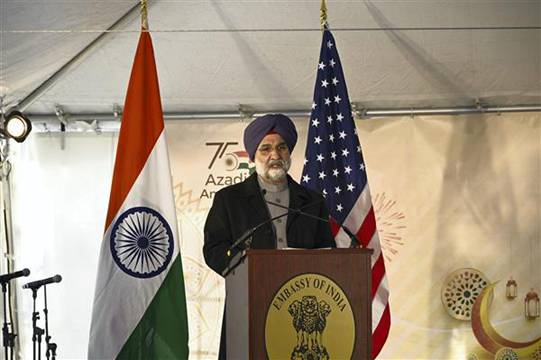
    WASHINGTON, D.C. (TIP): India’s Ambassador to the US Taranjit Singh Sandhu has said Khalsa is a “uniting and not a dividing force,” days after instances of violence at the Indian missions by a small group of pro-Khalistan supporters. Sandhu, who comes from an illustrious Sikh family, made the remarks on Saturday at an event where he was presented with the prestigious “Sikh Hero Award” from Sikhs of America along with several other eminent Sikh Americans.
    “Khalsa, which was created on the Baisakhi day, by Guru Gobind Singh is a uniting and not a dividing force,” Sandhu said in his keynote address at the event, which was attended by eminent Sikh Americans from across the country. The Khalsa tradition was initiated in 1699 by the tenth Guru of Sikhism, Guru Gobind Singh.
    The important concepts and fundamentals in the Sikh religion and history include universality, unity, equality, honest living, seva, meditation, peace of mind, and harmony between people, he said.
    The Khalsa flag—which flies at the Akal Takht and Nishan Sahibs—is a flag of unity, peace and universal love, the Indian diplomat said, asserting that Sikhism is a religion of inclusion, brotherhood, love and equality.
    “We must keep these cardinal virtues in mind and not what a couple of mischievous characters spin using virtual media,” Singh said in an apparent reference to the instances of violence by a small group of separatists in the US, Canada, UK and Australia.
    In his speech, Sandhu shared with the Sikh diaspora the rise of India and some of the key accomplishments of the country in key sectors of economy, digitization, health and entrepreneurship. “In such a scenario, Punjab and the youth in Punjab need to be connected with the economic, financial, tech and digital revolution happening in India,” Sandhu said.
    “The government, people and in particular the youth must take advantage of the expanding partnership with the US in various fields that Prime Minister Modi and President Biden are trying to put in place,” he said.
    Noting that youth and their parents are spending millions of dollars for sending their children to the US and Canada, Sandhu said the New Education Policy that has been put in place, and the efforts of the Prime Minister will ensure that such education is available in India as well as Punjab.
    “Delighted to receive Hero Award from Sikhs of America. Spoke about imp tenets of Sikhism: seva, brotherhood, equality, inclusion & honesty,” Sandhu said in a tweet after the event. “Highlighted the strengthening of US India partnership and tech and infra transformation taking place in India and huge opportunities for the youth,” he tweeted. In his welcome address, Jasdip Singh Jassee, chairman of Sikhs of America highlighted the role played by awardees in their respective fields. He said that violence has no place in the community. Others who received the prestigious “Sikh Hero Award” included entrepreneur and philanthropist Darshan Singh Dhaliwal; Gurbir Singh Grewal, former New Jersey Attorney General; former Hoboken Mayor Ravi Singh Bhalla, and entrepreneur Manraj Singh Kahlon. Slain Sikh police officer Sandeep Dhaliwal was presented the award posthumously

  • Sikh History This Week- March 24, 2023, to March 30, 2023

    24th March
    1664 Guru Har Krishan Ji visited Aurangzeb’s court. This is the time Guru Sahib visited Aurangzeb’s court, when Ram Rai emphatically declared that the decision of his father in selecting his younger brother as his sucessor to the pontificate of Guru Nanak was based on cogent reasons, and that he was now under the command of the new Guru.
    1847 The British being aware of the Sikh’s emotional and sentimental attachment to Golden Temple and other shrines, issued special instructions to the British subjects to be careful in maintaining the sanctity of the shrines.
    1922 Meeting at Rajowal by Kishan Singh Gargaj group to devise ways and means of reforming the toadies
    1945 Master Tara Singh denounces the Acharyae Formula.
    25th March
    1830 Baba Ratta Ji Nirankari was born.
    1921 13th Sikh Education Confernce was held in Hoshiarpur that and lasted until Mar. 27. This conference saw the rise of miltant Akalis who advocated non-cooperation with the British government and were deeply inspired by Master Mota Singh. They met sperately and created disturbances in the conference as well as worked on a sperate program. They were equally patriotic believing in the militant traditions of the Nihangs.
    1921 The militant Akalis hatched a conspiracy to murder the officials respobsinle for the Nanakana carnage. 1972 Mohan Singh Tur became President of Akali Party. 1981 The SGPC unanimously passed the resolution “Sikhs are a Nation.” With the passing of such a resolution by the Sikh Parliament and with the ratification of this resolution by the Jathedar of the Akal Takht on April 21, 1981, the issue stood finally decided by the whole of the Sikh nation. On May 11, 1981, the Akali Party also passed a resolution to that effect.
    1986 Surjit S. Barnala himself ordered firing at the Sikhs who were observing holy festival at Anandpur Sahib, killing several Sikhs.

    26th March

    1644 Gur Gadhi Diwas, Guru Har Rai Sahib Ji (1644).
    1746 The forces of Yahiha Khan and Lakhapat Rai seized and set fire to the Kahnuwaan forest. 7,000 Singh were martyred here while another 3,000 were taken to Lahore and martyred there.
    1746 Matta Sunder kaur Ji sent a mace of Kalgidhar to honor Jassa Singh Ahluwalia.
    1748 Raja Amar Singh of Patiala was born. He was a thorough gentleman.
    1923 Amar Singh, granthi of Kot Fatuhi, is arrested

    27th March
    1843 Raja Suchet Singh murdered. Raja Suchet Singh was brother of Raja Dhiyan Singh Dogra and Gulab Singh Jammu. He was a popular propenent of Sikh Raj. Sher-e-Punjab, Maharaja Ranjit Singh, personally bestowed the honor Raja on Suchet Singh.
    1923 Hazara Singh Sirbrah of Behbalpur is murdered.
    1924 The 4th shahihi jatha of 500 valiant Akali satyagrahies, led by Sardar Puran Singh Bahowal, marched from Anandpur Sahib to Gangsar, Jaito.

    28th March


    1552 Gur Gadhi Diwas, Sri Guru Amar Das Sahib.
    1620 Guru Hargobind Ji had to marry Nanaki despite his refusal. This was an unfortunate upshot of the jubilation in Sikh community caused by Guru Sahib’s release from seven years of incarceration. Within a few months two brides were pledged to him by their parents. Under the customs prevalent at that time, on Guru Hargobind’s refusal, those girls would have remained unmarried throughout their life. So he had to marry Nanaki on March 28, 1620, and Mehrai also called Marwahi on July 10, 1620. The first incident occurred too close to his release. Taken aback at the second incident, he announced that no one should pledge his daughter to him in future.
    1965 SGPC resolves at its general meeting to establish Punjabi Suba.

    29th March

    1552 Second Patshahi, Guru Angad Dev Ji departed this planet from Khadur Sahib. He served as Guru for 12 years and none months. Today is the actual date of joti jot, though its is observed on a different date by Guru Khalsa Panth.
    1552 Third Patshahi, Guru Amar Das Ji ascended to Guruship of Sikhsism. Amardas was influenced to Sikhims by Bibi Amro, daughter of Guru Angad Dev Ji. She was married to Amardas’s nephew. Bibi Amro was a very pious woman. She would get up early in the morning, take a bath and start reciting the hymns of Guru Nanak. One day Amardasheard Bibi Amro sing Guru Nanak’s Jap Ji and pauris of Asa-di-var. He was touched by the divinity and peity of the hymns. He learnt those gymns from her and started reciting them every morning.
    1699 Baisakhi day, Guru Gobind created the Khalsa order at Anandpur Sahib. Earlier Hukamnamahs were sent to Sikhs all over Hindustan and beyond to vist Anandpur. The people were asked to visit with their hair unshorn. The hill chiefs, who, according to one account, were taken into confidence about Guru’s program, were present in strength. He Abolished the corrupt and debased institution of ‘masands’. Created a small regular army and fortified Anandpurs with a ring of smaller fortresses around it.
    1748 The Sikhs assembled at Amritsar on Baisakhi day and by a gurmatta, decided to form Dal Khalsa by reorganization of over 60 arms jathas, bands, into eleven associatios (misls) under the overall command of’ Jassa Singh Ahluwalia. Nawab Kapur Singh because of his age sought retirement from active overall leadership.
    1922 Akali Dal renamed as “Shiromani Akali Dal”.
    1940 The Khalsa National Party at its meeting in Lahore, under Sunder Singh Majithia, saw danger in the division of India into Hindu and Muslim independent states, and said that the Sikhs would not tolerate for a single day the unadultrated communal rule of any community. As a logical sequence, it asked for restoration of Sikh sovereignty of Punjab, which was held in trust by the British during the minority reign of Maharaja Dalip Singh.
    1981 SGPC adopted the motion “Sikhs are a Nation”. When the Presdient Gurcharan Singh Tohra, was asked the question that the SGPC was turning political, he answered “On October 10, 1946, Ishar Singh Mahjaiol, had moved in the house a resolution for the creation of a Sikh State. The resolution was seconded by Sardar Swaran Singh. The “Sikhs Are a Nation” proposal was part of S. Ganga Singh Dhillon’s speech at 54th All India Sikh Educational Conference that took place on March 13, 14, and 15, 1981. In his presidential address, S. Ganga Singh Dhillon wrote: “SIKHS ARE A NATION We all are born equal, with a human right to preserve our religious and cultural heritage, improve our economic inheritance and freedom to mould our destiny.

    30th March

    1664 Patshahi Eighth, Guru Harkrishan Ji, left this planet for heavenly abode from Delhi. He was eight years of age, when he took over on himself the sufferings and sins of the people of Delhi. As a result, he left for heavenly abode. Today is the actual date of joti joot, though it is observed differently by Guru Khalsa Panth.

  • Maghi Mela at Muktsar

    Maghi Mela at Muktsar

    Maghi is the occassion when Sikhs commemorate the sacrifice of forty Sikhs, who fought for Guru Gobind Singh, the tenth Sikh master.

    Maghi, Makara Sankranti, the first day of the month of Magh. The eve of Maghi is the common Indian festival of Lohri when bonfires are lit in Hindu homes to greet the birth of sons in the families and alms are distributed. In the morning, people go out for an early-hour dip in nearby tanks.

    For Sikhs, Maghi means primarily the festival at Muktsar, a district town of the Punjab, in commemoration of the heroic fight of the Chali Mukte, literally, the Forty Liberated Ones, who laid down their lives warding off an attack by an imperial army marching in pursuit of Guru Gobind Singh.

    Mela Maghi, held at the holy city of Sri Muktsar Sahib each year in January, or the month of Magh according to Nanakshahi calendar is one of the most important melas (fairs) of India and the most important of all religiously significant gatherings of the Sikhs.

    Etymologically, mukta from Sanskrit mukt means ‘liberated, delivered, emancipated,’ especially from the cycle of birth and death. Mukti (liberation, emancipation) in Sikhism is the highest spiritual goal of human existence, and mukt or mukta is the one who has achieved this state of final beatitude. Mukta, also means a pearl, and the word would thus signify a title or epithet of distinction. It was probably in this sense that the five Sikhs, who on 30 March 1699 received the vows of the Khalsa immediately after the first five Panj Piare (q.v.), were blessed with the title mukta, plural mukte.

    The term Chali Mukte is also used sometimes for the martyrs whom were attacked by a huge army, which had been in pursuit of the 40 Sikhs, their Guru and the two older Sahibzadas since the evacuation of Anandpur by Guru Gobind Singh during the night 5-6 December. Encircled and hopelessly outnumbered at Chamkaur on 7 December, they engaged the enemy in small sorties throughout the day. Two of those sorties were led by their Guru’s two oldest sons the Sahibzadas.

    The Guru had previously created the Khalsa making his men his equal. Now Sri Guru Gobind Singh Ji told the survivors of his plan to challenge his attackers the next morning joining his sons, the Sahibzadas, in Sach Khand. The five remaining Singhs were Bhai Dharam Singh, (the two remaining Panj Pyare), Bhai Man Singh, Bhai Sangat Singh and finally Bhai Sant Singh. They begged Guru Ji to escape, they said, “At Kesgarh Sahib we watched you beseeching the five beloved ones to initiate you with Amrit. You had said then, I am of the Khalsa, and the Khalsa is mine. Today we ask in the capacity of the Khalsa beseeching you to leave Chamkaur and escape to a safer place.”

    Guru Saheb had no choice now but to accept their demands. It was decided that Guru Ji, Man Singh and the two Panj Pyare would leave the fort and that they would dress Sant Singh to look like Guru Ji because he had an uncanny resemblence to Guru Saheb. Guru Ji killed the few soldiers that were on watch. Then they left in the pitch dark the Guru clapped his hands three times saying “PeerÚ Hind Rahaavat” (“The “Peer” of India is Leaving”).

    They all shouted Sat Sri Akal and scattered in different directions. The mughals who couldn’t see where anyone was, ended up killing several of their own while Guru Ji and the three Sikhs escaped.

    Wazir Khan, the faujdar of Sirhind, denied the next day of the prize he had so eagerly and treacherously hounded, must have been furious. He would soon release that fury on the Guru’s remaining sons and their grandmother who, betrayed by their old family cook Gangu, soon fell into his hands back at Sirhind.

    While there is no unanimity over the names of the martyrs of Sri Muktsar Sahib and Chamkaur Sahib, the five Muktas who comprised the first batch of Sikhs to receive amrit at the hands of the Panj Piare are given in Rahitnama by Bhai Daya Singh as Ram Singh, Fateh Singh, Deva Singh, Tahil Singh and Isar Singh. No other details of these five are available except that an old manuscript of Bhai Prahlad Singh’s Rahitnama is said to contain a note associating Ram Singh and Deva Singh with the village of Bughiana, Tahil Singh and Isar Singh with Dall-Van and Fateh Singh with Kurdpur Mangat.

    According to Bhai Chaupa Singh, his Rahitnama or code of conduct was drafted by muktas. The text is said to have received Guru Gobind Singh’s approval on 7 Jeth 1757 Bk / 5 May 1700. It appears that the title of mukta was bestowed subsequently also on persons other than the original five. The number of muktas is recorded variously in old Sikh texts. For instance, Kesar Singh Chhibbar, Bansavallnama Dasan Patshahlan Ka, mentions 14, and Kuir Singh, gurbilas Patshahi X, 25.

    But the muktas universally celebrated in the Sikh tradition are the forty martyrs of Sri Muktsar Sahib who earned this title by sacrificing their lives for the Guru and who redeemed their past apostasy of having disowned their Guru and deserted him, when driven to desperation by the prolonged siege of Anandpur by the Rajput hill chiefs and Mughal forces by having their disclaimer torn by the Guru.

    Sikhs celebrate the Maghi with an end to end recital of the holy Guru Granth Sahib and religious rituals in all the Sikh Gurudwaras. On the eve of Maghi falls the common Indian festival called the Lohri when bonfires are lighted in Hindu homes and alms are also distributed. . however The largest assembly, however, takes place at Muktsar (Punjab) where big fairs are organized and pilgrims take a holy dip in the sacred waters of sarovar and also visit several shrines. A mahala or big march of pilgrims from the main shrine to gurdwara Tibbi Sahib, sacred to Guru Gobind Singh, concludes the three-day celebration.

  • The Creation of Khalsa

    The Creation of Khalsa

    Following the death of Teg Bahadur, Guru Gobind Singh (1666-1708), the most important of all the Gurus with the exception of Guru Nanak, assumed leadership of the Sikhs. Gobind Rai, whose name was altered to Gobind Singh possibly at the time of the creation of the Khalsa, was born in Patna, the only child of Guru Teg Bahadur. At the age of five he was brought to Anandpur and educated in Sanskrit and Persian and in the arts of poetry and warfare. His father’s execution in Delhi by Aurangzeb must have made a deep impression on the child. For several years after his succession as Guru, he continued his education in the Shiwalik Hills. He grew to manhood as the ruler of a small Shiwalik state, participating in various wars against other Shiwalik chieftains and demonstrating a particular delight in the sport of hunting.

    According to Sikh tradition, on Baisakhi Day late in the 17th century (1699), a fair was held at Anandpur, and all Sikhs were ordered to attend. The Guru remained concealed until the celebrations were at their height, when he suddenly appeared from a tent carrying a drawn sword and demanding the head of one of his loyal followers.

    At once the crowd became silent, wondering what had happened. The Guru repeated the command, and eventually Daya Singh volunteered and was taken behind a screen to be dispatched. Gobind Singh then reappeared, his sword dripping blood, and demanded a second victim. He too was escorted behind the screen, and again the sound of the sword could be heard. In this manner five loyal Sikhs agreed to die for their master. When he had apparently dispatched the fifth, the screen was removed, and all five were seen to be very much alive. At their feet lay five slaughtered goats. The five volunteers became the Panj Piare, the “Cherished Five,” who had proved that their loyalty was beyond question.

    Guru Gobind Singh explained that he desired the Panj Piare to be the beginning of a new order, the Khalsa (“the Pure,” from the Persian khalisah, also meaning “pure”). The masands (many of whom had become quarrelsome or corrupt) would be eliminated, and all Sikhs, through their initiation into the Khalsa, would owe allegiance directly to the Guru. Gobind Singh then commenced the amrit sanskar (“nectar ceremony”), the service of initiation for the Panj Piare. When the rite was concluded, the Guru himself was initiated by the Panj Piare. The order was then opened to anyone wishing to join, and Sikh tradition reports that enormous crowds responded.

    It should be noted that, contrary to the belief of many Sikhs, some central features of the present-day Khalsa did not exist in Gobind Singh’s time. For example, although the Guru required that those initiated into the Khalsa carry arms and never cut their hair (so that at least the men would never be able to deny their identity as Khalsa Sikhs), the wearing of the “Five Ks”-kes or kesh (uncut hair), kangha (comb), kachha (short trousers), kara (steel bracelet), and kirpan (ceremonial sword)-did not become an obligation of all Sikhs until the establishment of the Singh Sabha, a religious and educational reform movement of the late 19th and the early 20th century.

    The Sikh wedding ceremony, in which the bride and groom walk around the Guru Granth Sahib, is also a modern development, having replaced the essentially Hindu rite, in which the bride and groom walk around a sacred fire, by the Anand Marriage Act of 1909. The names Singh (“Lion”) for Sikh males and Kaur (“Princess”) for Sikh females, formerly adopted upon initiation into the Khalsa, are now bestowed to all Sikhs in a birth and naming ceremony (see below Rites and festivals). All of these changes have been incorporated into the Rahit, the Sikh code of belief and conduct, which reached nearly its final form in the early 20th century.

    Guru Gobind Singh believed that the forces of good and evil in the world sometimes fall out of balance. When the forces of evil become too great, Akal Purakh intervenes in human history to correct the balance, using particular human individuals as his agents. In Gobind Singh’s time the forces of evil, represented by the Mughals under Aurangzeb, had gained the ascendance, and it was Gobind Singh’s task, he believed, to right the balance. In the service of this mission, the Sikhs were justified in drawing the sword. He expressed this conviction in Zafar-nama (“Epistle of Victory”), a letter that he addressed late in life to Augangzeb. Soon after the creation of the Khalsa, the Guru was attacked by other Shiwalik chieftains in league with the Mughal governor of the town of Sirhind. In 1704 he was compelled to withdraw from Anandpur, losing two of his four sons in the battle that followed. The two remaining sons were taken prisoner and delivered to the governor of Sirhind, who cruelly executed them by bricking them up alive. The fate of these two children has remained an agonizing tale for Sikhs ever since. From Anandpur, Guru Gobind Singh escaped to southern Punjab, where he inflicted a defeat on his pursuers at Muktsar. He then moved on to Damdama, remaining there until 1706 and, according to tradition, occupying himself with the final revision of the Adi Granth. When Aurangzeb died in 1707, Gobind Singh agreed to accompany Aurangzeb’s successor, Bah?dur Sh?h, to southern India. Arriving at Nanded on the banks of the Godavari River in 1708, he was assassinated by agents of the governor of Sirhind.

              Source: Britannica.com

  • The Invincible Spirit of Optimism-‘Charhdi Kala’

    By Amarjit Singh Anand

    “The Spirit of Charhdi-kala is all about rising to the occasion, whenever standing up and speaking out becomes quintessential, whether for one’s own rights or to protect another who is being subjugated, oppressed, tormented and annihilated. It also refers to wielding the sword, as the last resort, after all avenues have been explored and exhausted. It is optimism to the extent of intoxication with the Divine thought of “I (the soul) am fearless as my Parent (The Almighty Majesty) and so I must not buckle down”. Now, in such a state-of-mind, the very thought of being outnumbered 1 to 125,000 enemy-ranks, does not occur at all, and so the mind becomes absolutely fearless and invincible, just indomitable. It is not about winning or losing the battle, per se but it is only about being on the right side, ethically.”

    A Sikh Day Parade in New York. (File photo)

    There are various hues of the Spirit of Optimism ( ‘Charrhdi-kala’) which were inculcated in the Sikhs, right from the time of Guru Nanak Rai Sahib Ji (1469-1539)-the Divine Preceptor of ONENESS of humanity. It continued to be instilled amongst the Sikhs, during the lifetime of his nine  successor Gurus.

    Guru Gobind Singh Ji, the 10th Divine-Leader on the Spiritual Throne of Guru Nanak Sahib Ji, says: “When I empower sparrows to fight the hawks, when I transform the weak and the meek into fearless lions, when I make the castigated ones feel exalted, when I enable one Sikh face an army of one hundred and twenty-five thousand; and so I am recognized as Gobind Singh”. He says,“in egotism, one is assailed by fear, he passes his life totally troubled by fear.”

    Innumerable hues and connotations of Optimism

    There are various colors and shades of the Spirit of ‘Charrhdi-kala’, whether it is sacrificing oneself on the battlefront  or maintaining peace on the home front, inside the nation or within the local community; be it attaining success in a diplomatic breakthrough like the re-opening of Kartarpur Sahib Corridor between India & Pakistan after over seven decades of the bloodshed and partition that accompanied India’s independence from the yoke of the British colonial, imperial monarchic occupation of India; or serving food, medications, vaccines, ventilators and oxygen concentrators during Corona pandemic; saving people during natural calamities as floods, earthquakes and hurricanes; or achieving resounding success which the farming-community of Punjab led from the front to unite nationwide workers and farmers to force the Indian establishment to revoke ‘the 3 Black farming Laws’; or successfully enhancing awareness about Sikhs, in the wake of rising hate-crimes in the post-9/ 11 scenario when many Sikhs were murdered and many more suffered near-fatal injuries, as a retaliatory measure whereby the mistaken-identity syndrome was rampant. The Spirit of Charrhdi-kala is all about rising to the occasion, whenever standing up and speaking out becomes quintessential, whether for one’s own rights or to protect another who is being subjugated, oppressed, tormented and annihilated. It also refers to wielding the sword, as the last resort, after all avenues have been explored and exhausted. It is optimism to the extent of intoxication with the Divine thought of “I (the soul) am fearless as my Parent (The Almighty Majesty) and so I must not buckle down”. Now, in such a state-of-mind, the very thought of being outnumbered 1 to 125,000 enemy-ranks, does not occur at all, and so the mind becomes absolutely fearless and invincible, just indomitable. It is not about winning or losing the battle, per se but it is only about being on the right side, ethically.

    Sree Guru Nanak Sahib Ji says : “There is One Light of Our Creator pervading in the entire Creation and in all Creatures”.

    Guru Nanak Ji was the pioneer, enunciating the cause of Inter-Religious Peace and Harmony. His tenets emphasize upon truthful living, humility, liberty, equality, justice, compassion, honest earning, serving the needy selflessly and protecting the weak and the meek. All this, he said would be tantamount to a Divine Life and real, true, actual worship and attainment of God and fulfillment of the purpose of human-birth. Guru Nanak was on a Divine Mission. He was a Spiritual Maestro, a Renaissance-Man, a Crusader for Interreligious Amity, an extraordinary social-reformist much ahead his era and yet he utters the absolute TRUTH that “he is, what he is, ONLY because of the Gracious Mercy of The Almighty and he is nothing without GOD”. In other words, Divine Guru is teaching humanity to embrace humility, by refraining from self aggrandizement.

    The Golden Chain: The foundation of Sikhism was laid  by Guru Nanak who  infused his own consciousness into a disciple, then became Guru, subsequently passing the light on to the next, and so on. The word “Guru” is derived from the root words “Gu”, which means darkness or ignorance, and “Ru”, which means light or knowledge The Guru is the experience of Truth (God).

    For over a thousand years, India was invaded by a small bunch of horse-riders, from Mongolia,Persia,Afghanistan, and other regions. Taimur, Ghazni, Ghori, Nadir Shah, Abdali, Durrani, Babar, Sher Shah Suri are only a few of those invaders, who plundered Hindu Temples, looted gold, took women and children as slaves, killed all and sundry who crossed their path.

    And then, in 1469, appeared a man on earth, the likes of whom are seen, once in a millennium. God  sent GURU NANAK, The Divine Preceptor of ONENESS of humanity and the epitome of humility to HEAL humanity. He was blessed by The Creator, to win the hearts of all, and to bring about massive transformation, wherever he went. The Divine Preceptor traversed various continents, 27000 miles in 25 years of his 70-year sojourn on this planet, fostering Goodwill amongst races, cultures, religions.

    Two of the ten Gurus had to take up arms, to protect the masses from the extreme persecution and tyranny of the ruling elite. The sixth Guru Hargobind Sahibji and the tenth Guru Gobind Singhji, with their disciples were the Saint Warriors. The fifth Guru Arjan Sahibji and the ninth Guru Tegh Bahadur Sahibji embraced martyrdom, for refusing to follow the diktat of the barbaric regime. Such events forced the sixth and tenth Gurus to raise a martial force, the army named The Khalsa.

    Guru Arjan Sahib and Guru Tegh Bahadur Sahib attained martyrdom for the cause of Freedom of Religion and Interfaith acceptance and harmonious coexistence. Guru Gobind Singh Sahib, tenth Spiritual Master, sacrificed his entire family including four sons, all under 18, fighting the tyrannical regimes, bent upon annihilating the Freedom of Religion, Culture and Traditions. During these five centuries, hundreds of thousands of Sikhs have performed the supreme sacrifice of life, for the protection of their motherland.

    They have been in the forefront against marauding invaders and the oppressive British regime. The maximum number of those exiled from India or those executed by the British, after fake trials, were Sikhs.

    Illustrious Martyrs include Bhagat Singh, who instilled courage in the masses by kissing the gallows, as a reward for serving the cause of India’s freedom. Udham Singh avenged the Jallianwala Bagh massacre perpetrated by the British, after twenty-one years, and was also hanged.Kartar Singh Sarabha was the leading figure who played a predominant role, in the propagation of Ghadar Movement. He tried to dismantle the military structure established by the British who were fanning communal disharmony in the country.

    Amongst the heroic Sikh soldiers Air Marshall Arjan Singh of the Indian Air Force and Lt. General Jagjit Singh Aurora are the shining stars. Hardit Singh Malik was an expert pilot of various jets in the World War theatre. Known as The Flying Sikh of Biggin Hill, Hardit Singh Malik was the first Indian pilot of the First World War and would go on to become a distinguished diplomat and Indian Ambassador to France. Sikh regiments and battalions have served the United Nations Peacekeeping Forces, worldwide, whether in war-torn countries or civil-wars, and in regions ravaged by natural calamities as famines, floods, droughts or earthquakes.

    Fighting in the World Wars, as part of the British Indian Army, the highest number of “exceptional gallantry” Awards from the British Empire were bestowed upon the Sikhs. The epic saga of twenty-one Sikhs attaining martyrdom facing ten thousand Tribal Afghans is unparalleled in world history.

    The role of the Sikhs in the Liberation of France is well recognized.Today, the Sikhs reside in several countries and have made a mark for themselves, in various spheres of endeavor. The Sikhs, whether in India or while living as law-abiding citizens and contributing significantly to the economic growth of their adopted nations of abode, have maintained strong connections with their land of origin. The foreign exchange remittances to India, from the Sikhs are enormousand contribute to  rejuvenating the Indian economy.

    Whether the armed forces or politics. science and technology, business or various professions, the arts or sports, Sikhs have excelled un-proportionately, in correlation to their very negligible percentage of the world populace.

    Revered Saint Bhagat Puran Singhji, personally, served the residents in a leprosy-home which he established. Being an epitome of humility and selfless service, he refused to be nominated for the Nobel Prize.

    There are several Sikh parliamentarians in various countries. Gurbax Singh Malhi, elected to the Canadian Parliament in 1992, created history, when laws had to be amended, to accommodate a turban- wearing member to sit in the Parliament.

    In the scenario of the post 9/ 11 tragedy, several Sikhs were murdered and bore the brunt of hate crimes, due to the mistaken-identity syndrome, but succeeded through relentless endeavors, to enhance awareness about the Sikhs. During the current global pandemic, the Divine Guru’s teachings of compassionate sharing, came to the fore, when millions of people were served with edibles, medicines, clothing, shelter and all essential services.

    During the unprecedented lockdown, several governments officially requested the Sikhs to prepare food in Gurdwaras, to be served to individuals, as well as to be sent to hospitals and other institutions for the old and the infirm, orphans, and economically weaker sections.

    Wherever the Sikhs reside, they assimilate extraordinarily well, in the mainstream life of any nation, culturally, politically, socially, economically, lending a spiritual and ethically sublime touch to all that they are involved in or are called upon to do.Guru Gobind Singh Sahib ji says “Acknowledge Entire Humanity as One Race”

    Myriad connotations of Freedom

    Freedom cannot be awarded and attained by mere rhetoric of sloganeering or by guarantees in written constitutions of nations.

    Besides political freedom, each and every human has the natural right to their aspirations and expressions. Only then would everyone be empowered to enjoy the bliss of a healthy and productive lifestyle, whose components are emotional, mental, psychological health. Freedom to practice the religion, faith, belief, tradition, custom, rituals of their liking is equally paramount.

     Freedom of thought and expression is the natural birthright of all. The practices of amnesty and of diplomatic immunity are really very abhorrent, as these undermine the very premise and concept of human rights.

    Guru Gobind Singh Sahib ji was the multi-dimensional Prophet, the Beacon-of-Light, who strictly proclaimed an injunction upon his followers thus: “I am an insignificant slave of the Primordial-Being. Those who worship me as GOD shall have to endure hell”.

    Guru Gobind Singh ji was born  on December22, 1666 at Takht Shri Patna Sahib in Bihar. He was anointed Guruwhen he was merely 9by his predecessor and father, Guru Tegh Bahadur Ji, when the latter marched towards Delhi to voluntarily court arrest, in support of the Kashmiri Pundits who were being forced by the Mughal emperor, to give up their religion or to face death. Guru Tegh Bahadur Ji was, then, martyred by being beheaded, after witnessing the torturous martyrdom of his three disciples, Bhai Mati Das Ji, Bhai Sati Das Ji and Bhai Dayal Das Ji. This was a turning point in Indian history, which led to another historic event. On the day of Vaisakhi in 1699, Guru Gobind Singh Ji formalized the martial institution of ‘The Order of The Khalsa’, the valiant force, making it mandatory for all Sikhs to wear a turban and to retain unshorn hair and beard.

    Guru Gobind Singh created Khalsa on the day of Vaisakhi at Anandpur Sahib in 1699.

    The creation of the Martial Force, ‘The Order of the Khalsa’ on the day of Vaisakhi in 1699 proved to be a harbinger in the history of Hindustan (India). In a dramatic fashion, Guru Gobind Singh Ji tested the fearlessness of his followers by asking for their head as offering to their Guru. After an eerie silence, five Sikhs came forward and they were anointed as the Five Chosen Devoted Disciples (5 Piaare of the Guru),

    Such was this Spirit instilled in the Sikhs that all four sons (all under the age of 18) of Guru Gobind Singh Ji, also attained martyrdom, just like adult warriors. Two older ones martyred in the Battle of Chamkaur Sahib were Sahibzaada Ajit Singh Ji (17) and Sahibzaada Jujhar Singh Ji (14). The two younger sons, bricked alive at Sirhind, were Sahibzaada Zorawar Singh Ji (9) and Sahibzaada Fateh Singh Ji (6-year lad).

    In our contemporary world, the Khalsa-panth (Pathway) or ‘The Way of Life’ is what The Guru gave to the Sikh community, which constitutes a large part of the global diaspora where several Sikhs are the influencers, being in positions of authority, as Parliamentarians and officials in government, in U.S.A., Canada, U.K., Australia, New Zealand, Malaysia, Singapore amongst other nations. In numbers, Sikhism is the 5th largest religion in the world, with some 28 million adherents.

    The Sacred Utterances of the Tenth-Divine-Sovereign includethe poetic Zafar-Nama (The Epistle of Victory) as a voluminous letter to the tyrant Aurangzeb, who felt such immense remorse upon reading it, that he died,soon thereafterThis communication clearly said that the Mughal Emperor did not behave as behoves a Sovereign ruler.

    The Guru wrote: “The Lord is One and His Word is True. The Victory is of the Lord. Aurangzeb, you’ve been pretending to be a devout and pious Muslim, whilst in reality, you are a liar who committed a blasphemous act by swearing on the Oath of Holy Quran, which oath was falsified by your treacherous and devious actions like attacking my forces, who were promised safe passage, if we vacated the Fort of Anandpur Sahib. Furthermore, you ought to be castigated for the execution of my two minor sons, who were bricked alive in Sirhind”.

    Guru Gobind Singh Sahibji authored the ‘Resplendent-Drama’ or Play (Bachitar or Vichitra Naatak) a poetic-autobiography about the time on the Hemkunt range of mountains, where he was immersed in meditation, merged in Communion with The Divine. Thence, he was Commanded by The Almighty Majesty to assume the human-frame, in the form of the 10th Embodiment on The Spiritual Throne of The Divine Preceptor, Guru Nanak Sahibji, in order to thwart the nefarious designs of tyrannical forces. Bachitar-Natak is part of the ‘Dasam Granth’, the Sacred Texts written by the 10th Guru. One stanza reads thus: “I have come into this mortal-world for this purpose. The Supreme Lord has sent me for the propagation of Righteousness, everywhere, and to seize and destroy the sinful and the wicked. I have taken birth for this purpose, let all holy men understand this. I have come to disseminate Divine Religion. I am committed towards the protection of saints; and for annihilating all the tyrants”. 

    Shri Daulat Rai Ji, a prominent figure in the Arya-Samaj sect of Hinduism, wrote a book ‘Sahib-E-Kamaal’ Guru Gobind Singh, the Spiritual-Master par excellence. It is dedicated to Guru Gobind Singh’s life, his noble thought and his mission so that the populace at large could have a just view of the Guru’s greatness.”

    Mai Bhaago, the brave lady-soldier inspired the 40 deserters to return to the Guru and fight alongside of him against the Mughal forces, at the battle of Muktsar Sahib, he was rejoined by his 40 Sikhs, who had earlier deserted him. They were inspired by a brave lady Mai Bhaago Ji to return to the battlefield. Travelling through Gwalior, The Guru was headed towards The Deccan area, at the invitation of Aurangzeb who wanted to apologize. The Guru was forgiving and went ahead, considering that the Mughal Emperor was almost double his age. En-route, The Guru got news that Aurangzeb had died.

    The Living Guru Sree Guru Granth Sahib at a Gurdwara in France

    Finally, Guru Gobind Singh Ji decided to terminate human-Guruship and so he passed on the mantle to The Scripture, at Nanded, where Gurdwara Takht Hazoor Sahib attracts devotees and pilgrims, from all over the world. Now, The Scripture, Sri Guru Granth Sahib was anointed as the Eternal-Guru in 1708, when Guru Gobind Singh Ji realized his mission was accomplished and it was time to shed the mortal-frame. As a mark of humility, he did not include his Sacred Verses in Sri Guru Granth Sahib, as he opined, he was not evolved up to the level of 6 Gurus and 35 Hindu & Sufi Muslim Saints, whose compositions are enshrined therein.

    Takhat Sachkhand Sri Hazur Abchal Nagar Sahib, Nanded, India was  the final resting place of Guru Gobind Singh who left for heavenly abode on October 7, 1708.

    Guru Gobind Singh Ji was a Visionary, Saint, Scholar, Poet, Philosopher, Warrior, Connoisseur & Patron of artistes and skilled warrior. He  sacrificed his parents, spouse and 4 minor sons, at the altar of upholding human dignity and Freedom of Faith/Religion & Right to Expression. 

    Guru Gobind Singh Ji mastered many languages including Sanskrit, Urdu, Hindi, Braj, Gurmukhi and Persian. He also learned martial arts to become adept in combat. In his 42-year sojourn on this planet, he authored several poetic compositions like ‘Akaal-Ustat’ (Pristine-Praise of the Timeless One). The Great Guru accomplished all of this while remaining mindful of his Divine Assignment of steadfastly being the Defender of Human Rights of the populace. Hence, he did not shirk his duty, when he was pulled into fighting 16 battles against the overpowering might of the Mughal Emperor of India, who was equipped with a massive army and large arsenals. Although he braved several acts of betrayal, treachery, deception, jealousy from various quarters, yet his utmost trust in ONENESS of humanity brought him loyalty from both sides, all of the Divine-conscious and conscientious Muslims and Hindus, when they sacrificed their life, fighting against tyrannical oppressive forces of darkness.

          The five virtues recognized in Sikhism are Sat (Truth), Santokh (Contentment), Daya (Compassion), Nimrata (Humility) and Pyaar (Love). For the Sikhs, the final goal of life is to reunite or merge with God (Mukti). The Sikh Gurus taught that to achieve this goal it was important to work hard at developing positive human qualities which lead the soul closer to God. The Gurus taught that all human beings have the qualities they need to reunite with God but they must train their minds to make the most of these qualities. In order to reach the final goal of life, Sikhs believe that they must constantly develop their love for God by developing compassion for all God’s creation. The mind of someone who is gurmukh (literally, ‘Guru facing’), is constantly focused on God at all times; while the mind of Manmukh (literally, ‘mind facing’ or “mind centered”) is full of desire, attractions, doubts, greed, etc and he or she will be full of sorrow and pain.

    ‘The Spirit of Optimism and Oneness’ transcends race and religion. Amongst the faithful devotees of Guru Gobind Singh Ji, several notable loyal Hindus and Muslims are respected by all Sikhs. All these noble ones have gained immortality and have become a part of Sikh history.

    Bhai Nand Lal Ji (c. 1633-1713) was an eminent poet laureate in the Guru’s Darbaar. He fled from Aurangzeb’s persecution.

    Hakim Allah Yaar Khan Jogi, an unbiased Muslim poet/writer wrote two poems almost a century ago, one on Chamkaur, under the title Ganj-a-Shaheedan and the other on Sirhind, entitled Shaheedan -a-Wafa, in homage to the 4 minor sons of The Guru.

    Pir Bhikan Shah saw the Divine Light emanating from the birthplace of The Guru and started bowing in Islamic Prayer, towards the East instead of towards Mecca in the West. He visited the newly born Guru, tested him by presenting two bowls (representing Muslims & Hindus). The Guru placed his hands on both. The Pir further said that he was immensely impressed and pleased with this act of the Holy child. The Pir, his disciples and servants then returned to his home and remained a steadfast supporter of the Guru for his entire life.

    Pir Buddhu Shah was a Muslim-Divine whose real name was Badr ud Din, who was an admirer and ally of Guru Gobind Singh. He brought many hundreds of his followers and his family members to assist the Guru’s force. However, the Mughals executed him, after the battle, for supporting the Guru.

    Diwan Todar Mal Ji was a wealthy Hindu merchant of Sirhind,performed the cremation of the three martyrs: the two younger sons of Guru Gobind Singh, Gujri aged 9, Fateh Singh aged 6 and their grandmother, Mata Gujari Ji. The two children were bricked alive, for refusing to renounce their faith. Their grandmother at the news of the sudden and despicable execution of the innocent youngsters. This wealthy merchant had to cover the required ground for cremation with an estimated7,800 gold coins.

    Baba Moti Ram Mehra Ji served edibles and milk to the two little Sahibzadas and Mata Gujri Ji. He did not conceal his act and boldly told the Nawab that it was his pious duty to serve edibles to the imprisoned innocent children and their grandmother. Hence, Baba Moti Ram Mehra, along with his family, were sentenced to death by being squeezed in a Kohlu (oil press).The Guru blessed the brother-duo,

    Ghani Khan and Nabi Khan with a ‘Hukamnama’: a letter of commendation stating that both of them were the “Sons of Guru Gobind Singh”.

    Guru Gobind Singh Ji blessed Nawab Sher Khan, Ruler of Malerkotla, for vociferously protesting against the inhuman act of bricking-alive two minor sons of The Guru. Muslim-dominated Malerkotla is the only Muslim majority city in Punjab with 68.5% residents being Muslim and the rest being Hindus, Sikhs, Jains, Christians and Buddhists. Not a single one was harmed here, during the riots erupted during the partition of India.

    The Guru was an empathetic humanist to the core, a brave commanding general as well as a soldier, leading from the front. The Divine Guru Gobind Singh Ji gifted his disciples, a practical ‘Way of Life’, after sacrificing his entire family for Human-Rights. His unflinching resolve to stand up and to fight for Equality, Justice, Liberty, Peace and Harmonious Co-Existence which are as relevant, today, as they were over three centuries ago.

    “For this purpose was I born, let all virtuous people understand. I was born to advance righteousness, to emancipate the good, and to destroy all evil-doers root and branch.” —Guru Gobind Singh.

    Guru Gobind Singh Ji blessed Bhai Kanhaiya Ji, who served water and administered first-aid to wounded soldiers of both warring sides. This supreme selfless service became the precursor to the founding of The International Committee of Red Cross. Bhai Joga Singh stood up, in the midst of ‘Anand-Kaaraj’ (his wedding ceremony) when Guru Gobind Singh Ji tested his loyalty and devotion, by sending his followers. to inform Joga Singh that the Guru required his presence soon.

     Before the head of Guru Tegh Bahadur Ji was severed in Delhi, his disciples who were martyred included the two brothers Bhai Mati Das, who was sawed alive and Bhai Sati Das Ji, who was wrapped in cotton and burnt alive. Another follower, Bhai Dayal Das Ji was boiled alive in a cauldron.

    The epoch-making epic battle of Fort Saragarhi witnessed 21 young Sikhs face the onslaught of the ferocious Pathan tribals in 1897. They did not surrender. Some of them were so young that they didn’t have a beard and moustache.

    Baba Banda Singh Bahadur (16 October1670 – 9 June1716) aka Lachhman Dev alias Madho Dass Bairagi, originally from the Jammu region, is revered as one of greatest Sikh warriors as well as one of the most hallowed martyrs of the Khalsa Army.The Khalsa were engaged in a prolonged fight against the cruel Mughals, who were practising their tyranny and terrorism. His confrontation with the Mughal administration in Northern India, though brief, was strong and vigorous enough to shake the foundations of this evil empire.The agrarian uprising that he led in the Punjab was the underpinning on which the Dal Khalsa, the Sikh Misls and Maharaja Ranjit Singh built the edifice which finally culminated with Ranjit Singh capturing Lahore in 1799 and establishing the Sikh Kingdom of the Punjab. This resulted in the end of a dark period in the history of India.

    The valiant one Nawab Kapur Singh. When Zakariya Khan, who became the governor of Lahore in 1726, adopted rigorous measures against the Sikhs, Nawab Kapur Singh organized a band of warriors, who, with a view to paralyzing the administration and obtaining food for their companions forced to seek shelter in remote hills and forests, attacked government treasuries and caravans moving from one place to another. Such was the effect of these depredations that the Delhi government, in 1733, at the instance of Zakariya Khan, decided to lift the quarantine forced upon the Sikhs and made an offer of a grant to them. Subeg Singh, a Sikh resident of Jambar, near Lahore, who was a police-inspector of the city under Mughal authority, was entrusted with the task of negotiating peace with the Khalsa.

    General Hari Singh Uppal ‘Nalwa’conquered regions as far away in Afghanistan. He was held in immense awe by the ferocious Afghan Pathaan tribals, whom he vanquished but ruled with equality and respect.

    The Conquest of Delhi was effected in 1783 by Generals Baba Baghel Singh, Jassa Singh Ahluwalia and Jassa Singh Ramgarhia, when they captured Shah Alam, the Emperor of India, and hoisted theKhalsa Insignia called the ‘Nishaan-Sahib’, atop the Red Fort in Delhi. The famed Peacock Throne of Mughal Dynasty was uprooted from theconcrete ground and was tied with iron chains, to be pulled by elephants and taken to Punjab. It is placed as a Souvenir or trophy, in the Ramgarhia Museum.

    Sardar Sham Singh Attari (Circa 1785-1846), a Sikh general in the Sikh army of Lahore Darbar, belonged to a Jatt family of Sidhu Clan. was the only son of Sardar Nihal Singh Attari (d. 1817), and grandson of Sardar Gaur Singh Attari (d. 1763), The first in line to Convert to Sikhism in the early days of Sikh political ascendancy and joined the Jatha or band of Sardar Gurbakhsh Singh of Roranvala. He soon established his, protection over an area around Attari, a village he had founded some 16 miles west from the holy city of Amritsar. His son, Nihal Singh Attari, was known for his martial prowess and for his personal loyalty to Maharaja Ranjit Singh. Nihal Singh’s son, Sham Singh Attari, entered the service of the Maharaja in 1817 and, in 1818, took part in the military campaigns of PeshawarAttock and Multan. He also fought in Kashmir in 1819. He led Sikh forces against Sayyid Ahmad of Bareilly who had during the years 1826-31 carried on in the trans-Indus region a relentless crusade against the Sikhs. Sayyid Ahmad was overcome and killed on 6 May 1831, along with his chief lieutenant, Muhammad Ismail.

    Emperor (Maharaja) Ranjit Singh, the 19th century ruler of the Sikh Empire in India,was voted as the best administrator in world history. He overcame competition from around the world, to be named the “Greatest Leader of All Time” in a poll conducted by ‘BBC World Histories Magazine’. He was instrumental for the Unification of Sikh Martial Groups (Misals) into a strong Confederation. The title of Divine Kingship can well be used while discussing Sikh Emperor Ranjit Singh, who stands out amongst the Greatest rulers, who treated their subjects with fair play, equality, justice, respect and benevolence. Wisdom, bravery, strategy and tolerance for all religions were his hallmarks. He donated tones of gold to Hindu, Muslim and Christian shrines just as to Sikh Gurdwaras. His ministers, advisors, generals and functionaries hailed from all religions, and some were of other races from other nations. In the first half of the 18th century, state terrorism against the Sikhs was on the steady increase and was intensified by Mir Mannu. In 1748, the Mughals appointed Mir Mannu as Governor (Subedar) of Lahore and also as a Nawab of Multan (1748-1753).

    Sikhs were offered a choice : “conversion or death.

    In order to pacify Hindus, Mir Mannu appointed a Khatri Hindu of Lahore named Kaura Mall as his diwan or minister. He then ordered 30,000+ army of mughals at Lahore to finish the Sikhs. The mughal army swept the countryside and killed many of the Sikhs they found. By now, the faith of the common people in Sikhi and the strength of the Khalsa had increased tremendously. Despite Mannu’s extreme torture and reign of terror, nothing could deter the Sikhs. A Panjabi folk song of that period goes like this in English:

    The motto/slogan of the Sikhs was: “We are the plants and Mannu is a sickle; The more he cuts us, the more we grow.

    This is the time when the army of Mir Mannu was going from house to house searching for Sikhs. Many of the Sikhs took shelter in jungles but some Sikhs who were living with their families in the cities and could not just leave right away or join any jathas. They were captured by the army and all were being sent to Lahore. Most of the prisoners were Sikh women and children.Many of the old women were killed on the way because they were weak and could not walk for a long time. All of the Singhni’s and their children were put in Lahore jail.At that time Sikh population was very negligible. A decade earlier, a governor had decided to kill all Sikhs. At that point people thought that all Sikhs were finished, but Bhai Gharjha Singh and Bhai Bota Singh came out of hiding and fought with Mughals, just to show them that Sikhs were far from finished.

    Everyday Muslims would come and taunt them by saying “where is your Khalsa now? They can’t even come to rescue you. All of them have been killed by the army. So it is better for you to accept Islam and live a rich happy life.” Singhnis never ever thought of leaving Sikhi. The sacrifice of the Khalsa women that was so great that it became a part of the daily prayer. They kept reciting “Waheguru, Hail the Guru”.

    Sikh Women in Mir Mannu’s Death Camps

    Mir Mannu started deploying terror tactics. First of all, he ordered that all Sikh women be imprisoned. Every woman was given forty pounds of grain to grind daily. A very heavy stone was placed on the chest of those who could not grind. They were given just a bowl of water and a quarter of a piece of bread to eat in a single day. The tyrants then started killing the innocent children by throwing them up in the air and landing them on sharp spears. One soldier would throw a child up in the air and another soldier would spear the child before the child hit the ground. The dead bodies of these children were cut into pieces and the ladies were garlanded with those pieces. Pieces of flesh of the children were thrust into the mouths of their mothers.But the faith of Sikh women was unshakable.

    Such is the invincible spirit of optimism of the Sikhs.

    (The author is a thinker and a scholar on Sikhism. He can be reached at asa1ny@yahoo.com)

  • Rising trend of Turban-tying among Sikh Girls

    Rising trend of Turban-tying among Sikh Girls

    By Dr. Assa Singh Ghuman

    Turban is being used as accessory by the fashionable ones also to symbolize empowerment, equality and self-expression but it is primarily sartorial trend, not a religious practice. In India the girls have started donning the traditional safa alongwith other baratis in Rajasthan, Maharashtra etc. It is not now a symbol of religious integrity and “izat”, as the traditional male turban used to have.

    Turban perhaps is the only item of the human attire which has many folds of history and mystery underneath its layers. It had attained hundreds of connotations and interpretations as far as its styles, colours, names, shapes and sizes are concerned.  It had acquired protective, decorative, cultural, religious, ethical, nationaland professional symbolism. It had “kingly” as well “raggly” status in different times of history in the different regions. In many cultures, it became symbolic of temporal authority while in some others it attained the spiritual aura, and thus signified power.From “murasa”(muVwsw) it progressed to be the base of kingly crown and empirical regalia in many cultures of Asia and Africa. It adorned the authoritative and spiritual heads with different namessuch as turban, turbante, dulband, pheta, pag, pagree, sapha, dastaar, cheera, dumala etc. etc. The nomenclature is basically embedded in Persian as it is considered that turban started from Arab countries.Clothing has always been the identifier of the different groups comprising any individual society, turban happened to be the prominent one. It has been a distinctive signifierin the sign systems of different societies from primitive to ultra-modern times. According to The Encyclopaedia of Sikhism, “As a form of head dress, it is of Semitic origin and was an essential part of the Israeli High Priest’s uniform in Moses’day,1300 BC, as stated in the Old Testament (Exodus,28:4).  In India, it is to be seen as worn by men depicted in the Ajanta caves (200 B.C.) and on the Sanchi Gateway (150BC)”.

    This happened in India duringthe Moghul period that the turban became a symbol of royalty and with that came the bigotry also to issue the dictates by the ruling class that Hindus were not allowed to wear turbans nor werethey allowed to ride the horses, which in fact was considered the privilege of the ruling class only. As a matter of tradition all the Sikh Gurus, like all the Pandits and other seers ofthe Hindu religion, used to adorn distinctive turbans. When this significant item of dress was banned in the later part of the 17th century along with the other draconian policies towards the mission of Sikhism, Guru Gobind Singh took the cudgels against this injustice and religious bigotry. In 1699, when he initiated the Sikhs into the new fold of Khalsa and brought about a great transformation, turban became an inseparable part of the Khalsa as it was ordained that the Sikhs must keep the Kes (hair) intact and unshorn. Turban became Dastar in Sikh language and literature.  “Saabat surat dastaar sira” became the benchmark of the Khalsa. Though turban, basically symbolized masculinity and martiality, yet Khalsa never discouraged the women from being turbaned. Mai Bhago is a glaring example of the Dastaardhari Sighani, who had all the masculine propensities and Guru Ji showered all the blessings on her. Even some paintings painted by some Britishers in 17th and 18th century show Sikh women in traditional Nihang dastaars on their heads.

    However, most of the Sikh women in Punjab and other states of India continued to observe their Sikh religion with their chunis or dupattas on their heads, even after being Amritdhari. It was Akhand Kirtani Jatha which started initiating the Sikh women in Khalsa fold,which emphasized the strict discipline of the Rehat and ordained the female Sikh initiates to have jura and turban. Both men and women started adorning dumalas over their heads to cover their unshorn hair, keski being the smaller turban under the bigger one. It is to be observed that Sikhs don’t just tie the turban or wear the turban, they adorn it or don it: ਦਸਤਾਰ ਬੰਨ੍ਹਦੇ ਨਹੀਂ, ਸਜਾਉਂਦੇ ਹਨ।

    Anyhow, many of the unmarried girls who used to get into such type of observances, have to face a peer pressure from the society as it was considered something queer for girls to wear the turban and lose the feminine look.It happened under the impact of the globality only that the Sikh girls started daring the peer and queer pressure. The 21st century has witnessed a rising graph as far as the trend of turban tying in Sikh girls and women is concerned. The graph is still going up. It has happened because of many factors happening around, among them the most important ones being sense of equality, individual identity, Sikh essentialism, post-colonial choice and being fashionable. In Europe and America, turban got very popular among women in the last two decades in fashion and modelling.  Its position with the diasporic Sikh girls is altogether different who wear it for religious considerations.The girls who have started doning dastaars in daily routine prefer domalas which has almost become a distinguishable iconic mark of female Sikhism as no other community in the world other than Sikhs wear domalas. These girls with domalas have a strong will to have equality, feminine identity and women empowerment. There is a long list of such Amritdhari successful Sikh girls who have achieved the echelons of empowerment. Many of them had to fight with the law of those lands where they are living to get the turban allowed on official duties. Turban proved to be a challenge for them.

    Palbinder Kaur, wearing a domala, has achieved the list of “first” by becoming the first Amritdhari turbaned Judge of a supreme court in Canada. Prior to that she was a human rights activist. Simerpal Kaur has become the first Amritdhari Sikh woman who serves in Australian police with her domala. Arpinder Kaur has registered her name as the first ever turbaned Sikh woman to be a pilot in United States. Similarly, Sukhdeep Kaur is the first female Sikh prison officer in Hong Kong. Twenty-two-year-old Gursoch Kaur has become the first turban-wearing Sikh woman in New York Police Department. All of them, including a number of others, scattered all over the globe, have been steadfast in performing their duties with turbanas their head gear because of their religiosity and spirituality. Yet it is not true of all the girls wearing turban in Punjab or even abroad. Many of the girls are adorning turban just as a matter of fashion.  At global level, turban-tying is a trend among Muslim as well as European women. As turban has got respectability and acceptability, more girls in Indian Punjab now feel comfortable with this head dress. The concept of being beautiful has changed. Many girls with domala turban on their heads appear more beautiful and handsome with their cherubish cheeky faces. Media has also started encouraging them to wear turbans, as this progression from Phulkari to Domalla is very interesting, catchy and attractive. Suchgirls with turban on their heads have become smarter by not having chuni or dupatta which had been a big nuisance, particularly for the working women, managing its loose ends all the time. Nevertheless, the Amritdhari Sikh girls are seen having dupatta also alongwith the domala for keeping the modesty of covering their bust.

    Turban is being used as accessory by the fashionable ones also to symbolize empowerment, equality and self-expression but it is primarily sartorial trend, not a religious practice. In India the girls have started donning the traditional safa alongwith other baratis in Rajasthan, Maharashtra etc. It is not now a symbol of religious integrity and “izat”, as the traditional male turban used to have. It is more a fashion, a fun or a fad to look different from others, to be photo genic. There is nothing new and unique in this trend. In fact, it is the revival of the earlier trends of wearing exotic head-dress by European women as evening dress or as party wear. The first documentation of the turban being worn as a fashion accessory was seen in the iconic Dutch painting “Girl with a Pearl Earring”, painted by Vermeer in 1665. There have been revivals of turban-trend time to time from 15 century to 19th century. It was revived in 1910s-20s by fashion designer Paul Poiret. In the last two decades of 21st century, turban has again gathered popularityin fashion prades on the ramps. However, the latest trends are being frowned at by the clergyand the elders because now the turbans being worn by the showbiz beauties (many of them are morally controversial), are more of religious styles rather than the traditional draped variations or head wraps. This mixing up of the religious symbolism to be sexy and seductive is being disliked by the Sikh elders also.

    To conclude, we can safely observe that the girls or women who are donning turban might be doing it for hundreds of reasons, but one thing is crystal clear that the turban on the head of a Sikh female doesn’t always signify being fundamentalist or spiritualist or religious in Sikhism.

     (The author is a retired college Principal. He has written hundreds of articles about Punjabi culture and Sikh history in Punjabi as well as in English. Out of 12 books published so far, Dastan-e-Dastar, Balhari Kudrat Wasiya and Katak Ke Vaisakh? Ke Dovein? have been well received by the Punjabi readers.  The fourth edition of Dastan-e- Dastaar is being awaited. To pen down write-ups of Dastaardhari “firsts” at National and International level is his first love.

    He lives in Village Nadala in Kapurthala district of Punjab, India. He can be reached at nadalaghuman@gmail.com. (Cell) 97798 53245.)


  • Guru Gobind Singh – the Saint-Soldier and the founder of the Khalsa

    Guru Gobind Singh – the Saint-Soldier and the founder of the Khalsa

    Guru Gobind Singh, born Gobind Rai (22 December 1666 – 7 October 1708), was the 10th Sikh Guru, a spiritual master, warrior, poet and philosopher.

     When his father, Guru Teg Bahadur, was beheaded for refusing to convert to Islam, Guru Gobind Singh was formally installed as the leader of the Sikhs at age nine, becoming the last of the living Sikh Gurus.

    Guru Gobind Singh was a man of great intellectual attainments. He was a linguist familiar with Persian, Arabic, and Sanskrit as well as his native Punjabi. He further codified Sikh law, wrote martial poetry and music, and was the reputed author of the Sikh work called the Dasam Granth.

    Guru Gobind’s  greatest achievement was his creation of the Khalsa in 1699. According to one tradition, one morning after services, he sat in meditation before a great number of Sikhs and asked if any would sacrifice himself for the faith. Finally one man stepped out. The Guru and his victim disappeared into a tent. A few minutes later Gobind Singh appeared with his sword dripping with blood, calling for another sacrificial volunteer. This ceremony continued until five men had volunteered. All five men then reappeared; according to one tradition the men had been slain but were miraculously restored to life, and according to another Gobind Singh had merely tested the men’s faith and slaughtered five goats instead. Initiated with amrit (sweetened water or nectar) and given the title pañc-piara (the five beloved), they formed the nucleus of the Khalsa. With the Khalsa as the guiding spirit of the reconstituted Sikh army, Gobind Singh moved against the Sikhs’ enemies on two fronts: one army against the Mughals and the other against the hill tribes. His troops were totally devoted and totally committed to Sikh ideals, willing to risk everything in the cause of Sikh religious and political freedom. He paid a heavy price for this freedom, however. In one battle near Ambala, he lost all four of his sons. Later the struggle claimed his wife, mother, and father. He himself was killed by a Pashtun tribesman in revenge for the death of his father.

    Gobind Singh proclaimed that he was the last of the personal Gurus. From that point forward, the Sikh Guru was to be the holy book, the Adi Granth. Gobind Singh stands today in the minds of Sikhs as the ideal of chivalry, the Sikh soldier-saint.

    His essential motto was ‘manas ki jaat sab ek hi pahnchanbo’ – all of humankind has one caste. The ‘panj piyares’ (five beloved ones) who were initiated by Guru Gobind Singh into the Khalsa and drank amrit (nectar) from one bowl belonged to different castes – one was a Brahmin, another was a Kshatriya and the other three belonged to the then so-called lower castes.This was a message of social equality – a highly symbolic ritual in which all castes became one again.

    The Guru born in Patna symbolises buoyant hope (carhdi kala) and an indefatigable spirit to wage a war for Dharam (righteousness). He was a spiritual leader and a prolific poet who gave a clarion call to embrace battle when the times demanded ‘shaheedi’ (the word has not been used by the Guru himself). That is the timelessness of his leadership – that is true ‘prakash’ (light). In his own words penned with reference to his father’s execution in Bichitra Natak:

    “Dharam het saka jin kiya,

    Sirr diya par sirarr na diya.”

    Loosely paraphrased: “He was martyred for upholding Truth and Righteousness. He gave his head, but not his determination.”

    Guru Gobind Singh’s contributions to the spiritual and theological lives of Sikhs in specific and Indians in general cannot be praised enough. At an intensely personal level, Guru Gobind Singh’s relevance stems from his valour and from the legitimacy he vested once again to war, to bravery and to giving up one’s life to uphold one’s Dharma (it is important to distinguish Dharma from religion). Love for all of humankind and destruction of oppressors can co-exist and do co-exist. Pacifism is not to be confused with cowardice; militancy spurred by malice or greed is not war for Dharma and raising of arms in the battlefield for the establishment of the fundamental principles of the Divine and humankind is not militancy. In our times, like in all of times when human beings have existed, raising of arms is both real and symbolic and wars are not waged for power and territory alone – they are also waged for change. India has always been a pacifist nation ready for war, we are capable of expounding the deepest of spiritual truths and also fighting the toughest of battles. That is the message which the life and teachings of Guru Gobind Singh reiterates.

    Gobind Rai, who would later be named as Guru Gobind Singh, was born to the ninth Guru of Sikhism, Guru Teg Bahadur and Mata Gujri at Patna Sahib or Takht Sri Patna Sahib (now in Patna).

    He was only nine when he became the Tenth Sikh Guru. He ascended after his father Guru Teg Bahadur accepted martyrdom in the hands of Mughal Emperor Aurangzeb to protect the Kashmiri Hindus.

    As a child, Guru Gobindh Singh learned many languages including Sanskrit, Urdu, Hindi, Braj, Gurmukhi and Persian. He also learned martial arts to become adept in combat.

    Guru Gobindji’s hometown was the city of Anandpur Sahib in the present Rupnagar disrict in Punjab. He left the town due to a scuffle with Bhim Chand and proceeded to Nahan, a place in the hills of Himachal Pradesh, following an invitation of Mat Prakash, the king of Sirmur.

    From Nahan, Guru Gobind Singh proceeded to Paonta, a town beside the river Yamuna in South Sirmur, Himachal Pradesh. There, he founded the Paonta Sahib Gurudwara and preached about the Sikh principles. Paonta Sahib remains an important pilgrim site for Sikhs. Guru Gobindji also wrote texts and had a substantial number of followers within three years, the time he spent there.

    In September 1688, at the age of 19, Guru Gobind Singh fought the Battle of Bhangani against an allied force of Bhim Chand, Garwal king Fateh Khan and other local kings of the Sivalik Hills. The battle lasted for a day and thousands of lives were lost. The Guru came out victorious. A description of the battle can be found in Bichitra Natak or Bachittar Natak, a part of the Dasham Granth, which is a religious text attributed to Guru Gobind Singh.

    In November 1688, Guru Gobind returned to Anandpur, which became known as Chak Nanaki, agreeing upon an invitation from the dowager queen of Bilaspur.

    After repeated conflicts with Garwali and Mughal leaders, Guru Gobind Singh wrote a letter to Aurangzeb in Persian, which was later famously named as Zafarnama or the Epistle of Victory, reminding him of the misdeed the Mughals had done to the Sikhs. He fought against the Mughals later in battle of Muktsar in 1705.

    After Aurangzeb’s death, Guru Gobind Singh no longer remained an adversary to the Mughals. The next Mughal emperor, Bahadur Shah was friendly with Guru Gobind at first. He even named the Guru as Hind Ka Pir or the Saint of India. But later on, Bahadur Shah was influenced by Wazir Khan, Nawab of Sirhind, to attack the Sikh community. Wazir Khan sent two Pathan assassins Jamshed Khan and Wasil Beg to attack the Guru during his sleep at Nanded, the Guru’s resting place. They stabbed Guru Gobind Singh in his sleep. The Guru killed Jamshed, the attacker, with his sword, while other Sikh brothers killed Beg. Guru Gobind Singh named Guru Granth Sahib, the religious text of the Khalsas and the Sikhs, as the next Guru of the two communities. He left his bodily form and on October 7 in 1708.