
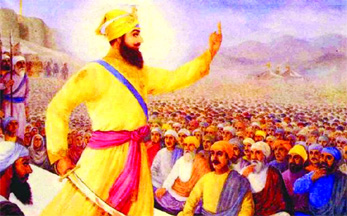

Khalsa Sajna Diwas, observed each year on Vaisakhi (13 or 14 April), marks one of the most significant events in Sikh history-the creation of the Khalsa Panth in 1699 CE by Guru Gobind Singh Ji, the tenth Sikh Guru. This day is not only a religious festival but also a sacred commemoration of identity, equality, valor, and spiritual discipline.
The founding of the Khalsa was a watershed moment-not just in the evolution of Sikhism, but also in the broader context of Indian resistance against tyranny, caste oppression, and religious intolerance.
Historical Background
In the late 17th century, India was witnessing intense social and religious turmoil. The Mughal Empire, under Emperor Aurangzeb, was expanding its control with aggressive enforcement of Islamic orthodoxy. Non-Muslims, particularly Hindus and Sikhs, were under growing pressure to convert. Temples were destroyed, religious taxes like jizya were imposed, and executions of dissenters became frequent.
Martyrdom of Guru Tegh Bahadur
The father of Guru Gobind Singh Ji, Guru Tegh Bahadur Ji, was executed in Delhi for refusing to convert to Islam and for standing up for the rights of Kashmiri Pandits. His public beheading was meant to instill fear-but it sparked a new era of spiritual and political resistance in Sikhism.
This incident deeply influenced the young Guru Gobind Rai, who was only 9 years old at the time. He grew up with a burning sense of mission-to ensure that his community would never bow to tyranny, and that faith would never be dictated by fear.
Vaisakhi of 1699: A Spiritual and Social Revolution
A Call to the Devout
Guru Gobind Singh Ji called for a grand gathering of Sikhs from across the Indian subcontinent at Anandpur Sahib on March 30, 1699, coinciding with Vaisakhi-a day already celebrated as a harvest festival in Punjab.
Thousands came, expecting a sermon or celebration. But what they witnessed was revolutionary.
The Test of Faith: Birth of the Panj Pyare
Standing before the crowd with a drawn sword, Guru Ji demanded a volunteer ready to sacrifice his head. After a tense silence, Bhai Daya Ram from Lahore stepped forward. Guru Ji took him inside a tent and returned alone-with a bloodied sword.
He repeated the request four more times. Four others stepped forward:
– Bhai Dharam Das of Hastinapur (UP)
– Bhai Himmat Rai of Jagannath Puri (Odisha)
– Bhai Mohkam Chand of Dwarka (Gujarat)
– Bhai Sahib Chand of Bidar (Karnataka)
To everyone’s astonishment, all five re-emerged alive, dressed in saffron robes, having passed the ultimate test of devotion and fearlessness.
These five were named the Panj Pyare (Five Beloved Ones)-representing the ideal Sikh who was ready to sacrifice everything for righteousness and truth, without regard to caste, region, or social background.
The Khalsa Initiation: A New
Spiritual Order
Guru Gobind Singh Ji created a new spiritual community, called the Khalsa, meaning “the pure”. He prepared Amrit (nectar of immortality) in an iron bowl, mixing water and sugar with a double-edged sword (Khanda), while reciting five sacred banis (prayers). He administered it to the Panj Pyare.
The Code of the Khalsa
The initiated Khalsa were given:
– A new surname: Singh for men (meaning lion), later Kaur for women (meaning princess)
– A distinct identity through the Five Ks:
– Kesh (uncut hair) – respect for God’s creation
– Kanga (wooden comb) – cleanliness and order
– Kara (steel bracelet) – eternal bond with God
– Kachera (cotton undergarment) – modesty and self-control
– Kirpan (ceremonial sword) – commitment to protect the weak and uphold justice
Guru Gobind Singh Ji then knelt before the Panj Pyare and asked to be initiated himself. This gesture made him the first among equals, reinforcing the idea that no one is above the community.
This was the first time in Indian history that caste hierarchy was publicly rejected in favor of complete spiritual and social equality.
Spiritual Meaning of Khalsa
“Deg Teg Fateh”
The Khalsa embodied a dual ideal:
– Deg: Providing food and service to the needy (langar and seva)
– Teg: Wielding the sword to defend the oppressed
The Khalsa was created to be a warrior-saint, devoted to God, but willing to fight against injustice, regardless of the enemy’s power.
The Khalsa Identity
The Khalsa was to be:
– Nirbhau (fearless)
– Nirvair (without enmity)
– Gurmukh (God-centered)
– A guardian of Dharam (righteousness) and freedom
Khalsa Sajna Diwas Celebrations
1. Gurdwara Services:
– Morning prayers, Akhand Path, and Kirtan
– Historical narrations and Katha (spiritual discourse)
2. Amrit Sanchar Ceremonies:
– Thousands take initiation into the Khalsa on this day
3. Nagar Kirtans (Processions):
– Led by Panj Pyare, featuring the Guru Granth Sahib, music, martial arts displays (Gatka), and decorated floats
4. Seva and Langar:
n Mass community kitchens serve free meals to people of all faiths
5. Decorated Gurdwaras:
– Illuminated buildings, flower garlands, and Nishan Sahib (Sikh flag) washing ceremonies
Global Celebrations
In the Diaspora (UK, Canada, US, Australia):
– Vaisakhi Parades attract hundreds of thousands
– Interfaith dialogues, blood donation camps, and cultural exhibitions are held
– Khalsa Sajna Diwas becomes a symbol of Sikh pride and heritage
Impact and Legacy of the Khalsa
1. Political and Military Strength
The Khalsa formed the backbone of Sikh resistance against Mughal tyranny and later British colonialism. Notable figures like Banda Singh Bahadur, Maharaja Ranjit Singh, and countless Sikh warriors were Khalsa initiates.
2. Religious and Social Revolution
Khalsa Panth was the first organized religious movement in India that:
– Eradicated caste distinctions
– Promoted gender equality
– Emphasized universal brotherhood and service
3. Modern Relevance
The Khalsa identity today is a source of:
– Strength for young Sikhs in the diaspora
– A reminder of spiritual duty and social justice
– A commitment to selfless service (seva) and community well-being


Be the first to comment