

High in the rugged Himalayas of Himachal Pradesh lies a sacred landscape where mountains are not merely peaks, but manifestations of the divine. Among the most revered of these is Kinner Kailash, a holy mountain in Kinnaur associated with Lord Shiva and deeply embedded in the religious traditions, legends and cultural memory of the region. For devotees, the journey to Kinner Kailash is not simply a mountain pilgrimage; it is an inward journey towards faith, surrender and spiritual awakening.
The Kinnaur region has been regarded as a land of gods for centuries. Its valleys are dotted with ancient temples and shrines, while local traditions preserve a distinctive blend of Hindu and Buddhist beliefs. Mountains, rivers, forests and villages are woven into a sacred geography in which the natural world and the divine are closely connected. Kinner Kailash occupies a special place within this landscape because of its association with Shiva, the supreme ascetic, yogi and lord of the mountains.
The Sacred Shivling
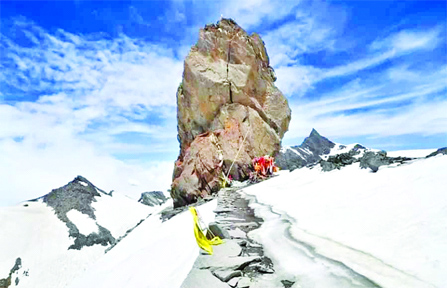
At the centre of the Kinner Kailash pilgrimage is the remarkable natural rock formation known as the Kinner Kailash Shivling. Rising dramatically against the Himalayan landscape, the rock is revered by devotees as a manifestation of Lord Shiva.
The sight of the Shivling against the vast mountain sky is central to the spiritual experience of the pilgrimage. For Shiva devotees, it is not simply an unusual geological formation. It is a sacred symbol representing the presence of the deity himself. The natural form of the rock reinforces one of the oldest ideas in Shaiva tradition – that Shiva can be worshipped through the sacred linga, a symbol associated with the infinite and formless nature of the divine.
The mountain itself is therefore considered sacred, while the Shivling becomes the spiritual focal point of the pilgrimage. Devotees traditionally approach the site with prayers and reverence, regarding the difficult journey as an act of devotion.
Kinner Kailash in Shaiva Tradition
The religious importance of Kinner Kailash is closely connected with the Himalayan association of Lord Shiva. Hindu tradition repeatedly portrays Shiva as the great yogi who dwells in the mountains, particularly in the Himalayan realm associated with Kailash.
Mount Kailash in Tibet is traditionally regarded as Shiva’s abode, while numerous Himalayan mountains and pilgrimage sites have acquired their own Kailash traditions. Kinner Kailash is one such sacred landscape, and its association with Shiva has made it an important destination for devotees.
The very character of the mountain reflects the traditional image of Shiva. The rugged cliffs, silence, snow, clouds and isolation evoke the atmosphere of meditation and renunciation. The pilgrim entering this landscape is, in a sense, entering the symbolic world of the great yogi.
The Legend of the Pandavas
One of the popular traditions associated with Kinner Kailash connects the mountain with the Pandavas of the Mahabharata. According to local belief, the Pandavas passed through or stayed in the Himalayan region during their period of exile.
Various local traditions associate the Pandavas with sacred sites across Himachal Pradesh, and Kinnaur has its own stories linking the epic heroes with the mountains. In some versions of the Kinner Kailash tradition, the Pandavas are believed to have undertaken penance and worshipped Lord Shiva here.
The legend reflects a familiar theme in Hindu sacred geography: mountains become holy through the presence, meditation or worship of divine and epic figures. Whether understood literally or symbolically, such stories have helped preserve the sacred character of the landscape across generations.
Shiva and Parvati: The Divine Couple
Another strand of local religious tradition connects the Kinner Kailash landscape with Lord Shiva and Goddess Parvati. In Hindu mythology, Parvati is the daughter of the mountains and the eternal consort of Shiva. The Himalayas are therefore not merely the setting of their divine story but are themselves deeply connected with the identity of the goddess. The idea of Shiva and Parvati inhabiting the Himalayan realm gives special meaning to mountain pilgrimage. The peaks become reminders of the divine couple, while the solitude of the high mountains evokes Shiva’s meditative existence.
For devotees, approaching Kinner Kailash can thus be understood as entering a sacred space associated with both Shiva and Shakti – the masculine and feminine dimensions of divine reality.
The Mountain as a Place
of Divine Assembly
Kinnaur has a long-standing tradition of regarding local deities as powerful living beings who protect villages and communities. In this religious worldview, gods are not distant figures confined to mythology. They are believed to inhabit mountains, forests and temples and to remain connected with the lives of their devotees.
Kinner Kailash forms part of this larger sacred landscape. Local traditions describe the mountains as places where divine beings gather, and the region’s numerous deity traditions reinforce the belief that the Himalayas are inhabited by the supernatural.
This belief gives the pilgrimage a character different from ordinary trekking. The traveller is expected to approach the mountain with humility and respect because the landscape itself is considered sacred.
The Rock That Changes Color
Among the fascinating beliefs associated with the Kinner Kailash Shivling is the observation that the rock can appear to change colour as sunlight shifts across it during the day. The changing light and weather conditions can produce striking variations in the appearance of the rock.
For devotees, these changing forms can acquire spiritual meaning and are sometimes interpreted as signs of divine presence. Scientifically, changes in illumination, shadow and atmospheric conditions can alter the appearance of a rock surface, but the religious interpretation remains an important part of the pilgrimage experience.
This illustrates how Himalayan spirituality often combines the physical landscape with a rich world of symbolism. What appears to be a natural phenomenon can simultaneously become an object of devotion.
The Meaning of the Pilgrimage
The journey to Kinner Kailash is traditionally regarded as an act of devotion rather than merely an adventure. The difficult terrain becomes part of the spiritual discipline. Every step requires physical effort, patience and determination.
For a devotee, hardship can itself become a form of prayer. The pilgrim leaves behind familiar comforts and accepts cold, steep paths, fatigue and uncertainty. This physical renunciation mirrors the spiritual ideal associated with Shiva, whose life represents detachment from worldly possessions.
The mountain therefore becomes a teacher.
It teaches patience when the path becomes difficult, humility when the landscape overwhelms the senses and surrender when circumstances cannot be controlled. The pilgrimage asks the traveller to move beyond the ordinary concerns of life and focus on something larger.
Shiva as the Lord of Transformation
The deeper religious significance of Kinner Kailash can also be understood through the nature of Shiva himself. In Hindu philosophy, Shiva is often associated with destruction, but destruction does not simply mean an ending. It makes transformation and renewal possible. Shiva destroys ignorance, ego and attachment. His ascetic form represents meditation and detachment, while his cosmic form represents the endless cycle of creation, preservation and dissolution.
A pilgrimage to a Shiva shrine can therefore be understood as an opportunity for inner transformation. The devotee approaches the mountain carrying personal worries, desires and prayers, and the journey becomes a process of reflection. The destination is important, but the transformation takes place along the path.
Kinner Kailash and the Idea of Kailash
The name Kinner Kailash itself evokes the sacred idea of Kailash. Mount Kailash in the trans-Himalayan region has for centuries been revered in Hinduism, Buddhism, Jainism and the Bon tradition. For Hindus, it is traditionally associated with Lord Shiva and Goddess Parvati.
Kinner Kailash is not identical to Mount Kailash in Tibet, but its religious association with Shiva places it within the broader Himalayan tradition of sacred mountains. The use of the name “Kailash” reflects the way particular Himalayan landscapes have become local expressions of a much larger sacred imagination.

Be the first to comment