
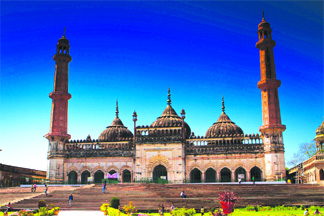

Lucknow, the capital of Uttar Pradesh, is not just a destination; it is an experience woven with culture, hospitality and centuries-old elegance. Famous as the City of Nawabs, Lucknow blends the charm of its Mughal-Avadhi heritage with the vibrancy of a modern metropolis. Every street, every aroma, every conversation echoes its legendary tehzeeb—a unique blend of politeness, poetic sensibility and refined living that defines the soul of the city.
A walk through Lucknow feels like stepping into a living museum. Start your journey at the Bara Imambara, an architectural marvel built by Nawab Asaf-ud-Daula in the 18th century. Famous for its central hall with no supporting beams and the mysterious Bhul Bhulaiya labyrinth, it remains one of India’s most intriguing historical structures. Just nearby stands the Chota Imambara, a shining example of Persian-influenced design, with chandeliers, calligraphy and ornate stucco work that transform the monument into a glowing palace.
The majestic Rumi Darwaza, often called the Gateway of Lucknow, rises like a regal backdrop to the city’s skyline. Modeled after Istanbul’s Sublime Porte, it captures the spirit of the Nawabi era. Further along, the British Residency whispers stories of the 1857 uprising—its quiet ruins standing as a reminder of Lucknow’s pivotal role in India’s freedom struggle.
CONSTANTIA
Now a part of the famous La Martiniere College in Lucknow, the Constantia is a grand creation of a Frenchman called General Claude Martin.Martin started the construction of this structure in 1785, with the intention of building a palatial residence in India. However, he couldn’t live long enough to live in the house and died in the year 1800. The construction could finally be completed only two years of his death. The building was named after the main principle of Martin’s life, which was ‘Labore et Constantia’ (energy and persistence). Before he died, he made a will stating his desire to use the property as a centre of learning and thus, Constantia became an integral part of the college. The architectural grandeur of this majestic building will remind you of the bygone era.
RUMI DARWAZA
An exquisite example of Awadhi architecture, the Rumi Darwaza is a 60-foot-tall gateway located close to historical landmarks such as Bada Imambara and Chota Imambara in the city of Lucknow. The exquisite arch-shaped doorway is as central to Lucknow, as India Gate is to Delhi or Gateway of India is to Mumbai. Built in the 18th century, Rumi Darwaza is famed for its intricate carvings, architectural beauty and the vantage point on its top which offers panoramic views of the city (though entry to the topmost point is restricted mostly). This striking gateway is also known as the Turkish Gate, because of its resemblance with the entrance gate in Istanbul.
BEGUM HAZRAT MAHAL PARK
Situated in the heart of the city, the Begum Hazrat Mahal Park was built in the memory of the beautiful Queen of Awadh, Begum Hazrat Mahal. Though the garden and monument were constructed by the Indian government to commemorate her contribution to the 1857 revolt, it is also immensely popular with couples now. This impressive garden in the Hazratganj region has striking wellsprings, beautiful trees and stone pathways. The greenery and serenity around the garden draws couples in large numbers.
KAISERBAGH PALACE
One of the most-visited tourist attractions in Lucknow, Kaiserbagh Palace complex is truly an architectural marvel. It was built by the Nawab of Awadh Wajid Ali Shah between 1848 and 1850. In the later years, the palace acted as a stronghold of Begum Hazrat Mahal during the 1857 mutiny. A major part of the palace was destroyed by the British forces after the Revolt of 1857. Though the palace is in ruins now, it remains a prime tourist hotspot in the city. Visitors can still see the pediments, lanterns, Moorish minarets and banisters here. Moreover, the tombs of Nawab Saadat Ali Khan (the fifth Nawab Wazir of Awadh) and his beloved wife Khursheed Zadi, rest on the northern terrace of palace’s courtyard, which is another major highlight of the place. With its splendid architectural style, Kaiserbagh Palace is a must see attraction in the city.
JAMA MASJID
Built entirely in sparkling off-white sandstone, Lucknow’s Jama Masjid is considered to be one of the most beautiful mosques in India. Constructed in the 15th century, this architectural wonder will leave you spellbound with the calligraphy on its walls, its picturesque domes and striking minarets. Standing tall with 260 pillars, the mosque has 15 arched domes complete with exquisite carvings and stone work. Still used for daily prayers, the mosque is decorated on special festivals such asId-ul-Fitr and Id-ul-Zuha. Located towards the north-west of Chota Imambara, the mosque is an important landmark in the city of nawabs.
CLOCK TOWER
Also known as Hussainabad Clock Tower, Clock Tower is a 67 m tall structure constructed by Nawab Nasir-ud-din Haider in the year 1881. Displaying the finest works of art, the tower was built to commemorate the arrival of Sir George Couper, the first Lieutenant Governor of United Province of Avadh. Situated close to the famous Rumi Darwaza, the tower is a magnificent example of English architecture, and displays Victorian and Gothic structural designs. The mastermind behind the creation of this gigantic clock tower was none other than the famous royal clock maker, James William Benson. So do make it a point to visit this impressive building while you’re in the city.


Right now it sounds like Expression Engine is the best blogging platform out there right now. (from what I’ve read) Is that what you are using on your blog?
Aw, this was an extremely nice post. Taking the time and actual effort to make a top notch article… but what can I say… I hesitate a lot and never seem to get anything done.
Aw, this was an incredibly good post. Taking a few minutes and actual effort to make a good article… but what can I say… I hesitate a whole lot and don’t manage to get anything done.
Can I simply just say what a comfort to discover somebody that actually knows what they are discussing online. You certainly understand how to bring a problem to light and make it important. More and more people have to read this and understand this side of your story. It’s surprising you’re not more popular because you certainly possess the gift.
Aw, this was a very nice post. Taking the time and actual effort to create a good article… but what can I say… I put things off a lot and never manage to get nearly anything done.