Tag: MADHYA PRADESH

  • Madhya Pradesh: Where India’s many worlds meet

    Madhya Pradesh: Where India’s many worlds meet

    Madhya Pradesh occupies a unique place on India’s map and in its cultural imagination. Located at the geographical centre of the country, the state derives its name from its position, yet its true identity is far more layered. Popularly known as “The Heart of Incredible India,” Madhya Pradesh is a microcosm of the nation itself-where ancient history, sacred traditions, artistic brilliance, wildlife, cuisine, and modern life converge within a single landscape.
    Surrounded by other Indian states on all sides, Madhya Pradesh lies largely across fertile plains and forested plateaus that form part of one of the oldest inhabited regions of the subcontinent. Much of this land was once known as Gondwana, the ancestral homeland of the Gond tribes, whose cultural legacy continues to shape the state’s rural and forest communities. Spiritually significant and historically rich, Madhya Pradesh is also one of the four sites of the Kumbh Mela, held every twelve years in the holy city of Ujjain.
    The state’s vast cultural canvas includes everything from medieval temples and Buddhist monuments to royal palaces and colonial-era structures. Indore’s rare glass temple, Ujjain’s revered Mahakaleshwar Jyotirlinga, the sculpted marvels of Khajuraho, and the serene Sanchi Stupa near Bhopal collectively narrate India’s spiritual and architectural journey across centuries. Complementing this heritage is the state’s extraordinary natural wealth, with dense forests and wildlife reserves that rank among the finest in Asia.
    Khajuraho: Stone Poetry of a Bygone Era
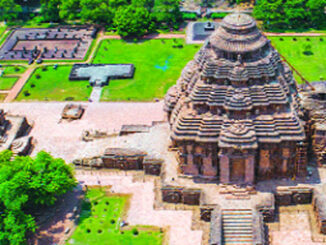
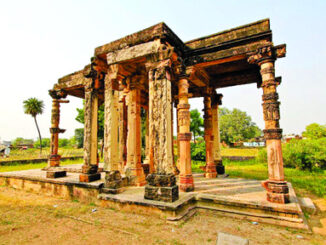
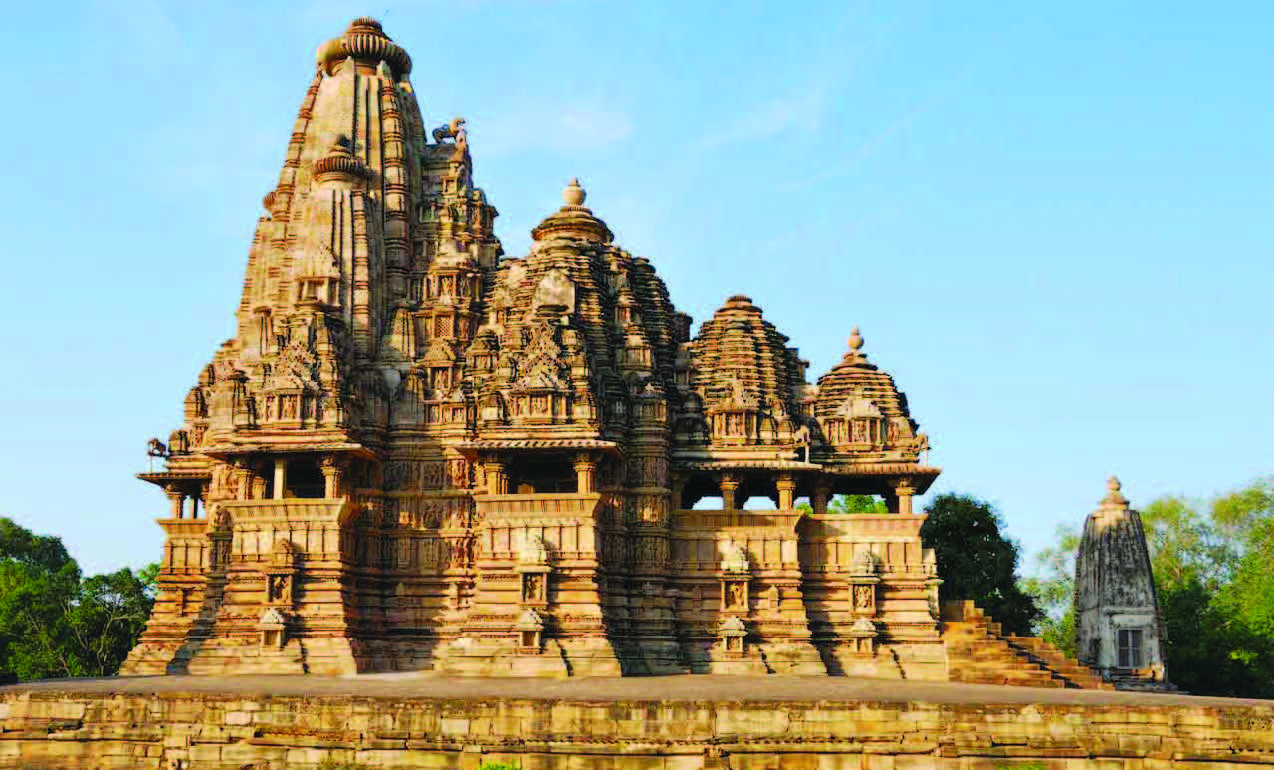
    The temple town of Khajuraho, a UNESCO World Heritage Site, stands as one of India’s most extraordinary artistic achievements. Located in the Bundelkhand region, Khajuraho is renowned for its intricately carved Hindu and Jain temples built between 950 and 1050 AD under the Chandela dynasty. These temples depict not only religious devotion but also everyday life, music, dance, and human intimacy.
    The famed erotic sculptures-often misunderstood-are deeply symbolic, reflecting ancient Indian philosophies that viewed desire as an integral part of existence and spiritual evolution. Once home to nearly 85 temples, the complex today preserves around 25, having survived centuries of invasions and natural decay. Yet what remains continues to astonish visitors with its boldness, symmetry, and artistic finesse.
    Pachmarhi: The Quiet Charm of Satpuras
    Tucked away in the Satpura range, Pachmarhi is the only hill station in Madhya Pradesh and its highest point. Known affectionately as “Satpura ki Rani,” the town sits at an altitude of about 1,067 metres and forms part of a UNESCO-recognised Biosphere Reserve. Dense forests, waterfalls, and ravines create a tranquil environment that contrasts sharply with the plains below.
    According to legend, the Pandavas spent part of their exile here, leaving behind five sandstone caves that continue to attract pilgrims. Discovered in the 19th century by British officer Captain James Forsyth, Pachmarhi also retains colonial-era churches and bungalows, blending myth, nature, and history into a peaceful retreat.
    Gwalior: Echoes of Royalty and Ragas
    The city of Gwalior rises dramatically around its magnificent hilltop fort, one of the most formidable and visually striking forts in India. Founded by King Surajesan, Gwalior has long been associated with power, culture, and royal patronage. Its palaces and temples reflect centuries of architectural grandeur and strategic importance.
    The opulent Jai Vilas Palace is among its most remarkable landmarks, famed for housing the world’s largest carpet and two massive chandeliers weighing nearly 3.5 tonnes each. Gwalior also holds a special place in India’s musical heritage as the birthplace of Tansen, one of the greatest exponents of Hindustani classical music. The annual Tansen Music Festival, held near his tomb, draws musicians and connoisseurs from across the country.
    Bandhavgarh National Park: Realm of the Royal Tiger
    Once the private hunting grounds of the Maharajas of Rewa, Bandhavgarh National Park is today one of India’s most celebrated tiger reserves. Known for having one of the highest densities of Bengal tigers, the park offers exceptional opportunities for wildlife sightings. In addition to tigers, it shelters over 22 species of mammals and nearly 250 species of birds.
    The park derives its name from the ancient Bandhavgarh Fort, perched atop towering cliffs. Though now in ruins, the fort provides sweeping views of the surrounding forests. Jeep safaris remain the primary way to explore this rich and dynamic ecosystem.
    Kanha National Park: Into
    the Wild Heart of Central India
    Sprawling across nearly 940 square kilometres, Kanha National Park is the largest national park in central India and ranks among the finest wildlife reserves in Asia. Established in 1955 and designated a Project Tiger Reserve in 1974, Kanha has been instrumental in wildlife conservation efforts, particularly in saving the rare Barasingha from extinction.
    The park’s diverse landscapes-lush meadows, sal forests, and water bodies-are home to tigers, leopards, wild dogs, sloth bears, jackals, hyenas, deer, and a variety of reptiles. Immortalised through Rudyard Kipling’s The Jungle Book, Kanha continues to attract nature lovers, photographers, and wildlife enthusiasts from across the globe.

  • History and origin of Pravasi Bharatiya Divas

    History and origin of Pravasi Bharatiya Divas

    The 18th PBD Convention will be held from 8 – 10 January 2025 in Bhubaneswar, Odisha. The theme of the 18th PBD Convention is ‘Diaspora’s Contribution to a Viksit Bharat’

    The Pravasi Bharatiya Divas (PBD), or Non-Resident Indian (NRI) Day, is celebrated annually on January 9th to honor the contributions of the Indian diaspora to the progress of India and to recognize their role in strengthening India’s ties with the global community. This day highlights the connection between the nation and its overseas citizens, celebrating the spirit of Indian identity, culture, and development worldwide.
    The origins of Pravasi Bharatiya Divas are deeply rooted in the larger context of India’s relationship with its global diaspora. The history behind this celebration is tied to India’s historical emigration patterns, the struggles faced by early Indian migrants, and the efforts to bring attention to their contributions to both their host countries and India. This article explores the history, significance, and origins of Pravasi Bharatiya Divas, looking at how this day evolved, its relevance today, and the broader context of the Indian diaspora.
    January 9 commemorates the return of Mahatma Gandhi from South Africa to India in 1915. To mark this day, the tradition of celebrating the Pravasi Bharatiya Divas (PBD) started in 2003. 1st PBD Convention was organised on 9 January 2003 to mark the contribution of the overseas Indian community to the development of India.
    Since 2015, under a revised format, the PBD Convention has been organised once every 2 years.
    The 17th Pravasi Bharatiya Divas Conventions have been organised till date. 17th PBD was held from 8 – 10 January 2023 in Indore, Madhya Pradesh. The theme of the 17th PBD Convention was “Diaspora: Reliable Partners for India’s Progress in Amrit Kaal”.
    The 18th PBD Convention will be held from 8 – 10 January 2025 in Bhubaneswar, Odisha. The theme of the 18th PBD Convention is “Diaspora’s Contribution to a Viksit Bharat”.
    Historical Background of Indian Emigration
    Indian migration has a long history, dating back centuries. The earliest known waves of Indian emigration can be traced to the traders, scholars, and laborers who moved across the Indian Ocean to places like Southeast Asia, the Arabian Peninsula, Africa, and beyond. However, the large-scale movement of Indians to other parts of the world began during British colonial rule.
    Indentured Labor System and Colonial Migration
    The most significant migration wave in the 19th and early 20th centuries was due to the British colonial administration’s establishment of the indentured labor system. This system saw millions of Indians sent abroad to work on plantations in places like the Caribbean, Fiji, Mauritius, and South Africa. As indentured laborers, these individuals faced harsh conditions but contributed significantly to the economic development of their respective host countries.
    In the early 20th century, a new wave of emigration occurred when skilled workers, professionals, and traders began to migrate to countries such as the United States, Canada, and the United Kingdom. This migration, especially after India gained independence in 1947, continued and saw an increase in the number of educated professionals from India seeking better opportunities abroad. Over time, the Indian diaspora grew into a global community that contributed to their host countries’ economies, cultural diversity, and political spheres.
    The Role of the Indian Diaspora
    Post-Independence
    After India’s independence, the Indian government sought to establish strong ties with its citizens abroad. The global Indian diaspora, despite being physically distant, played a key role in shaping India’s political and economic landscape. They helped raise awareness about India’s development and played an instrumental role in remittances, which became one of the primary sources of foreign exchange for the country.
    The Indian diaspora, spread across continents, helped build strong links between India and the world. They continued to make significant contributions to the development of their host countries, excelling in various fields like business, education, politics, and technology. Notable figures in the global Indian community include Dhirubhai Ambani, Sundar Pichai, Indra Nooyi, and many others who have not only succeeded in their respective fields but have also helped foster a better understanding of Indian culture and values globally.
    The Birth of Pravasi Bharatiya Divas
    The idea of celebrating the Indian diaspora on a national level was first proposed during the 2003 Pravasi Bharatiya Divas Convention. The idea to create a day to celebrate the Indian diaspora came from the efforts of the Indian government to recognize the contributions of NRIs and Persons of Indian Origin (PIOs).
    The First PBD in 2003
    The first Pravasi Bharatiya Divas was held in January 2003 in New Delhi, under the leadership of then-Prime Minister Atal Bihari Vajpayee. It was organized by the Ministry of Overseas Indian Affairs (MOIA), which was created in 2004 to specifically cater to the concerns of the Indian diaspora. The first convention aimed to provide a platform for members of the diaspora to interact with the Indian government, business leaders, and intellectuals. It was a way to acknowledge their contributions to India’s development and global standing.
    The year 2003 also marked the centenary of the return of Mahatma Gandhi to India from South Africa, where he had first developed his ideas of non-violence and social justice. In 1915, Gandhi had returned to India after being part of the Indian diaspora for over two decades. His return signaled the start of a larger movement against British colonial rule and for Indian independence. As a result, January 9th was chosen as the official date to commemorate this event, making the day even more significant. Thus, Pravasi Bharatiya Divas, which was initially conceptualized as a way to recognize the Indian diaspora, was also designed to mark the legacy of Indian leaders like Gandhi and their connection to the global Indian community.
    The Significance of January 9th
    The choice of January 9th as the date for Pravasi Bharatiya Divas is deeply symbolic. This date is significant because it commemorates the return of Mahatma Gandhi to India from South Africa. Gandhi’s experiences in South Africa had a profound influence on his methods of resistance and his eventual leadership of the Indian freedom struggle.
    Gandhi’s return to India from the diaspora marked the beginning of his pivotal role in the fight for independence. His return was seen as a powerful moment in Indian history, as it symbolized the strong link between India and its diaspora. By choosing this date, Pravasi Bharatiya Divas also honors the historical connection between the Indian diaspora and the Indian independence movement.
    Objectives and Purpose of Pravasi Bharatiya Divas
    The primary objective of Pravasi Bharatiya Divas is to acknowledge the contributions of NRIs and PIOs to India’s progress in various fields. The day provides a platform for the government of India to engage with the Indian diaspora, allowing them to discuss issues that affect their lives abroad and explore ways to contribute to India’s growth.
    Key Objectives of PBD
    – Recognition of the Contributions of NRIs and PIOs: Pravasi Bharatiya Divas serves as an occasion to acknowledge the positive impact that members of the Indian diaspora have had on their host countries and on India’s economy, culture, and political landscape.
    – Strengthening Ties Between India and the Diaspora: It provides a venue for dialogue between the Indian government and the diaspora, discussing critical issues such as remittances, legal and social protections for emigrants, and the promotion of Indian culture abroad.
    – Facilitating Collaboration: The event fosters collaboration between the Indian government, businesses, and overseas Indians, encouraging investment in India, promoting tourism, and strengthening the global reach of Indian companies.
    – Cultural Exchange and Promotion: PBD encourages cultural exchange, making the world more aware of India’s rich heritage and traditions.
    Subsequent Developments and the Global Outreach
    After its inception, the Pravasi Bharatiya Divas became an annual event, attracting thousands of NRIs and PIOs from across the globe. The government organized a series of seminars, discussions, and networking sessions during PBD to facilitate knowledge exchange and foster collaborations.
    In subsequent years, the event became increasingly inclusive, encompassing a wider range of issues important to the global Indian community, including topics related to education, healthcare, and the professional development of diaspora communities. PBD also saw the introduction of the Pravasi Bharatiya Samman Awards, which were presented to individuals and organizations that made significant contributions to India’s development or to the Indian diaspora.
    These awards became a key feature of PBD, as they not only celebrated individual and collective achievements but also showcased the diverse and vibrant contributions of the Indian diaspora across various domains, including science, business, and social activism.
    Challenges
    While Pravasi Bharatiya Divas has been a platform for celebration and recognition, there have been criticisms regarding its effectiveness in addressing the concerns of the diaspora. Some members of the Indian community have raised issues about the lack of concrete action taken by the Indian government in relation to the challenges faced by NRIs, such as immigration issues, legal matters, and the protection of their rights in host countries. Furthermore, there have been concerns about the focus on celebratory events rather than practical steps toward improving the living conditions of the diaspora.
    The Future of Pravasi Bharatiya Divas
    As India continues to develop as a global power, the role of the diaspora becomes increasingly important. The Indian government has made substantial efforts to reach out to NRIs and PIOs, particularly in areas such as trade, investment, and diplomacy. With the Indian diaspora becoming more prominent in global politics and business, Pravasi Bharatiya Divas is likely to continue evolving into a more significant event that not only honors their contributions but also acts as a catalyst for further cooperation between India and the world.
    The future of Pravasi Bharatiya Divas will likely see the development of new initiatives and programs that focus on strengthening the bonds between India and its diaspora. It may also serve as an opportunity to address the concerns of the global Indian community and promote a more inclusive, sustainable, and prosperous relationship.
    Pravasi Bharatiya Divas is a unique celebration that honors the global Indian community, recognizing their contributions to both India and the countries they have made their homes. From its origins in 2003, the day has evolved into a significant event that fosters dialogue, promotes cultural exchange, and celebrates the diverse achievements of Indians abroad. Through its various initiatives, PBD continues to serve as a bridge between India and its diaspora, helping to shape a stronger, more connected global Indian community.

  • It’s back to the drawing board for the Congress

    It’s back to the drawing board for the Congress

    The Congress needs to go beyond the current focus on the negative aspects of the ruling dispensation or its perceived faultlines

    “The Congress can build on this base, but to take this process forward, it needs to project a clear ideological narrative and articulate its own politics. For a start, it shouldn’t try to outdo the BJP as a ‘more Hindu’ party, particularly when voters have the option to go for the real thing. The ideological counter must reflect a different model of development with an emphasis on rights-based welfare, especially employment guarantees interlaced with social harmony. In sum, the Congress has to reboot its political discourse by foregrounding something substantive, which is best done by advocating a positive agenda that can galvanize the electorate and goes beyond the current focus on the negative aspects of the ruling dispensation or the perceived faultlines within it and the politics it has promoted.”

    By Zoya Hasan

    The Congress’ remarkable victory in Telangana was overshadowed by its devastating defeat in the Hindi heartland in the just-concluded Assembly elections. The Congress has suffered a big blow as it lost all three states — Madhya Pradesh, Rajasthan and Chhattisgarh — it had won in 2018. The Bharatiya Janata Party’s (BJP) comprehensive victory was backed by support across most regions in these states and a strong showing in urban areas. But the Congress, despite its defeat, has managed to retain its vote share — Madhya Pradesh (40.4 per cent), Rajasthan (39.5 per cent) and Chhattisgarh (42.23 per cent). The BJP has gained mostly at the expense of others in the fray. With these triumphs, the BJP has expanded its dominance of a key region ahead of the 2024 General Election. However, the Congress vote share holds considerable significance in the run-up to the Lok Sabha elections.

    The Congress tried to highlight issues such as joblessness and caste discrimination in the hope that it would appeal locally in the state elections and nationally in the General Election. But its two-pronged plank of welfare schemes and social justice was upstaged by the subtext of Hindu nationalism and communal politics. The BJP’s victories highlight the consolidation of Hindu nationalism and the great resonance it enjoys in the heartland states. The use of state machinery, ample financial resources and the party’s organizational framework, buttressed by RSS cadres, have helped it promote itself as a champion of a strong nation, development and welfarism as well as of Hindu interests and the Hindu religion.

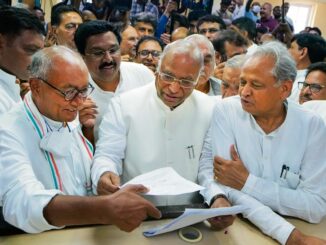
    From the outset, the BJP’s campaign pivoted on Prime Minister Narendra Modi, relegating established state leaders to the sidelines. The party decided not to nominate a chief ministerial candidate for any of the states going to the polls. This meant that even popular state leaders of the Congress like Ashok Gehlot and Bhupesh Baghel were not pitted against their local BJP rivals, but against Modi himself. The PM’s huge popularity in north and central India neutralized the public acceptance of these leaders.

    Taking a cue from its experience in Karnataka, where the visibility and prominence of local leaders paid off, the Congress projected state leaders, who were given a free hand. However, the infighting and overweening ambitions of its leaders in Rajasthan and Chhattisgarh put paid to this strategy. Factionalism and divided state leadership, which have been the undoing of the Congress in many states, was on full display throughout its term in office in these two states. Leaders were attacking each other until a few months before the elections, which sent a message to voters that this was a party that couldn’t keep its house in order. A settlement was forged between the warring leaders in both states, but it was a case of too little, too late.

    Apart from factionalism, there was no accord or concord between the state leadership and the high command. The Congress campaign lacked coherence; it appeared disjointed, with powerful state satraps unwilling to countenance any interference on their turf. In contrast, the BJP’s campaign was intensive and focused and the party spoke in one voice. This is not surprising, as the contemporary BJP is a highly centralized party, while the Congress, in a departure from the past, is relatively decentralized.

    To make matters worse, there was no agreement between the Congress and its allies in the state elections. The 28-party INDIA grouping led by the Congress, which came together to fight the BJP, did not feature in the state polls due to inter-party rivalries. Opposition parties should have negotiated state-specific alliances and seat adjustment in a spirit of give-and-take. This is easier said than done. Seat-sharing didn’t happen, which hurt the Congress as well as the INDIA bloc, which the voters saw as a divided house. The fate of the Congress and other parties in this election makes it clear that they can tackle the BJP only when they are united against it.

    A caste-based census was the big battlecry of the Congress to undercut the BJP’s support among the OBCs, but it turned out to be a ‘no-ball’. This call had little traction on the ground, with the issue not paying dividends — the BJP’s share of OBC votes has increased. In any case, it is doubtful that the demand for a caste census is an inspiring or effective counter to Hindu identity politics, which holds much greater appeal for subaltern groups in the current conjuncture. Caste politics and ideas of social justice were not enough without a clear political plank to serve as a counterpoint to the BJP’s politics in these states or effective campaigning, ideological clarity and organizational cohesion to communicate its message.

    There is limited evidence of a correlation between state and national elections. Yet, there’s little doubt that the Congress’ decisive defeat at the hands of the BJP in straight contests has undermined its credibility and is bound to demoralize it at a crucial time when the Lok Sabha elections are just five months away. However, all is not lost as the majority of the voters have opted for non-BJP parties in these critical states.

    The Congress can build on this base, but to take this process forward, it needs to project a clear ideological narrative and articulate its own politics. For a start, it shouldn’t try to outdo the BJP as a ‘more Hindu’ party, particularly when voters have the option to go for the real thing. The ideological counter must reflect a different model of development with an emphasis on rights-based welfare, especially employment guarantees interlaced with social harmony. In sum, the Congress has to reboot its political discourse by foregrounding something substantive, which is best done by advocating a positive agenda that can galvanize the electorate and goes beyond the current focus on the negative aspects of the ruling dispensation or the perceived faultlines within it and the politics it has promoted.
    (The author is Professor Emerita, Centre for Political Studies, JNU)

  • BJP on a roll, Opposition needs to regroup

    BJP on a roll, Opposition needs to regroup

    • The least resilient among the INDIA members are in danger of disappearing from the political scene

    “PM Modi’s most urgent task is to lift millions of his countrymen from the poverty in which they are mired. The affluent are certainly much better off since 2014. The stock market is booming. Those who have invested in stocks will become even richer if he is re-elected in 2024. The freebies now given away to the rural poor will eventually have to be stopped. The youth of those poor households, belonging mainly to the lower castes, must be equipped with skills to enable them to fend for themselves. Industrialists and entrepreneurs, who have prospered in the last 10 years, should be motivated to enter less-profitable segments of the economy so that jobs are created for our unemployed youth.”

    By Julio Ribeiro

    I write this piece as a member of a minority community — just 2 per cent of the country’s population. In a ‘first past the post’ system of electing people’s representatives, the BJP has swept the Assembly polls in the Hindi heartland. The Congress lost the tribal and women’s votes. The shift in votes from the Congress to the BJP catapulted the latter to power in Madhya Pradesh, Rajasthan and Chhattisgarh.

    ‘Sabka Saath, Sabka Vikas, Sabka Vishwas’ needs to be put into practice instead of being merely parroted every now and then.

    The difference in the overall vote share of the BJP and the Congress was roughly 2 percentage points in Rajasthan and 4 in Chhattisgarh. It was 8 percentage points in Madhya Pradesh, where the winner garnered 48 per cent of the votes as against 40 per cent by the Congress.

    It was a resounding victory for the BJP and Modi in particular. Not even his bitterest critic can say that he is not the most popular and charismatic of all political leaders in the country. It looks certain that he will be elected for a third term. The Hindi heartland is with him and that should tilt the scales in his favor. The South is not with him, but the West is his for the taking. What is in store for the country after the 2024 Lok Sabha elections? In the past decade, India has been divided on communal lines. The consolidation of the Hindu vote was what the Hindutva forces strived for. It succeeded to the extent of ensuring the BJP’s poll victories. Muslims and Christians together make up just 16 per cent of the population. The Sikhs account for less than 2 per cent.

    After the 2024 polls, the forward castes in the Hindu fold will be the chosen ones, like the Christian Brahmins and Kshatriyas were in Goa during the Portuguese rule. The BJP under Modi, influenced by the RSS, will placate the OBCs and the Scheduled Castes/Scheduled Tribes, counting them within the 80 per cent whose pride in being Hindu has to be ‘created’.

    The Muslims were in the doghouse in Modi’s first two terms. Beef-related lynchings, ‘love jihad’ accusations and the fear generated by the CAA-related NRC had stifled their quest for equality as citizens of India. Now, I envisage that they and the Christians, who are next in line on the extremists’ hit list, will have to adjust to second-class citizenship like Hindus and Christians in Pakistan have done in that religion-influenced country.

    Delivering his victory speech at the BJP’s headquarters in Delhi, PM Modi mentioned ‘appeasement’, besides corruption and dynastic politics, as the evils that he has been fighting. I do not know what he means by ‘appeasement’. If he is referring to the Muslims, it is only the mullahs who were appeased by the Congress, and that too in religious matters. That is not the mandate of a democratically elected government. Muslims should be ‘appeased’ like all poor communities, such as the Scheduled Castes and the Scheduled Tribes, in terms of education and healthcare. Religious issues should be sorted out by the community itself or by the courts.

    Extremist elements in the Hindutva camp have consistently railed against the Muslim minority. There have even been calls to exterminate Muslims and boycott their traders selling vegetables and fruits in Hindu localities. Modi should rein in these extremists by ordering penal action against them as ordained by law. He hesitates to do that for fear of losing their support. They, in turn, misinterpret this silence as tacit approval.

    PM Modi’s most urgent task is to lift millions of his countrymen from the poverty in which they are mired. The affluent are certainly much better off since 2014. The stock market is booming. Those who have invested in stocks will become even richer if he is re-elected in 2024. The freebies now given away to the rural poor will eventually have to be stopped. The youth of those poor households, belonging mainly to the lower castes, must be equipped with skills to enable them to fend for themselves. Industrialists and entrepreneurs, who have prospered in the last 10 years, should be motivated to enter less-profitable segments of the economy so that jobs are created for our unemployed youth.

    The possible re-election of Modi and the BJP in 2024 will consolidate the right-wing economic trend in the country. All left-of-center parties, like the Congress, TMC and the AAP, should come together to form an effective Opposition. If they fail to do so, the least resilient among the INDIA members are in danger of disappearing from the political scene. Many leaders of those parties, such as Arvind Kejriwal, will find themselves targeted by the ED, the CBI and other Central agencies with ruthless precision just before the elections.

    Nearly a century ago, writer-philosopher Aldous Huxley, in his futuristic work Brave New World (1932), prophesied: “By means of ever more effective methods of mind manipulation, the democracies will change their nature; the quaint old forms — elections, parliaments, Supreme Courts and all the rest — will remain. The underlying substance will be a new kind of non-violent totalitarianism. Democracy and freedom will be the theme of every broadcast and editorial… Meanwhile, the ruling oligarchy and its highly trained elite of soldiers, policemen, thought-manufacturers and mind-manipulators will quietly run the show as they see fit.” Does that ring a bell? An Opposition-mukt democracy is no democracy.

    PM Modi has often stated: “India is the mother of democracy.” If he really believes what he says, we, members of the minority in our own land, will be reassured if ‘Sabka Saath, Sabka Vikas, Sabka Vishwas’ is put into actual operation instead of being merely parroted every now and then.
    (The author is a highly decorated Indian Police Service (IPS) Officer and a former governor)

  • Challenge to Hindutva

    Challenge to Hindutva

    • The clamour for a caste census can redefine political equations and alliances in the run-up to Lok Sabha polls

    It’s premature to conjecture if caste is a robust counter to the BJP’s Hindutva. But the BJP’s strategy of employing religion to heighten a pan-Hindu identity among the non-upper castes might be past its shelf life, at least in the state elections.

    “The belated wisdom of a national party such as the Congress plunging headlong into sectional politics discomfited some of its insiders, who believed that it should focus on the economy’s big picture, inflation and livelihood and leave matters like a caste count to the identity-wedded entities it is aligned with in the regions. Insiders said that would be more in keeping with the ‘character’ of these players, some of whom, incidentally, are products of the post-Mandal period.”

    By Radhika Ramaseshan

    The upcoming Assembly elections in Madhya Pradesh, Chhattisgarh, Rajasthan and Telangana have got inextricably linked with three factors — the Bihar Government’s release of a comprehensive caste survey (CCS), the Congress’ promise to conduct a similar caste count if elected to power in these states and the BJP’s response to frame the discourse in a different idiom, featuring leitmotifs drawn from the Hindutva ideology. As the BJP garnered a little over 40 per cent of the OBC votes in the 2019 elections, largely by projecting Modi both as an OBC mascot and a Hindu icon, the Congress was bereft of any such attribute.

    A little before and immediately after the Bihar CCS demonstrated the potential of resurrecting the issue of the empowerment of Other Backward Classes (OBCs) or backward castes, the Congress strongly advocated for a caste count. Former party president Rahul Gandhi described it as an ‘X-ray’ that would reveal the socioeconomic condition of the OBCs, Dalits and Adivasis and challenged Prime Minister Narendra Modi to lay bare the findings of a socioeconomic caste survey undertaken during then PM Manmohan Singh’s tenure. Rahul claimed that the Congress governments in Rajasthan and Chhattisgarh had initiated a process to carry out a CCS — brave words from the Congress, which belatedly recognized and acknowledged the seriousness of OBC empowerment in shaping the politics of the Hindi heartland. Successive Congress Prime Ministers — from Jawaharlal Nehru to Rajiv Gandhi — did not pursue the recommendations of the Kaka Kalelkar Commission, the first Backward Classes panel, which submitted its report in 1955. It identified 2,399 backward castes in the country, with 837 of them classified as ‘most backward’. The commission also recommended undertaking a caste-wise enumeration of the population during the 1961 census and establishing a connection between the social backwardness of a caste and its low position in the traditional caste hierarchy, among other suggestions.

    The Congress ignored the Mandal Commission’s report mandated to identify the socially and educationally backward castes and adopt ameliorative measures to bring them on a par with the upper and intermediate castes. While the BJP was quick to grasp the political ramifications of the Mandal report and co-opted large OBC sub-groupings under the Hindutva umbrella, the Congress was convinced that its time-tested coalition of the upper castes, Muslims and Dalits/Adivasis would endure an epic churn. As it happened, the amalgam came apart and the party lost its base in the heartland, except in pockets. As the BJP garnered a little over 40 per cent of the OBC votes in the 2019 elections, largely by projecting Modi both as an OBC mascot and a Hindu icon, the Congress was bereft of any such attribute. Now, the party is making a concerted effort to position, front and center, its OBC Chief Ministers Siddaramaiah (Karnataka), Bhupesh Baghel (Chhattisgarh) and Ashok Gehlot (Rajasthan), despite the high command’s express misgivings about Gehlot.

    The belated wisdom of a national party such as the Congress plunging headlong into sectional politics discomfited some of its insiders, who believed that it should focus on the economy’s big picture, inflation and livelihood and leave matters like a caste count to the identity-wedded entities it is aligned with in the regions. Insiders said that would be more in keeping with the ‘character’ of these players, some of whom, incidentally, are products of the post-Mandal period.

    There is more than a grain of truth in this belief if the rejoinder coming from a regional party is an indication. Flagging the caste count issue in Telangana, Rahul contextualized his rationale with the alleged corruption by the Bharat Rashtra Samithi government, Chief Minister K Chandrashekar Rao and his family. A caste survey, Rahul claimed, would bring to light the extent to which the KCR clan had ‘looted’ Telangana. Can caste become a synonym for corruption, considering that the party of Lalu Prasad, whose household is enmeshed in graft charges, is a Congress ally and the Rashtriya Janata Dal draws its sustenance from identity politics? Can the RJD survive without its Muslim-Yadav support?

    The Telangana Government was not in slumber. In 2014, it carried out a household survey of the OBCs which showed that they made up 51 per cent of its 3.6 crore population. With the Dalits and Adivasis, the figure went up to 85 per cent.

    The Chief Minister is from the Velama community, a dominant caste of agriculturists, but in his two stints in office, he made space for OBCs such as the Gouds, Yadavs, Munnuru Kapu and Padmashali as ministers and Rajya Sabha MPs. Having been vociferous about a caste count, the Congress might be hoist by its own petard because its OBC leaders have clamored for three Assembly seats each in Telangana’s 17 Lok Sabha constituencies that add up to 51 OBC candidates in the 119 Assembly segments.

    The Chhattisgarh Government’s OBC survey in 2022 puts their population at 43.5 per cent, while as per the Madhya Pradesh and Rajasthan Backward Classes Commissions, the figures stand at 48 per cent and 42 per cent, respectively. Confronted with the data, the three governments — Chhattisgarh and Rajasthan are Congress-ruled, while MP is BJP-helmed — have made OBCs the centerpiece of their policies and welfare initiatives.

    Madhya Pradesh CM Shivraj Singh Chouhan set up dedicated welfare boards for specific sub-castes, as have Gehlot and Baghel. Rajasthan earmarked 64 per cent reservation in government employment and educational institutions with 16 per cent for the Dalits, 12 per cent for the Adivasis, 26 per cent for the OBCs and most backward castes and 10 per cent for the ‘economically weaker’ sections. In MP, despite the BJP high command’s manifest distrust of Chouhan, he was nominated again from his Budhni seat shortly after the caste census and the accent on OBC empowerment gained currency. Chouhan is from a backward caste. In Chhattisgarh, Baghel legislated an increase in the OBC reservation quota from 14 to 27 per cent and that of the Adivasis (a sizeable population) from 12 to 13 per cent in public employment and educational admissions.

    It’s premature to conjecture if caste is a robust counter to the BJP’s Hindutva. But the BJP’s strategy of employing religion to heighten a pan-Hindu identity among the non-upper castes might be past its shelf life, at least in the state elections.
    (The author is a Senior Journalist)

  • The narrative of development and populism

    The narrative of development and populism

    An easy way to make development an appealing proposition for voters is to define it narrowly in terms of visible physical infrastructure

    “Equating development to visible mega-infrastructure could, over time, become a dangerous obsession for two reasons. First, the suitability of such projects for the specific geographic location or users is often overstated without realistically assessing long-term environmental consequences and its implications on the livelihoods of present and future generations. Second, the mechanisms of financing mega-infrastructure are often on the assumption of exaggerated revenue accruals from multiplier effects and flattened costs without any time and cost over-run. The fiscal burden of such financing modes would start surfacing in the medium term, and addressing it imposes additional costs.”

    By M  Suresh Babu

    On September 14, the Prime Minister laid the foundation stone of projects worth over ₹50,700 crore in the election-bound State of Madhya Pradesh. This included a petrochemical complex and 10 new industrial projects. He emphasized that this investment would boost the State’s development. Just a few days later, on September 18, a major Opposition party announced “guarantees” for the people of Telangana ahead of the Assembly elections. These include ₹2,500 a month financial assistance to women, gas cylinders at ₹500, free travel for women in State transport buses, schemes promising an annual financial assistance of ₹15,000 for farmers, a housing scheme with a piece of land and ₹5 lakh for construction of house for homeless poor, 200 units of free electricity to each poor household, health insurance cover of up to ₹10 lakh and ₹5 lakh financial assistance to students from a poor background to pursue higher education. Both these announcements in conjunction show that ‘development and populism’ gain wide circulation before elections and that these two are pitched as poll promises with a call to evaluate the gains emanating with respect to short-term versus long-term benefits. The most common narrative is that development is the long-term ideal and populism is dubbed as myopic, with development-retarding effects.

    The development obsession

    There are no two arguments on the need to achieve higher and better development outcomes. However, there exists a need to assess its trajectory and inclusivity to understand the implications for welfare and sustainability. While the need for accelerated development is sold easily as a poll promise, the need to take stock and address unevenness in welfare gains is neither mentioned nor taken up in the post-poll time period. An easy route to make development as an appealing proposition for voters is to define it narrowly in terms of visible physical infrastructure. The advantage of such a narrow definition is that it can be easily showcased and achievements can be quantified. This in turn would give an advantage to the incumbent governments if the scale of physical infrastructure creation is high. The opposing political parties would then be left with three options: promise an even higher scale of infrastructure creation if voted to power; highlight the unsuitability of the created infrastructure and dub it as failure, and/or address welfare of some section of the population that is left out through economic populism.

    Equating development to visible mega-infrastructure could, over time, become a dangerous obsession for two reasons. First, the suitability of such projects for the specific geographic location or users is often overstated without realistically assessing long-term environmental consequences and its implications on the livelihoods of present and future generations. Second, the mechanisms of financing mega-infrastructure are often on the assumption of exaggerated revenue accruals from multiplier effects and flattened costs without any time and cost over-run. The fiscal burden of such financing modes would start surfacing in the medium term, and addressing it imposes additional costs. Two examples would clarify the above. First, during the period June 24 to July 10, 2023, over 41 landslides, 29 flash floods, and one cloud burst occurred in Himachal Pradesh amid relentless rain. One could call these as events of ‘climate crises’. But Himachal Pradesh is an active participant in the race to ‘development’ through the construction of several highway roads connecting various tourist locations, thereby making the mountain regions fragile and unleashing unplanned urbanization.

    Uttarakhand faced a big disaster in 2013. Rather than learning from it, the government went on to ‘rebuild’ the State, which was a rebranding of the State with many highway projects. The ‘Char Dham Yatra’ is hyped as road connectivity that brings millions of people as religious tourists despite the fact that most places have infrastructure for only a few thousand people. These are two of the many recent examples of projecting mega-infrastructure as development symbols, resulting in environmental disasters. The costs of such disasters are not one-time as the easy route of development selected by the policy regimes sets off a spiral of calamities. Second, to assess the fiscal burden, the story of the National Highways Authority of India (NHAI), the apex body for the construction and management of national highways in the country, is revealing. The total debt of the NHAI stood at ₹3,42,801 crore as on March, 2023, up from ₹23,797 crore in 2014. The bulk of the debt, i.e., ₹3.27 trillion, was contracted between 2017-18 and 2021-22. The NHAI’s debt servicing cost will cross ₹50,000 crore in FY28 as the money was raised through bonds in 112 tranches; the last of those will mature in 2050. Apart from debt, the NHAI also has contingent liabilities, most of which are from disputed claims that have been filed by contractors and developers. The fiscal implications of financing development lingers in the system, imposing long-term constraints. These two examples given above highlight the perils of the obsession of symbolizing mega- infrastructure as icons of development.

    Space for populism

    Populism has two dimensions — political and economic. According to Dani Rodrik, noted political economist of Harvard University, “The distinctive trait of populism is that it claims to represent and speak for ‘the people,’ which is assumed to be unified by a common interest. This common interest, the ‘popular will,’ is in turn set against the ‘enemies of the people’ — minorities and foreigners (in the case of right-wing populists) or financial elites (in the case of left-wing populists). Since they claim to represent ‘the people’ at large, populists abhor restraints on the political executive. They see limits on their exercise of power as necessarily undermining the popular will.” This is the hallmark of political populism which allows the majority to ride over the rights of the minorities. Economic populists too disfavor restraints on the conduct of economic policy, as restraints, in general, narrow their policy options. However, the economic policy environment tends to prefer rules and restraints because short-term interests might dominate when economic policy is largely shaped by political considerations. Rules and restraints serve the purpose of checking those in power from pursuing short-sighted policies. But unwavering commitment to rules and restraints may at times serve to advance the interests of narrower groups, enabling them to cement their temporary advantage for reaping long-term benefits. Thus, it emerges that while rules and restraints are vital in checking unbridled growth of political populism, a fine blend of rules with discretion is required to curtail the expansion of economic populism.

    On conventional models

    Conventional models of economic growth did not attach much importance to distribution as it was expected to be an inbuilt consequence of growth. These models assumed that the benefits of growth would percolate through the ‘trickle-down effect’, that is, growth is characterized as a ‘high tide that lifts all boats’. In this scheme of things, populist re-distributive policies do not find a place. However, cross-country growth experience shows that the benefits of growth do not trickle down that easily and some sections of the population become ‘outliers’ in the growth process. Government-led redistribution is needed to reduce the size of such outliers and spread the benefits of growth more evenly. The rationale for economic populism arises in this context.

    While economic populism imposes fiscal costs, inappropriate physical infrastructure-led development imposes additional costs, especially environmental costs. These costs might work as a binding constraint on subsequent governments. Poor resilience coupled with an injection of fragility to the environment results in a situation of costs of such ‘infrastructure led development’ remaining in the system for long. In contrast to narrowly defined and prominently visible megaprojects-led development, not all economic populism hurts. At times it might be the only way to forestall the dangerous obsession with physical infrastructure-led development.

    (The author is Professor of Economics at IIT Madras) 

  • Khajuraho: The Architectural Masterpiece

    Khajuraho: The Architectural Masterpiece

    Khajuraho, a UNESCO World Heritage Site located in Madhya Pradesh, is known around the world for its stunning temples adorned by erotic and sensuous carvings. A small town located in the Bundelkhand region, Khajuraho is a brilliant example of Indian architecture and its culture back in the medieval period. The architecture of these Hindu and Jain temples depict the erotic forms of love, the carvings on the walls display passion in the most sensuous yet aesthetic ways. Built between 950 to 1050 AD the sheer confrontational nature of these carvings shows a stark paradox with the conventional Indian ideals about eroticism, leaving everybody spellbound.
    Art in this small town is engrained in all of its structures and are a classic example of the finesse of India’s cultural and artistic heritage. The best part about Khajuraho is that although scores of plunderers tried to destroy the whole complex, they could never succeed, even though they managed to reduce the number of temples and caves to 25 from a staggering 85 at the time it was created.
    Dulhadev Temple
    Built in the year 1130 the Dulhadev Temple enshrines a beautiful shivalingam and striking sculptures of Apsaras and other ornamented figures. The temple also has a stunning sculpture of Lord Shiva with his wife Parvati, the intricate details of the carvings adding to the charm of the overall architecture.
    Kandariya Mahadev Temple
    Built around 1025-1050 AD, this temple exudes grandeur and finesse in its architecture. With beautiful frescos of women in various postures adorning the walls of this temple, this place is one of the most stunning tourists sites in Khajuraho.
    Kandariya Mahadev Temple has an artistically engraved shrine with over 800 images of women, most of which are more than 3 feet high. The temple is dedicated to Lord Shiva and has a shivalingam at the centre of Garba Griha. Made of a typical sandstone structure, the artisitic representation of eroticism on the walls of this temple are bound to give a new perspective on India’s cultural heritage.
    Lakshman Temple
    The oldest and most aesthetically pleasing temples among the Western group of Temples, the Lakshman temple is named after the ruler of that time. The trinity of Brahma, Vishnu and Shiva is depicted in the horizontal beam over the entrance of the temple.
    Parsvanath temple
    This temple is the largest among the Eastern group of temples and has intricately detailed carvings on its walls. The most intriguing side of the architecture of this temple is the aesthetic blend of Hindu, muslim and Buddhist styles.
    The highlights of the temple are the sculptures on the northern outer walls.
    Vishwanath Temple
    Dedicated to Lord Shiva, this temple is one among the western group of temples. It has a beautiful marble shivalinga as the main deity. An imposing image of Brahma is also housed in this temple. A massive sculpture of Nandi the Bull is also enshrined alongside the Shivalingam.
    HOW TO REACH KHAJURAHO?
    By Train: Khajuraho railway station is five km away from the main town and is linked to a few cities of Madhya Pradesh. Mahoba is the closest major railhead from Khajuraho which is around 78 km away. Trains from Mathura, Varanasi, Mumbai, Kolkata, Allahabad, Jabalpur, Gwalior, etc. run regularly from Mahoba.
    By Air: Khajuraho has its own domestic airport at a distance of two km from the temple sites. It has flights connected to Delhi, Mumbai, Bhopal, Varanasi etc. You can hire local cabs to reach the nearest hotel or the temple.
    By Road: With a decent transport network, roads to Khajuraho are well linked to all the major National and State Highways. From Khajuraho, many public and private buses travel to nearby cities like Jhansi. Standard buses, non AC and AC buses run regularly. Also, you have the option to hire private cabs to reach your destination.

  • Rahul Gandhi speaks his mind on his visit to the US

    Rahul Gandhi in US

    Rahul Gandhi gets a warm reception on arrival at the San Francisco airport on May 30, 2023. Seen among others is IOC USA President Mohinder Gilzian in white turban (Photo / PTI

    I.S. Saluja

    NEW YORK (TIP): On his first visit abroad after being disqualified from the Lok Sabha, Rahul Gandhi spoke candidly on a number of national and international issues at a number of events which included a National Press Club appearance in Washington, D.C. , meetings with students at universities, and with the public in California and Washington D.C.
    On a six-day visit to the US, Rahul Gandhi was in California on May 30 and 31 on the first leg of his tour where he spoke at the ‘Mohabbat Ki Dukaan’ event organized by Indian Overseas Congress USA in Santa Clara on Tuesday, May 30.
    On May 31, he held interactions with Silicon Valley AI experts and startup entrepreneurs.
    Rahul Gandhi was in Washington, D.C. on June 1 and 2 where he appeared at a number of events including the National Press Club appearance , held meetings with students, business and trade representatives, the Indian Diaspora organizations and with US lawmakers.
    He would arrive in New York on June 3 on the last leg of his tour where the Indian Overseas Congress USA has planned a huge public meeting at the Javits Center in Manhattan on Sunday, June 4, and before that, on June 3, a dinner has been organized where Rahul Gandhi will meet people in an informal setting.
    During his stay in New York, he will be meeting with representatives of various organizations and have interactions with a number of delegations . He will also speak to students.

    Indian Overseas Congress chairperson Sam Pitroda said Gandhi’s visit is aimed at promoting shared values and a vision of “real democracy”.

    “The purpose of his (Gandhi’s) trip is to connect, interact and begin a new conversation with various individuals, institutions and media, including the Indian diaspora that is growing in numbers in the United States and abroad to promote the shared values and vision of the real democracy with a focus on freedom, inclusion, sustainability, justice, peace and opportunities world over,” Pitroda said in a statement on Sunday, May 28. The Indian Panorama brings you below the media coverage of Rahul Gandhi’s visit to the US from May 30 to June 2, 2023.

    BJP can be defeated if Opposition is ‘aligned properly’: Rahul Gandhi

    @RahulGandhi Interacts with activists, academics and civil society at University of California, Santa Cruz (Twitter photo)

    SANTA CLARA, CA (TIP): The ruling BJP can be defeated if the Opposition is “aligned properly” and the Congress party is working towards it and it is “coming along very nicely”, Rahul Gandhi has told Indian Americans here, citing his party’s emphatic victory in the recent assembly elections in Karnataka.

    Responding to questions from the moderator and the audiences at an event at the Silicon Valley Campus of the University of California in Santa Cruz on Tuesday, Gandhi said he can clearly see “vulnerabilities” in the BJP.

    “As a political entrepreneur, I can clearly see vulnerabilities in the BJP… The BJP can be defeated if the Opposition is aligned properly,” he said.

    “If you look at the Karnataka elections, the general sense is that the Congress Party fought the BJP and defeated the BJP. But what is not well understood is the mechanics that we used,” he said.

    The Congress party used a completely different approach to fighting an election and building a narrative, Gandhi said, adding that elements of what happened in Karnataka came out of the ‘Bharat Jodo Yatra’.

    In the May 10 elections to the 224-member Karnataka Assembly, the Congress won 135 seats, while incumbent BJP and the former prime minister H D Deve Gowda-led Janata Dal (Secular) got 66 and 19, respectively.

    Gandhi said in the Karnataka elections, the BJP spent 10 times more money than the Congress party.

    He said the country needed an alternative vision to defeat the ruling Bharatiya Janata Party (BJP), in addition to having a united Opposition in the 2024 general elections.

    “On the matter of opposition unity, we are working towards it and it is coming along very nicely. But I think in order to defeat the BJP, you need more than just opposition unity. Just opposition unity, in my opinion, is not going to be enough to do the job. I think you need an alternative vision to the BJP,” he said.

    “Part of Bharat Jodo Yatra was the first step in proposing such a vision. It’s the vision that all opposition parties are aligned with. No opposition party would disagree with the idea of the Bharat Jodo Yatra,” he said.

    Bharat Jodo Yatra (Unite India March) was a Gandhi-led mass movement aimed at uniting India. The yatra began on September 7 from Kanyakumari, passed through 12 states and culminated in Jammu and Kashmir on January 31. During the course of the yatra, Gandhi, 52, addressed 12 public meetings, over 100 corner meetings and 13 press conferences. He had over 275 planned walking interactions and more than 100 sitting interactions.

    “So, I think bringing the opposition together is important, but also aligning the opposition and making the people of India understand that there is not just a group of opposition parties that have combined but a proposed way forward for the country. And we’re working on those things,” Gandhi said.

    The ex-Wayanad MP said it is the president of the Congress party who will decide the prime ministerial candidate.

    “We believe that everybody in India, regardless of who they are, whichever part of the society they come from, they should have a voice that voice should be respected, to be listened to be appreciated. And I think that voice is an asset,” he said.

    In his address, Gandhi also took a dig at the ruling BJP government, saying it is “threatening” the people and “misusing” the country’s agencies.

    “The BJP is threatening people and misusing government agencies. The Bharat Jodo Yatra started because all the instruments that we needed to connect with the people were controlled by the BJP-RSS,” he said.

    “We were also finding that in some way, it had become quite difficult to act politically. And that’s why we decided to walk from the southernmost tip of India to Srinagar,” he said.

    Gandhi said the yatra carried the spirit of affection, respect and humility.

    “If one studies history, it can be seen that all spiritual leaders — including Guru Nanak Dev ji, Guru Basavanna ji, Narayana Guru ji — united the nation in a similar way,” he said.

    Gandhi said India is not what is being shown in the media which likes to promote a political narrative that is far from reality, asserting that there is a “huge distortion”.

    “It was very clear to me in the Yatra that it’s in the media’s interest to project these things, it helps the BJP. So, don’t think that everything you see in the media is the truth,” he said.

    “India is not what the media shows. The media likes to show a particular narrative. It likes to promote a political narrative that is actually not what is going on in India,” he said.

    The Congress leader arrived here on Tuesday, May 30 on a three-city US tour during which he will interact with the Indian diaspora and meet American lawmakers.

    He had a first-hand experience of the American immigration system as he had to wait for about two hours along with his other co-passengers on the Air India flight because of the common shortage of staff at the US airports.

    People were seen taking selfies with him and asking him questions. He was seen interacting and mingling with other traveler’s at the San Francisco airport.
    (Source: PTI)

    Rahul Gandhi says PM Modi thinks he knows more than God, calls him ‘specimen’

    SANTA CLARA, CA (TIP): There are people in India who think they know more than God and Prime Minister Narendra Modi is “one such specimen”, Congress leader Rahul Gandhi has said.

    Speaking at the ‘Mohabbat Ki Dukaan’ event organized by Indian Overseas Congress USA in Santa Clara in the US state of California on Tuesday, May 30, Gandhi said these people are “absolutely convinced” that they know everything and can explain history to historians, science to scientists and warfare to the army.

    “The world is too big and complicated for any person to know everything. That is the disease…There is a group of people in India who are absolutely convinced they know everything. They think they know even more than God.

    “They can sit with God and explain to him what’s going on. And of course, our prime minister is one such specimen. If you sat Modiji with God, he would explain to God how the universe works and God will get confused about what have I created,” he said, evoking peals of laughter from hundreds of his Indian American supporters.

    “They think they can explain history to historians, science to scientists and warfare to the army. But at the core of it is mediocrity. They’re not ready to listen!” he said.

    Gandhi’s event was attended by community members not only in Silicon Valley but also from Los Angeles and Canada. Gandhi told the Indian Americans that the idea of India was under attack and is being challenged.

    He applauded the Indian Americans for holding up the Indian flag in America, showing the American people what it means to be an Indian by respecting their culture and learning from them while also allowing the Americans to learn from them.

    “You make us all proud. When we think of our country, you are all our ambassadors. When America says Indian people are extremely intelligent. Indian people are masters of IT, Indian people are respectful. All these ideas that have come, they’ve come because of you and because of your actions and your behaviors,” he said.
    (Source: PTI)

    Rahul Gandhi says his disqualification from Lok Sabha has given him huge opportunity

    Congress @INCIndia
    Scenes from @RahulGandhi ji’s interaction with the Indian diaspora in San Francisco, California, in the United States.
    Twitter photo

    SAN FRANCISCO (TIP): Congress leader Rahul Gandhi has said that he did not imagine his disqualification from Lok Sabha was possible when he joined politics but asserted that it has given him a “huge opportunity” to serve the people.

    Gandhi, who is in the US for a three-city US tour, made the remarks on Wednesday, June 31 night in response to a series of questions from Indian students at the prestigious Stanford University Campus in California.

    The Wayanad (Kerala) Member of Parliament was disqualified from Lok Sabha earlier this year after he was convicted by a Surat court in a 2019 criminal defamation case over his “Modi surname” remark.

    In his remarks, Gandhi said that when he joined politics in 2000, he never imagined this is what he would go through. What he sees is going on now is way outside anything that he had thought when he joined politics.

    Referring to his disqualification from Lok Sabha as a Member of Parliament, Gandhi, 52, said he didn’t imagine that something like this was possible.

    “But then I think it’s actually given me a huge opportunity. Probably much bigger than the opportunity I would have. That’s just the way politics works,” he said.

    “I think the drama started really, about six months ago. We were struggling. The entire opposition is struggling in India. Huge financial dominance. Institutional capture. We’re struggling to fight the democratic fight in our country,” he said, adding that at this point in time, he decided to go for the ‘Bharat Jodo Yatra’.

    “I am very clear, our fight is ours fight,” he said. “But there is a group of young students from India here. I want to have a relationship with them and want to talk to them. It’s my right to do it,” he said during his interaction with Indian students and academicians of Indian origin at the University here.

    He also emphasized in his frequent foreign trips like this, he is not seeking support from anybody.

    “I don’t understand why the prime minister doesn’t come here and do it,” Gandhi asked amidst applause from the audience who had packed the entire auditorium at Stanford.

    The moderator said that the Prime Minister is welcome to come to Stanford anytime and interact with the students and academicians.

    Some of the students were denied entry as the auditorium was packed. Students started queuing up two hours before the event started. In the last one and a half years, several Indian ministers have interacted with Indian students.
    (Source: PTI)

    Rahul Gandhi holds interactions with Silicon Valley AI experts, startup entrepreneurs

    SUNNYWALE, CA (TIP): Congress leader Rahul Gandhi Wednesday, May 31 spent the first half of his day with Silicon Valley-based startup entrepreneurs, known for doing path-breaking work in the field of Artificial Intelligence and cutting-edge technologies.Sitting in the front row of the Plug and Play auditorium along with Indian Overseas Congress chairperson Sam Pitroda and some other key aides who have been travelling with him from India, Gandhi was seen engrossed in the panel discussion of experts on various aspects of artificial intelligence, big data, machine learning and their implications on mankind in general and on issues like governance, social welfare measures and also disinformation and misinformation.

    Based out of Sunnyvale in California, the Plug and Play Tech Centre is one of the largest incubators of startups. According to its CEO and Founder Saeed Amidi, more than 50 per cent of the startups founder at Plug and Play have been Indians or Indian Americans. Amidi told PTI after the event that Gandhi has shown a deep understanding of the IT sector and his knowledge of the latest and cutting edge technologies are quite impressive.

    Participating in a fireside chat with Amidi and Shaun Shankaran, founder of FixNix Startup, Gandhi tried to link all the technologies with the impact this would have on the common man in the remote villages of India.

    “If you want to spread any technology in India, you have to have a system where power is relatively decentralized,” he said in response to a question and then went on to share with the select group of invited entrepreneurs about his personal experience of drone technology and its regulation, which, according to him, “faced massive bureaucratic hurdles”.

    Data, Gandhi said, is the new gold and countries like India have realized the real potential of it. “There is need to have appropriate regulations on data safety and security”. However, on the issue of Pegasus spyware and similar technologies, Gandhi told the audience he is not worried about it. At one point of time he said he knows his phone is being tapped. And jokingly said, “Hello! Mr Modi” on his iPhone.

    “I presume my iPhone is being tapped. You need establish rules with regard to privacy of data information as a nation and also as an individual,” he said.

    “If a nation state decides that they want to tap your phone, no one can stop you. This is my sense,” he said. “If the nation is interested in tapping phone, then this is not a battle worth fighting. I think whatever I do and work, is available to the government,” he claimed.

    Shankaran, who hosted Gandhi for the AI event at Plug and Play, said he is very much impressed about the knowledge he has shown about the latest developments in technology.
    (Source: PTI)

    India, China relationship is going to be ‘tough’, says Rahul Gandhi

    Rahul Gandhi speaks at a gathering during his US visit (Photo / ANI)

    SAN FRANCISCO (TIP): Congress leader Rahul Gandhi has asserted that India cannot be pushed around by China as he underlined that the relationship between the two neighbors is going to be “tough” and not an easy one.

    Gandhi, who is in the US for a three-city US tour, made the remarks on Wednesday, May 31 night in response to a question from Indian students at the Stanford University Campus in California.

    “How do you see the India-China relationship evolving in the next 5-10 years?” he was asked.

    Gandhi replied, “It’s tough right now. I mean, they’ve occupied some of our territory. It’s rough. It’s not too easy (a relationship).” “India cannot be pushed around. That something is not going to happen,” Gandhi said.

    India and China are also locked in a lingering border standoff in eastern Ladakh for three years.

    The bilateral relationship came under severe strain following the deadly clash in Galwan Valley in eastern Ladakh in June 2020.

    India has maintained that the bilateral relationship cannot be normal unless there is peace in the border area.

    During his interaction at Stanford University, Gandhi supported New Delhi’s policy of having its relationship with Russia in the context of the Ukrainian war, despite the pressure it feels from the West.

    “We have a relationship with Russia, we have certain dependencies on Russia. So, I would have a similar stance as the Government of India,” Gandhi said in response to a question when asked does he supports India’s neutral stance on Russia. At the end of the day, India has to look for its own interest. India, he said, is a big enough country whereby it generally will have relationships with other countries.

    It’s not so small and dependent that it will have a relationship with one and nobody else, he added.

    “We will always have these types of relationships. We will have better relationships with some people, evolving relationships with other people. So that balance is there,” the former Congress president said.

    Supporting a strong relationship between India and the United States, Gandhi underscored the importance of manufacturing and both countries collaborating in emerging fields like data and artificial intelligence. Simply focusing on the security and defense aspect of this bilateral relationship is not enough he said.
    (Source: PTI)

    BJP will be ‘decimated’ in the next three-four assembly elections: Rahul Gandhi

    WASHINGTON, D.C. (TIP): Rahul Gandhi has said that the BJP will be “decimated” in the next three-four assembly elections by the Congress, emphasizing that they have the basic requirements that are needed to defeat the ruling party which do not have the support of the vast majority of the Indian population.

    These remarks were made by Gandhi, who is in the US for a three-city US tour, on Thursday, June 1, at a reception hosted for him by eminent Indian American Frank Islam.

    “There is a tendency of people to believe that this sort of juggernaut of the RSS and the BJP is unstoppable. This is not the case. I’ll make a little prediction here. You will see that the next three or four elections that we fight directly with the BJP will be decimated,” Gandhi said in response to a question at the reception.

    “I can give it to you right now, that they’re gonna have a really tough time in these assembly elections. We’ll do to them the very similar stuff that we’ve done in Karnataka. But if you ask the Indian media that’s not going to happen,” he said.

    The Congress secured a comfortable majority and ousted the BJP from power in Karnataka in the May 10 assembly elections. The visiting leader told the invited group of Indian Americans, members of the think-tank community and lawmakers that the Indian press is currently giving a highly favorable version of the BJP.

    “Please realize that 60 per cent of India does not vote for the BJP, does not vote for Narendra Modi. That’s something you have to remember. The BJP has the instruments of noise in their hand, so they can shout, they can scream, they can distort, they can yell, and they are much better at doing that. But they do not have the vast majority of the Indian population (supporting them),” he said.

    Responding to another question, Gandhi said that he is convinced that the Congress will be able to defeat the BJP.

    Assembly elections will be held in five states — Madhya Pradesh, Chhattisgarh, Rajasthan, Telangana and Mizoram — later this year, setting the stage for the crucial general elections in 2024.

    “Rebuilding the democratic architecture is not gonna be easy. It’s gonna be difficult. It’s gonna take time. But we are absolutely convinced that we have the basic requirements that are needed to defeat the BJP,” the 52-year-old former Congress party President said.

    “You will hear from the media that Modi is impossible to defeat. A lot of it is exaggerated. Modi is actually quite vulnerable. There’s huge unemployment in the country, a massive increase in prices in the country, and these things in India, pinch people, very, very quickly and very hard,” he said.

    “But it’s been a very interesting time for me to see how this process plays out. I would’ve never imagined that this is how democracy is attacked. This is the method of attacking a democracy. It has been very good for me,” he said responding to a question on his disqualification as an MP.

    The Wayanad (Kerala) Member of Parliament was disqualified from Lok Sabha earlier this year after he was convicted by a Surat court in a 2019 criminal defamation case over his “Modi surname” remark.

    “These are good things for me because they teach me and they crystallize exactly what I’m supposed to do and how I’m supposed to do it. I thank all of you for your support, your love and affection. It means a lot to me, especially coming to the United States and seeing that there are many, many people who are ready to fight for Indian democracy and protection,” he said.
    (Source: PTI )

    Indian democracy is a ‘global public good’; its ‘collapse’ will have an impact on world says Rahul Gandhi

    Rahul Gandhi at the National Press Club in Washington D.C. Photo / PTI

    WASHINGTON, D.C. (TIP): Asserting that Indian democracy is a “global public good”, Congress leader Rahul Gandhi has said that its “collapse” will have an impact on the world and is not in America’s national interest.

    At the same time, Gandhi, who is currently on a six-day tour of the United States, said in multiple settings that the issue of democracy is an internal matter of the country, and he is committed to fighting against it.

    “It’s our job, it’s our business, and it’s our work to fight the battle for democracy in India. “And it’s something that we understand, we accept, and we do,” he told reporters at a news conference here at the National Press Club on Thursday, June 1.

    “But the thing to remember is that Indian democracy is a global public good. Because India is large enough that a collapse in democracy in India will affect…will have an impact on the world. So that is for you to think about how much you have to value Indian democracy. But for us, it’s an internal matter, and it’s a fight that we are committed to, and we are going to, we are going to win,” Gandhi said. He gave a similar answer to questions on democracy at a reception hosted for him by eminent Indian American Frank Islam.

    Responding to a question, Gandhi said that there is a need to broaden the India-US relationship and it should not be restricted to just defense relationships alone. “India has to do what’s in its interest. And that’s what will guide us… So, I am not entirely convinced about the sort of autocratic vision that is being promoted. I think that it’s very important that democracy is protected on the planet. So, India has a role there. India, of course, has its view on things, and I think that that view should be put on the table, but I don’t think one should think about these things as the center of things. I think that’s, that would be arrogant,” he said.

    “We understand the strengths that we bring to the table: democratic values, data, these are some of the things that technology, a highly educated, technically educated population. These are our strengths. I think we have to chart our course based on these strengths,” he said in response to a question on the India-US relationship.

    During an interaction with the media at the National Press Club, Gandhi said that “the US and India have synergies, that if they come together can be very powerful. What we are facing is a particular vision of the world, the Chinese vision of the world that offers productivity, and prosperity, but under a non-Democratic field.”

    “That’s not acceptable to us, because we simply cannot thrive under non-democratic. So, we have to think about productive production and prosperity in a Democratic field. And I think that’s where the bridge between India and the United States can play a very important role for us and for you,” he said.

    Responding to a question on China, at a dinner reception, Gandhi said the Chinese system offers prosperity, but under a non-democratic system. “I feel that an alternative vision needs to be put on the table. I think that’s the real challenge facing the United States and India and other democracies. What exactly does a countervailing vision look like and what are the core elements of that vision?” he said.

    “I think we are in the midst of a number of transitions. We are in the midst of a transition in mobility, a transition in energy, a transition in communication. How do we, how do we think about those transitions? I think those are really the big questions. Of course, uh, with regards to the United States, we have cooperation on defense, and that’s very important, but I think it’s equally important to widen the relationship and make it broader so it’s more secure,” Gandhi said.
    China is occupying Indian territory, the former Congress party chief claimed.

    “It’s an accepted fact. I think 1,500 square kilometers of land the size of Delhi is occupied by them. It’s absolutely unacceptable. The Prime Minister seems to believe otherwise. Maybe he knows something that we don’t know,” he said at the National Press Club.
    (Source: PTI)

  • Gangster Atiq Ahmad’s son Asad killed in encounter in UP

    Gangster Atiq Ahmad’s son Asad killed in encounter in UP

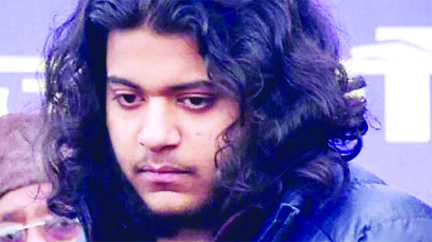
    Jhansi (TIP)– Dreaded gangster Atiq Ahmed’s son Asad, wanted in the Umesh Pal murder case, was gunned down by Uttar Pradesh police in an encounter in Jhansi on Thursday. His co-accused Ghulam was also shot dead.
    Both Asad and Ghulam had a reward of Rs 5 lakh on their heads. Asad Ahmed had been captured by a CCTV camera during the attack on Pal and was on the run since.
    Ghulam opened fire at a team of Uttar Pradesh Special Task Force around noon on Thursday, April 13, and the two were killed in retaliatory action, police said. Sophisticated weapons, new cellphones and SIM cards have been recovered from them, they added. According to police sources, Asad Ahmed had fled to Lucknow after the killing of Umesh Pal. He later moved to Kanpur and then Meerut before reaching Delhi, it is learnt. He then decided to flee to Madhya Pradesh. He reached Jhansi and was on his way to the state border on a bike when police intercepted him. Asad was reportedly in disguise. Police sources said they had an informer in Atiq Ahmed’s gang who told them about Asad’s whereabouts.
    Sharing details about the encounter, police said a team of 12 led by two DSP-rank officers carried out the operation. A total of 42 rounds were fired during the encounter at Babina road in Jhansi. The encounter killings took place on a day Atiq Ahmed was produced in court in the same murder case and sent to judicial custody for 14 days. Umesh Pal, a lawyer, was a witness in the 2005 murder of BSP MLA Raju Pal. On February 24, he was shot dead in a daylight attack outside his home in Prayagraj. The security personnel guarding him were also killed. Shocking visuals of the attack prompted questions on Uttar Pradesh’s law and order situation and the government came under strong criticism by the Opposition.
    Umesh Pal’s murder also put the spotlight back on Atiq Ahmed, a gangster-turned-politician with over 100 cases against him. A former Samajwadi Party MP, he was convicted last month in a kidnapping case and sentenced to life imprisonment. This case related to the kidnapping of Umesh Pal back in 2006 — 17 years before he was eventually murdered.
    The encounter killings of Atiq Ahmed’s son and his associate come against the backdrop of the gangster’s repeated allegations that the Uttar Pradesh police plans to gun him down in a staged encounter. In fact, the gangster told reporters yesterday that he was safe because of the media. “It’s because of you (media) that I am safe,” he told the press while being brought to Prayagraj for a court date.
    The gangster was moved to a prison in Gujarat on the directions of the Supreme Court after he was accused of engineering the kidnapping of a real estate businessman while in jail. He has been in the Sabarmati central jail since June 2019. Over the past couple of months, Atiq Ahmed has been repeatedly brought to Uttar Pradesh for court hearings. The high-profile nature of the case and the gangster’s apprehensions of a staged encounter has ensured extensive media coverage of the movements.
    After Thursday’s encounter, four people linked to Umesh Pal’s murder have been gunned down. Police are still looking for Guddu Muslim, who allegedly lobbed a bomb during the shooting, and another alleged shooter Sabir. Atiq Ahmed’s wife Shayista is also on the run.
    Source: NDTV

  • Man reaches agreement with two wives, will spend 3 days a week with each, free to choose on Sunday

    Man reaches agreement with two wives, will spend 3 days a week with each, free to choose on Sunday

    New Delhi (TIP)- A 28-year-old software engineer from Madhya Pradesh’s Gwalior arrived at an agreement with his two wives and divided his time between the two women. He agreed to spend three days of the week with one of his wives and the next three with the other. He is free to spend Sunday with either of the women. The man also had to provide separate flats to each woman. He has fathered children with both women.
    Advocate Harish Dewan, the counsellor appointed by the Gwalior Family Court in January 2023 to resolve the issue, said that a 26-year-old woman married the man in May 2018. The man worked at a company in Gurugram and the couple lived in the city for two years. They also had a son together.
    In 2020, the couple came to Gwalior after the pandemic began and the man started working from home. However, he went back to Gurugram after spending a few days in Gwalior. He did not come back for his wife and child even when the situation improved.
    The wife told him that she would come to Gurugram from Gwalior and her family found out that in 2021, the man had married his co-worker from the same company. The second wife also gave birth to a girl.
    The woman filed a case in a family court in Gwalior for alimony. The court asked advocate and counsellor Harish Dewan to attempt to reach a compromise before the hearing which was scheduled to take place on Tuesday.
    Dewan talked to the man and told him that getting married to another woman without divorcing the first wife is punishable under the Hindu marriage act. The lawyer also told the man that he could also lose his job if the first wife filed an FIR.
    The three parties then agreed to reach an agreement outside court. Under the agreement, the man has to spend three days of the week with one of his wives and the next three with the other. He is free to spend Sunday with whoever he chooses. According to Dewan, the first wife can move court if the contract is violated.
    Source: India Today

  • India finds 5.9 million tonnes lithium deposits in Jammu and Kashmir

    The Union Government on Thursday, February 9,  said that 5.9 million tonnes of lithium reserves have been found for the first time in the country in Jammu and Kashmir. Lithium is a non-ferrous metal and is one of the key components in EV batteries. “Geological Survey of India for the first time established Lithium inferred resources (G3) of 5.9 million tonnes in the Salal-Haimana area of the Reasi district of Jammu and Kashmir,” the Ministry of Mines said on Thursday. It further that 51 mineral blocks including Lithium and Gold were handed over to respective state governments.

    “Out of these 51 mineral blocks, 5 blocks pertain to gold and other blocks pertain to commodities like potash, molybdenum, base metals etc. spread across 11 states of Jammu and Kashmir (UT), Andhra Pradesh, Chhattisgarh, Gujarat, Jharkhand, Karnataka, Madhya Pradesh, Odisha, Rajasthan, Tamil Nadu, and Telangana,” the ministry added. The blocks were prepared based on the work carried out by GSI from field seasons 2018-19 to till date. Apart from these, 17 reports of Coal and Lignite with a total resource of 7897 million tonnes were also handed over to the Ministry of Coal.                 Source: ANI

  • The bewildering inner dynamics of Congress

    The bewildering inner dynamics of Congress

    There are signs, however faint, that the popularity of PM Modi is fraying at the edges and people are not too happy with the govt indulging in political games, even as they are feeling the pinch in terms of inflation and lack of jobs. And this is the time for Opposition parties, especially the Congress, to get a foot in the door. Bharat Jodo Yatra is expected to be the grand strategy to achieve a breakthrough. Time will tell whether the march has been worthwhile.

    By Parsa Venkateshwar Rao Jr

    Two major things are happening simultaneously in the Congress at a time when its friends and critics gave it up as being irredeemable. First, party’s former president Rahul Gandhi, who refused to take over as the chief despite the cringing pleas made by sycophants, has set out on a marathon padayatra based on the theme of ‘Bharat Jodo’ (unite India). Optimists believe that this move would revive the party, and party insiders and those who support the Nehru-Gandhi family believe that this would also show the challengers and the sceptics in the party as to who commands popular support in the country.

    In many ways, the party’s presidential election has been almost reduced to a sideshow. The contest for the party’s top post is between seasoned Mallikarjun Kharge, who is seen as the Sonia-Rahul candidate — though ‘strenuous’ efforts were made to show that the family had not endorsed his name — and the party MP from Thiruvananthapuram, Shashi Tharoor.

    This was preceded by the tragicomedy of Rajasthan Chief Minister Ashok Gehlot leading a last-minute protest rally by the party’s MLAs in Jaipur, which showed the chinks in the Nehru-Gandhi armor and forced the family to adopt a tough stance towards the family loyalist. The attempt of former Madhya Pradesh Chief Minister and Rajya Sabha member Digvijaya Singh to enter the fray failed once Kharge entered the fray. It is quite clear that the contest between Kharge and Tharoor, interestingly both from south India — one from Kerala and the other from Karnataka — is no epic battle like the one between Subhas Chandra Bose and Mahatma Gandhi’s nominee Pattabhi Sitaramayya in 1938. This year’s Congress presidential contest is not even like the one that took place in 1996 between Sitaram Kesri, Sharad Pawar and Rajesh Pilot because at that time Sonia Gandhi had not entered politics. Jitendra Prasada challenging Sonia in the 2000 party presidential election was indeed a non-event. The contest between Kharge and Tharoor is not evenly balanced. Kharge, apart from the ‘tacit’ support from the Nehru-Gandhi family, is considered by many Congress people as one of them because he has been in the party for decades now. Tharoor, despite being a three-time MP, is viewed as an unreliable newcomer, if not a total outsider. The former international civil servant, with all his proven savvy, has no advantages with the Congress and its convoluted factionalism.

    The fact that the Congress needs new ideas and a revamp is not a priority for the Rahul and Sonia camps; it is necessary to recognize that there are two camps, and the Congress deadlock since 2019 has been due to the tussle between the two groups. Tharoor does not belong to either of them. And it appears that the Rahul camp may tolerate Kharge better than they would Tharoor. The Nehru-Gandhi family should have favored Tharoor, but they are not sure of his loyalty quotient. Or, Sonia should have asked Sachin Pilot, the Gehlot rival in Rajasthan, to contest the presidential election. But it seems that they do not like the ‘ambitious’ Pilot, and his failed attempt to bring down the Gehlot government and his flirtation with the BJP have alienated him from the family. The palace intrigues of the Congress are indeed endless and they are not relevant when the question arises as to whether the Congress can revive itself sufficiently under Rahul to put up a credible fight against the Narendra Modi-Amit Shah BJP in the 2024 Lok Sabha elections. There are signs, however faint, that the popularity of Prime Minister Modi is fraying at the edges, and people are not too happy with the government indulging in political games, even as the people are feeling the pinch in terms of inflation and lack of jobs. And this is the time, indeed, for the Opposition parties, especially the Congress, to get a foot in the door. The Bharat Jodo Yatra is expected to be the grand strategy to achieve the breakthrough. Time will tell whether it has been worthwhile.

    A member of G-23, the dissident faction inside the Congress, has remarked that the Bharat Jodo Yatra will help rebrand Rahul; and strengthening of the Congress is incidental. But many would say that if Rahul is successful in rebranding his image, it would amount to rebranding the Congress.

    But Congress members of all camps should pay heed to what Union Home Minister Amit Shah told BJP members over a month ago; he advised the Union Cabinet Ministers to give time to the party work and party members. He said PM Modi was indeed popular across the country, but Modi would not be able to win the election if the party organization was not strong. It is a lovely commentary on the ruthlessly realistic approach of the BJP towards Modi and to elections in general.

    It seems that the strategy of the Nehru-Gandhi family as well as other leaders in the party camp is to strengthen the brand image of Rahul and of the family, so that it helps the party. But Rahul seems to be working on a Mahatma Gandhi-like mass contact program. It is an idealistic plank that will work on the realistic plane of day-to-day politics as well, but the party has to close its ranks and present a united front.

    Rahul is apparently focusing on making the Congress the lone alternative to the BJP because he seems to realize that Opposition unity is just a chimera. But he cannot ignore the imperative of making the party strong and broaden the base of inner-party consultation. A G-23 member’s complaint is that before 2019, Rahul did not like to have anything to do with the people above the age of 50, and now he has conceded to talk to people between the age group of 50 and 60. So, 80-year-old Kharge and 66-year-old Tharoor do not fall in this category.

    (The author is a Senior Journalist)

  • FIA Chicago is celebrating 75 years of Independent India under the banner of “The Azadi Ka Amrit Mahotsav

    FIA Chicago is celebrating 75 years of Independent India under the banner of “The Azadi Ka Amrit Mahotsav

    CHICAGO, IL (TIP): : Federation of Indian Association, Chicago is celebrating 75 years of Independent India under the banner of “The Azadi Ka Amrit Mahotsav”. Independence Day is always memorable – the day to rejoice in the glory of what India has been able to achieve and to remember the contributions, battles, and sacrifices of all the people who helped achieve it. During the past 75 years, India has emerged as a mature democracy. This is very special for all of us as INDIA completes 75 years of independence. FIA celebrations include the grand India Day Parade at the Devon Ave, Chicago on Saturday, 6th August at 11 pm. The Indian National flag rising will be on 15th August at the prestigious Daley Center in Chicago Downtown, and there will be a patriotic Gala Banquet on Friday, 12th August to commemorate and recognize the people who have been serving the community selflessly. “The entire Indian diaspora living the United States is very excited and looking forward to FIA annual India day Parade and celebrating Azadi Ka Amrit Mahotsav”, said Rakesh Malhotra, President of the Federation of Indian Associations, Chicago

    Celebrating Indian Independence Day 2022

    FIA has been organizing these events for the past forty years here in Chicago, in which the spirit of the freedom movement, honor to the martyrs, and their vow to develop India can be experienced. “It is important to make the new generation aware of India’s freedom struggle and the contributions made by the freedom fighters to get India its independence. Our goal is to inspire the young generation to connect with their roots, values, and rich heritage and work hard to make India Vishwa Guru Again”, said Rakesh Malhotra, President of the Federation. Miss India Worldwide Khushi Patel has been invited to India Day Parade. Indian diaspora living from Chicago land are excited about participation in the Grand Parade. Multiple community-based organizations representing various Indian states like Bengal, Punjab, Uttar Pradesh, Madhya Pradesh, Chhattisgarh, Maharashtra, Telangana, Andhra Pradesh, and Kerala will be showcasing their decorative floats during the grand parade to commemorate 75 years of Independence. Consul General of Chicago Amit Kumar, US Congressman Danny Davis, Congressman Raja Krishnamurthy, Congressman Brad Schneider, Alderman Debra Silverstein, Alderman Shweta Baid, Prominent Community leaders including Dr Bharat Barai, Dr Darshan Sigh Dhaliwal,  Mr Santosh Kumar, Executive Director MAFS , Dr. Ram Chakroborty, founder of Chicago Kali Bari and Mrs. Smita Shah President & CEO of Spaan Tech. are likely to attend the FIA India@75-day events.  Aparna Chakravarty, Mrs India Worldwide 2ndRU will be joining the Chicago Kali Bari colorful float to reflect the spirit of community and festivity

    Connecting with the roots

    To engage the young students, a poster and painting contest on the theme of “My Idea of India” is being organized so that the younger generation can express their impression and vision of India. Likewise, a “Rangoli Making” competition for all age groups has also been organized.  Participation in these contests is free and entries can be submitted digitally. FIA Chicago proudly shares that all plaques and trophies to be given during its annual India@75 Gala are handmade in India by Tribal from the State of Chhattisgarh.

    Federation of Indian Associations, Chicago will be also releasing India@75 souvenir on this momentous occasion to commemorate the glory of India. “Souvenir will capture iconic moments that shaped India”, informed Rakesh Malhotra. Young students, women and professionals are amongst the contributors.

    About the Federation of Indian Associations, Chicago

    Federation of Indian Associations (FIA), Chicago is the largest non-profit Indian American organization. It was established in 1980 to primarily serve the community and promote and educate Indian Cultural Heritage while making meaningful contributions to America’s growth. More than 50 Illinois-based community organizations and nonprofits are members of the Federation. Besides engagement with various organizations across Chicago land, the FIA also takes a lead role in bringing the community together to celebrate various events of historical importance to both the United States and India.

    (Press release and photo /Asian Media USA)

  • Madhya Pradesh: The heart of Incredible India

    Madhya Pradesh: The heart of Incredible India

    Madhya Pradesh got its name because of its geographical position, being located in the centre of India. However, it’s tagline ‘The Heart of Incredible India’ has more to do with the fact that it houses facets of the whole of India into this state. From the historical monuments to modern amenities, culture, food and people- this state gives a taste of entire India packed within its geographical boundaries.

    Madhya Pradesh is one of the few states that is surrounded by other states on all its sides. It lies in the plain regions of the country and occupies one of the oldest parts of the Indian Subcontinent which was once the land of the Gonds called the Gondwana. Every twelve years the grand fair of Kumbh Mela is organised here. Madhya Pradesh has some spectacular historical places in its region, of which a temple made of glass in Indore is quite famous. Ujjain, a sacred city for the Hindus, is a renowned place in the world as it is one of 12 Jyotirlingas in India. Madhya Pradesh is particularly famous for its Khajuraho temples which exhibit the erotic sculptures depicting the ancient India Kama Sutra text. The great Sanchi Stupa constructed during King Ashoka’s reign is situated here in Bhopal. The Bandhavgarh National Park which houses the Barasingha and the Tigers reserve is also located here.

    Khajuraho

    Khajuraho, a UNESCO World Heritage Site located in Madhya Pradesh, is known around the world for its stunning temples adorned by erotic and sensuous carvings. A small town located in the Bundelkhand region, Khajuraho is a brilliant example of Indian architecture and its culture back in the medieval period. The architecture of these Hindu and Jain temples depict the erotic forms of love, the carvings on the walls display passion in the most sensuous yet aesthetic ways. Built between 950 to 1050 AD the sheer confrontational nature of these carvings shows a stark paradox with the conventional Indian ideals about eroticism, leaving everybody spellbound.

    Art in this small town is engrained in all of its structures and are a classic example of the finesse of India’s cultural and artistic heritage. The best part about Khajuraho is that although scores of plunderers tried to destroy the whole complex, they could never succeed, even though they managed to reduce the number of temples and caves to 25 from a staggering 85 at the time it was created.

    Pachmarhi

    Pachmarhi is the only hill station and is the highest point in Madhya Pradesh. Pachmarhi is also often known as “Satpura ki Rani” or the “Queen of the Satpura Range”. Situated at an altitude of 1,067 metres, the picturesque town is a part of UNESCO Biosphere Reserve, home to leopards and bison.

    Five sandstone cut caves on the hilltop are believed to be the spot where Pandavas stayed in Pachmarhi during their exile, making it a popular spot among religious tourists. Being at an elevated height and surrounded by bewitching forests of the Satpuras with the streams and waterfalls, Pachmarhi is a perfect weekend getaway from the nearby cities of Madhya Pradesh and Maharashtra. Since the town was discovered and developed in modern times by Captain James Forsyth of the British Army, it houses charming churches built in colonial style architecture.

    Gwalior

    Gwalior is a historic city located in the state of Madhya Pradesh. Popular because of the hilltop fort, Gwalior is full of palaces and glorious temples giving this city a majestic charm which speaks volumes of its glorious past.

    A historic city founded by king Surajesan, Gwalior is a city where India’s most eminent royalty once resided. Jai Vilas Pala has the largest carpet in the world which took almost 12 years to weave and two most massive chandeliers in the world that weight close to 3.5 tonnes.

    The great Indian musician Tansen was born in Gwalior, and the tomb of Tansen is also an important place here. Every year, in November/December, a four-day Tansen Music festival is celebrated in the city where various classical musicians from all over the country perform on the stage near the tomb itself. Visit the various monuments and museums, eat the local delicacies like namkeen and go boating in Tighra Dam while you are in the city.

    Bandhavgarh National Park

    Formerly a hunting ground for the Maharajas of Rewa, the Bandhavgarh National Park is world-renowned as a tiger reserve and it is known to have the highest density of Bengal tigers in the world. The frequent sightings of royal tigers make this national park a must-visit for all wildlife enthusiasts. In 2012, around 44-49 tigers were living in the park. There are more than 22 species of mammals and 250 species of avifauna.

    The park got its name from the Bandhavgarh fort situated at the height of 800 m high cliffs nearby. The fort is in ruins now, but an hour trek to the fort is worth it as it provides ample views of the surroundings. The jeep safaris are amongst the most popular activities taken by visitors.

    Kanha National Park

    Located in a central region of Madhya Pradesh, Kanha National Park is the largest National Park in central India and has been ranked as one of the best parks in Asia. Among the 22 species of large mammals, the royal Bengal tigers are one of the major attractions. One of the best tiger reserves in India, the present-day area stretches over the 940-kilometre square which is divided into two sanctuaries: Hallon and Banjar.

    The park was established in the year 1955 and has since actively contributed to the preservation of many endangered species. The National Park was taken under the Project Tiger Reserve in 1974. Abundant in flora and fauna, the Kanha National Park houses one of the rarest species of deer- the Barasingha. It is known for the unique Barasingha conversation to save the species that were once on the verge of extinction. One of the most scenic wildlife reserves in Asia today, this National Park came to be known the world over through Rudyard Kipling’s book- The Jungle Book.

    Kanha National Park is famous for its wildlife safaris and attracts tourists from all over the world. Other important animals in this park are leopards, wild dogs, wild cats, foxes, sloth bears, hyenas, langurs, wild boars and jackals. Reptiles including pythons, cobras, krait and other varieties of snakes are also found in this National Park.

  • Trumping majoritarianism in the Hindi heartland

    Trumping majoritarianism in the Hindi heartland

    By Zoya Hasan
    While regional parties will continue to be significant in various States of the Union, the principal challenge of overcoming majoritarianism lies in the Hindi heartland, especially in U.P. Oppositional electoral alliances, notably the formation of a federal front, are important strategies in this battle but it is no less important to challenge the ideological foundations of the majoritarian project through progressive and inclusive politics.

    The landslide victory of the All India Trinamool Congress in the West Bengal Assembly elections and the pushback of the Bharatiya Janata Party (BJP) in West Bengal, Tamil Nadu and Kerala have given rise to a pervasive belief that right-wing politics can be defeated by regional assertions. Undoubtedly, regional and cultural assertion in these States acted as an effective bulwark against the BJP’s expansionary plans in southern and eastern India. The regional-cultural tropes deployed by Mamata Banerjee, for example, worked so well that at one point, Home Minister and BJP leader Amit Shah was even forced to clarify that if the BJP is elected, someone from Bengal would be the Chief Minister. This underlines the effectiveness of regional culture and politics in trumping communal politics. However, this claim needs to be tempered by the realism that it cannot work in the Hindi heartland, which is dominated by caste and communal politics, and has so far not seen any serious ideological and political challenge to politics based on these identities.

    Encompassing nine States whose official language is Hindi, namely Bihar, Chhattisgarh, Haryana, Himachal Pradesh, Jharkhand, Madhya Pradesh, Rajasthan, Uttar Pradesh (U.P.) and Uttarakhand, this region retains a central position in the electoral strategies of the BJP and its larger political imagination. The party’s stunning show in these States propelled it to power in the 2014 and 2019 parliamentary elections. Its continued political dominance in the heartland will neutralize its losses now as well as in future in States where it has been bested by regional players. I will focus here on U.P. to illustrate the limits of the regional assertion.

    Dimensions in the heartland

    The Hindi heartland is clearly different. There are at least four important dimensions of this difference. First is the absence of regional identity in States such as U.P. This is evident from the debate on States reorganization and the reorganization of Uttar Pradesh in the 1950s. The compulsions of nation-oriented identity emerged very clearly from the discussions in the States Reorganization Commission on suggestions for the division of U.P. for administrative convenience. U.P. leaders argued for a large and powerful State in the Gangetic valley as a guarantee of India’s unity.

    In this sense, U.P. was considered the backbone of India and the centerpiece of political identity in modern India. Importantly, it was supposed to provide the chief bulwark against growing regionalization and fragmentation elsewhere. Instilling a sense of regional pride, an essential part of Congress strategy in southern and coastal India, was not followed in U.P. U.P. was seen as the political heartland in contrast to Punjab and Bengal for instance, which were splintered and incorporated into two different nation states. As is well known, the bases of this post-colonial identity varied from its location in the freedom struggle to staking claim as the cultural homeland of Hindi and Hinduism. In both cases, it was centered in the idiom of the nation-state and strong central authority.

    Second, although U.P.’s cultural homogeneity remains a matter of disagreement, the idea of the heartland had great resonance among the political elite who opposed the demand for U.P.’s reorganization. The long-standing traditions of composite cultural identity and shared plural cultures began to yield place to a singular homogenized identity. The Hindi-Urdu divide, which mirrored the communal cleavage of U.P. society, played a crucial role in this process. Urdu was excluded as it was seen to symbolize Muslim cultural identity in independent India, while Hindi was boosted to promote the development of a Hindi-Hindu heritage for this region. The project of homogenization of Indian/U.P. culture as Hindu culture was quickened in later decades. Even though it would be hard to assume a direct link between Hindi dominance and communal politics of subsequent decades, it is nevertheless a fact that all political parties in the State used it as an ingredient of social and cultural differentiation and a means to consolidate political dominance.

    Role of communal politics

    Third, it is clear that communal politics and communal movements have played a key role in U.P.’s modern history which in turn have diluted other identities.

    In some respects, this process gained momentum in the wake of Partition which cast its long shadow upon political institutions and culture in U.P. and to a great extent affected the perspectives of Hindus and Muslims alike. Hindu nationalism was marginalized within the Congress party but many of its ideas were accepted in framing party policies. The State leadership was instrumental in forging a conservative consensus in the State under Chief Minister G.B. Pant who steered the affairs of the state for eight years after Independence.

    The intensification of communal politics took a new turn with the mass mobilization for the construction of a Ram temple at Ayodhya which was deftly used by the Hindu right to establish a major presence in U.P. and to facilitate the political reconstruction of U.P. through the promotion of a collective Hindu identity. The crusade for the appropriation of disputed shrines is central to the communalization of politics and short circuiting the more complex process of political expansion for the BJP.

    Importantly, this has laid the groundwork for building permanent electoral majorities through the deployment of ascriptive symbols in U.P. which, given its huge size, helps it to establish a strong base in the Hindi heartland to offset the appeal of countervailing identities elsewhere in India.

    Caste politics too

    Finally, caste politics which was expected to counter Hindutva expansion has failed to do so; in fact, caste politics has become a building block for the BJP’s expansion. The party has reached out to Dalits, actively mobilizing them and other backward castes to assimilate them into the Hindutva meta-narrative. Instead of erasing caste from electoral politics, the BJP-Rastriya Swayamsevak Sangh has sought to court fragments of castes as a way of undermining broad-based political movements and opposition to it. It has used the wider appeal of Hindu nationalism to co-opt backward castes and Dalits who are keen to align themselves to the larger narrative of Hindu nationalism.

    A reset is needed

    While regional parties will continue to be significant in various States of the Union, the principal challenge of overcoming majoritarianism lies in the Hindi heartland, especially in U.P. Oppositional electoral alliances, notably the formation of a federal front, are important strategies in this battle but it is no less important to challenge the ideological foundations of the majoritarian project through progressive and inclusive politics. This requires a reset of the basic political mindset in U.P. which can only be done by reviving the splendid heritage of the national movement in which this region played a central role and in which Gandhiji and Nehru played a heroic part. Invoking the spirit of the Bhakti movement which was the first major challenge to the religious orthodoxy of Hinduism would also help in resetting the cultural clock. This must, however, combine with much greater concern for the fundamental social and economic issues of the State, and making the struggle between communal and secular forces the central issue through public campaigns that address the problems of religious traditionalism and the cultural underpinning that this provides to the push to make India a Hindu state.

    (Zoya Hasan is Professor Emerita, Jawaharlal Nehru University)

  • India to import 50,000 MT medical oxygen amid COVID surge

    New Delhi (TIP): The government on Thursday, April 15,  said it would import 50,000 metric tonnes of medical oxygen to assure supplies to states even as it added that oxygen availability in the country was adequate. As hospitals reeled under oxygen shortages, the empowered group of officers addressing the issue met today and started mapping of oxygen sources for 12 high burden states of Maharashtra, Madhya Pradesh, Gujarat, Uttar Pradesh, Delhi, Chhattisgarh, Karnataka, Kerala, Tamil Nadu, Punjab, Haryana and Rajasthan.

    Medical oxygen is a critical component in the treatment of COVID affected patients and demands have been rising unusually in the high burden states.

    “There has been increasing demand for medical oxygen, especially from the 12 states with high burden of active COVID cases. While the demand in Maharashtra is expected to be beyond available production capacity of the state, Madhya Pradesh does not have any production capacity to meet their demand for medical oxygen. There is also a trend of increasing demand in other oxygen producing states such as Gujarat, Karnataka and Rajasthan,” the government said.

    After the meeting with manufacturers today, the government said 4880 MT, 5619 MT and 6593 MT have been assured and factored for 12 high burden states to meet their projected demand as on April 20, 25 and 30.

    The assured supply will be notified through a government order, sources said. The meeting also decided to import 50,000 MT of medical oxygen to be ready for the increasing demand.

    Health Ministry has been asked to finalise the tender and explore possible sources for import identified by the missions of MEA.

    Meanwhile 162 Pressure Swing Adsorption plants (plants manufacture oxygen and help hospitals become self-sufficient in their requirement for medical oxygen while also reducing the burden on the national grid for supply of medical oxygen) sanctioned under PM-Cares are being closely reviewed for early completion of 100 percent of the plants to enhance self-generation of oxygen in hospitals especially in remote areas.

    The empowered group asked the Health Ministry to identify another 100 hospitals in far flung locations for consideration of sanction for installation of PSA plants.

    The government said it was monitoring the situation to ensure uninterrupted supply of medical oxygen. India’s daily medical oxygen production capacity is 7127 MT. Current national oxygen stocks are 50,000 MT – more than daily consumption of 3842 MT but the government is readying for what it calls unusual surge in demand.

              Source: The Tribune

  • Centre sounds alert as bird flu cases spread to 6 states

    Centre sounds alert as bird flu cases spread to 6 states

    New Delhi (TIP): As a Bhopal-based laboratory confirmed that 437,000 poultry birds in Haryana died because of bird flu, the Centre on Friday, January 8, asked the six states where deaths because of the disease have been confirmed to increase their vigil and act to curb the outbreak. The Centre has confirmed bird flu in Kerala, Rajasthan, Madhya Pradesh, Himachal Pradesh, Gujarat and Haryana, the government said in a statement.
    “So far, the disease has been confirmed from six states. It is learnt that culling operations have been completed in both the affected districts of Kerala. The disinfection process is underway,” the statement read.
    Following the confirmation of bird flu, Haryana is set to start the biggest culling of birds in any state. Officials said 166,000 birds would be killed in the next few days. Culling of birds is to take place within 1 km of Kheri and Ghanauli villages from where samples tested positive for bird flu, they said. Two of the three samples sent by the Haryana animal husbandry department from poultry farms in Panchkula’s Barwala belt to the National Institute of High Security Animal Diseases (NIHSAD) laboratory in Bhopal tested positive for avian influenza on Friday. “As per the report received, it has been confirmed that birds of two poultry farms were infected with avian influenza (H5N8). Though this bird flu strain is less pathogenic, the state government has issued a notification for the affected poultry farms of Panchkula as a precautionary measure,” Haryana’s animal husbandry and dairying minister JP Dalal said on Friday. Tests done on three batches of samples sent to a Jalandhar lab from Barwala were inconclusive, following which the samples were sent to the Bhopal lab. More than 437,000 poultry birds have died in Panchkula’s Barwala and Raipur Rani areas, considered to be Asia’s second largest poultry belt, over the past 26 days. On Friday, the central team visited the community health centre in both areas. Arrangements have been made at the community health centre in Raipur Rani, and isolation wards set up, while Tamiflu tablets have been procured to check human-to-human transmission of the influenza, said Dr Saroj Aggarwal, deputy civil surgeon, Panchkula. “We are ready to deal with any situation.” (Source: HT)

    Budget session will be as long as earlier: Speaker
    Indicating that the upcoming Budget session of Parliament will have a Question Hour, Lok Sabha Speaker Om Birla on Friday, Jan 8, said questions of Opposition parties will be answered and issues raised by them discussed when the House meets for the next session.Speaking to reporters in Dehradun, Birla said the upcoming Budget session will be of the same duration as it had been in the past and there will be discussions on all issues. The Lok Sabha Speaker was in Dehradun to address an event part of an outreach programme for Panchayati Raj Institutions — ‘Panchayati Raj System: Strengthening the Decentralised Democracy’. The event was aimed at introducing panchayat members to the functioning of Parliament and to provide them with an exposure to democratic principles and ethos.
    India-UK flights resume
    Weeks after flights between the United Kingdom and India were suspended following the detection of a more infectious strain of the novel coronavirus, air services between the two countries resumed Friday. The first flight carrying 256 passengers from London landed in New Delhi on Jan 8 morning, reported news agency ANI. The government had suspended flights on December 23. As flights resume in a calibrated manner, for the next two weeks, till January 23, only 15 flights will operate between the two countries. The incoming flights will land only in Delhi, Mumbai, Bengaluru, Chennai and Hyderabad. The government has put out the standard operating procedure for travellers entering India. According to the guidelines, all passengers will have to undergo mandatory self-paid RT-PCR tests on arrival.
    India, Japan sign pact for 50-bn yen loan
    India and Japan on Friday signed an agreement for a loan of up to 50 billion yen (about Rs 3,550 crore) to back New Delhi’s economic support programmes for the poor and vulnerable affected by the Covid-19 crisis. CS Mohapatra, additional secretary in the department of economic affairs and Japanese ambassador Satoshi Suzuki signed the agreement in New Delhi for the loans with an interest rate of 0.65% per annum and a repayment period of 15 years, including a five-year grace period. Japan had earlier provided budget support of 50 billion yen and grant assistance worth one billion yen (about Rs 71 crore) to support the Indian government’s efforts to counter the Covid-19 crisis.

  • Bihar has strong message for Opposition

    Bihar has strong message for Opposition

    The results of the Bihar elections have a message for all states headed for polls in the months ahead on taking on the BJP under Modi.

    By Neerja Chowdhury

    Bihar has sent a strong message to the Opposition parties. They will have to combine effectively to have any chance of taking on the Modi-led BJP in states going to the polls. The RJD’s alliance with the Left parties in Bihar— CPI(ML), CPI(M) and CPI— did well, leading to a high strike rate.

    Even though Nitish Kumar has been weakened, the BJP will find it difficult to replace the chief minister with one of its own, having burnt its fingers in Maharashtra, where Uddhav Thackeray, denied the chief ministership, joined hands with the Congress and the NCP. The BJP is expected to tread more carefully in Bihar after the outcome.

    Economic distress of an unprecedented kind, compounded by a health pandemic of the last nine months, the migrant march of lakhs of workers on foot with probably the largest number walking back to their villages in Bihar, incursions made into Indian territory by China in the last few months which could have created a nationalistic upsurge against the government, palpable anger against Chief Minister Nitish Kumar that was evident — if these could not bring about a change of government in Bihar, it only shows that the other factors were more dominant. This when, in this instance, there was a clear alternative in Tejashwi Yadav leading the charge on the Opposition side and getting a popular response.

    Clearly, Brand Modi managed to slow down the Tejashwi chariot, though it was a closely run race. And Tejashwi, though not able to form a government in Patna, has established himself as a leader of the Mahagathbandhan at the age of 31. He set the terms of the poll narrative when he flagged ‘joblessness’ as the central theme of Bihar 2020, for the first time giving an economic — and aspirational — spin to caste which has determined poll outcomes in Bihar for three decades and more.

    Given the downturn in the economy, creation of jobs is increasingly going to find resonance, particularly among the young, as also in other states going to polls in the next few months. The first phase of the election was going the Tejashwi way. The turning point came with Narendra Modi’s invocation of ‘jungle raj’ of the Lalu Yadav-Rabri Devi years. This sent those among the most backward castes and women, who were beginning to look at Tejashwi with new eyes — Yeh naya ladka hai— scurrying back to the NDA again. The upper castes are anyway more enamored of the Hindutva, nationalist theme than of any economic hardship, and stayed by the BJP’s side.

    Bihar has reinforced the invincible image of Narendra Modi. He swayed the voters in national elections. This was not always the case in state polls. The BJP did not make it in many states, be it Maharashtra, Jharkhand, Telangana, Andhra Pradesh, Karnataka, Delhi, Rajasthan, Madhya Pradesh and Chhattisgarh. In Bihar, the Prime Minister made a difference to the poll outcome. The Bihar strategy may help the BJP in states which are going to the polls in the coming months — in West Bengal, Assam, Punjab, Kerala and then UP in 2022. It combined Modi’s undimmed popularity and sharp articulation, with Hindutva and nationalism (Ayodhya, Pulwama, Jai Shree Ram) as not so covert a theme, undergirded by a subtle appeal to certain castes. The PM has for some time now emphasized the help given to the poor by his government at the Centre, through the programs he has initiated. So, if money was transferred to the people in Bihar during COVID-19 times, they saw it coming ‘from Narendra Modi’ and ‘not from Nitish Kumar’. In the handling of the pandemic, which exacerbated the problems of the migrants, the Central Government successfully managed to shift the responsibility to the chief ministers. In Bihar, the BJP went one step further. It even managed to distance itself from the Bihar CM, even though it was part of the government headed by him. By going hammer and tongs at only Nitish Kumar, and urging the people to vote for the BJP, Chirag Paswan helped shield the BJP while directing the popular ire towards the CM. The BJP’s seats went up substantially, and those of the JD(U) came down, equally substantially. The BJP as the senior partner in the government will have its obvious advantages, and will increase its clout in the decision-making process.

    Even though Nitish Kumar has been weakened, the BJP will find it difficult to replace the chief minister with one of its own. Having burnt its fingers in Maharashtra, where Uddhav Thackeray, denied the chief ministership, joined hands with the Congress and NCP, the BJP is expected to tread more carefully in Bihar. For Nitish Kumar, with his reputation for doing ‘flip flops’, can always extend outside support to Tejashwi Yadav, if the BJP tries to replace him. Unless the BJP can, at a future date, break the JD(U), the Congress and wean away MLAs also from the RJD to form its ‘own’ government. But that does not seem to be on the cards for the moment.

    Bihar has sent a strong message to the Opposition parties. They will have to combine effectively to have any chance of taking on the Modi-led BJP in states going to the polls. The RJD’s alliance with the Left parties in Bihar— CPI(ML), CPI(M) and CPI— did well, leading to a high strike rate.

    Tejashwi Yadav might have just made it, had he not allowed Mukesh Sahni’s Mallah (Most backward)-based VIP party to leave the Mahagathbandhan over the issue of seat-sharing. This might have been possible had he given less seats to the Congress and accommodated the ‘VIP’ party and enabled Left parties to fight more seats, the ticket distribution based on the ground level strength of the parties today rather than on the position they enjoyed in the past. This Congress’ tally came down from what it was in 2015. While the RJD was able to transfer its votes to the Congress, the Congress could not ensure this for the RJD candidates. As it is, the Congress’ kitty does not have much to transfer.

    The five seats won by Asaddudin Owaisi, who did well in the Muslim-dominated areas of Bihar (Seemanchal) should come as a wake-up call for the Congress. The Muslims, who feel beleaguered and apprehensive, particularly with the way they have been targeted by the BJP, after the NRC, CAA and abrogation of Article 370, have looked to the Congress as the only party which would be able to take on the BJP nationally. For them to turn to Owaisi’s party which was not in a position to form the government in Bihar, being part of the small so-called ‘Third Front’, and not to the Congress, shows their growing sense of alienation from the grand old party. This is not good news for the Congress.

    The crisis — and drift — in the Congress is not likely to go away unless the party settles the question of its leadership, which is hanging out there unaddressed.

    Given the Bihar outcome, will the Opposition parties look afresh at the new challenge being mounted by a BJP determined to increase its footprint all over India, state after state, and go for one-party dominance in the country? Or will it remain business as usual?

    (The author is a senior political commentator)

  • Political takeaways from the Bihar campaign

    Political takeaways from the Bihar campaign


    By Seema Chishti

    Tejashwi Yadav’s campaign in Bihar is frustrating the ruling party as it is using that very powerful appeal against a 15-year-old regime by citing the absence of bread and butter issues and taking the campaign out to the State’s youth. His primary emphasis during the election campaign has been on 

    the high rate of unemployment, forming the backbone of his promise of providing 10 lakh new government jobs to the youth of Bihar. The BJP has been forced to play catch-up. After the results come in, there will be much to theorize on how caste politics has changed in north India. Enough has already been said about how this is the last of the Mandal elections (with Nitish Kumar on the backfoot, Lalu Prasad not campaigning and Ram Vilas Paswan no more); but on closer scrutiny, this is more about evolution of the social justice plank than its burial.

    Bihar’s Champaran farmlands served as the brewing fields for Gandhi’s ruminations and eventual journey to a Mahatma more than a century ago. Later, the State was quick to catch the sparks off Gujarat’s student revolt and lend the anti-Emergency movement the fury that was to become a prairie fire which consumed the invincible Indira Gandhi. Bihar is renowned for its intangible political energy, equations and trends that have gone on to shape India’s political firmament.

    Throwbacks to the past

    The final election results notwithstanding, not that the voters’ mandate is sacrosanct — consider Goa, Manipur, Karnataka, Maharashtra and Madhya Pradesh — the election campaign has provided important political takeaways. Like all elections in the last six years, including the municipal polls in the capital in 2017, Narendra Modi has campaigned with admirable energy and dedication in Bihar. The Prime Minister’s campaigning is an opportunity to peep into his vision and priorities for the people of the State and the country.

    A quick glance at his speeches shows that Mr. Modi’s refrain is Ayodhya’s Ram temple and Article 370 in Kashmir (Darbhanga on October 28 and Champaran on November 1), “Jungle Raj” spoken of often, a reference to the “double Yuvrajs” ostensibly of Tejashwi Yadav and Rahul Gandhi (Chhapra on November 1) struggling to “keep the simhasan/throne”, “BIMARU” Bihar, referring to an outdated acronym for Bihar, Madhya Pradesh, Rajasthan and Uttar Pradesh no longer used even in seminars. Almost all of the Prime Minister’s repeated references are jaded throwbacks to the past: Ayodhya’s Babri Masjid was brought down in 1992, ‘jungle raj’, referring to pejoratives for Lalu Yadav and Rabri Devi’s time as Chief Minister is 15 years ago and the last time that either Tejashwi Yadav or Rahul Gandhi’s fathers held public office was several years ago — there is certainly no ‘simhasan’ for them to defend. It is a negative agenda of a campaign anchored selectively in the past.

    No vision, invoking fear

    Nitish Kumar has been in power in the State for the past 15 years, mostly with the Bharatiya Janata Party (BJP), and there is little in the achievement columns of his report card for Mr. Modi to seek votes on. Soliciting support for another five years of a jaded government is tough, and thus the argument seems to be that “we are bad but they are worse” — not the most inspiring political pitch. More surprising is the lack of vision for either Bihar or India from the Prime Minister. The selective recall of the 1990s is odd when at 57.2%, Bihar has the highest proportion of those below 25 years of age in the country. This is like the captain’s proverbial yearning for the safety of the shore when the boat is in choppy waters mid-ocean, when, instead, it needs a vision to navigate ahead.

    The exponential rise of the BJP, now dominating the political scene with more than half of India’s States under its rule and having 302 Lok Sabha seats (as on October 1, 2020), began by leveraging the upheaval of the 1990s as the polity was challenged by newly opened fissures of caste, religion and economic disparity. Social and cultural issues are an integral part of Indian electoral politics, but to invoke the divisive issues of the past at this time points to a poverty of vision for the future, of the missing destination the ship of governance is aiming for when at sea. Instead of taking matters to a higher level of ‘aspiration’, the country’s top leadership has chosen to invoke not hope but fear.

    A lost opportunity and why

    When India has gone from one of the fastest growing three economies in the world to among the slowest, with an unprecedented decline of 23.9% in the first quarter of 2020, the country would have benefited from learning of the Prime Minister’s plan to get the economy back in shape. The novel coronavirus pandemic also offered an opportunity to speak of public health as a sharp arrow in its quiver, and take his party’s campaign to another high level. Quite the contrary happened when a free vaccine was offered as an election sop, hitting another new low for the BJP in 2020. Public health, at a time of a rapidly growing infectious disease, has always been handled centrally and has been universal and free. The smallpox vaccine, BCG or even the tuberculosis programme has been centrally driven and unconnected with electoral cycles.

    The appeal that proved invincible and lent a deathly blow to the Congress-led United Progressive Alliance in 2014 was a dream that Mr. Modi associated himself with. The ‘Gujarat model’, notwithstanding its merits, was about hope, about vikas, development (if not progress), and overall about improving lives of Indians, a formula that proved unbeatable. The promise, plastered on all available billboards was about ‘two crore jobs’ every year, ₹15 lakh in every bank account and the burnishing of an entrepreneurial spirit that would bring welfare and prosperity. Mr. Modi would make India great again and improve the conditions of its millions, who came out and voted for that dream. This appeal was developed on the campaign that Mr. Modi had carefully crafted around ‘Vibrant Gujarat,’ which had shut down his critics. It was Mr. Modi as the doer and the Vikas Purush that won accolades and eventually the seat of power in Delhi. The core Hindutva spirit that he stood for was just the backstory: Mr. Modi in 2014 worked, as he offered himself and much more.

    The youth connect

    Turning the tables on this, Tejashwi Yadav’s campaign in Bihar is frustrating the ruling party as it is using that very powerful appeal against a 15-year-old regime by citing the absence of bread and butter issues and taking the campaign out to the State’s youth. His primary emphasis during the election campaign has been on the high rate of unemployment, forming the backbone of his promise of providing 10 lakh new government jobs to the youth of Bihar. The BJP has been forced to play catch-up. After the results come in, there will be much to theorize on how caste politics has changed in north India. Enough has already been said about how this is the last of the Mandal elections (with Nitish Kumar on the backfoot, Lalu Prasad not campaigning and Ram Vilas Paswan no more); but on closer scrutiny, this is more about evolution of the social justice plank than its burial. Tejashwi Yadav in 2020 is doing a Narendra Modi in 2014, by not making it overtly about social justice alone. The Mandal campaign of the 1990s in north India was particularly anxious to underscore that it was not economics but social oppression that rankled and needed urgent redress. By threading economic upliftment seamlessly into the idea of social justice, Tejashwi Yadav has confounded his opponents. He need not even loudly talk about backward caste or utter the phrase social justice, any more than Mr. Modi had to proclaim that he is a proud bearer of Hindutva.

    In 2015 when Nitish Kumar and Lalu Prasad struck an alliance, they stumped the BJP by turning it into a ‘forward versus backward’ election. That was a case of political innovation in the face of the BJP juggernaut, at a time when the electoral machine of the BJP, with its freshness, was at its peak. But this time, what has annoyed Nitish Kumar and visibly frustrated the BJP is Tejashwi Yadav coming up from behind and smoothly introducing Social Justice 2.0 into the campaign in his own unique manner. The results of the elections will be known soon but if there is already a winner for political reimagination, it is Tejashwi Yadav against a weary Nitish Kumar and a rear-view mirror-gazing Narendra Modi.

    (The author  is a journalist based in New Delhi)

    (Source: The Hindu)

  • Madhya Pradesh Congress Government Falls as Chief Minister Kamal Nath Resigns Ahead of Floor Test

       Kamal Nath


    BHOPAL (TIP): Kamal Nath on Friday, March 20,  announced his decision to resign as Madhya Pradesh Chief Minister, thereby putting an end to the ongoing political drama and crisis in the state, thereby paving the way for the Opposition BJP to take over.

    Recounting the works and accomplishments of his government during its short tenure, while berating the BJP and turncoats for “engineering” the crisis, Nath said he would submit the resignation to the Governor shortly.

    Making the announcement minutes before the floor test, Nath said people of the state were watching the machinations and would pay back all those who helped topple the popular government elected by them.

    Who will be the next chief minister is on the mind of everyone.

    The BJP legislature party will make the decision in a meeting with observers from the Centre, party leaders say, dismissing speculation of “several claimants and differences and factionalism” in the party.

    Reports of senior state leader Shivraj Singh Chouhan’s “history of rivalry with Prime Minister Narendra Modi” is the main reason for the speculation.

    It is one of the reasons that while the most obvious name appears to be that of three-time chief minister Chouhan, names of other contenders like Gwalior-Chambal leader Narottam Mishra who, along with Chouhan, is among those the Congress has accused of “horse-trading” to dislodge the Kamal Nath government, are also doing the rounds.

    Apart from Chouhan and Mishra, others in the fray are Morena MP Narendra Singh Tomar, the Minister of Agriculture and Farmers Welfare and Minister of Rural Development in the Narendra Modi cabinet. Also being mentioned are Leader of Rajya Sabha Thawar Chand Gehlot, Union Minister of Social Justice and Empowerment Prahlad Singh Patel and Kailash Vijayvargiya, the fire spitting BJP old horse from Indore.

    (Source: PTI)


  • UP may face Mandsaur-like situation, warn farmer bodies

    UP may face Mandsaur-like situation, warn farmer bodies

    LUCKNOW: (TIP): The resentment among Uttar Pradesh farmers, especially sugarcane growers and potato cultivators, may snowball into protests if timely steps are not taken to prevent the simmering agrarian distress from going the Madhya Pradesh way, farmer bodies have warned.

    A faction of one of the organisations–the Bharatiya Kisan Union (BKU)–has even threatened to cut off supply of milk and vegetables to cities from Sunday if their demand for a CBI probe and an FIR into the police firing in Mandsaur, that claimed five lives, are not met.

    Taking a cue from their Madhya Pradesh counterparts, farmers in western Uttar Pradesh are gearing up to raise their own issues, ranging from unpaid dues to poor procurement infrastructure, which, they claimed, have not been adequately addressed by the Yogi Adityanath government despite numerous promises and repeated assurances.

    The activities of cow protection vigilantes in the recent times had added more trouble to the sector, they said.

    The farmers in UP have been closely following the agitations of Madhya Pradesh and Maharashtra, considering the stirs as their roadmap for the future. Under the banner of the BKU, a procession was taken out here on Wednesday to express solidarity with the agitating farmers of Madhya Pradesh and condemn the police action on them in Mandsaur.

    “Now, with these agitations, there is renewed energy among us. There is no end to the problems we face. We will also join the fight,” said Rakesh Tikait, president of the Bhartiya Kisan Union.

    His views have been echoed by leaders of other farmer groups. Another faction of the BKU submitted a memorandum addressed to the prime minister to the Lucknow district magistrate on Wednesday, demanding an FIR against officers responsible for the “unfortunate police firing” in Mandasur and a CBI probe.

  • ENVIRONMENT MINISTER ANIL MADHAV DAVE DIES

    ENVIRONMENT MINISTER ANIL MADHAV DAVE DIES

    NEW DELHI (TIP): Environment minister Anil Madhav Dave died this morning, depriving Prime Minister Narendra Modi’s government of a key figure as it considers whether to approve the country’s first genetically modified food crop.

    Dave, 60, died at a hospital in Delhi after complaining of feeling unwell, a day after attending a cabinet meeting.

    Prime Minister Narendra Modi tweeted that he was “absolutely shocked” and described Mr Dave’s death as a “personal loss”. He wrote, “I was with Anil Madhav Dave ji till late last evening, discussing key policy issues.”

    The prime minister also said Mr Dave would be remembered as a devoted public servant and was tremendously passionate towards conserving the environment.

    Science and Technology Minister Harsh Vardhan will take additional charge of Environment Ministry.

    The two-term lawmaker from the BJP, Mr Dave had a longtime association with the Rashtriya Swayamsevak Sangh (RSS). He was appointed Environment Minister last year. He was a Rajya Sabha member from Madhya Pradesh. He was a member of various committees in parliament and was also in the Parliamentary Forum on Global Warming and Climate Change.

    Source: Agencies

  • FORMER COAL SECY, TWO OTHERS CONVICTED IN COAL SCAM CASE

    FORMER COAL SECY, TWO OTHERS CONVICTED IN COAL SCAM CASE

    NEW DELHI (TIP): A special court here on May 19 (Friday) convicted former coal secretary H C Gupta in a coal scam case.

    Special CBI Judge Bharat Parashar also convicted the coal ministry’s then joint secretary K S Kropha and then director K C Samaria, besides others in the case pertaining to alleged irregularities in allocation of Thesgora-B Rudrapuri coal block in Madhya Pradesh to KSSPL.

    The court will pronounce the order on quantum of sentence on May 22. The court, however, acquitted chartered accountant Amit Goyal in the case. Besides Gupta, Kropha and Samria, the court also convicted the firm KSSPL and its managing director Pawan Kumar Ahluwalia. Kropha was the then joint secretary in the Ministry of Coal, while Samria was the then director (coal allocation-I) in the ministry.

    During the hearing, the CBI had alleged that the application filed by KSSPL for the coal block was incomplete and was supposed to be rejected by the ministry as it was not in accordance with the guidelines issued.

    The CBI had charged that the firm had misrepresented its net worth and existing capacity, adding that state government had also not recommended the firm for the allocation of any coal block.

    The accused, however, denied the allegations during the arguments. The court had in October last year framed charges against the accused observing that former prime minister Manmohan Singh was kept in the “dark” by Gupta, who had prima facie violated the law and the trust reposed in him on the issue of coal block allocation.

    Around eight different charge sheets have been filed against Gupta and proceedings are going on individually. The Supreme Court had recently dismissed his plea seeking joint trial in all these cases. Source: PTI

  • PLACES IN MADHYA PRADESH THAT TAKE YOU BACK IN TIME

    PLACES IN MADHYA PRADESH THAT TAKE YOU BACK IN TIME

    With three UNESCO World Heritage Sites under its belt, this central Indian state already has a prominent place on the tourist map of the country. With its rugged hilltop forts, beautiful palaces, intricately-carved temples, historic mosques and other monuments, Madhya Pradesh is the perfect place for time-travelling.

    KHAJURAHO

    Famous for its sensual sculptures, this UNESCO World Heritage Site contains one of the best examples of temple architecture in India. Khajuraho’s temples were built by the Chandela dynasty, who ruled over central India between 950-1050 AD. Out of the 85 original temples, only 20 survive today. Most of them have soaring vertical spires or shikharas, which are believed to represent the Himalayas.

    Khajuraho contains both Hindu and Jain temples, which are divided into the Western, Eastern and Southern complexes. It’s best to begin from the Western complex, either by taking an audio guide from the ASI ticket booth or hiring a guide. There is also a light-and-sound-show held every evening in Hindi and English, which narrates the history of the temples.

    The largest and best-decorated monuments are found in the Western complex. The Kandariya Mahadev is a Shiva temple with an exquisite entrance, and a large number of carvings of Hindu gods as well as lovers. The Chitragupta temple has an impressive seven foot image of the sun god Surya drawing a chariot pulled by seven horses. The unique Chausath Yogini temple originally consisted of 64 small shrines dedicated to ‘yoginis’ or female spiritual leaders, of which only 35 survive now.

    The Eastern complex includes both Hindu and Jain temples. The largest Jain temple now houses an image of Parshvanath, but was originally dedicated to the first ‘tirthankara’, Adinath. The Southern complex has two temples, dedicated to Vishnu and Hindu. The Chaturbhuj temple has a large idol of Vishnu, while the Duladeva temple is an ode to Shiva.

    SANCHI

    This UNESCO World Heritage Site contains some of the finest examples of ancient Buddhist architecture in India. Located at a distance of 40 kilometres from Bhopal, Sanchi is most famous for its Great Stupa (a dome-like monument housing Buddhist relics), which was built by the Mauryan emperor Ashoka. The stupa has four monumental gateways or ‘toranas’ covered with exquisite carvings. These depict scenes from Buddha’s life, Jataka stories and Buddhist history. Sanchi was a major Buddhist centre from the 3rd century BCE until the 12th century AD, and also contains the ruins of several other stupas, temples, pillars, monasteries.

    BHIMBETKA

    Located 46 kilometres from Bhopal, the Bhimbetka Hill contains a cluster of 14 rock shelters which house some of the best prehistoric rock art in the world. Now a UNESCO World Heritage Site, they are situated inside the Ratapani sanctuary. This densely-forested area also has several stunning naturally-sculpted rock formations. The cave paintings date back to the Mesolithic period, and explore themes such as hunting, dancing, music and animals. They also depict animals such as bisons, tigers, lions, wild boars, antelopes, and elephants, as well as religious and ritualistic symbols. They have been made primarily with red and white colours, with the occasional use of green and yellow. These colours were prepared using natural dyes, minerals, coal, and animal fat.

    MAHESHWAR

    A short drive away from Mandu and Indore, this small town is a popular pilgrimage centre with a rich architectural heritage. While Maheshwar has a long history, it was revived in the 18th century by the Holkar queen Ahilyabai. Ahilyabai shifted the capital from Indore to Maheshwar, consolidated the Maheshwar fort and constructed the city’s famous ghats and temples.

    The imposing Maheshwar Fort is located on a hilltop overlooking the Narmada river. Its walls enclose the Rajwada or Ahilyabai’s royal palace; Devpuja, the shrine used by her; and the ‘rajgaddi’, her throne, on which a life-sized statue of the queen has been installed. It also contains various heirlooms of the Holkar dynasty.

    Most of the activity is centred around its ghats, where pilgrims take a dip in the river Narmada. Maheshwar also has beautiful temples such as Kaleshwar, Rajarajeshwara and Ahileshwar, which have tall spires and carved balconies and doorways. To truly immerse yourself in the city’s history, stay at the Ahilya Fort, a beautiful and sprawling heritage hotel located on the banks of the Narmada river.

    ORCHHA

    The former capital of the Bundela Rajputs, Orchha was founded in the 16th century on the banks of the Betwa River. Dotted with palaces, temples and cenotaphs, this heritage site is still not on the mainstream tourist roadmap and makes for an enriching and quiet getaway from Khajuraho.

    The main centre of attraction is the fort complex. A medieval bridge leads to the three palaces inside its walls. The Raja Mahal is the oldest palace in the city. It was built in the 16th century by Orchha’s founder Rudra Pratap and his successor Bharat Chand. It contains royal quarters and the Diwan-i-Khas (a hall for private audience), both with beautiful wall and ceiling murals. The second palace, known as Jahangir Mahal, was built in the 17th century by Raja Bir Singh Deo, to mark the visit of the Mughal emperor Jahangir. The three-storey structure is an impressive example of Indo-Islamic architecture, with domes, balconies and delicate trellis work. Finally, the Rai Parveen Mahal was built for Bir Singh’s paramour Rai Parveen, a musician and poetess. The simple, two-storey building still contains her portrait.

    Orchha also has an unusual Rama Raja Temple, which is unique because Rama is worshipped as a king rather than a god. The temple is also actually a palace, where the idol, brought from Varanasi, had originally been installed while its temple was being constructed. Eventually however, the palace was converted into a temple.

    Finally, for a last whiff of royal history, check out the 14 beautiful chhatris or cenotaphs. These are located on the banks of the Betwa river, and were built as memorials to the Bundela rulers.

    MANDU

    Located in the Vindhya mountains in the Malwa region of Madhya Pradesh, this medieval hill fort is at its most picturesque during the monsoon. Mandu rose to prominence in the 15th and 16th centuries, under the Afghan ruler Dilawar Khan, his successors, Hoshang Shah and Baz Bahadur, and later, the Mughals.

    The city’s major monuments are divided into three broad clusters. The Royal Enclave contains several palaces, Mandu’s first mosque, and water bodies such as a ‘hammam’ or Turkish bath, a ‘baoli’ or step well, and lakes. The two-storey Jahaz Mahal or the ‘ship palace’ is located between two artificial lakes, Munj Talao and Kapur Tao. It was probably built by Sultan Ghiyasuddin Khilji for his large harem. It has open pavilions, balconies overlooking the lakes, and an open terrace.

    History-lovers should also check out the 15th-century Jami Masjid, whose grand architecture was inspired by the great mosque of Damascus. Located next to the mosque, Hoshang Shah’s tomb is considered to be the first marble building in India, and preceded the magnificent marble edifices built by the Mughals in Agra.


  • British-Indian Minister To Lead UK Business Team In Indore

    New Delhi: A major UK business delegation to Global Investors Summit in Madhya Pradesh will be led by a British Minister of Indian origin, Alok Sharma, an official statement said on Thursday.

    Alok Sharma, Foreign Commonwealth Office Minister for Asia and the Pacific, will join representatives of 28 UK businesses at the summit organised by the government of Madhya Pradesh in Indore on October 22-23.

    Speaking ahead of the summit, Sharma said, “Madhya Pradesh is one of the fastest growing states in India and a great example of how the UK and India are working together for both of our benefit.”

    “The UK has been a long-term supporter of the state, through aid and other partnerships, and it now has a vibrant economy,” he added.

    The UK now has a partnership with Madhya Pradesh, providing technical assistance on issues including Smart Cities and urban development, the statement added.

    British Prime Minister Theresa May will lead a trade mission to India next month during her first major bilateral visit since taking office.

    During her visit, she will join Prime Minister Narendra Modi to inaugurate the first India-UK TECH Summit, a showcase for partnership in technological industries.

    The two-day event will showcase the industrial strengths of the state and provide a global platform for interaction with Indian industry leaders, policy makers, investors and other stakeholders.