Tag: MADHYA PRADESH

  • Floods wreak havoc in MP

    Floods wreak havoc in MP

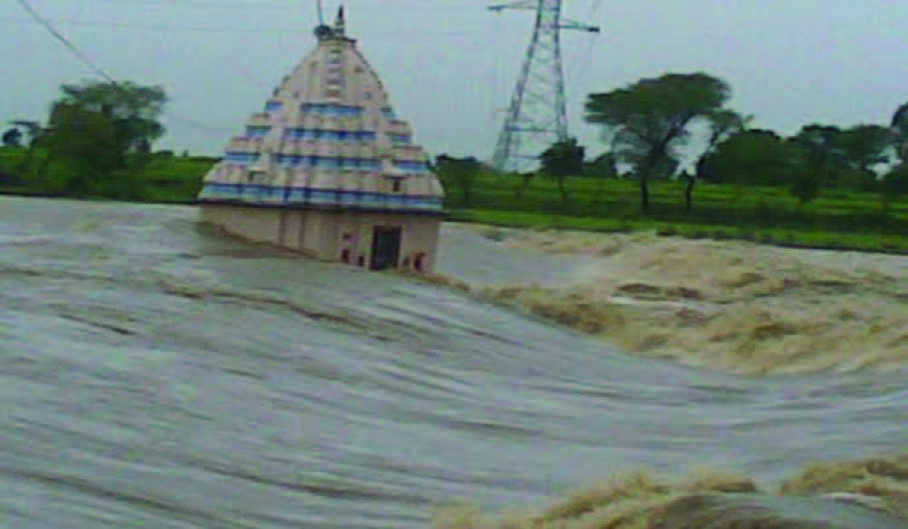
    BHOPAL/BHARUCH (TIP): The army and air force were pressed into service on Aug 23 to expedite relief and evacuation in flood-hit areas of Madhya Pradesh. At least 21 people have died in flash floods in the past 36 hours taking the toll to 106. Heavy rains have devastated at least 12 districts of the state, the worst-hit being Hoshangabad and Vidisha. More than 24,000 houses have been destroyed. And with the Narmada and Betwa rivers flowing above the danger mark, the state government has sounded an alert. Chief minister Shivraj Singh Chouhan chaired a high-level meeting to review the situation. All trains bound for south India, passing through Madhya Pradesh have been delayed. A 30- metre railway track between Barbatpur and Magardoh railway station in Betul was washed away early on Friday. Hoshangabad remained and cut off from the rest of the state and more than 3,000 villagers have been evacuated.


    img111

    In Gujarat, the Bharuch district administration has pressed the panic button following heavy rains in the catchment areas of Narmada river in MP. The heavy influx of water from Omkareshwar dam in MP into Sardar Sarovar dam has resulted in Narmada flowing at 32 ft at the Golden Bridge, eight feet above danger mark. According to Adra Agrawal, in-charge collector of Bharuch, nearly 1,670 people living in low-lying areas of Bharuch, Ankleshwar and Jhagadia have been shifted to safer locations due to flood threat.

    The administration had to use boats to shift people after Narmada waters inundated many low-lying areas in old Bharuch towns like Katopor Bazar, Furja Road, Pirkanthi, Bhrugu Rushi Temple and Dandia Bazar. An alert has been sounded in 32 villages of Bharuch, Narmada and Vadodara. Rafiq Sheikh, a shopkeeper in Pirkanthi area, said, “This is the second time this month that our areas were flooded. We have lost business in festival season.” Meanwhile, the Sardar Sarovar dam touched a new high of 129.70 meters on Aug 23. Earlier, it had touched the highest level of 129.50 meters on August 3. “The dam is overflowing since July 17. If the influx of water from Omkareshwar dam continues, the dam level is expected to touch 130.40 m by Saturday,” said PM Patel, chief engineer, Sardar Sarovar Narmada Nigam Ltd.

  • INDIA’S JOURNEY TO BECOMING AN ECONOMIC SUPERPOWER

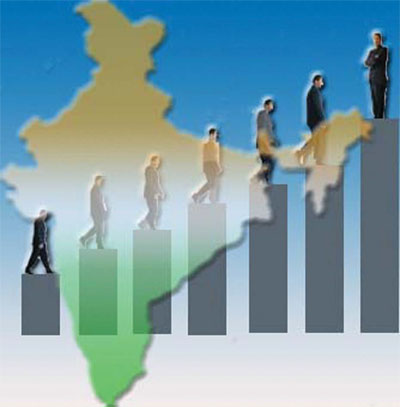
    INDIA’S JOURNEY TO BECOMING AN ECONOMIC SUPERPOWER

    The economic development in India followed socialist-inspired policies for most of its independent history, including state-ownership of many sectors; India’s per capita income increased at only around 1% annualised rate in the three decades after Independence. Since the mid-1980s, India has slowly opened up its markets through economic liberalisation.

    After more fundamental reforms since 1991 and their renewal in the 2000s, India has progressed towards a free market economy. In the late 2000s, India’s growth reached 7.5%, which will double the average income in a decade. Analysts] say that if India pushed more fundamental market reforms, it could sustain the rate and even reach the government’s 2011 target of 10%. States have large responsibilities over their economies.

    The annualised 1999-2008 growth rates for Tamil Nadu (9.8), Gujarat (9.6%),Haryana (9.1%), or Delhi (8.9%) were significantly higher than for Bihar (5.1%), Uttar Pradesh (4.4%), or Madhya Pradesh (6.5%). India is the tenth-largest economy in the world and the third largest by purchasing power parity adjusted exchange rates (PPP). On per capita basis, it ranks 140th in the world or 129th by PPP. The economic growth has been driven by the expansion of services that have been growing consistently faster than other sectors.

    It is argued that the pattern of Indian development has been a specific one and that the country may be able to skip the intermediate industrialisationled phase in the transformation of its economic structure. Serious concerns have been raised about the jobless nature of the economic growth. Favourable macroeconomic performance has been a necessary but not sufficient condition for the significant reduction of poverty amongst the Indian population.

    The rate of poverty decline has not been higher in the post-reform period (since 1991). The improvements in some other non-economic dimensions of social development have been even less favourable. The most pronounced example is an exceptionally high and persistent level of child malnutrition (46% in 2005-6). The progress of economic reforms in India is followed closely. The World Bank suggests that the most important priorities are public sector reform, infrastructure, agricultural and rural development, removal of labour regulations, reforms in lagging states, and HIV/AIDS.

    [5] For 2012, India ranked 132nd in Ease of Doing Business Index, which is setback as compared with China 91st and Brazil 126th. According to Index of Economic Freedom World Ranking an annual survey on economic freedom of the nations, India ranks 123rd as compared with China and Russia which ranks 138th and 144th respectively in 2012. India ranks second worldwide in farm output.

    Agriculture and allied sectors like forestry, logging and fishing accounted for 18.6% of the GDP in 2005, employed 60% of the total workforce and despite a steady decline of its share in the GDP, is still the largest economic sector and plays a significant role in the overall socioeconomic development of India. Yields per unit area of all crops have grown since 1950, due to the special emphasis placed on agriculture in the five-year plans and steady improvements in irrigation, technology, application of modern agricultural practices and provision of agricultural credit and subsidies since the green revolution.

    India is the largest producer in the world of milk, cashew nuts, coconuts, tea, ginger, turmeric and black pepper. It also has the world’s largest cattle population (193 million). It is the second largest producer of wheat, rice, sugar, groundnut and inland fish. It is the third largest producer of tobacco. India accounts for 10% of the world fruit production with first rank in the production of banana and sapota. The required level of investment for the development of marketing, storage and cold storage infrastructure is estimated to be huge.

    The government has implemented various schemes to raise investment in marketing infrastructure. Amongst these schemes are Construction of Rural Go downs, Market Research and Information Network, and Development / Strengthening of Agricultural Marketing Infrastructure, Grading and Standardisation.

    Main problems in the agricultural sector, as listed by the World Bank, are:

  • NCP Supports Demand For Vidarbha , Suggests States Reorganization Commission Be Set Up

    NCP Supports Demand For Vidarbha , Suggests States Reorganization Commission Be Set Up

    NEW DELHI (TIP): A day after the historical decision to carve out Telangana as a separate state from Andhra Pradesh, National Congress Party (NCP) leader Praful Patel said his party supported the formation of Vidarbha so long as the people want it. e also suggested that a states reorganization commission is set up to address the rising demands for new states in the country. “As far as Vidarbha is concerned, it has been a long-pending demand for statehood. There have been, in the 1950’s and 1960’s, big agitations for Vidarbha.

    I am sure people were waiting to see what will happen to Telangana. Now that this decision has been taken, as NCP, I can say we are fully in support of the demand so long as the people of Vidarbha are keen to have it—that has been our stand not only now but even earlier and we stand by it,” Patel said. “I represent Vidarbha. My stance and my party’s stance has been very clear—If the people want, we will support,” Patel added. Commenting on the increasing number of demands for new states, Patel said that they should be considered. “I think such kind of demands will come and have been coming in the past from many regions in the country.

    So, it would not be a bad idea to have a second states reorganization commission set up to look at all these issues,” Patel suggested here. Noting that in the past smaller states have led to development in those regions, Patel said “There is no issue of states being big or small. The question is whether they are justified and viable and I think the states reorganization commission will look into it.” Patel’s remarks come after Congress Member of Parliament Vilas Muttemwar revived the demand to carve out Vidarbha from Maharashtra.

    “The demand of statehood for Vidarbha is stronger and older than Telangana,’ said Muttemwar, who is also a member of the Congress Working Committee (CWC) that finalised the decision to carve out Telangana from Andhra Pradesh. Vidarbha is the eastern region of Maharashtra and is made up of the Nagpur Division and the Amravati Division. Its former name is Berar. It occupies 31.6 percent of total area and holds 21.3 percent of total population of Maharashtra. It borders the state of Madhya Pradesh to the north, Chhattisgarh to the east, Andhra Pradesh to the south and Marathwada and Khandesh regions of Maharashtra to the west.

  • BJP Wave In MP, Party On A Comeback In Rajasthan, UP

    BJP Wave In MP, Party On A Comeback In Rajasthan, UP

    NEW DELHI (TIP): The northern states of Rajasthan, Madhya Pradesh and Uttar Pradesh present a very contrasting picture when it comes to the political battle.While Rajasthan and Madhya Pradesh are basically a twohorse race with the Congress and the Bharatiya Janata Party (BJP) being the rivals, in Uttar Pradesh, which sends the largest number of MPs to the Lok Sabha, it is a four-cornered fight in most of the seats.

    According to the CSDSCNN- IBN Election Tracker survey, the BJP has a lot to cheer as the party is expected to give a tough fight to the Congress in Rajasthan to consolidate its position in Madhya Pradesh. Whereas in Uttar Pradesh, the party is on a comeback trail and is likely to bag the largest number of seats. The Congress, inspite of being in power in Rajasthan, is expected to do badly while in Madhya Pradesh it is being swept away by the BJP tide.

    Uttar Pradesh presents a very interesting picture with the two regional forces – the Samajwadi Party (SP) and the Bahujan Samaj Party (BSP) – not on a strong wicket with the Congress most likely ending fourth as the survey reveals that the grand old party of India is unable to repeat its good show of 2009 elections. The BJP has been on resurgences in all the three states and a good show by the party is likely to propel it closure to power at the Centre after the 2014 Lok Sabha elections.

  • OFBJP Organizes Public Reception For BJP President Rajnath Singh

    OFBJP Organizes Public Reception For BJP President Rajnath Singh

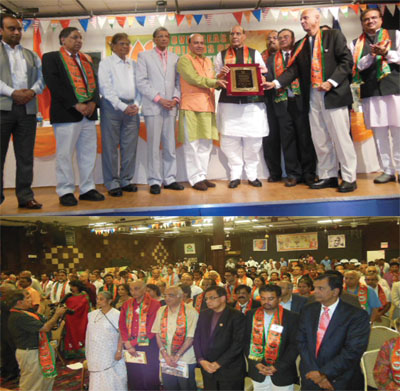
    EDISON, NJ (TIP): Indian American community of tri-state area (New Jersey, New York, and Connecticut) gave a rousing welcome to Rajnath Singh, President of Bharatiya Janata Party (BJP) and his BJP delegation Ananth Kumar, General Secretary; Sudhanshu Trivedi, National Spokesperson; and Vijay Jolly, Convener of Overseas Affairs and Overseas Friends of BJP (OFBJP) in TV Asia Studio Auditorium at Edison, NJ on Sunday July 21, 2013. The program was organized by OFBJP-USA as part of its community global outreach program.

    The program was broadcasted live on TV Asia across US reaching out to 1.5 million viewers. The program was also relayed live in India, Canada, UK, Europe and Middle East thru various channels. Addressing the jam-packed auditorium, Rajnath Singh said that he was elated by the warm welcome that had been accorded to him by the Indian Americans here in US. He said that trust and credibility have become a big problem in India and BJP is the only option. No party in India has grown bigger than Congress except the BJP.

    BJP is the only party that has not suffered a vertical split. Communists have lost relevance and Congress has no policy on any of the issues nor has any ideology. Since its inception in 1951 as Bharatiya Jan Sangh and later on as BJP, the party has been pursuing a policy of Nation first. He continued that Atal Behari Vajpayee led a 24 party coalition for 6 years and the NDA rule was far better than 55 years of Congress rule in every aspect.

    Corruption, Inflation and price rise are the signature of congress rule whereas NDA government controlled the inflation and price rise in spite of the prevailing severe drought and economic sanctions imposed by the entire West after Pokhran nuclear tests. NDA inherited a GDP growth of 4.8% and 10% inflation whereas BJP handed UPA a GDP of 8.4% and inflation 3.5% in 2004. Amidst applause from the audience he said that Pokhran test was a big step wherein the BJP led govt made India a nuclear power even though we knew economic sanctions were staring at us.

    Countries that are much smaller have become developed countries but India is still a backward country and not sure why 55 years of Congress rule did not change much. Congress has to answer as to how much time they need to make India better, to remove poverty. BJP invited FDI in telecom sector but encouraged Indian investors whereas Congress has opened up the telecom sector 100%, increased in the LIC sector from 26% to 49%. Foreign investors have pulled out $7.5 billion from India and no one is ready to invest.

    Even after 60 years of Independence we still have 67% of people who don’t get food and we need a food security bill. We need leaders with firm conviction and leaders with vision and when we come in power we will make India a super economic power in 10-15 years. National Highway development has seen tremendous growth during NDA rule. 50% of the highways that were built during 1980-2012 happened during 6 years of NDA rule and the other 50% were built during 26 years of non-BJP rule.

    Gujarat development has become a role model across the world. Madhya Pradesh agricultural growth (19%) is the highest in the world and very soon will be providing 24hrs of power supply. Chhattisgarh PDS system serves 90% of the population without any corruption and is a model for other states to emulate. Goa is the only state in India where Petrol is cheaper than Diesel. India has a GDP growth of 4.8% whereas BJP ruled states have 10% GDP growth. UPA government has no plan to tackle Naxalism or terrorism.

    Appeasement has become the state policy whereas BJP never links terrorism to any religion, caste or region. After Mumbai terror attack, Prime Minister made a statement that he will not talk to Pakistan until it gives an assurance that they will control terror activities and not support any groups that work against India but changed all that in a matter of few months. Our foreign policy is at its worst with no friendly neighbors around us. During NDA rule we maintained good relations with Russia and development excellent relations with US.

    We made US our strategic partner. He appealed to the US govt to lift the ban on visa to Narendra Modi, he said on one side US agencies rate Gujarat as the best state and Modiji as an excellent administrator and on the other hand they deny visa to him. It will be better if US takes a decision soon as they will be forced to take a decision anyway later. When BJP comes to power we will make India a power of Rishi and Krishi (knowledge and Prosperity), he said. Indian culture influenced the world for thousands of years.

    We never planned to dominate the world and even Swami Vivekananda came to Chicago on his own and had great influence on the world by his teachings. Citing the example of Newsweek columnist Lisa Miller who stated that by imbibing Yoga, Pranayam, Ayurveda and Organic farming people in the West are becoming Hindus whereas it is a crime in India if you say you are a Hindu.Talking on the recent controversy related to Narendra Modi statement that he is a Hindu and Nationalist, media created and pseudo secularists made a big fuss.

    Professing your Hindu culture became a communal word in India. He said that as per the Supreme Court, Hindutva is a way of a life. Hindutva teaches love not only for human beings but even for animals, plants, rivers, mountains etc. It is Hindutva that teaches us to serve milk to a snake and take care of animals like ants and birds. He called on the Indian American Community to support BJP to build a strong India.

    Shri Rajnath Singh was accorded standing ovation. Shri Rajnath Singh was honored by the OFBJP executive committee with a plaque for his contributions to the party and the country. Earlier, Ram Rakshpal Sood (Sr.Advisor, OFBJP) acting as the Emcee welcomed the audience, chief guests and the sponsors of the event. After the traditional lamp lighting ceremony amidst the chanting of Vedic mantras by Pandit Pravin Shastri and Chandrakant Trivedi and blowing of conch shell by Pravin Shashtri. Mrs. Vidya Labroo led the rendition of Vandemataram.

    Jayesh Patel (President, OFBJP) welcomed the distinguished guests and said that entire India is chanting Narendra Modi (NaMo) mantra and expressed hope that BJP will be able to get majority on its own merit in the next election. Ram Kamath (General Secretary, OFBJP) introduced Dr. Mahesh Mehta, National Coordinator of OFBJP-USA. Speaking on the occasion, Dr. Mehta said that mission 2014 is about transforming India into a global leader and Global Indians should contribute to be the part of this great movement that will eventually contribute to the development of India.

    Dr. Adapa Prasad (Immediate Past President) introduced Vijay Jolly, Convener of BJP Overseas Affairs and OFBJP, as a dynamic leader and former MLA who took on Delhi Chief Minister during the last election.

    In his electrifying speech, Vijay Jolly urged the audience to applaud for Rajnath Singh for honoring the feelings of the people by making NaMo as the chairman of the campaign committee. Stressing the fact the OFBJP is on a mission to develop leaders by inducting youth into the organization to dethrone the corrupt Congress regime in India. Stating that NRI’s have always made India proud, he said that OFBJP has setup its chapters in UK, Norway, Nepal, Kenya and other countries to work for the welfare of Indian diaspora.

    He got the past Presidents of OFBJP-USA honored by Rajnath Singh Introducing SudhanshuTrivedi, BJP National Spokesperson, Dr. Dinesh Agrawal (Former- President, OFBJP) said that as the national spokesperson, he is very active effective on TV channels spreading the message and its ideology of BJP. SudhanshuTrivedi reminded that July 21st the day of the program is a historical day when US astronauts landed on the moon. Edison town, the venue of the program, is also a historical town, named after the inventor of light bulb.

    Hence, he said that word Bharat stands for light and inspires us to take India to the pinnacle of glory. Stating that BJP is all set to form the next government is not based on hope but on facts. He concluded reciting a poem by A.B. Vajpayee. R.P. Singh (Org. Secretary, OFBJP) introduced Ananth Kumar, BJP general Secretary. Amidst thunderous applaud from the audience, Shri Ananth Kumar introduced himself as the Hanuman of South as Kishkinda, the birth place of Lord Hanuman is in Karnataka whereas Rajnath Singh is from U.P, the land of Ram. For Ram’s team to win we need Hanuman and he is there to lend services for the party and the country.

    India, he said is going through turbulent times and like A.B. Vajpayee model, we have Gujarat model of development under NaMo leadership and we will soon have NaMo model of governance. He said that BJP is already in battle mode, under NaMo and Rajnath Singh’s leadership we are all set to take on the corrupt congress government. Once in power, BJP will make India a global player not only in spirituality but in culture, strategic matters and will be a decisive player in the world. He urged the NRI’s to connect with their districts back home and work for BJP’s victory in 2014.

    Chandrakanth Patel introduced Rajnath Singh as a man of impeccable image in spite of being in political life for 40+ years. Born in a farmer’s family in Varanasi, he rose to be the president of BJYM. He was part of the J.P movement and became the Agricultural minister in A.B. Vajpayee’s government. He was the President of BJP between 2007-2009 and again became the President in January, 2013.

    Currently, he is a Member of Parliament from Ghaziabad, U.P. Earlier, the President of TV Asia and a well known community leader, Shri H.R.Shah addressed the gathering and said that TV Asia always supported India causes and he has been an admirer of Mahatma Gnadhi and Sardar Patel. He said he felt close to BJP principles and supported BJP. He wished that Narendra Modi would be elected as the Prime Minister. Krishna Reddy (Treasurer, OFBJP) presented the vote of Thanks.

  • Not In The Race For Prime Minister : RAJNATH SINGH

    Not In The Race For Prime Minister : RAJNATH SINGH

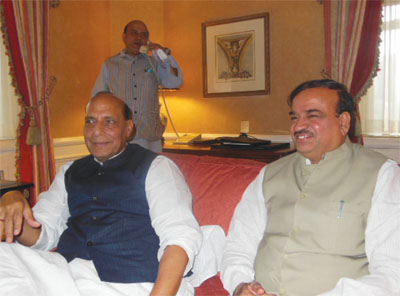
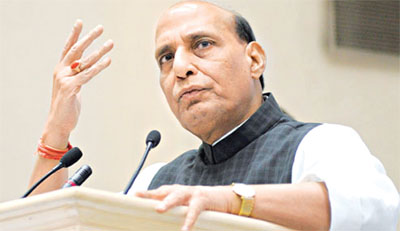
    NEW YORK (TIP): The Bharatiya Janata Party President Rajnath Singh on Saturday, July 20, categorically denied that he is in the race for Prime Minister of India if BJP returns to power at the Center. “I am more interested in getting the BJP back into power in Center and packing off the corruption-ridden bad governance of the Congress in my tenure as President of the party,” he said addressing a news conference of Indian-American media at Hotel Waldorf Astoria in Manhattan.

    On the question of party president not being projected as Prime Ministerial candidate in the Lok Sabha elections, he said it is not necessary that the two positions be placed in the hands of one person. “It’s not necessary that party president should also be a crowd puller and a prime ministerial candidate. I have an assignment to do for my party. I have a job to deliver – that is victory of the party in the 2014 elections.”

    “Seven months before the elections, I have nominated Gujarat Chief Minister Narendra Modi as chairman of the party campaign committee. What is unusual in that? We have nominated Modi like other parties do and why read between lines. I have named him as campaign head in view of his image, popularity and commitment to the party,” he said. He said Modi is certainly the most popular and the tallest leader of India.

    He is a crowd puller not only in Gujarat but also in Tamil Nadu, Andhra Pradesh, Uttar Pradesh and Bihar – from North to South, East to West. He is one single leader with a national appeal. His popularity will help the party in the elections. On the issue of visa rejection issue of Narendra Modi, he said he would take up the issue with the US lawmakers in Washington.

    “I will appeal to the US government to clear the US visa to the Gujarat Chief Minister.” People of India have now realized that BJP is the only solution after comparing the performance-oriented BJP led NDA Government and corruption-ridden inefficient Congress UPA dispensation, he said. The performances of several BJP-ruled states like Gujarat, Madhya Pradesh, Chhattisgarh are there for the people to see and if these states can provide 24 hour power supply, clean and efficient government, fillip to industries compared to poor performance of many Congressruled State governments what would people prefer? People have made up their mind, he said.

    Detailing steps taken by the BJP to face the national elections in 2014, he said the party had brought changes in organizational level by forming polling booth committees in every booth. “We have formed a committee consisting of 10 to 15 party men at grassroots level to strengthen the organization at village level,” he said Congress ruled for 10 long years at national level and what are their achievements other than wholesale corruption and compromise in national and international security, he asked.

    Indian voters are now realized that when the Center can’t guarantee growth rate of five percent or less, the growth rate in Gujarat, Madhya Pradesh and Chhattisgarh are approximately 10 percent. No one can fool Indian voters any more, he said. On the recent debacle of the party in Karnataka and setbacks in other states, the BJP President said assembly elections and municipal elections are different from parliament elections where people vote for a stable government.

    Voters are intelligent enough to compare the two governments and Congress will be out of power soon. They have ruled for 10 long years and now its time to give them rest, he said “We are confident that the failure of the Congress government will help BJP return to power in the center. Any political party that aspires to come to power should give good governance and satisfy the needs of the people.

    If they fail in this front, they will be out of power.” There is wholesale failure on economic front, compromise on internal and external security and diplomatic fronts as well. People are demanding a change very badly. If people want any change, the only choice is BJP who can provide an alternative to this government, he said. On allies deserting the party, he said BJP will try to get a clear majority in Lok Sabha polls but at the same time will not forget its allies – old and new.

    “Despite a clear majority in sight, we want our allies to participate in the government at the center. Now we have Shiv Sena and Shiromani Akali Dal and may get some nearer to the elections. There is also a possibility of post poll alliance with like minded parties if there is a need,” he said. In the coming Lok Sabha elections, Congress will be routed in Andhra Pradesh due to its ambiguity on Telengana issue.

    The BJP is the only national party that favors separate Telengana and it was passed as a resolution in our national executive committee meeting, he said. There is no ambiguity in the BJP unlike the Congress camp in the matter and BJP is in favor of Telengana. But it’s not in favor of bifurcation of UP and other states as Telengana issue is a totally different one. On the question of poll promises, he said BJP would rather go in for developmental debate than Ram Janma Bhoomi issue. “Ram temple was not a major poll issue anytime.

    It was at best a national issue but not an election issue,” he added. BJP government will consider instituting an inquiry commission to go into the corruption and scandals of the Congress government and will provide transparent and honest government with people’s interest as uppermost, he said. Ananth Kumar, party general secretary and chairman of Parliamentary Foreign Affairs Committee who is accompanying Rajnath Singh on the US tour, said the four member BJP delegation will meet members of the US Senate and House Representatives from both sides of the aisle – Democratic Party and the Republicans especially members of the Congressional Caucus of Indians and Indian Americans at the Capitol Hill.

    Ananth Kumar said Rajnath’s visit to the US is a two track outreach program – to outreach the Indian Diaspora to assess the mood of three million Indian-Americans across the nation who occupy important and powerful positions besides being opinion makers; and to meet with India Caucus Congressmen to impress on them that a change is sweeping in India on the heels of Lok Sabha elections.

    The other two members of the delegation are Dr. Sudhanshu Trivedi, party spokesman and advisor to the BJP President and Vijay Jolly, BJP national convener for Overseas Affairs and a former Delhi MLA. Jolly said the visit was to re-connect the Party President with the Indian-American Diaspora that plays a leading role in fostering friendship between the two countries. “We want to work closely with Non Resident Indians.” BJP – both as a government and party – will work with mainstream American and Indian-American business community on economic and investment matters.

    clearly is of the view that India and the US have a close correlation in internal and external security and they are strategic partners being natural allies, he said. Jolly said the Overseas Friends of BJP in the US has over 7000 members across the US and project a positive image of the party among Indian-Americans and policy makers. The Foreign Affairs Committee of the party will address the concerns of Indian Diaspora and include in them in the BJP parivar by assigning a major role in the ensuing elections.

    Rajnath Singh said it was NDA government under Vajpayee that gave voting rights to Non-Resident Indians and introduced Overseas Citizens Card (OCI) and Persons of Indian Origin (PIO) card. It was under Vajpayee’s leadership that the first Pravasi Bharatiya Divas was held in 2003 in New Delhi to bring all the Non- Resident and Diaspora Indians to work for the welfare of India. “All these were made possible due to the visionary leadership of Vajpayee and only the BJP has done a lot for NRIs and PIOs.”

    On the spate of killing of Hindu and BJP leaders in Tamil Nadu, he said he would appeal to Tamil Nadu Chief Minister to give protection to party leaders. “I appeal to Jayalalithaa to help stop the killing of Hindu and BJP leaders in Tamil Nadu. We will try to build pressure on state government so that it takes it seriously to put an end to such killings.”

  • BJP President Criticized For Violating The Spirit Of India’s Constitution

    BJP President Criticized For Violating The Spirit Of India’s Constitution

    NEW YORK (TIP): Juned Qazi, president of Madhya Pradesh unit of Indian National Overseas Congress (I), who is vigorously campaigning for a Congress (I) ticket from Aligarh Lok Sabha constituency, strongly criticized Rajnath Singh, BJP president, for violating the secular spirit of India’s constitution in speeches made in New Jersey, USA, July 21.

    Qazi, who recently returned from a whirlwind BHARAT NIRMAN SANDESH tour of Aligarh, UP, criticized Singh for advocating ‘Hindu nationalism and Hindutva’ as a political strategy at a public reception hosted by ‘Overseas Friends of BJP’ in Edison, NJ on July 21, 2013. In a strongly worded press release Qazi pointed out that people of India can’t allow religion-based politics any more.

    “Such politics clearly violates the fundamental values of our nation upon which our constitution is based”, he said. “India is a secular country which clearly states the establishment of a secular, socialist and democratic nation”, Qazi said. “With its religion based politics, BJP is tempering with the secular nature of our constitution.” Qazi said that India is fortunate to have a very progressive and modern constitution, which is capable of taking the nation to new heights in 21st century.

    “We are a nation of young people who have no interest in promoting the bogey of religion for serving the political needs of outdated politicians. India’s constitution was created under the leadership of visionaries such as Dr. Baba Saheb Ambedkar who wanted to build India as a strong nation based secular and democratic values”, he pointed out. “BJP is a narrow-minded party whose leaders foolishly mislead the people of India by dragging religion in politics”, Qazi commented adding that BJP president Rajnath Singh spoke in USA as if he was speaking to people ignorant of outside world.

    BJP president Rajnath Singh urges Overseas friends of BJP to lobby US lawmakers and US Department of State to issue a US visa to tainted BJP leader Narendra Modi. Mr. Juned Qazi would like to ask the BJP president, why it is that BJP is unable to come to terms with the fact that Narendra Modi is in-fact responsible for the heinous systematic massacre(s) in Gujarat. With technical legal maneuvers, political arm twisting, witness/evidence tampering the BJP ruling apparatus was able to temporarily fool the Indian judiciary and procured a clean chit for the tainted leader.

    Why is it that the state department revoked Mr. Modi’s tourist/business visa and refused to let Modi into the United states on a diplomatic visa? As clearly cited in the official state department communiqué and various un-biased reports published by human rights groups, Modi and his government were directly responsible for systematic violation of human rights in the state of Gujarat.

  • BJP Has Sound Plans To Jumpstart The Stalled Indian Economy- Rajnath Singh

    BJP Has Sound Plans To Jumpstart The Stalled Indian Economy- Rajnath Singh

    NEW YORK, NY (TIP): “The BJP-led NDA government created 67 million jobs in less than five years whereas the Congress led UPA created less than 2.7 million jobs between 2004 and 2009. These figures are from the data collected by the federal government controlled agencies and not a figment of imagination”, Rajnath Singh said.

    He was speaking on what BJP will do to jumpstart the stalled Indian economy at a function organized by India-America Chamber of Commerce, July 25. Rajnath Singh who was in Washington for three days said he had discussions with the Congressmen and administration officials on the issue of difficulties faced by candidates in H1B and L1 visa to work legally in the US. The GDP cost burden will go up by 0.3 to 0.4 percent due to increase in fees.

    “We had lodged our protest against the comprehensive immigration reforms bill and they had raised the issue of patents and compulsory drug license issues. There was only one case under these CDL whereas Indonesia had six cases and Canada four cases,” he added. The US would do well to share its latest technology on green energy with nations such as India so that it can benefit the humanity. Once these inventions are ashared, they would help us more in a very rapid manner, he said.

    The BJP government will strengthen the village economy as over 70 percent of the people live in rural areas. We will do our best to stop urbanization and create more jobs in the rural areas as was done in the previous NDA government under the PURA scheme. More than 55 percent of the jobs for youth are in rural areas and there is a need to strengthen this sector. Turning to climate change, the BJP leader said while US that has been preaching, has a carbon emission rate of 20 ton per capita per annum, India has only 1.5 per ton per capita per annum.

    The global average is only 4.5 ton per capita per annum. You now decide who is on the right side and who is not. Addressing the members of the India- America Chamber of Commerce in Manhattan, he said India is now facing a serious financial crisis of grave magnitude despite the fact that no one in the global economy can ignore India. The economy of India is not something that makes us feel comfortable or feel proud of.

    But India was regarded as third largest economy of the world, he said. When the NDA government led by Atal Behari Vajpayee stepped down in 2004, the fiscal deficit was 2.5 percent and current account deficit was surplus. The revenue deficit was less than one percent. The economy witnessed a boom period during 1999 to 2004 when the country was ruled by the NDA and the slide started in 2004. “The boom that we created lasted till 2008 and then we are now witnessing is one of the worse economic downturns,” Singh said.

    “When I mentioned to the Speaker of the House yesterday at Washington that we had a surplus current account when we left power, he was surprised. There was a revenue deficit that went up from 4.5 percent to 6 percent in 2008. The current account of deficit shot to 6 percent. We passed the fiscal responsibility bill in the parliament and hence were able to bring some fiscal discipline.

    Inflation is now hovering around 7.7 percent,” he said. The rupee value has depreciated drastically to the US dollar from Rs 37 a dollar in 2008 to Rs 60 in 2013 almost doubling in five years. We thought this would be offset by increase in exports and that also did not happen; it went up by just one percent. It’s very unfortunate that savings that have been the biggest strength of India as it provided capital is now falling at a very rapid rate.

    The small businesses tend to grow with the increase in savings and in the absence they take a major hit. Savings drop and growth rates drop and what else to drop. The success of Indian story is over. The success story of India is waiting for the BJP to return to power. The UPA has ruined the economic structure of the country. How will the BJP restore investors’ confidence and fix the broken economy once it comes to power? We will do what we did from 1999 to 2004 and we had a unique development model which is not only a model for India to feel proud of but came as a surprise to the world.

    When we handed over the reins of the government to the Congress-led UPA, India’s growth rate was 8 to 9 percent and rate of inflation was around three percent. More than 50 percent of the highways were built during the Vajpayee government and the present Congress dispensation had admitted this in the court. Where had all the developments gone now? The BJP created a success story only to be mauled by the Congress, he added.

    We have proved in the BJP-ruled states how we prioritize economic reforms and Gujarat is a shining example of India. The whole world is now talking about Gujarat and foreign governments are keen to study the success story. Take the case of Madhya Pradesh that was considered a sick state with no economic development before the BJP Government took over. Agricultural growth rate has gone up to 19.1 percent in the state as against 4 percent of the federal government.

    Madhya Pradesh has replaced as country’s largest supplier of food grains to the central pool. In Chhattisgarh, more than 90 percent of the population is covered under the Public Distribution System and people enjoy social security compared to mass suicide by farmers in the Congress-ruled states. Goa is the only state in India where petrol is cheaper than diesel similar to what we see in the US.

    Do we have to prove anything more to assure the people that our first priority will be to fix the problems and take India on a different plane?, he asked. The average GDP of BJP-ruled governments is about 10 percent whereas the nation is only experiencing a growth rate of less than five percent. There are only two models – BJP model for growth and Congress model for destruction, he added. Earlier, Rajiv Khanna, President, India-America Chamber of Commerce welcomed Rajnath Singh and introduced the subject of talk.

    He pointed out that Indian economy has been weakening and this had caused considerable doubts in the minds of investors and wanted Singh to speak on how his party, if it came to power would jumpstart the stalled Indian economy. The talk by Rajnath Singh was followed by an interesting Q & AA session. Singh candidly answered the few questions put to him.

  • Cong-JMM Exploring Govt Formation In Jharkhand

    Cong-JMM Exploring Govt Formation In Jharkhand

    NEW DELHI (TIP): The Congress and JMM appear to be inching closer towards forming an alternative government in Jharkhand which has been under President’s Rule — imposed after the fall of the Arjun Munda government on January 8. Newly-appointed Congress general secretary in-charge of the state BK Hariprasad will hold talks in this regard with state leaders of the Congress and JMM tomorrow in Ranchi.

    Shibu Soren’s party, which is supporting UPA-II from outside, has been keen on forming an alternative government in the state in alliance with the Congress ever since it broke up with the BJP leading to the imposition of President’s Rule there on January 18. While a large number of Congress leaders in the state are in favour of forming a government with JMM’s support as 18 months are still left for the current state Assembly’s term to get over, the top brass of the party was initially reluctant towards any such move.

    The JMM and Congress, which have 18 and 13 MLAs, need the support of 11 more legislators to form a government in the 81-member state Assembly. The Congress had supported an Independent Madhu Koda-led government in the state and had to face criticism later as Koda got embroiled in serious corruption cases. Besides, there are cases pending against some JMM leaders even now.

    Hence, the party leadership was wary of any such tie-up in the state. There, however, appears to have been a re-think over the issue of alliances now. JVM(P), which had forged an alliance with the Congress for the 2009 Assembly elections, parted ways with it in April last year over the FDI issue. The Congress now appears to be veering around to the view that it has to tie up with some party for the next Lok Sabha elections there.

    Out of the 14 Lok Sabha seats in Jharkhand, the Congress has one MP Subodh Kant Sahay, while JMM has two members. They had fought the last General Election separately. In 2004 Lok Sabha elections, when both parties had fought in alliance, the Congress had won six and JMM four seats respectively bringing 10 seats in the UPA kitty. There are indications that the formation of government with JMM will depend on an amicable seat-sharing agreement between the two parties for the next General Election.

    Another talk in political circles is that Assembly elections in Jharkhand could be held along with those in Rajasthan, Chhattisgarh, Madhya Pradesh and Delhi if the JMM and Congress fail to reach an agreement on the issue. Central rule in Jharkhand will expire on July 18 and a decision has to be taken before that. JMM MLAs Vishnu Prasad Bhaiya and Paulus Surin had a few days back issued threats of resigning from the House membership if the Congress failed to take a decision on government formation before June 16.

    Announcing his intent to lend unconditional support to the JMM and Congress if they joined hands for government formation, senior RJD leader and MLA Janardhan Paswan had earlier said that the Congress must come forward to give a new alternative to the people who have given a mandate for five years. The BJP, Jharkhand Vikas Morcha (Prajatantric) and AJSU Party have been demanding dissolution of the House to seek a new mandate. Congress president Sonia Gandhi had on June 10 held consultations with senior party leaders, including AK Antony, Sushilkumar Shinde, Jairam Ramesh and vice-president Rahul Gandhi, on the way forward in Jharkhand.

  • Karnataka will regain pre-eminent position as IT superpower: Moily

    Karnataka will regain pre-eminent position as IT superpower: Moily

    NEW YORK (TIP): Union Petroleum Minister Veerappa Moily assured the Non- Resident Indians that the Congress government headed by Chief Minister K Siddaramiah in Karnataka will put the state back again on the global map in Information and bio technology. It will become IT superpower again and make India proud. Moily was addressing Indian-Americans over live audio conference by telephone from New Delhi at a victory celebration organized by Dr. Dayanand Naik, Karnataka chapter President of Indian National Overseas Congress (INOC) here on May 13 night.

    Moily told NRIs that the previous Bharatiya Janata Party government had done irreparable damage to the image of Karnataka abroad which was the most favored investment destination when the Congress Party ruled the State. “We will respond to the aspirations of Kannadigas not only in India but all over the world by providing a stable, corrupt-free, transparent and accountable government.” Terming the recently-held election as “liberation movement,” the Union Minister thanked Dr. Naik and his team from the Indian National Overseas Congress for their support and campaign using social media and mass email to their friends and relatives back home to bring back Congress to power. Moily said due to anarchy and misrule, Karnataka reached its lowest ebb in education and knowledge sectors. “They have destroyed the education system by sanctioning universities and educational institutions that had neither infrastructure nor any faculty. “The State built by statesmen like by Sir M. Vishweswarayya was in shambles and the people have made a good choice to retrieve Karnataka from the clutches of corrupt BJP,” he said.

    The election results in Karnataka indicate the shape of things to come and Congress will form the government for the third consecutive term in the center, he said. George Abraham, president of Indian National Overseas Congress (INOC) in his presidential address, said the people of Karnataka had spoken loud and clear disproving all negativities and fake poll predictions of a hung assembly.

    He appealed to the Congress High Command to reserve seats for Non-Resident Indian members of the INOC who are Indian citizens to contest Parliament and State Assembly elections. “There are some NRIs among MPs now and we need more to raise the issue of overseas Indians in Parliament,” he said. He mentioned Juned Qazi, President of Madhya Pradesh Chapter who is aspiring for a ticket to contest Aligarh Lok Sabha seat and said INOC (I) fully endorsed him.

    Shudh Parkash Singh, INOC Senior Vice President said Karnataka has proved that stable government is a must for development. Dr. Naik, a leading physician and former president of American Association of Physicians of Indian Origin (AAPI) said over 100 volunteers from the US will go to India to campaign for Congress candidates in the Lok Sabha and Assembly elections. He said plans are afoot to rope in and seek the advice of Indian-Americans who campaigned for President Obama on how to use social media and online campaigns to ensure victory of Congress Party.

  • Delhi cops responsible for Mamata Banerjee’s heckling: Digvijay Singh

    Delhi cops responsible for Mamata Banerjee’s heckling: Digvijay Singh

    BHOPAL (TIP): Terming as ‘unfortunate’ the heckling of Mamata Banerjee by Left activists in New Delhi, Congress general secretary Digvijay Singh on April 11 said that police failed to ensure safety of the West Bengal Chief Minister. “The incident was unfortunate and it should not have happened with her (Mamata) and that too in the Planning Commission Delhi police are responsible for it,” Digvijay said.

    Singh said Delhi police should have taken adequate steps to ensure Mamata’s safety as she is Chief Minister. The incident took place on Tuesday at Planning Commission office when Mamata was heckled by the Left-wing Student Federation of India (SFI) activists and the West Bengal finance minister Amit Mitra accompanying her was gheraoed. On BJP Vice President Uma Bharti’s remark that BJP will perform the ‘pind daan’ (rituals after cremation) of Congress in the forthcoming Assembly elections in Madhya Pradesh, Digvijay said, “She should first clarify her position in the BJP hierarchy in Madhya Pradesh”.

  • President Confers Padma Awards

    President Confers Padma Awards

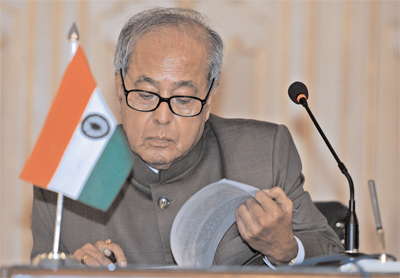
    NEW DELHI (TIP): President PranabMukherjee on April 5 conferred Padma Awards, the country’s highest civilian awards, to 108 personalities. The awards comprise 4 PadmaVibhushan, 24 PadmaBhushan and 80 PadmaShri Awards on Friday. 24 of the awardees are women and the list also includes 11 people in the category of foreigners, NRIs, PIOs and posthumous awardees. Noted physicist Yash Pal and space scientist Roddam Narasimha were chosen the second highest civilian honour Padma Vibhushan. Batting great Rahul Dravid and Olympic bronze medallist MC Mary Kom and late Bollywood actor Rajesh Khanna were named for the prestigious Padma Bhushan award, the third highest civilian award of the country. Renowned sculptor Raghunath Mohapatra and painter S Haider Raza were chosen for Padma Vibhushan.

    The list of 108 Padma awardees for this year also includes actress Sridevi, actors Nana Patekar and Malayalam star Madhu of Chemmeen fame and Olympians Yogeshwar Dutt and Vijay Kumar. Nobody was named for Bharat Ratna for this year too. The last awardee was late Bhimsen Joshi in 2008. Satirist Jaspal Bhatti, who died in a road accident last year, film maker D Rama Naidu, noted South Indian playback singer S Janaki, Bharatnatyam dancer Saroja Vaidyanathan, missile scientist Dr A Sivathanu Pillai of BrahMos programme, Industrialist Adi Godrej and R Tyagarajan, former bureaucrat M K Bhan were among the 24 Padma Bhushan awardees. In all four personalities were awarded Padma Vibhushan, 24 for Padma Bhushan and 80 Padma Shri. Of the awardees 24 are women, 11 belong to the category of foreigners, NRI, PIOs and posthumous.

    Padma Awards, the country’s highest civilian awards, are conferred in three categories, namely Padma Vibhushan, Padma Bhushan and Padma Shri.

    PADMA VIBHUSHAN
    Raghunath Mohapatra, Art, Orissa
    S Haider Raza, Art, Delhi
    Prof Yash Pal, Science and Engineering, Uttar Pradesh
    Prof Roddam Narasimha, Science and Engineering,Karnataka

    PADMA BHUSHAN
    Dr Ramanaidu Daggubati, Art, Andhra Pradesh
    Sreeramamurthy Janaki, Art, Tamil Nadu
    Dr (Smt) Kanak Rele, Art, Maharashtra
    Sharmila Tagore, Art, Delhi
    Dr (Smt) Saroja Vaidyanathan, Art, Delhi
    Abdul Rashid Khan, Art, West Bengal
    Late Rajesh Khanna, Art, Maharashtra
    Late Jaspal Singh Bhatti, Art, Punjab
    Shivajirao Girdhar Patil, Public Affairs, Maharashtra
    Dr Apathukatha Sivathanu Pillai, Science, Engineering,Delhi
    Dr Vijay Kumar Saraswat, Science and Engineering,Delhi
    Dr Ashoke Sen Science and Engineering,Uttar Pradesh
    B N Suresh, Science and Engineering, Karnataka
    Prof Satya N Atluri, Science and Engineering, USA
    Prof Jogesh Chandra Pati, Science and Engineering,USA
    Ramamurthy Thyagarajan, Trade and Industry,Tamil Nadu
    Adi Burjor Godrej, Trade and Industry, Maharashtra
    Dr Nandkishore Shamrao Laud, Medicine,Maharashtra
    Mangesh Padgaonkar, Literature and Education,Maharashtra
    Prof Gayatri Chakravorty Spivak, Literature & Education USA
    Hemendra Singh Panwar, Civil Service,Madhya Pradesh
    Maharaj Kishan Bhan, Civil Service, Delhi
    Rahul Dravid, Sports, Karnataka
    H Mangte Chungneijang Mary Kom, Sports, Manipur

    PADMA SHRI
    Gajam Anjaiah, Art, Andhra Pradesh
    Swami G C D Bharti alias Bharati Bandhu, Art,Chhattisgarh
    B Jayashree, Art, Karnataka
    Sridevi Kapoor, Art, Maharashtra
    Kailash Chandra Meher, Art, Orissa
    Brahmdeo Ram Pandit, Art, Maharashtra
    Vishwanath D Patekar alias Nana Patekar, Art,Maharashtra
    R Nageswara Rao alias Surabhi Babji, Art, Andhra Pradesh
    Lakshmi Narayana Sathiraju, Art, Tamil Nadu
    Jaymala Shiledar, Art, Maharashtra
    Suresh Dattatray Talwalkar, Art, Maharashtra
    P Madhavan Nair alias Madhu, Art, Kerala
    Apurba Kishore Bir, Art, Maharashtra
    Ghanakanta Bora Borbayan, Art, Assam
    Hilda Mit Lepcha, Art, Sikkim
    Sudha Malhotra, Art, Maharashtra
    Ghulam Mohammad Saznawaz, Art,Jammu and Kashmir
    Ramesh Gopaldas Sippy, Art, Maharashtra
    Mahrukh Tarapor, Art, Maharashtra
    Balwant Thakur, Art, Jammu and Kashmir
    Puran Das Baul, Art, West Bengal
    Rajendra Tikku, Art, Jammu and Kashmir
    Pablo Bartholomew, Art, Delhi
    Shri S Shakir Ali, Art, Rajasthan
    S K M Maeilanandhan, Social Work, Tamil Nadu
    Nileema Mishra, Social Work, Maharashtra
    Reema Nanavati, Social Work, Gujarat
    Jharna Dhara Chowdhury, Social Work, Bangladesh
    Late Dr Ram Krishan, Social Work, Uttar Pradesh
    Late Manju Bharat Ram, Social Work, Delhi
    Prof Mustansir Barma, Science and Engineering,Maharashtra
    Avinash Chander, Science and Engineering, Delhi
    Sanjay Govind Dhande, Science and Engineering,Uttar Pradesh
    Prof (Dr) Sankar Kumar Pal, Science, Engineering,West Bengal
    Deepak B Phatak, Science and Engineering,Maharashtra
    Dr Mudundi Ramakrishna Raju, Science and Engg,Andhra Pradesh
    Prof Ajay K Sood, Science and Engineering, Karnataka
    Prof Krishnaswamy Vijayraghavan, Science & Engg,Karnataka
    Dr Manindra Agrawal, Science and Engineering,Uttar Pradesh
    Dr Jayaraman Gowrishankar, Science & Engineering,Andhra Pradesh
    Prof Sharad Pandurang Kale, Science & Engineering,Maharashtra
    Vandana Luthra, Trade and Industry, Delhi
    Rajshree Pathy, Trade and Industry, Tamil Nadu
    Hemendra Prasad Barooah, Trade and Industry,Assam.
    Milind Kamble, Trade and Industry, Maharashtra
    Kalpana Saroj, Trade and Industry, Maharashtra
    Dr Sudarshan K Aggarwal, Medicine, Delhi
    Dr C Venkata S Ram alias Chitta, Venkata Sundara Ram, Medicine, Andhra Pradesh
    Dr Rajendra Achyut Badwe, Medicine, Maharashtra
    Dr Taraprasad Das, Medicine, Orissa
    Prof (Dr) T V Devarajan, Medicine, Tamil Nadu
    Prof (Dr) Saroj Chooramani Gopal, Medicine,Uttar Pradesh
    Dr Pramod Kumar Julka, Medicine, Delhi
    Dr Gulshan Rai Khatri, Medicine, Delhi
    Dr Ganesh Kumar Mani, Medicine, Delhi
    Dr Amit Prabhakar Maydeo, Medicine, Maharashtra
    Dr Sundaram Natarajan, Medicine, Maharashtra
    Prof Krishna Chandra Chunekar, Medicine,Uttar Pradesh
    Dr Vishwa Kumar Gupta, Medicine, Delhi
    Prof (Capt) Dr M Sharaf-eAlam, Literature & Education, Bihar
    Dr Radhika Herzberger, Literature & Education,Andhra Pradesh
    J Malsawma, Literature and Education, Mizoram
    Devendra Patel, Literature & Education, Gujarat
    Dr Rama Kant Shukla, Literature & Education, Delhi
    Prof Akhtarul Wasey, Literature & Education, Delhi
    Prof Anvita Abbi, Literature & Education, Delhi
    Nida Fazli, Literature & Education, Madhya Pradesh
    Surender Kumar Sharma, Literature & Education,Delhi
    Dr Jagdish Prasad Singh, Literature & Education,Bihar
    Late Shaukat Riaz Kapoor Alias Salik Lakhnawi,
    Literature & Education, West Bengal.
    Prof Noboru Karashima, Literature & Education, Japan
    Christopher Pinney, Literature & Education, UK
    Premlata Agrawal, Sports, Jharkhand
    Yogeshwar Dutt, Sports, Haryana
    Hosanagara Nagarajegowda Girisha, Sports,Karnataka
    Subedar Major Vijay Kumar, Sports, Himachal Pradesh
    Ngangom Dingko Singh, Sports, Maharashtra
    Naib Subedar Bajrang Lal Takhar, Sports, Rajasthan
    Ritu Kumar, Fashion Designing, Delhi
    Dr Ravindra Singh Bisht, Archaeology, Uttar Pradesh.

  • As I See It-Making India Truly Incredible

    As I See It-Making India Truly Incredible

    Some scary happenings
    Incredible India is the Union Tourism Ministry’s sales pitch to attract more and more highspending tourists from across the world. But is anyone in authority worrying about the hugely negative impact the gangrape of a Swiss woman in Madhya Pradesh and the plight of a younger British woman who fractured both her legs while jumping from the balcony of an Agra hotel to escape molestation, all within three days, are bound to have on the inflow of tourists? This is disgraceful beyond words.

    However, there are tragedies of a different kind that should shake us no less. Indeed, these are making us a laughing stock. Only a few most recent examples should suffice. The first is the controversy, nay, blatant contradiction between the rival accounts of the same episode by the Delhi police, on the one hand, and both the government and the police of the state of Jammu and Kashmir, on the other.

    On Friday, March 22, after arresting an alleged Hizbul Mujahideen terrorist, Liyaquat Ali Shah, the Delhi police had patted itself on the back and claimed that it had averted a massive terrorist attack on the nation’s capital around Holi. It had also stated that it had recovered arms, including an AK-56 and grenades stored for Shah in a guesthouse close to Delhi’s Jama masjid. But Shah’s family in Kashmir, backed fully by the state police and the government, has declared this to be false. Shah, according to them, was a former militant who was returning home from Pakistan via Nepal, to partake in the state government’s policy to “rehabilitate” those militants that had gone to Pakistan or Pakistan-Occupied Kashmir for training but had later realized their mistake and were willing to surrender.

    The state authorities have also endorsed the Shah family’s assertion that it had already filed an application with the Kupwara police to seek “benefits” under the “rehabilitation policy”. This is not all. Sections of the Indian media have also been punching holes in the claims of the capital’s cops who still stick to their version.

    It was no surprise, therefore, that Kashmir’s Chief Minister Omar Abdullah traveled to Delhi to parley with Union Home Minister Sushilkumar Shinde and the latter reportedly agreed to his demand for a “time-bound inquiry” by the National Intelligence Agency. Since then both the warring sides have raised the ante. The official word from the Home Ministry is that it is examining whether the incident calls for a probe. Is this the measure of cooperation and coordination between the Centre and the government of a very sensitive state? What makes it even more disturbing is that the Congress that leads the ruling coalition at the Centre and the National Conference that heads the government in Kashmir are coalition partners in both New Delhi and Srinagar. Worse, the squalid episode is not a stray one. It is part of a pattern that was not altogether absent in the past but has assumed more worrisome proportions since the hanging of Afzal Guru. The state government, the Opposition and the bulk of the Kashmiri political class are talking in roughly the same language, which is critical of the Centre.

    The death of a young man during a firing by a Central police organization stirred the pot even further. And what happened after the first Pakistan-backed terrorist attack on Srinagar after an interval of three years in which five jawans of the Central Reserve Police Force were shot in cold blood has made the situation even more alarming. For, it was acknowledged only then that, under orders issued by Srinagar, the CRPF is no longer allowed to carry firearms and make do with lathis.

    The CRPF formation that came under the terrorist assault had only one rifle and a lot of lathis. The question is whether New Delhi had accepted this incredible restriction. Naturally, Parliament was very critical of this state of affairs whereupon the latest inanity of Shinde was:” Sometimes one has to fight with lathis.” Of several other recent events that do neither the country nor the polity any credit and sometimes ought to make us hang our heads in shame, let me mention just one more. It is the shocking and bizarre reaction to the Supreme Court’s judgment on the horrific 1993 serial bomb blasts in Bombay (now Mumbai) that killed 257 innocent people and wounded another 700. It is a perfectly legitimate comment on the Indian judicial and investigative systems that they have taken two long decades to bring this chilling case to a close.

    Indeed, come to think of it, the unspeakable outrage is not yet properly rounded off. For, the mastermind of the mass murder and his deputy, both Indian nationals – Bombay Mafia don, Dawood Ibrahim, and Yaqub Memon – have not yet been brought to justice. They are strutting around Pakistan, enjoying its hospitality and protection. They are Smart Alecs that demand that New Delhi must “intensify” its pressure on Pakistan to hand over Dawood and Menon who seem to be ignorant of Islamabad’s response to our repeated plea for appropriate action against the mastermind of 26/11, Hafiz Sayeed. There were 100 accused before the apex court. Of them 98 have been punished.

    One is to be hanged, 10 will undergo life imprisonment and others varying terms behind bars. Nobody has commented on these men, largely poor and unknown individuals, or even about the two young Muslims who have been acquitted. But this country’s elite, especially the uppermost of the upper crust – including politicians, judges, actors, corporate honchos and, above all, movie moghuls of Bollywood – are renting the sky with their tearful pleas that poor, little Sanjay Dutt, sentenced to five years imprisonment, be pardoned without a minute’s delay. Why? Because he alone is “one of us”, and to hell with the hoi polloi.

    The lament of the rich and the powerful is: “Our poor Sanju” has already spent 18 months in jail and suffered for two decades. What about the two innocent souls that have been acquitted, not convicted, by the apex court. They spent nearly 20 years in the slammer. In our country, the Constitution ensures equality of all before the law. Must it be converted into an Orwellian republic where all are equal but some always “more equal than the others”?

  • UK issues travel  advisory for female  travelers in India

    UK issues travel advisory for female travelers in India

    LONDON (TIP): Britain has advised its female tourists to be cautious while traveling in India in the wake of the rape of a Swiss tourist in Madhya Pradesh last week. “Our travel advice states that women should use caution if traveling alone in India. Reported cases of sexual assault against women and young girls are increasing; recent sexual attacks against female visitors in tourist areas and cities show that foreign women are also at risk,” a Foreign and Commonwealth Office (FCO) spokesperson said.

    Though the advice has not been modified following last week’s sexual assault on a foreign tourist, the government’s travel advisory remains under constant review in view of the situation on the ground, it added. “British women have been the victims of sexual assault in Goa, Delhi, Bangalore and Rajasthan and women travelers often receive unwanted attention in the form of verbal and physical harassment by individuals or groups of men. If you are a woman traveling in India you should respect local dress codes and customs and avoid isolated areas, including beaches, when alone at any time of day,” said the FCO’s current advisory under the section of ‘Crime’. Six men accused of raping the 39-yearold Swiss tourist, who was camping with her husband in a forest in MP, have been remanded in custody. The woman has since been discharged from hospital.

  • President Pranab Mukherjee May Turn Down 5 More Mercy Pleas

    President Pranab Mukherjee May Turn Down 5 More Mercy Pleas

    NEW DELHI (TIP): The Union homeministry is learnt to have recommendedrejection of mercy petitions in five morecases as it seeks to speedily dispose of allthe cases of death row convicts pendingwith it.Seeking to have a swift closure on thecases of those who have filed mercy pleasagainst capital punishment awarded tothem, the ministry has sent all the pendingfiles to President Pranab Mukherjee for afinal call.Sources said that seven cases involvingthe fate of nine people have been sent to thePresident, with the ministryrecommending rejection of the mercy pleasin five cases. It has and left the tworemaining ones open for commutation ofdeath sentence to life imprisonment withthe rider that the life term means jail forthe entire life of the convict and not just 20years or 14 years in prison.

    The President had sent the files to Unionhome minister Sushilkumar Shinde onOctober 30 for his review and opinion.Shinde sent the files back within 100 daysin a major shift from the pattern wheredecisions on mercy petitions wereindefinitely delayed with files shuttlingbetween the home ministry and theRashtrapati Bhavan.Though the case-wise recommendationsfor convicts were not known as both thehome ministry and Rashtrapati Bhavancontinue to remain tightlipped on mercypetition files, the seven cases relate tomultiple murders, including one in which arape convict out on bail killed five membersof the victim’s family.

    While two files were sent to RashtrapatiBhavan on February 9 (the day ParliamentHouse attack case convict Afzal Guru washanged), the remaining five files weredispatched last month.The mercy files, which have beenpending for years while moving to and frobetween Rashtrapati Bhavan and the homeministry, saw unprecedented movement oflate, resulting in two quick hangings(Ajmal Kasab and Afzal Guru) within lessthan three months. Mukherjee had rejectedthe mercy plea of Kasab on November 5,and Guru on February 3.The files, which are now with PresidentMukherjee, include the longest pendingcase of Gurmeet Singh of Uttar Pradesh,who was convicted for killing 13 membersof a family on August 17, 1986.

    The otherscases are of Suresh and Ramji, also fromUP, who were convicted for killing fivemembers of their brother’s family andDharampal from Haryana, who hadmurdered five members of the family of agirl he had raped in 1993. He had murderedthe family while on bail in the rape case.The other cases are of Sonia, daughter ofa former Haryana MLA, and her husbandSanjeev, who drugged and killed eight ofher family in Hisar in 2001, including herparents. Sunder Singh from Uttarakhand isconvicted for rape and murder on June 30,1989, Jafar Ali from Uttar Pradesh who wasconvicted for killing wife and five daughterin 2002 and Praveen Kumar of Karnataka,convicted for killing four members of afamily on February 23, 1994.

    Mukherjee has so far disposed of mercypetitions of eight death row convicts in fivecases.The President has also rejected themercy petitions of Saibanna NingappaNatikar (Karnataka: convicted for killingwife and daughter) and mercy petitions ofslain forest brigand Veerappan’s associatesGnanaprakash, Simon, ‘Meesai’ Madaianand Pilavendran, who were sentenced todeath for killing 22 police personnel in 1993.However, the mercy petition of Atbir(Delhi), who was convicted for murder ofhis step-mother, step-sister and step-brotherover property, was commuted to lifeimprisonment by the President.

    Strained mercy:
    1,455 persons awarded death penaltyin India from 2001 to 2011Sentences for 4,321 persons werecommuted from death penalty to lifeimprisonment during the same period.Highest number of death penalty wasimposed in Uttar Pradesh (370)followed by Bihar (132), Maharashtra(125), Karnataka and Tamil Nadu (95each), Madhya Pradesh (87),Jharkhand (81), West Bengal (79),Delhi (71), Gujarat (57), Rajasthan (38),Kerala (34), Odisha (33), Haryana (31),Assam (21), Jammu & Kashmir (20),Punjab (19), Chhattisgarh (18),Uttarakhand (16), Andhra Pradesh (8),Meghalaya (6), Chandigarh and Daman& Diu (4 each), Manipur and HimachalPradesh (3 each), Tripura andPondicherry (2 each) and Goa (1)No death penalty imposed inArunachal Pradesh, Mizoram,Nagaland and Sikkim and UnionTerritories of Andaman & NicobarIslands, Dadra & Nagar Haveli andLakshadweepSentences of 4,321 persons werecommuted from death penalty to lifeimprisonment in the country during2001-11.

  • 2014 strategy: BJP sticks to politics, dumps Hindutava

    2014 strategy: BJP sticks to politics, dumps Hindutava

    NEW DELHI (TIP): Defining the battlelines for 2014 Lok Sabha elections, the Sangh Parivar has decided that the BJP will focus on development and decisive leader agenda, while the affiliated groups — such as the VHP — will help revive the “Hindu Identity” through Ram Janmabhoomi movement and the UPA charge of saffron terrorism.

    While the BJP core group met on Feb 1 to work out the reconstitution of its Parliamentary Board, Central Election Committee and the National Executive by the end of this month, top RSS, BJP and VHP leaders met at the residence of Goa LS MP Shripad Naik on Thursday to chalk out the future strategy and coordination among the Sangh affiliates. The meeting was attended by top BJP, RSS and VHP leaders.

    Party sources said it was decided at the meeting that Sangh affiliates would work to revive and bring back the focus on Hindutva issues with Ram Janmabhoomi movement, which is being re-launched at Kumbh Mela at Sant Mahasammelan on February 7 a day after the VHP Kendriya Marg Darshak Mandal meets in Allahabad. The BJP, on its part, will concentrate on the political agenda ofattacking the “rudderless” UPA government and showcase the development achieved in states ruled by the party, particularly Gujarat.

    Besides discussion on giving Gujarat chief minister Narendra Modi a larger role at the national level, the party also talked of the possibility of including Madhya Pradesh chief minister Shivraj Singh in the BJP Parliamentary Board, the larger issue was coordination among the Sangh affiliates. With the Sangh Parivar determined to project a united face for 2014 elections, differences between BJP and VHP were ironed out to rule out possibility of any conflicting statements in the future on core issues.

    At Thursday’s meeting, the Sangh leadersalso decided to target the UPA on socalled saffron terrorism with the aim of polarizing voters on the grounds that the UPA ministers — P Chidambaram and Sushilkumar Shinde — were deliberately “hurting” Hindu sentiments. “Further fine-tuning will be done at the Akhil Bhartiya Pratinidhi Sabha of the RSS on March 15-17, 2013 at Jaipur after reviewing the response to Ramjanambhoomi movement revival,” a party leader said.

  • States Showcase Their Strengths To Woo Investments By Overseas Indians

    States Showcase Their Strengths To Woo Investments By Overseas Indians

    KOCHI (TIP): Ten states of India showcased the multifarious investment opportunities for the Indian Diaspora with a view to identifying areas for forging partnerships with overseas Indians at the concluding day of the 11th Bharatiya Pravasi Divas here on Wednesday, January 9th. Kerala, the host state for the three-day event, presented to the delegates its developmental agenda and looked for investment, support and the talent of overseas Indians in helping the State to realize its vision. The multi-point program envisioned for Kerala was spelt out by Mr. Sam Pitroda, Adviser to the Prime Minister on Public Information, Infrastructure and Innovation.

    The program envisages connectivity through coastal waterways for movement of goods, building knowledge cities in Kochi and Thiruvananthapuram, integration of all ayurveda activities in the state, egovernance, waste management through green technologies, skill development, promotion of traditional industries and creating high-speed rail corridor. Among those who invited overseas Indians to invest in Kerala included Mr. Oommen Chandy, Chief Minister of Kerala; Mr. Vayalar Ravi, Union Minister for Overseas Indian Affairs; Mr. K V Thomas, Minister of State for Consumer Affairs, Food & Public Distribution and Mr. K C Joseph, Minister for Non-Resident Keralites Affairs Department & Culture, Government of Kerala.

    The north Indian state of Punjab prides itself in having a strong agriculture base, high consumer index, best infrastructure index, best industrial and agri work culture, high per capita income, highest agriculture output, best human resource and an enterprising populace. According to S. S. Channy, Principal Secretary, Department of Technical Education & Industrial Training & Cultural Affairs and NRI Affairs, the mission was to make Punjab a top-notch state in terms of being surplus in power, best air connectivity, finest road network, futuristic town planning, upgraded transport facilities, maximum emphasis on education, health for all, engaging youth through sports, make Punjab an industry & IT destination, social development, employment generation, heritage preservation and governance reforms.

    On the industrial front, the state’s fiveyear mission is to create a textiles hub at Ferozepur, Barnala, Mansa, Bathinda; food hub (Amritsar, Ferozepur); IT hub (Mohali, Amritsar); petro park (Bathinda); automobiles hub (Patiala); sugar hub (Amritsar, Gurdaspur); hosiery, garments, knitting, weaving (Ludhiana); hand tools (Jalandhar); sports goods (Jalandhar) and leather goods (Jalandhar). Mr. Rajendra Pareek, Industries Minister, Government of Rajasthan, spelt out the reasons to invest in the state. These include a conducive business environment, strategic location and market accessibility, large land bank, strong backbone of industrial power, availability of skilled manpower at low cost, booming automotive sector, consistently growing IT/ITes industry, home to leaders in ceramic and glass, ever-expanding horizons in tourism, seamless possibilities in non-conventional power generation, rich mineral and oil wealth, active institutional support, a destination favored by corporate and a great place to live.

    “The business friendly initiatives of the Government of Rajasthan, such as Rajasthan Investment promotion Scheme 2010 and Rajasthan Enterprises Single window Enabling and Clearance Act 2011, have attracted leading companies from various sectors. JCB, Honda, Lafarge, Saint Gobain, Infosys, Deutsche Bank, Hero Motorcorp and Petro are some of the prominent companies that have chosen Rajasthan for their operations,” he says. The State of Gujarat holds many records in India for economic development: It boasts of 16% of the country’s industrial output, 22% of India’s exports, 35% of the country’s pharma products, 51% of chemical products and 62% of India’s petrochemical production.

    According to Mr. Arvind Agarawal, Principal Secretary, NRI, Government of Gujarat, the percentage of working days lost in Gujarat due to industrial strife is 0.42%, the lowest in India. And even during the worst years of recession, Gujarat registered double-digit industrial growth over the last seven years. Further, Gujarat is the only Indian state with an integrated state-wide gas grid. It has an extensive transmission network of almost 2200 km. Odisha enjoys its own prominence in the form of agriculture, industries, infrastructure developments, corporate hubs, top-tier educational institutes, good career opportunities, ports for exports and imports, investment avenues and natural beauty.

    Mr. Surya Narayan Patro, Minister for Revenue and Disaster Management, Government of Odisha mentioned that the Odisha Government was trying to create a favorable environment for attracting investment by streamlining the process for regulatory clearances through Single Window System approach, for which Clearance Authorities and Level Nodal Agencies at state and districts level were functional. The agencies provide facilitation and infrastructural support services to investors under the aegis of ‘Team Odisha’. The state is rich in minerals, agriculture and other natural resources. Odisha has 33% of iron ore, 55% of Bauxite, 95% of Chrome, in addition to large reserves of Coal, Dolomite, Graphite and Manganese in the country.

    Odisha has a large number of large, medium and small-scale enterprises in Steel, Aluminium, Chrome, Power, Textile, Handicrafts and IT/ITES. To accelerate the industrial progress in Bihar, the Government has adopted a number of measures. As many as, 939 proposals have been approved and Rs. 300807.45 crore is to be invested, of which investments worth Rs. 502120 crore has already been made. It is also estimated that 229641 job opportunities would be created. The areas of opportunities for investment were food processing, service sector, textile sector, sugar sector, information technology, leather, biotechnology, drug and pharmaceuticals. has strategic locational advantage in Eastern India and is close to Kolkata, Haldia and Paradeep Ports.

    Ranchi, the capital, is well connected by air, rail and road. Industrial towns have excellent Rail and Road connectivity with major market places of the country. Golden Quadrilateral Super Highway passes through Jharkhand. Jharkhand is an ideal location for EOUs interested in emerging markets of South East Asia, because of the freight advantage. According to Mr. D Gupta, Development Commissioner, Government of Jharkhand, the state offers significant opportunities in tourism, building power generation capacity, establishment of quality engineering and Medical Institutes (IITs/Polytechnics/Medical Colleges etc) and setting up of cold chains.

    Mr. Ponnala, Lakshmaiah, Minister for IT & Communication, Government of Andhra Pradesh, said, “I am happy to say that the state of Andhra Pradesh continues to be a favorite destination for industrial investment from all over the world. Industrial investment in the state is consistently growing and the investments received during 2010-11 stands at Rs 29,995 crore recording a growth of 67% over 2009- 10. The state is home to 4416 large industries and 180000 MSMEs, giving employment to nearly 25 lakh people. Today, Andhra Pradesh stands at the forefront of key manufacturing sectors, including cement, paper, pharmaceuticals, chemicals, textiles, steel, light and heavy engineering products, leather and food processing sectors.”

    Andhra Pradesh has emerged as the most ideal destination for ICT sector in India. It has the largest concentration of Fortune 500 companies based in AP. It is home for Indian and foreign IT majors such as TCS, Infosys, Wipro, HCL, Mahindra Satyam, Cognizant, Patni, Tech Mahindra, Sonata, Infotech, and Fortune 500 companies like Microsoft, Google, IBM, Oracle, DELL, Motorola, Deloitte, Convergys, UBS, Bank of America, HSBC, Honeywell, Siemens, JP Morgan, United Health Group, Facebook and so on. The Maharashtra Government’s policy and reforms driven initiatives are demonstrated by its policies on Biotech, IT & ITES, SEZ, Grapes Processing Industry, Tourism and Greenfield Port.

    Some key initiatives of the Government include stateof- the-art infrastructure, development of thrust industries, human resource development, labor laws reforms, cluster development – SME sector, provide information and facilitation, single window clearance portal, capital incentives for SSI and regional development. According to Mr. Vijay Suryawanshi, Joint CEO, Maharashtra Industrial Development Corporation, some of the key policy initiatives of the state government are 5% subsidy on capital equipment for technology upgradation limited to Rs 25 lakh, 50% subsidy on the expenses incurred for quality certification limited to Rs 1 lakh, 25% subsidy on cleaner production measures limited to Rs 5 lakh and 50% subsidy on the expense incurred for patent registration limited to Rs 5 lakh.

    Madhya Pradesh has witnessed rapid industrialization. The major clusters in the state where industrial activity has been observed are regions in and around Gwalior, Jabalpur, Bhopal and Indore. The state has been proactive in adopting a seamless approach across sectors to promote sustainable growth resulting in fructification of investments over Rs. 7 lakh crore in the state. As many as 562 projects worth INR 3,57,558 crore in manufacturing, mining, power, services and infrastructure sector are being set up of which 206 projects costing Rs. 1,55,149 crore are in advance stages of completion and projects worth Rs. 39,000 crore are in various stages of execution.

    According to Arun Kumar Bhatt, Managing Director, Madhya Pradesh State Industrial Development Corporation Ltd., the Government of Madhya Pradesh decided to create a ‘Land Bank’, parcels of government land at various places suitable for industrial use. Such land parcels have been identified and are in the process of being transferred to Industries Department. Regional AKVNs have been entrusted with the responsibility of creating basic enabling infrastructure in such industrial estates or regions. The State Government has created a land bank of about 20,000 hectares across the state, which is being offered to various investors. Further consolidation of government land holdings with various departments that are suitable for industrial use is being carried out to identify more land and provide industries an impetus to set up base in the state.

  • Killed jawan’s father wants “befitting reply” to enemy

    Killed jawan’s father wants “befitting reply” to enemy

    BHOPAL (TIP): The distraught father of Lance Naik Sudhakar Singh, who was one of the soldiers killed in an attack by Pakistan Army across the LoC, wants that the neighbouring nation be given a “befitting reply” for the dastardly act. “The government should respond to the dastardly act by the enemy (Pakistan Army) in a befitting manner. That will be the real tribute to my martyred son,” Lance Naik Sudhakar Singh’s father Sachchidanand Singh said after the cremation of his son yesterday. “Hamari iccha hai ki dushman ka datkar muqabla karke usko usi ki bhasha mein jawab dena chahiye,” (we want that the enemy should be dealt with in a befitting manner),” Singh told from Dadia village in Sidhi district of Madhya Pradesh. “Sudhakar was our strength and was supposed to come to the village on February 15-16, but now everything is lost,” Singh said. The 30-year-old deceased soldier, the youngest of the four siblings, had joined Army on April 7, 2002.

  • Sc Blow To Govt In High-Profile Cases, Death To Ajmal Kasab

    Sc Blow To Govt In High-Profile Cases, Death To Ajmal Kasab

    NEW DELHI (TIP): Judgements giving a body blow to the government in the highprofile Vodafone tax case and scrapping of 2G spectrum licences hogged the limelight in the Supreme Court which in 2012 also brought the curtains down on the 26/11 case by sending the lone surviving Pakistani terrorist Ajmal Kasab to the gallows.

    The 25-year-old Kasab’s nearly four-yearlong legal battle for life ended on August 29 and 84 days after the verdict he was hanged on November 21 for the crime of “unprecedented enormity” planned in Pakistan. While the day-to-day hearing in Kasab’s case was being watched, the then Army Chief V K Singh in an unprecedented move dragged the government to the top court where he lost his battle on the age row, forcing him to withdraw his petition.

    The apex court told Gen Singh that he cannot resile on his commitment that he would abide by the government decision to treat his date of birth as May 10, 1950 and rejected the contention of “prejudice” and “perversity”. However, before the age row, the year began on a bad note for the government which lost its tax case of Rs 11,000 crore against telecom major Vodafone and the apex court scrapping the 2G spectrum licences allocated during the tenure of A Raja as telecom minister. The government’s woes did not end here as its pleas for review of the Vodafone and 2G verdict fell flat.

    After failing to get any relief in the spectrum case, the Centre came out with Presidential Reference to overcome the direction in the 2G verdict that all natural resources have to be allotted through the route of “auction”. There was some solace for the government when on September 29, a fivejudge Constitution Bench came out with the opinion that auction is not the only method for allocating natural resources to private companies and made it clear that its 2G verdict was confined to spectrum and not to other resources.

    The 2G spectrum case also gave some anxious moments to Union Minister P Chidambaram after Janata Party chief Subramanian Swamy dragged him for his alleged involvement in the multi-crore rupee scam. Chidambaram finally got a clean chit from the apex court which also rejected the review petition against its verdict. The scam in the coal block allocation and government’s decision allowing FDI in retail were also dragged to the apex court which, though refused to interfere with the policy matter, put some searching questions to government on FDI and asked it to take corrective steps to remove legal hassles. However, the petitions alleging large scale irregularities in coal block allocation are pending in the apex court. Amid these developments, the UPA-II government survived a scare when the Supreme Court by a majority verdict of 3 to 2 dismissed the petition filed by former Lok Sabha Speaker P A Sangma challenging the election of senior Congress leader Pranab Mukherjee as the President.

    However, there was another reason for the Rashtrapati Bhavan to worry as President’s Secretary Omita Paul, who was advisor to Mukherjee when he was the Finance Minister, was impleaded as respondent in the petition seeking CBI probe into the appointment of U K Sinha as the chairman of SEBI. Market regulator SEBI was making news throughout the year by acting tough against the Sahara Group of companies which received a major setback when the Supreme Court directed two of its companies to refund around Rs 24,000 crore to their investors in three months with 15 per cent annual interest. However, desperate efforts brought some relief to the companies — Sahara India Real Estate Corporation (SIREC) and Sahara Housing Investment Corporation (SHIC) — as a Bench headed by Chief Justice Altamas Kabir modified the directions of another Bench by allowing them to comply with the August 31 order by first week of February. While the hearing was on in the SEBISahara matter, an unprecedented turn of event took place when the apex court decided to lay down guidelines for media for reporting the sub-judice matter following the alleged leakage of documents relating to the case.

    The then Chief Justice of India S H Kapadia’s decision was opposed by media houses which argued that such exercise would lead to infringement of fundamental right to freedom of expression and tantamount to encroaching the legislative domain. After a marathon hearing, a five-judge Constitution Bench refrained itself from laying down broad guidelines and evolved a principle of postponement for reporting the sub-judice matter which could be considered if any of the aggrieved parties sought such direction. The infringement of fundamental right to expression was well manifested when the apex court severely criticised Mumbai Police for booking two young girls under the controversial provision of cyber law for their posts on Facebook against the bandh after the death of Shiv Sena chief Bal Thackeray. Among the political heavy weights who hogged the limelight in the apex court in the year gone by were two former chief ministers of Uttar Pradesh.

    While BSP chief Mayawati got a relief in the assets case, her rival and Samajwadi Party supremo Mulayam Singh Yadav was not so lucky as in the fag end of the year, the court gave a body blow to him and his Chief Minister son Akhilesh Yadav by asking the CBI to continue with its probe against them in the wealth case. So was the case of former Karnataka chief minister B S Yeddyuruppa, who has been subjected to CBI probe along with his some former colleague in the illegal mining cases in Bellary, Tumkur and Chitradurga districts of the state. Some of the big business houses like companies associated with the Jindal Group and Adani’s are also under the CBI scanner.

    In Andhra Pradesh, rebel Congress leader Jagan Mohan Reddy, facing CBI probe in several cases including the disproportionate assets case failed to get relief from the Supreme Court which rejected his bail plea. However, as Gujarat went to the polls, CBI and NGO headed by social activist Teesta Setalvad left no stone unturned to vigorously pursue some of the cases arising out of the 2002 riots and encounter killings in the state involving Chief Minister Narendra Modi’s close aide and former minister Amit Shah. While there was no direct case against Modi in the apex court, the probe into the Tulsiram Prajapati murder case, an offshoot of the Sohrabuddin Sheikh fake encounter case involving Shah, was handed over to the CBI and trial shifted outside the state but with a relief to Modi’s aide, who was allowed to enter the state after two years to campaign and contest the polls which he eventually won.

    Congress general secretary Rahul Gandhi also had to battle in the Supreme Court which provided him relief by throwing out a petition by a former Samajwadi Party MLA from Madhya Pradesh, who had dragged him in a false rape case. Among the terror cases, while the apex court concluded the marathon hearing on the Mumbai blasts case of 1993 involving Bollywood actor Sanjay Dutt, it also granted bail to Syed Mohammed Kazmi, the lone arrested accused for the terror attack on Israeli diplomat here in February.

    Besides Kasab and Israeli diplomat terror case, other matter which had the international ramification was the acquittal of Pakistani microbiologist Mohammed Khalil Chishti of the murder charge in a 20-year-old criminal case with a direction to the authorities to complete all the “formalities” for his “smooth return” to his country.

    The case relating to the murder of fishermen in Kerala by Italian marines also reached the Supreme Court which reserved its verdict to quash the case against them. An inter-state legal battle which kept the apex court busy was the Cauvery water dispute between Karnataka and Tamil Nadu in which only interim orders were passed from time-to-time and the matter is still pending.

    Other matters which hogged the limelight in the apex court was its direction to the government to lift the subsidy in a phased manner granted for Haj pilgrimage and restrict the number of VIPs in it. The dwindling tiger population also drew the attention of the top court which after totally banning tourism in the core sector of tiger sanctuaries modified its order by allowing it in 20 per cent area in accordance with the guidelines prepared by the National Tiger Conservation Authority.

  • Opposition Steals UPA’s Food Bill Thunder

    Opposition Steals UPA’s Food Bill Thunder

    NEW DELHI (TIP): The benchmark has been set higher for the UPA’s overdue National Food Security Bill, with Opposition-ruled states expanding the coverage of cheap food grains and improvising services under the public distribution system. Chhattisgarh may have scored recently with its state food act that expands coverage to almost 90% of the state’s voters but other states are also gearing up to do more even as the central government is yet to legislate its bill that is stuck in a standing committee. The central draft envisages covering 67% of India’s population and while states are setting the bar higher.

    Uttar Pradesh has sought 100% coverage while in Tamil Nadu it is already universal. The slow pace of the draft bill’s progress has frustrated Congress as the proposed law has the strong backing of Congress chief Sonia Gandhi. Take the case of Madhya Pradesh where the state extended the PDS for below poverty line rates to 71 lakh families against 56 lakh odd beneficiaries the Centre currently approves of. With a bumper crop in 2012 and a decent coffer, the state is looking to reduce prices at which it offers food grains to the poor. Others, such as BJD-ruled Odisha too are buying food grains out of their own pocket to supply to bigger number of beneficiaries than what the Centre supports.

    Odisha’s BJD government may have come under the CAG scanner for altering norms, but it has been more than happy to advertise that it is buying 8,669 metric tonnes rice every month beyond what the Centre’s supplies. The state provides an additional annual subsidy of around Rs 189 crore to distribute subsidized grains. With the new BPL survey still pending, Congress’s task to churn out a law offering greater benefits to reap a political dividend could get tougher in coming days. The central government had retained flexibility in the design of the survey to prune or expand the list of beneficiaries after the raw data is available.

    But pruning the numbers – already a friction point with influential chief ministers like Bihar’s Nitish Kumar disputing the Centre’s numbers — by a fiat is bound to be politically imprudent and invite a backlash. Since the time it began working on the bill, UPA and its various arms and agencies – relevant ministries, National Advisory Council, PMO and the Planning Commission – have often been at loggerheads about what was billed as ‘the’ flagship scheme for UPA2. The differences in approach, coverage and benefits is continuing. The new ‘game-changer’ social sector scheme – cash transfers – has only confounded the case further.

    The government’s reluctance to provide food subsidy through cash transfers has also added greater uncertainty about the proposed law. Finance minister P Chidambaram reiterated that the government would not include food subsidy in the cash transfer scheme at the moment. But debate rages on within the government and while sections f the from civil society, including some NAC members, are opposed to the Centre’s formulations.

  • Indore Mall files Case: CBI to Probe Digvijaya

    Indore Mall files Case: CBI to Probe Digvijaya

    NEW DELHI (TIP): The CBI has registered a case in connection with alleged irregularities in the construction of a high-end mall in Indore, including the role of then Madhya Pradesh chief minister Digvijaya Singh. CBI sources said the agency acted on the orders of the Indore bench of Madhya Pradesh high court which had directed it to probe “roles of senior officials, the then CM, chief secretary and environment minister” among others.

    The case relates to allegations that the mall was illegally built on a residential plot of one lakh square feet, with undue concessions from the then state government under Singh, who is Congress general secretary at present. In its order on October 19, a division bench of Justices P K Jaiswal and Moolchand Garg had directed the CBI to probe the matter and report back in six months. The bench gave the direction on a plea by social activist Mahesh Garg who had filed a complaint with the state Economic Offences Wing in 2009 which had given a clean chit to Singh.

    Soon after the court order, Singh welcomed the probe and said on social networking site Twitter, “Permission was given for it (mall) during my tenure as chief minister. The BJP government’s Economic Offences Wing has already investigated the matter and found nothing against me.”

  • Chilling reality: Madhya Pradesh tops in child rape, foeticide

    Chilling reality: Madhya Pradesh tops in child rape, foeticide

    BHOPAL (TIP): It is sure to come as an eye opener for the state government that claims to have left no stone unturned for the welfare of minor girls.

    Madhya Pradesh has recorded the highest number of child rape and foeticide cases in the country. Overall, the state is only second after Uttar Pradesh in crimes against minors.

    The startling revelation has been made in ‘Children in India 2012 – A statistical appraisal’, a recently-released report of ministry of statistics and programme implementation of the government of India. It states that 7,112 cases of child rape cases were reported in the country during 2011, as compared to 5,484 in 2010. The state reported the highest number of rape cases of minor girls (1,262) followed by UP (1,088) and Maharashtra (818). Similarly, 132 cases of foeticide were reported in 2011, of which the highest number was registered in MP, followed by Chattisgarh and Punjab. In 2011, the crime against children reported a 24% increase from the previous year with 33,098 cases of crime against minors reported in the country during 2011 compared to 26,694 cases a year earlier.

    Uttar Pradesh accounted for 16.6% of total crimes against children in 2011, followed by Madhya Pradesh (13.2%), Delhi (12.8%), Maharashtra (10.2%), Bihar (6.7%) and Andhra Pradesh (6.7%).

  • Krishna quits as foreign minister

    Krishna quits as foreign minister

    NEW DELHI (TIP): Keen to infuse more young blood into Manmohan Singh’s ministerial team, Congress may opt to give party MPs such as Meenakshi Natarajan, Manicka Tagore and Pradip Majhi minister of state ranks.

    Amid talks of a cabinet reshuffle, External Affairs Minister S.M. Krishna has resigned from his post, official sources said.

    Reports says that Krishna would like to give Prime Minister Singh a free hand in deciding whom he would like to chose as the next foreign minister of the country during the expected reshuffle of cabinet over the weekend.

    Sources are also saying that the Prime Minister could assume responsibilities of the foreign office for a couple of days before deciding on the person he would like in Krishna’s place.

    Rumors are also doing the rounds that Krishna could be headed back to Karnataka state politics, or even be made the governor of some state, given his seniority in politics and in the Congress Party.

    With the reshuffle expected to take place on Sunday, Congress leaders have said that it is the prerogative of Prime Minister Manmohan Singh.

    Keen to infuse more young blood into Manmohan Singh’s ministerial team, Congress may opt to give party MPs such as Meenakshi Natarajan, Manicka Tagore and Pradip Majhi minister of state ranks. Natarajan, a Lok Sabha MP from Madhya Pradesh’s Mandsaur, is one of the secretaries involved with Gandhi’s organisational works.

    CP Joshi is likely to retain the railway ministry and Thiruvananthapuram MP Shashi Tharoor may stage a comeback after being dropped in 2010 following an IPL controversy. K Rehman Khan, former deputy chairperson of the Rajya Sabha, may take over the minority affairs ministry from Salman Khurshid.

    Andhra Pradesh MP Cheeranjivi, who had merged his Praja Rajyam Party with Congress earlier, may be rewarded with MoS berth.

    Minister of State for Telecom Sachin Pilot has said that the Prime Minister will take the final call regarding reallocation of portfolios.

    “In the cabinet what work one does and who gets included and what kind of responsibility is given – this is the prerogative of Prime Minister. It comes under his jurisdiction. It is his discretion to whom to include in his team and what responsibility one has to be given,” he said.

    Speculation has been rife about a possible reshuffle in the wake of the exit of Trinamool Congress ministers and DMK representatives A Raja and Dayanidhi Maran in the last two years.

    Reports of an imminent reshuffle gained fresh momentum after Manmohan Singh and UPA chairperson Sonia Gandhi met President Pranab Mukherjee separately recently.

    Rumors abound that some young faces could be included in the Cabinet.

    Among the young ministers, Sachin Pilot, Jyotiraditya Scindia and Jitin Prasada may get promoted to Cabinet rank or get independent charge as Ministers of State.

    The latest reshuffle exercise could see some of the ministers holding charges of two ministries losing one of the portfolios.

    With six ministers from the Trinamool Congress leaving, two or three Congress leaders from West Bengal are expected to be accommodated.

    The names of Deepa Dashmunshi, Adhir Choudhury and West Bengal PCC chief Pradeep Bhatacharjee are doing the rounds.

  • Crime against children up by 24% in 2010-11

    Crime against children up by 24% in 2010-11

    NEW DELHI (TIP): India is fast earning the label of a country unsafe for children, with an alarming 24% increase in crimes against children in 2011 compared to the previous year. Nearly 33,100 cases were reported in 2011 against 26,694 cases in 2010.

    Uttar Pradesh accounted for 16.6% of total crimes against children in 2011, followed by Madhya Pradesh (13.2%), Delhi (12.8%), Maharashtra (10.2%), Bihar (6.7%) and Andhra Pradesh (6.7%).

    Maharashtra accounted for 74% of the total 27 cases of “buying of girls for prostitution” while West Bengal accounted for 77% of the total 113 cases of “selling of girls for prostitution”.

    Last year also saw a 43% increase in cases abduction, while cases of rape increased by 30%. UP and Delhi together accounted for 47.6% abduction of children while MP, UP and Maharashtra together made up 44.5% of child rape cases in 2011.

    These are the findings of the latest ‘Children in India 2012’ report brought out by the ministry of statistics and programme implementation. The last time such a report on the state of India’s children came out was in 2008.

    Feticide cases increased by 19% a year

    Feticide cases increased by 19% over 2010 to 132 cases in 2011, most of which were registered from Madhya Pradesh, followed by Chhattisgarh and Punjab, says a ministerial report. The three states together reported 56% of the foeticide cases last year.

    The report said, “The analysis of crime and children as presented here, puts forward a few upsetting revelations about the child victims as well as child offenders, which points out to the vulnerable conditions of children that need to be addressed urgently especially poverty.”

    India’s chief statistician T C A Anant said in the report, “Even today, after six decades of independence, the condition of children remains a cause of concern in the country. As the statistics speaks out loudly, we have miles to go to ensure a bright future for the children in all spheres of their life.” According to the report, procurement of minor girls saw a 27% spike—862 cases in 2011 compared to 679 cases in 2010. West Bengal reported the highest chunk of these cases (298) —a share of 34.6% followed by Bihar (183), Assam (142) and Andhra (106).

    The average chargesheeting rate for all crimes against children was 82.5% in 2011, which was the same in 2010 as well.

    The highest chargesheet rate was observed in cases under ‘buying of girls for prostitution’ (100%) followed by ‘rape’ (97.3%) in comparison to the prevailing national level chargesheeting rate of 78.8% for the IPC crimes. The lowest charge sheet rate was found in cases of feticide.

    The conviction rate at national level for the crimes committed against children stood at 34.6%. The conviction rate for ‘infanticide (other than murder)’ was highest at 46.9% followed by cases under ‘murder’ (45.5%).

    When taking all the crimes against children into account, the crime rate (ratio of number of crimes to population) saw a marginal increased from 2.3 in 2009 to 2.7 in 2011. Delhi, however, topped the crime rate (25.4) followed by Andaman and Nicobar Islands (20.3), Chandigarh (7) and Chhattisgarh (7), Madhya Pradesh (6) and Goa (5.1).

    The 2012 data showed that juvenile IPC crimes in 2011 increased by 10.5% over 2010 as 22,740 IPC crimes by juveniles were registered during 2010 which increased to 25,125 cases in 2011. Out of the total 888 juvenile murder cases reported in the country in 2011, Maharashtra and Madhya Pradesh reported 16.3% and 12.6% cases.

    The highest incidence of the juvenile rape cases was reported from Madhya Pradesh (23.6%) followed by UP (12.7%) and Maharashtra (10.9%). Among such disturbing trends, the report also had some good news. In 2011, buying of girls for prostitution showed a decline of 65%, and selling of girls for prostitution reported a decline of 13% compared to 2010. Cases of infanticide too showed a decline of 37 points during this period.

  • Priya Dutt praises donors; cites  anti-cancer effort of the Foundation

    Priya Dutt praises donors; cites anti-cancer effort of the Foundation

    NEW YORK (TIP): The Nargis Dutt Foundation organized its 31st annual fundraising event at the Marriott Hotel and Convention Center in Uniondale, Long Island Sunday, September 30.

    Member of Parliament Priya Dutt, daughter of the late Dutts-Nargis and Sunil, was the keynote speaker along with Ambassador Prabhu Dayal, Consul General of India in New York.

    The occasion saw a number of Indian Americans being honored for their excellence, services and contribution to community. They included Haridas Kotahwala (Lifetime Achievement), Kamlesh C. Mehta (Lifetime Achievement), Dr. Parag H. Mehta (Excellence in Medical Care), Sudhir Vaishnav (Excellence in Media), Gurdev D.P. Singh (Business Entrepreneurship), Dr. Tanveer Mir (Excellence in Medical Care), Ravi Chopra (Business Entrepreneurship), and Gurdip Singh Narula (Dedicated Service to the Foundation).

    Mrs. Priya Dutt spoke about the vision and work of the Nargis Dutt Memorial Foundation which was founded by her late father Sunil Dutt and Inder Bindra. She said during the last more than thirty years, the Foundation has taken up 57 projects at a cost of more than $5 million. She spoke feelingly about the vast population of India that suffers from cancer. She said the journey was long and the effort had to be kept on.

    And Consul General Prabhu Dayal underscored the importance of taking people along in the noble work that the Foundation was doing when he said, ” If you want to go fast, you go alone. If you want to go far, you go together.” He praised the work of the Foundation and the Indian American community for their generous support to the cause espoused by the Foundation.

    Inder Bindra, founder and past president of NDMF explained the method that goes in to funding a project. He spoke of four basic conditions: 1. The Foundation gives financial assistance to only charitable hospitals in India. 2. No cash is given; only equipment is provided. 3. The assistance should be used for treating the poor and the needy. 4. All equipment sent to a charitable organization has to be installed in the hospital for the care of the cancer patients.

    He added that the Foundation also sponsors doctors and volunteers for training in US to render better service in India.

    A cricket bat with signatures of Indian Cricket team that has been with Inder Bindra was auctioned for $20,000. There were three to bid – Harry Bola, Peter Bheddah and Gurdev DD.P. Singh. However, finally, the bat went to Gurdev D.P. Singh.

    A dazzling Fashion Show was presented by Ginny Jaggi that added color to the event.

    Before the event began Priya Dutt addressed a press conference, with Board members by her side. The Press Conference was conducted by The Indian Panorama Editor Prof. Indrajit S. Saluja

    “I am overwhelmed with the response from the Indian-American community to the charitable work we at the foundation are doing,” Mrs. Dutt said in her opening remarks. “Though there are several non-profit bodies working for the relief of pain caused by cancer, ours has a special place in society as 100% of all donations go towards our projects and other work we are doing with various organizations.”

    Recalling the charitable acts the foundation has undertaken over the years, Ms Dutt said one of the most important things was that it funded the entire expenditure of a teen-age girl who lost her right hand. “Now that woman is leading a near-normal life with an artificial hand,” the MP noted.

    According to her, the foundation is No. 1 in India in doing cancer-related service to the needy-both in rural areas and urban centers. She lauded particularly the services of Tata Memorial Hospital, Mumbai; Indore Cancer Foundation, Madhya Pradesh; Karnataka Cancer Institute, Hubli; and Indo-American Cancer Institute, Hyderabad. The foundation’s work in Punjab was also praised.

    She said the foundation ensures the supply of equipment and medicines to several of the centers and hospitals. “Spreading awareness is important. What causes it and how to prevent it. For instance leukemia/blood cancer can be cured and one has to stay away from carcinogens,” Ms Dutt pointed out.

    In her special message to the souvenir released on the occasion, Ms Dutt said, “It is my ambition to be decent. This shall be my doctrine. One that I will try and pass on to all who I deal with.”

    She added, “I am writing this message to congratulate you [all officeholders of the foundation] on completing three decades of fruitful service to improve cancer hospitals for the benefit of poor people in India.”

    Members of the foundation were praised by none other than Prime Minister Manmohan Singh himself. In his brief message on the great occasion, the prime minister said, “The commitment to the cause of cancer and the missionary zeal with which the Nargis Dutt Memorial Foundation has been helping those affected by this disease is indeed commendable.”
    The foundation has financed cancer-focused hospitals and organizations across the country in states such as Punjab, Maharashtra, Andhra Pradesh and Karnataka.

    The nonprofit, charitable body whose donations are tax-deductible is based in New Hyde Park on Long Island, New York state. It is formally known as Nargis Dutt Memorial Cancer Foundation Inc.

    The foundation was set up in 1981 in memory of Nargis, a noted film star in India. Though she entered the movie industry in mid-1940s, it was only in late 1940s she became widely known. She was probably best known for her film “Mother India”, which was nominated for an Oscar in 1957.

    She was a caring woman and her dream was to see that the underprivileged in India should have access to quality medical care. Despite the fact that she receive world-class treatment in New York, Nargis passed away in 1981-the year in which the foundation was established in her memory. She was 51 at that time. Her husband Sunil Dutt and her children, particular Priya Dutt, have since then embarked upon on the mission of helping cancer-stricken patients in India. Sunil breathed his last in 2005 serving the nation in the position of Minister for Sports and Youth Affairs.
    DJ Kucha and Mala Bakshi did well to manage the ceremonies.