Tag: Make in India

  • INDIA’S RELATIONS WITH THE US MUST NOT BE ONE-SIDED

    INDIA’S RELATIONS WITH THE US MUST NOT BE ONE-SIDED

    ‘It is in the interest of both sides that the visit is seen as being successful. Both sides have invested considerable political capital in it…….This rapid exchange of visits and the decisions taken have to be justified, beyond the symbolism, which is no doubt important in itself. This opportunity to impart a fresh momentum to ties should not be missed………. What we need is a pragmatic approach by both sides. On the side this is assured by Modi. He has shown that he is essentially pragmatic. The only principle he is attached to is India First”, says the author. 


    Prime Minister Narendra Modi’s ready acceptance of United States President Barack Obama’s invitation to visit Washington in September 2014 came as a surprise against the background of the visa denial humiliation heaped on him for nine years.


    Modi’s invitation to Obama to visit India as chief guest at our 2015 Republic day celebrations came as an equal surprise, as did Obama’s acceptance at such short notice.


    The messaging from both sides is clear. Modi wants to give a fresh impetus to the India-US relationship, seen as languishing for some time now. Obama has conveyed that he is ready to respond.


    Now that Obama is coming and the two sides want to reinvigorate the relationship, the outcome of the visit will be watched closely not only in India and the US, but internationally too.


    To look ahead, we should look backwards a little bit so that the potential for the future can be seen through a better understanding of the past.


    There are no instant solutions to the issues in India-US relations. The US demands in many cases require policy, legislative and administrative responses by India, not to mention care by us that a balance in our external relations is maintained.


    Obama had said during his visit to India in 2009 that he saw the India-US relations as potentially a ‘defining partnership of the 21st century.’ It is very hard to define what a defining partnership is, but what he meant presumably is that relations between the oldest and the largest democracy, between the world’s foremost economic power and, in time, the third biggest economy will define the contours of international relations in the decades ahead.


    Our leaders say that India and the US are natural partners. This is not borne out objectively by the history of the relationship, the differences that currently exist on a whole host of issues and the inherently unequal nature of the relationship.


    The US is the world’s only superpower with global interests whose contradictory pulls and pressures they have to manage even in our region, and we are not even a credible regional power yet.


    If the argument is that it is the shared values of democracy, pluralism and respect for human rights make us natural partners, then the US relationship with Pakistan and China — often at our cost — which are not democracies, has to be explained. US interests often take precedence over its declared values.


    Even if rhetoric does not measure up to realities, the fact remains that improvement of India-US ties has been the most important development in India’s external relations in the last decade.


    It is the 2005 nuclear deal that opened the doors to a transformative change in bilateral ties. Reflecting the new intensity of bilateral engagement, about 28 dialogues were set up between the two sides covering the fields of energy, health, education, development, S&T, trade, defence, counter-terrorism, nonproliferation, high technology, innovation etc.


    The US now supports India’s permanent membership of the UN Security Council in principle. It is backing India’s membership of the four international export control organisations — the Nuclear Suppliers Group, the Missile Technology Control Regime, the Wassenaar Arrangement and the Australia Group.


    Trade in goods and services between the two countries has grown to almost $100 billion (about Rs 620,000 crore).


    A big breakthrough has been made in defence. In the last five or six years the US has bagged defence orders worth about $10 billion (about Rs 62,000 crore). These include C-130, C-17 and P-80 I aircraft and heavy lift, attack and VIP helicopters. The US has emerged as the biggest supplier of arms to India in this period.


    The US has proposed joint manufacture of several defence items in India under its Defence Trade and Technology Initiative. While India has overcome its mistrust of the US and fears that at critical moments the US may cut off spares for its equipment as part of its liberally used sanctions instrument, India has been reticent in its response to the DTTI, possibly because it is still not convinced that the US will transfer the technologies that India would want or not tag unacceptable conditions to it.


    The US proposed at one time three ‘foundational’ agreements covering the areas of logistics, interoperability and access to high technology equipment, but India has been cautious, presumably because it was concerned about slipping into the US defence orbit and losing its autonomy.


    To balance this, India and the US have been conducting a large number of military exercises, far more than with any other country. The naval exercises in the Indian Ocean to protect the sea lanes of communication are particularly important because of their geopolitical implications. Trilateral India-US-Japan naval exercises have obvious significance.


    In Obama’s second term, however, the ties lost momentum for various reasons. Economic reforms in India slowed down, its growth rates fell, India was seen as reluctant to deepen the strategic partnership, it was lukewarm to the US pivot towards Asia, US nuclear firms saw their business opportunities in India blocked because of our Nuclear Liability Act, major US corporations began campaigning against India’s trade, investment and intellectual property rights policies in the US Congress and instigated investigations into them by the US International Trade Commission and the US Trade Representative.


    The US began criticising India for being a fence sitter, a free-loader on the international system because of its reluctance to uphold it even at the cost of its interests as other Western powers were supposedly doing. This was the sense of the ‘burden sharing’ demand of the US.


    India had its own complaints against the US regarding the implications of the new US immigration legislation for India’s IT industry, the movement of its professionals, the increase in cost of H1B and L1 visas, the totalisation agreement and outsourcing.


    During his Washington visit, Modi struck an unexpectedly good rapport with Obama who accompanied him personally to the Martin Luther King Jr Memorial and later in Myanmar described him as a ‘man of action.’


    Modi clearly signalled during the visit that he intends to reinvigorate bilateral ties and that he views them as vital for his development agenda at home.


    The joint press conference by the two leaders and their joint statement set an ambitious agenda, with many positives, if all goes according to plan.


    The two leaders agreed to increase the bilateral trade five-fold to $500 billion (about Rs 36 lakh crore).


    Modi asked publicly for more openness and ease of access to the US market for Indian IT companies, even if Obama failed to give any response.


    In order to raise investment by institutional investors and corporate entities, it was agreed to establish an Indo-US Investment Initiative led by India’s finance ministry and the US department of treasury, with special focus on capital market development and financing of infrastructure.


    It was also agreed to establish an Infrastructure Collaboration Platform convened by the ministry of finance and the US department of commerce to enhance participation of US companies in infrastructure projects in India.


    Modi invited the US to send two trade missions to India in 2015 focused on India’s infrastructure needs with US technology and services.


    It was decided to activate the Trade Policy Forum that had not been convened for a long time. An empowered annual working group was approved for addressing IPR issues and it was agreed to set up a contact group for implementing the India-US civil nuclear deal.


    US involvement was sought in the railways sector and in smart city projects (Ajmer, Visakhapatnam and Allahabad).


    It was also agreed that USAID will serve as knowledge partner to support Modi’s 500 Cities National Urban Development Mission and Clean India Campaign.


    Obama offered to reinvigorate the higher education dialogue, which has languished. He welcomed India’s proposal to establish the Global Initiative of Academic Networks under which India would invite and host up to 1,000 American academics each year to teach in centrally-recognised Indian universities, at their convenience.


    The decisions and understandings reflected in the joint statement on the energy front are potentially problematic as they could give the US more handle to put pressure on India on climate change issues.


    Both leaders expressed their commitment to work towards a successful outcome in Paris in 2015 of the conference of the UN Framework Convention on Climate Change, including the creation of a new global agreement on climate change.


    The two leaders, in recognition of the critical importance of reducing greenhouse gas emissions and improving resilience in the face of climate change, agreed to ‘a new and enhanced strategic partnership’ on energy security, clean energy, and climate change, to further which a new US-India Climate Fellowship Programme to build long-term capacity to address climate change-related issues in both countries was launched.


    A MoU was concluded between the Export-Import Bank and the Indian Renewable Energy Development Agency, which would make up to $1 billion (about Rs 6,200 core) in financing available to bolster India’s transition to a low-carbon and climate-resilient energy economy, while boosting US renewable energy exports to India.


    Modi and Obama stated their intention to expand defence cooperation to bolster national, regional, and global security. This broad-based formulation has important geopolitical implications. They agreed to renew for ten more years the 2005 Framework for the US-India Defence Relationship with plans for more ambitious programs and activities.


    They welcomed the first meeting under the framework of the DTTI in September 2014 and its decision to establish a task force to expeditiously evaluate and decide on unique projects and technologies for enhancing India’s defence industry and military capabilities.


    To intensify cooperation in maritime security, the two sides considered enhancing technology partnerships for India’s Navy, besides upgrading their existing bilateral exercise Malabar.


    They committed to pursue provision of US-made mine-resistanta ambush-protected vehicles to India.


    On terrorism, they stressed the need for dismantling of safe havens for terrorist and criminal networks, to disrupt all financial and tactical support for networks such as Al Qaeda, Lashkar-e-Tayiba, Jaish-e-Mohammad, the D-Company, and the Haqqani Network.


    The two countries also expressed the intention to start a new dialogue on space situational awareness.


    Obama affirmed that India met MTCR requirements and was ready for NSG membership. Noting India’s ‘Act East’ policy and the United States’ rebalance to Asia, the leaders committed to work more closely with other Asia Pacific countries through consultations, dialogues, and joint exercises. They underlined the importance of their trilateral dialogue with Japan and decided to explore holding this dialogue among their foreign ministers.


    Modi spoke of great convergence on the issue of peace and stability in Asia-Pacific and more joint exercises with Asia-Pacific countries.


    Very significantly, he stated that the US was intrinsic to India’s Look East and Link West policies, according thus a central role for the US in India’s foreign policy.


    They agreed to continue close consultations and cooperation in support of Afghanistan’s future.


    The principal points agreed during Modi’s visit will serve as a guide to what can be realistically achieved during Obama’s visit. To assess that, we should take into account some limitations and negatives that mark the India-US relationship.


    Already, what was agreed to is mostly not capable of quick implementation or rapid results. These are largely medium term objectives and not always clear in implications. In the course of implementation, many issues will provoke internal political debates, will require detailed processing and negotiations, parliamentary approval and intensive diplomatic effort on the international front by both parties. In some cases real differences have been glossed over by use of diplomatic language.


    On IPR issues it will not be easy to reconcile US demands on IPRs and our position that our IPR policies are in conformity with the World Trade Organisation’s Trade-Related Aspects of Intellectual Property Rights agreement. Legal issues involving our courts are involved.


    The USTR decided to put unilateral pressure on India by investigating India’s IPR policies under Section 301, but this has been halted in November 2014 in view of some forward looking announcements by the Modi government. The USTR’s ‘cautiously optimistic’ statements during his Delhi visit in November suggest that the US will wait and watch what the Modi government actually delivers.


    The US Congress has extended the investigation of India’s investment, trade and IPR policies by the USITC by another year.


    On climate change issues, under cover of its ‘political’ agreement with China, the US seems determined to put pressure on India to agree to some reduction commitments. In actual fact, this is political pressure unrelated to the merits of India’s case. Climate change is a multilateral issue, but the US is making it a bilateral one, with the commercial interests of its companies in mind.


    While the US claims that what it is offering under the DTTI has the green light from all those in the US who control technology exports, it can be doubted whether the US will be as liberal in transfer of technologies as it would have us believe. The US record in this regard with even its allies and partners is not inspiring.


    The US has shown no activism in pushing for India’s membership of NSG or MTCR as a start. It is to be hoped that it is not looking


    for a resolution of the nuclear liability issue and the finalisation of the vexed question of ‘administrative arrangements’ that is needed to complete the India-US nuclear deal before


    it does the heavy lifting again to promote India’s membership of the cartels in question.


    Surprisingly, the list of terror organisations against whom US and India have agreed to work together excludes the Taliban, pointing to a crucial difference between the two countries on the issue of accommodating this extremist force with its close Pakistani links into the power structure in Afghanistan.


    In reaching out to the Taliban the US gives priority to orderly withdrawal of its forces from Afghanistan, treating India’s concerns as secondary. The language on Afghanistan in the Modi-Obama joint statement in Washington was remarkably perfunctory.


    Worse, the US wants to retain complete freedom of action in dealing with Pakistan, irrespective of India’s concerns about its continuing military aid to that country. General Raheel Sharif, the Pakistani army chief, was accorded high level treatment during his recent visit to the US, meeting Secretary John Kerry who indirectly endorsed the role of the Pakistani army in nation building and politics by terming it as a truly binding force.


    It is worth recalling that after accepting the invitation to visit India, Obama felt diplomatically obliged to phone Premier Nawaz Sharif to say he could not visit Pakistan now and would do so later.


    The US involvement in developing our inadequate infrastructure — our ports, airports, railways highways etc — seems unrealistic as its companies are hardly likely stand up to international competition in India.


    As regards our nuclear liability legislation, it appears that the US government may be moving away from its fundamentalist position that supplier liability cannot be accepted and may be open to some practical solution to the issue in terms of limiting the liability in time and costs. The lawyers at Westinghouse and General Electric will, of course, have to be convinced.


    This is a highly charged issue politically and it is doubtful whether the decks can be cleared before Obama’s visit. The larger question of the economic viability of US-supplied nuclear power plants remains, not to mention the fact that GE does not have as yet a certified reactor.


    Work on a bilateral investment treaty will take time It appears that our side wants to be able to announce a couple of projects under the DTTI during Obama’s visit. In this connection anti-tank missiles, naval guns, pilotless aircraft and magnetic catapult for our aircraft carrier are being mentioned as possibilities.


    The US would want at least one project to be announced. Defence Minister Manohar Parrikar has let it be known publicly that US proposals are being seriously examined.


    The announcement of a more ambitious Defence Cooperation Framework Agreement valid for another 10 years is a certainty.


    The government’s decision on the GST, raising the FDI ceiling in insurance, the amendment to the land acquisition law are advance signals of its commitment to reform and attracting FDI, which is a positive from the US point of view.


    The emphasis on Make in India and developing India’s manufacturing sector, coupled with a commitment to ease doing business in India, have begun to change investor sentiment towards India, and this creates a better atmosphere for Obama’s visit.


    It is in the interest of both sides that the US President’s visit is seen as being successful. Both sides have invested considerable political capital in it.


    This rapid exchange of visits between the two leaders, leaving little time to process the decisions taken in Washington in September, has to be justified, beyond the symbolism, which is no doubt important in itself. This opportunity to impart a fresh momentum to ties should not be missed.


    But there is need also to be clear-headed about the relationship that is not easy to manage given US power, expectations, impatience and constant endeavour to do things the way it wants.


    It is a bit disturbing that an atmosphere has been created in which the focus is on what we can do for the US and Obama and not what the US must do to meet our needs and concerns. The agenda has become one-sided.


    The US should not expect India to support all its demands and polices, however questionable. India does not have to prove it is a responsible country by supporting even irresponsible US policies. Of course, India too should not expect the US to always adjust its policies to suit us.


    What we need is a pragmatic approach by both sides. On the side this is assured by Modi. He has shown that he is essentially pragmatic. The only principle he is attached to is India First.


    (By Kanwal Sibal who is a former Foreign Secretary of India)
    (British English)

  • India-US strategic partnership

    India-US strategic partnership

    In future, India may be willing to conduct joint military operations with the US in its area of strategic interest in a contingency in which India’s vital national interests are threatened, preferably as a Chapter 7 intervention under the UN flag and failing that, as part of a “coalition of the willing”, says the author.


    President Barack Obama’s forthcoming visit as the chief guest on Republic Day is likely to give a fresh impetus to the Indo-US strategic partnership. While the relationship is substantive and broad based, the impressive achievements of the strategic partnership are to a large extent attributable to the successful implementation of the 10-year Defence Framework Agreement signed in June 2005. The renewal of this agreement will be a major item on the bilateral agenda during the summit meeting.


    During the Obama-Narendra Modi meeting in September 2014, the two leaders had stated their intention to expand defence cooperation to bolster national, regional, and global security. It was agreed that the two countries would build an enduring partnership in which both sides treat each other at the same level as their closest partners, including defence technology transfers, trade, research, co-production, and co-development.


    Prime Minister Modi and President Obama welcomed the first meeting under the framework of the Defence Trade and Technology Initiative in September 2014 and endorsed the decision to establish a task force to expeditiously evaluate and decide on unique projects and technologies which would have a transformative impact on bilateral defence relations and enhance India’s defence industry and military capabilities.


    For several decades, India’s procurement of weapons platforms and other defence equipment had remained mired in disadvantageous buyer-seller, patron-client relationships like that with the erstwhile Soviet Union and Russia. While India has been manufacturing Russian fighter aircraft and tanks under licence, the Russians never actually transferred weapons technology to India.


    The country has now diversified its acquisition sources beyond Russia to Western countries and Israel. From the US, India has purchased weapons platforms and other items of defence equipment worth around US $10 billion over the last five years. However, none of the recent deals with the US have included the transfer of technology clauses. There is now a growing realisation in India that future defence acquisitions must simultaneously lead to a transformative change in the country’s defence technology base and manufacturing prowess. Hence, it is imperative that whatever India procures now must be procured with a transfer of technology clause being built into the contract even though it means having to pay a higher price. The aim should be to make India a design, development, manufacturing and export hub for defence equipment in two to three decades.


    In September 2013, Deputy Secretary of Defence Ashton Carter, now the US Defence Secretary designate, had offered India a “Defence Trade and Technology Initiative” under which the US will share sensitive cutting-edge defence technology and permit US companies to enter into joint production and co-development ventures in India. Carter had then said, “We changed our mindset around technology transfer to India in the Department of Defence from a culture of presumptive no to one of presumptive yes.” 


    The Javelin anti-tank guided missile is another key candidate for joint production, though so far the US has been hesitant to offer its seeker and warhead technology. India is also looking for high-end counter-IED technologies. In future, the two countries will conduct joint research and development for new weapons systems and the US may offer even nuclear power packs for submarines and aircraft carriers and fighter aircraft engines. Cooperation of such a high order will raise India’s technology base by an order of magnitude and help the country move several notches higher in its quest for self-reliance in defence production. stepping down as Secretary of Defence, Chuck Hagel had nominated Frank Kendall, the Department’s Undersecretary for Acquisition, Technology and Logistics, as the defence initiative’s American lead. With Ashton Carter soon to become Secretary of Defence, the initiative will get a fresh boost. The biggest boost will come from a show-piece joint development project like the BrahMos supersonic cruise missile jointly developed with Russia.


    The extended Defence Framework Agreement should take stock of the goals of the 2005 agreement that have not been fully achieved. For example, there has been no progress in cooperation on BMD technology. This needs to be rectified. Intelligence sharing is limited to ongoing counter-terrorism operations at present. It should be extended to the sharing of data bases as well, particularly the terrorism data base maintained by the US NCTC and India’s NATGRID.


    Prime Minister Modi’s government has raised the FDI limit for defence joint ventures to 49 per cent equity participation. It is likely to be open to modifying the offsets policy and amending export laws, which are considered a stumbling block. The agreement should take into account the Indian PM’s exhortation to industry to “Make in India”. The two governments should act as facilitators for their public and private sector companies to form joint ventures for the design and development, co-production and export of future weapons platforms.


    There is a mutual recognition of the adverse implications of China’s increasing assertiveness in the South China Sea and in dealing with the dispute over the Senkaku (Diaoyu) islands with Japan. This has undermined international and regional confidence in China’s desire to resolve disputes peacefully. There is need to work in unison with the international community to uphold the unfettered use of the global commons. India is building robust military intervention capabilities and the armed forces are engaged in the process of formulating a doctrine to give effect to these capabilities.


    Though India values its strategic autonomy and recognises that each bilateral relationship is important in its own way, the policymakers realise that the geo-political contours of the 21st century and peace and stability, particularly in the India-Pacific region, will be shaped through cooperative security. In future, India may be willing to conduct joint military operations with the US in its area of strategic interest in a contingency in which India’s vital national interests are threatened, preferably as a Chapter 7 intervention under the UN flag and failing that, as part of a “coalition of the willing”.

  • PRAVASI BHARATIYA DIVAS 2015

    PRAVASI BHARATIYA DIVAS 2015

    The 13th edition of Pravasi Bharatiya Divas is being organized at Gandhinagar, Gujarat from January 7 to 9, 2015. It is the first time that PBD has gone to Gujarat.

    The PBD 2015 is dedicated to Mahatma Gandhi, the greatest non-resident Indian who on January 9, 1915 had come back to India from his pravas.

    To connect India to its vast overseas diaspora and bring their knowledge, expertise and skills on a common platform, the PBD Convention – the flagship event of Ministry of Overseas Indian Affairs (MOIA), Government of India is organized from 7th-9th January every year since 2003.

    Pravasi Bharatiya Divas (PBD) is celebrated on 9th January every year to mark the contribution of Overseas Indian community in the development of India. January 9 was chosen as the day to celebrate this occasion since it was on this day in 1915 that Mahatma Gandhi, the greatest Pravasi, returned to India from South Africa, led India’s freedom struggle and changed the lives of Indians forever.

    PBD conventions are being held every year since 2003. These conventions provide a platform to the overseas Indian community to engage with the government and people of the land of their ancestors for mutually beneficial activities. These conventions are also very useful in networking among the overseas Indian community residing in various parts of the world and enable them to share their experiences in various fields.

    During the event, individuals of exceptional merit are honored with the prestigious Pravasi Bharatiya Samman Award to appreciate their role in India’s growth. The event also provides a forum for discussing key issues concerning the Indian Diaspora.

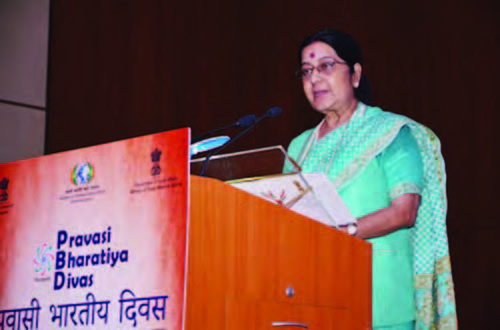
    Inaugurating the Youth Pravasi Bharatiya Divas (PBD) at Mahatma Mandir in Gandhinagar on January 7, Sushma Swaraj, Union Minister for External Affairs and Overseas Indian Affairs exhorted the Indian youth diaspora to ‘connect, celebrate and contribute’ to the transformational change being witnessed in India in the making of ‘Ek Bharat, Shreshth Bharat’.

    Sushma said, “The Indian youth diaspora can become ambassadors of the ‘new’ India as “you have retained a bit of India in your heart and each one of you have a bit of ‘Bharat’ in you.”

    PRAVASI BHARATIYA DIVAS 2015 1

    The Minister said that Youth PBD was not just about interacting with the young people of this country but has emerged as an important platform for the diaspora to discover and nurture their roots.

    She appealed to the youth to connect with the young generation of Indians – over 50% of the Indian people were under 25 years. Youth PBD, she said, was an occasion to celebrate India’s traditions, art and culture, even as the country strives to empower its youth with technology.

    “What excites the world today is India’s growth story,” Swaraj said and pointed to the government’s success in bringing about a complete transformation of the business sentiment in the country. This, she added, was the outcome of the numerous steps undertaken by the government to improve the ease of doing business.

    Swaraj said the diaspora could contribute significantly to the development of India through programs such as ‘Make in India’, ‘Digital India’, creation of smart cities and other physical infrastructure.

    Prime Minister Narendra Modi, on January 8, announced a string of facilities for expatriate Indians that seek to free them of regulations on their arrival to India and within the country.

    Inaugurating the 13th Pravasi Bharatiya Divas (PBD), organized by the Ministry of Overseas Indian Affairs (MOIA) in partnership with the Ministry of Youth Affairs & Sports and the Government of Gujarat, the Prime Minister said life time visa will now be granted to PIO cardholders and as a mark of respect to them, the regulation requiring them to visit a police station to verify their credentials once every week, has been scrapped.

    Modi said while the PIO and OCI cards have been merged, allowing similar facilities to either cardholder, electronic authorization of visa has commenced, apart from extending the facility of visa on arrival from 43 countries. In addition, the Pravasi Bharatiya Centre will be operational in Delhi soon. The Prime Minister said engaging with the pravasis was not a one-way street; “not everything should be seen in terms of pounds or dollar” he said, adding that overseas Indians need to be given unstinted support so that they feel enthusiastic in contributing to India’s development.

    The Prime Minister suggested that an online quiz competition could be started from the PBD platform on ‘Bharat ko Jano’ for teams of young people worldwide. This would help project India’s development effort in the right perspective. The competition, he said, could be conducted round the year so that the campaign for knowing India becomes a global movement.

    Modi urged the pravasis to actively participate in the government’s ambitious ‘Clean Ganga’ initiative by sharing their expertise in technology, innovations, ideas and resources. “There are opportunities for all along the river – in agriculture, water transport, city development and village rejuvenation and even adventure sports,” the Prime Minister said.

    On the occasion of the centenary of Mahatma Gandhi’s return to India from South Africa, the Prime Minister released Rs 25 and Rs 5 commemorative stamps and Rs 100 and Rs 10 coins.

    The Chief Guest at the PBD, Donald R. Ramotar, President of the Republic of Guyana, said India’s has seen a transformational change in recent years. The time has come arrived for India to demonstrate its mature political leadership to guide other developing countries, participate more actively in internal forums, look outwards for channelizing investments to other countries and strengthen air and maritime links with the rest of the world.

    He assured Guyana’s commitment to India’s pursuit of reform of the UN Security Council and expressed total support for India’s candidature for a permanent seat in an expanded Security Council.

    Maite Nkoana-Mashabane, Minister of International Relations and Cooperation, Republic of South Africa, the Guest of Honour, pointed out that the political, economic and cultural bonds between South Africa and India were strong. These were cemented by the community of Indians in South Africa, the second largest outside India. The bonds must be further strengthened by addressing the triple challenges of poverty, unemployment and under-development.

    She stressed the need for closer cooperation between the two countries in the fields of IT, healthcare and renewable energy and expressed confidence that India would support South Africa in its development efforts. Sushma Swaraj, Union Minister for External Affairs and Overseas Indian Affairs, emphasized that successful and politically influential diaspora is an asset to India. She called upon the diaspora to pursue a mutually rewarding participation in developing India.

    Anandiben Patel, Chief Minister of Gujarat, said that the new economic and social initiatives launched by the Central Government have unleashed a new wave of enthusiasm among the people. The pravasis with the sincere hard work had raised India’s image internationally, while keeping the links with the land of their origin alive.

    The three- day kumbh of the NRIs has attracted NRIs from all parts of the world. For most Gujaratis abroad it is a welcome visit home.

  • Fifty Shades of Saffron

    Fifty Shades of Saffron

    On December 11, 2014, when the U.N. General Assembly adopted June 21 as the International Day of Yoga, as recommended by Prime Minister Narendra Modi, India rejoiced. Never mind that the day before was the first Human Rights Day under his watch; this crept by unnoticed.

    At the SAARC Summit, Mr. Modi declaimed, “As we seek to build bridges to prosperity, we must not lose sight of our responsibility to the millions living without hope.” He was, as always, matchless as a kathakar, an artiste whose fabulous retelling of fables reinforces them in the minds of the faithful as fact. But while his performances have zero defects, on the lives of the multitudes hanging on to his words, believing in them and daring to hope, they have had zero effect so far, because the responsibility of which the Prime Minister spoke is usually ignored.

    In 1990, the U.N. launched the Human Development Report based on the challenging predicate that “people are the real wealth of a nation.” How wealthy are we really? After two decades of rapid GDP growth, we bestride SAARC like a colossus doing the splits, one foot splayed eastward to keep China out, the other westward to keep Pakistan down. We loom like a giant among midgets, but on every parameter that measures equity in development, there is little to choose between us and our neighbors.

    The Human Development Index (HDI) for 2014 ranks us at 135 among 187 countries; Sri Lanka at 73 did way better than us, and we were shadowed by Bhutan at 136, Bangladesh at 142, Nepal at 145 and Pakistan at 146. The fact that India was a stable democracy, as the others were not, that our economy had galloped along, as theirs had not, had made very little difference to the lives of our citizens.

    Within the HDI, the Gender Inequality Index which measures three critical parameters – reproductive health, women’s empowerment and their participation in the labor market – is particularly important because it shows how a society treats its more vulnerable half. Sri Lanka at 75 is well ahead of us, but so is Nepal at 98, Bhutan at 102 and Bangladesh at 115. India is in lock-step with Pakistan, both ranked at 127. The Criminal Law Amendment Act, which brought in far-reaching measures to protect women, is now almost two years old; sadly, it has made little difference.

    Depth of deprivation

    My five years on the National Human Rights Commission were a humbling experience. In 2009, we had 82,000 complaints, in 2013, a lakh. A five-member Commission could not possibly do justice to more than a fraction of these. We dismissed 60 per cent of complaints in limine, or at the outset, 11 per cent with directions to officials to act (but never had the time to check if they did) and transferred 6 per cent to the State Human Rights Commissions, which were mostly ramshackle.

    Our investigative visits to rural India were dives into the darkness that contained the mass of the iceberg of which the complaints coming to us were only the tip. In a country still largely illiterate, a terrible violation of human rights in itself, very few knew the NHRC existed. Those who did wondered if it would be able to help; many thought it would not. For every complaint that came to us, a hundred did not, but since so many were on systemic problems affecting entire communities, they brought home to us the range, depth and persistence of discrimination and deprivation in India. The two are often linked, and that is the real cause of worry with our new dispensation. The poorest and the most vulnerable – women, Scheduled Tribes, Scheduled Castes and Muslims – suffer because the social bias against them is rooted in Hindu belief and practice, and still so strong that the laws meant to protect them are impotent. Even under a secular government, public servants would plead with the NHRC that there would be law and order problems if they tried to implement these. The danger now is that under a government so overtly Hindu, these practices will flourish even more. The hate speeches of Cabinet members signal where this could lead us.

    “Discrimination and deprivation are often linked to one another, and that is the real cause of worry with our new dispensation”

    Mr. Modi wants his party to be careful with their words, but there are fifty shades of saffron around, most of it strident. He wants civil servants to be sensitive, but they always are, to the wishes of the powers that be. He wants the police to be SMART, but they already are, reporting to the National Crime Records Bureau that in 2013 there were only two incidents of human rights violations by their personnel. The same year, 33,753 complaints to the NHRC, a third of the total received, were against the police, detailing how they preyed on those they should protect.

    In Mr. Modi’s defense, these are national problems he has inherited, not created, but Gujarat is the template he holds up to the rest of India, and there are a range of impartial reports that show how cavalier it has been about the lives of the State’s people. A 2013 Lancet study found that among the 11 rich States, Gujarat had done the worst in bringing down the mortality rate of children under five, one of the Millennium Development Goals. The Census established that the sex ratio in Gujarat has declined from 934 in 1991 to 920 in 2001 to 918 in 2011. Not surprisingly, the NCRB data shows a high incidence of crimes against women. So too, the data shows, are crimes against Scheduled Castes, at levels higher than in the other developed States: Maharashtra, Punjab and Tamil Nadu. The ASER/Pratham Reports on Education show low percentages of students in Standard V who could read a Standard II text, and could do divisions. That is not a model to copy.

    Dreadful cost

    Despite what he said in Kathmandu, Mr. Modi’s record as Gujarat Chief Minister shows that his sights are set on prosperity, not on “the millions living without hope.” ‘Make in India’ is his priority, and there the signs are ominous. A few weeks back, ASSOCHAM issued an advertisement which announced, “Repeal of archaic laws is the need of modern times…ASSOCHAM has identified 105 laws for review, which can promote a better regulatory framework for successfully actualizing Mr. Modi’s vision of ‘Make in India’.” These include 43 laws that protect human rights and safeguard labor welfare, including the Bonded Labor System (Abolition) Act, Protection of Forest Rights Act, Inter-State Migrant Workers Act, Child Labor (Prohibition and Regulation) Act, and the Minimum Wages Act. If these are the voices he listens to, development will come at a dreadful cost.

    India’s governments have so far pursued development with a human face. Vast social welfare programs protect those whom the market forces savage, but these are riddled with huge problems. For instance, hardly any materials go into the rural employment guarantee projects, but each year material costs claimed are well over 20 per cent of its budget. A survey done for the NHRC showed that 60 per cent of the allocation for the Integrated Child Development Services was being stolen. The list goes on. The answer does not lie in jettisoning these programs, but in making them work better. Without them, rural India will empty out.

    Our Prime Minister’s many admirers believe that Sardar Patel’s mantle has descended on him. Vallabhbhai Patel made India, Narendra Modi can unmake it. But with his extraordinary talents, integrity and ability, our Prime Minister can also be the making of India, and make India, all of India, proud. That should be his tribute to his idol, not the monstrous statue of the Sardar now rising in Gujarat like a prelapsarian Ozymandias.

    By Satyabrata Pal

  • Eternal Vigilance is the Price of Liberty

    Eternal Vigilance is the Price of Liberty

    I.S. Saluja

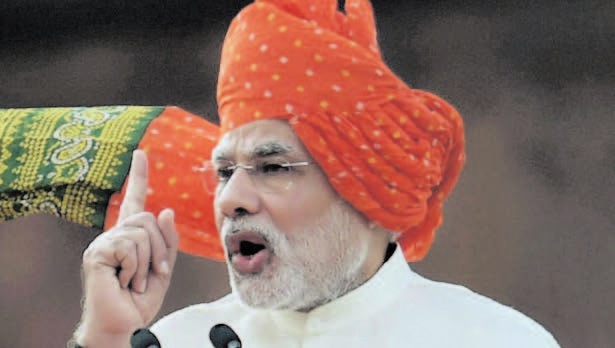
    Prime Minister Narendra Modi addressed the nation from the ramparts of the Red Fort on the 68th Independence Day of India on 15th August, 2014. It has been almost 4 months since he spoke of his vision of India in his first address to the nation as Prime Minister. In his long speech, inter alia, he reminded the people of India that “Eternal vigilance is the price of liberty”.

    I must agree with him as would the whole world. A people need to be vigilant and constantly evaluate their leaders. Hence, we are giving below the full text of Prime Minister Narendra Modi’s address to the nation and would like our readers to evaluate India’s Prime Minister. Please send in your comments to editor@theindianpanorama.news or to salujaindra@gmail.com. We will be happy to publish your valuable evaluation and comments.

    Following is the English rendering of the Prime Minister’s address on the occasion. My dear countrymen,

    Today, all Indians in the country and also abroad are celebrating the festival of independence. On this day of sacred festival of independence, the prime servant of India extends greetings to all dear countrymen. I am present amidst you not as the Prime Minister, but as the Prime Servant. The freedom struggle was fought for so many years, so many generations laid down their lives, innumerable people sacrificed their lives and youth, spent their entire lives behind bars.

    Today, I pay my respect, greetings and homage to all those who laid their lives for the country`s independence. I also pay my respects to the crores of citizens of this country on the pious occasion of India`s independence, and recall all those martyrs who had laid down their lives in India`s struggle for freedom. The day of independence is a festival when we take a solemn pledge of working for the welfare of mother India, and also for the welfare of the poor, oppressed, dalits, the exploited & the backward people of our country.

    What he stressed on during the speech My dear countrymen, a national festival is an occasion to refine and rebuild the national character. This National festival inspires us to resolve ourselves to lead a life where our character gets refined further, to dedicate ourselves to the nation and our every activity is linked to the interest of the nation and only then this festival of freedom can be a festival of inspiration to take India to newer heights. My dear countrymen, this nation has neither been built by political leaders nor by rulers nor by governments. This nation has been built by our farmers, our workers, our mothers and sisters, our youth.

    The country has reached here today because of generation to generation rigours undertaken by our sages, our saints, our maestros, our teachers, our scientists and social workers. These great people and these great generations, who had worked for the country throughout their lives, deserve our deepest respect. This is the beauty of India’s Constitution, this is its capability which has made it possible that today a boy from small town, a poor family has got the opportunity to pay homage to the tri-colour of India at the ramparts of Lal Quila(Red Fort). This is the strength of India’s democracy. This is an invaluable legacy which we have inherited from our architects of the constitution.

    I pay my respects to those architects of the constitution of India today. Brothers and sisters, today if we have reached here after independence, it is because of the contribution of all the PrimeMinisters, all the governments and even the governments of all the States. I want to express my feelings of respect and gratitude to all those previous governments and ex-Prime Ministers who have endeavoured to take our present day India to such heights and who have added to the country’s glory. This country has been built on such foundation of ancient cultural heritage, where we were told of only onemantra during Vedic period, which is indicative of our work culture, which we have learnt, we have memorized – “Sangachchhdhvam Samvadadhvam sam wo manansi jaanataam.” We walk together, we move together, we think together, we resolve together and together we take this country forward. Having imbibed this basic mantra, 125 crores of countrymen have taken the nation forward.

    Yesterday only the first Parliamentary Session of the new Government had concluded. Today, I can proudly say that the Session of Parliament reflects our thinking and it is a reflection of our intentions. We are not for moving forward on the basis of majority, we are not interested to move forward by virtue of majority. We want to move ahead on the basis of strong consensus. “Sangachhadhwam” and, therefore, the nation has witnessed the entire Session of Parliament. Having taken all the Parties and Opposition along while working shoulder to shoulder, we achieved an unprecedented success and the credit for this does not go to the Prime Minister alone, the credit does not go to the people sitting in the Government, the credit for this goes to the Opposition also, the credit goes to all the leaders of Opposition too and also all the Members from Opposition.

    From the ramparts of Red Fort, quite proudly I salute all the Members of Parliament, I also salute all the Political Parties and by virtue of their strong support, we could take some important decisions intended to take the nation forward and yesterday the Session of Parliament had concluded. Brothers and sisters, I am an outsider for Delhi, I am not a native of Delhi. I have no idea about the administration and working of this place. I have been quite isolated from the elite class of this place but during the last two months while being an outsider, I had an insider view and I was astonished.

    It is not a political platform, rather it is a platform of a national policy and, therefore, my views should not be evaluated from a political perspective. I have already said, I salute all the ex-Prime Ministers and earlier governments who have brought the country thus far. But I am going to say something else and it may not be seen from political point of view. When I came to Delhi and noticed an insider view, I felt what it was and I was surprised to see it. It seemed as if dozens of separate governments are running at the same time in one main government.

    It appeared that everyone has its own fiefdom. I could observe disunity and conflict among them. One department is taking on the other department and taking on to the extent that two departments of the same government are fighting against each other by approaching Supreme Court.This disunity, this conflict among people of the same country! How come we can take the country forward? And that is why I have started making efforts for razing those walls; I have started making efforts at making the Government, not an assembled entity, but an organic unity, an organic entity, a harmonious whole- with one aim, one mind, one direction, one energy. Let`s resolve to steer the country to one destination. We have it in us to move in that direction. A few days back…Nowadays newspapers are full of news that Modiji`s Government has come, officers are reaching office on time, offices open in time, and people get there in time. I observed that India`s National newspapers, TV media were carrying these news items prominently.

    As the Head of the Government I could have derived pleasure in the fact that everything started going on time, cleanliness got the attention, but I was not taking pleasure, I was feeling pained. That thing, I want to tell today in public. And why, because if government officers arrive office in time, does that make a news? And if that makes news, it shows how low we have fallen. It becomes a proof of that, and that`s how, brothers and sisters, the governments have run? Today in the face of global competition, when we have to realize the dreams of millions of Indians, the country cannot run on the lines of ” it happens”, ” it goes”. In order to fulfil the aspirations of masses, we have to sharpen the tool called the Government machinery, we have to make it keen, more dynamic, and it is in this direction that we are working.

    My countrymen, it`s not long since I have come from outside Delhi, but I give you an assurance that the people in the Government are very capable – from the peon to the Cabinet Secretary, everybody is capable, everybody has a power, they have experience. I want to awaken that power, I want to unite that power and want to accelerate the pace of the welfare of nation through that power and I shall definitely do it. I want to assure the countrymen that we will achieve that, we will definitely do that. I could not say this on 16th May, but today after my experience of twotwo and half months, keeping the tricolor as witness, I am saying on 15th of August that it is possible, it will be achieved.

    Brothers and sisters, time has come to give a serious thought to the fact that whether we have a duty to create India of the dreams of those great people who gave us freedom, whether we have a national character? Brothers and sisters, can someone please tell me as to whether he or she has ever introspected in the evening after a full day`s work as to whether his or her acts have helped the poor of the country or not, whether his or her actions have resulted in safeguarding the interest of the country or not, whether the actions have been directed in country`s welfare or not? Whether it should not be the motto of one and a quarter billion countrymen that every step in life should be in the country`s interests? Unfortunately, we have an environment today wherein if you approach anyone with some work, he begins by saying “what does it mean for me?” He begins by saying “what does it involve for me?” and when he come to know that it does not entail any benefit for him, immediately he says “why should I bother?” we have to rise above the feelings of “what does it mean for me” and “why should I bother”. Everything is not for self interest only.

    There are certain things which are meant for the country and we have to refine this national character. We have to rise above the feelings of “why should I bother” and “what does it mean for me” and instead we have to think that “I am for nation`s interest and in this field, I am going to lead”. We have to inculcate this sentiment. Brothers and sisters, when we hear about the incidents of rape, we hang our heads in shame. People come out with different arguments, someone indulges in psycho analysis, but brothers and sisters, today from this platform, I want to ask those parents, I want to ask every parent that you have a daughter of 10 or 12 years age, you are always on the alert, every now and then you keep on asking where are you going, when would you come back, inform immediately after you reach.

    Parents ask their daughters hundreds of questions, but have any parents ever dared to ask their son as to where he is going, why he is going out, who his friends are. After all, a rapist is also somebody`s son. He also has parents. As parents, have we ever asked our son as to what he is doing and where he is going. If every parent decides to impose as many restrictions on the sons as have been imposed on our daughters, try to do this with your sons, try to ask such questions of them. \My dear brothers and sisters, the law will take its own course, strict action will be taken, but as a member of the society, as parents, we also have some responsibilities. If somebody tells me that those who have taken guns on their shoulders and kill innocent people are Maoists, are terrorists, but they are also somebody`s children.

    I would like to ask of such parents if they had ever asked their children as to why they were taking a wrong path. Every parent must take this responsibility, he must know that his misguided son is bent on killing innocent people. He is not able to serve himself nor his family nor the country. I want to say to those youngsters who have chosen the path of violence that whatever they are and wherever they are, it is all because of mother India only that they have got it. Whoever you are it is all because of your parents. I want to ask you to think how green, how beautiful and how beneficial this earth can become if you shoulder the plough instead of the gun which spills blood on this land.

    How long shall we have bloodshed on this land, how long shall we take the lives of the innocent people and what have we got after all this? The path of violence has not yielded anything to us. Brothers and sisters, I had gone to Nepal recently. There I said something publicly to draw the attention of the whole world. There was a time when the Emperor Ashoka who had chosen the path of wars, got converted to the path of Buddha at the sight of violence. There was a time in Nepal when their youngsters had opted for the path of violence but today I witness that the same youngsters are waiting for their constitution. The same people associated with them are framing the constitution.

    And I further said that if Nepal could present the best example of moving from the weapons to the books then it could provide inspiration to the youngsters in the world to abandon the path of violence. Brothers and sisters, If Nepal, land of Budha, can give message to the world then why can`t India too do the same? So it`s the call of the hour that we renounce the path of violence and take the path of brotherhood. Brothers and sisters, for one reason or the other, we have had communal tensions for ages. This led to the division of the country. Even after Independence, we have had to face the poison of casteism and communalism. How long these evils will continue? Whom does it benefit? We have had enough of fights, many have been killed. Friends, look behind and you will find that nobody has benefited from it.

    Except casting a slur on Mother India, we have done nothing. Therefore, I appeal to all those people that whether it is the poison of casteism, communalism, regionalism, discrimination on social and economic basis, all these are obstacles in our way forward. Let`s resolve for once in our hearts, let`s put a moratorium on all such activities for ten years, we shall march ahead to a society which will be free from all such tensions. And you will see that how much strength we get from peace, unity, goodwill and brotherhood. Let`s experiment it for once. My dear countrymen, believe in my words, I do assure you. Shun all the sins committed so far, give up that way, follow the way of goodwill and brotherhood, and let`s resolve to take the country forward.

    I believe we can do that. With advancement of science, brothers and sisters, we have a rising feeling of modernity in our mind, but what do we do? Have we ever thought what the sex ratio in the country is like? 940 girls are born against per thousand boys. Who is causing this imbalance in the society? Certainly not God. I request the doctors not to kill the girl growing in the womb of a mother just to line their own pockets. I advise mothers and sisters not to sacrifice daughters in the hope of son. Sometimes mother-father feel tempted to have son in the hope of supporting them in old age.

    I am a person who has worked in public life. I have come across families with five sons, each having bungalows, access to fleet of cars, but parents are forced to live in old-age homes, Vriddhashrams. I have seen such families. I have also seen families with only daughter as progeny, that daughter sacrifices her dreams, doesn`t get married, and spends entire life in taking care of old parents. This disparity points to female foeticide and the polluted and tainted mind the 21st century has.

    We will have to liberate from it, and that is message to us of this Freedom festival. Recently Commonwealth Games were organized. Indian sportspersons brought glory to the country. Nearly 64 of our sportspersons won. Our sportspersons brought 64 medals. But of them 29 are girls. Let`s feel proud and clap for them. Girls also contribute to India`s fame and glory. Let`s recognise it. Let`s take them along, shoulder to shoulder. This way we can get over the evils that have crept in social life. Therefore, brothers and sisters, we have to proceed in that direction as a social and national character.

    Brothers and Sisters, Development is the only way forward for the country. Good governance is the only way. There are only these two tracks to take the country forward – good governance and development, we can move forward only by taking them with us. We wish to move forward with the intent of taking them with us. When I talk of good governance, you tell me, when I ask a person in private job, he tells that he does the job; when you ask the same from a person in government job, he says that I do the service. Both earn, but for one it is job while for the other it is service. I ask a question from all brothers and sisters in government service, whether the word “Service” has not lost its strength, its identity? Persons in government service are not doing “job”, they are doing “service”. We have to revive this feeling, we have to take this feeling forward as a national character, we have to move forward in this direction.

    Brothers and Sisters, whether the citizens of the country should take steps for the welfare of the nation or not? You imagine, ifthis 125 crores of countrymen move one step forward, then the country moves 125 crore steps forward. The meaning of democracy is not just limited to electing a government, but its meaning is that 125 crore of citizens work together joining shoulder with the government to fulfill hopes and aspirations of the country, this is the meaning of democracy. We have to create partnership with the people. We have to proceed under Public-Private Partnership. We have to proceed along with the participation of the people. But, please tell me why our farmers commit suicide? A farmer takes loan from the moneylender, but fails to repay his loans. He takes loan for the wedding of his daughter, but fails to repay.

    He will have to suffer hardships during his whole life. He chooses to commit suicide. Who will save the poor families of such farmers? Brothers and sisters, I have come here with a pledge to launch a scheme on this festival of Freedom. It will be called`Pradhanmantri Jan-Dhan Yojana`. I wish to connect the poorest citizens of the country with the facility of bank accounts through this yojana. There are millions of families who have mobile phones but no bank accounts. We have to change this scenario. Economic resources of the country should be utilized for the well-being of the poor.

    The change will commence from this point. This yojana will open the window. Therefore, an account holder under `Pradhanmantri Jan-Dhan Yojana` will be given a debit card. An insurance of One Lakh Rupees will be guaranteed with that debit card for each poor family, so that such families are covered with the insurance of One Lakh Rupees in case of any crisis in their lives. My brothers and sisters, it is a country of young people. The 65 percent population of the country happens to be under the age of 35 years. Our country has the largest number of youths in the world. Have we ever thought of deriving an advantage out of it? Today, the world needs a skilled workforce. Today, India also needs a skilled workforce. At times, we look for a good driver but he is not available, we look for a plumber, but he is not available.

    If we need a good cook, he is not available. We have young people, they are unemployed but the kind of young people we seek for are not available. If we have to promote the development of our country then our mission has to be `skill development` and `skilled India`. Millions and Millions of Indian youth should go for acquisition of skills and there should be a network across the country for this and not the archaic systems. They should acquire the skills which could contribute towards making India a modern country. Whenever they go to any country in the world, their skills must be appreciated and we want to go for a two pronged development.

    I also want to create a pool of young people who are able to create jobs and the ones who are not capable of creating jobs and do not have the opportunities, they must be in a position to face their counterparts in any corner of the world while keeping their heads high by virtue of their hard work and their dexterity of hands and win the hearts of people around the world through their skills. We want to go for the capacity building of such young people. My brothers and sisters, having taken a resolve to enhance the skill development at a highly rapid pace, I want to accomplish this.

    Brothers and sisters, the world has undergone a change. My dear countrymen, the world has changed. Now India can not decide its future by remaining isolated and sitting alone in a corner. The economics of the world have changed and, therefore, we will have to act accordingly. Government have taken many decisions recently, made some announcements in the budget and I call upon the world and call upon the Indians spread world over that if we have to provide more and more employment to the youth, we will have to promote manufacturing sector. If we have to develop a balance between imports and exports, we will have to strengthen manufacturing sector. If we have to put in use the education, the capability of the youth, we will have to go for manufacturing sector and for this Hindustan also will have to lend its full strength, but we also invite world powers.

    Therefore I want to appeal all the people world over, from the ramparts of the Red Fort, “Come, make in India”, “Come, manufacture in India”. Sell in any country of the world but manufacture here. We have got skill, talent, discipline, and determination to do something. We want to give the world an favourable opportunity that come here, “Come, Make in India” and we will say to the world, from electrical to electronics, “Come, Make in India”, from automobiles to agro value addition “Come, Make in India”, paper or plastic, “Come, Make in India”, satellite or submarine “Come, Make in India”. Our country is powerful. Come, I am giving you an invitation.

    Brothers and sisters, I want to call upon the youth of the country, particularly the small people engaged in the industrial sector. I want to call upon the youth working in the field of technical education in the country. As I say to the world “Come, Make in India”, I say to the youth of the country – it should be our dream that this message reaches every corner of the world, “Made in India”. This should be our dream. Whether, to serve the country, is it necessary for the youth of the country to be hanged like Bhagat Singh? Brothers and sisters, Lal Bahadur Shastri had given the slogan “Jai Jawan, Jai Kisan”.

    A soldier sacrifices himself at the border and protects Mother India. Similarly, a farmer serves Mother India by filling the godowns with grains. This is also nation`s service. Filling the granary is the biggest nation`s service that a farmer provides. That is why Lal Bahadur Shashtri had given the slogan of “Jai Jawan, Jai Kisan”. Brothers and Sisters, I would like to pose a question to my youngsters as to why despite them, we are forced to import even the smallest of things? My country`s youth can resolve it, they should conduct research, try to find out as to what type of items are imported by India and then each one should resolve that, through may be micro or small industries only, he would manufacture atleast one such item so that we need not import the same in future. We should even advance to a situation wherein we are able to export such items.

    If each one of our millions of youngsters resolves to manufacture atleast one such item, India can become a net exporter of goods. I, therefore, urge upon the youth, in particular our small entrepreneurs that they would never compromise, atleast on two counts. First, zero defect and, second again zero effect. We should manufacture goods in such a way that they carry zero defect, that our exported goods are never returned to us. We should manufacture goods with zero effect that they should not have a negative impact on the environment. If we march ahead with the dream of zero defect in the manufacturing sector then, my brothers and sisters, I am confident that we would be able to achieve our goals.

    Brothers and sisters, the youth of India has completely transformed the identity of India in the world. Earlier, in what manner did the world know our country? Till only 25-30 years back, if not more, there were many people in the world who thought that India was a country of snake charmers, it was a country which practiced in black magic. The real identity of India had not reached the world, but my dear brothers and sisters, our youngsters, 20-22-23 years old youngsters have mesmerized the whole world with their skills in computers. Our young I.T. professionals have given a new path of making a new identity of India. If our country has this strength, can we think something about the country? Our dream is, therefore, of “Digital India”. When I talk of “Digital India”, I don`t speak of the elite, it is for the poor people. You can imagine what a quality education the children in villages will get, if all the villages of India are connected with Broadband Connectivity and if we are able to give long distance education to the schools in every remote corner of the villages.

    If we create a network oftelemedicine in the places where there is a shortage of doctors, we can have a clear guideline of the way in which health facilities have to be provided to the poor people living in those areas. The citizens of India have mobile phones in their hands, they have mobile connectivity, but can we walk in the direction of mobile governance? We have to move in a direction where every poor person is able to operate his bank account from his mobile, is able to demand various things from the government, can submit applications, can conduct all his business, while on the move, through mobile governance and if this has to be done, we have to move towards `digital India` and if we have to move towards `digital India` then we have a dream. Today we are importing electronic goods on a large scale. Friends, you will be surprised that we are bringing in these televisions, mobile phones, ipads and all these electronic goods.

    It is a necessity to import petroleum products, oil, diesel and petrol. Second to this is the import of our electronic goods. If we move ahead with the dream of `digital India` to manufacture electronic goods and become self reliant at least there, how big can be the benefit for the treasury! Therefore, e-governance is what we need to take this idea of `digital India` forward. E-governance is easy governance, effective governance and also economic governance. Egovernance paves the way for good governance. There was a time when we used to say that the railways provided connectivity to the country.

    That was it. I say that today it is IT that has the potential to connect each and every citizen of the country and that is why we want to realise the mantra of unity with the help of `digital India`. Brothers and sisters, if we move ahead with all this then I believe that a `digital India` will have the potential to stand with the world on equal footing. Our youth have that capability, it is an opportunity for them. Brothers and sisters, we want to promote tourism. Tourism provides employment to the poorest of the poor. Gram seller earns something, auto-rickshaw driver earns something, pakoda seller earns something and tea seller also earns something. When there is talk of tea seller, I feel a sense of belongingness.

    Tourism provide employment to the poorest of the poor. But there is a big obstacle in promoting tourism and in our national character and that is – the filthiness all around us. Whether after independence, after so many years of independence, when we stand at the threshold of one and half decade of 21stcentury, we still want to live in filthiness? The first work I started here after formation of Government is of cleanliness. People wondered whether it is a work of a Prime Minister? People may feel that it is a trivial work for a Prime Minister but for me this a big work. Cleanliness is very big work.

    Whether our country can not be clean? If one hundred and twenty five crore countrymen decide that they will never spread filthiness, which power in the world has ability to spread filthiness in our cities and villages? Can`t we resolve this much? Brothers and sisters it will be 150th birth anniversary of Mahatma Gandhi in 2019. How do we celebrate 150th birth anniversary of Mahatma Gandhi? Mahatma Gandhi, who gave us freedom, who brought so much honour to such a big country in the world, what do we give to Mahatma Gandhi? Brothers and Sisters, Mahatma Gandhi had cleanliness and sanitation closest to his heart.

    Whether we resolve not to leave a speck of dirt in our village, city, street, area, school, temple, hospital, and what have you, by 2019 when we celebrate 150th anniversary of Mahatma Gandhi? This happens not just with the Government, but with public participation. That`s why we have to do it together. Brother and Sisters, we are living in 21st century. Has it ever pained us that our mothers and sisters have to defecate in open? Whether dignity of women is not our collective responsibility? The poor womenfolk of the village wait for the night; until darkness descends, they can`t go out to defecate.What bodily torture they must be feeling, how many diseases that act might engender.

    Can`t we just make arrangements for toilets for the dignity of our mothers and sisters? Brothers and Sisters, somebody might feel that a big festival like 15th August is an occasion to talk big. Brothers and Sisters, talking big has its importance,making announcements too has importance, but sometimes announcements raise hopes and when the hopes are not fulfilled, the society sinks into a state of despondency. That`s why are in favour of telling those things, which we can fulfil just within our sight. Brothers and sisters, you must be getting shocked to hear the Prime Minister speaking of cleanliness and the need to build toilets from the ramparts of the Red Fort. Brothers and sisters, I do not know how my speech is going to be criticised and how will people take it. But this is my heartfelt conviction.

    I come from a poor family, I have seen poverty. The poor need respect and it begins with cleanliness. I, therefore, have to launch a `clean India` campaign from 2nd October this year and carry it forward in 4 years. I want to make a beginning today itself and that is – all schools in the country should have toilets with separate toilets for girls. Only then our daughters will not be compelled to leave schools midway. Our parliamentarians utilizing MPLAD fund are there. I appeal to them to spend it for constructing toilets in schools for a year. The government should utilise its budget on providing toilets.

    I call upon the corporate sector also to give priority to the provision of toilets in schools with your expenditure under Corporate Social Responsibility. This target should be finished within one year with the help of state governments and on the next 15th August, we should be in a firm position to announce that there is no school in India without separate toilets for boys and girls. Brothers and sisters, if we proceed with the dreams, we are in a position to realise them. Today, I wish to tell one more specific thing. It has its own importance to discuss the matters and express the views of nation`s interest. However, our Members of Parliament do not get opportunity though they are willing to do something.

    They can express themselves, write to the government, agitate, give memoranda. Still they do not get opportunity to do something on their own. Today I have come to you with a new idea. We are running so many schemes in the name of the Prime Minister in our country, there are numerous schemes in the name of various leaders. However, today I am going to announce a scheme on behalf of the Member of Parliament- `Sansad Aadarsh Gram Yojana`. We shall fix some parameters. I urge upon the Members of Parliament to select any one of the villages having population of three to five thousand in your constituency. The parameters will be according to the time, space and situation of that locality.

    It will include the conditions of health, cleanliness, atmosphere, greenery, cordiality etc. On the basis of those parameters, each of our MPs should make one village of his or her constituency a Model Village by 2016. Can`t we do at least this? Shouldn`t we do this? If we have to build a nation, we should start from the village. Make a Model Village. The reason of fixing this target for 2016 is that it is a new scheme. It takes time to formulate a scheme and then to implement it. After 2016, select two more villages for this purpose, before we go for the General Elections in 2019. And after 2019, each Member of Parliament, during his/her tenure of 5 years must establish atleast five model villages in his/her area. I also call upon the Members of Parliament from urban areas to adopt one village of their choice. I also urge upon the Members of Parliament from Rajya Sabha to adopt one of the villages. If we provide one model village in each district of India then the surrounding villages shall be automatically inspired to follow that model.

    Let us establish a model village, let us establish a village well equipped with all systems and facilities. The birth anniversary of Jai Prakash Narayan Ji happens to be on 11th October. On 11th October, the occasion of birth anniversary of Jai Prakash Narayan Ji, I will present a complete blueprint of “S?nsad Adharsh Gr?m Yojana” (Members of Parliament Model Village Scheme) before all Members of Parliament and State Governments, and I urge upon State Governments also that as per the feasibility in their respective states, all the Members of Legislative Assembly resolve to establish a model villageYou can imagine all the Members of Legislative Assembly and all the Members of Parliament in the country establishing a model village.

    All of a sudden, there would be a model village in each block of India which could inspire us to transform the amenities in rural areas and could give us a new direction and, therefore, we want to move ahead under this”S?nsad Adarsh Gr?m Yojana”. My dear brothers and sisters, ever since our government has taken charge, there has been a discussion in the newspapers, on T.V. channels as to what would happen to Planning Commission. I believe that when Planning Commission was constituted, it was done on the basis of the circumstances and the needs of those times. In recent years, Planning Commission has contributed to the growth of the country in its own way. I respect that, I am proud of that, but the prevalent situation in the country is different, global scenario has also changed, governments are no longer the centre of economic activities, the scope of such activities has broadened. State governments have been at the center of development and I consider this a good indication.

    If we have to take India forward, it can happen only by taking the states forward. India`s federal structure is more important today than in the last 60 years. To strengthen our federal structure, to make our federal structure vibrant, to take our federal structure as a heritage of development, a team of Chief Minister and Prime Minister should be there, a joint team of the Centre and the states should move forward, then to do this job, we will have to think about giving the Planning Commission a look. So, I am saying from the rampart of the Red Fort that it is a very old system and it will have to be rejuvenated, it will have to be changed a lot. Sometimes it costs more to repair the old house, but, it gives us no satisfaction.

    Thereafter, we have a feeling that it would be better to construct a new house altogether and therefore within a short period, we will replace the planning commission with a new institution having a new design and structure, a new body, a new soul, a new thinking, a new direction, a new faith towards forging a new direction to lead the country based on creative thinking, public-private partnership, optimum utilization of resources, utilization of youth power of the nation, to promote the aspirations of state governments seeking development, to empower the state governments and to empower the federal structure.

    Very shortly, we are about to move in a direction when this institute would be functioning in place of Planning Commission. Brothers and sisters, today, on 15th August, we also have the birth anniversary of Maharishi Aurobindo. Maharishi Aurobindo, being a rebel, moved on to achieve the status of a Yoga Guru. With regard to the destiny of India, he remarked, “I have a faith that the divine power and spiritual heritage of India will play an important role towards the welfare of the world.” Such sentiments were echoed by Maharishi Arvind. I strongly believe in the words of legends. I have great faith in the statements made by ascetics, sages & saints and that’s why today at the ramparts of Lal Quila I am reminded of the words of Swami Viveknanda. He had said – “I can see before my eyes Mother India awakening once again.

    My Mother India would be seated as the World Guru. Every Indian would render service towards welfare of humanity. This legacy of India would be useful for the welfare of the world”. These words were spoken by Swami Viveknanda ji in his own style. Friends, the words of Viveknanda ji can never be untrue. The words of Viveknanda ji, his dream of seeing India ensconced as World Guru, his vision, it is incumbent upon us to realize that dream. This capable country, blessed with natural bounty, this country of youth can do much for the world in the coming days. Brothers and sisters, our foreign policy is a much talked about issue. I clearly believe that India`s foreign policy can be multidimensional.

    But there is an important issue to which I want to draw your attention that the way we fought for freedom, we fought together, we were not separate at that time. We were together. Which was the government with us? What were the weapons available to us? There was a Gandhi, a Sardar and lakhs of freedom fighters and such a huge empire. Didn`t we win in the struggle of freedom against that empire? Did we not defeat the foreign powers? Did we not force them to leave India? We were the ones, they were our ancestors only who showed this might. If the people of India could remove such a big empire without the power of the government, without weapons and even without resources, then friends, it is the need of the hour to eradicate poverty, can we not overcome poverty? Can we not defeat poverty? My 125 crore dear countrymen, let us resolve to eradicate poverty, to win against it.

    Let us move with the dream of poverty eradication from India. Our neighbouring countries are also faced with the same problem. Why not get together with all the SAARC nations to plan out the fight against poverty? Let`s fight together and defeat poverty. Let us see at-least for once as to how wonderful is the feeling of being alive instead of killing and getting killed. This is the land where incidents from Siddharth`s life happened. One bird was shot with an arrow by one brother and the other took out that arrow to save it. They went to mother- whose bird, whose swan? Whether killer`s or saviour`s, they asked of mother. The mother replied, saviour`s. The saviour has more power than the killer and that makes him Buddha in future. And that`s why I seek cooperation from neighbouring countries for fighting against povertyin concert and cooperate with them, so that together with SAARC countries we can create our importance and emerge as a power in the world.

    It is imperative that we work together with a dream to win a fight against poverty, shoulder to shoulder. I went to Bhutan, Nepal, all the dignitaries from SAARC countries took part in oath-taking ceremony; this marked a good beginning. This will definitely yield good results, it is my belief and this thinking of India, in the country and the world, that we want to do well to the countrymen and be useful for the welfare of the world, India wants such a hand to be extended. We are trying to move forward with these dreams to achieve them. Brothers and Sisters, today on 15th August we will resolve to do something for the country.

    Let`s be useful for the country, we will move ahead with a resolve to take the country forward, and I assure you, Brothers and Sisters, as well as my colleagues in the Government, that if you work for 12 hours, I will do so for 13 hours. If you work for 14 hours, I will do for 15 hours. Why? Because I`m amidst you not as a Prime Minister, but as the first servant. I have formed the Government not as a ruler, but as a servant. Brothers and sisters, I assure that this country has a destiny. It is destined to work for the welfare of the world, it was said by Vivekanand ji. India is born, this Hindustan is born in order to achieve this destiny. One hundred and twenty five crore countrymen have to move forward wholeheartedly for the welfare of the nation. Once again I feel proud of the devotion, the sacrifices of the security forces of the country, para-military forces of the country, all the security forces of the country to protect Mother India. I say to the countrymen, jk”Vª;ke] tkxz;ke~ o;e~ Eternal vigilance is the price of liberty”. The army is vigilant, we should also be vigilant and the country scales new heights, we have to move forward with this resolution. Speak loudly with me with full force –

    Bharat mata ki jai, bharat mata ki jai, bharat mata ki jai. Jai Hind, Jai Hind, Jai Hind. Vande Mataram, Vande Mataram, Vande Mataram!

  • Featured: He CAME, he SPOKE, he CONQUERED

    Featured: He CAME, he SPOKE, he CONQUERED

    NEW YORK (TIP): Yes, it is Narendra Modi, Prime Minister of India. All Indian Americans are familiar with that name, for good or for bad, mostly for good, though.

    Modi was in New York from September 26 to 29th afternoon, before he left for Washington to enjoy the hospitality of US President Barack Obama in the evening and a bilateral talk the next day, before flying back to India.

    Much before he arrived in the US, Indian Americans had set out to give him a hero’s welcome. A trusted friend of Modi, Dr. Bharat Barai, was tasked with arranging a massive community reception to Modi which he did, with the help and cooperation of a devoted band of people. It was a colossal effort to have around 20,000 people come to Madison Square Garden to give a rousing reception to Modi, an icon for many, particularly from his community and place, Gujarat, a state which he governed with appreciable growth for around 12 years.

    And why not! Modi was coming as Prime Minister of India to a country which had denied him a Visa since 2005 for his alleged role in not preventing killings of people from a particular community in Gujarat when he was the chief minister of that state in 2002. His admirers here gloated that US had no option but to welcome him now that he was coming to the United Nations as India’s Prime Minister, whose party had got a massive support of the people of India and was catapulted in to power, with total command over government, without having to depend on allies’ support as was the case when Atal Behari Vajpayee formed a BJP led government in 1999 which lasted its full term of 5 years, to 2004.

    So, here was a man who represented a democratic country -the largest democracy in the world- with 1.25 billion people. How could the US ignore Modi whose country was poised to become an Asian giant and the second largest economic power in the world by 2050? No way! So, Obama invited Modi over to the White House for a private dinner. It was another matter that the invited dignitary was fasting on account of Hindu festival of Navratras and he would not eat. By the way, Modi has been observing Navratra fasts for the past 40 years, insiders said.

    So, Prime Minister Narendra Modi arrived on September 26. He was given a rousing welcome at the JFK airport in New York. My good friends, Narain Kataria, Arish Sahani and Jagdish Sewhani arranged to have a large number of people gather at the airport to give a warm welcome to Modi. So, we had the chant of “Modi, Modi” which surely pleased the man, given to showmanship, which explains his admiration for film actors, like Amitabh Bachchan, and of course, some others.

    And while in New York, Prime Minister of India, Narendra Modi left no one in doubt that he was a better performer than any in the world. A perfect juggler, a consummate magician, a pied piper of India.

    I found many acknowledging Modi’s felicity of expression which allowed him to connect with people immediately. He speaks in the language and diction that people at all levels commonly understand. He relies on simple words and home truths to deliver his ideas home. Again, he has mastered the art of delivery. His body language is extremely expressive and impressive. During the more than 90 minutes speech he delivered at the Madison Square Garden on September 28th, not a soul could have looked at the watch. Not one could have yawned, out of boredom. None would have thought of anything but what Modi was saying. The eyes of all remained fixed on the man in the center of the arena. Such was the grip of the man. And whatever he said seemed to come straight out of his heart. He pumped into his speech his heart, his mind and his vocal cords-delivering the “very best”.

    Now see what he said. First, India can and will achieve the greatness that it once had. Second, we have a huge human resource capital in the form of a young India, with 60% of population under the age of 35. No other country in the world has such human resource. Third, we have brains. Example, our scientists succeeded in the Mars mission in the first attempt itself, a feat which even US could not perform. Modi took pride in mentioning that India’s Mars mission cost peanuts when compared with the money spent by countries like USA on similar missions.

    Yes, we can. But how can we do it? He did offer Namo Mantra for that. He spoke of the defects in the system in the country and said the system that stood in the way of quick progression had to be demolished. He spoke of the futile, cumbersome and irrelevant laws which needed to be consigned to dust bin. He spoke of the massive investment required for development. And he invited Indian Americans as also the whole world to come and invest in India. Also, he gave a call to “make in India”.

    Modi was particularly appreciative of the Sikhs, in his speech. He spoke of the great sacrifices the Sikh Gurus had made. He also recalled the sacrifices of the Sikhs in the freedom struggle of India. He spoke of the brave Sikh soldiers in the Indian armed forces and said the nation is proud of the Sikhs who have always stood by their motherland, come what may.

    Modi simply created a vision. He came up with ideas that won attention and admiration of many. He wove dreams that all would love to own. He assured the gathering of around 20,000 at the famous Madison Square Garden which somebody christened as “Modison” Square Garden that India was on a fast track to development. Then he made some announcements to please the locals, too. He told them he was taking care to ensure there is no harassment at the airports in India of Indian Americans visiting India. He also said he knew of problems with getting visas. He said there will be no delays any more in obtaining a visa. Also, he said the clubbing together of OCI and PIO was being worked out and soon the problems arising out of OIC/PIO will be over. He also announced visa on arrival for US nationals on the pattern of some 9 countries whose citizens are entitled to get tourist visa on arrival in India. Surely, the local crowd was pleased.

    The magician Modi wielded his wand for more than 90 minutes and left the gathering charmed and captivated. Yes, he came, he spoke , he conquered the hearts of Indian Americans who had come from far and near to have his darshan and hear him speak. But before he left, the gathering burst in to Modi chant, just as it had when he had arrived. And, believe me, Modi must have enjoyed the chant. The “Modi” chant must have been music to his years.

    During the course of his stay in New York from 26th September to 29th September afternoon, Modi attended a large number of events, met a number of people from all walks of life which included world leaders, his counterparts from neighboring countries Sri Lanka and Nepal, US lawmakers and officials, captains of business and industry, community leaders, religious leaders and eminent people- both Indian Americans and others, and discussed a variety of issues.

    We bring our readers here a few pictures of Modi’s New York visit. All pictures have been provided by The Indian Panorama special photo journalist Mohammed Jaffer.

    Modi pays homage to victims of 9:11 at the 9:11 memorial at ground zero on September 27th 2014.

    Prime Minister Modi speaking at Global Citizens Festival at Central Park in NYC on 27th September, 2014

    Modi addresses the 69th United Nations General Assembly. He called for a relentless fight against terrorism and the Security Council

    Madison Square Garden on September 28

  • MAKE IN INDIA

    MAKE IN INDIA

    The Prime Minister’s call for making India a manufacturing hub and creating jobs should boost small and medium enterprises as well

    By Charan Singh Prime Minister Narendra Modi’s ‘Make in India’ campaign is creating waves both in India and abroad. Given the government’s intention to boost domestic manufacturing and create new jobs, its proposal to introduce a new policy for Micro, Small and Medium Enterprises (MSMEs) deserves a closer look. While Mr. Modi’s invitation to international companies to make investments has been receiving a lot of attention, the government’s close interaction with industry associations from different regions and sectors within India to discuss specific problems inhibiting domestic enterprises deserves equal consideration. India’s MSME sector has recorded more than 10 per cent growth in recent years despite the economic slowdown. MSMEs contribute nearly eight per cent to the national GDP, employing over eight crore people in nearly four crore enterprises and accounting for 45 per cent of manufactured output and 40 per cent of exports from India. Thus, the focus of the government on MSMEs at this juncture is justified given their potential for providing growth and employment.

    Significant initiatives In view of the significance of the sector, the government had announced a number of measures in its first budget. Some of the significant initiatives were setting up of Rs.10,000 crore of venture capital fund and establishing a nationwide, district-level incubation and accelerator program for encouraging entrepreneurship. Other important budgetary announcements included establishing a network of Technology Centers; revising the definition of MSMEs for providing higher capital ceiling, friendly legal bankruptcy framework to enable easy exit, a program to facilitate forward and backward linkages with multiple value chain of manufacturing and service delivery to be put in place, and launching the Skill India movement for youth with an emphasis on employ ability and entrepreneurship. A committee was also proposed to examine the financial architecture with a view to removing bottlenecks and creating new rules and structures for the sector.

    The government recently inaugurated a holistic, innovative and low-cost National Small Industries Corporation’s online e-commerce shopping portal for buying and selling of products produced by MSMEs. MSMEs are mainly classified as manufacturing and service enterprises. There is a specific stipulated limit on investment in plant and machinery for each of the respective micro, small and medium segments in manufacturing with a maximum limit of Rs.10 crore, and for equipment in service enterprises with a maximum limit of Rs.5 crore. MSMEs with 94 per cent of units unregistered are highly diverse in terms of their size and the level of technology employed. The production in the sector ranges from output of grass-root village industries and auto components, to microprocessors, electronic components and electro-medical devices. Since 1948, successive governments have been making intense efforts to encourage MSMEs but the sector continues to be under stress. The office of Development Commissioner for MSMEs was set up in 1954 and a dedicated Ministry for MSMEs in 1999. The Small Industries Development Bank of India (SIDBI), established in 1990, is the principal financial institution for promotion, financing and development of the MSMEs in addition to commercial banks, State financial corporations, and State industrial development corporations. Despite such efforts, some of the key problems faced by MSMEs continue to be related to availability of technology, infrastructure and managerial competence, and limitations posed by labor laws, taxation policy, market uncertainty, imperfect competition and the skill level of the workforce. The problems faced by MSMEs need to be considered in a disaggregated manner for successful policy implementation as they produce very diverse products, use different inputs and operate in distinct environments. In general, there is need for tax provisions and laws that are not only labor-friendly but also entrepreneur-friendly. More importantly, there is need for skill formation and continuous upgrade both for labor and entrepreneurs. While the government has to strengthen the existing schilling efforts for labor, there is an urgent need for managerial skill development for entrepreneurs running MSMEs – an area that is considerably neglected. These programs for entrepreneurs could be offered in a structured way in Industrial Training Institutes and management schools to include modules on management, labor laws, accounting, financial markets, procurement and marketing skills. Further, the government could consider dedicated television and radio programs, similar to agriculture, to help educate entrepreneurs running small businesses. Consumer tastes have been evolving as greater integration with global markets takes pace. In order to keep pace with changing tastes, large corporate firms have made substantial investment in extensive research and developing suitable product ranges. However, due to shortage of office space and financial resources, many micro and small enterprises are unable to invest in R&D and develop new products, and perish as a result. Therefore, government support in undertaking research to help develop new products that are being produced by MSMEs could be very helpful, similar to what agriculture universities do. Similarly, to encourage products manufactured by MSMEs, India could illustratively showcase and promote their products such as phulkari of Punjab, bamboo works of Assam and West Bengal, and cotton weaving of Tamil Nadu via galleries and museums.

    Credit crunch Issues related to credit, like adequacy, timely availability, cost and mortgages continue to be a concern for MSMEs. Consequently, 93 per cent of units in the MSME sector are dependent on self-finance. Profit margins are extremely thin due to stiff competition and the small size of firms. The government drive for financial inclusion could benefit MSMEs. The government could consider dedicating specialized financial schemes for addressing difficulties in assessing and providing credit for the MSMEs, as also providing line of credit to firms which are under financial stress. Given the grand financial inclusion initiative, maximum employment and growth with minimum difficulty to the entrepreneur will augur well for the country. (Charan Singh is RBI Chair Professor of Economics, IIM Bangalore.)

  • Ambani, Birla, Premji share their vision of ‘Make in India’

    Ambani, Birla, Premji share their vision of ‘Make in India’

    At the star-studded launch of Prime Minister Narendra Modi’s ambitious programme, attended by the likes of Reliance Industries Chairman Mukesh Ambani, Tata Group chief Cyrus Mistry and Aditya Birla Group’s Kumar Mangalam Birla, industry leaders said job creation and high growth would be possible only if the manufacturing sector gets into a high growth trajectory. These factors will include the buildup of critical infrastructure across the country supported by stable policies, transparent and competitive tax and duty structure, efficient and time-bound administration through the use of egovernance, cost effective and reliable energy coupled with logistics, critical for the competitiveness of industry,” Mistry added. Pledging his support to the initiative, Ambani said in order to succeed in this campaign, it was important to be open to capital and expertise from all over the globe, and implementation of GST will make India one market and strengthen overall Make in India programme. Ambani, who announced that Reliance Industries would create 1.25 lakh jobs in the next 12-15 months, further said it was also important for villages to stay connected to be a part of growth story.

    ICICI Bank Managing Director and CEO Chanda Kochhar said the ‘Make in India’ programme would become the next growth driver for the country. “Quite clearly in manufacturing we have lot of catching up to do. We need manufacturing to put the economy into a higher growth trajectory and to create millions of jobs,” Birla said “We need an educated workforce of thinkers to meet ‘Make in India’ vision. True success of manufacturing lies in being able to service global markets, said Azim Premji, Chairman, Wipro.

  • India offers essential 3Ds to Japan – democracy, demography & demand

    India offers essential 3Ds to Japan – democracy, demography & demand

    Tokyo (TIP): Inviting Japanese investors to ‘Make in India’, Prime Minister Narendra Modi said, “There is no better place than India for Japanese investors.

    India is one of the most competitive markets in the world.” Addressing Japan’s Nikkei Exchange, Modi said that India offers the three essential ‘Ds’ for businessmen to thrive namely; Democracy, Demography and Demand. “It is important for Japan to move to low cost hubs of manufacturing.” Promising a conducive environment for investors, Modi said, “Foreign investors need a proper environment to grow in India.

    We are working towards improving ease of doing business in India.” “There is no red tape but red carpet in India. We have eased off a lot of regulations,” Modi sought to assure. Talking about Japan’s prowess in hardware manufacturing, Modi advocated India’s robust software industry. “India is known for its software services, Japan for its hardware.

    Let’s work together to enhance the two,” Modi said. He told Japanese investors that India is a “god gifted location” for reaching out to global markets. Modi said his government is ready to offer whatever is required to promote foreign investment into India. “Without Japan, India is incomplete and without India, Japan is incomplete”, he said.

    Modi also said that India plans to roll out metro trains in at least 50 cities. Government is focused on promoting small & medium industries, Modi added. “India has a government that is working on development, to increase manufacturing.” Confident of great results from India-Japan ties, Modi said, “India & Japan can create history by working together in several sectors such as digital, solar energy, technology, skills.”

    Citing the recent spurt in GDP growth, Modi said, “Within 100 days of our government, we have managed to achieve a 5.7% growth. GDP growth indicates that our policies, decisions and ease of business are yielding results.” Hardselling India as a manufacturing destination, Prime Minister Narendra Modi invited Japanese investments, saying the era of “red tape” has been replaced by “red carpet” with ease of doing business and liberalisation.

  • Framework to boost exports

    Framework to boost exports

    The new NDA government’s first annual Foreign Trade Policy (FTP) statement will be unveiled soon. Normally presented after the Union Budget, the FTP has usually concentrated on measures to boost exports and reduce transaction costs.

    It cannot explicitly reduce import or export duties – which are in the domain of the budget. However, the incentives for exporters have indirect implications for the exchequer. Employment generation in India through exports of manufactured goods has been a key objective of the FTP, which remains despite the change in nomenclature from the previous Exim Policy that was focussed on exports.

    A proactive policy on imports is equally necessary in a scenario where India is integrating with the rest of the world. Within the country there are minimal import restraints. A consistent policy framework is necessary to deal with items such as imports of gold and petroleum. Recently, the FTP has outlined ambitious plans for the diversification of exports, both in terms of the range of products and the destination countries.

    These commendable efforts have, however, not improved India’s export performance which, like world trade itself, remains below par. The new government’s orientation to trade cannot be really different from that of its predecessor. The Prime Minister, while inaugurating a port-based special economic zone, urged manufacturers to join in export promotion.

    In his Independence Day speech he called for a “make in India” movement, which has the potential to turn India into a global manufacturing hub. The emphasis in the FTP will naturally vary depending on current circumstances. Multilateral trade as embodied by the WTO received a setback with India holding out against a previously agreed Trade Facilitation Agreement.

    While India has its own reasons – preserving the norms for domestic food security – the fact is that the failure in Geneva has spurred moves towards free trade agreements (FTAs), regional pacts, bilateral agreements and so on. These are inferior to rule-based multilateral trade, irrespective of any short-term gains they might confer. The Commerce Minister’s call for a comprehensive review of the performance of all FTAs is noteworthy. India already has 14 agreements in force, including one with the ASEAN grouping of 10 countries, and is negotiating several others.

    Both India and China have free trade agreements with ASEAN, and unless cumbersome procedures relating to country of origin are scrupulously followed, India might face a flood of duty-free Chinese goods. Besides, FTAs have not exactly delivered on their promise of larger trade between signatories. These factors will surely weigh, even as India prepares to renegotiate stalled issues of the Doha round.

    (The Hindu)