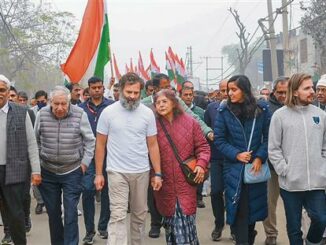
Tag: Mansukh Mandaviya

  • Yatra lends purpose to Rahul’s political journey

    Yatra lends purpose to Rahul’s political journey

     In Indian electoral politics, alliances are formed on the basis of strengths rather than weaknesses of the participants. The aura of success surrounding Rahul’s Bharat Jodo Yatra is set to provide him with moral authority to play a pivotal role. In addition, in Sonia Gandhi, Rahul has a reserve bench of sorts; the former party chief can act as a line of communication with many non-NDA allies, including the Left, to keep the mahagathbandhan going. 

    This year, the Congress faces a litmus test in Karnataka, Madhya Pradesh, Rajasthan and Chhattisgarh. If it can win these states, the grand old party would emerge as a serious challenger for the 2024 General Election.

    By Rashid Kidwai

    There are many quotes that have been attributed to Mahatma Gandhi. In the Congress party office at 24, Akbar Road, one of them reads, “Kabhi kabhi hum apne virodhiyon ke karan aage badhte hain.” (At times, we move ahead due to our opponents). Then there is another one saying, “Pehle woh aap par dhyan nahin denge, phir who aap par hasenge, phir aapse ladengen, aur tab aap jeet jayenge.”(First they would not pay any attention to you, then they would mock you and then they would fight with you. You would win once these stages are completed).

    In the context of Rahul Gandhi’s ongoing abstract, yet arduous, Bharat Jodo Yatra, these quotes ring a bell, bringing some relevance and hope for the Congress leader.

    There is a broader and growing consensus of sorts among Rahul’s detractors and well-wishers that finally, the Gandhi scion is showing signs of purpose, perseverance and hope in his political journey that began in 2004.

    Politically, the yatra may or may not be a game-changer, but it has succeeded in establishing Rahul as a credible politician who can walk the talk, intermingle with the masses and get support from a range of politicians and celebrities — from MK Stalin, Aaditya Thackeray, Supriya Sule and Farooq Abdullah to Raghuram Rajan, AS Dulat, Swara Bhaskar and Kamal Haasan.

    More importantly, the BJP’s stringent criticism, Union Health Minister Mansukh Mandaviya’s ‘appeal’ to suspend the yatra over Covid concerns, and the outrage over Rahul’s comments on China allegedly entering Indian territory have helped him become a singular dissenting voice.

    When the yatra began from Kanyakumari, Rahul’s popularity ratings were at an all-time low. The Congress organization was in a shambles and the leadership issue was far from settled. While the yatra was on the Kerala-Karnataka border, Rajasthan Chief Minister Ashok Gehlot, at that time tipped to be the next AICC president, stunned friends and foes alike by showing defiance, a throwback to the bygone era of Devaraj Urs, Arjun Singh and other party chief ministers.

    But throughout the Congress organizational election process, Rahul stayed away and focused on the yatra. The Assembly polls of Himachal Pradesh and Gujarat offered a mixed bag as the Congress went on to win HP. It was a surprise for those predicting the Congress’ death. The ‘corpse’ is, in fact, very much alive and kicking.

    This year, the Congress faces a litmus test in Karnataka, Madhya Pradesh, Rajasthan and Chhattisgarh. If it can win these states, the grand old party would emerge as a serious challenger for the 2024 General Election.

    We need to remember that the fortunes of the Congress and other non-BJP parties are closely linked to the 2024 Lok Sabha polls where the non-BJP, non-NDA Opposition and the Congress-UPA partners will have to target the ‘half of half’, i.e. half of the 272 Lok Sabha seats on their own — a challenging but not unmanageable number in the 2024 battle.

    There are four crucial states of West Bengal, Bihar, Maharashtra and Karnataka where the BJP-NDA had done exceedingly well in 2019 but the subsequent political developments have unfolded a new scenario. In West Bengal, for example, the BJP had won 18 Lok Sabha seats out of 42, while in Bihar, the alliance with the JD(U) had resulted in its netting 39 out of 40 parliamentary seats. In Karnataka, the BJP had won 25 out of 28 seats, while in Maharashtra, the alliance with the undivided Shiv Sena  had resulted in the NDA allies winning 42 out of 48 seats. Imagine a situation if the BJP’s strength from these four states gets reduced to half. A simple majority of 272 would become a distant dream and prospects of a khichdi government a reality.

    The Congress, in order to be a contender, has to win 100 or more Lok Sabha seats from states such as Kerala, Chhattisgarh, Maharashtra, Rajasthan, Madhya Pradesh, Assam, Karnataka, Uttarakhand, Himachal Pradesh and a few others where the grand old party has been in direct contest with the BJP or traditionally has a strong presence.

    Next year’s parliamentary polls are set to be contested in contrasting styles. If Team Modi is set to make full use of the Prime Minister’s personal ratings, big-ticket projects, Covid-19 handling in the context of the massive vaccination programme, achievements on the diplomatic front and reliance on emotive issues like the Ram Temple, the Congress and its potential allies are prepared to take the battle to the states where regional players are expected to hold sway.

    So, if the parties led by Mamata Banerjee, Nitish Kumar, Uddhav Thackeray, Sharad Pawar, MK Stalin, Naveen Patnaik, HD Kumaraswamy, Chandrababu Naidu and Akhilesh Yadav together manage to hold on to a chunk of the parliamentary seats, the Congress has the task of doing well in most of the Hindi-belt states and the Northeast.

    In Indian electoral politics, alliances are formed on the basis of strengths rather than weaknesses of the participants. The aura of success surrounding Rahul’s Bharat Jodo Yatra is set to provide him with moral authority to play a pivotal role. In addition, in Sonia Gandhi, Rahul has a reserve bench of sorts; the former party chief can act as a line of communication with many non-NDA allies, including the Left, to keep the mahagathbandhan going.

    (Rashid Kidwai is a Senior Journalist and Author)

  • Modi’s Cabinet reshuffle

    The revamp belies PM’s claim that caste in India has been ‘buried’

    By Julio Ribeiro

    “Modi had said caste had been buried, but he had also said black money would be eliminated with demonetization and Covid had quietly fled the country because of some unnamed advantages we Indians have been blessed with! But I am for ignoring those erroneous calculations. I have no doubt that he tried hard, he worked like he always does, 18 hours a day, and he felt victory was his on each occasion! He should have admitted those miscalculations. If he had done that his credibility would not have taken a tumble.”

    Unexpected Move: The PM has established the Ministry of Cooperation. (Photo : PTI)

    A Prime minister in the Westminster system of governance has the sole right to choose his or her Council of Ministers. He or she can also drop one or more ministers whenever he or she thinks it necessary and induct a minister or more whenever he or she thinks fit. There has been some criticism and many comments on Modi’s recent rejig of his Cabinet. He has expanded the number to nearly 80, almost the maximum permitted by law. The salient feature is that he found representation for all castes, and even many sub-castes to please as many sections of our vast population as possible.

    Scheduled Castes were allotted 12 slots, Scheduled Tribes eight. There is nothing wrong in that. In fact, that is how it should be in a multi-religious, multi-cultural society.

    Some critics have pointed out that Modi had boasted, after the 2014 and the 2019 elections, that caste had died and been buried by the electorate. He might have willed that to happen or dreamt that had happened. A leader is entitled to his fancies. The bitter truth is that caste will not go away from our ancient land in the foreseeable future. It is too deep-rooted to be wished away.

    Take my Goan Christian community. Its adherents were converted from Hinduism by the Portuguese over 400 years ago. One would have expected the ubiquitous caste configurations to have disappeared after conversion, but it is practiced even today, in marriages in particular. If something so traumatic as changing gods could not excise caste from consciousness, how does any impartial observer of the political space expect this PM or any past or future PM to eliminate caste considerations from something so relevant to expectations as representations in a Cabinet?

    Modi had said caste had been buried, but he had also said black money would be eliminated with demonetization and Covid had quietly fled the country because of some unnamed advantages we Indians have been blessed with! But I am for ignoring those erroneous calculations. I have no doubt that he tried hard, he worked like he always does, 18 hours a day, and he felt victory was his on each occasion! He should have admitted those miscalculations. If he had done that his credibility would not have taken a tumble.

    When he gave a place to different castes in his Cabinet, he was aware that efficiency would suffer. He neutralized this by entrusting some critical portfolios to newcomers whose capabilities he had observed over a period of time. A less-known politician from his native Gujarat replaced Dr Harsh Vardhan as Health Minister. It is a calculated gamble.

    Mansukh Mandaviya was the Junior Minister of Chemicals and Fertilizers in which capacity he dealt with the pharmaceutical industry, the pricing of essential drugs, etc. His work there has propelled him to higher responsibilities. Modi probably has arranged for increased supply of vaccines in the next five months, something he has kept to himself to spring a pleasant surprise.

    Ravi Shankar Prasad was a vociferous proponent of his leader and his policies. Why was he dropped? I can only guess that he was more confrontational than required. This created too many hassles in the matter of appointment of judges and attracted negative attention internationally when he twisted the hands of local Twitter bosses. What Modi probably desired was a workable balance which Prasad was unable to provide.

    A former bureaucrat has been saddled with three portfolios: Communications, Information Technology and Railways. Ashwini Vaishnaw was an IAS officer of the Odisha cadre. A huge responsibility has been cast on him. For succeeding here, he needs more than grey matter. He needs to learn the skills of a juggler also.

    Narayan Rane from Maharashtra has, at last, got some importance after changing three parties. I cannot figure out what the BJP will gain, maybe a Lok Sabha seat or two, if at all. Rane himself lost his seat last time out. His two sons contested two Assembly seats and only one of them won. If Modi has been told that the Maratha vote will consolidate behind Narayan Rane, I can safely state that the PM has been misinformed. In the Konkan, it is the OBC vote that predominates.

    My recollection of Narayan Rane is a personal one. For over 20 years, I was chairman of charitable organization called the Happy Home and School for the Blind. President Bill Clinton and PM Atal Bihari Vajpayee had visited our school. I took over the reins from retired Justice Bakhtawar Lentin of the Bombay High Court. He had succeeded former Vice-President of India and former CJI, Justice M Hidayatullah.

    Despite our credentials, Narayan Rane, as CM of Maharashtra, when approached by a restaurateur of the city, cancelled our government lease of the land on which we had built the boarding school and transferred it to the restaurant owner! I met the Chief Secretary, Arun Bongirwar, and threatened to sit on the road in front of the school with 200 blind boys. I also filed a writ in the High Court, which succeeded. Our pro-bono lawyer, Navroz Searvai, told me that in his long career in the courts he had never encountered such gross abuse of power.

    The rabbit that a shrewd politician like Modi intends to pull out from his hat is in the establishment of the Ministry of Cooperation (cooperative societies are a State subject under the Seventh Schedule of the Constitution) and investing the responsibility to his trusted lieutenant. What is the purpose of this unexpected move? Why does the Home Minister, the No. 2 slot in the Cabinet, with a full-time job, have to do with cooperatives? His many agencies and the Income Tax Department and Enforcement Directorate under the Finance Ministry are sufficient to tackle the ills spawned by cooperative banks and sugar manufacturers. Why has Amit Shah been roped in? We will wait and watch with bated breath.

    (The author is a retired IPS officer)
