

Every year on the last Monday of May, the United States observes one of its most solemn and emotionally significant national observances – Memorial Day. In 2026, Memorial Day falls on May 25, a day dedicated to honoring the American military personnel who lost their lives while serving the nation.
Unlike many public holidays marked purely by celebration, Memorial Day carries a deeper emotional purpose. It is a day of remembrance, reflection, patriotism, and gratitude. Across the United States, Americans gather at cemeteries, war memorials, churches, and town squares to honor soldiers who made the ultimate sacrifice in wars fought across generations.
Though often associated today with parades, family gatherings, and the beginning of summer, Memorial Day remains rooted in mourning and national memory. It is a reminder that the freedoms enjoyed by citizens have often come at a profound human cost.
The Origins of Memorial Day
The roots of Memorial Day stretch back to the aftermath of the American Civil War, one of the deadliest conflicts in United States history. Fought between 1861 and 1865, the war claimed the lives of more than 600,000 soldiers and left countless families grieving across the divided nation.
In the years immediately following the war, communities began organizing local tributes to fallen soldiers. Families, women’s groups, churches, and veterans’ organizations decorated graves with flowers and flags while holding prayer services in memory of the dead. This practice gave rise to the original name of the observance – “Decoration Day.”
Several towns in the United States claim to be the birthplace of Memorial Day. Communities in states such as Mississippi, Georgia, Pennsylvania, Illinois, and South Carolina held early remembrance ceremonies for fallen soldiers after the Civil War. One historically significant event took place in Charleston in 1865, where formerly enslaved African Americans organized a tribute for Union soldiers buried in a mass grave.
The observance gained national recognition in 1868 when General John A. Logan, leader of the Grand Army of the Republic – a Union veterans’ organization – proclaimed May 30 as a nationwide day to decorate soldiers’ graves with flowers.
The first large official observance took place at Arlington National Cemetery, where both Union and Confederate soldiers were honored. Over time, the tradition expanded beyond Civil War casualties to commemorate all American military personnel who died in service.
In 1971, Memorial Day officially became a federal holiday observed on the last Monday of May under the Uniform Monday Holiday Act.
The Difference Between Memorial Day and Veterans Day
Memorial Day is often confused with Veterans Day, but the two observances have distinct meanings.
Memorial Day honors military personnel who died while serving the country. Veterans Day, observed in November, honors all individuals who served in the armed forces, whether living or deceased.
While Veterans Day celebrates military service broadly, Memorial Day focuses specifically on sacrifice and remembrance.
The Significance of Memorial Day
At its heart, Memorial Day is about honoring sacrifice. The holiday serves as a national expression of gratitude toward soldiers who lost their lives defending the United States during wars and military operations around the
world.
The observance carries emotional significance for military families, especially Gold Star families – relatives of service members who died in military service. For them, Memorial Day is deeply personal. It is a day filled with memories, grief, pride, and remembrance.
The holiday also symbolizes:
– National unity
– Patriotism
– Courage
– Service
– Civic responsibility
– Respect for military sacrifice
Historians note that Memorial Day helps preserve collective national memory by reminding citizens of the human consequences of war. It encourages younger generations to understand the sacrifices behind the freedoms and democratic institutions they inherit.
Wars Remembered on Memorial Day
Memorial Day honors American military personnel who died in conflicts including:
– The Civil War
– World War I
– World War II
– The Korean War
– The Vietnam War
– The Gulf War
– The Iraq War
– The Afghanistan War
From the beaches of Normandy to the jungles of Vietnam and the mountains of Afghanistan, Memorial Day commemorates generations of service members who never returned home.
Traditions and Observances
Across the United States, Memorial Day is marked through solemn ceremonies and patriotic traditions.
Visiting Cemeteries and Memorials
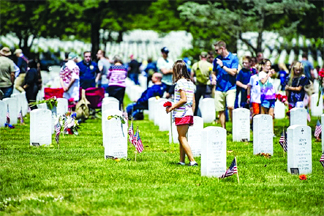
Families visit military cemeteries and memorial sites to place flowers, wreaths, and flags on graves. Thousands of volunteers participate in decorating cemeteries with American flags.
One of the most moving sights occurs at Arlington National Cemetery, where rows of white gravestones are adorned with flags ahead of Memorial Day weekend.
National Moment of Remembrance
In 2000, Congress established the National Moment of Remembrance. Americans are encouraged to pause at 3 p.m. local time for one minute of silence to honor fallen soldiers.
This collective pause symbolizes national gratitude and remembrance.
Lowering the Flag
The American flag is flown at half-staff from sunrise until noon on Memorial Day as a sign of mourning. At noon, it is raised to full staff to symbolize the resolve of the living to continue the nation’s ideals.
Memorial Day Parades
Cities and towns across America organize patriotic parades featuring:
– Military bands
– Veterans
– Marching groups
– Scouts
– Patriotic floats
– Honor guards
Some of the largest Memorial Day parades take place in cities such as:
– Washington
– New York City
– Chicago
Religious and Community Services
Churches and civic organizations hold memorial prayers, concerts, and candlelight ceremonies dedicated to fallen soldiers.
Patriotic hymns and military salutes form an important part of these observances.
Memorial Day Events in 2026
Memorial Day 2026 is expected to feature large-scale events and commemorations across the United States.
National Memorial Day Parade
Held annually in Washington, D.C., the National Memorial Day Parade honors American veterans and fallen soldiers through marching bands, military units, historical reenactments, and patriotic performances.
Rolling to Remember
The motorcycle demonstration known as “Rolling to Remember,” previously called Rolling Thunder, brings thousands of riders to Washington, D.C., to honor prisoners of war and missing service members.
Concerts and Patriotic Performances
The annual “National Memorial Day Concert,” traditionally held near the U.S. Capitol, features musical performances, tributes, and stories of military sacrifice.
Community Gatherings
Local communities organize:
– Memorial runs
– Charity events
– Veterans’ fundraisers
– Candlelight vigils
– Educational programs
– Military museum exhibitions
Arlington National Cemetery: The Heart of Remembrance
One of the most iconic Memorial Day ceremonies occurs at Arlington National Cemetery in Virginia.
Located near Washington, D.C., Arlington serves as the final resting place for more than 400,000 military veterans and service members.
The Tomb of the Unknown Soldier remains one of the most powerful symbols of Memorial Day. Guarded continuously by elite soldiers, the tomb honors unidentified American soldiers who died in war.
Each Memorial Day, senior government leaders participate in wreath-laying ceremonies at the site.
Memorial Day and American Culture
Over the decades, Memorial Day has evolved into both a solemn observance and a major cultural occasion.
For many Americans, the holiday marks:
– The unofficial start of summer
– Family reunions
– Outdoor gatherings
– Sporting events
– Barbecues and travel
However, historians and veterans’ organizations continually stress the importance of remembering the true meaning behind the holiday.
Many schools and institutions use Memorial Day as an opportunity to educate young people about military history and civic values.
The Symbolism of the American Flag
The American flag plays a central role during Memorial Day ceremonies.
Placed beside graves and displayed during parades, the flag represents:
” Sacrifice
” Freedom
” National identity
” Unity
” Remembrance
The sight of thousands of small flags fluttering across military cemeteries remains one of the most emotional visual symbols associated with the holiday.
Memorial Day in Modern Times
In recent years, technology and social media have changed the way Americans observe Memorial Day. Families now share stories, photographs, and tributes online, helping preserve the memories of fallen loved ones for future generations.
Virtual memorials, digital archives, and oral history projects have also expanded awareness of military sacrifice.
At the same time, debates occasionally emerge about balancing the holiday’s solemn purpose with commercial activities associated with the long weekend. Veterans’ groups frequently remind the public that Memorial Day is fundamentally a day of remembrance rather than celebration alone.
A Day of Reflection and Gratitude
As Memorial Day 2026 approaches, millions of Americans will once again gather to honor the fallen. Whether through silence at a graveside, participation in a parade, or the careful placement of a single flower upon a headstone, the holiday continues to unite the nation in remembrance.
Memorial Day is ultimately more than a historical observance. It is a national act of gratitude toward those who sacrificed their futures so others could live in freedom. Through ceremonies, traditions, and personal memories, America continues to preserve the legacy of courage carried by generations of soldiers who gave their lives in service to the nation.



1 Trackback / Pingback