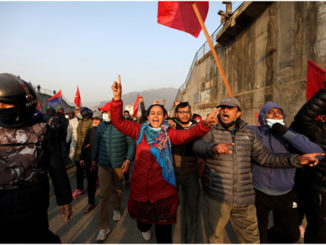
Kathmandu (TIP): Nepal’s government on Thursday signed a peace agreement with a banned radical Maoist group, which was involved in violent attacks, extortion and bombings targeting infrastructure projects in the country.
According to the three-point agreement signed between the government and the outlawed Communist Party of Nepal-Chand, the government will lift the ban, release all their party members and supporters in jail and drop all legal cases against them. On its part, the rebel communist group will address all its political issues through dialogue and carry out all political activities in a peaceful manner, according to a statement issued by the leaders of both sides on Thursday. The government banned the CPN-Chand, a faction of the previous Maoist party, in March 2019 after it carried out a series of deadly bomb attacks in the capital Kathmandu.
According to government sources, details of the agreement will be made public on Friday during a programme which would be attended by Prime Minister KP Sharma Oli and general secretary of CPN-Chand Netra Bikram Chand, who has remained underground for two years.
Over 2,000 leaders and carders from the CPN-Chand face various charges across Nepal.
The peace agreement comes two days after the government formed a team led by Home Minister Ram Bahadur Thapa to hold dialogue with the radical group. The CPN-Chand had also formed its own talks team led by Khadga Bahadur Biswakarma. PTI
Kathmandu (TIP): Nepal Prime Minister KP Sharma Oli will not resign immediately and implement the Supreme Court’s verdict against him by facing Parliament that is due to convene within two weeks, an official representing the embattled premier said on Wednesday. In a landmark ruling, a five-member constitutional bench led by Chief Justice Cholendra Shumsher on Tuesday annulled the Oli government’s “unconstitutional” decision to dissolve the 275-member lower house of Parliament. The court also ordered the government to summon the House session within the next 13 days. Nepal plunged into a political crisis on December 20 after President Bidya Devi Bhandari dissolved the House and announced fresh elections on April 30 and May 10 at the recommendation of Prime Minister Oli amid a tussle for power within the ruling Nepal Communist Party (NCP). Oli’s Press Adviser Surya Thapa said the Prime Minister, who turned 69 this week, intends to implement the verdict of the apex court after facing Parliament that is due to convene within two weeks.
KP Sharma Oli
“The Supreme Court’s verdict is controversial, however, it should be accepted and implemented. Its effects will be seen in the future as the decision has not provided any solution to the political problems,” Thapa said. He claimed that the apex court’s verdict will further fuel instability and pave the way for power-play. “The Prime Minister will face the House of Representatives to implement the verdict but will not tender his resignation as of now,” Thapa was quoted as saying by The Himalayan Times.A large section of the Nepalese media welcomed the Supreme Court’s verdict that reinstated the dissolved House of Representatives. They hailed the decision, saying it has upheld democratic values and safeguarded the Constitution. — PTI
Oli should resign
Vice-president of the CPN Bamdev Gautam, who has so far maintained a balance between Oli and his rivals Prachanda and Madhav Kumar Nepal, has urged the PM to step down. “As the court verdict has proven that the PM’s step was unconstitutional, he must resign immediately,” he said.
‘Against his autocratic style’
Members of the anti-Oli faction said they rejected his autocratic style of functioning and the latest court order proved his inability to govern.
“If Oli does not resign then parliament will take a decision on his fate,” Shrestha said, adding that the tourism-dependent economy needed a stable government. Reuters
Kathmandu (TIP): Nepal on Thursday approved the Chinese COVID-19 vaccine Vero Cell for emergency use, a government official told Reuters, the second shot to be cleared after the AstraZeneca product. “Conditional permission has been granted to the Chinese vaccine for its emergency use in Nepal,” said Santosh K.C, a senior official in the Department of Drug Administration. Reuters
KATHMANDU (TIP): Nepal has banned two Indian climbers and their team leader from carrying out any mountaineering expeditions in the country for six years after a probe found that they faked their Mt Everest summit in 2016. Indian mountaineers Narender Singh Yadav and Seema Rani Goswami received expedition certificates from the Tourism Department during the spring season of 2016 without successfully climbing the world’s highest mountain. Both the climbers received the certificates of climbing the 8,848.86m (29,032 ft) mountain by producing fake documents and pictures to claim their summit, according to a press release issued by the Ministry of Tourism, Culture and Civil Aviation on Thursday. Their certificates have been revoked, the ministry said. After receiving a complaint about the fake ascent, the ministry had formed a committee to investigate the matter. The investigation has confirmed that both of them had obtained certificates by giving false details, it said. They have been banned from ascending any mountain in Nepal for six years. The ban will be effective starting May 20, 2016, it said.
Their Indian team leader Naba Kumar Phukon, who led the expedition, has also been banned for six years starting May 20, 2016.
In New Delhi, Sports Ministry sources said that Yadav, who was recommended for the Tenzing Norgay Award last year, will not be bestowed with the honour. “Narender Singh Yadav issue is over from our side. The inquiry initiated by the ministry found that he faked about climbing Mount Everest. He submitted fake pictures,” said a sports ministry official.
Yadav was initially recommended for India’s highest adventure sports award but his name was withheld after media reports emerged of the possibility of him submitting fake documents. (TOI)
Under-Construction Bridge Collapses in Bhutan, Three Indian Workers Killed at Site
Thimphu (TIP): At least three Indian workers were killed and six other workers were missing after an under-construction bridge collapsed in Bhutan. As per a Reuters report, rescuers recovered three bodies from the site of Wangchu bridge 60 km (37 miles) south west of the capital Thimphu.
“The partially constructed bridge collapsed on Tuesday and we are still looking for missing workers,” said Lendup, a police officer overseeing the rescue operations.
“Saying prayers for the lives lost and hoping we find all missing persons safe and sound,” Prime Minister Lotay Tshering said in a twitter post.
The nationality of those missing was not immediately clear. The bridge was aimed at linking Haa district with Paro, where the Himalayan country’s international airport is located.
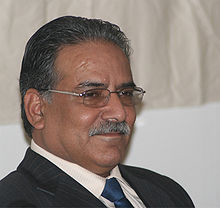
Kathmandu (TIP): At least six people, including two former ministers, were injured when police lobbed tear gas shells and resorted to baton charges to break up a protest rally during a nationwide general strike that paralysed normal life in Nepal on Thursday. Over 200 leaders and cadres of the Prachanda-led NCP faction were arrested for involvement in vandalism, arson, and other prohibited activities in different parts of the country, My Republica newspaper reported, citing police. Nepal Communist Party (NCP) splinter faction-led by Pushpa Kamal Dahal Prachanda called for the protests to oppose the appointment of office bearers and members of various constitutional bodies by PM KP Sharma Oli-led caretaker government.
“Protesters tried to vandalise cars and a police van, forcing police to resort to mild force in which six people including two police personnel were injured,” Dhanusa district administrator Bandhu Prasad Bastola said.
Two former ministers, Ram Chadra Jha and Matrika Yadav, who are also senior leaders of the rival faction of the ruling party, were among the injured in Dhanusa.
Police said at least 157 people were detained across the country to curb the violence.
President Bidya Devi Bhandari appointed as many as 32 office bearers to 11 constitutional bodies on Wednesday morning. The Prachanda-led faction has alleged that they were appointed unconstitutionally. The caretaker government has no right to make new appointments or reshuffle the cabinet, he said. Nepal plunged into a political crisis on December 20 after Oli, known for his pro-China leanings, in a surprise move dissolved Parliament, amidst a tussle for power with Prachanda. — Agencies
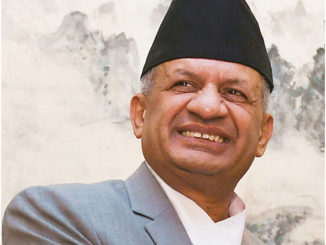
Kathmandu (TIP): Nepal’s Foreign Minister Pradeep Kumar Gyawali on Thursday embarked on a three-day visit to India during which he will attend the 6th meeting of Nepal-India Joint Commission and discuss the entire gamut of relations, including COVID-19 cooperation and border disputes, with his Indian counterpart S Jaishankar.
Gyawali is the senior-most political leader from Nepal to visit India after Prime Minister KP Sharma Oli triggered a border row last year by publishing a new political map that showed the three Indian territories — Limpiyadhura, Kalapani and Lipulekh — as part of Nepal. The Joint Commission is the highest mechanism between the two countries to discuss the entire gamut of bilateral relations.
During the meeting, the two countries are scheduled to hold discussions on various issues including bilateral trade, energy, border disputes and COVID-19 assistance. The Joint Commission meeting “will discuss the whole gamut of Nepal-India bilateral relations, including trade, transit, energy, boundary, COVID-19 cooperation, infrastructure, connectivity, investment, agriculture, tourism, culture, among others,” the Ministry of Foreign Affairs said in a statement earlier. During his visit, Foreign Minister Gyawali will also meet with the high-level dignitaries of India, the Foreign Ministry said here.
Gyawali is being accompanied by Foreign Secretary Bharat Raj Poudyal and Secretary at the Ministry of Health and Population Laxmi Aryal, according to officials.
After Nepal released the map last year, India reacted sharply, calling it a “unilateral act” and cautioning Kathmandu that such “artificial enlargement” of territorial claims will not be acceptable to it. India said that Nepal’s action violated an understanding reached between the two countries to resolve the boundary issues through talks. PTI
Beijing (TIP):China has hosted a vice-ministerial-level meeting with Pakistan, Bangladesh, Nepal and Sri Lanka on controlling the COVID-19, expanding its first such meeting held in July involving Islamabad, Kathmandu and Kabul.
Chinese Vice Foreign Minister Luo Zhaohui hosted the virtual meeting. “To jointly defeat COVID-19, protect people’s life, safety and health, and accelerate economic and social recovery and development, China, Bangladesh, Nepal, Pakistan and Sri Lanka convened a vice-ministerial-level video conference on COVID-19 response on November 10,” the Chinese Foreign Ministry said in a statement on Thursday.
The five countries had “in-depth exchanges on cementing the political consensus on jointly fighting COVID-19, enhancing cooperation on containing the coronavirus and restoring economic development and movement of people and achieved positive results,” the statement said.
This is the second ministerial meeting held by China involving the South Asian region on COVID-19. Chinese Foreign Minister Wang Yi held a similar meeting with his counterparts of Pakistan, Afghanistan and Nepal in July.
China has pledged that COVID-19 vaccine development and deployment in China, when available, will be made a global public good, the statement said.
China is also ready to consider providing vaccines to developing countries positively, the other four countries included, it said. In the context of long-term COVID-19 containment, the five countries will uphold multilateralism, firmly support the World Health Organisation in playing a leading role in the global fight against COVID-19.
They reiterated their opposition to “politicisation and stigmatisation” by using COVID-19, and also agreed that the autumn and winter seasons are a crucial period for its containment and vowed to strengthen information sharing and coordination of policies and actions to cope with the impact of its second wave.
The Chinese side is ready to step up cooperation with the other four parties in testing, diagnostics, treatment and medicine, and continue to provide them with assistance of containment supplies, the statement said.
They agreed that countries linked by land ports should establish joint response mechanisms in border areas.
Standard operating procedures will be developed on COVID-19-related notification, border control, containment measures at points of entry and emergency response to prevent cross-border transmission. They also agreed on the importance of coordinating COVID-19 response and economic and social development, and will advance the Belt and Road cooperation to boost post-COVID-19 economic recovery and development, it said. “In a spirit of mutual trust, openness and win-win cooperation, the Five Parties welcome other regional countries to join the cooperation against COVID-19 and are ready to engage in dialogue and communication with them,” the statement added. According to Johns Hopkins coronavirus tracker, the coronavirus has so far infected more than 52 million people and killed over 1.2 million others globally after it emerged in the central Chinese city of Wuhan last year. PTI
Kathmandu (TIP): India’s Commerce and Industry Minister Piyush Goyal and Nepal’s Urban Development Minister Krishna Gopal Shrestha on Thursday jointly witnessed the ground-breaking ceremony to mark the beginning of the construction of an Integrated Check Post (ICP) at Nepalgunj in Western Nepal, aimed at bolstering bilateral trade and people-to-people contact. Indian Ambassador Vinay Mohan Kwatra and Nepal’s Minister of State for Urban Development Rambir Manandhar also witnessed the virtual ceremony along with Ramesh Prasad Singh, Secretary, Ministry of Urban Development from Kathmandu.
India is building the Integrated Check Posts on either side of the Indo-Nepal border to systematise the movement of cross-border cargo trucks between the two countries by bringing customs and immigration facilities under one roof, according to a statement issued by the Indian Embassy here.
The ICP at Nepalgunj, once completed, will have export and import cargo handling facilities including warehousing, refrigerated cargo facilities, medical, plant and animal quarantine areas, amenities for travellers, CCTV and other security systems, 24/7 power backup, waste-water treatment facilities, etc. to facilitate smooth movement of cargo and passenger vehicles. The facility is aimed at promoting systematic approach to cargo handling and, therefore, will result in saving of time and reducing overall transaction costs for cross-border trade and commerce, it said.
ICPs at Birgunj and Biratnagar were jointly inaugurated and operationalized in April 2018 and January 2020 respectively by the Prime Ministers of the two countries.
The cost of the current two-year project is Rs 147.12 crores. The facility will be built on about 61.5-hectare land identified by the Nepal Government in Janaki Rural Municipality of Nepalgunj. A similar facility is being built on the Indian side in Rupaidiha by the Lands Ports Authority of India and the work on the facility started in May this year and over 10 per cent construction work has been completed. During the construction period, the ICP Nepalgunj project is expected to create local employment and boost local economy by way of direct and indirect job creation and also supply of essential raw material and items from local markets, the statement said. PTI
Beijing/Lhasa (Tibet) (TIP): China is building the world’s highest-altitude cloud computing data centre in Tibet that will meet the data storage needs of the country and South Asian nations like Nepal, Bangladesh and Pakistan, official media reported On Thursday. The data centre is situated in a high-tech zone of the Tibetan regional capital city of Lhasa and located at an altitude of around 3,656 metres, making it the highest-altitude data centre in the world, state-run Xinhua news agency reported. With a total planned investment of 11.8 billion yuan (over USD 1.80 billion), the project will provide services in areas such as video rendering, autonomous driving, distance-learning data backup, among others, according to its Lhasa-based operator, the Ningsuan Technology Group. It is expected to provide those services to major Chinese provinces and cities, as well as Nepal, Bangladesh, Pakistan and part of Southeast Asia, said the company. The first phase of the project is expected to be put into operation in 2021, said the report. After the completion of phase one, the data centre will have 10,000 machine cabinets and an annual revenue of 1.5 billion yuan (about USD 223.5 million), meeting the data storage needs of key clients in the country and in South Asia. Wang Jun, Ningsuan’s vice president and chief marketing officer, said as Lhasa pushes forward with the construction of a regional bureau for stepping up international communications services, Tibet will become a big-data industrial base. PTI
World leaders on Thursday congratulated Prime Minister Narendra Modi for his landslide victory for a second term in office. Congratulatory messages from various parts of the world poured in. While most of them congratulated him over telephone, some leaders took it to social media to extend their greetings.
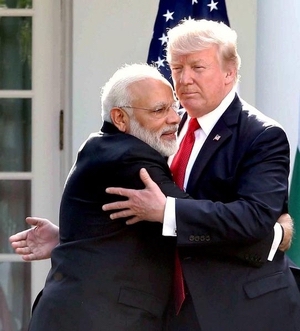
US President Donald Trump – Congratulations to Prime Minister @NarendraModi and his BJP party on their BIG election victory! Great things are in store for the US-India partnership with the return of PM Modi at the helm. I look forward to continuing our important work together!
Bangladesh PM Sheikh Hasina – The Prime Minister of Bangladesh had initiated the call to Modi to extend her congratulations on the clear mandate given by the people of India to the NDA Government. In doing so, PM Sheikh Hasina became one of the first foreign leaders to congratulate the Prime Minister, thus reflecting the extraordinarily close and cordial ties between India and Bangladesh, and the excellent rapport that the two leaders enjoy.
President of the Russian Federation Vladimir V. Putin – Putin called Modi and congratulated him on his victory in the general elections. President Putin expressed his conviction that the Prime Minister would further strengthen the longstanding friendship between the peoples of both countries and enhance the Special and Privileged Strategic Partnership that bind the two countries together.
French President Emmanuel Macron – President of France congratulated Prime Minister Narendra Modi over telephone, describing him as one of the foremost leaders of the democratic world. President Macron reiterated his invitation to Prime Minister Modi to visit France in August 2019 for a bilateral meeting and also to attend the G7 Summit at Biarritz.
Prime Minister of Nepal, K.P. Sharma Oli – K.P. Sharma Oli called Prime Minister Modi and congratulated him on the electoral victory in the Lok Sabha elections.
Prime Minister of Japan, Shinzo Abe – Shinzo Abe called Narendra Modi and congratulated him for the resounding victory of his party in the 2019 General Elections.
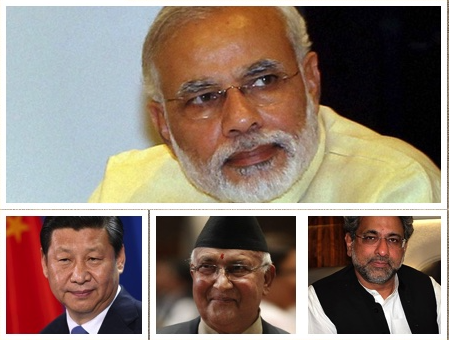
Chinese President Xi Jinping – President of People’s Republic of China, Xi Jinping sent a letter to Prime Minister Modi congratulating him on the electoral victory of National Democratic Alliance under his leadership. In the letter, President Xi noted the great importance he attached to the development of India-China relations and his desire to work with Prime Minister Modi to take the Closer Development Partnership between the two countries to a new height. President Xi also expressed satisfaction at the strong momentum of development in India-China relations in recent years with the joint efforts of both sides.
Israel Prime Minister Benjamin Netanyahu – Benjamin Netanyahu called his Indian counterpart Narendra Modi to personally congratulate him. “Narendra my friend, congratulation, what an enormous victory. I hope, Narendra, that we can see each other soon, as soon as you form a government and as soon as we form a government,” Netanyahu said in a short video clip of the phone call released by the Prime Minister’s Office. “Well, thank you for your congratulations on my victory, but there’s one difference: You don’t need a coalition, I do, and there’s a big difference.”
India’s regional reset won’t be complete without a change in its Pakistan policy
By Rakesh Sood
“Even Prime Minister Narendra Modi’s critics acknowledge his uncanny ability to take bold decisions and this reflects in his foreign policy initiatives. Interestingly, he is also demonstrating an ability to undertake course corrections. The informal summit at Wuhan, China, last month and a visit to Nepal this month reflect a change aimed at reviving the ‘neighborhood first’ policy, announced in 2014. The big challenge, however, will be providing a sense of direction to the policy on Pakistan which has oscillated between ‘jhappi’ and ‘katti’.”
Mr. Modi had received Chinese President Xi Jinping in September 2014 in Gujarat reflecting his personalized diplomacy even though the ongoing stand-off in Chumar in eastern Ladakh cast a shadow on the visit. The personalized diplomacy was reciprocated the following year when Mr. Modi visited China and Mr. Xi received him in Xian, but its limits soon became apparent.
In mid-2016, China blocked India’s bit to join the Nuclear Suppliers Group (NSG) despite a meeting between the two leaders in Tashkent on the margins of the Shanghai Cooperation Organisation (SCO) summit. This was followed by China vetoing Masood Azhar’s listing as a terrorist in the UN Security Council even though the Jaish-e-Mohammed (JeM) is a banned entity. China’s veto continued even after the Uri Army camp attack by JeM cadres later that year, adding to India’s growing annoyance. Hydrological data sharing stopped amid reports of diversion of Brahmaputra river waters. The 73-day stand-off at Doklam last year and accompanying rhetoric reflected a marked downturn. India responded through all this by voicing skepticism regarding Mr. Xi’s Belt and Road Initiative (BRI), stepping up maritime engagement with the U.S. and Japan and reviving the Quad (with Australia) in Manila last year.
Both leaders soon realized the risks of the downward spiral of confrontation and were pragmatic enough to understand the need to restore a degree of balance to the relationship. Mr. Xi had emerged stronger after the 19th Communist Party Congress and the decision by the Central Committee to remove the restriction of two terms for a President made it clear that he would continue beyond 2023.
Significant messages were carried by Foreign Minister Wang Yi and Politburo member Yang Jiechi last December during their visits to Delhi. Follow-up visits to Beijing by Foreign Secretary Vijay Gokhale, National Security Adviser Ajit Doval, Foreign Minister Sushma Swaraj and Defense Minister Nirmala Sitharaman earlier this year prepared the ground for the informal summit meeting in Wuhan last month. The leak of the government circular advising officials to stay away from events commemorating 60 years of Dalai Lama’s exile in India and declining Australia’s suggestion to participate in Malabar naval exercises indicated Indian interest in a reset.
The Wuhan summit was projected as ‘informal’ (something the Chinese have engaged in with U.S. Presidents Barack Obama and Donald Trump), without an agenda. Over two days, the two leaders met for 10 hours, four times one-on-one and twice with their delegations. Instead of a customary Joint Statement, there were separate briefings by Mr. Gokhale and Chinese Vice Foreign Minister Kong Xuanyou indicating the key takeaways. It is clear that messages have gone out to the Army to improve communications and understanding and prevent the stand-offs that were becoming frequent. Both sides have agreed to undertake a joint project in Afghanistan. No softening of Chinese position on the NSG or India’s reservations on the BRI was visible though these issues would have figured in the discussions. However, with three more meetings likely during the SCO, G-20 and BRICS summits later this year, it is clear that there is an effort to bring the relationship on track.
Rebuilding trust with Nepal
A similar exercise appears to be under way with Nepal. Mr. Modi’s visit in 2014 had generated considerable goodwill but subsequent decisions queered the pitch. India’s public display of unhappiness with Nepal’s new Constitution and support for the Madhesi cause created ill-will. The economic impact caused by the disruption of supplies of essential items such as liquefied petroleum gas, petroleum products and medicines fed the anti-Indian sentiment which K.P. Oli effectively exploited to score a decisive electoral victory late last year. Clearly, Delhi was disappointed with the election outcome but decided that the relationship with Nepal was too important to let past misunderstandings fester. A new beginning was necessary.
A couple of phone calls between Mr. Modi and Mr. Oli followed in December-January and Foreign Minister Sushma Swaraj was in Kathmandu even before Mr. Oli was sworn in as Prime Minister to convey congratulations and an invitation from Mr. Modi to visit India. Mr. Oli responded positively, and much was made of the fact that in keeping with tradition, he made Delhi his first foreign destination last month. A surprise one-on-one meeting with Mr. Modi on the first day provided the two leaders an opportunity to clear the air about the past and rebuild a degree of trust.
A return visit by Mr. Modi to Nepal within a month (on May 11-12) indicates that both sides are keen to show positive movement. Expectations are being kept low key, but the optics of positive messaging are evident. Included in the itinerary are a visit to Janakpur to offer prayers at Janaki Mandir and a public address which will announce the inauguration of the Ramayana pilgrimage circuit linking Ayodhya and Janakpur. The same idea had been shot down earlier when the Nepali authorities had cited ‘security issues’. In addition, Mr. Modi will visit Muktinath and the pension paying office at Pokhara, highlighting the historical, cultural and religious ties between the peoples of the two countries. Undoubtedly, the fact that he begins his visit to Nepal by landing in Janakpur, capital of the sole Madhes-ruled province will give comfort to the Madhesi community, but Mr. Modi realizes that his challenge is to repair ties with the wider Nepali community.
The Pakistan challenge
With Pakistan, after the opening when the then Prime Minister, Nawaz Sharif, visited Delhi in 2014 and Mr. Modi dropped in to have tea with him in Lahore in December 2015, relations stalled in 2016 following the Pathankot and Uri attacks. Firing across the Line of Control (LoC) has intensified leading to higher casualties on both sides, both civilian and military. In September 2016, India launched ‘surgical strikes’ as retaliation for the Uri attack but this has not reduced infiltration. Since Burhan Wani’s death, local recruitment by radical groups is also on the rise. India has successfully stalled the South Asian Association for Regional Cooperation (SAARC) summit since 2016 and Mr. Trump’s tweets criticizing Pakistan have given Delhi satisfaction. But limits to the policy of isolating Pakistan are also apparent.
Elections are likely in July and the Army would prefer to keep Mr. Sharif’s PML(N) out of power. Mr. Sharif’s dismissal and disqualification for life from politics by the Supreme Court makes it clear that the Army is determined to control the political transition. Pakistan Army Chief Qamar Javed Bajwa has, on more than one occasion, emphasized the need for improving relations with both India and Afghanistan.
The resumption of the stalled Track II Neemrana Dialogue last month in Islamabad indicates that a shift may be likely. Pakistan realizes that the time frame for a shift is limited before India goes into election mode. The question is whether Gen. Bajwa can make good on his suggestion by showing forward movement on the issues flagged by India — curbing the Lashkar-e-Toiba and JeM, the Kulbushan Jadhav and 26/11 trials, etc. Faced with a similar situation, Gen. Pervez Musharraf had gone in for a unilateral ceasefire on the LoC in 2003. The guns fell silent, tensions were defused, and Pakistan hosted the SAARC summit in 2004.
A change in the Pakistan policy may well be the reset to enable Mr. Modi to reclaim his ‘neighborhood first’ policy.
(The author is a former diplomat and is presently Distinguished Fellow at the Observer Research Foundation. E-mail: rakeshsood2001@yahoo.com)
The South Asia working group’s initial report to the International Religious Freedom Round-table
By Dr. Mike Ghouse
“The many millennia old caste systems and the ‘unparalleled social abuse of untouchability (A.J. Toynbee)’ are based on religious doctrines of Brahminical Hinduism. Thus, caste-based violations of human rights in India are expressions of the utter lack of religious freedom.
“In Pakistan, the Hindu population is steadily declining as a percentage of the overall population with forced conversions. Christians are targeted with blasphemy and apostasy laws.
“In Bangladesh, Atheists, Buddhists, Hindus, and Ahmadiyya Muslims live in apprehension; the Atheist bloggers have been killed. There is a deficiency of law and order.
“In Sri Lanka, the ethnic violence continues between the Buddhists and Hindus and Buddhists and Muslims.
There is a dire need to address the violations of religious and political freedoms in South Asia comprising the nations of India, Pakistan, Bangladesh, Nepal, and Sri Lanka.
A critical note – when a reference is made to the Hindus, Buddhists, Muslims, Christians, India, Russia or others, it is not “all” people of that faith or country. It is usually a small percent of disaffected people from among the majority who feel threatened about their future and their way of life.
The Center for Pluralism offers a solution to counter that – We need to reassure each other in conflict, particularly those who may be troubled by the changing paradigms and demographics of the society that we are committed to safeguarding the way of life for everyone. As Citizens of a given nation, we uphold, protect, defend and celebrate the values of liberty and freedom enshrined in the Constitution. We acknowledge that not all constitutions have the element of freedom embedded in it – an example would be the rights of Ahmadiyya Muslims in Pakistan and rights of Arab Israelis.
There are pending issues that are simmering and may boil over one day. We hope to understand these issues and do our share of reporting them to the International Religious Freedom Round Table, an informal group.
This group will identify problems and offer recommendations and possible solutions, and they are;
Monitoring to ensure the individual rights of people are protected.
Facilitate democratic values and hoping for stable political and economic climate
Secure our long-term interests of the safety of Americans and their investments
Governor Sam Brownback, the newly appointed Ambassador for religious freedom, said in the inaugural reception. The essence of which was -if you want a nation to have peace, give the people their freedom, but if you push them to the corner, their anger will morph into extremism, and everyone will lose in the end.
Here is a summary; a detailed report is in the making and will be produced upon a request.
There is no doubt a lot of good things are happening, but our focus is how to identify exceptional violations of human rights and religious freedom.
India
The commissioners of USCRIF have been the denied visa to India to investigate, among other things; Sikh Genocide, Massacre of Muslims in Gujarat, the plight of Hindu Pundits and the caster system that mistreats the Dalits who are shamefully called untouchables. Most of the Hindu American organizations have an affiliation with the ruling party in India; we need them to stand up for the religious rights of the people and work on getting the Visas to the commissioners for an honest evaluation of the situation.
The policies of the government will lead to mass suicides by the farmers. The Farmers raise the cattle to sell and eke out a living. Now, they are afraid to sell the cattle for fear of being killed by the vigilantes and the Government does nothing. The Cows have gone astray and are eating the farmer’s crops and eating trash on the streets – the cows are treated with disrespect and left on their own, its gross violation of animal rights.
In India currently, you do not have the freedom to eat, drink, wear or believe in the pursuit of your happiness.
A Dalit groom rode a horse on his wedding Baraat (Procession) in the state of Uttar Pradesh last month; the upper caste Hindus could not stomach the “neech –i.e., the low caste untouchable” ride above them and they ended beat him up. Last week an Adivasi (Tribal) Girl was burnt alive. The upper caste Hindus feel entitled to the Dalit women for their pleasures. It is an endless agony for the Dalits. They cannot even convert to other faiths to escape these attitudes due to enforced anti-conversion laws.
Here is a report from the Dalit Leaders in India.
“The many millennia old caste systems and the ‘unparalleled social abuse of untouchability (A.J. Toynbee)’ are based on religious doctrines of Brahminical Hinduism. Thus, caste-based violations of human rights in India are expressions of the utter lack of religious freedom.
This perilous situation is aggravated by anti-conversion laws that have been passed in many states of India. Their purpose is to prevent Dalits from converting to other religions where they would not be considered untouchable’. https://www.loc.gov/law/help/anti-conversion-laws/india.php
The inferior status that Hinduism accords to Dalits, in spite of the equalities guaranteed by the constitution of the country, reflects in severe social, economic, and educational inequalities.
Dalits continue to suffer extreme prejudice and deprivation, apart from institutional harassment. Violence against Dalits – public shaming, beatings, rape, murder – is a daily occurrence. The law enforcement agencies, police and the judiciary, largely remain mute spectators, if not actively conniving in the violence.
Statistics show that violence against Dalits has only increased in recent years. Religious freedom and equality thus remain a mirage for 200 million Dalits in India.”
The Muslims are lynched and killed for doubt of possessing beef; fake encounters are common practice to trap the young Muslim boys; RSS (political Hindus in the guise of culture) set the bomb blasts in Mumbai and other places and blamed Muslims. Muzaffarnagar and other riots were created to pit Hindus against Indians.
Christian Nuns are raped; pastors are chased and beat up in the public. The Christians Churches are burned, and the couples are constantly harassed on Valentine’s Day and Christmas Day. The Dalits are forced to convert back to Hinduism.
Justice to Sikhs is not done yet; mothers are still waiting for their unaccounted children from the Sikh Genocide of 84 where in three days, the extremists among Hindus butchered about 3000 Sikhs.
Blatant discrimination births frustration leading to violent expressions, when that happens the foreign investors will pull out, who wants to invest in a place where their investments are not secure. It’s happened in India in the mid-60’s, mid 70’s and it has happened in South Africa. The consequences do not bring goodwill.
There is a significant crisis brewing in India, and the Supreme Court will render a judgment about the disputed land and authority to build or not build a Hindu temple, where a 500-year-old Muslim Mosque was razed to the ground.
The Supreme Court of India would review the documents if that Mosque were built razing a temple. The internationally famed Guru of Art of Living, Sri Sri Ravi Shankar has sowed the seeds of discontentment. Instead of suggesting the public to respect the Supreme Court’s decision, he has predicted civil war if the Court decides one way or the other. He has shown disrespect to the average Hindu and average Muslim who have demonstrated respect to the decisions of the Apex Court, several times in the recent past.
We pray that the Modi government and the State Government will offer strong safety protections to the public at least for a few months after December 5, 2018, the new date of the verdict.
Pakistan
Harassment of all minorities continues unabated. Ahmadiyya Muslims are denied their right to call themselves Muslims. There are numerous billboards that proclaim that it is legitimate to kill Ahmadiyya. The Hindu population is steadily declining as a percentage of the overall population with forced conversions. Christians are targeted with blasphemy and apostasy laws; these are the fake encounters. The Apostasy and Blasphemy laws were created to appease the tyrant kings and have no basis in the religion of Islam, and both are tools of oppression.
Bangladesh
The Atheists, Buddhists, Hindus, and Ahmadiyya Muslims live in apprehension; the Atheist bloggers have been killed. There is a deficiency of law and order.
Sri Lanka
The ethnic violence continues between the Buddhists and Hindus and Buddhists and Muslims. Sri Lanka’s president declared a state of emergency Tuesday amid fears that anti-Muslim attacks in several central hill towns could spread. The emergency announcement came after Buddhist mobs swept through the cities outside Kandy, burning at least 11 Muslim-owned shops and homes. The attacks followed reports that a group of Muslims had killed a Buddhist man. Police fired tear gas into the crowds, and later announced a curfew in the town. The government will “act sternly against groups that are inciting religious hatred,” Cabinet minister Rauff Hakeem said after a meeting with the president.
Nepal
It seems this nation is free from religious strife at this time, as it has undergone tumultuous political conflicts including a change in the form of Government from Monarchy to a democratic Republic.
A full report is available upon request to Mike Ghouse.
(The author is Chair, South Asia working group – IRF Roundtable. He can be reached at Mike@CenterforPluralism.com / Phone no. (214) 325-1916
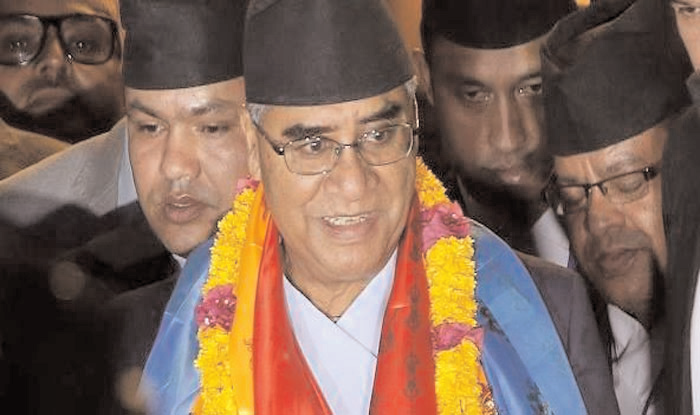
KATHMANDU (TIP): KP Sharma Oli was on Feb 15 sworn in as Nepal’s prime minister for the second time, weeks after his Left alliance with former Maoist rebels swept the historic parliamentary polls, kindling hopes for much-needed political stability in the Himalayan nation.
President Bidya Devi Bhandari administered the oath of office and secrecy to 65-year-old Oli at a function held at President’s Office, Shital Niwas, in Maharajgunj. He is the 41st prime minister of Nepal.
Known for his pro-China stance, Oli had served as the country’s prime minister from October 11, 2015 to August 3, 2016.
His PM candidacy was supported by the UCPN-Maoists, Rastriya Prajatantra Party Nepal, and Madhesi Rights Forum-Democratic along with 13 other small parties.
Earlier, former prime minister and Nepali Congress president Sher Bahadur Deuba had addressed the nation and submitted his resignation to the president.
Deuba was elected as the 40th Prime Minister on June 6 with the support from CPN (Maoist Centre) which is now a part of Left alliance and opting for merger with CPN-UML.
“The elections of three tiers of government have been successfully held under my leadership setting the foundation to long transition,” Deuba said in the television address.
The Left alliance of the CPN-UML, led by Oli and CPN-Maoist Centre, led by Prachanda, secured almost two third majority in the Parliament during the parliamentary elections.
Oli’s party CPN-UML secured 121 seats in the 275-member Parliament and became the largest party in the Parliament. The Nepali Congress has 63 seats while the CPN-Maoist Centre has 53 seats.
The total strength of the CPN-UML and CPN-Maoist Centre was 174, sufficient to form a majority government at the Centre.
The Madhesi parties – Rastriya Janta Party Nepal has got 17 seats and Federal Socialist Party Nepal secured 16 seats in the parliamentary elections.
The elections were seen as the final step in Nepal’s transition to a federal democracy following a decade-long civil war till 2006 that claimed more than 16,000 lives.
In 2015, when Nepal adopted a new Constitution that split it into seven states, dozens of people were killed in ethnic clashes over territory and rights.
Following the adoption of the new Constitution, the ethnic Madhesi group, mostly of Indian-origin, protested for months, saying they were not getting enough territory in one of the provinces and were also facing discrimination.
The polls are said to be a step forward in cementing democracy and providing political stability to Nepal, which has seen 10 prime ministers in as many years.
Oli had served as deputy prime minister during the then interim government led by Girija Prasad Koirala in 2006 after the successful conclusion of the second Peoples Movement. He was elected as a member of Parliament in the House of Representatives for the first time from Jhapa district in 1991.
He had also served as minister of home affairs in 1994-1995. He was re-elected to the House of Representatives from Jhapa electorate in 1999.
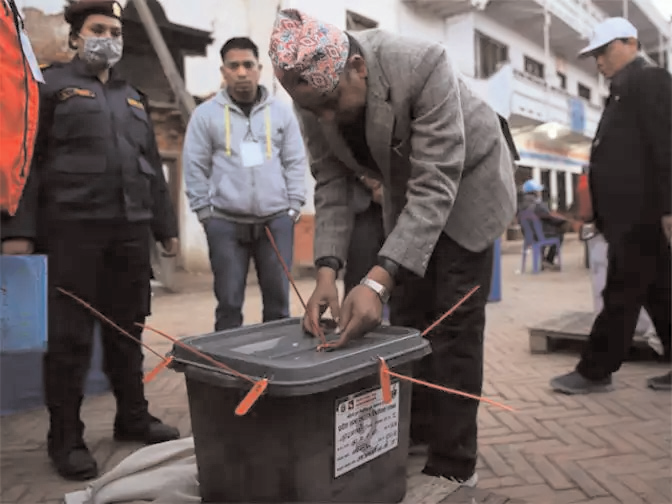
KATHMANDU (TIP): Nepal registered 67 per cent voter turnout in the last phase of the historic provincial and parliamentary elections that many hope will bring the much – needed political stability to the Himalayan nation on Dec 7.
This was slightly above from the first phase when 65 per cent voters had exercised their franchise on November 26.
The counting of votes has also started in most of the districts following an allparty meeting.
The voting, which began at 7 AM and closed at 5 PM, was by-and-large peaceful except some minor incidents of violence, Chief Election Commissioner Ayodhi Prasadi Yadav said.
Three persons were injured in clashes between the cadres of the ruling Nepali Congress and the main opposition CPNUML at a polling centre in Bhaktapur district, about 14 km east of Kathmandu.
The Election Commission said that 67 per cent votes were cast across 15,344 polling centres in 45 districts which went to the polls under the second and final phase of provincial and parliamentary elections.
As many as 7,752 polling centres were arranged for today’s voting. A total of 155,000 employees and 200,000 security personnel were deployed on poll duty.
More than 12.2 million voters were eligible to exercise their voting rights in the second phase of the polls. The voting took place for 128 constituencies of Parliament’s House of Representatives and 256 seats of Provincial Assemblies in 45 districts. The political fortune of 4,482 candidates, including Prime Minister Sher Bahadur Deuba, were sealed in ballot boxes. For the Parliament, 1,663 candidates contested while 2,819 candidates tried for the Provincial Assemblies.
The first phase of the polls in the landlocked country was successfully held in 32 districts on November 26. Around 200,000 security personnel, including the Army, were deployed for the polls in an attempt to step up security in the wake of explosions ahead of the elections.
This is for the first time that elections for Parliament and Provincial Assemblies are being conducted under the new Constitution promulgated in September 2015.
In total, the elections will elect 128 Members of Parliament and 256 Members of the Provincial Assemblies. The House of Representatives consists of 275 members. Of them, 165 are elected directly under the First-Pastthe- Post system while the remaining 110 come through Proportional Representation system.
The elections are being seen as the final step in Nepal’s transition to a federal democracy following a decadelong civil war till 2006 that claimed more than 16,000 lives.
While many hope Nepal’s first state elections will hasten regional development, others fear they will spark a fresh wave of violence. (PTI)
NEW DELHI (TIP): After years of foot-dragging, India will begin work in around a month on an $87 billion scheme to connect some of the country’s biggest rivers, government sources say, as Prime Minister Narendra Modi bets on the ambitious project to end deadly floods and droughts.
The mammoth plan entails linking nearly 60 rivers, including the mighty Ganges, which the government hopes will cut farmers’ dependence on fickle monsoon rains by bringing millions of hectares of cultivatable land under irrigation.
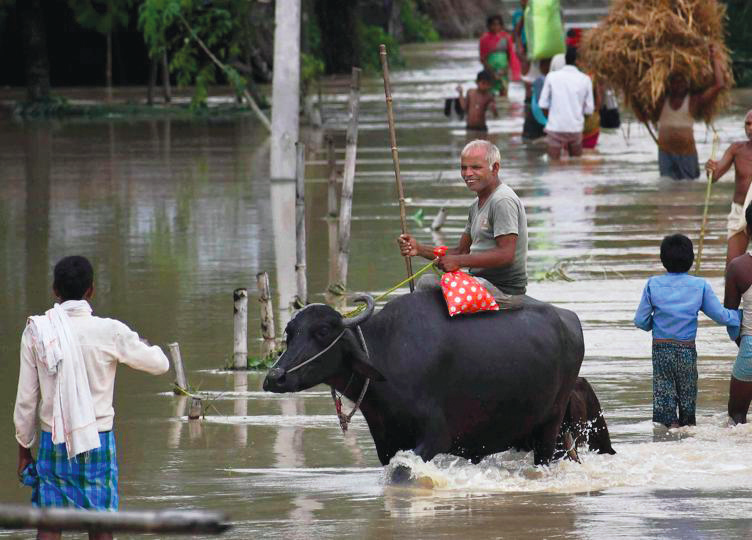
In recent weeks, some parts of India and neighbouring Bangladesh and Nepal have been hit by the worst monsoon floods in years, following two years of poor rainfall.
Modi has personally pushed through clearances for the first phase of the project – which would also generate thousands of megawatts of electricity – the sources say, despite opposition from environmentalists, tiger lovers and a former royal family.
That will involve construction of a dam on the Ken river, also known as the Karnavati, in north-central India and a 22- km (14-mile) canal connecting it to the shallow Betwa.
Both rivers flow through vast swathes of Uttar Pradesh and Madhya Pradesh, ruled by the Bharatiya Janata Party (BJP), and the prime minister hopes the Ken-Betwa scheme will set a template for other proposed river interlinking projects, one of the sources said.
“We have got clearances in record time, with the last round of clearances coming in only this year,” Sanjeev Balyan, the junior water resources minister, told Reuters. “The Ken- Betwa interlinking tops the priority list of the government.”
Government officials say diverting water from bounteous rivers such as the Ganges, Godavari and Mahanadi to sparse waterways by building a clutch of dams and a network of canals is the only solution to floods and droughts.
But some experts say India would be better off investing in water conservation and better farm practices. Environmentalists and wildlife enthusiasts have also warned of ecological damage.
The 425-km (265-mile) Ken flows through a tiger reserve nestled in a verdant valley. The government plans to clear out 6.5 percent of the forest reserve to build the dam, relocating nearly 2,000 families from 10 remote villages.
Around half a dozen clearances, including on environmental and forest protection, have been obtained for the scheme to link the Ken and Betwa, according to two sources and documents seen by Reuters.
Modi’s cabinet is likely to give its final go-ahead for the project within a couple of weeks, sources say, after which he will flag off construction at the site about 805 km (500 miles) from New Delhi, currently marked only by rows of red concrete slabs placed on the ground.
NEW DELHI (TIP): Infrastructure development, measures to improve connectivity, earthquake reconstruction and a concerted effort to tackle the perennial problem of floods on both sides figured prominently during the comprehensive talks between India and Nepal here today.
A range of bilateral issues came up for discussion during talks between PM Narendra Modi and his Nepalese counterpart Sher Bahadur Deuba on his first overseas visit after assuming office in June.
Nepal also reassured India that it would never allow any anti-India activity from its soil as both sides discussed defence and security matters. Modi identified defence and security as important aspects of bilateral ties.
At the joint media meet, Modi said both sides had a positive meeting that reviewed the gamut of the partnership and that he had assured Deuba about India’s commitment towards Nepal’s development.
The two leaders jointly inaugurated the Kataiya-Kusaha and Raxaul-Parwanipur cross-border power transmission lines. Eight MoUs were signed — four pertaining to earthquake reconstruction; and one each for narcotics control; cooperation in field of standardisation; construction of Mechi bridge; and Chartered Accountants institutes.
Deuba’s visit comes amid the standoff between India and China at Doklam, a development on which Nepal has preferred to remain neutral. Foreign Secretary S Jaishankar said Doklam did not figure in any of the PMs’ talks.
India also walked the extra mile to welcome Deuba whose predecessor KP Sharma Oli had tilted towards Beijing much to the discomfort of New Delhi. Deuba also called on President Ram Nath Kovind and Vice-President M Venkaiah Naidu.
On Madhesis, India reiterated its stand that the broadest possible consensus of people and society should be considered while making the Constitution. Deuba said Nepal was making efforts in that direction and it was a work in progress.
NEW DELHI (TIP): As many as 7,620 Indian nationals are lodged in foreign jails, with the highest number in Saudi Arabia. Of them, at least 50 are women
In response to a question raised in the Lok Sabha on Wednesday, August 9, minister of state for external affairs M J Akbar said due to strong privacy laws prevailing in many countries, local authorities do not share information on prisoners unless the person concerned consents to the disclosure of such information.
Of the 7,620 prisoners lodged in 86 jails, at least 50 are women, shows data available with the government. Most of these women are in prisons in south-east Asia, neighboring Sri Lanka, China and Nepal, the Gulf countries, the US and UK.
The Gulf countries account for 56% of all Indian nationals in foreign jails. The prisons in Saudi Arabia have the highest number of Indian nationals, with 2,084 of them confined on charges of financial fraud, burglary and bribery.
A number of them have also been arrested for drinking and selling alcohol in the country. It is illegal to produce, import or consume alcohol in Saudi Arabia.
In countries in south-east Asia – Thailand, Malaysia, Singapore and Indonesia – most of the 500 immured Indian nationals were charged with offences related to drug and human trafficking and immigration and visa violation.
In Pakistan, according to a list handed over by the government to the India envoy in Islamabad, at least 546 Indian nationals, including nearly 500 fishermen, are in Pakistani jails.
Fishermen in the southern parts of India have also entered troubled waters and landed in jails in alien soil, especially in Sri Lankan jails. Tamil Nadu prisoners were tracked in Bangladesh, Bhutan, Brunei and Ethiopia too.
In Australia and Canada, countries that see high migration from India, 115 prisoners are Indian nationals. Most of their offences relate to murder, sexual assault, money laundering and road accidents.
Most European countries like Germany, Italy, Greece and France did not furnish details of Indian nationals in their prisons.
The minister said since the enactment of the repatriation of Prisoners Act, 2003, 170 applications for repatriation had been received and 61 Indian prisoners had been repatriated from foreign prisons.
So far, India has signed treaties with 30 countries, under which Indian prisoners have been brought back. Besides this, India has also ratified the Inter American Convention by which India can receive and send requests to member countries for release of prisoners.
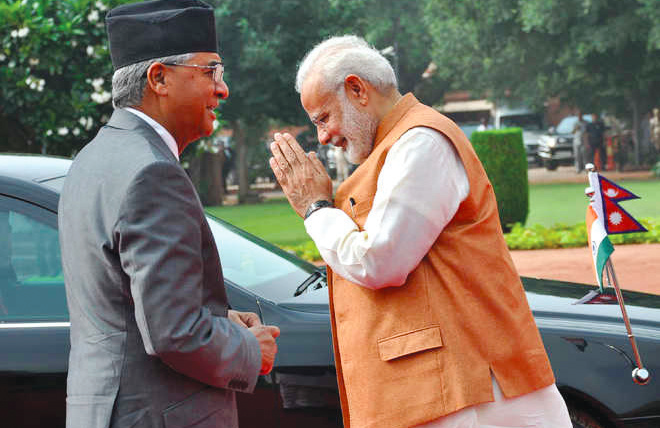
KATHMANDU (TIP): Nepal’s parliament on June 3 elected unopposed three-time former prime minister Sher Bahadur Deuba to the top post once again. This is the tenth time in just over a decade the leadership has changed hands in the Himalayan nation. Deuba, a wily political veteran, stood unopposed in the parliamentary election having struck a deal with his predecessor that some criticised as being undemocratic. Maoist leader Pushpa Kamal Dahal- who resigned a fortnight ago after just ten months as prime minister- had agreed to stand aside for Deuba once long awaited local polls had been held in Nepal. “I announce that respected member Sher Bahadur Deuba… has been elected to the post of Nepal’s prime minister,” said Parliament Speaker Onsari Gharti Magar, addressing parliament during a live television broadcast. Indian Prime Minister Narendra Modi on Tuesday called up Nepal’s Prime Minister-elect Sher Bahadur Deuba to congratulate him and convey his best wishes for the country’s progress. (agencies)
ISLAMABAD (TIP): The “kidnapping” case of a retired Pakistan army officer in Nepal could not be taken to the ICJ or the UN on the basis of “assumptions” as there is no “concrete evidence” suggesting India’s hand in it, a minister has told Parliament.
Minister for states and frontier regions Gen (retd) Abdul Qadir Baloch said it was yet to be established that Muhammad Habib Zahir had been picked up by the Indian forces, the Dawn reported. “No final report suggesting that the Indian intelligence agency (RAW) or the Indian government was involved is available with the foreign office (FO) or the government,” he said while winding up a discussion on an adjournment motion in the Senate on Wednesday.
Senate chairman Mian Raza Rabbani asked if the statement meant that the foreign office was exonerating India from the kidnapping of Habib as the minister had admitted “absence of concrete evidence”. Baloch replied in negative, saying: “We are hundred per cent sure that Indian intelligence agency RAW is behind the kidnapping, but the evidence to this effect is not final”. The issue appeared to have a link with the conviction of Kulbushan Jadhav, he said, but stressed that material was required to legally prove it.
Baloch told the Senate that the issue of “kidnapping” of Habib in Nepal some two months ago could not be taken to the International Court of Justice (ICJ) or the United Nations “on the basis of assumptions”, the report said.
The FO was trying to obtain solid evidence and the Nepalese government had been asked to get in touch with three Indians who had received Habib at the airport, Baloch said. He said it was still not clear whether the three people were Indian government employees or civilians or working for a private firm. (PTI)
KATHMANDU (TIP): Nepal’s mountaineering community was celebrating the first conquest of Mount Everest 64 years ago June 29, as well as this year’s climbing season during which hundreds scaled the world’s highest peak.
A ceremony later Monday marking the first successful Everest climb by New Zealander Edmund Hillary and his Sherpa guide, Tenzing Norgay, in 1953 will also honor several others who have contributed to the climbing industry, said Ang Tshering of the Nepal Mountaineering Association.
The industry suffered back-to-back tragedies in 2014 and 2015, when deadly avalanches forced the mountain’s early closure.
This year’s season, which began in March and ends on Wednesday, saw hundreds of climbers reach the top of the 8,850- meter (29,035-foot) peak despite severe weather conditions. Last year was also considered a successful season, during which hundreds reached the top but five climbers died.
Six climbers died in the attempt this season, and all but that of American doctor Roland Yearwood had been recovered by Sunday.
The three Sherpa guides who attempted to retrieve Yearwood’s body said the location was too dangerous to reach, according to Murari Sharma of Everest Parivar Expedition agency.
On Sunday, rescuers brought down from Everest the bodies of an Indian climber who died this year and two Indians who died last year.
NEW DELHI (TIP): As concerns abound in India over Nepal’s decision to join China’s One Belt, One Road (OBOR), Nepal has come out strongly to underscore the significance of its ties with India, saying no country can change its geography.
While fears have been expressed about another South Asian nation walking into a debt trap, Nepal has assured India that the agreement it signed to officially join OBOR is still at a “premature stage” and that it will carefully weigh terms and conditions for utilisation of funds from China. “What we have is only a framework agreement (on OBOR) with China and the modalities of terms and conditions for fund utilisation will be worked out later. All such considerations will be made on merit and in keeping with our national interest,” Nepal’s ambassador Deep Kumar Upadhyay told TOI. This is significant in the context of Sri Lanka which, faced with a debt crisis that emanated from Chinese loans, has again turned to Beijing for help. China is seeking to improve connectivity with Nepal, including by building a cross border railway line, but Upadhyay said such projects would take years.
“Even China acknowledges that we can’t change geography. We need 365 days of continuous supplies. We have joined OBOR but we have also made it clear to the Chinese that by joining OBOR we don’t want to, or mean to, undermine the relationship with India which we are proud of,” Upadhyay said.
To underline the significance of Nepal’s ties with India, Upadhyay said cooperation with India in the power sector had resulted in practically no power cuts across the country since Diwali last year. This has been made possible by not just our own internal management but also because India supplied us an additional 151MW of power last year. This additional power was made possible through the double circuit transmission line between Muzaffarpur and Dhalkebar. (TOI)
KATHMANDU (TIP): Nepal Prime Minister Pushpa Kamal Dahal ‘Prachanda’ on Wednesday resigned after a brief stint of nine months, honouring a power sharing understanding reached between his party and the ruling partner Nepali Congress. Prachanda, 62, announced his resignation while addressing the nation in a live telecast. It was his second stint as the Prime Minister. He was elected as the 39th prime minister of Nepal after forging alliance with the Nepali Congress on August 3, 2016. (PTI)
NEW DELHI (TIP): Prime Minister Narendra Modi has congratulated outgoing prime minister of Nepal Pushpa Kamal Dahal ‘Prachanda’ for the successful conduct of local elections there.
Modi conveyed his felicitations to Prachanda in a phone call last evening, the PMO said today in a tweet. Modi “also felicitated Shri Pushpa Kamal Dahal ‘Prachanda’ for his strong commitment to strengthen democracy in Nepal,” it added.
Millions of Nepalese on May 14 voted in the country’s first local-level polls in two decades as the Himalayan nation took a crucial step towards cementing democracy amid political turmoil.
Before the elections, Prachanda had called up Modi who had assured all possible help from India in conducting the polls successfully.
Prachanda, who became the prime minister in August last year, resigned two days back under an agreement with Nepali Congress leader Sher Bahadur Deuba at that time that they would share power on rotational basis till next year’s elections.
Under that understanding, Prachanda had to resign after nine months. (PTI)
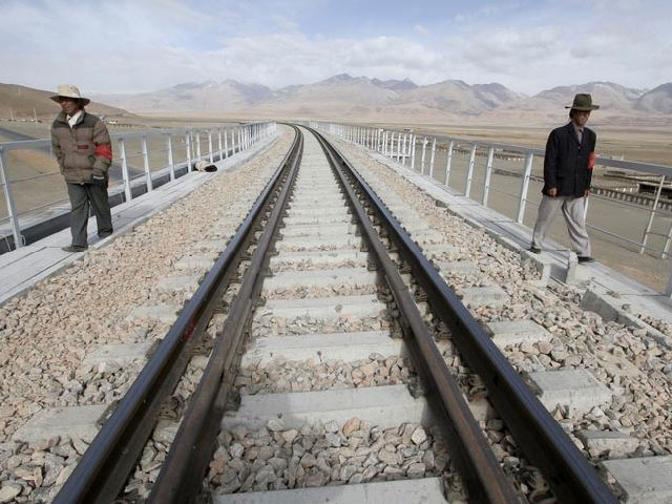
BEIJING (TIP): Nepal is in talks with China to build a cross-border rail link that may cost up to $8 billion, and funding could be expected after Nepal formally signed up to Beijing’s Belt and Road initiative, a Nepali finance ministry official said on May 14.
Yug Raj Pandey, an under-secretary at Nepal’s ministry of finance, told Reuters the proposed 550 kilometre-long railway would connect China’s western Tibet region to Nepal’s capital of Kathmandu and will carry goods and passengers.
The Himalayan nation officially signed an agreement two days ago to be part of President Xi Jinping’s ambitious plan to build a new Silk Road, he said on the sidelines of the Belt and Road Forum in Beijing.
“Now we are a member of (the initiative) we can get some specific project assistance from China’s government. We expect it for the railway,” he said. “Once we connect by railway then we can increase our trade and invite more tourists to Nepal.”
Pandey said the two countries had been in discussions for the past five months about the project, which could cost $7-8 billion and take up to eight years to complete.
He said Nepal planned to start preparing a detailed project report for the railway, and that they had yet to decide how much funding they will seek from China.
The railway will travel over 400 kilometres in China to the Nepal border, and then about another 150 kilometres from the Nepali border to Kathmandu, he said.
Uttarakhand is one of the most beautiful northern states of India located on the southern slope of the Himalayan range. Mighty Himalayan peaks and glaciers are on its north where it borders Tibet. Nepal is on its east, Indian state of Uttar Pradesh is on south and Himachal Pradesh lies on its west and northwest. 65% of its area is covered by dense forests that are home to Royal Bengal tiger, leopards and many other endangered animal and plant species. The glaciers of two of the most important rivers—Ganga and Yamuna— are located here.
It has something to offer to every kind of traveller. For wildlife lovers, Jim Corbett National Park—the oldest national park of the Indian subcontinent is a must visit. Many rare Himalayan birds can also be spotted here besides Pangot and Sattal. For adventure seekers there are some of India’s best trekking trails like Valley Of Flowers, Roopkund, and Chopta-Chandrashila. It also provides immense opportunities for adventure sports, such as skiing at Auli and white water rafting at Shivpuri. Popularly known as the ‘Land of Gods’, it is home to numerous holy places like Gangotri, Yamnotri, Kedarnath, Badrinath, Rishkesh and Haridwar. Therefore, thousands of pilgrims throng the state every year. Amazing hill stations like Chakrata, Mukteshwar, Dhanaulti and Munsiyari make Uttarakhand a sought after tourist destination for leisure trips. Here’s a list of destinations in Uttarakhand that every nature lover would love to visit.
CHAKRATA
Having breakfast with the view of snow covered Himalayan peaks on a lazy morning while soft rays of winter sun embrace your body and soul while cool breeze kisses you is something city people always crave for. Chakrata located at a distance of 330 km from Delhi, is a tiny hamlet which is a perfect place to do so. There are two routes to drive from Delhi to Chakrata, one is via Panipat and Kurukshetra and the second one is via Loni and Saharanpur, which supposedly is more beautiful and has less traffic.
Chakrata is a small cantonment town in Dehradun district resting at an elevation of about 7500 ft. The town gets a magnificent view of the snow covered Himalayas and is covered in deodar, Himalayan oak and rhododendron forest. Many day trips to places like Deoban, Koti, Kanasar can be done with Chakrata as base. There are some easy treks also around Chakrata that your hotel guys can arrange for you. There are not many hotels in the area so make sure to book your accommodation inadvance. Chakrata is a year round destination; the winter season is perfect to experience snow, greenery is at its best during the monsoon season and the summer season too is quite pleasant.
AULI
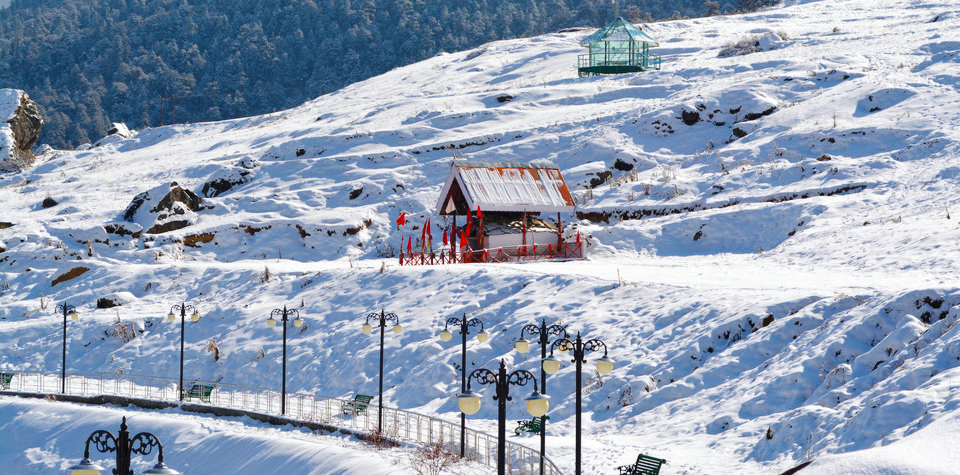
Auli is one of the most beautiful places of Uttarakhand. Bordered by snow-covered Himalayan peaks, Auli is enveloped in dense golden oak and pine forest with green meadows and slopes ranging from a height of 2519 m to 3049 m. It is considered to be a world-class spot for skiing. GMVN winter resort here provides skiing facility, besides ski training for aspirants. Almost from everywhere in Auli, you can enjoy stunning views of the lofty mountain ranges—Nanda Devi, Mana Paravat and Kamat.
The golden rays of sun on the snow-laden peaks fill the atmosphere with a divine glow. The 3rd highest peak of the world—Nanda Devi gleams like the crown of the region. There is an open cable-car to go up to the spot where skiing is done. Even if you do not want to ski, you have plenty of things to do. Climb up the slopes, play with snow, ride a sledge and who knows you might feel like trying skiing too. The best time to visit Auli is in between December and March.
CORBETT
Spread across an area of 520.8 sq km, Jim Corbett National Park is located in Nainital district of Uttarakhand. It is the oldest national park, and is named after Jim Corbett who was the main person behind this establishment. The park is divided in 5 zones—Bijrani, Jhirna, Durgadevi, Dhikala, Sitavani—and is inhabited by royal Bengal tiger, leopard, jungle cat, barking deer, hog deer, cheetal, sloth bears, otters, Himalayan goral, Indian pangolins, langur and many other wild animals.
Many rare birds can also be spotted in the region. Gorgeous Corbett National Park is one of the favourite destinations equally for wildlife lovers and weekenders. It is just 235 km away from capital city and can be reached in couple of hours. It features splendid landscapes and offers a good amalgam of hills, rivers, forests, marshlands and grasslands. The park is open from the months of November through June. The park is kept closed in the monsoon season as the roads inside the park get washed away due to rain. After the monsoon season, repair work starts and ends only by November.
TEHRI DAM
A beautiful uphill drive through the hills covered in pines and small villages will take you to this dam. It is built on the Bhagirathi River in Uttarakhand and is the tallest dam in India. It is counted amongst 5 highest dams in the world, with 855 ft high rock and earth-fill embankment that makes it an engineering marvel. Its length is 1886 ft, crest width is 66 ft and base width is 3701 ft and generates 2400 MW of power. There is a viewpoint near the Bhagirathipuram bus stop from where you can have a majestic view of the entire dam. During the construction of the Tehri Dam, a huge water body was created. The tourism department has developed this 44 sq km artificial lake, as a tourist spot with arrangements of various water sports like jetski, kayaking, canoeing, boating, diving, snorkelling etc on the lake. You can also visit the botanical garden, located at New Tehri, that features a range of beautiful flowers.
MUKTESHWAR
Staying in middle of fruit orchards in tents and eating garden fresh meals while looking at the Himalayan peaks covered in fresh snow are a few of the many beautiful memories I have of Mukteshwar. You can walk through the dense pine forest and enjoy stunning views of the mighty mountains. Situated at an altitude of 7500 ft in the lap of Kumaon hills, Mukteshwar is an ideal nature get away from Delhi. It just takes 7 hrs from Delhi to reach Mukteshwar via Gajraula, Rampur, Haldwani and Bhowali. Summer months (March to July) are the best months to visit Mukteshwar. If you want to experience snow, visit during Jan or Feb when the whole area is covered in snow and looks stunningly beautiful. If you happen to visit this place around the month of June, the harvesting season, you’d find many fruits like peaches, plum and apricot. And if you still did not have your fill, Mukteshwar has many fruit orchards and you might get lucky to get offered the fruits just plucked from the trees by villagers.
Signup to our Newsletter!
Don’t miss out on all the happenings around the world