Tag: Nisha Desai Biswal

  • Indian American policy expert Nisha Desai Biswal named deputy head of US development finance agency

    Indian American policy expert Nisha Desai Biswal named deputy head of US development finance agency

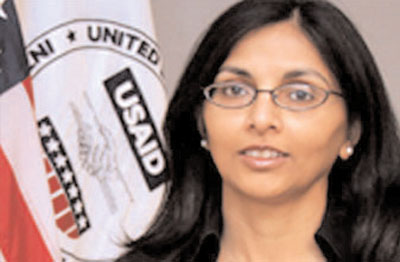
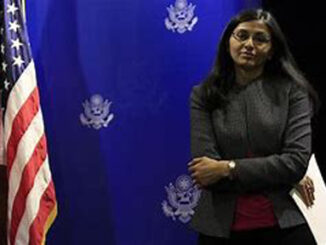
    WASHINGTON, D.C. (TIP): President Joe Biden intends to nominate Indian American policy expert Nisha Desai Biswal as Deputy Chief Executive Officer of the US International Development Finance Corporation (DFC), dealing with most critical challenges facing the developing world.
    The American finance agency provides loans, loan guarantees, direct equity investments, and political risk insurance for private sector led development projects, feasibility studies, and technical assistance.
    It invests across several sectors including energy, healthcare, critical infrastructure, and technology, with stated priorities of women’s empowerment, innovation, investment in West Africa and the Western Hemisphere, and climate change.
    Biden’s intent to nominate Biswal, who served as Assistant Secretary of State for South and Central Asian Affairs from 2013 to 2017 during the Obama administration, was announced by the White House Monday along with six other key posts. In that job Biswal oversaw the US-India strategic partnership during a period of unprecedented cooperation, including the launch of an annual US-India Strategic and Commercial Dialogue, the White House noted. Biswal also initiated the C5+1 Dialogue with Central Asia and the US-Bangladesh Partnership Dialogue during her tenure as Assistant Secretary.
    Biswal brings over 30 years of experience in US foreign policy and international development programs within the Executive Branch, Congress, and the private sector, according to her official profile.
    Currently Biswal is the Senior Vice President for International Strategy and Global Initiatives at the US Chamber of Commerce, overseeing the US India Business Council and US Bangladesh Business Council.
    Prior to her stint at the State Department, Biswal was Assistant Administrator for Asia at the US Agency for International Development (USAID), directing and supervising USAID programs and operations across South, Central, and Southeast Asia.
    She has also spent over a decade on Capitol Hill, working as Staff Director on the State and Foreign Operations Subcommittee on Appropriations as well as professional staff on the Foreign Affairs Committee in the House of Representatives. Biswal serves as the Chair of the Advisory Committee on Voluntary Foreign Aid and is on both the Board of the National Democratic Institute and the US Institute of Peace International Advisory Council.
    She is a member of the United States Institute of Peace Afghanistan Study Group and the Aspen Institute’s India-US Track 2 Dialogue on Climate and Energy. Biswal is a proud graduate of the University of Virginia, where she studied International Relations and Economics.

  • Six Indian Americans honored with Pravasi Bharatiya Samman

    Six Indian Americans honored with Pravasi Bharatiya Samman

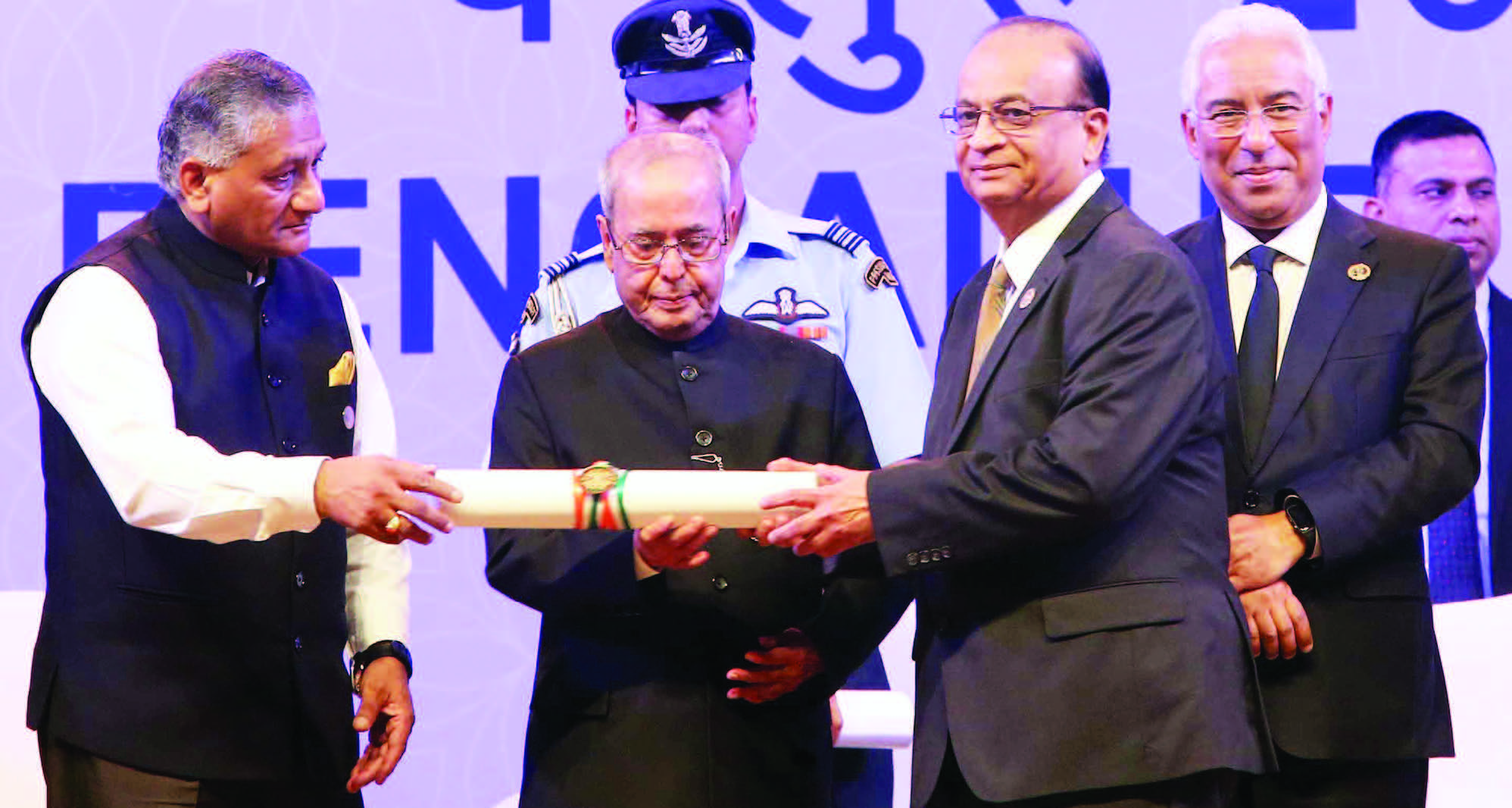
    BENGALURU (TIP): Nisha Desai Biswal, Assistant Secretary of State, Department of State, community activist Dr. Sampatkumar Shivangi; community activist Ramesh Shah, environmental engineer Hari Babu Bindal, philanthropist and organizer of Modi’s historic Madison Square Garden event in 2014, Dr. Bharat Barai; and the founder and former president of Vishwa Hindu Parishad of America, Dr. Mahesh Mehta are the six Indian Americans who received 2017 Pravasi Bharatiya Samman Awards (PBSA) from President Pranab Mukherjee on January 9 at Bengaluru.

    Dr. Sampat S. Shivangi is a renowned Indian American leader. A street in Mississippi is named after him in recognition of his contributions to the progress and welfare of the community. He was the first Indian American to be appointed for the top health post, the Chairman of the Mississippi Department of Mental Health, in 2014. Dr. Sampat Shivangi was the advisor to the US Secretary of Health and Human Services in the presidential regime of George W. Bush. He is the founder and president of the American Association of Physicians of Indian-origin in Mississippi. The CEO of US Info Systems of Mississippi, he is one of the trustworthy confidantes of Prime Minister Narendra Modi.

    One of the recipients of the Pravasi Bharatiya Samman Awards, India-born and Chicago-based Dr. Bharat Barai is the director of oncology department at Methodist Hospitals in Indiana. He got a mention in the Guinness Book of World Records as the longest serving member of a State Medical Licensing Board in the US. He is a community activist and philanthropist too. He treats uninsured, disadvantaged patients and works to reduce medical expenses for them. Known for his unconditional community services, personal integrity and professional excellence, Dr. Bharat Barai is also in Prime Minister Narendra Modi’s coterie of close associates.

    Another Indian American awardee of the Pravasi Bharatiya Samman, Dr. Mahesh Mehta is the founder of Vishwa Hindu Parishad of America. He also founded the Hindu Heritage Foundation of America, Friends of India Society International, India Quality Group and several other organizations. He has many widely published articles on socio-cultural, socio-economic and socio-political aspects to his fame. ‘Hindu Philosophy in Action’ is the latest from Dr. Mahesh Mehta’s repertoire of books and journals. Dr. Mehta is a cofounder and director of Hindu University of America in Orlando, Florida.

    Nisha Desai Biswal is an Assistant Secretary of State for South and Central Asian Affairs among the six Indian American recipients of the Pravasi Bharatiya Samman Awards 2017. She helms the United States’ foreign policies and external affairs in India, Bhutan, Nepal, Sri Lanka, Maldives, Bangladesh and other countries in central Asia. Under her distinguished leadership, the US Department of State ensures and enhances human security and national security in south and central Asian nations. Based in Washington DC, Nisha Desai Biswal leads the US’ bilateral consultations with Central and South Asia to deepen ties with those Asian nations.

    The Pravasi Bharatiya Samman Award (PBSA) is the highest honor conferred on overseas Indians. PBSA is conferred by the President of India as a part of the Pravasi Bharatiya Divas Conventions organized annually since 2003 on Non-Resident Indians, Persons of Indian Origin or an organization or institution established and run by the Non-Resident Indians or Persons of Indian Origin in recognition of their outstanding achievements both in India and abroad.

    The 14th edition of the Pravasi Bharatiya Divas (PBD) Convention was held in Bengaluru from 7-9 January, 2017. The Pravasi Bharatiya Samman Awards were conferred by the Hon’ble President at the PBD Convention on 9 January, 2017 in the valedictory session of the Pravasi Bharatiya Divas celebrations in an impressive ceremony.

    A 11-member Jury-cum-Awards Committee, with Hon’ble Vice-President as Chairman and Hon’ble External Affairs as Vice-Chairman and nine other distinguished members from various walks of life, considered the nominations for the Pravasi Bharatiya Samman Awards, 2017 and had unanimously thirty nominees.

    President Pranab Mukherjee conferred Pravasi Bharatiya Samman on Nisha Desai Biswal, US Assistant Secretary of State. Seen in the picture, from L to R: General VK Singh, Minister of State for External affairs, President Pranab Mukherjee, Nisha Desai Biswal with her honor scroll and Luiss Da Costa, Prime Minister of Portugal who was also conferred the honor. Photo/Jay Mandal on assignment
    President Pranab Mukherjee conferred Pravasi Bharatiya Samman on Nisha Desai Biswal, US Assistant Secretary of State. Seen in the picture, from L to R: General VK Singh, Minister of State for External affairs, President Pranab Mukherjee, Nisha Desai Biswal with her honor scroll and Luiss Da Costa, Prime Minister of Portugal who was also conferred the honor. Photo/Jay Mandal on assignment

    Nisha Desai Biswal delivered the acceptance speech on behalf of the awardees.

    The list of thirty awardees is as follows:

    1. Gorur Krishna Harinath Australia Community Service
    2. Rajasekharan Pillai Valavoor Kizhakkathil Bahrain Business
    3. Antwerp Indian Association Belgium Community Service
    4. Nazeer Ahamed Mohamed Zackiriah Brunei Community Service
    5. Mukund Bhikhubhai Purohit Canada Business
    6. Nalinkumar Sumanlal Kothari Djibouti Community Service
    7. Vinod Chandra Patel Fiji Social Service
    8. Raghunath Marie Antonin Manet France Arts & Culture
    9. Lael Anson E. Best Israel Medical Science
    10. Sandip Kumar Tagore Japan      Arts & Culture
    11. Ariful Islam Libya Community Service
    12. Tan Sri Dato Dr. Muniandy Thambirajah Malaysia Education and Community Service
    13. Hon’ble Pravind Kumar Jugnauth Mauritius Public Service
    14. 14 H.E. Mr. Antonio Luis Santos da Costa Portugal Public Service
    15. Raghavan Seetharaman Qatar Business Management
    16. Zeenat Musarrat Jafri Saudi Arabia Education
    17. Singapore Indian Association Singapore Community Service
    18. Carani Balaraman Sanjeevi Sweden Medicine
    19. Susheel Kumar Saraff Thailand Business
    20. Winston Chandarbhan Dookeran Trinidad & Tobago Public Service
    21. Vasudev Shamdas Shroff United Arab Emirates Community Service
    22. India Social and Cultural Centre, AbuDhabi United Arab Emirates Philanthropy and Community Service
    23. Hon’ble Priti Patel United Kingdom Public Service
    24. Neena Gill United Kingdom       Public Service Service
    25. Hari Babu Bindal USA Environmental Engineering
    26. Bharat Haridas Barai USA Community Service
    27. Nisha Desai Biswal USA Public Affairs
    28. Mahesh Mehta USA Community Service
    29. Ramesh Shah USA Community Service
    30. Sampatkumar Shidramapa Shivangi USA Community Leadership.


  • India’s Independence Day belongs to all Indians and all people who wish India well

    India’s Independence Day belongs to all Indians and all people who wish India well

    As an American proud of my Indian ancestry, and my name unchanged, I am more than merely delighted that these United States and India have found a durable rhythmic tune, geopolitical and strategic in nature, bound by common notes and dreams of our bilateral citizenry in their enlightened self-interest-based pursuit of happiness guaranteed by separated powers regimes.

    2015 is special for many reasons. We overcame the unexpected bilateral pain that became known as the Devyani incident with Hours of Immunity successfully negotiated by FM Salman Khurshid with Secretary John Kerry, to then witness PM Modi rock Madison Square Garden. Later, as I wished, President Barack Obama held a Chai Summit in India. But, then it got better. President Obama did for Indian-Americans and India what he did for Chinese-Americans and China – as he had appointed Gov. Gary Locke as our ambassador to China in 2011, in the past year he appointed Senate Leader Harry Reid’s right hand Richard Rahul Verma as our ambassador to India. For good measure, he also appointed talented diplomat Atul Keshap as our ambassador to Sri Lanka. Recently, Nisha Desai Biswal, Assistant Secretary of State for Central and South Asia, visited India’s Consulate General in New York to personally plant eternal-goodwill where Devyani used to be DCG. Such an act serves to repair even frayed feelings and is worthy geometrically – as there is an implied promise that all will be well between our two nations.

    That India produced a man such as Dr. Kalam – who rose to be India’s 11th President – an Indian Muslim – and who was so loved by Indians and who so loved India -seems to me to be a clarion call for all good people everywhere to stand up to religious oppression everywhere with humility-based good deeds that serve their nation above all else, and with respect for all faiths. Earlier, the world experienced the slaughter and splatter of precious ink at Charlie Hebdo – the home of cherished Voltaire who prodded many a monarch to better serve the public good – and Paris became Ground Zero for unity of all nations’ leaders walking arm-in-arm seeking tolerance of free speech as a “core” right and obligation of global citizenship. Dr. Kalam, methinks, singlehandedly well honored Mahatma Gandhi’s love for Muslim Indians, Christian Indians, Buddhist Indians, Jewish Indians and inter alia, Hindu Indians. 68 years ago Pandit Jawaharlal Nehru rose to say these immortal words: “Long years ago we made a tryst with destiny, and now the time comes when we shall redeem our pledge, not wholly or in full measure, but very substantially. At the stroke of the midnight hour, when the world sleeps, India will awake to life and freedom. A moment comes, which comes but rarely in history, when we step out from the old to the new, when an age ends, and when the soul of a nation, long suppressed, finds utterance.”

    Dr. Kalam answered India’s Tryst With Destiny – excellence with humility, nation above religion, peace above war. India belongs to everyday Indians who recall the sacrifices made by so many to be a free nation, and live their lives as homage to those who sacrificed so much.

    That Indian Tea played a starring role in the Boston Tea party of 1773, and today India and United States find themselves in a vortex that cannot be denied – of unity of interest – one may be forgiven to say it was so decreed even by natural law without the need of being a Calvinist. May we continue to be worthy of God’s grace at the stroke of the midnight hour and every hour thereafter.”

  • Indian community showers accolades on outgoing Consul General Mulay

    Indian community showers accolades on outgoing Consul General Mulay

    NEW YORK CITY (TIP): The Indian community in New York, headed by GOPIO in collaboration with the Consulate of India organized a get together to bid farewell to the Consul General, Ambassador Dnyaneshwar M. Mulay on February 14, 2016.

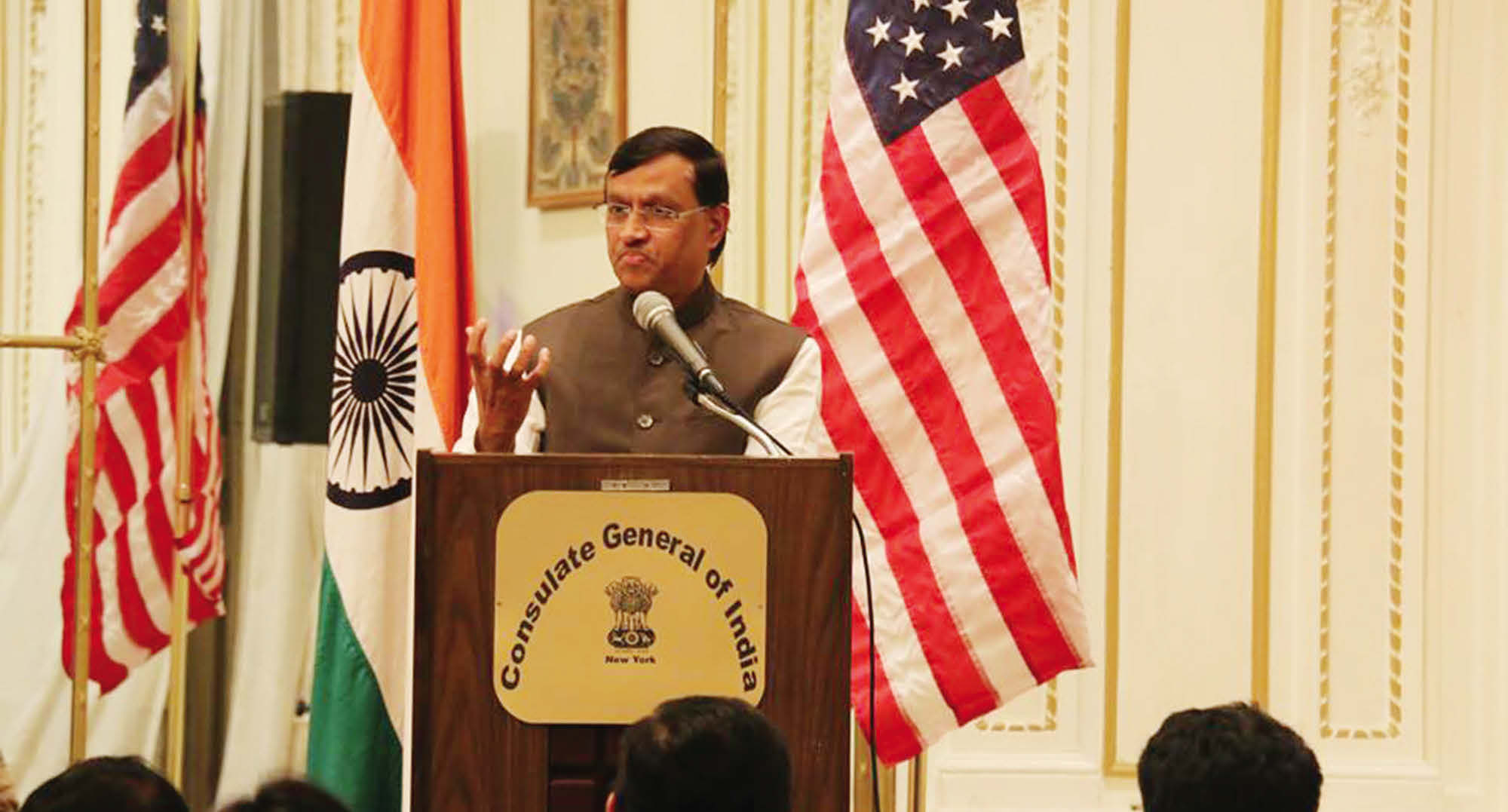
    Mr. Mulay addresses the gathering at Royal Albert's Palace on February 16
    Mr. Mulay addresses the gathering at Royal Albert’s Palace on February 16

    Ambassador Dnyaneshwar M. Mulay, who served as the Consul General of Indian in New York for two years and ten months, received accolades from business owners and professionals alike at the farewell event which was attended by a large number of people from all walks of life.

    Mr. Mulay’s rare achievements, to mention a few, include founding of monthly Media-India lectures, PM’s first visit with special reference to his public meeting with Indian community at Madison Square Garden and his interaction with the local public at Central Park, making the Consulate a model for cleaning drive by the Ministry, strengthening connection with Indian community by starting well-appreciated out-reach programs called ‘India at Your Doorstep’, besides several others.

    Mr. Mulay has been appointed to head the newly formed ‘India Diaspora Division’ in the Ministry of External Affairs incorporating the Ministry hitherto known as Ministry of Overseas India Affairs. His many great contributions covering all aspect of services -personal and official were recalled and appreciated by the speakers who included India’s Permanent Representative to the United Nations Ambassador Syed Akbaruddin, H.R. Shah, Dr. Sudhir Parikh, Dr. Navin Mehta, Prof. Indrajit S Saluja, Attorney Ravi Batra, and Ashok Vyas. Deepak Dave conducted the program.

    India's Permanent Representative to the United Nations Syed Akbaruddin as a skillful diplomat who can handle any situation deftly
    India’s Permanent Representative to the United Nations Syed Akbaruddin as a skillful diplomat who can handle any situation deftly

    Ambassador Syed Akbaruddin, Permanent Representative of India at UN and a contemporary of Mulay in the Indian Foreign Services, recalled his early days when Mulay was known as a poet among his batch mates. “A literary person at heart Mulay emerged as a fine diplomat fulfilling his duties, which are like writing hard prose not poetries.”

    Ambassador Akbaruddin recalled that Mulay had skillfully handled delicate issues during the political turmoil in Maldives where he was serving as the High Commissioner of India before coming to New York. His diplomatic skills were put to test in New York when India-US relations reached new lows in the event of the arrest of Devyani Khobragade, the then Deputy Consul General.

    Dr. Navin Mehta, a former Chairman of Bharatiya Vidya Bhavan said, "We are going to miss his down-to-earth approach in con-necting with all sections of Indian Americans."
    Dr. Navin Mehta, a former Chairman of Bharatiya Vidya Bhavan said, “We are going to miss his down-to-earth approach in con-necting with all sections of Indian Americans.”

    Speaking on the occasion, Dr. Navin Mehta, a former Chairman of Bharatiya Vidya Bhavan who has known Mr. Mulay well for some years now said, “Mulay successfully implemented a policy of ‘bringing the consular services to our doorsteps’” said community leader Dr. Navin Mehta, “We are going to miss his down-to-earth approach in connecting with all sections of Indian Americans.”

    Prof. Indrajit S Saluja described Mr. Mulay as a man endowed with the best of qualities of head and heart
    Prof. Indrajit S Saluja described Mr. Mulay as a man endowed with the best of qualities of head and heart

    Prof. Indrajit Saluja, Chief Editor of The Indian Panorama wondered how one man could have so many diverse qualities of head and heart and commented that God must have created Mr. Mulay with some special stuff. Turning to Mr. Mulay, he said, “you are leaving a rich legacy behind. You will always be remembered for the great work you have done here as Consul General and also for being a perfect gentleman”.

    A plaque was presented to Mr. Mulay by Attorney Anand Ahuja on behalf of GOPIO.

    Two days later, on February 16, the Indian American community organizeda farewellevent at Royal Albert’s Palace in Fords, New Jersey. Known for his literary talents the community recognized him as an officer who transformed the way passports and visa applications were handled under his watch.

    Ambassador Mulay with hosts and community leaders at Royal Albert's Palace
    Ambassador Mulay with hosts and community leaders at Royal Albert’s Palace

    Those who acknowledged Mulay’s contribution as a ‘man of action’, included Ramesh Patel, Chairman, Federation of Indian Association, H. R. Shah, Chairman, TV Asia, Dr. Navin Mehta, Trustee, Bharatiya Vidya Bhavan and Dr. Sudhir Parikh, Chairman, Parikh Worldwide Media, all of who said that the consulate staff was more efficient than ever. Mulay on his part disclosed his style of functioning as that of a leader who cared for his subordinates. He pointed out that his staff needed a new vision in order to become more productive. “On the first day of my work, I called a few of my staff and asked them to give their opinion about a painting hanging on the wall. All of them said there was nothing wrong with the painting. Then I turned the painting upside down and asked them what they thought of it. All of them pointed out that the painting looked much better than before.”

    Mulay narrated the above incident to bring home the point that it was possible to improve things without making a worker feel guilty. “I applauded my staff and showed them a different way to be more productive. A marked improvement in the functioning of the consulate was visible soon”, he said.

    Issuing timely visas and processing applications for new passports are the most important responsibilities carried out by consulates. Any pitfall in discharging such duties is bound to bring bad reputation for the office of the Consul General. Mulay realized this fact and quickly implemented an ambitious plan to expedite applications for visa, OCI and OPI. He was promptly assisted by Dr. Manoj Kumar Mahaptra, whose youthful attitude sparked new energy among the consular staff.

    Manoj Vyas, a well-known painter presenting to Mr. Mulay the latter's portrait he made as a farewell gift
    Manoj Vyas, a well-known painter presenting to Mr. Mulay the latter’s portrait he made as a farewell gift

    “We are proud to say that we process all applications within a day or two”, said Mulay in his speech at the farewell function. His vision was to project the New India House, the consulate premises, into a center for cultural and intellectual activities. “We held more than 200 events in a year”, he said adding that his office aimed at encouraging all sections of the community within its resources.

    The monthly lecture series launched by Mulay on various current topics in art, literature, journalism and judiciary were well appreciated in the cultural circle of New York. The consulate hosted high-ranking officials

    from the State Department such as Nisha Desai Biswal,Assistant Secretary, Bureau of South and Central Asian Affairs and high profile New Yorker such as Salman Rushdie.

    Mulay is returning to New Delhi, where he will be responsible for the Affairs of Overseas Indians. “I hope to continue working with you”; he proclaimed demonstrating his deep interest in contributing for the progress of India with the help of Indian Americans. For the past year he initiated outreach initiatives to connect with people of Indian origin in various states of USA, which fall under his jurisdiction. He established good working relations with a number of officials including the Governor of Massachusetts Charlie Baker who sent a proclamation for Mulay.

    The farewell event was hosted by a host of community organizations including FIA, GOPIO, AAPI, Bharatiya Vidya Bhavan, and others. A plaque was presented to Mulay on behalf of FIA. Andy Bhatia, a former Air India official conducted the event.

    A view of the gathering at the Indian Consulate on February 14
    A view of the gathering at the Indian Consulate on February 14
  • The 68th Anniversary of India’s Independence

    The 68th Anniversary of India’s Independence

    India’s Independence Day belongs to all Indians and all people who wish India well. As an American proud of my Indian ancestry, and my name unchanged, I am more than merely delighted that these United States and India have found a durable rhythmic tune, geopolitical and strategic in nature, bound by common notes and dreams of our bilateral citizenry in their enlightened self-interest-based pursuit of happiness guaranteed by separated powers regimes.

    2015 is special for many reasons. We overcame the unexpected bilateral pain that became known as the Devyani incident with Hours of Immunity successfully negotiated by FM Salman Khurshid with Secretary John Kerry, to then witness PM Modi rock Madison Square Garden. Later, as I wished, President Barack Obama held a Chai Summit in India. But, then it got better. President Obama did for Indian-Americans and India what he did for Chinese-Americans and China – as he had appointed Gov. Gary Locke as our ambassador to China in 2011, in the past year he appointed Senate Leader Harry Reid’s right hand Richard Rahul Verma as our ambassador to India. For good measure, he also appointed talented diplomat Atul Keshap as our ambassador to Sri Lanka. Recently, Nisha Desai Biswal, Assistant Secretary of State for Central and South Asia, visited India’s Consulate General in New York to personally plant eternal-goodwill where Devyani used to be DCG. Such an act serves to repair even frayed feelings and is worthy geometrically – as there is an implied promise that all will be well between our two nations.

    That India produced a man such as Dr. Kalam – who rose to be India’s 11th President – an Indian Muslim – and who was so loved by Indians and who so loved India – seems to me to be a clarion call for all good people everywhere to stand up to religious oppression everywhere with humility-based good deeds that serve their nation above all else, and with respect for all faiths. Earlier, the world experienced the slaughter and splatter of precious ink at Charlie Hebdo – the home of cherished Voltaire who prodded many a monarch to better serve the public good – and Paris became Ground Zero for unity of all nations’ leaders walking arm-in-arm seeking tolerance of free speech as a “core” right and obligation of global citizenship. Dr. Kalam, methinks, singlehandedly well honored Mahatma Gandhi’s love for Muslim Indians, Christian Indians, Buddhist Indians, Jewish Indians and inter alia, Hindu Indians.

    68 years ago Pandit Jawaharlal Nehru rose to say these immortal words:

    “Long years ago we made a tryst with destiny, and now the time comes when we shall redeem our pledge, not wholly or in full measure, but very substantially. At the stroke of the midnight hour, when the world sleeps, India will awake to life and freedom. A moment comes, which comes but rarely in history, when we step out from the old to the new, when an age ends, and when the soul of a nation, long suppressed, finds utterance.”

    Dr. Kalam answered India’s Tryst With Destiny – excellence with humility, nation above religion, peace above war. India belongs to everyday Indians who recall the sacrifices made by so many to be a free nation, and live their lives as homage to those who sacrificed so much.

    That Indian Tea played a starring role in the Boston Tea party of 1773, and today India and United States find themselves in a vortex that cannot be denied – of unity of interest – one may be forgiven to say it was so decreed even by natural law without the need of being a Calvinist. May we continue to be worthy of God’s grace at the stroke of the midnight hour and every hour thereafter.”

    Ravi Batra

    Also Read: theindianpanorama.news/guest-comments-blog-news-tip/independence-day-greetings-from-the-law-firm-of-ravi-batra-15-august-2015-45203/#.Vc3UHnjOHBJ

  • Intense time ahead for US-India relations: Nisha Desai Biswal

    Intense time ahead for US-India relations: Nisha Desai Biswal

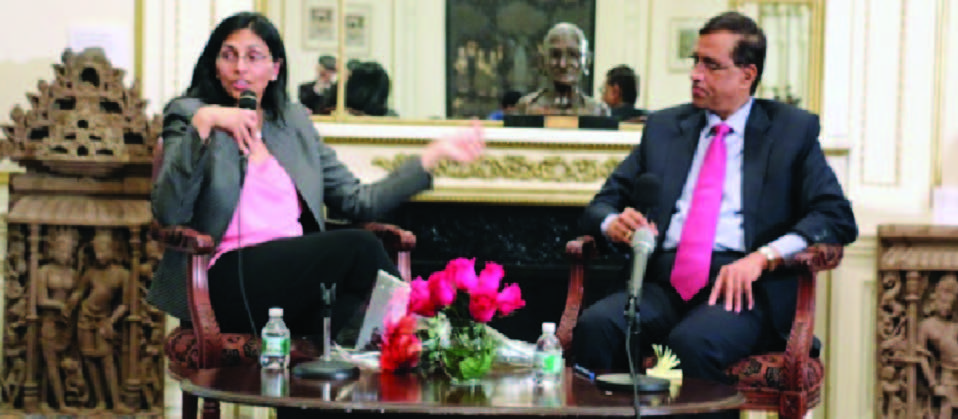
    NEW YORK (TIP): US Assistant Secretary of State for South and Central Asian Affairs Nisha Desai Biswal said that before Indian Prime Minister Narendra Modi’s second visit to the US in September, it will be a ‘very intense time’ and ‘moment of intense observation’ for US-India relations. She made the remark during a lecture in the Media India lecture series at the Indian Consulate in New York, August 4.

    Speaking on “Vision of India-US Relations in the coming years and its strategic significance in the global context” Biswal said that the US is very much looking forward to Narendra Modi’s second visit to the country next month.

    “We are very much looking forward to Prime Minister Modi’s return visit to New York as well his visit to Silicon Valley. There is a lot of excitement that the potential of a technology partnership between our two countries can really bring about a new growth model that focuses on innovation, technology to usher in cleaner, more efficient, sustainable and inclusive models of growth for both countries”, she said.

    She said California is “abuzz with anticipation and excitement” over the tremendous opportunity Modi’s visit to the state brings.

    “There is a lot of excitement that the potential of a technology partnership between our two countries can really bring about a new growth model that focuses on innovation, technology to usher in cleaner, more efficient, sustainable and inclusive models of growth for both countries,” she said.

    She noted that during her visit to Silicon Valley last week, she noticed that entrepreneurs, scientists and investors are very focused on how to find new paths to partnership between the two countries are looking at new technologies that will power solutions to the big challenges.

    “India is a development laboratory for very cutting edge new ways of tackling old challenges,” she added.

    Noting that two-way trade has tripled in the past decade from $36 billion in 2005 to over $100 billion in 2014-15, Biswal highlighted the incredible potential between India and the US to increase bilateral cooperation across a range of sectors including defense sector and space science and stressed that the two nations have a “core strategic interest” in each other’s economic prosperity. “If you look at the ambitions of the American President and the Indian Prime Minister in terms of where they want to go with this relationship, I think it has charted a very ambitious path and the past year of engagement between our two leaders and between the two governments is indicative of the deep value that each places on this relationship.”

    She also stressed that there should be more trade architecture between two countries to help create platforms for advancing common goals and to create a framework for addressing areas of difference. “We recognize that a strong and prosperous India will be a stronger partner regionally and globally as we tackle common challenges and strive to achieve shared goals,” she added.

    In reply to a question on Khobragade issue from PTI Reporter, Nisha said that it was a “painful period for bilateral ties”, and added that the incident has led to “important learnings” and there is a determination to avoid such instances.

    “Both governments learned some important lessons and we achieved some important understandings and clarity in how to operate in each others’ systems, with more clarity to the expectations that we each have of the other,” she said.

    Khobragade, a former Indian deputy consul general here, was arrested in December 2013 on charges of visa fraud. The charges were rejected by her. Her arrest and mistreatment resulted in a major diplomatic row between India and the US.

    India took several retaliatory measures like reducing the diplomatic privileges of American diplomats in the country and bringing it at par with what Indian diplomats get in the US.

    Biswal further said, following the episode, there are things that the US has tried to do differently in terms of its officials in India.

    “We had very important learnings that came out of that episode. There is a determination to avoid such instances,” she said, adding that both India and the US work in “complex and highly regulated environments.”

    “We have very robust and open societies and so it is going to be complex in managing all of the different aspects of this relationship,” she said.

    There will be times when things go wrong, when some American official could violate rules and regulations and “we will have to deal with it and vice versa”, Biswal said.

    She said the countries have to learn how to operate within each others’ walls and it gets “complicated” at times but a part of the business of diplomacy is navigating the complex issues.

  • Indian-American Physicians’ Role Praised by US Lawmakers

    Indian-American Physicians’ Role Praised by US Lawmakers

    WASHINGTON:  US lawmakers have lauded Indian-origin American physicians for their role in passage of a bill by the Congress that reformulates the way physicians are reimbursed for a government health insurance for seniors.

    Several US lawmakers – including Nisha Desai Biswal,Assistant Secretary of State for South and Central Asia, and Ami Bera, the lone Indian-American physician in the US Congress –  praised them for their hard work and their constant efforts to make healthcare affordable.

    “We are extremely delighted and grateful to the US Congress for passing this historic measure,” said Ravi Jahagirdar, President of the Association of American Physicians of Indian Origin (AAPI) urging the US Senate to take up the bill and pass it without delay.

    The legislation requires the Senate approval to repeal medicare sustainable growth rate (SGR) currently in use and would reformulate how physicians are reimbursed for Medicare, a government health insurance for seniors over 65.

    The passage of SGR bill came on March 26. The SGR formula places a cap on spending for physicians services, according to an AAPI statement.

    “AAPI has been a tremendous organisation for what you do here in the United States and for what you do in India and for what you do to improve and extend the US-India relationship,” Biswal said in her keynote address.

    Bera shared his own personal experience of growing up to be a physician and how he got elected in a district that has only 1 per cent Indian-Americans.

    “My story is your story and our story is that of the entire nation,” he said, adding: “I want my legacy to be how the generation is going to take us all to the next level and have many more Indian Americans get elected to the Congress.”

    AAPI is the largest ethnic organisation of physicians, representing over 100,000 physicians, fellows and students of Indian-origin in the US, who have been lobbying for the repeal of SGR formula for years.

  • WORLD CELEBRATES DIWALI with prayers, bright lights and fireworks

    WORLD CELEBRATES DIWALI with prayers, bright lights and fireworks

    WASHINGTON (TIP): The five-day Indian festival – Diwali – symbolic of victory of good over evil was celebrated , from October 22 , the world over with great enthusiasm Amid chanting of Vedic mantras and lighting of the traditional ‘diya’ by US Secretary of State John Kerry, Diwali was celebrated for the first time at the State Department. “As the days grow shorter, the Diwali reminds us that spring always returns – that knowledge triumphs over ignorance, hope outlasts despair, and light replaces darkness.

    Diwali is a time for the revitalization of mind and spirit,” said Kerry who was joined by India’s Ambassador S Jaishankar. “It affords a chance to reflect on how we can bring light to others. It is an opportunity for us all, regardless of our own traditions, to renew a shared commitment to human dignity, compassion, and service – and it is a commitment, I think, at the heart of all great faiths,” he said. Some 300 guests, including a large number of eminent Indian-Americans and envoys from other South Asian countries, were present to celebrate Diwali for the first time at the State Department’s historic Benjamin Franklin room, which was lit with many small diyas and candles.

    The top Indian-American US officials, including Assistant Secretary of State for South and Central Asia Nisha Desai Biswal and USAID Administrator Raj Shah, were also present. “We worked hard to prove that we were, in fact, natural partners, which I believe we are. We are two optimistic nations who believe that history doesn’t shape us, but that we have the power to shape history. And that spirit of hope and optimism is really at the center of the Diwali celebration,” Kerry said and greeted people with Saal Mubarak. The guests were served the traditional Indian dishes – including sweet dishes like Jalebi, Gulab Jamun, different varieties of burfi, kaju katli and kheer. Some of the dishes were in fact were made inside the State Department kitchen, while other dishes were procured from a popular Indian restaurant in Washington DC.

    It was also one of the rarest occasions that no alcohol was served. It was all soft drinks, juices and not to miss the traditional mango ‘lassi’. In Birmingham, UK, Bhangra music filled the air as hundreds of people flocked to Diwali celebrations in Birmingham. Food stalls and dancing also entertained families as they turned out in their droves for Soho’s Festival of Lights.

    It was the first time the event had been staged after being organized by the newly-formed Soho Road BID. The BID is home to 560 predominantly independent businesses stretching from Holyhead Road to Soho Hill – with an estimated local population of 250,000. BID manager Craig Bucky said: “We were so excited to be able to run our first community event. “It’s been a lot of hard work and determination but it was a great celebration that the community can be proud of.” BID chairman Dipak Patel said that more events were in the pipeline in a bid to improve the area.

    “The long-term strategy is to make Soho Road an exciting place to work and live,” he said. Diwali was celebrated with enthusiasm and vigor in Sri Lanka, the land where the epic happened. Distribution of misri and lighting a lamp was a traditional fix. Locals offer prayers along the beach. In Thailand, Diyas or lamps made of banana leaves with candles and incense were placed in the river to float. People greeted each other and distributed sweets. Diwali was celebrated with full aplomb in Malaysia. Even the locals indulged in the festivities wholeheartedly. Diwali is an official holiday in Malaysia. People invite each other to their homes and celebrate it with their friends and family.

    The Hindu community of Malaysia constitutes about 8% of its total population. The community celebrates it under the name of Hari Diwali. Nepal is a multi ethnic land with diversity in culture. Nepal celebrated Diwali with bright lights, gift exchanges, fireworks, and elaborate feasts to welcome Lakshmi, the goddess of light and wealth. Diwali in Nepal is known as Tihar. In Australia, Diwali was celebrated publicly amongst the people of Indian origin and the local Australians in Melbourne.

    The cultural kaleidoscope of India was depicted as Indians in Melbourne showcased Indian art, culture, style, traditions and food via various activities, seminars, festivals, fairs and events. Diwali was also celebrated in Guyana, Fiji, Mauritius, Myanmar, Singapore, Trinidad & Tobago, Indonesia, Japan, Thailand and Africa, among the Hindus across the world.

  • Japan to participate in Malabar exercise with India and US

    Japan to participate in Malabar exercise with India and US

    WASHINGTON (TIP): In an effort to strengthen the tri-lateral cooperation, Japan will participate in this year’s Malabar naval exercise to be held at the end of this month, with India and the US.”Japan will participate in MALABAR this year which is our largest bilateral naval exercise with India and it’s scheduled to take place at the end of this month,” Deputy assistant secretary of defense for South and Southeast Asia Amy Searight told lawmakers during a Congressional hearing on yesterday. The assistant secretary of state for South and Central Asia Nisha Desai Biswal said there is strong trilateral partnership between the three countries.

    “We were about to hold the fifth iteration of the US-India-Japan trilat earlier this summer. We have had to reschedule that but we have seen a tremendous growth in the amount of collaboration that we’re able to have, not only in terms of sharing of intelligence and analysis but also looking at active areas of cooperation,” she said. The Malabar series has historically been an India-US affair, but its scope has widened with Japan being invited for the annual naval engagement. “We will be doing joint exercises with Japan and India in the MALABAR exercises later this fall.

    And we see opportunities for increasing the collaboration across Southeast Asia. We are engaging more frequently in consultations and dialogue with the Indians on Asean and look forward to increased and frequent consultations across the East Asia sphere,” Biswal said while replying to a question from Senator John McCain. Lisa Curtis of The Heritage Foundation said there’s a realm opportunity to build the US-India-Japan trilateral cooperation. In the past few years India has focused increasingly on buttressing security ties with Japan, South Korea, and Vietnam to meet the challenges of a rapidly rising China, she said.

    “Indo-Japanese ties, in particular, are expected to get a major boost under Modi’s administration since Modi and Japanese Prime Minister Shinzo Abe are both increasingly concerned about China and appear prepared to take new policy directions to deal with the challenges posed by Beijing’s rapid military and economic ascendance,” Curtis said. Both the heads of state, Shinzo Abe and Narendra Modi have developed a close personal rapport, she said. “As chief minister, Modi traveled to Japan in 2007, marking the first time an Indian chief minister had travelled to the country. Modi was one of the first foreign dignitaries to congratulate Abe when he was reelected in 2012. The recent postponement of Modi’s visit to Japan is all the more perplexing, given the history of the personal relationship between Abe and Modi,” she added.

  • The United States and India: Global Partners in the Global Economy

    The United States and India: Global Partners in the Global Economy

    Remarks made by Nisha Desai Biswal, Assistant Secretary, Bureau of South and Central Asian Affairs, at Tampa Convention Center, Tampa, FL on April 25, 2014

    Thank you, Dr. Singh, for your warm welcome. It is a great honor to participate in the 2014 FICCI-IIFA Global Business Forum. Tampa is an ideal location to talk about the important and growing economic ties between the United States and India. Not only is Tampa the seventh-largest port in the United States by volume, it also handles the highest volume of goods headed to India.

    And FICCI is certainly the right partner for this conversation, as they have been such a key player in advancing our economic relationship. And how thrilling it is for the IIFA Awards to be held in the United States for the first time! Indian culture is increasingly influencing popular culture, not just in America but around the globe. I recall a moment some two decades ago,when I was a Red Cross volunteer in Tbilisi, Georgia, and I went to a local theater where Sholay was playing, dubbed in Russian.

    Imagine listening to some of the most iconic dialogues of Hindi cinema in Russian! And I will never forget the time I was in the small mountain town of Kutaisi and was asked to sing a folk song. I started singing “mera joota hai japani,” and the entire room of 200 Georgians started singing with me. They knew all the words! Indian art, culture, and film have global appeal. Every day, ethnic, linguistic, and cultural lines are blurred, because from Kabul to Kinshasa, from Moscow to Mumbai, from Tampa to Trivandrum,we are all under the thrall of Indian popular culture. But it isn’t just pop culture.

    It is the idea of India itself that holds such special appeal to so many around the world. As for the United States, we want to take what three successive presidents and two prime ministers and most importantly our 1.6 billion citizens have built in 15 years, in this defining partnership of the 21st century, and make it even better. Today, I want to discuss the opportunities that lie ahead as the U.S.-India economic relationship expands and matures, and as our two economies become increasingly intertwined and interdependent.We are living in a truly globalized world, brought closer by technology and trade – and yes, even movies! But despite the lightning speed of technological advances that are transforming so many aspects of our life for the better,we’re also contending with one of the most complex moments in world affairs with very real challenges, including conflict, poverty, and climate change.

    Nowhere is this more apparent than in Asia, which boasts nearly two-thirds of the world’s population, squeezed into only a third of its landmass. It is a region with tremendous promise and potential. As President Obama said in Tokyo yesterday,when he reiterated that we are and always will be a Pacific nation, “America’s security and prosperity is inseparable from the future of this region,” and that’s why we’ve made it a priority to renew American leadership in the Asia Pacific. By 2050, Asia may well comprise half of global GDP. But for the region to realize its potential, it must embrace strong, inclusive, and sustainable economic growth, one where the private sector, not government, leads economic development.

    It must defeat terrorism and counter violent extremism,while at the same time advancing human dignity and human rights. And in an age where citizens have more access to information and are demanding more accountability than ever, governments must promote effective and transparent governance. Despite these challenges,we’ve never been more optimistic about the future of Asia – and the role the United States and India will play in advancing prosperity and stability in the region. One reason is India’s growing economic connectivity – eastward with Bangladesh, Burma, and Southeast Asia; and we see promise in links westward with Pakistan, Afghanistan, and Central Asia. These are vital to the prosperity and stability of Asia.We are committed to supporting economic linkages that will cultivate new markets and knit these countries even closer together – and make them more integrated with the global economy. We’re advancing regional initiatives that do just that.

    First, there’s the historic opportunity to connect South and Southeast Asia into an integrated economic landscape. This Indo-Pacific Economic Corridor is a unique geography teeming with opportunity, but traditional northsouth trade still trumps east-west movement of goods and services by a factor of five. And through our New Silk Road initiative,we have been focused on creating regional energy markets that link Central Asia with South Asia; promoting trade and transportation routes and investing in critical infrastructure; improving customs and border procedures; and linking businesses and people. Today, Afghanistan and its neighbors are increasingly championing and owning that New Silk Road vision, creating new transit and trade routes that complement the very vibrant east-towest connections across Eurasia.

    And the region is making concrete efforts to reduce barriers to trade, invest in each other’s economies, and support development and cross-border projects. At the heart of all of that is India, because prosperity in South Asia hinges on dynamic growth of its economic powerhouse. The United States is committed to working with India to fully unlock the true potential of our economic ties. Today, the United States is one of India’s largest trade and investment partners. Our bilateral trade in goods and services has grown to nearly $100 billion. I think India’s excellent envoy in Washington, Ambassador Jaishankar, said it best recently when he noted that the extraordinary growth in our trade relations has “changed the chemistry of our ties.”

    Tectonic shifts in global economics have helped bring us to where we are today. And it didn’t happen overnight. After the Second World War, the creation of a rules-based trading system increased commerce, connectivity, and prosperity across the globe.While India’s economic transformation is more recent, its progress has been swift. Import tariffs on average are more than 30 times lower than they were in 1991,when then-Finance Minister Manmohan Singh began sweeping reforms. And since 2005 we have seen an increase in goods trade by 250%, in services trade by 350%. But we can do even better.

    As Vice President Biden said last July, there is no reason why our bilateral trade shouldn’t quintuple again if our countries work to grow together and remain candid with each other about the obstacles that exist. I believe $500 billion in total trade is entirely possible. Bilateral investment flows have also grown immensely, with foreign direct investment into India from the United States reaching $28.2 billion last year. Cumulative Indian FDI into the United States has also grown remarkably, from a negligible $96 million in 2000 to $5.2 billion by 2012. Even so,we still lack the investment diversity needed to fuel the growth of new and emerging sectors in our respective economies.

    India needs a transparent, straightforward way of attracting foreign investment, offering private capital a way to share in India’s opportunity. There must be a welcoming business environment that allows every dollar of investment to work efficiently. Currently, the United States and India are negotiating a Bilateral Investment Treaty, or BIT, which will be critical to deepening our economic relationship, improving investor confidence, and supporting economic growth in both countries. A BIT will go a long way toward bringing our economies closer and reducing the friction that’s only natural with two complex free-market systems such as ours. It will help us move past the choppiness that comes from not having an over-arching investment framework. And it will open up even more opportunities for American and Indian firms.

    Beyond our BIT, India’s investment and tax policies need to be designed to attract capital flows from across the world. Regulatory requirements need to be transparent and consistently enforced. Contracts must be upheld and honored across jurisdictions, and perhaps most importantly, intellectual property rights – based on international norms – must be recognized. And the future of India’s economy critically depends on the ability of people and goods to move where they are needed – efficiently and affordably. Soon, some sixty-eight Indian cities will have populations of over one million people each. India’s planned trillion-dollar commitment to infrastructure, with its strong emphasis on public-private partnerships, is both ambitious and admirable.

    No doubt infrastructure improvements will help to relieve the congestion on roads, railways, ports, airports, and in the power supply. American businesses are eager to participate – an effort the U.S. government fully supports. India’s future prosperity will also depend on one of our shared strengths – innovation. Increasingly, our two countries are putting our best minds together, to make growth more sustainable and inclusive and address 21stcentury challenges like climate change and energy security. That’s why we are so excited about the U.S.-India Technology Summit and Expo in November of this year in Delhi. The event will showcase our cooperation on science and technology, helping commercialize technology for economic growth and development, and shaping an ecosystem that incentivizes innovation.

    Policy-makers, industry leaders, educators, and scientists will discuss topics including manufacturing; life sciences and healthcare technologies; clean and renewable energy; IT; and earth science – all areas where U.S.-India collaboration can help us seize the opportunities, and respond to the challenges, of the 21st century. The Tech Summit is the idea place to showcase initiatives like the Millennium Alliance with FICCI,where we support Indian innovators and entrepreneurs who are coming up with new technologies to meet India’s development challenges. In March, I saw first-hand some of the most cutting-edge cooperation in science and technology,when I visited the Indian Space Research Organization, ISRO.NASA’s cooperation with ISRO on India’s Mars Orbiter Mission – India’s first inter-planetary space launch – and ongoing discussions about future joint initiatives, show that even the sky is not the limit when it comes to our partnership. And our energy partnership is changing the way our economies are powered.With 400 million people in India lacking reliable access to energy, the stakes for India’s future growth are enormous.

    We’re collaborating on clean and renewable energy, oil and gas, new technologies, energy efficiency, and civil nuclear energy. But real prosperity is only possible if it is also truly inclusive. That’s why ensuring women and girls are part of the conversation is a critical element to all these areas of partnership. Positive linkages between women’s engagement and a country’s economic status have been definitively proven, and the Obama Administration is determined to elevate the status of women and girls as a critical aspect of our foreign policy.We firmly believe that women’s rights are human rights, and women’s security is national security. While India is a leader in supporting women’s leadership across government, civil society and certainly in business, in many ways the potential of women and girls in India remains untapped and underutilized as a force for growth and development.

    This is why we support efforts like the Girl Rising Project to encourage public dialogue on gender and education issues to encourage community level interventions to help improve girls’ education. So I look forward to the next panel as a way to advance this discussion. In this area and in so many others, our relationship is much broader than our government and business ties. As the late Senator Edward Kennedy noted, our relations are not just government to government, but people to people, citizen to citizen, and friend to friend. Nowhere is that more evident than in the deep and rich ties between the people of the United States and India. Nearly 100,000 Indian students are studying at colleges and universities in the United States. Last year, almost 700,000 Indians visited the United States for business or tourism.

    It is these connections, between our entrepreneurs, scientists, scholars, and artists that make this partnership whole. We find that the relationship is also flourishing at the state and city level. And our cities and states are partnering more extensively than ever before, helping plant even deeper and stronger roots for our partnership. A growing number of states and cities are tailoring their international outreach efforts for India, with delegations from Arizona, Iowa, Indianapolis and San Francisco visiting the subcontinent over the last year. And these trips are yielding real results, opening new doors for business, educational exchanges, and workforce skill development.

    A great example is California and Maharashtra, home to the megacities of Los Angeles and Mumbai, sharing ideas on how to improve fuel quality for India’s fast-growing vehicle fleets. These efforts will not only improve the health of urban inhabitants, but help mitigate climate change. So in conclusion, let me say that I am bullish on this relationship because I believe in the strength and vibrancy of our two countries. I know there is no challenge that we can’t address, no problem that we can’t solve when we bring our two societies together. Thank you again for this opportunity. I would be happy to take a few questions.

  • US Senate confirms Indian-American Puneet Talwar for key state department post

    US Senate confirms Indian-American Puneet Talwar for key state department post

    WASHINGTON (TIP): Puneet Talwar has been confirmed by the US Senate to a key diplomatic position, becoming the second Indian-American to join the state department. Talwar, who was a key aide of President Barack Obama on the Middle East, would now serve as the assistant secretary of state for political-military affairs.

    He was confirmed on thursday by voice vote. In September last year Obama nominated Talwar, who played a key role on negotiations with Iran, to this top diplomatic position in the state department. After being sworn-in, Talwar would be the second Indian- American serving as assistant secretary in the state department after Nisha Desai Biswal, who is the assistant secretary of state for South and Central Asia.

    Talwar would provide policy direction in the areas of international security, security assistance, military operations, defence strategy and plans, and defence trade. The Bureau of Political-Military Affairs is the department of state’s principal link to the department of defence. Since 2009, Talwar has been a special assistant to the US President and senior director for Iran, Iraq, and the Gulf States on the White House National Security Staff.

    Prior to this, Talwar served as a senior professional staff member on the Committee on Foreign Relations of the US Senate (SFRC) from 2001 to 2009 and from 1997 to 1999, and was the chief adviser on the Middle East to then senator Joseph R Biden in his capacity as the chairman of the Senate Foreign Relations Committee. He served as a member of the department of state’s policy planning staff from 1999 to 2001. From 1992 to 1995, he served as a foreign policy adviser to Representative Thomas C Sawyer, and from 1990 to 1992 as an official with the United Nations. Talwar received a BS from Cornell University and an MA from Columbia University’s School of International and Public Affairs.

  • US Senate confirms Nisha Desai Biswal as assistant secretary of state

    US Senate confirms Nisha Desai Biswal as assistant secretary of state

    WASHINGTON (TIP): The US Senate has confirmed Indian- American woman administrator Nisha Desai Biswal as the assistant secretary of state for South and Central Asia, making her the first person from the community to hold the top diplomatic position. Biswal, who is currently the assistant administrator for Asia at the US Agency for International Development ( USAID), will replace incumbent Robert Blake to head the key bureau in the state department. President Barack Obama had nominated her for this top position on July 18. The Senate foreign relations committee had held her confirmation hearing last month, during which she received bipartisan support and was praised by lawmakers from both the parties. “I consider you another compelling argument for comprehensive immigration reform,” said Senator John McCain of the Republican Party. “Despite your misguided political affiliation, I would like to say that you’re a great example to all of us of people who come to this country.

    I know you were very young … and the opportunities that this country provides,” McCain said in praise of Biswal, who is from the Democratic Party. McCain who lost out to Obama in the 2008 presidential elections rarely praises someone from the Democratic Party. From 2005 to 2010, she was the majority clerk for the state department and foreign operations subcommittee on the Committee on appropriations in the US House of Representatives. From 2002 to 2005, she served as the Policy and advocacy director at interaction. Previously, she served on the professional staff of the US House of Representatives international relations committee from 1999 to 2002. Daughter of first generation Indian Americans, Biswal draws her inspiration from her parents’ story of journey far from rural India to pursue the American Dream and a better life for their children, which she told lawmakers during the confirmation hearing of her current position on July 21, 2010.

  • Obama nominates Indian-American Puneet Talwar to key diplomatic position

    Obama nominates Indian-American Puneet Talwar to key diplomatic position

    WASHINGTON (TIP): US President Barack Obama has nominated Indian- American Puneet Talwar as Assistant Secretary of State for Political Military Affairs, a top diplomatic post. Talwar, who was Obama’s top advisor on the Middle East region for over four years was nominated for the position by Obama yesterday. He is the second Indian-American to be nominated as the Assistant Secretary position in the State Department. In July, Nisha Desai Biswal was nominated as the Assistant Secretary of State for South and Central Asia. Both the positions need to be confirmed by the Senate. Obama announced his intent to nominate Talwar to the top State Department position along with nearly 30 senior administration positions. “I am grateful that these talented and dedicated individuals have agreed to take on these important roles and devote their talents to serving the American people,” Obama said. “I look forward to working with them in the coming months and years,” he added. If confirmed by the Congress, Talwar, in his capacity as the Assistant Secretary of State for Political Military Affairs, will provide policy direction in the areas of international security, security assistance, military operations, defense strategy and plans, and defense trade.

  • Indian-American Nominated For Key Post In Obama Administration

    Indian-American Nominated For Key Post In Obama Administration

    WASHINGTON (TIP): US state department’s heavy hitter for India will be an Indian origin bureaucrat, Nisha Desai Biswal, a first for both the community and the administration. President Barack Obama on Thursday, July 18, sent a proposal to the senate to appoint Biswal assistant secretary of state for South Asia, top US diplomat for India.

    If confirmed Biswal will replace Robert Blake, an impossibly gangly career diplomat who liked to joke at India-US events his speeches were almost always the same as Indian ambassador’s. Biswal’s appointment was welcomed by the Indian American community, its experts and non-experts. “Great news … she is a terrific role model,” said a Facebook post.

    “This is a landmark appointment for Indian- Americans, the first time someone from the community has been chosen for the top diplomatic job dealing with South Asia,” said Sadanand Dhume, an Indian origin expert with conservative think tank American Enterprise Institute. “Nisha Biswal is an excellent choice for the position. She’s well-informed about the region and has many friends and admirers in both the executive and legislative branches of government.”

    Biswal is currently assistant administrator for Asia at the US Agency for International Development (USAID), a position she has held since September 2010. At USAID, her boss was administrator Raj Shah, another Indian American. who remains the senior most Indian American in the Obama administration. From 2005 to 2010, Biswal was the Majority Clerk for the State Department and Foreign Operations Subcommittee on the Committee on Appropriations in the House of Representatives.

    Biswal and her husband Subrat Biswal have two daughters. The position of assistant secretary of state – roughly the equivalent of additional secretary – is a crucial one, with responsibilities including Bangladesh and Sri Lanka. It wasn’t clear from the White House announcement if she would also hold charge of Central Asia, as was Blake’s brief, along side South Asia. She would most likely. But South Asia will not include Pakistan and Afghanistan, which have been entrusted to a special representative since the creation of that office in 2008, with Richard Holbrooke in charge.