
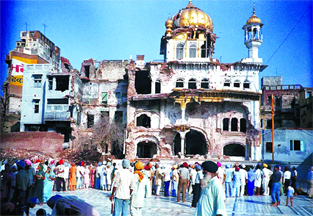

Operation Bluestar, the Indian Army’s 1984 assault on the Golden Temple to remove militants led by Jarnail Singh Bhindranwale, left deep scars on Sikh consciousness. The operation, followed by Indira Gandhi’s assassination and anti-Sikh riots, triggered years of militancy, political unrest and unresolved demands for justice that continue today
More than four decades have passed since Operation Bluestar shook India to its core, yet the pain surrounding the events of June 1984 continues to linger with extraordinary intensity. For many Sikhs across the world, it remains not merely a military operation but a deeply emotional and spiritual wound – one that transformed the relationship between the Sikh community and the Indian state forever.
The assault on the Golden Temple complex in Amritsar by the Indian Army was one of the most controversial actions undertaken in independent India. Tanks rolled into Sikhism’s holiest shrine, bullets tore through sacred walls, and hundreds – perhaps thousands – lost their lives in the crossfire. The operation left the Akal Takht in ruins and scarred the psyche of an entire generation.
But Operation Bluestar was never an isolated event. It was the climax of years of political miscalculations, rising militancy, mistrust, and escalating violence in Punjab. Its consequences were devastating: the assassination of Prime Minister Indira Gandhi, the horrific anti-Sikh riots of 1984, years of insurgency and counterinsurgency in Punjab, and a deep sense of alienation among Sikhs in India and abroad.
Even today, the memory of 1984 continues to evoke grief, anger, debate and reflection. For some, Bluestar was an unavoidable military necessity to preserve national unity. For others, it was a catastrophic political failure that could and should have been avoided.
The Roots of Sikh Discontent
To understand Operation Bluestar, one must look back to the aftermath of Partition in 1947. Punjab was divided between India and the newly created Pakistan, leading to immense suffering and displacement. Sikhs lost some of their most historically and spiritually significant places, including Lahore and Nankana Sahib, which became part of Pakistan.
Although Sikhs played a major role in India’s freedom struggle, many in the community felt politically marginalised after Independence. Questions surrounding language, identity, water-sharing, territorial boundaries and federal autonomy became increasingly contentious.
The Punjabi Suba movement, led by the Akali Dal, demanded a Punjabi-speaking state. While Punjab was reorganised in 1966 into Punjab, Haryana and Himachal Pradesh, many Sikh leaders believed their aspirations remained unfulfilled. Chandigarh, intended to serve as Punjab’s capital, became a shared capital with Haryana. River water disputes remained unresolved. Demands for greater state autonomy intensified.
In 1973, the Akali Dal adopted the Anandpur Sahib Resolution, which called for greater federal decentralisation and protection of Sikh identity. Though many of its demands were constitutional in nature, critics portrayed the resolution as separatist, deepening mistrust between the Centre and Sikh political leadership.
The Rise of Jarnail Singh Bhindranwale
It was in this politically charged atmosphere that Jarnail Singh Bhindranwale emerged as a powerful religious and political figure. A preacher from the Damdami Taksal, Bhindranwale initially focused on religious revivalism, urging Sikhs to return to orthodox practices.
However, his fiery speeches and aggressive rhetoric soon attracted attention far beyond religious circles. Many scholars and political observers later argued that elements within the Congress party initially encouraged Bhindranwale’s rise to weaken the Akali Dal politically.
What began as a political calculation would eventually spiral beyond control.
Bhindranwale gained enormous popularity among sections of Sikh youth who felt disillusioned by unemployment, corruption, social inequality and perceived discrimination. His image as a fearless defender of Sikh rights resonated strongly at a time when tensions in Punjab were escalating rapidly.
As violence increased in the state, Bhindranwale’s supporters and allied militant groups were linked to assassinations, attacks on police officials and intimidation campaigns. Punjab descended into fear and instability.
By the early 1980s, Bhindranwale had become both a religious icon to supporters and a dangerous extremist in the eyes of the government.
Punjab Descends Into Violence
The situation deteriorated dramatically after a series of violent incidents. One of the most shocking was the murder of Deputy Inspector-General of Police A.S. Atwal inside the Golden Temple complex in April 1983. He was shot dead after offering prayers, and his body reportedly lay unattended for hours.
The incident symbolised the growing breakdown of law and order in Punjab and demonstrated the extent to which militants had established control inside the Golden Temple complex.
Bhindranwale and his armed followers moved into the Akal Takht within the shrine complex. Over time, the complex was transformed into a heavily fortified position. Arms and ammunition were smuggled inside. Bunkers and firing points were constructed. Former Indian Army officer Major General Shahbeg Singh reportedly helped train militants in military tactics and defensive warfare.
The Golden Temple – once purely a spiritual sanctuary – had become the centre of a volatile armed confrontation.
Failed Negotiations and Political Miscalculations
Many historians believe the tragedy of Operation Bluestar could have been avoided through political dialogue and compromise.
Moderate Akali leaders had repeatedly engaged with the central government over issues such as federal autonomy, water disputes and Chandigarh’s status. Several observers argue that many of these demands were negotiable and could have been resolved peacefully.
However, political calculations often overshadowed attempts at reconciliation.
Accounts from former officials and political insiders suggest that there were missed opportunities to isolate extremists and strengthen moderate Sikh leadership. Negotiations reportedly collapsed due to internal divisions within the ruling establishment and electoral considerations.
One controversial episode involved veteran Congress leader Swaran Singh, who was tasked with negotiating with Akali leaders in 1982. He reportedly succeeded in drafting a conciliatory statement acceptable to the Akalis. But the statement was allegedly altered at the last moment under political pressure, causing negotiations to collapse.
Another alleged missed opportunity came when plans to arrest Bhindranwale during his visit to Delhi in 1982 reportedly failed after information leaked from influential political circles.
These failures deepened the crisis and strengthened extremist narratives that the government could not be trusted.
The Golden Temple Becomes a Fortress
By 1984, the Golden Temple complex resembled a fortified military zone.
Militants had stockpiled sophisticated weapons, including automatic rifles, grenades and rocket-propelled launchers. Strategic defensive positions overlooked entry points and open courtyards. Snipers were positioned across buildings.
The Akal Takht became the main operational headquarters of Bhindranwale and his followers.
For the Indian government, the situation posed an enormous dilemma. The militants could not be allowed to operate openly from the country’s most sacred Sikh shrine. Yet any military action inside the complex risked inflaming Sikh sentiment across the world.
Prime Minister Indira Gandhi faced mounting pressure from security agencies and political advisers to act decisively.
Operation Bluestar Begins
On June 3, 1984, Punjab was sealed under curfew. Transportation was suspended, communication lines cut and media access heavily restricted. Thousands of pilgrims were believed to be inside the Golden Temple complex because the operation coincided with a major Sikh religious observance.
The army launched the main assault on the night of June 5.
What military planners expected to be a swift operation soon turned into fierce urban combat. Soldiers attempting to enter the complex encountered heavy gunfire from fortified militant positions.
The troops faced deadly resistance while moving through the narrow pathways and staircases surrounding the parikrama. Militants used hidden firing positions, rooftops and underground access points to attack advancing soldiers.
As casualties mounted, army commanders decided to deploy tanks and armoured personnel carriers.
This decision would become one of the most controversial aspects of the operation.
The use of Vijayanta tanks against the Akal Takht caused massive destruction to one of Sikhism’s highest seats of authority. By dawn on June 6, much of the structure had been reduced to rubble.
When troops finally entered the shattered Akal Takht, they found Bhindranwale dead alongside many of his followers.
Official government figures placed the death toll at around 554 militants and civilians, along with 83 soldiers killed. However, independent estimates suggest the number of dead may have been far higher, ranging from several hundred to several thousand.
Shockwaves Across the Sikh World
The images of tanks inside the Golden Temple and the destruction of the Akal Takht sent shockwaves through Sikh communities worldwide.
Even Sikhs who opposed militancy were devastated by the scale of damage inflicted on their holiest shrine. Anger spread rapidly across Punjab and the global Sikh diaspora, especially in countries such as Canada, the United Kingdom and the United States.
Many Sikhs viewed the operation not merely as a security exercise but as an assault on Sikh identity and dignity itself.
The emotional impact was immense. Families mourned relatives killed during the operation. Survivors recounted horrifying scenes of gunfire, destruction and panic. The trauma was especially severe among older generations who had already lived through the horrors of Partition.
For countless Sikhs, June 1984 became a defining historical rupture.
Assassination of Indira Gandhi
The consequences of Operation Bluestar escalated dramatically on October 31, 1984.
Prime Minister Indira Gandhi was assassinated by her Sikh bodyguards, Beant Singh and Satwant Singh, in retaliation for the military action at the Golden Temple.
Her killing plunged the nation into shock.
But what followed was even more horrifying.
The Anti-Sikh Riots of 1984
Following Indira Gandhi’s assassination, anti-Sikh violence erupted across Delhi and several other parts of northern India.
Mobs armed with iron rods, kerosene and voter lists targeted Sikh homes, businesses and gurdwaras. Thousands of Sikhs were murdered in one of the darkest episodes in post-Independence India.
Eyewitness accounts described horrifying brutality. Men were burned alive. Women were assaulted. Children were killed. Entire neighbourhoods were destroyed while police and authorities were accused of remaining passive or complicit.
More than 3,000 Sikhs were reportedly killed in Delhi alone, while nationwide estimates exceeded 8,000.
The riots left deep scars on India’s secular and democratic fabric.
Many Congress leaders were accused of inciting or facilitating the violence. Decades later, only a limited number of convictions have taken place, reinforcing perceptions of delayed and incomplete justice.
For many Sikhs, the anti-Sikh riots and Operation Bluestar became inseparable chapters of the same tragedy.
Militancy and Counterinsurgency in Punjab
Instead of ending militancy, Operation Bluestar intensified it.
Bhindranwale’s death transformed him into a martyr-like figure for many radical supporters. Punjab entered a prolonged phase of insurgency and counterinsurgency during the late 1980s and early 1990s.
Militant groups demanding Khalistan carried out assassinations, bombings and attacks. In response, security forces launched aggressive operations to suppress insurgency.
Punjab became a landscape of fear, disappearances, extrajudicial killings and human rights abuses. Thousands of civilians, militants and security personnel lost their lives during this turbulent period. Eventually, through a combination of police action, political processes and public exhaustion with violence, militancy declined during the 1990s. Punjab slowly returned to relative normalcy.
Yet the memories of those years never disappeared completely.
The “Third Holocaust” in Sikh Memory
Within Sikh collective consciousness, Operation Bluestar gradually came to be remembered as the “Teeja Ghallughara” – the Third Holocaust.
The phrase deliberately links the events of 1984 to earlier massacres of Sikhs during the eighteenth century, including the Chhota Ghallughara and Wadda Ghallughara.
For many Sikhs, 1984 became part of a long historical narrative of persecution, sacrifice and survival.
The memory of Bluestar increasingly entered Sikh religious and cultural practices, including references in ardaas, the Sikh prayer that commemorates martyrs and historical suffering.
This process of remembrance ensures that the events remain deeply embedded in Sikh identity across generations.
The Diaspora and the Khalistan Narrative
While support for Khalistan diminished significantly within Punjab over time, sections of the Sikh diaspora continued to keep the issue alive internationally.
In countries such as Canada and the UK, organisations and activists commemorated Operation Bluestar annually and campaigned for justice for victims of both Bluestar and the anti-Sikh riots.
Militant organisations such as Babbar Khalsa International and Khalistan Commando Force also continued to exist in fragmented forms, often accused of receiving support from Pakistan’s intelligence networks.
For younger generations born long after 1984, the memory of Bluestar has often been shaped through family narratives, documentaries, social media and political activism.
The Unfinished Search for Justice
One of the deepest reasons the wounds of 1984 remain unhealed is the perception that justice was delayed or denied.
Successive governments expressed regret over the violence. Former Prime Minister Manmohan Singh apologised in Parliament for the anti-Sikh riots. Sonia Gandhi also publicly expressed sorrow over the events.
Yet many survivors believe accountability remains incomplete.
Commissions of inquiry were established, reports were written, and investigations reopened repeatedly over decades. But for many victims’ families, the pace of justice remained painfully slow.
The absence of closure has ensured that the trauma of 1984 continues to echo across generations.
A Wound That Still Shapes India
Operation Bluestar remains one of the most emotionally charged and politically sensitive chapters in Indian history.
For the Indian state, it represented an attempt to restore order and confront armed extremism. For many Sikhs, it symbolised betrayal, desecration and collective suffering.
No side emerged untouched from the tragedy.
Punjab lost an entire generation to violence and fear. India lost a prime minister. Thousands of innocent Sikhs lost their lives in the riots that followed. Trust between communities was fractured.
And yet, Punjab also demonstrated resilience. Over time, peace gradually returned. Elections resumed. Ordinary citizens rebuilt their lives and rejected the politics of violence.
But history has a long memory.
The story of Operation Bluestar survives in prayers, memorials, songs, family stories and political debates. It survives in the ruins and reconstruction of the Akal Takht, in the tears of survivors and in the unresolved questions that still haunt India’s democratic conscience.
Forty-two years later, Operation Bluestar remains more than a historical event. It is a living memory – painful, contested and deeply human.


Be the first to comment